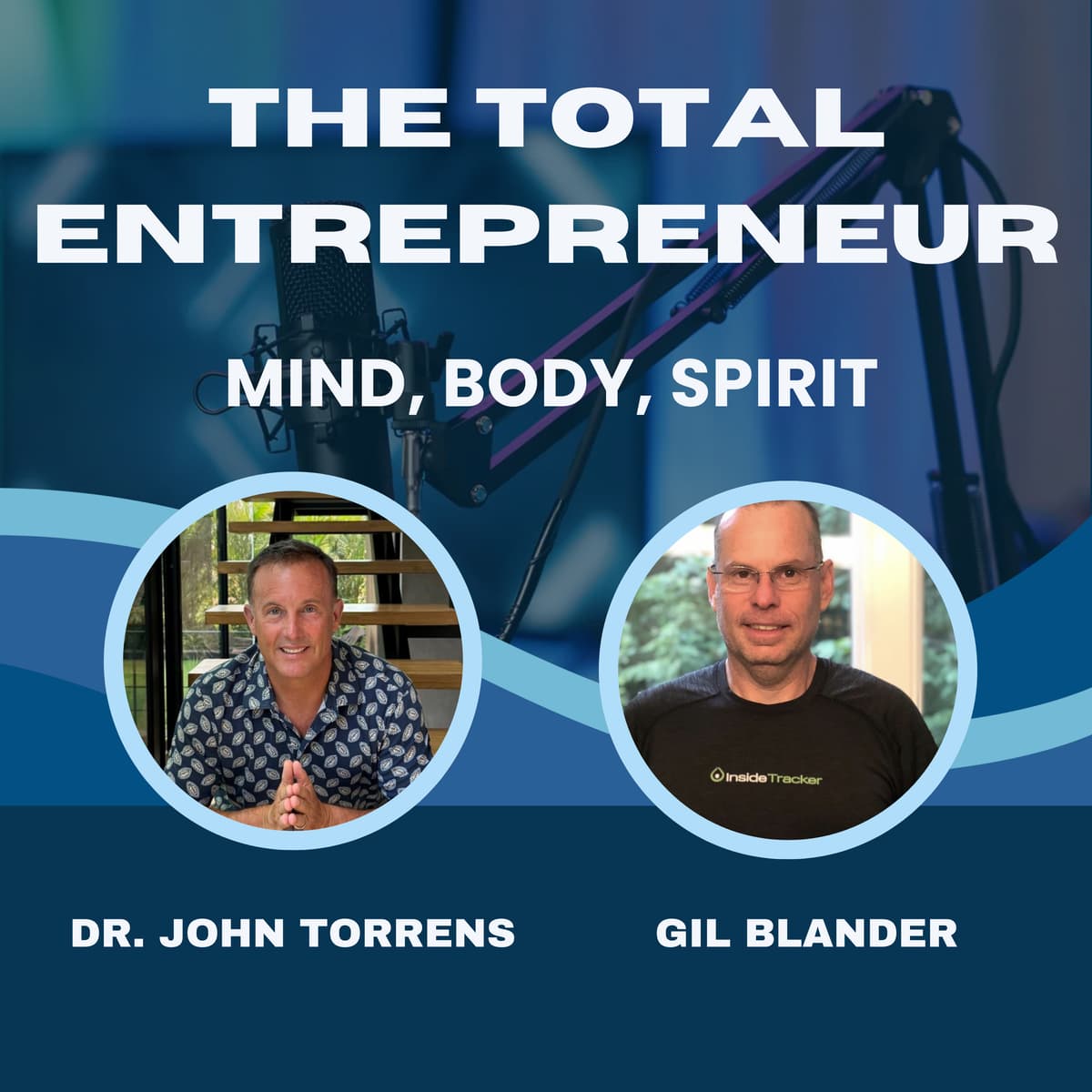
Lifespan vs. Healthspan: Mastering Your Biomarkers and the Science of Personalized Nutrition with Gil Blander
with Gil Blander
Feb 19, 2026 · 00:45:46
Part of our conversations on
entrepreneur that's working all the day, when you go to sleep, you'll start thinking and analyze the day. But if you do the analysis an hour before, then your brain will be less busy and allow you to sleep better. Don't eat 2 minutes before sleep because then you will digest the food and that's a lot of blood flowing will wake you up. Try to maintain the right temperature for you at the room. Make it very dark and try not to have too much noise. There are a lot of things that you can do to improve your sleep. That's the bottom line.
Gil Blander, thank you so much for joining me. I'm excited for this conversation.
Thanks for the invitation.
Yeah, so I've been an InsideTracker user now for I think almost a year and I've really enjoyed it. So can't wait to talk to you a little bit more about that. But first, before we even get into the product or the app and everything it does, I just wanted to talk to you a little bit about longevity. One of the things I hear from people when I talk about longevity is that they don't wanna live that long. And there's a lot in there to discuss. So I just wanted to get your reaction to that. Like, what, you know, what do you say when people say, I just don't wanna live that long?
Yeah. Longevity, you can look at it at a lifespan, basically the length of time that you live from birth to death. And there is what we call the healthspan, how long that you live in good health. So I assume that everyone wants to live better longer. So basically increase the healthspan related to the lifespan. If the lifespan, all the lifespan will be in a good healthspan, I assume that most of us would like to live longer. So in my opinion, it's all about the quality of life. And if we'll provide a high quality of life to everyone, I assume that the majority of us would like to live longer.
I agree with that. And that's usually the explanation, right? Is like, if you could live longer, better, would you still not want to live that long?
Right.
I think most people say, yeah, no, if I could live, you know, healthier and more vital, then yes, of course I would. Yeah. So which leads me to your background. One of the best ways to improve your chances at living a longer, healthier, more vital life is to track your biomarkers. So before we talk about InsideTracker, tell us a little bit about your journey. I know you're a scientist, you went to MIT, so you've got a lot of really scientific credentials before you even get to the company. So, tell us a little bit about your background and how it influenced you to get to where you are now.
Yeah. So, as you said, I'm a scientist born and raised in Israel, a PhD in biology from the Weizmann Institute of Science in Israel. And there, I studied a premature aging syndrome that's called Werner syndrome, which is basically a very rare premature aging syndrome that people die from it at their 40s. At that time, I investigated the interaction between the gene that caused, or the protein that caused this syndrome with a very important tumor suppressor called p53. Then I moved to MIT and studied the serotonergic family of deacetylase, very well-known group of protein that identified by the lab of Lenny Guarente for the ability to extend lifespan in yeast and after that in mice and other organisms. And those actually the protein that David Sinclair, which is, you know, almost everyone knows, continued to research them in his lab at Harvard. After that, I moved to the industry and spent a couple of years there doing system biology, computational biology, which what everyone calls today AI, but that was before the AI was cool. And then, in 2009, I founded InsideTracker. And the goal was, let's help people to live better, longer based on what's happening inside the body. So, that's basically personalized health. So, let's say fit, the right food for you, the right exercise for you, the right lifestyle changes for you, the right supplement for you in order to allow you to live better, longer. Yeah.
How did you find that jump from being a scientist to an entrepreneur? I was trained as a clinician and then made a jump to being an entrepreneur and it wasn't all that comfortable. I made a bunch of mistakes. So how was your journey?
Yeah, it's not easy, but I don't think that anything is easy and you need to take some risks. So I took a big risk that I assumed that other people won't take. So I think that that's a big difference between entrepreneur and non-entrepreneur. It's someone that takes risks and they're willing to take the consequences of that risk. So that's one. And second, it is exciting because suddenly you are not only doing science, you are doing business and you are doing development and you are raising money and you are selling. So it means that you are actually doing a lot of things which might fit for some people, might not fit for others, but I enjoyed it.
Do you have a favorite part of entrepreneurship? Is it the capital raising? Is it leading people? Is it just being in the lab coming up with new things? What is it for you?
For me, it's building something from nothing. So I would say the early days are the most exciting, that suddenly you have nothing and then you have a product, you have the first customer, you have the first 100 customers. Then you walk in the street and someone recognizes you and says, hey, you are the founder of it. So suddenly you feel like, oh, there is a value to what I'm doing. I'm less excited about fundraising and all of that. I think that that's more like a means to an end. And, for me, the end is helping as many people as possible in the world to be better and live longer and better. So, that's for me, but everyone is different. So, that's what excites me.
Yeah. A lot of the students I work with at the university, they come from a biology or science or even an engineering background, which is amazing. So, when you had the idea for InsideTracker, how did you go about it? Who'd you talk to? What were the frustrations? Because I want the students that listen to this to understand that it's not easy, and it doesn't happen automatically, you have to be persistent. So I'd love to hear your story about that period.
So when I moved to the industry, I moved to the industry because I said, I want to start a company, but I haven't had a clue how to do it. So I said, okay, let's work in the industry for a year or two and try to understand it. And during that time, I worked, as I said, in a computational biology, system biology company. And during the off hours, I basically ran some analysis of caloric restriction, which is well known at that time, was one of the only interventions that have been shown to extend lifespan in model organisms. So I collected a lot of data and tried to understand what is happening under the hood, why caloric restriction extends lifespan. And basically, I got the result and it was complex. There are a lot of different processes that are changing. There are— it's not enough to use one mimetic, it's much more complex, it's multifactorial. And then together with a few other scientists at that company, we came to the idea that basically, Basically, if we need many different compounds to mimic the effect of caloric restriction in extending lifespan, why can't we use food as a drug of choice and basically use that in order to extend the lifespan and healthspan? And the idea is let's move the drug cabinet from the bathroom to the refrigerator. And let's say fit for each user the right intervention that fits for him. So that's basically personalized nutrition or personalized health. So, at the first, I would say, 6 to 12 months, I worked on the idea, worked on the databases, worked on the algorithm that we'll use together with a few people. So, definitely I had a small team. And then I started to go to potential investors and ask them to invest. And that was very early in the personalization. So, a lot of investors basically kicked me out of the room and said, you're crazy. Nobody will want to do that. And I was either persistent enough or stupid enough to continue to push. And I think that that's a very important trait of an entrepreneur is don't get discouraged if someone's telling you no, because if you're really right, you'll find the right people that will invest in you and the right customers. And so, so I was persistent enough and I succeeded to raise some money and I succeeded to, to get more and more customers. And that's the story in a nutshell.
Yeah. And just because somebody says no, it's a no for them, right? It doesn't mean no, it's a bad idea. But yeah, I think a lot of us get kind of, we take that too personally or too seriously and we think, well, maybe it's just a bad idea.
Yeah. And especially with investors, you don't need 100 investors. If you find one good investor, that might be enough. And the same with, if you go B2C is different, you need a lot of yes. But if you go B2B, Even if you find one buyer from B2B that have millions of users and you are golden. So I think that it's, you need to try to understand what is the product market fit and try to direct your effort to there. And even with a couple of years, you can make a big change in the world.
So you started in 2009. So you're almost, almost 20 years into it. And, you know, Insight Tracker came on my radar maybe 3 years ago, I was listening, I forget which podcast I was listening to. But I heard about Insight Tracker. Tracker. And I thought, hey, I like to track my biodata, I'd like to check this out. And I've been a user ever since. What was the first decade like versus like, you know, maybe the last 7 years, and maybe talk about the growth and how you felt during that time to get to where you are now?
Yeah, so at the beginning, it was a small startup. So that exciting days of only a few people, and they— you are fund-starved. So you don't have a lot of money, and you're trying to do a lot from nothing. We started with working mainly on blood biomarkers. Today we have around 50. At that time we had maybe 10. And basically we try to start with the markers that are giving you the highest value for your buck. And then with time we added more and more markers to make it more holistic view of your body. After that, we started to look at the DNA and try to understand, provide some value about the risk score, whether you have a high risk for high LDL or low risk for high LDL. The same for glucose and other. And more recently, we had the data from a fitness tracker. So what can you do with your resting heart rate or the sleep data or the VO2 max or steps and so on? And more recently, we started to add also data about nutrition. So we use a food recognition algorithm that you can scan your food. And based on that, we provide you some information and advice of what should you do with that and what should you change, should you continue to do, and so on and so forth. So the idea is to have a multilayer of Currently, what we have is basically blood DNA, fitness tracker data, food data, a lot of questions that we're asking the users. And based on that, to provide the user the best holistic recommendations of what food to eat, what supplement to take, what exercise to do, what lifestyle changes to perform.
Yeah, it is pretty exhaustive. I mean, the things you've added, you know, like the, yeah, the food scanning is pretty cool. It can read my Oura Ring, it could read the data from my CGM. And it gives me, yeah, really good suggestions. But before we dive into that, I wanted to, you mentioned something about calorie restriction as one of the earliest, better known things to, to slow your biological age. And I've read about that too. I think it was maybe CRON, calorie restriction, optimal nutrition, right? The people who, who take as few calories as possible, but make sure it's optimally, you know, you know, optimizing for nutrition, right? As a scientist, can you talk to us about why that works? Why is restricting calories such an important thing in terms of extending your biological age or lowering it?
Yeah, first, we need to understand that the caloric restriction is working much better in model organisms than in us. And there is a big question about what does it mean? Because if you think about data from mice and rats, when you grow them in the, in the lab, we are feeding them ad libitum, meaning that they— it's like they have a refrigerator next to them, and they can eat as much as they want. And I think that the situation today is similar for us. If we think about it, again, we live very close to the refrigerator, we can eat all the time. It's not like what happened in our society, I don't know, a few hundred years ago when we were starved most of the time. And once in a while we found a deer and we ate it or we found some berries. So, a lot of what happened with caloric restriction is basically in a way, it brings us back and brings us to a situation that we are not too heavily fed. But there is some effect of caloric restriction. So for example, a very natural one is that you lose weight and you decrease your BMI. And when you— we know that a lot of diseases and a lot of effect of aging is basically happen of overweight. So you decrease that. But you can also see some other effect even in humans. Like decreasing of the lipids and the sugars in the blood. The blood pressure is better. So caloric restriction have some effect that connected to weight, but some other that might not connected to weight. It's not 1% clear why it's extend lifespan. But what I want to say that in human, when we are looking at that, the effect is much smaller. And I think that the reason for that is So it's much harder to come to someone and say, hey, from now on until you will die, you will eat only 40% or 60% of your calories. So there have been a few studies that done that, but they only cut the calories of the users for a 15% cut from what they ate before. And the study were only for a couple of years. And you can see some effect, but we are not sure if it will really increase the lifespan in the human again, because the study should be in much longer than couple of years.
Right. Does it work the same way that a fast does, or even like those fast-mimicking diets, or is it a completely different mechanism?
Yeah, so it's similar. So there are a lot of ways to skin the cat here. So you can do a caloric restriction, meaning let's say that you should consume 2,200 calories, let's cut it by 30%. And every day you'll eat that. There are other ways like the fasting-mimicking diet. There is a company called Prolon that's doing it. I don't know if you heard of them. Yeah, I do. Yeah. They're sending you a kit with a few olives and a very small amount of calories that basically a kit that you have ready-to-eat meals for 5 days or so. And then the rest of the time you continue to eat normally. So that's another way. There is a, what we call intermittent fasting, and there are different ways to do it. For example, the most known one is a 16:8, basically 16 hours of fasting and 8 hours of feeding. So let's assume that you start eating at 10 a.m., you won't eat after 6 p.m. And then during the feeding time, theoretically, you can eat whatever you want. But again, you cannot eat too much because then a lot of the effect will disappear. There is a day on and day off. One day you fast, another day you don't fast. There is 5:2, 5 days that you feed normally and and 2 days that you fast. So there is a lot of way to do it. And what we see that they're showing comparable results. And it's a matter of what is the right fit for the end user. But again, if you would ask me about caloric restriction 10 years ago, I would be very bullish. Right now I'm a bit less bullish about it because I'm not sure that this is the best intervention, especially in humans. I know that in mice the effect is strong, but even a study that have been done on primates, on monkeys. There were 2 studies, one in Wisconsin and one in the NIH. One of them showed some increase in lifespan, some— the other one haven't shown. And the one that showed increase in lifespan was the basal diet for the control group was a very high-fat diet. So it's still not completely sure if caloric restriction really will work in All right.
So you're less bullish on that now. But what are the things you are excited about? What are the interventions or the habits that you are bullish on and the things you really are optimistic about?
Yeah. So I think that let's start with something that all of us can control, and that's more like a lifestyle. So let's start by exercise. So a lot of data show that endurance exercise and strength exercise can increase the healthspan. Maybe the lifespan, but for sure the healthspan. So we know that if you do some endurance exercise and increase your VO2 max, you can be healthier for longer. The same in the strength exercise. If you'll build more muscle, you have a better chance to perform better when you are older. And also if you will fall, less likely that you'll break your hip. And by the way, if you are above 65 years old and you are, you break your hip, Statistically showing that your average lifespan after that is 7 months, because most of the people that break their hip, they're very fragile and it's very hard for them to recover from that, not only physically but also emotionally. So those— that's about exercise. Sleep is very important, to sleep the right amount of time and the quality of sleep. And we can talk about sleep for a couple of hours. There's— there are a lot of things that we can do about sleep. Very important to sleep consistently. So basically go to sleep and wake up more or less at the same time and don't change it because it's important for the circadian rhythm and the quality of your life. So that's about sleep. Another thing that we are seeing more and more evidence about is social relationship. So especially after COVID, most of us are working from home and maybe we're going to the office once a week and I don't know, you have a Peloton in your basement, so you are using that. So there are much less reasons to go out of the house. But a lot of data show that the social relationship is important for us. So it's important to keep that. Another important thing that we should pay attention about is it's not enough to go to the gym at 6:00 AM and exercise an hour and then sit at your desk from, let's say, 8:00 AM to 6:00 PM. It's important to move your body during that time. So something like 5 to 10 minutes movement every hour is also very important. To improve your health. So those are a few examples of what you can do lifestyle. You don't need any drug or anything else. But there are a lot of new technologies that are coming in the longevity domain that might be able to extend the lifespan and the healthspan. I'm sure that you heard about metformin and rapamycin. There are 2 different drugs that a lot of people are talking about them as a life lifespan extension. I don't think that they will extend it significantly. Like, it might give you another couple of years, but it won't be— won't allow us to live to 150. There are some new data. Actually, I recorded the episode of Longevity by Design today about psychedelics. And there is a paper that was published 6 months ago that showed that if you treat cells or mice with a mushroom-specific ingredient, they live much longer. So that's very early. We don't know yet, but that's very interesting. But there is all the story about epigenetic reprogramming. I don't know if your audience know about it, so I can give a quick introduction. So I don't know, a decade ago, a scientist named Yamanaka found that if you introduce to normal cells 4 different proteins, you can transform the cell and it can replicate forever. So basically, you take normal cells that replicate, let's say, 60 times, you inject them with those proteins and they replicate forever. And basically push them to become a stem cell again. Stem cell is a cell that can basically become any cells that you want. The risk with that is definitely that if you replicate forever, you can become a cancer. Cancer. So some scientists play with this cocktail and found that only 3 of them can do a similar event, but the risk for cancer is much lower. And we call it epigenetic reprogramming because it brings your epigenetic clock or age to almost zero, or in that case, a bit higher than that. And then you can take a skin cell and make it a heart cell or a neuron or a muscle So basically, you can use that for maybe create new organs based on the cells that you have in the body. You can also maybe protect you from diseases. And there is a— there are a few papers that published that show that you can take blind mice and treat it with this cocktail, and it starts seeing and a lot of other things. So that might be a technology that if we think about what can be a game changer to increase our lifespan for, let's say, the maximum lifespan today, that now today is 122 to 150, this technology might do that. There are also senolytics. Basically, I don't know if your audience heard about senescence. Senescence is basically a mechanism when cells replicate enough time, they get into senescence. Basically, they stop dividing. And what we learned that those Those senescent cells basically produce some protein and some molecules that harm the cells around them. So some scientists came with the term senolytics, basically use a molecule that can kill the senescent cells. And then some scientists claim that that can basically increase the lifespan of an organism. There are many companies that are trying to prove it. And the jury is still not clear whether it's working or not, but there are some evidence that it might work. So, so there are a lot of ways that we might be able to increase the lifespan significantly in the future. Those are still working in the lab, none of them show effect in real life. And if you ask me, what should someone from your audience do today, I would say it's all the lifestyle interventions that we discussed before: sleep, exercise, de-stress, social, and movement. Those are the interventions that you can do in order order to improve your healthspan and hopefully your lifespan.
Yeah, so actually, there was a lot there that I want to try to remember to come back to. But yeah, so exercise, obviously, we've heard that for so long. But I think we're getting a little bit— we're getting some fine-tuning on it, right? Yes, you want to do some endurance. You don't want to just do an hour's worth of endurance in the morning, then go sit, because sitting is kind of like the new smoking from what I heard, right? I also heard, and you may have an opinion or some experience with this, but the, like these high, high intensity intervals or like shorter, more intense bursts of activity are good as well to start adding in. So instead of like these very long, slow distance workouts, it's really important to have some high intensity work as well. Is that your understanding?
Yeah. Yeah. The HIIT, it's called HIIT, high intensity interval training. It's definitely good and it's good for people don't have a lot of time because there are, you know, a lot of people that sometimes say, oh, you need to exercise 5 hours a day. But most of us don't have 5 hours a day to exercise. You need to work, you need to be with your family, you need to sleep, you need to eat. So HIIT is a good way to pack what you want to do in a much shorter burst of time. And yeah, it is definitely something that you can do. But again, don't do HIIT Try not to do HIIT for 10 minutes and then sit all the day. Even a bit of walking or you will have a— I don't know, go to the restroom every, every hour or go to take water or walk a bit or have a walking treadmill that you can take some of your meetings or take a walking meeting. There are a lot of interventions that you can do in order to remove the sedentary lifestyle that we are living today. Even the one that going to the gym and spending an hour a day.
It's still not enough. Right. And it's also important to get some resistance in there too, right? Because if you're just doing cardio all the time, you're not— yeah, you definitely need to get stronger. Especially, I mean, I don't know how old you are, probably a similar age to me. But yeah, as we age, our strength becomes even more critical.
When you get older, it's much harder to build muscle. So if you have a younger audience, go to the gym. And I see it a lot when you go to the gym, you see much less women, especially in our age, lifting weight. And it is important. It's very important to lift weight and build it. Because when you will get to the postmenopausal, it's much harder to build the muscle, you have less steroid hormone that helps you to build the muscle. So it's, it's, it's better to start as early as possible and maintain it for a long time.
Yeah. And you mentioned sleep as the second one. And that's really important, especially when you're talking to entrepreneurs, they sometimes wear their sleep deprivation as a badge of honor, right? They're proud of how little they sleep. They sleep when they're dead and they can pull all-nighters. And, and I believe that there is a season for that. Sometimes you have to do it. But I think it's important to recognize, like you said, that sleep consistency is the key. It's not just how many hours you get, but are you going to bed and waking up similar times throughout the day? So do you have any just just real quick, you know, maybe evidence-based tips for sleep or like if, if somebody is just starting this journey and they recognize that, all right, I'm not sleeping well, I've got to fix this somehow. What are your favorite or go-to behavioral changes that they can adapt?
Yeah, so you need to prepare to get to sleep. Some of the preparation starting in the morning when you wake up, expose yourself to sunlight. At the evening, don't have too much light. Don't work until 1 minute before you go to sleep. Have some time to relax. Do some meditation or maybe yoga before that. Do something that makes you more relaxed. Because if you are, like you said, an entrepreneur that's working all the day, when you go to sleep, you'll start thinking and analyze the day. But if you do the analysis an hour before, then your brain will be less busy and allow you to sleep better. Don't eat 2 minutes before sleep because Then you will digest the food and that's a lot of blood flowing will wake you up. Try to maintain the right temperature for you at the room, make it very dark and try not to have too much noise. There are a lot of things that you can do for sleep and it takes time. You need to, I'm not sure that we can cover all of it, but there are a lot of things that you can do to improve your sleep. That's the bottom line.
I started a 3-month quest, you know, 'cause my sleep was pretty good. Like my deep was really good, but my REM was consistently below 10%. And on my InsideTracker app, you know, on my, you know, my health habits report, you know, my REM was the thing that was the thing that, you know, that, so, so I went on this quest to improve it. So, you know, obviously tracking your sleep is one of the more important things because if you don't track it, you can't change it or you don't know what you're changing. But yeah, the, the morning light is important, but for me, the biggest bang for the buck was just eliminating alcohol or at least not drinking, you know, 4 to 6 hours before I go to bed. That was huge. I also started using the blue light blocking glasses once the sun went down. That to me was really important. And then setting a consistent bedtime, really helpful. But yeah, the, the InsideTracker app was key for me. It, first of all, it highlighted it, right? 'Cause I thought I was doing pretty well, but it said, hey, you're doing great on all these factors, but here's, you got a little red dot on REM. So of course anybody, anybody wants to fix that, you know?
So that was really helpful. Just a couple of words about what you discussed is we developed recently a habit score that basically look at the, analyze the last week of your activity coming from fitness tracker. And based on that, providing you some recommendation, what are the activities that you are doing well and what you are not doing so well and giving you some recommendation about that. So in your case, it was REM sleep. So I'm happy that you liked it and it's helped you to improve it. Talking about alcohol, so alcohol is, if you think about it, even a few years ago, the recommendation was, hey, you can drink 1 or 2 glasses a day and it's not, it will be good for you. Even some people said that it will be, it's better to drink 1 to 2 drinks a day than nothing. And the more and more evidence today show that it's actually alcohol in any amount amount is not good for us. I'm not saying don't drink alcohol, but as you said, if you drink alcohol, don't drink it 2 minutes before sleep. Maybe don't drink it even in the evening, try to drink it earlier and try to cut as much as you can because it's not only the sleep. There is a lot of data that it can affect cancer and cardiovascular diseases and others. So definitely, and definitely liver diseases because the alcohol is detoxified by our liver. So alcohol is something that we are seeing more and more evidence that it's not very healthy for us to consume.
Yeah. So did I hear you right that day drinking is okay? I'm not saying it's okay.
I'm saying it's less wrong. Right. No, I'm, for example, I'm not drinking alcohol at all. That's the intervention that I decided to do, but that's my decision. Everyone, you know, it's at the end of the day, You we need to enjoy life. So there are it's like it's going back to your question about caloric restrictions. Think about the person that cuts 60% of his calories and basically barely eat. He's not enjoying his life. Not only that, he also because you are in caloric restriction, you lose the majority of the fat in your body. So you are cold all the time, and because you are losing the the fat from your body, most of our sex hormones are are a fat derivative from cholesterol. So if you don't have enough fat, you'll have less stress sex hormone, you'll build less muscle, but you also will have less sex drive, and you will be less fertile. So the question is, it's a balance. At the end of the day, we want to live. And everyone should find his own balance, what is good for him to live the longest, but also in the highest quality. And again, it's going back to the healthspan. So it's not only lifespan, it's healthspan. And some people say, I love alcohol so much, so I'll drink one glass a day and I'm okay with that. That's fine.
That's your decision. Yeah, no, I agree. I think, you know, I didn't declare that I've given up alcohol. I just hardly ever drink it anymore because I don't like what happens to me when I do. Even one, like you could see it in your data. And when you drink less and less, it affects you more and more in my experience. So like literally one drink now, even within 3 hours of bedtime, I'll feel different the next day. I won't sleep.
And by the way, bad night's sleep have a lot of an effect the day after. You make a bad decision. Yeah. You are more grumpy. You have a higher chance to have higher rates and high glucose and your testosterone usually is lower. And so you are also, your cortisol, your stress is higher. You are more prone to get injured. So there are a lot of things that happen just because you haven't slept well. And I think that when you make all those changes and suddenly you sleep better, you see that actually the world looks better when you sleep better. And people that don't see it, it's hard for them. And I'm really sad for all the shift worker, like pilots and physicians and, I don't know, truck drivers that all the day are awake. For them, it's very tough and life is much harder for them.
Yeah. I mean, let's not even talk about medical residents and what they have to go through in the decision they make on very little sleep, right? Yeah. But, you know, especially for entrepreneurs, you know, it's the irony is that we've been conditioned socially and through advertising that that, you know, when we're stressed, we just take a drink and we'll de-stress, right? Yeah. That's a whiskey, have a beer, have a glass of wine, you'll unwind, you'll feel better. That's 180 degrees from the truth. And I think it's really important for entrepreneurs who are stressed to understand that one of the best ways, the simplest ways, and for me, the biggest bang for the buck is just eliminating alcohol to the degree you can. You'll feel so much better. Yeah. Yeah.
And if you stress, if you, let's say, I cannot, I cannot I cannot stay focused 8 hours. So I have a burst of like half an hour of really focused and then I need to do, to de-stress a bit. So you can, I don't know, go for a walk for 10 minutes, just take a power nap, do something else. You don't, it doesn't have the, the break doesn't spend some, a few minutes with your family or friends. I don't know, do read newspaper, do something else. It doesn't have to be to drink alcohol. There are other things that you can do in order to break the session of focus. And also, it doesn't mean that if you work 15 hours every day, you are more productive. It might be that 8 hours that you are more focused is better than 15 hours that you are less focused. So, don't come say, I'm an entrepreneur, I have to work 15 hours a day. It doesn't— it's not true. Right.
You just have to get it done. And if you're optimized, maybe you'll get it done in less time and, you know, be able to do other things. Yeah, no, for sure. Yeah, no, I feel like there's a social shift. And you mentioned community and the value of building and nurturing a community for your own lifespan, healthspan, longevity. And I think alcohol is just such a part of community gatherings, you know. And but now I've been, I've been just slowly, you know, club soda, grapefruit juice, club soda bitters, you know, mixing mocktails or whatever. And the fun thing is now when you go out to restaurants, they actually have a mocktail menu. And, you know, they've got nootropics and interesting things in them. So yeah, I think, I think, you know, we're slowly seeing a shift in that, which is really—
and even, even a lot of restaurants have non-alcoholic beer. So you can have the same taste of beer without alcohol if you really want to have it. So definitely that's, that's true. But also you, you spoke about the social effect. So one way to become social is to go to a restaurant and spend time with people. That's one way. Another way is to go for a walk with someone or go and have a session in the gym or have a yoga class. Or so, so, so, so there are a lot of different ways to have social that doesn't combine feeding and drinking. And I think that all of us need to understand that that's also social events. Social event doesn't have to be sitting in a restaurant than drinking wine.
Yeah, no, right on. I totally agree with that. So, I want to ask you a little bit about the app. So, can you talk to me a little bit about how the inner age is calculated? Because I know, like, I've done, like, pace of aging clocks and Horvath clocks and that sort of thing, but I think it would be interesting to know how your algorithm or your AI figures that out.
Basically, biological clock is a way to estimate how old you are based on biomarkers in the— in your body. In contrast to your chronological age, that basically calculates how many days passed since the day that you have been born. And if your biological age is younger than your chronological age, that means that you are better theoretically. If your chronological biological age is higher than the chronological age, that means that you are worse than what you're supposed to be based on your chronological age. Now, there are many ways to calculate that. One of them is the epigenetic age, or you called it the Horvath age. So basically, on our DNA, there are modifications that are happening on the DNA. Some of them are methylation. And epigenetic age is measured by that. So basically, it's looking at hundreds or thousands of modifications on the DNA of methylation, and basically compare it to a big database and come and tell you, you are better or worse than someone in your age in the level of methylation on the combination of all of those. So that's one way to do it. The advantage of that is that it's very, very accurate because you look at thousands or tens of thousands of people and it's become very accurate. So the prediction value is maybe more than 90%. The disadvantage is that it's not clear why you are older or younger. Younger. So, you know that you're older and younger. Again, we're not sure 100%, but we are— there is some correlation for that, but we don't know why. What we developed at Instatracker is a biological age based on blood biomarkers. So basically, looking at your cholesterol and glucose and inflammation and other markers, we know that those markers correlate very well with aging-related diseases, cardiovascular disease, diabetes, diabetes, inflammation diseases, and other. And based on that, we are combining all of those markers together, and we have around 16 of those, and calculate your biological age. What is nice about that, that then you know exactly what to do. So if we're telling you, hey, your inner age is 50 and you're 45, so you're older 5 years than your chronological age, we can tell you exactly, you are older because your glucose is higher and your LDL cholesterol is higher, and maybe your inflammation is higher. And then we can show you what are the interventions that you can do for that. And then you can do that and test again and see changes. While with the epigenetic clock, it's much harder to know what intervention to do and to try to predict how can you improve your biological age. So those are different tools. I think that the biological age based on blood, what we are using in Insatrac, is much more practical for, let's say, a general audience. The biological age based on the epigenetics is better for research labs that want to understand and develop new tools.
Yeah, for me, it was really helpful, you know, because I've done the Pace of Aging test before. But when I, when I started using InsideTracker, and before I even had a blood draw through InsideTracker, I just uploaded my labs, which is a great feature, because now you can start tracking with previous labs, you know, my inner age was lower than, or it was higher than I thought it was based on other tests I'd done. And one of the things was just my, my LDL. So I went on this, you know, quest again to try to fix that. And one of the suggestions I got from the app was, you know, adding or trying different foods, right? So 3 to 4 days a week, I swapped my normal breakfast of eggs for chia. You know, which was the fiber and the protein I needed. And after about 3 months of that, my LDL just kind of got right in the right zone and my reports were really good. My inner age was better. So the idea that based on the inputs, right, the data that's in the app, it can take that and give you personalized recommendations is powerful. And, you know, I would love for everybody to take advantage of that because it's worked wonders for me. So thank you.
Thank you for the kind words. And that's exactly what we are trying to do, to provide to you evidence-based recommendation and try again, as we are going to the beginning of our conversation, to move the drug cabinet to the refrigerator. So the chia seed example is a great example. But if you think about it, there are thousands of building blocks from food that we can feed to the right person. Based on the right need that they need, they have. And I assume that you didn't know that chia seed is a sort of a superfood for you, but apparently it is. So I assume that now you like it more because you feel like it's not only a food, it's also in a way a drug for you.
Yeah, no, it's a medicine in a way. And, you know, I soak it in some almond milk that I make myself, add some, you know, fruit to it, and it's great. Now, I did get other recommendations of things I could do, but that That seemed to be the easiest one for me to incorporate, the one that tasted the best. And yeah, it's, it's a, it's great in terms of, yeah, just a, a medicine. Yeah. And, and I could go on and on. I don't wanna fanboy out on you too much with, with the changes I've, I've had as a, as a result of InsideTracker. But so, so what's next for you? Like what, you know, where's the company going? What are you excited about?
Yeah, so we are continuing to add more inputs and analyze more, definitely the AI now. I'm sure that everyone is hearing AI all the time. So we are incorporating a lot of AI and AI tools to allow the user to understand the data better and basically make it clearer, easier, spend less time researching and basically spend the time on implementing the intervention. And yeah, and trying to get more and more partners that are not only direct-to-consumer, but also big business-to-business. So go to big, big chains, big sort of gym chains and the healthcare providers and insurance and other that basically will bring the value of Instatracker to millions of users.
Yeah. One of the things I do like about it is that, you know, you get the paraprofessional coming right to your house to do the blood draw instead of having to go somewhere else. That's just a huge benefit. Huge time saver. Yeah. So last questions for you. I, you know, I was wondering, what do you do to keep yourself healthy and grounded, you know, as the CEO of a fast-growing company? What are, what are your strategies?
As we discussed before, I master my sleep. So every night at 10 AM— 10 PM, I'm going to sleep, and I'm trying to sleep until 5:30 or 6 AM. I'm trying to exercise. I see that for me, the morning is better So I'm going to the gym and exercising usually from 6 to 7 a.m. A few days a week I'm doing CrossFit-like, more to do some strength. And the rest of the days I'm doing some cycling either outside in the summer or spinning in the winter. I'm also doing a few sessions of yoga a week that allow me to stretch, have flexibility, but also de-stress. I see, you mentioned aura ring and the sleep quality. I see other days that I'm doing that, I'm sleeping better. I also trying to do more jacuzzi session again to stretch, but also to de-stress. I master my nutrition to eat the right food that fit for me. Your example with chia seed for me is the avocado. I realized that avocado is my superfood. Food. I didn't like it, but I didn't like to eat. But now when I see that it's a value and it's improving my biomarker, I suddenly also like to eat it. And yeah, trying to move more, trying to have the right social interaction and basically try to find the friend that helped me to be better me and not the one that stressing me. So it's also show me who are your friend and I'll show you who you are. So try to find the that are making you better and not making you worse. But that's just in a nutshell. So I think that if you want to take me as an example, it's a work to be better. It's a work and you need to think about it all the time. But when you are better and when you sleep better and when you exercise better and eat better, you are also more productive and a person that also others like to be more with and so on. So I think that there is a lot of value in that. But what I want to say, it's there, there is no silver bullet. It's not like take one supplement and all you'll be okay. We don't, we are not there. Maybe with the epigenetic reprogramming, we'll have something that we'll inject to ourselves and we'll be better. But we are far from that. I would say maybe 10, maybe 20, maybe even 50 years until it will have that. So for now, we have a lot of tools of lifestyle changes that we need to adopt.
Yeah. Well, it sounds like you do all the things that we talked about, which is, which is great. Well, Gil, I really appreciate you spending some time with me today and sharing your background and, and having a good conversation. If people are interested in learning more about you and the work you do, how can they find you?
Yeah, they can. First, they can go to inserttracker.com and learn about the company. They can find me at LinkedIn, at Instagram, at Twitter, what's called X right now. And I'm there and I'll be more than happy to receive comments and communicate with them.
Gil, thank you so much.
Thank you, John. That was a pleasure.
About This Episode
What if you could move your medicine cabinet from the bathroom to the refrigerator?
In this episode, John sits down with Gil Blander, an MIT-trained scientist and the founder of InsideTracker, to demystify the complex world of longevity science. Gil’s journey began in the labs of Israel and MIT, studying premature aging syndromes and the "longevity genes" that allow organisms to live significantly longer. Frustrated by a one-size-fits-all approach to health, he founded InsideTracker in 2009 to provide entrepreneurs and high-performers with a data-driven blueprint of what is actually happening inside their bodies.
Gil challenges the fear of "living too long" by redefining longevity not just as Lifespan (how long you live), but as Healthspan (how long you live in peak health). From the impact of "sitting as the new smoking" to the personalized "superfoods" that acted as medicine for John and Gil, this conversation provides a practical guide for anyone ready to stop guessing and start tracking.
Key Points Discussed:
The Entrepreneur’s Sleep Preparation: Why analyzing your day an hour before bed is the key to mental clarity.
Healthspan vs. Lifespan: Shifting the focus from simply surviving to thriving in old age.
The Science of Aging: Gil’s background at MIT and the study of Sirtuins (the "longevity proteins").
Building Something from Nothing: The jump from scientist to entrepreneur and the persistence required to face 100 "no's".
The Truth About Caloric Restriction: Why Gil is less "bullish" on extreme calorie cutting for humans than for mice.
The Big Four Lifestyle Pillars: The essential roles of Exercise, Sleep, Social Relationships, and Movement.
Future Tech: Epigenetic reprogramming, senolytics, and the quest for the 150-year lifespan.
Resistance Training & Aging: Why lifting weights is non-negotiable, especially for women in post-menopause.
The Habit Score: How John used InsideTracker to identify and fix a critical deficiency in REM sleep.
Alcohol’s Hidden Cost: Why "one or two drinks" isn't as healthy as we were told and how it affects next-day decision-making.
InnerAge Explained: The difference between DNA methylation (Horvath Clock) and blood-based biological age.
Gil’s Personal Protocol: Mastering the morning workout, CrossFit, and the "Avocado Superfood" discovery.
Keep listening
More on Body
About the Host
Dr. John M. Torrens
5× Inc. 5000 entrepreneur, Professor at Syracuse University's Whitman School of Management, author of Lightning in a Bottle, and TEDx speaker on ADHD as an entrepreneur's superpower.
Browse all podcast guests →Book a strategy call →