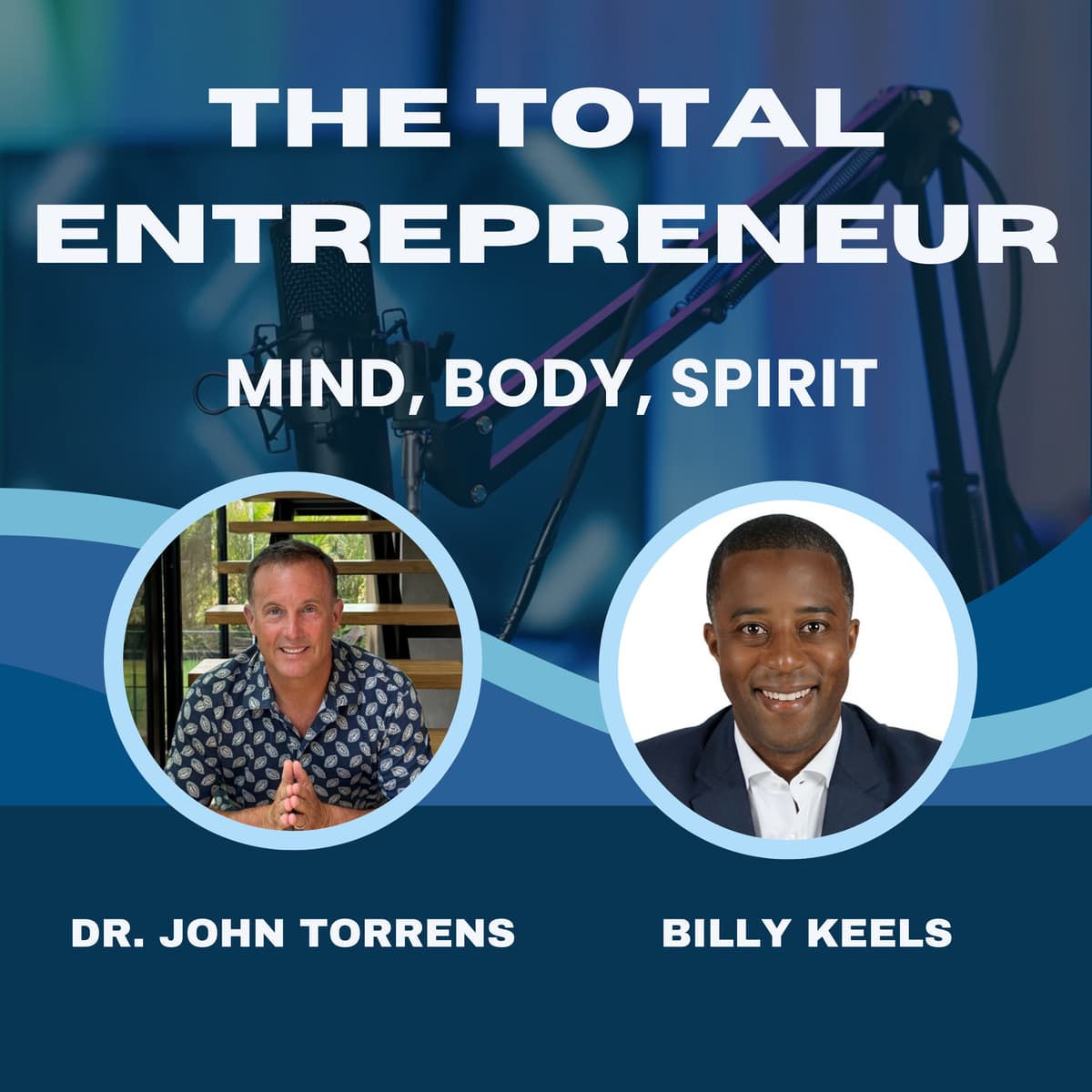
Making Your Corporate Job Optional - Leveraging Skillsets, Building Systems, and Mastering Time Freedom with Billy Keels
with Billy Keels
Feb 26, 2026 · 00:48:08
Part of our conversations on
If you are in control of your destiny, if you are in control of your time and your income, then it gives you more leverage in terms of the way that you're using your time. It makes sense in terms of why that first step of clarity is so important. And also the fact that it's the same 168 hours a week, whether you are an employee or an entrepreneur. The difference is when you're an employee, you have very little say over how your time is utilized. When you are an entrepreneur, you have 100% of the say for the good. And also, if you don't get it right as an entrepreneur, it's a major situation. It's also the other side of entrepreneurship or business ownership.
Billy Keels, welcome to The Total Entrepreneur. Really appreciate having you here.
Hey, John, appreciate it, man. Looking forward to the conversation.
Yeah, my first thought or question is, I've heard you talk about helping executives understand that their jobs are optional, and I love that idea. It seems like it brings about a lot of, you know, mental ease for people once they realize that. So tell us more about what you mean by, you know, Job being optional.
Yeah. So, and the thing about making your job optional, and, you know, it's because a lot of the work that I did when I was working in corporate, 26-year career, had an opportunity to work and travel throughout some 86 different countries during my corporate experience. And, and I realized that there was a certain point where a lot has to do with my background and kind of the way that I grew up watching 2 parents work 2 jobs most of the time. And I thought money solved all problems. And so then I got into a certain get good grades, As I got the good grades, I got the right jobs. And then, I got into the corporate world. And as I was in the corporate world, I realized that there were so many benefits to take from it. And at the same time, I was completely tied to my role. If I wasn't in my role, or I started watching colleagues around me that were— companies would consolidate, and then we'd have duplicity in terms of you have 2 teams doing the exact same thing. So, you don't usually want to have 2 people doing the exact same thing. And as people started leaving or were let go, I realized, wow, I really— this corporate game, I think there's a lot of benefit to it. And at the same time, I don't want to have my own life legacy, a future 100% dependent on my role. And because of the type of role that I was in, a lot of people were like, you would be crazy to do something else. But I did want to make my role optional. I wanted to continue to excel in my corporate roles. And at the same time, I realized that one of the things that I could do was start to build an independence and start to build a business on the side. And that was one of the things that I started doing towards the latter part of my career. And once I was doing that successfully. My corporate role, although I liked it a lot, it did become optional because the last 4 years of my 26-year corporate career, I didn't actually need the paycheck anymore. But I was going because I really enjoyed sitting down with CEOs of multi-billion euro type of companies in euros or dollars, whatever the case may be. So, yeah. So, that's what I— when I talk about having your role become optional, it's because you're literally going into your job because you want to, not because you have to. And these are— I'm talking about people that are earning upwards of $250,000 $50,000 a year and even into the 7 figures in terms of salary.
Yeah. And there's probably some freedom in that, or definitely freedom, right? And I think the idea that you're going there because you want to, not because you desperately need the paycheck, is very liberating. That's amazing.
Yeah, that's exactly it. And it's one of those things that I never really thought about, John, because I always thought just because of the way that I was raised, I thought that was the only path. And I was very— and I'm still to this day because my clients are working corporate— I was very happy and thankful for the roles that I had in corporate. I gave a lot to corporate. Corporate gave a lot to me. And at the same time, there was just a feeling of little freedom. I had much more confidence when I was actually going into my job because I wanted to, not because I had to. I wasn't worried about whether or not there was going to be another layoff. I didn't— fortunately, at the time, I didn't have to think about AI. A lot of clients that I'm starting to work with now are thinking about AI, or they have been impacted by AI. And I didn't worry about whether there was a a corporate consolidation because I was doing my job and whether I had my paycheck or didn't. And I want to say the last 4 years of my 26-year career, it just, yeah, it felt really different. It felt different for sure and different in a positive way.
Yeah. And what's that process look like? Because I imagine it's different for everybody, right? There's going to be some people who are just so locked into the job and are so afraid of the idea of leaving it and starting on their own and failure. And there might be some people who are just all in and like, yeah, I could do this. So, yeah, maybe talk through the process and what should people be thinking of if they've got a good corporate job that they want to make optional?
Yes. And I love what you just said, John. And that is so important because it's really important what you just said, especially those last couple of words. It's if you want to make it optional. Like I said, the first 22 years of my corporate career, probably not the first total 22 years because I was working the last 8 years, I was building business on the side. But let's say the first 14 years of that career, 15, 18. Now, the numbers on the— I'm on the spot. So, more or less, the 18 years I was doing it, I didn't think. I didn't want to do anything else. I just wanted to continue to get my bonus checks and I wanted to get my paychecks. And I didn't think about doing anything else. And that was the right thing for me. Just like it's the right thing for people that I speak to. There are some people that say, hey, look, I'm earning a really good salary. Never thought I would earn this much money. I'm able to take care of my family. I don't mind working a lot of extra hours. It's fun with my spouse. And Where the kids, if they see me or if they don't, this is the thing that we've agreed. And so, this works for me. And so, that's super important to highlight. But there is a group of people who you are an executive or you're a senior leader, let's say, in a really big company. And you enjoy what you do at your job. Like you enjoy it. And at the same time, you realize, hey, I feel like maybe there's something more that I could be doing with my skill set. I like going into these meetings. I like being able to share ideas. I like being able to solve really big problems. But I don't know if I want to continue to every 90 days have to reset or every 365 days, I start at zero every single time. Like, I don't want to keep doing that. I want to actually listen to this inner voice that's calling me that's saying, hey, listen, there's something else that you can actually be doing with your skill set. Or maybe you have additional capital that's sitting somewhere and you want to be able to start to build that bridge to what I say is to your optionality. So, you're creating that pathway to making your job optional. Now, this is a combination of one thing. Sometimes when things are— when you're going through things, you feel like they're happening to you. And it's only with perspective, you start to realize that these things were happening for you. And that's been one of the things that's happened to me throughout my life. And you're asking me, it's like, kind of what's the path? One of the things that I work with clients now on, because it's something that in the beginning, I didn't recognize it, but now I'm recognizing that there is a process to actually making your role optional. And the first part of that really starts with being really clear on what it is that you want to do and why you want to do it. It goes back to exactly what you said, John. It's not for everybody. But if you have that inner voice and you're like, hey, listen, I like my job and I feel like I want to be doing something else because there's something in me, there's this entrepreneurial spirit, there is this way that I want to be able to build a business. I want to take my skill set and actually use it outside of corporate. You have to have clarity because if you do not have clarity in terms of what it is that you want to do and why you want to do it, You can— and a lot of times when I start working with clients, you're just working because you know that working harder will get you to whatever goal. But if you're not clear on where the goalposts are, like, you're just going to keep working forever. And that's— then you're working 2 jobs, and that's not what you wanted to do. So, first part is really to get crystal clear. I like to say quantifiably clear on what it is you want to do and why you want to do it. Afterwards, because you like your job, and I tend to work with people that Primarily like the roles that they have in their corporate. And it's really important to protect those benefits and also integrate your corporate career into this life that you will also be building on the side, because ultimately, that's something that you like. Now, there has been one or two clients that they really didn't like their corporate role, or they felt like they weren't being— let's say they weren't getting the most out of their skill set, and they didn't like corporate. But that's really the minority in terms of the clients that I work with. So, the second pillar is really to make sure that as you're in your corporate role, that you continue to excel in your corporate role, and you can integrate that corporate role into what is the third part of the process, which is really around being able to have much more control. And that is control of the most important asset for all of us, which is time, and that you're able to leverage your time, leverage your skill set in the best possible way. And then ultimately, you also need to be able to control more of your income, because if you're not having a profitable side business, then that's probably going to end up with a lot of frustration and things that we don't want to happen. And as I mentioned, those 3 steps, whether you're starting with your career, starting with the clarity, also then building and excelling in your career, and then lastly, being able to control your time as well as your income.
In your experience, is there— so, so people have worked the corporate job and climbed the ladder, maybe 20, 30 years.
Do they—
it seems to me that they would have assembled a set of skills and a contact list and some experience that is really beneficial for them to go out and do this? Or do you find that they become so institutionalized that they can't function outside of that corporate environment?
It's a combination, I would say, of the two. Because what really happens, and it happened to me, right? I'm speaking from experience. When you are in the role and you have amazing benefits and the company culture is one that continues to give you new opportunities for growth and taking on more responsibility, and in return, you're going to get a salary bump and then you're going to get more responsibility, more people, more annual reviews. You are much in the corporate busyness, right? The corporate business, the busyness of corporate that it's really difficult sometimes unless you're extremely intentional about it to say, okay, hang on a second. I am building this set of skills. I do understand more of the leadership principles and how I can create the right environment so that employees that I'm able to bring onto my team or promote to another team that you're able to create the types of environments that are needed. Or able to also have a strong financial understanding and capabilities. And so, there are these skill sets that you are building in your corporate. But if you're not intentional about them or have somebody to give you an outside-in perspective of the actual skill set that you're building, it's really easy to fall into the trap of thinking that skill set can only be used inside of the walls of the corporate that you're working for. And so, it's when you actually take a step back and you recognize, okay, listen, there's a lot of the same skill sets. And a lot of the people that I tend to work with are in the sales or in the marketing, some in the consulting space. You start to realize that when you have that ability to generate revenue, to lead teams of people and manage businesses, well, guess what? That's exactly what entrepreneurs do. And so, then you start to recognize that there are these sets of transferable skills that you can identify that you then begin to improve. And you have to go from a very specialized environment, which is what corporate is all about. You are a specialist in a specific area. And then, you take those specialist skills And then you apply that to more of a general culture. So, when you're starting out in entrepreneurship, you're coming out and you have your idea, you want to test that idea. And you want to see that the idea is solving a problem for a given market. And then you continue to replicate that as your business gets bigger. If you want your business to be bigger, and that's really important as well, then you start to use those same skill sets, you're able to acquire talent, you're able to then develop that talent, and they're able to help you in whether it's sales and marketing, whether it's in operations, or whether it's in finance.
Yeah. And have you seen, or do you have a— have you experienced best practices? Or in other words, are there critical success factors? So somebody who's considering doing this, are there a set of things that are more likely to lead to success and also a set of things that are more likely to lead to failure that people should keep in mind as they start to contemplate this?
Yeah, so it's interesting. I was talking to a buddy of mine this morning and we were talking about something that's very similar. The things that I tend to see or know about that don't work because usually someone who's coming to me, they either have a very clear idea, they recognize that they don't want to go it alone. They recognize that in their corporate roles, they have been very successful because they were able to build or have internally, they have a board or they have a marketing team, they have a legal team, they have a lot of different teams that they can also draw experience from. And I'll come back to that because I want to finish there. But Those that tend to not be as successful tend to want to be what I call— they suffer from the lone wolf syndrome. They have an idea and they want to actually just go out and brute force everything themselves without really having a proven process, or they don't have— they have a really good idea. They also have a full-time job. So it's one thing if you're having an idea and you just want to test it and you don't have a full-time job, you don't have responsibility, maybe you don't have kids or spouse. Those are— I don't think I have any clients that are in that fit that bill. However, when you talk about best practices, those that I see that are succeeding more, number one, have an idea of what it is they want to do. So, for instance, there's typically 2 paths. One, it's someone that recognizes that they have a skill set that they believe they can build a business around. And so, then it's going down that process. The first part is identifying what is the path that you want to take. So, is it Leveraging your skill set. Or there are also people that, that come and say, hey, listen, I actually have capital that I have just sitting in the bank. It's not really doing anything. It's keeping me safe. I've got some 401 stuff. I've been doing some qualified plans. I've thought about doing something else. I've done some stocks on my own. But there's this money that's just sitting in the bank, and it goes beyond what keeps me safe, but I don't know what to do with it because I'm in the corporate busyness, and I feel safer if it's just here. So, there's One of those 2 scenarios that typically we start with. So, are you going to leverage your own skill set? Or are you going to leverage capital? And then based on that, you're then either looking for, if you're going down the skill set, what can you do to, once again, at the second step is to preserve and integrate your corporate role into what it is you're doing? Because it's very important that you continue to perform in your corporate role. If you don't perform in your corporate role, then building a business on the side will soon become the thing that you have to do primarily because you have to hit your KPIs. That's, that's a non-negotiable. And then after integrating the role either in the skill set or in the capital allocation, then it's about being able to either find and create the system that will allow you to attract clients that go for the problem that you want to solve, that you are uniquely qualified to solve. That's one hand and that's the first path. And then if you're going down the path of capital allocation or looking to place your capital somewhere else to what we like to talk about is on those types of assets that are going to generate more cash for you and potentially other benefits. It's really about creating the system that will bring new opportunities for you to consistently be able to evaluate and make sure that they fit in with your own. I don't want to say, yeah, I guess it would be with your own thesis around investing and things like that. So those are the 2 different paths. The first step is identifying which path you want to go down. Second step of the best practice is making sure that is that you're not doing anything to put your principal role, your primary role, and your full-time job at risk. And then afterwards, it's about creating the systems that will either bring you clients or being able to bring you new opportunities. So hopefully that makes sense.
Yeah, it does. And as you were talking, I was wondering, do you have a typical age range that your clients tend to be in? Because I know from the research that people in their 50s make excellent entrepreneurs because of all the reasons we just talked about. I was wondering if you see any kind of trends in ages and stages in corporate life.
Yeah. So, I would say more than ages, it's what you just said. It's more the stages in life. So, I'll give you an example of a client who actually is in his early 40s, has 2 kids, Both sub-10 years old or 10 and 7, and basically has been working in corporate for many years, is earning $350,000 and more depending on bonus and stuff like that. But it's more the fact that the stage in life. So, recognizing that he's worked his corporate career up until these days, he's recognizing now that his children— this is one of the conversations we had recently— that he's noticing the window that He has for his children, what you talked about the other day, he mentioned, I come home and I see my kids at night and I give them a kiss on the forehead. Or in the morning, I'm walking out the door and I'll see the kids and I'll give them a kiss on the forehead. And so, it's this whole thing of he's recognizing that time is going by. And at the same time, he's going through the day-to-day, the busyness of corporate, and he's recognizing that he's missing for him what are The higher value type of activities. Like, he doesn't want to just see his kids in the morning and at night, but he feels like he has to continue to do that because he doesn't have another predictable source of income. And when you're in the sales profession, there's always this constant thought that, hey, listen, if I don't make the numbers next quarter or 2 quarters in a row, am I going to be able to— And this is something we talked about. Like, if I were in a place where 15 days and I don't have a role, then I have the stress of trying to find another new job or being without a job and maintaining the lifestyle. So, I would say more than age, Jon, it's really the stage of life. I do have— and I have another client that I'm thinking about right now because that's not actually his spouse and kids, but he's also thinking about his parents and being able to take care of his parents because his parents are also aging. And he recognizes that there's a lot more responsibility that he will need to and want to take on. And when he lives across the country from his parents, one of his motivators— and when I talk about getting clear and understanding what you want to do and why you want to do it, it's really so that he has the flexibility to be able to, at any moment in time, say, hey, listen, I want to be able to go see my parents. I need to be able to be there to take care of XYZ. The things that I recognize the most from the clients that I'm working with, it's more the stage in life that they're going through versus where, you know, how old they are. It's really about the stage in life and what are the things that are happening.
Yeah.
what they feel like is to them, but happening for them and at that particular point in their life.
And it makes me think of this paradox. You know, a lot of people think, well, you know, I'm going to, you know, start my own business because then I'll be in total control of my time. I'll get to work whenever I want. And it's like, yes, you get to choose any 20 hours of the day you want, you know, those types of, you know, myths and legends and things like that. So I guess the question that was in my head is, do Are people just going from the frying pan to the fire? Like, you know, they're leaving the safe, which we all know that corporate job isn't necessarily safe long-term, but they're leaving the safe job, the safe paycheck, the systems for something that's maybe not as safe that they control, but they're almost, you know, they have to still work quite a bit at. So, I'm just wondering about where that balance is. And then, it brings me to the next question, which is when do people know, you know, they've got enough? But yeah, let's talk about that paradox first. You're gonna start your own business to get some time freedom, and next thing you know, you have less time than when you were working the corporate job.
When I'm working with my clients, the thing that is very consistent regardless of where you're starting is every single person is responsible for the same 168, right? And we talk about this over and over. And when I say 168, for anyone who is watching or listening, I'm talking about The hours in the week. And so everybody has the exact same amount. Doesn't matter if you're the richest person on earth or you're somebody who's sleeping under a bridge. And the thing is, how are you going to utilize that amount of time? That is the biggest decision that each and every one of us gets to make every single day. And, and as you— as I think about the 168 and we're talking about, yes, today you're dedicating a large portion of that 168 hours. to working, to building someone else's dream. And that's fine. I did it for a really long time and I was fine with it. And the compensation that I received, the benefits that I received, it was great. And it also— I had this illusion in my mind that it would last forever. But once you go through your first round of layoffs and friends that you were working with yesterday and today you're working and they're not, they're looking for another role, it makes you realize how fragile your experience can be in corporate. At the same time, when you are making that move to entrepreneurship, to business ownership, you still have the same 168 hours that we talked about before. This is just a different way of how you are able to utilize those 168 hours. And so it goes back to the first thing that I talked about, John, and this is why it's— people talk about clarity and they think it's like this nebulous thing, but it is absolutely the most critical— point of anything as you get started towards the road of entrepreneurship, in my opinion. Why? Especially when you're coming from a corporate role, because you're leaving a usually multiple 6-figure, at least the clients that I work with, multiple 6-figure type of role. And you want— you're searching for something more. So as long as the, the return on your time is equal to or greater in the entrepreneurial role you'll continue to do that. But you have to have a concrete example. So let me give you a concrete example. Today I was speaking to— it was, I guess for me it was 12, yeah, it was 12 noon. And I spoke to another friend of mine who's also an entrepreneur. It happened to be 6 o'clock in the morning for him. But we were supposed to speak for an hour and we decided we were going to speak for 2 hours. And we spoke for 2 hours. Why? Because both of us own our time.
Yeah.
There's no one that we needed to respond to. There's no boss that was going to call us and call us away from— now, of course, we both have family as a high priority, so that would have taken a priority. If a client were to call, then that would have been a call that wouldn't— wasn't taken at that time because of the type of business that I do, right, and the type of business that he has. And, and I'd use that as an example because we were supposed to be there for an hour. I never felt the pressure of I have to go somewhere else because This was a call that was for me in the middle of the day, for him at 6 o'clock in the morning. And it was the way that I chose to use my time today because it gave me the best return on my— today it was about emotional cup. Of course, we talked about different business opportunities, but more importantly, we were talking about family, what it's like to, to be a father, to be head of household, and some of the same challenges that we're going through with kids that are adolescents. And then also just some of the ideas that we wanted to that we wanted to bounce around. And I say that and I use that as an example because it's not always about just being able to make more money. It's about how are you actually able to utilize your time. You know, you— I— when I left corporate life, I was able to be in Spain when I needed to be in Spain, and I was in the US when I needed to be in the US. I didn't have to ask my boss. Like, when I was working in corporate, I had to ask my boss if I could have 3 weeks of vacation and go and visit visit my family. And so when we go back to the first step, John, in terms of clarity, understanding what it is that you want and why you want it, you've got to be crystal clear on that because you can get to a point where you're earning the same amount of money or maybe even less, but you own 100% of your time. And if that is something for you that is a greater value as you watch your children get older and you don't want to be in a business meeting on the other side of the country for a week or however many days at a time because it's a special event for your kid. If you are in control of your destiny, if you are in control of your time and your income, then it gives you more leverage in terms of the way that you're using your time. Hopefully that's not too like in, in the pie in the sky, but it makes sense in terms of why that first step of clarity is so important. And also the fact that it's the same 168 hours a week, whether you are an employee or an entrepreneur. The difference is when you're an employee, you have very little say over how your time is utilized. When you are an entrepreneur, you have 100% of the say for the good. And also, if you don't get it right as an entrepreneur, and it's a major situation, it's also the other side of entrepreneurship or business ownership.
That's very clear. Yeah. And I think, you know, the point is that you're gaining some agency, right? Personally, I'd be willing to trade a little bit of income for a little bit more autonomy if I didn't have autonomy Which I'm very blessed that I do. So yeah. And it also sounds like the same, the same rules apply if you're just in a startup scenario without that corporate job versus if you have the corporate job and you're still trying to start, you're like, you still need to solve a specific problem for a specific customer in a way they're willing to pay for and that kind of thing. So there's really no different rules that apply. It's just maybe your why and the clarity and that sort of thing.
Yeah.
Yeah. That's really interesting.
Yeah.
So, I want to talk a little bit about— oh, sorry, did you have a comment?
That's exactly right. At the end of the day, you have to be able to know what problem you want to solve. And the problem that you solve, is there a market that is willing to pay you for your service or your product to solve their problem?
The same rules apply, right? So, I want to talk a little bit about your background. So, yeah, I mean, I know you've had a pretty long history and responsible for hundreds of millions of dollars in sales and that sort of thing. And you talk about going long. So maybe break that down a little bit for us and maybe talk about how your definition of long-term success has changed over the years, or, or what even, you know, going long refers to when you're working with your clients.
Yeah, sure. And I appreciate that. That's making the reference to my podcast, the Going Long Podcast, and that's one of the focus areas that we have. And very fortunately, we've had now 603 or 604 published episodes, so we're pretty excited about that. And it's also one of the, one of the philosophies, which is Really being able to recognize not just where you are today, what is the vision that you have for the future? Initially, when the podcast started, it was really about— I was living in one place, I was living in Europe, and I was investing exclusively in the United States. So, it was about how do you put the systems in place to be able to literally go along, live in one place because I chose to live in Europe. And being someone from the US, I chose to make investments in assets back in the United States. And so, that was the genesis for the thoughts around Going Long. And really today, it has continued to have the same philosophy, but it's really about how do we help that corporate senior leader who is really looking to develop their systems, being able to develop the clarity around their idea so that they also have that longevity. And that they— I think it's one of the things that is really important, and I say this and sometimes it doesn't strike well with people. But it's just the reality, John, like, every relationship ends, right? And when we talk about every professional relationship ends, it will end because whether it's because you choose or because the organization chooses, the relationship is going to end. I don't know. I don't think I know anyone who has only been in one role their entire life. I don't think I've met that person because you're going to get promoted or the role is going to be made redundant or your company is going to be purchased by somebody else, or you're going to find an opportunity outside of your current company. And so, when that happens, it's a matter of how are you— what are you doing today to be able to protect and integrate that future that you want for yourself? Because the stark reality is that at some point, the professional relationship is going to end. And I want to work with senior leaders that want to have more control of when the moment comes, that they're not caught off guard, because they've already started doing their homework, they've already started the idea. And they have come to the agreement. And I want to go back to something that you said in the very beginning, that this is an idea, this side business is something worth going after. Because there are also cases when you can have someone that says, you know what, I've gone down this path, I've seen what can happen. And you know what, I'm okay with my multiple 6-figure salary. And I'm just going to continue to do what I'm doing. And my family's okay with it. And my— And I'm okay giving away that part of my agency. So really, that's a little background on the going long, where that comes from, and then also how we're working with clients today.
Yeah, it's interesting. It reminds me of, you know, in my work at the university, we spent so much time teaching young entrepreneurs how they start companies, but I realized a few years ago that we never really teach them how they get out. Because kind of like you said, the relationship or the job will end. Likewise, you're going to leave your company one way or another, right? Whether you You sell it, you just close it up, you go bankrupt, or you die, or you're leaving your company one way or another. And thinking about how that happens, I think, is, is almost as important, right? So you leave the corporate job with some intentionality, you start your own business with some intentionality. I think thinking of the eventual exit or how you unwind is probably worth it as well.
I went through the process of a revocable living trust many years ago, and the idea was to think— no one wants to think about the negative things, no one wants to think about the hard things, but I will tell you, going through that process, John, of thinking about the emotionally charged, difficult decisions that will need to be made in the unlikely event that I wouldn't be here at a particular point in time, it was so much more helpful to go through that when I was here. And I was able to think about the impact of how it would affect my children and potentially those that were going to be responsible for releasing assets that would take care of my children and things like that. And so, I think about it in a very similar way when you can prepare for this eventual end, but you can do it from a place of serenity, from a place of complete calm, that it's much better for you and much better for those people that love you the most and that you love because you're just making decisions from a moment of calm and not making it in this haste or in a moment of major stress in your life because the professional corporate relationship ends.
Yeah. No, that's, that's, that's good information. And it's, I think it's important for people to think about, you know? So what I wanna talk about next, I, I'm just curious on, on your practices or go-to habits, because I, you know, I love working with entrepreneurs on growing and scaling up businesses while keeping their wellbeing intact. Right? I, it kills me to see people who literally kill themselves for their companies and they spend a lifetime creating wealth. And by the time they're ready to enjoy it, they can't because they're dealing with chronic diseases they probably could have managed 20 years ago. So what are some of your go-to practices? Or how do you keep yourself grounded and mentally, physically, and spiritually healthy despite all the stuff you have going on?
Yeah, one of the things, and I mentioned it earlier, is just I realized it's so important to invest in relationships. I've mentioned to you a friend of mine who is also a business owner and being very intentional with the time that we are able to talk about anything and everything. It's very important. And especially, I tend to say that we don't do this much more as men to be able to talk about what's happening with us emotionally. And there's so much of that emotion that can stay bottled up. And when it stays bottled up, it can be one of the biggest sources of stress. And so if you don't have someone that you can actually talk to, that you can confide in, that you can be intentional with, it's difficult. And so it's a normal practice for me. And one of the reasons when I invest my time and being able to invest my time in those relationships and very intentional relationships, I know that it gives me a sense of return on that time, which also helps me just from being able to clear my mind, to be able to know that I have someone else that I can speak to, that I can confide in. It's something that I really appreciate. And I'll tell you that because I went through, and just in 2023, I went through a Divorce, and I went through a really challenging business situation. And I realized that— and this was while I'd already left corporate. I was 2 years out of corporate. And I realized that the importance of being able to continue to not just having the relationships, but also being able to take care of myself. So physical activity, like, I really enjoy running. It's something that I've always done. I actually lost too much weight when I went through divorce. I had to stop running a little bit, eat a little bit more because I was losing a lot of weight. But in terms of the practice, it is continuing to take care of my cardio. I do a lot of that. As I'm getting older, I also have to make sure that I am in the weight room with my weights. And something that's also very— something that I have taken up again is journaling in terms of mental health. And the reason I talk about the journaling is because it's another place for me to also be able to get out my thoughts, to get out my feelings in a way that I can express and I feel completely comfortable. is something that is really important for me. And one other thing I've started to learn a lot, I've been learning a lot more about, and I was talking to my friend this morning, we were going through some of the readings of Emmet Fox and Joseph Murphy. I don't know if you're familiar with Joseph Murphy and Neville Goddard. So, they're really a lot on the things of energy and just how important words are in terms of the things that we're thinking, imagining, the things that are in our mind really control our mind, control our body on a conscious level. on how much the conscious and subconscious play with one another, or interact with one another is a better way to say it. I know I went in a lot of different directions, but it is something that prior to 2023, I was actually going through, just taking care of myself. When 2023 happened for me, I realized how much more important it was to continue to take care of myself mentally, physically, and really lean into those close relationships. Not everybody, of course, but like— leaning into those relationships with people that wanted to, what I like to say is sit in the mud with me, just listen to me, or those that would also be there to opine and share their ideas. And especially when you're going through moments of difficulty, because as John, it's one of those things as you are a business owner, entrepreneur, it's sometimes it can be very lonely. And if you don't have those outlets, everything stays bottled up. And that's not good for anybody.
Community is so important and having a peer group or just a close, tight network of trusted people who get it and, you know, they don't want to fix your problems. They're just there and they're listening. Yeah, no, that's, that's really important. And, you know, I like how you said 2023 happened for me. I think that's a major reframe that a lot of people miss, right? They think, oh, this happened to me, it happened to me. But happening for me, totally, totally different outcome if you reframe it that way.
And it's just a part of being intentional and reflecting on things as they're happening to you. Because if you would have asked me, I wouldn't have been able to tell you that in 2023. I said all these things are happening to me, and there were even moments When I said, why are these things happening to me? And it's only through reflection. It's only through having those very close-knit, intentional relationships. It's only on doing the internal work that you can get to a point where you say, these things happen for me. So now how do I move from here to actually leverage this experience? How can I actually be better for it? And it was something that was— I'm not going to pretend it wasn't like it was emotionally charged. It was really difficult going through.
Yeah.
But because I was intentional and because I had people that loved me and cared for me and were there for me, I was able to go through those really challenging times. And now I'm able to look back with perspective and say, these things happened for me. And even some of the things, Jon, I don't know why they happened for me. I'm still not crystal clear. I just know that they happened for me. It's a part of the growth experience. And I guess that's what I've been most of my life. And I think about resiliency, and I think people have said that to me. And I was just going through life, and a lot of the same practices that I had Growing up, but now they manifest themselves in different ways. And just because you picked up on that, I did want to just come back. Don't beat yourself up if you feel like it's happening to you, because if it's close, if it's right in the moment, sometimes you need a little perspective just to be able to recognize that it's happening for you. But in those moments when you feel that it's happening to you, and I catch myself now, those are the moments when I lean into those intentional relationships and say, hey, you know what? John, I gotta— can you just sit in the mud with me? Because I gotta get some stuff off my chest.
Yeah, I know it's important. I mean, it's, it's valid and it's good to realize that, hey, right now this kind of sucks, right? But as long as you can have that in the mind that, you know, at some point, you know, just have that perspective that, yeah, there's gonna be a point in time, whether it's, you know, in a week, a month, a year, I'm gonna be able to look back on and say, okay, did this happen for me for these reasons? And I think that's, that's really important. And you mentioned you resilience. And you know, from the research that resilience is the key trait among entrepreneurs and business owners. If you don't have resilience, you're just never going to make it. So it's those— and he talks about thoughts and thought patterns. So important. Like, you can't have that negative self-talk if you want to succeed. It's just impossible.
No. Yeah, that negative self-talk, because it's just— it's the— you perpetuate negative thoughts and then you don't break the loop, and then you can't really focus on where you need to focus because it As you're here to solve problems, if you just wallow in the problems and aren't looking for a solution for the problem, starting with what could be your own, it makes it really challenging. So, it is important to recognize that these are patterns that can be stopped and can be redirected. So, yeah, for sure. Yeah.
And they're recognizable in entrepreneurs too, aren't they? Like, you can tell the ones who are just going through the motions and doing the thing like, oh, here's the thing I do next. Here's the thing I do next.
Right.
But they don't really feel it or believe it, right? The ones who are like, yes, you know what, this is hard, this sucks, but I'm going to do it. I can get through it. It's a completely different mindset shift.
Yeah.
So, I've been keeping a journal since 1991. And so, I love the fact that you journal too because over the course of that time, what I've learned about myself and just the way I process things, the funny thing is that the more things change my life, the more things stay the same. I still stress about the same 3 or 4 things just on a bigger scale, right? Absolutely. And, I still like to do the same things again just on a bigger scale, but you learn so much. And, one of my favorite things to do is to go back through my journal. Today's whatever the day is, February 17th. I like to go back and look at, okay, what was I doing or thinking on this day in 1994 or whatever? And, it's so Crazy. I don't know if you've had that experience. Do you go back and look at your old journal entries too?
You know what, so I keep some of them here in my desk, and it's really funny. And so if you don't mind me doing this, because this is like real— this is like real life stuff, you know. You keep these journals, and as you look through them— I don't do it enough, but there are days when I will sit in the living room, or I'll go up and I'll sit next to the pool, and I'll just read. Because I actually started my practice— and also too, like, full transparency, I have not been as dedicated to it all the time.
Right.
But I started in 1995 when I went and I lived overseas for the very first time. I lived in Valencia, Spain, and I've kept all of my journals. So they've traveled with me, and I've now lived in 4 different cities, 3 different countries, 2 different continents over the last 25 years. And I realize that there are things that I'll go back and I'll look through that trip in, in 1995. I had no idea that I would ever come back to live in Spain. So it was one of these things that I'm writing these things down And when I look back on it now, I think, oh my gosh, I have grown so much as a person. To your point, there's so many things that have changed and so many things that have stayed the same. It's, it's, yeah, it's pretty wild. I started to get the idea of reading these, but it's probably a bad idea while you and I are in the middle of an interview.
You might come across something that you wish you hadn't read. Yeah. Well, you know, see, sometimes I'll be mentoring, I'll be like, Like, oh my God, I think I have to burn this particular issue because nobody can read this. This is crazy.
Yeah, no, that's great. And actually, I'll tell you one of the things that I have not really done, but I have not yet. I kept a video journal and a written journal through a lot of that challenging time that I mentioned to you before. And I was very intentional about especially the video journal because it's one of those things where I enjoy video a lot more. than writing because it seems more natural for me. But I do have the— I will, I don't know when, but we'll go back at some point in the future and look at what was happening, like how my thought process was, how I was actually feeling, because I was very intentional about making sure that I kept all of that. I've never actually shared that in public. So I guess here I'm sharing it with you first. But it was one of those things that I know that looking back, I will see the growth, I will feel the growth, and I will also recognize how I was feeling in that moment in time, how I—
how—
what was my appearance and things like that. There is a lot of excitement about knowing if the more that you journal, the more that you keep it, whether it's a written journal or a video journal, that you can look back on that and just enjoy the time.
It's—
I'm doing that with my kids now who are older and in their adolescence, and we're looking at videos when they were super little. So it's a similar kind of concept.
Yeah, I know my adult kids love looking back on, you know, their videos when they were young and that sort of thing. Yeah. But the thing that makes journaling for me sustainable since 1991 is I don't do it every day. You know, sometimes I might not do it every week. Sometimes I'll do it multiple times a week. It's really just like when I've got something that I gotta get down, or at the worst case, I'll try to set aside like a Sunday, you know, for a few hours to do it, you know.
Love it.
And that just makes it really sustainable.
Yeah. Yeah.
So I wanna switch gears a little bit. So you're in Barcelona, you're in Spain.
Yeah.
And, you know, I've been to Barcelona a bunch of times, love it there. The thing, the only way that I functioned in Barcelona was to try to stay on East Coast US time because, like, I can't eat dinner at 11 o'clock and I can't go to bed really late and that sort of thing. So, for me, what worked, like, I've got to be super vigilant with my sleep schedule and that kind of thing. So, I'm just wondering, like, how do you handle that being in Barcelona where it seems like the The clock just shifts a little bit for—
Yeah, I'll tell you, John, I'm going to share my whole secret here. I came to Europe in 2001. It was supposed to be a 1-year sabbatical. It's been 25 years. And I just mentioned it's been 3 countries. So, I started in France, I lived in Paris and lived in Montpellier down in the south. I lived in Italy. And I have actually been living in Barcelona for the last 20 years. So, I'll just say that I very much adapted to what's happened here locally. And yeah, it's more difficult now when I go back to the East Coast of the US to have dinner at 6. But hey, but I also say that it's one of those things that it is like that being able to be here in Europe for such a long time, that is another thing that's happened for me, right? Because I realized that it's very easy for me to adapt to the location that I'm going to and just really quickly reset. Yeah. So that's one of those things that I don't struggle with that so much anymore. I just go wherever I am, I adapt.
Yeah. So, is it pretty common? Like, what's your average dinner time when you're there?
Yeah, I would say that now it's— so, it got to a point where on the weekends, it was probably like 9:30, 10:00. It was not uncommon. I do now because I'm getting a little bit older and I start to recognize that if I'm eating too late, it's not good for me just because I need some more time to digest. But, during the week, I like to eat no later than 8:30. No later than 8:30.
That sounds actually kind of early for me.
Yeah, and no, it is early here. I actually have friends that come over pretty frequently from the US, right? And they'll want to go to a really nice restaurant, similar to what you were talking about before. And I'm like, yeah, but the really good restaurant that I want to take you, it doesn't open until 8:30, 9 o'clock. They're like, what? It's okay, it'll be worth it, I promise.
Yeah, it's funny because, you know, I'm so— I'm like a maniac with my sleep, right? I mean, I work ordering, I check my data, and one of the things that I noticed that one of the best things for sleep is eating my final meal of the day as early as possible. So, my sweet spot, believe it or not, is 3:30 or 4:00 to have dinner, which makes me a miserable dinner companion.
Really?
Yeah. If I eat dinner that early and I usually go to bed by 9:00 anyway.
Okay.
But, if I give myself a good 4 to 5 hours between my last meal and the time I go to sleep, my REM is higher, I don't wake up as much, sleep is better. It's Yeah. So it's really hard, you know, you say, hey John, let's go out to dinner and be like, hey, 4:30 reservation sound good? And people just don't, don't, that doesn't compute, you know?
And they're like, John, and especially if you're in the center or south of Spain, they're like, man, we don't even have lunch. We're still maybe wrapping up lunch at 4:30.
Yeah.
Yeah.
It's kind of funny. Yeah. So as long as you like your circadian rhythm, like, like what time do you go to bed? What time do you wake up? What's, what's normal for you?
Yeah. So now I want, I want to start going a bit earlier, but if I'm someone who needs 6 hours of sleep, I have actually been working on getting 7 hours of sleep. So a lot now will depend on if, if my boys are here or they're not. But I like to be in bed asleep at 11:30— at 11, sorry, at 11. And if I sleep till 7, then great. But I have this thing where I'll usually, like today, I woke up at 4:30 and I was like, Okay, so what do I do? Do I go for a run? Do I just hang out? Or sometimes I'll just sit there and I'll meditate. But I do attempt to nowadays sleep if I can until 7. That's like my thing. During my corporate days, I was up every day at 4:30. But it's just, I guess it's a different— it's that whole ownership of time.
Right.
And also now it is because of the life and lifestyle and my boys that are adolescents. It's really the most important thing I was talking to my buddy about this morning is When my— when I'm here, my number one priority is make sure that when my kids are around that I am available to be with them. Right. And because their times are later here, I tend to be a little bit later because school's later. Kids don't get out of school until 5 o'clock, which back at home, like I finished school every day at 2 o'clock or 2:30 or something like that. But the kids start later here. They start at 9. Back home it was whatever, 7. I think even at a certain point I started—
6.
Before 7 o'clock in Ohio, but hey.
Yeah. Yeah. I mean, and you're supposing biology when you're that old doesn't work at that time. Yeah, that'd be your community school schedule figured out a little bit better. Yeah. Yeah. Well, Billy, this is it. I really enjoyed our time together. This is great. If people are interested in finding you and learning more about you, how do they do that?
Yeah, John, this has been super awesome, man. So I guess a couple of things. And if someone wants to be able to find out more about me, if you're that corporate person that I was talking about before, you're enjoying your role, at the same time, you have this inner voice that's getting louder and want to build a business on the side, I have a really practical guide. You go to makeitoptional.com, makeitoptional.com. You can pick that up. It's great. Also, John, you mentioned the podcast, the Going Long podcast with Billy Keels. I think it's 604 episodes where we've just published now. Really excited about the podcast. And I'd like to connect with people on LinkedIn. And I would say if you've already Here listening, Total Entrepreneur with John and I. If you leave a LinkedIn, just leave a personalized LinkedIn and let me know that you're already listening to me and John, and we'll continue the conversation from there. And then billykills.com, of course. And John, I'll do all the things that my, my marketing team say don't do. Just give people one place to go. I'm like, it depends on what people want to do. Let them go from there. But I really do appreciate the opportunity to share a bit of my story with you, John, and your audience. And just thank you very much. I really appreciate it.
Yeah, Billy, it was a pleasure. Thank you so much.
Thank you.
About This Episode
What if the most valuable asset in your portfolio isn't your 401 (k), but your agency?
In this episode, John sits down with Billy Keels, a former corporate executive who spent 26 years navigating 86 different countries before successfully making his high-level career "optional". Billy bridges the gap between the specialized world of the C-suite and the generalist grit of entrepreneurship, proving that you don't have to quit your job to start building your legacy.
Billy challenges the illusion of corporate security, arguing that everyone has the same 168 hours a week; the only difference is who has a say over how they are utilized. From the "Lone Wolf" syndrome that kills side businesses to the emotional resilience required to survive a "year that happens for you," this conversation is a blueprint for senior leaders ready to reclaim their time and diversify their income without risking their principal role.
Key Points Discussed:
The "Optional" Job Concept: Realizing that working because you want to is a total game-changer for mental ease.
The Three Pillars of Optionality: Clarity, integration of your current career, and controlling your own income.
Transferable Skills: How corporate leadership and sales are the exact same tools needed for entrepreneurship.
The Lone Wolf Trap: Why trying to "brute force" a business alone is the fastest path to failure.
Stages of Life: Why age 50+ is a "superpower" stage for new business owners.
The 168-Hour Rule: Navigating the paradox of gaining time freedom while still putting in the work.
Going Long: The philosophy of remote investing and preparing for the "eventual end" of every professional relationship.
Investing in Relationships: Why men need "sit in the mud" friends to process the emotional toll of business.
The "Happening For Me" Reframe: Using 2023's challenges as a catalyst for growth and resilience.
The Legacy of Journaling: Keeping video and written records since 1995 to track personal evolution.
The Barcelona Schedule: Adapting to European life and the impact of early "final meals" on sleep data.
Keep listening
More on Business

About the Host
Dr. John M. Torrens
5× Inc. 5000 entrepreneur, Professor at Syracuse University's Whitman School of Management, author of Lightning in a Bottle, and TEDx speaker on ADHD as an entrepreneur's superpower.
Browse all podcast guests →Book a strategy call →