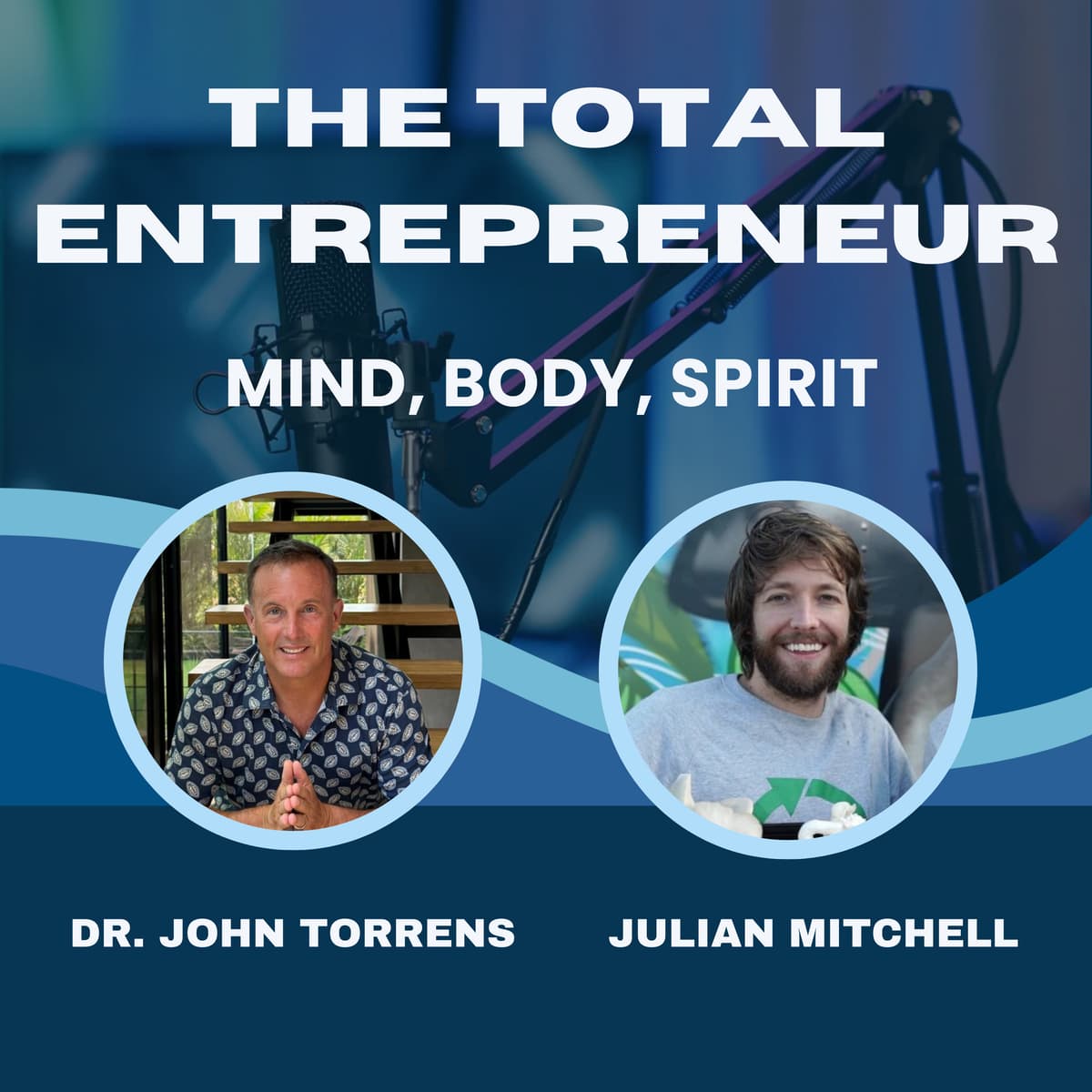
Biohacking, Functional Mushrooms, and the Science of Human Performance with Julian Mitchell
with Julian Mitchell
Feb 12, 2026 · 00:51:19
Part of our conversations on
Is there a major myth about the mushroom supplement industry that you wish you could just debunk?
I think just that mycelium is amazing. Mycelium has amazing compounds that you won't find in the fruiting body, 'cause mycelium is essentially the roots of mushrooms. A lot of superfoods are the roots and not the actual flower or the fruit itself. So there's always a lot of benefits within the roots. And so that's essentially one thing I think it's good for people to understand is that mycelium is beneficial. It's the starch levels that people need to be aware of. So knowing where your mushrooms were growing is important.
Julian, welcome to the podcast. It's really great to have you here.
John, excited to talk with you. I've been a fan of some of your podcasts and just the topics around wellbeing is something I nerd out on as a CEO at LifeCycle and just personally. So excited to chat.
Before your journey into mushrooms, this began with a sustainability project, right? Repurposing coffee waste into mushroom cultivation. That's a cool story to me. So talk to us about that and how that shifted into this functional mycology health movement.
Yeah, it's funny. I guess when we first started out 10 years ago, we were seeing, you know, sustainability, huge topic. How do you feed the world? How do you feed the population? How do you do it sustainably? At that time, a lot of lab-grown meats were coming out and Beyond Meat and all that kind of element. And just to be honest, wasn't a big fan of the ingredient list and the processing. And, you know, nature has all the things that we require. And so we just have to work more harmoniously with nature. And so mushrooms just tick all the boxes from Pesticide-free, you know, very low carbon footprint in terms of water use, in terms of land use, in terms of deforestation. So it just ticks all those sustainable boxes and a protein source, amazing amino acid profile, low carb, no sugar. So it ticked all those boxes from a food. And so we very initially intended as being an agricultural company growing mushrooms, particularly oyster mushrooms, shiitake, and a couple others, but mostly oysters and shiitake. So we were growing them in sea containers and doing 300 to 500 kilos per week out of one sea container in an urban environment with very low water use and catering to all the cafes, all the restaurants in the area. And so we looked at that as a model to help feed the future. I love meat, lamb, all the sources of protein. It's just about having another source of protein that would help feed 9 billion people. And so that was the very original intention, something that we're still very passionate about. But then from there, it evolved into performance, immunity, like you spoke about, brain health, and all these elements that functional mushrooms can do for us.
I want to back up even one step further before the coffee grounds and this discovery. Talk to us a little bit about your journey from being a physiotherapist to how you got to be where you are now.
Yes, I was a normal Aussie kid growing up in Australia. You love sport like the Americans, like the Canadians, like we love our sport. And growing up playing semi-professional and then realizing, oh, through injury and ability, not gonna be able to make a career out of it. So, I went into physiotherapy with the intention to be a sports physiotherapist and work with elite teams. And so, I went through my studies and very lucky, my first job out of university after graduating was in the English Premier League. So, the NFL of soccer in England, if you like, or, you know, of NHL. So, one of the top tiers. And so, I was very lucky to work in that elite environment with sports psychologists, medical professionals, work with the best surgeons in Europe with our athletes. And so, I loved that. It was very one-on-one. You work with that player to get his ankle back or his knee or his groin. And after a while, I just thought I wanted to be able to scale impact and scale help. And after a couple of years, just wanted to reposition how I spent my time, but I loved it and I do love sport and I love performance. And so it came full circle because we didn't start LifeCycle and mushrooms thinking that we would be a performance longevity brand, but that's where it's led into.
Yeah, I was gonna say that. So you've had this background in working with performance and athletes and it's translated right into this. So is this considered a supplement? It's not really a food. So what, like what category do you guys live in?
Yeah, we live as a dietary supplement now with our Lion's Mane Cordyceps ratio. It's a dietary supplement and then it bleeds into longevity stacks, biohacking stacks, protocols. But the beautiful thing with the mushrooms is they cater to everyone. If you're going through menopause as a female, then maybe the reishi and the cordyceps are great for energy and your nervous system. But also reishi is great if you're a student, but it's also great if you're a business owner and you're flat out. So they're very ubiquitous in that they speak to everyone depending on what you're after. And so that's what we love about it. It's not just for the athletic population, even though we work with UFC athletes, NFL teams, and the likes.
Yeah. So before we get into some of the functional benefits and the performance aspects, I just wanted to talk a little bit about science, potency, extraction, things like that. So first question is, how many lion's mane mushrooms would you actually have to eat to get the same benefit as one of your tinctures, for example?
Yeah, it's around about 10 to 1, 10 to kilo, 10 to 1 extraction process. So 10 kilos to 1 sort of kilo that gets extracted into 1 liter. of liquid. But then as well as that, to make these compounds, let's speak to lion's mane as example with erinaces as one of the key compounds within the mushrooms. You're not gonna be able to get that through ingesting. It has to go through an extraction process. Now, this extraction process is very soft in the sense of how it's done. It's a dual extraction, water ethanol. There's no heavy additions or machinery or tools that are used, but it still allows for the compounds to be pulled out of the mushrooms and be bioavailable. So you, you know, with a lot of these mushrooms, you can't just chew them and get that same absorption. And so that's sort of part of our patented extraction process because we grow and extract everything out of Wisconsin in Green Bay. And from there, we've learned over the 10-year period just how to extract it really well, patented that extraction process. And one of the key elements with mushrooms, because there's a lot of Conversation, debate, mycelium, fruiting body. For the people that hear about mushrooms, which one is— we're like the Switzerland where we believe there's benefits to both. Mycelium has a role to play, absolutely. Fruiting bodies have a role to play. They both have different compounds. So we like to, to have a full spectrum product, not a product in isolation. When you think of isolating compounds, that's more a pharmaceutical model where you're looking at one compound versus with a full spectrum product, you're looking at the synergistic benefits that, to be honest, we don't even really know the full majesty and physiology of how that's working. We just know that's what nature has designed. And so keeping those starch levels down in the mycelium, that's the critical element. That's where mycelium can get a bad rap because mycelium grows on a carbohydrate base like a rice or a wheat. And that's fine as long as the mycelium is extracted from that product. And a lot of the time with mycelium products, and we've done a test across the market, In Australia and the US, you'll, we find that there's very high starch levels in the finished product. And so you are consuming starch. So extracting that mycelium makes the compounds really bioavailable and potent. And then the fruiting body as well is sort of our premise and how we show up with our products and what we think gets the best results.
Yeah. And I think that's an important thing to note too, because a lot of people say just eat the whole food. But the little bit I know about mushrooms is that you don't even get the most of it from eating them raw. You really have to cook them to get the benefit from them. And then what you're saying further is the bioavailability in your body from eating the raw mushroom or the fruit body, probably not gonna be what it is after you extract it. So I think that's really important. So if people are doing mushroom supplements already, what are some of the quality red flags that they should watch out for in that supplement space? Like you mentioned high starch content or grain fillers, things like that. What are some things people should look at in choosing a mushroom supplement?
Yeah, I think you want fruiting body and mycelium. And when you're looking at mycelium from the back of the label point of view, you know, you're gonna see that it's grown on rice or grown on wheat, and that's okay. But a very easy scientific test you can do at home is put the powder on a plate and add some iodine to it. And if that powder turns black, purple-black, then that shows up for starch.
Mm-hmm.
Because if you grab a piece of bread or something that's carbohydrate, carbohydrate-based, and you add iodine, it turns black straight away. It turns a dark purple black, and that's a starch present. And so if your mushroom powder turns purple black, that's a starch presence as well. You shouldn't have that at all.
Mm-hmm.
So from our lens, we prefer liquid extract. That's why we make liquid extracts. We believe this is more bioavailable. We did a study with the University of Queensland last year, which showed that our mushroom liquid extracts versus mushroom powders were up to, were up to 7 times more bioavailable and potent. And what it showed in the study is that within a 24-hour period, Which is also amazing is that actually you're getting a physiological change within 24 hours of taking the product.
Hmm.
But what you're seeing under microscope and what they saw at the University of Queensland in the Brain Institute was that you were getting neuronal outgrowth. So, they could see the neuronal outgrowth within the cells immediately within 24 hours, but it was up to 7 times more with our liquid extract versus powders. And so, we're a proponent of absorption and bioavailability. And so liquid extract is superior to powders for most things because anything that has to go through the gut and the stomach, it's a very acidic environment. There's a lot going on in there. It's nondiscriminatory. It's just trying to break everything down. And so really how much of it goes can get into the bloodstream, very limited versus if you're able to take things sublingually, then your blood vessels and your vascularization under your tongue allows it to go into the blood. So that's one amazing way to take it. But even if you take it as a liquid, it absorbs a lot quicker than as a powder where there's more steps for it to be broken down.
So I wanna talk now about some of the functional benefits and, you know, how it affects human performance. I can talk from my own experience. I was on a 3-month quest to improve my REM. Like my sleep was pretty good. I was getting decent deep sleep. REM was atrocious. So I did a bunch of things, blue light blocking glasses, early final meal, all those types of things. But I started using lion's mane regularly. And so I was wondering if you could just start with lion's mane and talk about what are some of the cool things lion's mane can do for you? What are people taking it for? What types of patterns you've seen through user feedback or even personally?
Yeah, the lion's mane REM relationship is a really interesting one in that it wasn't showing up in the literature at all. It just came subjectively, notably through Dave Asprey at first, who is a biohacker measuring everything, you know, and so n equals 1 as the subject, he was able to see on his own data through his Oura Ring that the REM sleep was increasing through Lion's Mane. And then from, because a lot of people and even other brands would only speak to Lion's Mane to take in the morning for focus, for concentration, all of those elements. But if you're taking it at night, it's still acting and it's acting on the brain to support that REM sleep, which is a critical part of translating short-term memory to long-term memory.
Yeah.
About consolidating whatever you've learned that day. And locking it into a deeper memory system that allows you to store it and regurgitate it, remember it later. Lion's Mane for REM sleep, incredible. For focus, for articulation, for post-concussion, in that specific case, really good. We've had a lot of athletes, surfers, fighters, MMA fighters, even if you're getting some microtrauma or you've had a history of concussion, you should definitely be taking Lion's Mane. One other one that's super interesting is arthritis. So, You know, when it comes to arthritis, we think it's the joint. And being a physio, we were taught it's wearing down of the joint that's causing the pain. But really what the most recent science shows is that it's the nerve endings that are inflamed. And so lion's mane helps with neuroinflammation. So it doesn't fix the cartilage at the joint, but it turns down the inflammation at the joint. And so we noticed that in the older demographic, the subjective feedback around, okay, my The arthritis in my hands isn't as bad anymore when I take Lion's Mane, and when I stop taking it, it comes back.
Hmm.
So this is the amazing thing about mushrooms and the applications being so wide, but Lion's Mane for decreasing neuroinflammation. So what must that lead to? A whole cascade of longevity markers. Because if we think of neurodegenerative issues that we see, Parkinson's, Alzheimer's, all of these things are neurodegenerative ailments that take place as we get older. So if we can slow neuroinflammation with Lion's Mane, Then potentially you can slow the onset of those things. And if you take it earlier, the performance benefits are incredible. I could talk about lion's mane all day. I don't want to chew your ear off because there's other mushrooms to talk about.
Yeah, I got that tip from Dave Asprey actually, that you mentioned it. And I didn't control my protocol just to isolate the lion's mane I was taking. I was also doing the glasses, the early meal and all that. Yeah, no alcohol, but combined My REM sleep went from averaging 13 to 15 to over 20 consistently. And yeah, it's been great. And of course, you know, when you're sleeping better, everything else works better.
It's the key fundamental. I think the discipline for the morning routine is easy. The discipline for the evening routine is the one everyone needs to nail. And I have to put my hand up myself. Yeah.
Yeah. Yeah. So let's talk about cordyceps now. So cordyceps is Also interesting. Tell us about that one.
So cordyceps, you know, I mean, we're a society that loves caffeine and we love stimulants and we love energy drinks and we love to fuel that energy because of probably mostly likely on the back of poor sleep, trying to bandaid poor sleep. We're having extra caffeine, extra stimulants. And so cordyceps is one of those natural sort of energy boosters. That's actual real energy in the sense that, as we know, caffeine is just blocking receptors. Telling our body we're not tired. So we're getting a sleep debt, we're getting an energy debt, whereas what cordyceps is enabling to do, it enables ATP production. And so it allows the mitochondria to produce more ATP. So it allows our own body to create more energy in a real way that's sustainable. And so from that you get, you know, not that peak and trough, which is an artificial energy boost from caffeine and stimulants. You're getting over a 4 to 6 hour wave of smoother energy. Not that peak, and so you're not getting that crash either because the body is producing ATP. It's all very natural. It's all very much in alignment with the biology of our body. So it's incredible from a functional point of view. If you're crashing in the second half of the day, if you're a long-distance type athlete, or you're trying to do a second workout, or you're running a marathon, or you're running a triathlon, anything long distance—that second half of the day, that second half of the game—you're just not as fatigued. You're not gassing as quickly, and that's what we hear subjectively. And that's why the athletes, that's what the athletes report, whether it's like the second half of the game, the last few rounds of the fight, of the run, of the swim, I still felt like I had got a lot of good energy. So that's where it's really popular. And that's really where it originated was in the Olympics with some long distance runners and some Chinese long distance runners. And then they drug tested them and said, oh, you know what, just what's going on here. And really the story was that Chinese medicine, because a lot of this Mushrooms date back to ancient traditional Chinese medicine. When I visited China, you know, the reishi mushroom is, and these mushrooms like cordyceps are revered. There's a lot of paintings on the walls within temples. The reishi mushroom is known as the mushroom of immortality in China. It's in all their, their Chinese traditional textbooks from thousands of years. And so it's not new, but the extraction process that we're doing today is bringing it full circle to make it really bioavailable. But that's the cordyceps energy, anti-fatigue, no crash. libido elements to it, viral elements, antiviral when it comes to respiratory conditions. So that's one that's really interesting. So it's good to take over winter for that.
In Syracuse, New York, where I live and teach, yeah, we don't see the sun for a long time between the middle of November until maybe April or May. So yeah, that's, that's important. I was, it was 2 years ago, I was training for a sprint triathlon and a fairly long bicycle race. And yeah, I was doing the full spectrum of mushrooms in your biohacker's box. And yeah, I can relate to that. I definitely felt I improved my time over the past couple of years, even though I was a year older. I just did better. Again, I didn't control it and just isolate the mushroom extracts, but it was just part of a larger effort that I was doing. But anecdotally and just from my own behavior, I felt there was a benefit for sure.
When you're really on that train, you're never really isolating too much because you're doing so many things. But, you know, you look at the literature and I think subjectively you still notice something, but it's a 1 or 2%. Versus if you're a person who's not doing too many things, those customers feel a 5 to 15% uplift, maybe a 20% uplift.
Yeah. And I was gonna ask you about that, the data you guys are collecting and keeping. Is there peer-reviewed research that's coming out of your products? Are you just extrapolating more generally or broadly from the research on mushroom extracts?
We'd always love to do more research coming from a physio degree and a science degree, understanding the journey of research and getting it peer-reviewed and just the sort of the cost and the time element to it while running a business. We're trying to, we're trying to do both because we're very heavy in the science. So we've done a study with University of Queensland, which is the lion's mane one. There's further studies to do there. Once you do a study, it asks more questions than answers. And so there's plenty more things we want to explore.
Right.
And then we did a study with the University of Newcastle, another very popular and highly regarded University here where we spoke about immunity and we looked at turkey tail for immunity. And what it showed was that it really helps support and grow levels of interleukin-10. And interleukin-10 is very important as a cytokine for anti-inflammation when it comes to cold and flu, when it comes to rhinovirus. And so that's what we showed there with the turkey tail mushroom. So we've done initial trials and studies that we'd love to do more and we will, you know, as we go on this journey. We're 10 years old now. And so that's really what we want to lean into being a trusted authority when it comes to the science and the extraction process and the quality of the product, because we've seen so many starchy grain powder products out there. And we see it a bit like the CBD space where CBD was kicking off and going really well. And then there was just too many inferior products out there that the consumer got bedazzled by which one's trustworthy. And then they had a couple of experiences and they didn't feel maybe what they expected. And so it waned off. And this is the risk with any industry that gets very popular. So we've got a very high retention on customer base and it's just about education. And to your point, science is critical.
Yeah, I worked with a cannabis and CBD company for a while. And so I learned a little bit about the science of that, but you're right. If consumers are paying a lot for supplements, hoping to get a benefit and they don't see it, they're just gonna stop taking it. And I think the unfortunate thing is that the bad actors or the poor companies that just jump on the bandwagon ruin it for everybody else. And so that was my next question. is mushroom supplements have seen a boom lately. And you just said you've been at it for 10 years, although you've only been on my radar for maybe a year and a half or 2 years or something. So I did want to get into this notion of overnight success and how long it actually takes to achieve an overnight success. But talk to us a little bit about the landscape of mushroom supplements and that sort of thing. It's just, you know, what's out there and how do you guys stay committed to quality over this trend?
Yeah, the background of growing mushrooms, the origins of growing mushrooms, has supported us along the way because founder or as a D2C entrepreneur, it can be very easy just to buy white-labeled products from a manufacturer and put a label on it and become a marketing company. And that's the majority of brands out there. And I think those brands won't last the test of time because consumers are narrowing in on product and feeling and benefit. And so we've done both in the sense that we understand the importance of marketing and education. And on the back end, we've noticed the importance of vertical integration and innovation. If you look at all the best companies in the world, they're innovating in their lane, they're leading in their lane, and that's why they're enduring companies. And so by doing that, everyone was doing powders and capsules because it's easy and the economics are really good on it. And you can add starch to the product or not remove the starch. And the economics are really good for it, but the potency is not there. And so the customer is not sticky. And so you don't build a following, a loyal customer base, a loyal subscription base, which really drives your company. So it took us longer to build that out. And as you said, you heard about us in year 8 or 9. So that first 5 years was very much about infrastructure, vertical integration, understanding how to best extract, how to best grow, and building that out and scaling that. But yeah, the capsule powder space, We're not offended by it, but we're not in love with it because we just think it's not the best form of taking the product and taking the supplement from a bioavailability point of view, a purity and a potency point of view. And we're very big proponents of liquid extracts when it comes to mushrooms. We're very big proponents of the fruiting body and the mycelium, as long as the mycelium is removed of all starch. So our starch levels sit around between 0.5 to 1.3%. We've tested a lot of the big brands across all the retail markets and websites and Amazon and these places, whether capsule or powder. You know, the average is sitting around anywhere between 32% up to as high as 68%. 68% starch. When you think you're buying a lion's mane capsule or powder, you're actually buying 68% of blended rice, blended grain. So that's almost criminal and it's really bad for the industry. And so that's something that we're not fans of. And now we haven't called out brands specifically. We call out that as something that consumers should look out for. And as I said, you can do the iodine test. And so I think for us, it's just about innovating within the mushroom space, more science, more studies, and bringing out amazing products that you feel the benefit pretty quickly.
A question on the iodine test, because that is something that is useful. People could do that if they don't have iodine laying around. Can they do it with iodized salt or does it really need to just be like pure iodine?
It doesn't need to be pure iodine like a Lugol's iodine. There's many benefits for iodine, so we should all have iodine in our pharmaceutical first aid cabinet. That's great to add to water. It's a great— a lot of people are low in iodine, so it has a dual effect. You can test your mushrooms, but add it to your water. It's a part of a base level biohacking cabinet.
Yeah, yeah. So is there a major myth about the mushroom supplement industry that You wish you could just debunk? Does one come to mind or did we cover it already with the starches and the capsules and things like that?
I think just that mycelium is amazing. Some brands will say, oh, it's got mycelium in it. Mycelium has amazing compounds that you won't find in the fruiting body. And if we look at a lot of superfoods, because mycelium is essentially the roots of mushrooms, you know, a lot of superfoods are the roots, you know, are the root structure and not the actual flower or the fruit itself. So there's always a lot of benefits within the roots. And so that's essentially one thing I think it's good for people to understand is that mycelium is beneficial. It's the starch levels that people need to be aware of. And I think with everything, Australians love Australian grown and Australian made. It's no different with Americans and Canadians as well. And so knowing where your mushrooms were grown is important. And so ours are Wisconsin, USA, proudly grown, which we're very proud of.
That is great. Of course, yeah, people wanna know where things come from and that kind Kind of thing. Yeah. So before we move into your story as an entrepreneur, which is also quite interesting, tell us maybe a few really interesting success stories or just some anecdotal evidence of people who are using these and have achieved interesting outcomes.
Yeah. I see there's a wave in the background there. Are you a surfer?
I am. Yeah. Yeah. As much as I can. Yeah.
Yeah. So one that comes to mind is Owen Wright, a surfer, professional surfer. Big wave surfer, and he was competing for the world title, right up there in the top five for the world, and had a really big wave hit him, and he had a micro trauma or a concussion—a series of micro concussions that led to a bigger concussion that caused a near death experience where he was unconscious, had a near death experience, which which you measure in the blood through your DMT levels in the blood at that time, and then you're clinically diagnosed as having a near death experience, which. He later spoke to us about, but it was through someone else who was using our product, who was the World Surf League health coach and chiropractor. And he recommended to Owen because on his road back to recovery, he felt there was some sticking points there where he just wasn't remembering what he wanted to remember, wasn't able to pick up tasks because he was— went from high-level pro surfer competing for world number 1 to wheelchair-bound to not being able to remember his name and his family and things like that. And so it was a huge recovery process. And he really said that lion's mane and the REM sleep just really supported that recovery and that regeneration of neurons. It was something he did everything, went to every clinic around the world that was important to him, but that was one that he said notably was a game changer. And from there, he then canceled some of his contracts with bigger companies that weren't aligned, stimulant drink companies and things like that. And we worked with him and he went on from that to then win a bronze medal at the Tokyo Olympics, knocking out Uh, he was in these, in, in that heat competing for a medal against world number 1 and he knocked him out. Which the other element of that story, because what REM sleep does is improve dreaming. So he was taking lion's mane all the way from the recovery all the way up to winning a bronze medal. And he's, he shaped his board based on a dream he had from the lion's mane. And so the lion's mane does create a lot of dreaming. And so dreaming is a good thing. This is when you're also getting that short-term memory to long-term memory. long-term memory consolidation. It's very regenerative for the brain. So that's one story that's just, that's quite interesting and quirky because the dreaming element helped him carve the surfboard because he's a tall athlete. He went to his shaper and said, I actually want a small board and I want it to be like this and this, which, you know, the carver's like, that's quite bizarre, but that's what he went with and that's what he won a medal with. And so that's a fun, interesting story. But I think the arthritis one also stood out for us because it's not in the literature anywhere. And this is where we know we're making a great product when we're getting feedback from customers that's not in the literature, because that's how literature starts. It starts with an idea. It starts with feedback. It starts with a hypothesis like, hang on, maybe lion's mane is good for arthritis. No one's ever looked into that. So maybe that's a path for us to go down with research. So yeah, many stories, but I guess there are 2 that probably people aren't, haven't come across before when it comes to lion's mane.
Who is the big wave surfer? What's his name?
Korn Wright, Australian surfer in the WSL. Yeah, sure.
Yeah, I follow WSL, longboarding, big wave, all that kind of stuff. So let's talk about your journey for a little bit. You went from being a physiotherapist to a mushroom farmer, mushroom grower, a mushroom supplement company CEO, manufacturing. And so there's a lot you have to do in your role that you probably weren't educated and taught how to do. So talk to us about that journey. How did you figure this out? How did it go for you? And how did you How did you keep yourself in a good place from a mental, physical, and spiritual wellbeing place along that journey?
Yeah, I think that last piece is critical. It never makes sense until you look backwards. And so, the physio element, because a part of that role was also I spent a lot of time with the performance coaches in Formula 1 for Lewis Hamilton, Mark Webber, Sebastian Vettel at that time. And so, I was one-on-one with these guys. So, I was learning how These performance coaches, because I was looking at that as a career path, look after those guys. And it's really no different to how we have to think about ourselves as CEOs and founders and business owners. I think athletes back in the day would drink and get away with it and still perform and whatnot. But as an athlete, as a founder, as a CEO, as an executive, you have to be dialed in. And so, I think that helped with this 10-year journey. Otherwise, I would probably most likely be pretty burnt out and I wouldn't have been able to endure it. And I would have had a health compromise there and mental health and emotional, physical health. So, I think that was a great apprenticeship that helped because, as you said, came in with a pretty clean slate of not having any business background, not knowing what, you know, really finance, operations, any of the marketing, no background in any of these areas. So, it was very entrepreneurial in the fact of just being around good people, having good mentors, good advisors, building a good team. And learning and making mistakes and just being consistent and working our butts off for 10 years. And that's the base level of ingredients that have helped us along the way. And for sure, plenty of mistakes. And we still feel like we're just getting into it in the sense of, okay, we've done a decade, but there's so much more and things we can do and things we can do better. And so, I think, yeah, we're still probably just finishing up the apprenticeship now, the first decade of business.
Yeah. At what point in the journey, was it early on or was it about midway through or was it even fairly recently when you thought to yourself, okay, this is going to work, we have a company that's going to make it?
I think it was when the lion's mane chief scientist brought the lion's mane home because at that time we were very entrepreneurial, like living together, working out of a garage type thing, just live and work. That was all we would do. We'd eat dinner, after dinner we would be working together. And so it was very intensive hours early on, which I think can't be underestimated. With the focus and just the dedication that's needed early on to get it off the, get it off the tarmac. But when he brought that product home and I tried it the next day and it was just very instantaneous with the lion's mane. And I think that's what's always missing in the supplement space is some things do take time. Granted, they do take time to develop, but when you can have something that has instantaneous benefit and brain and mental clarity, which everybody wants, Okay, and it's in a category of its own. That was the first piece. And then of course, present it to the market and you see that adoption curve, you see that feedback and you see that retention. Okay, we really narrowed in on that. And because we were doing a lot of things within the fungi kingdom, we were doing packaging, we were doing soil remediation, a whole host of other areas that you can get into with ecology and fungal biotechnology. It's infinite, really, the applications for humanity and for the environment. And really, once we got that market adoption and we knew that was a winning product, which today is still our number one product for sure, that's when we knew, okay, we've got something here. And then the big moment would be, I guess, when Joe Rogan mentioned us. That was one. And prior to that, Dave Asprey. So when you have these subject matter experts, these titans of industry, Acknowledging your work, acknowledging your product. I guess that's when you know you're on the right product, on the right track path.
Yeah. And what was that, a year, 2 years? Like how deep into the beginning of your journey was that?
Year 4 and 5, something along those lines.
So you were grinding away until anything like that happened, right? It was just—
Yeah, in the dark working on the mushrooms. Yeah.
Yeah. And I really appreciated what you said about Just working. You ate dinner, then you went back and worked. And I think entrepreneurs get that, that they know, hey, there, there's a lot to starting a company. You can't fall asleep at the wheel. You gotta be on all the time. And while you're doing that, it also sounds like maybe you were doing other things to support yourself so that you could keep doing that. So what was your habit or supplement stack or what were your practices that were, that enabled you to get through that? Maintaining your health? I'm assuming you maintained your health because we're sitting here now, but yeah, what were you doing along the way?
It's definitely evolved as, as information has evolved. Back then it was pretty— I say year 1 to 3 and 4, it was pretty generic but consistent in the terms of movement, exercise, eating a clean diet, eating a low carbohydrate diet, whole food diet. Like, carbohydrates But if your blood sugar is inconsistent through carbohydrate consumption, then your mood and your energy and your clarity is going to be inconsistent. So really keeping that down, I think, is— and timing of that is important. Because if you're having, as an example, a large carbohydrate meal at lunch, the second half of your day you're pretty useless. At least I am myself. And so timing of food, diet, nature— Sunday we would always be hiking or in at a beach or doing something in nature to decompress away from technology. So we called that Sunday church. So Sunday church was making sure you're in nature, you're with friends in community, and you're just removing yourself from it completely. And then it was typically a 6-day work week is what we were doing. But it's about having fun on the way. And we were working with friends and inspiring people as well along the way, other people building business. So community. And that being said, I guess that's because I came from a base of zero knowledge. Don't come from a base of zero knowledge. I think there is an element of you don't need to be going as hard in terms of hours because like the pathways. And so it changes over time. But then yeah, from now, in the last 5 years, it's been pretty, it's just part of my life now. But I guess the longevity biohacking part is quite, to some people may seem a bit extreme. Like we just completed a 3-day fast, a 3-day water fast last weekend. With the life cycle community, so we had 1,200 people sign up to a three-day water fast. So we had some team members, but a lot of the community on our email list sign up. And so I do three-day water fasts quarterly, or at least biannually. Just an amazing way to detoxify the system, autophagy, DNA repair, mental clarity, visceral fat. Just there's so many benefits for fasting. So there's those things. There's detoxing, saunas, ice baths daily. So Yeah, it does get quite— now it's quite extensive. But I think that holds me in good stead for the long term.
Yeah. So it sounds like you had some tools in your toolbox, because I think that's the part that a lot of people miss, especially the entrepreneurship students that I teach at the university. They look up to people who have founded companies like you, and all they see is the hard work and the grind. And I think a lot of times they, they worship that part of the hero's journey. We don't often hear about all the things you have to also do to support yourself to perform at that level. So thanks for sharing that. Appreciate it.
Yeah, no problem.
So as an entrepreneur, what are some of the things that you found most surprising along your journey?
Most surprising? That's a good question. Because I came from a zero base, it's all been learning on the way. And I think entrepreneurship 10 years ago, as you would have seen, and 10 years prior, it's evolved in itself and the conversation around it has evolved. And that's first, that last 10 years has really been a hustle culture conversation, you know, and, and you've got to burn the boats in other parts of your life, which I don't think are necessary and actually is not good either. Why win one prize and then lose 3 others, whether it's your health, relationships, friendships? And so I guess that's the surprise, is that there's not many that are doing that, to be honest. There's not many that are able to have all the balls up at a high level, and so they're I think that's what is going to be exciting to see with the conversations that are happening and with the experience of great entrepreneurs talking from a place of them achieving some things and missing the boat on others. So I think holistic entrepreneurship and designing your life around it as well in a better way, I think that's a real measure of intelligence is actually designing your life and not just winning one medal by building an 8-figure company, by building a 9-figure company at what cost? I'm more of a pro the balanced entrepreneur, not the extreme entrepreneur that burns other boats that are actually really valuable for a meaningful life.
Yeah, I can relate to that. And there are periods where it's maybe out of balance, right? So when I think of balance or when I teach balance, I'm usually thinking over a broader period of time, right? So in any one 24-hour period, you might not be able to hit all the things. But over the course of a week or a month or certainly a year, you should be able to find some balance.
Yeah, very true. Very true. No, because it is an extreme game. There's no doubt about that. It's an extreme game. It's a— and that's what I— when I was working with English Premier League players, they are the 1% of the 1% when it comes to footballers. Every kid out of Brazil, every kid out of Spain, every— they want to be in the English Premier League. And so, I'm working with 15 or squad of 30 of 12 teams, 20 teams. They are the 1% of the 1%. So I learned a lot from their mentality, their mindset, because a lot of them come from very humble beginnings. But at the end of the day, business is no different. The businesses that you see on the NASDAQ or on the S&P, they are the 1% of the 1% also. And those startups as well. And it's competitive. And so that's what I think a lot of people love about it. That's the name of the game is it is a balance with balance because it's a, you've got to have a healthy relationship. But as you said, Today for me doesn't look very balanced. There's back-to-backs all day and some things in the evening. That's fine. Maybe on the weekend, I'll balance it back out.
Yeah, I think it's just that perspective. And I love talking to elite athletes and elite entrepreneurs because there are so many similarities. And if I could boil it down to one thing, it seems that it's resilience, right? So elite athletes who— they've got to work hard, they're tearing their bodies down, but they build resilience to And similarly with entrepreneurs who operate at a high level, they know they've got to work really hard for long periods of time. And they need the resilience in order to be able to do that. You can't possibly do what you need to do as an entrepreneur if you're not maintaining your overall health. So I think that's a great point.
Yeah. And that's the lucky thing about business people is that they get a second chance or a third chance and you can reinvent yourself in your 40s and your 50s and your 60s. As an athlete, you have a finite window. Between 20 and 35 for most athletes in most sports, 35 is an old athlete in a lot of sports. So, you know, 31, you have an injury or you don't perform, you may not get your contract renewed. And then it's a very slow or quick down spiral. Whereas business, okay, your business can go ass up at 34, but you've got all those learnings and you can go again. And within 24 months, you can have something going. And that's an amazing ability as well, an amazing opportunity. As long as you're resilient.
Yeah, because if you're an athlete, once your body's done, doesn't matter how much you remember, you're just not physically going to be able to do it. But in business, your body could be failing on you, but you've still got a lot to offer. Yes, making sure that you're incorporating some sort of resilience practices so you can make it to that level and enjoy the fruits of what you've developed. Yeah. So when you look at the next decade or even the near-term future, what gets you excited about the role of mushrooms, mushroom extracts in human health and performance?
Yeah, I think mass adoption is the next wave. Like it's becoming, it's been niche, you know, athletes and the likes. And so on that adoption curve, I think we're, we're really about, from our point of view, looking for adoption for the everyday person and biohacking and longevity interest not being niche. It's a part of everyday's life because everyone has a stressful life today. Everyone's living in a bit of a more toxic world than it was 10, 20, 30 years ago when we talk about air, water quality, food quality, soil quality. So it's not really an option anymore. You must be supplementing with key nutrients that you're deficient in. You must be doing these things to manage stress levels. You must be engineering your life to get good sleep for the most part because of the stress levels. So I think Supporting the masses is important to us, not just supporting athletes and people who are interested in it from that point of view. So that's one big tier for us is how much of an impact can we have? And I heard this like very early on, which was like to build a billion-dollar company, you've got to impact a billion people positively. And so that's like the how we think about that translation. Okay, if our revenue is this, does that mean we're impacting that many people to an element? Okay, so to grow revenue, It's very simple. Just impact more people positively and positively enough that they notice you and want to come back. And that's, I guess, where we're up to on that journey and branching out beyond just mushrooms. Now mushrooms is our hero and what we're known for, but we've got a range of longevity tools, the nasal tape, the mouth tape, the sleep mask, the red light mask. Those things are all amazing tools again, just to help us work with Engineering, good sleep, good breathing, good nasal breathing—all those elements are important. Beyond that, we've got some super nutrients that we're bringing out, like we've got a liposomal NAD and NR.
Oh, yeah, I take NMN now.
So yeah, tell us about that. Yeah, so very probably very just as we get older, our NAD levels drop. Our mitochondria is not able to produce as much NAD as we get older, and so that's why we're. Less energy levels. If you imagine someone who's picture someone who's 70 and picture someone who's 20, NAD levels will look like this in different ways. And so supporting a slowing down of that NAD depletion—that's what NR, NMN both can do—and something we've been working on and bringing out a liposomal product in that. And so we've had that out for a few months now. Very popular because we've got that back-end vertical integration because we've got that. core science team, we can branch out into these key areas, not too wide, but just in things that we know are beneficial and that we believe in.
On the NR versus NMN and NAD+, my understanding is that NR is more difficult to create NAD+ from that, or NMN is the precursor. If you could maybe just clarify that for me, because it's, I always get that confused and listeners may as well.
Yeah, I think it's just people will gravitate to certain things. The science speaks to the popularity of both. Both are precursors. I think what's fundamental is that both are preferable over NAD itself. And what we learned and why we believe that very strongly is because it's exactly the case with lion's mane. If you look at peptides, BDNF peptides, and for decades scientists have been trying to able to increase BDNF levels. So BDNF levels For the brain, really important for brain-derived neurotrophic factor. You get it from high-intensity exercise, and you get it from a couple of compounds, and one being lion's mane. But this is an important compound, and you cannot cross the blood-brain barrier by injecting more BDNF into the body. The body will resist it, reject it, not acknowledge it. So again, our whole philosophy is working with the body, and so it picks up that's too artificial. And same with NAD levels. If you're IVing NAD, you'll get a boost, but you won't get a full absorption. You won't get as much absorption as just providing the body with the ingredients. Provide the master chef with the ingredients and let the master chef do the cooking.
Mm-hmm.
And provide the precursors, provide lion's mane, and you'll see a spike in BDNF levels in a natural way that's in harmony with your biology. Provide the NR or the NMN, With to the body, and then the master chef will do the cooking and increase your NAD levels. And so that's what we've seen from absorption, from levels when it comes to NAD versus NR NMN. But NMN has been the favorite chosen child in a way, but we're proponents of NR equally. And so NR is much easier. Both are extremely difficult, but we believe in the liposomal form. If we think of absorption, we believe in liposomal. So if it's liposomal NMN or liposomal NR, that's fine. But yeah, so we produced, and it took us 2 years to get this to market, a stable liposomal NR. And so we have components of both. We've got an NR product.
Yeah. And I wanted to talk about your suite of products. So not only do you have the tinctures with the different extracts, you've got the coffee, you've got the gummies, I've got the Shilajit, but I gotta tell you, man, I can't. I don't know about this. I just can't. I can't do it. The taste is just too. So I don't know if you have any tips on the best way to take shilajit, but I've heard the benefits are amazing. I just can't get it in.
That's a great question. We've got the gummies now. They don't have the shilajit gummies. No, we've got. We'll have to get you some. But the shilajit gummies—it's a black cherry flavored delicious because shit. I think that's the only reason shilajit hasn't scaled to the moon in terms of adoption because. From again, I put it right next to lions. I put it in the top five without a doubt, especially for males and females. But for males, for hormonal testosterone support; for females, for estrogen and progesterone balancing. Incredible beyond heavy metal chelation and detoxification, energy levels. It's also a transporter, so the fulvic acid within shilajit allows you to shuttle other nutrients in. So with shilajit, it's really good to stack with vitamin C. Lion's Mane, whatever your supplement stack is, if you add Shilajit to that, you're just gonna get more of it shuttled into the cell. So it's really good at crossing that cell membrane. So yeah, if you can't take the resin, which is an acquired taste, depends on your level of hardcore. Some people will just take it like that. Some people will have it in their water as a tea. I don't mind it as a tea in water with lemon, like mid-morning, late morning.
Mm-hmm.
It's an— it becomes more enjoyable with time. But then there's the shilajit gummies, and then we've also brought out a liposomal sachet because we're proponents of liquids when it comes to absorption. So we've got a liposomal sachet which has lion's mane, cordyceps, chaga, vitamin C, and shilajit. But most importantly, it's all clinical doses. It's not— because this is another supplement industry element that people should know, is that you see ingredients on the front, but it's really a fairy dust sprinkle of that ingredient. It's not a dose that's going to have a physiological physical response. So we're very proud of that single-serve sachet, which is a cinnamon maple flavor, but that helps mask that shilajit because we know to get shilajit to a wider audience, taste is important.
Yeah, I've tried— I think the gummies or the sachet, I might try those just because, yes, I'm— I've taken a pretty deep dive into the benefits of it, but yeah, for me If I'm going to take it, I have to at least enjoy it somewhat or not hate it. Yeah. Yeah.
Yeah. And that's been a big learning for us, I guess, with the US market in particular is just taste is very important. Australians would be like, if it's good for me, I'll take it. That's the Australian mentality. But in the US, you're very good with flavors and things of that nature. So that's been part of our company evolution is to evolve beyond the tinctures to gummies. To sachets for convenience and taste and things of that nature. Yeah. Yeah.
And yeah, I just wanna circle back to one thing you said earlier about the need to supplement. 'Cause I talk to people who say you could just get all this stuff from food. You don't really have to supplement. Or 50 years ago, my parents and grandparents didn't take all these supplements. But I think the reality is that our soil has been so depleted that the food we eat isn't even as nutritious as what our parents grandparents used to eat. So it's a different earth now than it was, and we're getting different things from it, not to mention all the extra things that are in the food, especially in the US, things that we're allowed to eat compared to the rest of the world. Just shocking. So would you agree with that assessment that there is a real reason why we need to take supplements now versus your parents and grandparents not having to take them?
Yeah, 100%. I think I think that's a very important thing for people to wrap their heads around, that the bread isn't the same bread it was 50 years ago. The tomato's not the same. The meat's not the same for many reasons. And as well, the levels of stress, the levels of work that we're doing now as entrepreneurs or as business owners or as everyday people are much higher. So, there's 2 prongs that are very different to what they were 40, 50 years ago. Not to say it wasn't stressful back then, and difficult, but they weren't getting texts at 8 PM at night. They weren't getting phone calls on the weekend. They weren't looking at their emails. The level of cortisol is much higher now than it was 50 years ago, one. And two, yeah, the nutrients are not what they are. And so I think the only way you could defend that argument that I don't need a supplement is if you've done your bloods and there's no deficiency there across zinc, iron, testosterone, whatever it may be. Triglycerides, all of those things need to be spectacular. And subjectively, I feel incredible. And if you can say that and you've done your heavy metal testing and you've done everything else, then you get a pass. But that would be very few people.
I agree with the testing. It's so important to get your biomarkers tested just so you know what you're doing. Otherwise, you could be supplementing the wrong things or doubling up on something you don't need or just wasting your money. But that's an important Julian, if people are interested in learning more about you, the company, the benefits of mushroom extracts, where can they find this information?
Yeah, at LifeCykel, you know, LifeCykel, we spell L-I-F-E-C-Y-K-E-L, and that was probably an interesting learning. Spelling it differently was hard for people early on, but that's how it's spelled. And that's Cykel, that's Scandinavian, because very early on we just felt that the Scandinavians do a lot of things right. When it comes to health, when it comes to parental care, education, all of those things. So cykel.com or on Instagram or Facebook or any of those things. My email is julian@lifecycle. If anybody ever wants to reach out, happy to answer any questions. But yeah, that's where you can find us and we'd love people to give us a go and try our products and give us feedback.
Yeah, and I am looking forward to getting myself some of those shilajit gummies just So try it out. That's amazing. Julian, thank you so much. Really appreciate you joining me.
Awesome. Thanks, John.
About This Episode
What if the secret to elite performance isn't another cup of coffee, but a 10,000-year-old fungal network?
In this episode, John sits down with Julian Mitchell, the CEO and co-founder of Life Cykel, to explore the frontier of functional psychology and biotechnology. Julian’s journey is anything but linear, starting as a sports physiotherapist for elite English Premier League athletes and Formula One drivers before pivoting to build a global mushroom empire.
Julian breaks down the "overnight success" myth, revealing the decade of vertical integration and scientific rigor required to move from a garage startup to a brand endorsed by the world's top biohackers . He pulls back the curtain on the supplement industry, exposing how common "grain fillers" are robbing consumers of potency and providing a simple at-home test to ensure your supplements are actually working for you . From the REM-sleep benefits of Lion’s Mane to the ATP-boosting power of Cordyceps, this conversation is a masterclass in engineering a life, and a business, built on resilience and biological harmony.
Key Points Discussed:
Debunking Mycelium Myths: Why the "roots" of the mushroom are often more powerful than the fruit.
The Sustainability Origin Story: How Life Cykel began by repurposing coffee waste in sea containers.
From the Premier League to the Lab: Lessons in elite performance from the world’s top athletes.
The Extraction Advantage: Why eating raw mushrooms isn't enough and the science of bioavailability.
The Iodine Test: A simple way to check if your mushroom powder is mostly starch.
Lion’s Mane & The Brain: Improving REM sleep, dreaming, and neuroinflammation.
Cordyceps vs. Caffeine: Sustainable energy production via the mitochondria.
Scientific Rigor: Peer-reviewed studies on immunity and neuronal outgrowth.
The 10-Year "Overnight Success": Building infrastructure and avoiding the "white label" trap.
The Surfer’s Recovery: How Lion’s Mane supported Owen Wright’s journey back from a traumatic brain injury.
Entrepreneurial Resilience: Managing cortisol and the "Sunday Church" of nature.
The Future of Longevity: Diving into NAD+, precursors (NR/NMN), and Shilajit.
Keep listening
More on Body
About the Host
Dr. John M. Torrens
5× Inc. 5000 entrepreneur, Professor at Syracuse University's Whitman School of Management, author of Lightning in a Bottle, and TEDx speaker on ADHD as an entrepreneur's superpower.
Browse all podcast guests →Book a strategy call →