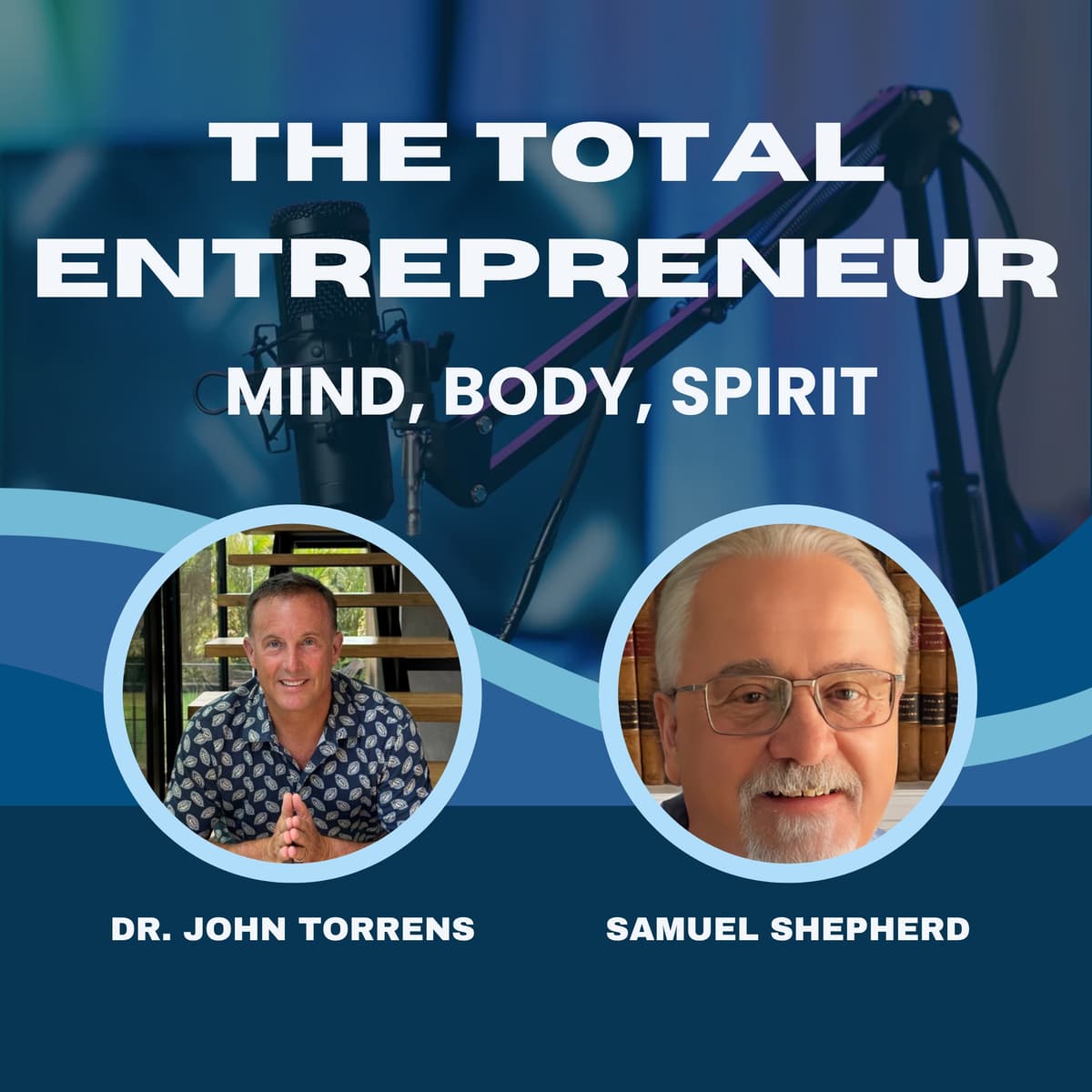
Understanding Chronic Inflammation and Free Radicals - Samuel Shepherd
Sep 17, 2026 · 01:14:16
Part of our conversations on
He said, Sam, he said, your blood is so thick right now that you could throw a blood clot to your brain, your heart, or your lung. And if it happened right now, it would take me 10 minutes to declare you dead. So off to the hospital I went, and that was the very first phlebotomy.
Samuel Shepherd, thank you for joining us on the Total Entrepreneur Mind Body Spirit Podcast. Really good to have you here.
Thank you, John, for having me.
My first question is, in 2003, you were handed a diagnosis really with not much of a treatment path. It was a rare bone marrow cancer that conventional medicine really hadn't had nothing for. And then 10 years later, you were in full recovery using a molecule that you engineered yourself. So I was wondering, what did your doctors make of all that? What kind of reaction did you get?
It turned out they called it a natural remission. They didn't have an explanation, but I knew full well at that point. It took me several years to figure out why it worked. But going off of the anecdotal evidence as to how that molecule was in other animals, it became very apparent that it had some pretty high potential of initiating free radicals. I had a pretty strong background in free radical chemistry prior to that in the polymer industry. And when I began to look at the biochemistry of this, it turns out that that single molecule that I found in those animals was one of the most powerful antioxidants known to exist.
Yeah. And, I want to get into that later too because I find that really interesting, but I'm still kind of interested in the moment in your life, right? So, before we get into the science, maybe actually just give people the 60-second version of Samuel Shepard around 2002. You got 42 patents, you worked for NASA, technology at the Beijing Olympics. What kind of problems were you solving back then and what was your life like in 2002?
Yeah. Even back into the '90s, if somebody had a pretty serious problem whether it was inside a government agency or in civilian, I had a fairly decent reputation of being able to solve a lot of these critical problems that they were coming up with. I was well-versed in chemistry and physics and engineering and thermodynamics and kinetics and the environmental sciences. So I had a lot of tools in the toolbox prior to 2003. So when it hit me, It was pretty unsettling. I really didn't anticipate that sort of a diagnosis. I thought maybe I had a little bit of high blood pressure, some coronary issues. Turned out I had none of that.
And what were your symptoms like? What made you go to the doctor in the first place and get an exam? What was going on?
My blood pressure was becoming uncontrollable. I'd lay in bed at night, and in my neck, I'd feel my heart go into what was later diagnosed as AFib. It would beat, then stop, then rapid succession of beats. And at night, when everything would quiet down and I'd try to get to sleep, it became very apparent that my blood pressure was outta control. And then on a couple occasions, my blood pressure hit very high levels. I thought my eyes were going to blow out of my, my head. The blood pressure was that high. And the one time I went in, they checked my blood pressure and it pegged on the, on the cuff. And they said, well, we must have a bad blood pressure cuff. So we went through 4 different types of blood pressure cuffs, and the maximum is 300 millimeters on a blood pressure cuff. I didn't know that until they realized that on 4 different instruments, I had pegged the exceeded 300 millimeters on my blood pressure. And typically, my blood pressure—it was not uncommon when I would go in—it would be 280 over 160. They thought I was going to blow a cork, obviously, and I thought I was going to blow a cork. I mean, I could feel it in my eyes. My eyes pulsed with every heartbeat. My neck pulsed. And the only thing that the doctor could figure out was that I was in pretty good shape from a coronary perspective to be able to handle that kind of blood pressure spikes. But when they did the blood work and they confirmed I had a hematocrit of 82, My hemoglobin was not uncommon to be 25, 26. And so I was pumping ketchup out of that. And the only thing they found from the coronary side was I had an enlargement in my heart. So my heart had enlarged slightly, they think, from the chronic high blood pressure issues. The heart was working so much harder. And it caused a little bit of an enlargement in my heart. So when I get diagnosed with this polycythemia and it was confirmed with what's called a JAK2 STAT3 mutation, I, I was, to be perfectly frank, quite shocked. I, I thought I was in pretty good shape. And then when, when he came in, I, I got a call on a Sunday night from a nurse that said, the doctor wants to see you at 7:30 Monday morning. Well, if you ever get that call, it's probably not a good call.
Right.
So I went in. The nurse actually opened, opened the door for me, and I'm the only person in there. And I go in and go into a room, and he wheels up in one of those little chairs with wheels on it. Puts his hands on my knees, and he says, "I got some really bad news." And I said, "What's that?" And he said, "You've you've got a cancer called polycythemia vera. It's pretty severe." And I asked him, I said, "Well, what the only thing I knew, you know, chemo with the standard protocols, chemo radiation. Is it something that can be taken care of surgically? Do I need a bone marrow transplant? You know it." He just shook his head no. And he said, there's not enough of these cases that would have justified the pharmaceutical companies to do the research to develop a protocol.
Wow. Yeah, I can imagine that would be devastating.
Yeah, I mean, I looked at him and I said, you know, what are you telling me? He said, Sam, this is terminal. And I said, well, how much time do I have? And he said, In your current condition, you have 10 minutes to 10 years. And I— he said, 97% of the people will perish within 10 years. And I said, what about 10 minutes? He said, Sam, he said, your blood is so thick right now that you could throw a blood clot to your brain, your heart, or your lung. And if it happened right now, it would take me 10 minutes to declare you dead. So off to the hospital I went, and that was the very first phlebotomy.
Wow. So most people who get that kind of news probably go looking for a new oncologist or a new treatment, but, and I'm sure you might have done that too, but you went looking into the literature. So what was the first question you set out to answer for yourself?
Well, I, I sort of bought into the phlebotomies because when I did the phlebotomies once a month, it, it obviously worked. And I thought in my own mind, I know it's denial, you know, you can go through all the stages of dying and all that, and But I was sort of in denial that as long as I was being phlebotomized monthly, I seemed to be able to control this. And I, I just agreed to do it. I didn't tell anybody I was dying. Nobody wants to do business with a dead man. I had contracts with government. It was better just put my head in the sand and let's just go day to day and live my life. And then about three years into it, my blood pressure became very erratic. I would have these bouts, and they had put me on some blood pressure medications to try to manage it, and it wasn't—it wasn't working because mine was more of a physical cause of blood pressure, just the accumulation of red blood cells in my bloodstream. Some people get this and they have a white blood cell problem. It depends on how the stem cells in the bone marrow are affected. But in my case, it was red blood cells and it, it, it became very erratic and I couldn't sleep at night. My blood pressure was, was starting to come back and I knew I was going to have to step up my phlebotomies to probably once every 2 weeks instead of once a month. But, uh, getting that much blood taking— taken out, it, it messes with the way you think. It, it, I think it changes your electrolytes in your bloodstream. There's, there's certain side effects of having that blood removed. Um, you know, it could be as much as 2 bags of, of, of blood per sitting. And it made me very tired. It made me very lethargic. Um, but it did keep me alive.
Yeah. And how long did you do the phlebotomy for before you went down the road of looking at astaxanthin?
About 4 years, every month.
Oh, wow. So 4 years, every month you would go for some phlebotomy. Wow. And what, like, at what point did you decide, all right, this, this isn't working and I need to do something? Like, what, what, what, what clicked in your head?
It was almost a physiological thing. I couldn't sleep at night. I'd get maybe 2 to 3 hours of sleep, and then I would wake up and my heart is pounding. So it was affecting, affecting my sleep. So I was waking up about 4 o'clock in the morning. Then I'd go try to sit up in a chair, try to do meditation, relaxation exercises. I couldn't. Couldn't get the intensity of the heartbeat, not so much the rapidity of the beats. It was the thumping. It was really pounding. And this one morning, I knew, I really thought that it was coming to a point that I was gonna stroke.
Wow.
And I didn't want my family I had lived with a grandmother who stroked. She lived for 3 years, totally paralyzed, could see out of one eye. So all those memories came back that that's how I was gonna end up also.
Yeah.
So I, probably the darkest point in my life was making a decision of Sort of sacrificing my own life not to be a burden on my family.
Wow. Yeah, that, that's, that is quite a journey you took there. So of everything available in nature, why astaxanthin, right? So what makes a physicist look at a pigment from red algae and see a therapeutic molecule?
While I was sitting there that one, that one morning trying to decide whether I pick up the .38 and end it all or do I go on, It dawned on me that God created everything here on this earth, supposedly, you know, for us to manage, to get through. And since then, I'm even more of a confirmed believer that this is pretty special what we live in. So I said, there's got to be some animals or leaves or something that doesn't get these mutated cells. And at that time, I had worked up through the Department of Defense, and I had access to a database called ProQuest, and it was used for research. It— I think it's where all the AI information now exists. It had all of the known— the knowledge of the universe in that database, and it was available to To researchers and to certain things that I was working on, I had an access code also for it. So I just queried it, and I said, list all the animals that apparently don't get cancer. And there were five that it printed off that there was no known or very low documented cases of cancer, and it was salmon. pink flamingos, sharks, elephants, and naked mole rats.
Hmm.
And so I went to Scripps Oceanographic in San Diego, and I said, you have tissue samples of these 5 animals. I said, I would like for you to do a screen on all of the organic molecules required. This is enzymes, lipids, proteins, carbohydrates, any sort of vitamins, any sort of peptides, that would— or genetic material that would be unique to that animal. I want that screened out. But I only wanted to know the molecules that had no bearing at all genetically or physically or chemically to that organism. And they came back and it took about 4 months. And they come back and they said they found one that shouldn't be in any of them, but it's found in all 5 that I had listed, all 5 animals. And it was astaxanthin. And I said, I said, what's astaxanthin? And they said, well, it's a pretty powerful carotenoid made by an algae called Haematococcus pluvialis. So I got the algae species from the University of Texas. I went into my backyard in one of those, I call them hillbilly hot tubs, but the Intex blow-up hot tubs. And I started fermenting that algae, growing that algae in my backyard. And here I am, I have it set right next to my pool in Houston, Texas. And my wife, I, is, is, is giving me grief because I'm killing algae in my pool and I'm growing it like 5 feet away from the pool. But, um, but I became very, uh, efficient at being able to grow it. I knew how to stress it to make it maximize its production of that astaxanthin. I harvested it through what's called DAF, dissolved air flotation, floated it to the surface, skimmed it off, put it in a hydrator, and I knew it was 3.8% astaxanthin, so I did my own dosing at that point.
Wow. Well, that alone is incredibly interesting, but I want to back up a little bit just to your, your thought that, you know, in nature something must exist that can help, right? Like, is, is that a— like, were you into biomimicry and, or anything like that before, or did this just kind of come to you in a moment of clarity? Because I think that, I mean, to me, that seems like the defining moment where you said, hey, something in nature probably exists to help this. So, I'm just interested in digging into that a little bit more. Like, where did you get that inspiration from?
It actually came from a, I've got to say, a religious training. I did, you know, we were always taught that God gave us everything we need on this earth. There shouldn't be anything that we need. Well, I sort of called him on it. When you're grasping for straws, and I see it in this, and you see it also in this field, people, when they're faced with a terrible prognosis, they'll seek anything they can. Life is that precious. And I sort of had Instead of relying on man, because man pretty much told me there's nothing that man can do. So what else do I have other than God and my faith? So I wasn't all that religious up to that point. But at that time, God and I got really close. There were times where I would, inside my head, ask questions, go for a walk, And everything's blocked out. All the outside stimuli go away, and all of a sudden I come back and I've got the answer that I can work on.
Hmm.
I don't know what that's called. I don't know whether that's— I don't know. But the answers, I could logically rationalize how I could see and envision how that would work. And now it's a matter is, is that hypothesis, and it goes back to the scientific method, can that hypothesis in my mind, that belief in my mind actually come to fruition? And I'd come back and work on it in my garage. I have a t-shirt that says, if it's done in a lab, it's called chemistry. If it's done in your garage, it's called a felony. And, you know, I did things that were really outside the guardrails in other fields. But so I didn't have those restrictive guardrails around me at that point. Nothing else mattered. I had— I was independently wealthy. I had 2 airplanes. I could go anywhere in the world I wanted to go. I could go do anything I wanted to do. And none of it mattered. I don't know how to explain that any better, but none of that mattered. Whether it's narcissism, self-preservation, I can't quite put my finger on it. But something— I had hit a wall and I knew I couldn't go through the wall. I either had to go under the wall or go over it.
Well, it sounds like a really interesting confluence of spirit and science, right? I mean, you had the scientific background and knowledge and you had this spirituality. And yeah, it seems like it was just a perfect mix. So, I want to talk a little bit about the science and the inflammation because I want to take listeners from this idea that inflammation is bad, which we generally know, to maybe understanding a little bit more about the mechanism. So first, walk us through the difference between acute inflammation, that's generally what keeps us alive, and chronic inflammation, which kind of kills us slowly. So, where does the switch flip and why does the body failed to shut that off, right?
Without some form of inflammation, you and I couldn't have this conversation. So, a lot of the cellular communication is done through these free radicals. So, I found the 4 free radicals that seem to be— there's actually a nitryl free radical.
4 free radicals, you said?
There's 4. There's superoxide, singlet oxygen, The peroxyl and the hydroxyl for free radical. Those four I've linked now to about 92% of all human diseases. At some point in the protocol, from the free radical generation in the mitochondria up to the presentation of disease, those free radicals that in there's an inflammation step, sort of like the Krebs cycle, but there's there's a step. In there where those free radicals are involved. So in producing plastics, I don't wanna get too scattered here in the weeds, but in producing plastics, we initiate polymerization by putting a free radical in, and the free radical generates a free radical in the styrene or the polyethylene or whatever the polymer is, and it begins to propagate. And it begins to grow a long-chain polymer that we call plastic. Well, I spent a decade understanding that part of organic chemistry on the free radical side. So when I began to look at— and I taught biochemistry to nurses and pre-med doctors and at the university, at Lone Star University in Houston, Texas, and North Harris Community College. So I understood the biochemistry pretty well, and it all sort of gelled like, okay, this is an immense human health is an immense balloon, water-filled balloon. What can I do to focus everything in? And that free radical biochemistry is where I chose to focus, and it turned out to be absolutely correct. The The, the activity, the chemical activity and the ability of free radicals to not only keep us alive, there is a portion of inflammation that's required and it can be acute. It, it can be operating at a certain under-the-sheet level constantly in our mitochondria that allows certain chemical processes to happen. But if we lose the ability to control the inventory of those free radicals as we get older, it becomes a chronic inflammatory problem. And now they're— whatever they touch, they're going to affect. And now what we know is that the lowest oxidation state in our DNA is the guanine. So the G portion of the DNA is the one that's being attacked by these free radicals. The higher you make the concentration in the cell, the higher the probability— it's a statistical game— that it will cross into the nuclear envelope and begin to react at the DNA level, causing DNA mutations. We now know that it's happening at the G level of the DNA, and it's a free radical attack.
Before we signed up for this interview, I didn't really know anything about astaxanthin. So, I had to look it up and do a little reading on my own. So, you described the 4 free radicals that produce most of the inflammation, right? But, it seems like what I've read anyway, and again, it's just a very cursory read, but a single astaxanthin molecule can neutralize more than 30 free radicals. So, I was hoping you could explain that a little bit more because I know vitamins C and E, they can kind of do similar things. So, I was hoping you can maybe dive into why it's so much more effective added or better than those. Other molecules?
Yeah, um, the astaxanthin is a really unique molecule in that it has, um, a large, um, phenol group on both ends, sort of shaped like a dumbbell. Then it has a number of conjugated alternating double bonds down, down the carbon chain. So it double bond, single bond, double bond, single bond. Well, When a free radical comes in and hits that astaxanthin double bond, the double bond opens up, the free radical attaches. So let's say it's a hydroxyl free radical, so it attaches. Now I have this OH hanging off of the backbone of the astaxanthin. The other part of that double bond comes down and it will scavenge another OH. So now I have 2 hydroxyls hanging off of that backbone per double bond. Now, astaxanthin itself is fat soluble. It's soluble in lipids, not in water. So it we bioaccumulate it. It's why salmon are pink. They eat enough of it and bioaccumulates in their lipid layers, and it stays in there. The half-life is about 38 hours. So you lose half of it about every 38 hours. One molecule of astaxanthin. Has 16 of these conjugated double bonds and the ability to absorb on its phenolic ends these hydroxyl free radicals. It's some, and that's what makes it the most powerful. The other big advantage we found later on when we were doing this work is that it is not ever converted into a pro oxidant like vitamin C. Vitamin C has to be processed through the liver. Well, in that processing, it generates inflammation. The same thing with fructose, fructose and alcohol. But vitamin C will eventually become a pro-oxidant. So you get an inflammatory kick at very high dose of vitamin C that can be detrimental to your health. Low dose can have a very anti-inflammatory benefit to it. But if it has to be processed through the liver, you can get a pretty severe non-alcoholic fatty liver disease component associated with some of these more powerful antioxidants like vitamin C.
Wow. Yeah, I didn't know that, and I'm sure most people didn't. So you mentioned fructose, and I think most people file fruit under the unambiguously healthy category, right? But, it sounds like maybe there's a little nuance there that needs to be added.
Yeah. There's no nutritional value in fructose at all, zero. Most of our cholesterol is produced from fructose or alcohol. It's not coming from animal fats. That's why it got lowered in the food pyramid with the Maha movement and all that. They recognized it also. But fructose can't be used by a single cell in your body. So when you ingest, the reason we ingest fructose is it's the sweeter. It satisfies the human desire for sweetness, right? So it's a purely human desire to eat fruit. It's nature's candy, right? So when fructose enters your body in whatever form, it can be high fructose corn syrup, it can be Fruit. Now, a natural fruit has a little different because it affects the absorption rate in the small bowel.
But that fruit is because of the fiber that's in it.
It is. It's it's the it's the diffusion component. There's a resistance when you have fiber versus drinking pure sugary drinks. That's immediate. That gets into your small bowel very very quickly. But when you combine it with food at a certain time, or it's a high fiber food, it has to work its diffusion through that fiber to get to the wall of the small bowel and finally be absorbed. Now, in some cases, the the fructose content can get into the lower part of the small bowel or even into the colon and begin to ferment. That fermentation process. Can generate a lot of inflammation. Can also be the cause of irritable bowel syndrome, and I've noticed it in people who eat large amounts of fruit like peaches during peach season. They'll get a bad case of diarrhea. Well, that's inflammatory. That's what's causing that is the fermentation of that fructose. So fructose has always been a chronic poison. I contacted the director of CDC in Atlanta. And I said, why are you promoting fruit? This goes back to 2015, by the way. Why are you promoting fruit? The fructose is a poison. It's the primary cause of high cholesterol. It's all converted into triglycerides. They called it the cop's disease. If you eat too much sugar, spend too much time in a donut shop, your triglycerides go out the roof. The triglycerides are later converted into LDL cholesterol. And that's why we have such a struggle with cholesterol. We thought for years it was being related directly to fat that we ate in animal protein. Turns out it's not. It's coming from sugar and from fructose.
All right, so apple juice, orange juice, definitely we could see why that could be a problem. But like eating an orange or an apple, it's going to be a little bit better because of the mechanism, and it's going to kind of slow down with the diffusion with the fiber. Correct.
The one place that we've— I've told people that have chronic disease like cancer or some of these pretty severe, just cut them off of fruit. I don't eat fruit. I'm, I'm a meat and potatoes and vegetables guy. But, but it turns out that most people can handle with their glutathione, their catalase, and their, their cellular antioxidants. Enough to handle the free radicals generated from the fructose ingestion at about 4 grams of fructose per 100 grams of fruit. So when I looked at the antioxidant content, for example, in an apple, the antioxidants are contained in the skin and in the seeds. So when you eat an apple, eat the whole apple.
Right. Don't peel it, in other words.
And eat everything. Eat the seeds, eat, eat everything. But When I calculate in a Fuji apple, the big apple, it turns out that it's more inflammatory than it is healthy. So it used to be said in this, you know, up until 1960s, that an apple a day would keep the doctor away. Now an apple a day will bring the doctor to your house. So I calculated What size apple should we be eating such that the antioxidant content of the skin and seeds just offsets the free radical generation of you eating the flesh of the apple? And it turns out to be almost 0.8 inches in diameter, about that, about that big around. That's as big an apple that you should be eating. But they want to sell more apples and make more money. So they've hybridized the apples to make them very, very large. Like the Fuji apples, the real sweet apples, because they sell better. There's more money involved in them. But the ideal apple is a Granny Smith about that big around, about an inch in diameter.
And Granny Smith, is that, is that just because it's got lower, lower levels of fructose in it?
Yeah. Yeah. Okay. Much lower, lower fructose.
And like in, in terms of the highest level of fructose, is it, what is it? Is it Fuji or is it Honeycrisp or what kind of apple has the highest?
It's the ones that they hybridized to generate the highest concentration of fructose.
Right. And they're nice and sweet and tasty and big.
Yeah, very delightful. Yeah. Alcohol and fructose are processed the exact same way. So giving a 9-year-old or 10-year-old 3 sugar sodas a day does the same liver damage as if you gave that child 3 beers a day. Exact same liver damage. So, in in my case and probably in yours, you're seeing more and more younger kids having fat non-alcoholic fatty liver disease. Well, it's coming from the sugar, the fructose side of the sugar molecule. Yeah, that's interesting.
And I you know I wasn't aware of any of that that you just talked about. You know, I just assumed that yeah maybe there's. the fructose in the fruit, but it's offset with the fiber and you get all these other nutrients and stuff. I'm gonna have to take a closer look at that, right? Because as you're trying to dial things in and optimize, that seems like a, so to speak, relatively low-hanging fruit, right? To manage your fruit intake.
Yeah, yeah. Typically, we have 3 cellular antioxidants that work. We can do a lot of stupid things when we're younger.
And get away with it.
Yeah, yeah, get away with it. I still like to do a lot of those stupid things, but But I can't. So, we have glutathione catalase, superoxide dismutase. These are 3 cellular antioxidants that's produced inside the cell. And, they're only functional if they're produced inside the cell with the proper amino acids.
So, in other words, if you get an IV drip with glutathione, there's really no effect to that. Is that what you're saying?
No, but IV drip of glutathione will neutralize the free radicals in your bloodstream.
In the blood. Okay. Yeah, gotcha.
It's very difficult to get it through the cellular membrane because there's not a channel. It's only by high diffusion rate can you even penetrate the phospholipid membrane of the cell.
Gotcha. So, all right. So, the IV drip has some benefits, but it's not going to act in the way you're describing when it comes to—
Correct. It's not going to act intracellularly. It's going to act extracellularly.
Gotcha. Okay.
So there is some benefit to it. But in the work we did with looking at glutathione levels, for example, we found that at age 42 in women and about age 50 in men, our ability to produce glutathione drops off by as much as 80%.
Right.
So this is the onset of our age-onset disease progression That we sort of normalize. You know, we sort of expect that we we get old, we get sick, we die. Well, now we know the reason why is because we're not producing those antioxidants at the cellular level.
And and those and so name the antioxidants again.
There's glutathione. Yeah. Catalase and superoxide dismutase or SOD S O D. Those, those are totally dependent on the proteins like tyrosine, guanine, leucine, isoleucine. So the cell takes those amino acids and they make glutathione intracellularly because that's the only way you can get it inside the cell close to the mitochondria. To capture those free radicals when they're generated by the mitochondria. It's all a statistical game. It is a probability.
Yeah. So, when we talk about people just writing off their symptoms as just getting older, it sounds like it's really chronic inflammation sort of announcing itself, right? Like, hey, here we are.
Sure is. And, in engineering, there's an overall Equation in minus out equals accumulation. So the rate of generation minus the rate at which you can get you you can make it go away equals the accumulation. Well, it's the accumulation of these free radicals is what causes disease. So I have two parts in the left side of that equation. I can either reduce the generation rate or I can increase. The takeout rate. Well, Asta's the the Velasta increases the takeout rate. Your diet decreases the generation rate. So if you can move both sides of that left side of equation, the inventory or the accumulation term goes away and your disease goes away. Your liver picks this up. If there's a large accumulation, you'll see markers like your high sensitivity C-reactive protein marker. It'll start to elevate. So we use it as the single marker. So we want to measure your hs-CRP at least every 2 or 3 months after the age— in men, after the age of 50. We can actually measure it before, but you do it on a 6-month schedule there. If that number's under 3 milligrams per liter, you have less than a 3% probability of generating a chronic disease.
Would you say 300 milligrams per liter? Is that what you're saying?
3 milligrams per liter for your hs-CRP. If it's under that, you have less than a 3% chance of acquiring an inflammatory disease. That's the marker. So what Valasta does, for example, COVID, we, we had probably well over 100 people that were— that come down with COVID None of them that were taking Valasta actually died. So it's not the COVID virus that kills anyone. It's the inflammation or inflammatory response to the virus that killed everyone. So, if we could stop and interrupt the inflammatory cycle, nobody died. Nobody got disease so severely that it caused them to fall outside their life envelope. Yeah.
So, I want to talk about Velasta now because this is the result of your work and your patent. And, I was looking at the patent earlier and it describes reacting astaxanthin with a monosaccharide under microwave energy just for a couple seconds is what it seemed like. So, this whole process of invention has always been fascinating to me. So, walk us through how you arrived at that, how many failed attempts, how did you know when you finally had it, and that sort of thing.
So, when it started out, I was eating the algae. So, just eating the dried algae that you'd been growing on the pool? Yeah, I knew it was 3.8% astaxanthin by analysis. And so, I knew I could calculate how many grams for a specific dose. So, it's a red algae. And red things in nature are usually pretty toxic to your liver. So I wanted to be very careful, but I was also put in a position where my life became not so much of a, of an issue because if I knew I was going to die, so I'd reached a point of saying, why not try it? Right. So I started out at 4 to 5 milligrams a day so I could calculate how many grams based on 3.8% astaxanthin in the algae. How many grams of the algae I had to eat? So I started there, and I was looking to see, checking my blood work to see if my AST and ALT and my EGFR was getting out of whack, and they didn't. They stayed really in good shape. And at that time, my A1C, just to give you an example, was about 6.2. That was my A1C. So I started this at about 5 milligrams and my A1C dropped down to about 5.8. I didn't change anything.
Wow.
And I'm going, okay, that's, that's it. Everything's going in the right direction and it's not killing me eating this red, what I thought might have been toxic algae. So the other thing I noticed is that my phlebotomies got pushed out instead of once a month, about once every 2 months. Statistically, it wasn't significant, It could have been caught just in the noise of, of lab error, but at least it, it, it was moving in the right direction. So then I got gutsy and I said, let's just triple the dose. So I went to about 15 milligrams a day and my phlebotomies got pushed out to once every 4 months. Statistically, that was significant. And I thought, okay, I think now I've got 3 slopes of the curve. I've got the control with no astaxanthin. I have 5 milligrams with this slope. Every 2 months I'm being phlebotomized. My hemoglobin is climbing out. And then I've got 15 milligrams every 4 months. So I had 3 slopes of the curve. So there's a there's a pharmacological equation that you can use for dosing. So I applied that same equation, and I said, "How much do I have to take so that I'm never phlebotomized for the next 50 years of my life?" And it turned out to be 96 milligrams. So I started eating essentially 100 milligrams a day, and my phlebotomies flat out. Ended. My hemoglobin became 15 to 17. I didn't have any deviations outside my range. My hematocrit became quite normal. My A1C became normal. I began to lose weight, which was another real interesting component to it, but it dropped my insulin resistance. So this, this really got me intrigued. as to how that was working. My own mother, who was a diabetic, type 2 diabetic, since she was 48 years old, at 88, they told her that— 'cause she was taking 64 units a day of insulin.
Wow.
And they told her when she was 88 that her eGFR had gotten down under 30, and that she was looking at dialysis. She refused dialysis. So I asked her if she would go on this. She went on it. Her eGFR came back up into the upper 50s, low 60s. Her insulin levels went from 64 to 5 units a day, and she was still suffering from low blood sugar at 5 units per day. And I finally told her, I said, now, I eventually moved in with her to help take care of her. And I caught her getting up at 3 o'clock in the morning having donuts and, and milk or ice cream or ice cream. And I said, what are you doing? She said, well, my blood sugar dropped. I said, well, stop taking insulin at night. No, no, I'm not doing that. I said, why not? She says, because I like to get up and eat. Donuts and have ice cream and the insulin offsets my sugar. I said, you're, you're no different than a cocaine addict. That didn't go over big, to put it mildly. But she wanted to maintain her lifestyle, so she was afraid to go off of the insulin because the doctor would stop prescribing insulin for her. But it completely cured her after all that period of type 2 diabetes.
Wow. So, but you could have just kept doing 100 milligrams a day, right? But you went down a different path and you're like, hey, let me figure this out. And so, what was the benefit in your mind of trying to formulate what eventually became Valasta versus just kind of creating or growing and harvesting and taking the algae?
It was operational. And, that's a critical point in this. I was eating the algae. I didn't want to eat the algae. And as a chemical engineer, I knew how to extract the astaxanthin with a process called supercritical CO2 extraction.
Right.
So I knew how to get the pure astaxanthin out. So when we did that and I began, I put it in olive oil just to make it soluble in a liquidy form. And I began taking that. Well, when I began taking that, my phlebotomies— I had to be phlebotomized again. My hemoglobin began to climb out at the same dose level, what I thought was the same dose level. And I thought, what is this? So I went in, had to have a couple more phlebotomies after I switched from eating the algae, the dry algae, to this higher form of astaxanthin. a more liquid form, a purified form. And that was counterintuitive to me. It just didn't make sense to me, the pure that it is, why it didn't have the same effect. The only conclusion is that I altered chemically, I inactivated the astaxanthin.
Ah, so that was by mixing it with whatever you mixed it with?
Or by the process.
Or the process that you had to do. I see. Okay. Yeah.
So So that's how I sort of came to the conclusion that I chemically altered the astaxanthin either through inactivity or I chemically rearranged it or added what I thought was a CO2 molecule to it and it became a different molecule. So I sent it in and had it analyzed and I had the algae analyzed and I had the processed, the pure material analyzed. The astaxanthin that existed in the algae was in 2 forms. There was a liposomal form, which the fatty acid was directly connected to, chemically connected to the astaxanthin. And there was another form where a glucose or monosaccharide was attached directly to the astaxanthin. So it had 2 different molecules. One was a glucocytic and the other one was a liposomal, chemically attached, not physical mixture. They were chemically attached. And then when I analyzed after that 2,200 PSI supercritical extraction process, analyzed the astaxanthin, I had just the pure astaxanthin. There was no glucose attached, nor was there a lipid attached. It was pure astaxanthin. So I cracked that sugar off or I cracked that lipid off in the process of getting the pure molecule. So that is when I woke up and said, that's why this isn't working. I'm not absorbing it because when your body and your cell sees that glue, it's called a Trojan horse. And we did it in bioweapons development to get things in with a time delay. So that when you poison somebody, it took them three days to die. The operator could get out of the country. So there were certain reasons why why we did that in a bioweapons program. But so I thought, okay, I cracked that glucose molecule off of that astaxanthin molecule. So then the way that we put glucose onto organic molecules. Is think of a microwave oven. What it does is it's set at a frequency that causes the OH in the water molecule to vibrate very rapidly. It's called a resonant frequency. So I knew, and you can look at some of the textbooks up here, um, I spent 15 years understanding how that works. And we developed electromagnetic pulse weapons and auditory weapons, but I got very familiar with understanding that. So there is a certain resonant frequency that causes the OH on the astaxanthin to vibrate and the OH on the sugar molecule to vibrate. So I get that energy without the addition of temperature to the point that the OH on the astaxanthin Grabs a hydrogen, it peels off a water molecule, and now I have an ether linkage joining the glucose to the astaxanthin. It's chemically bound. And now I had my Trojan horse. Now when the— when that glucosidic astaxanthin gets into your small bowel, your cells see that sugar. Since it's chemically bound, it drags the astaxanthin with it. And that's how it gets into the cancer cells. So when cancer uses 16 times more sugar than a normal cell uses, and that's why it generates so many more free radicals. Every one of those OHs on the sugar molecule, when it's processed in the mitochondria of a cancer cell, becomes a free radical. So it generates a slightly acidic pH around the cancer cell that kills adjoining cells. That makes space for the tumor to grow. That's the mechanism of tumor growth.
Alright. So, let me back up for a second because I think I might have something a little confused in my head. So, the natural form of astaxanthin, right, when it's got the— Sugar molecule. Yeah, it's got everything involved and that was working. When you did the supercritical CO2 and you kind of broke that apart and you had the pure astaxanthin, wasn't really working because you kind of needed those other molecules like you said as maybe a Trojan horse or something. You further processed it. It almost seems like you brought it back to its natural state, or did you— is it— how is it different than the natural state?
It's not.
Okay. So, all right, got you. So, so then what— then what's the benefit of that versus just kind of doing like regular algae and growing it? Is it really just that it's in a better form or something?
Yeah. Okay. If you— if you grow the algae and you eat the algae, you're going to be eating a lot of algae. Got you. Yeah, you're going to get into the same problem I got into was it becomes a major portion of your diet. Right. Okay. For example, salmon accumulates astaxanthin. It's what turns the salmon pink. But you have to eat 6.5 pounds of salmon every day to get to that dose level. Right. So algae, although it's a little higher in concentration, you're looking at eating a lot of bland red algae if you want to do that. Plus you have to grow it, you got to keep protozoa, there's a quality control issue.
Yeah, totally get all that. I just wanted to make sure I had it straight. So you did kind of bring it back more to its natural state, but just in a delivery format that was, it was just much, much more convenient, easier, and that sort of thing.
And it's set— when we filed for the patent on it, and the patent is the process of putting the glucose onto the astaxanthin, So the title of the patent is a method for the process of using glucosidic astaxanthin for the treatment of disease, particularly for the treatment of cancer. And that sent the FDA through the roof. So I went to my attorney and I said, they're not— the Patent Office isn't going to approve this title. And They ended up approving it, and we did nothing more than to take industrial astaxanthin and put it back into its natural form. And the Patent Office granted me a patent on a natural product.
Hmm. Interesting. I didn't even know that was possible.
I didn't either. I was totally amazed, but it was the process that the patent office looked at. Yes. Of how to do that, because we had done that and filed a lot of patents, by the way, and some of them are not patented. Where you pharmaceutical companies do this all the time is develop a synthetic molecule in the lab, attach a sugar molecule to it, and that's what makes it effective in your body as an antibiotic or as, you know, a hormone or whatever it gets. It's, it's an absorption issue. So when I was eating the, the processed algae and the pure astaxanthin, I was well over 800 milligrams just to get my phlebotomies turned again. Whereas if I was eating the pure algae equivalent was 100 milligrams. So I had to eat, and and there's two ways to get chemistry into your cells. It's either through channels and through biochemistry, or it's by absolute brute force or diffusion. You you increase the concentrate. It's called concentration gradient. You increase the concentration outside the cell to greater than it is inside the cell. And just by brute force, it will diffuse through the phospholipid membrane and get in. And that's what happens with type 2 diabetics. They have to increase their blood sugar levels so high they can't— they're insulin resistant. And it's by concentration gradient that the cell can even get sugar into its mitochondria to survive, because insulin, which would open up the channels, which is more effective, isn't, isn't effective at all. Right. So that's the 2 issues that we were looking at. One was brute force. The other one was chemically, I was now adding the astaxanthin via the glucose channel.
Yeah. So it's interesting because the, you know, the supplement industry has a little bit of a credibility problem in some places, right? Because, you know, they overclaim, there's thin evidence, a lot of noise. But it seems to me like you're selling something a little different, some real science into that market, but you're still kind of legally restricted from stating plainly what you believe your product does. How do you thread that needle? How do you, how do you deal with all that?
The, the Patent Office requires us to put the title of the patent. The FDA says that this product cannot be used to treat, diagnose, or cure any disease.
Right. So, so yeah.
2 agencies. Yeah. And we're complying with both. We put the label on from the FDA. We we have the patent title that we have to divulge also. Yeah, let the people decide.
Yeah, and I guess the results will speak for themselves, right? Yeah. Yeah. Wow. And where can people find Velasta? Like, where is this? Do you have just a consumer channel, or they can find it in a store?
It's velasta.net. We're currently in 26 countries, all 50 states through a distribution network. It's sold worldwide. We have distributorships in Australia, Singapore, Europe. We have a marketing center in Europe. And we've done no real sales or marketing. It's all been by word of mouth through the treatment of people's disease. It went completely around the world and we didn't do any. Any sales or marketing. It was this person gets cured of cancer. They tell everybody, and it went completely around the world. It's it's an interesting business to be in. I testified in Washington in 2019 to a bunch of senators, representatives. The five majors were there: Johns Hopkins, Sloan, MD Anderson, Mayo, and the Cleveland Clinic. And they were shocked when I detailed to them the four free radicals that cause 92% of all human death. They were shocked. The director of oncology from John Hopkins come up to me after the meeting. You went on, supposed to go on for an hour, went on for 2 hours. And he said, he said, you have this figured out. I said, yeah. I said, I know what, why people are getting these diseases. And he says, he said, I'm the gatekeeper for all the monies that move from the legislative branch into the NIH. He said, I'm going to allocate money to this. And I volunteered. I said, I'll help. You don't have to pay me. I said, I'll come and help. He said, no, you just need to go away. That was his comment to me.
You need to go away.
You need to go away. And I looked at him and he said, these all have to be unbiased, peer-reviewed research papers. And I understood where he was coming from. Gotcha. So I'm— so I'm okay. But at first it shocked me. And now since then, you can Google NIH and astaxanthin and whatever disease— cancer, diabetes, irritable bowel, Alzheimer's, Parkinson's. And now since 2019, the NIH has confirmed all of my research.
Wow.
It's all out there, peer-reviewed, independent of me. So you don't have to believe anything that I'm saying here because now they've, they've actually figured it out also the same way that I figured it out, and they've come to the same conclusion.
And even with all of that peer-reviewed research, you still can't make certain claims because there hasn't been a clinical trial. Is that the idea?
No, I think it has to do with just the FDA control. They've given us what's called GRAS exemption, generally regarded as safe exemption. So we're operating under that right now. But, but from a Valasta point of view, because I'm only the supplier of the technology, I'm not an officer of Valasta. So I developed the product and I licensed it to Valasta. So if they want to come after me, they can come after me. But when I go to— one thing that's got them terribly on edge is that when I show up and present to an attorney that a U.S. agency called the Patent Office gave me this, how are you going to counter that now? Right. I mean, it's in the FDA is wrong. Yeah. And if there's doubt, I win. So the FDA doesn't— Dave, I got sued by the state of Oregon after my 2019 presentation in Washington. The state of Oregon sued me for practicing medicine without a license. Well, I end up winning that because I'm a research doctor. I'm not a prescribing doctor. I'm not a medical doctor. So I won it under the First Amendment. No government agency or employee can interfere with my right to do research. Right. And I ended up winning that case, and they backed away. And not only did they back away, they investigated the oncologist that filed the complaint because the oncologist lost a patient who we cured of cancer without chemo, without, without any involvement of him. He got ticked because It cost him the insurance and pharmaceutical money. Oncologists are the only doctors that get paid cash when they put somebody on chemo or radiation treatments. So I did not know that. Wow. Yeah, they're the only doctors. So only about two out of three cases from PET scan are actually cancer, and yet 100% of those red PET scans by an oncologist. They'll put you on chemo, but only 2 out of 3. A PET scan cannot differentiate between cancer and inflammation lesion. But if an oncologist reads it, 100% of the time it's cancer because it's a quarter of a million dollars in his bank account when he puts you on chemo. Each patient.
It's unbelievable. And it's, it's the, it's the worst of the worst. Yeah. That's terrible.
And so I ended up in July working through that lawsuit. It got settled. They backed— the state of Oregon backed away. And then in November, I was hanging Christmas lights in my front yard and somebody took a shot at me, blew my fence up, missed me by 4 inches.
Wow.
With a .223 round, hiding in a pile of leaves across the street in the woods. And just about got me.
Wow.
The, the, the hole in the fence, I could show you pictures, but I was wrapping Christmas lights around my fence, had the lights in my left hand, and I always have them plugged in because invariably I'll pull a plug or something. And it was a pretty lengthy run down the fence. And well, my lights went out. So the plug was right there. I must just pulled on it too hard. My lights went out. So when I reached back for the plug, he shot and the bullet come through chest high. Would have been a perfect heart shot.
Wow.
.223 hollow point came through my fence, went underneath my armpit only because I was holding my arms up. I got hit with all this wood come up and hit me in the face. And, and I didn't— I— and then I heard the shot and I yelled up. I said, stop shooting, and I jumped behind a truck that was there. And I wanted to peek out, but I didn't.
Yeah.
So I bolted for the house. Went in, called the sheriff. There's a police report filled out on the whole thing. And I— the sheriff came out and I showed him the bullet hole. And he pulled his— he put a wire in it and the trajectory was right at almost ground level. So I thought it was maybe a deer hunter, to be honest with you. That's what I really thought. I didn't know it was personal or anything like that. So he walked up there and I'm walking behind him and he turns around and he says, no, you need, you need to go in the house. I said, okay. So I went over and got on the porch and watched him walk up into the woods and he kicked around a few things and he looked, he came back and he put his weapon back in his holster and He said, Mr. Shepherd, what do you do for a living? I said, well, I said, I'm a research scientist. He said, well, we need to go in and talk. I said, okay. He said, so I started to tell him what I was involved in, and he's filling out this report. He said what he found was a pile of leaves that somebody had put up. Somebody had been laying in them. He said they'd been laying in them for longer than 2 hours because he found where somebody had rolled over and urinated. There was a wet, a muddy spot there, and there was a boot print. He was able to cast that boot print. Wow. And I said, you think it was a deer hunter? He said, no, no, this is no deer hunter. And he said, I've got to turn this over to the FBI. I said, okay. Well, Agent Reichert, I think it was his name, Reichold, he ends up calling me about 2 days later on the phone. And he said, Mr. Shepherd, he said, I understand somebody took a shot at you. I said, yeah. I said, I still think it's a deer hunter. He said, no. He said, it's no deer hunter. I said, how do you know that? He said, well, first of all, it's a .223 round explosive hollow point. He said, the second thing, it's a flat trajectory. Deer hunters shoot from tree stands.
Right.
He said, the third round is every deer hunter knows not to shoot towards houses.
Right.
And I said, I said, you really think? He said, he said, yeah. He said, I, I know. He said, he said, you have any reason why they would have wanted to take you out? So I started explaining to him what I was doing. And he said, oh no. He said, I have your whole file in front of me. I know exactly what you're doing. And he says, right now, he said, I've got 17 cases just like yours that I'm working on. You're my only survivor.
Wow.
And that made me sit up and think that all of this conspiracy crap that I thought was just bogus, it was real. And I said, well, how do you stop it? This was in the end of November, after between Thanksgiving and Christmas of 2019. And I said, how do you stop it? He said, well, he said, it has nothing to do with you personally. He said somebody's trying to stop the information. He said the only thing you can do is go public with everything you know. So when you go on YouTube, you'll see about 20 YouTube videos that I did from December of 2019 through January and February of 2020. I spilled my guts. I spilled it out there. I— yeah, I did everything by disease as to how it works. And I haven't had a problem since.
So they really were that married to their, their revenue stream and protecting their business that they had to take you out?
Yeah. And this, this FBI agent said he wanted me to know that I was shifting a trillion-dollar-a-year business.
Well, yeah.
And he said, Sam, he said, this has nothing to do with personal. Don't take this personal. He said, this has to do with trying to protect the pharmaceutical side of this. And man, man, I still struggle with trying to believe that that is real. But I've come to the conclusion with what I've experienced, there's a pretty good story to tell. About all of this, and I'm going to tell the story.
Um, I hope you do. Yeah.
So, um, I'm hope— hopefully by this time next year, at least the public gets a blip of how corrupt our medical industry has, has really been.
Yeah, I mean, you know, it's starting to become more obvious, right? Like, just You know, because now science gets disseminated so much more quickly and easier and people are starting to see the deception, right? Even just like with the food pyramid and, you know, that fat was the problem, right? And COVID, right? Exactly. Like, just like what you were talking about earlier.
Yeah.
So it's, it's, and I think it's hard to swallow the fact that these agencies that are supposed to protect us and the companies that say they're doing things to save our lives are actually doing the opposite. It's a really hard pill to swallow, so to speak.
It's terribly difficult. I grew up in this industry. Yeah. You know, for 40 years of my life has been sort of trusting the science, trusting the biochemistry, that what we're doing is, is morally and ethically correct. And yeah, and then I find out that even that might, might have been a psyop. Uh, uh, routine that I wasn't clever enough to understand.
Yeah. Well, well, you were focused on the science, right? That's what you were into. And, and they, they had you locked into that, right? Yeah. So that seems pretty normal. And I would just want to back up and say that like the, the people, the humans that work in the pharmaceutical industries, probably, you know, nothing to do with any of this, right? It's the people at the top. Yeah, they're, you know, like, they're well-intentioned people for sure, trying to, you know, do right for the world. But yeah, it's, it's the, the shareholders or the CEOs or the people in power who are, who are causing some of this.
Even the clinical studies now, uh, I, I know a lot of researchers who were involved in clinical studies, so, uh, they were in bed with the FDA to the point of if they just got a 30 to 33% improvement in their clinical study, the FDA would approve it. Well, where I operated from was I had to be 97%. I had to be 3 sigma. I had to be 97% confident before I would go do something. And that was always my struggle with the supplement industry was I could never get there. I can always You know, when people would come to me and say, "Hey, you need to try my product," and I would say, "Well, how does it work?" They say, "Well, I don't know how it works, but I feel better after being on it." Well, that's a red flag to me. Right. You know, I'm going. Feelings don't matter at that point. And show me how it biochemically works. It took me eight years. Of my of my life to try to figure out why this worked to the point that I felt comfortable with even talking about it. But all the the stars sort of aligned because the people that were coming to me were in desperation, and they said, "Well, you're working on this." Well, I moved from Texas to South Carolina. A group of pretty well-heeled guys said, "You need to come here." We'll put you at the Navy Yard under tight security. You grow the algae there. And so I was offered a level of technological security by those guys.
Wow.
And so we were very successful in developing it. And then Lori Cockrell was her name, a friend of mine I hadn't seen for years. And Mississippi went to a party together and she came in with a bandana, no hair, no eyebrows. And I said, what's going on? She said, I've been given 2 to 4 months to live, inflammatory breast cancer. She said, I understand you're working on an anti-cancer material. I said, yeah, but nobody's supposed to know it. Well, the guy invited me to the party. I told him. So never trust your friends with a deep secret. That's the lesson there. But we ended up giving it to her and she had brain tumors and she had, um, colon tumors. And 42 days after putting her, I, I gave her 3,000 milligrams a day.
Hmm.
And I did that for 42 days and her cancer went away. MD Anderson was shocked. She went back down, she was home with hospice. And hospice called MD Anderson and said she's not progressing.
Wow.
So they called her back.
Well, you just ruined an entire business model.
Yeah. And that ruining an entire business model, I could have cared less about because it was my life.
Yeah, I know. Of course.
More important than any other business model.
Right. And you would think that— yeah, I know. It's, it's, it's a crazy, uh, That's quite a story. Jeepers. Yeah. Well, Samuel, thank you so much for sharing it. I mean, this went to a place that I wasn't expecting even though I had done the research pretty well. I really do appreciate you sharing your story about your diagnosis, your journey with astaxanthin, and just the last few minutes of talking about your journey between the FDA and the patent office and your attempted Yeah. Assassination. Yeah, that's, uh, that's quite a story. Well, I feel like there's more to tell here. And yeah, maybe we, maybe we can, uh, revisit this again after a period of time because I'd love to dive more into, uh, the next phase for you here as you, as you start to tell the story more.
Absolutely, John. Thanks for having me. And hope is still alive, you know.
Yes. I feel it too.
I get 20 people a day dying of cancer on phone calls. And it can be a very depressing side of existence. I didn't go into medicine because I didn't want to deal with people, and I guess God had another plan. Yeah, because now I'm in the latter part of my life, I'm dealing with people. So, right, so, so much for your plans, right?
Yeah, yeah. So just one more time, the, the website is valasta.net, V-A-L-A-S-T-A dot N-E-T. And, people can go there and check it out for themselves. And, like you said, they can Google the science. They don't have to believe you, they can read it for themselves.
Very good. Thanks, John.
Alright. Thank you, Sam. Appreciate it.
About This Episode
Understanding chronic inflammation and free radicals starts with a question most of us never think to ask: why does the same biological process that keeps us alive also seem to slowly wear us down as we age?
Samuel Shepherd spent decades as a chemist and engineer, holding 42 patents, working with NASA, and solving technical problems for government and industry, before a serious health diagnosis sent him deep into the biochemistry of free radicals and antioxidants.
In this episode, he shares his personal story with John and walks through his perspective on understanding chronic inflammation and free radicals: what they are, how they differ from the acute inflammation that helps the body heal, and the antioxidant chemistry he spent years studying afterward.
What comes up
- •Samuel's personal account of his health diagnosis in 2003, and the path that led him to study free radical biochemistry.
- •His explanation of the difference between acute inflammation (which keeps us alive) and chronic inflammation (which he connects to age-related disease).
- •A breakdown of the four free radicals he focuses on, and the basic biochemistry of how antioxidants work at a cellular level.
- •His explanation of astaxanthin, a carotenoid pigment, and why he found its molecular structure compelling from a free radical chemistry standpoint.
- •His personal research process, including how he arrived at the compound that became the basis of his company.
- •His views on fructose, fruit, and inflammation, a more contested nutritional position worth weighing against mainstream dietary guidance.
- •The story of his mother's experience with type 2 diabetes, told from his personal perspective.
- •His account of the product's use during COVID, offered as his own observation, not a clinical finding.
Keep listening
More on Body
About the Host
Dr. John M. Torrens
5× Inc. 5000 entrepreneur, Professor at Syracuse University's Whitman School of Management, author of Lightning in a Bottle, and TEDx speaker on ADHD as an entrepreneur's superpower.
Browse all podcast guests →Book a strategy call →