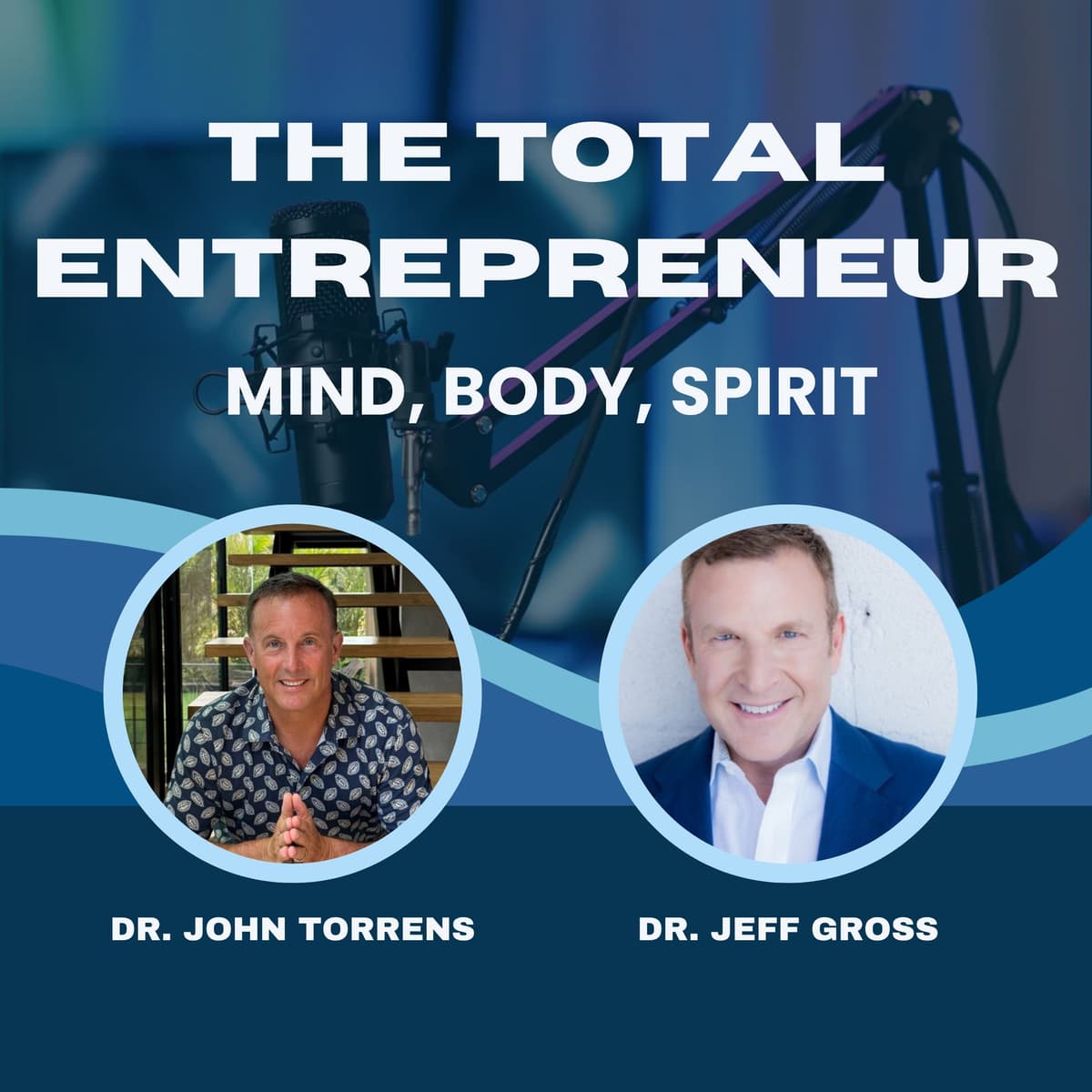
Peptide Therapy for Longevity: What's Real vs. Hype - Dr. Jeff Gross
Sep 13, 2026 · 00:52:18
Part of our conversations on
So, when people say, don't get those Chinese peptides, the joke's on them because they're really all from China.
Dr. Jeff, great to have you here today, and I'm excited to talk about all things peptides with you.
I'm excited too. It's such a popular topic. Thanks for having me.
Yeah, very popular lately. I mean, I'm kind of Dipping my toe into the biohacker world, but peptides are, are all over the place. So, I wanted to start with a question about BPC-157, that peptide specifically. The FDA effectively banned it back in 2023 and then this February pretty much reversed course on it. So, I was wondering for your opinion on were they wrong then or were they wrong now or is there something in between?
They're always wrong. They're always wrong. What are you talking about? So, yeah, let's unpack that because BPC-157 is a naturally occurring peptide in your body. So, to ban it means they banned you. So, they didn't ban the use of BPC-157.
Okay.
What they did was they told compounding pharmacies a few years back that it wasn't allowed for them to compound it to make it available that way. Did that stop compounding pharmacies? No. It was an enforcement guidance is all it was. And then earlier this year, like you said, they decided that would be okay. And now they're meeting again to discuss this. It has nothing to do with the practice of medicine. And accessibility does vary how you get things. And with the right clinical guidance, BPC-157 is a wonderful therapeutic peptide that, although we can't make claims because the FDA hasn't approved the marketing claims, is a very potentially useful peptide in the musculoskeletal sense, in the anti-inflammatory sense, in the healing and repair sense, depending on how you get it. So that whole banning has nothing to do with doctoring patients. It's a compounding pharmacy compliance guidance piece.
Got you. Yeah. So, before we get into the peptides and what they do and that sort of thing, I wanted to ask about just the difference between published peer-reviewed randomized human control trials and the clinical anecdotal evidence that you're seeing with your patients because a lot of people might take pause with that and say, hey, if there hasn't been a randomized human trial, it's not for me.
Right.
But, I know you have a different perspective on that. So, can you break that down and help people kind of understand Yeah, there are different strengths of studies, right?
The best type of study you could do that has the least bias or potential bias, even accidental bias, would be a randomized study that has placebo control and, you know, blinded to all the reviewers so that, so that you don't know until the very end who got the medicine, who got the placebo. That requires a lot of money, right? Those are very expensive studies. You have to have a lot of people in them. You have to have what's called the power, the statistical power. You have to have a lot of people. So, those are hard to do. And in the regenerative sense, people don't want to join a study where they might get a placebo. So, you don't have big pharma behind these because the naturally occurring peptides can't be patented. So, they're not going to pay for these expensive studies. So, below that, you have other types of studies. You have animal studies. You have observational studies, you have studies where people have received the peptide and they track objective outcomes, things like that. And, the vast majority of medicine fits in those studies. Very little medicine is actually truly randomized controlled practice study. Where that applies is big pharma drugs, right? To get through the marketing claims approval from the FDA, they have to do that. So, the vast majority of medicine is not approved by the FDA. They do not approve medicine. They— I mean, the practice of medicine, they approve marketing claims. So, vitamin D is not approved by the FDA. IV fluids, if you're dehydrated, are not approved by the FDA. So, the real answer here is, you know, is to really understand that not everything we do has to be approved by the FDA. for marketing claims, and we're not always going to get the highest quality of studies. So, just like good doctors, we start with observations. You know, the first few people who got insulin were at a children's hospital. They were just trying it, and they were observational. They didn't do placebos then. There aren't those studies on so many things that we do as clinicians, so we shouldn't overly depend on those. High-power, big-funded studies. They just are not practical everywhere.
And I think, you know, maybe it's pharma or the FDA, but they've done a really good job in their PR to kind of train us to think that, hey, if something's not FDA approved, you know, we— it's dangerous for some reason.
Bingo.
I think that's a problem.
Bingo. Yeah, it's a huge disservice to patients to say the phrase FDA Approved or FDA unapproved because well first of all if something's not approved that doesn't mean it's disapproved or unapproved. If you look at a bottle of vitamins, it usually says this has not yet been evaluated by the FDA. It's neutral. It's it's no more approved than it is unapproved. So people you're right. It's a disservice and people think oh I only do what's FDA approved. And there's some doctors who consume the Kool-Aid so much and that's where they are with it. Unfortunately, they're doing a disservice to patients because they're limiting the options to those patients, things that could really help patients.
So I think the key message is just because something is FDA approved, they're not saying that it— I mean, maybe it's safe and effective or whatever, but really all they're saying is that the maker of this medicine or drug or whatever can make certain claims.
Exactly right.
And that's the extent of it, right?
The FDA has jurisdiction over consumer protection and marketing claims.
That's it. And I think that's really important for people to remember because, yeah, we do, we do get sort of trained into thinking the way they want us to about that. And, I know that next week coming up, I think FDA has a bunch of peptides that they're thinking of reclassifying from or so. I read something about next week's a big week for peptides with the FDA. Is that right?
I don't think so. I think that it's blown out of proportion. They're, again, looking at compounding pharmacies, what they're going to enforce, what they're not going to enforce has nothing to do with the practice of medicine. All they're going to do is support the gray market even more. Either way they go, they're going to support the gray market. So, it's, you know, Patients have an appetite for these natural things. Patients have an appetite not to trust drugs and the government after the what COVID did to us and the COVID vaccine is doing. Patients have less and less trust for government, and rightly so. So you know, and I have some patients that say, "Well, if it's FDA approved, I don't want it. I want the I want something else." You know, they even go full full U-turn on that.
Yeah. So for listeners who've only heard the word peptide, you know, on a skincare. label, for example. How would you explain what a peptide actually is and how it works in the body?
So a peptide is a small protein. And if you look at how proteins are made in the body, and I'm taking you back to high school biology, everybody, sorry, but for those of you, it's traumatic. But proteins are most of our body collagen, you know, receptors, some neurotransmitters, some hormones, enzymes. A lot of our functioning is proteins in our body that we make. Our genes have the instructions, the ribosomes then assemble amino acids to make up proteins in certain sequences. And, the smaller ones we call peptides. It's just short for the word oligopeptides, which is just a small protein. And, these small proteins have very specific functions in the body They stimulate things and they're naturally occurring. We make them, they're ours, they can't be patented. So, that's why Big Pharma is not producing these and that's why you have to get them in another way. And, it turns out that a lot of these decline with age just like hormones do.
Hmm.
And, sometimes you replace hormones when they decline with age, the same with peptides. You can use them strategically. It's a biological lesson and it's natural. So, We like them. We're learning more about them all the time. And, that's what peptides are without getting into specific functions. Some of them go into the cell and encourage DNA to make certain genes. Some of them bind a receptor. Some of them bind another protein or target and cause an effect that we want.
So, it sounds more complicated than a multivitamin.
I was supposed to simplify it. Did I make it worse?
Well, no. I mean, I think that the actions like what they do, it sounds like Like, for example, you wouldn't just go over the counter and buy a, you know, a vial of peptides and just start, you know, taking them yourself based on some internet research.
People do that. Let's, let's be frank. They do that. And really, we want to give you guidance. You can hurt yourself with peptides. So— Right.
That's what I was getting at.
Yeah.
Yeah.
So, it's— you really need to have some coaching and guidance and find a clinician that's experienced and that And let them at least train you and teach you and go over the risks and benefits and what we call informed consent and how long to use it and when to take a break and what endpoints to look for, things like that. That's, that's where we come in. And I'm involved in a lot of education and training other clinicians in the realm of peptides through a few organizations. So it's— we know we need to train docs because they're not getting this in medical school. They're not getting this in residency.
Right. What are some of the biggest mistakes people make when they try to do this themselves, or have you seen some disastrous cases as a result?
Well, some people don't understand the dose and they think that milligrams are the same as units on a syringe, which is not the case. So, if you look at an insulin syringe, it has 100 marks, marked to 100 with hashes. Those are units, and depending on how you make up the peptide concentration-wise—yes, I'm taking you to high school chemistry—is is the dose. So you have to be able to do that calculation because I've seen people take ten times the amount of like a growth hormone secreting peptide for muscle gain, and that you could hurt yourself. You could really throw off your hormonal axes. There are downsides. So if you take too much GLP weight loss. Fat loss peptides, you can hurt yourself. You can have gastrointestinal side effects. So, so get good advice. The internet, by the way, there's some good stuff and there's some not so good stuff. So how do you know? You know, so go get a professional involved. It doesn't have to be extensive. You know, I can train someone in a couple visits what they need to know for a particular peptide, how to use it, how to make it up, how to deliver it.
So you mentioned GLP-1s, which are indeed a peptide, right? So is that Do you credit that with the rise of interest in peptides in general, or has this been happening for a while and now it's just front page because of these GLP-1s?
I think if you let me choose both, I think peptides have been around a long time. Insulin's a peptide. We've had peptides for over 50 years. This is not new. GHK-Cu is a peptide identified in the 1970s. And, a lot of the research on the small peptides, the bioregulators, even came out of Russia in the '80s. And, it just took a while to get outside the red curtain and get to us. So, this isn't new. But, I agree with you, the GLPs, and those are slightly different. GLPs in our body are naturally occurring, but they only last an hour or 2. The reason why these GLPs that are offered by Big Pharma are patentable is because they slightly modified it. to last longer. So they can patent that. So it's almost natural, it's natural-like, it's natural-adjacent. So, um, but you're right, those have been so widely successful and widely used and widely known that they have brought more interest to the realm of peptides, and I think that's a good thing.
Yeah, no, I would agree with you on that. So before we get more into the, the science and everything, I'd love to hear your origin story because I found it pretty interesting. So, you know, you were a Berkeley biochemist to virology researcher, spinal neurosurgeon. And then you found ReCelebrate, which is cool because this is a show for entrepreneurs and you're doing the thing, which is great. So, give us a quick walkthrough of your origin story and history.
Yeah. I mean, I wish it was really cool like I was bit by a radioactive spider or something, but no, I was frustrated for patients. Patients are being funneled into this scripted cookbook, sick care system, health insurance-driven nonsense. They don't want surgery. They don't want, you know, drugs. They don't have to have them. I was always the least surgical surgeon. And, you know, I'm a neurosurgeon spine surgeon. So patients would come to me and say, yeah, I've got back pain. The things we've tried haven't really worked adequately to keep doing, like injections and therapies. But I'm not ready for surgery. I said, okay, great, because I didn't want to have to do it. And then he's like, but what else you got? And, you know, stem cells would come up frequently. For decades, you know, I've heard stories of athletes going to Europe to get stem cells. And wait a minute, how come we don't have that? What's going on with that? I should learn that. So instead of going to these annual neurosurgery, spine surgery nerd conferences, I started going to stem cell conferences. and got sort of reawakened into stuff I studied in college but wasn't ready for prime time, but now it is. And, a lot of the medical evidence and science we base our protocols on come from European studies that were done 20 years ago and now have 15- to 20-year follow-up. This isn't new. It's late here to the U.S., but you don't have to leave the country to get it now. We have it. I'm not the only one. We have stem cells, we have exosomes, we have peptides. All of those things fit in a realm of biologic treatments and cell signaling. We're trying to encourage our cells to do something better, more youthful, more restorative. We're encouraging them, we're, you know, cajoling them, we're, you know, getting them back to a state to do what we want them to do because the world's influence What's in our water, pesticides, our food source, our food, all kinds of stress, screens, all kinds of things work against our cells and we need to get back to restoring their capabilities. So, that's how I came together and I had to make this tool available for my spine patients, but it blossomed into everything we're doing now. So, that's where we created ReCelebrate because we're celebrating renewal of your cells.
Yeah. Now, is that a, is that a part of your medical surgical practice or is this the everything you're doing now? Or how does that, how does ReCelebrate kind of fit into your professional, um, you know, portfolio, I guess?
Yeah, it's the, it's the umbrella. It's the brand. And, you know, I've never had to have a brand before. I'm a doctor, but now I kind of became an exosome expert over the last 8 years. And so we have now an exosome product, a nutraceutical. We have a skin cream. That's exosome-based that fall under the ReCelebrate umbrella. I do a lot of joint and spine injections for cartilage regeneration. That's not a claim; that's an educational point. I can show befores and afters and examples, but I'm not allowed to make the claim. But that's my main job now. I'm basically non-surgical, and I'm happy to be non-surgical. I have better ways and other options to offer people short of that, and we we apply that to cellular health and anti-aging and fighting inflammatory issues that contribute to disease. disease progression and cosmetic things and all kinds of approaches now. And, people come to me with hard problems that I haven't seen before and we dig into the root cause. So, I have this renewed sort of version 2.0 of my doctor profession and I have tools now that I'm so happy I have and I wish I had earlier in my career.
Are you finding it hard as a physician to kind of go off the The beaten path of surgery, prescribing, and doing what you're doing?
I find it easy. Yeah. I find that patients that have an appetite for it, and I have an appetite for that, for offering it, so it's great. There are patients who don't have an appetite for it. They're like, whatever my insurance will approve, you know, and they find doctors who'll say, I'll only do what your insurance will approve. And, you know, we're going to offer you a fusion surgery for your back, even though there are other options that don't require your back to be ripped open and screws and rods to be inserted. So, um, there's a mindset. There are puppet masters at the health insurance level that trickle down into medicine, and there are doctors who are happy to be puppets. So I'm— it's easy for me to extract myself from that. Yes, I have colleagues that don't understand, that think I'm the crazy one. Um, but, you know, they're the ones losing hair over this.
Right. Are you comfortable talking a little bit more about diving into the, you know, you just mentioned the puppet masters, right? Inside the insurance company.
Yeah.
I mean, I've experienced this. I mean, you know, my business is healthcare adjacent. You know, we deal with insurance companies. I just think they're probably among the most miserable organizations to deal with. And like you said, like people will say, hey, if insurance doesn't cover it, then it must not be good or useful or anything like that. Give us your honest take on that because I feel like you're going to be preaching to the choir with me, but I think a lot of people might be hearing this for the first time.
Yeah. Yeah. Look, health insurance is not here to make you better. They're here to make a profit and they know how to do that. And they do it by focusing on offering certain treatments that they can profit from amongst others. And they only look at the short-term premium gain at the end of the year. They're not looking at your long-term health and wellness, although they may advertise that. Their fiduciary duty is to their shareholder, not their policyholder. Think about that.
Right.
Okay. And they know that and they say it and it's in their annual statement. So, their premiums are going up. And, you know, it really is this sort of socialistic mechanism for us to help the super wealthy get wealthier. UnitedHealthcare, I'm told, and maybe you know better than I do, John, they take in more money in a day than they pay out in a year. Think about that, 365x+ return on their dollar.
That's always been frustrating for me, especially, you know, as relatively healthy adults, like the premiums I pay in a year. I mean, I hardly ever even meet my deductible. And really all I would like to get is like a A catastrophic policy, right, to protect me if I'm in a car accident. Yeah.
And we should pay for that. Yeah, of course. They're priced out of the market. And the best ones are the health savings account, the flexible spending account. At least you have some control of your health dollars that don't require someone to say no because denial is a profit center. Denial hassle factor is a profit center. Rationing by hassle is health insurance company. And they just need to push it off to the next year so that it goes on the next year's books. That's how insurance works, right? Because they're going to continue to collect premiums. If you need a surgery, if they can kick that off 6 months, then they've earned it in premiums. So, it's a ridiculous thing. There's plenty of money in healthcare. It's just not going to healthcare.
Right. It's not going to the providers. It's not going to the consumers.
The delivery. Yeah. Yeah. Yeah. It's, it's ridiculous.
Yeah. And there's, there's very little profit motive for prevention and improving healthspan, right? I think, I mean, my own personal, maybe cynical view on it is that it's, it's good business to keep you sick, uh, or, or keep you alive with a chronic disease because the longer you're alive with chronic disease, the longer you have to take their pills and drugs and surgeries, you know? Yeah.
Yeah. They, and, and they honestly, Medicare is pretty ruined by this because these insurance companies take your Medicare money. And then they pay out less, right? You contract through them and it's an arbitrage not in your favor. And they get you by offering you drugs. And there's some pharmacy benefit manager who is negotiating these crazy arbitrages where you go to the pharmacy and pay a copay, not a big deal. And they're making money on that too. So, they're making money on your premium and they're making money every time you need a drug. So, they've got it coming in 2 different forms. But, interesting I should mention is that not yet approved for marketing claims by the FDA is stem cells, exosomes, most peptides, not all, and PRP. And, you've probably heard of platelet-rich plasma. It's kind of the lowest-level regenerative biologic.
Yeah.
So, for years, they weren't paying for that. Now, they started to. So, some Some accountant bean counter person at an insurance company said, you know, that's cheaper than the surgery. We should pay for the PRP. And now they're starting to pay for it. So I hope there's a move for them to start paying for these other things. You know, oh, well, if the stem cells and exosomes help prevent surgery, maybe that's cheaper in the long run. So maybe they'll wake up to that and look at, you know, keeping a customer, that lifetime value of a customer paying premiums. keeping them healthy and away from surgery could be better than just the short-term gain of that one event. And, I don't know if they're too dumb or they make money being dumb or how it works, or maybe they're smart because they can play dumb. I'm not sure.
Yeah. No, neither am I. So, you talked about PRPs, exosomes, stem cells, and peptides. Can you give us a quick primer on difference between those?
Yeah. So, stem cells are the building blocks that create a baby. And, we retain them after we're born. They help us grow and develop. And then, later, they help us replace, restore, and heal. And, you carry them all through adulthood. We still have them. They're still doing things. They just become exhausted, less numerous, less functional. And then, we can strategically tap back into a younger source to do certain things in the body. We have More and more things we can do with that these days. Now, if you look at stem cells, it turns out they really don't do the work. They provide a signal to our cells, and our cells can behave better, get back to a restorative mode. And the way they do that is by secreting smaller vesicles and growth factors, proteins, peptides. So we have cell signaling in those two forms: the protein group and the vesicle group. The vesicle groups are called exosomes. So, usually, we use the word exosomes, we're talking about stem cell-derived exosomes. And now, you can skip the stem cell altogether and go right to the peptides in the exosomes. They're more efficient, they travel through the body better, and they're less expensive. So, that's where we're moving. We have some other— we can get more advanced and talk about Muse cells and other types of tissue-specific exosomes. We're getting better and more granular about the biologics we have for people and what they can do. Wow.
So, I want to go deeper into BPC-157 specifically. So, I know there's animal and cell model evidence. Maybe the human evidence isn't quite there yet based on the types of studies we talked about, but what are you seeing and what's the best and highest use for those and what are maybe a cool case success that you've got?
Yeah. So, BPC-157 stands for Body Protection Compound 157. It is something that's identified first from stomach juice, gastric juice. It's really good for helping the gut repair itself. That's one of its main functions. It also is good for repairing other parts of the body. It has anti-inflammatory effect. It has angiomodulatory effect, meaning it stimulates blood vessel development where we need it for healing. It's strategically used in musculoskeletal repair. if you twist your ankle, you're a weekend warrior, you're out playing tennis or something, Shawn, and you like twist your ankle, you're like, darn, I'm gonna have the worst couple weeks of my life here. I don't want this, you know. Um, it's something you could take and recover quicker. Now, that's not a claim, it's just an observation.
Mm-hmm.
Um, and it's usually part of 2 peptides we like to use together for synergy, BPC-157 and TB-500. Together, they form the base of what we call the Wolverine protocol or the Wolverine stack. And, this is because of the comic book hero, the X-Men who could heal himself.
Right.
Right. And, if you were Aaron Rodgers and you hurt your ankle playing quarterback for the Jets and you were out for a while, you're getting injections of the Wolverine stack and you're getting pretty good doses. And, a lot of musculoskeletal injuries can repair faster. People also use it as a general anti-inflammatory or recover from a surgery perhaps, or recover from an illness. Some people like me use them strategically throughout the month depending on what I'm doing. If I really have a hard day at the gym, and I want to have hard days at the gym, right, because that's where the work is done and that's where the growth is maintained, I might take a good dose of that. If we take our kids to Disneyland, our grandkids I should say, to Disneyland, and I'm doing 20,000 steps a day 3 days in a row, from 8:00 a.m. to midnight, I'm going to take an up-dose so I can recover faster from that because I'm 60 and I need that. So, I use it very strategically and we use it for different reasons for different people.
Right. So, if somebody is the weekend warrior, they twist their ankle, they hurt their knee, or they do something, it doesn't sound like they're going to call their primary care physician and say, hey, I'd like to come in for a peptide treatment to help this ankle injury. So, what would the average person who doesn't already have a relationship with a functional medicine doctor or somebody who deals with peptides, what could they do to avail themselves of these treatments?
You can reach out to someone who does them. I do this remotely for people, right? I recommend places where you can get these that I trust, places that have third-party testing, certificates of analysis so that you don't have any impurities and it has exactly what it says it has in there. And, we teach you how to make it up, how to buy the sterile water, how to how to reconstitute it, how much to give, how to mix it, how to store it, how to deliver it to yourself with a, you know, an insulin syringe. This can all be done remotely. So, and once you're good at it, then you can, you know, you can, you know, be, be self-sufficient with that. So you can do that. Some people do it on their own. And, you know, I love freedom, but be cautious, you can hurt yourself. Not everything on the internet is accurate.
So that's good news, because it's accessible not only to the Aaron Rodgers of the world but to average people if they just know where to go. The expense of, say, a treatment protocol for somebody with an injured ankle, what would that roughly cost, do you think? Not trying to pin you down, but just ballpark.
No, no, you should pin me down. That's why we're here to talk about the real stuff. I love you for having a podcast because it's the tip of the spear in free speech. So, we should speak freely. So, The, uh, you know, a typical— like, if you did a round of it, a bottle might last you 2 to 4 weeks depending on the dosing, and that might run you, with all the supplies and stuff, maybe $200.
Yeah, that sounds pretty reasonable, really, um, you know, compared to what you might spend on other things as well without the, without the benefit. All right, good. Yeah, I just want people to understand what they would be dealing with. You know, it's not like a $5,000 or $10,000 treatment like Like stem cells, like I've got friends who've gone to Costa Rica for stem cell treatments and it's quite expensive.
It doesn't have to be. The stem cell exosomes are way more affordable. You come visit me in Las Vegas for, for exosomes. You don't get to visit Costa Rica. So if you're looking for that vacation with it, I can't offer you that unless you like Las Vegas in the heat of the summer.
Yeah. So let's talk about GHKCU. This keeps coming up in longevity and skin health conversations. I get in the biohacking communities I'm involved in. What is it? What's the mechanism? What's real versus hype?
So, GHK-Cu is a 3-amino acid peptide around a copper ion, a copper atom. And, if you know copper, it has different states depending on how many electrons it has in that state. And, it usually has a blue or a green color depending on the state. Statue of Liberty is turning green because it's made of copper and that's a certain state of copper, but the GHK-Cu is usually blue-violet color in its state. So, it's got 3 amino acids and there's a coding, a single-letter coding for amino acids. GHK is the 3 amino acids that make this up. So, it's very small. It's small enough 3 amino acids plus a copper atom will fit through skin. It'll get through. 4 amino acids are too big. And there's— when we look at molecules, we go by mass or weight, and 500 kilodaltons— don't look that up, but it's a certain size— will pass through your skin. Anything bigger than that, tough to pass through your skin. So, we know that GHKC, you can go— is a topical. It can also be injected. It's really great for skin health. It helps rebuild collagen 70% more than we did without it, and elastin, which is great for skin and hair. But, it does excite about 4,000 different genes. And, as I mentioned earlier, it's been around for over 50 years, and it declines with age, so we're help replacing it. Those genes are I think it's 60% of those genes deal with repair and function. So, we're restimulating our ability to self-heal. And, that's why it's a longevity peptide. So, you can do it by injection, you can do it by topical, you could do both, get the inside and out approach. It's for real. It's here to stay. There are good studies on it. No, there are not placebo-controlled randomized thousands of patient studies. No one's going to pay for it because it's naturally occurring.
Yeah. Right, exactly. So, so it's a topical, it absorbs through the skin. Is it meant specifically for skin health, or does it absorb into the body where you need it for, for healing? I, I didn't— I was confused on that.
Topically, it probably doesn't get past your skin cells, your fibroblasts, and your, uh, you know, dermis. Uh, so you really don't get the systemic bump from topical, you get more of the skin health bump.
Gotcha.
You would need to do subcutaneous injections in your abdomen for the systemic benefit. And, the only caveat with the copper peptide is, and sometimes we use it as part of a group with the BPC-157, the TB-500. If you stack those 2 plus the copper, we call that the glow stack because it's known to make your skin glow. But, that one will sting a little bit. That's the caveat. The copper has a slight sting.
So let's talk now about thymic peptides. Um, so those, they seem like they're being explored for immune resilience as we age. So it seems promising, but you know, I'm not a physician. So, so what's there? What's promising? What's still to be decided or learned?
Well, there's always more to be learned. Okay. Let's just, let's just admit that right now, but it is promising and there's good evidence. Uh, and this was actually looked at some of these peptides, by the way, have dose escalation studies, phase 1 and 2 trials that pharmaceutical companies were looking at and just they didn't go any further. So, we have data on some of these that go pretty far. So, there's a gland in our body called the thymus. And, you probably don't hear about it too much because it's very big when you're a baby, then it sort of shrivels up and goes away, but it stimulates the immune function. And, we know that from the Russian studies, the extract from the thymus gland called thymosin, and there are different extracts, there's thymosin alpha, thymosin beta, particularly thymosin beta-4 is really great for stimulating the immune system. So, if you get sick a lot or you need to recover faster or you need that piece, it also has healing and anti-inflammatory properties. People take it, and the synthetic version is called TB500. There's also thymosin alpha that that is used to stimulate the immune system. So we have a couple different aspects of the thymus that we use. So there's TB500, which is part of that Wolverine stack, and then there's the thymosin alpha alpha one, which is used for more of the immune restoration. So these are very useful peptides we use in our own practice. Healing, restoration, immune function, uh, and even the thymosin alpha-1 has some anti-cancer properties. So, uh, something you might add, especially if you're trying to recover from other cancer treatments or separately. So that's not a claim. It's something you can look at because a doctor has a duty called informed consent, which means we have to go over all the options, all the options. Otherwise we're doing a disservice and we're not servicing our Hippocratic oath.
So, can you share an example of a case that you were especially excited about or a really good success? You had a patient came in presented with problems, whatever they had, and you did X, Y, and Z with them and the result was something that you were especially excited about. Yeah.
I have a group of patients who come to me with sort of these odd collection of symptoms, complex issues. They've seen multiple doctors, they've had tons of labs, they've tried all kinds of things and they They lack energy. They lack— they have brain fog. They're not sleeping well. They, you know, they're just not doing— it's kind of adult failure to thrive kind of situation. You know, some of these patients have had COVID vaccines, and we wonder if that can be a factor. And some of them, I've told they have fibromyalgia because their doctors don't know what else to call it. So, um, we have found that there is a pattern in a lot of these patients where they have mitochondrial problems. And mitochondria are a cell within a cell. You know, it's, you know, you learned in high school it's the powerhouse that makes the ATP and the energy, but it really is more than that. It has its own DNA, it goes through its own repair cycle and, and renewal cycle. It is kind of a cell within a cell. And if your mitochondria aren't functioning, you have all kinds of problems. So we've been fairly successful in a couple very extreme cases with doing what we call mitochondrial repair series, where we do one month of one peptide and the second month of another peptide, both in the mitochondrial space. The first one helps repair the mitochondrial membrane, and the mitochondria acts like a battery, and you have to seal the battery so it can maintain a charge, just like you want to close all the doors and windows to your house before you turn on the AC so it doesn't, you know, leak out the windows, right?
Yeah.
So, that one is called SS31. We do a month of that. And then, once we seal the mitochondria, we go to a month of MOTS-c. Now, MOTS-c— now, both of these are, you know, made by the mitochondria. MOTS-c is normally released when you exercise. So, you're giving yourself a dose of MOTS-c. It's released by the mitochondria, it goes into the cell nucleus and turns on some awesome genes that you want, repair genes and healing genes and youthful genes. So, this is a way to give it people extra MOTS-c who need it. So, we do a month of the repair of the membrane and then a month of the repair of the inner working of the mitochondria with the MOTS-c, which is kind of simulating the benefits of exercise. One of the reasons why you hear that Alzheimer's is reduced and cognitive problems are reduced in people who exercise—it's because they're releasing that MOT-C peptide goes to the brain and supports the brain cell activities. That's one of the reasons exercise is so good for you. So anyway, that repair has caused these people to be functional again: return of energy, improvement of brain function, and and and you know they've seen doctors and doctors and doctors. I have I have two people in mind we've done this to, and it's changed their lives. So I'm so I'm impressed by the importance of the mitochondria, and I'm looking at that in more detail every day.
Wow. So, other things in the biohacking longevity space that directly supposedly affect mitochondria, NR, NMN as a way to kind of deal with that.
Yup.
Yeah. NAD, NAD+, right? So, the things you're talking about, is NAD part of it or is it a separate thing or can you supplement NAD or a precursor to it to get the same effect or what should we be thinking about there? It's a great point.
That you still need the ingredients that run through your mitochondria to make energy. And those are molecules based on nicotinamide. So you have NAD+, you have NMN, you have nucleotide riboside. They all go into that pathway. They require cofactors, which are the B vitamins generally. Most of your B vitamins deal with those pathways, and you need all of that. So a lot of these people are already restored in that they've tried NAD+, it wasn't enough. It's not because— so they have the ingredients They're just— the motor's not running, so they need to seal it, run the motor, and, and the ingredients are part of that. You're right.
All right, no, that, that's a good, good way to distinguish it. I like that. So, you've got the ingredients, it's just the, the motor. Yeah, because yeah, I mean, you could take like a methyl B12, methylfolate, take NMN or NR or NAD+, but still, still be lacking or still kind of feel that maybe clinical Blasé or whatever, right? That you're talking about with the treatment. Okay, got you. Yeah. So, you mentioned earlier hormones and that sort of thing. Are peptides something that can help you as an alternative to say HRT for women or TRT for men? Would peptides be a reasonable first stop or are they not even in the same ballpark?
They overlap, but they're really not a replacement for good therapeutic bioidentical hormone optimization treatment.
Mm-hmm.
The peptides that we use are more in the growth hormone axis for body composition, muscle gains or maintenance. And, of course, muscles are your main organ of longevity, so you really have to maintain that muscle mass. No, you need your sex hormones. You need to have those optimized for longevity, Uh, for suppressing inflammation, inflammation being keyword for aging here. So, as your cells degrade, they age. And, if you want to reverse that or slow it down at least, then you have to maintain their optimal functional status. And, that includes youthful hormones, exercise, proper sleep and restoration, nutrition, supplementation, and probably hormesis. which is a slight stress on your cells to build adaptability and resilience. That could be high-intensity exercise, hot sauna, cold plunge, fasting, things like that.
Yeah. Besides the peptides we talked about, are there others that are especially interesting or exciting for you personally?
Oh, yeah. I mean, listen, we're scratching the surface here, John. I mean, we talked about some of the common ones, but there are other— the GLPs, are amazing. GLPs and some of the growth hormone secretagogues like tesamorlin, ipamorlin, CJC-1295 to maintain and rebuild muscle mass or help support it. And those have to be done cautiously. There's a way to do it right. We have others for the immune system. You know, if you get a lot of infections, you might want a course of LL-37. We have longevity peptides, epitalon, There are peptides for vision improvement. Retinalamin is one of the names.
So, can they improve if you have presbyopia? Can that help that?
If there is a retinal component, we've seen improvements there. Again, not allowed to make any claims.
Right, right, right.
But, educating-wise, there's research on it and I have observational confirmation that it can work for retinal, anything involving the retina or the visual apparatus. Presbyopia is usually a change in the shape of the eye and the lens that I haven't seen that directly improve. But presbyopia can be multifactorial, so you could try. It's only a ten-day course of that one. Yeah, we have we have you know peptides for libido PT141. If you want a tan, you can take melanotan one or two. Two has the PT141 effect. There are others that. deal with metabolism. And, we can get granular into IGF-1s and things like that. We also have other— we call bioregulators. The smaller peptides we like to call bioregulators. They usually work at the gland level, intracellular. They're small enough to pass into the cell and affect the DNA. And, there are multiple bioregulators. Epitalon is the is the biggest one that has longevity benefits, is known to improve the telomere length, is what we want. And then, we have— now, I even have some peptides that we use to help fight cancer. So, FOXO4 DRI, we have Klotho, and I'm using PNC-27 and 28. There are others and there are new ones that I can look at anytime, they're just hard to source. You have to find a good source of these things. And, just so people know, peptides are generally not made in the U.S. They are typically— it's a resin where you create these resins, and those are generally made in India. And then, they go to these large finishing pharmacies in China. Why? It's inexpensive. And, they get cleaned, they get the solvents removed, they get cleaved from the resins, not in that order, and then they get lyophilized, meaning made into a dry powder, and then they're shipped to the U.S. And, high-quality importers must do third-party testing, and that's where you get the certificate of analysis, and that's where we get them. So, when people say, don't get those Chinese peptides, the joke's on them because they're really all from China.
Okay.
As long as you get Have them imported properly by a large company that follows the rules and you're not getting them on Temu and who knows what you're getting. So, you got to get that certificate of analysis. They have them, sometimes it's on the web like, here's what you're ordering, here's the batch. They only have to test the batch. So, that is generally what we see and what we use.
Yeah. So, as you were going through that litany of peptides, I was wondering, like, how do, do these show up on normal labs? Or like, how would you know that somebody is deficient in one or could use one?
Well, it depends on the person's goal, healthcare needs, goals, desires, right? So if you, if someone came to me and say, hey, I'd like, I've, I can't drop that last 20 pounds. Uh, my metabolism isn't where it should be. We start at the beginning. Okay. Let's talk about your diet, your sleep, your exercise, your nutrition, your hormones. Let's do some basic labs. Let's get the terrain ready. Let's put the fertilizer in the soil before we plant some seeds, right? So we get that all ready. And then if that doesn't fix their issues, then we might look at peptides as the next level. You know, okay, we, let me help you with that stubborn 20 pounds. Your hormones are dialed in, you're exercising right, you're eating the protein. Let me help you. Your, your metabolism is stalled. Then we might go to a GLP. And then if they're losing muscle with that, because any weight loss comes with some muscle loss, we know that. You know, it's about around about 30% of weight loss is muscle. It's just the way weight loss works. We want to help restore that. Maybe we add an ipamorelin, a CJC-1295, to put some muscle back on. Maybe, maybe they've lost a lot of weight and they have loose skin because the skin didn't catch up with the fat loss. So we might do some GHKCU to help rebuild, remodel the collagen faster. So that's kind of the approach where peptides may not be first, um, because we do need to look at labs and tests and body composition analysis. But there aren't really good tests for how much GHK-Cu do you have in your system. It's just not a useful test, and I don't even know if it exists.
Right. Well, and I think that's an important thing to note too, because it's not like you can come in and take a test and say, oh, you need, you need this, you don't have it, right? So you As a clinician, as a provider, you kind of back up and go with the basics. And then, if that doesn't work, then you kind of say, all right, let's try some peptides. So, it's not a peptide mill and you're not just prescribing pills just because that's what you know. You're doing this, I guess, intentionally and conscientiously, which hopefully makes people feel really good about proper use of peptides.
We want to do it right. That's what doctors are supposed to do, right? We're supposed to help people hear the options. Let's figure out what's best for you and your appetite. Some people have no appetite for peptides. Fine. I mention them, let them know they're there. Yeah, it's not for you, it's not for you. Some people don't want to inject themselves.
Yeah.
And we really don't have good alternative forms of peptides— oral, liposomal oral. It just— we don't get anywhere near the type of delivery with that. The exception would be copper peptide topically for skin, not for the rest. And BPC-157 oral for the GI tract, for the gut, is good.
Okay. So, you said you're 60, and I have to say you look really great for 60. So, what is your— what's your personal stack of peptides if you don't mind sharing?
Uh, so, uh, I, I'm on a low-dose GLP-1 called retatrutide. It's a triple agonist. I've been on a GLP-1 now for 4 years. About 4 years ago, I had that last 10 stubborn pounds I couldn't couldn't lose because I had 56-year-old metabolism at the time.
Yeah.
So, uh, I got in the GLP and I love the way I feel on it. I love not being hungry. Uh, I eat when I need to eat. I focus on protein. But, um, there are long— we're seeing more and more long-term anti-inflammatory benefits from GLPs. The studies are coming out, um, showing reduced cancer diagnosis, reduced fatty liver, reduce dementia, all kinds of things, reduce heart attack events. So, so, um, we're going to learn more and more about these, and everything we learn seems to be positive. So, I'm on a low dose, not to lose weight because I'm already low. Um, I just keep it at a healthy number, and I like the way I feel. I take a growth hormone secretagogue at night, uh, because I want to maintain and build muscle. So I focus on my protein intake. I lift weights, I work out, and I'm building muscle. I take an anti-inflammatory combo called KLOW, K-L-O-W, which has BPC-157, TB500, GHK-CU, and KPV, which is a 3-amino acid peptide that's really great for reducing brain inflammation. Not that I think I have brain inflammation, but One additional anti-inflammatory in that stack just makes good sense to me, and I sometimes don't use it. Sometimes use it if I go hard at the gym. I'll take it preventatively. If again, we do those those big days at Disneyland, I'm taking a big dose. It just just depends if I'm if someone near me is sick, maybe I'll take it just to build resilience, and I will use others. I will use thymosin alpha one. I will use PT one forty one. I've used melanotan two. I cycle on an awesome longevity peptides, Epitelon, thymosin alpha-1 again. My wife has used retinalamin for vision and has had a good success story there. So, different things. And, I always try them on myself first before I offer them to anyone else so I can speak to the experience. So, I'm my own lab rat. For sure.
Yeah. No, you eat your own cooking. That's, that's good. Yeah. Well, Dr. Jeff, I really appreciate all the time you spent with us breaking this down. Super helpful. Like I said, it's been an interest. I, I haven't explored peptides mostly because, you know, I've just been reading about them. Haven't actually had a chance to speak with anybody who, who knows what they're doing. So thank you for that. If people are interested in learning more about you and your work and where to find you, how do they do that?
Check us out at ReCelebrate. R-E-C-E-L-L-E-B-R-A-T-E. We, we made up that word when we, when we started over in our practice of regenerative and anti-aging and, you know, cutting-edge biosignaling medicine. So we, we kind of cornered the internet. So that's our Instagram, that's our website, recelebrate.com. If you type that in your search bar, you'll pretty much find us.
Very cool. Yeah. So you're, you're in Nevada. But you can work with patients anywhere?
Yeah, anywhere. I believe in making myself available remotely. One of the good things that COVID gave us was telehealth, right? It was a small thing. Now it's a big thing.
Amazing. Well, Dr. Jeff, thank you so much. Appreciate your expertise.
Thanks for having me.
About This Episode
If you've heard the word "peptide" on a skincare label or a biohacking podcast and wondered what it actually means, this episode on peptide therapy for longevity breaks it down from someone who's spent his career at the intersection of neurosurgery and regenerative medicine.
Dr. Jeff Gross is a former Berkeley biochemist, virology researcher, and spinal neurosurgeon who founded ReCELLebrate after growing frustrated with how little the traditional "sick care" system offered patients who wanted alternatives to surgery and prescription drugs.
In this episode, he sits down with John to explain peptide therapy for longevity in plain terms - what peptides actually are, how they differ from stem cells and exosomes, and why the FDA's regulatory relationship with these compounds is more nuanced than most people realize.
What comes up
- •What a peptide actually is, and why your body makes them naturally throughout your life.
- •The real story behind the BPC-157 "FDA ban" headlines, and what it actually means for patients.
- •Why most of medicine isn't FDA-approved, and why that doesn't mean what most people assume it means.
- •The difference between stem cells, exosomes, and peptides, and how they work together.
- •What peptides are used for in musculoskeletal repair, skin health, immune resilience, and mitochondrial function.
- •Dr. Gross's take on the health insurance industry's incentives, and why "insurance doesn't cover it" isn't the same as "it doesn't work"
- •Why sourcing and third-party testing matter enormously if you're considering peptide therapy for longevity.
- •A case study on chronic fatigue, brain fog, and mitochondrial repair.
- •Why working with a qualified, experienced clinician is essential before starting any peptide protocol.
Keep listening
More on Body
About the Host
Dr. John M. Torrens
5× Inc. 5000 entrepreneur, Professor at Syracuse University's Whitman School of Management, author of Lightning in a Bottle, and TEDx speaker on ADHD as an entrepreneur's superpower.
Browse all podcast guests →Book a strategy call →