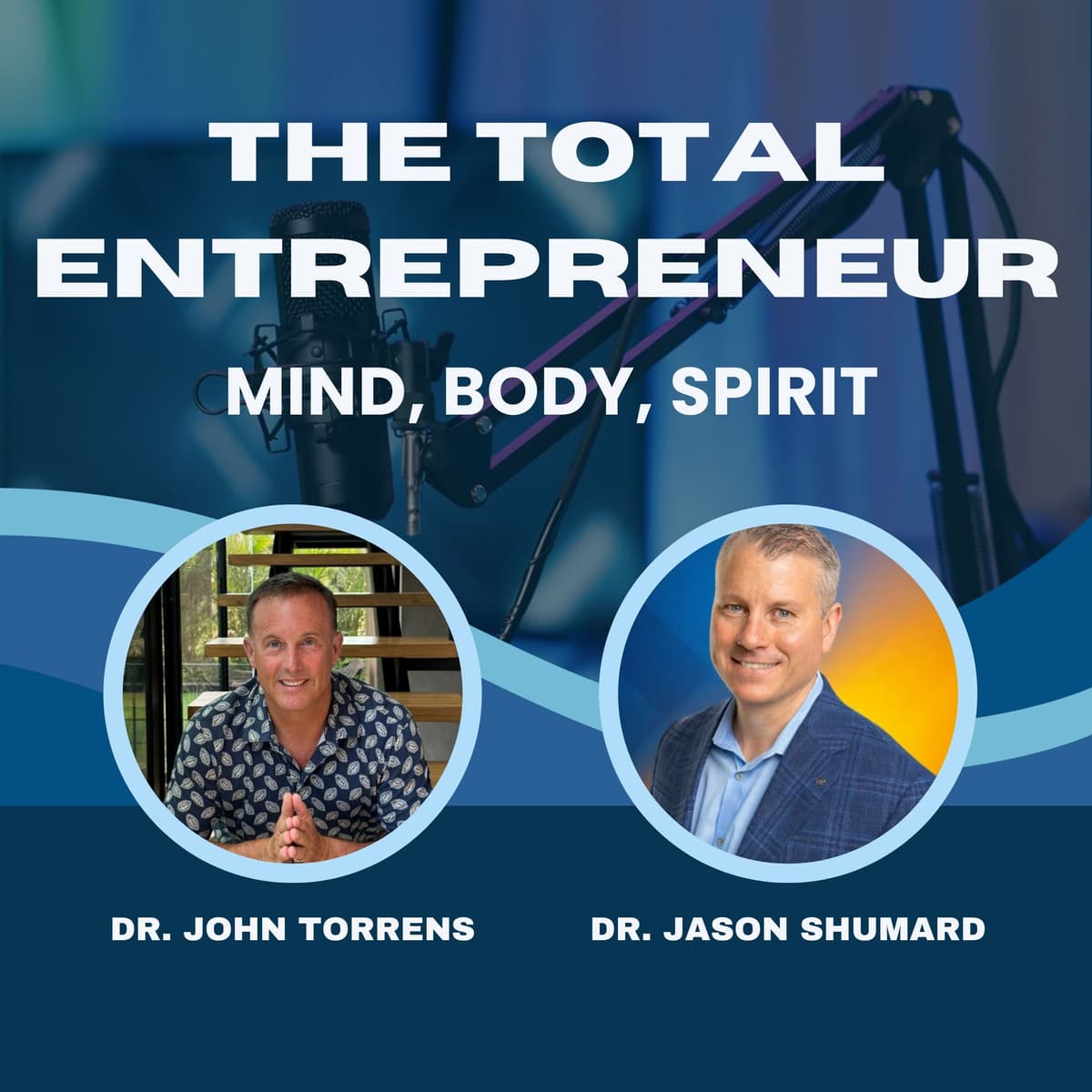
How to Reverse Type 2 Diabetes with Dr. Jason Shumard
with Dr. Jason Shumard
Aug 7, 2026 · 00:56:27
Part of our conversations on
Imagine you're driving down the road and your car check engine light comes on. That's an indication that something's broken, something's not right, but your car can still drive. It's still doing its job. But so your choice is take the fuse out so you don't see the check engine light anymore, or you take it to your mechanic to get evaluated. That's functional medicine. Functional medicine is looking for the check engine lights that are going on inside your body.
Dr. Jason Shumard, thank you so much for joining me. I'm excited to have you today.
Yeah, excited to be here. Thank you.
Yeah, of course. And you're calling from San Diego. How's the weather in San Diego today?
You know, it's a little overcast, but normally it's, um, sunny and nice. Yesterday was beautiful, but we can't have a beautiful every day, I guess.
No, right? What would be the fun of that?
Right.
That's right. Yeah, I'm currently in upstate New York, and actually today, today it is, you know, fairly nice, so we're, we're lucky.
Awesome.
Yeah. So I want— we're going to talk today about metabolic health, blood glucose, and that sort of thing, which is like we were talking before we started the recording, a topic that's really personal to me because I had that journey as well. But yours kind of starts with another personal story with your mother. Is that right?
That's correct. Yep.
Yeah. Tell us about that.
Yeah. So when I was roughly around 2000, 2001, I was just going into Starting my, my program up to become a doctor of chiropractic. I, my mom was diagnosed with diabetes and like many people, at least my understanding at the time, I just thought can be managed, lifestyle, medication, she'll be fine. Well, over time as things progressed, she was not fine. She started taking more medication and started seeing some health decline, et cetera. And it just didn't seem right. Something didn't sit well with me and I was learning a lot more. With my education. And I come to find a program called functional medicine. I didn't know anything about it at the time, but my school was very open to different things and they had good instructors come and teach us this stuff. And it was just really cool. And I was like, okay, well, this— there's an option here, I think. So, when I finished up with my doctorate, I moved back down to San Diego. I just started taking more and more courses. Anything I find I started doing my postgraduate studies in functional endocrinology and functional medicine. And as I got a little more into the process, I felt really confident. Okay, now I have the ability to help individuals who are dealing with this metabolic dysfunction. So I went to my mom, went to my dad and said, hey, we've got this incredible work that we can do. Unfortunately, it fell on deaf ears. Neither one of them were interested. They, at the time, My mom's blood sugars are being managed. Her doctors were telling her everything was fine. There was no issues. So she's good to go. And unfortunately, as we all know, the progression continued. She got sicker and sicker. And eventually, what was interesting was her first symptom of diabetes was dialysis, kidney failure. Like, that's so significant, right? And literally, there were 6 months prior where the tests showed no issues. 6 months later, She was in basically 12 GFR and so the kidneys were basically done. And she was then going 3 times a week for 3 hours at a time for dialysis. 8 months later, she had a stroke and she passed. Like, that's how fast this process happened. And it was mainly because her doctors were telling her that she was good because her A1C was in a good range. Her A1C at the time was a 6.1 when she went to full blood dialysis. Wow.
That doesn't actually sound that good to me.
6.1 is actually considered prediabetes.
Yeah.
Yeah. So it's, it's managed really well because in the medical world, as long as you're below a 7, they're happy. You're totally good in their mind. They're in a good place.
But the crazy part is just because you're not diabetic yet, you're prediabetic, but there's still all sorts of bad stuff going on in your body, even though you're not clinically diabetic, right?
Yeah. Yeah. And you're right. What you're saying is accurate, but in the medical world, they don't see that. Situation in their mind, you're doing fine. And she was believing them for whatever reason, maybe because I was her son or whatever it was. Right. But there was a belief there and that happens quite a bit still to this day. We have patients we meet with, they'll go back to their doctor and say, oh, that's not going to work for you. You just need to eat better. And they believe it and they just kind of go on and they, until they, dramatic event happens, unfortunately.
Yeah. Well, and they say you got to eat better, but they never really tell you what that means. Right. I mean, you know, yeah. So, so I want to go back to functional medicine because what we were talking about alludes to that a little bit. What is the difference between functional medicine or integrative medicine and traditional Western medicine?
Yeah, I think the biggest one is the analytics, right? With the medical model, they're really evaluating someone to use what's in their toolbox, right? Their toolbox is pharmaceutical drugs, injections, or surgery. So, they're going to evaluate someone based upon their treatments. So, they're not going to evaluate someone more in depth because they don't have a treatment protocol for it. And, I'll give some examples. In functional medicine, we use more deeper analytics to identify where things are broken, where they're not functioning optimally, maybe not in a disease process as of yet because we want to capture it before it becomes that issue. And, the medical model is looking more for like that disease process. The best analogy I can probably give is that imagine you're driving down the road and your car check engine light comes on. That's an indication that something's broken, something's not right, but your car can still drive. It's still doing its job. But so, your choice is take the fuse out so you don't see the check engine light anymore or you take it to your mechanic to get evaluated, right? And so, that's functional medicine. Functional medicine is looking for the check engine lights that are going on inside your body. Rather, if you wait and don't do anything until your car breaks down, now you're on the side of the road in the middle of nowhere in the middle of the night, on a stormy night, if you will, that's medicine. Now, it's in that emergency situation, you have to figure out what to do at that point to get your car fixed. This is no different in the medical model compared to functional medicine.
Yeah. I talk to entrepreneurs and CEOs all the time about this idea of just being the CEO of your own health.
Right?
Because like, you know, if we treated our businesses like we did our healthcare, it would be a train wreck, right? Like, so this example of like the annual visit, they check your A1C, they maybe check your fasting glucose and your labs. And as long as you're not diabetic, they're like, oh, you're fine. We're just going to wait and see, you know, eat right and exercise. And they send you on your way. Like, if you do that in your business and you say, oh, well, you know, we're not out of money yet. So everything's fine. And we're just going to, you know, make more and spend less without really thinking through what that means. It's going to be a disaster. And I feel like that's the same thing they do in regular medicine. And especially when he told your mom, just eat better. You know, what does that actually mean? That's, um, yeah, that can be really frustrating. Yeah.
Yeah. Yeah. Because I mean, think about it now. There's the marketing is clear. There are diabetic-friendly meals and diabetic-friendly foods and all of them are terrible. It's mostly terrible. And they're thinking they're doing a good job because there's lower sugar. Their mind is, as long as I eat food with less sugar in it, I'm going to be okay because there's no education understanding around it.
Yeah. And like a lot of things will turn into sugar in a very short amount of time, right? Yeah. It's, uh, it's crazy. I know.
Yeah. Well, technically, if you think about it, everything we consume turns into sugar because that's our fuel source, right? The difference is how fast, as you mentioned, it's going to be converted inside the gastrointestinal system, which means how fast it's going to be released. So if you do things like Refined sugars, breads, you know, um, so those, like, those simple carbohydrate type foods, they're going to be released fast, which requires a fast release of insulin. And that's where the problem comes up for— and our body gets— things get worse and worse over time.
Right. So, and I want to get into that a little bit. So if somebody's not clinically diabetic yet, maybe they're pre-diabetic or not even pre-diabetic, but just kind of dancing on the line, and the doctor says, hey, you're fine, we'll wait and see, what are the things that people should be tuning into, or what should they be looking at, or what is actually happening Yeah.
I love what you said there that my favorite diagnosis is let's wait and see. Like, I love that diagnosis. Give me a break. Come on.
Yeah.
But, the reality, let's start from the beginning because I think it's important to understand what's actually happening to the body. So, as I mentioned, when we consume food, the goal of that food is to get into our intestinal tract where we can break that food down and now we're going to remove the nutrients our body needs and Remove the waste so that it goes out through urine or feces. And so, that's the purpose of our gut. That's why it's so important to have a healthy gut. Now, at that point, that gets converted to glucose because now that's our fuel source, right? The perfect analogy I can give everyone is imagine you're putting gas into your car. Are you putting it directly into the engine? No, you're putting it into the gas tank. That gas tank is the same analogy of our intestinal tract. Now, from the gas tank of the car, it has to get to your engine through the fuel line. Well, in the human body, that's called the bloodstream. It's released into your bloodstream, and then it eventually gets into your engines. And our engines in our body is inside of our cells called the mitochondria. So the process happens when you release this glucose into your bloodstream. It's going to trigger a response by the pancreas to release insulin. The insulin's only job is to grab the sugar, drag it over to a cell, and attach to an insulin receptor. That opens a door in your cells to now allow the sugars to enter into the mitochondria, into your cells. And now the action takes place. How we create ATP energy and how our body functions. This process is basic fundamental function. If you're not able to do that, we cannot survive in a long time. So this process is happening over and over and over again. Now, where does the process become an issue? The process becomes an issue for a couple of reasons. One of them can be you're eating improper foods, right? A lot of carbohydrates, sugary foods. This releases rapid amounts of sugar from the bloodstream into the bloodstream, which is now going to release rapid amounts of insulin into the bloodstream. Now, the problem with high amounts of insulin into the bloodstream, it's like throwing too much water on a plant. What happens to the plant? Guys, when you throw too much insulin around an insulin receptor, so does the receptor, closes up and can't have the insulin enter. So what's that called? Insulin resistance.
Hmm.
Most people don't even know what that even means. They know the term, they have no idea what it means. And so if it's one cell, no issue. What if it's 20, 20,000, 200,000 cells? Now we start to have a problem. So, the insulin can attach. Now, where'd that sugar go? Can't get in your cell now because the door never opens. It goes back to your bloodstream, causes elevated sugars, and now we get a diagnosis of elevated sugar. And now, what's all the focus on? Bring that sugar down. When the real focus should be on the cell and why the cell's damaged. Because insulin, high amounts of insulin, is just one mechanism. There are hundreds of other mechanisms that can cause the same problem. Which is why when an individual changes their diet, their sugars may come down, but they're still diabetic because other problems are existing that no one's looking into.
Hmm. That was a good explanation. And with your permission, I'm going to steal your car analogy when I talk about it next time.
Yeah.
Yeah. So, so, so the, the sugar is a problem because it brings more insulin and then the insulin kind of floods, I guess, the the zone there and creates that resistance. And once you're there, what, what are the things that will happen to your body?
Yeah, so the first thing you might— most people start to notice is fatigue. They start having lower energy. Well, that makes a lot of sense because if you can't get your fuel into your cells, you can't create energy. And if you can't create energy, your body's gonna say, okay, we're gonna prioritize this. Your brain's gonna get it, your hearts are gonna get it, your internal organs are gonna go first. Whatever's left over, that's what you get. So oftentimes people will say, "Oh, I'm just getting older. It's part of the process. I'm supposed to have less, not as much energy." That's not the case. It's your body telling you there's a problem going on. But most people don't understand language. Other problems can be you start to gain more weight, mainly in the belly area. That visceral fat or belly fat that is very challenging to get rid of. You can be exercising. You can be trying to. Lift weights, all those things, but you're not losing that belly fat. It's because your body feels like you're in starvation mode. It's holding on to these things like this. Constant urination throughout the night is a very common one. Brain fog, sleep issues. These things are, these are the early signs, but I can't tell you how many people I meet with on a regular basis that they'll go in to see their doctor on a random visit. Their blood sugars will be 300, 400, 500.
Wow.
with zero symptoms.
Hmm.
That's what's so amazing about the human body, the adaptability, because many times they're not gonna start to feel those symptoms until enough of those cells are damaged. Because if you think about it, this is why diabetes is so intriguing to me, because we know it's a cell disease problem that's leading to this issue. And when you look at the human body, every single tissue's made of cells. So now we've got a disease process that can impact any tissue in the body. While one person, sorry, 10 people with the same diagnosis, one of them can have brain problems leading to dementia, also referred to as type 3 diabetes.
Hmm.
Next one, vision loss. Next one could be cardiovascular problems. Next one could be kidney issues, GI circulation, nervous system issues like neuropathies that lead to amputations. This is the same disease. But the only disease I can think of that can affect any tissue in the body because it's not a sugar disease, it's a cell disease.
Yeah, that's a good way to put it. And, you know, I've read recently that a lot of cardiac issues are related to metabolic disorder. It's not just all about cholesterol and all that kind of thing. It's metabolic as well. Is that your understanding or do I have that wrong?
It's actually kind of scary when you think about it a lot. Many people see cholesterol as a negative. It's not at all, right? It's not a negative, it's positive. We need it. It's our cells need it, our hormones need it, our brain needs cholesterol.
Yeah.
The problem becomes when you have a systemic disease like diabetes, because think about this, when you have high amounts of sugar in your bloodstream, if you look at sugar under a microscope, would you imagine sugar would be nice smooth edges or would it be very sharp jagged edges?
I'm guessing it's probably sharp and jagged.
Sharp and jagged. Now, it's circulating and those jagged edges are doing what to the arteries? They're clipping it, clipping it, clipping it. And, when you do that, you're getting microscopic holes, if you will, or gashes in your arteries. So now, the body says, okay, we've got some systemic inflammation. So now, we're going to go to the liver and produce cholesterol. Why? Because cholesterol is a protective method. It patches the areas of the artery. Now, the problem that comes into play is when this happens for decades, what happens? It keeps on patching, patching, patching, patching until you get a block.
Mm-hmm.
So, the reality is when we're suppressing cholesterol production, you're reducing your ability to heal, which means you're getting more and more damage and creating more chronic issues in the cardiovascular system. On top of that, when you have this excessive amount of sugar in your arteries, what does it create? Density, right? So, when like you're— you like to surf like I do, we're ocean guys, so you're in the ocean, it's easier to float because the density of the water Well, the same thing with really dense your bloodstream. So if your bloodstream is dense, is it going to cause you have to beat harder or lower? The beat harder. Blood pressure goes up because you're trying to get it to your extremities and your circulation has to get there through small little capillaries. And what do we do? Suppress it. So we have less blood supply going to our extremities and increasing the risk for neuropathies and amputations and things like that. I mean, we continue playing the mole game in the body instead of evaluating things. There's something going on here. Let's do a full evaluation to see where the dominoes are. We're putting those dominoes back in place. That's the only way you're going to do any healthy.
So what you said about the, the sugar sort of, you know, death by a thousand cuts almost inside your, your vascular system, right? And then the cholesterol coming to repair it. And the advice we've gotten, you know, from like the food pyramid, for example, is that, you know, cholesterol is really bad. You got to avoid it because it's going to kill you. And, uh, you know, just, you know, have, you know, have pretzels instead of peanuts or something, you know, whatever, right? Like the, the conventional wisdom wisdom a decade or two ago was that, you know, just avoid all fats, carbs are fine. But in effect, that was like the exact opposite, or it created the exact situation you just described with the sugar damaging the arteries, the cholesterol patching it up, and then over time just building it up, right? And then, yeah, the high blood pressure coming along and blasting off a piece of it or something. It's just a— yeah, it's a disaster.
And yeah, it's a cascade. And unfortunately, like you said earlier, none of these things are being talked about in the medical model. For the purpose of maybe time, or they just don't think people are going to listen, or it's just easier to take a pill. Who knows what that might be? And then you have someone like myself and yourself going out and blasting what's really going on in the body and like, well, that can't be true because it's not on the 6 o'clock news or it's not on in the newspaper. Do you guys know who owns those companies? They're owned by Big Pharma, right? Put that out there?
No way. Like, who, who runs all the ads, right? Yeah, no, you're preaching to the choir there. But yeah, no, it's hard because, well, you know, well, my doctor doesn't say that, or my doctor doesn't know about that. If my doctor doesn't know it, then, you know, it must not be true. And, and not, not to, you know, shit on doctors because like you said earlier, they are, they are really good at certain things. You know, if, if, if you need a Western doctor because of trauma or a, you know, serious condition, you're— there's no one else you'd rather see. But there's just not trained, equipped, or incentivized to do the types of things we're talking about.
100%. And that's why I think there's a place for both, right? If you have an emergency situation, Heart attack, stroke, you have internal bleeding, broken arms and legs, etc. Thank God we have modern medicine. But, when you have chronic degenerative diseases, yes, get stabilized by using pharmaceuticals, but then now you're not good because— and you know this, all you have to do is ask your doctor, when can I get off this medication? And, when they tell you for the rest of your life you have to take it, you got a problem on your hands.
Yeah.
Now, you got to go find somebody, identify why this happened, So you can get the body healthy again so you can get off that medication finally in the future. You have the ability because your body was there once before. You just have to identify what barriers your body's going through and start unlocking those. Yeah.
Is it safe to say that like complete avoidance of sugar would be perfectly fine and healthy because you're getting enough through normal dietary means anyway?
Well, I think we want to describe sugar, right? Because if you're referring to like refined sugars, 100%, absolutely. Refined sugars are not necessary at all. I mean, let's just say that you're having a date night with your wife. You want to have a piece of cheesecake. Probably not going to be a big deal. But if you're doing it on a regular basis, yeah, not a good idea. But if you're doing like fruits that has fructose, that's okay because you get the fiber and the nutrients in there as well. That's going to be not an issue. So I think we want to make sure we're defining what that sugar comes from and what type of sugar. Like if you're doing like sucrose and maltodextrin, like these horrible sugars, guys, like they're They're not good for your body and they're in so many things. I always say, if you can't pronounce the word on the food or you wouldn't consume it with a spoon, don't eat it.
That's good advice.
Bring it into your body.
Yeah.
You know, not to say I'm saying potato chips are a good idea, but when you look at the back of a bag of potato chips, if there's anything else in there besides potatoes, you probably shouldn't be consuming it. Right.
And almost every packaged potato chip I've ever seen has more than just potatoes and oil, right? Or potatoes and a seed oil or something like that. Yeah, exactly right.
All this, all these chemicals to make you suppress your brain's communication with your gut of, of, um, satiation. And so you want to eat more, you want to consume more, which got— which they make more money off you buying.
Yeah. So it's pretty clear that, you know, high, um, processed sugar is just a very low performance food across the board, right? Um, you mentioned even just fatigue and all the other things, but what is it doing to your gut microbiome? Like I've read a lot about how dangerous or just how bad it is Yeah, 100%.
I mean, see all these things that are going on in the GI system, right? Irritable bowel syndrome, colitis. People talk about polyps. I don't even know what even polyps are, but they're talking about these things. Oh, I did a colonoscopy, my doctor cut out 3 polyps and they were not a problem. That's a problem. That's an indication your gut is not healthy. So, these things, we look at microbiome and microbiome is so essential. These are the good bacteria for your gut. And they protect your gut from a lot of problems you could be exposed to. But more importantly, they help you break down your food, help you digest and absorb your nutrients your body needs. So you could be eating the right types of foods without healthy guts. You're not getting the right nutrients in. So you're becoming deficient in these nutrients that your body's essential to for your cells and other organs and tissues as well. So, but also on top of that, you can develop a condition called leaky gut.
Right.
Leaky gut, again, people have probably heard the term, but they don't understand what's really going on inside the system and why horrific this issue, this, this condition is. But essentially, when you look at under a microscope and you see your, um, your cells of your intestinal lining, they look like little shoelaces. They're like attached like this. These are called the gap junctions. And so what happens is these gap junctions become loose. Not that you're like bleeding out because people have this image in their head, they're bleeding out. But now you can get these macromolecules So larger molecules that are undigested, they start to slide through these little gaps and they get into your bloodstream, which is where your immune system sits. Your immune system says this is not normal, even though it's a piece of banana or if it's a piece of beef or chicken. But the immune system says this is too big to be in there, we're going to start attacking it. And so what happens when you get done? Food sensitivity. So now every single time you consume beef, So you can have a GI problem now leading to your cancer or autoimmune diseases.
Yeah. And neurological problems, whatever it is. But so, so you mentioned cancers and I want to talk about that too. So my understanding is that malignant cells, cancer cells survive on a diet of sugars. I mean, so you're, so you're quite literally feeding fast-growing, potentially malignant cells when you're consuming these processed sugars.
100%. And this is one of the reasons why when someone's like, you go to these cancer treatment centers, they recommend like ketogenic diets or carnivore type diets because you're reducing that sugar, you're getting rid of sugars completely. It just feeds it because when you bring in sugar to a cancer cell, yeah, it just thrives and just grows and grows and grows and it starts proliferating to other cancer cells and you're basically just putting gasoline on a fire.
Mm-hmm. So a few years ago, I was, you know, just, you know, I was inching towards prediabetes and, you know, I didn't want to get there because my mom's a type 2 diabetic and I kind of, I didn't know what that looks like. And so I wanted to avoid it. So I started wearing a continuous glucose monitor a couple times a year. And at the time, you know, they, it was really just for diabetics. And if you're normally healthy, they didn't want to prescribe it, but now it's a lot easier. But I have to tell you, I learned so much about how my body reacts to stuff. Some of it, you know, I probably could have learned in a book, but others definitely not. Like, for example, one of my favorite things that I learned is that, like, if I want to have— if I want to feed my sweet tooth, cookies and cake will spike me every time. I've got to avoid it. But I can have a little bit of ice cream with near impunity from a blood glucose perspective. And my understanding is that it's just because there's enough fat in it that slows the absorption down. So I think wearing a CGM is a really great thing for people who are worried about this. I don't know if— I mean, you must work with CGMs in your patients, right?
But, totally fine. We just want to make sure we're evaluating to some capacity. But, I agree with you, if you have the ability to get a CGM, there's so much data you can get from a food source and what you're consuming.
Yeah. I mean, it's absolutely shocking once you start to learn. I mean, not even shocking but just educational and amazing, right? I don't touch fruit juices anymore, haven't since I started wearing them because the conventional wisdom was, well, it's fruit, it's juice, it's great, you're getting vitamins, but you're also just getting uninhibited sugar absorption, right? There's no fiber to slow it down. down. I couldn't believe it the first time I had a little orange juice and my CGM, I mean, it just lit up on me. That was amazing.
It's crazy. And, I have patients ask that. They're like, hey, well, can I have some apple juice or some orange juice? I'm like, yeah, no problem. Once you can consume 6 to 8 oranges in a setting, you can have your orange juice. And, like, whoa, I can't consume that. I'm like, exactly, but that's what you're consuming in one glass. So, if you can't eat it like that, then you can't consume it. And, they're like, oh, okay, now I get it. I understand.
Yeah, yeah. So, so what other things do you and your patients sometimes discover or find out, or what are some interesting insights you get from CGM usage?
Yeah, I think the biggest thing is oftentimes what are quote-unquote healthy foods that are spiking sugars in that individual that technically shouldn't, but it's because of how their biochemistry is actually going on in their systems. It does help us try to— and then as we start to optimize things, that'll probably subside over time. But it would be like, for example, a person could be consuming, I don't know, I'm going to say fish and then boom, it spikes for whatever reason. And, it's likely the case, it's not the fish itself, it's because they have a sensitivity to the fish that's going on and the immune system is creating a reaction and that reaction inflammation, again, that cascade of problems that are going on. So, once we start to improve that mechanism of their overall immune reactions, that's the great thing about sensitivities, they can go away. They're not like allergies where you have them for life. As you fix the immune system, as you fix the gut and you start to stabilize the human body, most if not all sensitivities will go away over time.
So let's talk a little bit about your work and even your book about reversing diabetes, because I think conventional wisdom is, you know, once you have diabetes, you're kind of stuck with it. You can't reverse it. I've heard that from a lot of people, actually, you know, even fairly educated people. And I almost question myself when I talk about them just because of their position and their degree, right? When they say, well, you can't reverse diabetes, and I kind of think you can. I, I, I don't even argue because I think maybe I'm wrong. Right. Um, so how does, how, how does one start that journey? So you've got the diagnosis, you're feeling the effects. How do you start that journey?
Yeah, I think I, I wanna answer what you just said there first about there's a lot of highly, um, educated individuals have a lot of degrees and a lot of letters behind their names, and they're gonna tell you that you can't reverse diabetes. And the reality is the reason why they're telling it, telling you that is because Because their tools do not do it. And if their tools don't do it, then in their mind, it can't be done. But the research is very clear. There's a lot of research in PubMed that you can identify reversing type 2 diabetes by doing the right steps. Because when we look at diabetes from a blood sugar perspective, yeah, you're right, you cannot reverse it. You'll rarely, if any, ever get the person off medications if you just focus on their sugars alone. But if you focus it from a cell perspective and the cell disease, now we're talking because now we're getting to the root issue that's going on. So, when we look at diabetes, the first thing we have to do is we have to understand what problems is the individual experiencing that is contributing to their cell damage. Obviously, we know for most people it's going to be their lifestyle and we can make easy changes there to make that. But we also need to identify other problems. And this is where testing comes into play. So we typically do what we refer to as our root cause analysis. And this is 2 tests that we run. There's lots of tests that can be ran, right? But we just, we want to run these ones initially. The first one is a very comprehensive blood test. It's going to look at all the different areas inside the body. We have to understand there are multiple organs and glands that are involved in blood sugar regulation.
Yeah.
For example, the liver, the kidney, the adrenal glands, the gut, the thyroid. These are all areas in the body that are directly involved in blood sugar regulation. So, if one or more of those is not functioning optimally, it will impact the cells directly and impact their ability to accept sugar. So, we have to look at all those and make sure they're working optimally or not. And we can identify many of them from a proper blood test. The second test we do is a toxicity test. This looks for things like metals, molds, and environmental toxins, because we know for certain toxins damage cells. They increase the risk for cancers, autoimmune diseases, and type 2 diabetes. There are even specific toxins out there— environmental mold as well as heavy metals— that directly influence the endocrine system, which we know includes not only just neurochemical hormones but also blood sugar regulation, which means it's attached directly to the cell disease. So once we understand what it is for that individual, most of the patients that we evaluate are going to have between about 10 and 20 different problems that are contributing to those cells being damaged and essentially closing the doors, as I like to refer to that. So once we understand what those are, when you bring in the proper lifestyle and you start Fixing those problems, removing the toxins, improving liver function, kidney, gut, whatever it is that's damaged. Now you start seeing that person's blood sugars dropping dramatically. This is important to understand because as those sugars start to drop, that individual can now, with the help of their doctor, start reducing medications. Now, if we take this same individual and they reduce their medications before I started working with them, we all know their blood sugars would spike. Their A1C would spike. But what's interesting with these individuals, their sugars are dropping, they're reducing medications, their sugars stay low, which is—
Hmm.
That we're not only helping them lower sugars, we're fixing the cells where the damage actually happened. This is how they become non-diabetic, no longer on medication, normal A1C, normal blood sugars. We see this happening all the time when you truly address the the problem. So I'm never giving anybody anything to lower their sugars. My entire approach is to fix the cells once we understand what's going on. Hmm.
I mean, it seems very logical, right? Yeah. Which is, I think, what I like about it. Yeah. So, so the, like, do you have a, like a case example you could share? Yeah, obviously you don't have to share names or anything, but like, just, just so somebody understands like what a What one journey might look like.
Yeah. So, we'll give an example of an individual. They came to us, they had 15 different toxins. And, I don't recall how many each. There was a certain amount of mold, certain amount of heavy metals, and certain amount of environmental toxins. On top of that, they had— and again, when I say they had problems in these organs, I'm not referring to they have a disease process, remember, because we're looking at from the check engine light situation. So, we identified these problems. We're not functioning optimally, that they were not fully in the disease process. So, if they went to their doctor and said, oh, this functional medicine doctor says I have a liver issue, this and this, I'm like, it's totally fine. It's because they're looking at it from a disease perspective, not functional health perspective. So, take that into consideration. They showed problems with leaky guts, they showed problems with adrenal issues, and they showed problems with liver problems as well. Massive amounts of inflammation was showing up there as well. So we had approximately 15 different— or sorry, 20 different problems with this individual, 15 different toxins, 5 additional problems that showed up on the blood test. So the priority on this individual is what? We have to get these toxins out because what are these toxins doing? They're creating inflammation, they're creating stress on the organs that are involved in trying to get rid of them: the liver, the kidney, and the gut. So that was impacting the liver to do its job, the kidney to do its job, and the gut to do its job. Which is why we saw identifying markers showing they were not working properly. So, we have to first start to improve the health of the elimination pathways, liver, gut, and kidney. Then we start removing toxins one by one. We start to get the toxins to a safe level. Typically, for most patients that are in this situation, we start getting those toxins to a safer level immediately. We start seeing sugars dropping. We start seeing medications going away, but we don't stop there. Because once we get the toxins into safe levels, now we've got to make sure we continue working on reorganizing the body. Think about this. If your house is on fire, are you only going to hire someone to come in and clean up the debris? Are you going to have someone rebuild afterwards? Of course you're going to rebuild. Well, when you're removing toxins, guess what? It's creating a lot of damage. It's breaking things down. We have to go in and rebuild. So we do a healing process afterwards to make sure we go in and restore function to the areas we found that were damaged. In this situation was the gut, the liver, and the adrenal glands. And so we do that process. So then when we retest them, because we always like to retest because we don't want to assume, we want to have data. So we retested, we saw that their toxins were now in safe levels, the organs are in a better place, and of course what happened? Normal A1C, normal blood sugars, person was off all medications, and they're doing well. Now someone may say, okay, great, But what if it comes back? The only way this is coming back is if that person goes back to their old lifestyle because that lifestyle was part of the problem they were dealing with. So, we always tell people, listen, we're closing that door, we're locking it, throwing away the key, we're creating a whole new lifestyle. If they follow that new lifestyle that we recommend for them, it's not coming back because now they can maintain it for the rest of their life.
Right. And, even if you have a bad day or bad week, it's not going to be enough to send you back in to diabetes range because, because you're otherwise healthy and your body can adapt.
That's right, 100%. And, we always say that. I'm like, listen, and it's usually when it's a husband and wife, right? I'm like, listen, if you want to take your wife on a cruise for a week and enjoy yourself for a week and have fun, then you should do that. And, she's over there laughing like, yeah, let's do that. But then, at the same time, when you get back, what are we doing? We're back on that horse. You're back at it. If you fall back in that line and continue down that path, the chance of this coming back is going to come back because we know lifestyle is a contributing factor to cellular damage, which can leave your body vulnerable to these new problems developing down the road. So, it's, you know, when somebody gets diagnosed with diabetes, their mindset is, oh, I just got diagnosed. No, this problem has been going on for 10 to 20 years.
Right.
It's taken 10 to 20 years for enough damage that you're now seeing the symptoms, i.e., the elevated sugars.
And I'm so glad you mentioned that because most of the people I work with are pretty young, like in their early 20s. And, you know, it probably wouldn't shock you to know what they're eating and drinking, but I mean, it's, it's insane. Like literally like 32 ounces of soda and then with some cookies or whatever, right? It's, it's really bad. But that's the, that's what I tell them is that, you know, the chronic diseases you're going to be dealing with in your 70s are starting right now. And from, from the perspective of an entrepreneur, of an entrepreneur who's trying to build a company and build wealth, that's especially concerning because by the time you get to the point where you can where you're supposed to really enjoy it, everything you've created, you're just gonna be dealing with chronic disease. And so that, that's why it's kind of been my mission and my passion to, to get at these young entrepreneurs at a time we can make a difference. Not only that though, it's the foods that they're eating are, besides the fact that they're gonna create a chronic condition 20 years in the future, they're super low performance for what they're trying to do right now. Like you mentioned, brain fog and fatigue and energy and getting up in the middle of the night to pee. So your sleep is really bad. A bad night of sleep plus brain fog, you are not going to be an effective entrepreneur. That's just a fact.
Yeah. And it's 100%. And you can compare it to athletes, right? You look at some of these athletes, and I'll mention just 3 of them that are well known. One of them is a tennis player by the name of Andre Agassi, right? Some of the younger people you're working with may don't know him, but everything. But I grew up watching Andre Agassi. He was really— I loved what I loved because he was just like this, like, bad boy type of appearance, right? Yeah. But when you, what happened was when he was in his younger years, he never broke the top 10 at all. Never broke the top 10. He was like this, he was like a top player coming through in the United States. But it wasn't until he hired his coach, Brad Gilbert was his coach, and all he did was change his eating habits. Because in Andre Agassi's book, he talks about, I ate McDonald's after everything, just all the stuff that he was eating. And when he immediately did that, he didn't change anything else except for his eating habits. He immediately went to number one.
Wow.
1 within a year. He stayed in a number 1, number 2, number 3 for many, many years. It was because of that, and he was able to continue his career for a very long time. And the same thing with 2 other people, um, um, what's his name, Drew Brees and, um, Tom Brady. Again, these guys in the initial early years had terrible eating habits, terrible. But why they were able to play so long at a quarterback position, one of the most One gets hit more than often, anyone else, with damaging effects. But we're talking about guys who are in their 40s playing high-level football because of what they did in their life. They ate well, they took care of their body, and that's why they're able to have such high careers. So if we can do the same thing in our 20s, like I remember, um, the last time I had any type of fast food, and I'm talking about fast food of like, um, traditional McDonald's, Burger King, those type of things, right? Mm-hmm. I was, I was 21 years old, right? That was 20, 28 years ago. 28 years ago. And I tell people that and they're like, that's not possible. I'm like, it is. Because once I understood what this food was doing to my body, because I was in school learning about science, biology, and I was like, this is unbelievable. I stopped completely. Never ate it ever again. My kids, I have 10-year-old twins. They have never consumed anything fast food. We have been. We were at a neighbor's house a couple years ago, and they were having like this discussion about who had the best french fries. Everyone's like, "Well, McDonald's." Everyone else. My kids are like, "What's McDonald's?" They don't know what it is. They have no idea because they've never been. They've never been introduced to it. Yeah. Do we go to like a restaurant and they can have a burger or stuff like that? Of course, right? But it's going to be crafted. It's going to be good quality. Type of food. We're not going to like, um, and I live in, um, In-N-Out world and everyone's like, oh, In-N-Out, everything else. And they do have some good things about their food there, but we've never eaten there. They've never eaten there. Yeah, we don't even consume that type of food. So the more education that we have, the way we— if we feed our body this nutrients, we're feeding our brain with education about business, it's going to match together and it's going to make such dramatic events and growth And the individual and their business as well.
Like you, it's, it's been a while since I've had any fast food for that reason. Maybe 2 decades, so maybe not quite as long as you, but, um, you know, there is probably some food in that, but a lot of it's not even food. It's like, it's— your body's not even meant to, to deal with that yet. You have to, you know? Yeah.
So yeah, I think that the videos, right, where you have like the guy buys the hamburger at McDonald's and 10 years later it looks exactly the same. There's no mold, nothing on it.
Yeah.
It's a problem.
Yeah, right. Or if like the flies and the ants aren't going for it, it's—
yeah, it is. The salmon, where they have the farm-raised salmon and the fresh salmon, the ants are all over the regular salmon. They're not even touching the farm-raised. I mean, nature knows what's good and what's not good.
Yeah. And I think that's, that's a major point, right, is that nature knows. And, you know, something I've learned lately too is that, you know, our grandparents knew. also, right? So like what I've been, one of my mantras is just trying to get like, how did my grandparents cook this? Or what would they have eaten? And that sort of thing. And that's, you know, doesn't guide everything I do, but I think about it a lot, you know?
And even on top of that, I don't know if it is where you are, but I mean, I'm going to the restaurants here in San Diego. We have some good quality food here in San Diego, but the quality of the food has gone down substantially. It doesn't taste as good. I mean, I'm like, I told my wife, I'm like, I don't even know if I want to go out anymore to restaurants. we can just make it here because we order grass-fed beef and bison and things like that. I've got a barbecue. Hey, man, I can just do everything here. We can better quality food. We grow our own vegetables, our own fruit, everything in our backyard. And, it's really cool because the kids get involved and they love that and it's just a really cool experience because I grew up in a farming area.
Oh, yeah.
My dad was a farmer and I got to go out in the field with him and I I'd pop off a piece of corn, shuck it right there and eat it raw, like that type of stuff, or grab the tomatoes and eat them right off the vine and stuff like that because it was so fresh. And so, having that same experience for our kids is really valuable and I think they're going to really enjoy that.
Oh, yeah, for sure. I've lost my train of thought. Peter, you can edit that little part out, my producer. But yeah, you know, it's, it's important to eat real food, right? Just eat real food when you can. And, and it's just amazing to me how much unreal food there really is. I mean, it's— yeah, I don't know, it's, it's a little bit, um, sometimes gets a little depressing. But I agree with you, our, our dining out has drastically reduced for those exact reasons. It— I guess it tastes all right, but the taste— the stuff that tastes really good, you know, is just not really good for your body. And it's become really expensive lately too. So it's just way more fun to eat in. You can control the whole experience. And yeah, I like to do that too.
I couldn't agree with you more. It's been— and it's challenging. I get it. My wife's an incredible cook and she's taking— she always like makes the kids lunches that are just amazing and it gets overwhelming. And sometimes like, hey, I'm just over it. I want to go out. worry about that. But I think, you know, she's starting to recognize it as well. If it's just the quality is not as good and it's just something we do more often now, maybe a couple times a month we go out instead of, you know, maybe every other Friday we were going at that point. Yeah.
Or actually my wife and I were in a— we would go out a couple times a week just because, right? When we became empty nesters, we were like, well, we don't have to feed the kids, let's just go out, right?
Yeah, yeah, 100%. Yeah, yeah, yeah.
So for people in their mid to late 20s, early 30s who are in the throes and the chaos and all the stress starting a company, growing a company, what are some of the behaviors that, like, you probably would recognize them? Like, what are the things they should avoid? And what are some behaviors or habits they could adopt that will improve their performance and set them up for a much healthier life later on?
Yeah, one of the things that really helped me a long time ago when I was working with a mentor is he asked me, he said, hey, I want you to come back and write down the 5 most important things in your life. Like the most valuable things in your life. So I came back all excited and I was like, I got my good list and everything. And I go through my list and everything and he's like, this is a really good list. I'm really impressed. He's all, but just as a question, where do you fall on that list? And I wasn't even in the top 5. Everything else. So it was an immediate 2x4 to the head thinking, this is crazy. I'm not even doing anything for myself first because if I don't take care of me, none of these other things are going to be in place because they all need me. To be successful. So immediately I made a change and I was like, okay, so now I have to, how am I going to implement what I have to do for myself in my day to still get my day done? So the only way that I found was I had to wake up earlier. If I wake up earlier, I start implementing my things for myself. So what are the things that I do? I work out every single day. I wake up, I go and I do, um, either some cardiovascular, lifting weights, and sort of work out every single day. I also do meditation. Meditation, like red light therapy, I do combined. So I do red light therapy for 15 minutes, meditation at the same time as well. And it can be minimal, 5-10 minutes of your meditation if you want to not spend too much time on it. But it just clears all the negative energy, the negative thoughts and things in your brain, and you're just filling yourself up. This is great to do in the morning because now you're filling your body with positive Excitement to your day and become successful. Because we all know if we say we're going to put it at the end of the day, it's never going to get done, right? Things are going to pop up, it's never going to get done. Things you all do tomorrow, do tomorrow. So that's why I carved out in my day. I also make sure that I'm consuming the right types of foods. So we shop every single week, we go to the store for a weekly shopping, right? So we have proper food. So I'm consuming good quality foods, getting good nutrients. I'm not filling myself with a huge burrito where I'm gonna crash out in the middle of the afternoon. Right. If I'm gonna drink any alcohol, I rarely do. But if I do drink any alcohol, it's usually on the weekends only because if you're drinking throughout the week, it's gonna impact your brain, your thoughts. You're not gonna be able to have good brain function, which means you can't communicate with your team or the individuals. And for me, I have to be the sharpest and the best for the individuals that I'm talking to every single day. So if I am gonna drink, it's on the weekends only, but I I rarely drink alcohol these days at all. Consuming lots of water, like all my liquids is water. Like I don't drink really anything else because anything else that I drink is for pleasure and not for benefits for the body. I will add some electrolytes or do like a mushroom tea. That's about pretty much— I don't drink coffee. I don't do caffeine at all really. That's just me personally because I've has a negative effect on my body even though we know that black coffee can be really healthy and beneficial. I just don't like the taste of it, to be honest. I'll just do mushroom teas and I'll get some of those nootropics from that type of response there. So, that's what I would say. If you can control what you're doing for yourself and put yourself as a priority over everything else first because then you can be there for your wife, for your kids, for your business, for your church, for your community, whatever it is that's in your life.
Yeah.
But you have to be there first before you can actually help everyone else in your life.
Yeah. And it takes some intentionality, right? Because especially when you're young, like the things you have around you are usually not the things you were just describing, right? So you have to put some thought and intention into it. Like one of my pet peeves is when you're at a conference or a meeting and the afternoon coffee break comes out and it's cookies and candy and granola bars and things like that. You know, it's one of my pet peeves, you know, because what you're doing is you're, is you're just killing, you're destroying everybody's attention, focus, and creativity right at the point where you want them to be creative, you know. You know, one question I didn't ask you, and I'm interested in your take on it, you know, because I deal with a lot of entrepreneurs with ADHD because people with ADHD naturally gravitate toward entrepreneurship for a variety of reasons. What's your take on the effect of Blood glucose and sugar on ADHD symptoms?
Well, I think it escalates it massively, right? When you bring in, when you have dysregulation of your blood glucose, it's going to mess up your hormones, your dopamine, your serotonin levels. It's going to cause you to spin out. It's almost like giving an addict more of their drug. Control it. And I think that's individuals who are dealing with a fetal condition are perfect persons for a CGM. Constant glucose monitor. Like, if they're using that, you can start— if you start seeing your sugars like this, you're gonna also notice how well your brain functions throughout the day. If you start like this, you're gonna notice, man, I just couldn't pay attention. I was, I was thinking about some of the things and not being able to focus on what I wanted to do here. And you'll see the direct correlation with blood sugar spikes compared to more stabilization, for sure.
Yeah. And, you know, and it's that, it's that dopamine and the reward thing, right? So like, you feel like there's a reward and having that concentrated sweet just because it tastes so good and you really wanted it and you're addicted to it, right? It's that same kind of loop. Like you said, it just dysregulates your entire system. So yeah, that was my sense. That's what I've read. But yeah, I just, I think because so many entrepreneurs that listen to this probably have ADHD, I wanted to throw that out there as well.
100%. There's a lot of great options out there as well from a supplement perspective. That you can take to help modulate some of those things as well. And so they're not going to create any kind of crashes or, you know, like some of the negative effects you can get from some of the pharmaceuticals. You can take a lot of more of like great, great supplementation. There's a lot of great options out there. I don't want to give any specifics because it won't be specific to the individual. It has to be— you want to evaluate, get evaluated, and identify what's best for you. But there's a lot of great things that can really keep you focused and not cause negative effects. Um, in conjunction when you're doing the proper eating habits and keeping your blood sugar stabilized.
Yeah. Final question for you. Tell me, um, what you think about berberine, because I've been reading a lot about berberine in, in like, um, kind of comparing it to say metformin or something. So yeah, talk, talk about those.
It's interesting you said that because they, they say that berberine is the natural form of metformin. That's the kind of, they kind of like, kind of give that equation there.
Yeah.
Essentially, what berberine does is it does a couple things very similar to metformin except it has one more component that metformin doesn't have. So, metformin, why metformin works, and for those who don't know what metformin is, it is the entry-level medication that is given to individuals with prediabetes or get initially diagnosed with diabetes. And, the reason why they do this is because the medication does 2 things. The first thing it does is it slows down the release of sugar. From the gut, so that's not a good always a good thing. But it does have an effect of slowing things. So what they're trying to do is trying to reduce the spikes of individuals who use because these individuals use the second thing that it does reduces production of glucose from the liver, right? So so gluconeogenesis or being released from the liver. When you're when you're not consuming food for a period of time, say dinner's at say 10 p.m. By 3 or 2 p.m., your sugar is gone from that food, but your brain still needs it. Your heart still needs it. So your brain is constantly asking your liver to produce sugar throughout the day to include. So it has the fuel that it needs to survive. And so like what my partner does is. Down, that releases why we oftentimes get like brain fog. Um, we get these like dizziness, off a little bit because we're not able to produce enough of this glucose for our organs to function. And now you're burning up in your muscles, so now you have lower muscle function. You feel like you have no energy. You feel like weak all the time because your body's consuming this because the medication is trying to suppress the amount of sugar being released in these areas. Now what berberine does is very similar, has very similar effects. You can reduce the amount of gut very, um, cause it to go slower. It's not going to be as, as aggressive as I guess using supplements, but it does have that impact. It also reduces the amount of glucose being released by your liver as well, but it also has a component which helps insulin sensitivity receptors a little more So it does have that one more component that doesn't happen with metformin. So berberine is a better option. The difference is you can only take a certain amount of berberine, whereas metformin you can increase these doses to get more of an impact on your sugars than berberine can give you. So if you're taking berberine and noticing sugars coming down, you're likely in a place where you have a lower amount of cells that are being produced. With the tickly berberine, it's not really making a difference. It's high, that's the time you need additional support. Wow.
No, thank you for that. That was helpful. And is there a better time of day to take it? Like, because what you were describing, it almost makes me feel like morning might be a good time, but is there, is there a better time of day to take berberine?
Take it, I would probably recommend that someone's going to do it, um, like you take it 3 times a day, right?
Oh yeah. Okay.
Just like, um, morning or evening as well. Because usually what happens a lot of times with individuals with blood sugar dysregulation, they don't— they're not hungry, they don't want to eat. So they'll like either eat one meal a day or maybe eat at lunch and at dinner, where oftentimes we're trying to get individuals to eat more often because we can use that food to control their sugars throughout the day from having these huge gaps of no food whatsoever. Yeah.
Well, Dr. Shumard, I really appreciate your time and sharing your experience and expertise. Like I said, for me, this was a highly interesting conversation just because my personal history and what I see in the young entrepreneurs I work with. So people, if they're interested in getting ahold of you or just checking out your work, where can they find you?
The easiest place is probably my website. So it's dr. Schumard, S-H-U-M as in Mary, A-R-D.com. Great information there. But more importantly, we have an ability for you to sign up for my webinar. I do a webinar where it goes into more detail about diabetes, insulin resistance, how we identify it, common underlying problems, and more importantly, what needs to be done to address type 2 diabetes and help them reverse that. So, if there's any interest there, The webinar registration is on the website. You can join the webinar. There's no obligation. You can just go in there and get that information. It's about an hour-long presentation typically.
Thank you so much. I appreciate it.
Yeah, man. Appreciate being here and a lot of fun. Thanks.
About This Episode
If you've ever been told diabetes is something you just manage for the rest of your life, this episode on how to reverse type 2 diabetes will challenge everything you thought you knew.
Dr. Jason Shumard is a functional medicine doctor based in San Diego who has spent over two decades studying functional endocrinology after watching his own mother's diabetes diagnosis turn fatal, despite her doctors repeatedly telling her she was "fine."
In this episode, he sits down with John to explain why treating diabetes as a blood sugar problem misses the real issue entirely, how to reverse type 2 diabetes by addressing the root causes of cellular damage, and the practical daily habits that protect your metabolic health as an entrepreneur.
What comes up
- •The personal story that sent Dr. Shumard into functional medicine, and why his mother's "well-managed" A1C didn't save her.
- •Why traditional medicine treats diabetes like ignoring a check engine light, and what functional medicine does differently.
- •How insulin resistance actually develops at the cellular level, explained through a simple analogy anyone can understand.
- •Why diabetes should be understood as a "cell disease," not a "sugar disease", and why that changes everything about how to reverse type 2 diabetes.
- •The real relationship between sugar, cholesterol, and arterial damage (it's not what the food pyramid taught us).
- •The two root-cause tests Dr. Shumard runs on every patient, and what they reveal.
- •A real case study: how one patient with 15 toxins and multiple organ issues reversed their diabetes and came off medication.
- •What continuous glucose monitors (CGMs) reveal about "healthy" foods that spike your blood sugar.
- •The direct link between blood glucose dysregulation and ADHD symptoms, critical info for entrepreneurs.
- •Berberine vs. metformin: how they compare, and what berberine can't do that medication can.
- •The morning routine Dr. Shumard uses to protect his own energy, focus, and metabolic health.
Keep listening
More on Body
About the Host
Dr. John M. Torrens
5× Inc. 5000 entrepreneur, Professor at Syracuse University's Whitman School of Management, author of Lightning in a Bottle, and TEDx speaker on ADHD as an entrepreneur's superpower.
Browse all podcast guests →Book a strategy call →