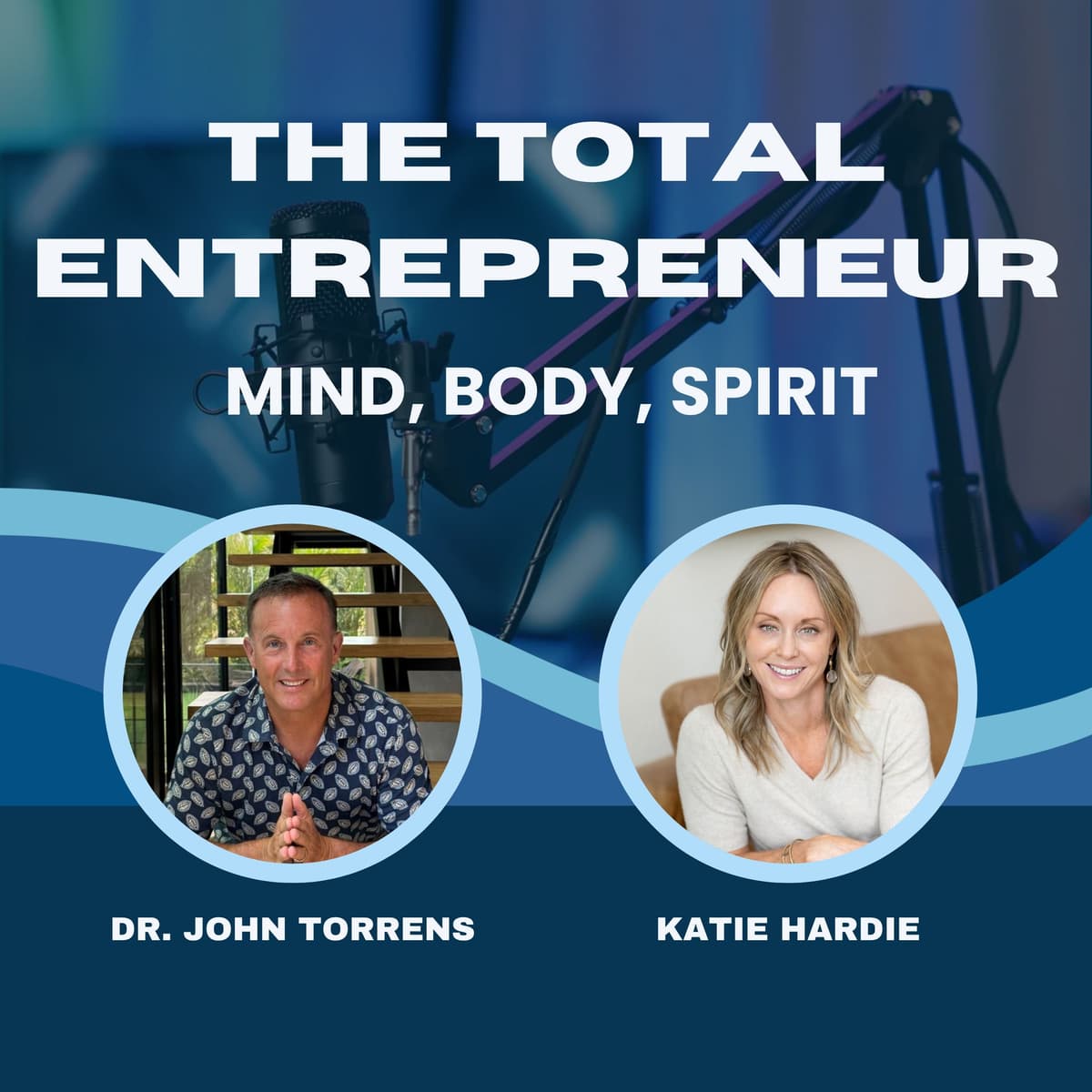
You Can't Out-Supplement Burnout | Katie Hardie
with Katie Hardie
Sep 3, 2026 · 00:57:44
Part of our conversations on
message for entrepreneurs is that nutrition isn't or shouldn't be an afterthought. It should be thought of as part of the work you're doing because if you really want to perform at an optimal level, which most entrepreneurs I know do, then yeah, the nutrition is equally as important as the rest and the work you do.
Yeah.
Hey, Katie, welcome to the podcast. Great to have you here.
Hey, Jon, thanks so much for having me.
Of course. So the first question I wanted to ask you is about, well, the fact that you've helped clients biohack their way out of burnout, right? So first question, you've helped your clients biohack their way out of burnout. So what's the single biggest lie the wellness industry tells busy, high-achieving people about their energy and about their nutrition?
I think the single biggest lie people hear is that you can out-supplement Or outnutrition your way out of a lack of strategic recovery.
I think that's true. And I always say that the recovery is part of the work, right? Like, you have to recover so you can do your thing for better, longer, faster. And you've got some experiences with this as a fairly extreme athlete, if I'm correct. Is that right?
Yeah. Well, yeah, I would call myself a former endurance athlete. I don't do that anymore because I understand the role of strategic recovery on how that impacts your adrenals and your hormones and your energy and basically your overall output. And, I think as you just kind of mentioned that the recovery can actually be the hardest work hard workers can do because they're so used to the accolades and the badge of honor that come from grinding it out and the production that they're doing, the busyness almost, but it's not. not necessarily effective or quality output. It's the sake of being busy for kind of that masochistic mindset, you know, mentality of just doing more but not doing smarter.
Right. And there's a point of diminishing returns or like a U-shaped curve when it comes to exertion or training or anything, right? And I think an endurance athlete, while not exactly analogous to entrepreneurship, there are some parallels. So could you talk a little bit about your career as an athlete, how you approached recovery?
Sure. So, I actually started off probably what my body's more designed to do with more of that sprint type of athletic focus when I was younger and was more into team sports like volleyball. And then, it was post having kids where it's really hard to collect 11 other people to go play a game of volleyball and you're trying to coordinate work schedules, kids' schedules. And so, You know, I was like, all right, well, I love learning about different conditioning programs. I have a strength and conditioning background as well. And so for me, I'm an experiential learner. So I'm like, well, I want to see how this feels. Like, let's do a triathlon. And, you know, instead— long story short, instead of doing a sprint or an Olympic distance, which are the shorter ones, it's like, well, let's not qualify it with half. Ironman. Let's do a full-on Ironman. Let's just do it all. And so that was your first one. Yeah, it was basically my second one. It's like, let's just do it. And so, you know, when you're able to just kind of go out and like push your kid in the stroller or, you know, just go out on your own time, it doesn't really matter. Um, you know, what distance or what type of thing you're doing, you can do any individual sport on your own. And so It became something that, again, I don't think my body was necessarily designed for endurance, although I did totally fine at it. I still kept all the other components of intervals and weight training and working and all the other aspects of life. So, it was just adding more physical stress on top of all the mental, emotional, just life stress. And you get through it in your 20s, your 30s, you're fine. Find a way to get through it. And then, it starts sneaking up maybe mid to later 30s, definitely 40s, 50s. And so, it wasn't really until I started understanding the role of hormones with that whole energy in versus energy out equation that it started to make sense because you hear, well, just if you're trying to keep your body at a certain physique, You're like, well, just burn more calories than you consume, right? That's what everybody hears. So you start eating less and working out more. And in the short term, that absolutely works. And in the long term, your body has to adapt. And so inside, underneath, you can't see it from the outside, but your hormones start shifting and start adapting to make it so you can still take care of today's needs. We just kind of table tomorrow's longer-term projects. And longer-term projects would be sex hormone production, digestive enzyme production, thyroid function, immune cell production, all these things that if you're not here tomorrow, it doesn't really much matter if those things happen, but you're getting through today. You're taking care of today's workout, you're taking care of today's stressors because that is what our body's survival mechanism has built into it. And then you do that for years and decades, and then that's when the tip of the iceberg starts surfacing above water and you start noticing symptoms. So just because you don't experience symptoms or have a lack of symptoms doesn't mean nothing's brewing underneath. And so for me, I'd been grinding this way, you know, basically my whole life since high school, just, you know, burning the candle at both ends, very successful, very productive, you know, high achiever. You know, you get rewarded for it, all the things we talked about at the beginning. And then all of a sudden something happens, and usually it's an unexpected illness or injury. that happens at the least opportune time and is so annoying to be sidelined for. And so, for me, that was when it really hit home like, oh, inside the body, hormones, all this stuff matters, was when I got into running functional labs like blood, urine, stool, saliva to understand what's going on under the hood. And, I had done a urine saliva test to get into stress and sex hormones, Right before I went on this backcountry skiing hut trip. And this was a time of high, high, high stress in my life. And again, burning the candle at both ends, eating crappier than I normally would, drinking more alcohol than I normally did. Um, overtraining, underrecovering, like pretty much textbook checked all the boxes of what you should not do. And on that hut trip, we were skiing out on the last day and going one by one during a little like steeper area where it's a little more avalanche prone. So you gotta do that and then get out. for the next person. And it was like a warm day prior, kind of like March spring skiing. So it's getting warm during the day, kind of melting and then freezing at night. My, my ski caught on something and all of a sudden I like fell. I was like, whoa, I need to get up really fast. This is embarrassing. I don't want the person behind me to see it. I have no idea why I fell. And then when I went to pop my foot back in the ski, my knee bent backwards, like the wrong way. And I was like, oh no, that's probably my ACL. I have a long ways to get outta here. So I kept trying different ways of getting in the ski and skiing down. It just kept buckling every direction. And what happened was once I got back in town, got the results on paper inside, you know, like hormones-wise, I was a recipe for a disaster like that to happen because it wasn't a contact injury. I wasn't playing football or anything where somebody hit me. It caught on like snow.
So.
It just, you know, my body was in a state of total breakdown underneath. And you can't necessarily see that from the outside, but that's exactly when, you know, injuries happen. And it can be overuse, or it can be an acute injury like that, or it can be getting sick, whether that's a cold or something larger like cancer. And so that was kind of my, okay, this applies to me too, not just other people I'm working with. And I really need to listen to my own advice and really start incorporating a little more strategic recovery. And I've, you know, kind of overhauled how I approach things since then.
One of the hardest things to do is to take your own advice sometimes, right?
Yeah.
Yeah. Well, no, I appreciate you sharing that story because I think it's a really good illustration of, well, a couple of things. One, that yeah, recovery is an important part of the work, but you could be slowly but surely damaging your body and not even really know it because you feel pretty good. I mean, you know, You're young, you're healthy, you feel all right until you don't. And, you know, one of the things I talk to my students who are entrepreneurs about this is you're going to spend a lifetime starting a business, creating wealth, and you don't want to ruin it in your last couple of decades because you're dealing with chronic disease and those chronic diseases start now, right? With all the habits you're, you're developing or not developing.
Yeah, totally. And to your point, what you're saying is The habits we do now are setting our future self up for either an easier road or a more challenging road, as well as your current self.
Right.
So, I think it's hard to look or imagine your 10, 20, 30-year-from-now self, because especially the younger you are, like, you're not— you're invincible. You don't care about health. You just want, like, kind of living in the now, which there's benefits to that. And the things that we do now to set us up for feeling awesome and performing awesome later also help in the now. And I think that's kind of the disconnect where, um, it's kind of like you're so used to getting by because that's what you know. You don't know what you don't know. And like what you said, you do feel really good when you're running off of adrenaline and cortisol. You feel awesome. And so it's hard to like pull back from that high, right?
Yeah, for sure. You know, I, I've heard people talk about it much like a, you know, saving for retirement almost, right? Like, you know, the $200 you put away per month now, you don't really see the benefit of it until it starts to compound. And then when you're in your 70s or 80s and you need it, you know, then you've got it because you built those habits and that discipline early on.
Yeah.
So tell me about your business trajectory. So, um, so first, what is My Peak? What do you do? And I'd love to hear the origin story of how you, how you started it.
So, my Peak— Peak actually stands for performance, uh, whether that's physical, like athletic, or professional, or just being like your best as your human being that you can be. And I do that through E-A-K is energy, like energy management, uh, both through nutrition, finding the right foods for each person's body, and keeping really stable, solid, positive energy all day long and not having those energy dips. Awareness is tuning into what your body's actually giving you for signals. And, I do that both with biofeedback. I know you do HeartMath, right?
Yeah.
Yeah. That's one of the things I use for one of the biofeedback methods because of that whole high performers wanting to measure some sort of output. A lot of times looking at the recovery seems like, oh, if I have time, I'll do that. But, I look at the recovery health How efficient are you? How productive are you at recovering? And so kind of flip it that way. But also continuous glucose monitors, other ways where you can see real-time data of like, what is your body doing right now? How do you feel? You know, checking in with that. And then the K is for knowledge. That's where we dig under the hood to get those internal metrics from our gut functioning, our hormone functioning, our, you know, immune inflammatory hormones, thyroid, you know, all of that through blood, urine, stool, saliva, and then put that together for a really comprehensive tailored plan because everybody's different, right? We all have different inputs we're coming in with, we all have different goals, we all have different applications in which we want to express those goals. So it's, you know, it's a journey, it's very much about people who want to be the best version of themselves, learning how to do those things on their own. So they don't need me holding their hand forever. They can continue on indefinitely. And they know when they're in a certain situation, ah, this is going to best serve me. This might feel good in the moment, but not be best for my, you know, hour from now self or a year from now self, and be able to make confident, educated, informed decisions on how to best navigate those situations.
And, tracking your own biometrics is such a logical place to start, right? Yeah, HeartMath is really good because you can see— I like how you framed it like how good are you or how productive are you at recovery, right? Any competitive person wants to be really good at it, I guess, when you frame it that way. But then, the CGM, I wear one a couple times a year just to keep track. I monitor my sleep. I do the labs 4 times a year. And yeah, it's really important because you don't know, right? You could look pretty healthy on the outside and things could be falling apart. And, it's especially hard these days.
Yeah.
And, I'll get to that later, but I want to continue with your experience with MyPeak. So, how did you start that? You didn't just wake up one day and said, oh, this is what I think I'm going to do. What's your origin story for the business?
So, I've always been interested in human performance and just starting from the early days of the Presidential Fitness Challenge tests. I don't know if you guys did those growing up, but I was totally drawn to those. I hear they're coming back, so that would be cool. So, I always wanted to You know, just learn what is it that I need for my specific body to like perform at its peak potential. And so I went down the road of strength and conditioning, nutrition, and ended up doing culinary school, which wasn't planned, but integrating all that in and sport and performance psychology, and then running the functional lab. So just really like to go deep into every subject matter that I'm wanting to understand. And I'm like, well, if I'm wanting to know these things, I know other people do too. And I, I've always had a balance of wanting that application to be physical. That's kind of, I think, you know, where our comfort zone lies, at least is our culture particularly. Everything's pretty physical. But then like through the sport performance psychology program, really starting to learn, um, how much of that mental piece impacts the physical piece. So have you read The Biology of Belief, Bruce Lipton?
Yes. I love Bruce Lipton. Yeah. Yep.
Mm-hmm. So, like, that gets into how our thoughts are part of that whole epigenetic programming of our body. And epigenetic means, you know, like, you, you have the DNA passed down to you, but how that expresses is influenced by your environment. Environment including nutrition, stress, the thoughts that we actually have. And it's so cool how you can see how those things are actually measured and impact the tightening of the DNA helixes, or, you know, like what basically is expressed or not expressed. And so, that has just been so fascinating to me just from whether it's a healing perspective or performance perspective and how much we actually can control our destiny a little bit more than I think a lot of times we give ourselves credit for. And, for those people like me who need to see it on paper because you're a little bit of a skeptic—
Right.
That's where those functional tests come in because I was like, kind of like back to my adrenals. I'm like, yeah, yeah, it makes sense that people would need to recover a little bit, but like, I'm tough. I don't need that. I don't need the nap. I grew up in the Midwest. Like, napping's if you're lazy. You can sleep when you're dead. Um, if you're not super busy, then, you know, you're not being as productive as you could be. Just all these like, you know, downloads that have, you know, kind of been a part of your subconscious upbringing. That you're like, oh no, that actually impacts my adrenals too. And that impacts like what your body can produce for repairing and recovering in the form of DHEA, which is upstream of your testosterone. So if your goal is to build muscle, like, that is really important. And so this isn't a luxury to recover. This is actually part of a strategic training plan. So from the strength and conditioning perspective, you have periodized programs. You have preseason, in-season, postseason, hopefully an offseason, which is kind of becoming more and more rare. But that is so important for peak performance, whether that's the Olympics or something that's an annual basis. But you are always training with the end in mind. But when you look at workplace, like, a lot of people are just performing all the time without training. And so they don't build in those strategic recoveries or offloading weeks like you would in the gym. And so a lot of these same concepts do apply, they're just not being applied. And so I think for people who are very metric-driven, very performance outcome-driven, seeing these things on paper is really important for gaining buy-in and understanding of, oh, what's going on with my specific body. And how can that shift? And how does that actually tie into me cognitively functioning better? Because a lot of times people don't get that connection. Like, why does physical health relate to mental performance at work? And it's very much important because health is a prerequisite for any kind of performance, whether that's physical, mental, or emotional. And if you're in physical, you know, endurance is prerequisite for being able to stay on task and to stay focused or to keep your emotional cool and not just lose your shit on everybody around you. It is necessary. The inflammation that goes in your body with, you know, certain types of lifestyles, that's going to slow down your cognitive functioning. That's going to create more of that anxiety, depression in your brain. Because it isn't just inflammation in your gut or in the rest of the body, it goes to the brain too. So for people who really care about any sort of performance, health is the first step. And then, you know, with our current system, we are very much of an acute situation healthcare system or disease management, but it's not like health preventative. And so when you're getting labs done, you see, oh, everything's fine, quote unquote fine, but people are still having like afternoon energy dips or having like midsection weight, or most people are overweight, so they don't realize they're actually overweight and inflamed because it looks normal compared to everybody else. Not normal, but it's common. Um, you know, we have this, I think, false idea of being healthy because we're not worse than most of the other people. Who are also unhealthy. And so nobody's functioning their like peak potential. And so that's where when you're getting into, you know, these types of labs or looking with different ranges, you're trying to solve the equation for peak performance, not, oh, you're totally broken. And that's the difference. Part of it is like understanding what is our healthcare system telling us about ourselves right now? It's just like kind of like telling you, okay, well now you're broken. But, I want to know before you're broken so we don't get to the point of being broken. And, that was my frustration early on. You're asking about why was this important to me? Because the recommendation was always eat less, work out more. Okay. Well, I was—
What does that mean? I know.
Yeah.
It's crazy.
And, when you're an athlete and you're already training and you're limiting your intake, which is a stressor on the body, you're increasing your output, which is another stressor on the body, I burned through, like my adrenals were just shot. Like all my hormones were impacted in high school. That's pretty young for that to be impacting you. But you know, if you're like, oh, I'll just keep eating less and keep working out more, you know, I'm probably 125 pounds now. I was like 105, like 20 pounds less than I am now. And I'm not like this big person right now. So I didn't have that room to go down that low, but I was just following the guidelines. And I was like, no, no, they're not written for me. They're not written for performance. They're written for the average person who is too sedentary and is eating too much processed food. They're not eating too much steak and kale. They're eating too many Doritos and Ding Dongs and sandwiches and pasta. But, you know, it's, it's not, you know, solving or answering the right question. It's not specific for this, you know, specific person. So that's what I want to do is create something for people who are, you know, motivated They're self-starters, they want to learn more and be better, and they're tired of the generic guidelines that might work for some portion of the population but aren't tailored for them. And so that's really kind of how that came about. It was like out of my frustration of, I'm following the rules, but the rules are not right for me.
Or the rules are stupid in the first place, right? Like you said, you know, exercise and eat less without any specificity. But I like what you said about You know, even when you go to the doctor and, you know, you're fine, you're within normal limits, I think it's important that people understand that that's within normal limits for an increasingly sick population, right? It doesn't mean optimized. So just because the doctor kind of gives you the blessing and says, hey, you know, your fasting glucose is 99, you're good to go, right? You're not pre-diabetic yet. You're one point away and there's probably all sorts of bad stuff going on in your body meanwhile, right? So I think that's the part that's really important for people to understand. is that these guidelines are for an increasingly sick population and they're not meant to be optimal and they're not customized to you, which is, I think, an amazing thing that you're doing for your clients. So speaking of your clients, what does one look like when they come to you? Like, do you have a typical or prototypical client? Like, they present in a certain way, or is it truly all over the map?
It is a little bit all over the map. The thing that is in common though is the person who is kind of going and going hard because that's what they're used to. That's what's gotten them to whatever point of success or functioning that they are right now. And usually, they need to incorporate more of that nervous system regulating work, like strategic recovery, to be able to get their nervous system in a place where they can recover, where they can heal, where they can allow their body to have space so then they can come and perform higher. And so sometimes people don't even realize how exhausted they are because that's just been normalized for them. And then once we start playing with those things and seeing it on paper, like, hey, here's— like, you have no cortisol production and here's the availability. This is why it's really hard to get out of bed. Or different profiles could be like, I'm kind of wired but tired. Here's why. And here's what we can do. And, you know, within, you know, a month, 2 months, 3 months, it's pretty wild, the transformation, when people are like, oh my God, people are coming up to me, my skin's glowing, I have more muscle tone, my energy without caffeine, without needing to turn it on with caffeine, without needing to turn it off with a downer. They're like, this is crazy. And it's just the awareness of like, well, what things could we be doing? How could we be planning the day a little bit differently? The flip side of it, when we come down, because from strength and conditioning, all the sweet stuff happens between the workouts. It's when the muscle fibers are rebuilding and then they rebuild stronger. So you are either stronger or faster or whatever the goal is. Same thing across the board, regardless of the output or outcome that you're looking for, but it's giving that extra space for recovery. All of a sudden their speed is faster. Their endurance is higher, their strength is higher. And like, this is also wild. I feel like I'm doing less, which means less volume, less busyness is how I would describe it, and having higher output. So people are like, they look fine on the outside. Everybody looks at them like, oh, you're, you know, you're active, you have good energy. And then all of a sudden they're going to these people like, your energy and just like your vibrance, vibrancy is so much higher. And now instead of being kind of middle to back of the pack, they're in the front of the pack. and they're just having energy to crush their day and not kind of limping it along. But when, when people are hard workers, they don't often realize how much they're mentally willing themselves through the day, 'cause they're good at it. And when you don't have to do that, it's like you've just opened up this whole reserve of energy that you didn't realize was possible. And that's what's cool. Yeah.
And you know, when, when you give a healthy body the right fuel and let it do its thing, it's just amazing what happens, right? But back to your previous point, like, do you find that, like, so you get a high-performing client who finally starts to understand what you're saying and is internalizing it, do they kind of go toward this all-or-nothing place or almost get too competitive or maybe too maniacal about the healthy living part of it? Do you ever find that?
Well, that can be an area to look out for because that all-or-none, like, kind of rigid thinking kind of can get you into the hole. It's what pulls you out of it, knowing that you have that. And then, uh, everybody's different. Some people need the nudge to do a little more. Other people need that permission to incorporate more flexibility with themselves and in their lives. And so that's very case by case. And I do see that with people. It's like, all right, you don't have to for example, we do— I do this spring and fall cleanse challenge. It's 3 weeks long. And so, we pull inflammatory things, we add liver-supporting things, we add recovery restorative activities. And sometimes, coming off of that because people feel so awesome, it's all real food and lifestyle. Sometimes, people are like, what— how do I transition? Like, I don't want to lose my progress. I don't want to lose how I feel. And they're almost anxious about it. I'm like, All right, keep these in mind, you know, 50 to 80% of the time, not 100%. And just, you know, the biggest question is when something comes up, whether it's like happy hour, birthday cake, or, you know, you're traveling to Italy, the, you know, handmade pasta, like, is it worth it? Knowing how you feel without those things and knowing the experience you might get with the things Weighing it out. Is it worth it? And something's going to be worth it, but a lot of the things won't be worth it. So it's kind of like in the larger scheme of the lifestyle, you know, what's worth it to you? What's worth it to you might be different than what's worth it to me, and that's fine. It's just kind of learning about yourself and like something— be flexible with some of those things. And maybe it's like, okay, I'm going to have a bite or two of the thing, but maybe not the whole pie or the whole piece. You know, but like, I really work with people on finding the gray zone because gray zone's a lot harder than black or white. And that's life.
Mm-hmm.
You know, like, you, you want to have strong boundaries, but not so rigid that you're, um, missing out on some of the finer things. So, with my culinary background, I very much appreciate food and wine and culture and, you know, all that together. And that's why, you know, I don't really go out to eat much because I feel like we can do the same thing, if not better, at home. And it is part of travel. It is part of, you know, social experiences. So some people use, you know, celebration as their hall pass to do all these things all the time, you know. And other people, like, if they're gonna be too rigid, then they might miss out on some of those experiences when they are traveling. And so it really depends on the goal. Like, are they still in the deep clean phase of their journey? Or are they in the maintain phase? Because the answer is going to be different with that too. And so when, you know, like if you have ever had house cleaners come, they usually do a deep clean first and then they get into a maintain place. So when we're deep cleaning, it's not helpful to like walk around the house with muddy boots. And, you know, when we're maintaining, it's not going to take as long. And your body, when it's more resilient, when we've kind of done some of the work, it's more resilient to be able to handle those things. And so what's cool is people whose stomachs used to get upset with eggs or dairy or, you know, fill in the blank, when they're in a healthier spot, they can actually periodically have those things without having the setbacks that they once did. And that's the whole goal. It's not to be, um, this is so rigid forever, but it's actually the discipline you put in earlier gives you freedom and flexibility later for when those things are worth it, to be able to enjoy it stress-free, guilt-free, and really be present with it.
Kind of like the 80/20 rule, right? If you're following best practices 80% of the time, you don't have to sweat the 20%, I guess, once you get to a healthy place. But, you mentioned earlier the fact that the recommendations we get aren't really necessarily specific to us, they're just general population recommendations. And I've heard you talk about bio-individuality. So how would you break that down and explain it to somebody who's just hearing it for the first time? And I learned this, and my wife and I were both wearing a CGM, we're eating the same things, and my body reacted completely different than hers on a whole range of foods. Like, you know, you would think in general, if you eat a banana or a potato or rice or pistachios, your body's going to react the same because you're a human, right? Our bodies reacted so differently to several foods, which kind of leads to this bio-individuality idea, and I'd love to hear you explain that.
Oh, I'm glad you brought that up because one of the things I work on with people is finding the right foods for their body. So we all have different genetic inputs, you know, from our ancestral heritage, and we all have different states of being in or out of balance or homeostasis. And so when we're more out of balance, the things we need to get us to feel more in balance are going to be a little bit different than when we're already in balance. So some people do better with higher-fat, higher-protein meals, a little bit less on the carbohydrates. Other people do better with more carbohydrates, a little bit less on the fat and protein. Within each of those categories, some people do better with you know, more like the organ meats or game meat type of proteins. And other people do better with like lighter ones, like lighter fish, like the, you know, white meat of the poultry. And so there are a lot of variances between people. And when you have somebody who I call it like a fast oxidizer, they burn through their carbohydrates and some of their nutrients a little bit faster. When somebody like that is given, like you said, a banana, That is going to spike their blood sugar, and then it'll crash afterwards, where somebody who burns through that a little bit slower is going to have a little more modulated response, a little bit more like rounded out curve, and that person might be able to handle that banana a little bit better. So for example, I'm one of those people, I always tried to eat like more vegetarian, more low-fat, no-fat, you know, grew up in the '90s, like don't touch the avocado, go crazy with the red— white bread, you're fine. Well, I tried to eat that way for a long time and I was constantly hungry and I didn't understand why. And, it wasn't until I realized I'm actually somebody who does much better with more protein, more fat because with all those simple processed carbohydrates, spike, crash, spike, crash, not stable energy. The energy management that I'm working for with people right now. When I shift to, you know, much higher fat and protein, and the carbs I do eat are not processed, they're whole, you know, they're vegetables, maybe some, you know, root vegetables, maybe a little bit of starchy vegetables, but like vegetables, maybe some grains, it just depends. But when I eat more that way, my energy is so stable I can go 4, 5, 6 hours just feeling really solid, whereas before I'd go maybe 90 minutes and be like, all right, now what are we gonna eat? You know, like, I'm hungry, like, I'm low blood sugar.
Mm-hmm.
I didn't realize that was why. So the bio-individuality is how we each respond differently to the state— same stimulus or input. So with, you know, you and your wife, if you had a banana and she had a banana and one of yours spiked higher and faster and stayed up longer, Mm-hmm, yeah. That is that bio-individual response, and that's why I do that so people can learn about themselves right now, because if you have a lot of stress going on, you already have cortisol going through your system, you already have more blood or sugar in your blood, that's going to also result in a different response than if you were in a very restorative state. And you didn't have all the stress hormones and sugar floating around in your blood. So, it's a combination of what you're given coming into in addition to that epigenetic expression of what you are right now. So, that creates a whole lot of variables that we need to work with to figure out what works for you right now. And, as somebody gets more balanced, more in line with their health or their performance, that might shift a little bit too. It is.
is very multivariate and very complicated, right? Like you said, even, you know, if I had that same banana in a different state or my nervous system was regulated better or I was fasting or not fasting or I had fiber in my belly already, it would be completely different. So I think that's why it's really important for people to just understand this. So what I'd love— I'd love to hear your thoughts or your explanation on this because I hear this from young entrepreneurs a lot. They just kind of look at it as a calorie counting exercise, right? So they need, Mm-hmm.
So that equation is based off thermodynamics, which just takes into account calories. It's not taking into account actual nutrient demands that our cells have. And, uh, you know, every system in our body needs specific nutrients, or if you're thinking about if you're building a, you know, large building, it's not just like the dimensions of the building you need, like in the form of cardboard. You need solid materials. So our body's the same way. It's not like, oh, just give me the exact dimensions. We want them actually serving the physiological function that they need.
Mm-hmm.
Fulfilled. And so, um, it's how nutrient-dense is it? What, what does your muscle need when it's broken down and, you know, needs to repair? Needs amino acids. Well, do 200 calories of the M&Ms give you any amino acids? Zero. How about Doritos? Zero. Okay, what about a steak? Lots. You know, what about chicken? Lots. You know, fish, you fill in the blank. So it's about what nutrients are you getting from it. And if you think about it just with common sense, you give a 2-year-old, you know, 1,000 calories of broccoli, 1,000 calories of chicken thighs, 1,000 calories of white sugar, which one do you want to hang out with? Not the one who just has sugar. I'll tell you that right now. And so just common sense, like you don't need any, like, you know, letters behind your name to just like know people act differently with different inputs. And so yes, not all calories are created equally. It's not as simplistic as calories in, calories out, because that does not account for hormones. And so you had mentioned blood sugar earlier. The hormone that is really important, I think, to look at is insulin, fasting insulin. They don't check that regularly at the doctor because that's not correlated with any specific diagnosis or corresponding prescription, because that tells us 10 years ahead of the time you might need some insulin or have a diagnosis. So I look at fasting insulin because that'll tell us how much stress the body's going under in the background. And so that's what I like looking at— what's going on in the background that we can tell, hey, this actually looks optimized, this looks awesome. Actually, this over here There's a lot of inflammation going on. What is inflammation? That is the root of all diseases. So if you don't want to set yourself up for that future self having to deal with cancer or, you know, being overweight or not being able to like move around and do the hobbies you like doing, we want to look at fasting insulin now along with, you know, your hemoglobin A1C, your C-reactive protein, maybe histamine. You know, there's fibrinogen just to know what's going on under the hood. So we can start making some adjustments because fasting blood sugar is very transactional. Like some people get nervous around the doctor or the nurse or needles. And so that might go up artificially. The other thing is when our insulin's working really hard in the background, its job is to keep your blood sugar in a good range. So your blood sugar can be in a quote unquote fine range. But your body's not in a fine range because when you're fasting, insulin is working overtime. What that's doing is it's removing the sugar from your bloodstream because too much sugar in your bloodstream is damaging. It ages you, it damages your blood vessels, which leads to, you know, heart attack, stroke, the things you don't want to have. Nobody wants to look old or have a heart attack or stroke. So those are like, you know, big-time things that we want to avoid. So your body will release insulin to shuttle that sugar, you know, into your liver, into your muscles, or into fat if those are all full. And if somebody's sedentary and is eating too often, eating too many processed carbohydrates or sugars, then that's going to get stored as fat. And so those are things that we can, you know, get in front of and look at. and you could eat the same number of calories in a day, and one person has them being utilized like in their muscle for recovery and repair and, you know, helping them out, whereas somebody else, the way they space them, eating every 2 hours or eating breads and pastas instead of, you know, meats and veggies, they are shuttling that as fat for storage. And so they're gonna have very different body composition, they're gonna have very different inflammatory profile and very different energy management. So, they're going to have highs and lows, highs and lows all day long. They're going to want that afternoon nap or just feel like, oh, I need a little afternoon boost, or they're just not going to be as stable, positive, focused. And so, on paper, yeah, they both had 2,000 calories. In reality, the response couldn't be more different.
Right. And, I like how you framed it. You called on the law of thermodynamics. And, If that were all it is, then yeah, calories in, calories out would be all we need to worry about. But you know, there's nutritional biochemistry at work as well. So the things you eat now kind of set you up for the processing and digestion of the things you'll eat later and dictate how long you'll hang on to fat or produce fat. And you know how how well you'll process things and you know just how sharp you'll be. So I think the the message for entrepreneurs is that you know nutrition isn't. Or it shouldn't be an afterthought. It should be thought of as part of the work you're doing, because if you really want to perform at an optimal level, which most entrepreneurs I know do, then yeah, the nutrition is equally as important as the rest and the work you do.
Because you want to be really efficient with your time, right? And if your brain is a little sluggish or slow to start or kind of getting distracted or wandering or like, oh, I'm hungry. What can I look for in the pantry? Like, You know, you're not getting the work done. And let's be efficient. Let's, you know, you know, go hard and then recover. You know, it's kind of like series of sprints versus one long marathon grind throughout the day.
I definitely relate to that for sure. I mean, luckily not anymore, but that, you know, what you were describing earlier was kind of my life 20 years ago, you know? Yeah. So one of the things that people are starting to talk about, but I think are still maybe misunderstood, is gut health and the role of gut health and even, you know, the interaction of hormones and gut health. Could you talk a little bit about why people are so interested in gut health lately, why we see it deteriorating, and, you know, what, what are one or two things people could do to maybe manage that for themselves?
Yeah, so the gut is where most of our immune system is housed. And our neurotransmitters are produced. Neurotransmitters are, like, chemical messengers that help— like, people have probably heard of serotonin, dopamine, GABA, things like that. They are what help people feel happy, motivated to do things, calm, things that, you know, very much affect our mood. And then they travel along the vagus nerve up to our brain. And more of our signals come from our gut to the brain than the other way around. And so when we have low bacteria, that's like the good guys, if you will, in the stomach, that's just less availability for those necessary components to be produced. And so sometimes you'll have people who have, you know, just very low good gut bacteria. They also have the exact same symptoms of anxiety or depression. And the first, you know, go-to is Wellbutrin or Xanax or, you know, fill in the blank. But when you look at the gut, a lot of that can be corrected that way. That can also correlate with low progesterone, but, you know, like, we don't necessarily go straight there. So, you know, when you kind of look at the gut, which nutrition, just real whole foods, is like a super simple, like, answer to that. That's going to be much more supportive for maintaining and supporting a good microbiome. And then things that can be damaging to it or inflammatory can be processed sugars, processed carbohydrates, gluten in the form particularly that we have here because we've changed the form. We've, you know, genetically modified it. from the original state. So I see this all the time with clients where they don't realize it's impacting them until they go off of it. And then when we try it back, they're like, oh, I do have a little joint pain, I do get a headache, I do get gas or bloat. And then they go to Europe where it's more of the ancient grain, and they're like, actually, I'm fine with it here. And so not all, you know, grains are created equally, kind of like kind of like meat. You get, you know, conflicting information on meat. It's not all raised the same way, so you're not really comparing apples with apples. So quality very much matters. And so when you're looking at gut health, things that would contribute to what we call a leaky or permeable gut would be, you know, especially the gluten we have here, just kind of opens that so the outside world is having contact with the inside world, like the immune system, which can make your immune system unnecessarily reactive, and then that can create issues more so for some people than others. But as far as, you know, just the things that can really support your gut health, a variety of organic vegetables, primarily fermented foods if your body is okay with them, fruits, a variety of proteins. Minimize the processed foods like the crackers, the breads, the Pastas, the, you know, the things that are very quick to spike your blood sugar and drop it. And, um, you know, giving yourself a break between meals, like have breakfast, have the right food so it lasts you till lunch. Give your gut a break. And because your gut needs to clean things out, it's kind of like you got to vacuum your house at some time. If you're constantly walking around with your shoes on while you're trying to vacuum, it's kind of missing the point. You're, you know, really getting ahead. Same thing from lunch to dinner, get substantial amount of food so you don't need to snack. That's part of the energy management, you know, we work on is, you know, finding what that ratio is, what the amount is, what the types of foods are, because just like our bodies and our brains and our muscles need recovery, our gut does too. And if we're constantly eating and grazing, You're not giving it time to clean up, and that can create a lot of gas and bloat and other issues. So those would just be some quick tips, um, for some, you know, gut health to help support not just physically but your mind and mood too.
Thanks for the description or the explanation of gluten, because a lot of people are just experiencing that, right? And I think it's important to realize it's not necessarily the same thing that your grandparents were eating. And I think that's a What I've seen anyway, it's a major trend is people are like, oh, well, you know, my grandfather used to eat this all the time and he lived to 100. But, your grandfather probably wasn't eating exactly that. Maybe it was called that, but it wasn't made the same way. And, I think that's confusing for people. So, yeah, I don't know if you've noticed that as well.
It is. And, I used to be totally anti-gluten peep. I was like, no, I'm extra gluten, extra carbs. And then, When again, I realized, oh no, it's not all created equally. And then just how my body responds, my body doesn't love it, you know? And, uh, I'm going to Europe in a month and I will eat it there, you know? So again, part of this flexibility is I wanna see how I handle it there.
Mm-hmm.
Because, you know, I recommend it to people and it works for them and I, I wanna see how it works for me. And, um, but I know for me it's not worth it here. Like, there's no satisfaction in 5, 10 minutes that outweighs the feeling 1 hour to a month to a year later, in my opinion.
Yeah.
And so, everybody's different. Everybody has— again, the bio-individuality, everybody handles things a little bit differently. And, most people are more sensitive to it than they realize. They've just been marinating in it the whole time. never experienced a lack of it, to then go back and know, oh, this is actually how I feel with it. And that's part of that awareness piece. Um, when you don't know what you don't know, you can't just discount it. Like, I used to be so close-minded of those things, and now that I'm much more aware and tuned in, I'm like, oh nope, there's actually— well, there's tons of science behind it. But then at the end of the day, to me, the end of one is much more important than what any you know, study of hundreds, thousands of people will tell you, because when I'm working with one-on-one clients, I need to know what works for them. And so if this works for 99 people but not me, and I'm concerned about my performance, that's the end of one I care about.
Yep. Yeah, absolutely. So let's talk about labs for a minute. So if somebody is, is listening and they're thinking, yeah, you know, I've I got to do something here and maybe to figure out, I'm going to start with getting a proper panel. What do you recommend? Where should they start?
I like to get a really extensive intake to kind of see what's been going on historically and then kind of what the goal is going forward. And so, what I tend to include is a stool sample, it's a poop sample, and that gets into the microbiome and how your gut is functioning from a digestive standpoint. Because nutrition isn't just what you eat, it's what you eat, digest, and absorb, assimilate, you know, and use into your cells. So you could be eating the most perfect diet for you, but if you're pooping it right out, it doesn't quite serve you the same way as if you're actually able to absorb it. And then, you know, it just gets into what's going on back to that point of all the gut-brain connection. And then hormones, stress hormones, I think gets overlooked in a lot of the conventional conversations because It isn't best picked up through blood, and so it's picked up throughout, you know, 24 hours between urine and saliva. Well, that doesn't work with a blood panel, and so when people get one cortisol point in blood, it's kind of meaningless because your cortisol pattern is just as important as well as the actual amount you're producing. But what that also misses is what you're clearing. Because when we've got dysfunction, you're going to clear at a different rate than you produce. So this all ties into energy throughout the day. So really important to understand why is your energy good in some points of the day, maybe poor in the other. And then that all trickles down to hormones. You know, that's kind of, you know, the rage with, I'd say, a lot of, you know, circles of conversation is like bioidentical hormone replacement therapy. Do you need it? Do you not? Like, what kind's the best? But this will get into, you know, what people are producing, the, you know, metabolic pathways, you know, is it more supportive of like health, more, you know, cancer-prone, and so it just really dives deep into it. So I do like to look at that because so many, you know, high-driving people have some sort of adrenal dysfunction or areas to maybe maximize it a bit more. And that to me, with those people, is the biggest turning point when people get their adrenals supported so they're firing on all cylinders and not just like barely limping along. And then for blood work, I like to do a full panel that gets into, you know, the standard things like the complete blood count, the metabolic panel, the lipid panel, but I do advanced lipid panel where you get into particle number, particle sizes, Lp, ApoB, just to kind of get a much better picture of what's going on. I include inflammatory markers, like I was mentioning, the fasting insulin, because that'll tell you so much more about how hard your body's working in the background, how inflamed it is. I include sex hormones on that because while the— I use the DUTCH for the urine saliva, well, that includes that, blood is still considered gold standard for hormones, and if people are going to go down that route of supporting or supplementing there, we need to have it all. And full thyroid, because a lot of times people only get the TSH, which is your thyroid stimulating hormone, that doesn't actually tell you about your actual available T3 or your stored form. And a lot of times when people are on thyroid medication, they're getting the synthetic stored form T4, but when they have liver congestion or things going on, it's not converting it to the active. And so kind of like your blood sugar and fasting insulin, your TSA or TSH could look okay, and lab range is way wider than functional range or optimal range, but the available T3 might still be in the, you know, dumps. And so again, it's just like, you know, a more complete look at it with tighter ranges because as you were mentioning, the lab ranges are based on population averages, they're not based upon— this is the recommendation of where we should be, and so between all those, and you know, some people will just do gut, some people will like do the whole panels, you know, some people really want to dive into toxins, environmental toxins because of whatever their life you know, events have taken them through, that might be more relevant, or they want to get into what their cellular amounts of all these vitamins and minerals are because they really want to optimize, or they want to get into food sensitivities. But for most people, I like looking at the gut, stress and sex hormones, and blood because that gives us, like, to me, it's like the fewest tests that gives us the most information. And from there, It's just really tailoring the plan to most of it's diet lifestyle. You can do so much of it that way. And, I give everybody a HeartMath because the sensor that you use, because that's so transformational to people who are just used to checking all the boxes, but they're checking them in a little bit of a frantic fight-or-flight state. And it doesn't work. It doesn't work. And when I didn't, you know, before I didn't used to incorporate that, people would come back with H. pylori, H. pylori, keep coming back. They're doing the protocol, but their body can't receive the benefits if they are, you know, like frantic. And they don't necessarily feel frantic. They're just so busy that their body doesn't ever come down. And allow those things to be able to work for them.
Yeah, so again, it's, it's complicated. And, you know, if you're feeling like this is a journey you want to go down, it's probably a good idea to, to get a hold of a good functional practitioner, whether it's functional nutrition, functional medicine, somebody who really is willing to get to the, the root cause of problems. And, and actually, what you just described in terms of what you look for in the different panels, that circles back to one of the first things you said, which is you can't out-supplement poor health. And That's really important because you could take all the supplements in the world, but unless you're taking the ones that your body needs and can process and make bioavailable, then you're probably just, just wasting your money. So that's, that's a great point. So Katie, if somebody's interested in learning more about you and your work and what you do, how can they find you?
Yeah, my website's mypeak365.com, or if people are interested in like, hey, I want Mm-hmm. To take some action today, I do have a 10-minute shopping list because for a lot of people, I think, uh, grocery shopping and like preparing any food at home can feel overwhelming, but it shouldn't feel that way. And I think when you have something that's going to really reduce the barrier of time or complexity and make it where I can get in and outta the store in 10 minutes, and here now I've got ingredients for 3 very quick things I can make. That seems more approachable, and that was that was pretty life-changing for me. Was just learning how to put things together my body needed in a way that actually tasted great and didn't consume a whole bunch of time. And so I have shopping lists. If you go to mypeak365.com/shoppinglist, you can download again. It's like basically you know produce and some meats and just the quick things that you need to get your week going just to set you up. You don't have to go from cooking no meals a week to every meal by any means, but just getting a few things around to fill in like the lunch gap, which often gets skipped. And then we go to bars and things that are just super convenient, but not necessarily in our best, you know, cellular interest. I think that can go a long way. And that's one of the things I get the biggest feedback on is like how good people feel when they have real food. And so I recommend that. I'm on, um, Instagram at mypeak365.com. So I'll show like little reels of like, here's how to whip this together and just try to make it fun and approachable. Because at the end of the day, if that is one more stress, that's anti what we're going for. So we wanna make it fun, we wanna make it approachable, and we want people to just feel good like doing it. That's part of the process, part of the journey.
It sure is. Well, Katie, I really appreciate you being here and sharing your experience with everybody. Thank you so much.
John, it was so fun chatting with you. Thanks for having me.
About This Episode
If you've ever powered through exhaustion because you're "tough" and "don't need the nap," this episode on strategic recovery for high performers might be the wake-up call you didn't know you needed.
Katie Hardie is the founder of My Peak ( mypeak365.com ) - PEAK standing for Performance, Energy, Awareness, and Knowledge - and a former endurance athlete who completed multiple Iron Man triathlons before understanding the toll a lack of recovery was taking on her body. In this episode, she sits down with John to break down why strategic recovery for high performers isn't a luxury or a break from the work; it's part of the work itself, and skipping it quietly sets you up for burnout, injury, or worse, even while you look and feel perfectly fine on the outside.
In this episode, you'll learn:
The single biggest lie the wellness industry tells busy, high-achieving people about energy and nutrition.
Katie's own wake-up call: a backcountry skiing injury that revealed her hormones were in a state of total breakdown, despite feeling "fine".
Why strategic recovery for high performers matters more the older you get, and why symptoms take years or decades to surface.
The PEAK framework: Performance, Energy, Awareness, and Knowledge, and how functional lab testing fits into it.
Why "calories in, calories out" misses the real picture, and what fasting insulin reveals that a normal blood sugar reading doesn't.
Bioindividuality: why the same banana can spike one person's blood sugar and barely affect another's.
The truth about gut health, why most of your neurotransmitters are made there, and simple ways to support it.
Why modern wheat and gluten hit differently than what earlier generations ate.
How to find your own healthy "gray zone" instead of rigid all-or-nothing rules.
What labs Katie actually recommends if you want to start investigating your own health.
Keep listening
More on Body
About the Host
Dr. John M. Torrens
5× Inc. 5000 entrepreneur, Professor at Syracuse University's Whitman School of Management, author of Lightning in a Bottle, and TEDx speaker on ADHD as an entrepreneur's superpower.
Browse all podcast guests →Book a strategy call →