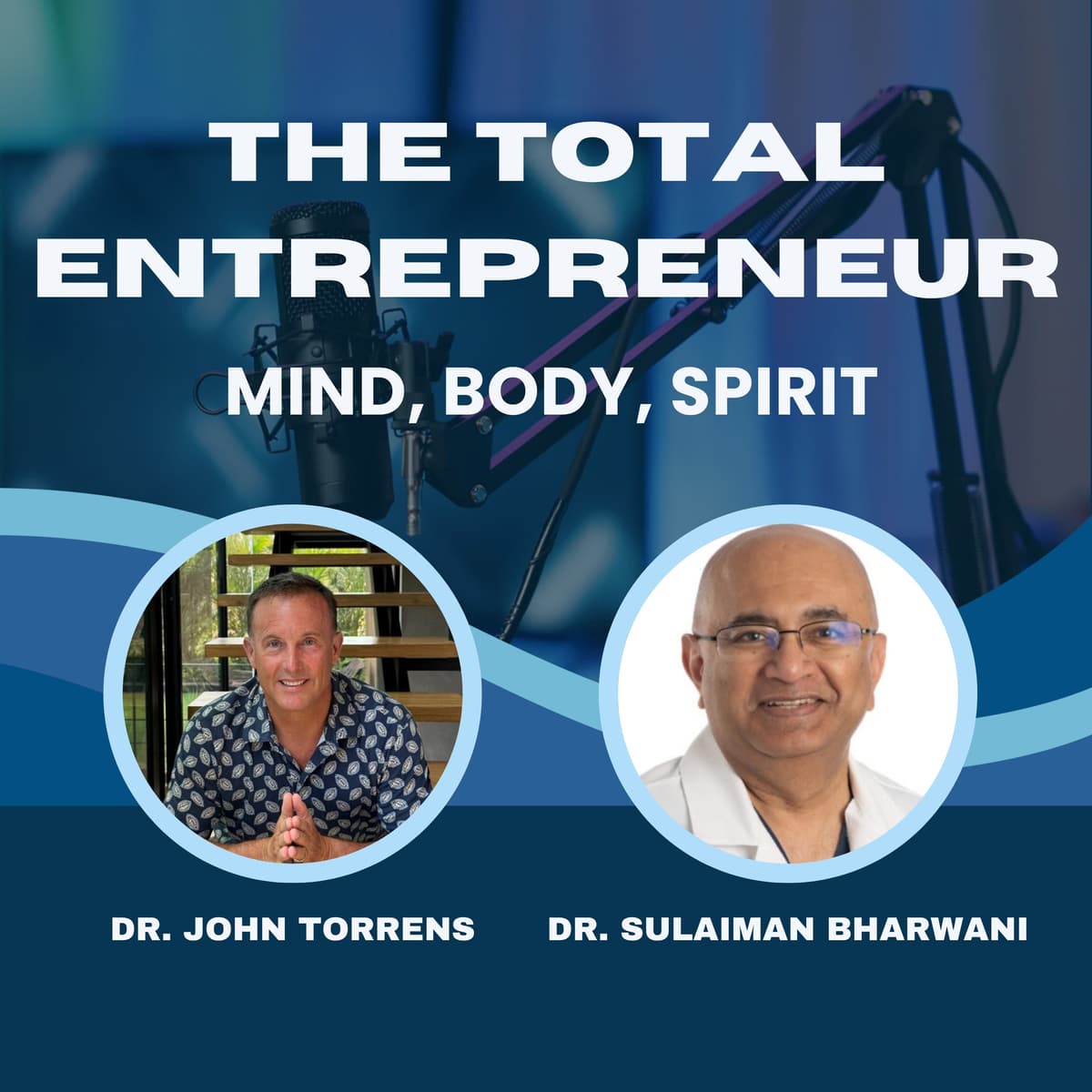
Fix Leaky Gut Naturally with Dr. Sulaiman Bharwani
with Dr. Sulaiman Bharwani
Oct 1, 2026 · 00:57:10
Part of our conversations on
During the fasting is when major healing starts. Longer fasting can even stimulate stem cells to build new cells, regenerate new cells, but it also wipes out the unhealthy ones so that your cancer risk goes down with intermittent fasting.
Dr. Sal, welcome to the Total Entrepreneur Podcast. It is wonderful to have you here today.
Thank you so much for having me, John.
Of course. So I wanted to start, I wanna jump right into it basically, and just ask you to explain to us in pretty simple terms, not like it's a peer-reviewed journal or something, but why is gut health so important and what is the connection between the gut and the brain?
So last 20 years have opened up a lot of information And a lot of publications have come out about the microbiome. The gut microbiome actually determines not only just your gut health, but your overall health. So your heart health, your skin health, and your brain health. And in looked at it like as if it prevents chronic illnesses, it works towards your longevity as well. So the gut microbiome, which we had ignored it for many, many years, now suddenly surfacing as the most important or the vital organ in our system. The sheer numbers of 38 trillion microbes, many of them are bacteria, some are viruses and fungi. They are calling the shots for us. If they are healthy, if they are taken care of, they return the investment to you. in terms of better heart, better brain. So we have found that the gut and the brain interacts. They interact very, very genuinely, and it's a bilateral communication. Many times when you look at the brain, the brain acts as a CEO who orders around, right?
Right.
Who orders other systems. But gut is the only organ which is through the vagus nerve informs the gut 80% of the time and receives information 20% of the time. So gut is quite autonomous, and that's why it's called a second brain. Now, I like to joke about it. It's like my wife talks to me 80% of the time and I return 20% of the time. Apart from the joke, the important thing is that the gut-brain axis is a real genuine thing. And that determines your sleep, your mental health, your anxiety, your stress control. And in the heart, it determines your, you know, plaques in the arteries. It reduces your high blood pressure. It maintains your insulin sensitivity. So, so much through the microbiome things are happening. The body inflammation is controlled. So they— this is what like suddenly made me realize that I cannot be now just a gastroenterologist anymore sitting, you know, in the clinic seeing one patient at a time and talking. This message needs to go. This message needs to be heard. And microbiome enrichment or taking care of the microbiome is everybody's responsibility. But it's not only just dependent on what's at the end of your fork, what you're eating. That is one very major aspect of it, but there are other things that we need to take care of. That's why I designed the 7 pillars of taking microbiome care, which will eventually lead to longevity for you.
Yeah. So, so let's break that down a little bit. Let's talk about what you're eating first and, and why, how that affects you. And then I wanna get into the other things, and I especially wanna hear about the 7 pillars. But It seems like the, like the gut microbiome isn't necessarily tested in a normal panel when you do a regular physical. Like, you know, I do blood work pretty recently, but nobody's really testing my gut microbiome. So it seems like, it seems like it might be a good idea, but I'd love to hear your thoughts, especially as a nutritionist and a gastroenterologist. I think that's a wonderful combination. Talk to us a little bit about diet, what we should be thinking about in order to support our gut microbiome and that sort of thing.
So the concept that people usually miss is that the gut microbiome are diverse group of bacteria.
Right.
Mostly bacteria. But it's such a diverse group. There are thousands and thousands and thousands of species. But the thing is, they all depend on different kind of food varieties. So variety is the key to engage more microbes. The more microbes are engaged, the more short-chain fatty acids, which are the products that eventually come out of their metabolism, of their digestion. And those short-chain fatty acids, the 3 main amongst them are the butyrate, acetate and propionate. Without going into the names and all that, the important thing is that these are molecules that these bacteria create, but they need variety of food and they need fermented food and they need fiber. Human beings cannot digest fiber. Did you know that?
I didn't know that.
We cannot. We don't have enzymes to digest our own fiber. The fiber is for the microbiome. Because they have thousands of enzymes through which they can digest a variety of fiber. So when we talk fiber, the soluble fiber, they are prebiotics in modern terms. The prebiotic food are all kinds of soluble fiber. Okay. Beginning from your grains, from your beans, nuts and seeds, lentils, chickpeas, they have high fiber content. We only think fruits and vegetables. Yes, they are. But there are other things here— nuts and seeds and grains and beans that people often miss, which are heavily, you know, heavy in fiber. And this is what these microbiomes love. So if you eat the same kind of food or the same kind of fruits and vegetables every day, you're engaging only a few group of bacteria.
And that's interesting because I know a lot of entrepreneurs They take that decision fatigue out of their lives by just eating the same thing all the time. So that could be leading to some, some gut health issues, perhaps.
This is definitely because eat more vegetables is no longer a valid instruction. If you are taking tomato, cucumber, and onion, the 3 things every single day, a ton of it, it's not going to make much difference because you need colors. You need 30 different plants at least in one week. And that includes different, different colors of fruits, different, different colors of vegetables, different kind of beans. Lentils are 4 or 5 colors. Beans are so many colors. Black beans, brown beans, red beans. Rice are so many colors, not just white rice. You have red rice, black rice, brown rice. So the thing is, the more colors, the more variety you give to The more variety of bacteria are engaged, right? So then you create more solid molecules that go throughout your body. These short-chain fatty acids are the healing molecules after the digestion from the microbes. And they go, they fix the immune cells, which is 70% in the gut. They go and create, you know, like anti-inflammatory molecules. So your inflammation is down. They fix the leaky gut. Then they go to the blood-brain barrier and reduce your anxiety and stress.
Wow.
They go to the frontal lobes and make your decision-making improved. They go to the sleep centers and through serotonin, they create melatonin. So you sleep better. Better fiber intake, better sleep at night. And so this is one aspect of it. The other is the probiotic from the food, which is the fermented food, the yogurt with live cultures, the kefir, that kimchi or the— with the vegetables, if you create pickles without the vinegar, sourdough bread. Okay. These are all high in probiotics. They are live cultures. So when you're giving this with the prebiotic, you're sending in reinforcement to your gut bacteria, reinforcement of live bacteria with the products with them. It's like the doctors are going and the nurses are going to a war-torn community, but without the supplies, without the gloves, without the oxygen, without the medications. So here you are sending the pro with the pre through the food.
So it seems like this is like just getting back to basics, right? Like eat real food, not ultra-processed foods, eat a variety of foods. And, you know, so you are what you eat goes beyond just the simple macros of, you know, fat, protein, carbs, and just making sure you're getting a variety. To feed your gut microbiome. So I wanted to ask you about antibiotics. You know, we're getting into the season where, like, at my university, I was sick a couple weeks ago. Students are getting sick. And I think the first move for a lot of people is just like, oh, I need an antibiotic before they even understand what kind of bug they've got. Can you walk us through what happens to your gut microbiome when you're on a course of antibiotics and what you can do afterwards to restore the health?
Right. So antibiotics are sometimes very necessary, but I have started joining the stewardship that many doctors are now advocating, trying to not give antibiotics unless it's absolutely necessary. And I advocate parents and for their children because it has been shown that infants and toddlers, if they get early age antibiotics in their early age of life, they wipe out a whole lot of their microbiome, and that develops obesity in the future. So I tell the parents to be proactive in asking their physicians, okay, doctor, do you think that this antibiotic is absolutely necessary? Could this infection be just viral? Can we just do the throat swab and make sure it's not strep? And maybe this is virus. Maybe the baby will get over it. Can we wait a couple of days? You know, those are the questions that parents are, you know, will have to start asking for their kids. But as us as adults also talk to our doctors that, is this antibiotic absolutely necessary? Can I see another 24 hours what happens? So luckily, the newer and newer antibiotics are going to be more and more focused towards the targeted bacteria and may save the other microbes which are friendly to us, which are helpful to us. Now, there are conditions like antibiotic-associated diarrhea, or after the antibiotics, your colonies of microbes have diminished. So there are things you can start doing it. And again, food is the main source. Fermented food. You just start giving Fermented food, live cultures. See yogurt. When you pick up the yogurt container, read the back, the label. It should say live cultures: lactobacillus, acidophilus, bifidobacterium, all these names. Then you know that that's the back. That's the thing you want. Sourdough bread. And once you start doing this, but initially you may need a short course of probiotics from the supplement counter. And they can enrich you. There are a few of them which have been studied. There are millions out there, but only a handful have been studied. The supplemental probiotics I'm talking about.
Yeah.
The few that have been studied, like VSL-3, VisBiome, Culturelle, those have been— and Florestor, which is the yeast, not a bacteria, Saccharomyces. Those have been studied that they can replenish you, start replenishing you a little bit. during those times. And if you have irritable bowel syndrome, you know, then you need a few weeks of those. But the way things are marketed now, that you need probiotics like a vitamin D supplement all your life, that's not true. That is not going to get you anywhere because you don't know what it's going to do. Because again, it's a very smaller number of strains you're sending it. to the thousands and thousands of varieties of bacteria? How do you know that they're going to thrive there? Correct? And then how do you know that this limited numbers are only the ones which have magical potion in them when you have so many thousands of species which we have not understood? Coming back to your question that how we don't have a test, we do have stool samples testing now, right? They do test for microbiome.
Yeah.
But they're not perfect. The tests are not perfect because, again, they pick up bacteria from this bacteria or this bacteria or this and this species and that species. But not all of them have been studied in the lab. What happens, John, the biggest problem is as soon as they find out about one bacteria, the industry joins that. You know, the industry just picks it up. And puts in a bottle and starts marketing it. Just like they picked up Akkermansia, Akkermansia bacteria, Akkermansia muciniphila, and they said that, oh wow, this is the natural GLP thing, you know, GLP-1 thing, and it's going to lose— you're going to lose weight the more of this you have. People started popping in, you know, like taking Akkermansia. But then How do you know that that Akkermansia alone can do anything?
Right. You're guessing instead of testing, right?
Right. And then, and how do you know this Akkermansia survived the gut all the way to where it's supposed to be? Now, Akkermansia is very, very important in maintaining the lining of your gut. They constantly maintain that mucus lining so that, that is the barrier between the harmful bacteria and your gut wall. If this mucus lining gets thinner, the harmful bacteria get closer to the wall and cause inflammation and leaky gut.
Just to follow up on the antibiotics. So, so somebody takes a course of antibiotics. How, how long roughly would it take to completely restore their gut microbiome, assuming they're, they're eating, you know, all the variety and the colors and they've got prebiotics and the fermented foods and all of that? Like, what would be a reasonable expectation of how long it might take to get back there? And, and what would they— what should they be worried about or thinking about along that journey?
It takes weeks to months.
Weeks to months.
Yeah, weeks to months. And but it— but the, the opposite side is more serious, which is if you deprive the microbiome for even 3 weeks of no fiber diet, you lose 20 to 30% of the microbiome. to starvation and death. You have chicken nuggets, pasta, and you have fries. This is all beige color diet. Imagine how much of the microbiome the kids have lost. And in my clinic, I'm seeing fatty liver diseases along with gut symptoms in 10 to 17-year-olds.
Is that a relatively new phenomenon? Like, were you seeing that a decade ago?
Now, this is a very rapid rising phenomenon. And I attribute this entirely to the diet because their diet has significantly withered away. And parents are not looking at this, how important this variety is. The colon cancers are coming down to younger and younger age group. The heart diseases, the chronic illnesses, the type 1— not type 1, but type 2 Which is an older people's disease. It used to be called— I'm seeing it in 16-year-olds with obesity. So this is like— and if you test their microbiome, I'm sure half of it's gone. So we are talking longevity would be a problem to achieve for our younger kids. You and I may survive up to 80, 90, 100. But can you say this for the kids who are eating what they're eating today?
Well, no, and if they're developing chronic disease in their teens and early 20s, that's a long life of chronic disease management.
Exactly. Yeah. Wow.
So I wanted to ask you another question. A lot of my audience happens to be entrepreneurs with ADHD. And I was, you know, so I try to keep current on those types of topics. And I saw that there's a paper in the Journal of Attention Disorders, a crew from the University of Warwick, did this, um, is a systematic review and meta-analysis. And basically what they looked at was they, they linked GI symptoms. So, so if you have ADHD, you're 50% more likely to have GI symptoms, uh, 2 times as likely to have constipation, 58% higher odds of irritable bowel, uh, 4 times the odds of encopresis, I think it was. So I was wondering If you could, if you've ever heard of that or if you've seen that in your own practice because you work with pediatric populations. So, are you seeing ADHD? Can you link that to gut health?
Yeah, all the time. I don't need this paper to tell me that. Several things happen with ADHD. A lot of kids have encopresis, which is like constipation gone so bad that they start leaking and they, then they lose the sensation. That they are wet, they are smelly, they cannot smell, they cannot do it. It's beyond that. So that kind of constipation that leads to incontinence that they can't even feel it. So that's with ADHD. Now you have to look at both ways. First is that they don't have enough focus or attention to even sit on the toilet long enough because of the distraction. So this is, this is one thing that is purely associated with constipation, ADHD, because they're, they don't, they're too much to do, too much distractions to sit on the toilet. Sitting on the toilet is, is a must. And that's one of the things that I encourage, like 10 minutes after a meal, you sit for 10 minutes. That is when the gut actually moves, the stomach and the colon talk to each other. The colon moves, the brain registers. Now relating ADHD to all the other brain stuff and the gut stuff. So constipation is not the only thing, but ADHD also, I think there is an underlying variable of the diet because they, many of them have sensory issues. Many of them have texture issues. So parents have really hard time getting plants and all that we talked about, right? The fermented food. in their system. They are so used to the industrial, ultra-processed food because it's smoothed out for hyperpalatability. You know what that means, right? That you— that your palate loves it more and more. So the ice creams and all the chicken nuggets and all those spaghettis and all, they are smoothed out. So the ultra-processed food with all their use of emulsifiers smooths the texture out. So they go for the smooth ones. They don't like anything that is different in the texture. So I think that leads to the microbiome issue. And through the microbiome, they have all the other gut issues, the irritable bowels. They are at very high risk of anxiety and depression. Because that's the gut-brain axis through the microbiome, the gut-brain axis. That is the reason 70 to 80% of irritable bowel syndrome will have associated anxiety and depression and vice versa. A lot of autistic spectrum children also have significant gut issues. So the question now is that the, the, the billion-dollar question would be like, Is there a way that we can advance the fecal transplant to the point that we can help these children out, non-ADHD to ADHD? You know, the transplant, fecal transplant, would that work? All the animal work is showing that in obesity, the lean mice's microbes, fecal transplanted to the obese and the obese to the lean, they changed. The lean mice became obese and the obese mice became lean.
Wow. So yeah, talk to us a little bit more about fecal transplants because I've read a little bit about it.
So right now it is at this stage where we're doing it for Clostridium, like C. diff infection, which, which is very hard to shed, like with antibiotics and all that. If this— if you're colonized with the C. diff infection, C. difficile lives with us, but when it becomes too toxic and starts secreting toxin, then they create severe diarrhea and blood and stool and all that.
And, and what gives rise to, to an overpopulation of C. diff?
For example, C. diff again is the, is the chronic antibiotic use.
Okay. Oh, got you. Okay. Yeah. Okay.
So that, that because it changes the dynamics, it changes the proportions, right? Like it So, some sitting quiet, all the bacteria that are inside, some are called commensals. Like, they are tolerated, like E. coli, you know, Shigella, you know, you have Clostridia and E. coli especially, they are tolerated to small numbers. Think of it as the gut microbe is a parliament where each— they represent their sections, their sectors, their constituencies. But they are smaller. They remain smaller. If they become powerful, E. coli and Clostridia start getting too much power, then the whole thing shifts because they cause more damage and they love ultra-processed food. So if you are giving them more power through your food, through your diet, they're gonna take over and cause leaky gut and inflammation and everything around. So you have to keep them under 5%, under 3%. But your majority should be like Bacteroidetes and other, you know, those which are producing short-chain fatty acids. Those bacteria you should be feeding through the prebiotic, through the plants, through the colors, and through the fermented food. So it is up to us. So in ADHD, again, because of the— there is definitely multi-component to it. But microbiome deficiencies are definitely playing a role. We have not tested what if we do ADHD patients who are eating much better variety of diet, right? How how is that affecting their symptoms and how little they are dependent on the medications, right? When we know that even executives who are not taking a diversified meal are actually working on. on poor data, you know, and their biological— if you talk biological optimization. So CEOs have their CEO functions affected by the way the microbiome is affected. It has been shown your performance, your decision-making, your impulse control, your emotional regulation is dependent on how strong your microbiome is.
Yeah. So, so a proper diet isn't really just for like overall health or it's a performance issue, right?
I mean, performance issue.
And we know athletes, it's important, right? Because we always think diet goes directly to like, you know, skeletal muscles and that sort of thing. But it is, it's an executive function performance issue as well.
Correct.
Yeah.
To the, yeah. To the point that at one study even challenged that our sense of fairness in a game situation is also dependent on how strong your probiotics are.
Wow.
So it's— so it affects like in many different ways that we are now learning, learning more and more about it. And, and these short-chain fatty acids, they reduce the chances of your heart disease and heart attacks. They normalize your blood glucose. So your chronic illnesses go down, your longevity gets up. Yeah. Yeah.
And, of course, longevity is about living better longer, not just living longer with chronic disease.
Vibrant lives.
Yes. Yeah.
Yeah. So, that's the reason. So, the pre and the pro in your diet is very, very important. Avoiding ultra-processed food at all cost is very, very essential because they create the leaky gut.
Yeah. So I want to talk about leaky gut too, but the ultra-processed food, trying to avoid it is increasingly more difficult. It's so hard to avoid. I mean, you have to be very conscious about it and you have to be willing to spend a little bit more. It seems like the ultra-processed food is relatively cheap and, you know, you kind of getting what you pay for there. So how can somebody go about like, like what, what are some, some relatively easy things or low-hanging fruit, if you will, for people to start to move themselves away from ultra-processed foods and into the food that's going to support their gut microbiome?
You know, the answer to this question is, is something that people don't readily accept. And that is just one-liner, back to the kitchen.
Yeah.
Unless we are willing to spend a few minutes in the grocery stores and the farmers market and a few minutes in the kitchen, You can create any kind of brownies and cookies and pastries and all your lovely, you know, snacks inside your kitchen by using the ingredients right. 3 or 4 ingredients only.
Mm-hmm.
But if you don't, then you are tempted all around you. You're traveling at the airport. The problem is that the ultra-processed food is designed to be consumed more and more. So you're not going to be satisfied, right, with a little bit of it.
Right.
So they sell. On the other hand, the advocacy is important. If we don't see— look at the tomatoes, right? There were only red tomatoes, just like there's only one Cavendish bananas now. But people advocated. So now the heirloom tomatoes started coming in mainstream. If people make a fuss about emulsifiers that they're not touching it, you know, if you see carboxymethylcellulose, you see polysorbate 80, you see gums, you see lecithins inside everything, it is written that the chemical names and you say we're not touching this food, the industry will have to come up with alternatives. I have started seeing in stores now Advertising three ingredient package, four ingredient only.
Yeah.
Why? Because we are pushing it.
Yeah. Yeah.
We have to push them out. And and people, if they spend a few minutes in the kitchen, and John, I've said this many times, but I write prescriptions for my kids who come to the clinic, and I say find me three green vegetables when you follow up in six. weeks, I want to see 3 new vegetables you found. That's in the prescription pad.
That's amazing. Yeah. And if it's not—
I want them to go to the grocery store because parents don't go. They don't take their children. And then they say children wouldn't eat, but children have no stake in it. If you go show them the different colors and say, pick one color today.
Yeah.
It has happened. It has happened. I mean, I was so pleasantly surprised. This was my hero mom, I call her. She brought this kid to me, and this sassy 9-year-old is like, you know, Doc, this week I'm being killed by asparagus. So, every week her mother puts something totally different plant in the diet. So, you know, last week it was this. He's complaining, but he's in a jovial mood. But the thing is that that's the kind of parents we want now.
Right.
Not to just drive through and pick up popcorn chickens from the driveway, you know.
Yeah. Yeah. So yeah, the drive-through, the takeout, the prepared foods, ultra-processed foods. Yeah, they're all, like you said, you've got to be willing to shop for good food and prepare it. Like you were saying, the 3 or 4 ingredients. I've got a slight ice cream problem. I love ice cream, but the packaged ice creams in the store, like you said, you read the labels, it's unreasonable. So, we just started making it ourselves, literally 3, maybe 4 ingredients depending on the flavor. And, that's been working great for me. So, I can— yeah.
That is the mission I'm promoting that make kitchen your center of home. And, and your, and your coffee tables should have fruits and nuts lying around, dates and figs lying around instead of anything in packages. The packages should be harder to reach. And they open the fridge, the yogurt should look first in their eyes.
Yeah.
Right. So once— not, not the, not the drinks of any kind. Yeah. So these are the messages. Unless we are willing to spend time inside the kitchen, make it our family thing again. That massive change is not gonna come through the pro and prebiotics sold at the counter.
Right. Yeah. I mean, it's, it's gonna come from things that are grown in good soil and cultivated and that sort of thing. Yeah. What's your take on the, you know, gluten sensitivity and dairy sensitivity? It seems like children these days just have a lot more allergic responses or sensitivity to foods that I don't remember causing that much sensitivity years ago.
That's a very, that's a very, very important question. So the gluten allergy, the celiac disease, this is found throughout now. Initially, you know, with the agriculture, with the processing and with the wheat and all that, we're seeing a lot of it, but it has many of the genetic components too. But the sensitivity part and the allergies, it is likely because early on in life, children are not introduced to the variety. Again, if you're introducing diversity of diversified food from early life, then your body starts remembering them. That's called immune tolerance, right?
Mm-hmm.
70% of the whole body immune system lies in one place. Your gut, 70% of your body immune, like it's a totally immune organ and is the first one to taste everything, to reject it or accept it, to reject it, to accept it. So, if you are not giving a variety from early childhood, your body is not sensitized enough, right? Everything looks alien to them.
Right.
And the body reacts. When they're older and taking it, the body reacts. I think sensitivity has that part. Now, there's a non-celiac sensitivity, gluten sensitivity, which is a debatable diagnosis. Like, almost 50% doctors believe in it, 50% don't. But gluten-free diet, if they makes them feel better, but some feel that maybe this is related to irritable bowel syndrome underdiagnosed. And not really the sensitivity. But again, there are ways to— but the way I have found that the milk, if it is coming from the market, ultra— again, with the mass consumption, with the mass production of milk, that milk has some problems, I believe. Because as soon as I shift people to organic farming, the milk coming from, you know, pure sources, then they don't have those reactions to milk. So I find that, again, the commercial— commercialization, the mass production creates— and for the shelf life or something, things are added to these things.
Right.
I mean, when you go— what my daughter and I were discussing, like, We have a farm where we have the hen laying different kinds of eggs all the time. And we go to the market, to the grocery store, they're all perfect.
Right. All perfect. They look the same. Yeah.
How can hens create such a perfect batch all the time? Not real.
Right. Well, it's— yeah, they probably have the same exact input all the time, right? Yeah.
So, so that's, yes, they collected, they may be doing things, but they're, they're not giving us what true nature gives us.
Right.
There's some bluish, some greenish, some, you know, different shades. That's what the hen does. And that's what happens with the— why the other varieties of bananas are not in our diet, you know, but they provide variety to the different microbes. 1,000 species of bananas in the world.
Wow.
Hmm, that's incredible. Praying hand bananas. Yeah, praying hand bananas, baby bananas, plantain bananas, purple bananas, blue bananas. Wow. Hmm.
So I'm wondering, like, as you were speaking, I was wondering, like, is there— like, even though there's, there's not a really great test for the microbiome, at least one that's not commercially available. Are there, are there certain biomarkers that you could look at in a normal blood panel that could help you infer what the gut microbiome is, or is that hard to do?
So far, there is no marker, the single marker that will tell you. What we have is the inflammation markers.
So like C-reactive protein or something?
Yeah, C-reactive protein. But by that time, people already have crossed that early stages.
Right.
So, but the, but the microbiome testing and for the stool testing may develop in the future. But right now we can't say too much based on that because so many species are not, not discovered yet or not understood to do what they do. Plus, the thing is that, you know, what, what I worry most about It's like people taking bars, like protein bars and stuff, thinking we need more proteins. But if the proteins are not coming from the animal and the plants, your body may not recognize it if it's coming a strong dose of similar kind of stuff. Similar, similar food or non-diverse kind of any structure is alien to the microbes.
Hmm.
you know, they only feed only a certain part of it. So many other bacteria will always thrive if you're giving the same kind of thing. So variety, the 30 different counts of plants, the 7 different rainbow colors, that is the message that we want people to get along with animal and plant proteins in enough quantity. Now, athletes, John, lastly, I would tell you that, you know, in Those who are serious and extremes in athletic forms, their physiology is not you and I physiology, normal human physiology. Their microbiome also doesn't always depend on what I'm preaching. Their need for proteins is enormous. Their need for exercise is enormous. And their gut microbiome is so diverse that common mortals cannot get that.
Right. So, so let's go back to fecal implants a little bit.
Yes.
So, so transplant, transplant, transplant. Sorry. So it sounds like the, the mouse, the mouse studies are kind of promising, but are they doing them yet in humans?
No. Okay. But there is a push for it.
Okay.
At some point. I am sure the humans would be more— there would be more volunteers.
Yeah.
If they would want to come out of the GLP-1s, if they want to, you know. But, but my only concern is that what if this becomes widespread? Then you are taking on the microbiome. Okay. You— if a person is overweight and he takes on the microbiome of a thin person, And then he becomes thin. But what if along with those microbiome, we take all the other genes that are going to determine that person's fate, some sort of early autoimmune diseases?
Hmm.
Then what happens? Who's going to regulate this kind of— because it is still— you're taking the whole bunch. There's not a targeted intervention.
Right, right.
You're taking en masse something and putting in something. So you're taking thousands of genetics from one person and transposing into another person, and what those genes are going to do for that future. I'm taking your fate. You're taking my fate here. Yeah.
Yeah. So it makes sense.
So yes, I get a good figure, right? If I go to a thin person and you know, and then what?
Right, right. What, what else do you get along with that? Exactly. Yeah, you get the whole thing.
So because the autoimmune work, the autoimmune diseases have clearly shown that the, that the SLE, the Sjögren's, the rheumatoid arthritis, all these different kinds have different, different kind of microbes in them. So if you manipulate one, what's happened with the other one? That's the reason why I stick with the variety of diet itself, right? Because let the diet do the job.
Yeah, as it was meant to, right? It seems like—
As it's meant to, based on the microbiomes you have received.
Yeah, right. Yeah, yeah.
And, and yes, there are no biomarkers, John, but your body will tell you.
I was, I was gonna say that earlier, like maybe you don't need blood work, right? You can, you can tap into how you feel.
Exactly. Your breathing, your sleep, everything starts improving, right? You are— no, you don't have that afternoon slump anymore, right? You don't have the brain fog anymore. All of those will start telling you that, hey, I'm not feeling my, my stress responses are immediately— I come out of it. So which means your vagal nerve is so stable now that you are coming from stress to non-stress pretty fast. Things don't get to me anymore. Those are the markers, you know, the subjective markers, unfortunately.
Right.
We will come, we will come up with, we will work with ITs. We will come up with the markers to see how other things help. Like, you know, in the pillars, I didn't mention, but there are like the pre and the probiotic food. But we also have the sleep Before 10 p.m., sleep is extremely important. Shouldn't, shouldn't stay up beyond 10. Why is that? You have— because the major microbiome clearing and the gut cleaning and the complexes that move the gut, migrating motor complexes that clean the gut from all the residues and the bad bacteria and all the The byproducts of the feeding, digestion, you know, that takes place between 10 PM to 2 AM. People who skip those 4 hours are not going to live healthy. Wow.
So, so is that even true? Like, just, you know, say you've got a non-traditional schedule and, you know, maybe you're still getting 7, 8 hours of sleep, but just not—
Well, it's not gonna work enough.
So even, even if you get all the Sleep you're supposed to, but you're not sleeping between 10 and 2. That's probably because this is— I've never heard of that before, and I think that's gonna be a shock to entrepreneurs, actually.
Yeah. This is, this is the most important thing because without this, they have shown that you're actually living as a chronic jet lag person.
Wow.
People who are in shift duties and stuff, their microbiomes are very unhealthy.
Wow. So it's, it's really a— it's, I guess it's a circadian biology issue, right? Like, you're—
Yes.
Like between 10 and 2, no matter when you're sleeping or how well you're sleeping, that is when your gut does its work. And if you're not sleeping at that time, that magical time, your gut doesn't get to do its job.
Think of, think of it as the cleaning crew has the deal you do. Wow.
And those are their hours. They punch in at 10 and punch out at 2. All right.
Wow. That's huge. Those are the most important brain— for the brain also. Most relaxing part, the most deep sleep, the most, you know, comfortable sleep is at that point. So that's important. And the hydration is next. Fasting is next. Fasting for 12 to 14 hours is one of the strongest pillars of your microbiome. All right.
So intermittent fasting has become much more popular. Can you walk us through the physiology of that or why it's so important for your microbiome?
So again, during the fasting is when major healing starts. So, the microbiome cleans up all the dead cells and mutated cells. So, because we are constantly changing, right? John Torrance today is not the same as John Torrance 20 years ago. So, because you're a completely new person, so we are replicating all the time. And in this fast replicating, there are many mutant cells that come on. Not all cells are perfectly formed. Those mutant cells have to be wiped out, picked up and kicked out. And that process, the microbiomes that are responsible to do that, do that during those fasting hours. So, if you, you know, in a way, it not only just cleans up the things, but actually Longer fasting can even stimulate stem cells to build new cells, regenerate new cells, but it also wipes out the unhealthy ones so that your cancer risk goes down with intermittent fasting.
Right. So, so you're talking about autophagy, right? Like, what, you just—
Yes.
Cleaning out the dead cells. Yeah. Huh. Well, yeah, no, I mean, I, and I know that works for me reasonably well, right? Is there a, is there a certain ratio or window? Is it like, you know, 12 on, 12 off? Is it, you know, 16 and 8 or like, Is there a perfect ratio or does it depend?
From the point of view of a physician, my recommendation or the allowed recommendations are 12 to 14 hours.
Okay. Of fasting.
You go beyond for the fasting. So, even the benefits you'll see at 14 for sure, but you need minimum 12 hours of time for your system to come back to normal, for the microbes to do their work. Right.
Because if they're always processing—
I'm saying 12 to 14 based on the research, the strong data. Now, there is 16:8 and people who go beyond it, but I cannot recommend it to people because of my position as a gastroenterologist.
Got you.
Because I'll have to I'll have to bring strong data for it.
Sure.
But we know that there is data for different kind of food restrictions. They have shown that 5:2, where 5 days you eat as much normally, 2 days of restricting, that has shown to significantly benefit your health, also significantly reduction in chronic illnesses and stuff.
And I guess that goes back to the way you know, we were, like, evolutionarily speaking, right? Like, we didn't, we didn't eat 3 meals a day, you know, all the time, right? We, we did have periods of fasting. So that, that does make sense.
Yeah.
So you, if your body is constantly processing and digesting, it can't get to the work of, of cleaning, I guess.
Correct. Correct. Exactly. Of cleaning.
Yeah.
So that is, that is why you have, understanding of the microbiome is evolving, but I'm taking advantage of it. And I've just completed a novel, a fiction with science-based data. Some— so that is a woman who falls into her own microbiome and suddenly finds herself dealing with all these factions. Okay.
Like you were describing earlier. Okay.
Yes. Trying to take power and trying to do— and depending on what food is being supplied, they are either survive— trying to survive with minimal staff. And then there are those, the cleaners, who cannot do their stuff because there's not enough this or that. And this whole thing that she, she notices, uh, the, the book's name is going to be Mick and Me. Mick is the microbiome, uh, persona. Oh, Mick and Me. Okay. So that, I think that will It's entertaining from my standpoint enough and not too much sciencey jargons, but to understand that there are groups, there's a parliament, there's numbers to be maintained for the microbiome to survive. And, and the way they talk about the host, you know, that the host did this, that's why we're in this, you know, situation.
Right. So, the personal responsibility. What a cool way to translate science into something accessible for people. That's great. I love that.
Thank you so much. So, hopefully, Before the end of the year, that's gonna come out. Before the end of the year, there is a microbiome game for kids. I read about that. Video game that's gonna come out.
Yeah.
And we'll, we'll see.
That is cool. All right. So, well, back to the pillars. So, we, we got through fasting. What's after that one?
Fasting. And then you have a go, go, go, which is the— it's A, B, C, D, E, F, G. A is avoiding the emulsifiers, sorbitols, sugar alcohols, and ultra-processed. B is for breathing. Diaphragmatic breathing is very important. So belly breath, you take 4 counts in and, and breathe out 6 counts. So you're breathing out more than you're breathing in. That changes your nerve, your vagus nerve from—
Sympathetic to parasympathetic.
Sympathetic to parasympathetic. Sympathetic is the worrisome, right? Frightful. flight. Parasympathetic is rest and digest. So breathing. C for counting and colors, counting plants and colors with enough protein. D is for drinking enough of water. E is early sleep. F is fasting. And G is go with the movement. And the movement, I especially emphasize 10 to 15 minutes walk after every meal. It reduces your insulin spikes, and glucose spikes. So immediately after eating, not waiting for a few minutes. Oh, I have just eaten. I need some rest. No, start walking as soon as you finish your last bite. 10 minutes of walk after every meal will prevent your diabetes.
Hmm.
And the movement itself also helps the gut motility. And the gut motility keeps the microbiome functioning better. So these are all— these have all shown to improve, like fasting improves. Drinking enough water keeps the mucus thick enough, gives microbes enough water to work in their machinery, right? In the butyrate production, in the short-chain fatty acid machinery, you need enough water supply to come. Breathing changes the microbiome. Breathing, in fact, can fix the leaky gut, they have shown, through vagal stimulation.
Breathing can.
Breathing can, but it has been not direct. I have to be open about it because breathing increases the vagal tone. And they've shown that people with increased vagal tone, when they put auricular electrodes on their ears to stimulate their vagal nerve system, and prior to that, they had given them stress hormone to create leaky gut, they had improved leaky gut even after— as soon as they got the vagal stimulation.
Oh, wow.
And vagal stimulation and also the breathing deep diaphragmatic improves vagal nerve tone. So with that, you can say A equals to B, B equals to C, so A equals to C. So that definitely increased vagal tone through the deep diaphragmatic breathing can reduce your leaky gut also. What I do in practice, I also do breathing with with imagery, the guided imagery that with your breathing, your eyes closed, you're actually feeling your gut is improving.
Hmm.
For those with diarrhea, I tell them to imagine that this river is flowing slow. And for those with constipation, you believe that this river is flowing at a steady rate. That imagery with breathing has been shown in children to work better Wow.
So, so you mentioned leaky gut a few times. Can you just describe what that is, how one might develop it, and what are some of the downstream side effects of it?
So ultra-processed food is definitely responsible for that because those are not digested and they create many other compounds that directly damage it. Plus, ultra-processed food Thins the mucus layer. That has again been animal studies, so I have to be very open about it. So animal studies they've shown that the the lining of the mucus becomes thin. That means the harmful bacteria have closer proximity to your barrier, to the gut lining wall, right? To the gut wall cells, and they damage it as soon as they damage a little bit of it. the harmful bacteria start secreting pro-inflammatory molecules like those that cause inflammation. They're toxins, they're antigens. They cross. And that's when the leaky gut gets bigger and bigger. And then they have more inflammation. That inflammation, unfortunately, doesn't stay there because that inflammation starts going through the whole body. When it gets to the heart, you start getting, you know, you have more plaques. gets to the brain, you have micro neuroinflammation that gives you all the anxiety and depression disorders and early cognitive decline toward Alzheimer's.
Oh, wow. So it's much bigger than just the gut.
This is— the gut is the gateway, right? So, so my next book that is coming out is called The Gut Switch, that how not using this as a right liver Yeah.
And is that out already or is that coming?
Uh, still in developmental editing.
Okay. All right, great. Well, Dr. Sal, I really appreciate you spending some time with us. This is— for me, this was really informative. I love this information. I really like how you're you know, besides gastroenterology and nutrition, your visualization and breathing and prescribing kids to go out and find vegetables of different colors, it's a really refreshing approach and I think really healthy and I thank you for that. And so if people are interested in learning more about you and following along with you or checking out your work, where can they go?
So I have a, the website is gutrewire. gutrewire.com. We also have a program for 12 weeks of rewiring your whole life through your gut program in school. It's a Gut Rewire program. You can— people can write to me, drsal@gutrewire.com, and I'd be happy to, you know, give them more information.
Yeah. And, and just to clarify that, that school, it's www.school.com/gutrewire. Gut Rewired. If anybody's interested.
Thank you. Thank you so much.
Yeah, of course. Dr. Sal, thank you. This was really informative, and I appreciate you sharing your expertise with my audience.
No, lovely to be here, and thank you for inviting me and honoring me with this privilege. I appreciate it. Thank you.
About This Episode
Most people think gut health is just about digestion - Dr. Sulaiman Bharwani says that's the smallest part of the story. In this episode, John interviews gastroenterologist and nutritionist Dr. Sulaiman Bharwani ("Dr. Sal") of Gut Rewire to unpack how the gut microbiome drives everything from heart health and brain function to anxiety, ADHD symptoms, and long-term disease risk - and exactly how to fix leaky gut naturally through food, sleep timing, breathing, and fasting.
Dr. Sal breaks down his "7 Pillars" framework (A–G: Avoid ultra-processed food, Breathe diaphragmatically, Count colors and plants, Drink water, early sleep, Fasting, and Go with movement), explains why the body can't actually digest fiber (the microbiome does that work for us), and makes the case that 30 different plants a week matters more than counting macros.
The conversation also covers the surprising, research-backed link between ADHD and gut symptoms, what really happens to the microbiome during a course of antibiotics, the current (and future) state of fecal transplants, and why the hours between 10 PM and 2 AM may matter more for gut repair than how many total hours of sleep you get.
What comes up
- •Why the gut microbiome is now considered the body's most influential organ system, and its role in heart, brain, and immune health.
- •The real reason fiber matters (hint: it's not for you, it's for your bacteria).
- •Why "eat more vegetables" isn't useful advice anymore, and what 30 plants a week actually looks like.
- •What antibiotics do to your microbiome, and how to proactively protect it.
- •The gut-brain axis: how microbiome health shapes anxiety, sleep, focus, and decision-making.
- •A surprising research link between ADHD and GI symptoms in kids and adults..
- •What leaky gut actually is, how it develops, and its downstream effects on inflammation, heart disease, and cognitive decline.
- •Fecal microbiota transplants: where the science stands today, and the open questions that still worry Dr. Sal.
- •The physiology of intermittent fasting, why 12–14 hours is the evidence-backed sweet spot, and why fasting may help your body clear out damaged cells.
- •Dr. Sal's "7 Pillars" (A–G) framework for rebuilding gut health.
- •Why the window between 10 PM and 2 AM may be critical for gut and brain repair.
- •Rising rates of fatty liver disease and gut-related symptoms in children, and what's driving it.
Keep listening
More on Body
About the Host
Dr. John M. Torrens
5× Inc. 5000 entrepreneur, Professor at Syracuse University's Whitman School of Management, author of Lightning in a Bottle, and TEDx speaker on ADHD as an entrepreneur's superpower.
Browse all podcast guests →Book a strategy call →