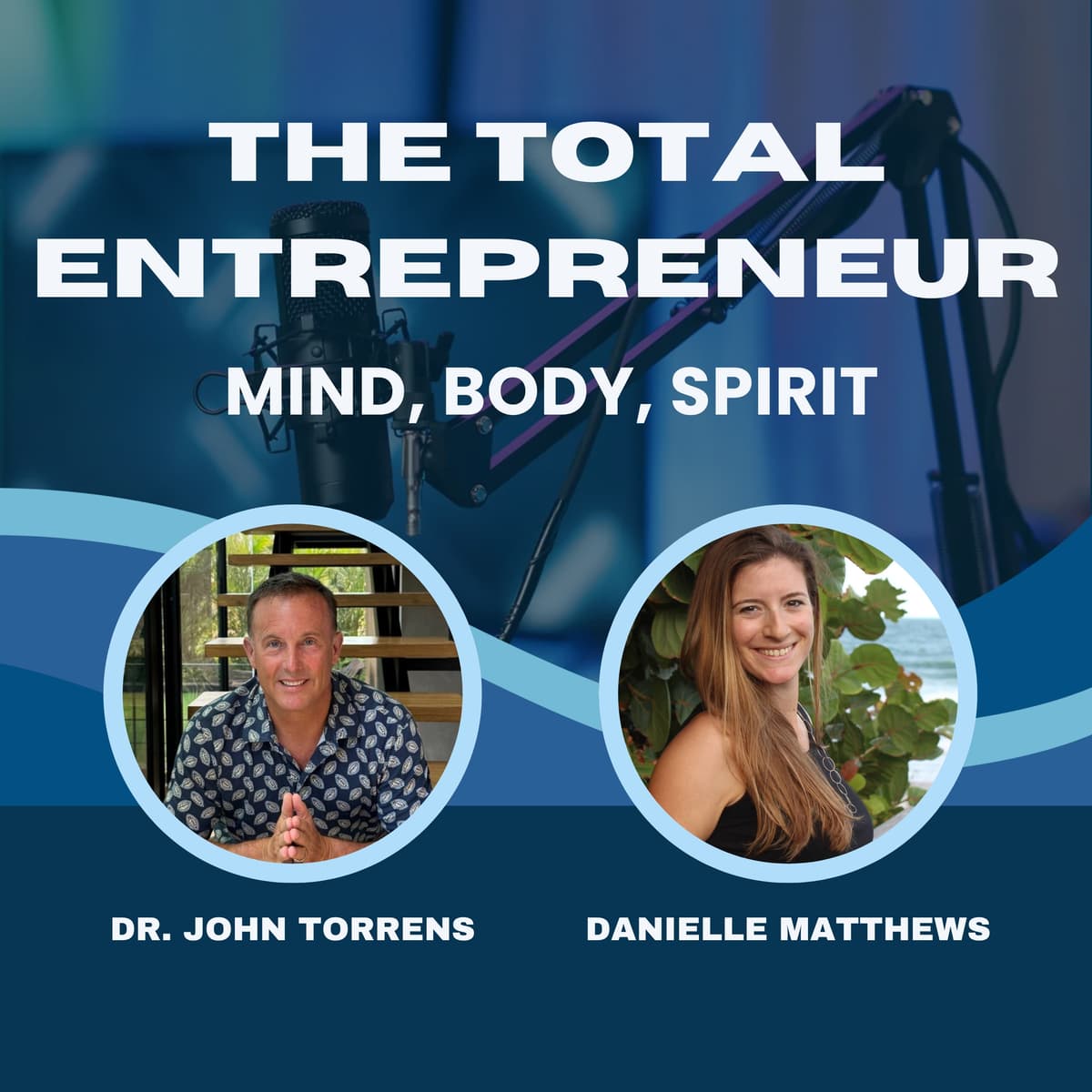
Yoga Nidra for Trauma Recovery with Danielle Matthews
with Danielle Matthews
Oct 8, 2026 · 00:56:03
Part of our conversations on
Yoga Nidra was designed as a tool for enlightenment. It's literally designed to walk you out of the mind, out of the physical body, and into the truth of yourself, into your soul.
Danielle, welcome to the podcast. It's great to have you here.
Yeah. Thanks for having me on.
Yeah. So, we met at the Biohackers World Convention in New York City over the summer and we just ran into each other and we started talking. And, I was really interested in your entrepreneurial journey, but more importantly, what happened in your life that got you there in the first place. So, why don't you kick it off by telling us that story?
Yeah. I went to the University of Virginia. I studied biology. That was the track my life was on. Right out of college, I did Teach for America and I taught for 2 years. And then, life just took a 180. I got hit by a drunk driver and I sustained a brain injury and my life turned upside down. And, for several years, I was really just trying to get my health back. And it's interesting because in that time, all these things that I thought my life was supposed to be about, what success looked like, what, you know, go get a good job, right? I went to one of the top schools so I can get employed by one of the top places. And it just, I was watching my friends do that and I went, no, this isn't what life is supposed to be about. This isn't like living. And I'm watching people just on this loop, you know, having to decide, can I go home for Thanksgiving or Christmas? And I'm like, this isn't what life is supposed to be about. So, getting put on the sidelines really of life for a couple of years gave me a very different lens to start looking at things. And interestingly, kind of my journey in entrepreneurship, I didn't know what I wanted to do. After I got my health back, which was in large part thanks to the technology that I was actually at the biohackers conference I'm sharing with you, that technology really revolutionized the way that my body could handle my injury. And, but even after I started to get my health back, I wasn't sure what I wanted to do. And I just kept saying to my parents, you know, I wanna do something where I've got flexibility, where my time can be mine, where I can spend my efforts and energy doing something that's going to make an impact, that feels like it fuels me internally. Because tomorrow's not guaranteed, John. You never know. I was doing nothing wrong at 7 o'clock in the morning on a Saturday. I was going to a friend's wedding.
Have it on a Saturday morning. Wow.
Yeah. I was leaving Baltimore City. I was going to a wedding. And, this guy passed out and he'd been out, I guess, the whole night before and hit me. And, it just I can never unknow, you know, because I was doing nothing wrong. Right. And I had, if you would look at my life up to that point, you know, she's like achieving, she's doing the best. Right. And, you know, life threw me a curveball. And so it just caused me to go, all right, well, tomorrow's not guaranteed. So what are we doing today? Why am I really here? And what impact do I want to have on this planet while I'm here?
Yeah. So, so walk us through just the day of that accident. I mean, you know, because my, my wife and my son have both been in pretty nasty accidents. So I'm kind I'm kind of familiar with the sequelae of what happens after that, but yeah, what happened that day? How long were you in recovery for? Break that down for us.
Sure. So, that morning, so basically, he passed out and he hit me head-on. So, it was headlight to headlight, which thankfully was the best way because a car is meant to take a hit that way. So, it crumpled in, the car was completely totaled, but I was physically okay. I actually got out of the car. There was a group of runners that happened to be on the street and half of them came to me and half went to him. And, it was so interesting looking back, right? At the time, I didn't think about it. But, you know, I couldn't find my phone. It was somewhere in the car. So one of them handed me a phone and they said, you know, whoever you need to call. So I was like, oh, I want to call my parents, you know. So I'm looking at the phone and I couldn't figure out how to use the phone. It was the weirdest thing, but it didn't register as weird. I just handed it back and I said, can you call for me? And the woman was very nice. She said, sure. And the phone number came out. It'd been my phone number since I was a little kid. So that was no problem. And then I heard her talking to my parents and I went, this isn't good. They're going to think I'm not okay because I'm not on the phone. So I took the phone back and, you know, by that time they got on the road, the paramedics came. But what's interesting, John, is they didn't even take me in because I looked like this. I looked fine. I had burns on my arms from like the airbag going off. And I kept saying to them, like, I don't feel right, you know, and I couldn't use the phone. Like, I was like, I don't, I don't feel normal. And the guy said, well, you're just in shock. Like, you were in a really bad car accident. Like, you're in shock. And I went, okay. You know, I had no idea. Uh, so went home. My parents were like, no, something's very wrong with you. They took me to an urgent care and the woman told me the same thing. You're just in shock. And, uh, they totally missed the fact that I'd had a brain injury. And, um, it didn't, um, really come— I, about 2 weeks later, because I was just not well and my head hurt so much, and I went into my primary care and he said, I, I think you've had a head injury. And so then I got put in with a neurologist and that's when they They finally said, oh yeah, you know, they classified it as a mild TBI, mild traumatic brain injury, which what an oxymoron.
Mildly traumatic.
Yeah. Yeah. I, you know, and I being stubborn me, I attempted to go back to work, but I couldn't concentrate. I couldn't remember the kids' names. I couldn't handle light. I couldn't handle noise. I would have a panic attack when I'd get behind the wheel of a car. And You know, I was put on medical leave and unfortunately, you know, in this timeframe, this was 2012, um, they didn't really have a lot for concussion, for brain injury. Um, this was, it was just coming online. It was like the NFL was paying more attention to it. They're paying more attention with our veterans. They were, but there was just not a lot. A good friend of mine was in medical school and he was like, yeah, this is like the sexy new frontier. I said, oh, not so sexy to have it.
Right.
I'd rather have some solutions here. Um, but they just kind of told me sit tight. And it would clear in a month. And then they said 3, and then they said 6. And then at my 1-year appointment, um, I was basically told by the neurologist, he said, Danielle, with your type of injury, your body's done all the healing it's going to do, and this is your new normal, and you need to shape your life around it. Yeah, I was 24 when he told me that.
24 years old. Wow.
Yeah. Wow.
So, but it sounds like there's a little bit of a silver lining in terms, in terms of, you know, what, what you went on to do and that sort of thing. So, so you had your 1-year appointment, the doctor said, hey, new normal, just get used to it. Had— do you feel like you had improved at all in that year, or just mildly, or how did you feel?
If I'd been like a 10 out of 10 of like pain and discomfort, I maybe had gotten to like an 8 out of 10. But it was still like I was in a dark room, like blackout fabric on the, the windows, like natural light. Yeah, that it was. And I couldn't go out, I couldn't do anything. Um, I was sleeping all the time. But I had done neurobiofeedback, which I think had helped a little. Um, and I had done hyperbaric oxygen treatments, HBOT, which I think those were the 2 that made like the biggest kind of dent, but they certainly didn't like heal the issue. You know, it was still very prevalent.
And did they do like MRIs or CAT scans, CT scans of your head just to tell you what it was like? Yeah.
Okay. Yeah. But they said, well, basically with my type of injury, you can't with the scanning they had at the time. Now I think there's more advanced things now, but at the time they couldn't pick up. It was like basically like the myelin sheath had been ripped. And so you couldn't pick that up. They did a cognitive test with me and based on my performance on the cognitive test, they could tell I had an injury. Like my processing speed was like, I scored super low. Um, and then I scored like, like average or high in other areas. And they're like, yeah, that's typical of brain injury where certain parts of the brain have had this damage, um, that, you know, are operating now at much lower capacity.
Yeah. And so now what's it, 12 or 14 years later? Um, and yeah, how are you feeling now compared to then?
I feel like a brand new person.
Yeah.
Honestly, I look back with gratitude and at the whole journey because I think 2, 2 things happened. One was an appreciation for like why I'm here. It was a big spiritual awakening for me, truly, because my thoughts in that first year, you know, my reaction had been, well, push through. I've been an athlete my whole life. Like, you push through, you push past, you keep going. You know, I was like, I'm going to get better. I'm going to get back to my life. And then when my doctor told me that, something inside of me said, don't listen to him. Like, you're fired. Like, you're going to find an answer. But then some other part of me went, okay, well, you've been resisting this reality for so long and you're miserable. I was anxious. I was depressed. I was having panic attacks. And I said, all right, we're going to have to switch something here. And I just realized my thoughts were making me miserable and I didn't want to listen to them anymore. And I said, all right, I'm not going to allow myself to think about the future for a second. And I'm not going to think about the past. I'm just going to be here in this moment. I'm just going to be present. And I literally, Jon, I planned my life 10 minutes at a time so I could just be present because otherwise, it was insufferable. I mean, my mind was basically telling me, well, you should just kill yourself because there's no point in being here. Like it is hell to be on earth because light and noise and everything hurt, and I couldn't do anything. And my future just felt like it was slipping more and more away, right? I'm watching my friends go on and do great things. And so I, I literally came to the present moment. I started a yoga nidra practice, which is a guided meditation, because I could lay down and listen to that. And that was a lifesaver because it allowed me to sleep, number one. So there are great like physiological benefits and a ton of research behind that. I mean, they use it with veterans that have PTSD, and there's so much. with yoga nidra. But it also was allowing me to like touch this space inside of me that was calm. And that space like started to grow. And I started to be able to be present in the moment and totally calm in my mind. It was like, I'm not my thoughts, I don't have to listen to my thoughts. And I found the place beyond them. And unbeknownst to me at the time, that was the beginning of a beautiful spiritual awakening.
And it seems like that you could use that, you know, to recover from— I mean, you used it It is partially to recover from a mildly traumatic brain injury, but I think anybody could use that same tactic or technique to recover from anything difficult or to get through anything difficult. But, you mentioned you were an athlete. What was your sport?
Well, I was a swimmer since I was 8 years old. I did that. I was on the club team at UVA. I didn't make it into Division I swimming, but I did snowboarding in college, which was a blast. I absolutely loved that. I think my last year I ranked 5th nationally.
Snowboarding.
Wow.
Yeah.
So I definitely probably hit my head a few times snowboarding. That didn't help my cause.
Yeah, probably. Oh, cool. Well, that's good. What was your event when you were a swimmer?
Oh, breaststroke. I was really good at breaststroke. Yeah.
Yeah. I was a swimmer too in college. It was just D3, but yeah, I was, I was a 200 butterflyer.
Wow. Oh, you were a crazy one.
Yeah, I think I was a crazy, or maybe that was like the only stroke I could do reasonably well. And funny thing is I was, I would get my butt kicked in the 100, but I would do reasonably well in the 200.
So, endurance.
Yeah, I could just stick with it long enough, you know, before I totally collapsed. So, where did you snowboard in Virginia?
I know. Um, so we had— UVA had like a little mountain that was maybe 45 minutes from campus. And, um, I, I joined the team because I just wanted to go snowboarding and they gave free rides. And they were like, well, we need girls. Like, girls don't compete. And I was like, what is the competition? Like, what are you doing? And they said, you just gotta kind of go down the mountain through these gates and, you know, just go fast. Okay. All right. Wow. And then I got to do border cross, which was a ton of fun.
Wow.
I was— I like to compete back then.
Yeah. Well, so you were competing at a pretty high level. I mean, even UVA's club swimming team was, I'm guessing, was pretty competitive.
Yeah, they, you know, I, I'm telling you, like, prior to my accident, it was like top of the top, right? Graduated top of my class. I got a, you know, graduate distinction from UVA, which is a top school. Like, I was up here. in every way that, you know, we look at what success looks like, whatever, for a 20-something-year-old. And then it all just came crashing down and I realized none of that really mattered. None of that's why any of us are here. And it was never going to bring any sort of fulfillment into my life that was sustained, you know, it was temporary, but not sustained.
Right. You know, I think a lot of the young people that I teach or work with, they just, yeah, I'm getting that vibe from them, right? Like they'll go to college because they want to, further their education, or maybe they have a specific job or career path in mind. But a lot of them are like, I'm just kind of going through the motions here, doing it because my parents wanted me to, or something like that. Or they think they're going to get the job that they've always wanted and they end up there and they're like, really? This is what I've done my whole life. This is what I've spent my whole life preparing for. And this is it. So especially this younger generation, to me, it feels like they just didn't innately know there's something bigger or more important than what they've been told they should be doing. And it sounds like that was what you realized.
Yeah, it totally was. Because I realized all these things external, they felt like me. So, when my accident happened and all of that left, I couldn't snowboard, I couldn't work, my friends got nothing. I felt empty because I had been so identified with all those things. That's who I was. That's what mattered. And, that's what society told me also. And, God bless my parents, but them too, they were so proud of me, right? Look at these accomplishments. Look what you're doing. You're so great. We're so proud of you. And, when that all went away, it was like, well, who am I? Who am I behind all of this? Who am I and why in the world am I here? I never had a moment to stop and breathe and even ask questions like that because I was constantly going onto the next thing, onto the next goal, having a blast achieving it, whatever.
Yeah.
And, um, and we all feel it, right? You, you reach a goal and it feels good temporarily, but then spontaneously, like something else, oh, now you need to do this thing. Now you need to. And so, we're constantly, it's like our mind is constantly telling us, you'll be happy when you get there. And like, you suck on this lollipop of hope on the way.
Yeah.
I'll feel good when I get there. And so, I, I just, I just asked very deep questions and it was like, what, why am I here and what am I doing? And when I felt that peace inside of me, I went, that, that's me. All of this other stuff is just experiences, you know? And I came here for something much more. And it's interesting because words didn't get like put to it. Like it was a knowing within me, but I went to get certified in Yoga Nidra because I was very curious to be able to learn a little bit more about the practice because it'd been so beneficial to me. And, and it just so happened that I was able to go to the training and it was a 10-day training. And the first 5 days were all about the philosophy of why this practice was even invented. And what it was really a tool that was meant to do. And I'll never forget the very first day we're sitting there and they have us close our eyes and envision ourselves sitting on a beach and then like just water in front of us and seeing a boat come into view, right? But the boat's moving and it takes up your whole view at one point, but it continues moving and it's gone. And then they had us open our eyes and they said, are you the boat? And I was like, what a silly question. What are we doing here? Like, no, we're not the boat. We were watching the boat. And they said, well, the yogis would say the boat is your thoughts. Is it not true that there is something there before, during, and after every thought? And even if it feels like it's taking up everything, you're not it. You're the one watching it. And I went, yeah, that's the thing I realized during my brain injury. And I was like, what else did these people like learn? You know, what else do they offer? And so I was hooked just from like the first 2 minutes of the, um, of the class. And then I came to realize that Yoga Nidra was designed as tool for enlightenment. It's literally designed to walk you out of the mind, out of the physical body, and into the truth of yourself, into your soul. And, uh, in doing it, that's where you're walking every single time. And you're getting the physiological benefits like I was— oh, better sleep, less stress, all that happens. And if that's all you want from it, great. But if you really realize what it's a tool for, it will take you to a depth that's unbelievable. And that's where you access your intuition. And that is where it has served me so well in my entrepreneurial endeavors, because I look at life And I realized it's not about achieving. It's not about creating some big business, making all this money. That will come. Great, fine. But it's about having fun and joy in the process, right? And just seeing like this expansion of my soul in like this creative way, you know. And my intuition guides me every time. We'll do this, try this, say this, go here, you know. And then the next thing unfolds, and it's like. It's a joyful co-creation every day, day by day, you know? And then, yeah, I look back and I go, wow, look at what I've created and look what's happened and look what's here. But it's not, I'm not striving for something, you know? It's the creative process. And I've learned to love, fall in love with that. And it's been the key, I think, to my success and my mental sanity.
Yeah. Well, so now, yeah, why don't we talk about where those storylines converge? So, so you had the accident and you were recovering, doing what you could with the yoga, Yoga Nidra. And so, yeah, now start us on, um, ASEA and your entrepreneurial journey and how they kind of work together. Yeah.
So, um, this acupuncturist had recommended I try this product called ASEA. Um, it had a redox signaling technology. It was cell signaling. They said it would activate your cellular intelligence, help your body to find damage better, and help you to repair at the cellular level.
And redox cell signaling, can you just describe that for us?
Yeah. So redox stands for reductants and oxidants. So, so a reductant will reduce things, it will give an electron, and an oxidant will receive. And so at the cellular level, the conversation is all happening through electron transfer inside of ourselves and between ourselves. Like, we cut ourselves and we don't tell the body to go heal it, right? It's just there is an awareness and intelligence in the system, communication happening with ourselves that Indicate, hey, here's an issue we need to go repair. We never think about this, you know, but it's happening all the time. And evidently, as we get older, we have less signal. So it's a problem. You typically start to lose health and start to feel, you know, your endurance isn't so great. You wake up achy. These things start to happen. Diseases start to pop up because the signal's weaker, because the body's literally not hearing where the issues are. Now, I just had so much damage. That it was like one bar service on a cell phone. The signal couldn't get out. So, this woman suggested it. I laughed at her honestly. I thought the whole thing sounded ridiculous. And, I was like, I'm a biology major. I know better than you. I was kind of a brat. But, my mom, she trusted this woman. It was a good friend of hers. And so, my mom started using this product. My mom had bone-on-bone in her hands. And so, she had been told by doctors, pain management is all we can do. And, she was in her 50s. She was like, I don't want to take drugs the rest of my life. So, she went looking for alternative things and within 6 weeks, she had full range of motion back in her hands. You can literally see all the swelling was down. And, I thought it was a placebo, but my dad was a big athlete and had injured his knee 30 years prior. And so, he started using it thinking maybe it'll help my joints. And yeah, sure enough, his knee starts feeling better within 10 days and his endurance went through the roof. His recovery times were much faster. And, he's like, what is this stuff? So, they went and learned. I still was like, ah, placebo. They went and learned about it, learned it couldn't hurt you, no contraindications, it works in everyone, it can't not work because it's how the body innately signals. And, they said, Danielle, just drink it for 6 months. So, I said, I think it's a waste of money, but fine. So, that's how I started with it. Fast forward 3 months, the pounding in my head stopped. It had been relentless for 2 years, relentless. It stopped. And, I went, whoa, if that's all this thing does, amazing. But, as I stayed on it, personality came back, concentration came back, the brain fog left, my energy levels came back, I could sleep again. A year in, sensitivity to light went away. 2 years, noise sensitivity. It was unbelievable. So, as I'm getting my health back, I'm like, I got a second lease on life. What do I want to go do?
Yeah.
What I'm going to spend my life doing now? And, I just knew, again, I wanted something that was flexible, I wanted something where I had purpose, that was going to make today feel fulfilled. And my mom said, why don't you partner with this company, ASEA? And I was like, what do you mean? You know, the product I'm drinking, right? And she's like, well, they're only coming to market through word of mouth. I said, what do you mean, like network marketing? And she said, yeah. And I said, that's like a sleazy thing to do. You know, I said, I, I have a great degree from a great university. Like, why am I going to do network marketing? And she said, Danielle, you know, in life sometimes you don't know what you don't know. And she said, why don't you just come meet the company and meet the people, and then you can make a decision about what this is and what it's not. And I said, all right, fine. So I went with her. I said, I'll go to one of these things and don't ask me again. Um, so I went with her, and I'm sitting in the back of this room. I still had like noise-canceling headphones on because I still wasn't 100% well. I was still sensitive to noise at that time. And I'm listening and literally, the gentleman at the front, the founder of the company, he starts talking about this children's book that is a little boy walking around talking to animals asking like basically, what am I supposed to do with my life? And who am I supposed to help? And how do I know? And all these things. And the essence of the story is basically be present, serve the person in front of you and do whatever's best for them. And that will be a fulfilled life. And I went, whoa, I wasn't expecting that conversation here. This was, again, something I learned during my brain injury. Be present. What did I do in the present moment? I literally just— whatever was going to make the person in front of me happy, that's what I did. And I continued to listen to him. And then, he starts talking about other principles. Put people, put principles ahead of your ego, ahead of economics and business. If you do that and you drive up your own capacity, right? Keep P over E. You need E on some level. You need ego. You need economics or you're never going to have business. But if it's not in alignment, like think about how many businesses out there, the economics of it. Just think about the pharmaceutical industry. I mean, look at the opioid epidemic that's in our country. Like that was a P/E ratio that got out of balance. They were looking for money, not caring about what it was doing to the people. You know, look at where we are. So, he was talking about keeping your P over your E in business. And I went, you know, I can learn something from this guy. And he was talking about how the principle of network marketing— well, first of all, ASEA was going to be sold to a pharmaceutical company and the pharma company wanted to shelve it. And they said no.
Hmm.
And they said, we've got to get it to market. So, they chose word of mouth because no one knew what redox was. It wouldn't sell on a store shelf. So, they said, it's going to have to be kind of like a natural grassroots thing. And I went, okay, that makes sense, right? Makes sense why they chose this business model. And then, he started to explain the business model. And I went, hang on, so all I'm doing is helping people. I'm educating about a product that could help their life, right, like it did for me. And I'm looking for other people that might be interested in creating a side income, be it to cover their products, to cover rent, whatever, or if they really want, you know, to create a big income and make a big impact in this world. And I went, if, if what he's saying is true, then this is like the exact type of business that I want to get into. You know, you become an entrepreneur without all of the risk associated with this big investment upfront, all of these things. And there are people that are in place that are literally, they benefit from your success. So, they are incentivized to help you. And in fact, for you to go further than them. And so, I said, okay, I'm gonna give this thing a year. We'll see how it goes. So, I dove in for a year, Jon, and I didn't know what I was doing. It was hilarious. Looking back now, I was just like ignorance on fire. I was like excited by the notion. I didn't know what I didn't know business-wise. Like, I'm some, you know, like, I had some guy say to me, oh, you're some pretty little girl selling salt water. Like, I have people laughing at me, but I just, I knew in my heart, like, this can— this is the vehicle that's going to allow me to create a life where it's flexible, where I'm helping people, where I feel lit up and on fire by the people around me. This is what I want. And if I ever have an accident again, what network marketing promises is that income can continue to come in passively if you build it properly. And I thought, well, 10 years from now, that's the position I want to be in. I love it. So, let me start building something now. And I just couldn't get it out of my head or out of my heart. And so many people laughed at me. Family members told me I'd lost my mind. People kept saying, oh, when are you going to get serious, Danielle? Why don't you go back to grad school, Danielle? And I'm like, no, where's grad school going to take me? I mean, really, it's not going to take me into learning how to run a business. It's just not. I went to a top university. They didn't teach me anything except how to be a good employee. So I thought, no, I'm on the right track here. And I was meeting people. This was the best part. I was meeting other people, these other entrepreneurs, these spirits that like, they couldn't concentrate on one task long enough, right? I think that's where entrepreneurs, like they just have ideas and they just go. And like, you need that. You need some sort of creative inspiration. Entrepreneurship is not for everyone. And it's certainly not for you if you're not ready to look yourself in the mirror And to deal with, you know, the internal challenges of mindset. But having overcome my brain injury and the internal battle that I was having, like, no, I was like, well, nothing's as hard as that, you know. So it really prepared me very well to be able to go into that. And then I did yoga nidra every day. So at the end of every day, I reset myself, I reconnected with the truth of who I was. And then day by day, if I saw my mind coming in, if I saw my ego coming in, I just went Okay, that's not me. That's not going to be helpful. Put that over here. Serve, you know. And now we can fast forward 11 years, and that life that I was wanting to create, I made it. Wow. And it's here. And the industry is, um, it's like the best personal development, uh, that you could ask for. Great people. I— and, you know, now I have a network of beautiful souls that I know all around the world. And, uh, it's great. It's, it's been a blast. And I— and it's not talked about. Like, I never learned about the industry really. I heard people laugh about it. I heard people make jokes about, oh, you got into the Amway cult, or stuff like that. Like, you know, right, very negative connotation. Um, and, and to be fair, people do it poorly, you know. There's bad companies out there.
Sure.
You can say the same is true about lawyers and any other business, right? Um, people are people. So when done well, with a good company, good product, And it has been, uh, it's been a dream. And then about in 2022, um, I opened up another business because I learned all the skills that I had built there. You know, it was like effortless, uh, to open up this other, which is more coaching. I call it enlightened coaching, where I'm helping with the mental-emotional side of life and spiritual.
Oh, cool. I didn't realize that was part of your professional portfolio. Oh, very cool. Yeah, so I want to dig into that too. Well, so it sounds like, you know, Between the car accident, your own recovery, kind of stumbling across ASEA and your biology degree, it was all just kind of set up for you, right? Yeah. Yeah.
Looking back, it all makes sense. In the moment, none of it made sense.
Right.
Yeah.
So, so dig a little bit into the technology itself. So, I know there's the, there's the liquid that you drink. And then when we met in New York, there were a couple of topicals as well. One, I think even with some gold in it or something. So, yeah, talk through the technology, the mechanisms, the indications or whatever people would use those for because I found that really interesting.
Yeah, it's fascinating. It's like its own category. And, I think it's interesting because I had my own awakening about healthcare when I sat in that office and the guy told me there's nothing you can do, your new normal. And, I'm like, there is a limitation to our healthcare system because chronic issues, I don't think they serve well. They're very good at dealing with You know, like accidents and stuff like that. We're diagnostics, but root causes—they don't really know. Things that come over years—they don't really know. Or chronic issues like I had. So I started to kind of question, like what? You know, the just you know get a script or have a surgery. Like there's got to be more. And then the answer obviously came through an acupuncturist who had this. this liquid. And, um, I think what they're doing at ASEA is, is honestly, I really think it's like revolutionizing the way that we can access health. I look at it as like the next wave of healthcare because, and I think consumers are asking for it too. I think the pandemic shook a lot of people to go ask maybe some different questions about how to keep their health and, you know, really like—
For sure. And just like health autonomy too, right? Yeah.
Yeah. There's so much. So, um, so with ASEA, what is it? So, it's a liquid, uh, that you drink. All right. They just got brand new packaging. So, this looks different than what I showed you. Um, but the liquid is the first thing that they ever came out with. You just drink it. It replenishes your supply of these signaling molecules. So now, rather than like having 1 bar service and your cells trying to say, hey, there's some damage over here, now it's a very clear, strong signal.
Yeah.
And so, the body very rapidly and quickly can find old damaged cells, replace them, if your hormones are out of balance, get them back. The back of the bottle talks about things like a stronger immune system because it's researched to boost it, less inflammation in your body, which let's be honest, it's the root cause of most of the stuff we have going on.
Exactly.
It's researched to go after and help your body get that natural cellular repair, which I mean, we think about our skin with repair, right? If you cut yourself, well, if it can repair faster, that's great. But also, just as we age, our skin doesn't turn over as quickly. Well, if you can repair the cells faster and get new healthy ones in there, You don't look younger. Lasting energy, a healthy heart, active recovery. Athletes love this product. So, it's supporting each person differently. So, you drink it, John, I drink it, your wife drinks it. It's going to do something different for us because where my damage is and where your damage is varies. So, this isn't a pill for a certain specific problem. We're literally just putting more signal into the body so the body can more effectively find where the damage is and help The system to repair. So, it's so unique. It sounds a little too good to be true until you understand the biology behind it and you go, oh, well, that makes sense. And systemically, it's the same in plants and animals. And I've used it with plants and animals to get the same results. So yeah, it's pretty remarkable.
And so, is the active ingredient, is it sodium and chloride, a combination? Or what's the—
What is the proprietary way of making it? Yeah. So, when you make these molecules, you're like a sack of saline, right? Your cells are little bags of saltwater. So, the body uses the sodium and chloride of salt. It uses the hydrogen and oxygen, right? H2O, water. And, it will break apart the bonds and reformulate. So, think about hydrogen peroxide. We all probably have it at our house. It's H2O2. So, it's the same building blocks as water, but you add another oxygen and you get a very different molecule. Right? So, your body is constantly reformulating these 4 building blocks into different molecules. And, if they end up net negative, it's called a reductant and positive is called an oxidant. And so, ASEA, literally same thing goes in, 2 ingredients, water and salt, sodium chloride. And then, it goes through a process of electrolysis where they break it apart and then they reformulate it. So, you can't just mix salt and water at home and do this. And, ASEA didn't invent redox, it's huge field. I think the first Nobel Prize was awarded for it like in 1998.
Wow.
Yeah. But, they couldn't stabilize it. So, the problem was it's kind of like stabilizing a spark. You get this energy burst and how do you put that in a container? You can't. So, the breakthrough with ASEA is that they stabilized it and it stays stable for almost 2 years. And so, you can replenish your supply. And, as soon as it touches anything organic, So, you can't mix it in anything. You got it straight, you swish it in your mouth, you swallow, it starts to work in your body where your body needs. And, people were spraying it on their skin, seeing great results with their skins. They asked the company to make a topical. Took them 5 years to get a clay that it could make it congeal but not make the molecules react.
Wow.
And, that's called RENU 28. That one we got to play with and do a little reflex test up in New York. So, you can feel what it feels like to get more signal in your body. But, I use that. That thing is like first aid in a tube. It's amazing. I use it for everything. And then, people were rubbing it on and they were feeling discomfort going away. And so, we went back to the company and we said, hey, did you guys know this is going way deeper than just the skin cells? And, they went and did some more research with the University of Western Sydney in Australia and University of Bath in the UK. And, they developed the Redox Gold, which is the one you were talking about. So, it concentrates on the signal that just helps with basically the body making more glutathione so you can get rid of inflammation. And, if you can do that, if you add 24-karat gold in, it's a catalyst. So now, I can have more reactions, more signaling. And so, very, very quickly, my body can rid itself of inflammation in a very targeted spot. And so, what that feels like for you and I is, well, my discomfort goes away.
Right.
Yeah.
Wow. Yeah. No, thanks for describing that because I didn't want people to get the sense that just salty water was going to do the trick because there was a process that That was applied to it, and yeah, you explained that to me really well in New York. So that's good. Yeah. So so you've got something you can drink. You've got a few topicals. Well, that's that's good. So so now let's talk a little bit about your the beginning of your journey into entrepreneurship, right? So so you say, all right, I'm doing the you know the multi-level marketing thing. You know Amway aside and all that, and which by the way, when I was a college kid, I sold Cutco knives. Same same type of idea, right? And actually actually kind of loved it. You know it was really fun.
It sort of you know met that need for.
like that gratification. And, you know, it was cool. I liked it. So you did that. Like, how was the startup phase? How long did it take you to establish like your core book of business? And then how's it been going for you since?
So the first year was rough because I didn't know what I was doing. So I was reading books and I was just getting into action, very messy activity. I said, all right, you can't steer a parked car. So I need to just go out there. And I was listening to people that had had success in the industry. And I said, well, they clearly know something I don't know. Um, let me just apply what they're saying. And at the end of the year, I think I had made like $6,000. I mean, it was nothing to write home about, but I will never forget the first check that I got. Um, and I looked at it and I went, holy cow, because I knew the exact person that had purchased the product. I knew exactly what was going on with them and how it was helping them. And I went, they just paid me because I opened my mouth and shared something. Wow, I can do that once. I could do it 100 times. I could do 1,000 times, you know. And so the first year in business was just like this pure energy and excitement and but a lot of ignorance. So I had a lot of learning to do after my first year. No one was following me. No one was joining me in business, but I had some customers. And then the next year I said I need to work a little smarter. And so I started to do an event every week. week. And I invited people to that rather than having all these one-on-one conversations. I just invited everyone to one conversation. And then people went, could I bring a friend next week? And I said, sure. And so this thing started to naturally, organically grow.
Hmm.
And the key to the success was my consistency. I just didn't stop talking to new people because I knew there were people out there looking for what I had. Some people just looked at what I had, you know, and then their mind analyzed and whatever. And it was kind of like, oh, it's nice information, move But I knew people were looking for it, right? Like I had been. I didn't know it came in a blue bottle and sounded like salt water. Like, I didn't know. So I just kept knowing that somebody out there was looking for it. And, um, the biggest breakthrough came when a woman who literally for a year was very rude to me, um, and kept pushing me away— oh, you're a network marketer, I want nothing to do with you— she was a massage therapist. And, and, uh, I ended up needing to get a massage because I had some whiplash from from the accident.
Yeah.
And I had lived in this area for like a year. I didn't have a good body worker, and everyone kept telling me, that's the lady, she's the best in the area. And I was like, dang it. So humbled myself, I go in, I'm laying on her, on her, she's working on me, and, uh, she says, didn't you have a brain injury? I said, yes. And she said, my husband's had 2 in the last year, and he had a stroke. Does that stuff— you think it could help him? And I said, yeah. She said, I'm at my wit's end. And so she asked to meet with me. I met her for coffee. I'd shown her everything, and she said, "I want this package," and it was like thousand something dollars—a huge package of product because it was like three months worth for the two of them. And I literally tried to walk her out of it. I said, "That's a lot of money. You sure you want to spend on that?" Hilarious lesson for me in business. She said, "Yeah, I did math. You know, financially it makes more sense." And over the three months, and so we're doing this. And I said, okay, well, 3 months in, her husband started to be able to speak again, articulate himself, have energy to go to the gym. Oh, wow. Yeah. And so everyone— and she was well known in the area, so everyone saw it and went, what happened? And she said, Danielle's stuff. And so then all of a sudden I wasn't some crazy kid, you know, they were like, what does she have? And then people started to take it seriously. So you never know when the moment's gonna be. And that was a big moment. Like, that was an inflection point in my business of now I somehow had credibility because people had seen what I knew to be true. But I already knew it, right? It was just, how do you articulate it? How do you get somebody else to see this?
Right.
Yeah. And then, she joined me in business. And so, then I had another voice out there in the community sharing. And I thought, wow, this thing multiplies. It's not just addition now. Now, I'm multiplying my efforts. And I went, this is pretty cool. I should probably get some more people doing that. So, that's what we did. And I started to do bigger events and bigger events. And it grew to the point that we had 100+ people in a room learning about this, and I had a blast. And then I wanted to move back to Colorado where I had been prior to my accident, and I moved. And I moved March of 2020. And you know what happened then? So, like, threw another curveball. And I realized, hey, I can't build this business how I did doing events. I'm going to need to learn something new. And it was social media. So, then I spent my whole pandemic going, all right, what's this challenge making possible? What can I do with this? Who can I meet from home? And I had a blast. My business went international because of social media. And to this day, I still have things growing from people that I met online. And it's, yeah, it's wild. You got to look at every challenge as an opportunity, full stop.
Yeah. And if you had listened to those first few people who told you you were crazy or or they didn't want to talk to you, you wouldn't be where you are right now, right? And you have to just kind of keep going based on your convictions and what you know.
Yeah, that's what you need to do when you're an entrepreneur because, um, other people don't get it. Like, it's a dream that's placed on your heart. It's not for somebody else, right? If you see it, go for it. Like, the worst thing that happens— like, I just, I don't believe in failure anymore. Like, you learn from it all. So you just go out there, you try your best, and either something's gonna happen from it, or you're gonna meet somebody that opens the next door of whatever to happen in your life, and it just is gonna unfold. And people just get so worried, or they get so— how— what are people gonna think of me? They're really like, the judgment of others is huge. And I, I'm not gonna lie, it stung, you know, with when people were like— had interventions with me, took me on car rides to try and tell me like, you need to get your life right. And I'm like, who are you? Like, what are you talking about?
Right, right, according to who, or right for who, right? Yeah, yeah, exactly, exactly.
And now, it's funny, John, like a year ago, one of my best friends from college got married and I was at the wedding. And one of the friends from college said to me, like, you're so lucky, you know, the life you're living, you're so lucky. I wish I could do that. And I said, this is also, again, some of the people that have been trying to talk me out of this. And I said, there was no luck involved. I just made a decision 10 years ago. You can make the same one.
Yeah. That's it.
Yeah.
Yeah. That's— I, that's— I really appreciate you sharing that because I think it's, um, I think it's inspirational for a lot of people to hear, right? Because that, that initial, that initial startup phase, no matter what the business is— I mean, yes, you were lucky that you had a, a company and a system and processes and people who really wanted to help you. You know, some entrepreneurs are up against something different, but I still think it's— there's a lot you can learn from that. So let's talk about the other business you have. So, so the coaching, I— that's interesting. It's the first time I've learned of it. So, so explain how that started and how that's going.
Well, part of what I saw while I was growing my business is that people's minds get, get in their way.
Um, and almost always, right? Yeah, it's a big problem.
I always tell people the first person you need to lead in this business is yourself. Like, you've gotta— you want to be an entrepreneur, you've got to learn how to lead yourself. If you can't deal with your own mind and the ups and downs that happen in life, Like you're gonna be a mess. You're gonna be curled up in a corner crying. So, so I saw that, and then I also, you know, I continued with the yoga nidra, that training that I took way back when. I actually took that training right after that conference I went to with ASEA, and so I had this realization that I wanted to do ASEA. I went to this training, and I also really resonated with these spiritual teachings, and so I continued. So for ten years, eleven years. I continued to study with this this lineage of Eastern philosophy because I thought this is like the best science. This is the body-mind connection. This is understanding like on a whole other level about this life that we're on our journey here. And I actually moved here to the institute five years ago, so I live here and and study in depth. Yeah. So my teacher, so he's ninety-four. His name is Amrit Desai. He came over from India when he was a teenager in the '60s. He was one of the first of that wave to bring kind of Eastern philosophies to the West. And, he's the only one still alive of that era. And, his daughter Kamini Desai is the one that teaches the Yoga Nidra and that I fell in love with what she did and was learning from her. And then, now, I live next door to him and he's a truly enlightened soul. I mean, it is amazing to watch him operate in life, to see how he's run an organization and a business, to come from absolutely nothing in India, like nothing, to come to the US with no money in his pocket and to create, like he created Kripalu, which was and still is like the largest.
Oh yeah, of course I know Kripalu. Oh wow. Yeah. Yeah.
He's the founder of Kripalu. So he left, he left there and then he founded the Amrit Yoga Institute, which is down here. It's their 25th anniversary.
Wow.
Yeah. And it's been amazing for me, right? Business hat on, entrepreneur hat on, to watch this man. He's a massively successful entrepreneur and he's done it entirely lockstep in alignment with his spiritual path and spiritual principles. And it has been just eye-opening for me. Like, I have taken— I've spent so much money on personal development and I've have great people. I've met a lot of good people, but it's a lot of ego. It's a lot of willpower. It's a lot of pushing and all. And I'm like, I'm watching someone effortlessly create a massive business really and impact in the world. He's helped millions and he's not efforting. So I'm like, he's doing something that these guys are wrong.
Right. Yes.
And, um, that I, I just like, I just kept studying and kept learning myself, right? Applying it, applying it, applying And finally my teacher said, like, I think it's time for you to teach. I think it's time for you to teach. And so I launched my course. Um, I called it Inner Management Mastery, and I literally had 100 people book a call with me. And, um, the day I launched it, it was, it was like, you know, because I had learned through network marketing and through building my Facebook— um, at the time was the platform I was using— that I made a post to create curiosity, I went live and talked from my And boom, calls booked. It was unbelievable. Wow. 50 of them closed. I mean, it was incredible. So yeah, that was back in '22. And now it's just kind of evolved. Like I do private spiritual retreats here. My work is very one-on-one. It's very personal and looking how to just unlock trauma from the body, really things that are keeping you limited. It's not all the mind. The mind can only push through so much. There's stuff that's locked energetically in your system, and if you learn to release that, you're free. You're totally free. And if you learn to use life as your spiritual playground, like everything can be blissful and enjoyable. And yeah, it's just fun. And I've had the best teachers showing me, you know, how to be an entrepreneur and not lose your life force energy. In fact, actually cultivate more of it, and how to be a light in this world and help others access their true self. You know, not all the stuff the world says you want and need. It's like you're going to get it and you're not going to feel satisfied. So how can you feel satisfied along the way? Just be in this co-creative process along the way. So yeah, it's a very, like, sometimes I wake up and I'm like, how did I get here? You know, it's kind of wild that my neighbor is this amazing enlightened soul. And I feel so fortunate to be learning from him. And being able to apply it day to day, you know, in my business, then bring my questions to him. You know, it's just, yeah, it's a real blessing.
Yeah, it's— I love that story. And, you know, because we— a lot of, a lot of young students, you know, students who are learning about entrepreneur— entrepreneurship, they learn about the hustle and the grind and pushing through and, you know, always be closing or whatever they talk about, right? there's room for that too. But I think what you're describing is, you know, just allowing. There's a lot more magic there. And it's, yeah, I've experienced the same thing. It's much more joyful. Yeah, you get a lot more from it. So, you know, I was wondering, I keep going back to your car accident because it seems like you were on a path that most people are on. You must have thought like, okay, this, maybe this happened for a reason or so, or like, or where does, You know, where does destiny or just random, random acts kind of fall into this for you? Because I find that really interesting.
Yeah, if someone had said to me at the time, like, you know, this is happening for a reason, or like, this is going to be the best thing that ever happened to you, I probably would have punched them in the face.
Right. Because at the time, it doesn't seem like there's much of a reason except to ruin your life, right?
Exactly. I'm in bed feeling like absolute hell with migraines like you couldn't believe, unable to do anything. I'm I mean, like, I couldn't look at a phone. I couldn't listen to music. Like, think about all the things you do.
Yeah.
To calm down or to escape or to numb yourself out or to whatever when life is hard. Pretty much cross all of them off the list because I couldn't do any of them, right? I could lay down and I could listen to a meditation. We found that and that was a lifesaver. I could sit outside with sunglasses and a hat on. So I didn't understand at the time. that all of that had to be stripped away.
Yeah.
To reveal to me who I really was. And through that, you know, they call it post-traumatic growth. And this is a concept that I only heard the term after I had experienced it, which is that people that go through trauma, it can actually propel them into becoming the greatest version of themselves because they realize how to transmute it, how to take what feels like the worst thing ever And actually use it to become the best version of you, right? And for me, that's what happened. I didn't know post-traumatic growth was a thing. I wish somebody had said it to me so I could have understood that like maybe there's some hope with all I'm going through, right? Like the closest I had to it was a therapist at the time because I went to therapy because I was a mess, John. Um, and he said— because I mean, all my friends, literally, they're getting PhDs They're getting MBAs from Yale. They're like— I knew a lot of really highly capable people.
Right. All the normal indications of success, right? Yeah. Yeah.
Here I am watching all their lives unfold on social media, and I'm in a dark room unable to do anything. And it was my therapist said at the time, his name was Steve. He said, Danielle, at the end of this, you're not going to get a diploma. You're not going to get some certification that you can hang on your wall. But your emotional intelligence is going to be through the roof. You are going to be a better mother. You're going to be a better friend. You're going to be a better partner. You're going to be a better daughter for everything that you're going through right now because you're going to understand. You're going to have empathy like no one else can have. And I didn't understand what he meant, but it felt like a knot that I could tie at the end of the rope. You know, it's like I hung on to that like, okay, something's going to come from all of this. And he's correct. Like what has come is now I have no judgment towards other people. I see the struggles they're having in their own minds, and I think, man, I get it. I was there. You know, maybe I could say something, show something, do something that can help them to realize the illusion that they're living in with trying to listen to their thoughts. You know, and how limiting those thoughts are, and like how empowered they can be if they just take their power back from them. So it's um yeah, I look now looking back, right? I go. That was definitely meant to happen, and it's so interesting. I don't know if you believe in like these star charts and stuff like that, but I was kind of funny story. So the I think it was March of 2012. I was snowboarding with friends, and they knew these like it was like a lesbian couple that lived like off the grid, but it was some great backcountry skiing where they lived, and so I was invited to go. It was like the principal of my school. Like his brother knew them or whatever. So I'm there to go snowboarding, and the night we arrive, the woman does like astrology, and she's like, "Well, tell me your birthday." I'm like, "Okay." So I give her all my information, and she starts reading my chart, and she's like, "Whoa, whoa, whoa! What's happening?" You know, and she's like, "Change, change. Everything's in the change. Everything's in the house of change. You know, this change, this change." She's like, "There's so much change coming into your life." And I looked at her and I was like, no, there's not. I'm teaching 6th grade again next year. Like, I already know where I'm living. Like, nothing's changing. Literally June, a couple months later, car accident happens. Everything changes.
Wow.
And I think about that sometimes and I go, you know, I don't know what's written in the stars. I don't know about all that. I've not studied it. But it's so fascinating that there was some indicator that, yeah, my soul, I believe, chose to like put this obstacle course in my life in my 20s so that I had these realizations, so that I woke up, right? A lot of people, it's further on in life that they have some of these realizations, maybe after they've had the successes and they're like, something's not so satisfying here. Um, and, you know, hopefully my, my words can reach other people that are, that are thinking, struggling, wondering, you know.
Yeah.
It's like, these are questions we all should be asking. And there are beautiful answers and there's people that have walked the path before us that can show us.
Yeah. You know, I find that a lot that, you know, people who have had to deal with the most adversity or at least some adversity there, if nothing else, they're more interesting than people who have lived a very cushy, you know, chill life without any adversity. Right. Um, but yeah, that, that's where all growth comes from is from adversity or being outside of your comfort zone. Right. And I think, um, that, you know, fearing hard things or just trying to avoid hard things at all costs because they're hard misses the whole point that that's, that's where your growth comes from. And even though it sucks in the moment, uh, it's, uh, there is something to be gained. Yeah. So I appreciate you sharing that.
Of course. It's kind of like, well, as athletes, right? Like we go to the gym, we work out, we know it's gonna be painful. We're gonna be sore the next day, but we also know that when we do that, we get stronger. Yeah. And there is some breakdown that we all miss where like we get it on a physical level, but the mental, emotional, spiritual side of life, we want it easy. Right. And when it's easy, you don't grow, you don't get stronger. But if you can start to look at life and go, well, this challenge is here to— I now look at everything as like a gift wrapped in very weird packaging sometimes because my accident was, my brain injury was.
For sure.
And I go, well, if this was a gift, what is it meant to be giving me? Like, what am I meant to be learning here? How is this asking me to grow or to look at things differently? Like, what's it making possible? And If you just change your perspective on stuff, the world becomes way more fun. It becomes exciting. Challenges don't feel like this daunting, emotional, overwhelming thing. It's like, who do I have to be to meet today? I got to pull something different from out of me. Okay. What else is in there? That's what it's about. And it's like working out, but yeah.
And if you're motivated to avoid adversity and you never do hard things, you'll never learn how to do hard things and you won't be resilient, right? And no matter what in life, in business, especially in business, it's going to be hard and you've got to be resilient in order to keep going. So I think there's a, there's a lot of value. And that's, that's one thing that I hope young entrepreneurs take from this is that, you know, the best way to get good at doing hard things is to just do hard things over and over again. Right. Yeah.
Your confidence goes up for sure.
Yeah. And, you know, you don't enjoy it in the moment, but there's satisfaction in it when you're done. Right. So it's the, the, But the idea isn't that you want to avoid hard things in general. You want to be able to do them better and have them feel not so hard. So, the things that are really hard for other people aren't so hard for you anymore because you've done it.
Yeah. People always say, you see the glory, but you don't know the story. We look at these entrepreneurs, oh, they're so lucky. Look what they did. The story behind them, how many times they wanted to quit or they were giving up or they were emotionally at the end or they're being told all these things. like, you don't see it. You see the glory part, but the story is who made them into that, right? And you've got to walk it, and you got to make your own story and enjoy the journey. Like, yeah, tomorrow you might not ever get to the destination. And I'm telling you, yeah, I arrived there, right, with my network marketing career. Like, Diamond is like the whatever, and I, I hit it, and it was the best sensation ever, right? The next morning I woke up and I was in the same Same bed, same life. I'm like, there's no band playing for me, you know, like, right? And I went, you know what, I don't feel any different, but holy cow, look at who I became.
Yeah, yeah, look at what you accomplished. And now, now you're ready for more, right? And, and that's, that's the beauty of it. Yeah. Wow. Well, Danielle, this has been a really fun conversation. I really appreciate you spending this time with me. Um, and if people are looking to learn more about you and ASEA and your coaching, where can they find you and how do they get a hold of Um, my website probably is the best spot.
Uh, it has all my links to social medias and stuff on there too. So whatever platform you guys like, you can, you can use, but it's just brainbodyself.com.
brainbodyself.com. Oh, I love that URL. Nice. Good. Well, thank you again. This is a great conversation. I really appreciate it.
Yeah. Thanks for having me on, John.
About This Episode
At 24, Danielle Matthews was told by her neurologist that her brain injury was as healed as it was ever going to get, and that she needed to build a new life around it. In this episode, John talks with Danielle about the head-on car accident that upended her life, the mild traumatic brain injury that followed, and how a daily yoga nidra practice became the tool that carried her through the darkest stretch of her recovery, and ultimately opened the door to a spiritual awakening, an entrepreneurial career, and a new understanding of what “success” actually means.
Danielle shares how yoga nidra for trauma recovery became more than a coping mechanism, tracing her path from competitive college swimmer and snowboarder to brain-injury patient to network marketing entrepreneur to spiritual coach, trained directly in the lineage of Kripalu founder Amrit Desai. It’s a wide-ranging conversation about post-traumatic growth, presence, letting go of external validation, and building a business and a life in alignment with something deeper than achievement.
What comes up
- •The car accident that caused Danielle’s traumatic brain injury, and the year it took doctors to properly diagnose it.
- •What it’s like to be told by a doctor that your “new normal” is permanent at 24 years old.
- •How a daily yoga nidra practice helped Danielle sleep, regulate her mind, and eventually access a deeper sense of presence.
- •The philosophy behind yoga nidra as a tool for enlightenment, not just relaxation.
- •What “post-traumatic growth” means, and how adversity can become the catalyst for becoming a stronger version of yourself.
- •Why Danielle walked away from the traditional “top school, top job” path after her accident, and what she realized mattered more.
- •How Danielle built an entrepreneurial career through network marketing, including the mindset shifts and consistency it took to grow it.
- •The launch of her coaching practice, Inner Management Mastery, and what “enlightened entrepreneurship” looks like in practice.
- •Why leading yourself has to come before leading a business, and how unresolved mindset and trauma show up in entrepreneurship.
- •Lessons on resilience, judgment from others, and redefining what success actually feels like once you arrive.
Keep listening
More on Spirit
About the Host
Dr. John M. Torrens
5× Inc. 5000 entrepreneur, Professor at Syracuse University's Whitman School of Management, author of Lightning in a Bottle, and TEDx speaker on ADHD as an entrepreneur's superpower.
Browse all podcast guests →Book a strategy call →