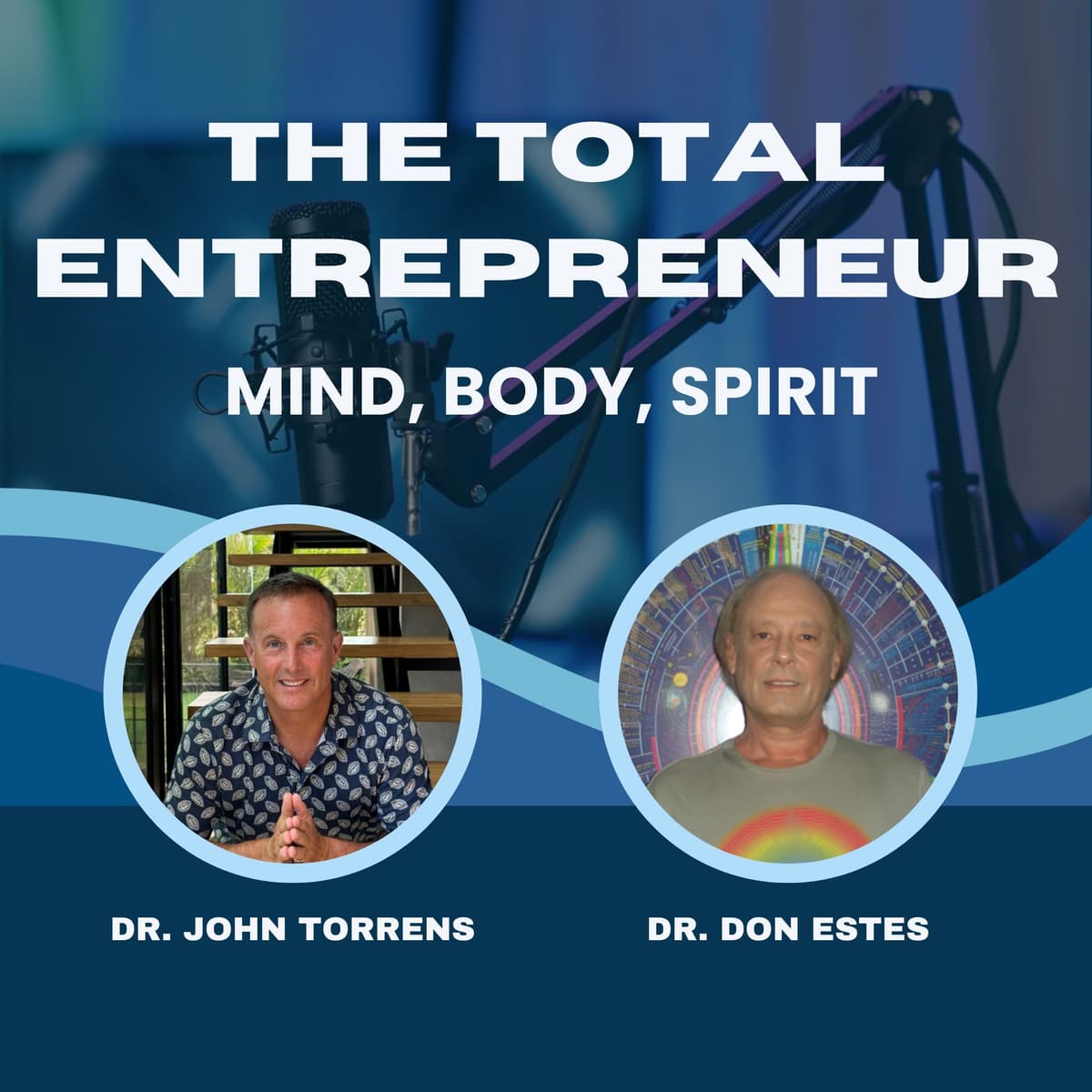
What You Say Shapes Your Reality With Don Estes
with Don Estes
Jun 11, 2026 · 00:59:49
Part of our conversations on
Don, welcome to the podcast. It is so great to have you here, and I'm looking forward to this conversation.
Likewise. All right.
Well, so the first question I had for you is that, well, most of us think of sound as just something we hear, right? And I know you see it very differently. So I was hoping you could walk us through what vibration actually is at the most fundamental level and why it matters for human health in the first place?
Yeah, I prefer, instead of calling it sound, I prefer to call it waves or waveforms. And those phenomenon actually have their— it's a triune relationship that has frequency and phase and amplitude. So it's not just about the frequency. Pretty much everybody in the industry is kind of hung up on frequency. frequency this and frequency that. But the truth of the matter is, is that phase and amplitude are equally, if not more important than just the frequency. And pretty much in most of the things that we've studied out there, they don't really include the concepts of phase and amplitude. And so we prefer to call it waveform therapy or vibrational therapy. Instead of just sound therapy, because it's much bigger than just sound.
So amplitude and phase, kind of define those for us. I think everybody gets the idea of frequency, right? But amplitude and phase, how do we define that?
Yeah, so frequency is the number of cycles per given amount of time. And we usually measure things in hertz or cycles per second. So a frequency of 2 Hz or 3 Hz would be 2 or 3 cycles per second for that wave. But the phase is the difference between the peaks and the valleys of the phase. And pretty much everybody in the industry is sort of hung up on the idea of like single frequencies, like sine waves and cosine waves. And when you see them, you see they're just— they just look like a little bell curve. And when they plot those together, they show the cosine wave as being 90 degrees out of phase with the sine wave. But that's only like 2-dimensional. It's not really 3-dimensional because there's— those 2 are like 90 degrees out of phase. spatially as well as temporally. And so if you could be at a frequency watching it go away from you, the sine wave is giving it the ups and downs part of the wave, and the cosine wave is giving it the side-to-side sort of wave. So when you see it drawn out, you always just see like a simple sine wave. But if you could be at the point to where that's moving away from you, Right. Coming towards you, you would actually see a 3-dimensional picture of something. And this is basically how reality works, is that there's a sine wave and a cosine wave, and they create a 3D version of whatever the image is supposed to be. So these are sort of complex ideas we're talking about here, and it's really easier to really show them in a diagram than try to just talk about it. But basically, the bottom line of what we're talking about here is that waves have 3 components. They have frequency, phase, and amplitude. And that phase is really what causes the shape of the wave or the geometry of the wave. And that generally gets left out of a lot of the concepts that are out there about frequency.
Mm-hmm.
So all of the technologies and everything that we've developed are phase-locked and amplitude-locked so that All of that gets locked down. Otherwise, when you try to play it back to somebody, it gets all discombobulated. And like if we have light going into the eyes and sound going into the ears and vibrotactile vibration going into the body, the peaks get out of phase with each other to where each— the peak of, say, 7 Hz doesn't line up with all 3 of those things. But if you phase lock it, then you get the— All the peaks and the valleys relating to each other correctly.
So frequency is subjectively perceived as the pitch or the note, right? The amplitude is subjectively perceived as the loudness. Do we have a subjective perception of the phase?
Well, you would have to really see what that looks like. Like I said earlier, a sine wave is just a simple bell wave.
Yeah.
But, um, frequencies that we're talking about that are music or us talking or anything like that are complex waves. They're not just single waves like that. And, uh, the complex wave, um, actually, um, would show not just the sine waves, but it would show every sine and every cosine wave that come together. Uh, to make the wave. Like, I was always fascinated by the signal coming down a, um, a wire, say, from your stereo to your speaker. And any given moment, if you were to take an oscilloscope shot of that, um, you would, um, you would see that, uh, everything that's in that music, the vocals, the instruments, the drums, everything is in that one little moment of time.
Hmm.
So instead of having that clear shape like that, it's all over the place with lots of peaks and valleys in it. And that gets left out a lot of— a lot of people talk about frequency. You see lists of frequencies. This is good for the heart, or this is good for the liver. which is pretty much inaccurate because there's no way that a frequency that would be resonant with a baby's heart would be the same frequency that would relate to like a grown man's heart because everything's totally different like that. So we work more in the realm of complex frequencies than just in simple frequencies.
Well, yeah, that makes sense, right? A baby's heart and a grown man's heart would just have different qualities. So yeah. But I wanted to, I wanted to ask you a question about something I saw in the movie Superhuman, which is where I was, I first became acquainted with your work. And I think it was the, is it an intention manifestation machine? I think, I think that's what it was, right? So it was probably one of the coolest things I've seen. So you think about something positive. And the visual that comes out is kind of pleasing, right? And you think of something negative or displeasing and the visual is displeasing. And that blew my mind. So I was hoping you could just walk us through that a little bit or even correct some of the, you know, if I'm factually inaccurate about what I was seeing, but I thought it was very interesting.
Now you've moved into a whole new realm of things that is outside a little bit outside of frequency and all of that.
Yeah.
Because what we discovered is, is that when you look at a frequency like that, I mentioned that it could be a sine wave or a cosine wave. And if you go talk to experts about it, a lot of them will tell you they're the same thing because when you see them drawn out, they look like the same thing. But then the question becomes, why do they call them sine wave and cosine wave? If they're both the same thing, and so we did a lot of studying on that, and we started out with something called the standard complex waveform equation, which is we didn't make that up. This is something that every scientist use, and it defines a wave like a sound wave or a light wave, and it says that the the sound wave is equal to. The— or the complex wave, put it like that. The complex wave is equal to the reals times the cosines times the frequency plus the imaginaries times the sine wave times the frequencies. And being a scientist, I sort of knew what sine and cosine were, but they never told us what it had to do with vibration. They just told us what it had to do in trigonometry with hypotenuse and tangent and right angles and all that. They never taught us about what it had to do with actual waveforms. But we started studying that and asking everybody, mathematicians, sound therapists, physicists, what are those real and imaginary components in that equation? And nobody could tell us. And I became fascinated with that, that why would there be this and have those names put to it and nobody can explain what they really are? The best we could ever get is that those are mathematical functions that are required to solve that equation. And I'm like, okay, but where did that come from? And nobody could really tell us. So out of a lot of study and years of study that we did on that, I finally identified what it was. And it's pretty simple. And I was really surprised that nobody had ever really talked about this before. But The real part is the part that's coming from the player, and the imaginary part is the part that's coming from the instrument. And a human being is basically a musical instrument. As we speak, we're using our instrument and we're playing it through our voice. And so it turns out that the Those real and the imaginary components basically create those— how can I say this? Those actually occur on the other side of the quantum veil. But when intention reads across and brings it over into this time domain that we live in, those real and imaginary components turn into sine waves and cosine waves. And as I mentioned earlier, that creates the shape of the wave. So if I take a person's voice and I separate it into those real and imaginary components and play one of them in one ear and the other one in the other ear, the brain has to actually resolve the difference between those 2. And it creates a sound and it creates a visual. And those visuals that you saw in the Superhuman movie were her speaking into it. And then it It's feeding her back a sound and a tactile vibration into her body, but also that visual that you saw, which is actually the shape of the wave. And all those geometries that you saw were actually shapes that were in the words and the frequencies that she was using. And it is really quite spectacular to watch that. A lot of scientists will say that it doesn't work until they actually come in and they try it. And see that it actually does work. And it basically shows you— in fact, people get so good at it over the years, people have gotten so good at it, they can create those shapes by just the way that they're talking.
Hmm.
So like if you're balanced between real and imaginary, you get kind of a circle. But if you get too imaginary, it turns into an oval this way, or if you get too real, it turns into an oval that way. So you can start shaping your reality by looking at what happens when you speak this way or you speak that way.
Yeah. And that was the takeaway I got from it. Right. And it, so it sounds like it's maybe, maybe there's a lot to do with, like you said, the instrument, right? So the instrument has a big part of it, but the player, the person behind it has a big part of it as well. So is there, so what I'm trying to do is connect it to, you know, the fact that, that our words matter and the things we say and even the thoughts we have matter. And this is, to me, just one more way of showing that, yeah, there is a, there is a physical manifestation of these thoughts because they're, they're just frequencies and waves as well. So, can you connect those for us? And because I'm— what I'm trying to figure out is how do we, how do we get people to really understand that their thoughts and their words matter a lot more than they think they do?
Yeah, that's probably— I usually tell my my clients and the people listen to my workshops, I say, if you don't remember anything else about what I've said, remember that, that you have to watch what you say. Because if you say it just one time, uh, and whatever, it just kind of comes and goes. But if it's a mantra, something that you say over and over and over again, it sets up reality through those sine and cosine ways to make that come true. So you have to really watch exactly what you say, uh, because otherwise it will come true. Yeah.
So, all right. So if it's just a single thought or, you know, you say it for one time, if you say, oh, I'm so stupid or whatever, right? Maybe not a big deal. But if, like you said, if that's a mantra, if you're always saying that to yourself, or if you're saying I'm not good enough, or I'm too fat, or I'm too— whatever it is, right? You're saying that that becomes a reality. So How does, how does that work? And I know, you know, manifestation is popular now and people are trying to get their arms around it. And what I love about this is that it breaks it down into the science, right? The waves or particles, that sort of stuff. So how does the thought actually impact reality?
It really all boils down to the fact that the universe is a quantum universe and it goes way beyond just frequency and phase and amplitude, and it all becomes quantum-oriented. And so, uh, to kind of give you an idea, um, there's a, um, everything is— how can I say this— everything is, uh, related to like a black hole. And in the center of the black hole is a singularity, and that singularity has all of the potentials that could happen in that particular circumstance. And it actually is projecting that out through the black hole through something called Hawking radiation. It comes out of the black hole and it goes directly to a qubit that is out on the event horizon, like space as we know it. And that qubit that's out there in space is entangled with the one that's inside of the Singularity. So when you say something or you look at something or you have any kind of event happen at all, it actually projects out of the black hole onto the event horizon and you see it. And so, as I mentioned, if you— if it's something that you just say one time, it just kind of comes and goes. But if you say it over and over and over again, it starts building those sine waves and those cosine waves together to create an image of what it is that you're talking about. And it projects that out into space. And that's what you see. Hmm.
Now, does it have to be spoken words or can it also be thoughts?
It could be. Well, that's another interesting factor there, because if you If you look at how that lays out graphically-wise, there are 4 quadrants of manifestation. First, you think something, then you express it, you make a model of it or talk to people about it, then you take action on the expression, and then it manifests itself. But that thought is purely imaginary. It's not real at all. And but when you say it, it actually brings it into the real world.
Ah.
So you can think whatever you want and it doesn't cause much trouble, maybe a little internal dispute or something like that going on, but it doesn't really mean anything until it is expressed. And it doesn't even have to be a thought. It could actually be a roll your eyes or some kind of gesture about the thought. And that actually makes it real and brings it into the real world. So thinking is important. The way a person thinks is very important, but it's way more important or less important than what they say.
All right. So I'm just going to try to repeat this back to you to make sure I've got a grip on it. So there exists, say, in the black hole, that it's just almost every potentiality out there, right? Whatever outcome could happen exists somewhere. Our speaking it or bringing it into the physical world kind of invites that reality into our experience.
Is that sort of right? Yes. Yeah. When you speak it, when you bring it into the real world, it starts building those images and you actually begin to see it out in the real world. or experience it out in the real world. It doesn't have to be something that you see. It can be a thought, a sound, a vibration, a smell, any kind of sensory mechanism. In fact, this all really boils down to the fact that the only connection that consciousness has with the internal or external world is through the sensory mechanisms. And that was really one of my major discoveries that I that came about when I started all of this back in the '60s and the '70s is the realization that the sensory mechanisms have to be synchronized. You have to see the same thing that you're hearing, the same thing that you're feeling, and then that actually makes it come true. If you leave one of those senses out, the part of the brain called the reticular activating system will keep going around to all those senses, and it'll find one that doesn't fit the picture, and it brings you out of the the experience of it. So it has to all be synchronized for it to work correctly.
Does it sort of reconcile with the idea that, you know, if you say something enough, it just becomes true?
Yeah, it sets into motion those real and the imaginary components. It sets those in motion that try to bring that reality to pass. And over time, it will do that.
Yeah. And it's not making judgments about it. It's just, it's just saying, hey, this is, this is what was spoken, or these are the words that need to be manifested, right? It doesn't have to be good, doesn't have to be bad. It's just what it is.
Just what it is. That's right.
Yeah.
And if it's bad, that can cause all kinds of trouble. Right.
Of course. So you mentioned the reticular activating system a minute ago. A lot of people I work with, myself included, have ADHD, and I know that, you know, from my research on it, our RAS, or reticular activating system, somewhat of a traffic jam there. So, so what does your work in sensory resonance, uh, do differently than, say, meditation, medication, things like that?
It's, it's similar in a way, but it actually synchronizes the senses to get to that state. Because if all the senses are not synchronized, then that part of your brain, that reticular activating system, will pull you out if one of the senses aren't part of the picture.
Hmm.
And so it's important that you— that you— in fact, the technology that we use, you've probably seen it. You saw it on that, some of it on that screen there. You didn't see the VibraSound in the Sensorium, which is a, uh, hypersonic table that you lie down on that allows you to feel every signal inside of every cell of your body at the same time.
Hmm.
And a real sophisticated, um, audio system that has an audio dimensionalizer in it, so you get superior sound. And then it's got lights that are synchronized with the vibration and the tactile And the sound and the tactile vibration. So all of the senses are getting the same information. And when that happens, the reticular activating system kind of gets out of the way. And the system runs through something called the ascended reticular activating system, where it gets past the block of the security and the safety and all of that. And it goes to those higher states of mind. We're into the third ventricle and the pineal and the pituitary and the thalamus and all of that, where you have, you know, an amazing experience that's outside of the day-to-day mundane stuff that most people deal with every day.
And where can people find these sensoriums? Because it does sound quite interesting. Is it, you know, is it a doctor's office or do you have health centers yourself or where would people find one?
We have help centers ourselves. We have our main one is here in Santa Monica, down on the promenade. I'm sure you've probably been down there before.
Sure, yeah.
And we're on 2nd Street there in the promenade. It's called Reality Center.
Okay.
And we do a lot of work with, excuse me, with veterans and first responders. Our medical director down there is the chief psychiatrist for Los Angeles Health— Mental Health Department. And she works with policemen and firemen and other city workers that are having psychological or hard times. And she works with those and brings those people to our center down there. But we also have some grants through the military because they deal with PTSD, all the time. And, um, we've had a lot of, a lot of vets say that it beats the heck out of ketamine, our process.
Wow.
And, uh, because, uh, it's very— it's safer. If you don't like it, you could just get up and end it. You're not like along for a journey that you're not enjoying.
Yeah.
And, uh, so, uh, it's, it's safer, it's more effective, it's funner. It's kind of like a— in fact, you know, we skipped the part to how this all really got started. Because for me, it basically started in the '60s when I was a chemistry major in college. And there was about a year or so before they made LSD illegal. And so we were just making it and doing it. And I freaking loved it. I wanted to live in that state for the rest of my life. I could, I can remember running circles around my professors and stuff like that. It was just, it was so enlightening. But when I figured out that you can't do it even more than like 1 or 2 days at a time without causing other compensatory lag problems, Right. I devoted my, I devoted my life to coming up with a way that I could achieve that state without having to pop the pill. And that's really where all of my technology has come from, is to ride it. In fact, now they're actually calling it digital psychedelics.
Yeah, or technodelics. Is that what they're calling it?
Technodelics, yeah.
Yeah, yeah, yeah. So it's basically just non-ordinary states of mind without substances, right?
That's right. In fact, once you do it enough, you learn how to do it, which is the other big advantage of this. Because right now I can close my eyes and start tripping my brains out. And then turn it right back off just like that. Because once you learn how to get yourself there, you don't really need any of that. You don't need the technology or the equipment or the drug or anything to get you into that state. It's all right here. You know, they— what they're not telling people or what they haven't really told people is like millions of years ago, we used to be those plants. And the way evolution works is it conserves order. So it's all still right there. Everything that all the plants do and all of that is right there.
Wow.
Once you learn how to access that, which a lot of that has to do with giving the reticular activating system what it wants, once you learn how to do all of that, then you can easily get into those altered states at free will and then turn it right back off when you want to.
Wow. So you're not stuck in a 4, 5, 6-hour trip. You can just turn it on and off. So how long does it take somebody to get proficient in that sort of behavior?
Well, it depends on the person. You know, people that are like really into it and put a lot of time into it can do it pretty quickly. I have— we have a lot of people come in and they have like an amazing spiritual experience first time on the system. But for others, it takes 3 or 4 times before they realize that, whoa, this is a powerful technology, and they start learning how to use it. It took me a number of years to actually learn how to do it myself. And, uh, it, uh, it really, really all boils down to, um, the amount of time you put into it and, uh, how conscious you stay of that mode throughout the day. Because there's so many distractions going on these days, it's really easy to get pulled out of it.
Yeah, for sure. So with technodelics— so I understand psychedelics, right? You're introducing a substance into your nervous system that upregulates or downregulates neurotransmitters But with your technologies, that's not happening, right? There's nothing invasive except for maybe waves. So how does that work without the actual substance?
It all has to do with what's going on in the brain and that whole reticular activating system that we were talking about, because those drugs kind of numb that out of the way. And the signal can get past that into those higher states of mind, but it's only because the reticular activating system has been numbed out of the way. So when you do that, you do my technology, you learn how to work your way around that rather than just shut it off. And it's much more powerful. And, uh, and, you know, when you wake up, you remember the experience. It's not It's not like something that you forget what happened there because you were kind of numbed out about it.
And you said you can get in and out of the states pretty easily. So what are, what are like some of your practical daily applications for it? Or is it not something you do daily? Like when would you say, hey, you know what, I'm just going to, I'm going to slip into this state for a little bit?
I actually try to stay in what I call unbroken communion. with my higher self and try to stay aware of the fact that my higher self or God or whatever you want to call it is observing the universe through me at the same time that I'm doing it. So it's seeing out my eyes, it's hearing what I hear. And I just call it communion. A lot of people call it meditation. I would probably prefer the word contemplation instead of meditation because it basically, instead of kind of checking out, it actually lets you tune in instead of tune out. And unless you tune in and start realizing your responsibility in all of that and things that you're doing that cause all those things to happen in your life. So the, I guess I would say that God consciousness really comes down to How much of your time you spend in that state? Some people—I was raised as a primitive Southern Baptist—and I would notice that Sunday night they'd turn it off and they wouldn't turn it back on until the next Sunday. And how I would ask my parents, you know, why do you say "I'm in" at the end of a prayer? They said, "Well, honey, that's the way we we." Turn off the prayer, get rid of the prayer. And I said, but God's still there, right? And I don't—I never really understood why it could be turned off and say, you know, okay, well, I'm going to be over here for a week, and then I'll come back and touch base with you next week. But it's the amount of time that you spend being conscious of all of that, and sooner or later you just learn what I call unbroken communion to where you are it. You are aware of it throughout the day. And when things happen to you, you don't just throw into the experience. You say, wait a minute, what does that really mean? How did I create that? What am I doing here? And just stay conscious of it all the time is the key to an incredible life.
And actually, something you just said made me think that that's— it's really important for everybody to realize that We have a lot of agency over this, right? Like when you said, hey, what am I doing to bring this on? Or what's my part in this? That's really important because we are kind of the captains of our ship, I suppose, right? Like we are driving this.
Yeah, absolutely. And yeah, and when you don't drive it, you wind up having a wreck.
Because it's happening no matter what, right? Whether you're being intentional with it, or completely chaotic, right? So one way or another, this is acting through you, I guess. And I almost said to you, but that didn't sound quite right, but through you maybe. I'd love to hear your perspective on, you know, God consciousness, just consciousness in general. I know a lot of times when we say the word God, it turns people off, but we're not, we're not saying it in the, you know, the white bearded guy up in the cloud. This is like just The one field, the quantum field, the conscious field, right? So can you give us just a quick perspective on that for people who aren't really familiar with it?
Well, I actually personally believe that there is a being, that God is personal, and it's like the perfect personality. And it's a relationship that you create with it. It's not some blob of energy out there that's running the universe. is actually what created the universe. And to develop an experience or a relationship with that is just mind-blowing. It's not some old guy sitting in a robe up there taking notes where they're going to punish you for something. But it is someone that's up there, and they are taking notes because of the Akashic Record. Every quantum moment that goes by, a picture is taken of the entire universe. That stays there forever. So it is being recorded, but it's not really being recorded for— to punish a person. It's you punish yourself by not really getting there. So you stay at all these lower levels all the time, and that's where you live. But once you learn how to get up into the higher levels, then you can live there as well.
So levels of what? When you say lower levels, what are you referring to?
Lower levels of consciousness to where, you know, you're stuck in all the mundane stuff. You get up, you go to work, you get up in the morning, you say, oh, I got to go to work. And, you know, you're not— not many people get up in the morning and go, wow, thank you so much for me being here for this. I mean, I don't even really understand how all this got here. It's mind-blowing. And I've never heard— I've had many conversations about this, and I've never heard one single explanation of how it could have all happened out of nothing. And so just studying that, how everything came from something instead of nothing, you start developing this relationship with it until you realize that it is absolutely real. And it's not religious. I don't even really like the word spiritual even because it just goes beyond all of that. It's just the way reality works. It's the way it's all set up to where we can be aware of it or not be aware of it.
Yeah. So, so back to the, you know, just waking up and thinking, oh man, I gotta go to work, or this is my day versus just waking up with joy and wonderment.
Yeah.
I think a lot of people get stuck in the idea that, you know, this is my life. Yeah. I got a 9 to 5 job that I don't really like, but I kind of need it 'cause I gotta pay the bills. And they just sort of go through the motions. Right. And it feels for a lot of people like that, that's just the reality. That's the way it is, right? So how does somebody who's in that reality or that level of consciousness start to intentionally move their way out of it?
Well, it takes a lot of work usually, but that's the reason I created the technology that we did, because sometimes it works almost immediately. It throws a person into a state of mind, an altered state, and they suddenly go, oh my God, Um, life is much, much bigger than I realized. And once you have one of those experiences, um, then you want more of it and you start seeking it out. How do I feel like that? And what you do is you just eventually wind up in a place to where you're aware of it all the time. And so when things happen to me, the first thing I do is I think, why did that happen? Or how did— what did I do to have that occur in my life? And once you do that enough, then you learn how to create the good things all the time instead of letting all the bad things show up. Because the bad things are going to show up no matter what you do. But when you realize that 9 times out of 10, you created it, then you can start backing yourself away from that and learn how to create your own reality.
Right. So, so maybe somebody who's in that lower level of consciousness stuck in the 9 to 5 that they don't like because they got to pay a mortgage and so on, right? Maybe it's just the realization that, hey, this is what I chose and being okay with that. And once you're okay with that and you speak those words, this is what I chose and this is okay now, does that then affect the future reality or the reality that's coming at them? Just that recognition and speaking that it's okay.
Yeah, yeah, that's the way it works.
So, because, you know, I don't want people to mistakenly think, well, hey, this sucks, I'm just going to quit my job or whatever, right? Because there's, you know, there's real-life impacts on that. But if you, if you put some intention behind it, which I know is, is something you talk about a lot, uh, is intention.
I guess you hit it right on the head there, that, that's basically just the way it works. And the, the bad things keep happening, um, But when you start realizing your part in it or how something happens to you because it helps somebody else, even it might not have even helped you, but something that happened to you helped somebody else. And when you start realizing that, you know, it's all this big picture, it's not just this day-to-day mundane stuff that people get caught up in every day. It's much bigger than that.
Right. So, and that realization is the shift, right? And then you can start speaking other things into reality. So yeah, so take the job that maybe somebody doesn't think they like. Maybe you reframe thinking, well, what I'm doing every day is helping these people, or it's preventing this from happening, or it's adding this to the world. Just that action or just that speaking it, that will begin to change the reality for these people. That's, that's sort of how I'm understanding this.
Yeah. Yeah. Yeah. You mentioned that you don't want to imply that things just They can just be, you know, gotten rid of. But the truth is, is like, I have a lot of clients that come to me that want to be sound therapists, but they have another job that provides them lots of money. And so what they'll do is they'll try to get both of them going. They'll start the sound therapy business over here on the side. But they'll keep their job.
Right.
Unfortunately, the universe does not like that. It likes for you to burn the bridge to the other side because it knows that the first little thing that comes up when you make the change, the first little problem that comes up, you'll run back across the bridge. And it does not like that. It really requires dedication of, no, I hear you in my voice. I hear my spirit. This is what I should be doing. And you put everything into it, then the universe steps in and makes that happen. But if you try to hold on to the old, then you're doing the same thing. You're just holding on to the old.
Yeah. So by trying to mitigate risk, you're sort of preventing the future reality that you're looking for. Is that the idea?
Well, you're just taking them out. You're taking the other side out of the picture. You're taking I mean, you can call them angels, whatever you want to call them, but there's a, there's a huge reality going on. Like right now, for example, most people would be a little freaked out if I were to say that there are beings in my room right now as I'm doing this, watching what's going on.
Hmm.
And that freaks people out a little bit to think that they're being observed by a bigger picture. But the truth is, is that they really are. It's not to punish you. It's actually to help you and to find out what's going on with you and to help you learn how you're responsible for a lot of this stuff that happens to you.
And how do you come to those realizations? I mean, I realize it's probably the culmination of years and years of work, but for people who are hearing this for the first time thinking, whoa, what is this guy talking about? How do you get to that place? How do you realize it?
Well, you know, I think the biggest problem with scientists and everybody that studied any of this is that they leave out the spiritual aspect of things. And it's all about the physical reality of things. It's not just about spiritual reality and about what, you know, when somebody asked me, what is the purpose of life? And which is a really complicated thing, but the truth is that the purpose of life is to decide who I'm going to be when I pass over and I go to the other side. Because this is just one little time limit here, as you're here as a physical being on this planet. That's just one little time limit. It goes on forever and ever and ever and ever. So who am I going to be when I pass over and go to the other side? And I want to be that now. I don't want to have to wait until I die and pass over to the other side. I want to be my pure spiritual self, even as I'm on this side. But these are things that most people don't really get without some kind of wake-up call.
Right.
So, you know, and you can get that a number of ways. For some people, that's a very bad thing. They have a terrible accident or something like that. something huge happens to them, and then, um, 6 months later you're saying, thank God that happened. Because everybody has those experiences where you'll say, you know, something, an event will happen, you say, why me? What did I do to cause this? And all of that. And then 6 months later you're saying, thank God that happened. So you could never put— um, this gets us into a whole nother thing, but we were talking about amplitude. And the supercomputer we use always reports back amplitude as magnitude instead of amplitude. So I ask it, why do you use magnitude instead of amplitude? It said, well, magnitude is the same thing as amplitude, but without the sign. What sign? The positive or the negative sign? In magnitude, things are either 4 or I mean, in amplitude, they're either 4 or minus— plus 4 or minus 4. In magnitude, they're only 4. So I ask, what does that mean? And it means that a human being can never afford to put a sign on any experience that they're having until it fully plays itself out. So you can't say that's good or that's bad or whatever, but until it fully plays itself out.
And you may not even know when it's played out, right? Because like in the— it could take years, I guess, to play out.
And it could be forever. Yeah, it could be until you're standing face to face with what created you.
Ah, so gotcha. Which actually brings— yeah, it's this question I've got, and I've heard other people talk about it. I don't know if you have a perspective on it, but it's this whole idea of time and Multiple dimensions, multiple timelines. And the way I've heard it explained that I can understand it the best is that each timeline is kind of happening like there is no past or no future. Everything is happening now, but it's— they're like stacked almost like records or cards, and the point in time goes down through them. I have no idea if that made any sense because I don't completely understand it myself, but I was wondering if this is something that you've that you know about, you can shed some light on for me?
Yeah, I just watched something from Brian Greene, who's a famous physicist, about all of this just this morning. I was actually watching it. And the— everybody has different ideas of what time is, right? And I believe that it's I do believe that there is a past and a present and a future. And all of that, the thing that they usually leave out of that is choice. You actually have to choose those things. So a lot of the scientists will say, well, it all lives in the block sphere. So past and present and future are all the same thing. It's all there. But then that takes out the whole thing about choice. And so the fact that we do have choice puts us in a situation to where we have a past that we remember, we have a present moment, and we have this future. But that gets into all kinds of other scenarios to where the time— how long does the time last? What is the present moment? And if I were to say, if I were to ask you, when does the next moment start? You would say, you'd try to tell me, oh, it starts right there, right there. But you can't do that fast enough because it actually starts at the Planck time, which is 10 to the minus 44th of a second.
Okay.
And so the next moment happens that fast. But our brainwaves are so slow that a 10th of a second goes by before you even recognize the next moment has shown up. And in that 10th of a second, everything that makes you up, the electrons, the protons, the atoms, the cells, the molecules, get the information first before you even recognize the next moment has shown up. So this is— that's one of the keys to understanding how we create our own reality, because you set it up. From what you thought in the past moment. So you cannot— I had a conversation with several people about this, about how, you know, everybody says, well, you should live in the present moment. But you can't live in the present moment because it comes and goes so fast that you can't really live there in it. So all you can really do is live in the next moment, not the future. But the very next moment, you live in the very next moment is the key to life. What am I going to do with what action am I going to take right now? And that gives you the moment. And for some people, the moment is very narrow. Like if I were to say to a little kid, say, let's go to Disneyland, they're going to jump up and down. Yeah, go to Disneyland.
Next week.
Next week? Ah, forget about it. They'll just blow it off because their moment of the time is so narrow. But the older you get and the wiser you get, that moment starts increasing to where for everything that you do in the present, you reach into the past and say, what do I know about this? What have I learned about this? And you reach up into the future and say, well, if I take this action now, what's going to happen 2 months from now. So, your moment of time, we call that unit of time perspective. And the more mature that you get, the wider that gets. But immature people have this really narrow moment. Does that make sense?
Yeah. No, it does. And I feel that too as I get older. Like, you know, maybe the delayed gratification, to simplify it, is easier to handle, right? Like, you can live with the fact that, hey, I'm going to take action now. that won't really benefit me, you know, for a few weeks or months or years or whatever. So I think there is that realization, right? And even just by making that decision or speaking about it, I feel like sends something out that eventually comes back. I don't know how to articulate it, but that's kind of the sense I have.
Well, there's a bigger picture going on and there's all kinds of beings on the other side that are dealing with all this stuff. Every decision you make, there are beings on the other side that are trying to help that come true for yourself.
Yeah.
And, uh, but people, people want to leave that out of the picture. They want to make it all about what's going on and the physical reality and all of that. They don't really want to consider that there's this other reality going on. It's, it's a, uh, a service motive economy over there. It's not a profit motive economy over there. So time means nothing over there. The fact that you're going to do something now that doesn't affect something for 6 months, it's fine because it all just keeps on going forever.
Right. So let me ask you this. If, if what I'm thinking about or what I'm trying to manifest or bring into my reality affects other people, which it almost always does, you know, those forces and beings on the other side, how does that, how does that work? Is there like a, do they weight the outcomes? Like, well, he wants this, but it's going to affect this person this way. And maybe I'm just, maybe I'm really doing a good job of speaking it out there. And the universe has no choice but to, you know, conspire with me to bring it about. But there's other people involved. So how does that work?
Yeah. All of those beings on the other side are taking that into consideration and talking to each other. And they're trying to make it work out best for everybody.
So the thing that I think I want, right? may not actually end up exactly like that, but it might end up being just for my best and highest purpose because there's other people involved too who, who also need something for their best and highest.
Yeah, it all boils down to the time thing that you were talking about. What's the time involved in all that? Because you can do something right now that's not really so good for yourself, but 6 months from now, it's the best thing that ever happened. But for the other person right now, it works for them right now. Those beings are moving at such fast frequencies that to them we look like we're moving in like slow motion like this. So they have all of this time to think all of this out and make all that work and get people together. A lot of them work towards what I call personality arrangements. So their job is basically to make sure that this person that lives over here in the United States meets this person that lives over there in Singapore. And how do we go about doing that? How do we manage things out for them to make sure that that connection takes place? So there's all kinds of things like that going on. And I know it sounds really weird to a lot of people, but the truth is I have all the science behind it to kind of prove it.
Well, so that's what I really like about your profile, and that's why I wanted to talk to you, because yeah, there was something backing all this up, right? It wasn't just your, your opinion on something, you know.
Now, I've presented this to scientists all over the world, and well, you can actually see it behind me, this chart back here.
Yeah, you know, I was going to ask you about the chart because that has a little notoriety. Like, that, that's been, that's been called one of the more influential, I guess, um, images in science. So yeah, I'd love for you to explain that a little bit.
Uh, yeah, that's just a, um, An expanded version of the linear electromagnetic spectrum that you've always seen, where they draw the broadcast radio up through heat and light and gamma rays. And this is just an extended version of that to where both ends are pulled into the same point, like a cycle more than like a linear kind of thing. And I've shown this to people all over the world, and I've asked, you know, if there's something on here that shouldn't be on there, then you tell me about it and explain why, and I'll change the chart. But so far, I haven't had a single scientist come up and argue with me about any of this because you can lay it out like this, and it pretty much proves everything that you and I have been talking about.
Hmm, that's wild. So while you were, while you were looking for that, I had another thought or question. So you were talking about, you know, the personality arrangements and, you know, kind of making sure that, you know, what's happening here is going to work and everything. Could it even cross over what we consider lifetimes? So maybe somebody's wanting something to happen now, and it involves somebody else. And, you know, maybe it's going to be viewed as a negative thing for that other person, but in another incarnation or life or existence timeline, whatever it actually is, a good thing? Could it be that complicated? Yeah.
Yeah. Yeah. It's more complicated than you could ever even imagine. It's a big, huge, huge picture, this thing that we call life. And we're all stuck in this day-to-day, moment-to-moment version of it rather than backing off and seeing how It goes on forever, and we will go on forever as well, as long as you choose it. I don't believe that there is a hell that you get thrown into because you don't believe it. You're given every opportunity in the world to see the truth about life, and you get to choose it to go on and on and on and on. Hmm.
Yeah. So my mind is just bubbling with all sorts of things I would love to ask you. But for, for people whose first exposure to your work might be this interview, can you recommend like a nice, easy on-ramp for somebody who is looking to explore more of these concepts, especially, you know, young entrepreneurs who are in the thick of things and just having a hard time seeing the beauty of it all? And yeah, where would they start?
Well, the first thing they can do is start thinking about it and studying about it. So they can go to my website.
Okay.
And on my website, there's a Learn menu there where you can read everything I've ever written about any of this as an article form there on my website. So you can kind of start studying it and you can actually search it to find out what does he say about this or what does he say about that and just kind of go through there and And see the different things that have come up.
Is that donestes.com or is it drdonestes.com?
Yeah. So that's one thing they can do is just start studying it and they can go to the website and they can see all of the different technologies and the equipment that we use to do all of that with. But then the most important thing is to experience it. It's not something that you can really think about that deeply. It's something that you have to experience. And once you experienced it, you're going to like, oh, I get it. But so we have different places. Probably I've got maybe 400 of these out in 20 different countries around the world.
Oh, okay.
And so a lot of— most of them are not in public places. They're mostly with therapists and medical doctors and dentists and chiropractors and other people that are attempting to get a person out of that locked-in state that they're in.
Is there a list of locations on your website where people can find these?
Yes. Okay. Yes. And anybody that's near Santa Monica should definitely check out our home office there in Santa Monica called the Reality Center. I think you have the web address for that as well, called Reality Center Santa Monica. And we do all the work there. It's actually a showroom for all of the technology. But we do all kinds of different therapies there with it, the latest of which is something called a fundamentalizer voice analysis thing. So that we've basically discovered that a human being is basically a musical instrument. And if you were going to ask a musician to tune a guitar or a violin or something like that, laying against the wall over there, what would they do? They would pick it up and they would play it and they would listen to it. And if it's not in tune, the strings would be sharp or flat of a note. If it's not in tune, they would use the little tuning pegs to kind of tighten the string or loosen the string. But the human being is the same thing. Our nervous system are those strings and our endocrine system are those strings. And once you know what's going on there, you can tighten that. that pituitary up or loosen that, um, solar plexus up or whatever, um, whatever the string is. You can tighten it or loosen it with playing the right frequencies or the right music and that sort of thing.
Wow.
So it's very, very, very powerful. Uh, and that, that basically kind of explains all of my work, is basically just to How do we tune a person up?
Yeah, come in for a tune-up. No, I love that idea. Yeah. And, and the beautiful thing is you don't really have to understand it yourself necessarily because the technology just does it.
Yeah. And you have the experience and no matter how much we try to explain it to you, it doesn't mean anything until you experience it yourself and say, wow, I just left my body and I went somewhere. I don't really know where I went. But I learned something. I learned something amazing about myself.
Yeah. Well, you know, so it's hard to do this, but my mind is blown. So I really appreciate you taking some time to talk to me and share your work and your technologies with the audience. I find it exceptionally interesting. And yeah, I can't wait to try it myself. My profound thanks for your time and expertise. I really appreciate it.
My pleasure. I look forward to talking to you again soon.
You got it, Don. Thank you so much.
All right, thank you.
About This Episode
What if the words you repeat most often aren't just habits of thought, but are literally constructing the geometry of your physical reality through measurable wave mechanics?
In this episode of Total Entrepreneur: Mind, Body, Spirit, John interviews Don Estes, researcher, inventor, and creator of the Vibrasound and Sensorium technology. A former chemistry major who began his research in the 1960s, Don has spent decades studying the intersection of quantum physics, wave mechanics, and consciousness, developing technologies now installed in over 20 countries, working with veterans and first responders at The Reality Center in Santa Monica, and presenting his work to scientists around the world. His expanded electromagnetic spectrum chart, visible in the background throughout the conversation, has been called one of the more influential images in science.
Don breaks down why the wellness industry's focus on frequency alone is missing two of the three essential components of any waveform, phase, and amplitude, and why that omission makes most sound and vibration therapies far less precise than they could be. Whether you are an entrepreneur who has always sensed that your words and intentions carry more weight than anyone can fully explain, or someone looking for the scientific framework behind why mindset work sometimes works and sometimes doesn't, this conversation will give you a completely new lens through which to understand how reality is actually built.
Key Points Discussed
Frequency is only one third of the picture: Why phase and amplitude are equally, if not more, important than frequency in any waveform, and why most sound therapy and vibrational wellness approaches produce inconsistent results by ignoring two of the three components that actually determine a wave's effect on the body.
You are both the player and the instrument: How Don's study of the standard complex waveform equation revealed that every human being has a real component, the player, and an imaginary component, the instrument, and how intention crossing the quantum veil is what turns those components into the sine and cosine waves that shape physical reality.
Watch what you say: Why a single statement comes and goes without much effect, but a repeated mantra builds sine and cosine wave structures over time that literally project an image of what you are saying into the quantum field, whether that image serves you or not.
Thoughts vs expression: Why a thought exists purely in the imaginary domain and carries limited power until it is expressed, through words, a gesture, or even a rolled eye, and how that expression is what brings a reality across the quantum veil into the physical world.
The four quadrants of manifestation: Think it, express it, model it or talk to people about it, take action on it, and how moving through all four steps in sequence is what allows an intention to fully manifest.
Technadelics - altered states without substances: How Don's Vibrasound and Sensorium technology, a hypersonic table with synchronized light, sound, and tactile vibration, bypasses the reticular activating system by giving all the senses the same information simultaneously, accessing the same higher states as psychedelics without numbing the brain to get there.
Unit of time perspective: Why immature thinkers operate in a very narrow present moment that cannot defer gratification, and how widening that window to reach into the past for wisdom and into the future for consequence is one of the most important markers of genuine leadership maturity.
Keep listening
More on Spirit


About the Host
Dr. John M. Torrens
5× Inc. 5000 entrepreneur, Professor at Syracuse University's Whitman School of Management, author of Lightning in a Bottle, and TEDx speaker on ADHD as an entrepreneur's superpower.
Browse all podcast guests →Book a strategy call →