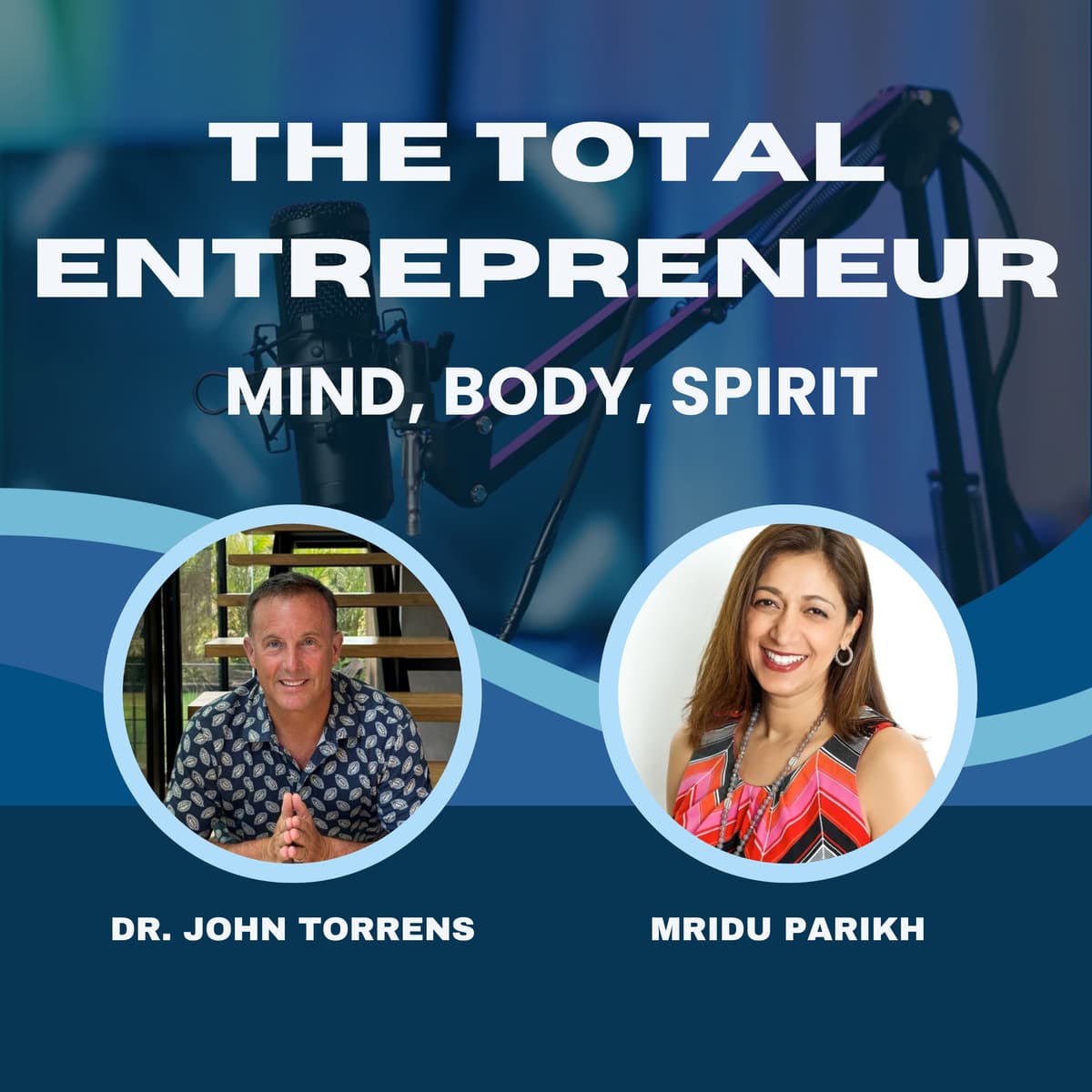
How to Feel More Productive with Mridu Parikh
with Mridu Parikh
Oct 16, 2026 · 00:44:16
Part of our conversations on
I think of productivity as a feeling, an emotional connection. So it's like a feeling you get when you get the results you want, the feeling you have when you get the results you want. And that's really how I measure it. So at the end of the day, I think, how did I feel?
Ritu, welcome to the podcast. So nice to have you today.
Thanks for letting me be here. I'm excited.
Yeah. So I wanted to start by talking about some of the things you mentioned in your TEDx talk. A lot of my listeners skew ADHD and productivity and activity and just getting things done is a big theme. And I know you have a specific take on that in terms of productivity and being busy and still not getting the things done you need to. I was wondering if you could just kind of Give us a little rundown on that.
Yeah, well, thanks. I think to start, I think about productivity a little bit differently or maybe in a unique lens, I think, than a lot of other folks or at least productivity experts. And I think of productivity as a feeling, an emotional connection. So it's like a feeling you get when you get the results you want, the feeling you have when you get the results you want. And that's really how I measure it. So at the end of the day, I think, how did I feel? Because often we can be busy all day. We all have those days, right? From morning till night, we're checking everything off the list. We're crossing things off. We're running around dealing with everyone's emotions. And at the end of the day, we can still look around and think, what did I even get done today? And other times, like, maybe I only put in an hour or 2 or not nearly as much frenetic energy, but I got something done that I've been procrastinating for 2 weeks or 2 months. And it's like off my mind. And at the end of the day, you're like, wow, this feels like such a good day. I feel so good. And to me, that's like, if we could, I think, start measuring productivity that way, it would just automatically guide us where to put that energy every day. We're like, what is that thing or things that are going to make me feel really good? When I make some progress on them or even just knock them off my list at the end of the day.
I think part of the problem for high achievers or strivers is that they just never feel like they got it done. So no matter what they did, even that pillow time, they might just think, geez, I'm not enough. I didn't get it all done. I got to do it tomorrow. I got to push. I got to grind. So how do you respond to that type of thing?
So I think you're absolutely right. As overachievers, highly ambitious, really driven, nothing's ever enough. So I think if we put some parameter about around what might be enough for a day, then you have something to measure against it at the end of the day. So for example, if you wake up and as a high achiever, you're looking at your giant to-do list and it's probably 3 pages long, right, of all the things you need to do, of course, at the end of the day, you're going to feel like a failure because there's no way you can get through all that. It's like not humanly possible. The time is time. But if you had that long list and you said, let me pick my top 3 things, like my top 3 that are going to make an impact today, are going to make me feel really great, going to put some progress on maybe professional or personal goals that matter, really matter to me. And let me just focus on those 3. Now, everything on top of those 3 feels like you feel amazing, right? You're like, okay, I've kind of knocked out those 3 or worked on them. And now the other 10 that I also did, all those emails and texts, Wow, now I feel so good. But now I'm like an overachiever, right? So I think it's because when you're looking at that giant list, there's no way to get through it. So you always feel behind. So you want to focus in and hone in on 3, maybe 5. Like, keep it as a short, manageable list that still challenges you for the day, but then you'll feel much better. Even if you got 2 of the 3 done, you're going to feel better than, oh, I got, you know, 6 things off my list of 45. Yeah,
yeah, that makes sense. And I think starting the day with some intention, like, hey, here's the things I need to do. And I like limiting it to 3, maybe 5, right? For the exact reason you say that, you know, it makes it achievable. And I think for people who are high performers and strivers, they, you know, they need wins every day, right?
Yeah, yeah.
So let's back up to your origin story. So you spent some time with Amex and Mercedes Before you split off to do your own thing. So tell us a little bit about, you know, what that part of your career was like, and then what was the turning point for you, or what was the, I guess, the point in time that made you say, hey, you know, I'm ready to go off and do this on my own?
Yeah, I'm so grateful for that first decade of my career because I was in client services in a marketing company. And so some of my clients were the ones you mentioned, Mercedes and like American Express, these big corporate clients. And I don't think— I think often in the time when you're going through something, you can't necessarily appreciate it, right? The lessons are always afterwards. So I don't know. I don't know that I loved my job when I was doing it. I was in client services, which means I was the middle person, the liaison between the agency and the clients at these various companies. So I was that person who had to really learn how to deal with their emotions and negotiate with them and appease them, and then also work with this internal team, the creative team, in production and do the same things with them and work on their schedules and, you know, put up a lot of boundaries and help them work through it. So, after I left that career, and I'll tell you how that happened, I really, I think that really built the foundation of so much work that an entrepreneur is doing. We're constantly problem-solving. We're being creative. We have to negotiate. We're, you know, dealing with so many different types of people. So, I really attribute those skills from there and also like all the detail-oriented stuff I had to do. But the reason, honestly, why I was able to change tracks was because my husband's job took us from New York City. And I was working crazy hours, as you do often in agency life in the city. And I had a 2-year-old son who I thought I never saw. I think my nanny was raising him. And we had an opportunity to move to Nashville. This was 20 years ago. And if anyone's like, oh, cool, Nashville. Okay, Nashville was not cool 20 years ago. It was not the it city. It was not fun. But it did give us a much more calm lifestyle and a great lifestyle. And because of that, I was able to leave agency life and just had the freedom to kind of figure out what I wanted to do next. And I just was like, I don't want to go back to that lifestyle because that's all I knew. What could I do to build on my own skills? That's where some of that stuff came in. It was the detail-oriented stuff. It was dealing with people. It was problem solving. It was creativity. And also, I love teaching. So it's like I was able to kind of bring that all together and sort of start my entrepreneurial path.
Yeah, we've got that love for teaching in common. I've, you know, in addition to the other things I do professionally, I'm a professor at Syracuse University and I teach entrepreneurship students. It's really quite rewarding and amazing. So it's interesting that you started your career on the agency side but didn't make that leap to corporate. Like, that seems to be a very natural path, right? You start on the agency side, you go to work for corporate clients, but you chose something different. So I think one of the inflection points that a lot of my students and a lot of listeners and viewers are interested in is what was going on in your life? How did you make that decision? Like, what was it really like? Because I think that's like the secret sauce or like the mystery point of how do you really do that, right? Yeah. And then all of a sudden you were working for yourself. But there's a lot that happens in between there. So can you break that period down in a little more detail for us?
Yeah. And like I said, I always had the luxury of a little bit more freedom and time at that point. I didn't have to run back to work, so I had this time. But that really allowed me, I think, the self-reflection that I didn't necessarily ever do before. I think you sort of go from high school to college to your degree to your job, and you just sometimes you're just following like what you should be doing or like You know, like your next job, your next job. And at that point, I was able to just sit and think about it. I went through those very tactical, those things that, what are you really good at? Those career books you can buy and like, what are your strengths and what are your weaknesses and what are your passions? And I realized, I mean, I knew I wasn't really passionate about what I was doing and thinking, is this what I want to do for the next 30, 40 years? I don't, I don't think it is. What could that be? And so the series of sort of just sitting sitting, thinking, writing, a lot of journaling. What is it that I— what are the things I love and how can I take these things that I'm passionate about or that are just things that come naturally to me or skills and create something out of that? Actually, in fact, I wouldn't even say I was looking to create. I just thought I'd find that job. And when I couldn't find that job, it was like, well, then maybe I just need to create it and I can create it. So I can't say it was one necessarily moment, but it was going through that journey of that self-reflection and sitting and thinking about those hard questions that often life, we don't have time to do that. So it
doesn't sound like you had that plan or thought to be off on your own. It just naturally happened.
I kind of naturally did. I thought, well, okay, if I want some flexibility, if I want to use these things that I love doing. So actually, when I started my business, it's very different from what it was today. I started as a professional home organizer. That was back in the day. When, like, nobody knew what that was. There was no Marie Kondo. There was no Container Store. This is, like, way before, right? So, like, but I got there because I went through this self-reflection. I was like, well, what's something that comes— what comes really naturally to me? What do I love doing? I'm obsessed with— I love organizing things. I'm very systemized. I'm very workflow-oriented. I love things to look beautiful. You know, I— so it got me. And then, and then when I thought about this, I was like, wow, I wonder if I can— and people have always asked me my whole life, can you help me fix this space or organize this? I was like, wow, I wonder if someone would actually pay me to do something like that. And then I found this organization, this National Association of Professional Organizers. Anyway, so one thing led to another, but it really was just like, well, maybe I can have someone pay me for this. And the first clients are my friends and they're for free. The next one's $20 an hour, then $40 an hour, and you kind of Just build up that confidence. And I was like, wait, I can make a real business out of this. Yeah.
Yeah. And I read somewhere that while you were organizing other people's homes, your own life felt disorganized. So when did you realize that the organizer needed organizing?
Yes. So there's a really big distinction between being organized and being productive. And I think I thought they were one and the same. I think many people think it's the same. In some ways, there are some similar skill sets. In some ways, they're very different. So, like you said, I could organize a pantry or closet and a space beautifully. But when it came to actually focusing on the priorities that mattered most to me, whether it was motherhood at the time, whether it was growing my business, whether it was being a great spouse, I felt like I wasn't doing anything particularly well. Like, it was sort of like Things were just kind of half going on on all sides, and I realized myself I wasn't focusing on my health, spirituality, things that were so meaningful were falling through the wayside. They had—I just—I just didn't have that—that understanding of prioritizing, focusing, even delegating, systemizing things in my business. So I went down a personal development path. I'd say this really had nothing to do with let me move my business this way. I was just like, I've got to figure this out. Things are falling through the cracks. I'm just. not feeling really productive at the end of the day. I'm not feeling really fulfilled. And I wish I could say it was overnight. It was probably like a 2-year journey of classes and coaching and lessons and teachings and trying and failing and all the tweaking that goes along with it. But when I did come out on the other side, I truly, truly, my life had changed in every way. And probably the most prominent thing was just my level of confidence and self-esteem and just how I felt about myself. And then that trickled down into everything because once I felt more confident in clarity, decision-making, prioritizing, then I could make better decisions for my business. Then I could be more focused with my children. Then I knew, okay, the priority is my health and spirituality. And those pieces of the puzzle kind of started falling into place. And so once that sort of happened, and it's a lifelong journey. It's not like I just went and done, it's done. But as that unfolded, I thought, I cannot be the only entrepreneur who's struggling with this, right? This is like, we're all handling a million things. I feel like this is, this is where my path has taken me and where I can really help other business owners and other entrepreneurs do under, you know, deal with this too. So I evolved over time from home organizing to productivity, time management, focus, and, and it's been, it's been great.
Yeah. I notice in my own life, like, I mean, because of my ADHD and because how disorganized things like my calendar tend to be, like my workspace and my home environment needs to be super organized, right? If, if that's organized, at least I feel somewhat settled and regulated internally. And then I feel like at least I've got the, the foundation for productivity. So I dunno, has, has that been your experience with your clients as well?
Yeah, I think environment is very undervalued. People don't even get how important that environment is. So I'll give you an example. So let's say you're just, you're working on an email because we're always working on email, heads down, right? You're typing. And when you're thinking, as a neurological response, your eyes shift. So you're typing, you're looking down, and then your eyes look up because you're thinking, oh, what's that next right word? What's the next phrase I should say? And just in that momentary lapse, right, of just looking up, Like looking up at your screen, looking at your date, you're like, oh wait, there's that thing I should do. Let me take this to the kitchen. Let me go mail this. Let me work on this file. And you just, in that momentary lapse, instead of sitting in the discomfort for 20 more seconds of just thinking through your thoughts, our thoughts escape us and we start jumping on something else. And then we jump on something else. And that's truly part of it, yes, is just our inability to just stay focused. But a lot of it's just because there are things around us in our environment. And so, What we really need is like a visual anchor or something that just keeps us anchored straight ahead down when our eyes shift, we're not looking all over the place. And if you could, so simply, if you could just take everything off your desk, keep it clear, you don't have to go organize it, you don't have to go color code it, just put it on the ground, like put it away from your peripheral vision where you can't see it. That one shift alone can help you tremendously when your eyes are shifting to not get distracted. And I know especially with ADHD, we suffer with that, but even not, right? If you're not diagnosed, we are all— our attention span is like a goldfish. I mean, it's so low that nanosecond can distract us. So yes, I agree with you. I just think environment, it doesn't have to be perfect. It doesn't have to be, like I said, super organized. It's more just like out of your space and out of your visual periphery to keep you focused at the time.
That distraction that you described, to me, that raises my stress levels, right? If I'm distracted and it's messy, I just feel more stressed. And I know you have something called the Stress Squasher, I think it is. Is that it? Yeah. Talk to us about that.
Yeah, that's my title, the Stress Squasher.
Yeah. Yeah.
Well, I mean, that's kind of like my— I call myself, I guess, also known as the Stress Squasher because at the end of the day, I think all of this stuff, whether it's organization or goal setting or prioritizing or time management, whatever, whatever aspect you want to look at it. My goal at the end of the day, working with clients or training or coaching or talking to friends about this, is to bring down your level of stress. It's to help you feel less overwhelmed. Life is overwhelming. Running a business, family, social commitments, you know, a community, everything, social media. It is overwhelming. We have so many inputs and distractions all the time. And, if I can help in any way through any of these strategies, through mindfulness, through, you know, to help not just performance, which of course we all want greater performance and better results and more revenue and all those things, but just bring down your stress so you can be a better mom and a better business owner and a better friend and make better decisions from everything you put in your mouth to how you spend your time to how you react to other people, like my job has been done. And so, That's how I kind of came up with the Stress Squasher. I'm like, that is ultimately my goal, is to help people bring down their stress and live a better life.
It's a very holistic approach, it sounds like, right? You're not just focusing on one aspect of productivity or performance. It's very holistic, which I think is important. So let's go back to your TEDx talk because I think the message in that is really important and interesting. So you mentioned it earlier, but I want to dig more into it. So you call productivity a feeling, not a number of checkboxes, right?
Right.
So how do you coach someone who, for example, gets their dopamine from checking boxes?
Mm-hmm. Mm-hmm. So I want to be clear, it's not— we're not going to do away with your to-do list. We're not going to not check off boxes. We just want to start with the right boxes. So it's like we mentioned that top 3, the top 5. In my TEDx talk, I say just 1, like start with 1, you know, 1 professional, 1 personal. As you get a little better at that, maybe move to 3 or, you know, and move up, but 3 to 5 max. You're still gonna have that. And it's gonna make you feel so good when you do those things. And by the way, they could be small. It doesn't have to be the 3-hour-long thing. It could be, I've been walking by this piece of paper that's sitting at the bottom step for like 6 weeks, and I'm just gonna pick it up and go file it finally, right? That could be the thing. It's a 2-minute task, but— and you get to cross it off your list, and that could be one of my top 3, and you're going to feel so good. And when you're done with those top 3, you can add on another 3 and another 3. So you can still end your day with your little, little tasks, with your 20 you want to cross off. That's fantastic. But it's really being intentional about what they are instead of just kind of like going down that list. Sometimes it's mindlessly, sometimes just what's on top to bottom, sometimes it's just what's the easiest one to knock off. Sometimes it's, you know, like there's all different reasons, but let's be really intentional about what's going to have the biggest impact on you and your goals.
And it seems like, yeah, I love the idea of turning it into a feeling, right? Because that's what you're going to remember the next day. That's when it— yeah, that's basically what's going to keep you going. So yeah, I think that is important. You talk about not putting your ideas on the to-do list. And I'm guilty of this all the time. Like, you know, on my to-do list, there's like big ideas. And I think I have a sense for where you're going with this, but talk about why maybe that's not the best idea for your list.
Yeah, the to-do list is an action list, which means there is some verb associated with it. And it's like something that has an end time, right? It's sort of a— it's not a— yeah, it's not the idea, but it's Take the trash out, go make that phone call, return the email, right? It's a task, it's an action. The idea list is great. I love that you're writing down your ideas. I think we have so many great ideas all the time and we don't capture them enough. So it's like we lose these great ideas and, you know, we don't have them. Have a separate list for it, a separate idea bank, a separate, you know, document, whatever you want to have it. The problem is because when those ideas are all mixed in with all the actionable tasks, now you're going to get even more overwhelmed, less clarity, more confusion. How do I pick? And more distracted because you're like, right, I have all these tasks, but I also have these ideas. And most likely every idea has about 30 tasks associated with that idea, right? And so now you're just going to get more overwhelmed. It's more stressful. You are just— you're adding to confusion. So we just want to separate them and be very clear that like my To-do list is a task, action-oriented, like next step kind of list.
That's really helpful, and I think it's important. And like I said, I'm guilty of it, right? I have my, my big ideas on my to-do list because in my mind, you know, to do for me is to, to spend some time on the idea. But I think, you know, separating time to ideate and do some blue sky thinking, it's really important. And then just keeping your idea list to tasks, something I finished at the end of the day with my 3 things. That's really important. Super helpful for me, actually.
Yeah. And in fact, one of your 3 things may be 1 hour towards one of the big ideas. And that's fine. That could be one of your— but to keep all of them in that same list can get just very confusing. So it certainly can be part of that list, meaning like you're pulling something over from your big idea list. But to see them all there, often I find it just makes me shut down because now I'm so overwhelmed because I have so many big ideas and I have so many to-dos that I'm like, I'll just go find something on social media, on Instagram to go scrolling through because I want to start organizing my desk because I just don't want to actually deal with the real work.
Yeah. Tell us about your concept of this power hour. It seems to be a twist on the Pomodoro technique, which a lot of people use for productivity. What's the power hour?
The power hour to me is the most powerful, important, critical hour of your life, your business, your health, your relationships. Everything that is meaningful to you. The power hour is 1 hour of the day, ideally for most people, not everybody, but for most people, that first hour of your day where you are fully intentional, deliberate, and focused on a priority that matters most to you. So it's not email, it's not your texts, it's not— it's typically the way to even identify it. is typically the thing that you've been procrastinating. So ideally, I'd love to do one personal power hour and one professional power hour every day. So that first hour personally might be on what's that thing I'm always procrastinating? Working out, going for a walk, you know, maybe it's planning my day, maybe it's journaling, maybe it's praying for 10 minutes, maybe it's meditating. I could do a whole, a whole slew of personal things that I typically just think I'm going to get to later that don't happen. So this is very personally important to me. I also think the personal ones should be something very uplifting, grounding for the day. Again, not like not getting on the news and scrolling and doom scrolling. That first hour of your workday ideally then might be to focus on whatever you're procrastinating, the sales calls, the relationship building, the strategy creation, the problem solving, the system making, whatever that is. And if an hour is a lot, it's a lot, right? An hour, it's 2 hours, I'm saying. And if that feels like a lot, it is a lot. Start with 30 minutes. Everybody can find 30 minutes. I guarantee you, if you just turned off your email for 30 minutes, you will still get back to your email 400 times a day. And for 30 minutes, if you're like, I'm just going to focus On that thing that I'm procrastinating, because I know it's going to make me feel really good when my head hits the pillow tonight. So imagine that's over 5— it's 2.5 hours a week if we just did weekdays, uh, times 4 weeks, was that like 10 hours? Like 10 hours of dedicated focus time to this one thing you've been putting off probably forever. Like, how much could you get done in 10 hours? And if you really did the hour a day, it's 20 hours in a month. That's— it's nuts. It's amazing how much we cannot get done when we just focus at. And if you think about it on a health perspective, if you're like, I did that 30-minute workout a day or that 1-hour workout, like what results could I get in 10 or 20 hours putting towards anything? So that's what that power hour is. It's— and then figuring out ways to make that really intentional, whether it means talking to your team, working in a conference room, you know, turning off your email in the morning, putting your phone in another room, whatever it may be that's going to keep you focused. You know, there's a lot in that as well. But that's what the power hour is.
I mean, how many hours do we spend just scrolling, right? I mean, that has become such a big part of daily life. And I think we're not even aware of how much productive time we're giving up by doing that. So that's just a good way to frame it. You know, like if you can get 30 minutes back, you know, that's definitely helpful.
Yeah. And I think we also spend so much time in just kind of spinning, like our wheels are spinning. You look at the list, you rewrite the list, you're procrastinating on the thing you should be doing. You do 2 minutes here and 2 minutes there. There's so much just our brain is spinning and we're wasting so much time and energy in that overwhelm and really not moving anything forward. So when you have the power hour and you know, I'm going into it for the next 30 minutes, I'm focused on this one thing or the next 60 minutes on this one important priority, it's amazing what we can get done versus just spending that time spinning your wheels.
Yeah. Let's switch our focus a little bit from productivity to self-care and why that's important. And you make a distinction between self-care and what people think of as soothing. And there is a difference. So, describe that for us.
So, think about the things that we think are soothing. I think for me, it's often an escape. It's my Instagram feed. For me, it's so soothing to just sit there and look at dog videos or even sometimes the latest gossip going on, whatever. It was just like an escape or going and getting on Netflix and then, okay, I'll just watch the next episode, the next episode, the next episode. And so they feel soothing, they're relaxing, they're comfortable. But often at the end of that time, right at the end of whatever it is, an hour and a half you've now spent, you're not necessarily feeling like I've taken care of myself. I feel so much— often we're watching shows or news or comparing something on any of these platforms that's making us feel less than, that's comparisonitis, that's stressing us out because it's something stressful. We're seeing the news scrolling or whatever. It's not helping us necessarily reach a goal or feel more ignited or inspired or motivated in any way. Self-care, if you think about the end result, It's typically, if it's things like truly rest, like let me close my eyes and sleep more, get healthy food in my body that fuels me, go for a walk, call a friend or a family member that really energizes me. At the end of that task, that action, if you compare where you're feeling, it's typically, it is motivated, inspired, grounded. you know, you're rejuvenated. And so again, it sort of does come back to that feeling of how are you feeling at the end of that? And so that's sometimes how I'll be able to explain this is soothing and this is really self-care. Does that help? Does that make sense?
Yeah, for sure. And I think, you know, oftentimes the things that we think are soothing, even though they may be soothing, like they're just like mindless, they're actually like, you know, scrolling, right? Even though it's kind of Yes. Because you've got your feed curated the way you want it. It's actually just, you know, seeking that dopamine reward. And in some cases, it could just be getting you fired up and, you know, architecting some rage or anger or excitement, right? So I think it's important to understand what is really soothing, what's self-care, and what is actually causing anxiety, you know?
Yeah. Yes. And hopefully a lot of the self-care is soothing. Right? I mean, think about it, putting on just a great— your favorite music playlist, okay? And that's usually— they're great, they're songs you love, right? So it is mindless, kind of like scrolling. It's quite mindless listening to music, you know? But you could feel so good. So it's soothing, but you could feel so good at the end of that, you know, after hearing 4 of your favorite songs, always gets you in a great mood. Or you can go for a walk. A walk is pretty mindless. You're just walking, but now you're out in nature, you're getting fresh air, you're seeing, you know, you— and you just come back feeling so good. So soothing. So it's soothing. And self-care. And that's like the best combination. But I think when it's just soothing and there's that feeling at the end isn't igniting, then it's— then that's not the right one. Yeah.
What about for you personally? What are your go-to self-care activities or behaviors?
I'd say my favorite is walking. I think just getting out. Yeah, walking. It could be walking my dog. It could be going for a hike, but just getting outside. I think that's my number one. I always feel, and I think it is something with just being in nature, and I don't think— and also, I think that people say that you don't need to be in a park. Even if you lived in the middle of Manhattan and you were in a high-rise building, it doesn't matter what we say nature. I think it's truly like air, fresh air, being outside is great. Sunlight. So don't think you need to go to like, you know, like, oh no, I don't have the woods near me, or I don't have a trail. That's not what I mean. I just walk out my door, walk around the block, I'm going to feel better. That's, that's a good one. Um, I would say I'm on and off, and I'm always trying to get better at journaling. I do it not every day. I wish I was. It's something I'm always trying to create more of a habit, but every time I do, I feel better. And again, I don't think journaling needs to be perfect prose writing. It's just getting thoughts out of your head.
Yeah.
Lately, I've even just been doing it with ChatGPT, Muse, something like another— just because the whole idea is to get it out of your out of your mind, whatever the thoughts you're having. So if you find it easier to just verbally do it, because often it's just so much easier to speak than to sit, get a pen and sit down and write, that's great too. It's, you know, you're just, you're just emptying your brain. You're getting things out. It's amazing how much better you feel when you're like, I just got that out of my head. And also, a lot of times I find whether I'm journaling or I'm saying it out loud, it helps me like figure out problems. You know how many times you just Talk to— you're talking to someone, you're like, wait, I'm just talking this through. And then you figure out the thing to do while you're talking it through because you just needed to talk it through. Well, that happens with yourself all the time, you know? And so that's why I love that practice of either, again, talking or journaling. Those are top 2. Oh, and then, and then I just, I do think self-care. I love, I just love listening to a great podcast, but someone that I know, something like this, like yours, John, that I know, like, The guests are going to be inspiring, they're energizing, you know, whatever it is that makes me feel really good. I think that for me is self-care as well.
Yeah, you mentioned journaling a couple times earlier, and I wanted to circle back to that, but you mentioned it, which is great. So yeah, for me, that's one of my favorite ones too. I've been keeping a journal since 1990.
It's amazing. How many do you have? You must have like hundreds.
Boxes. Dozens. Yeah. It's insane. But the key for me is that I don't write every day, and sometimes I don't write every week, but that's been the thing that's enabled me to be consistent over a long period of time. I think my—
That's great.
My longest period of not writing was maybe 3 weeks or something, but otherwise it's usually once a week, maybe twice a week, more or less sometimes. But the periods of time where I'm not writing is usually when things are going great and I don't really, you know, I don't have anything I have to just dump outta my head.
Right, right.
But yeah, I agree. That is a really great self-care practice. And I agree, I've learned so much about myself just from reading back prior entries. Yeah. One of my favorite things to do is say, okay, this is, you know, whatever the date is, say it's October 9th. I like to go back and see what was I doing on October 9th in 2020? What was I doing on October 9th, 2010? And so on. And just like see the progression. And it's amazing how You know, how some things stay the same. You still tend to stress about the same things or react similar to other things. But what I love to do is, you know, just say, hey, I hope when I read this in 10 or 15 years, these are the things that are happening now. And it's, you know, just kind of setting that intention and putting it out there. And it's been a really cool practice. Probably the only thing I could say I've done consistently since 1990.
That's amazing. That's amazing. Oh, I have one other practice. I want to mention this because it's so easy. It's the easiest one. And it is something I do and I forget because I do it every day. And I've evolved it a little bit. But one practice was I try so hard that my first thoughts in the morning when I wake up, so whether my eyes are open or closed, but you're awake, is to be grateful for one thing. And I don't say it out loud. It's just in my head. And whether it's like my husband's next to me and we're waking up with him there, or— I'm getting my nails done today, or I love my dog. I mean, it could be, or there's fresh air in our house. We have air conditioning. I mean, it's, again, it's just like, it's just one thing of gratitude. And it's become a practice that when I wake up, it's my first, I'm like, oh wait, what is it? What is my thing for today? And I try to keep them different all the time. But what I've added to that now, and I'm pretty good at doing this every day now, is what's one thing I'll be— so I do that, what's the one thing I am grateful for, and then what's one thing I will be grateful for today. So as I wake up this morning, I'm like, I'm so grateful I'm going to be on this podcast today. I'm so grateful I'm going to make that— do that hard thing I was putting off today. I'm so grateful I'm going to get to the gym, whatever it is. I think that also kind of helps set an intention, just an energy, and it's forward. So I like that the grateful thing is in the present, and then what I'm looking forward to is the future. And that also just sets my energy really well.
I started doing that too. Not in the morning. Mine is usually at night, right before I go to bed. Like as I'm laying there, I just kind of run through the list of things that are awesome and amazing and that I'm grateful for. And you know, it's crazy. Like once you start doing that, you just start looking at everything that way. And yeah, things just start to become amazing. And it's hard to describe. It sounds kind of silly and contrived, but I think until you experience it, you, that's, that's just the way it is. Yeah. You know?
Yeah, yeah, I, I totally agree.
Yeah,
where you're— what is it? Where your attention goes, your attention grows. So if like you are focused on that gratitude, you start finding it just like you said, and in places you just never used to before. Yeah.
Yeah. And I like, you know, I might actually start doing it in the morning because even, even though I know it's not the best thing, one of the first things I do often is just reach for my phone. I do try to consciously avoid that because it's, it's actually in the bathroom, so it's not—
Good for you.
Bathing in the EMFs all night. Um, but then when you get up in the morning, it's there, you know, on the vanity, you know, and you're like, oh, let me just grab it. So what I've been trying to do when I'm at my desk, I'll go make my coffee, hang out, make a journal, and then I'll grab my phone. But sometimes it's just too tempting.
Yeah, yeah, yeah, we're all human. And I think that's just what growth is. It's just, it's a journey. We're always just about 1% better every day. And then sometimes you go back 2% and you come back 1%, you go back 5%, you go back, you know, it's like, but it's just being intentional about thinking about it, you know?
Yeah. Yeah.
Doing our best.
So you're a empty nester, is that right?
Yes. And this has been through— this will be our third year. My youngest just went to college as a junior. And yeah, it's a lot of change, different phase. But my husband and I are loving it. And then we decided to get a puppy. We did everything backwards. Never had it. Never had an animal. A pet. And then after our kids left, then we got the puppy. Um, everyone thinks we're crazy, but we— it's been fun. It's been fun to have, have another little baby in the house. Yeah.
Yeah, it's been almost 10 years since our kids left the house, but it's funny now they both kind of come back and stay with us for long periods of time. So I always joke that they're like boomerangs. They never actually leave forever.
But
yeah, but how has becoming an empty nester changed how you think about time? Purpose and, you know, just what you're building next in your life.
Yeah, well, you have a lot more of it. You have a lot more time, right? Because typically for most people with kids, you just spent 18 years of sports and theater and classes and just every— tutors. It's like your whole life is wrapped up in making, hopefully making them the best versions of themselves. And so you're really busy, and then all of a sudden they're gone and you're like I have so much time after school, before school. So I think that in itself is a bit of an adjustment. And but I think it's almost back to when I was younger, like I had more freedom just to think and to really just contemplate, but meditate, journal, like think about what is this next phase going to be? How do we want to live it? What's most important to us? What are— I spent a lot of time thinking about relationships, I found, in this, in this phase of who lights me up, where do I want to spend my energy, um, are there any toxic relationships I want to just not be a part of anymore, um, and who aligns with my long-term, maybe a longer-term vision and goals. I feel like at this phase you become a more, or at least I have more confident, you're just more secure in who you are and what you're doing. So It's almost easier to turn off that noise of— and plus, you're so busy when the kids are growing up, you almost don't have time to think of that. But you get to sort of put yourself first and think through these longer-term things. So that's where my brain's been going in the last couple of years. And then, of course, I've obviously also been thinking the same way about career and business. Like, what does that really look like? What is that? If I had that perfect business, how would I build that out? What does it look like in 10 years from now? So it's been, it's fun. It's always evolving, but it is nice just to have more bandwidth to think about it.
Right. And I think one of the things I've heard you talk about and read on your website, maybe it was where you say plan around your energy, not just your time. And to me it seems like this stage of both of our lives where we're empty nesters, there's a completely different energy. So we have allegedly a lot more time, but I think it's more about the energy. So could Can you dive into that concept a little more for us?
Yeah. Yeah. I mentioned earlier when we were speaking about how the power hour is for most people the best in the morning, primarily because once you get into your day, your attention is pulled in so many directions. You just get so scattered and then you don't do the thing you really want to do, right? You're too tired and overwhelmed and you're distracted. But some people based on their energy, and I definitely have clients like this, are like, I am a night person. I'm an owl. best work is at 9 o'clock at night, 9 to 11. I have other ones who are like, I am so good at 11 AM. Like, I just, I'm so stressed about thinking of things in the morning that like, I'm the best at 11. So, it's knowing your own self and being very honest and being good with your energy. Now, sometimes in life, you don't have that option. Sometimes when you have young kids and that's their priority and they're up at 6:30 and you got to get them to school and you're a morning person, well, that's not going to be the best time. You're going to have to adjust, right? So there's that. But then when there are other times when you can adjust things in your life, maybe it's a phase of life, maybe when they're a little bit older, maybe just, you know, things are always changing. Think about your energy, even as simple as maybe even lunchtime isn't the best time for you to eat because everyone eats at 12. Maybe you're like, my body is actually saying I'm not hungry till 2. So why am I forcing myself to eat at 12? Because I'm going to better digest it and be more energized. Like, it's that stuff. It's that to that level of like, what is this signal? Now, however, don't use it as an excuse like, I never feel like working out, so I'm not going to work out. Like, I never have the energy for that. No, it's more like, when is your highest energy for— when do you have the most energy? And then make, you know, then decide what you're going to do during that time. So, yeah, I think, again, it's kind of undervalued. We sort of fall into these, here's what I should be doing when I should be doing it. This is what the books say. But take into consideration what works well for you too.
For sure. I, um, yeah, it took me a while to figure out that, you know, my morning routine doesn't necessarily help me all that much. Um, I can do all those things later, but what I'm really good at is doing the harder things first. Like, just the things that are going to take a lot of mental energy. So if I can bang those out before 6:30 in the morning, um, yeah, I found that things Things that would take me several hours after work or in the evening take me a fraction of the time when I first wake up. So I can wake up, get the hard things done, and then do the other things I need to do for self-care, for exercise, for whatever. Yeah.
I totally agree.
Yeah. Yeah. So if a listener could adopt only one hint from Accomplish It tomorrow, What should it be?
I believe the number one strategy to, you know, that will snowball into great results and performance is focus, is attention, like getting working on the one thing that would be your focus. So in starting small with that, so I've mentioned a few things, but it's like, let me do 30 minutes of work with my phone in the other room. Let me turn off my email notifications. Let me put my phone on do not disturb. Let me put a sign on my door that says I'm unavailable for 30 minutes. Tell my team, don't Slack me, IM me, or whatever from 12 to 1 every day. Like, if you start getting small pockets of focus, intentional, deliberate focus, and be focused on something during that time, it has a tremendous effect. Again, not just on getting things done and performance, but you will start building up your confidence that the whole world isn't going to fall apart if I'm not connected 24/7. Completely lost all confidence in ourselves that things will be okay if we're not like touching this phone every you know five seconds. Everyone's checking my email. Everyone's checking my second. Oh, someone texted me. I didn't get right back to them. And when you can start, we we got to start retraining our brains and even like our whole nervous system that it will be okay. And that, like I said, the effects of that are incredible, whether it's on your your. Bringing your stress down, truly your heartbeat, your heart rate, your blood pressure, and just knowing that I can still get all these things done and feel better about while I'm doing it. So I would say then it's not really a one answer, like just do this. But if you had to do one thing, it would be work on that focus, work on your attention.
Right. So maybe almost protecting, being better at protecting your time and focusing. Right. It kind of sounds like you're focused. Yeah. The attention I think I need to constantly work on. Yeah. Well, I really appreciate your time and you sharing your origin story and some of your professional tips. And if people are interested in learning more about you, where do they do that? Where can they find you?
Best place is on my website, lifeisorganized.com. You can get all the freebies and get my blog list and all the things there. Watch my TEDx talk. My book is there. So everything's on there. I have 200 episodes of Productivity and Purpose, which is geared towards women, but it's really— tips are for everybody. So yeah, all things just point to Life Is Organized.
Amazing. Radu, thank you so much for being here. I appreciate it.
Thank you so much for having me. This was great.
About This Episode
You can be busy from morning to night and still end the day wondering what you got done. Productivity expert Mridu Parikh, known as “The Stress Squasher,” says the problem is how we measure productivity. In this episode, John talks with Mridu about how to feel more productive by treating productivity as a feeling, the emotional payoff of making real progress on what matters, rather than a count of checked boxes.
Mridu shares the practical system behind her TEDx talk: pick your top three tasks instead of facing a three-page to-do list, keep your ideas on a separate list, and protect a daily “power hour” for the thing you’ve been putting off. The conversation also covers her path from client services at a marketing agency to professional home organizer to productivity coach, the difference between being organized and being productive, and why soothing activities like scrolling aren’t the same as self-care.
What comes up
- •Why Mridu defines productivity as a feeling, and how to measure your day by how you feel at the end of it.
- •Why high achievers never feel like they’ve done enough, and how a top-three list fixes it
- •The difference between an action list and an idea list, and why mixing them leads to overwhelm
- •What a “power hour” is, how to start with 30 minutes, and the math on 10 to 20 focused hours a month.
- •Her path from client work for brands like Mercedes and American Express to starting a professional home organizing business.
- •The difference between being organized and being productive.
- •Why your environment matters for focus, and the desk trick that keeps your eyes from wandering.
- •How she became “The Stress Squasher,” and why her real goal is lowering your stress.
- •Soothing vs. self-care: how to tell whether an activity actually restores you.
- •How becoming an empty nester changed the way she thinks about time and energy.
- •Why you should plan around your energy, not just your time.
- •The one change to make tomorrow: Protect small pockets of focus.
Keep listening
More on Mind
About the Host
Dr. John M. Torrens
5× Inc. 5000 entrepreneur, Professor at Syracuse University's Whitman School of Management, author of Lightning in a Bottle, and TEDx speaker on ADHD as an entrepreneur's superpower.
Browse all podcast guests →Book a strategy call →