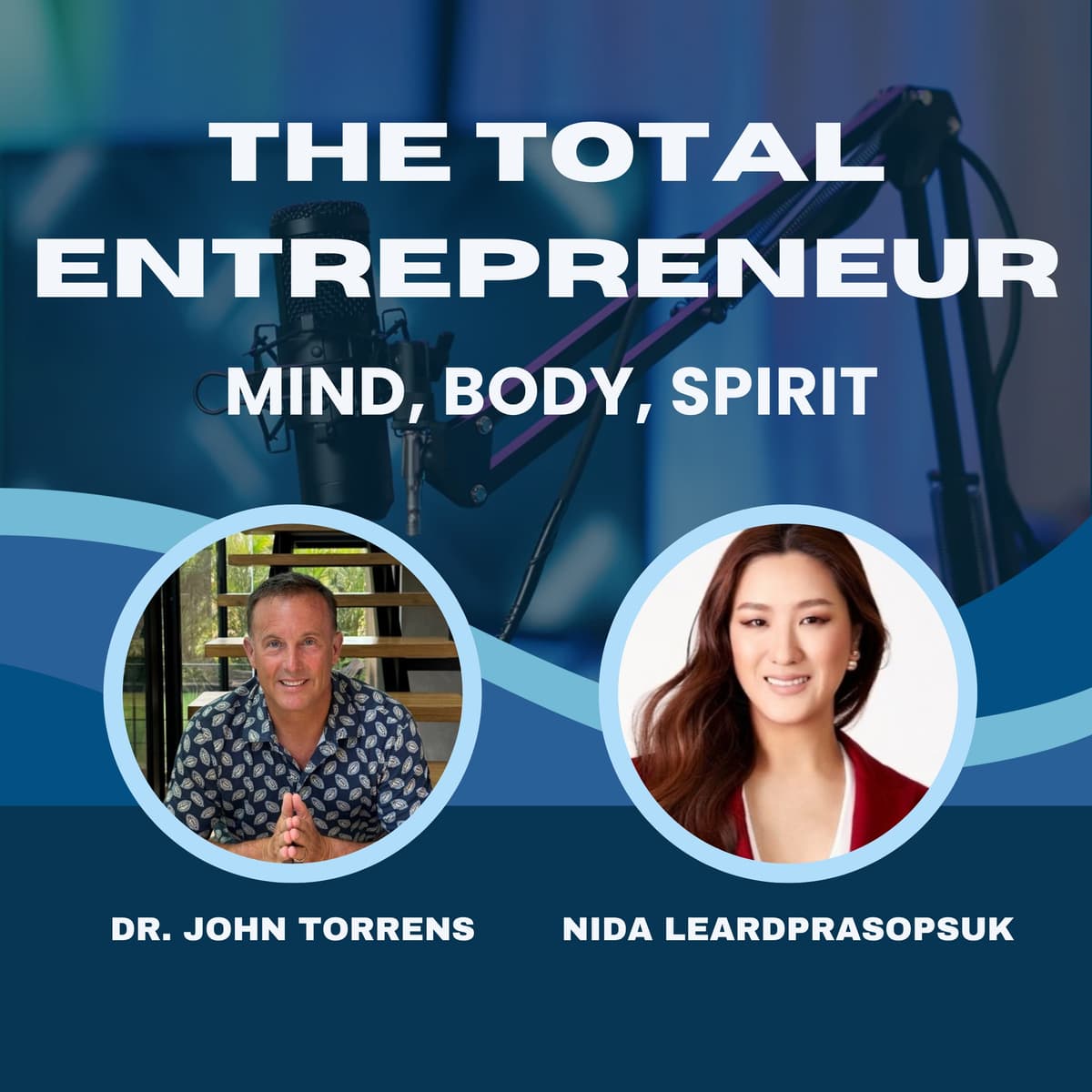
How to Build Real Relationships (Not Just Network) - Nida Leardprasopsuk
Sep 25, 2026 · 00:41:27
Part of our conversations on
The digital world has actually made us worse at building relationships because it gave us this illusion that you're well connected to everyone. Like you can just go on LinkedIn, just go to Facebook, click, click, click, click, click, add a bunch of people, and you kind of feel like, yeah, I know all these people, but not actually.
Nita, welcome to the. Total Entrepreneur Mind Body Spirit podcast. Welcome. So great to have you here.
Hi, John. Thank you so much for having me. Yeah.
So the first question I have for you is, so you've had a very interesting career, L'Oréal, Unilever, Wreck-It, coach, TEDx organizer. But what was the moment you knew you were done with corporate life? And what did you have to be willing to give up or lose in order to leave that? I think it's an interesting question, especially for a lot of the younger entrepreneurs I work with.
Yeah. So, I think in hindsight, I realized that my personality was not really a great fit to work in corporate, not really a good fit to— my number one strength really is ideation. So, I love inventing things. I love solving problems and inventing solutions. But in at that moment, you know, it was early twenties. I didn't really have that self-awareness. I only knew that every, you know, when I started a new job, it would be exciting. But then, like after three months, I would kind of be really bored. I'd be really bored. I'd be like, yeah, we're launching another product again, and it's kind of the same routine. And so, you know, I thought maybe it's not it's the job. Maybe I have to change and do another. you know, work at another company, a new role or something like that. So, that's why I think I worked for a few companies in the span of 5 years. And then after that, I just happened to marry my first boyfriend and have a child. So, that's how I actually left corporate. I was kind of like, yeah, corporate is not gonna be the long-term plan. And, you know, I was gonna be a stay-at-home mom. That was the idea. So, I started a child development center. Ended up becoming a single mom after two and a half years. You know, I didn't really know much about relationships back then, or like who I was, or what kind of person I wanted to be with. And when I got into child psychology, running that you know child development center, that was when I realized that I have to be doing something with psychology. I am obsessed about psychology. I really love understanding. The human mind, human behavior, and why we do the things we do. You know, what makes us different? And like, why are you know, like just just observing humans, observing myself and people around me. I was just really curious about all this, and so that's how I got into coaching. You know, one day I was listening to this guy on YouTube, and he I remember he created a lot of like psychology content. And then one day he said, "You know, I'm a life coach, and I I coach people." And back then, like it wasn't a term that. people like, you don't hear that term often. And I was like, I Googled it. I was like, what is a life coach? And that's how I got into this whole, this entire rabbit hole of becoming a coach. I got certified with the International Coaching Federation. I started a coaching school so that I could train and mentor other people so they could get certified as well. Became a business executive coach, but then also got interested into the world of romantic relationships. So, I got trained on the Gottman Method. as a couples coach, couples therapist, family systems therapist, and also trained here at the medical school as a sex therapist as well. So it's kind of an odd mix, but I am just fascinated, whether it's personal development, professional development, all— every field of psychology. I was just— I just was so interested. I still am, so I'm very interested and love to study psychology.
That was my undergraduate major too, actually. That's funny. And, you know, so you said you had a child development center, but I run a bunch of integrated preschools. So some of the kids have disabilities, some of them are typically developing. We have an outpatient clinic, home health program. So yeah, very similar in that way.
Yeah.
So let's talk about relationships as an asset class. I mean, clearly this is something you've got some experience and passion for. But first, let's start with the distinction everyone seems to get wrong, what actually separates What we call networking, right? I teach at a business school and we talk about networking a lot. What's the difference between networking and building a real relationship?
When we hear the word networking, I don't really think of anyone that like goes, yay, we're gonna go networking, or like has a really positive feeling when they hear the word networking. Just because of the negative experience that people have had with networking, I suppose. In my mind, networking is kind of like you're just going out out there and you're just meeting a bunch of people. You're going to a networking event. You just like, you know, end up kind of exchanging name cards with people or nowadays, kind of like your digital contacts or Instagram, LinkedIn, WhatsApp. And, you know, you kind of remember some of them. You don't remember some of them. You might follow up with some of them, but it's mostly for like professional reasons, right? That you go kind of networking. You look for customers, you look for clients. Maybe you're looking for a job. But building relationships is like you actually have a relationship with this person, you know. And it doesn't mean everybody has to be your best friend. Some people can be your— still remain your acquaintance or a colleague or a friend, but maybe not that close, you know. So this is why I always talk about doing a relationship audit and understanding that not everybody's going to be your best friend and not everybody is going to be your friend, right? Some people will remain— will be your acquaintance. And that's okay too. It's like not everybody has to be your inner circle, your close, your best friend. But when we talk about relationship building, it's like kind of like it happens in several phases, right? You connect with a person, then you kind of get to know them. you get to know them as a person. Who are they? What are their core values? What are their outlook in life? What matters to them? What's important to them? What motivates them? And how did they get to where they are today? So, that's kind of how I like to understand and really get to know someone. And then, from there, there's like this nurturing process that requires consistency and meeting up and getting to know each other and then supporting each other. And so, that really depends on what kind of relationship you're trying to build with each individual that comes into your sphere, your circle. And I find it that the digital world has actually made us worse at building relationships because it gave us this illusion that you're well connected to everyone. Like you can just go on LinkedIn. You can just go to Facebook. You know, click, click, click, click, click, add a bunch of people. And you kind of feel like, yeah, I know all these people, but not actually. You don't actually have a relationship with these people. And just because you see what people are having for lunch or dinner, you see their birthday party, you see their family photos, it kind of— it's almost like this parasocial relationship with the people you actually know in real life. Not like parasocial relationship with celebrities, but like kind of people that you actually know. But you're not in their life. And that's kind of why, you know, at 2 AM, there's not many people that you can actually call if you have a crisis because it's just like, you're just consuming this information but there's no relationship building happening here. And I think like, we've been living with this, like these social media platforms for the past 20 years and we've really gotten used to doing life that way and doing relationships that way. And yeah, that's what I'm trying to reverse. I'm trying to reverse the damage and what, you know, what has been done by us all being on the internet and consuming and, you know, following but not really connecting and not really building real relationships.
Right. It feels like we need a new name for networking, right? Because I think the whole idea is relationship building, right? Because people want to do business with people that they have a relationship, not just some random stranger who they have to have a business card from. I've read that you describe relationships as the highest or one of the highest return assets in life and in business. So, if we can reduce that to numbers or a metric somehow, like, how would you measure it? Or how do you measure it? And then what is a, if you will, what does a strong relationship portfolio look like versus a weak one?
Let me answer the second one first. There's research, you know, and books that people have written about, about how You know, on average, we can maintain 150 to 250 relationships in life. I would say maybe the modern world, we've gotten actually worse at that. We might have 5,000 LinkedIn friends, 7,000 Facebook, whatever. But the number of people we actually can say that we know, we like actually know these people, I think nowadays has maybe on average, not 150 to 250 people. But as a species, as a human being, that's the number that we should be able to maintain. But we've been kind of trained through the digital world to be isolated. And now, we live in micro families and we're more independent. And now, the work from home and everything you can just do without leaving the house. You can consume information. You can work from home. You can kind of have these virtual online things at home, you know. So, I would say a good portfolio, at least for me, would be like you have these different categories of friends and relationships. So, I grade my relationships. So, I would recommend everybody do an audit on their relationship. So, it's kind of like you're— it's like a grading system for school. school. But I wouldn't say everybody just copy me or copy my system. Just do whatever works for you, right? Well, I used to kind of explain it this way. I say there's a cat, like a grade A, grade B, grade C. Those are all friends. Those are all people you trust. Those are people that— but different levels of closeness, right? Your A's are people like family. You talk to them every day, like your friends that are like family. You talk to them every week. like you're super close. You reveal like things that you feel vulnerable about. And your Bs are just less close, and Cs are even less close. And maybe it's the lifestyle, maybe it's the time, and the, you know, a lot of people are busy. They might not have time to invest in this relationship, to build this relationship with you. And then the Ds are people that you can work with on projects, but you don't entirely trust them because they have done something to break your trust. Like, you know that they don't really have your best interests at heart. And then the Fs are people that are dangerous. And then Gs are acquaintances, like general acquaintances. And I think that a lot of people get confused, and they might— especially women— they end up calling everybody a friend. And when I hear my clients or my friends, like, talk about these people, uh, it doesn't sound like they are your friend. It sounds more like they are just an acquaintance. And there's nothing negative about that. It's just not great when you give them the wrong category, let's say, you know, and you have all these expectations that, oh, this person should be investing in this relationship the way I am. But they're just like, they just view this as you as an acquaintance. So, I believe in understanding the nature of these different relationships and being intentional about how you invest in those relationships because if you end up investing in the Ds and the Fs, that's going to take a lot of time and energy from the relationships that you should be investing your time and your energy in. I would say a balanced or healthy portfolio would be like, for me at least, I want to have 20 really great people in my inner, inner circle that I could call like best friends. I never say I have one best friend. And so, I personally want to have 20. And some people would say, well, why do you need so many? And I guess my argument is like, well, if you can have 20 best friends, why not? Like, why would you want to have only 1 or 2? And I guess the only downside would be it requires time. It does require time and energy and investment because it's like 20 relationships that you have to nurture. Consistently, right? And then, so nowadays, I kind of look at it more when I'm doing the relationship audit. Maybe you can do a grading system. But when I think about my friends or when I have it, I've built an app called IRL. So on there, there's kind of these categories and you can choose a category for each of your contacts or your connections. So, there's like new. There's inner circle. There's nurturing. There's acquaintance. There's colleague. There's all these different categories. And I think you just need to be really intentional and understand. So for me, acquaintance, I would prefer to have around 250 to 500. That's my number. But I am— this is my business. This is the career. This is my— I run all these things that are related. all these businesses that are related to relationships. So I would probably see in the future even that number expanding to 1,000. But I think there's no fixed rule for everyone. It's not like a one-size-fits-all. I think you have to work out that number for yourself. But yeah, like, so 20, maybe like best friends, and then Surely enough, in those groups of like 20 people, you might be closer to maybe 3 to 5 people just naturally. And then there's like this 50 people that are, I kind of call them like more than acquaintance. So 50 people, you kind of engage with them maybe on a quarterly basis, you know, or maybe every 2 months, something like that, 50 people. And then the 200 to 500 could be like once every 6 months. Or once every year, you know. So that's kind of how I think about my own portfolio.
I appreciate you breaking that down for us. So as you were talking, I was thinking of a few things. So it seemed, at least in my experience, it seems like there's, there's some gender differences there with the way men and women handle, like, the nature of their relationships, the number of their relationships. And it also seems that there might be, like, not only just the frequency of your interaction, but maybe the the history of it, right? Like, for me personally, there, there are people that I grew up with maybe, or I went to college with, that we were really close for a short period of time, and then 5 years could go by where we don't really engage that much, but then when we do get together, it feels like we didn't even miss a beat. So I was wondering if there's a name for that, or a, you know, if you— I'm sure you've got experience with that.
Yeah, yeah, I think everybody has that experience. It's Like the lifestyle or where you are in life with these people, you might not be engaging with them that often. And I have friends like that as well. I have a friend that, you know, a group of friends that are amazing, amazing human beings, but they're athletes. And I am like not an athlete. I don't, you know, I don't want to go to like Ironman. I don't want to go hiking. I don't want to go do all these things. And because of the lifestyle, It's different. We don't talk that often. We don't meet that often. But you know, if something happens, they call me at 2 a.m. I will I will go and help them. You know, and I think that it's the same way as well. And you know, these friends that you have a really long history with, I think it's the same feeling. Like you love them. You do have a really strong relationship and long history with them. But you might not be engaging that often. But what I hear from clients and and people around me is that you know. As you get older as well, you kind of like regret not keeping in touch or not spending more time with those people, I guess. And some would just completely forget about these people. You know, you could— a decade can pass and you never spoke to them. So I guess that would— you would consider those people in like inner circle friends, best friend category, really depending on how close you are with these people. And I think the measurement of closeness is not always how often you meet up with them.
Right.
It's how well do you know each other at a deeper level, at a deeper layer, right? You, you can like not talk to someone for years, but like you really know them, they really know you. And for me, apart from the nurturing side of things, I view someone as like someone that is close to me and I consider them someone in my inner circle or best friend. Because I just love that person, like, for who they are as a person. And then, if we break that down, it's really—it really comes down to core values, right? When I look at the people that I, you know, want to keep in my life, they're the kindest people, you know, generous people, people that want to leave the world a better place, like through all the actions and decisions that they make on a daily basis. So, like those are my people. So I just. Everybody needs to know, like, who are my people? Who are your people? And what really makes you feel like these people are the people you want to keep in your life? And think about the reasons. I feel like we don't, as human beings, we might not think about that as much as we should. If you do this relationship audit and you look at your, you know, the 10 people, the 20 people in your inner circle, or the people that you love the most, you want to keep in your life, There's something usually, there's something common about them. And there's a reason you get along with these people. There's a reason you feel that these people are important for you. And it could be a mix of core values and history and things that you've done for one another, how you've had each other's back throughout the years. And sometimes, we forget and we forget to nurture those relationships because life is just busy.
Yeah, it seems like a lot of it is, or maybe not a lot of it, but maybe the intensity or the intensity around the beginning of the relationship. Like I know, I work with veterans and people in the military and they often cite really tight bonds with the people they served with. You know, same with people you went to college with because that's just a very intense period of time. So I don't know, I've always thought like, you know, I'd love to nurture those relationships with people I meet more recently, but, you know, I always come back to it's really hard to make new old friends, right? So I was wondering if you And the reason I mentioned this is because in business, people want to do business with people they like and they have a relationship with and they connect with. So it seems like it's a worthwhile skill to develop, not just personally, but professionally. So do you have tips for people on how to do that in a way that's authentic and real and doesn't just signal, hey, I'm only in this because I need something from you? But how do you, I guess, how do you make new old friends, in other words?
Lots of people tell me, well, you know, I keep my professional connections separate from my personal relationships. And there's nothing wrong with that. Personally, I think, well, I only want to work with people if I could choose, if I could really make a decision. And if I had a choice, I personally want to work with people that I would want to be friends with. Not saying that I need to go and hang out with these people, but it It tells me that these people are trustworthy, that I can trust them, that they will be trustworthy people. They will be honest people. They will be respectful people. So, there's a set of core values that I look for in people. And that means that this person that I choose to work with, or hire, or partner with, or collaborate with has to have these core values. And therefore, I could work with them professionally. I could be their friend. They could one day— we could be best friends. So, For me, it's really about the core values. So, going back to your question, how do you make new old friends? First of all, understand what kind of people you're looking for. And I always tell people that, you know, one of the really great friendship strategies that I've applied so far is being a TEDx organizer. Because, well, I can't take all the credit, but the TED brand really attracts people. that are curious and open-minded and want to learn about the world and want to change the world for the better good. So, what's like a smaller version of being a TEDx organizer? Because it's a lot of work. I'm not telling everybody to do it. But what's a kind of a mini version of that is like hosting your own dinners, hosting your own get-togethers. And that doesn't mean you have to cook. Like, you can just like, hey, let's have coffee on Saturday at 3 PM at this venue. Or let's have dinner Sunday, whatever. And you just set it up and you invite people and maybe you, you know, 3 people, maybe these are your like friends from college, right? You bring them together like, hey, these are the 3 people. These are kind of people I'm looking for. Hey, you 3 people, do you have friends that you wanna introduce to me or friends that you think would be a good fit for this dinner table or this coffee meetup? And you have to actually tell them what kind of people you're looking for depending on who you're trying to add to your circle at the moment. If you're a mid-level manager in corporate, you're looking to find more connections or more friends in that industry, say for example, then you'll be very specific. I'm looking for this, this, and this. X, Y, and Z, whatever it is. If you're just looking for friends, yeah, I'm looking for like-minded people that are kind and generous and curious and open-minded. And, you know, maybe they're nerds. Maybe, you know, there's particular ways to describe that group of people depending on what you're looking for and who you vibe with. And automatically, these people will kind of like think of someone that you don't already know, right? And you tell them to bring them to invite them to dinner. So, it's like a second-degree dinner thing. And, you know, along the way, you might find someone, you meet someone, And you invite them to the dinner table. So this is like a way to meet new people. And then after that, you kind of like, maybe you don't totally get along with everyone at the dinner table with all the new connections, but maybe there's like 2 or 3 people that you're like, ooh, these could be like my best buddies, right? And nurture those relationships. You're like, hey, what about next week? Let's have coffee again. Or like, hey, I have this thing going on. Do you want to join me on doing this? Like, I'm doing doing paddle, I'm doing tennis, whatever. Let's do something together, right? I feel like the world has really made all of this, like, not a normal thing anymore to ask people to join you to do things. And I think that, like, before the digital world, all of this was normal. You just do it. But now, like, especially with the younger generation, they're like, no, that's cringe. You don't do that. You don't ask people to do things with you. And it's Not a normal thing anymore, but I think we should bring that back and make it normal.
Yeah. And, and we know from, you know, a lot of the longevity science that, that your community or your tribe has a big impact on your healthspan, right? I mean, you know, people who are part of strong communities live better, longer lives. So, it's, it's business, it's personal, it's all those things. I like the, the intentionality you talk about because, you know, college friends, you, you just, you didn't really choose each other for the most part. You were just like stuck in the same dorm or on the same team or the same fraternity or whatever. And, and it just sort developed from there. But what you're saying is, hey, you know, you can, you can be more intentional about this and, you know, develop the circles that you want to. So you're an executive coach and a sex therapist, and those are 2 things you normally don't see on one person's resume. So what does one teach you about the other?
Strangely enough, all of it is kind of the same thing to me. It's just psychology. It's like, What motivates us to do things the way we do? How does like our conditioning, our parents, our childhood and everything affect the way we do things? How we do something is how we do everything. We've heard this. People say this, right? And it's so true. So, if you're not confident to say what you actually want in the boardroom or in leadership, you're not assertive. You're not able to give feedback to other people. That kind of shows up in the bedroom as well. So, it's kind of like, yeah, how you do something is how you do everything. And yeah, so my work is really— I've found whether it's executive coaching or it's coaching high-performing teams, or whether it's couples or parents, it's a lot of the things that we talk about are really all about relationships. Even if people would think, oh, when you're coaching a CEO or an executive, they're probably talking about business strategies and all that. I would say most of the time, the challenge for people, it's like they already know the answer. They already know how they're going to do something. But it's something else that they're stuck with. It's like a fear. It's like a conflict. It's like this inner conflict. Like, I know the right way to go is this way. But I want to keep going this way. And there's something internally that really is about the pattern that they've— the childhood pattern. To me, it's really like if you understand your patterns, you understand how you arrived at this conclusion that, you know, this is how you're going to do things and how this pattern actually started. And you look at your parents and the example, like who taught you how to do it this way? And, you know, where did you learn these these beliefs from, right? It's usually from your childhood, from your upbringing. And once you learn the new way of doing things, you can apply that to every single area of your life as well.
Yeah. So it's interesting, you know, you say how you do anything is how you do everything. So it strikes me that if there's some sort of dysfunction or angst or something not working in your personal life, that is naturally going to show up in business. So if you're a CEO or a founder, in my case, I work with a lot of founders, Whatever's going on in the background is going to manifest as a business problem, I would imagine. So you work with CEOs, high performers, and that sort of thing. So I'm sure, and I'd love to hear like your take on it, or maybe an example or two of people who are objectively and outwardly successful. They've got it all, but privately not feeling it or unwell in some way. And like, you know, what's going on underneath that? What's your experience with that?
Yeah, so many people. And actually, um, I remember watching this, this podcast and this guy that used to work, um, for the CIA, he said that there is a correlation, um, with success and trauma. And they would usually require, like, recruit people for the CIA that, that had trauma. Because they're kind of like willing to do anything to survive. And they are a survivor. So, there's just a lot of, I'm not good enough. Therefore, I need to prove to the world that I am good enough. And that sometimes people use that to drive their success and to get the accolades and the trophies, right? And so, a lot of high achievers, overachievers are what's really underneath that is like, I'm not good enough. So, I'm gonna keep going and going for the next thing and the next thing and the next thing. But eventually, they're not happy. And sometimes, they burn out. And sometimes, they burn out and they keep going. They still keep going and keep going and keep going. And sometimes, they realize midlife, what am I doing? I'm lost. I don't feel I have all this money and success, but I don't feel fulfilled. I don't feel happy. You know, some will kind of like go and do the inner work and discover like, oh, you know, oh, it was the trauma. It was this and it was that. And, you know, you do the inner work and you heal and you choose a different path, you know. And maybe some will never actually go through that and they keep going and keep hustling and never realize that they are not, you know, they, I think they know that they're not happy, but not everybody wants to do something about it. And they might just keep on going on that path and not really, you know, never find what happiness really means for them. And actually, Harvard's longest study on adult development. And, you know, if people haven't heard about this research, they can just look it up on YouTube. It's a really famous TED Talk. It's called What Makes a Good Life. And the talk was released like 10 years ago. It talks about Harvard's longest this running study on adult development. And they found that the number one factor that supports a human being to live a long, healthy, happy life is actually the quality of the relationships in your life. Not going to the gym, not the food that you eat, but it's the quality of the relationships in your life. Because that affects everything. Like even the money, like the money you make, the lifestyle that you live, everything is a consequence of the people you spend time with because we have these mirror neurons and we mirror what we see. And so, if you spend a lot of time with people that are living an unhealthy life or an unhappy life, you kind of model that and it becomes your normal. It's kind of your baseline. It's like, it's normal because all my friends are doing the same thing. Like everybody's miserable. So, it's normal for me to be miserable, right? But if you take this miserable person and you change their group of friends and you put them with 5 really happy people, they're— that person is gonna question like, okay, there's something strange here. Like, why? What's going on with me? Like, what are the choices that I've made? Why are these people so happy and why am I miserable? You start questioning things, right? And maybe you can make some changes. Um, but yeah, it's kind of like we attract people that are similar to us. It's kind of natural. And you end up on that trajectory not realizing that, okay, I'm actually not happy. I want to change things. I don't even know how to.
Yeah. And I think there's a tendency to externalize our happiness, right? It's always out there, which is why we need the trophy, the accolade, the trophy spouse, the title, the office, whatever it is. These are the things that are going to make us happy. And we forget that we can actually choose that right now, I guess. What is IRL? And so, give us the foundation there and then we'll kind of build on that.
So, IRL is an app that bridges your online and offline world. And it's an app that tries to get you off the screen. And so, the measurement of success for us is not like any other social media platform that tries to keep you 8 hours on the screen doom scrolling and consume more and consume more and consume more. So, So success to us for IRL means you go out and build and nurture real relationships in real life. And I would love to hear these stories about relationships that actually come out from this app, you know, like, oh, I met my best friend on this app. I met my kidney donor. Quite a stretch, but I believe it will happen. Happen one day. Um, I met my life partner. I met my mentor. I met my co-founder, whatever, on this app. Because of this app, um, I, I met these people, these amazing people. So, it's an app that bridges your online and offline world. It helps you make introductions and connect people. You know, if I met someone that would— I thought would be a great, you know, for whatever reason, friendship, career, business, sponsorship, whatever the reason, I would connect person A and person B and like, hey, you guys should know each other. But we do it on the app. We design it so that it's easy to make introductions. We normalize it. We show it to people like, this is the behavior people should be doing. And when you make introductions, other people will want to make introductions for you as well. So, law of reciprocity. And I learned all the things that I put into this app through going from super introvert to super connector. And then, I realized that all the other people that were also super connectors, they did the same thing. Whether it's hosting dinners, inviting people, hosting a gathering, doing a book club, initiating something. I think being like initiating, being an initiator is such an important skill in life, whether business or career. Like being the person that goes first, being the initiator. Like, let's do this. And the opposite of that would be a passive person that just waits around and doesn't initiate anything and just waits for people to initiate something, right? And so, you can make intros. You can host gatherings. You can host dinners for your first-degree, secondary connections, third-degree connections. Exactly the dinner that I was sharing earlier. You invite people and those people invite more people to the dinner table. And then, it doesn't even have to be a dinner. It can be like a walk and talk in the park. And AI introductions as well. So, we can't just rely on human beings to make intros for us. So, it is an AI-driven app. So, AI has human beings. We have limited time. We are all very, very busy. And what I learned is that I have met so many amazing people. And then, I found out later like I met them on LinkedIn. I met them through an AI super connector. I met them for different ways. And then I learned later that actually like 5 or 6 of my friends knew this person. Like we had common mutual friends, but those 5 or 6 friends never introduced me to this person because there was no reason to. And that's just not how— that's not how we do things. We don't go around, hey, introducing people to people all the time. You just don't do it. There has to be a reason for you to introduce someone. And so humans can't do that, but AI can, right? We should use AI to our own benefit. AI has all the information, detailed information on every IRL user. And in IRL on the app, you would tell the app, you know, who am I looking to connect with? Who do I want in my circle? What am I working on at the moment? Who am I? You choose your core values, your interests, your passion, everything. So the goal is to get AI to understand as much as it can about you as a human being at different levels and layers. And then it will do its best job to match you with someone depending on what your goals are. Let's say I'm a startup founder. I want to meet VC. I want to meet people that are investors or tech people. So it will try to find like good matches and do these warm introductions for you. So That's what IRL is. And it also is a personal CRM. So, it helps you maintain and manage and nurture all these relationships because we know how bad we are at maintaining relationships. I've interviewed a ton of people. Some people do it on an Excel sheet. I do it on WhatsApp. I've tried 20 to 30 apps throughout my adult lifetime, like adult life, trying to manage and have a system to manage all these relationships. So, it's kind of— it's a second brain. that knows about all your relationships and helps you be better at nurturing and maintaining these relationships. It will remind you to reach out to the right person at the right time so you don't lose people. You don't forget about people because it's just you are going to forget. We are humans. We will forget, you know. So, why not have this AI that is like a personal assistant and second brain for all your relationships? And when we become better at our relationships, we become better human beings. So ultimately, this is an app that aims to make people better at their relationships, form better relationships, solve the loneliness pandemic, you know, have more fulfilling relationships in your life. You know, it's one of the most important pillars when we want to see humans flourish. And yeah, that's, that's what IRL is.
That is cool. It's so, it strikes me that you're using what has typically been associated with a degeneration of community, you know, social media and AI as a way to build it, right? So you're, you're kind of re-harnessing it, repurposing it and saying, no, we can actually do something with this. I think that's cool.
Yeah, I think, you know, technology and tools Because if humans use it the right way, with a moral compass, with, you know, ethics and integrity, we can make it work for us. It's a good thing. You know, it becomes dangerous when we're not careful with it.
Sure.
You know, companies kind of like just care about their stock prices more than helping humans live a better life. And yeah, I'm all about building solutions to help people live a better life.
Yeah, that sounds like a great solution. Is it on, uh, on the app stores?
Yes, so it's on the App Store now, and, um, it will be released on Android this week.
Okay.
Probably this week, latest next week. Yeah, but by the time this episode is, um, published, it will all be on, on the App Store, and, uh, it is on the App Store, and it will be on Android as well.
Oh cool. Yeah, I'll look forward to that. And if people are interested in checking you out more about, you know, with the coaching and the other work you do, how can they find you?
So LinkedIn, I can share with you the links. I probably have it on the show notes. LinkedIn, my name, Nita Lerdprashapsuk. On Instagram, Nita Lerd Official. And yeah, I have a website, but you know, if anybody wants to find out more about IRL, they can go to joinirl. And there are buttons and ways to learn about IRL and download the app there as well. All right, cool.
I'll definitely check that out. Well, Nita, thank you so much for sharing with us today. I really appreciate it.
Thank you, John. Thank you so much for having me.
About This Episode
If you've ever collected 5,000 LinkedIn connections and still couldn't think of who to call at 2 a.m. in a crisis, this episode on how to build real relationships is for you.
Nida Leardprasopsuk spent years in corporate roles at L'Oréal, Unilever, Reckitt, and Coach before leaving to become a certified executive and business coach, a Gottman-trained couples therapist, and a medical-school-trained sex therapist - an unusual combination she says all comes down to the same underlying subject: Human psychology.
In this episode, she sits down with John to break down how to build real relationships in a world that's made us busier, more "connected," and lonelier than ever, and shares the practical framework she uses to audit, grade, and intentionally grow her own relationship portfolio.
What comes up
- •The real difference between networking and relationship building, and why the digital world has made us worse at the latter.
- •Why the average human can only meaningfully maintain 150 - 250 relationships, and how that number holds up (or doesn't) in the age of social media.
- •Nida's relationship "grading system", from A's (your closest people) to G's (general acquaintances), and why misclassifying people creates unnecessary hurt and wasted energy.
- •How to do your own relationship audit, and what a healthy relationship portfolio actually looks like.
- •Why "how you do anything is how you do everything", and what her dual work as an executive coach and sex therapist taught her about the same underlying human patterns.
- •The surprising link between trauma and high achievement, and why so many successful people privately feel unfulfilled.
- •What Harvard's longest-running study on adult development found is the #1 predictor of a long, happy, healthy life (it's not diet or exercise).
- •How to "make new old friends" as an adult, including Nida's simple, repeatable dinner-hosting strategy.
- •Why she believes being an initiator is one of the most underrated skills in business and life.
- •What IRL is, the app Nida built to help people turn digital connections into real relationships, using AI to make the introductions humans rarely make for each other.
Keep listening
More on Spirit
About the Host
Dr. John M. Torrens
5× Inc. 5000 entrepreneur, Professor at Syracuse University's Whitman School of Management, author of Lightning in a Bottle, and TEDx speaker on ADHD as an entrepreneur's superpower.
Browse all podcast guests →Book a strategy call →