The Science of Sound: Healing Through Cymatics with John Stuart Reid
with John Stuart Reid
Dec 11, 2025 · 01:19:33
Part of our conversations on
Hey, everybody. Welcome back to the Total Entrepreneur Mind Body Spirit Podcast, where we help entrepreneurs become healthy people so they can grow healthy companies. Today's guest is John Stuart Reid, who is the inventor of the Cymascope. The Cymascope is a device that makes sound visible. And if you've never heard of the Cymascope or the idea that you can make sound visible, you're going to really like this episode. He gets into the weeds of the science of sound and how it can be used to heal your body, how healthy cells sound different from diseased cells, and how doctors in the future are going to be able to excise cancer cells using that signature frequency of healthy versus diseased cells. It's a fascinating conversation. I hope you like it. And if you do like it, please subscribe, give us a like, or give us a comment. Thank you. Welcome to The Total Entrepreneur, Mind, Body, Spirit, where we turn cutting-edge science into practical strategies for entrepreneurs. I'm your host, Dr. John Torrance, Entrepreneur Inc. 5000 honoree and professor of entrepreneurial practice at Syracuse University's Whitman School of Management. Each episode, we dive into mental, physical, and spiritual health with expert guests offering actionable insights to help you thrive and perform at your highest level. Let's get started. John, welcome to the podcast. It's really great to have you and can't wait to dive into this topic of cymatics.
Great pleasure to be with you, John. I'm really looking forward to our chat today.
Yeah, thank you. So what is the study of cymatics? What is this?
Well, cymatics is the study of visible sound, sound made visible, or music made visible for that matter. And, you know, a lot of people would say to me, or have said to me in the past, well, we all can, we know we can do that. We have lots of instruments where we can make sound visible, like an oscilloscope or, you know, spectrum analysis or whatever. But, you know, these are graphs. They're not how sound works really in space form. You know, the way that nature works with sound, You know, everyone talks about sound waves, right? But the reality is that sound waves don't actually exist. You know, if you, if you say to someone, what's the shape of sound? They will almost certainly say, well, it's a wave. You know, that's what we've always been taught from schools, college, universities. Sound is a wave. And of course, they also talk about light waves as well. And they don't, exist either in nature. So why are we using this word wave? Well, it goes back a long, long way, all the way back to Aristotle and other, you know, other Greek philosophers. The essential aspect of how sound works in reality, in nature, is that all audible sounds— and I'm talking now about audibility to humans— all audible sounds are spherical. in their space form. So right now I'm talking and there's a bubble of sound coming out of my mouth and a little bit out of my nose as well. So kind of a joint bubble. And that bubble is oscillating in and out with all the frequencies of my vocal folds, right? And of course, at the same time it's doing that, it's expanding. But these oscillations, these in and out pulsations or oscillations, you can call them, are really what the sound is. And if you graph that energy, that pulsation, with an XY, you know, coordinate graph, of course you will see a wave, a wave-like action, because the, the— it is a— it is indeed a pulsation which is following what's termed the law of the sine. It's a sinusoidal mathematical law. And if you, if you graph it and look at it, you will see— What's the law of the sine? What looks like a wave, but the reality is different. It's not a wave at all. Now, coming back to your original question about cymatics, when sound, in this case a bubble of sound, say from my voice as I'm speaking now, when that encounters a membrane, it imprints a pattern of energy on that membrane automatically. In fact, as I'm speaking right now, There'll be patterns on my computer screen in front of me, on my desk in front of me. All of the surfaces basically in the room are sufficiently flexible. You might think, well, how can a computer screen be flexible? But it is really. And in fact, one of the very first experiments ever conducted with cymatics, although it wasn't called that then, there was a guy, an English genius called Robert Hooke. Who in the 1600s did an experiment with a glass plate. And he vibrated that glass plate with a violin bow. And sprinkling some powder on the plate, he was able to see the sound patterns for the very first time. So there's a glass plate. You might think, well, it's very strange that a glass plate can be flexible. But indeed it is. In fact, a little while later, a German musician and physicist called Ernst Chladni He performed a similar experiment using a brass plate this time, and brass is actually even more resonant than glass. So you get beautiful patterns on the surface of a brass plate when you sprinkle on some fine powder, and then you play that plate, say, with a violin bow. So this is Ernst Chladni, and from his work, We now have this term in science, Chladni figures, which are basically sound patterns, is really what they are. The whole principle of cymatics is simply sound imprinting onto a membrane. Now, in my case, you know, I actually, I'm the inventor of the cymascope instrument using this word cyma, cymatics, and then scope, you know, like microscope or telescope. And indeed, the Cymascope instrument is showing us a realm that was previously invisible. If you think of the realm of the microscope, for example, microscopic realm, you know, what did we know about the microscopic realm before the invention of the microscope? Well, actually nothing, you know, nothing. No one even suspected that there was such a realm. And what do we know about the realm of the cosmos, the universe, without the telescope? Well, again, very, very little, actually. You know, okay, people had seen these wander— what they thought of as wandering stars. In other words, the planets. And they had mapped all of the constellations and so on. But really, you know, humans had very little knowledge about the universe before the age of the telescope. And it's a similar sort of situation with sound in relation to the cymascope. Because when you see sound made visible, not as a graph, but in, you know, really as it would appear if your eyes could actually see it all around us, it is very, very beautiful. These patterns are geometric. They're always very symmetrical and just, you know, very, very beautiful. So if you see music made visible, for example, wow, it is spectacular. And we You know, we have an app right now. We have the Cymascope app as well as the instrument. We have a Cymascope app, and, you know, for a few dollars, you can literally see sound around you. You know, any, any sound can be made visible with the Cymascope app.
Yeah.
But coming back to the Cymascope instrument itself, John, how that works is it's not— now we're not talking about a glass plate or a brass plate anymore. What we're talking about is the surface of water, pure water, and the purer the better. So if you think about the surface of water, it's extremely sensitive. It's super sensitive to vibration. So we're using that principle of nature to imprint sound onto this beautiful surface of pure water. And because sound is spherical, we, we make it visible in the cymascope in a circular configuration. So we're using what's termed a fused quartz cuvette, which is a little receptacle for the water. And that, then we imprint the sound into that cuvette, and therefore it appears on the surface of the water. You can see it with your unaided eye, but not very well. And what, in order to see it really well, you need some really nice illumination and a good camera. And then the imagery is absolutely spectacular. And this, you know, some people, when they see the Cymascope imagery, certainly on a video, they think it's computer generated, you know, CGI or something. And in fact, it's not. It's how nature actually works. So then what is the relevance? of all of this to the human condition? Well, the relevance is that every part of your body has a membrane, like every cell in your body, and there are trillions of cells. They all have membranes. So when you're immersed in a musical environment, say, and I'm now, John, I'm not talking about headphones, I'm talking, or earbuds, I'm talking about speaker system or live music. When your whole body is immersed in music in that way, every single cell in your body receives a beautiful cymatic pattern. Now, where is the relevance of that from a perspective of health? Well, you may not know, John, that every cell in your body has on its surface membrane what they're termed as integral membrane proteins. These are little little proteins, like little antennas actually for all the world, that project from the cell membrane, the surface of the cell membrane. And this is the way, through these proteins, it's how the cell communicates with its brother and sister cells. It's how it takes in food products. It's how it excretes waste products and so on. So now you get the idea that when these cymatic patterns, these beautiful cymatic patterns are imprinting on every cell in your body, that they are actually— because music always has phase changes, you know, the phase is changing within music all of the time as the frequencies in the music mix and mingle. So the phase is changing. And what that means from a cymatics point of view is that the pattern on the surface of the cell is rotating. It's not stationary. It's rotating slightly and giving these little IMPs a beautiful massage. It's really like a form of sonic nutrition, I could call it. You know, it's a way of giving energy to the cell. And you may not know that every cell in your body has its own unique song. In fact, it was called The Song of the Cell by Professor James Gimzuski of UCLA. And he was the first person in history to listen in to the sound of cells for the very first time in 2002. And he used an instrument called an atomic force microscope to literally listen in to the sound of cells. And what he found was really interesting. That is that the sounds of cells are centered around 1,000 hertz, which is a, you know, it's a frequency we can all hear. Of course, they're not just simple one-frequency sounds, an array of frequencies, but all centered around 1,000 hertz. And so the idea here is, you know, that if your ears were sensitive enough, you would be able to hear the song of your own cells. Well, it's probably just as well that your ears are not sensitive enough because it would, you know, probably sound very noisy. So, but, but the reality is that every cell, every type of cell has its own unique song. So when music imprints on your body and enters into your tissues, not only do we see this cymatic pattern created on every cell membrane, and by the way, not just on cell membranes, but on all the fascia tissues, all your organ surfaces and so on. Not only that, But also, if you think of it, you're feeding frequencies into your cells that are the same frequencies as the songs of your cells. And in fact, there's a medical condition called the quiescent phase or the G0 phase of the cell cycle, in which if you are unfortunate enough to imbibe some, I don't know, some toxic substance, or maybe a pathogen has invaded your body, there are various ways that the cells respond to that. And sometimes they go to sleep. They go into this quiescent or this, you know, G0 phase where they're literally sleeping. And one of the ways that they can be awakened is through music or sound frequencies in general. Because literally those frequencies energize the cell. give it energy, sufficient energy for it to reawaken. I liken it to the kiss of the prince. You know the Sleeping Beauty story?
Sure, yeah.
You know, the prince comes along and kisses the princess and she awakens, or the Sleeping Beauty awakens. And it's a similar sort of thing. You know, the frequencies in the music can cause the cell to reawaken, in this case to rejoin the cell cycle. So it's a fascinating subject, John.
Yeah, it is really fascinating. And the more I learn about it, the more fascinating it gets. It's like with anything, the more you learn about it, the more you realize you don't know anything, right? So, so sound waves aren't really a wave. They don't go through time and space like this, right? They're, they're spherical, right? So they kind of extend out in multiple dimensions. And it's interesting that your cells each have a, a sound, or I guess a frequency, right? So is it, is it true to say that healthy cells sound different than the same cells when they're diseased?
They do indeed, John. In fact, this was a study that, that I embarked on with Professor Sungchul Ji of Rutgers University. Actually, it's a few years ago now, and he's now emeritus. In other words, he's kind of retired, but he's still a professor. He still has that professorial status. And anyway, Sungchul Ji and I He worked with me in the lab here for several days on a study involving making visible the songs of healthy cells and the songs of cancer cells. In this case, what we found was really pretty extraordinary. And it is that all the sounds from healthy cells have this beautiful symmetry. And if you see them, if you know what a mandala looks like, it's kind of very— symmetrical and, you know, perfection basically in geometric terms. It's kind of similar to that. But of course, the difference between a mandala and a cymaglyph, which is the word that I coined many years ago simply to mean sound image, the difference is that a mandala is very much a fixed image. You know, it's a fixed drawing or geometry. Whereas a cyma glyph is very, very dynamic. It's changing all of the time. It's scintillating. It's really, you know, quite gorgeous to behold. Anyway, so we discovered that the cancer cell sounds, they produce very ugly or subjectively ugly, I could say, skewed, asymmetrical, if anything, images. So there's a big, big difference. And the study that we, that we conducted was ultimately published in the, in the Water Journal. And it's a precursor really to ultimately, or certainly inspiring the possibility of a new type of instrument that would be used by surgeons when excising a tumor from the body or from the brain. One of the difficulties, one of the challenges that faces a surgeon is knowing exactly where the margins of the tumor lie. Apparently, it's not that easy to see where the, where the tumor ends and the healthy tissue begins. And so this instrument that we have conceived would be able to give the surgeon immediate feedback. You know, he or she would be wearing proper a particular type of eyewear with a little video camera in it. And as they move a laser beam, scanning, manually scanning a laser beam across the tissues, they would be able to see in literally in this little screen in their eye vision, they would be able to see exactly where the pattern changes from that of a beautiful pattern, which is obviously the healthy tissue, And then, as the beam enters into the cancerous tissue area, so it would become very skewed and asymmetrical, if anything, so that the surgeon would be able to know exactly which tissues to remove. So, it's a very wonderful future that lies ahead in that area.
Wow. It's interesting that a diseased cell gives you a cymaglyph that is, I guess, subjectively unpleasant to look at. And, a healthy cell gives you a cymaglyph that is pleasant to look at. And, It reminds me of, you know, I studied HeartMath, right? So coherent heart rhythms and uplifting emotions give you a very pleasing heart rhythm graph, whereas, you know, frustrating negative emotions give you a displeasing heart rhythm graph.
I've seen those graphs, John. Yeah, right. You know, the coherent image produces a graph which is quite attractive to the eye. Incoherent rhythms are obviously all over the place, you know, very, very ugly. Yeah. Yeah.
So I wanted to talk a little bit about some of the laws of cymatics, cuz I think they're really relevant. Uh, and I'm sure you agree just to overall health.
Right.
And I think it's, I may have this wrong, but I think it's the second law of cymatics with that has to do with the water and the compression of the sound.
That's absolutely right.
And our bodies are mostly water. So if sound can impact water in that way, it's logical that it will impact our body in that way. So I'd love for you to dive into that a little bit more and just maybe talk about that second law of cymatics, if I have it right, if it's not the right one, correct me. And then, yeah, go ahead and, uh, and, and go with that.
Thank you, John. Yes, you do indeed have it right. So, you know, one of the— it's a really simple principle, and I have so far uncovered 4 laws of cymatics. But this second law that you're referring to now, it concerns the way that when sound enters into water, what happens. Now, if you think of it, you know, sound in air is the movement of vibrations between adjacent colliding atoms or molecules. So the air is obviously a mixture of gases. You know, there are some atoms and mostly molecules, but nevertheless, these are all atomic particles, let's call them. And when, let's say, if we're talking about the human voice, When your larynx vocal folds of the muscle tissues vibrate, they are passing on their movements, their vibrations to all of the atoms and the molecules in that are surrounding the air, you know, surrounding the vocal folds rather. That bubble, that little pearl, I like to think of it as a little pearl of acoustic energy rapidly expands out of. Your mouth and ultimately expands away into space, right, carrying with it all of these modulations. So the atoms and the molecules, you know, are now carrying all of those vibrations away into space. One of the really interesting aspects to this, by the way, before we talk a little bit more about the second law of cymatics, is that when atoms and molecules collide with each other, in this case, delivering sound frequencies bouncing literally from one to the next to the next, like a row of dominoes kind of thing, but in 3 dimensions, if you can visualize that. When that happens, there's something else that's kind of magical that happens, because whenever 2 atoms or 2 molecules collide with each other, not only do they pass on their vibrational information from one to another, But also light is created. Now the reason this happens is because every atom and every molecule has a mag— what's termed a magnetic moment. What this means is literally a shell of magnetism around every atom and every molecule. And you know, when you were a child and you might have played with bar magnets and you try to put two North Pole magnets together or 2 South Pole magnets together, they don't want to go together, do they? You know, they kind of feel that spongy kind of feeling, you know, where the, the 2 fields are just not wanting to go together. Well, it must be something like that that atoms and molecules experience, if you can call it that, as they are colliding with each other. In other words, it's the magnetic fields around the atoms and molecules that are literally interacting, colliding with each other. And whenever that happens, nature creates light. In fact, you cannot have light without sound. I'll say that again. You cannot have light without sound in the universe and on Earth and anywhere, basically, right? So sound gives birth to light. And this works simply because the vibrations of the atoms and molecules that are carrying the sound vibrations As they are colliding and bumping into their neighbors, not only are they passing on their vibrations, but also they're creating light. And one of the simple proofs of this, if you like, is to simply rub your hands together very, very vigorously. And as you do so, you hear a little sound, of course, of the friction between your 2 surfaces of your skin as they are passing each other. But you hear that sound, but at the same time, you feel warmth, don't you?
Yeah.
And the more vigorously you move your hands together, then the more warmth you're creating. And this is because all of the trillions and trillions of molecules in the skin of your hands, as they slip past each other— now, if you think of these magnetic shells that are all passing each other and slipping past each other and colliding with each other, that's what's creating the light. In this case, The light is infrared light. So whenever you have sound, you have to have light created at the same time. And one of the wonderful, well, you could say almost magical aspects to this, this aspect of nature, is that the light that's created is modulated by the sound frequencies. And this is very, very important when it comes to sound therapy, and music medicine, which are aspects of frequency medicine that is going to be huge in the world eventually. It started already and it's really taking a hold, but eventually it will move into mainstream. And this principle of sound giving birth to light will become, I predict, I prophesy, will become very, very important. Now let's come back to To the second law of cymatics, right? When sound enters into water, it is immediately compressed in a ratio of 829 to 1. Why is that? Well, it's because the distance between the molecules and atoms in the air is a certain distance apart. They're quite, quite a long way apart, actually. But when the sounds enter into water, they're now entering an environment in which the molecules in the water are 829 times closer together. This means that the wavelengths, so-called wavelengths, are not really waves at all, but nevertheless, these— this— we're stuck with this term wavelength.
Right.
The wavelengths of any sound as they enter into water are compressed in that 829 to 1 ratio automatically, right? So where this becomes really interesting from a perspective of your eyes, it actually becomes interesting from the perspective of your whole body, because if you think about it, your body is, you know, a very high percentage of water.
Yeah.
But your eyes are literally filled with water. You know, it's a type of water. And so now, if you get this idea that with your, particularly with your open eyes, but it actually works even if your eyes are closed. But if you think of your eyes being open, the sound frequency, say, from a speaker system or from live music, enters literally into your eyes, where the wavelengths are automatically compressed in this ratio. And then the sounds travel straight through the eyeball to the retina. The retina is a form of liquid crystal, which is very high percentage of water. So the eyeball itself is literally, well, almost pure water, has a little bit of protein content. But the liquid crystal retina is very high percentage of water. The sounds, these compressed wavelengths, then move through the retina straight into the optic nerve, which is also optic nerves, which are also liquid crystal forms of liquid crystal. And again, very high percentage of water. So now you get the idea that all these beautiful musical frequencies travel straight through your eyes, straight along the optic nerves, in direct into your brain. And there's a connection now with the pineal gland. They're not literally directly connected to the pineal, but they are indirectly connected to the pineal through the hypothalamus. And what this basically— and by the way, the pineal gland, well, the hypothalamus is again very high percentage of water, as is the pineal gland. In fact, the pineal gland, which looks a little bit like a pine cone, hence its name, is sitting in a little beautiful little sphere of water. So now you get the idea that you can excite what is termed, or has been termed in the past, as your third eye, which is the pineal gland. And the pineal gland, as you probably know, has been linked with our spiritual nature.
Yeah.
So this is why, you know, Indian sages who have been focused on the— on, on exciting the third eye, this is why they have talked about improving our connection with the divine through sound. So this is kind of getting into the spiritual realm now.
Yeah.
But the reality is that sound, you know, not— it's sound and musical frequencies in general have huge therapeutic powers in the body. And, you know, I could talk about this subject if you wish, because we've just, just recently completed a study on the effects of music on human blood.
I'd love to hear about that. But before, before you talk about that, just real quickly, is there, is there a specific frequency to stimulate or activate the pineal gland?
There is actually, and it's, it's E3. If you think about it on a piano or any instrument, it's the 3rd octave of the note E. Yeah, the 3rd octave of the note E. And that's—
How many hertz is that?
165 hertz, thereabout, close to your concert pitch, but it's, it's about 165. So it's quite a low, low note. But then you have to remember that as it enters into the water of the eyes and so on, it becomes compressed. And when it becomes compressed, then that wavelength fits exactly with the dimensions, the real dimensions of the pineal gland. And that's why that particular frequency or musical pitch is so important, because it actually resonates literally directly with the pineal gland dimensions. Therefore, the pineal gland is able to absorb that energy very readily, as opposed to any other frequency, you know, where it's not— it doesn't mean that it's not going to be— it's not going to receive some energy. It will at any other frequency, but not optimally. You know, if we want optimal resonance, then we have to use E3 or 165.
So if you listen to 165 for the specific purpose of pineal gland stimulation. Is it— so it sounds like it's better just to have it in the room and not necessarily on headphones. Is that accurate?
Oh, for sure. I mean, you wouldn't— headphones, there are— I can talk to you about one, about headphone healing, which is a totally different subject, uh, and a different— it excites a different aspect of the physiology. In fact, I, I think we should really talk about that because that is very important. But in the case of what we're talking about here, which is the pineal gland activation through sound, it has to be full body immersion, you know, from a speaker system or from a live musical instrument such as a guitar or a piano or any other musical instrument, a harp, you know, whatever, any other musical instrument. Yeah.
Yeah. No, that makes sense. So, yeah. Tell us now about your research with sound and blood. I find that really fascinating.
I'd love to share that. And also, if we have got time, I would love to also mention about the headphone healing, because that's another very important subject. First of all, relating to music and blood, well, you know, I think it's probably fairly common knowledge that Pythagoras, the Greek philosopher Pythagoras of Samos, about 500 BCE, said that music could be used in place of medicine. So we're talking about 2,500 years ago. here, you know, that he said that. And one of his biographers wrote that down. Iamblichus, the guy is called. He wrote that down. And so it's come down to us, you know, across all of those centuries, millennia in fact. And, uh, and so I came to realize a few years ago that very little research had been conducted into the biological effects of music on the human condition. And there was, you know, There's quite a significant body of evidence that music does have powerful therapeutic effects, but the literature doesn't really get into the nitty-gritty of the effect direct on the cells. It's more of a systemic effect that it has, that has been studied in the past. So I dreamed up this experiment in order to test the effect of musical frequencies on human blood, literally on red blood cells in particular. In fact, the initial study that we started 7 years ago now, 2018, was all focused on red blood cells. I'll put it in a nutshell for you and for everyone that's listening or watching, that the sounds that enter into your blood have a direct impact on the viability, what's termed the viability of red blood cells. This term viability means the ratio of dead red blood cells to living red blood cells. So I need to give a caveat here that this is— we're not talking about bringing dead red blood cells back to life. You can't bring the dead— Right. Back to life. But in your bloodstream, and indeed, you know, in a test tube of red blood cells, which is the way that we worked in the experiments, there are always going to be enormous numbers of red blood cells that are alive and well, thank you very much. There's also going to be an enormous number that are dead, and they are going to be in your body. They're going to be mopped up, obviously, by your body's systems and replaced. You know, your red blood cells are being replaced constantly. But there's also going to be another huge number that are old. Literally, that's how they are classified medically. They're just simply old. And what that means, if you were to look at one under a microscope, you would see that that beautiful shape of the red blood cell, that little dimpled beautiful shape is starting to break up. It's starting to lose its beauty and its integrity. So that membrane that encloses the red blood cell cytoplasm, it's no longer so pretty. It's starting to break up. Well, in the experiments that I conducted with the help of Professor Sung Chul Ji, the same guy, you know, that we worked on with the music, the making visible the sounds of healthy cells and cancer cells, We worked together to devise a protocol for this new experiment on human blood. And what we found in a nutshell is that all of the music we tested created a significant increase in the viability, this ratio of dead to living red blood cells, within 20 minutes. So that was the protocol that we arranged. So we have a little test tube of blood that's literally in an incubator receiving music from a speaker, literally with the speaker in the incubator. And we also have a control vial of blood that's outside of that area in what we term the Faraday cage, which is a very quiet room, little room within a room within the lab here. That's the control experiment. So we measure the viability of the red blood cells in the control And then we measure them in the musical incubator after 20 minutes of immersion, and then we compare the two. Now, to compare the two, we use a system involving a stain, and it's called trypan blue stain. And the reason we use this stain, mixing it with the blood after it's been diluted— after the blood's been diluted, we use this stain. And what happens is that any old red blood cell that's, you know, not pretty anymore, it's losing— it's lost its integrity, its beautiful outer membrane is starting to break up— the trypan blue stain will easily enter that old red blood cell. And it will certainly also easily enter any dead red blood cell, but it will not enter— it cannot penetrate a healthy red blood cell. And so this is the method used to count how many are literally alive and well and how many are dead, or they literally won't be— not necessarily everyone will be dead. Some of them that have the stain will be old. They'll simply be old, right? So when— what happens is in the 20 minutes of immersion in the musical frequencies, These old red blood cells are made new again. Literally, the outer membranes where they were all raggedy and starting to break up and can easily be penetrated by the stain. Now, after only 20 minutes, they have been, let's say, made sufficiently new again that the stain will not penetrate when we do the counting. So this is how the ratio can change very quickly from a very, very poor ratio to a very good one simply by the addition of musical frequencies. And what we found, which was absolutely fascinating, John, I'm sure all of your viewers and listeners are going to find equally fascinating, is that the type of music that provided the poorest result Still had— still a pretty good result, but nowhere near as good as what we then found. Classical music provided the poorest result. And that was really counterintuitive. You know, we both thought that classical music would probably provide the best result.
Yeah.
But no, indeed it didn't. In fact, it provided the clue by which we ultimately came to understand the mechanism of healing, how it is that those red blood cells are healed within 20 minutes. The connection here came, or the clue, let's say, came from the pop music. So when we immersed the blood in any pop music, then the viability shot up to much higher levels than with the classical. And we came to realize, after scratching our heads for a while, that it was the low frequencies in the pop music, the boom, boom, boom, boom, you know, of the bass beat, that was literally causing— that had sufficient energy to cause the oxygen that's already dissolved in the blood to bind to the hemoglobin molecules in the red blood cells.
Wow.
And to help repair, help regenerate the proteins that would then, you know, prevent the trypan blue stain from entering.
Interesting.
And it is interesting because when you think about it, in your vascular system, your heart, of course, its primary role, we all know, is a pump, right? It's pumping the blood around, circulating the blood around your body. But at the same time, who knew that it's the sound of those heartbeats, literally the low-frequency pulses of sound throughout your vascular system that is assisting the oxygen to bind to the hemoglobin. Every time there's a heartbeat, there's a binding, a binding, a binding with every pulse of sound. So what we were doing really with the, the low frequency sound from the pop music was mimicking, you could say, the heartbeats of your, of your, you know, Really quite amazing. And we just got to the point now where this study is about to be— about to go for peer review. So, and we found, by the way, that white blood cells also respond, not such high percentage increases, I have to say, but, but still, even the fact, even the fact that even the white blood cells are, you know, going to gain benefit from music. Is a wonderful fact that we have learned from this study. I'm really excited about it. Wow.
So, yeah, just bathing yourself in music has so many benefits, right? I mean, beyond what we've been talking about now, it's, yeah, it's really fascinating. So I could, you know, I'm imagining the people driving around with the bass, you know, on their speakers, right? It's probably not that bad, right? And yeah, we've always thought that maybe classical music is better for some reason. But, it's interesting that your research showed that now you kind of need that low-frequency beat to signal to your blood. That is fascinating.
Yeah. But, there is a caveat to this, John. It's very important to know that the sound pressure level, the volume, if you like, of the music has to be within a certain range. So, talking about decibels, which is how we measure sound pressure levels, Anything below 70 decibels is really not optimal for this effect, because we have tested music, the effects of music on blood below 70, and there's very little effect. It still produces a small effect, but nowhere near— once you get between the range of 70 and 85 decibels, that's the optimal range. range that we've come to call the Goldilocks zone for obvious reasons, you know. But if you go above 85, and you know, you hear a lot of people, particularly young people going around with their, you know, car speakers blasting, that's really not good for you. In fact, Professor G and I did some research in that series of experiments. where we took the sound pressure levels way above 90. In fact, in one of the experiments we conducted at 110 decibels, it killed all of the red blood cells within 20 minutes. Every single red blood cell was dead, right? So, so listening to very, very loud music is counterproductive from a health perspective. But, you know, 85 decibels is pretty loud. It's, it's not a quiet sound by any means.
Yeah. So can you compare it to something like 70 to 85? Is it like the roar of a crowd? Is it the beat of a drum? Like, what could we relate that to?
Um, I would just say it's getting to the point where music's starting to become uncomfortable. It's really hard to give you a guide here, but, you know, it's where anything— once you get to 90 and above, well, I'm, you know, referring here to, to perhaps middle-aged people and older people like myself, it starts to become actually painful. You know, any sounds above 90. Perhaps young people can tolerate those sound levels with less, you know, obvious pain or anything. They probably won't experience pain. But nevertheless, 85 is— anyone would say that's a loud sound. So the body can take that loud sound and actually use it to good effect. But once you get to 90 and above, then you're starting into the area of pain where your ears will literally feel pain. And also, and just discomfort, you know, stress, discomfort.
Okay.
But then think about every cell in your body and how it is experiencing that sound pressure level, right? Particularly the lower energies that penetrate deeply into your tissues. every cell in your body is going to be stressed as a result of that. So anyway, coming back to the Goldilocks zone, 70 to 85, that's really the optimal area where, you know, not too quiet, not too loud, just right. And then that's very, very healing for the body. But have we got enough time, John, now to talk a little bit about headphone healing?
Yeah, yeah. I mean, I'd love to talk about that because Yeah, headphones and earbuds, they are, they're rampant, right? Everybody uses them. So I'd love to hear more of your perspective on that.
Well, this is an area where, you know, I'm really very, very excited. But I'll tell you what, before we go into that, I just need to, I just remembered, just to finish off with the music blood, that those experiments with human blood, and I told you that the peer review process is going to start very soon on this. paper that we have written. The reason I'm so excited about, about that is because what we see for the future here are hospital beds that actually contain low-frequency tactile transducers so that the sound frequencies can enter into a patient's body. If you think of a supine patient lying there in bed, One of the big challenges with patients lying like that stationary and not able to move very much at all is the lymph in their bodies, right? Lymph is a big— it becomes a big problem because the lymph system of the body needs movement. So when— and of course, the lymph system is the way that your body is able to deal with toxins. You know, it flushes toxins out of your body. That's how it does it. So if you're not moving, those toxins build up, and that's not going to be a good thing for patients lying in hospital for weeks on end. So the idea here is that you would have these low-frequency tactile transducers built into the body of the bed, basically, and there would be a bedside console that the clinician would be able to access to press a button and cause low-frequency vibrations to not to be like a boring drone coming up through the body of the patient, but like a wave of energy flushing up and down, gradually up and down the patient's body, that would actually move automatically. It would move the lymph in the patient's body. But the other thing it would do is it would increase the levels of the partial pressure of oxygen in the patient's bloodstream, even without them having to do anything other than, you know, just normal breathing, basically.
Wow.
So, so that's a really good, a good way to help the patient, you know, with the toxins and also more oxygen. And of course, oxygen is the key healing molecule in the body. So if you've got more oxygen, you've got more healing ability in your tissues. But coming on now to headphone healing, which is a completely different subject area, but nevertheless all related to healing. This is the area where I see an even greater future than the one that I've just described. And the reason is because there are many groups of researchers around the world, medical researchers I'm referring to, who have made the discovery That low, very, very low frequency sounds can stimulate the vagus nerve system optimally in the body. They have also discovered that if the vagus nerve system is optimally stimulated, then chronic inflammation can be cured. Cancer prognosis can be increased by about 50%, 5-0%, And many other medical conditions can be supported, even potentially diabetes and many other medical conditions. So why does this work and how does it work? Well, the first thing to describe here, John, is that the vagus nerve is the longest nerve in the body. When it leaves the brainstem, the base of your skull, the first places it goes to are your left and right ears. This is, these are the, what's termed the pinna, the outer ear, right? If you touch your outer ear with your fingers very, very lightly, you will find that your ears are extremely sensitive to the touch. Why is that? Well, it's because the vagus nerve is literally innervating the whole of the pinna, the whole of that outer ear. But where the most of the nerve endings are concentrated, is in what's termed the tragus of the ear. This is this little flap of tissue that overhangs your auditory canal, right?
And where it's shaped like a triangle almost.
Yeah, that little flap. If you want to— if you don't want to hear a loud sound, you're trying to mitigate it, you would push on that, and that pretty much closes off your ear canal, and you can, you know, really protect your hearing if there's a very loud sound or Maybe you don't want to hear what somebody's saying. You press on that, right, on both ears. Now, that area, that tragus area, is exquisitely sensitive, particularly on the inside, where you've got all these thousands of nerve endings from, from the vagus nerve. So why did nature take the vagus nerve to the pinna of the ears? It's a really interesting question because this is nothing to do with hearing, John. You know, the vagus nerve is not related to— it doesn't go in the brain to the auditory center, right? So it's nothing to do with hearing. The hearing center, of course, the auditory center, the nerves there, the auditory nerves go to the cochlea, don't they? Each left and right cochlea.
Right.
And so the sound enters through your auditory canal, Goes through the fluids into your inner ear and into the cochlea, and ultimately are sensed through the auditory nerve. But I'm not talking here about the auditory nerve. I'm talking about the vagus nerve, which goes to the pinna of the ear, the outer ear. Nothing to do with hearing.
Why?
Why did nature do that? Well, it turns out the answer is because nature wants your vagus nerve system. to be optimally tuned, to be in good tuning order, right? The way it achieves that is by exactly what I've just said. It takes the vagus nerve to your 2 pinnae. Your— you can think of these like parabolic dishes, little mini parabolic dishes that are collecting sound from the environment for 2 reasons. One, so you can hear. But secondly, so that your vagus nerve system is doing its very best to be optimally tuned. So where would these sounds of nature come from? Well, the sounds of the wind in the trees, the sound of birdsong, the sound of the ocean waves crashing on the shore, the sounds of whitewater rivers, and so on. All these natural sounds that people, you know, from millions of years ago, the early humans, would be picking up through their pinnae, helping to maintain or to optimize vagal tone. So why is it so important? Well, because the vagus nerve system literally innervates, connects with all of the major organs of the body. So it connects straight from when it leaves the pinnae of the ear, the next place it goes to the pharynx and the larynx. And this is good news for humans. Why? Because it means that every time we speak or sing, we are helping to stimulate the vagus nerve system. So I'm getting a really good workout right now of my vagus nerve system simply by talking. So social connection with humans, you know, chattering together, is actually a very good thing for many perspectives, but one of them is that it helps the vagus nerve system to be optimally tuned. Okay.
Hmm.
However, then, of course, from the pharynx and the larynx, it then goes on to the heart, to the lungs, to the kidneys, to the— every major organ, basically, even to the gut. Right. All of the major organs are connected via the vagus nerve. And this is why, by the way, if someone has a break in their spinal cord, they can continue to live. It's only because the vagus nerve is supporting all of these other functions of the body, right? So you may not have motor function anymore because of the break in your spinal cord, but you will nevertheless still be able to carry on living, right? But coming back to the, to the frequencies that have been discovered by researchers, for optimal vagus nerve stimulation, it turns out that these are very, very low frequencies for optimal. And I'm talking now, John, 5 Hz to 10 Hz. So these frequencies—
Are those even audible?
No, they're not audible.
They're— okay.
Yeah, 16 Hz is the lowest frequency roughly that a human can hear. creatures, you know, elephants and other creatures can hear much lower. But humans, no, 16 Hz is about the cutoff. But here we're talking even lower frequencies, 5 to 10 Hz, right? Well, this is what I'm going to share now that is really so important and why I'm so excited about this, bearing in mind that optimal vagus stimulation has been discovered to be able to reverse chronic inflammation. And by the way, chronic inflammation is the root of virtually every cancer. You know, if you have chronic inflammation in your body and it's not dealt with, ultimately it becomes cancer in the body. So it's very important to deal with chronic inflammation if you're unlucky enough to have it. And, and there is no pharmacological substance that can be given to you by a doctor, a medic, that can fix chronic inflammation. If you have chronic inflammation, there are substances that can be used to mitigate it a little bit, but nothing's going to fix it, excepting this discovery that I've, you know, not my discovery, but others have made this discovery. So you might say, well, why is it not being rolled out in the medical world? Well, It's a very good question. You know, I think I know the answer to that, but— Well, I think I know the answer to that as well. But one, one thing, I'm not going to go off on it, you know, incorrect politically, political argument here, but I will say something that I learned not so long ago that really surprised me, a fact that surprised me, that was that there's a 17, 1-7 year gap between evidence and practice in mainstream medicine. Yeah, 17 years, right? So, so this could be one of the reasons why we're not seeing this new modality proliferate into the medical world. I'm not sure if that's the whole reason, but certainly one of the reasons. It's a very slow process. You know, evidence-based medicine needs good evidence, you know, before any major changes are made. So even though these researchers have made this amazing discovery, then, you know, it might take many more years before it becomes mainstream. However, the really exciting thing that I wanted to share about all of this is a discovery that I made myself about 2 years ago in this case. And this concerns headphone healing, what I call headphone healing. And it concerns how these extremely low frequencies, 5 to 10 hertz, can be created by some music albums. Not all, but some. And this discovery happened accidentally, like, you know, many of the best discoveries. We have a friend, dear friends, musicians Anders Holt and Kachina Miyadu. They're a married couple. They live in Denmark. Anders is Danish and Kachina is German from Munich. And they're now, you know, together and they make the most beautiful music. And one of the albums that Anneliese, my wife, and I listen to very often at breakfast time, it's called Dream of the Blue Whale. And in it, Anders, who has this gorgeous deep voice, very resonant voice, is kind of mimicking the sounds of whales. You know, the whale, the humpback whale sounds are so beautiful, those songs. And he's mimicking those sounds. And at the same time, Kachina is playing her beautiful keyboards. And the sound is just so beautiful. And we, as I say, we often listen to it at breakfast time. Well, this particular day, this thought popped into my mind. I wonder what the frequencies are that are originating particularly from Anders' gorgeous deep voice. And so I brought the album down into the lab here, and I tested it on a spectrum analyzer. And boy, was I shocked by what I saw, John, because the, the lowest band on the analyzer, which is the 12 Hz band, was dancing merrily up and down, right, with Anders' voice. And then there are times when Anders stops singing and Caccino's keyboards keep on playing. And even with Kitchener's keyboards, there was the 12 Hz band merrily dancing up and down. I was really puzzled by this because I knew that in a recording studio, when a music track is being mastered, as they call it, all frequencies below 20 Hz are very steeply rolled off. And the reason for that is because if they weren't, speaker systems in particular just can't handle these very, very low frequencies and would cause a lot of flapping about of the speaker cone. So I knew that, and I thought, well, how is it possible that we're seeing these very low frequencies? Now, you have to also know that the shape of the filter curve in the analyzer is like a bell jar shape. So it means that when you see the 12 Hz band dancing up and down that there are frequencies present down to 4 and 5 hertz. So you can imagine why I was so excited to see that.
Yeah.
And cutting a long story short, John, I then went up into our home because the home, our home is literally adjacent to the lab and brought down a whole bunch of albums and tested a lot of them. And almost all of them did not show this effect, but a very small percentage did. And so now I have created this list, and we— I'm calling this effect the audio heterodyne effect. Now, heterodyning is very well known in radio transmission, for example, but it's not known at all in audio. And this is— so this is a discovery, a new discovery that I made, and I'm very excited about it because there are— although speaker systems cannot handle these extremely low frequencies, some very high-quality headphones can, right? So you can probably see where I'm going with this now. If you experience music that from any of these audio that have any of the— have the audio heterodyne effect through good quality headphones that can reproduce frequencies down to, say, 5 Hz, Then it means that your vagus nerve system is going to get an optimal workout just by experiencing beautiful music. So how good is that? You could put a set of headphones on, play an album, and if you were unfortunate enough to have chronic inflammation in your body or cancer, let's say, and you want to improve your prognosis or you want to you know, completely banish the chronic inflammation, you can actually do so by listening to beautiful music. Now, it's not going to happen overnight. This will take, you know, perhaps, I don't know, 3 or 4 weeks of, of listening before your, uh, before your cytokines, which are in a kind of war in your bloodstream, come back into balance. Because this is what happens in chronic inflammation. The cytokines, as are fighting with each other and causing the inflammation.
Yeah.
And so imagine a world in which a doctor, instead of giving you a pill to try and, you know, help you, support you with chronic inflammation or cancer prognosis, can simply loan you, let's say, a system where you've got high-quality headphones, high-quality headphone amplifier, and a playlist of albums that come from my audio heterodyne list. And I'm going to share that list with you, John, and you are very welcome to share it with all of your listeners so that these albums can, you know, be used by anyone in the world who has any of these medical conditions that can be helped by optimal vagal stimulation. Oh, it's amazing.
Thank you. So one quick question on that. So is that why— so going back to nature's design, you know, for the pinna, uh, to get— you know, that's where— why the vagus nerve goes there. Is that why just being in nature and listening to natural sounds can also be related to, to healing?
I'm sure that's a large part of it. You know, Annalise and I, we've just come back from a vacation to the Azores. It's the first time we've been to those beautiful islands in the Atlantic. And one of the benefits that we gained there was from the, the fact that the beach— the hotel where we were situated was right next to a really beautiful beach, and the waves that were coming in were fantastic. I've never seen waves like— a bit like what you see in Hawaii, you know, where the surfers are out there. In fact, there were surfers surfing these waves.
Yeah, yeah.
Anyway, so the waves were crashing on the shore, creating, of course, white noise, which is If you ever look at that on a spectrum analyzer, you'll see thousands of frequencies way up into the ultrasound ranges. So up to say, I don't know, 40 to 60 kilohertz, you know. So very, very wideband noise, which is very healing for your body. But also, in addition, and of course, think about your ears picking up all this sound and going into your— vagus nerve system, a very wide frequency range from the 40 to 60 kilohertz way down to, well, I don't know because I never looked at it, but I imagine there will be extremely low frequencies present in the sound of wave action. And then in addition to that, think about all of the negative ions that are created by, you know, the wave action. So negative ions, as you probably know, are extremely healing for the body because, you know, our metabolic processes create situations where atoms are being stripped of their electrons and you end up with atoms that are positively charged.
Yeah.
And these are sometimes called free radicals and they do harm in the body. Now, this is a natural process. If you walk barefoot on the sands, on wet sand, grounding, or on soil, yeah, you would be grounded and this effect would never happen. You know, there'd be an inrush of electrons that would instantly neutralize all of these free radicals. But, you know, because in the natural world that we live in, in the modern world, I should say, we walk around with shoes on. And that's insulating us from Mother Earth. So the metabolic processes in our body has a chance to create these unfortunate free radicals, which do do harm. However, if you breathe in negative ions, that's one way that you will neutralize, you know, without— even when you've got your shoes on, just breathing negative ions into your body will neutralize all of the free radicals. And another way is by drinking structured water. I know that you wanted to talk about that. I don't know whether we have time or not, John, but structured water is another way you can neutralize free radicals in your body.
Now, structured water— is this— I've heard of hydrogen water. Is that a type of structured water?
No, that's a different type of water. Hydrogen water devices are readily available, and you know there is some benefit to them because obviously creating the hydrogen water is based on the idea that you the atoms in the molecules rather in the water are going to gain electrons temporarily. But you have to drink that water immediately because if you didn't, it would just gas off. It would literally leaves the container. So you have to drink it immediately it's been created. But no, structured water is an entirely different process. You know, if you pour water into a glass, just a normal glass, you will see what we were all taught at school and college is the, the meniscus around the boundary, the periphery of the glass where, where you see the water starting to climb up the wall a little bit, right? They never really explained that in school. They also can call it, you know, capillary attraction. But again, no explanation. Well, you know, we now know that this is all due to electrostatic charge and literally free electrons in the water. And this happens automatically when water meets a boundary condition, hydrophilic boundary condition, then it literally causes this attraction, electrical attraction. And one of the discoveries that I'm, you know, so thrilled by is by Professor Gerald Pollack of the Pollack Labs in Washington University in the US. And he and his team discovered that this type of water around the boundary of a glass, say like that, Is a completely different type of water to the water in the bulk part of the glass, right? It's a different. It has a different refractive index. It's kind of sticky. It's not the same as normal water, and this has happened automatically. It has changed. And what they discovered is that this type of water has an actual structure. They also discovered, and the structure, by the way, is hexagonal. If you've ever seen The hexagonal lattice of frozen water is very similar to that, but in this case, it's not frozen. It's just a different phase of water. In fact, they've called it the fourth phase of water. So this water, this hexagonal structure of the water, allows us to, if we drink that water, to gain free electrons. So one of the discoveries that they made, an amazing discovery, and again, in this case happened accidentally in their lab, is that structured water is built by infrared light. So if you want to create structured water, to, you know, create more of it, then you have to use warmth. You have to use infrared light. And the way that I Teach my students how to make structured waters the same way that Annalise and I do in our kitchen at home here. Take it, take your source of water, whatever it is. I mean, obviously, the better the quality of the water, you know, obviously, that's the best quality water you can have to start with is better. But any water will do the same thing essentially. If you take the water and first thing is to put it into a food blender. And whiz it for about 30 to 40 seconds in the food blender. And what that does is that disassociates the big water clumps. Obviously, you can't see these clumps in the water because it's all transparent, isn't it, to the eye? But in reality, all natural water, wherever it comes from, has these big clumps, sometimes called coherent domains. And they can have like, I don't know, a million water molecules all clumped together. So by whizzing it in a food blender, you break up those clumps and you basically allow all of the water molecules to be separate from each other, to disassociate from each other. It doesn't take very long to do it, like 30, 40 seconds, it's done. Then you pour that water from the food blender into a saucepan or into a kettle. And you warm it to either blood temperature or just above blood temperature. It doesn't matter. It can be up to, can even be as high as, well, 100 degrees F or, you know, 50 degrees C. It can be, you know, it can be quite a bit higher than blood temperature, but not too hot. And then you pour that water into a vacuum flask, glass. It has to be glass-lined vacuum flask. put the lid on and effectively cook it overnight, right? It takes several hours to cook it. And then the next morning, you start drinking from that vacuum flask. And, you know, whenever you're thirsty, thirsty, you drink from that flask. And what you're drinking then is a very high-quality structured water that will instantly eradicate any free radicals in your body. So it's very, very good quality water to drink. And also, of course, it's warm, so it can be immediately assimilated by the body. You know, it never ceases to surprise me, John, that Americans— you know, my wife is American, and, you know, we obviously visited America many, many times. It never ceases to surprise me when you go into a restaurant or a cafe, the first thing the staff will do is bring you some ice-cold water with ice cubes in it, you know. And this is the worst kind of water to drink, basically. You might think it's going to refresh you, but actually warm water is far more assimilable by the body and more refreshing, actually, than chilled water. You know, your body has to warm up that ice water before it can do anything with it, right? Whereas if you drink warm water, and particularly the water I'm talking about now, which is, you know, beautiful, got all these free radical qualities, got all of these free electrons that can eradicate free radicals, then it's way better for you, you know, than icy and ice-cold water. And so it's a very, it's a wonderful discovery that Pollack Labs made, Jerry Pollack and his team made. And now, thanks to to Gerald Pollack. You know, we are drinking this, making and drinking this structured water in our home every day. Yeah.
If before we sign off, I was just wondering if there's one thing you'd like people to take away from this conversation, what would it be?
Well, the one thing I really would love to share before we, before we close is the Cymascope app. You know, I mentioned the Cymascope.
Yes, I would love to see that.
Yes, at the beginning. So here is, you know, this is an iPhone. But you can, you know, this, the same app is available on Android platform as well. And you can see what's happening now as I'm speaking. Then the app has a very sensitive analyzer in it that's picking up my voice frequencies. And it's showing you these frequencies in cymatic mode. So these are all cymaglyphs that are automatically coming up onto the screen. Now, that's in itself, you know, there are many different aspects to this app. But the aspect of this app that I'm most excited by is if you go to the, to the top left burger bar, as they call them, on this app, you will find a whole library of articles based on music medicine and sound therapy. So these are all nicely referenced so you can track back to the original science for all of these. And so all of those articles are free within the app. There's no extra purchases. $12 buys you this app. So it's not only brilliantly clever and can help you, particularly if you're a musician, you know, this is a really clever app.
Yeah.
But in addition to all of that, you've got this receptacle of knowledge, this library of knowledge that you can dip into and basically learn so much about the power of sound frequencies and music to support your own health and the health of your loved ones. So there you go. It's called Cymascope app, C-Y-M-A, then scope, like microscope, and it's $12. So there you go.
No, that's great. I appreciate that. And the The albums you mentioned earlier, are those on Spotify somewhere, or how can people access those?
No, I'll have to send you the list, John, and then you can distribute it, you know, along with your podcast notes. I'd be happy to share that. I updated it in September. It's not a huge list yet, but, you know, in, in the months that come, I will test more and more albums. And by the way, if there's anyone that's this watching or listening to this right now, and you are a musician and you have albums that you would like to have, excuse me, like to have tested, then please get in touch with John. And ultimately, I'm completely open to testing albums. I want to test as many albums as possible and expand this list. And ultimately to have like a multi-genre list of audio heterodyne healing albums that people can choose from. Provided, you know, always provided that you listen to this music through really good quality headphones. And when you look at the specification of the headphones, they have to be able to start at 5 Hz, not 20 Hz, which most headphones do. 5 Hz. And there's a model that I particularly recommend. It's called Beyerdynamic. It's a German brand. Beyerdynamic. Dynamic, and the model number is DT 770 Pro or DT 770 Pro X. Both of those models you can use, and they have this frequency response starting at 5 Hz, and they're not hugely expensive. That's why I recommend them, because, you know, you can pay $1,000 for headphones, you know, if you're an audiophile, but these are high quality. And, you know, I think they're not much more than $100, something like that.
That's great. Amazing. Well, John, this was a really fun conversation for me because I love the science of sound. And, you know, your invention of the Cymascope has been really interesting to me since I've learned of it. If people are learning more, interested in learning more about you and your work, where can they find you?
Well, you can, you can, uh, find far more information on our main website, which is cymascope cyroscope.com, C-Y-M-A-scope, like microscope, .com. And there you'll find a free resource, many different subject areas where, you know, cymatics science can be used to tease out many of the mysteries of nature. So please do visit that. And also we have a shop where, you know, all our research is self-funded. And the shop is soundmadevisible.com, all one word, soundmadevisible.com.
John, thank you so much for being here. I appreciate it.
My pleasure. Thank you so much, John, you know, for, for inviting me and being this wonderful platform that allows knowledge to be shared into the world. So many, many thanks, many blessings.
Thank you so much for listening to the Total Entrepreneur Mind Body Spirit podcast. If you liked what you heard or heard something interesting today, please give us a like, share a comment, or better yet, subscribe to the podcast. Thank you.
About This Episode
What if sound could reveal the hidden patterns of life and even help heal the body? In this episode, acoustic scientist John Stuart Reid, inventor of the CymaScope, takes us inside the mesmerizing world of cymatics, where sound becomes visible and its vibrations shape matter itself.
Reid unpacks how every cell in the body has its own “song,” and how the right frequencies can energize, harmonize, and even support healing. From the impact of sound on water and the vagus nerve to its role in reducing chronic inflammation, he reveals how tuning into the right vibrations can transform our well-being. He also introduces the CymaScope app, a groundbreaking tool that lets users visualize sound and explore the emerging science of sound therapy.
A must-listen for anyone curious about the intersection of science, health, the unseen power of sound, and how we can use it to live and lead more consciously.
Episode Chapters:
00:00 - Introduction to Cymatics
04:29 - Understanding Sound and Its Nature
07:16 - The Cymascope: Making Sound Visible
10:04 - Cymatics and Human Health
13:23 - The Unique Songs of Cells
16:07 - Cymatics in Cancer Research
19:02 - The Laws of Cymatics
21:48 - Sound, Light, and Healing
25:03 - The Impact of Sound on Water
27:51 - Pineal Gland Activation through Sound
31:05 - Research on Music and Blood
33:56 - Pop Music vs. Classical Music in Healing
36:48 - Conclusion and Future Implications
42:13 - Understanding Sound Levels and Health Effects
45:32 - The Goldilocks Zone of Sound
48:26 - Innovations in Sound Therapy for Healing
55:26 - Headphone Healing and Vagus Nerve Stimulation
01:01:45 - The Audio Heterodyne Effect
01:10:26 - Structured Water and Its Healing Properties
01:18:28 - Exploring Cymatics and Sound Therapy
01:19:16 – Outro
Keep listening
More on Spirit
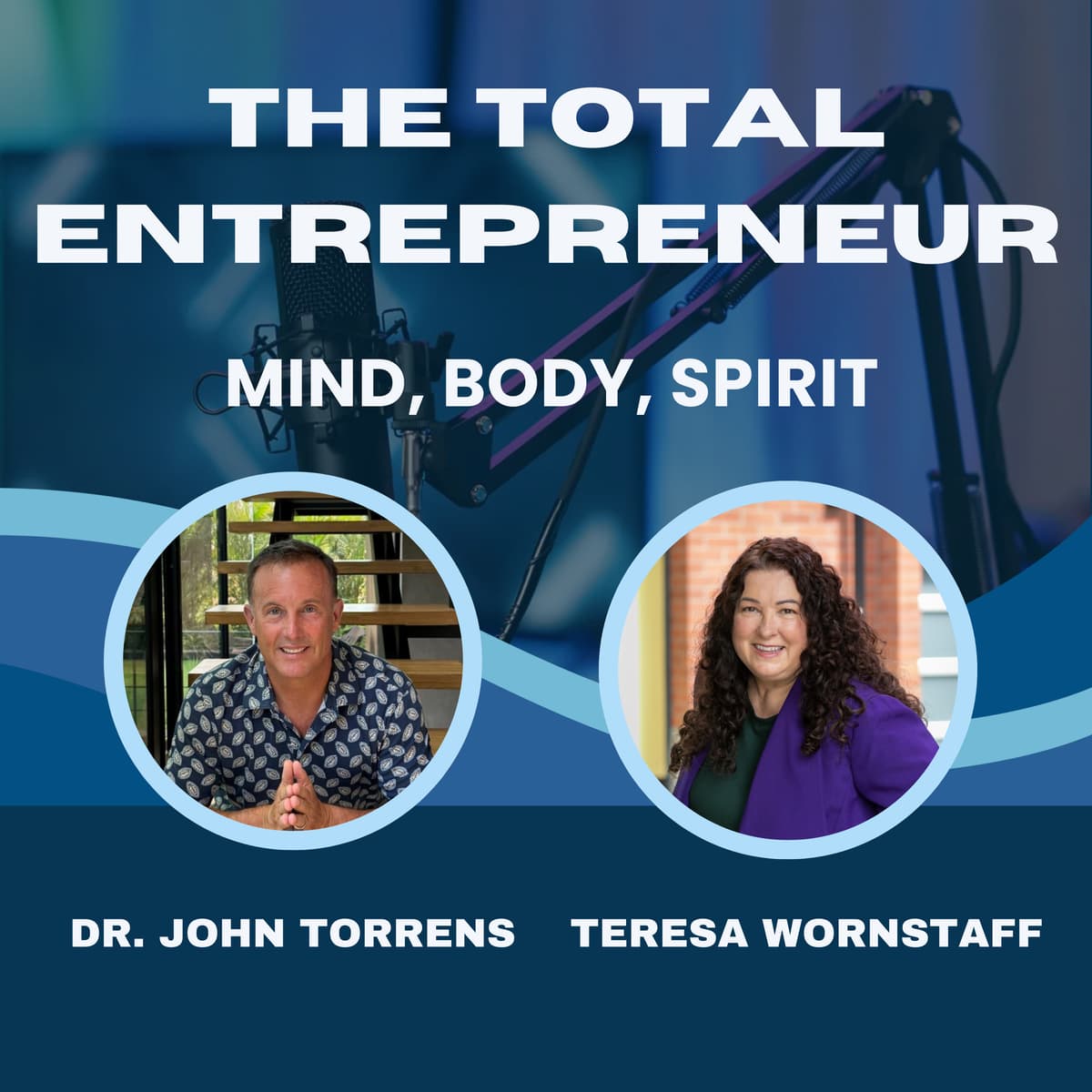


About the Host
Dr. John M. Torrens
5× Inc. 5000 entrepreneur, Professor at Syracuse University's Whitman School of Management, author of Lightning in a Bottle, and TEDx speaker on ADHD as an entrepreneur's superpower.
Browse all podcast guests →Book a strategy call →