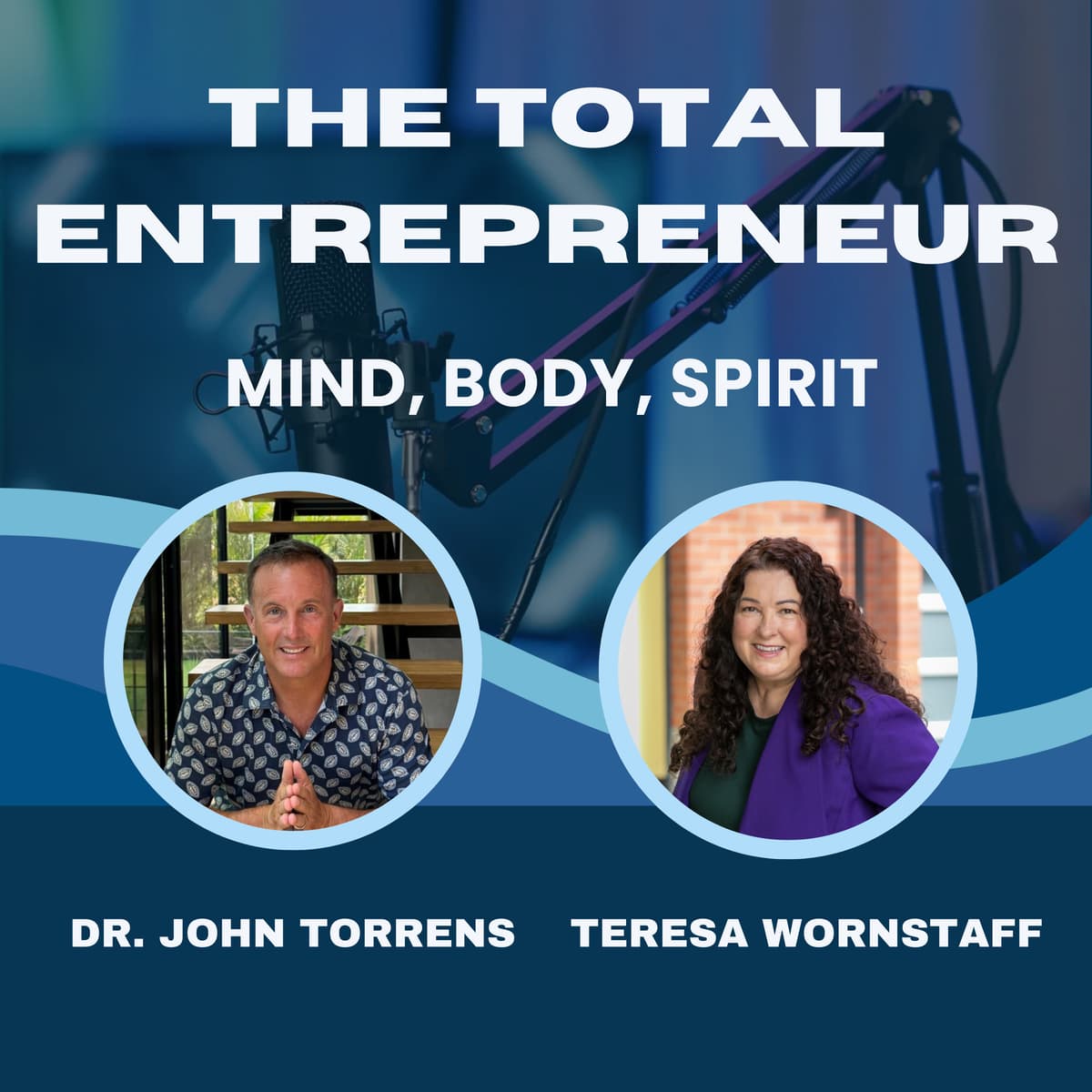
Using Intuition for Business Growth & Manifesting Sustainable Success with Teresa Wornstaff
with Teresa Wornstaff
Feb 5, 2026 · 00:51:06
Part of our conversations on
True success is not measured by money. Money isn't success. Money is an outcome. Now, if you treat money like an outcome, you've just taken the lid off of possibility.
Theresa, welcome to the podcast. So nice to have you here.
John, it's my pleasure. Thank you so much for the invitation. I'm very much looking forward to our conversation. It feels good.
Yeah, me too. I'm excited to have you here. My first question is, you describe your mission as normalizing spirituality, and I love that because I think we need that. But why do you think spirituality still feels a little bit uncomfortable or even marginalized in professional and entrepreneurial spaces?
I think most people believe the only way to be successful is to run your business by the tried and true standards that we've established over the last, I would say about 3 centuries. It was very much about designing the product or service, bringing it to market, making it as desirable as possible. And yet when you run a business with spiritual ethics, and this is my opinion, one looks at what is the best expression of me in the world? What is the service or the product that I can bring to bear that will add value to the world? And when you design a product strictly by old measures, it's simply all about how will this do in the market? Will it bring in money? Financial seems to be the primary KPI. And we don't tend to look in the other areas that I believe create much more unbridled success. There's no limits when you come from the heart, when you come from the essence of your brilliance, when you come from the thing that you're meant to do on this planet.
Playing devil's advocate for a minute, like business is a, we keep score with our financial statements, right? Where the companies are evaluated based on their income statements. So that's the game we're playing, right? I guess the point is that if you're using spiritual ethics as a way to improve your bottom line, then maybe that's okay. But if it hurts the bottom line, it's probably, there's no room for it in business. That's what I'm gathering people would be thinking as they, as they're listening to this. So how do you respond to something like that?
That's a very typical business response because it's very polarizing. It doesn't leave room for the and. So it doesn't mean that you ignore financial responsibility. That would be silly. You couldn't function because that's the way our world is built. What it does mean is that You allow yourself both. You allow yourself to run your KPIs with financial indicators. And you have KPIs that talk about who am I? What am I here to do in this life? How can I deliver it in a model that benefits others as well as myself? You create a win-win. Whereas, When you look at the traditional business model, there is not necessarily a win-win. There's just a win. And that's for the business. So if you walked into your business and said, I'm going to align with vendors who have the same values as I do, it becomes much more predictable and easy to bring to bear whatever you're taking to market. Because you understand and you know how that business will operate. It's very aligned with how you think and feel. If you look at your customer or client base and say, these are people who require this service, require this product because it will enhance their life, it will enrich your life. All of a sudden you've changed the game. To me, those are spiritual concepts. They're not necessarily traditional business concepts. And it's so interesting because I run a group every Tuesday morning at 9:00 AM, and this is what we were talking about. We were talking about KPIs in business and, A, can we skew them to be more focused on, okay, what would a good vendor relationship look like? What would a collaborative client-customer relationship look like? And how can we build KPIs to reflect that? And how can we measure it? How do we know? Is it because we get good reviews on Amazon or on Trustpilot or any of the other social media tools that we have to measure success? And here's the other thing. And I'm going to make a statement that pretty much freaks everybody out the first time they hear it. True success is not measured by money. Money isn't success. Money is an outcome. Now, if you treat money like an outcome, you've just taken the lid off of possibility.
Mm-hmm. And I think more and more people are starting to see that, or put another way, or a better way, they're starting to feel that, right? Because we probably both know a lot of people with a lot of money still don't feel successful, don't act successful, maybe don't even feel happy. Right. So I guess it's just a matter of how do we redefine success in a way that is sustainable and that feeds us as whole people, not just money-making machines for our businesses, right?
Yeah, 100%. And you bring up an excellent point. One of the key reasons why for me, what I do is so vital Is that we have been programmed to live by default. Okay, what I mean by living by default is we adhere to societal norms. We do it the way it's always been done. We ignore that sixth sense, our intuition, which if you pay attention will take you exactly where you are meant. To go to allow yourself to be successful. The other thing is, what is, what is successful to you? Financial is one measure, but it's certainly not the only one, and in my opinion, not the most important one. As I said, if I'm adhering to success by my definition, financial well-being is a natural outcome for me. Am I living my truth? Am I living from my brilliance? Am I using my intuition to guide myself? Because that's a key leading principle for me. And so identifying what is success for you. Yeah.
So you said we were talking about intuition and I know you were born a high-level intuitive, right? So How did you learn to trust that ability in a world that often prioritizes logic or money over knowing?
Yeah, I was born with all of my intuitive abilities turned on, and through a set of life circumstances, I systematically shut them down or turned them down because it didn't adhere to societal norms.
Mm-hmm.
When you are 6 years old standing in front of your teacher and they're lying to you and you know they're lying, you don't know how or what, or you're watching your primary caretaker, my parents, make a decision and you're feeling into the ramifications of those decisions and watching the energy literally fall apart. You're scared. You're like, what? What are you doing? Don't do that because it isn't going to help the family. So I had to really start closing them all down. Now, my father was an incredibly successful entrepreneur. He built businesses across the world. He was one of the first men invited into China to partner with bringing in new construction technology, blah, blah, blah. I watched that. So naturally, I leaned into watching him be the patriarch, that successful, vital, charismatic man who created his world. And so I followed very much in his footsteps to try and determine, okay, how can I fit into corporate? Because I'm watching my dad. He's happy. He's fulfilled. He's doing what he loves. So I'll take that route. That's how I ended up in corporate for 30 years.
Yeah. I was going to say it wasn't just your dad. You have decades of corporate and consulting experience alongside this deep intuition. So how do those 2 worlds actually complement each other in your life?
They didn't for a long time. From the beginning, I did not pay attention to my intuition because I really come out of a time where it didn't serve me well, in my opinion. That was my learning, right? Eventually, what I found was that the more and more that I used my intuition to determine a project's viability, to identify optimal candidates for positions of power in the company, To understand how to motivate individuals so they could thrive in their job. When I started applying my intuition in those areas, all of a sudden everything became more successful.
Hmm.
Everything became easier. My teams were thrilled. They loved what they did. They stayed in their jobs. Or we agreed that I would train them so that they could find their next position and grow themselves. So all of a sudden, my perspective on business and how I could contribute started to shift because I started in sales. Talk about being driven by the bottom line, right?
Yeah.
Everything I did was measured by how much money I was bringing in. The profile of the client. If I could get a Microsoft or an AT&T or an Eli Lilly or a Procter Gamble on the client list, it was a win. So all of a sudden, I started shifting my perspective, which was good for me because I get bored really easily. So it gave me something else to focus on. And I just watched as my success continued to rise. I got more and more successful because I was doing everything I was doing before, but from a new perspective.
Yeah. And there is research in the entrepreneurship literature out there anyway, that talks about serial entrepreneurs using intuition. And it strikes me that in serious management schools or schools of business, we don't pay a lot of attention to that. We're very logic, numbers-driven, quant, right? There's not a lot of room for gut feelings and intuition. Like you said, you were using that to, to build your company and affect the KPIs in a positive way. So yeah, there is definitely room for that. And it's great to see you doing that. Yeah. So when it comes to entrepreneurship and people trying to start and grow, even exit companies, What are the biggest energetic or consciousness blocks that you see that holds entrepreneurs back from this more sustainable success that could come from using their own intuition?
That's a great question. I think some of the keys are trust your intuition. And I'd like at some point to define intuition in a really accessible way.
Yeah, let's do that.
Okay. So let's jump in. Intuition is simply an expansion of all of your physical senses. Sight, smell, taste, hearing, knowing— our brain— feeling— skin. So it's what we've done is over thousands of years diminished our capacity to read energy and to receive information from anything except our core senses. And our core senses are probably I would say 3 to 7% of the information available from whatever we're receiving. So even your mind, it's narrowly focused on your past experiences, your present experiences, your beliefs.
So if it's 3 to 7%, what is the rest?
Right. It's all the things that you don't know you don't know. Therein lies the infinite possibilities when you lean into your intuition.
That's a good definition. And I like that because I think we have been taught, programmed, trained just to rely on almost what we could measure, right?
Mm-hmm.
But I do think that the science and the instrumentation is catching up to spirituality and consciousness, and we can measure things that we couldn't in the past. So I feel like there's more acceptance or more room for it. Let's go back to that question of what holds entrepreneurs back or what kind of energetic or conscious blocks do you see people experiencing that keeps them from living their fullest life or from achieving sustainable success?
Yeah. So again, number one is use your intuition. And our job in using our intuition is understand your why and be, be very adept. And this is number 2, be adept at how things unfold. You will always be directed in a manner that is Optimal for the full execution of whatever intention you're trying to manifest. If you pay attention to your intuition and just take one step at a time, when we start to prescribe too much, when we start to say, "I'm going to do this, but I'm going to use these methodologies, and it's going to follow this project plan, and these are the stage gates that we have to run through," you're limiting yourself. So be open to. By all means plan, but be open to pivot and to be nimble.
Yeah. Because I feel like you're almost tempting the universe to say, I don't think so. This is actually what we had in mind. Yeah.
Exactly. And those are those 2x4 moments that we don't need to invite in.
Yeah. You talked about manifestation, right? And I love this topic. So it's getting a little bit more into the woo, right? Which a lot of my students know that I'm into that, but I like it because we can start to measure it now. Like I said, there's science, there's instrumentation. So talk to us about your mediumship and the intuitive work you do that doesn't necessarily focus entirely on business.
So I think probably the flagship of what I offer my clients is the Alchemy of an Intentional Life. That's a 6-month container where we take you through setting intentions Not only personally, but in your business. So most people who take this workshop run a dual track and do their business while they're doing their personal life, and they find tremendous crossover. And when you begin to integrate personal and business, you're again pulling off the barriers to unlimited success. Some of the other tools that I provide my clients with are soul contracts. A soul contract is when your soul comes together with others and says, okay, in this lifetime we're going to have this karma, and we're going to come in with these skills and these attributes, and we're going to live with this family for the formative years so that we can experience These things, when we have an understanding of our soul contract, our karma, our talents, our goals, our destiny, this is what my clients tell me. It's like peeling the lid off of any limitation that you perceive you have, because all of a sudden everything that you thought you knew about yourself becomes validated and expanded. So it's like holding up this big mirror to say, oh no, you're really great in these areas, and this is what you're supposed to be doing. You're on point, and here are the other things that you can do if you choose to align with your soul's destiny. See, when we do that, life just becomes easier. Right.
Yeah. And it's, and I, I could imagine people listening now thinking, all right, now this is getting too crazy for me. Right. Although my hope is that the people who like this kind of crazy are, are still with us. Right. So, Yeah. I guess it goes back to the idea of your intuition and feeling, because I guess we can't, as humans in this experience, know that you're right about any of that.
Right.
So maybe we just feel it. Talk to me as you would a skeptic, like, or actually, but I believe, you know, it's not necessarily necessarily our job to change a skeptic's mind, right? We're just here to live our lives. But you must confront that from time to time. So how do you handle those types of objections?
Most of the clients that I work with, I've met through the Inner MBA or through some of my business contacts. And they've watched me. They've watched how my life has unfolded and expanded in such an incredibly beautiful way and come to me and say, okay, how did you do that? Can you teach me? And when you asked what are the things that entrepreneurs should do, this is the other one, hire a coach. Find somebody that is living the life that you wanna lead. Doesn't have to be in your industry. It doesn't have to be in anything that's familiar to you, Trust your gut and look at the coaches that come across your awareness because they're brought to you on purpose. Your guides, the universe, God, whatever you want to call it, want you to notice these certain coaches, these certain mentors. I call myself a mentor, not a coach, that can help you self-realize at a greater level. Now, When I work with an individual who's still not sure, I bring them forward by helping them to trust themselves. Because I don't have all your answers, but I'm going to give you the tools to find the answers yourself. Because that, my friend, that is true power. When you can step into a relationship with yourself and go, okay, I got a big decision to make. And like Jobs would do when he was developing projects or products, he would gather all the data and then he'd go into meditation and say, okay, what's the optimal unfolding to create this outcome? And 100% of the time he trusted his intuition.
Yeah. And I like what you said too, about just people observing you and recognizing that you're living a beautiful life and that's what they want. And it kind of reminded me of that movie. I think it was When Harry Met Sally, where she's, you know, faking she's having an orgasm or something in Katz's Deli. And the woman says, oh, I'll have what she's having. It's that kind of thing, right? Like you said, you want what that person's having. You want to achieve the life and the level of happiness and Maybe mental freedom. So that often to me is what does the trick because you're not going to logic your way through it when you're talking to somebody, right? It's intuitive. It's feeling. It's just living it and letting other people either explore their curiosity or not.
Yeah. Yeah. And like I said, it really is, you have every single answer you need within you. Every single answer. To most people, that's mind-blowing. They don't recognize how incredibly powerful they are and how well-equipped they are to live their life. You have everything you need.
Yeah, because we are just pieces of consciousness, right? The way I've heard it or read it is like if you take a drop of water out of the ocean, that drop of water isn't the ocean anymore, but it's got all the properties of the ocean, right? And eventually you can put it back in the ocean and it'll blend right in. And that's us with consciousness, right? So we have all of that accessible to us. It's just how we access it. Are we tuned into it and that sort of thing? So I want to go back to your experience. Like, what was it like growing up with this intuition? And when did you know that you had it? And maybe it was at a different level than other people. And what was your experience of that growing up?
Yeah. So my first memory is when I was about 7, 8 months old, lying in my crib. And I can remember playing with energy and seeing colors and interacting with the environment in what I later learned was a very unique and different way than other people. I can remember going to the mall with my family and sitting on the bench with my dad as my mom's off shopping with the younger kids. But I didn't want to shop. I wanted to watch the people because I could see in every single human how they felt. And I could see the dissonance in their physical body. And then I could begin to start to feel that. I could tune in and feel, man, they're really sad. Or they're really unhappy. And there were very few exceptions of finding somebody who was just lit up, who was happy, who was joyful. What I saw around me was so much dissonance, and it scared me. Not having the barrier between this world and the next, my thought Was always, what did I sign up for and how the hell do I get out of here? This is not fun.
Because it's a really powerful ability or tool, but it must be really scary, especially when you're young.
Yeah. And overwhelming. And I would share them with my friends. We'd sit on the grass and this is the time When you went out when the sun came up, you came back when the lights came on, right? So we'd be sitting on the grass talking about dreams or just talking, and I'd share all these perceptions and they'd be like, what? You're weird. And so I learned not to share. I learned that this wasn't normal. It wasn't accepted. And that was when things started. I started to diminish the gifts.
Yeah. So was that, so that seems like it was a conscious or active process where maybe you were suppressing it or just not recognizing or honoring it. So did that, I have to believe that that had some sort of negative effect or manifestation in your body somehow, or, or maybe I'm wrong. How did, how did that work when you were suppressing those gifts?
It anchored me more deeply in beliefs and behaviors that didn't serve me. And it didn't allow me to do the deep dive into myself. And see the other side of the coin, that if I stopped believing that I would always be abandoned or that I couldn't be successful, when I stopped believing those things that we make up as kids and start to define our world, it also reinforced it because I didn't have that pure essence of that internal self that said. No, that's just a belief or no, that's not true. It's just a perception.
How old were you when you, for lack of a better term, came out of that or started to embrace these abilities and gifts and say, hey, yeah, and lean into them?
Yeah, I was, it was when my kids were born, my late 20s. I slowly started to bring them back because I was a single mom with 2 young babies. And I recognized at that point that I needed to pull in every skill and ability I had to take care of my family.
And how did you— how did those gifts and abilities do that for you?
A couple of ways. I always knew I would be safe. I always knew that I would be okay. I Could manifest a job or a new opportunity or a consulting gig pretty quickly. I could manifest money pretty quickly. I can remember shortly right around my divorce, I had closed my business and gotten a job because I felt that was an easier way to be insured.
Sure.
And I came home from work, paid all the bills, and I had about $40 to get us through 2 weeks to the next paycheck. And I went and grabbed the mail, and in the mail was a check for $150. It was a refund from Comcast. So little things like that would happen, and it was exceptional. And then as I began to see evidence of that continue to happen, I would open myself up more and find ways to use this as a tool for myself.
Yeah. So you said you could, you could manifest money. And I've felt that not just poof, it appears, but like I could, I've always felt that I could make opportunity happen or in another way to say it, make money happen eventually. I never really stressed that much about it, but I'm guessing that a lot of people listening will say, oh, I want to be able to do that. So could you talk a little bit about just the basics of manifestation, what it is, what it's not, and how do people start to tap into the intuition that will allow those types of things? Yeah.
So the fundamental way of being that is optimal for manifestation is trust. Trust in yourself. And Understanding that money can come to you in a multitude of ways, and if you want to win the lottery, that's not making money. That is not how to manifest money. It is not optimal. When you want to manifest something, you want to identify what you want and why you want it. From those two fundamentals. You begin to daydream. You begin to envision what that looks like when it occurs, and when you envision it, you begin to infuse it with emotions. And emotions are fuel for intention. That's really important that you set an intention and then infuse it with a belief and with the. Joy and the happiness and the gratitude that you will feel when that's achieved. I also want to differentiate intention and goal. A goal typically has a finite manifestation. I just want this. What happens if just that is only the first step to 10 times what you could imagine?
Mm-hmm.
So intentions, especially as we're looking at 2026, intentions are far more powerful than a goal. So identify what you want, identify why you want it, ensure that it's aligned with your personal values. And these are all things that I teach in Alchemy of an Intentional Life. Sure. Ensure that it's aligned to your values and then pay attention to your world because you will be shown how to make that a reality.
So in the example you mentioned earlier where you had $40 left, so your goal could be, hey, I just need money to get through the next 2 weeks until I get paid again. What would the intention be that would be different from that?
Yeah. So the intention would be, I want to make sure that I can put nutritious meals on the table. I want to ensure that I have gas in my car, that I have money to play with, and that I am prepared to meet the needs of myself and the kids, however they show up.
And very different, right? The goal is just the amount of money by when. Versus the intention is what do you wanna do with it? What is it for? And the important thing that I heard you say, I guess the emotion or the feeling. And, and so my understanding is that it's important to conduct yourself in a way or feel as if it's already happened and be grateful for it and just imagine it's already happened because then the universe really has no choice but to yield to that.
Yeah, 100%.
The other thing in my understanding is that, so let's take the money example, right? You had $40 left. If your dominant thought was, man, I don't have enough money. I don't have enough. There's lack. There's this type of thing. Is it true? That's probably what you'll get more of because that's the intention you're putting out there, whether or not you realize it.
Yes, 100%. So being very intentional with your energy is key.
So let's talk about the power of our thoughts, right? And I think a lot of people Myself included until recently, didn't really get the fact that the things we put out there through our thoughts are so powerful and so important, and you can change your life completely just by thinking about it differently.
Yes, you can. And the first step in understanding the power of your thoughts is to listen to them. You're making breakfast for the family and you drop an egg and you think, oh, you're clumsy. Guess what? You're going to perform in a way that gives you evidence that you're clumsy or you're lazy, or you can't do it. All of those scripts that we have looping through our head contribute to the environment that we create. So understanding them and saying, oh, I'm not clumsy. I just wanted to share with the dog, creating a playful and fun narrative. I'm actually not clumsy at all. These things happen, and I'm actually very elegant in my movements and fluid in how I move through my physical world.
Yeah. And I think that's so important because we've been trained almost to be overcritical or to critique everything, right? And it doesn't have to do with you. It could be a spouse, a child, a coworker, an employee, the thoughts you have about them. Oh, they're incompetent. They're stupid. They're whatever. if those are the thoughts you have about them, those are the things you're going to experience from them. Do I have that right?
Yeah. In my book, I gave this example. I came into the office and went into my office, and I had, I don't know, probably 50 cubicles in front of me of my team and others. And I came in, I was pissed off, I was running late. The traffic was terrible. The weather was terrible. I got some bad news, and I came in just rah rah rah rah rah, just all grumpy. Sat down, closed my door most of the way, which signaled don't disturb me unless you have to. And by the time I had grounded myself and got myself to a better mental state, better emotional state. and come out of my office and checked in with my team, everybody had gotten grumpy. Everybody was snipping at each other. Everybody was criticizing each other. Everybody was complaining. And I felt so bad. So I literally went into every single person and helped to reorient their world to something a little more optimistic. But yeah, we have a lot of impact on ourselves and on others.
Yeah, I've experienced that too. And even with my family, my family always tells me just my vibe just changes the vibe in the house, or employees do the same thing, right? Or even you walk into a classroom of students, your vibe has an impact. And it's really important to recognize that. And it's not something you can see with your eyes. We could measure it with a magnetometer, obviously, right? The electromagnetic feel from your heart and the intention that flows from it. But yeah, it's really important to keep that in check. And the other thing I'm interested in your thoughts on is this idea of joy or happiness, and which maybe leads to from gratitude, but I sometimes get into debates or with people like who say they're not happy for whatever reason, or, okay, once I start the company, then I'll be happy. Or once I start the company, get my first contract, then I'll be happier. Once I find my person, then I can finally be happy. And I often say, no, you can skip that line and just choose to be happy now, and they just dismiss it and think I'm a kook. So I'm really interested in your thoughts on that.
Yeah, conditional happiness is a quick way to fail at meeting your deepest desires. When we're conditionally happy— I'll be happy when, I'll be happy if— we're putting a lid again. We're limiting ourselves. Instead, when we decide I'm happy because I am in an amazing relationship with myself and I love my world and I love my friends and I love my family. All of a sudden, love is what is reflected back to you in your world because that's what you're putting out. Our internal world creates our external world. And so if you want to be successful and you think the only way to do that is to build a company, Well, feel successful first. Define what success means to you and then start building the company. Because I will guarantee 100% that the moment you start building the company from feeling successful, you are going to find the people, places, things, and experiences you need to lay the foundation are going to drop into your lap. There's zero efforting. Zero efforting. It's all just showing up because that's what you're projecting into the world.
Yeah. So that seems like the easier side of the equation, right? Because you can choose those thoughts. You're like, so conditional happiness, I get that that's not really the path. But what about a conditional unhappiness or something like I'm driving to work and somebody cuts me off? Of course I'm mad because that person cut me off and that person made me mad. Or you did something to upset me. You canceled the contract, you quit, you stole all my clients. You did something to get me mad.
Yeah.
Tell me about that. What do you think of those thoughts?
Oh boy, that's one of my favorite topics. Every single thing that comes into your life is there for a reason. Nobody does, does in quotation marks, anything to you. You lost all your clients because you didn't believe you could hold them. Somewhere in you is a belief That outcome was what you deserved, or that outcome happened because there's something even greater waiting for you. So our job when we hit are hit with these two by four moments, these challenges, is to do three things: get curious. Why did that happen? What is it trying to teach me? What is it trying to tell me? And sometimes that can take days or weeks to figure out. To be neutral, not to impose judgment. The key— you can't be judgmental and curious at the same time. So that's why I always say curious first. Why is this happening? Neutrality. Don't pass judgment. Stay curious. Number 3 is patience. And that's my biggest opportunity because I, I want to manifest fast, right?
Yeah.
So I'm not very patient, but sometimes you need to wait to understand the full ramifications of what happened. And I would also venture to say that you will understand it in layers, especially if it's a big event. Somebody cutting you off, you know what, They didn't do anything to you. They're in a hurry. They're short-sighted. They're not paying attention to anybody but their own needs and wants. So let them. Something bigger happening— losing a business, losing clients, having a health issue, getting a divorce— all of those big life-changing challenges, they're there for a reason. And I promise If you are brave enough, if you have enough courage to explore why and be curious, neutral, and patient, you'll discover that what's on the other side of the healing of that incident will give you something greater than you could imagine if you're courageous enough.
Yeah. And I've lived that myself. Like, you know, Almost 25 years ago, I had an employee, 2 employees actually, who left my company to start their own company to compete with me. And as you can imagine, I was livid. I was hot. I felt completely betrayed and I couldn't, I just could not get over it until I did. And then, you know, became friends with them and we maintained a relationship. And, you know, fast forward another 20, 25 years when they were ready to get out of the company, I had an opportunity to buy their company back once I was out of my other one. And it got me out of a situation that I didn't really love in the first place. And I got back into a place that was comfortable. So when I reflect on it, it seems like almost a gift that that happened that I didn't recognize at the time. It was very difficult. I was really bitter for a long time. But now when I look back on it, I'm very thankful that that was the case and that I had that opportunity.
Yeah, yeah, that's a great example. And that actually brings to mind the third thing that I— you know, your initial question, what should every entrepreneur know to develop a spiritual business? Collaboration is the other thing. Competition is a false narrative. It is a narrative from lack. So if you can look at a win-win, I'm collaborating with this individual because I bring a win, they bring a win, and together we can create something even greater, then you'll never fail. You'll never fail.
Yeah. Survival of the fittest and competition and Darwinism or Sun Tzu's The Art of War. That's a— that ethos has been ingrained in us from a business education perspective Which I'm happy to say that's getting unwound now. But I agree. And I think the research shows that collaboration trumps competition every time when you're trying to achieve greater outcomes.
Yeah. Agreed. Agreed.
Yeah. Yeah.
Wow.
So someone who's new to all this and new to intuition, is there a single daily practice that can help them start listening inwards? Because we want to keep it simple. We don't want to make it overwhelming. What's the one thing that could start people on this path where they could feel a little bit of this and get a little success and start to think, oh yeah, I can do this?
Yeah, I'm actually going to give you 2. I think take the example of intuition and start to pay attention to your world and watch when intuition guides you and start to validate the kind of intuition you have. For example, if you are Drawn to read a billboard, then that's a message. That's your intuition giving you information. If you think of somebody before they call, that's intuition. Pay attention, validate it, because the more you do, the stronger it will get. Even if you're in the grocery store and you overhear a part of a conversation, and yet it has relevance to you, again, that's your intuition. So your intuition is always going to try and communicate. communicate with you. Your opportunity is to validate when it does and to continue to look for opportunities to grow it.
So instead of brushing it off as a mere coincidence, maybe observe it in a different way.
Yep. Yep, exactly. And for me, the second is, God, and don't throw anything at me, meditation. And let me context— yeah, let me contextualize that. Because my brain is way too active to sit on a poof for an hour and meditate. That's not my jam. It's uncomfortable for me. And it is for most people when they start. Go for a walk. Here are my 2 go-tos. I walk. I put in several miles a day, just walking me and the dog and allowing my mind to wander wherever it needs to be. But always I reflect on how am I feeling? What's going on within me? So look within. Another tool that I use is I go for a drive. I love to drive. I will drive for an hour or two and just let my mind wander. Another one is getting out in nature. So find the way that you can create a state that allows you to do self-reflection. That's meditation. Figure out what's the right one for you.
So for me, driving is not the answer because I don't know what it is when I'm in traffic or in an airport, I lose it. I like that. Those are my lessons for, I don't know, I still have to learn them. But getting in nature, taking walks or even cycling or something. Yeah, I can relate to that because you just get yourself into a different state. And I think the cool thing is that the younger people that I work with, they get this in a way that students that I was working with even 10 years ago didn't, you know?
No.
Yeah. The one thing I, I do kind of joke with them a lot about is because a lot of them get offended very easily because of something somebody said or whatever. And what I say is that, hey, being offended is a choice. And I get a lot of crap for that because of course it's the other person who shouldn't be so offensive. But I'd love to hear your thoughts on that because is being offended a choice or is it just natural that I'm offended because you said completely offensive?
I think it's both and.
Okay.
I do believe that how we respond to somebody, regardless of the situation, even if they're being offensive, is entirely up to us.
Right.
I also think that if somebody says or does something that is offensive to you, they've crossed a boundary. And your boundaries are defined by your values. So where is there a values misalignment? And maybe that's a good indication that's not the right person for you to be hanging out with. Or maybe that's the bridge that you need to build by saying, hey, can I share something? I feel very offended by this statement. Are you open to exploring it? Or shall we just leave it alone? Because I'll handle my side, but I wanted to let you know because you're important to me, or we work together or whatever. Are you willing to go down this path? And no judgment in either direction. Now, if somebody says— I almost swore— screw you.
That's okay.
That wasn't the word I was going to use. I don't care what you think. Then that's telling you—
screw you, they don't want to go down that pathway and explore that with you.
Yep, then they're telling you what kind of person they are, and pay attention. We are at choice on how we want to respond to any situation, and do your own work, do the internal work, figure out why you were offended, and then explore whether that's something you— that's a bridge you want to create with someone.
That's a great way to look at it. I appreciate that. Yeah. Yeah. So Teresa, for me, this has been such a fun conversation. I really love this stuff and I love the work you're doing. If other people are interested, if this conversation resonated with somebody and they want to find you, how can they do that?
Definitely go to my website, theresawarnstaff.com, spelled the way it sounds. And I want to also offer, I have 2 books out. for those people that are curious and want kind of a— they come at it from a beginner's mind. One is called A Manual for Humanity, and the other is Workbook for Wisdom. So A Manual for Humanity is everything I teach, a lot of what we talked about today. And the Workbook for Wisdom is its companion, where I take you through objectives, practices, and journal prompts so that you can start to begin to find The ways that you meditate best, or what self-care means to you, or what intuition means to you. The other thing I do that in the book is talk about energy systems. We know our physical body, we have no clue about our energy body. So I give you a breakdown of some of those systems. So for example, when you're in an airport, You know how to shield yourself and not be influenced by the energy around you. I'm super sensitive and I travel all the time, so I have the same challenge and I need to really boundary up to ensure that I'm not feeling tired and exhausted and frustrated and angry and anything else that might be going on around me. The other thing they can do is reach out. I have a free circle I run every Tuesday for Individuals. I— The Alchemy of an Intentional Life. 90% of the people who take this workshop, and I've been doing it for 4 years now, stay for multiple iterations because it levels up your life in ways that you can't imagine. I also have a podcast. I have a summit that I run every spring. So go to my website. There's lots of ways for us to work together, including one-on-one.
Amazing. Yeah, actually I was at your website earlier and that the soul contract reading was interesting to me 'cause I'm, I'm just curious about what kind of agreements I made before I even got here. So that would be super—
It's fascinating. Yeah.
Yeah. Theresa, thank you so much. I really appreciate your time and your expertise and just your openness to having this conversation. So Thank you so much.
Thank you, John.
About This Episode
What if the most powerful business tool you own isn’t your balance sheet, but your intuition?
In this episode, John sits down with Teresa Wornstaff, a seasoned corporate consultant turned spiritual mentor, to bridge the seemingly distant worlds of business strategy and spiritual consciousness. Teresa challenges the traditional metrics of success, arguing that when you align your business with your soul's purpose, financial abundance becomes a natural outcome rather than the sole objective.
She shares her personal journey of suppressing her innate intuitive gifts to fit into the corporate mold, only to rediscover them as her greatest asset for leadership and decision-making. She demystifies concepts like manifestation, soul contracts, and energy management, offering practical tools for entrepreneurs to tap into their "sixth sense." From handling toxic competition to redefining KPIs with heart, Teresa provides a blueprint for building a business that honors both the bottom line and the human spirit.
This is a transformative conversation for founders who feel there must be a better way to lead, and for anyone ready to stop living by default and start leading with intention.
Key Points Discussed:
00:00 - Redefining Success: Money as an Outcome, Not the Goal.
03:47 - Merging Spiritual Ethics with Business KPIs.
08:50 - Teresa’s Journey: Suppressing Intuition to Fit Corporate Norms.
13:20 - Demystifying Intuition: Expanding Beyond the Five Senses.
17:00 - Soul Contracts and The Alchemy of an Intentional Life.
24:00 - Growing Up Gifted: Seeing Energy and Dissonance.
30:00 - How to Manifest: Intention vs. Goals.
34:00 - The Power of Thought: Moving from Criticism to Creation.
38:00 - Conditional Happiness vs. Living in Joy Now.
42:00 - Handling Conflict: Curiosity, Neutrality, and Patience.
45:00 - Daily Practices to Sharpen Your Intuition.
Mentioned in this episode
A Manual for Humanity by Teresa Wornstaff →Workbook for Wisdom by Teresa Wornstaff →Keep listening
More on Spirit
About the Host
Dr. John M. Torrens
5× Inc. 5000 entrepreneur, Professor at Syracuse University's Whitman School of Management, author of Lightning in a Bottle, and TEDx speaker on ADHD as an entrepreneur's superpower.
Browse all podcast guests →Book a strategy call →