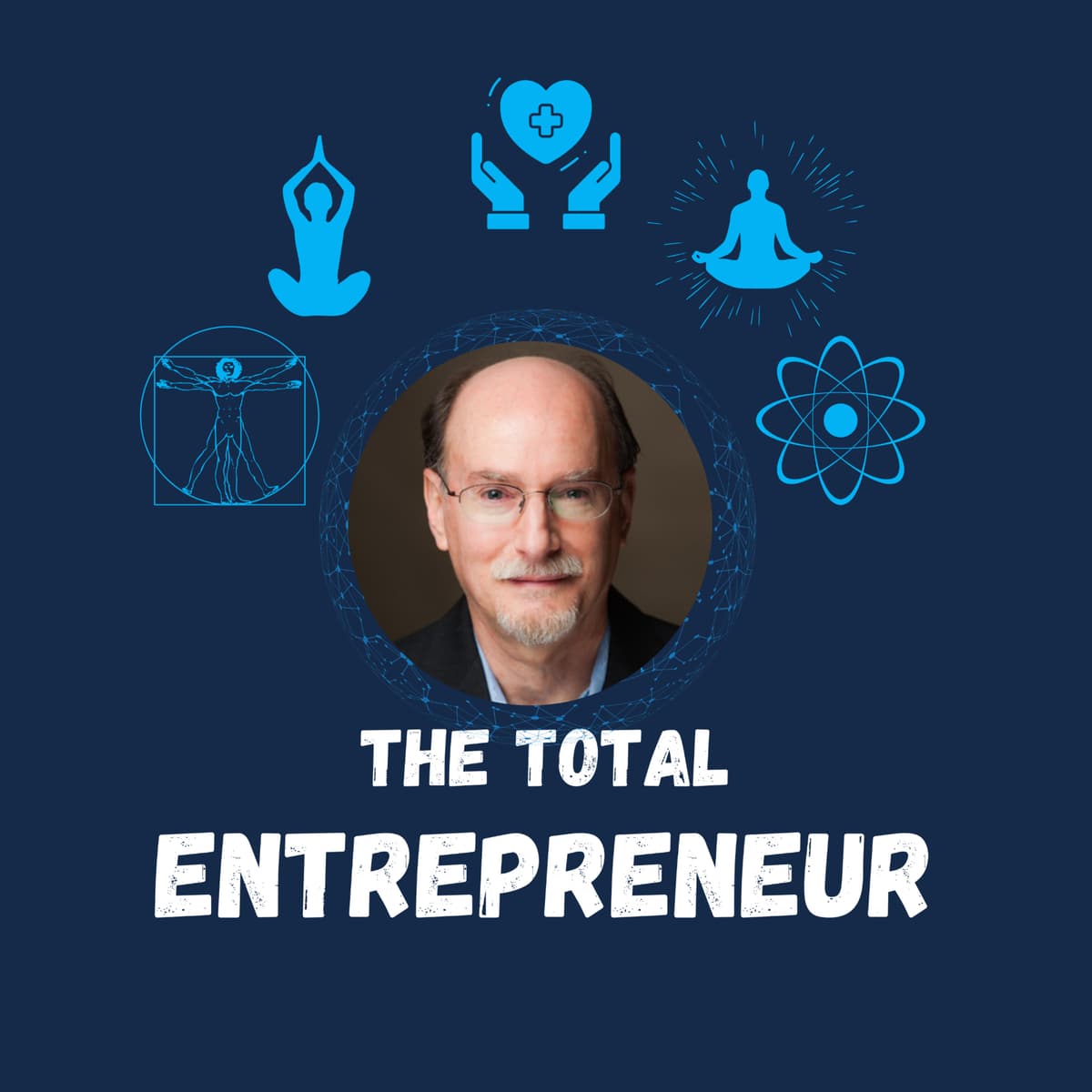
The Science of Magic: Consciousness, Intuition, and Mind-Matter Realities with Dr. Dean Radin
with Dr. Dean Radin
Oct 10, 2025 · 01:05:23
Part of our conversations on
Welcome to the Total Entrepreneur Mind Body Spirit Podcast. I'm really excited for today's guest, Dr. Dean Radin. He is the chief scientist at the Institute of Noetic Sciences and one of the world's leading researchers in consciousness, intuition, and mind-matter interaction. His research explores phenomenon often considered on the edges of science, but as you'll learn about in today's episode, they may hold the key to unlocking the next paradigm of human potential. With a background in both electrical engineering and psychology, Dr. Radin has worked at top institutions including Princeton University and SRI International. He's authored numerous groundbreaking books like The Conscious Universe, Entangled Minds, and Real Magic. He's also an entrepreneur serving as the co-founder and chairman of the neuroengineering company Cognigenics. I think you're really going to love this conversation. Welcome to The Total Entrepreneur Mind Body Spirit, where we turn cutting-edge science into practical strategies for entrepreneurs. I'm your host, Dr. John Torrance, Entrepreneur Inc. 5000 honoree and professor of entrepreneurial practice at Syracuse University's Whitman School of Management. Each episode, we dive into mental, physical, and spiritual health with expert guests offering actionable insights to help you thrive and perform at your highest level. Let's get started. Dr. Radin, thank you so much for being here. I'm looking forward to our, our conversation very much.
Thank you. It's my pleasure.
So before we start, could you first talk to us about what noetic science is and maybe describe a little bit of the work that IANDS does?
Well, the word noetic refers to deep intuition, knowing things without knowing how you know them, but not in the conventional sense of forgotten expertise, but rather when you get a so-called download of information that turns out to be valuable in some way. And there doesn't seem to be any reason for receiving that information. That's like a catch-all for what noetic means. In the vernacular, it turns into things like mystical experience, psychic experience, near-death experience. Those kinds of experiences are considered noetic.
Okay, thank you. So yesterday and today, I spent several hours exploring your Google Scholar profile. And I was impressed with how much research you've done connecting science and consciousness and for how long you've been doing it. So you've been at this for a while. So before we jump into some specifics, can you just summarize your research interests and explain how you even came to this area of inquiry in the first place?
In some ways, I probably read a little bit too much science fiction and fantasy as a child, although children do that, and I had the opportunity in graduate school to start looking into psychic phenomena, particularly remote viewing— used to be called clairvoyance—
Mm-hmm.
Because there was a faculty member who I found was also interested in these things. So we started doing little experiments and getting intriguing results. So I started looking into the literature in more detail and discovered that this was a very interesting area of study because you could apply the same tools and techniques of science that you would in other disciplines to study these kinds of phenomena. So I, I started doing that in more earnest, and my first real job was at Bell Laboratories. And one of our missions in the group I was in was to study why machines fail.
Hmm.
And most of the time it's human error of some type. Somebody did something poorly or something. But when you do failure analysis, you typically find that you can end up explaining around 95% of why things fail. Sometimes it's a machine, usually it's a person, but there's always 5% that's not explained.
Hmm.
And so since I've been reading the literature in parapsychology, there's this whole section on mind-matter interaction, so-called psychokinetic effects, including some people who have been working essentially with machines as a target system. So the machines are simple electronic circuits called random number generators, typically based on quantum events for the randomness. And so I took advantage of business travel to visit other laboratories where people were actually doing this kind of work. And I was fortunate enough to bring home with me back to Bell Labs one of these random number generators.
Hmm.
So I used it on myself and on my colleagues and The results, the overall results, were way beyond chance.
Hmm.
And that convinced me that this wasn't just something interesting I could read about that other people were doing, but I could do my own experiments. And a miracle occurred where I convinced my management at Bell Labs that this was worthy looking at, because every technical environment at Bell Labs and every other technical spot has a lab lure. which has been incorporated into Murphy's Law, that whatever will go wrong will happen, and whatever will— whatever happens will be happening at exactly the wrong time, essentially.
Right.
And we saw many instances of that when, when we were doing demonstrations and things at Bell Labs. So my argument was that if there really is some kind of a mind-machine interaction that we don't understand, we should probably look into that. And they agreed. So I started going to conferences and people, other scientists interested in this stuff. And at one of those conferences, I was recruited for what at the time was the classified program of psychic spying that was from the U.S. government called Stargate. It's actually called something else, but there are a lot of code words. And then, and that, I, that was an offer I couldn't refuse. So I did that. I took a leave of absence from Bell Labs and did that for a year and had the opportunity of seeing people who were exceptionally talented in remote viewing. And that convinced me that if there was a way to spend a career where that's what my job was, to look into these things, that's what I wanted to do. So I figured out a way of doing that. And that's what I've been doing now for 40 years.
Yeah. So you mentioned a few things that I wanted to touch on later, which is your work on it with random number generators, but you mentioned remote viewing a few times. So for people who aren't familiar with it, Can you give us just a little background, maybe brief history of it, how it's used and what it is?
Remote viewing is a modern euphemism. We're very adept at creating euphemisms to mask what we're doing, because we recognize that even the term psychic phenomena will cause people's hair to stand up.
Yes.
And we learned very quickly not to talk about such things. So we come up with euphemisms. The euphemism within the Stargate program was remote viewing. which is identical to clairvoyance, the old term, which is referring to the ability to perceive through time and space.
Hmm.
So it's not like remote viewing suggests like you're looking, and it's never that. Clairvoyance is gaining impressions about things happening at a distance or that are shielded in some way so you can't see it or you can't sense it. But nevertheless, some people are quite good at that. And when we do experiments in the laboratory, we sometimes will select people who report special claims, but usually not. The vast majority of participants in experiments in our lab and other labs are the equivalent of college sophomores. They're doing it because they get credit for their psychology course.
Oh, okay.
And so we learn from that, even though the results are not spectacularly strong, we can tell that what we're dealing with is essentially a normal curve. It's the same kind of curve you'd expect for musical talent or sports talent. Some people are just amazingly good at that phenomenon. And again, we're talking about relatively vague impressions, typically, for the average person. For experts, they can end up in some cases with veridical drawings of what the thing actually is, whether it's at a distance, even at a distance in the future. or in the past. So up until the development of what is no longer modern physics, it's like 100 years old already. Up until then, our sense of physics was what we now call classical physics, and it would disallow these phenomena.
Hmm.
So many skeptics today who say that's, that's impossible, you can't do that because it violates the laws of physics. My response is, yeah, in the early 19th century, It might have, but we're a couple of centuries past that now. And so these kinds of phenomena, while they're quite strange, they do not violate any physical laws at all.
Mm-hmm.
The mystery is, how is it that we know in the micro world and the macro worlds, where time is very funny and flexible and space is not what we think it is, how is it that that connects with us as biological systems? So that was a stopping point. until about 20 years ago when quantum biology became a thing.
Hmm.
The argument then was, yeah, but humans are not quantum. Like, we don't operate that way. Until about 10 years ago when the possibility of quantum phenomena happening in the brain was starting to become a thing. It's becoming more and more a thing. So the old arguments that this violates physics, that biological creatures are not connected to the quantum world. All that stuff is slowly going away and making it more and more plausible from a scientific perspective about how we can begin to understand that some aspects of our perception are not localized.
Mm-hmm.
They're spread out through space and time. So that doesn't yet explain the psychokinetic effects like mind-machine interaction. So there you look at the quantum observer effect, and again, very different than classical physics, where now there is something about the role of gaining information from a system through observation or measurement.
Does this relate to the double-slit experiment?
It does. That's the, that's the Physics 101 way of demonstrating that it's a real thing. But yeah, you gain any information at all about a quantum particle, quantum object, and its properties change. It's not that they change so much, it's that before you observe a quantum system, it doesn't have properties in the everyday sense. It's like it's a superposition of all possible possibilities.
Right.
And so you observe it and you start collapsing, so-called collapsing properties that it has into certain classical actual properties that we can measure. That's what our measurements give us, classical actuals. And so this is usually developed, shown with a double-slit optical system because it's easy to show that.
Mm-hmm.
But there, there are many, many different ways of showing it. And what it suggests is that if we're operating in some sort of quantum fashion, then when we observe something through, through our, our mind, our consciousness, that we are changing the physical world in some way. We're creating properties that weren't established before. And many experiments have been showing that that is probably true.
Mm-hmm.
So again, I'm not saying that quantum mechanics as we currently understand it explains all of this. What I'm saying is it's pointing in the right direction, right? Because we, we don't have a— we don't have a solid physical explanation yet for why these phenomena exist. But we can say that when you look at the trend in physics over the last couple of centuries, We're definitely going in a direction that will eventually give us a satisfactory answer, like not exactly a mechanistic answer, but one that will be satisfying for scientists as to why these phenomena must be true.
It's almost like our, our methods and instruments are slowly catching up in order to enable us to study these things.
That's right. Yep. A lot of it has to do throughout the history of science that every time you develop a new instrument The instrument opens whole new realms of possibilities. And so we're, we're developing new instruments all the time. One of the instruments I use a lot now is optical interferometers because they're exquisitely sensitive and we're able to see how is it that mind is interacting with these extremely sensitive systems.
So tell us about that instrument. What does it do? What do you measure with it? And maybe give us an example of how you've been using it in your research. your research?
An optical interferometer is based on the idea that light has characteristics of particles and waves. And so just as when you look at a pond, you throw a pebble in it, you see interacting waves— that happens with light too. So you can create an optical system where you're causing the waves to interact. And in fact, you see that every time you, you look through a diffraction grating or any kind of optical system, you see light bending. Well, that's a wave-like phenomenon. These systems allow you to make extremely precise measurements of 2 types. One is that when waves interact, their waves can combine, and so you get a larger amplitude. Or it might interact in such a way so that it cancels out or even goes in the other direction. So there's an amplitude effect. The other thing you can measure is about phase. So if you have one wave that's sort of waving along, the other one's slightly behind it, they're slightly out of phase. So you can measure phase differences in light as well. So in my experiments, I've been using a variety of different kinds of interferometers that have slightly different characteristics. Most recently, I'm using one called a Mach-Zehnder interferometer. These are mostly named after people.
Mm-hmm.
I don't know of anybody named Mr. Double Slit. That's more of like a description of what it is. But most of them are named after whoever came up with it first. So Mach-Zehnder is named after Mach and Zehnder.
Yeah.
They came up with a way of very— all of these are very simple systems. You know, you look at pictures of people doing quantum mechanics research on optical tables, there's a gazillion pieces of apparatus. The actual interferometers, the core structure is extremely simple, which is one of the reasons why It's considered a beautiful experiment in physics because it's simple. In fact, you can just look at it and sort of figure out what it does. So Mach's amplitude is very simple. It allows you to measure amplitude and phase differences to an extremely significant degree. So you may remember a few years ago the LIGO experiment, the gravitational wave detector experiment that won the Nobel Prize because they figured out a way of using an interferometer Mm-hmm. That happened to have— they're in this case 2 arms of the interferometer. This is where the light beams would come together and interfere, but they're something like a mile long, and each one in a hard vacuum underground. So you need something of that size to pick up these gravitational waves, which are hypothesized to be extremely long. That's why you needed this thing. But you can make a version— like, I have one behind me here that's 10 centimeters long. And it doesn't need a vacuum. And it's still extremely precise in terms of amplitude and phase differences. So I'm using that in an experiment to ask people to imagine that they can mentally shrink one of the arms of the interferometer, which means there are 2 laser beams, they're the same length, make one a little bit smaller. Don't worry about how that happens, just will it to be so. And if that happens down to approximately the diameter of a hydrogen atom, I'll be able to detect it. So that's the level of precision you can get with these things. And again, you can get much, much better resolution with fancier equipment, but my tabletop thing only costs around $20,000, and you can, you can get way down into tiny little atoms, that kind of measurement.
So the way I understand it, and kind of going back to the You know, the original, the double slit experiment, because, you know, I think a lot of people when they first look at this or learn about it, it's a little bit mind-blowing, right? So the infinite potentialities is the waveform of light or something, right? And then when we observe it and we start collapsing and we're giving it information, that, that's when it becomes more particle. Is— do I have that right, or am I, am I totally botching that?
No, no, that, that's correct.
Okay.
So when you demonstrate this in Physics 101, you use a double-slit system because again, it's extremely simple. You have 2 tiny little slits, you shine a laser beam at it, and then on the screen that you, you see after the light goes through it, you get an interfering pattern which looks like a series of bright and dark bands.
Mm-hmm.
And that, that only occurs because of the interference of the waves. So the experiment is you take a photodetector and you put it behind one of the slits. So now you can tell where the photon went. So that's your measurement. You're able to gain information about the system. When you do that, that alternating band structure goes away. And so many, many variations have been done on this that suggest that there's something about the act of gaining information that makes this happen.
Yeah.
A conventional explanation, which turned out to be wrong but is often said, is that the reason why this works is because the photon interacts with the physical device itself, with the photodetector, and that causes it to so-called collapse into a particle. Like, you need a physical interaction. That is incorrect because there are, there are things called the Elitzer-Baum detector, which is an interaction-free form of measurement.
Hmm.
The way you can simply explain that is If you have a detector behind one slit and you fire a single photon and the detector does not go off, but you see a spot on the screen, you know it had to go through the other side.
Mm-hmm.
So you're able to infer. We can infer.
Mm-hmm.
Because otherwise the photon's doing the inferring.
Mm-hmm.
When you do that kind of setup, you still get a particle. So somehow you, you have set up an arrangement that doesn't— does not require an interaction with a physical system. but constrains how the particle is, is acting now without hitting anything. So who, who's doing the constraining? Well, we don't have a good answer for that. It might be that photons know that they're being looked at or know that they're being measured, because you can do exactly the same experiment where the detector is turned off, so you don't even have any way of knowing, and then you get the, the wave-like behavior again.
Yeah.
So, so there are lots of strangeness going on in these kinds of Yeah, I think you mentioned quantum entanglement.
Um, what is that? Can you explain that a little bit more and maybe kind of break down like what the translation or application might be, or why it's important to understand that this is a phenomenon?
Nobody knows what quantum entanglement is. What we know in— what we know is what it does.
Okay.
And also there are applications for it already. So what it does is that under the right circumstances, you can cause 2 quantum objects like photons to interact or be produced from the same source, and then there's a way to measure afterwards what the correlation is between its properties. So the easy experiment— you can do this on a tabletop now— you, you create the entangled pair. You have a certain kind of crystal that you send a laser through. It, it breaks a blue photon into 2 red photons, breaks it basically energetically in half. And then they go on their merry way, but you send one of them through a polarizer. And now, and now you measure the coincidence between the 2— the polarization between the 2 photons in a detector. They go through fiber optics and go through a detector. So if changing the polarization of one of those photons under a classical idea, the other one's completely independent. It's not going to make any difference.
Mm-hmm.
if they're entangled, it does make a difference. And so why it makes a difference, this is the, the, like, the underlying fundamentals. We don't actually know. It looks— I mean, we can interpret it as the photon appears to be a separate thing even when you split it into 2 parts, but it's not really separate. It's kind of along the lines of what is the wave-like nature of an electron, like a physical particle? It also has a wave-like nature, right?
Right.
And it also has a superposition state where there's lots and lots of properties that until you look at it, they're not exactly properties in the classical sense yet. They're like the potential of properties.
Yes.
So something about entanglement is saying that until you observe a system in the right way, it behaves in very strange ways, like everything is holistically connected together all the time. So the way that this is being used is in quantum computing. It's used in quantum cryptography and quantum communications. And one of the reasons is that in cryptography, for example, or in communications, if you have an entangled pair and something happens to one, you know that something must happen to the other one. So it provides a very secure communication channel because now you can detect on the incoming side by comparing it— what, what was sent, like what I got and what you sent. If they're not in a certain kind of correlation, then somebody messed with it, or it's the— it's a corrupted signal. And the other thing is that these connections are not bound in spacetime. So if you— the moment you send it, it's already there.
Okay.
And that's why the word sending a signal is not actually the right word— way to say it. What you're seeing are correlations that are stronger than you would expect in a classical sense. Which doesn't help us too much because, well, where did that come from? Again, it suggests some kind of an underlying holism where things appear to be separate, but they're not really separate.
So if I were to play this out further, or just, I guess, broaden it to a larger application for people or humanity, is it too much of a leap to say that this suggests that perhaps there is no separation between us, like between you and I or other people? Or is that too much of a leap based on what we know now?
From our everyday experience, we are clearly separate. Everything in our experience is constantly reminding of that. From a quantum perspective, separation is an illusion. Everything is connected all the time, not just through space but through time as well. The reason I'm interested in psychic phenomena, including things like telepathy, is because our— it seems as though our experience Our conscious experience, unconscious too, has access to that level of connectivity. I mean, after all, telepathy is a term we just use when people's subjective sense seems to be connected in some way.
Yeah.
Clairvoyance is when you seem to be connected with some object at some other place, which normally your normal senses are localized. You can't pick that up. But it's there. It's like in your awareness. All of these phenomena share this same similarity. It's something about having access through consciousness, through to— the jargon now is non-local forms of consciousness.
Yeah.
That we're not constrained in what we have access to.
Yeah, no, that's true. Yeah, I've heard that jargon a lot more recently. So let's back up and talk about your work with random number generators and what, what you do with them and how, you know, what, what are the applications for the knowledge that comes from these experiments?
If you go back to the origins of science and Sir Francis Bacon, he basically established empiricism as one of the core elements of the scientific method. And interestingly, he suggested in, in one of his original books where he goes through a lot of examples of how you would do empiricism. He said if you wanted to test the force of imagination, which is what today we would call something like the force of your intention in the physical world, you could toss dice with intention and see whether or not you got the results.
Hmm.
Well, it took almost 300 years before people started doing that. It started with J.B. Rhine at Duke University in the 1930s, I think. Where people were tossing dice with holding a certain target in mind, and then they would measure it. And 50 years later, there were over 100 experiments reporting this. They became more and more rigorous over time as skeptics said, well, maybe it's this and maybe it's that. That line of research suggested that it does seem to be that at least that your intention can probabilistically change the result of physical events.
Hmm.
So in the 19s, late 1960s, this transitioned into electronic circuits called random number generators because it became much easier to record the data. You could guarantee that the source of randomness was quantum, which is considered to be fundamentally random, and you can record the data, analyze the data, it would be just much simpler in many ways. So lots of different random number generators have been built over the years.
Mm-hmm.
Probably the longest running series was at Princeton University. It was called the PEAR Lab, the Princeton Engineering Anomalies Research Laboratory. So they used the same random number generator for a sequence of experiments over 12 years, and actually went longer than that, but the same experiment with lots of people for 12 years, where they gave people an instruction while looking at the They'd press a button, the machine would produce something like 2,000 bits out of this random number generator with instruction to aim high, meaning maybe make more 1 bits, and then aim low to make more 0 bits, and then do nothing as a control. When you look at the results, the cumulative results over the 12 years, it's very clear that probabilistically people can push the system in those— in that way.
Hmm.
So that's like a— I think they call it like, it's the, the benchtop core experiment. It's the baseline experiment. It is like that demonstrates that whatever's going on works somehow. So, so many, many hundreds of variations of experiments like this have been tried. I've done many, including electronic circuits and also radioactive decay. as the, the latencies in radioactive decay are also fundamentally random, that works too.
Hmm.
So this is the easiest way of evaluating whether mind-matter interactions actually exist.
Mm-hmm.
And one of the reasons we look at it from probabilistic sense is because many people have claimed that they can move objects, they can change pinwheels, they can do all things like that. Those generally don't work out so well.
Mm-hmm.
The pinwheel experiment, for some people, they're able to do it even at a distance, even under glass, but it doesn't work in a vacuum. And so what it suggests is that maybe the, the, the Brownian motion of air molecules moving around are kind of like a random system. If you're able to probabilistically push it, you can make a pinwheel turn. But that's about it. When it comes to things like making something levitate and that stuff, We don't see that in the laboratory. I'd love to see it. And there's like 1 or 2 cases of ancient examples of that from Russia.
Mm-hmm.
Haven't seen that in, in the modern day. So it's very difficult to, to test. The closest that we have to a macroscopic effect, which is like seeing something happen, occurs in so-called spoon bending parties, the metal bending craze of the 1970s. But those still are happening. And I was extremely skeptical that such things were even possible because I can imagine that something was happening at the microscale, like at the grains of the metal itself, and maybe that's why things bent. But I wanted to see it for myself. That's essentially, as an empiricist, I— that's like my first go-to thing.
Yeah.
Somebody makes a claim, I want to see that. So I went to one of these spoon bending parties. about 20 years ago already, because I heard that a woman there had been able to bend the bowl of a soup spoon in half. That's really difficult to do. I mean, try that with 2 fingers.
Right. Yeah.
You can't do it, especially a heavy soup spoon. But she claimed that she had done it. So she showed me a picture of it. So at this party, I found that lady and I was, I was kind of mimicking what she was doing with the same kind of spoon. And nothing was happening. She couldn't do it. But then somebody behind me said, "Look what you did!" So I was looking. Who? Who? Somebody did something. Yeah, I did it. Actually ended up. I'll show you here. This is the spoon. So that's the spoon. I I bent it in half with a little pinch, and it like people have described beforehand. It's it was always cool to the touch. It felt like putty bent over, and it has remained there. And I've put it in boiling water and frozen it and done all kinds of tests to see. If it's Nitinol, like memory metal, and other, other ways that this could have been a fake thing. No, that's what it did. And it stays there. So that still could have occurred at the micro level first.
Mm-hmm.
Because the metal has grains in it. If you just barely change a little bit of the structure of the metal, it will become soft momentarily. So maybe that's what happened. But that's as close as I've ever seen to a macro level effect. I've done many, many experiments with micro-level effects, and those probabilistically happen.
Yeah. So let's talk about your research on presentiment, right, which I think is similar, right? I think, but it suggests that we may have a physiological response to future events. Is that right? So if that's true, I was just kind of wondering if there is a practical application, say, for entrepreneurs. I mean, I know that You're taking a relatively controlled study or experiment, and I'm trying to extrapolate it to a much larger application. But I was kind of interested in your thoughts on that.
Yeah. So there was a study done in London with people who are learning how to do day trading. What they found was that the correlation between success among the students and the profit that they would make was correlated with the degree to which they had very good interoception. That's a term that means you are conscious of your heartbeat and other physiological things going on.
Oh.
So the more that people were, were sensitive to that, the better their intuition was when they're doing day trading, especially on things like futures trading, where it's basically a coin flip. That was fairly recent, but I started doing these experiments many years before because I was interested in precognition, because that's pretty challenging to think about how—
Yeah.
But it's— so it turns out that most of the experiments and even the anecdotes that we know about suggest that these phenomena are bubbling up from the unconscious, that in fact consciousness gets in the way. Like, you immediately try to analyze things and analytical thought just squashes this. So it's sort of in— it's in your body, it's in your unconscious. So use physiological measures to pick up what's going on, just like somebody with high interoception is figuring out what their body is doing, which is way down below the level of conscious awareness. It's like what a lie detector is used for.
Mm-hmm.
So I did an experiment where I was mimicking kind of what happens in real life, where you've driven to work the same way 1,000 times before. And you're coming up to an intersection, a busy intersection, but you have a green light. And so normally you'd accelerate a little bit to make sure you get through it. But today you just have a bad feeling about it. You said something's not right. So you start slowing down as you go and you keep slowing down more and more and more. And all the cars behind you are starting to honk their horn.
Yeah.
Because you have a green light, go. And so you approach the intersection now very slowly and a truck barrels through the red light and would have hit you if you had kept going the same speed. And so you basically save your life by listening to that little voice inside saying something's not right. So in the real world, it's very difficult to know whether maybe you did that because of peripheral vision, you saw a truck and something like that. In the laboratory, we can exclude those possibilities. So you sit somebody down in front of a computer screen They press a button, 5 seconds goes by, and then a random decision is made to pull a picture out of a large pool of pictures. It could be very emotional in 2 directions or very calm. So the 2 directions of emotionality are positive and negative, positive being a smiling baby and negative being a car crash.
Hmm.
And the calm pictures are like a placid pool or a forest or something like that. So the question of the— or the hypothesis then is that if we're measuring your physiology, say skin conductance, galvanic skin response, or pupil dilation or heart rate or anything, if you unconsciously can feel the future, even though it was randomly selected, nobody knows in advance what you're about to see, will your body begin to respond appropriately? So if you're about to see a calm picture, you remain calm. If you're about to see an emotional picture, you become emotional. And the answer is yes. So I did the first experiment in 1996, and from then to now there's about 48 replications in 7 or 8 different laboratories, okay, which show overall that this is a real effect, and using lots of, lots of different kinds of physiological measures.
So I know you're a scientist, but if you had to imagine an explanation for that, how do you explain that?
It's actually fairly easy. It doesn't fit our everyday experience, except if you have a precognition. But almost all of the equations in classical and quantum mechanics are time symmetric.
Mm-hmm.
Time either doesn't play any role at all, or time is in there and things can go forward and backwards in time. There is even a classic physics experiment that demonstrates that called the delayed choice experiment. So this is an experiment which is like a double slit. Except that the detection of a photon happens after it has gone through the double slits. I have to say this correctly because it's confusing to think about. It's even confusing to describe in words. But you can look up delayed-choice quantum eraser experiment and that will go through the details of it.
Yeah.
And there's a lot of debate over that because it does suggest that because photons are not in time, I mean, if we have our notion of time and notion of speed of light are so closely related that a photon is moving at the speed of light in a vacuum anyway. And so it's deeply connected to the notion of time. And when you send a photon out of a laser from here to there, it's basically there the moment you let it go.
Mm-hmm.
So it also seems that if something intervenes in there, it's as though it got there before it left. Which is suggesting some kind of retrocausal effect. So again, from a basic physics perspective, we know that there's retrocausation. We can then show that in the laboratory. We know that the equations essentially say that our present moment is certainly influenced by the past, but it's also influenced by the future.
I think that's the part that gives me the most trouble, right? Because it's hard— like you said, it's hard to imagine because we live in this linear spacetime reality, right?
Yeah, yeah. The clock just keeps ticking.
Yeah.
Even though at some more fundamental level, that's probably a matter of entropy, which is a thermodynamic effect and not a fundamental physics effect. So again, we, we are thermodynamic creatures. Like, I am a lot older than I used to be, right? And, you know, it has effects. Uh, so that part of the clock is not changing, but at a more fundamental level Like the atoms and electrons inside of me, they don't know anything about time.
Right. So I get, for me, that brings up the idea that, you know, in a world of, you know, data-driven decisions and analytics and algorithms, where does intuition fit in? I mean, especially like, you know, from an entrepreneur's perspective and someone who teaches young entrepreneurs, we almost discount that, right? Especially when you don't have a lot of experience, you can't count on your intuition because what do you really know? It's got to be data, data, data. data. So I was kind of interested in your perspective, or I'm sorry, your perspective on that.
Yeah. So in the 1970s, a former colleague did an experiment with executives at different companies. And so he used as one of the variables of interest, the degree of profit in the company. He gave all of them a precognition test. And he found a significant positive correlation between profit in the company and how well they did on the precognition test. So precognition is not something you can figure out. There's no data on it. It is a way you can think of it as an enhanced form of intuition. So there's 2 forms of intuition. There is forgotten knowledge, so that like experience will eventually get an intuition how to do things because you already know it, even if you don't consciously remember.
Right.
The other one, though, is getting— is pulling this information from somewhere. From your own future, from somebody else's future, who knows where it comes from. But in general, people who are extremely successful in their profession have that kind of intuition as well. And they have both. And you need both. Because if your experience tells you this, don't do this, the question then is, well, if your other form of intuition is saying do it anyway, Mm-hmm. You have to decide, well, which one are you going to do? So if you get into a role where everything becomes an omen, a bird fell today, and so that means I have to do this. Maybe that's useful and maybe it isn't.
Right.
And so this was where, again, the wisdom element comes in on what are you going to trust. But again, in my experience, certainly talking to a lot of people in different businesses, they are very interested in the kind of work that I do because they know from their own experience that when their little voice tells them something and they get a sense of certainty about it, do that.
Mm-hmm.
Even if it— even if everybody else is saying, no, that doesn't make any sense, and why would you do that?
Mm-hmm.
There's a certain kind of experience you gain. And again, this goes back to the meaning of noetic. It's not simply that you get an intuition, but it carries with it a certainty that that is correct. It's like it's a knowing that it is correct. Regardless of everything else that you may know.
Yeah. And it's just so hard to grasp in this data-driven analytic society, right? And I, you know, I experienced that in higher ed, right? There's not a flat-out discounting of intuition, but it's not as important or not as real, or we don't teach it. You know, I mean, I guess how can you teach that? Maybe. Yeah.
Well, so yeah, the question is, can you teach it? If you think of this as a talent, some people will have it and others don't.
Yes.
For the ones who don't, it's just like learning how to play tennis. If you don't have any talent in tennis, you can practice up the wazoo and you're not going to get much better.
Right.
The ones who have a little bit of talent, they can actually learn something. And the ones with a lot of talent, they basically don't need to do anything. They'll just go to Wimbledon tomorrow. The same is true in this domain.
Okay.
So if it turns out that you don't have talent, like you don't have that little voice, you don't pay attention to it, the analytics are certainly important, right? That is, that's extremely important. So you get— if you have a talent that's more on the intuitive side and maybe you're not so good on the analytics, that suggests that you need a team where some people are really good on one side of intuition and the others are really good on the other. Because not everybody has every possible talent. And that's why teams are important, because you take advantage of the diversity of abilities and you collectively are way more effective than any individual.
That is a— yeah, thank you for breaking it down like that. That was super helpful. Yeah. So the other thing I wanted to ask you about a little bit, I guess in popular culture, manifestation has become this thing, right? self-help world and that sort of thing. But based on your scientific research, what's the most accurate evidence-based understanding of what we commonly refer to as manifestation? And what I'm interested in is how, how an entrepreneur can harness that and, and apply it. So like, what are the key ingredients to that?
Yeah, so there is first of all a psychological component. If you believe you can't do something, you're not going to be able to do it, right? So You need to believe in yourself. You need to use your intuition, use your intention, use everything that you possibly can bring to bear to something with a positive attitude like this. I'm going to be able to do this. If you push it too hard, you become delusional. So again, it's useful to have a team that can— that was kind of watching what you're doing and saying, you know, you may want to slow down a little bit and maybe that's not correct.
Right.
But if the— one of the reasons why I wrote a book on magic a couple years ago, and I have a new one coming out in October, is because in the magical traditions, manifestation would be called enchantment.
Mm-hmm.
It's about spellcasting. And so since I've spent a career looking at various kinds of psychic phenomena, especially mind-matter interaction, that is about taking your intention and causing something in the world to change as a result. that it wouldn't have done unless you had this strong intention.
Mm-hmm.
In the magical world, real magicians, that's what they do. They have various techniques of doing it, but that's essentially the idea. It's enchanting something outside of yourself to behave that way. Go all the way back into the quantum world, it's as though your observation of a system, which is again related to intention and intention, causes the world to change a little bit, probabilistically. That's essentially what I think is going on with manifestation, cast either in terms of magical methods or psychic methods, however we want to think of it. That a lot of it is psychological, but there's an additional little push. And so the little push is that your intention could actually make— I would say not make, but influence the outcomes of events that are unfolding in time.
Mm-hmm.
Like you can steer in a certain direction rather than another. And if you do that with the right kind of attention, focused attention and intention, and hold strong belief that it is possible, because you could easily block this by thinking it's nonsense.
Mm-hmm.
You do all of that and then you can optimize the degree to which the probabilistic event that you want to occur will in fact occur. And it's strongly related to the likelihood it would occur in the first place. So I get a lot of emails from people saying, well, how do I win the lottery? My answer is, what are the odds of winning that particular lottery?
In the first place, right?
If it's 100 million to 1, if you're really good, maybe you can reduce it down to 10 million to 1, which, I mean, that's amazing. Yeah, but it's still 10 million to 1. Yeah. If you're playing something like a pick-3 game and the odds may be 100 to 1, well, now you're talking. Maybe you can pull it down to 10 to 1. In most cases, you lose slower than you would otherwise.
Okay.
Yeah, it's by the way that these games are created. You'll lose slower, but not always. I know people who intuitively can walk into a casino and wander around the slot machines and somehow feel precognitively or intuitively or whatever, they feel this one's going to pay out and they'll either get it like the first or second time. And it pays out, and then they leave. Yeah. And the reason they— the reason they leave is because they know how to do this, and they go to different casinos. They don't want to get blocked from going in the casino because they can walk out each time with $5,000 or $10,000. That's how they make their living.
Yeah.
So they're not— it's not the average person on the street, but there are people who can do that. Yeah.
So you mentioned your book, uh, Real Magic. So if I remember properly, there were— there were 3 pillars, right? One was this, um, Force of will, which is kind of, I think, what you were describing almost, right?
Yeah, that's enchantment.
Enchantment. Okay, gotcha. And then, but there's 2 others. So it's this divination or psi, and then the idea of rituals, right? Can you talk us through those and just like explain how they kind of come together?
Yeah, 3 different practices, which in the, in the psychic world, enchantment is mind-matter interaction, psychokinetic effects. Divination is like clairvoyance and precognition. It's perception through space and time or into hidden targets. And the third category is theurgy, which roughly means spirit working, working with spirits, which is the whole realm of evidence suggestive of survival after bodily death.
Mm-hmm.
Things like mediumship and near-death experience and so on. So those are in the magical worlds too. The magical worlds have, of course, have an overlay that's been colored by entertainment and fiction. Usually devolves quickly into horror.
Yeah.
But the practices have been refined and operationalized in the psi laboratory. And that's what we study. We study enchantment, essentially.
Yeah.
We study divination and we study things like geergy. Through mediumship studies and near-death and things like that. So the phenomena are the same with different terms that have developed over long periods of time and also shaped by culture and stereotyped by the way that fiction portrays it. That's one of the reasons why the kind of work that I do is also looked at as a stereotype. Like, you know, that's— this is psychic nonsense. What are you doing?
Right.
My answer is, You can take the phenomena into the laboratory and use exactly the same tools that you would for a conventional phenomenon, and you will get results.
Yeah.
So the phenomena are real. It's just not like what you see on TV. Yeah.
Well, and like you said, you're an empiricist. You've got peer-reviewed research and not just a little bit of it. There's quite a bit out there. So, you know, it's very, very interesting. So based on everything you've done and all the research you've been a part of and read and, you know, just processed. If you had to kind of boil it down to 1 or 2 tips or words of advice for entrepreneurs on how they might apply or harness or even think about this body of work, what would you tell them?
First of all, we're capable of much more than we think we are.
That's really good.
The second is that the way that most people who go through an academic career, they come out of that career with, especially in a technical environment, whether it's engineering, science, or one type, you come out with a philosophy that has not been explained as a philosophy. It's a philosophy of materialism.
Mm-hmm.
Which is the current leading doctrine in science, which says that everything is made out of matter and energy, and that's the end of it. From that particular philosophy, which like all philosophies is just a collection of assumptions, Those assumptions are really, really good in helping to create the modern world. It's given us tools to be able to do that. It completely fails in trying to explain what is subjective experience.
Hmm.
Like, we can look from the outside what the brain is doing and create fancy equipment to do brain-computer interface and so on. That doesn't tell us anything about what the internal experience is like. That materialism fails utterly. We don't know how that happens. Nevertheless, if you go through that academic career, you'll come out like in the neuroscience world and say, the brain is producing that. Nobody has any idea how that could happen.
Right.
How could 3 pounds of neural tissue in your head produce an internal experience, the experience of our awareness? We don't know. That means that something about materialism as a philosophy, a set of assumptions, is really good, but it's a special case. It works for certain things. We need a more expansive philosophy in order to understand, well, how do we fit in the idea of consciousness into this?
Mm-hmm.
So 30 years ago, only philosophers were studying this issue. Now it is absolutely mainstream. Like, it's all over the place. Everybody's interested in consciousness, even more so because now we're wondering whether AI is going to become conscious.
Right.
Maybe it already is conscious. Well, what does that mean?
I've been part of some of those conversations. Yeah, super interesting.
Yeah, they're important conversations. So, so when you start thinking then about, uh, we, we always live in this— live in a set of assumptions. It is never completely correct. It's, it's like good enough for what we do. And in the everyday world, it has very important consequences about what we accept as a philosophy. Especially if we're not told that it is a philosophy.
Mm-hmm.
Right? Like when you finish an engineering curriculum, nobody ever says, oh, by the way, some of the things that you've learned are not completely correct. Even though you have equations, you can make rocket engines, all kinds of things, that's not the whole ball of wax. There's other stuff going on, a lot of other stuff. So one of the consequences of materialism as a philosophy is that it drives the engine of civilization. Everything about business, politics, all of it is built on this idea that we are matter and energy. You die, you're dead, and that's the end of it. And so one of the consequences of that idea is that it creates a sense of nihilism.
Hmm.
There's no meaning or purpose to anything other than what you can inherently create. But there's no ultimate meaning or purpose to anything because that's not allowed. It's not part of the philosophy. What would happen if you expand your sense of possibilities? And there's— in philosophy, there's many other philosophies of science that do that. What happens, interestingly, is if somebody has a noetic experience, so either through psychedelics or meditation or through near-death experience or something like that, they go through a transformation that can happen overnight.
Mm-hmm.
They are one person one day, something happens, they're a different person. The interesting direction of that is almost always they become prosocial. So they might have been a jerk beforehand, totally narcissistic and only interested in themselves and everything. Afterwards, much more compassionate, way more empathy, much more interested in serving others, all of that. I mean, that's what I mean by prosocial.
Yeah, yeah.
Well, that's quite interesting. It's as though your belief system that you are only a physical creature goes through a transformation and you become a better person as a result. Well, that's yet another reason for being interested in the nature of consciousness, and in particular the noetic experience, because it is almost always associated with these kinds of transformations.
Yeah.
It can go in the other direction. So PTSD is having a horrific experience, which also causes a transformation, but not necessarily in a good direction. Right? So any kind of traumatic experience could be positive or negative. In the case where it's positive, people invariably become better people. And it would change the way that politics and business and everything else would work.
Yeah, wouldn't that be nice? So is that related to the global consciousness effect that you've studied?
Is that similar? No, that's a mind-matter interaction experiment at the global scale.
Okay.
All right. So it makes the assumption that what we see in the laboratory scales up to include billions of people.
Gotcha.
And we see it, we see the effects of that during periods where media carries events live, typically, where billions of people can be inferred to all be paying attention to the same thing at the same time. So as though a moment of mental coherence on a large scale actually creates an effect that is measurable physically around the world at the same time.
Yeah, and I've read, or I've heard, maybe it was even random number generators, but like some of these things have like you could read them before a major event like 9/11 or October 7th. I mean, is that— am I making that up, or do I remember that properly? Like, there's some place where you can go to a random number generator and get some sort of input that there is something major incoming in global consciousness. Am I, am I off there, or am I completely making that up?
No, you're not making it up.
Okay. All right.
So we've looked at, like, we spent a lot of time looking at the data from 9/11.
Yeah.
And, and it did look like several hours before the events unfolded, as far as the public was concerned, there was already a change happening in, in the random generators. So it kind of looked like a large-scale presentiment, right? So people didn't consciously know what was happening, but there's some portion of their attention was being pulled. I've done a similar— and we've looked at other things like large-scale earthquakes and so on, and sometimes we see it and sometimes we don't. So It doesn't happen every single time, so we're not entirely sure what's happening. But I did a different experiment using Twitter, when it was called that, where I got a bunch of years of Twitter data and had a measure of sentiment, positive and negative sentiment, over a long period of time, from like 10 years or so. And then I went through events that had occurred which were negative, quite strongly negative, that were unpredictable.
Mm-hmm.
But the idea that maybe collectively the words that people are using reflecting their sentiment will become more and more negative as the effect— as the day approaches. So I did that by going out 2 weeks before the event and looking at the data 2 days before the event, because I didn't want to get closer to the event because, you know, when you have to deal with time zones and so on.
Yeah, yeah.
So you look at the slope of that line. Is it negative or is it positive or is it flat? Turns out it's significantly negative. And I did it for 10 different languages. So these were almost all tweets at the time in these different languages. And sure enough, you find in almost all languages you have this negative trend. And when you combine it all together, you get a significant negative correlation with an event that's unpredictable that will happen 2 days later.
Wow, that's interesting. Yeah, that's— so this is an example of a presentiment.
Right, like a large-scale presentment.
Yeah, yeah.
Wow.
So what's next for you? Like, what are you excited about? What kind of research are you working on? I know you've got a new book coming out, like you said, in October. So yeah, so what's on your horizon?
Well, what I'm working on right now— this is extremely geeky stuff, but you know, I'm a scientist. Yeah. So in 2000, I launched an online suite of, of simple psychic tests called Got Psi. It's still running, so we're still collecting data. So I took year 0, 2000 to 2018, which is a very uniform set of data. And one of the tests that we have on there is a remote viewing test. It's like a very simple test, you know, what do you think the picture will be after you press this button?
Mm-hmm.
And you fill out a bunch of things and you also enter some words. So I wanted to analyze how close were the words to the future target. This is a linguistic test, a semantic similarity test.
Yeah.
So I used all the modern methods of doing that and am finding that each year over 19 years, when you look at the words in terms of the similarity of the target versus decoys, you get quite significant evidence that's persistent for 19 years. I do each year separately so I can see whether it replicates. Very strong evidence, statistically speaking. So again, these are average people around the world just playing a game and doing this. They put in words that just happen to match more what the future target will be than decoys. And the decoys are selected from other targets they could have gotten.
Hmm.
Because it's making a random— it's pulling a target out of the pool. And then we choose other targets that are semantically different. from that as possible. And so from that pool, what they're describing statistically turns out to be the number one rank, the best match. So this wouldn't have been possible 10 years ago because the amount of computation involved— I have almost 500,000 trials like this, and so you're crunching huge amounts of data.
Right.
So the geeky part that gets me excited is I'm using the GPUs to do this in parallel. So if I did this in the old style with like one core where you're running it, yeah, it would take weeks, right? I can now do it in minutes.
Wow.
Because I prepared all the data, I shove it into the GPU and it has thousands of cores in it. It does it in a flash, pushes it back out, and we do this very sophisticated analysis very quickly. So it's— I'm excited because it's like having a supercomputer on my desk.
That's incredible. So, and, and your new book, what's that about? What's the title of it? Uh, what's it about?
The book is The Science of Magic. It's all about a change in the way that science has been considering what consciousness is and whether the idea of non-local consciousness makes sense. So I have a big chunk in the book which is bringing the evidence up to date. even from my past book. And it is— at this point, a neutral observer would look at it and say, there's overwhelming evidence that this stuff exists.
Hmm.
And then I link it back into the notion of magic because they're basically the same phenomena. You know, you have all of these things about spells and whatever, but it's all about the use of intention in pushing the world around. Same with divination. There's less solid data on the theurgy. side, because there's still questions about what exactly is going on there. But at least for enchantment and divination, it's pretty clear. Another part of the book then is from my first book, people are saying, okay, I'm convinced. How do I do it?
What do I do? Right.
There's no magic schools. What do I do? So about the last third of the book is going through classical methods that are used in the magical world about what do you do, just as like a primer. For these are things that people do to exercise these kinds of abilities.
That sounds really cool. And it'll be released in October, you said?
Yeah, October. It's— if you go on my personal website, you'll see a bunch of buttons to different bookstores and you could preorder it now.
Oh, that's great. Well, and that was my next question was, you know, if people are interested in learning more about you and the work you're doing, where could they find you?
2 places. My personal site is deanradin.com. My work site is noetic.org, N-O-E-T-I-C dot org. Okay. And what we didn't talk about, which is relevant, but we don't have time to talk about, I'll just mention it. As part of my work in the psychic realm, I co-founded a genetic engineering—
Cogenetics, right, Eric? Uh, cogni— I've read about that. I did want to ask you about that. Yes, so please. Yeah, let's take a look at this. Yeah.
Okay, so Because there's a lot of anecdotes and lore that people with psychic talent run in families, suggesting a genetic component.
Right.
So we did a small-scale study to see whether people like that, psychic and psychic families, and we vetted them for some talent, is their DNA different than people who never had these experiences? No one in their family ever talks about it. And it turns out we found a difference. And so we published that a couple of years ago. And then we've just recently done another study, which we haven't published yet, which confirms that there does seem to be a genetic component to the kinds of experiences that people have that they would call psychic. So in thinking about that, we realized that in order to find what the actual genetic traits are— and we're talking here about not a gene, but a polygenetic trait, hundreds of genes probably that are involved in various ways— How do we find that? Well, you need tens of millions of dollars because it'll cost a huge amount of money. So we said, okay, let's create a company that we could sell so we get tens of millions of dollars so we can fund this research, because nobody's going to give us that kind of money.
Right.
So the company we formed was to use an intranasal delivery system for RNA interference, specifically targeting psychiatric problems. And we target a particular receptor, serotonin receptor called 5-HT2A. which if you downregulate that receptor, your anxiety decreases, your memory increases, and those are very significant effects we see in preclinical work.
Hmm.
So we're at the stage now where we're ready to bring it into the clinic. Again, raising money— biotech is not an easy place to raise money. But yeah, we want to bring this into the clinic targeting first something called Parkinson's psychosis. So one of the things that happens when you're given treatments for Parkinson's is that you might become psychotic. You'll start hallucinating all kinds of things. So in order to treat that, there is one drug on the market. The one drug is a 5-HT2A antagonist. It's designed to pull down this particular receptor. Well, our treatment very specifically and only goes to that receptor and knocks it out. temporarily. So our prediction is, based on our clinical work, that that would be an extremely effective way for treating somebody who's otherwise taking these Parkinson's drugs so that they don't become psychotic.
Wow.
And eventually we— there's lots of other applications ranging from OCD and various kinds of other psychoses, maybe schizophrenia, certainly chronic anxiety, dementia, all kinds of things that basically by regulating individual receptors, you can make major differences. And the beauty of this, it's not systemic. You know, you take an SSRI drug, it gets into your GI tract, it has all kinds of horrible side effects. The drug that's used for Parkinson's psychosis is a black label box. That means it might kill you. Like, it might help you with psychosis, but it might also kill you. Well, that's one of the things that happens with pharma drugs because it's not targeted very well. Our system is easy to take intranasally and it is exactly targeted to only the thing that we're interested in.
Wow, what a great innovation. And that's cognigenics.io, I believe, is the— Yeah.
Yeah.
Actually, I was looking at the website yesterday or maybe yesterday morning and I noticed we have the same attorney, which was really weird. Katie is the counsel for you guys. She's my attorney. And when I read that, I was like, What was that connection? That's crazy.
Yeah, there you go.
Yeah, great. Well, Dr. Radin, thank you so much. This was a very, very interesting conversation. I appreciate your time very much. And yeah, people can preorder your book, go to deanradin.com, go to noetics.com, it was?
noetic.org.
noetic.org, yeah. Thank you so much.
You're welcome.
Thank you so much for listening to the Total Entrepreneur Mind Body Spirit Podcast. If you liked what you heard or heard something interesting today, please give us a like, share a comment, or better yet, subscribe to the podcast. Thank you.
About This Episode
What if science could prove that your thoughts shape reality? In this episode, Dr. Dean Radin, Chief Scientist at the Institute of Noetic Sciences, shares decades of pioneering research on consciousness, intuition, and mind-matter interaction. From quantum mechanics to remote viewing, Dr. Radin explores phenomena once dismissed as “fringe,” now backed by rigorous scientific inquiry. He also reveals insights from his upcoming book The Science of Magic , offering practical takeaways for entrepreneurs and innovators seeking to harness intuition, creativity, and hidden human potential in business and life.
Episode Chapters:
00:00 - Introduction to the Podcast and Guest
01:26 - Understanding Noetic Science
02:14 - Dr. Radden's Journey into Consciousness Research
06:15 - Exploring Remote Viewing and Mind-Matter Interaction
08:16 - Quantum Mechanics and Consciousness
19:01 - Applications of Quantum Entanglement
24:02 - Mind-Matter Interactions and Random Number Generators
30:28 - Pre-sentiment and Practical Applications
36:44 - The Nature of Time and Entropy
37:15 - Intuition vs. Data-Driven Decisions
37:43 - The Role of Intuition in Business Success
40:20 - Teaching and Developing Intuition
41:33 - Manifestation and Scientific Evidence
42:32 - The Science Behind Magic and Psychic Phenomena
01:00:44 - Genetic Components of Psychic Abilities
01:04:47 - Conclusion and Final Thoughts
Keep listening
More on Spirit

About the Host
Dr. John M. Torrens
5× Inc. 5000 entrepreneur, Professor at Syracuse University's Whitman School of Management, author of Lightning in a Bottle, and TEDx speaker on ADHD as an entrepreneur's superpower.
Browse all podcast guests →Book a strategy call →