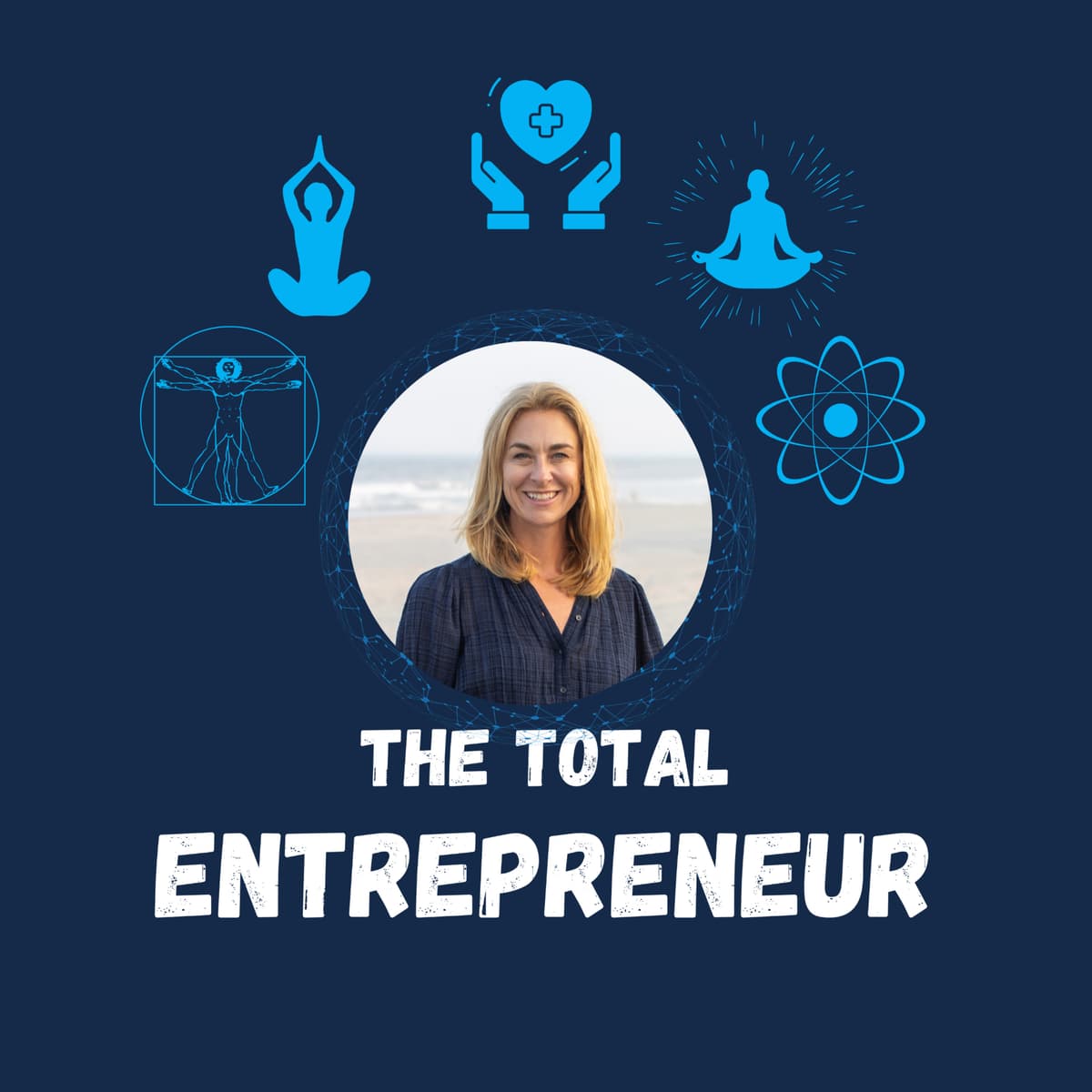
The Clarity Map: Tools for Growth, Connection, and Purpose with Lynn Mull
with Lynn Mull
Oct 3, 2025 · 00:35:32
Part of our conversations on
Today's guest is someone who has lived at the intersection of high performance and holistic living. Lynn Mull spent 25 years as a Wall Street executive leading people development, navigating mergers, and managing massive organizational change. But along the way, she realized that true leadership is not just about results. It's about alignment, clarity, and wellbeing. Now, as a holistic career coach, author, and leadership development speaker, Lynn helps leaders and teams humanize work, make aligned decisions, and thrive without burning out. She's the creator of the Clarity Map and the 24 Oracle Deck, blending practical business strategy with wellness tools like Reiki, yoga, and values-based coaching. In our conversation, we'll explore how to turn life's big milestones into empowering pivot points, the role of clarity in navigating complexity, and how leaders can stay grounded while delivering results. Whether you're building a business, leading a team, or simply trying to balance the many roles in your life, this episode will give you tools to make work and life work together. Welcome to The Total Entrepreneur Mind, Body, Spirit, where we turn cutting-edge science into practical strategies for entrepreneurs. I'm your host, Dr. John Torrance, entrepreneur, Inc. 5000 honoree, and professor of entrepreneurial practice at Syracuse University's Whitman School of Management. Each episode, we dive into mental, physical, and spiritual health with expert guests offering actionable insights to help you thrive and perform at your highest level. Let's get started. Lynn, welcome to the podcast. It's really great to have you.
Thank you so much. Happy to be here.
So tell us about your transition from Wall Street to being a holistic career coach. That's very interesting to me. I'd love to hear more about it.
Absolutely. I often think that people see my journey as very sudden or the typical leap in air quotes, but it really took a long time for me to get to this place. So, for anyone who's thinking, I need to make a huge shift, I think it's often easier to work behind the scenes. So, I was working on Wall Street, both on the West Coast and the East Coast. I was traveling constantly. Doing post-merger integration, team meetings, big conferences on stages, a lot of operations work, a lot of efficiency work, but a lot of people work ultimately. So when you're in those big environments, you're constantly navigating different styles of communication, different ways in which you operate as a team, and how to change people's perceptions in order to make huge change management decisions from whether it's regulatory or industry-wide. And what I realized is that I love working with different types of people. And I also love transitions of people. But as I was working in my 30s, my mom was diagnosed with stage 4 colon cancer. Now, she's well now and is a medical miracle in many ways. But she Her illness woke me up to a real life or death. What am I doing here? And as you might suspect, or people have read or heard about or heard me speak, I was in a very codependent and abusive relationship with my work. It was very, very toxic. I learned a lot, and I don't regret a day of it. However, the environment was so, so, so all the time. A lot of verbal abuse, and I never had a break. I would get sick very often. So, all this is transpiring, and one of the other trigger points for me was that my boss was murdered, my last, one of my last bosses, by her husband. And between that, my mom, and realizing how intense this job was at all times, and that I would never get a break, I really started to look inward and say, well, what do I want? Do I really want this promotion? Do I really want this next job? Do I really want to relocate? Do I want to be on planes every day? And what's most important to me? The flexibility of being able to care for my mom and my dad and my sister going through this cancer transition. So, I peeled back the layers. I hired a coach and I started to say, I love people. And I took a coaching certification course, which I adore, love, and I could use it even if I wasn't in this industry. And I just kept moving along and started my own practice after working. It was 5 years, John, soup to nuts from when I had this idea that I need to leave. This place is toxic. I could really, really injure myself internally or externally. And I was a shell of myself. I didn't recognize myself. And I wanted to get back to the core of who I am and have high impact and a lot of purpose-driven.
Wow, that is, that's quite a journey. Now, how old were you when you made that decision and you started that 5-year transition?
Well, my mom was diagnosed when I was 32, and I finally left. There was a huge chunk of time where it was just about cancer treatment, but I really, I left at 45. I left Wall Street at 45. So I would say about 8 years from thought I got serious about 5 years of real training, trying to figure out what I wanted to do, who I wanted to work with. Did I want to work with kids? Did I want to work with teenagers? Did I want to only work with women or men? It was really that time of experimentation.
And there's probably this tension between, you know, the fact that if you stayed with what you were doing, you could keep making more money and getting promoted and have that I guess, external corporate validation compared to just going off on your own into the abyss and not knowing how you're going to make money. So I think that I hear that a lot from people who are in that very position where, yeah, they'd like to go do something, but they've come to rely on that income so much. Were there times where you just thought, you know what, I got to stick with this because I need the money?
I did. I had a milestone that I wanted to make. That allowed my some of my bonuses to vest. I was in finance, so I was very practical. My dad was in finance. We talked about money at the dinner table growing up—not exactly dollars and cents—but that my kids are playing the game of life right now a lot this summer. And so, you know, do you buy the insurance? Yes, you do. Like we had these conversations about risk reward. I do think you need to get very practical about. the finances of it. And with healthcare costs rising in the US, like, what do you need? What can you agree upon with your spouse? And is there a transition that makes more sense? Is there a weaning out or a part-time or a transition into something where you could still have income that you can count on that makes, makes sense? Do you need disability insurance? Like, there are very, very practical ways. And then there's this other side of me that's very spiritual and believes in abundance and the magnetism And what you put out, you can get back. I'm also very thoughtful about my relationships. So who can I call on? And as you know, you're leaving, you don't have to tell anyone. But making those significant connections, both in your current job and in your current industry, and then also externally start to build those relationships. That's why how I use social media, people hate it, and I use it to connect. I use it to build relationships that are significant to me to help my career prosper.
Thanks. I'm really interested in that transition. That story that I hear often is, it's just, yeah, it's fraught with, it's fear. Like that's probably the driving emotion I would imagine, but maybe some excitement as well. So did you have to kind of get your house in order? Like did you decrease expenses? Did you simplify your lifestyle or did you just go into it saying, hey, I'm going to, I'm going to make the most of this and I don't really have to do any of that?
So it's twofold. I, you know, we've got 2 kids. My husband is self-employed too. So it was a lot of, I would say, conversations and continued conversations. The real nuts and bolts of it is having those tough conversations with my spouse about money, budgeting, what projects are we putting on hold. We were about to buy a rental property that we pulled back from. As I was transitioning out, I do think we could have made it work. However, the stress and the strain we decided wasn't worth it on our relationship. We have two kids in school; they are going to go to college. I've got two girls saving for weddings, right? Like what are is going to? Are we going to continue to contribute to five twenty nines? Are we pulling back? So we pulled back on some of that example vacations. We often stay with family, friends, rent houses instead of hotels. We traveled, for example, with my husband this summer to Montreal on a work trip and made use of that hotel space. So we are still working to be very fiscally responsible. Are we saving as much? No, we're not right now. And that's okay. We know we're in a build period. And then I did have a medical— I had 2 surgeries. One in September of '23 and one in December of last year that took me out for a while. So what does that look like? How do we cut back on expenses? How do we not travel? I want to explore with my family, but maybe it's a trip into Philadelphia or New York City, which aren't that far away, versus a trip we took 4 years ago to California and did a whole road trip. And we're just being really thoughtful and having really tough conversations. I wouldn't say tough.
They're very uncomfortable. Yeah, I could imagine that. So we're— I want to talk about your, your spiritual work and your Reiki and that sort of thing, but were, were you always that way or, or were these skills that you developed along the way or how? I, I, yeah, I'm interested in if you were built that way or if it's something you just developed.
I'm going to go back to one point on the financial piece is that you have to both be in the mindset, whether you're in a partnership or not, you have to be in the right mindset and time block how you're going to communicate. So, I do structure that. It's not at night when we're both tired. It's not in the morning because I'm not a morning person. So, it's like we set a lunch date in the house. We both have our laptops up. We have notebooks out. We have statements up. We are in it. And we do it no less than quarterly, but it's often monthly. Now, the summer's a little tricky. So, I just want to say structuring it Bless you. Structuring it is, is the best way. So to go in from finances and talking about nuts and bolts of adulting to spirituality, when I lived in California, I really had some deep experiences through— I started yoga when I was 24, living out in San Francisco and Marin County. I had very prolific experiences amongst the redwoods, but I don't know that I knew what it was. But through yoga, I learned to hear myself think again and to feel my energy. I've also always been hyperintuitive, didn't know what to call it. Came to New York, was so stressed out by the energy of everyone. Such a vibrant city, beautiful city, but New York is vibrating literally from the ground up, people, and I was exhausted all the time. So I really wanted to find a way to harness that energy and started to explore. I'm a big reader. And a big lifelong reader. And so that just, it's a journey. I followed breadcrumbs to Reiki training and I have some really wild things that happened in my Reiki training. I heard tongues. I saw images of ancestral women. I really became open to a whole new world. And for a long time, I didn't talk about it. It was like my own gifts that I kept to myself. And now When given permission or in the right setting, I lean on those clairvoyant, clairaudient ways to connect to higher powers. So no, I think I always had a piece of it, but tapping into it's a whole different game. You have to, I think, be willing and open.
That's what I've heard from a lot of people is that, you know, everybody can do this, but you've got to be able to, yeah, to tap into it and find that. Yeah. So you mentioned you're an avid reader. What, what are some of the, your biggest influences or what are some of the books that you think have had the biggest impact on you? So I'm a big reader too. And so I always love suggestions.
Yeah. I think that's my, the reason I started Reiki was my now Reiki teacher, Kelsey Patel, wrote Burning Bright and it's a real broad brush on wellness. So it's, got all sorts of, I would call them little recipes and ideas on how to start. I'm rereading The Women Who Run with the Wolves, which is very much about coming out of masculine, the environment I was in, and into the feminine and allowing myself to feel that. And my latest favorite, I would say in the last 1 to 2 years, is Brianna Wiest. She is young in age and old in soul. She writes so wonderfully, very poignant. And a lot of her books are the type where you can turn a page and feel into that. I could go on and on, but I have a list. I have a list I capture too. But yeah, I love—
Yeah. What are you reading lately? Like, what's on your nightstand now?
I just finished a summer read, but I I am really loving Permission to Rest. I go back to that book all of the time. And then Almost 30, my friends Linda and Christy— Krista wrote a book about being almost 30 and the transition from 20 to 30. And I joke, I'm gonna write Almost 50. And even though it's about— I'm closer to 50 than I am to 30, the themes still apply. How do you go through a big transition? What are you going to do to support yourself? How are you going to ask for help? A lot of people forget to ask for help. They think they have to go through these major life transitions alone. And whether it's friends, accountability buddies, going through it. And my last really amazing book, which I was lucky enough to get a reader's copy, I can send you one. I have a couple of extra, is Lovable by Amber Rae, and it's a memoir about a lot of things, but moving out of the shoulds and into living your best life.
It's for anybody at any point, right? So, yeah. Well, right. So let's turn to, to some of the work you're doing now. So you, you talk a lot about humanizing work as the example, right? So what does that mean in practice for leaders, organizations?
I think for leaders, and I really hone in on— I've led many a group. I led a group on Saturday night and I do love group work. But I love getting one-on-one and opening up people's ability to tell their truth, test the stories in their head. For leaders that I work with still in the C-suite on Wall Street or Wall Street adjacent, I'm also working with a lot of folks in the medical field because they're also at a huge level of burnout as the medical industry is in a real tight spot. A lot of doctors, nurses, and administrators are getting squeezed with their time and being told they're widgets. So, I work with a lot of C-suite women who are so burnt out, want more, and yet they can't for one reason or another, or they have deep degrees and they're like, listen, I'm not leaving this industry. I'm going to ride this out. So, a couple of things I do is Focus in on how you want to show up as a leader. As a Reiki master, I focus on how your energy moves 6 feet around us— up, down, left, right. And how are you going to project your energy in the workplace? Now, if you're in a big meeting and you're on stage and you're about to present to the board, are you going to, you know, talk about manifestation? Probably not. But how are there ways in which you can soften, especially as a woman, and even a man by asking more questions, by allowing time in meetings for a real catch-up. Like, what do you want to do in this space? It's halfway through the year. What do you want the next half to look like? Or we just called everyone back to work mandate 5 days a week by September 1st. How is that going to impact your family and your nervous system? So, having those deregulated, lower-intensity conversations It's not only providing you space and your employees space, but it's providing that deeper conversation to connect. Those are the relationships that will continue on whether you stay at the job or not. So, I think it's really giving yourself time and space. It doesn't have to be every week. But those check-ins are a very easy way for any executive to make time. And the good ones do because a lot of the work incorporate in these bigger environments. It's a lot, very repetitive. So you could slough off at least 4 hours a month to connect with staff.
So I wanted to talk about the clarity map and the 24 oracle deck specifically. So first, let's, let's work with the clarity map. So what was the inspiration for that and how did you develop it and how do you use it in practice?
I do a lot of visualizations, whether it was from my youth, all the youth sports and into college, thinking about literally serving the volleyball over the net. And I didn't realize not everyone does that. So through visualization, a lot of times I take people on a journey and I say, you know, we're in a forest, we're on a road. What does the road look like as we're doing Reiki sessions, both virtually and in person? Or I'll do the same thing when I'm coaching an executive, like, how are we going to take this path? So a road is a very easy metaphor for people to get behind having that inner compass. And that's ultimately what I want is people to hear themselves and their own decisions and being able to drop into what they know. So the map is all of my best tools and it is $24. It is editable. It is downloadable. I've printed copies if people want those too. And it's a way to take and distill. And basically I use it with my coaching clients together, but people can also self-service. There's a little map just like we have on Maps that has the icons. It has a legend. And everything from values-based work to, hey, I'm in a really shitty place. I call it the dip. It's like the rocky road and you're going off and that those little bumps on the side of the freeway are slowing you down. And just admitting that like, hey, this is what I'm learning in this really hard time. So, it's documenting the moments to get to clarity. The best part of that, I'll say, John, is both the feeling and what I've what I've created is the Clarity Tumbleweed. So it's the experience of when you get clear, that's when the abundance— that's what people call manifestation— things start to happen. So when you're clear and you can say, I am an intuitive, that's when those type of clients come in and you start to see real progress. And it's fun to watch, fun to feel.
See it before you can be it. And I think just, you know, giving that journey, right? Because I was looking at the tumbleweed, right? So yeah, you've got this whole journey where it's vision, values, priorities, values in your why, priority, the non-negotiable. It's a really interesting and cool tool. I love it. What kind of response have you had from your clients when they work with it?
We all are in our heads so much. I don't know if it's this space we're in in the universe or just humans have just gotten to overthinking. And It's a way to put it on paper and then to go back to it and reference it. There's so much science, as you know, and talk about the science of writing things down. So, and oftentimes I'm typing them out, but it's, let's get really simple on this stage or people future cast. They're like, oh, well, I want to be, I always say, I want to be patient. I'm not patient. Maybe I'll never be patient. I'm trying. But like, what am I, what do I need today? I have a friend who knows she wants to get a master's degree, but she can't. Her, her, Her family life is not such that she can do it, but she could take one class. She can't go full-time to get a master's. She can start her journey in a different way. She can work part-time in a place. So it's about what do I need right now? And people love seeing it. They absolutely love seeing it on paper. It's also easier to create boundaries. People are like, well, I said no to that because it's not on my clarity map right now.
That's great. Let's talk about the, the, is it the 24 Oracle deck, right? Or is it the Oracle 24? I think I've got that right. 24.
The 24 Oracle deck.
That's cool. And, you know, I, I imagine like you might get some weird looks the first time you break that out. I don't know. I'm guessing if you do that in a corporate environment. So talk to us about that. To me, that seems really interesting.
It's a really good icebreaker. So whether it's at a girls' weekend or in a conference room, the 24 Oracle deck, uh, 24 is a very important number to me. I was born on the 24th of November. but also there are 12 new moons and 12 full moons. And so the ability to recognize we all go through phases. And very often we don't see the transition of the moon or the sun, it's all behind clouds, or it's in the night sky, it's just these minuscule little changes. So knowing that everyone is phasing, including Mother Nature is going through phases. It came to me in a complete divine download, which sounds very woo, and it was. I took a night alone at a hotel as I was leaving just to regroup, and I wrote the entire deck and designed it in about 24 hours. So all the things combined, it's about— oracle has no rules. It's not tarot, it's not future telling, it's a way to anchor to your thoughts. And I don't know if you've used them regularly, but I used one every day in COVID when I was very scared and confused and A really great way to anchor. There are prompts in the little booklet, and it's a very simple deck because I wanted— people's minds are so busy, like I said, you know, it's very simple designs. You can come up with your own interpretation. So it's just a way to take a breath, pull a card, do the prompts, and you can do it as a team to strategize. You can do it as an icebreaker. You can do it at home with your kids. I do it before I work with clients.
So, it was the permission to live in the and. And I see you've got the ampersand sign behind you there. So, I think I get that. I mean, it resonates with me for sure, but I'd love to hear your interpretation of that.
I know. I even got an ampersand tattooed on my arm. It was so significant. In Wall Street or in my 20s and 30s, my adulting alone, it was always like, yes or no, I'm going to take this job or I'm not. for this director title or I'm not. I'm going to get fired or I'm going to get hired. I'm going to live in this apartment or I'm not. It was very much a black and white way of thinking, whether that's how I was raised or it's just who I am. I was— and listen, Wall Street's very, here are the numbers, here's your budget, let's go. Here's the deadline. And over time, you realize that there's so much in between, so much gray. And how do you come back to that? So, as we start to spiral out, I often start to work with people who are very, very stuck. And that stuckness can come and overthinking or underthinking. It's like, what is true for you? And what's a way to come into the middle? So, are you really going to get fired from an email? Probably not. Like, let's come back to our center. And if you are stuck, what are you learning in the stuckness? So, taking the piece of exhaustion and stuckness and opening it up to have a different conversation. It's learning to love the and because that's really why we're here. And that's what life is. It's the good and the bad. And I also no longer, Jon, wanted to feel guilty about having a good day. I wanted to be having business success, even though before we started recording, I talked about my dad having a heart attack this spring. It's like, I had a great week in business the week my dad had a heart attack. And I wanted to hold both. I wanted to hold the sadness and the success and be okay with it. And so, it's that deregulation of the barbell effect and coming into the middle.
So, it seems to me like your background with yoga, Reiki, some of the other things you've done, and I mean, we haven't even really gotten into the download you got before you did the 24 Oracle deck, which is very interesting to me. I've talked to other people who've had similar experiences. Can you talk a little bit about that? Like, where were you, what you were doing? Um, like, how did you know? Like, yeah, just what was happening in your body, uh, while this was going on?
So I had— I'm a big journal— I have a lot of journals. If anyone ever wants to get me a gift, get me a cool journal or a book. You know, I love that. And I had traveled a ton by myself through work, and so very comfortable traveling alone. And I was getting As my deadline to leave work was getting a little delayed for one reason or another, I started to get very depressed and I was like, I just need to go away by myself. I had young kids. I was like, you know, John, thank you. I need 24 hours. So I booked a great little hotel and I took a journal and some markers, not really sure of what I was doing. My rules were no TV, no down, you know, no Netflix, no whatever, Bravo, nothing. Just chill out, be with myself. I made a dinner reservation to go out by myself. And that was sort of it. I wanted to take a walk. So I got back from the walk, and I started journaling as I did often. And then I ended up needing bigger pieces of paper. And so I started doodling out these words that have ended up on the card. And the first card was about the redwoods, which is— I had a very prolific experience around how redwoods grow. They grow in a circle. And as the older ones pass away, they allow the nutrients to be absorbed from them into the younger redwoods. And I just kept writing. And then I went to dinner because I got hungry. And the waiter said, I'll never forget, the waiter said, oh, are you a writer? And I said, I thought to myself, not, not really. But yes, yes, I am. I am a writer. And I never stopped. I literally couldn't stop the project if I tried. I just— and everything fell into place. The printer, the woman who took my doodles and made them into a file that the printer could use. It just— I had never had one roadblock. And even now when I look back, I can't believe what I wrote in the booklet. It— I'm like, wow, that's good. That's a good prompt. Where did that come from? So I barely remember writing it. If I'm being honest, maybe another deck is in me. I don't know. We'll see. I'm playing, I'm playing a lot more with animal, animal guides right now are really coming through quite a lot. So I don't know. We'll see.
So let's, I wanna talk about Reiki a little bit and the application to business and life. Um, you know, I think nowadays it's, it's perceived as less woo than it might've been. And I love your story cuz it's like from Wall Street to woo. I mean, even though that's not what you're doing now, it's like kind of, it's, yeah, it's what it feels like, right? So when did you, when did you start studying Reiki, practicing it? And have you had any really interesting experiences with people on your Reiki table?
I have. So Reiki is, for anyone who doesn't know, is the Japanese art of energy healing. And it is not a religious experience, but very spiritual. And like so many, there's a story of someone having the ability to heal without touch. They're using their hands. a lot of leprosy in Japan at the time. And then a female, which I also love this part of the story, brought— she was a student of the Reiki master Usui. She brought Reiki to Hawaii and therefore the US. She was healed through some other ailments and back issues. So I love that a female brought it over and, and made it a usable art. People are so stressed out. They are now commuting again. The pressure is high for growth in capitalism, which I appreciate, admire, understand completely. The phones make us 24/7, all things we already know, but we're living in fight or flight. So, for me, Reiki is a way to calm the nervous system. And one of the easiest ways that I tell people is to do a body scan. Close your eyes. You can do this at your office. Don't cross your legs. Don't cross your hands. Put your feet on the ground. You can have your shoes on and just take 10 breaths and go from your toes to your crown. Front, then go down your back and say, where do I feel stuck? What feels hollow? And that's an easy thing to do in the office before you're about to present. Where do I want to show up differently? And whether you look it up on the internet or Instagram DM me, there are parts of our body that indicate different things. So the throat, obviously, how we're projecting what we think and feel. The back of the neck. how we talk to ourselves. And some people, I think everyone can do a body scan in their mind's eye with some ease. People do it a lot before bed anyway. Like, where am I feeling good? Where am I feeling off? I think in business, it's about also a lot more people are visualizing. The athletes are all talking about it, but a lot of CEOs are hiring meditation coaches. They're hiring visualization coaches. They're bringing in people to do energy healing and group work, whether it's a group of lawyers or a women's network, to really center yourself. Because if you don't fill your cup up, if you don't put your oxygen mask on first, even for 5 minutes in the office, you are not going to show up as your best self in that board meeting, in that presentation, in that tough negotiation with the OCC regulators, whatever it is. So I think it's being practical about Reiki, and I've just been doing it since COVID and I believe it. It's changed my life to the point where every time there are four steps for me, and every time I did a step for months after, people would say, "You look different. Did you have something done? Did you color your hair? Did you cut your?" I'd be like, "Nope, nope. It's just a higher connection." And I grew up Catholic. I had that as part of my structure, and I can say that I've never had a stronger connection to universal life force energy. I use the word God. I've never had a stronger connection and feel more supported, even through my surgeries, even through hard times, even through my dad's heart attack. So I feel very supported and blessed to have that through Reiki.
So switching gears a little bit, you know, given your background on Wall Street and the work you're doing now, Where do you see society going in the next few years? Like, I mean, this is a topic I love to talk about, but I'm super interested in your take on it.
Sometimes I have a hard time with this because I can get really overwhelmed by the thoughts about longer term. But if I think about the positive, if I think about acceptance of different modalities, and I do believe the West Coast and a lot of Europe, right, they're leading the charge. I'm on the East Coast now and I see a little bit more resonance residents that there are people are not really sure how this all works. But I do believe that there's a more of an acceptance of Eastern modalities that can support Western modalities. So for example, I did have to have surgery. I went to a Western doctor and then I proceeded to ask help from acupuncture, a hormone doctor, all these things. And then also Reiki, also working with a spiritual teacher. I think it's going to blend. I think it's going to— my wish, I'll tell you my wish. I don't know what's gonna happen. My wish is that a lot of this is covered by insurance as both preventative and is more easily accessible to everyone.
Yeah. I feel like people are, at least on the East Coast. Yeah. Maybe they're a little bit behind and like you said, Europe or the West Coast, but I feel like there's more acceptance of this. Like, you know, we probably wouldn't have this discussion publicly 10 years ago. Right. I mean, I don't know if I would, maybe you would, but Yeah, it seems to me like things are, things are moving in that direction. And especially the young people that I work with, I feel that there's more of an acceptance and more of an awareness about it anyway.
Yeah, I agree. I agree. And for me, it's about if you're open to it and if you want a Reiki session. And people say, like, I've never done this. I've heard about it. Worst case scenario, you get a 45 to 60 minute rest nap. You know, you get, you get to chill out and not be on your phone for an hour. What's better than that? And a lot of people see images, colors, there's so many things that can come through. Some people laugh, some people cry. I have a friend, I keep seeing hummingbirds for her. And it's, I personally see the number 24, 42. I see my birthday all the time. So I feel that once you connect in, you also just feel a lot more supported. even when things are going sideways on, on Earth, you can feel that there's a bigger connection.
For sure. Well, Lynn, if people are interested in learning more about you and the work you do, how will they find you?
I'm on Substack under Lynn Mull. It's very easy. My website is lynnmull.com, and then Instagram is @_lynnmull. And if anyone references hearing our conversation, And uses the code TEN spelled out, T-E-N, they can get 10% off the oracle deck or the clarity map. So, please reference it.
Amazing. Thank you for that. And thanks for a great conversation.
Thank you so much.
Thank you so much for listening to the Total Entrepreneur Mind Body Spirit Podcast. If you liked what you heard or heard something interesting today, please give us a like, share a comment, or better yet, subscribe to the podcast. Thank you.
About This Episode
From Wall Street executive to holistic career coach, Lynn Mull shares how clarity, financial planning, and spiritual practices can transform both life and leadership. She introduces tools like the Clarity Map and 24 Oracle Deck, designed to help individuals and teams align with their true purpose and build deeper connections at work. Discover why humanizing leadership, embracing transitions, and integrating wellness practices like Reiki are essential for sustainable success in business and beyond.
Learn more about Lynn Mull here: https://www.lynnmull.com/
Episode Chapters:
00:00 - From Wall Street to Holistic Coaching
09:58 - Navigating Financial Transitions
19:28 - Spirituality and Energy Work in Leadership
28:46 - The Clarity Map and Oracle Deck
35:14 - Outro
Keep listening
More on Business
About the Host
Dr. John M. Torrens
5× Inc. 5000 entrepreneur, Professor at Syracuse University's Whitman School of Management, author of Lightning in a Bottle, and TEDx speaker on ADHD as an entrepreneur's superpower.
Browse all podcast guests →Book a strategy call →