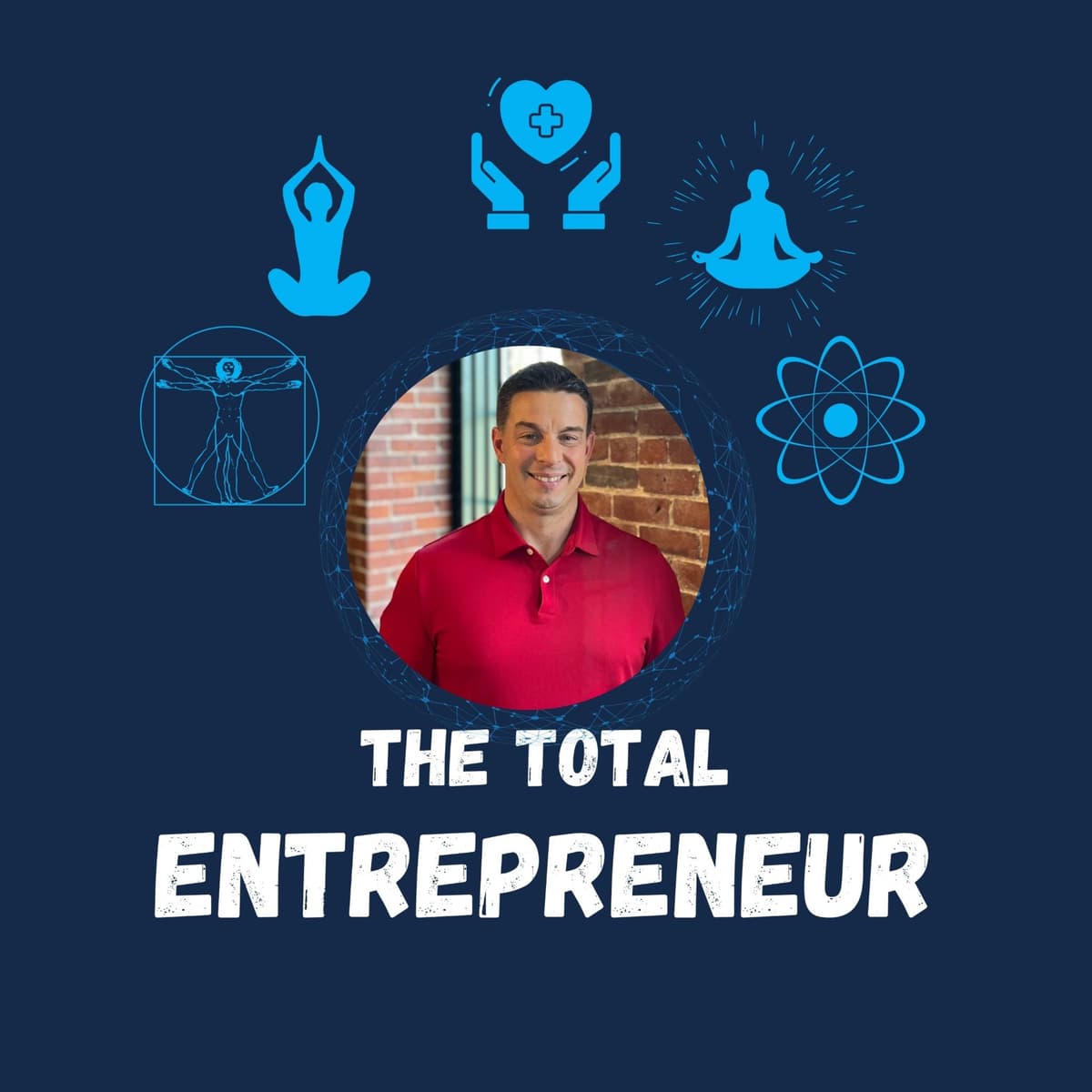
Stay Fit for your Business with Eric D’Agati
with Eric D’Agati
Apr 25, 2025 · 00:37:05
Part of our conversations on
Today's guest is Eric DiAgati, who has spent the past 25-plus years in the fitness industry as a coach, trainer, and instructor. Each year, Eric travels around the world teaching and speaking to trainers, coaches, and therapists as a lead instructor for Functional Movement Systems. And he's a guest speaker for such prestigious organizations as Mount Sinai Hospital, New York University Medical Center, the Navy SEALs, the Mayo Clinic, and multiple major universities. Eric also appeared in the New York Times bestseller, The 4-Hour Body by Tim Ferriss. His list of training clients includes individuals who have been Olympic gold medalists, All-Americans, national champions, World Series champions, and Pro Bowl athletes. He also works with many high-level sports teams at the high school to professional ranks. Eric also serves on the advisory board for OnBase University, the Baseball Health Network, and the Raritan Valley College Exercise Science Department. His latest projects include Principles of Program Design, an educational workshop series and coaching service for trainers and clinicians on the art and science of designing training programs. In addition, Eric hosts the Principles of Performance podcast, where each week he talks to leaders in the health, fitness, and performance industry. The show is available on YouTube as well as all popular podcast streaming services. Eric also recently launched the Ageless Athlete Blueprint through Eterno Athletics, an interactive coaching program for athletic and competitive males over 40 looking to Welcome to The Total Entrepreneur: Mind, Body, Spirit, where we turn cutting-edge science into practical strategies for entrepreneurs. I'm your host, Dr. Jon Torrance, Entrepreneur Inc. 5000 honoree and professor of entrepreneurial practice at Syracuse University's Whitman School of Management. Each episode, we dive into mental, physical, and spiritual health for Welcome entrepreneurs.
I'm Dr. Jon Torrance. to the podcast.
I'm John Liebenfelder, and today we're talking about physical health and spiritual health with expert guests offering actionable insights to help you thrive and perform at your highest level. Let's get started. Eric, welcome to the podcast. Great to have you.
Thanks for having me, John.
Yeah, I was excited to talk to you with your background in physical health and exercise. And one of the things I know from a lot of my entrepreneur friends is that they don't bother with their physical health because they're just too busy with their business, right? They got a lot of stress, they got deadlines to meet, they got financial obligations. been successful in business, but I'm guessing you have a different perspective on that.
Yeah, unfortunately, when that bill comes around, it's usually a little, little too late, and it's, it's usually more than most people are willing to pay. And that's when the sacrifices are significantly bitter than the smaller sacrifices you can make every day that'll pay off in the long term. You know the old expression, like, eat an apple a day, keep the doctor away? Well, eating 7 apples on Sunday is not the same thing, John. And so this is not something we can necessarily You gotta make the minor deposits because they have much bigger dividends than trying to scramble at the end, because that usually doesn't work.
Yeah, you know, and actually that's a good point because I know in, in a startup scenario, right, you've got these major pushes where you just consolidate and focus all your energy on a major deadline or event. And then, you know, you slack— and not slack off, but you just relax a little bit, right? So I think that same idea translates to their physical health where they're like, all right, I got some time, I'm gonna run, I'm gonna eat well, I'm gonna do an ice bath, I'm gonna do all this stuff. for a week, and then I'll be fine. And I'll go back and focus on business.
It's not like getting your haircut where you do get it done and you can, you know, come back 2 weeks later. It's cumulative. And that's what most people don't get. They think of it in isolation and in a silo. And it's never been one rep, one set, one workout. I've never had anybody of all the jerseys you see on the wall behind me, nobody ever said I won a World Series or a Super Bowl because of that one workout that I did in October 2021. Like, that's not the case. It's cumulative. And so it's about— I'd rather have Not the greatest workout in the world but a good workout that's done consistently than something that's great and that's magical. And so we're looking for this magic, okay, formula of whatever this influencer told me of this magic morning routine when the reality is that's like for someone that's got to be on meetings by 8 or 9 AM, they don't have time for a 4-hour morning routine of ice baths and meditations and grounding and all that stuff. It's great in theory and any one of those things does have benefit. But, we have to pick and choose, and prioritization is probably the biggest missing thing that's lost in taking the big picture, the 30,000-foot view of how you actually optimize your health and wellness and performance.
Yeah. And, I think there's a mentality where if you can't go all in or you can't go big with it, then it's not even worth it, right? I can't spend an hour in the gym, so I'm better off just not going and focusing on something else.
Yeah. And unfortunately, the research doesn't back it up. The research shows that doing as little as some air squats every single hour has almost the same impact as if you were to do 30 minutes on the bike at the end of the day. There's research that shows we can get these small little exercise snacks that we can put in throughout the day. And the reality is that this whole concept of even wearing a special outfit to go drive to a special place that's confined with special meters that tell me how many calories I burned and how much— all that has been fabricated by my industry. And we've done a really lousy job of packaging fitness for you. And if you go back hundreds of years ago, there were some really fit people who didn't have access to any of this stuff because we just moved more. The only reason that we've packaged it down is because of the way that the modern workday works, is to say the only way we can do this realistically is to package it into smaller packages. But, you know, even the research shows if you took 3 10-minute walks first thing in the morning, at lunch, in the afternoon, it's actually not only just as effective as doing a 30-minute walk, but the people who do that have higher compliance. And that's a As I said, the bigger thing than actually the intensity. Consistency will trump intensity any day of the week.
Yeah, so let's talk about walking because I think it's enjoying a little bit more of a higher profile than it used to, right? Because even like 10 years ago, you know, taking a walk didn't actually seem like it was exercise or physically helpful, right? But the data is pretty clear that walking is key.
Okay, so we have to take some context. First of all, the fact that walking's cool, you know, and trendy— like, the Stoics talked about the power of a walk and thoughtful walks, you know, thousands of years ago. This is nothing that we're inventing here. And then it depends on what bucket you're putting it in, right? So there's lots of things that, that come into fitness. And so when we think that one thing will do everything, that's where we fall short. So we think that, okay, if walking is going to give me great cardiovascular fitness— Walking's going to give you a little bit more of a metabolic effect. Like, going for a walk after dinner helps with digestion. It's going to help with you better settling that meal. Walking is going to have a little bit of metabolic effect. It's going to have a little bit of cardiovascular effect for the low-end benefit of a base. But is it going to get— is it enough to give you a well-rounded cardiovascular fitness? No, it's not. Just like yoga is fantastic, it's great for mobility and stability and building base bodyweight strength, but is that going to make you— you know, for one of my professional athletes, is that going to be enough to make a professional athlete? Absolutely not. Your yoga instructor is the least powerful, slowest person in your town, but they move really well. So, understanding that Fitness is not just a thing, and even strength is not a thing, cardiovascular. There's components of that, and understanding it's just a checklist. It's a checklist of what are the things that kind of are going to get me a most well-rounded— resiliency is really the best thing we're looking for— that I'm adaptable to any situation. And we're not really good at that. We're good at 72 degrees and carpeted and comfy and cozy.
No, that's a really good point, and I love what you said about it, you know, not no one thing being the thing, right? You need a balanced approach for sure. Yeah. So, speaking of a balanced approach, like for early-stage entrepreneurs or even entrepreneurs in rapid growth mode who are always short on time, generally stressed, have a lot going on, is there something you could prescribe to them that maybe would at least check the boxes at a minimal level and give them something to work with?
Yeah. So, let's talk big picture and then we can keep zooming in. So, the way the system I like to use with people is I say there's, look, 3 big things. And I like to do things in groupings of 3. So, the 3 big things and categories we got to look at is move. We got to do something to move. We can't just sit around all day. You're going to be more productive if you can take your calls walking, if you can be on your feet. Anything that we can do to just move, take the stairs instead of the elevator, is going to be helpful. Now, we can obviously get more specific and we can break each one of these big components to smaller components, but move is, is a big one. Figure out a way to move more than you do now. The second thing is we need to fuel. Now, fuel is obviously what we put in our body. Most people think of nutrition, which is a huge component of it, and that we, you know, you can't run on poor fuel. So, we can't go on, you know, whatever you're going to grab out your car window and expect for you to run optimally. So, we want to make smart choices in terms of fuel, and fuel also includes hydration. But fuel also includes what we get in our eyes and ears, John, like what we, you know, social media we follow, the books we read, the TV we watch. Like, nobody ever said— You know, I feel so much better after scrolling Twitter for an hour. Like, we have to understand that there's certain things that are going to drain from our energy too, and we have to be smart in how we utilize it because there's only so much of it to go around. And last but not least, that's the big part, is reset. Is that we don't grow from the challenge, we grow from the response to the challenge. Like with exercise, I explain to people it's like seeds and soil. The exercise is just the seeds. The soil is what makes it grow. So, if I plant seeds in a hardwood floor, nothing's going to happen. If I now need fertile soil, what is that fertile soil? It's your reset. It's your sleep, number one. Okay? So, the heroicism of getting up at 4:00 in the morning, going to bed at midnight sounds cool, but sleep is where our brain gets to recover and gets lathered in all these chemicals that help it reach. So, you're going to lose— you're not going to be as sharp the next day. Your nervous system is downregulated. Everything that makes you sharp. Has now just been tuned down on the dial knobs when you don't get that sleep. And then, when it's not sleep, it's just something as simple as taking some deep breaths and resetting. And, we can go into the whole thing of how our nervous system works and how that works, whether you're sitting in a boardroom or you're outside exercising. That is the main manipulator of— it's going to determine how we feel, how we operate, how we optimize all of our performances wherever it is.
I think that's great. Yeah, great advice for sure. So you mentioned working with elite athletes. And so last week I spent a couple days at NFL Biz Week where we were just teaching NFL players about, you know, how to manage their business after football, right? But what I was struck by is the mindset of being an elite performer, right? So, so when you get to the NFL, you're like part of the 0.1% in the game, right?
Yeah.
And I was struck by how much that mindset transfers into everything else they do. So I know you've worked with elite athletes. Can you talk a little bit about what you notice about these athletes that makes them operate at that level? Like, what do they do? What's different about them from the average Joe who never gets to that level?
Well, the first thing, let's be honest, John, it helps to pick the right parents. Like, DNA does matter. I'm never making it in the NBA at 5'6. But once we get past that, the biggest thing— and I've seen this across all levels, doesn't matter the sport, and even if it's outside of sport, the people who I train who are insanely successful business people, is there's certain non-negotiable habits that they have that they don't deter from, right? And so whatever that is, is they say, look, this is going to happen no matter what. And that gives them some sense of purpose and direction that kind of guides their day. If they don't have that, it's very easy to get distracted, especially when I've seen— when I worked in the NFL for 9 years, it's really easy to get distracted by the shiny stuff when you don't have core principles that you're going by, and your principles are based on your habits, your actions are based on that. So having that set of non-negotiable habits, and whatever that may be, whether it's like, I, you know, every night I have a mobility routine before I go to bed, or every morning I take 10 minutes to focus on doing some meditation, or every day I have to get this in because that's part of what makes me. And if you don't have that, then you're a ship without a sail. And so that's the toughest thing because it gets so easily distracted. I know as an entrepreneur, I have a to-do list of like 1,000 things on my whiteboard, and if I focus on 1,000 of them, I'm going to get none of them done. But if I can have— if I say, look, I know that I'll get this, and then I'll get to this, and then I'll get to this. But if I don't have some habits that kind of steer me straight, it's almost impossible.
No, that's true. And you know, it At the risk of becoming boring to your friends, right? I guess it's just a matter of knowing what you value and prioritizing that. And I think the idea of non-negotiables is key, right? And I could see how that would separate them. Yeah, I mean, you know, when I was working with these players, you could see that, I mean, some of them are gonna just take that mindset that got them to the NFL and apply it to business, and you could tell they're gonna do good things. It was pretty cool.
On one side, you know, everybody kind of— I almost deter people away from like, The Jocko Willink thing of 4:30 in the morning and I'm up and there's a heroism to that. Well, like, that's not realistic for most people. Like, that's a special— Navy SEALs are a special breed. You can't think you're going to do what they're doing, right? But at the same time, his most popular book has a theme to it of discipline equals freedom. Like, when you say it's boring, that's just a matter of a certain level of discipline which allows me the freedom. So guess what? The discipline I have to make sure that I'm exercising regularly Well, that gives me the freedom to do a lot of things that maybe you can't when you don't do those things. So, if I go and go on vacation with my family and we go hiking through the mountains in Italy and get to see these unbelievable views and this breathtaking life memories, if they're worried about dad getting out of breath or his bad knee or his bad heart or those sorts of things, we never get to have that experience. But it was that little bit of discipline to make sure I got the exercise in that's going to pay me the dividends that allows me that freedom, that I don't have to worry about those kinds of things. And so, that's really how you have to look at it. Yeah, you have to need a little bit of boring. And if you looked at— everybody sees the NFL as the bling and all the exciting stuff, but there's a boring undercurrent to it. If you watch even workouts, there's sexy stuff you see on Instagram that looks cool and sexy, but if you looked at most of the workouts that I would do with a high-level athlete, 90% of it is relatively boring, that gets the clicks, but the 90% of it is just hammering the basics. And so you have to get good at boring.
Yeah, it's like it's an investment, right? And I think entrepreneurs understand the concept of investment. So you're— yeah, you're doing something now that maybe you don't like to do or you want to do, right? But you want to do what it's going to enable you to do later, like hiking the Dolomites or whatever it is, you know. So I want to talk about that too. I know on your website you've got some free content about VO2 max and things like that. And the more I read about it, the more important I realize it is. And it's a really good indicator of longevity. So could you break down VO2 max for us? What is it? Why is it important? How does one calculate it? And how do you improve it?
Okay, so it's basically, to not get too deep into the weeds, it's just a measure of your aerobic fitness. So we have different systems that we need to develop, you know, to be robust and resilient. We have our musculoskeletal system, which we get through primarily through, you know, strength training and good movement training. And then the aerobic system and their ability to deliver energy to all those parts is through our aerobic system. And we have to do that at different layers along the continuum so that the segment of that system that you use, if we're going to sprint up a hill, it's not the same if we were going to go, you know, jog a couple miles. VO2 max is your ability to uptake oxygen and convert it into energy. And so if you wanted to get it truly measured, You go to an exercise science lab. Most local hospitals have that. It's going to cost you a couple hundred bucks. They put a mask on. It's going to give you your oxygen exchange rate and those sorts of things. Does everybody need that? Absolutely not. There are some really good proxy tests that you can do that will give you a rough idea of where you are. So something as simple as a Rockport walk test. If you look these things up, basically you just— you're going to follow the test, you enter in your sex and your age, and it'll plot you a rough guesstimate of what your VO2 max There's something else called the Cooper test where you, for 12 minutes, you either walk or run, and it'll— you go into— there's calculators online you can enter, it'll give you a guesstimate. You could also do it on a rower, you can do it on a bike, and I have a whole free course on this that people can get. The main thing is that we want to look at where you rank in terms of the bottom end of this. If you kind of broke it into 5 things of like very good, average, not good, and the worst, is that the difference in lifespan from one level to the next is significant. Like, the difference in literally the years you will live, but also the quality of those years. They can actually predict based on your VO2 max when you can no longer live independently and you're going to have to have somebody help. It's crazy. And so that's just one of the metrics that we look at in terms of looking at how robust you are in terms of fitness. And then in terms of how you do that, you, you need a well-rounded training program. And so you need some low-end fitness Zone 2 has become a very popularized term, but it basically just means, you know, hey, we're working out together and we're on the treadmill next to each other, John. We know we're doing something, but we could still hold a conversation. We don't have to mouth breathe, we're not really killing ourselves, but we know we're doing something, right? That's kind of that low-end level. The middle level is where the sentences are getting a little broken up now, we're working a little bit harder, but we're not going all out. And then there's this top level where it's like, hold on, I can't talk to you right now, we're gonna go all out for like a minute. And we need to work both ends of it because, you know, we've heard stories where there's the marathon runner who drops dead shoveling snow because they can never handle that super high end. And then there's the weightlifters who get out of breath just walking down the street because they never work the low end of things. And so you need to kind of check all the boxes in the checklist to make sure you're well-rounded. So VO2 max is one of them. There's also some other really interesting measures that correlate with longevity, and not only longevity but also your healthspan, the quality of those years. And one of the ones that people don't— that are pretty amazed by is grip strength. If I measure your grip strength, because— and it's not so much the strength of your hand and your fingers and your forearm, it's an expression of how robust you are. And someone who's got a good firm handshake, who's got good strong grip, who could hang from a bar for a minute, right? Those are people that are people who are less likely to fall. And if they do, they're not going to, you know, they're not going to have the same effect of somebody who's a little bit weaker. So weakness is something that— and there's different components of that. There's sarcopenia, how we lose muscle every decade from once we turn 30. And then even more, it's something that people don't talk about, is something called power penia. The difference between strength and power— power is a time component. So strength would be, you know, lifting a weight from point A to point B. Power is, if I throw a ball, if I could then, you know, do something with some level of force. And you think as we get older we don't need that. Well, if you're going to go out in the pickleball court with everybody else over 40, you're going to need that. And you're going to need the speed to be able to react and slow down and change directions. If not, you're going to be one of the other— one of the millions of people that are in the ER with a torn Achilles or hamstring or ACL or something that you did because you didn't have the timing and speed to slow down. Or even as we age, When you step off that curb or you miss a step, can you get your foot down in time to save yourself so you don't fall? That's a speed component. That's power penia, and we lose power at twice the rate we lose muscle.
Oh, I didn't know that. I do know we lose VO2 max at a pretty fast rate for every decade over what, 40 or something like that, right?
Yeah, but here's the good news: a lot of that can change. There's been measures of female cyclists in their 80s who have VO2 maxes similar to men in their 20s. So I'm not telling you that you're going to go out and be able to be like you were in high school at 50 years old, right? But you can be way better than the people that are your peers, and you could probably be better than people a decade or two younger than you. Because not only do I have clients that are doing all the time, I'm seeing it myself. I still play in a 35-and-older men's hardball league competing against guys 15, 20 years younger than me and still being able to compete. Because of the little deposits I'm making each day and in my health.
Yeah, those little deposits are important. In terms of rough VO2 measurements, I use a Garmin watch like for my tri sports and stuff, and it has a VO2 measurement. I think mine right now is 44, and for a 58-year-old guy, I think that's okay. It says good or excellent maybe. But is that watch— is that pretty accurate, or is that like complete garbage? Or what's your assessment of how Garmin can assess VO2 max?
The wearables that you have available to— whether it's Garmin, whether it's Apple Watch, whether there's Oura Ring, there's Whoop straps, all those things— it is an incredibly exciting emerging tool that we have available to us. Unfortunately, because it's so new, the accuracy is not quite there. And I've even seen the accuracy improve dramatically since I started playing around with these things 10 years ago. So it's getting better every day, especially as there's more demand for it and the market share of those things keeps doubling almost every year. It's great information, but I wouldn't necessarily bank on that your score is what the same you would get if you went into an exercise science lab. Here's where the wearables are really helpful. It creates awareness, right? And this is where I tell people to use them. So, like, if let's say you wear an Oura Ring to look at your sleep, don't get caught up in saying when it tells you how many hours of REM sleep you had versus non-REM, like, that I can't tell you is going to be accurate because There's— you need to be in a sleep lab with actual, you know, patches that's reading your brain. But you can notice certain trends to say, wow, I didn't realize when I have that glass of wine at night, that really disrupts my sleep when I never paid attention to it before. Or I can start to notice that certain stressors are impacting me. So I do a little readiness screen with my clients before each session, and little things like how long you can hold your breath. Like if you just sit up, you ask somebody sit up tall and take 3 natural breaths, and at the end of the third one, Exhale, and once the air is out, pinch and hold your nose and time how long you can hold your breath. Ideally, we want to see at least 20 seconds, and really more so, we would like to see 30 seconds or more. This is another window into that autonomic nervous system I referred to earlier. If you think about what that is, it's— you have your fight-or-flight system on one side, and you have your rest-and-digest on the other side. So, think of a volume dial that goes from 0 to 10. Well, most People unfortunately kind of are living at the simmering 7, especially entrepreneurs. Like, they're constantly at this simmering 7 or 8. They never really get to 10, challenge themselves, so they don't build any kind of robustness by getting a 10 because if they're not training. But they also never get down to 0, and so they kind of burn out because they're revving at this high RPMs. Well, when I ask someone to do this breath hold test, almost all those Type A, like, high, you know, high motor people They're getting like— I've had people get 7 seconds, 9 seconds, 11 seconds. And so when we give them certain strategies to help them reset, to dial down, to get them to calm down a little bit, some deep breathing techniques, you know, maybe some type of meditation or visualization and get them to calm that down, it completely changes that. And you can see it happen in real time. I have a client who, he's in his 60s, and almost every time I test him, his breath hold times 40 seconds plus. One day, I see him before his session, and I see him outside the window, and he's super animated on a phone call. Now, that's not like him. And so he comes in, he's like, my effing partner, and he's had a super stressful, you know, call. Test his breath hold, and it's like 18 seconds. And it's like, something's different here. All right, we're not cyborgs. All right, so we have to also have a little bit of dynamic in terms of how we relate to that. So that is a little bit of a window into what kind of soil you're giving me to work with here to plant these seeds of training. And so yeah, it sounds great that I'm gonna do, like you said, the cold plunge and the 5-mile run and the HIIT workout and the hill sprints and all that stuff. But if you don't give yourself enough soil and things like your breath hold, your grip strength, your sleep, your— and I always say the big 3: sleep, stress, and nutrition— are going to drive how much I can actually challenge you. And so, with that, I can only challenge you as much as you're willing to accept that challenge. And, that comes down to what's happening those other hours of the day.
The message of resetting as just a really healthy part of a plan is really important. So, that breath-hold protocol again, just if people wanted to just informally assess, could you walk us through that?
Sure. So, you just sit up tall and you take 3 natural breaths. At the end of the 3rd breath, once you're done exhaling, you're going to pinch and hold your nose, and you're going to start a timer. As soon as you feel the urge to breathe, breathe, and then hit stop and see where you're at. Again, 20 seconds, kind of the minimum, 30 seconds is more ideal. There's a couple different systems that use this. There's a guy, Patrick McKeown, has a book called The Oxygen Advantage, and he calls it his BOLT score. There's other systems that use something similar, but it's just a window into your kind of how you're handling stress, because when you have that panic to breathe, You're in that fight-or-flight mode. And so, they even found that the breath hold times for people during COVID who were more stressed versus unstressed, that changed. Like, there's really— this is a window into kind of your resiliency.
I surf a lot, and I did a little breathwork class for surfers, right, for like the long hold downs. And it was eye-opening because you can hold your breath for longer than you think, but it is very— it's very mental, you know?
100%. Yeah, I mean, you look at the freedivers who are doing it for 6 minutes at clip and it can be trained and it's just a component of our aerobic system and our nervous system communicating with each other and kind of sensing where those RPMs are revving at.
Yeah. So, I wanted to ask you a little bit about, you know, just gym habits for young entrepreneurs, right? So, you know, people go, they, you know, they might have 30 minutes, 45 minutes, whatever it is, right? Like, and I know everybody's different, right? Everybody's physiology is different, people need different things, people have different weaknesses, but is there Is there some general advice you can give to people who are, you know, they're going to be able to hit the gym maybe 3 times a week for a half hour, 45 minutes? Can they maximize that time?
1,000%. The main thing is understanding what are the big rocks. So, I use a lot— I do a lot of coaching and mentoring for coaches and trainers and clinicians. And, you know, we explain to them, when you're programming, I use that kind of analogy of the jar of life. And, if people aren't familiar with it, it's this college economics professor took a jar, puts it on his desk, and he fills it with these rocks. And he says, okay, is the jar full? And people think it's full. And he says, okay, well, he takes a bunch of pebbles that now fill in the space inside the rocks. And he says, okay, is it now full? And they think yes. And then he takes sand and fills it inside the space of there. And his analogy was more of a looking at the meaning of life and saying, you know, the sand is, you know, your distant acquaintances and so forth. The rocks Your friends, and the next layer in. And then, the big rocks are your family and the people you care about most. And a lot of times, especially as entrepreneurs, we get caught up in the sand, and we forget the big rocks, and we forget about the people that we care about most, unfortunately. Well, how does that apply to exercise? Well, there's some things that are kind of nice to do, and there's things that are need to do, right? So, the main thing is I'm a big checklist person. So, if we want to make sure that— okay, if you're a bodybuilder that has 5 days a week to train, well, then we can have a day for for forearms and a day for calves and a day for this. If we don't have that kind of time or we don't plan on standing on stage in our underwear, we don't need to train like that. So we can now— let's look at the big rocks. And there's all the movement that we do can be broken down into about 7 or 9 basic patterns. We gotta push, we gotta pull, we gotta hinge, we gotta squat. So if you can think, all right, I'm gonna just get one exercise for each of those and either, you know, pack that into one day or spread that throughout the week, then now it's a lot more manageable to get done. Now, as much as people are unique, everybody needs those patterns. It's just a matter of which version of that pattern they need and how do I adapt that. If you do have a shoulder issue, if you do have lack of equipment or a lack of exercise skill, and that's where we can make slight adjustments to those things. But the basic template looks the same, but we're just making slight adjustments as to your unique needs.
Yeah. What do you think about bodyweight exercises as not a complete substitute for lifting heavy stuff? But, you know, sometimes that's what people have available to them.
You know, if we look at strength, you know, it's not a matter of what the implement or his body— its body weight versus machines. Or look at this, the basic way it works in the most fundamental way is that you challenge yourself and your body goes, oh my gosh, I don't know what you just did, John, but if you're going to do that again, I'm going to have to adapt to it. Because that's every cell in our body is trying to adapt as we're sitting here. So if it was really hot, we'd sweat to cool down. If it was really cold, we shiver. If you lift heavy things, your body thinks I'm going to need to— if you're going to continue to do that in order to survive, because that's how our systems were built. They weren't designed for 2025 with gyms and boardrooms and that kind of thing. They're designed for millions of years ago. We just had to survive another day. So, if I have to lift a lot of heavy things, I might want to build a little more muscle and build a little more neurological drive so I'm stronger. And so, you need those repeated bouts, and so it'll respond in kind. Now, as you go along a continuum, You're going to get strong by lifting things for as little as 5 to 10 seconds, for as much as a minute, which if you look at that in terms of repetitions, that ranges anywhere from 1 to maybe is 8 to 10 depending on the movement you're doing. But once you get beyond there, you're not really getting strong. You're probably getting a little more muscular endurance. Not that that's a bad thing, but if I wanted to get strong, if I think about that, okay, well, what's going to challenge me for that time period or number Well, if I'm doing that with bodyweight squats and I'm not conditioned, doing 10 bodyweight squats may be all you can handle. So it's awesome, that's all you need, right? But for someone who's more fit, who's strong, they're going to get to 10 and they probably could have done 50 more. And so there's 2 basic rules: you have to be challenged, because as we said, if you're not challenged, you don't change. But you also have to be successful. So bodyweight can be that, but you're going to come to a certain point where you may outgrow it, or you need to kind of be a little more creative. In terms of how you use your body weight. Gymnasts are insanely strong relative to their body weight, but they have to be very creative in terms of the position because gravity goes only one way. And so, you have to change your position of your body relative to gravity. So, if you're learning how to do a push-up, if you start with your hands real high on a step or a couch, then as you get better, you bring your hands lower relative to your feet, and eventually you're on the ground. And then, okay, that's too hard. So now— that's too easy. So now I have to start reversing it and elevating my feet. to make it harder. So yeah, you can adjust those bodyweight exercises to continue to keep you successful and challenged, but you have to be a little bit creative with it.
That's great input. Thank you for that. So, so for you, like, as an entrepreneur and somebody who does this for a living, how do you eat your own cooking? In other words, like, how do you manage this for yourself?
Well, the first thing is you got to give yourself a little bit of grace. Like you said, there's going to be certain periods where we're making a push for something. So if I'm working on a project and understanding that, like, I need to be all in on this project My workouts can't be as intense. There's just not enough of me to go around. So, I have to be okay with the fact that I'm not a cyborg and that my training can't be full tilt all year round. And then, I'm going to take advantage of the times I do have a little more window, and then I will lean into it a little bit more. And so, it's a matter of having a little bit of planning. And, I keep going back to this, John, is having a checklist. So, checklist is no different than— I do a lot of the cooking in my house. And so, I want to go to the food store to make sure I have everything, and so I need to go to the store with a checklist. And so, if I don't have that, what happens when you go to the food store without a checklist? You come home with 2 bins of kale that you're going to throw out in 2 weeks because you never had a plan for what you were going to do with it. And, the same thing goes if you just kind of wing it and say, I'm just going to show up at the gym on Tuesday night with no plan, you're just going to kind of putz around and pick a few exercises. And, it's better than nothing. If you walk in the door of a gym, you've already won.
Yeah.
But you could have made that time a lot more useful. So having some sort of plan is extremely helpful because you want to maximize that time. And so I want to get the most out of it, so I have to be, you know, somewhat careful in my planning of how am I going to get this all in. And I have a checklist, all right? If I need to get 2 to 3 days of strength, where is that going to fit? And I sit down with my clients and we have a weekly checklist and we say, here's all the things that you're going to need to get to where you need to be. So we need, you know, this much cardiovascular training, we did this much strength training, you spend this much time working on your movement and recovery. All right, now let's look at your week and where is this going to plot and fit in. One of my mentors said there's no solutions, there's only trade-offs. And so it's a matter of, if I don't have as much time, what's going to have to give a little bit here? And how am I going to incorporate that? And how am I going to mix some of these things in? And that has to come with planning. If you don't go You end up coming home with a bunch of stuff from the supermarket and you'd still have nothing for dinner.
That's good. This is a really helpful conversation. And I, you know, hopefully the people who listen, you know, like you said, I mean, give themselves a little grace and, you know, start to make, you know, small changes that will last, right? Because like you said, it's, you know, it's their seeds you gotta plant, you gotta give them the right soil and it's an investment in their future. And I always say, you know, what's the point of spending all this energy creating wealth if you can't enjoy it, right? You can't go for a hike with your kids when you're older. You know, things like that. So, this is a really, really helpful, important conversation. So, thank you.
I appreciate that. And, the last thing I'd probably leave with people is that I try to give everybody an equal dose of reality and empathy. Okay. So, what do I mean there? Alright. If you say, you know, because what's going to happen is everybody's got that wake-up call one day that gets them to call me or gets them to walk into the gym because they have a bad doctor's visit or they go And, they try to play with their kids and like, oh my God, what happened to me? They go to do a push-up and it's like, I used to be able to do 20 of these. I can't even do one. And so, I have a joke and I have a post that I'll recycle every once in a while. My wife said to me, why am I no good at push-ups? And I said, well, what have you done to get good at push-ups? She said, nothing. I go, well, there you go.
Right.
So, there's the reality of that. There's a reality of with weight loss, That there's a law of thermodynamics. If you eat more than you burn, you will gain weight. That is a law. There's very few things in science that are laws, like gravity's a big one. Thermodynamics is a law.
Yeah.
And so, we have to accept the fact that if you've gained too much weight, you've eaten more than you burn. Reality. But I also have to have empathy for the fact that there may be reasons why you overate, because you don't know what to eat, because maybe you're eating out of stress, or maybe because of trauma, or because of a lot of other reasons. And so, you need to have the grace to understand there may be reasons for it, but if we don't face the reality that it's not some magical apple cider vinegar cocktail or some special pill that you're going to order in the middle of the night or a certain magical ab exercise, that's not it. The reality is there's more calories in than there is out. That's a reality. The reality you can't do a push-up is because you haven't done anything to get good at a push-up. We need to face the realities first and be okay with that. And then, from there, have the empathy to understand, okay, well, how do I change this? How do I change my behaviors, my habits, my decision-makings, which ultimately is going to change me?
Absolutely. So, if people are interested in learning more about you and the work you do, where can they find you?
Easiest place, the hub is my website, which is just my name. It's ericdagati.com, E-R-I-C-D-A-G-A-T-I.com. And there, I have information, a whole bunch of different stuff. You get links to all my social media. Blog with all sorts of articles. There's a couple things where you can download a free course on VO2 max. You can download the thing if for guys over 40, because that's really the big demographic that I work with with Eternal Athletics. And I have an Ageless Athlete Blueprint specialized for guys over 40. There's a power program for guys over 40 that you can download for free. And so that's where kind of everything happens there. And then if you— there's also on there an Ask Eric. And because I do a fair amount of interviews and public speaking, and so when, you know, someone who can't Call in right now and say, "I wish I could ask him this." That's why I have that. So ask me a question related to health and fitness, and I'll get back to you. If I can't give you the answer, I'll find a place that can.
Amazing. Well, Eric, thank you so much. Really appreciate your time, and this was a great conversation.
Thanks for the opportunity.
Thank you so much for listening to the Total Entrepreneur Mind Body Spirit Podcast. If you liked what you heard or heard something interesting today, please give us a like. Share a comment, or better yet, subscribe to the podcast. Thank you.
About This Episode
In this episode, host Dr. John Torrens interviews Eric D'Agati, a fitness industry veteran with over 25 years of experience as a coach, trainer, and instructor. Eric shares insights on the importance of consistent, cumulative efforts in physical health for entrepreneurs, who often neglect it due to business pressures. He emphasizes the significance of regular movement, proper nutrition, hydration, sleep, and stress management as essential components of a balanced fitness regimen. The conversation unpacks the practicality of bodyweight exercises, the growing interest in walking, and the relevance of VO2 max and grip strength as indicators of overall health and longevity. Eric also discusses non-negotiable habits of elite athletes and offers practical advice for entrepreneurs to incorporate effective fitness routines into their busy schedules. The episode is a blend of actionable strategies and motivational insights aimed at helping listeners enhance their performance in both business and personal health.
Keep listening
More on Body
About the Host
Dr. John M. Torrens
5× Inc. 5000 entrepreneur, Professor at Syracuse University's Whitman School of Management, author of Lightning in a Bottle, and TEDx speaker on ADHD as an entrepreneur's superpower.
Browse all podcast guests →Book a strategy call →