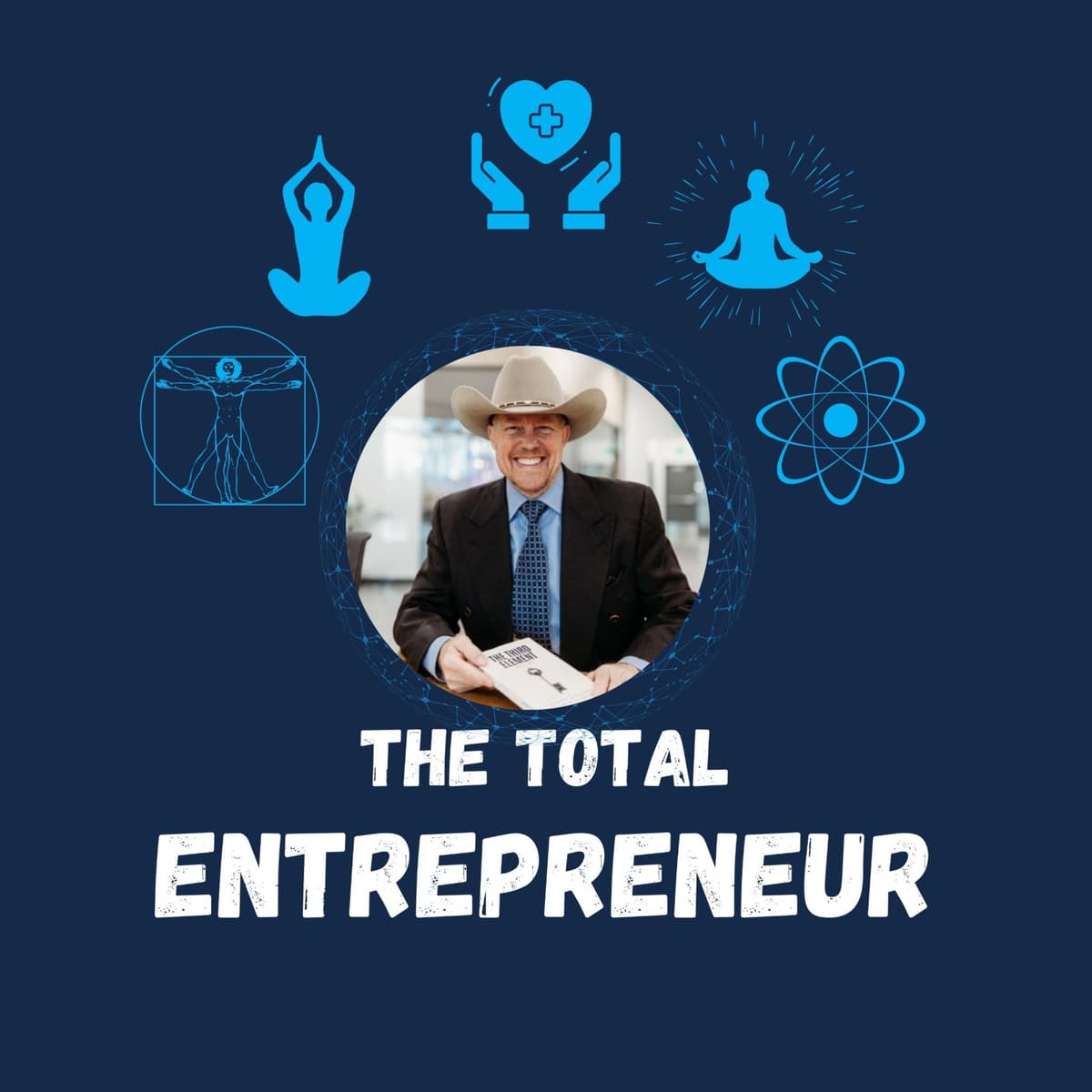
Emotional Intelligence in Entrepreneurship with Randy Lyman
with Randy Lyman
Apr 18, 2025 · 00:33:44
Part of our conversations on
Today's guest is Randy Lyman, the purpose-driven leader, physicist, and exited founder who has redefined what it means to create purpose-driven success in the building and growth of his multiple 7-figure companies. Randy combines decades of experience in business with a deep commitment to fostering emotional intelligence and spiritual grounding. His new book, The Third Element, makes these complex concepts accessible and actionable. Randy's entrepreneurial journey began in the technical world of physics and engineering, where he founded and grew a business that became an industry leader. Despite his professional success, he experienced a pivotal moment when he realized that stress and emotional disconnection were holding back his potential and the success of his team. This realization inspired him to focus on cultivating emotional awareness and creating a culture of belonging, which led to dramatic business growth and a renewed sense of purpose. Welcome to The Total Entrepreneur Mind, Body, Spirit, where we turn cutting-edge science into practical strategies for entrepreneurs. I'm your host, Dr. John Torrance, Entrepreneur Inc. 5000 honoree and professor of entrepreneurial practice at Syracuse University's Whitman School of Management. Each episode, we dive into mental, physical, and spiritual health with expert guests offering actionable insights to help you thrive and perform at your highest level. Let's get started. Randy, welcome to the podcast. I'm really excited to have you here and have a great conversation.
Great to be here, John.
So the first thing I want to ask is about your, I guess, your inflection point. A lot of people feel like, you know, once you've made it to the top of a multimillion-dollar business that you've made it, right? You should be happy. Like, that's the goal. But it seems like that wasn't really the case and that you felt like there was something missing. Could you describe that a little for us?
Certainly. In 1989, I had multiple successful businesses. And so I had educated myself and worked hard to be successful, but I wasn't completely happy. I wasn't fulfilled. And that's when the changes happened in my life. Once I realized that, by happenstance, I met a woman who changed my perspective.
Ah, tell me more about that.
So I met Maria in November 1989. And we spent 3 years together. During that time, she helped me start to see the spiritual, emotional side of life rather than just a left-brain scientific side. I'm a physicist and an engineer, multiple patents, business person. I still respond first by taking action and thinking, and I feel last, but I absolutely understand how important it is that we're aware of our emotions and become fluid in our emotions.
Yeah, I think that's so important because, I mean, young entrepreneurs especially, they see that, you know, Getting to the point where you're running a multimillion-dollar business, that's the endgame, right? That's when you've hit the summit. But in your experience and in mine too, that's really where things just start to get difficult.
But society tells us we're going to be happy when we get there. And you're right, they get difficult because in order to take a business beyond a certain level, we have to be able to connect with people in the way they can feel us. When they feel us, they can hear what we have to say. They get on board with our vision. But if we don't have that connection, it's almost impossible to get a group of people on board with our vision.
Yeah. And it's, I mean, you know, the return on investment for good spiritual health is pretty obvious. And yeah, I love the work you've been doing. So let's talk about your background. So being a physicist is really interesting, and I think it gives you a unique perspective when you're talking about the spiritual. So maybe just kind of give us a, you know, a quick bio on, you know, how you got started with physics and what type of businesses you ran and that sort of thing.
Well, I started in college in 1980 in mechanical engineering, and I got kind of bored with that, and I wanted to learn more about electronic circuits and computer programming, and I couldn't get into either one of those programs. So somebody said, go sign up for physics, and I did. And so I learned both. It was hard, it was challenging, but it was really rewarding, and it helped me just see the world from a different perspective and understand everything is energy. From a scientific point of view, everything is energy. And from a spiritual point of view, with the law of resonance, law of attraction, everything is energy.
And what kind of businesses did you get involved with?
Well, I started in my garage in 1982 with a differential, doing differential repair. And about a year and a half later, I moved out of my garage into a commercial business while I was still going to college doing differential repair. I graduated in December of 1985, Sacramento State University with honors, national honors. And Again, I was kind of bored. So I started a differential parts distribution company, a warehouse, basically wholesale distribution, and built that up over the years. And I learned so much there about business and hard work and getting things done. But again, that's where I found that I just wasn't fulfilled.
Well, what was the disconnect, right? So what did you think you would feel versus what you did feel? So you weren't, you weren't feeling fulfilled, but what were you looking for versus what you actually were feeling?
I was looking for a sense of accomplishment and a sense of just less worry, more at being more at ease. And anybody who's built a business knows as the business grows, we typically have less ease. We have less comfort. And I found out eventually, it doesn't have to be that way. When I changed my perspective, then I was able to find a way to be at ease and be comfortable and have everything in the business flow rather than it being a constant fight. But that took a different perspective. That took a different approach.
Yeah, I think that's really important, right? Because the goal is to be happy, right? And we think that by achieving success in business, that's going to get us happy. But if we're not happy to begin with, business success isn't going to make us so, right?
And the funny thing was, when I changed my perspective and I started being more considerate, more compassionate, more caring, And being aware of how the people I worked with felt. We didn't make decisions based on emotion, but we were aware of how everybody felt and what was up. And I had to show up clear and confident without worry. And when I took that approach, it was scary at first. Oh my God, how are people going to respect me? But when I took that approach, people connected with me. People were more at ease. They showed up with their authentic self and they wanted to be on board with the overall plan rather than just showing up and protecting their job.
Yeah, everybody wants to be part of something like that, right? So yeah, whether or not you're making decisions based on that is one thing, but having it be part of the organization and having people feel that is important. And I guess it goes back to the energy, right? The energy that you bring to the office or to the workplace every day really does make a difference.
And when people were able to acknowledge their feelings, talk about them, when I myself was able to be aware of my feelings, then we can separate out the emotional side of being human with the logical, active side of being human. And it doesn't mean that because we're aware of our emotions, they're going to influence our decisions. In fact, the opposite is true. Once we're aware of them, then they're less likely to influence our decisions. And for the people we work with, when they feel safe enough to share what they're feeling, then they can realize, okay, I've worked through this. I've expressed myself. I've been heard. And then the relationship with management changes. And so, people need 3 things. And you talked about belonging. They need to be acknowledged for who they are as an individual. They need to feel like they're contributing to the cause. They want to have meaning in their life. And sometimes, that meaning only comes at work. And then, they want to feel like they belong to the group and they want to feel safe within the group. So, those 3 things are more important than money. And they don't cost us much at all to invest in. A little bit of time upfront. But the return on investment is so great.
Yeah. So how do you start to, I guess, infuse these things into your organization? If you've been classically trained in a business school and you don't get much of this type of background, now you're out in business and you've been running your KPIs and all that type of thing. How do you start to infuse this into your organization so it becomes part of the culture and you can start reaping the benefits of it?
So for me, it started with myself. It always starts with leadership. I had to be more aware of my emotions. I did it through journaling. I did it through EFT tapping. It's really effective for me. And I had to learn to dive into the emotional pain rather than avoid it. I did all these things when I was away from work. And then I thought, well, how about if I— first of all, I got to show up more clear. And when I showed up more clear, then I said, well, how about if we bring some of these ideas into the workplace? And I was scared at first. If I'm vulnerable at all, then I won't be respected. But it turns out, when I do it from a place of intelligence, then people felt more safe. Because when I'm vulnerable, then they can let down their guard. As a leader, that was really hard for me to show up differently because I thought I— again, I already said it. I thought I would lose respect. But in the end, I gained more respect. So, listening helped with me. Asking questions and being open to letting people really take the time to explain themselves. Group problem solving helped a lot. And so, there's different exercises that we did. And I don't cover all these in my new book, The Third Element. But what I do cover is a way that a leader can become more emotionally aware and clear out some of their own baggage and show up more authentic.
Super important! Can you go through some of those with us like a couple of tips or ways that people can do that as leaders?
Well, for one, breathing is a big one. There's a lot of breathing exercises that are out there. Wim Hof really made that movement more visible to the rest of the world. But if I'm in a challenging situation, if I can just be aware of my breath, feel the breath in my body, my lungs, the air going in through my nose or whatever it might be, now I'm aware of my body. I'm in the present moment. And if I feel any frustration, here's where I'm different than everybody else. I want to amplify that frustration, feel it within my body, and then visualize breathing it out. Well, what that does is it brings me in the present moment where I can be aware of what I'm feeling. And then my mind is not busy pushing that feeling down. Now, I don't have to express it. I just have to be aware of it. Once I'm aware of it, if I have to, I write it down. Don't usually have to do that, but I can and go back to it later. But now I've separated my thinking mind from my emotions that are trying to come through and interfere with my thinking and my thoughts and my presentation. What are some others? Walking in nature. And we can do this even if we're in a city. I can take a 10-minute break and I can go out and walk. And if I'm in the middle of a city, I'm going to find a flower pot or a tree or a weed coming up through the sidewalk. And then, if I can be at a place of gratitude and just see the beauty in nature around me, these simple things, again, that I outline in the book, they'll take us to being in the present moment. And then, we're not so worried about, oh my God, how am I going to do all this? Because the human mind Finds a little problem and blows it out of proportion. But we come back and we take a breath, somehow we relax and our approach changes.
And these are so simple. They're free. You don't have to spend any money on them. You don't have to study for them, right? You just— I mean, you do have to learn a little bit of breathwork, right? You have to learn some of the best practices. But yeah, I love the idea of getting out in nature and touching the earth and grounding. There's a lot to be gained from that. So you mentioned tapping, and I mean, I understand what that is. I know what it is, but some people may not. Could you describe a little bit about what tapping is and then maybe describe application that people could use for it with it?
Certainly. I have some free offers and some free videos and such on my website. And I also dedicate the appendix in my new book, The Third Element. Got to throw that pitch in on this. But what tapping is, it involves the mind, the body, and our emotions. So our thinking mind is always in the past, in the future, stream of thought. It's never in the present moment. Our emotions at the other extreme know no time at all. They are bigger than time and space. And what's really important is they can only come through our physical body. And our physical body is only in the present moment. So, when we're in our mind, we're removed from feeling what's the— our body, where the emotions come through. And what tapping does is it is a coordinated effort between our mind guiding us through touching our body in 8 different places. And so, it's guiding the process. And because we're touching our body, we're doing 2 things. We're being aware of our physical body, which takes us in the present moment. And we also, the places, the points on our body we touch on, these specific points open up energy meridians. And that is from ancient Chinese acupuncture. And this opens up areas where energy flows through our body. So it lets our signals in our body work better. It gets us in touch with our body and the opportunity for emotions to come through. Now we don't have to have a big reaction. For me, sometimes I'll just get like a tear. Sometimes I'll get no reaction at all, but just a feeling. And the interesting thing is tapping works for me almost 100% of the time. It's the only thing that I can do, the only activity I can do that's pretty much guaranteed to work once we've practiced it a few times. And in my book and on my website, I explain how a person can write their own tapping script. And I have some free tapping scripts as well.
Yeah. So what's an example of a tapping script or how might people use it? Is it like if they're feeling anxious going into a meeting, they could go through one, or if they're Really mad about something? Like, what would be a good application?
All of the above. So if I'm anxious about a meeting, I'm going to go through 3 cycles. I'll just do it really briefly. The first cycle is to acknowledge the negative, the challenge that I'm having, the problem. I want to be aware of it first. So I set up my intention in a setup statement, and we say it 3 times while tapping on the side of our hand. And I say, I'm concerned about this meeting. I'm a little worried about what the outcome is going to be. You don't have to do it perfectly. I have some anxiety around this meeting. I'm not sure how it's going to go. I really want to be prepared for this meeting. Then we start the first cycle. And the first cycle can be 1 or 2 or more laps. Each lap is 8 different points we touch. The first one's above our eyes. I'm really concerned about this meeting. Meetings haven't gone well in the past. I've had challenges in meetings in the past. Side of the eyes. And it didn't work out well. This is negative, but I want to bring it up. I'm not going to stay there. Then under the eyes. I haven't always performed the best that I could. In meeting situations, and under the nose, I'm feeling my anxiety. I'm slowing down now to actually do it. I'm feeling my anxiety. I feel it in my body. I know that there's a part of me that's ready to heal and work through this. I'm already starting to work toward the neutral. Then the next spot is in the bottom of the collarbone. I have experienced challenges in the past. Underneath the armpit, some meetings in the past haven't gone well. And then the 8th spot on the top of the head. Can be a problem. And I'm going to transition right now to the neutral. Doesn't have to be. Then I go through the 8 steps again. And now I'm talking about, this can go better. I know there's a possibility of a good outcome. I've had good outcomes in the past. I've seen other people make changes. I've made positive changes. There's an opportunity for me to succeed. I know that success is a possibility. I'm ready for positive. Now, I change on the 3rd cycle to Optimism. I've done this before and I know I can do it. My mind is in charge and my emotions are getting processed and out of the way. I'm ready for this. This is going to turn out well. I visualize a good outcome. I know I'm capable. And the last I like to finish with, I know that God and Spirit, Source, however we see it, something bigger than me wants a good outcome. I'm turning this over. I'm surrendering to a power bigger than me and I know it's going to work out well. So I go through the negative, the neutral, and then finish with the positive. The negative can bring up the emotions. The neutral, Law of Attraction, we only go one step at a time. I can't jump from a 4 to an 8. I got to go to a 5 and a 6 and a 7. Then the neutral takes me closer to a positive outcome. And then the final cycle, I am saying, affirming in my mind, and my mind picks this up, my subconscious picks this up, things are going to work out. Is that kind of what you're looking for?
Yeah, I know that was super helpful. So it sounds like it's a lot of affirmation. So I'm wondering how much is— how much of the tapping and the physiology, how much does that play into it versus just the affirmations that you would go through?
Well, it first gives us the opportunity to be in the present moment and in touch with our body where our emotions can come through. And for me, it's always about in order for my thoughts to be helpful and my actions to be helpful, I have to deal with the underlying old negative emotions, which again, no, no time. They are like gasoline. You store gasoline in a can for 10 years or 20 years, you can bring it out and burn it, but you only got to burn it once. So, when I have positive thoughts and I'm taking positive actions, if I have old emotions that need to be worked through, they're going to dampen the effectiveness of my mental thoughts and my approach. They're going to dampen the effectiveness of my actions, including my communications with people. So, in the tapping exercise, I give myself an opportunity to release some of that emotional energy that I no longer need.
Yeah. So you mentioned manifestation. So I wanted to talk a little bit about that because it's becoming more popular among especially the students I work with and young entrepreneurs, but I feel like a lot of people still don't understand it. So I was wondering if you can maybe describe it from your perspective and what are people getting wrong about it or not understanding about it in order to really maximize this idea of being a powerful manifester?
Well, From— in science, we learn that opposite charges attract. In electronic charge, it's true. Opposites attract. But also in science, we learn about resonance and harmonics and sympathetic vibration. So, Law of Attraction is based on sympathetic vibration, meaning things that are alike are attracted to each other. So, our negative thoughts out in the universe attract negative things to us. Our negative actions attract negative things to us. And here's the key. Our emotions, again, know no time. The old emotional wounds we're holding from the past, those are still in our energy, in our vibrational energy. And here's the real key. The Law of Attraction is happening all the time. It can't be turned off. But it's also our friend in the way that it's going to bring us a gift of an irritation to remind us of an emotion from the past that we have the opportunity to heal and release. And these gifts don't look like gifts. Somebody cuts me off in traffic. My brother gets upset with me. My boss gets mad. Something turns out bad. Okay, so— And I talk about this and I explain it really clearly all the way down to the subatomic level in my book, The Third Element, in really fun stories. It's not just science. This is fun stories. So, Law of Attraction is obligated to respond to our positive thoughts, obligated to respond to our positive action, but also obligated to respond to our old positive emotions. Now, We can feel, we can put ourselves in a place of feeling when this goal comes to fruition, this is the wonderful way I'm going to feel. And that helps. That's a big part of it. But if I also have an old emotional wound that's contrary, that energy is within me. And again, in science, physics, chemistry, sympathetic vibration, that energy is there within us. So, if we are bold enough to find a way to dive into those old emotional wounds, And then, we release them. I think, I know everybody's going to find the same thing I found. When I had my biggest, first biggest release, I felt something I've been hanging on to for 12 years I wasn't aware of. Some family member said something to me that really wounded me deeply while I was going through a 4-day communication workshop for business communications. And on the 3rd day, I got to the level of the old emotional wound. I cried in front of a group of 15 people. And here's the wonderful part is 4 days later when I went back to work, a big issue that I had with incompetent people in my life, those people either became competent miraculously or they left my life. And myself as a scientist, I said, cause and effect. I had this big emotional release and this physical reality changed in my relationships. And that's what really started me on the path. So that's been over 30 years. So every time now I have a challenge, I look at it through that lens. And what I write about in the book is through my experiences. This isn't just an idea that I had. This is what I've lived through for 30 years. And it's so real and it's so helpful. And the hundreds of people I've worked with who have taken this approach, their lives have improved. That's really what this is about is how do we have a better life personally? And how can we show up in our business as a leader and touch people personally in the way that we get better results?
Yeah. And it seems— so, I've been fascinated just with the underlying science of manifestation. Because it seems like now science is catching up a little bit in terms of instrumentation sensitivity and just the ability to measure some of these things. So to understand manifestation, you have to understand that thoughts and emotions have a signal, or like you said, like a frequency, right? And I don't know how much we can measure those yet, you know, but I know you can certainly measure certain emotions, right? So if you can measure it and it's got a frequency, Then you can apply those laws of physics where it's going to attract and resonate and that sort of thing. So it's super interesting, and I'm so happy that the science is getting there.
And so if you go to the first law of thermodynamics, it says energy cannot be created or destroyed. So when we have a situation, we build a story around it and we have an emotional reaction. In the moment, it's always valid. If it feels good, go towards it. If it feels bad, go away from it. In the moment, that is valid and helpful. The problem is we don't feel it completely. We hold that energy within our being. And then what we're feeling is no longer valid because the moment has passed. Well, when we can release that energy, when we feel whatever the emotions are, we feel it in our body. And just like in thermodynamics, energy turns to action, can turn to heat. So when we feel it, it turns to heat within our body and that energy is gone. So yeah, I can't write the equations for it, but I can tell you that is the science behind it, is that stored energy turns into heat, it's released into the universe, and we feel better and we attract better.
The more I read about it, the more interested I get. But it seems like, you know, so a lot of people kind of go back to like The Secret, which I think did a good job of making people aware of it, but maybe it's— it led people down the wrong path where, you know, they say, oh, I— from an entrepreneur's perspective, they just have to think, oh, I want to raise that million dollars from an investor. And if they think it enough, they'll attract it, right? But it seems like it's a little bit more involved than that. And you have to get into the emotion of it and the feeling of it. Is that your experience?
Absolutely. It's a 3-legged stool, and we could sit on a 3-legged stool, but you take one of those legs away— thoughts, actions, or emotions— and don't consider all 3, then we tip over. We just are not stable, and it doesn't bring the whole picture together because we have the 3 different components of us, the 3 different elements are all interacting with the Law of Attraction. And this is something I've known for a while. But in order to really deliver the message clearly, it's taken me a lot of time to do what I ask other people to do. Write it down, work your way through it, become more clear in our thoughts, our actions, and the emotions around it. As an entrepreneur, again, I was very successful. But when I started incorporating the emotional side of life into my own growth, And then my business, the business grew 30 times. And we're not talking 10x. We're talking 30x. Great success. Inc. 500 list. Employees who are happy. We just clobbered the competition and brought more value to our customers. And we were rewarded financially. When I showed up at work, I didn't have to worry, are people on board with the plan? They were part of the plan. And with the right people at work, you still got to get rid of the bad apples. You still have to deal with the challenges. But there's a different, better way of doing that. And once I learned that, the success grew so much, there was no way to turn back.
And it's different just, you know, explaining these principles or teaching them and living them versus doing it and also scaling the type of business you did. So, so you experienced quite a bit of success. I mean, young entrepreneurs aspire to that level of success, but you were able to do it in a way that was sustainable and made you happier and was good for your organization too, which is really a win for everybody.
And one thing I want to add is I made mistakes along the way. And what I share with people now, they can take advantage of the mistakes I made and the processes I share. But it just, it wasn't smooth from the beginning. But if we have clear intent of I want to make things better for everyone I work with, then what happens is the group that we lead feels that. Our power as leaders doesn't come from our title. It doesn't come from our intellect. It comes from, are we able to get the people we work with to get on board with the vision? And if we didn't need our group, we would just do it as an individual. But that's not how people work. That's not the human experience. The human experience is, how can I uplift others? How can I get people to support each other? And in doing so, how can I get them to support the vision? Now, as a leader, I'm showing up being of service. They're not there to serve me. I'm there to serve them. And that's where my power comes from is when that group understands Randy's here for us and he believes in us and he's going to go to bat for us. Now, I have a team. Now, I build a winning team. And whether it's just my business in an industry or it's my team in a large organization, that has a positive ripple effect. So, that's the change in leadership is how do we show up calm and confident? How do we be vulnerable and still be respected? And how do we get people to say, my leader's here for me and I'm on board with the vision?
The idea of the ripple effect is so powerful and it's so true. You can see it in just the smallest acts of kindness or even acts of meanness, right? Like it ripples out for sure. And I think it's important. Yeah.
And as leaders, for me, respect was a big thing. Well, what happens if I praise somebody who's doing a mediocre job? Will they get mediocre? Will they continue mediocre? Will they get lazy? What'll happen? No, they love the praise and they reach for more. And when I show up and I share my fears, are they going to lose faith in me? No, they see that I am confident enough to share my doubts, to share some of my stories of my fears. I can't share my other team's fears or things from the past that expose others. But I share my own personal fears, my own personal failures. And I do it with calm and confidence. And I say, this is what I learned from it. Now, when people look at me, they say, wow, this guy is so solid. He's not afraid to be human.
Yeah, you're real and you're vulnerable and you're not afraid of it. Yeah, that's important. So something I've learned or experienced, like back to the example of an early-stage founder, just, you know, really thinks they need to raise the million dollars from the equity investor. And that's what they're focused on. That's what they're thinking. They're meditating on it. They're, you know, they're really trying to send that signal out. What I've found is that sometimes the things you think you want aren't really in your best interest, right? For your best and highest. So what I started doing a few years ago is just the thing I think I want, say it's raising the million dollars. I feel what that's like. I try to manifest it, but then I also couch it and say, but truly whatever is for my best and highest self and purpose, right? If it's not raising a million dollars, I can't wait to see what the replacement is or whatever it is that I really need and what's gonna serve me most. That's what I'm looking for. And it's hard because you may not even know what that is. And I was wondering what your experience with that idea is.
Well, gut feel is the same to me as intuition. And intuition comes from a higher part of ourselves, whether— no matter what people believe, whether it's their subconscious or whether it's from a higher intelligence, it comes to us as a quiet message with no justification. When we learn to tune into that, then we can make decisions and be guided without worry. So, after I learned this 30+ years ago, I learned how to tune into my intuition. And most of the big business decisions I've made, multi-million dollar decisions, have been from my intuition. And yes, they make sense to my thinking mind. But my thinking mind is limited. And when I can tap into something bigger than my thinking mind, I do what you said. I said, this is what I'd like. Bring me this or better. And I surrender to the process. I open myself up to be guided and people show up in my lives. New opportunities show up in my lives, in my life. And if I'm really focused on this is the only way to go, then I'm not open to all these other ideas. Not just my own things that come through from intuition, but other people's ideas, etc. So I hold my vision. This is my goal. And I say, this or better. And I keep working towards my goal, but I'm always open to other opportunities and other guidance.
I like that idea, this or better. And that's kind of what I was trying to articulate. And I think that's, I think that's really powerful. And, you know, because sometimes you don't necessarily know what is the best thing for you, you know?
Well, my opinion is we really never know. But I believe the universe wants us to have our own goals. The universe wants us to have our own intentions. And that's all fine. But, but again, that or better. So the universe might have a better goal in mind than us. And the thing that I've learned not to be attached to is the path. Yes, I lay out my plans and I take my steps forward every day. But if the path takes a different direction, I don't cuss and swear and say, I don't want that path. I say, okay, I'm going to embrace this path. Show me what you're trying to show me. Tell me what you're trying to tell me. I'm here to learn. I'm here to grow. And I'm going to trust that I'm being guided in the right direction. And whether it's the direction of an irritation I need to feel, Or a better opportunity that's being presented. It's that surrender and the trust and the faith. And that comes slowly, but with practice, it gets stronger.
Powerful. Yeah. So you mentioned something earlier about intuition and, you know, kind of letting it come to you. And I was wondering what role your internal state or frame of mind or your heart-brain coherence plays in that, right? Because it seems to me that you won't really be able to tap into that until you're in a place where you're open to it in the first place.
We have to find a way to be in the present moment and not be stuck in our mind. We need to be able to interpret the difference between emotions coming through us and intuition coming through us. And they come through very similar. Emotions will always have a justification, same as our mind. Turn left because— and all these reasons. And our intuition will simply say, turn right. And that's it. So our intuition gives us free will. The universe gives us free will. So when that pure message comes through us, It has to just be the message without justification. And then it's up to us to listen and discern. So that's what I guide people on is, okay, when you think you're hearing your intuition, does it come with justification or is it just a really quiet voice?
Yeah. So tell us a little bit about The Third Element. What was the inspiration for the book? What was your process? And then, you know, what are you hoping people will gain from it by reading it?
Well, my inspiration was I was feeling so much frustration when I first started to learn about the law of attraction and manifestation and all that. 30+ years ago. And then after I had my big epiphany, my emotional release, and the physical world around me changed, and I started to look at everything differently with taking emotions into consideration. I would go to seminars and talks and hear all these people talk about our mind and our action. And I'm going, no, no, no, you got to get the emotional part. So my life was busy. I incorporated it into my business life. And then finally, 4 years ago, I took the time to write the book. And the reason I wrote the book is my life has been so wonderful. I've been so blessed. And I just want other people to have opportunity to have a better life, to have an opportunity to find a path to listening to their intuition, being guided, working through their challenges, and then finding faith and finding hope. Faith in whatever process works for them and hope for a better future. And I want to see the world become a better place. And I know so many people are just That close to finding the answer. And for me, dealing with the emotional side of being human has been the answer. And in the book, I make it a fun, easy read that brings it all together so people can have an aha moment and go, oh yeah, I see this can work. Randy's an intelligent guy. He gives me a reasonable path and reasonable explanations. And here in chapter 7 are 12 different exercises I can try to bring me closer. So, I want to touch people's lives in a positive way. We're here to learn and grow and have fun. This is not supposed to be a battle, right?
No, I agree with that. I mean, I've always— well, not always, but I guess in the last couple decades at least, you know, really, I guess, embrace this idea that we're really just here for joy and everything else is just extra, I suppose.
So, well, we're not taught that as children. We're taught that life is a battle, and sometimes it is a battle, but there's more to it than that. And that's what I want people to be able to to do is incorporate more joy in their life and more guidance from their intuition.
Yeah, no, that's amazing, Randy. So if people are interested in learning more about you and what you do, where can they go?
So they can find me on my website on randylyman.com, and that's L-Y-M-A-N, right? L-Y-M-A-N. They can find my book, The Third Element. Uh, it's on— is it backwards for you? I'm sorry if it is. I think it'll—
I think it'll fix itself.
Okay.
Yeah.
And, um, It's on Amazon, both Kindle and the softbound. And then it'll be out in Audible in probably about 6 or 8 weeks. I'm recording that now so they can find it on Amazon as well. And again, this is all— this is not about me. This is about the message. This is about people improving their lives. And that's what I'm hoping to see.
Well, Randy, thank you so much for sharing your journey and your message. And I really think this is going to resonate with listeners. So thank you so much.
Well, you're welcome, John. Thank you for having me on. You made this really easy.
Thank you so much for listening to the Total Entrepreneur Mind Body Spirit Podcast. If you liked what you heard or heard something interesting today, please give us a like, share a comment, or better yet, subscribe to the podcast. Thank you.
About This Episode
In this episode, host Dr. John Torrens welcomes Randy Lyman, a physicist, exited founder, and author of 'The Third Element.' Randy shares his journey from building multi-million-dollar businesses driven by technical prowess to redefining success through emotional intelligence and spiritual grounding. He discusses the impact of emotional awareness on leadership and team cohesion, the principles of manifestation and the law of attraction, and practical strategies like journaling, breath work, and EFT tapping. Randy's insights provide a roadmap for entrepreneurs to incorporate emotional and spiritual health into their professional lives for sustainable success and overall well-being.
Keep listening
More on Business
About the Host
Dr. John M. Torrens
5× Inc. 5000 entrepreneur, Professor at Syracuse University's Whitman School of Management, author of Lightning in a Bottle, and TEDx speaker on ADHD as an entrepreneur's superpower.
Browse all podcast guests →Book a strategy call →