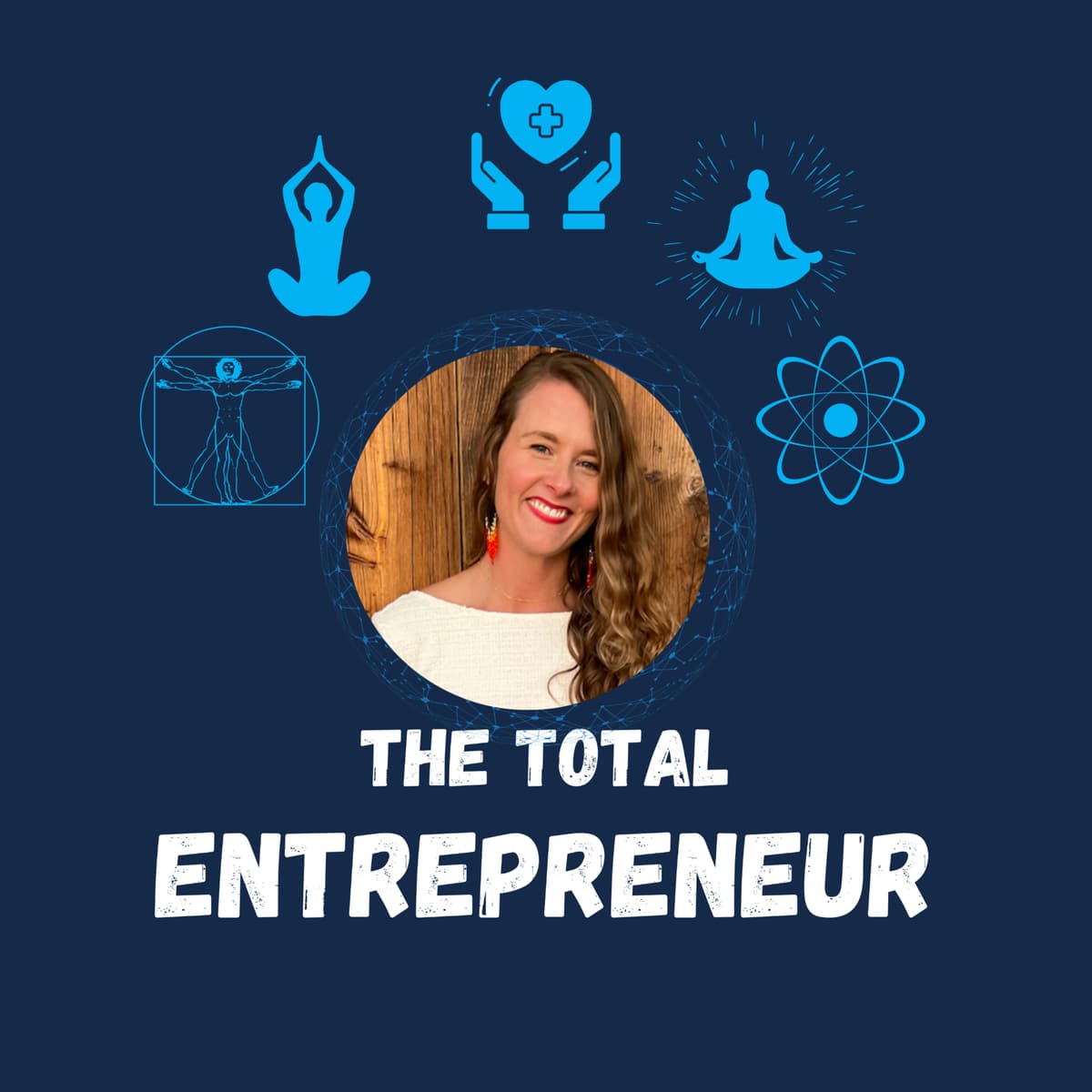
Building Bridges Between Cognitive and Embodied Awareness with Carissa Karban
with Carissa Karban
May 2, 2025 · 00:36:41
Part of our conversations on
Today's guest is Carissa Caravan, and she is a leadership embodiment coach. She specializes in creating containers of love, safety, and education to support you in building the bridge between cognitive and embodied awareness. She is the founder of the HEAL Collective, a community-building organization that brings people together to regulate, play, and return to love through connection and community. She currently offers virtual workshops, coaching programs, retreats, and talks in support of the revolution of love, awakening, and unity. Welcome to The Total Entrepreneur: Mind, Body, Spirit, where we turn cutting-edge science into practical strategies for entrepreneurs. I'm your host, Dr. John Torrance, Entrepreneur Inc. 5000 honoree and professor of entrepreneurial practice at Syracuse University's Whitman School of Management. Each episode, we dive into mental, physical, and spiritual health with expert guests offering actionable insights to help you thrive and perform at your highest level. Let's get started. Carissa, welcome to the podcast. I'm excited to have you, and thanks for being here.
Thanks so much. I'm excited to be here.
Yeah. So I want to ask you, you said that the HEAL Collective was born from your own journey of embodied vulnerability. So can you take us back to that moment that you knew you had to leave the traditional path behind and create something radically different, not just for yourself, but for others searching for a more meaningful life?
Yeah, I think for me, it was a series of moments of coming up against the edges of the boxes that I had put myself in time and time again. Culture, my upbringing, everything told me to play it safe, play it small, and then I'd have security, I'd have happiness. But every single time I tried to do that, I tried to contort myself, follow the traditional path, check the boxes for success. I ended up more miserable, more burned out than before. So eventually there were multiple pivot points where I realized I've gotta do something radically different.
I, I mean, I think that search for meaning or, you know, checking the boxes and, you know, doing what your parents think you should do or what all your peers are doing, right? I think that leads to a lot more stress and anxiety and ultimately unhappiness than we could imagine, you know? But I was wondering, so, so in terms of the meaning behind Heal, What is that and what does it stand for and how did you get to that?
Yeah, so HEAL is an acronym that stands for Here Everything Is About Love. You know, I think the traditional path is all about sort of this one-size-fits-all, you know, do the same thing that your peers are doing, just do it better than everybody else. And it's sort of this prescription, you know, we think about things like imposter syndrome or the imposter phenomenon. And as I've thought about my own path, no wonder I felt imposter phenomenon for so long because I was trying live a life that wasn't authentic to me. And I went through really quite an intense deconstruction and reconstruction of my whole identity and my constructs for how I view and how I show up in the world. And what I noticed was so important in order for me to do that was having a container of safety, right? I was living, and I think many of us live in a constantly dysregulated state from a nervous system perspective. We're constantly in that sympathetic nervous system state, which is great for helping us go and achieve and get things done, but we're not meant to live there. So having finally this opportunity in my 30s to take a step back, to relax, get into that parasympathetic state, it was this beautiful opening of a doorway into a new way of being because I believe in Maslow's hierarchy of needs, right? So as we start at the bottom, we really need to have those physical needs met, our emotional needs, and Ideally, we're ascending up this pyramid into self-actualization and self-transcendence. But I like to use this kind of cheeky joke that Maslow's hierarchy is not a hopscotch, right? If we are truly worried about how we're going to meet our own physical needs, how we're going to provide for ourselves, our family, it's really hard to ascend into the state of self-actualization or self-transcendence. And so for me, it's about creating containers of safety so that people recognize that we have everything we need within us. And so we can take that moment to pause, to start to look in the mirror, because if we're always running full speed ahead, full tilt, we never have time to pause, to sit, to contemplate, to get curious about why am I doing things the way that I'm doing, right? Who made me believe this about myself or that I need to go out and achieve this particular path? So having that container of safety was really impactful for me. And that's where the Heal Collective really came from, is creating these containers of safety, because it's not about me helping or transforming other people. I believe every single human being has the beautiful power within them to transform, to come home to themselves, as I like to say. And so my role is really to provide the safety, the love, the education, and the tools that people need in order to kind of cross that bridge into self-transformation. It's not about, you know, a power differential. It's not about looking to somebody to heal you, as we've been taught for so long. to externalize our power, to trust the authority figure, whether that's parents, teachers, our doctor, whoever it is, right? We have wisdom within our bodies. And so it's really just about creating the opportunity and the tools so that people recognize that they have that power within them to transform, to create and live the life that they dream of.
You said so much in that. So there's so many things I wanna get back to on that. But I think one of the biggest things is that it's very empowering. to believe, or at least to start learning that you have everything you already, you need already inside of you, right? So can you expand on that a little bit? Because I think that's a really interesting and empowering thought for people.
It's sort of this double-edged sword, if you will, because I think there's the first step to really embodying our unique individual power also requires this really courageous and difficult step of Taking responsibility for the situations that we find ourselves in. So when I say take responsibility, some people might hear that and think, you know, victim blaming, right? Like, how did you create the situation that you're in? When I say responsibility, I think it's about taking 100% of the responsibility for what is your part in the situation. So I'll use myself as an example. I've repeatedly found myself in situations from a work standpoint, especially working in corporate and the consulting world, where I was burning myself out, but I would constantly externalize my power to, let's say, my boss or the projects I was working on, to the person who was assigning me to the work that I was doing and thinking, gosh, I don't have any power to say no, because I was really identified with, I need money, right? We all need money in this society to survive. And so I was constantly sort of playing a bit of the victim mindset of I don't have the power, right? This is happening to me. And so a really powerful step towards embodying that power that I have within me and recognizing that I have everything I need is I can say no, right? Everything is a choice. Truly, everything is a choice to wake up, to say yes, to say no. And in a lot of the New Age philosophy today, there's this I would argue oversimplification of just let it go. If it doesn't serve you, just let it go, right? Just put it down. I think if you don't have a practice of doing that, you don't really understand what it means. That can be very disempowering to hear because then we can spiral into the shame stories of, oh, I'm not doing this right. Why is this so hard for me? Everyone else must be able to do this easily. And so that's where I think it really comes back to that idea of looking in the mirror to say, How did these stories serve me when I was growing up? So if I look at my learned powerlessness, I have a lot of stories from childhood where in situations where I did need to play down my power, I did need to allow someone else to be in that sort of higher power position. And that actually aided my survival getting through childhood. But as I like to say, it's a jacket that we wear that gets too tight, right? We outgrow it. as we come into adulthood, if we continue showing up in that learned powerlessness, then we're not in control of our lives. We don't really get a say in the situations, the jobs, the business success, right? If we're constantly attaching to, let's say, monetary results, external validation. And so coming back to this idea of we have everything we need when it comes to thinking about self-love, right? Self-trust. Rather than every time I think about, I need this from somebody else, whether it's a partner, a boss, a customer, or whatever it is, that's where I start to get curious and I say, how can I give that to myself, right? If it's love I'm seeking, if it's validation I'm seeking— I don't know if you've ever worked with like internal family systems and parts work, right? How can this one part of me that really needs something, how can another part of me step in and give that to myself? And that's really empowering to step into that realization that I can embody the thing that I'm seeking from outside of me, because then it's within my control, it's within my power. And everything outside of us can and will disappear at some point. So how do I bring that locus of power back inside myself?
So it seems like if you want to experience love or say you want to experience unconditional love, one really good way to do that would be to give it, to love someone or something unconditionally or yourself even, right? Because by doing that, you're experiencing the exact thing that you said you want. So that's kind of interesting. I like that. And when you were talking about Maslow earlier and the hierarchy, that really resonated because I work with a lot of young entrepreneurs who who have this dream or this passion or this idea or this problem they've fallen in love with solving. But the truth is they've got student debt and they've got a new car payment and they've got to go get the job in the accounting firm or the consulting firm or whatever. So I get that. And you're a good example of it, right? So you left a successful career in corporate consulting to do this. So maybe talk to us a little bit more about that. What was that like? What was some of your thought process? What were some of the things you stressed about and what was it that got you to find finally say, all right, I'm doing this and it's going to work out somehow.
How much time do we have now? You know, I think what's really interesting, so about 4 years ago, I— so I've been coaching for 10 years inside of— when I was at Cisco, I was coaching inside of Cisco as sort of the side hustle to my day job. And about 4 years ago, I started my own coaching practice outside as my side hustle with the intention of exiting the corporate career but doing so in a way that was really safe and methodical and systematic. And then it didn't pan out at all the way that I wanted or expected. But what I really got from that—
Yeah.
What I got from that was, were so many lessons, right, in how I was externalizing my power. I was really attached to how people were perceiving me. And I was really, even though I was speaking about authenticity and vulnerability and doing things your own way, I hadn't quite learned how to embody kind of what I was teaching. And that shows up, right? Energetically, people can really feel that mismatch between what we're saying and how we're being. And so I let that go for a couple years because I was in a consulting career that just took up all of my time and bandwidth. I didn't have any time to think about anything else. And then last year, my life sort of blew up. My husband told me last year that he wanted a divorce, which I didn't really see coming. And I had really learned to cultivate self-trust. I think that's ultimately where so much of our fear comes from. If we go back to Maslow's hierarchy and we sort of unpack every fear to its base level, it's a fear of death, right? A fear of our resources, excommunication, something that leads to us not having enough and then us dying. And so what I had learned over the last several years is that I really didn't trust myself. You know, when it came to taking this leap of faith, I was really attached to and identified with, you know, this external marker of success. And as I was deconstructing and sort of reconstructing into the current version that I am today, I realized I've got this, I've got me, I'm resourceful, I'm scrappy, right? I'll go wait tables if that's what it takes to make ends meet to pay the bills. And so, when my husband, to kind of come back to that story, when he kind of delivered the news that he wanted a divorce, if I had still been identified with the idea that, you know, how I was going to be perceived really determined my worth as a human, that could have been a really terrible situation. And it was very painful, don't get me wrong, to go through the unraveling. But we were able to do it in a really kind, conscious, respectful way. Because I knew that him choosing to be in relationship with me or not did not do anything for my worth as a human. I had really cultivated a lot of that self-love and that self-trust so that the external circumstances around me don't determine that. And so I think going back to the question, you know, it's really about self-trust. And if we think, okay, if I lose this job, Again, maybe I won't be able to make ends meet, I won't be able to do this. But I have a lot of evidence, and I would guess that you and your listeners do as well. There's a lot of evidence that we figure it out, right? It may not look the way that we expected or wanted, but we're resourceful, we're scrappy, we'll get the job done and do what we need to. So really reframing this idea that I've got me, I can handle it. I trust that whatever unfolds, whatever is presented to me is what is meant to be presented. And it's all an invitation to learning, to growth, to expansion, to pivoting if I need to, really gave me this sense of internal peace and strength that allowed me to, after, you know, going through this divorce, I said, okay, well, I see the divorce and I raise you. I'm quitting the job, selling the house. I'm gonna go on this travel sabbatical and just, you know, kind of my own little Eat, Pray, Love adventure because I knew that I could handle whatever came my way.
Yeah, so instead of recoiling and just kind of, You know, curling up in the corner. Yeah. Like you said, you raised the stakes. You were like, you know what? I'm quitting the job and I'm doing this. And yeah. So you went all in on it.
Yes. But only because I had cultivated the capacity in my nervous system to handle that level of uncertainty, to handle that level of change. Because if not, then I could have been pushed down Maslow's hierarchy into this state of freeze, right? You know, kind of this, uh, dorsal parasympathetic freeze state. And so I think there are a lot of things that we can do strategically to increase our capacity for uncertainty, to increase our self-trust so that we can continuously push against that growth edge. And then we can take bigger and bigger leaps once we've cultivated the capacity at each subsequent step.
Yeah, I love the idea of just thinking to yourself, I got this, I can do it, right? It's a very self-loving, self-trusting validation, I guess, right? So one of the things you talked about was co-creating from this place of vulnerability and authenticity. And I think that's, I think most of the people I talk to, they want to be vulnerable and they want to be authentic. They even maybe see themselves as showing up as authentic. But like you said, there's a mismatch between the behavior you're observing and what they're saying. So what do you do with people who maybe need to work on that vulnerability and authenticity? What's a good way to start? kind of deconstructing so that you can show up that way?
It's a beautiful question. There are a lot of different ways and angles we can come at it. I think really what it takes is the courage to look in the mirror. And as a coach, as a container creator, it's really just a beautiful mirror. For me, I can speak to my own journey and what has worked for a lot of my clients in the past is learning to move from judgment to curiosity. Because we have this binary bias, right? And we're conditioned to judge everything as, okay, this is good, this is bad. We assign value to everything, whether it's circumstances, relationships, ourselves, learning how to suspend judgment and zoom out to get curious. You know, let's say I judge myself. Why can't I be vulnerable in this situation? Instead of going to that judgment, just getting curious. What am I afraid of in this moment? Or what do I think might happen? What do I think people might think of me? Right. And there's a Six Sigma tool, the 5 Whys, right? Which I really love to use. It's like. And why is that? And why is that? And just a way to sort of pull that thread and unravel it. So I think if we can get curious, it's really hard for judgment and curiosity to coexist, 'cause if we can truly embody curiosity and say, huh, where does that pattern come from? Why do I think that? What am I afraid is going to happen? Then that's where we're really opening a door rather than judging something and closing a door.
That's really good too. I like that. You've got a lot of really good, yeah, examples or, you know, just ways of looking at it. That's really helpful. So I want to switch gears a little bit to some of your work in individuation. People may not even know what that is. So if you wouldn't mind just kind of describing it, and then I know you've done some work on this whole wheel with different traits and qualities. So I think it'd be really helpful if you just kind of walked us through that.
Individuation, for those who are familiar with Carl Jung, the psychologist, you know, typically you hear of Freud and Jung as contemporaries in the early to mid-20th century. Carl Jung, his life's work was around individuation, which he really described as this integration of the whole self. And he talks about, you know, integrating the shadow and the unconscious. And as I've been on my own journey of what I would now call individuation for close to 15 years, and the journey continues, there's no endpoint for me, you know, something when I was in grad school a few years ago getting my second master's in leadership and org development, It came time to pick a research topic. And what I saw in reviewing the literature around individuation is I think this is a really powerful tool. However, if you're not really familiar with terms like shadow work and integration or the unconscious, it can feel, you know, almost like you go talk to a master sommelier, right? And they're talking about the qualities of wine. And if you've never really studied wine, you might, it might just all go over your head. You think, what the heck are you talking about? Right? Or you talk to professional musicians who are talking about rhythm and timing, and a lot of the lingo just doesn't really land with you. So when I was in grad school, what I did was I really explored individuation from the same angle that Daniel Goleman uses for emotional intelligence. Emotional intelligence, he uses as sort of umbrella topic, and in it you've got these specific pillars, you know, around self-awareness, social awareness, relationship management. And I got really curious, can I do the same thing for individuation? Can I take this fairly ambiguous topic and create tangible practices that are both practices and end states? Unfortunately, it is a complex process. So I tried my best to distill it down to as simple as possible. And there are 9 pillars. I know that sounds like a lot. And it is. I recognize that. Uh, but there are really these 9 pillars of individuation. That are all active practices and end states that can really help any leader, any entrepreneur, any person who's willing to get curious and kind of enter into this cycle to say, how do I show up in a more embodied, a more integrated, a more confident, transcended way as a human being?
Yeah. So actually, let's just ask you a few things about each one. So yeah, describe, I mean, I think self-awareness is pretty self-explanatory, but maybe, you know, there, there might be something that, you know, we could miss on it. So yeah, describe that for us.
Yeah, I actually love that you said that, John, because I think there's an assumption that self-awareness is self-explanatory. But what I've seen is a lot of times we tend to think that self-awareness is, oh, I know what my strengths are. You know, I kind of understand how I show up in the world and that's definitely a key part of it. But I think self-awareness is a little bit like the rabbit hole that we can go down. It's really about looking in the mirror and willing to take a hard look, right? So our ego identity creates this construct of who we are, you know, our attachments, what gives us value. And self-awareness, I believe, is really the ability to zoom out just a little bit more from where you are today, to zoom out and see your identity, to look at your identity, look at, okay, what are my attachments to my relationships, to my status, you know, whatever it is. And so self-awareness is really about zooming out to create more awareness. A term that I like to use that a lot of entrepreneurs or business owners might know is working in the business versus working on the business.
Sure. Yeah.
And self-awareness is the ability to kind of, instead of working in yourself, to work on yourself.
That's a great analogy. I like that. And I think anybody who's ever done or, you know, been part of a 360 review kind of understands that you're probably not as self-aware as you think, right? It's humbling to get that kind of feedback, you know?
Yeah, definitely.
Another one that I see on the wheel is resilience. And, you know, I had a guest on who, you know, she's got a trademark on this idea of mental muscles that you can exercise and improve. And resilience is one of those. So yeah, I'd love to hear your perspective on resilience because I agree that's super important. For entrepreneurs at any stage, we know that resilience is a key competency. So yeah, I'd love to hear your take on it.
Absolutely. You know, I think again, it is one of those mental muscles, right? I like to use the term the emotional gym. A lot of the times we think about working out our physical body and we know this idea of hermetic stress, right? We are stressing our body. We are technically breaking the muscles down so that as they repair, they become stronger. And I think emotional resilience, mental resilience is much the same way. You know, it's a lot of times as we think about enlightenment or awakening or self-improvement, whatever word you want to use for it, we can think that the expectation is to get to a place where we're not triggered, where we don't struggle anymore, we get to this place of, oh, everything is great all of the time. And I think That's not true for our physical bodies. You know, we're always going to need to go to the gym. And if we stop going to the gym, I know for me, I get out of shape very quickly. It's something that it requires constant practice, consistent practice over time. And I think that mental and emotional resilience is much the same way. It's not about not being triggered or not stumbling, not feeling challenged. It's about kind of right-sizing our perspective to say, I know I can get through this challenge. I know I can overcome it. And then the more we practice it, then we build that muscle to say, wow, I got over that challenge. So I know that the next challenge that comes my way, even if it's a little bigger, because I'm taking a bigger risk, I'm going a little bit further out of my comfort zone, whatever it is, it's building and we're living at that growth edge. But every step we've taken up to this point serves us. So just to tie it to that physical example, You know, I'm not going to go into the gym on day 1 and try to lift 100 pounds off the rack. You know, I'm going to go with a 5 or 10-pound weight. And then over time, I'm going to slowly increase the amount of weight that I can lift until I get to that 100-pound weight. And so realizing that the process of building those muscles, because the other thing that I hear from a lot of people is, I thought I already got through this. I thought I solved this problem before. Why am I having the same limiting beliefs coming up? And I say, because you're living at a new growth edge, you're taking a bigger risk. And so the process of breaking those muscles down is the same at 10 pounds versus 20 versus 30. But if we can, again, zoom out for that perspective and say, wow, I was feeling the same way, but if I look back, that's when I was lifting 20 pounds and now I'm lifting 30, then we can track our progress over time and that helps build the resilience.
Yeah. I think one of the things that people often get wrong about this is they think, well, You know, if I'm resilient, then I, I don't, you eventually don't have to bounce back because you're gonna be good, right? You're either zenned out or you're chill or you're just fine. But I think the whole point of resilience is that, yes, hermetic stress, right? So what doesn't kill you makes you stronger. You can deal with one hard thing, you bounce back from it. Now your body adapts and you can take something that's even harder and bounce back from it. So I think that was a really good example, and it's something that I see people kind of getting wrong about this idea of resilience. You know, so another one is neutral observation. And I know that's super hard as well, but I was wondering what the difference between that and self-awareness is.
I think they go hand in hand. I'll say that the ability to observe ourselves neutrally, right? And I think it goes back to that comment around judgment versus curiosity. And if we can really neutralize, you know, thinking about how we look at everything that happens to us, you know, a couple of authors I really love in this area are Byron Katie, Pema Chödrön, you know, really talking about When Things Fall Apart or Love And so I'll speak to Byron Katie, you know, this idea of being able to see everything that happens. And it's going to sound a little cliché, maybe it's a quote that people have heard before, but this idea that everything's happening for me rather than happening to me. And so I think if we can learn to see everything neutrally rather than trying to categorize it into the buckets of, oh, this is terrible, or this is amazing, because the other part of it is if we're going to let go of one end of the spectrum, if we're going to let go of the negative judgment then we also need to let go of the positive end of the spectrum because in the law of duality, those 2 things go hand in hand. And so that's again where I think the, you know, we can get into like toxic positivity, assuming like everything that happens is amazing, you know? And I think that from a neutral standpoint, yeah, there are things that are really hard, right? Grief, loss, overcoming challenges. I'm not a fan. I'm not an advocate of gaslighting ourselves into thinking like, this is all amazing and it's happening and it feels great. It's really that neutrality of saying, okay, I feel this in my body. I feel the stress. I feel the tightness in my shoulders. I feel the knot in my stomach, validating that experience. And then looking for what's the invitation here rather than the judgment. What's the invitation? Where's the lesson? Where's the opportunity? You know, maybe I was out of my integrity in how I had that conversation or how I showed up. No point in ruminating. We can't change the past, but if I feel that discomfort somatically in my body, then that's an invitation that next time I'm in a similar situation, I wanna show up differently. And being able to take that step back and observe things neutrally really gives us the opportunity to engage that prefrontal cortex and decide how we want to show up next time.
Yeah. You know, I was looking at your website and you have a, there's a page where you have a bunch of book recommendations and I've got about 75% of those on my bookshelf. So it's a, it's a great list. Yeah. I like it. But no, I think that's a really good point and not denying yourself this experience or the emotion because especially in entrepreneurship, it's hard a lot of the time. Most of the time, it kind of sucks and your job is really just solving problems all the time, right? So, thinking, oh, this is great, or trying to talk yourself into the fact that it's not hard or you're not experiencing something difficult, I think, yeah, you're doing yourself a disservice for sure.
100% agree.
Yeah. So appreciative acceptance, what's that one?
You know, it really builds from that idea of neutral observation. Appreciative acceptance is about once I've learned how to cultivate the practice of observing things neutrally, where do I see the lesson and the gift in it? I'll use again my own story as an example, going through a divorce last year with the person that I was 100% committed to spending the rest of my life with.
How long were you married, just for context?
Yeah, we were together about 7 years and married for 6.
Okay, yeah.
For additional context, we had gone through some significant challenges. So people always ask, you know, were you surprised? And what I say is I was shocked but not surprised in the sense that it's not like everything was beautiful and easy and amazing all of the time. But I think I, I thought he'd be willing to work on it a little longer before we called it quits, you know. And so that was a really challenging experience for me. But because I have this practice of going through, you know, what's the lesson, what's the opportunity, where's the gift in this, it allows me to get to a state of gratitude. You know, we talk a lot these days about a gratitude practice and a gratitude journal. And so it's really about coming into gratitude, embodied gratitude. Again, not just the cognitive gratitude of like, okay, I can write down 3 things I'm grateful for today, but truly feeling in my body, in my heart, that everything is happening in service of my highest good. And by believing that and knowing that and taking each step forward with that embodied mindset, I was able to— I like to say make lemonade out of lemons, right? So rather than allowing this really difficult situation— or I could even use my coaching practice, right? Several years ago when I started that business and it didn't go the way I wanted, it didn't take off and make me loads of money and allow me to, you know, live the life I dreamed of in that moment. I did spend some time, you know, kind of feeling sorry for myself, you know, mourning the dream, the loss of this dream and this vision that I had. But I was able to put it to rest by seeing that it gave me a lot of opportunities to continue looking in the mirror, to continue building my own self-awareness and my own practice of individuation. And I've gotten to a place of gratitude because Every single step I've taken along the way has led me to where I am today, and I wouldn't be who I am or where I am without every single thing that has happened. And because I've now cultivated a life that I find incredibly joyful, incredibly fulfilling, and I love every single moment of it, even the hard moments— not to say every moment's easy, but even the hard moments— I have such appreciative acceptance for everything that has come my way.
Yeah. When I talk to successful people, hardly any of them would go back and not face a really hard circumstance again because of exactly what you said. It made them who they are and it gave them that experience. So I think that's really important too. And so let's end the individuation circle with the one you said was last, which was so important. Everybody knows it's important. It seems very elusive sometimes, especially, you know, with all the inputs we have available to us. So tell us about presence.
I love this one. This was definitely a hard practice for me because as a result of my childhood, one of my adaptive strategies was to live in my head and to project into the future, right? When I'm out of this situation, things will be better. I'll be in control. I'll be able to create the future that I want. And so a lot of times we either ruminate, we live in the past, or we project into the future. So it is really hard to be present in this moment. And to your point, right, everyone knows, like, Like, the only moment we have is the present moment. But it can be really hard to cultivate because, again, it comes back to that idea of safety, right? And if we grew up in a situation where the present moment wasn't safe, then we're either going to live on the memories of moments that were safe, or we're going to project into a future where we can cultivate that safety for ourselves. And so, I like to— one side note I'll make is rather than saying our comfort zone, I like to say our zone of familiarity. Our comfort zone, like the place that we live, that we know, our zone of familiarity, can actually be a consciously very uncomfortable place to be if that's what we've known from childhood and early adult experiences.
That's a great difference. I like that. That's a good way to put it.
Yeah. And so the idea of being present, I think, first comes with getting curious about what makes me afraid to be in the moment, right? Because again, it can seem like one of those oversimplified, you know, just be present, just be present in the moment. But if you don't know how to do that, or you have a very strong nervous system reaction against that, then it can be a really challenging thing to do. So it could be simple but not easy. So one thing that I like to use as an example comes from Alan Watts. I love his teachings, and he really talks about how when we're present in the moment, we're not analyzing, we're not judging, In order to analyze or judge something, we have to create separation from it. So anytime we notice that we're thinking, oh, I should have said this, or I wish this was going a different way, that's a clue that we're not present in it. Because when we're embodied in the present moment, we're just in flow. We're just going with the moment, allowing things to be presented, and then choosing a response or a reaction in the moment without a lot of that overthinking. So that can be a really tangible way for us to say, huh, maybe I'm not being present because I'm sitting here analyzing or I'm judging or I'm waiting to, you know, share what is going to come up next. And so that can be a really good clue and like a breadcrumb for us. If we notice that we're— if we've separated from the moment so that we can analyze and judge it and decide how we want to show up next or wish something had gone different, that's a clue that we're not being present in the moment.
And I think there's so much of that in an entrepreneurial journey, right? Second-guessing decisions you made or moves you made, worrying about the future. You know, are we going to run out of money? Is this team member going to stick around because I can't afford to pay him or her what they're worth? But, you know, a quote I heard was that worrying is just praying for something you don't want, right? I don't know if you've heard that one too, but yeah, you just keep putting it out there, right? That's the thought and the energy you put out, and that's what you might get.
100%. I also really love the one, worrying is like a rocking chair. It'll pass the time, but it won't get you anywhere.
I like that one too. That's great. Well, Carissa, this has been a great conversation. I really appreciate your insights and the way you approach this. I think it's gonna be really helpful for my listeners. So if people are interested in learning more about you and what you do and your retreats and that sort of thing, where can they find you?
Yeah, this has been such a great conversation. Thank you for the opportunity. So you can find me at healcollective.me. It's really, again, this idea of it's community, it's co-created. So I'd love for anybody to join the conversation. Let me know where you're struggling, what you'd like to see. You know, I have a lot of ideas that I'm bringing forward, but want it to be a really community co-owned opportunity. And something else I'll share that is new to you, John, I recently stepped in as co-founder of a second company. It's actually an AI video game company. called Astro Puffs. That's all about kind of gamifying and taking a lot of these principles that we've talked about today and putting them into a nonviolent, safe, fun, delightful video game to help create possibility for us to bring these ideas into the real world. So you can also visit astrapuffs.com. Wow.
So you're stepping right back into the founder role, but you know, I think the work you're doing with HEAL is going to help what you're doing in your startup so much. So I'm really excited to kind of Follow your journey and see how that works out. Thank you so much for listening to the Total Entrepreneur Mind Body Spirit Podcast. If you liked what you heard or heard something interesting today, please give us a like, share a comment, or better yet, subscribe to the podcast. Thank you.
About This Episode
In this episode, Dr. John Torrens sits down with Carissa Caravan, a leadership embodiment coach and founder of the HEAL Collective to discuss her journey of leaving the traditional corporate path to create a community that fosters love, safety, and education. Carissa emphasizes the importance of self-awareness, individuation, and resilience in personal and professional development. She shares insights into creating environments that allow for self-transformation and building internal trust. Lastly, Carissa also talks about her new venture, Astrapuffs, an AI video game designed to teach these principles through play.
Follow for more:
Dr John Torrens: https://www.linkedin.com/in/johnmtorrens/
Carissa Karban: https://www.linkedin.com/in/carissakarban/
Keep listening
More on Business
About the Host
Dr. John M. Torrens
5× Inc. 5000 entrepreneur, Professor at Syracuse University's Whitman School of Management, author of Lightning in a Bottle, and TEDx speaker on ADHD as an entrepreneur's superpower.
Browse all podcast guests →Book a strategy call →