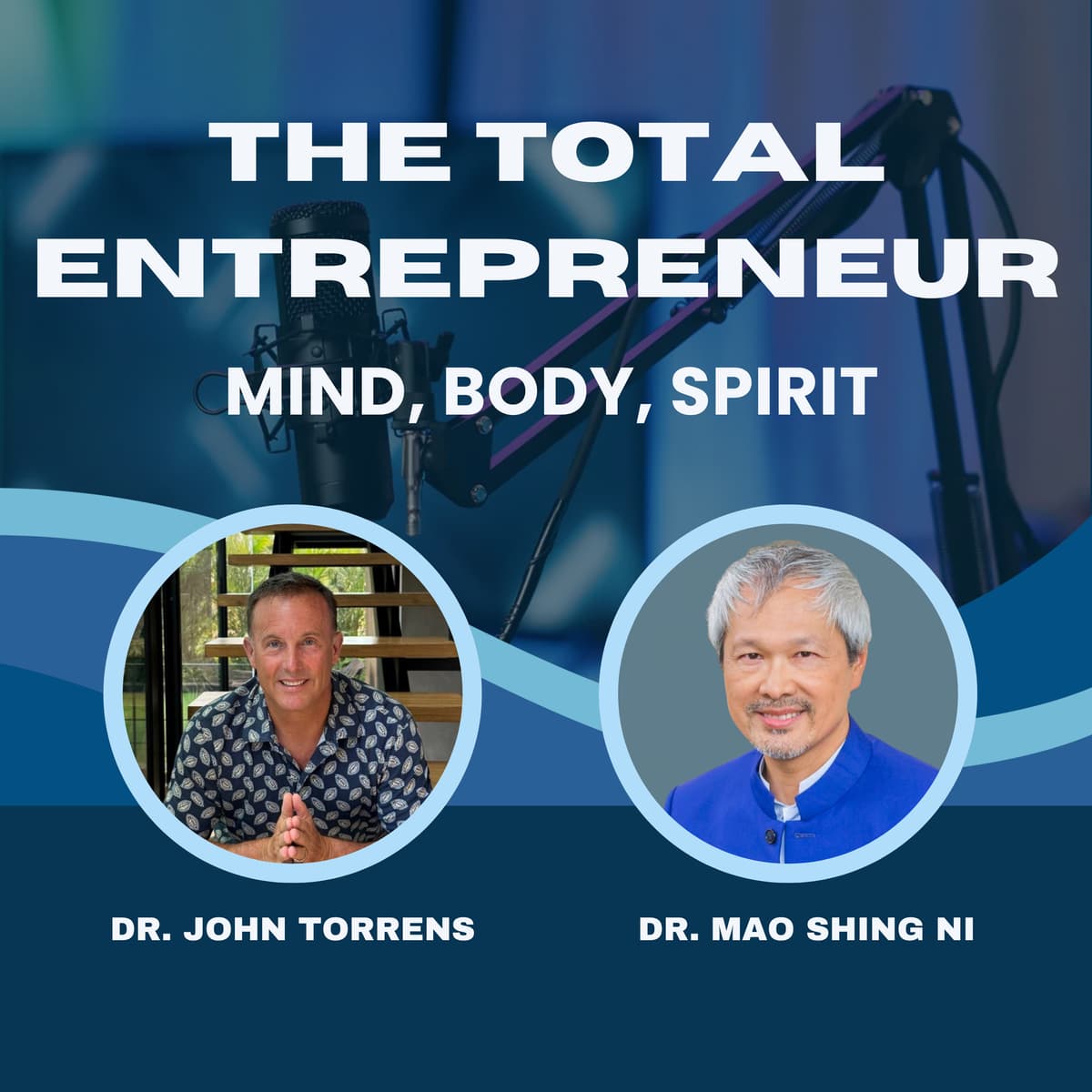
Secrets of Energy and Longevity with Dr. Mao Shing Ni
with Dr. Mao Shing Ni
Apr 9, 2026 · 00:57:55
Part of our conversations on
Your thoughts really matter, right? And the clarity of your thoughts, the number of your thoughts, and how kind they are, right? A lot of entrepreneurs, their self-talk is very negative and they beat themselves up. And it's important to realize that that's all part of your energy.
John, thank you for that because you're absolutely right. That negativity that happens, the self-degrading thoughts that come in, those are the very highly destructive. If you're angry at yourself, if you talk down to yourself, it's the worst thing you can do. What would your mentor and what would your loved one If you fell off the bike trying to learn how to ride the bike and they say you're stupid, you probably never want to ride that bike again. But if they say, hey, listen, you're doing great, just a little bit more, I see the potential in you and I know you can succeed, and then you do it because the confidence boost helps you get there. Dr. Mao, it is a pleasure to have you on the show.
Pleasure to see you again, and thank you so much for being here. I'm excited to share your knowledge and wisdom with the audience.
John, it's really been my pleasure, and, uh, and it's been too long since I last saw you, my friend.
That's right. Well, hey, I want to start really quickly by just asking you where you got the nickname Dr. Wow from. Where did that come from?
You know, that's such a funny story, but A friend of mine moved from LA to New York to create a show called Sex and the City, which I never watched. I hear other people talk about it. But so one day, patients came in and I had— probably that one day I had like 200 calls from, you know, friends and others that said, hey, you know, we saw your character on Sex and the City. And I'm like, what is that? You know, anyway. So So I went and watched the episode and it was really funny. So Michael Patrick King, the creator of the show, said he had threatened, he says, I'm gonna put your character on my show one of these days. And he, he made good on that promise, but it was a funny thing.
Yeah, absolutely. Notoriety from Sex and the City, that's funny. Thanks for sharing that. But more seriously, I wanted to dive into your expertise in Chinese medicine, functional medicine. And before we start, I've read that you come from 30 38 generations of practitioners, which is almost hard to fathom that many generations and that much knowledge going down. So maybe talk a little bit about that and, you know, what the power and value of that much generational information being passed down is.
You know, it's interesting. I was the second born. So it traditionally in a Chinese family, if you're in family business or tradition, it passed on to the oldest son, right? And since I'm the second son, I was never really chosen. So my older brother had all the pressure of like you have to continue, right? But I was a tag-along because I decided very early on after my near fatal fall from the rooftop of our three-story house, I spent about a month in a coma and then couldn't walk for a couple of years. So it was acupuncture and Chinese medicine that saved my life and brought me back. to health. And so for me, it's been a privilege and an honor. And, you know, really looking back in our family history, 38 generations, roughly 1,300 years, and we have the name of every one of our ancestors going back that far. It's kind of unfathomable in today's time where a family can have that lineage. And so I grew to have tremendous respect and also a sense of responsibility. Like, We have had this cumulative wisdom that has been passed on over the years, and Chinese medicine is different from Western medicine in that Western medicine is always innovating and finding something new and discovering new. Chinese medicine has had this 5,000 years of history of what works and what did not work, and so you know it's kind of like not needing to reinvent the wheel. And what we've been able to see. That's really amazing is a validation of these age-old wisdom that's come alive today. We can explain it with science and oh, this is how and why it works. And so in Chinese medicine, the older, more time-tested, the better. In Western medicine, the newer, the more innovative is better. But then we also deal with side effects. You know, in Western medicine that whoops. 10, 20 years down the road, there might be an issue that we didn't know about. So anyway, what I find is that the integration of the ancient and the modern is really where it's at, the intersection of the two.
Yeah, because it seems like there's thousands of years of wisdom, right? It seems like it's becoming discovered again or more popular again with more people. But then, yeah, there's the intersection with modern medicine that is doing all the cool stuff, you know, looking forward. And yeah, I think the marriage of them and not discounting one in favor of the other, just using them Where they make sense, right? Yeah. So when you're beginning with a patient, what do you start with? Like when we go to a normal Western medicine doctor, we kind of, you know, we get the blood pressure, the vitals, you sit on the table, you wait, you know, all that kind of stuff. But what does a first encounter with, with you look like usually?
Well, it's, uh, it's interesting, right? We do the physicals in Chinese medicine as well, right? When you come in. But the first thing we advise And we also have a school. So I'm going to switch to my professor hat here.
Right.
Yeah. John, I know you've been back in education for a while. So, so here's what we do. First thing, someone comes in, you size them up really quickly, the way they walk, the way they gesture, and so forth. You can tell a lot. They're giving you a lot of clue as to what's going on, why they're visiting you. But we also look into their eyes and very much specifically observe the spirit. Because why is the spirit important? Emotional, mental turmoils and disturbances that happen shows up in the eyes, and you can see the spirit. Literally, we look for the spark in the eyes. We look for the ability to focus and carry on a train of thought in the conversation instead of darting all over the place. I mean, we see attention deficit, we see anxiety in the eyes, we see depression, we see even despair. So, so much can be gathered. And so that's what you want to do first thing. So then because the spirit or the overarching mental condition is going to affect the physiology of the patient. So that's the first thing. And then we go through the process of interview, Chief complaint and similar things what Western medicine does, and the physical exam involves taking the pulse. We listen because the pulse reading provides clues. We have like twelve positions between both hands of organ systems, subtle changes in the body that we can ascertain from pulse reading. Then we confirm it with tongue. The tongue diagnosis is looking at the tongue as a map of the body, and literally it tracks the body. So for example, if there's heart issues, if there is anxiety and so forth, which is attributed to the heart, then we see the tip of the tongue being kind of not just red, but like these red dots like a strawberry, and very, very telltale as an example. So the tongue is a map that validates what we're reading from the pulse. And interestingly, Western medicine, long time ago before technology took over, Relied on tongue and pulse too. So this is not exclusive to Chinese medicine, but it's been lost from Western medicine.
Yeah, so that was going to be my next question actually. So what are some of the things that were lost that are still pretty useful? Like, yeah, it's just evaluating somebody's tongue, looking in their eyes. What other types of things have been lost that are useful?
I think the over-relying on technology and blood testing and so forth Many of my patients complain that their visits with their PCP, primary healthcare provider, is far from being satisfying because the doctor doesn't even touch them. This is the problem now, right? We go through abdominal examination, we palpate. If there's a pain, we try to do some tests based on just physical exam. But doctors today are so busy, they've got 5-minute or 7-minute increments in their appointment book. And so the actual face time with the doctor is very limited. And like I said, the doctors don't even touch you except for the handshake in the beginning, if there's any at all. So it's all farmed out to blood testing. It's all farmed out to imaging and so forth, which is so impersonal. I would say the biggest thing that's lost in Western medicine is this Conversation. Hey, John, how are you really feeling? Not the usual, hey, sure, I'm fine, I'm doing great, whatever it is. No, really, how are you feeling in terms of your mind, in terms of your body? What's your relationships like? What are the pressures in your life? Let's talk about it. Let's have time to understand what you're experiencing, where you're coming from. Because oftentimes patients will tell you exactly what's wrong. I mean, we can confirm it with the blood tests and other techniques, which we use as well, John, because we do integration of East and West, right?
Mm-hmm.
So I'll order the blood test and I'll do the imaging, but more as a confirmation of what I already know. And no one knows their body better than a patient. And so I'm not going to sit here and just pretend that I know everything, but I need to listen. And the listening skill, I would say, is really amiss in the patient-doctor experience today. So this is one of the things that I feel like it's been lost because of the overreliance on technology.
Yeah. So now I'll go to a functional medicine doctor because I feel more satisfying. It kind of brings me back to just the education of these practitioners. All right, so could you describe a little bit of the difference between what you teach in your school and what a modern medical school student might learn or encounter?
Yes. So at our school called Yo San University of Traditional Chinese Medicine here in Los Angeles, our curriculum also includes Western medicine. So our students have to learn both Eastern and Western medicine because they are practicing as primary healthcare providers. So besides the usual pathophysiology, clinical diagnosis, and all that, we do teach them very specifically on this patient interface. This is really one of the most important things, learning to recognize clues that patients are giving off and really connecting with them so they feel heard. And then really listening, not just listening for facts, but listening for nuances of what's really happening. Sometimes they're not comfortable telling you their feelings, but the feelings are—it shows through if you can relax with them and you can make them trust you because at that and the trust can only come from this relationship building. So the relationship is. Going away, I pride myself in taking care of four generations and some of my patients' family. I'll take care of great grandpa and then now the young, so great grand. Yeah, that says something. Yeah. And so having that continuity, these are rare times today because of the way the healthcare has shifted and changed. You don't really have that continuity of care anymore, and then also specialization because you know you. The kids go see a pediatrician, which my pediatric patients do have pediatricians, but their parents will bring them to us because they don't want the antibiotics for the ear infection because that's one too many that they've taken. They want to look at what's the root of it and is the immune system that's weak and other kind of potential problems that were dietary-wise or nutrition that we can deal with. So yeah, we have this more of a holistic perspective and we talk about holism. It's really about you know the mind, body, and the spirit. So it isn't just physiology we're looking at because everything affects physiology. So the environment, what they put into their body, and the interpersonal relationship they're having with others in their lives. So they all play a role in the disease process. And you know Harvard has done studies that show 80% of chronic disease today. Have their roots in the mind. Wow. Wow. Yeah.
So, so it's the idea of, you know, you being the placebo, right? Like you have access to a pharmacy already inside your body. If you can unlock it, maybe.
I love the way you say it. And I, for whatever reason, in Western medicine, placebo seems to be a bad word, but I tell you, I try to leverage placebo as much as possible. And ultimately, that's what we're here to do. We're here to guide the healing process. And so, as much as I can to empower the patients to do the right thing to help their body and to activate their own healing mechanism, I'm succeeding in what I'm doing.
Yeah, yeah. I've read some of the studies specifically looking at placebo and sham surgeries where people think they got a meniscus replacement in their knee but all they were— they were just opened and closed. they miraculously felt better. You know, it's, yeah, placebo is real. And I think that's important for people to realize that the power of your mind is much, much more enormous than you might think both ways, right? So there's the nocebo effect where you could actually think you're ill because somebody told you or, I mean, that's how voodoo hexes work, right? So, yeah, yeah.
Yeah, yeah, no, to your point, you know, this is where mind-body you know, medicine comes in, right? Because how can we turn the mind to help the patient heal? And that's just as important.
So another thing that you don't really hear a lot about in Western medicine is somebody's energy, right? And I know you do work with people's energy. I've heard you say that the real currency for entrepreneurs is their energy. So talk to us about that because that's fascinating to me.
Yeah. First of all, if you think about it, if you're out there building a business, you're scaling up, you're doing everything you can. Ultimately, yes, you have a company, you have people that are doing the work, but you're the leader. And leaders spend a lot of energy driving their vision and realization of their vision. So a lot of people think like their greatest assets, it's intelligence, which is true. Their capital, yes, and strategy, no question. But really, your true currency is energy. Because everything you produce, right? Decision, leadership, relationship comes from your available energy. You know, it's fascinating to me that we're not limited by time, really, because, you know, you think about time as finite, and yes, it's true to that degree, but really, We have all the time in the world to realize what we want to do, but we're limited by energy availability and quality. I mean, if you take 2 founders who work 10 hours a day, the output and productivity is totally different. And why is that? And it comes down to energy, really. You know, one person can produce a lot of clarity, innovation, and momentum. While others maybe produce fatigue, burned out, reactivity, and therefore end up making poor decisions. And so, ultimately, it comes down to the biology of energy capacity.
Are you talking about the physical energy from cells? Are you talking more of an ethereal kind of energy aura type of thing? Or what are you referring to?
Well, no, it's a great question. Great question. I'm talking about both really because biology dictates how much ATP your mitochondria, which are these organelles in your cells, they're your engine, energy engine that produces ATP. So that's your currency, right? And so production of energy is important. How your metabolism is utilizing energy is important. And then how you are regulating your nervous system. You know, you can have like tons of nervous energy, right? Which is causing you to have a lot of anxiety and poor decision-making, or you can have very calm, clear energy. So that's like the sympathetic versus the parasympathetic. This is why I advocate self-care as part of the practice, like meditation. The reason why you wanna meditate and you wanna do practices like yoga and tai chi and qigong is that you can flip your nervous system back into parasympathetic instead of sympathetic. Sympathetic is survival. And if you're in that survival mode, you can't make the right decision. It's like knee-jerk reactions. It's what happens when people get emotional too. And if you can just step back in that kind of what we call rest and digest mode, you can literally digest, analyze with clarity, and then make the right choices, right? If you have inflammation in your body, you are consuming so much energy. I look at inflammation like a car sitting at an intersection. You've got your foot pedal to the metal. And then so you're revving up to 3,000, 4,000, 5,000 RPMs, but you're not going anywhere. You're just burning fuel. That's what inflammation does. So if you have poor health, it's going to get to you for sure, right? And so all of it compromises your ability to make good decisions, clarity, right? Emotional volatility goes way up, so you can't stay calm enough to you know. And then your cognition it gets affected. We know that in fact cortisol, the stress hormone, is toxic to neurons. So literally degrades your ability to convey you know to make the right decision. The signaling now in Chinese medicine we look at energy. We call it qi. It's a little different concept, but I think you can get the sense of it. It's the same in that this chi is what helps you. It's the bridge between your vision and the material reality. So we can have a thought like, okay, I want to accomplish X. But then what happened is procrastination, no follow-through, whatever it is, it doesn't manifest into physical reality. But if you want to manifest your physical reality, you need something bridging between the physical reality, which we call Jing, with the essence, and spirit, which is the mind, we call Shen. And then we have Qi in between. That's the energy. That's the life force in which you are using to manifest your vision into physical reality. So that's why we spend so much time working with Qi. Acupuncture, for example, is very specific to activate your energy flow, your Qi flow, removing blockages, because blockages can come from poor diet, improper sleep patterns, lack of movement, the right kind of exercise, and not having enough kind of balance. your life. And so that's going to disrupt your chi. So whole premise of Chinese medicine acupuncture is to balance and promote flow of chi so that you can manifest your vision.
Yeah. So, and that idea of manifestation is becoming more popular, right? I mean, it started a number of years ago with The Secret, which I think did it justice, but then you've got people who are building on it and that kind of thing. Yeah. I was wondering if you just share a few more thoughts, you know, your, your own personal thoughts on that and how people can best set themselves up to be able to, because you're manifesting all day regardless of whether or not you know it, right? Like the thoughts you have are sending that out into the field and you're getting them back is my understanding. So how can people manage that knowing that it's, it's happening all the time?
The interesting idea, John, is to actually reduce all the mental chatter, right? I always sort of counsel people, be careful what you wish for.
Right. Right.
You know, because all this stuff, the worry and this and that, whatever it is. So the first thing is unclutter your mind and reduce the amount of thoughts you have, right? Because energy scatters and does you no good. It doesn't, nothing comes from it, right? But what you want to do is you want to be able to focus and concentrate energy almost like laser. So if light is scattered and diffused, great, there's light, but that does nothing else. But when light is, you know, on the spectrum, electromagnetic spectrum, when it's harnessed, it becomes a laser beam, right? And the beam can now— we use lasers to, you know, actually cut, you know, matter. So I was reading the other day that they now have lasers to actually shoot down drones and bombs and whatever else that's happening in the, in the, you know, conflicts out there. And so it's powerful. Lasers can also be used for healing, right? So lasers are being used in surgery. Laser surgery is an example. And so, so when you harness, so that means you need to actually have less thoughts, but more consistent thoughts and alignment. So it comes back to how to manage your mind. Because if your mind is scattered, nothing's going to get done. But if your mind is in alignment with your vision and like simplify your thoughts so that there are few important decisions that you make and the focus on that, Mm-hmm. then you can begin to put more energy behind it. And help you manifest the you know the reality of that vision. So it's really interesting, and so the process is starting with that, and then you work with practices that build your qi. So that means meditation, that means qigong, tai chi, or yoga. That means doing practices that help you whittle down the not important stuff. Just let it go. It's none of it's important because you know what's important, what you want to manifest, and then build on it. And then that means building chi, building energy, and cultivating energy. That also means nutrition, eating the right foods. You know, some foods make you tired. It's very— I mean, I tell people, eat intuitively, right? There's so much information out there on diet and misinformation. Oh, we're now on a protein kick. I'm telling you, in this last 2 years, you know, everybody's saying, oh, you have to get more protein. You know, you got to get, you know, 200 grams of protein a day. Well, I mean, if you have kidney problems, you're going to knock your kidney functions out. This is not a good thing.
Hmm.
And invariably, you know, the animal protein comes with saturated fats. And so now you're building up an increase in your cardiovascular risk. And so that's not ideal either. So it's all about balance, right? If you are an athlete and if you're running a 100-yard dash or a marathon, you know that you need energy. Good carbohydrates, good quality carbohydrates, still important because carbohydrates is really what gives us energy. And then yes, there's the stored energy of fats, that good quality fats is also important. So those kind of things that again, you know, I just find that whenever the trend pushes in one direction, we then throw our whole trajectory off. So it's just as important to pay attention to what you're putting into your body and then sleep. I made the mistake of really, like everybody out there trying to scale up your enterprise and whatever it is, you go, okay, I gotta finish up this email. I gotta do this. I gotta do that. Next thing you know, it's midnight. And then you have to get up at 5 because you wanna train, you wanna do exercise. So now you got 5 hours of sleep. That's just simply not enough. And for me, I think my body steadily suffered from my, you know, my 40 years of just driving myself too hard. And so now in the last few years, I've discovered the magic of sleep. I sleep 8 to 9 hours every night. I don't wake up with an alarm and I wake up well-rested. It's like before I used to dread waking up every morning. But I do it because I need to do it because I need to succeed. But now I just wake up and I feel great. I have it. And my energy then goes out and manifests exactly what I want and not what I don't want.
Yeah. Yeah. So, it's basically setting the stage so you can do that. But I think the big headline for a lot of people listening is that your thoughts really matter, right? And the clarity of your thoughts, the number of your thoughts, and how kind they are, right? Because especially a lot of entrepreneurs, their self-talk is very negative and they beat themselves up. And it's important to realize that, you know, that's, that's all part of your energy. So, yeah.
John, thank you for that, because you're absolutely right. That negativity that happens, the self-degrading, you know, thoughts that come in, those are the very highly destructive. If you're angry at yourself, if you're, you talk down to yourself, it's the worst thing you can do. It's like, what would your mentor and what would your loved ones tell you? They would, you know, if you fell off a bike trying to learn how to ride the bike and they say you're stupid, you probably never want to ride that bike again.
Right.
But if they say, hey, listen, you're doing great, just a little bit more. I see the potential in you and I know you can succeed. And then you do it because the confidence boost.
Yeah. So, one of the things I hear a lot of people talk about is nervous system regulation, right? Oh, my nervous system isn't regulated. And I'm not sure that they even know what they're saying except for maybe they think they need to relax a little bit. So, you talked about sympathetic versus parasympathetic, right? And the fact that sympathetic has an absolute utility, like we need to switch into that mode when we need to, but we're not meant to live there, right? So, could you talk a little bit about nervous system regulation, what that means, and how we can get out of that mode? Yeah. Maybe a couple tips that you could provide for people to reset their nervous system when they need to?
Yes, of course. So, we now live perpetually in this sympathetic overdrive. It's survival mode, right? And, like you said, it's necessary. In the old days when we were being chased by saber-tooth tiger, we need to get out of danger. Climb up a tree, get into a cave, whatever it is to get out of danger. Today, that seems to be perpetual, right? Because at least in the old days, you got back to the cave, got the big rock against— at the opening. So you can relax, you can decompress and get back to parasympathetic, which is rest and restore and digest. But now people almost never get to do that. And so the perpetual sympathetic overdrive will lead to burnout. Your whole system will burn out. You'll, you know, not only will you feel terrible and consume your chi, by the way, your vitality, your life force, your energy, but don't forget is that literally cortisol is equal to prednisone. It's the same molecule, by the way. People don't realize this, but prednisone is cortisol.
Ah.
And so every day you're pumping and producing more. So at some point you find yourself like, why am I like 10 pounds overweight? I've got this big belly in my stomach and I feel nervous all the time and I can't settle down. Well, you just basically over the last year, you've been taking 10 milligrams of prednisone or 20 milligrams of prednisone every day. And so you're suffering the side effects of that. I see this all day long, which is so interesting, right? And so self-regulation is key, recognizing, whoa, I need to rebalance my body because I need that parasympathetic reset in order to restore. And if I don't restore, I'm not going to be any good. And so a couple of things besides making sure you sleep every night, very quick reset. Our breathing can, you know, in 2 minutes' time, can help you get there. John, if you would indulge me, let's try it.
Sure, let's do it.
Okay, so when— let's do a couple breaths first. Inhale, just take in the air through your lungs and into your abdomen. And then exhale. And exhale, you can exhale through your mouth if you want, and just kind of blow your air out and let it go. Okay. And now what I want you to do is I want you to inhale, and I will do a count to 4. Inhale, 1, 2, 3, 4. And now exhale to a count of 6. 1, 2, 3, 4, 5, 6. Let's do it one more time. Inhale to 4. 1, 2, 3, 4. Exhale to 6. 1, 2, 3, 4, 5, 6. Now let's inhale to 5. Inhale, 1, 2, 3, 4, 5. And now exhale to 8. 1, 2, 3, 4. Continue to exhale, 5, 6, 7, 8. Inhale once again to 5. 1, 2, 3, 4, 5. And exhale to 8. 1, 2, 3, 4. Continue to exhale, 5, 6, 7, 8. 1, 2, 3, 4, 5. 7, 8. Okay. Now, how do you feel just from that minute and a half of breathing?
Yeah, I feel quite a bit better, actually. It's noticeable.
It's noticeable because when you exhale, you activate the parasympathetic. When you inhale, you activate sympathetic. So if you do that, this is why, like, When people are confronting something dangerous, what do they do? They take a deep breath, inhale, right? Because they need to activate their sympathetic. It's the opposite we need to do. We need to activate our parasympathetic in order to relax. So that's why we elongate the parasympathetic. And even if you think like, well, I don't have any more breath, you do. You just got to keep blowing. And then that will make you, you know, end up And, you know, usually what I will do is I would do inhale to 5, exhale to 10, but we sort of need to practice it.
Right, right.
But all you have to do is do 2, 3 minutes of this once an hour, for example. You'll notice that your resting heart rate— it's measurable— your resting heart rate will drop by about 10 points after doing 2, 3 minutes of this breathing, which is like amazing if you think about it. It's faster than taking a Xanax.
Yeah, yeah. And it's, you know, it's interesting because I think a lot of people don't do it because they're like, it's just breathing. I do that every day without even thinking of it, and how is this going to actually help me? But, you know, it's important to realize that respiratory physiology is, is a thing. Can it— can really help you. And I think that's why people don't take it seriously, because we just breathe every day, and, you know, what's, uh, what's the difference?
Yeah.
Yeah, no, thanks for that. That's, uh, that's helpful. And it's a good reminder to, to just breathe, but with intention, right? Making sure the inhale is for a certain amount of time if you want to activate your sympathetic, and then the exhale is a little bit longer if you want to activate the parasympathetic. Yeah.
And you can also, you can also inhale positive traits or attributes and exhale what you don't want in your life. So think about like as you inhale, inhale health, vitality, calmness, money even, right? And exhale, exhale negativity, tension, stress, anger, frustration, blockage, whatever it is that you don't want in your life anymore. And imagine if you did this consistently, it's almost like a mantra, right? That eventually Your subconscious will register exactly what you want. And then when you're sleeping at night, it's going to work for you and coming up with incredible revelations and solutions for you.
Yeah. Well, I love that because that's something your primary care physician isn't going to tell you about, right? They're not going to have this conversation with you. Yeah.
Or, you know, John, there are lots of smart people that are primary care. But the problem is they don't have time. Yeah.
They need to be able to do this in 5 to 7 minutes.
It's just not possible.
Yeah. Yeah. And it's not within their scope as they see it, right? And there's no CPT code for it or whatever. So there's—
And that brings me to really ultimately what's happening is that the system is creating a degradation in the whole healthcare system because it's become very efficient, money-driven, you know, it's all about cutting costs, right? But then our healthcare costs spiraling out of control, like 18 to 20% of GDP. How is that sustainable? And it's like 8% for Switzerland and Singapore, and they have excellent healthcare. So what we're doing is not working. It needs to be changed. Anyway, it's the system is what creates the behavior.
Yeah. You know, and it kind of begs the question, like, you know, is it really about containing costs because the costs keep going up? And do they even want to contain costs because there's really not a lot of money or profit in prevention and optimized health, right? All the money is in treatment and keeping us alive longer with chronic disease. I mean, not to go down that road.
They say containing costs, but the reality is that It's an industry and we just have to recognize that. Yeah. Like, why do drugs cost more in America than across the border? 3 times more or 4 times more? Yeah. What is the reason for that? There's a lot of reasons I won't get into, but the fact is it's an industry that needs to generate profit for its shareholders. And, but somehow I feel like healthcare, housing, are the 2 most basic things that humans need. And so, you know, we need to— we need to— we've got deficits on both ends.
Yeah, you know, and a focus on real health, right? Not fixing you after you've already become sick because I think it's an important message for entrepreneurs, especially when they're young. A lot of the chronic disease that they might encounter in 40 years could probably be prevented or ameliorated now. So, so what is, what's different about now? You know, I know that, you know, our food is a little bit different. There's, you know, more toxins are in our environment, but it just feels, you know, we've got more stuff going on now than I can remember my parents or grandparents talking about.
You're absolutely right. I, I totally agree. And Chinese medicine agrees with you. that treat the disease before it happens, right?
Yeah.
And much of the chronic disease that we see today, number one killer, heart disease, number 2, cancer, and number 3, iatrogenic, which stands for errors made from doctors, hospitals, and drugs. And all those can be prevented. They really can. Much of it is lifestyle. And stress management, and what we so it's what we do, what we eat, and how we heal. So today, I think the challenge is that increasing urbanization, there's a lot more concentration of it around us in terms environmentally, in terms of our work. I mean, look, we just came through you know pandemic. We just came through. You know, we're witnessing war, inflation. There's a lot of stressors in the world today that, not to say our parents didn't go through it. I mean, they did. There was World War II and all of that. But at the same time, I think there is less safety net really in our world today. Young people especially, like, you know, what is the prospect of AI taking your job? Right? I mean, you spend all this money going to— and then you graduate with a degree and you go into the workforce only to be laid off by AI taking your job. So there's a lot of uncertainty and the young generation today is grappling with that. I think the stress is very real. I mean, I hear it all the time from my patients, you know. And then the food, you know, I think there's a movement among Younger generation, and that they really want to. They're solid. You know, they emphasize regenerative agriculture. They want they're organic. They are supporting the local farmers market. But you know, ironically, the farmers market is more expensive than what they can get from your regular stores, you know, supermarkets. And so we need to kind of make that more accessible and available. And and then also too, it's young people today are. I think the device that we have today and the so-called social media, it's kind of looking at what other people are doing, comparing yourself. It's just that the stress is immense. And by the way, John, I don't participate in the social media thing. I mean, I occasionally posting whatever, but I don't watch other people's thing.
Right.
I just, first and foremost, I don't have time. And number 2, I choose to spend more time in nature. And I think this is my message is get back to nature. Nature ultimately is healing. Nature is what kind of our sustenance, right? We wouldn't be here without natural environment.
Yeah.
And I was just actually reading today, someone sent me a research about trees, right? Those, Harvard did a study, those who lived, women, like this 110,000 women that were studied, that lived near parks and trees had 12% less or lower rate of death.
Yeah.
Mortality from all causes than those who lived in an urban jungle with no trees. Just being near trees. Wow. I mean, think about that. We've always known intuitively, and we, I come from the spiritual tradition of Taoism, And we celebrate nature because the Tao is nature, right? And so I try to go out and spend time in nature because that's where I find my inner peace. That's where I find connection to the whole. And I don't feel like I'm alone. And that's another thing. The loneliness quotient is really high among younger generation today, but overall, everybody today.
Yeah.
And so that's going to have a huge negative impact. On your health and well-being.
Yeah, I agree with that. Just being outside is just— it's therapeutic. I was wondering, could you talk a little bit about the grounding effect or Mother Earth's charge and what the benefits of just touching Earth might be for people?
Well, yeah, I mean, this is what I love to talk about, right, John, is that the Earth pulses at an EMF electromagnetic field of 7.2 hertz. And our body syncs to that same rhythm. And interestingly, when you fly, this is one of the reasons why people have jet lag besides the time change, is that for however many hours they're disconnected from the Earth's EMF when you're up in 35,000 feet. And so as soon as you get off the plane and you get to where you're going, make sure you take your shoes off And put your feet on the grass if that's possible, or just be on the ground floor and just walk around with your socks, right? In your hotel lobby, totally fine, right? But just to reconnect because your body needs to get back into that rhythm because when it's, it's out of rhythm, you are going to suffer because so much of our body is electrical system. And so you're gonna, you're gonna have dysregulated, you know, nervous system if you don't kind of get reconnected. So it's important. I would say take your shoes off and just go walk through, through, you know, through nature if you can.
Yeah.
Safely, of course.
What do you think, you know, for those, those people who can't conveniently do that, what do you think about grounding mats and pads and sheets and that kind of stuff? Is there something Is there any validity to that or is that just kind of a gimmick?
No, no, it's not gimmick. It's real?
Okay.
No, I mean, like grounding, you know, like grounding mats is important. There's also infrared mats that can also simulate, uh, the, the, you know, the Earth's EMF and so forth. So yes, there are all these tools that you can use. And then for those who live or work in high-rises, This is the thing: Earth's EMF reaches up to about fourth floor level, and so it's actually distance specific. So make sure you come off your ivory tower and go onto the ground level and walk around and so forth. And then you know the kind of shoes you you wear as well. I mean, like for example, rubberized soles acts as an insulator. So a lot of times, you know, I would suggest that you know. get a leather moccasin or something like that where you can, you know, walk around in that every day for 10 minutes, 20 minutes, whatever, on the ground floor. That would be very helpful.
Yeah. And is the, is the earth conductive enough where if you're in a big city and you're just outside on the concrete sidewalk, are you still getting the benefit or does it actually need to be? Okay, good.
Concrete, again, it's not a barrier, right? Right. But the rubberized kind of insulator is.
Okay. Yeah. So, even if you're in a big city, there's opportunities whether it's just through a mat or a pad or a sheet or just, yeah, getting down on the concrete or to a park. But yeah, I totally agree that that's valuable. Yeah. So, my next question is just about supplementation, right? A lot of people take supplements. They may not necessarily know why except for maybe they heard it or saw an influencer somewhere. And, I know you've got experience and an opinion on this. So just general advice for people considering supplements, and are there any that, you know, are just you should take anyway because your body's probably deficient, or is it better to test, or what's your, what's your thought on it?
It's a good question. I get asked about that all the time. First, you know, kind of a disclosure, I do manufacture supplements, right? So, uh, but I don't just provided indiscriminately. So, it's really targeted therapy. I myself take targeted supplements. For example, I'll maybe list, I would say, top 5, let's say.
Okay.
That I think in general people can benefit. First and foremost, vitamin D, right? D3. We're chronically deficient because you don't get enough sun. You just don't. And so, unless you want to take mushrooms and sun-dry them belly up for 2 days, which studies show can increase vitamin D production by up to 4,000 times. That's the only plant-based— although mushrooms are technically plants— but plant-based food that has vitamin D. Of course, meats and eggs and so forth have vitamin D.
Now, is it true that you need to— for absorption, you need to take it with vitamin K as well? Or is D just by itself?
It's actually— it's an oil-soluble vitamin. So, if you're going to take vitamin D, you got to take it with some oil. So, I would take it with omega-3 fatty acids, for example. And that's my second one, right? So, vitamin D is important for bones and hormones and immune system. Omega-3, which oftentimes there's plant-based and then there's fish, right, sources. And that's good for inflammation, good for your brain. And in that, that'll help vitamin D get absorbed. The K oftentimes paired with vitamin D is because they work together for the bones, so strengthen the bones, and the K prevents calcium from ending up in the blood vessels and causing plaque. So that's the reason. So, so that's two. The third thing is some kind of, for example, antioxidant. Formula, like for example glutathione, which by the way, all of this comes from food, right? So avocado has a lot of glutathione, so it's my number one go-to. Yeah. And lutein, lycopene from tomatoes, for example, that's really good for your eyes and prostate for men. There's zeaxanthin, there is astaxanthin. Those are antioxidants from shellfish, and they're also good for your eyes and skin, protecting you. Think about this for a second. Like, blueberries is what I hold up as one of the model child for antioxidants, okay? Anthocyanins and so forth. And imagine you sitting outside during a hot summer for 12 hours, right? naked, no clothes on. What do you think will happen to you?
You probably shrivel up like a prune. Yeah.
But the blueberry gets exposed and it just gets more plumper and plumper, right? And it's because of that coating, that anthocyanin, the antioxidant coating. So, the antioxidants really protect your cells against damage, oxidative damage, and aging. And so, that's really important. All right. And so those are the kind of things that I would suggest. There's— oh, I'll give you 2 more.
Yeah.
So another thing, and again, these are things that I take as well, would be the actual— there's an extract from a plant, the Oregon grape, or a plant called Coptidis, called berberine. So, berberine has kind of more recently become more popular because a lot of research. You know, some people call it like the herbal natural Ozempic, you know, GLP-1. But actually, it's not the same. It certainly doesn't have those side effects, but it can help you decrease your insulin resistance. And what's happening is that we're seeing a huge population of people with insulin resistance. And, and there's a lot of reasons for it, just a lot of it's stress and lifestyle and diet and so forth. But at the end of the day, it's going to predispose you to diabetes and other metabolic disease. So berberine does help reduce insulin resistance. And it also has a benefit of keeping your microbiome in check. So a lot of times people come in and they complain like bloating and gas and so forth, fermentation. So, the bad bacteria causing hydrogen sulfate and methane gases, which then they get diagnosed as having SIBO, small intestine bacterial overgrowth, very, very common problem now. And so, a lot of it's from processed foods and overeating sugar and bad Carbohydrates, starch, you know, simple starches and so forth. And what happened is that berberine can inhibit the bacteria that produces hydrogen sulfate and methane gases. So it vastly reduces your gastric distress. And so that's, that's one thing that I take on a regular basis, because it really does have tremendous benefit from that.
Yeah.
And finally, another thing that I take one last one is DIM, which is basically an extract, broccoli extract. So it contains indole-3-carbinol. And so as a natural broccoli extract, it helps lower the risk of cancer. So cancerous cells and so forth, which is number 2 cause of death in America today, it's cancer. And so this is the one thing it— what it does is also mops up bad estrogen in the body. So for women, it can lower the risk of breast cancer. And for men, it actually helps with regulating your testosterone so that it also doesn't become excessively impactful in a bad sense, you know, because high testosterone sometimes can increase prostate cancer. But furthermore, belly fat. It does help reduce belly fat. So there, these are the kind of like the 5 things that I take for sure. And then depending on what the issues are, we can do urine tests for vitamins, micronutrients, and then we will then prescribe specific, the actual targeted supplement therapy for them.
Oh, yeah. So I was, when you're talking about vitamin D, it made me think of another question I had regarding Sunlight, right? There's been, it seems like a demonization of sunlight. And I did just an experiment a few weeks ago when I was in Costa Rica where I didn't wear sunscreen, but I didn't wear sunglasses. And I was in the sun in the early part, in the later part of the day and covered up if I was in the brighter part. And what I was going on was something I read where your eyes take in that light spectra. And that's really important because it tells your skin, hey, we're in the sun, we got to protect ourselves now. I would love to hear your perspective on that.
Yes. I think the— I think this was a response to the skin cancer campaign that they did back like 20, 30 years ago. So what we did was we went from going to the sun, lathering up with baby oil and getting that nice tan looking, right? And really frying our skin and developing basal cell carcinoma and maybe even melanoma. So it's like complete opposite. We've gone right to the other extreme where people are so afraid of the sun. And I think it's, it's a wrong message to send. So the healthy way is exactly what you're doing. And I talked about in my book, Secrets of Longevity, where cultures that are out, you know, like early morning to about 9 AM during the summer, and then after 4 PM in, you know, in the afternoon. So you're going out, you don't need sunscreen on because the sun is at an angle. So UV rays are much weaker at that point. And you need to get the sun in your eyes first thing in the morning because it actually activates your pineal gland to produce melatonin at night. Like it has an hour, it has a specific 12-14 hour stimulation life. And so once you get the sunlight in your eye, then it knows that like 14 hours later, we need to start producing melatonin as the evening approaches. And that'll help you sleep better at night, of course. But what you're doing is critical. And yes, it does activate the skin to produce vitamin D. And so we're missing out on all this good stuff. And now there's a trend of what they call the eye bathing, like in the morning, first thing with the sun, just allow it to bathe your eyes. I wouldn't necessarily look straight at the sun because that's too bright.
Right.
But just being out without sunglasses on is good enough. And it's interesting because we've always had this practice. I grew up with this Taoist practice of this sun salutation where you meet the you know, the rising sun. And then so you do this bowing and breathing and take in this solar energy. And, uh, so it's, it's, it's great to see these, um, old ancient practices being validated today by science.
Yeah, no, I love that too. You know, everything that's old is, is new again. And yeah, ancient wisdom for modern times, right? I love that. Yeah, yeah, yeah. Well, Dr. Mao, I really appreciate you spending some time with us and sharing all your wisdom. with the audience. If people are interested in learning more about you and your work, where can they find you?
Yeah, you can find me at Tao of Wellness. That is taoofwellness.com. And so that's my clinic. I still work after 41 years. I love the patient care. I work with a team of doctors of traditional Chinese medicine where we integrate East and West. For our patients. We do a lot of work with fertility, for example, with health, athletic injuries, and, and just in general, people who want to live long and healthy lives.
Yeah. And if people are interested in checking out your supplements, where can they find those?
So they can go to Dowell's Wellness Living— I'm sorry, wellnesslivingstore.com.
Wellness Living Store.
And if you're interested in the university, you can go to yosan.edu. That's yosan.edu.
Amazing. Dr. Mao, thank you so much. This was, this is a pleasure for me.
Thank you, John, for having me on, and it's so good to catch up after so many years.
Right on.
About This Episode
What if the key to peak performance, boundless energy, and long-term health wasn't in the latest biohack, but in a 5,000-year-old tradition passed down through 38 generations of healers?
In this episode of Total Entrepreneur: Mind, Body, Spirit, John sits down with Dr. Mao Shing Ni, known simply as "Dr. Mao", a 38th-generation practitioner of Traditional Chinese Medicine, co-founder of Tao of Wellness and Yo San University, bestselling author of 18 books, and one of the world's foremost voices on integrative and anti-aging medicine.
Dr. Mao shares how a near-fatal childhood accident healed through acupuncture set him on a path now spanning 41 years of clinical practice. Drawing from ancient Taoist philosophy and modern science, he breaks down why energy, not time, capital, or intelligence, is the true currency of entrepreneurship, and how most high performers are unknowingly depleting it. He dives into the lost diagnostic arts of Chinese medicine, the biology of qi, and why nervous system regulation is the master lever for everything from decision-making to disease prevention. He also reveals his personal top five supplements, the truth about sunlight and grounding, and leads a live breathing exercise that can lower your resting heart rate in under three minutes.
Whether you're an entrepreneur pushing toward your next breakthrough or a high performer committed to thriving for decades, this episode will fundamentally shift how you think about energy, not as something you spend, but as something you cultivate.
Key Points Discussed
Eastern vs. Western diagnosis: How reading the eyes, pulse, and tongue can reveal what blood tests miss, and why the first thing Dr. Mao observes in any patient is the spirit.
What Western medicine has lost: Why the most powerful diagnostic tool is a genuine conversation, and how a system built around five-minute appointments is quietly eroding the quality of care.
The true currency of entrepreneurs: Why energy, not time, money, or strategy, is the real determinant of your leadership, clarity, and output.
Qi, mitochondria, and ATP: How ancient Chinese medicine and modern cellular biology are describing the same life force, and why blockages in both show up the same way.
Sympathetic vs. parasympathetic: Why living in perpetual "survival mode" is the equivalent of flooding your body with daily doses of prednisone, and what to do about it.
Manifestation and mental clarity: Why scattered thoughts produce nothing, and how focused, aligned thinking works like a laser to bridge vision and physical reality.
The healthcare system trap: Why there's little profit in prevention, what that means for your long-term health, and why Chinese medicine's oldest principle, treat the disease before it happens, may be the most radical idea in modern wellness.
The truth about sunlight: Why avoiding the sun entirely may be as harmful as overexposure, and how morning light without sunglasses activates your pineal gland to improve your sleep that night.
Sleep, nutrition, and balance: Why consistency and intuitive eating matter more than any trending protocol, and how Dr. Mao's own health transformed when he finally committed to eight to nine hours of sleep.
Keep listening
More on Body
About the Host
Dr. John M. Torrens
5× Inc. 5000 entrepreneur, Professor at Syracuse University's Whitman School of Management, author of Lightning in a Bottle, and TEDx speaker on ADHD as an entrepreneur's superpower.
Browse all podcast guests →Book a strategy call →