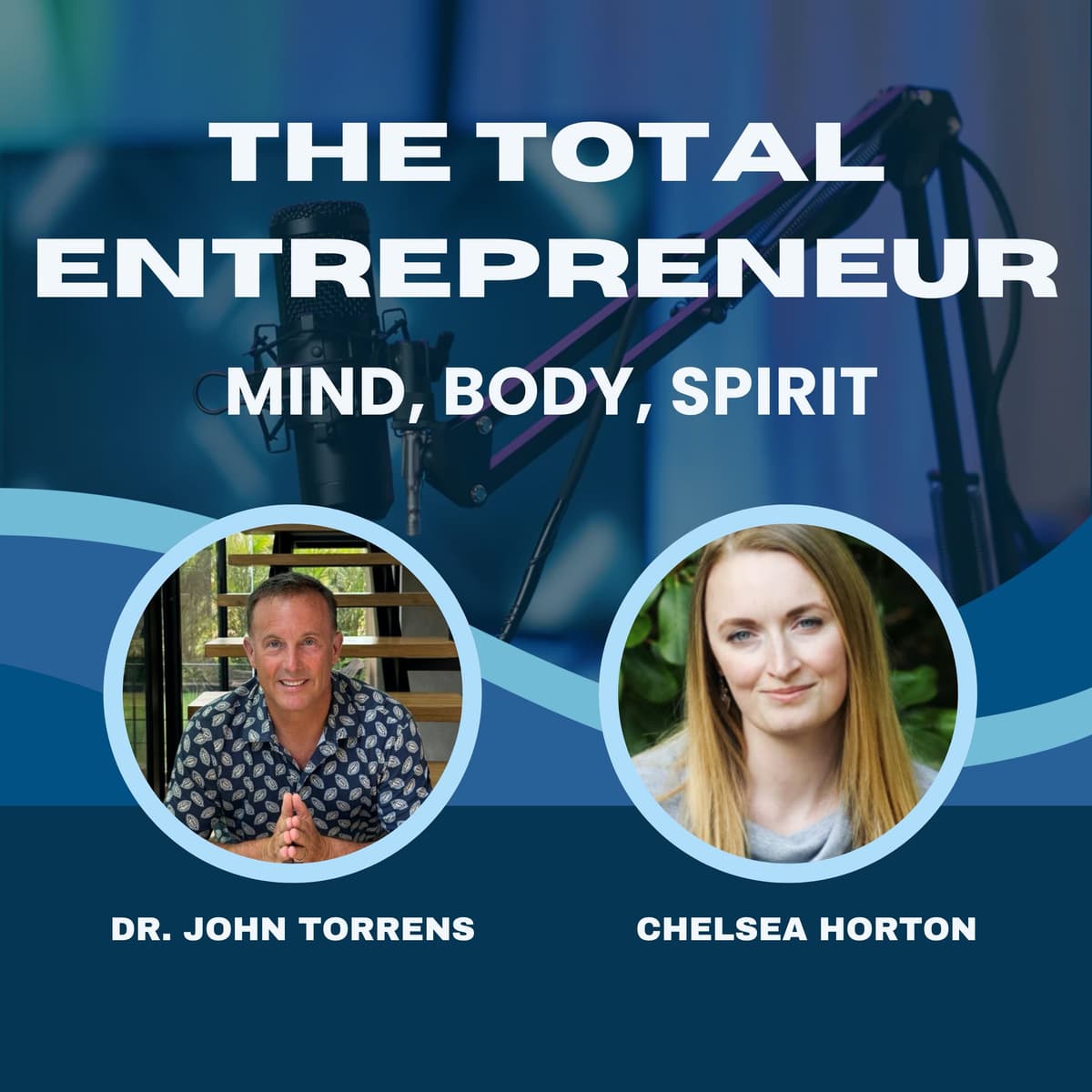
Your Body Keeps the Score With Chelsea Horton
with Chelsea Horton
Apr 16, 2026 · 00:43:50
Part of our conversations on
If emotions are energy in motion, if that feeling could move, how would you want to move with that emotional energy? Now their body's wisdom is kicking in because our bodies know how to metabolize emotion. Our mind gets in the way. So now we're accessing the body's inherent wisdom for metabolizing this emotion. And suddenly the emotion is becoming something else. The energy cannot be created nor destroyed. It transforms. So now it's becoming something else. And now it's like, okay, what are you noticing now? That knot is a little looser. Okay. What else are you noticing? I don't feel as afraid. I feel like, okay, I can hang out with this discomfort.
Chelsea, welcome to The Total Entrepreneur Mind Body Spirit. Really glad to have you here.
Thank you so much for having me. I'm excited.
Of course. Hey, so before we start, can you tell us what somatic therapy is? Because I hear this word a lot, and I'm sure a lot of people don't even know what it is.
Well, I'm going to answer your question with a question, and that is, are you a floating head in a jar?
Not to my knowledge. Right.
So do you have a body?
I do.
Yes. And I think everyone who's listening to this podcast, I imagine, also has a body, no matter what the ability of that body is. I imagine everyone listening to this podcast is also not a floating head in a jar. And yet therapy and mental health is approached as if we are.
Mm-hmm.
It's so disconnected from the rest of our human existence, which happens in a body. They're approaching emotions only through the head, through the mind. But our bodies are the living, breathing storybook of our lives. Our bodies are what hold and store the emotional experiences that we've been through that maybe have really stuck with us and are impacting us today. Our mind is the thing that tries to make sense of our feelings. And most people stay stuck there. Most people are trying to make sense of their feelings through their mind and never actually addressing Their emotions, which live in the body. So essentially, somatic therapy addresses the emotions on a body level. It goes beneath the surface layer of the mind instead of trying to intellectualize things. Can you actually learn how to feel your feelings? You might hear that a lot, like, feel your feelings, feel your feelings. But most people don't actually know how to do that. When they go to feel their feelings, they're actually just sitting with What they're thinking about their feelings. So somatic therapy is where you learn, how are my emotions living in my body? And how do I begin to feel them through my body instead of just talking about them?
That was a good description. And that made it a lot more sensible. So is it like a one-to-one correlation where this emotion goes to this part of your body, almost like meridians in Chinese medicine? Or is it just completely different?
Yeah, it's not like, okay, anger is always stored in your solar plexus.
Right.
It's how are my emotional patterns manifesting in my body? And for people, it can look really different. Okay, if I'm feeling stress and anxiety, how does that manifest for me? Do I get that like tight feeling in my chest and my heart starts racing? Do I get that dropping feeling in my stomach? And when these emotions start happening in my body, How do I then respond behaviorally? Because our behaviors and our thoughts are actually a response to our nervous system state. So if my nervous system, if my body is going into this state of stress or anxiety, and I'm feeling all that activation and the heat in my pits, and I'm starting to sweat, and my breath is getting shallow, and my shoulders are tightening, that's going to impact how I'm thinking about a situation and therefore how I'm Behaving in a situation. So it's how our body then becomes patterned due to these emotional things that we're carrying.
Yeah. So it almost seems like it's a continuous feedback loop, right? So there's an event, I react to it, I have an emotion, that emotion shows up somewhere in my body, that feeling I have in my body either amplifies or causes a new emotion, which makes me react. Am I getting that right? Yes.
I call it a thought-feeling feedback loop.
Ah, okay.
So, say you're about to take some sort of step or risk in your business and you get that tight feeling in your chest and your heart starts racing and you start feeling that dropping feeling in your stomach like, oh no, your body feels discomfort, your body feels fear or stress, and then your mind goes, what if this fails? What if this doesn't work out? What if I lose everything? And then those thoughts then exacerbate the feelings. And like you said, sometimes other feelings can come along with it. Now suddenly I'm panicked. Now suddenly maybe I shut down and then I behave in a way in response to that feeling because I'm believing the thoughts and the feeling in my body makes me believe that the thoughts are true. Okay, well, if I'm having this feeling and then I'm thinking these thoughts and I'm feeling this way, then, then it must be the full picture. And we often try to like analyze the thoughts. We try to figure out the thoughts. We try to find the certainty. We try to find the answer. We're trying to rationalize and intellectualize. Well, how do I know if this is going to fail? Well, what about this? And what about this? And what about this? When really, if we just took a moment to go, ooh, whoa. Yeah, I'm feeling that discomfort in my body. My body is going into a fear response. Can I take a moment to interrupt that thought-feeling feedback loop and just slow down with the feelings? Can I put a hand over my chest and go, oh yeah, I know this is big. I know this is risky. I know this is vulnerable. And I'm— so of course my body is feeling some fear. What can I do with and in and for my body right now to help my body come out of that stress response and feel safe even in the face of risk or uncertainty or discomfort?
So when you're doing somatic therapy, it sounds like you're not really focusing on your thoughts about the emotions as much as you are about the feeling in your body or the emotions themselves. So maybe break that down and explain how that might be different or look different than just like a regular talk therapy session or something like that.
Yeah. So let's take the same example. You know, say you're, you're in a talk therapy session, you're like, you know, I have to make this big decision in my business. And, you know, I'm thinking about, you know, what if, what if this happens and what if that happens? And so your talk therapist might go, well, okay, What's happening right now, that's a cognitive distortion. That's catastrophic thinking. So can we label the cognitive distortion that's happened? Okay, that's catastrophic thinking. So let's think about, let's reframe those thoughts. All right, well, what if actually things went really well? Let's look at everything that you've done. Let's find the evidence of the contrary. Okay, you want to go into the worst-case scenario? What, what if that happened? Okay, what about this? And what about that? And you're kind of dissecting and analyzing. And interpreting the thoughts. And you could do that for the rest of eternity because our minds are very clever and they can always come up with a new what-if and a new angle and a new this. And so like you're going round and round in circles. So say we bring in that same challenge into a somatic therapy session and the person says, I have to make this big decision in my business. I'm afraid that this is going to happen and this is going to happen. I might go, okay, woo. Yeah, this feels like a lot. It feels heavy for you.
Yeah.
Let's take a moment and just notice how that fear is living in your body right now. Okay? And so we might slow down. We might notice when you're thinking about this decision, what lights up in your body? What sensations do you notice? Ooh, okay. Wow. You feel that tightening in your chest. Okay. How tight is it? How much space does it take up?
Oh, wow.
It's really, really tight. It feels like this huge knot in my chest. All right, let's take a moment. Can we create space for that feeling? Can you literally take a bigger breath and feel the space around the feeling?
Okay.
And if that feeling— if emotions are energy in motion, if that feeling could move, how would you want to move with that emotional energy? I feel like I would just really wring my hands together. Okay, let's wring your hands. Like, let's let that energy move so that it doesn't keep feeding the same thought loop. All right. So now their body's wisdom is kicking in because our bodies know how to metabolize emotions in the same way our guts know how to process food. Our bodies know how to metabolize emotion. Our mind gets in the way. So now we're accessing the body's inherent wisdom for metabolizing this emotion. And suddenly the emotion is becoming something else. The energy cannot be created nor destroyed. It transforms. So now it's becoming something else. And now it's like, okay, what are you noticing now? Oh, that knot is a little looser. Okay. What else are you noticing? I don't feel as afraid. I feel like, okay, I can hang out with this discomfort. Okay. So if the fear is becoming less and you're feeling the energy shift and you're not stuck in that fear, what else are you aware of? What else becomes available? Okay, well, I now have more access to the desire. I really want to take this step and I'm afraid. Okay. Can now we hold both of those things at the same time? Because before, the fear took up all the space. Okay, now I'm feeling, can I hold both the thing I want to do and the fear at the same time? Okay. Where do I feel the desire in my body? The thing I want to do, the vision I have, the thing I want to create. Oh, wow. That feels like this tingling, this like lighting up in my chest. Okay. Can we lean into that? So now we're getting somewhere. Whereas before it's really easy to go round and round on the merry-go-round and go down the rabbit hole of the mind.
Yeah. And it almost seems like the more you think about it and the more you talk about it, I don't want to say the worse it gets, right? Because I certainly don't want to disparage, you know, traditional therapists and talk therapists, but it does seem like this somatic therapy fills a gap, right? Where like, yeah, you can keep talking about it, but unless anything physical happens in your body that's positive, you're just going to keep going down that same spiral, it seems.
Exactly. I love how you said it fills a gap.
Yeah.
We're not a floating head in a jar. We have this body that's coming with us in all these experiences.
Yeah. And in your experience, what's the role of just somebody's mindset or the thoughts they're choosing and the way it relates to that expression in their body, right? Because I've experienced this a lot, say, with students, right? You get 2 students, they both get a B on an exam. One student is ecstatic because she was really worried she was going to fail, but she put in a lot of time and she was so happy for the B. The other student's like a Type A personality, super competitive, and is distraught that they got the B, right? Same exact grade, same situation. 2 completely different reactions. So I was wondering what your experience is on just, you know, mindset and thought patterns and how that plays out.
Yeah, we first have to look at the experiences that shape that perception of that same situation, right? If our body's a living, breathing storybook of all of our experiences, what are the experiences that the person who has a panic attack about the bee has had? Like, what has her body learned about What a B means—that's somehow evidence of failure. And what does that mean if I'm a failure? My body then suddenly feels all this shame. I'm bad. I'm wrong. I'm broken. Then I shut down, and then I'm afraid that I'm going to lose everything. So all this fear gets activated because of the experiences that shape the perception. Now you have this other person. Maybe they're like maybe there was more support. Maybe like they have failed before, and to to them, like the B is a win. Like Our experiences shape our perception and our reactions. And oftentimes, we're responding to a present moment situation through the lens of a past experience. So, if growing up, every time I got a B on a report card, my parents punished me or criticized me, or I was only praised when I was perfect and achieved the most, I'm carrying that story from childhood in my body. And now suddenly, I get a B in a college class. This literally happened to me once. I get a B in a college— I'm a high school student taking college classes. I get a B in a college class and I have a meltdown because my body's experiences in the past shape my perception and my reaction to the present moment.
Right. So yeah, that, like, it's kind of what I thought. It's not really the event, it's our perception or thoughts about the event, right? So, so in one case, it's really good to work on your thoughts and try to get at the bottom of those. But I always wonder, is there just a shortcut? Is it as simple as just choosing a better thought or, you know, better self-talk or affirmations? I was wondering what you thought about that.
I believe like shifting our thoughts and our beliefs and affirmations are really helpful. And our body has to believe them. Have you ever seen someone like look in the mirror and being like, I am enough, but their body is saying a completely different story? Like their body doesn't believe it. Like there's no congruence. They're saying one thing with a completely incongruent energy. So we want to make sure that our body also believes the thing that we're saying. Because if our whole lives, our body learned, I'm not enough, I'm a failure, no one's going to love me unless I'm perfect. And then suddenly we're like, okay, let me slap some affirmations on there. We also have to address the body's experience. And so for some people, just a shift in the thoughts really works because it was just— that's all it was. It was like, oh my God, I didn't even realize that thinking was a little wonky. But for someone whose body is maybe still holding on to some pain or wounding or trauma, the mindset shifts alone aren't going to touch that deeper stuff that's still sitting inside of them.
Right. So you get at that by I guess, calling on the body to, to help explain what it's feeling and where and that sort of thing. And once you can identify that, you know, the, I guess, the, the somatic aspect of it, that's the release, right?
Yeah.
Yeah. So, and there's other circumstances that I can think of just, you know, with, you know, entrepreneurs that I work with or coach or teach, you know, big thing, big thing that I get a lot is imposter syndrome. Right? Like, do I belong in the room? Who am I to be starting a company? Who am I to be asking for money to raise, raising capital for the company? Why do I think somebody's going to want to come work for me? And I think anybody who's been an entrepreneur or a small business owner has felt that in the past. But I'd love to hear your perspective on, well, first of all, do you deal with this in your own clients? If so, what are some ways that people can start to overcome this? Because I see it gets in their way a lot.
Oh yeah. I feel like every, almost every single one of us entrepreneurs deals with some version of this. And like I said, my clients as well. And what I've seen in all of those scenarios, whether it's imposter syndrome or raising funds or asking your fee, a lot of it boils down to being seen. Okay, here I am in this room of people who I perceive to be really successful. Who am I to be in this room? Meaning like, what if they see me as not enough? What if all these successful people, I get found out?
Right.
When I'm asking for funding or stating my price, what if someone looks at me and goes, uh, no. And then I'm vulnerable and I'm seen and I'm being seen asking for what I want and what I believe in. And someone I perceive it as a rejection. And so all the things that our bodies learned about being seen, being vulnerable, asking for what you want, this all— like, we all have so many experiences throughout our lives where we were seen and made fun of, we were seen and rejected, that our desires were never celebrated. We're like, settle down, don't ask for too much. Well, no one— good girls don't want to be rich. Like all the things that our body learned about being seen. And so suddenly we're in a situation where we have to be seen, where we're presenting in a room of really successful people, where again, asking for funding, saying our price out loud, and the story about being seen then gets activated in the body. Am I bracing for impact? Where did my body learn that? Where did my body brace for impact? Where do my body— why is my body anticipating already being rejected when that hasn't even happened yet?
Yeah. Yeah. I think anybody, like we said, anybody who's been in business can relate to that, right? So I guess there's a couple of ways around it. One is just experience. You realize, oh, I stated my fee and it was okay. Or, you know, I gave the pitch and, you know, maybe it didn't result in any investment, but I survived and it's okay, you know? So, so maybe it's experience. Maybe it could be a mindset shift or, uh, just, um, a reframe like, hey, I am good enough. I'm gonna crush it. People like this, whatever. But yeah, so, so that, that does make sense. But it's still, it's one of those things that people just struggle with all the time, you know? And I, I'm always looking for something that I can just tell these young entrepreneurs like, hey, this is, this is how to look at it or try this or something like that, you know? So, but, but it sounds like maybe there is no, you know, magic pill.
Yeah, I mean, I think there's definitely things that we can do somatically before one of those things. Being reminded, reminding yourself that you've got you, even if someone rejects you, the pitch doesn't go well, whatever. Even if— how can I communicate to my body that I've got me? That even if I feel that disappointment or that discomfort, How can I, like, in this moment, remind my body, I'm not going anywhere. I'm not going to abandon you. I'm not going to reject you. Like, I'm, I'm my own safe space. I'm my own best friend. So maybe it just looks like putting your hands over your heart and you're like, I've got me. I've got this no matter what. I'm going to be okay.
Yeah. And it could be just that simple, right? It's just enough to get you out of that sympathetic cycle and That's interesting. So, I work with a lot of entrepreneurs who also have ADHD. And, one of the things that comes along with that sometimes is rejection-sensitive dysphoria or RSD. And, you talked about rejection earlier. So, are there common places where people who just have that negative reaction to rejection, do they feel it in certain places in their body? Is it their neck? Is it their chest? Is it their gut? Do you experience commonality among that or is it truly individual?
It's really individual. And what I'll also say is that some of our more emotionally charged sensations happen in our torso. So that could be throat, like your throat closes up, chest tightening, solar plexus, this kind of tight burning feeling or that dropping feeling in your gut. So when you're maybe experiencing what you perceive to be a rejection, notice what lights up in your body from your neck down to your pelvic floor. Like what, what lights up the most? Like where do I feel the most heightened sensation? And could, can I put a hand over that part of my body or can I move that part of the body a little bit differently? Or can I communicate to that part of the body or send a breath to that part of the body? To kind of soften the edges of that reactivity.
Yeah, no, that makes sense. And it's, it's really just kind of an awareness almost, right? Like just, it's a way to focus on something else than what's causing you stress at the time. Maybe that could be the first win, right? But then of course, beyond that, it's actually like sending a breath to that part of your body, the breath of the arrow, they call it. Yeah, that's been really effective. I know for me anyway. So I wanted to ask a little bit about how you got into this line of work anyway, right? Like you don't come across a lot of somatic therapists, you know, movement therapists. The type of work you do is, you know, it's not, it's not that common out there. So I was just wondering how you found your way to this.
Yeah. So I got my undergraduate degree in counseling, just like regular counseling psychology. And I've been also a dancer. for 20 years. I did musical theater. I'm a very creative person. And so I couldn't really see myself, like, I'm like, okay, do I go to school for musical theater? Do I go like, I feel these 2 kind of seemingly opposing passions pulling me, like psychology, mental health, but also like expression and theater and dance and creativity. Like, I remember being like, is there a way to combine the 2? And this is, you know, before ChatGPT. So I went to Google, I was Googling, Googling, like, is there such a thing as like fusing dance and psychology? And that's when I discovered and found dance and movement therapy, which is a master's degree. And basically it's a blend of somatic therapy and creative arts therapy. So I was like, this is me as a career.
Great too. Yeah.
I was like, there's no way I'm not doing this. And so I got my master's degree in dance and movement therapy. And then I worked in the mental health system for 2 years full-time. That's the traditional path is like, okay, you get the degree and you get a job in that field. Well, very quickly I learned how unsustainable the mental health system is. Like the burden of being like wildly underpaid for someone with a master's degree. Like just chronically understaffed, the turnover rate. I was like, whoa, this is what I signed up for the rest of my career? And I'm just 2 years in and I'm like, oh no. I loved the work that I got to do, but I was like, oh no. And so, this is when my entrepreneurial journey began. I was like, okay, is there a way that I can do this work that I love in a way that's sustainable for me? in a way that I can be more creative, that I'm not just like fitting myself into this rigid role that the system requires of me. And that's when I started my own company, Healing Embodied, in 2019. And so, yeah, that's how I got here.
That's amazing. And I love those origin stories and mine's kind of similar. I was trained as a speech language pathologist. You know, it's a similar clinical degree. Yeah. I went off and got a job, didn't love it that much. And then started my own company in the different therapies and stuff. Yeah, so I can relate to that for sure. Like, I actually remember feeling stress in my chest on Sundays because I knew Monday I had to go to work. I figured that was no way to live, right? That was like my first— Sunday scaries, yeah. Yeah, Sunday scaries. Yeah, I've seen that. I saw you wrote that somewhere. Yeah. So talk a little bit about the Sunday scaries for me because there are— I do get a lot of people who have these amazing ideas for their new companies, but are just so scared to do it because of the You know, the security, the quote unquote security of their job or their 9 to 5 and that kind of thing. So yeah, talk to me about Sunday scaries and then I want to hear a little bit more about what Healing Embodied is.
Yeah. So Sunday scaries is like you said, that feeling you get in your chest or in your body on Sunday and knowing that you have to go to work on Monday, especially when your job feels draining. Or I just remember being like, oh my God, I've got to get through 5 days of this, 8 hours a day. And then you're starting that cycle. So Sunday scaries is like your body being like, oh no, I'm anticipating this thing that feels really uncomfortable for me. And yeah, I also understand that fear of starting your own thing and the perceived security of working in the system. And it really just depends on what you value most. Do you value security? Like, are you willing to sit with the Sunday scaries? Every single Sunday for the rest of your life for security, and if so, that's fine. Or are you someone you actually value creativity and freedom and flexibility and being able to create your schedule? Do you value that, and you're just afraid of what might happen? And the idea of security because of a job—it's not real anymore. We don't have pensions. We don't like if you're loyal to a company, they'll drop you. If they got to do budget cuts, they'll freaking do budget cuts. They don't care how long you've been there. My husband's been working in you know in corporate for ten years, and he's watched manager after manager who's been with the company for ten years be laid off. It's like we it's a false sense of security, and so yes, it is nice to have the predictability of that paycheck. You know how much it's going to be. Yada yada yada. But And, but it's about learning a new, building your own security and learning a new way of what security can look like outside of that predictable system.
Yeah, I agree with that. Have you had the experience of working with anybody through that transition and seeing the change in them along the way?
Yeah, I'm working with several people right now who are still in corporate and then they're now on the side building the thing that they want to eventually be doing. And yeah, that's the biggest fear they deal with. It's like, oh my gosh, the paycheck is nice. Can I ever— there's this belief I can't ever build something that pays me this much on my own. And it's like, I doubled my income in the first year of business from what I made working at a job. And so, it's like there's a lot of deconditioning and deconstructing that has to happen for someone who's been in like the corporate world for a long time that then wants to start their own thing. The corporate world wants Of course they want to feed you that story that this is the only way you'll have security. This is the only way you'll make money. Like they need you to keep working for them.
Yeah. Yeah, I know. Yeah. And, you know, and it's kind of built into society, right? Like if you're going to get a mortgage, they want to see a W-2. Yeah. You know, it's just, yeah, it's hard to get yourself out of that for sure. But no, I agree. If you can get yourself to that point, the upside potential is way greater.
It's a limitless upside potential. In the system, there's a limited upside. And in entrepreneurial, there's a limitless upside.
Yeah. And I think people just have to kind of get over that and understand it's hard to fathom, right? But it is, it's true.
I could never fathom.
Yeah. No, it is. Well, it's hard to imagine, right? Yeah. That you can create something so great for yourself. So, so speaking of that, tell us about healing embodied. What, what is that? What's your approach? You know, how, how do you do that?
Yeah. So Healing Embodied is an online international coaching and education company. So we work with people directly. We work with leaders, creatives, entrepreneurs, helpers, healers to help them with all the somatic stuff that comes with blazing your own trail, bringing your own body of work into the world, making an impact, being visible, all those things. We also help people learn to move with and embrace any and all emotions so that they stop overthinking their emotions or being afraid of their emotions. They learn how to embrace all of it without fear and actually learn to channel it and alchemize it into their power. And then we train, certify, and educate mental health professionals, coaches, leaders in somatic work. We have an accredited year-long certification program teaching other people how to facilitate somatic work. Because again, I truly believe that that's how we help people experience and create lasting change for themselves. So if I can help other mental health professionals do that for their clients, I'm on top of the world.
Yeah, no, it always does feel good to help other people get to their goals and things like that. Can you think of and share maybe one of the most wild success stories or just like the most memorable case you've ever experienced through Healing Embodied?
Oh, gosh. I mean, it's really wild to think about the impact we've had. A lot of our work, we've helped people with anxiety. I feel like anxiety is one of the most common things that people deal with.
Yeah.
And to watch people go from overthinking everything, doubting themselves, wondering if they're going to even be able to do the thing that they want to do, whether that's take a risk in their relationship and commit and whatever it is to watch them go from, I don't know if I'm going to do this. I might walk away from everything because I'm so scared, to I'm now about to go to the 4th client wedding. People having healthy thriving relationships, babies being born because of people doing the work with us and really stepping into the fullness of their lives. And, You know, people starting businesses. I just helped someone. They just opened up their LLC and got their website doing embodiment work with other people. Like, it's just, it's hard to measure and quantify.
Yeah. It's like the butterfly effect. You're like, you're sending ripples out. Right. And I love that analogy because I think when we think about, you know, making a huge impact on the world, That's a little overwhelming, right? Like, how does one do that? But you can send out one positive ripple, one at a time, several times a day, and you have no idea where those are gonna go, right?
Oh my gosh. Yeah. I love the way you put that.
Yeah. I was reading on your website, you're talking about leading with presence, intuition, and creativity versus just pure strategy. So I come from a highly ranked business school and strategy is central core to everything we do. I know there's room for presence. Like, you know, we also teach executive presence. We don't teach a lot of intuition, although I do believe that is also data that we should take into account. And we do a little bit about creativity, but pulling all those 3 together sounds like it could be really powerful. So talk about that for me.
Yeah, I love the combination of strategy, creativity, and intuition because it's not Just one thing. Like yes, we need strategy, and anyone who says they have no strategy just hasn't realized the strategy that they're using. Like of course we need to learn business basics and fundamentals, and if we learn this strategy but we have all this fear and self-doubt and we don't trust ourselves, first of all it might be really hard to implement the strategy because what if the strategy is okay you need to be live on Facebook every single day and you're like ah. Either you won't do it, you won't execute the strategy, or the energy with which you do it is one of fear and you play really small versus, okay, how can I do all of this and lead with my creativity, lead with my embodiment, lead with my intuition? Okay, there's this strategy here, but I'm also kind of intuitively feeling, I don't know why, but if we did this thing, this little shift. I don't— I'm just getting this sense that if we did this here, it's going to do something. And so you could be following all the rules and things aren't really working the way that you hoped. And then you infuse some of your magic with it and boom, suddenly you get a result that you didn't think was possible. Suddenly you access new information inside of yourself that then opens other doors.
Yeah, I think there's a real wisdom that comes from that, or just the experience of being able to lean on your intuition a little bit, right? Because it's not one of those things that's highly touted or respected or valued or cheered on, you know, when you're using your intuition, because you should be making data-driven decisions. But I think people who are comfortable enough with their own experience and their own intuition trusting your gut, that sort of thing, will eventually make better decisions, create better strategy, and execute better as well. I mean, I've, I've done, you know, I've set strategy with my companies before, something about it didn't sit well, we've had to pivot. So yeah, I've definitely experienced that.
And I feel like for most entrepreneurs, the reason why you start a business is from intuition. You're like, I have no data or evidence that what I'm going to do is going to work, but I have this sense deep inside of me that maybe, just maybe, I could build something. And that's how it all began.
Yeah. Or maybe it's not like super quantitative, right? But their intuition is probably being informed by something, something they've seen in the market or like a problem they've seen in another offer or just other conversations or vibes they've picked up. So they do have that, but it's probably more qualitative and it's feeding their intuition. It's not something they're going to get on a spreadsheet. Maybe, right?
Yeah, our intuition isn't just random. It is responding to something. And I say that intuition is actually somatic intelligence.
Oh, yeah. I love that. Talk about that more because I believe that.
Yeah. Intuition isn't just like this woo-woo random thing. It's like your body's ability to attune and be present with a situation. And it's like the wisdom that comes before your mind can even make sense of it. Like you said before, it can even be put on a spreadsheet. Your body is picking up on something, reading something, attuning to something, whether it is a problem that you want to solve or you've seen someone else do something similar and you're like, you know what? I feel that that's possible for me too. I feel this whole— and for me, like even when I lead my sessions with my clients, it's very intuitive. But that intuition is actually my body picking up on what I'm subconsciously reading. Our nervous systems are always unconsciously and automatically detecting things. So if my nervous system is automatically and subconsciously detecting things, I mix that, my nervous system's detection system, with all the expertise and training that I've had. It's not one or the other. It's the things that you've learned inform your intuition. And that's when the magic happens.
Yeah, no, I agree with that. And it's hard. I guess it's hard for people who haven't experienced it or maybe haven't had enough lived experience to really buy into it. But I love the fact that science is now, they have ways to measure these things, right? Like, I don't know if you've seen the studies where participants are shown a series of pictures. They're either happy pictures or really evil, like, you know, fear-inducing pictures. And the research has shown that just milliseconds before the picture comes up, your body is pretty good at knowing what's coming next. It's like it's out there in the field. Your body's picked it up, or your psyche or your spirit has picked it up, but it hasn't registered in your brain just yet until another millisecond later. I don't know if you've heard about those studies or have tuned into those types of things. Something tells me you probably have, But I find that super interesting.
It's the coolest. I mean, I could go, if you've ever listened to the Telepathy Tapes podcast, that stuff will blow your mind. But yeah, we have these abilities that are often overlooked because they're really difficult to explain.
But now they're getting easier to measure. So I think, I feel like there's more acceptance of it. Or if we were to try to have this part of this conversation 10 years ago, this would be exactly where people tuned out or called us absolutely nuts, right? But I'm guessing people who are still listening are like, oh yeah, no, that's real. I know it. I felt it. All right. I've heard that podcast or read that study. So, it's encouraging to know that it's not in the realm of woo anymore like it used to be.
Yeah. We can now actually measure these things and see that there's a science behind the magic.
Yeah. So, if you're okay with that, I'd love to get into that and get your perspective on that. So, what other areas of magic and science are you really interested in or maybe don't talk to a lot of other people about because you think maybe they think you were nuts or, you know, just something like that because I'm all in on that stuff. So I just love hearing from guests what they're in on. Yeah.
Yeah. I mean, I'm sure a lot of people have heard the word manifestation and are like, that's made up. My husband being one of them. He's very— he's an engineer, very logical. We can only see what we can see. Like, that's the only reality. And I'm very much into like We can tune into something unseen, like you said, this field of possibility, potentiality. We can tap into a greater intelligence, the intelligence that we're all connected to, the intelligence that makes the trees grow and the birds fly and our heart beat. Like there is a life intelligence that's greater than just our meat suit. Our human meat suit. And so if we can tap into that intelligence and that creative intelligence that literally creates life, then we can tap into our ability to create. And that's really what manifestation is. It's creation. So can I tap into my ability to create before I've even seen the 3D physical evidence that I can see, hear, feel, touch, taste? And so In being able to tap into our creative abilities and our creative intelligence, we can literally create something that has never been before. And this is the underwriting current of my entire business and how I've built what I've built. I really believe that I've built what I've built because of my ability to tap into creative intelligence and to go, I don't know how this is going to happen. I don't know all the answers. I don't have all the data, but if I can imagine it and sense it, then I can bring it into form.
That's so true. And I'm aligned with you on that. Yeah. It starts with your mindset and your thoughts, right? Because the old adage, whether you think you can or you think you can't, you're absolutely right. You know, and that there's a reason they have adages like that, but yeah, it starts with your thoughts. And there, there is so much more science now than there used to be, right? Like just going back to the double slit experiment, I'm sure you're aware of, right? Like just our observation of matter changes matter, right? It turns it from a wave into a particle while we're observing it. So, and that's even hard to get your head around, right? Like the only reason something exists is because I'm observing it. That seems kind of weird, right? But the more you go into that, you realize, wow, like really everything in my experience is up to me and under my control as much as I've been trained to believe the exact opposite.
Yeah, I'm sure you've already heard of Dr. Joe Dispenza, but he has like—
Of course. Yeah. Yeah.
This is what we're talking about here, like the quantum physics. And he has the largest database on meditation in the world. Yeah. And measuring all these different data points of like what happens when someone goes into this meditative or creative state where they're imagining, visioning, tuning into a potential. And, their body is also in a state of receptivity and relaxation rather than in a stress response, the magic that happens that is now being measured with science and data points. And, it's the coolest.
Yeah, I know. I love Dr. Joe and I love his meditations. Yeah, they're super cool. And, I've read all his stuff. And, it's funny, but I don't know if you've read You Are the Placebo about the placebo effect. And, I mean, it's so real that that pharmaceutical companies have to bake it into their drug testing, right? Because people, if they believe something, it's more likely to happen on both ways, right? So you could believe something great is going to happen and it will, like having a sham surgery on your knee, for example. Like they didn't actually do anything except cut you open and close you, but now you think your knee feels better. And likewise, if you feel like somebody's put a curse or a hex on you and you believe it, yeah, you're going to feel all those symptoms. It's really amazing. So yeah, I love connecting with other people on that because I feel like Even though you don't hear it in conventional media sources, everybody that I talked to lately is kind of coming to this realization that this is the thing. It's real and we're not crazy.
Yeah. I feel like that's always my test with people. I'll talk about things like, have you heard of Dr. Joe Dispenza? I'm like, how woo are you willing to get with me? But also, yeah, how interested in the science are you? I feel like that's the really powerful bridge, like how we bridge the intangible to the tangible is like through the work of, you know, people like Dr. Joe and all the like quantum physics and the— yeah, I think the research really helps us to see like, okay, this isn't like— this is something worth paying attention to.
Yeah, for sure. Just if nothing else, it kind of, well, maybe legitimizes it, but it sort of quantifies it in a way that maybe we hadn't been able to do before, right? So people like your husband who are very logical, and scientific, you know, if they were exposed to that part of the science, maybe slowly but surely they'd be like, oh, all right, you know, I can see that. I can understand it.
Yeah, he's totally into the telepathy tapes. He introduced me to it. You have to listen to this podcast. And he's like, what? This is crazy. And it's so like when the science is introduced, his ears perk up and he's like, yeah, what? That's what?
Right. Well, yeah, because without that, it's just, it's hard to believe. Right. And, but the cool thing is, but once you actually believe it, then it becomes of your life. And it's amazing all the cool shit that just starts to happen, you know?
Yeah. Yeah. If you're looking for magic, you'll find it.
Yeah, no, for sure. Well, that's cool. Chelsea, I really appreciate you spending some time with us here. This was really a fun conversation for me. If people are interested in learning more about you and your work, where can they find you?
You can go to www.healingembodied.com/connect. I have an amazing free resource there all about learning about somatics and also entrepreneurship from an embodied perspective. So there's a free resource library that you can get where I have trainings, demos, podcast episodes where I'm really going deep with this stuff. So if it's something that you're interested in, definitely check out that website. I'm also anywhere on the internet, Instagram @healing.embodied, Facebook. So wherever you search on the internet, we'll probably be there.
Amazing. Thank you so much, Chelsea. Thank you.
About This Episode
What if the reason you keep going in circles with your anxiety, your self-doubt, your fear of being seen, is that you've been trying to think your way out of problems that live in your body?
John sits down with Chelsea Horton, founder and CEO of Healing Embodied, a dancer turned somatic therapist who fused two seemingly opposing passions into a thriving international coaching and education company. Chelsea holds a master's degree in dance and movement therapy and has spent years helping leaders, creatives, and entrepreneurs break free from the cycles of overthinking, self-doubt, and emotional avoidance that quietly sabotage their performance and their lives.
Chelsea breaks down what somatic therapy actually is and why traditional talk therapy often keeps people stuck in the same mental loops. She unpacks the thought-feeling feedback loop that drives imposter syndrome, rejection sensitivity, and the Sunday scaries, and explains why affirmations alone rarely work when the body is still holding a different story. She also dives into the deeper connection between intuition and somatic intelligence, why entrepreneurs build their best businesses when they lead with creativity and presence alongside strategy, and how tapping into creative intelligence may be the most underrated performance advantage in business.
Whether you're an entrepreneur struggling to take the next big leap, someone fighting through the fear of being seen, or a leader looking to make decisions you can trust from the inside out, this conversation will change how you think about your body, not as a passenger in your entrepreneurial journey, but as the very source of your power.
Key Points Discussed
What somatic therapy actually is: Why most people mistake thinking about their feelings for actually feeling them, and how somatic therapy goes beneath the surface layer of the mind to address emotions where they actually live: in the body.
The thought-feeling feedback loop: How a physical sensation in your body triggers a mental spiral, which amplifies the sensation, which deepens the spiral, and the simple somatic interrupt that can break the cycle in real time.
Imposter syndrome and the fear of being seen: Why pitching investors, stating your price, or stepping into a room of successful people triggers a body-level bracing for impact, and what to do about it before you walk through the door.
Why affirmations don't always work: How repeating "I am enough" with a body that believes the opposite creates incongruence, and why lasting mindset shifts require addressing what the body is still holding onto.
The Sunday scaries and the illusion of corporate security: Why that dread you feel in your chest every Sunday is your body sending you a message, and why the security of a paycheck may be less real than you think.
Intuition as somatic intelligence: Why your gut instinct isn't a woo-woo concept but your nervous system's ability to detect, read, and attune to a situation before your mind can articulate it, and why the best entrepreneurs have been using it all along.
Leading with presence, creativity, and strategy: Why following the playbook without trusting your own instincts produces mediocre results, and how infusing creative intelligence into your strategy unlocks outcomes you didn't think were possible.
The science behind the magic: From quantum physics to Dr. Joe Dispenza's meditation research, why what was once dismissed as out-there thinking is now measurable, and what it means for how you create your business and your life.
Mentioned in this episode
Free Resource Library →Keep listening
More on Mind
About the Host
Dr. John M. Torrens
5× Inc. 5000 entrepreneur, Professor at Syracuse University's Whitman School of Management, author of Lightning in a Bottle, and TEDx speaker on ADHD as an entrepreneur's superpower.
Browse all podcast guests →Book a strategy call →