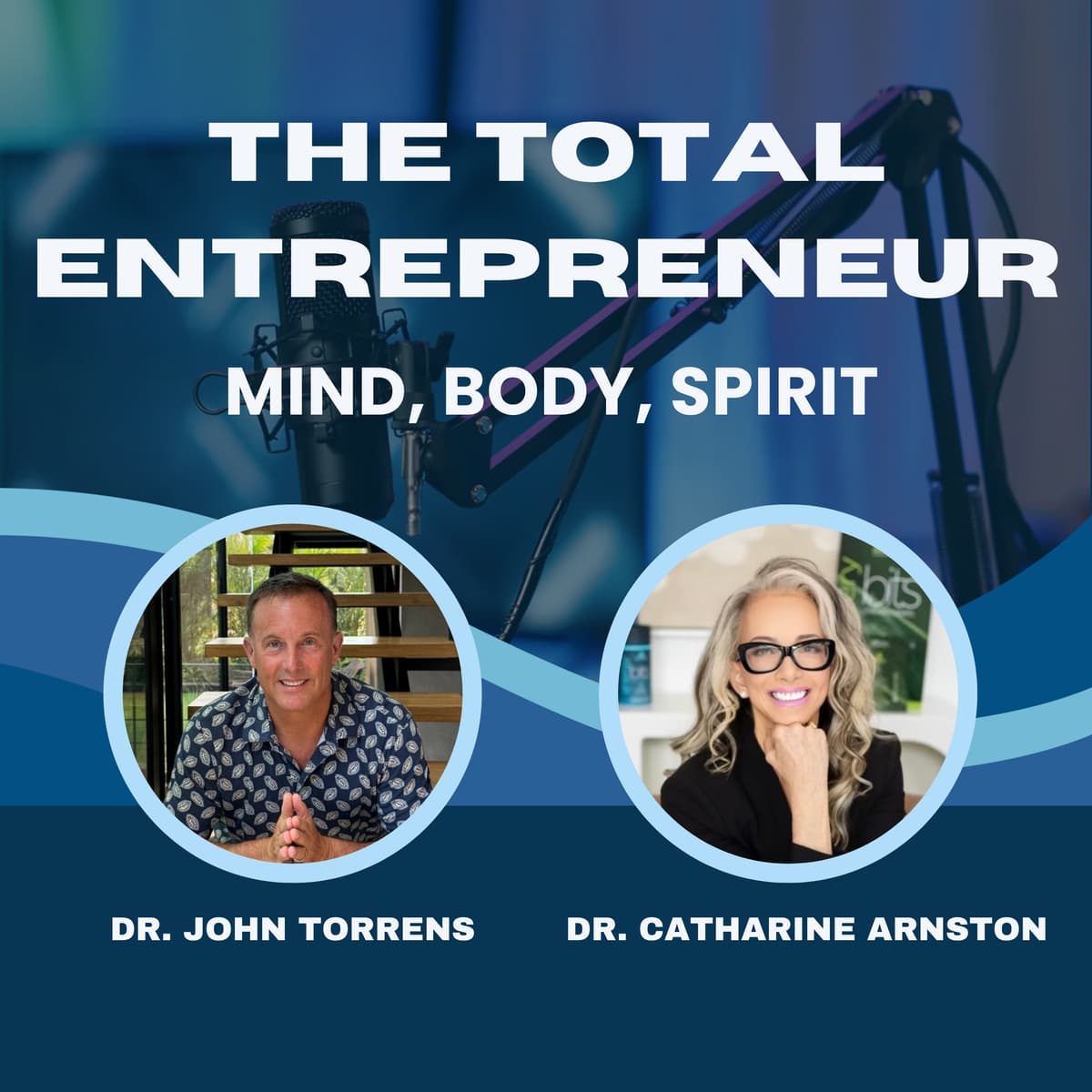
Energy, Nutrition, and the Science of Spirulina and Chlorella With Dr. Catharine Arnston
with Dr. Catharine Arnston
Apr 2, 2026 · 00:54:03
Part of our conversations on
You, the entrepreneur, you keep putting the pieces together. By the time you're about 90% done your puzzle, it's very satisfying because you're working on it, right? And you ask somebody, they go, oh yeah, that's really cool. Can I put the last piece in? Can I? Can I? People are elbowing each other out of the way. No, I want that. I want to do that because they can finally see what you're doing and it makes sense to them. And they feel so proud to be part of something that's showing completion and success. Everybody in the world wants completion and success, but only the entrepreneur is willing to tough it out to make it happen.
Catherine, welcome to the podcast. It's really great to have you here.
Thank you, John. And thank you for helping other entrepreneurs stay alive and thrive more than alive, because that's what I've been doing. And it's a subject close to my heart.
Yeah, thriving is the goal, right? Living is just basic. Yeah. Why don't we jump right in? And I'd love to hear a little bit of your story, because you left a successful 25-year corporate career to start the company you're in now. But maybe just set the stage with a little bit of what you did before and then talk about that inflection point. A lot of my listeners like to know what it's Like, like, how do you leave a corporate job to start a company? What does that even look like? So yeah, give us the rundown.
Yeah. The company that I run now is called Energybits, in case people are near a computer and they wanna find out what this woman actually does. And we sell algae tablets, spirulina and chlorella algae, which is a multi-billion dollar industry, by the way, in Asia. Just is misunderstood or not understood here in America, but I'm trying to change that. I was not planning on starting a company. I'm Canadian by birth, lived in America for 35 years, pretty much in Boston, although New York City for a couple years. And my MBA was in international business. So I had been working in international business for the large part of my career. Although I did have a small segue into some entrepreneur activities. I was a publisher of an interior design magazine. As you'll find out, I'm someone who will just jump in feet first, even if I don't have any background. If something moves me, I go with it. I'm sure there's a lot of entrepreneurs that are like that. So anyways, I'd had this corporate career. And then out of the blue, 17 years ago, my younger sister— I have 2 sisters, they're both in Canada. I'm very close to them cuz that's, they're all I've got left. My parents have both passed. My younger sister developed breast cancer. Now I want everyone to know she completely healed, but her oncologist, which is a cancer specialist, told her to change her diet to an alkaline diet as she was preparing for chemo. Now they didn't tell her what an alkaline diet was or why it was good for her. So my sister called me cuz I love her and I'm just a really good researcher. I always have been. I knew nothing about nutrition, zero, but I wanted to help my sister. So I went online, Googled alkaline diet, turned out to be mostly a plant-based diet because of the chlorophyll and the phytonutrients, which have been proven to build your immune system. So I gave her lots of tips on what to eat and what not to eat. But then I started reading more because, like a good entrepreneur, once your interest gets intrigued, you want to go deeper into that rabbit hole. And I did. But also I found out that there was a German scientist by the name of Otto Warburg in the '30s who won a Nobel Prize for discovering Discovering that cancer cannot exist in cells if they are alkaline. So I have to believe that this was the other reason why my sister's oncologist wanted to have an alkaline diet so the cancer couldn't spread into the rest of her cells. As I started reading about alkalinity and plant-based diets, I gave up my corporate career thinking because nobody was talking about plant-based nutrition. It was almost 18 years ago, and I'm just a very passionate person. I think you have to be an entrepreneur. You have to have some kind of passion that moves you because there's so much inertia in the world that wants to keep you exactly where you are. You can't build anything if you. Stay exactly where you are. So I just thought somebody has to tell the world about this alkaline diet stuff. So I thought, I have no background, but I'll figure it out. And I went and got a coaching certificate in nutrition, which led me to realize there was more than I had expected about this alkaline plant-based diet thing. So I taught people about the importance of eating vegetables, found out most people either didn't like vegetables, didn't— they went bad quickly, gave them gas. So then again, the passion of the entrepreneur said, then I gotta find a solution, don't I? And so I just dug into everything I'd found for my sister. And when I got to algae, that's when the miracle happened because it's the most nutrient-dense food in the world, the most studied food in the world, 100,000 studies documenting the health benefits, a multi-billion dollar industry in Asia. And the best part of all is that it came in little tiny tablets that you could swallow or chew. They look like these little tiny tablets.
Mm-hmm.
So that was 16 years ago. And when I realized that algae was the answer to just about everything that you need for your health and entrepreneurs need for their energy and for their focus and for everything, and that if I'm gonna recommend something, I better make sure there's a healthy, safe supply of it. And all the algae tablets to that date had come from India or China. So then I thought, well, I guess I better start a company to provide the product that's gonna give the benefits that I've been teaching everybody about. So when I became an entrepreneur focusing on algae nutrition, it wasn't because I'd studied it for a long period of time. It wasn't because it was something that was in my background and was just the natural segue, which in most cases I would recommend that people, when they start a company, that they start with something they're already in and they know some inside information. But that wasn't the case. I just had this burning desire to make a difference in the world. And I just thought, I'll figure it out. I'll figure it out as I go along. And as most entrepreneurs, that's what we do. We jump in and fake it till you make it, right? But in this situation, there was a lot of science that I had no science background whatsoever. MBA, yes, I'd actually spent years working in business and economics and all that sort of stuff. But the good news is, as an entrepreneur, you have to be willing to pivot. And you have to be curious. You have to be curious and pursue what nobody else would pursue. I think that's the definition of entrepreneurs. We do what nobody else will do. We do it longer. We do it without pay. We do it with passion. We do it with everybody scratching their head like, what is she doing? That doesn't make any sense whatsoever. And you have to block all that out because if you're driven by something inside you that says, you need to do this, you should do this, you can do this. And if it's your joy, then that's what we do. And then you wait for the rest of the world to eventually catch up with you. Here we are 16 years later. They're finally catching up to what I saw as an opportunity, but it's a lonely, hard, difficult, challenging financially, emotionally, spiritually road. Being an entrepreneur is both a blessing and a hardship. But those of us who are listening who are entrepreneurs, there's no other place for you.
Yeah. So, Catherine, I'm going to go out on a limb here and ask you, do you have ADHD?
No, I don't. Oh, okay.
I thought my antenna was up and I thought I saw it.
Yeah, I have mostly millennials working for me. By the way, John, I am turning 70. That's 7-0 in a few months. Yeah.
Wow.
And so I started the company when I was 52. I had no plans on starting a company. I just wanted to help my sister get better. And then I realized I could help more people get better and yada yada. But I do not suffer from ADHD. In fact, I'm writing a book now and I love it because I get to focus on one thing on the weekends and do all my writing. One thing for 12 hours at a time. I'm in my happy zone. I live with and work with almost all ADHD people, but I am not one of them. Yeah. Yeah.
So what were you doing before Energy So what was your corporate career like? What were the types of jobs you had? What were you doing at the time that your sister called and said, hey, I had a plant-based diet?
A couple of the careers, because I studied international business, I was hired by one of the Canadian governments, it was Ontario. They ran offices around the world, 30 of them. And in those offices, like in New York, there were 6 in America, the one in New York, the job was to help Canadian companies market into that specific country. So I got hired right out of MBA school to go to New York to facilitate Canadian Ontario-based companies to market into the US. And I did that for 2 years in New York City. So I would write marketing plans and take them to trade shows and make introductions for them to distributors and very hands-on logistics, operational kind of stuff. And then I guess I did the job so well, they then promoted me and moved me to Boston, which I thought was a demotion because I loved being in New York. But now I had a larger territory. And I did that for them for another 6 years. I was with them for 8 years. And then the government changed. And they decided to shut all the offices down, which was unfortunate. 400 people were out of work. But then I, by then I got a green card because I came down on a political visa and I stayed in Boston. And then I had a series of other jobs. One was I worked in the trade show industry because I'd worked with so many shows. I hated that because that was where, if you have ADHD, you should go work for a trade show company because it's crazy. And then I have a love for the arts. I always have. And I had been doing a lot of pro bono work with artists, helping them to do art shows. And there was a magazine in Boston, an interior design magazine, and they were doing a feature article on 5 people in Boston that were involved with the arts. One was a ballet director, one was a musician, the symphony director. And then they picked me because I was doing so much work in the fine arts. And they interviewed me and took pictures. My pictures turned out to be so great, they put me on the COVID And then I got to know the owner of the magazine and I said, this was really great. I'm so excited. And he said, don't get too excited because I think we're going into bankruptcy. And I said, why? They said, we need a publisher. And I need someone to run the business. I said, what does a publisher do? Oh, they run the business side of a magazine, ad sales, distribution. And I said, I have an MBA. How difficult could it be? So this is the clue that Catherine jumps into things without any background. I said, I'll give it a shot. So I went from being on the COVID of their magazine to becoming the publisher. And I pulled them out of bankruptcy. I tripled their revenue, got them into $3 million in global sales. And then we had a bit of a falling out and I left. And within 6 months they did go into bankruptcy, but I had proven to myself at that point I could turn stuff around because I was passionate because I've always loved design and I always loved business. In my career, I didn't mention this earlier. I would always bounce between arts and business, arts. And I was a fundraiser for a theater, for a museum, for performing arts, and you don't make any money. So then, but you're very satisfied. At least I was. So then I would go work for like a trade show company, or I worked for the British government doing the same thing I did for the Canadians. So just before my sister got sick, I had started another company because after I left the magazine, I seem to be always ahead of my time. I actually wanted to start a TV show showing people how to decorate. And I tried to get funding for almost a year. Nobody said, no one's going to watch decorating shows on TV. And so I thought, okay, fine, I'll give it up. Fast forward, how many decorating shows are there now on TV? Like hundreds, right?
Yeah.
So when that idea didn't pan out, I had noticed by then that the hotels, luxury hotels were getting more and more beautiful furniture. And I went to one in Boston. I said, you should allow your guests to buy everything that's in your hotel because it's so beautiful. And they said, that's a great idea. Why don't you help us do that? So again, I had no background. I built a platform that allowed luxury hotels to sell everything that was in their hotel. their lobby furniture, the lighting in the bedrooms. I had clients in Boston, New York, Vegas, but it required a lot of venture capital. And I had venture capital for that one because you had to inventory all the furniture. And I was struggling trying to find the next round of financing. And that's when my sister got sick. So I was trying to figure out the next step for this business I had set up. And then finally, when she got sick, I thought, you know what? Forget the business. I want to focus on my sister. And so I did. And I just put everything on pause. I closed the company down. It was very sad because closing down your own company. Anyways, I was just—I only have two sisters. That's all I have for family. And she was my priority. And interestingly enough, here I thought I was helping her, and I did help her with some suggestions. And she did go through chemo. So I'm not suggesting that algae saved my sister. Certainly the diet recommendation from the oncologist and the chemo are what helped her. But the irony is here I am 16 years later with a company that I absolutely love, that's hugely successful, that is in an industry that I, not in my wildest dreams would I ever have expected to be in, that have, that motivated me to get, drum roll, my PhD in natural health. I got it last year. And I have turned out to be a science geek. I still love the arts. I still love business. But I love science. I discovered something called PubMed. That's where you get millions of scientific papers. And I never go to movies anymore because I find the body and nature far more fascinating. And when you understand how they all work and how things like algae, which is what I sell, is the key that unlocks great health in so many ways, it's much more interesting. So, My sister actually helped me because— and this is the way the world works. This is the way any entrepreneur who's listening. Sometimes things just don't make sense to anybody else but you. And honestly, you are the one that needs to be listening to the voice. Don't listen to them. Listen to you. And that little voice will not shout because your ego will always shout. Your soul, your spirit will always whisper to you. And if it absolutely terrifies you, That's what you should do because it's pushing you out of your comfort zone into something that you've never done before that you have. And so we all like comfort. We all like to feel that we're doing something that's not that's right. But sometimes you don't know what's right because you haven't tried it yet. And so if you're out of your comfort zone and you're scared but excited at the same time, that is the blend. That is the magic that happens. And don't worry about everybody else. They'll either never. get it or they'll get it eventually. And I have a great analogy for you because I— this is how it happened to me. I literally downloaded exactly what I needed to do. I didn't know it was going to take me 16 years. It'll probably be 20 before I really achieve my— what I'm— because I'm trying to build a billion-dollar company, it's going to take longer than 20 years. But anyways, I knew exactly what I was going to do. It was nothing I'd ever prepared for, studied, understood. But it's like when you buy A puzzle box. When you go to a store and you select that puzzle off the shelf, there's a picture of what you're gonna make out of that puzzle.
Yeah.
You know what you're doing. You go home, you open the box, you dump all the little pieces onto a table. It's a mess. Half the— 90% of them are upside down. And you ask people, oh, would you help me come and make this puzzle? They look at you, they look at the mess, they go, I got better stuff to do. No thanks. So, they move on. What do you do? You start putting the pieces together all by yourself. Maybe you get a third of the way and now you say, hey, how about come and help me now? They still look at the mess. They can see a little bit but nope, they're too busy. Nope. So, you the entrepreneur, you keep putting the pieces together. By the time you're about 90% done your puzzle, it's very satisfying because you're working on it, right? And you ask somebody. They go, oh yeah, that's really cool. Can I put the last piece in? Can I? People are elbowing each other out of the way. No, I want that piece. I want to do that. Because they can finally see what you're doing and it makes sense to them. And they feel so proud to be part of something that's showing completion and success. Everybody in the world wants completion and success, but only the entrepreneur is willing to tough it out, to make it happen in spite of all of the distractions and lack of support, emotional, financial, spiritual, familial. Only the entrepreneur will do that. Because you know where the satisfaction is there if you want to get to completion. And it's a very lonely journey. And it's very hard. But there is nothing— I don't have a family. So I know parents have children, and they are so grateful for their kids because they say— I always hear my sisters say, nothing more joyful than having a family. But since I don't have a family and my company is literally my child. It's the only reference point I can give you about being so satisfied. And there's almost no words to describe it. The pride, the gratification. Because what happens, you think you're building one thing, but then you start— I wanted to bring algae to the world. I've now created a company. I have over 21 full-time employees, 20 part-time employees. I have provided them with income for themselves, for their families. I provide an environment for them to belong to something that's positive, that's good, that's making a change in the world. I give them education. We meet every week and I'm as a team and I work, meet daily with everybody individually. But I'm as proud of the company I've built as the impact I'm gonna have on the world with this very important nutrient that was the first life on Earth. So you don't know what you're about to do until you do it.
Yeah. No, I love that analogy of the puzzle. And with your permission, I might steal that and use it in the Absolutely. That's a really good one. Yeah. And I really connect with your feeling and just the love of science and the way you earned your doctoral degree later in life. I have a similar— I earned my doctoral degree later. Yeah. So a lot of parallels there. So let's dive in and talk about algae. I've taken spirulina and chlorella. My understanding of chlorella is that it's a good chelator and that's literally the end of my knowledge on chlorella and algae. And I pride myself on learning about these things. I love learning how to optimize my biomarkers, my performance, and things like that. So, I'm excited to hear your perspective on what is spirulina, what is chlorella, why would you use them, what's the difference between the two. And yeah, let's get into it.
People don't even know that spirulina is an algae. It was the first life on Earth, not just the first plant but the very first life. There's a whole chapter on the origin of the world and it started something like spirulina, which is a bacteria. People don't— nobody knows spirulina is a bacteria. Chlorella is a plant. So I say there's something spiritual about being the first life on Earth, so I call spirulina spiritualina for that reason. It's, you know, I like to make it kind of funny. Within algae, it's a food category, first of all, because it doesn't fit into any other category. There's 2 subcategories. One is macroalgae and the other one is microalgae. Macroalgae is that stringy stuff that you see washing up on shore, also known as seaweed, dulse, or kelp. It's still very good for you. It's only in the ocean, has iodine, has high fiber but virtually no nutrition. So only in the ocean, high fiber, virtually no nutrition. Microalgae is the other category, and that's where, um, where, what we're— I'm— that's what I sell. And, um, microalgae is completely opposite to macroalgae. You can't see it. So it's not like the stringy stuff. It's microscopic in size, which is why it's like you can get a million of them on the head of a pin. And it is the most nutrient-dense food in the world. NASA feeds it to the astronauts. We have a quote from them saying 1 gram of algae has the same nutrition as 1,000 grams of fruits and vegetables. So 1 to 1,000. Also has, and you'll find out, spirulina has the highest protein in the world, 3 times more than steak. So microalgae, high nutrition. And either no fiber or very little fiber. Spirulina has no fiber because it's a bacteria, has no cellulose wall. Chlorella has the hardest cell wall, which is why it chelates. So macro, micro, and within micro you have tens of thousands of strains. There's blue-green, green, red. The most popular blue-green is spirulina, and the most popular green is chlorella. Now, spirulina is called a blue-green algae because it has 2 pigments in it. The green one, which you're familiar with, which is chlorophyll, but also has a blue one called phycocyanin, which is spelled with a P-H-Y. And that's why when I designed the packaging, I made our spirulina in blue because of the blue pigment. And spirulina gives you energy, so we called our spirulina Energybits. Now, it's not a stimulant. It doesn't have caffeine chemicals or sugar. It gives you energy 2 ways. One is it has the highest protein in the world, and the protein is already in amino acid form. When you eat animal protein, your body has to break it down into aminos before it can be absorbed. So often it can take 2 or 3 days and you may have eaten 50 grams of protein, but you only got 10% as aminos because of a deficiency in your absorption. With spirulina or chlorella, because the protein's in amino acid, When you get 5 grams of protein, you get 5 grams of aminos, and it's a complete protein. It has 18 of the 20 aminos, including the 9 your body can't make. So you get instant energy because it's also loaded with B vitamins. B vitamins convert the aminos into glucose, which gives you energy. That's why a lot of energy drinks will have lots of B vitamins in for that, that effect. And the other amazing thing is that spirulina has antioxidants like the blue pigment and other antioxidants, a long one called superoxide dismutase, which feed your mitochondria. Your mitochondria are what give you energy at the cellular level. So when you take spirulina, it's like putting a log on a fire. When you have a stimulant like chocolate or coffee or sugar or something, it's like putting paper on the fire. You get a burst and a crash. None of that with spirulina. So this feeds your brain, your body, your mitochondria. You get steady energy. You do need a minimum of 10 tablets at a time. They're very tiny. 30 is better. And you can't, your body can't store ATP, which is cellular energy. So whatever you're doing at the time, the energy will be used for that. So if you do a workout and you take 20 or 30 of these tablets beforehand, we work, we started as a sports nutrition company. You'll have the best workout. You'll run further, faster, lift more, lift longer, and you won't even notice it. But if you're reading a book or you're driving a car or you're writing an exam, The focus will improve because that's what you're doing at the time. Very important because with entrepreneurs or anybody, you need your brain to be working. Your brain uses the most ATP because it has the most mitochondria per cell. There's 2 million mitochondria per cell in your brain. It uses 20% of your body's ATP, even though it's a very small percentage of body weight. So spirulina, very energizing mentally, physically, mitochondria. And it satisfies your hunger. So you could have 30 for lunch. Yeah, 1 calorie per tablet, 40 vitamins and minerals, highest protein in the world. In fact, 50 years ago, the United Nations had a global conference just on spirulina and declared it the answer to world hunger because it's the— there's nothing in the world with more protein than spirulina, and it's a sustainable crop.
Wow.
So very nourishing, safe for every single age, children, babies, pregnant moms, kids, pets. This is by far the food that's gonna save the world.
So why don't we hear about it? Right. It sounds so amazing. Like, why don't people just ingest this every day? Why can't more of us?
That's another chapter in my book. So why don't people know about it? And it's a multi-billion dollar industry in Asia. Right. Because it started in Asia and that's another chapter. So here's why. 99% of algae, spirulina and chlorella, are grown in Asia. China, India, Taiwan, Korea, the Philippines, not anywhere else, not in large scale. So I'm in America. So when you go to school in any of those countries, Taiwan, China, you ride your bicycle, you take a train, you drive your cart, you go by algae farms. It's as normal there as us driving by a tomato patch or a corn patch or a wheat farm. It's just normal. But here, We don't see it, so you can't know about something that you can't see. So that's number one: not grown in large scale. Number two: there are a hundred thousand studies, sixty thousand for spirulina, forty thousand on chlorella, documenting all the different health benefits: reducing inflammation, preventing Alzheimer's, preventing heart disease, improving gut health, improving elimination, improving sleep. Documented scientific papers. There's literally Too much science. It's just too much. And scientists talk to scientists. They don't know how to talk to us mere mortals.
Yeah.
And I used to argue with the— when I started going down this path, I argued with the universe, pick somebody else to do this because I don't know any science. I had to teach myself cell biology and microbiology and evolutionary biology. And, but I realized I was the perfect person because I'm a good communicator. And I taught myself the science. That's why I find I've been on 400 podcasts and I'm now writing this book to get the science to people in a way that's not condescending or too geeky. Like, for example, you know about chlorella being a chelator. So the way I describe it is it's like giving your body a shower from the inside. People understand that.
Mm-hmm.
You take a shower on the outside every morning. Chlorella will pull all the garbage that you've interacted with in the air, your food, your cosmetics, and pull it out. So the reason why people don't know about it, because it's not grown here. The scientists don't know how to explain it. Food companies do not launch new products. They wait till an entrepreneur like myself, passionate and devoted, has proven a market opportunity. This is what happened to collagen powder. Collagen had been used for centuries in other countries until Vital— and nobody in America knew about it until Vital Proteins launched collagen powder. Now it's everywhere. Bone broth used for centuries in other countries. Nobody really knew about it until Ancient Nutrition started launching a product. Yoga. Yoga had been used for millions of years, or at least thousands of years. And until Lululemon came along and made it popular with really fun yoga wear, it hadn't been. I'm basically, and here's an interesting thing. I didn't do this intentionally. I just wanted to help my sister. That was it. Then I realized it could help more people. Then I realized I had to create a company with safe, pure product because we do third-party labs. So I just kept going on these baby steps. But what I'm doing is what all these other companies did. It's called a blue ocean strategy. I didn't do it intentionally, but it is what it is. I used to teach occasionally to entrepreneurs because there's basically, when you start your company, you have to decide on which kind of company you're going to be. You're either going to sell stuff, which is fine, or you're going to build a brand. Selling stuff, and you can use this analogy too in your classes. Selling stuff is, I say, is like speed dating. Very transactional. Boom! Sell as much as you can. Maybe sell out. Boom! Building a brand is like falling in love. It takes time. It takes consistency. You have to be there day in, day out, year in, year out consistently. Repetition and consistent and high quality. And you have to be honest and you have to have integrity. Otherwise you'll never have that love last. So it's very hard to build a brand and very time-consuming and usually very expensive. But I didn't want to be transactional. I wanted to build something that was gonna make, that was gonna have lasting impact on the world and on people's health. And I didn't have any money, so I just had to be more clever than anybody else. And that's what we've all— And so I, reverted to my interest in design and beauty. And I have designed all of our packaging. I wrote recently, wrote a little book called The Algae Love Story. It's sort of like a children's book for adults about all the beautiful things that algae does for you. It took me literally 9 months. It's only 20 pages and it's only got a little bit of copy. People love this thing because it gives them exactly what they need in this, just nuggets of information. But that's what, When you're in love with something and you're building something with high integrity, you want to build a brand, you put the time in, you sacrifice other stuff. Other people are at the beach. I'm on my computer with PubMed or designing something. And by the way, this is the other thing entrepreneurs do. If you don't have the skill and you can't afford it, you teach yourself.
Hmm.
I didn't know anything about package design, but I knew I needed packaging. I knew I wanted boxes and bags. So I, for boxes, I went to Whole Foods. I got all the empty boxes from Lululemon, Larabar, Kind Bars. It didn't go into the trash bin, but they were just empty on the shelf that I filled my bag up and brought them home. I would have 6 or 7 boxes on my dining room table and I measured them length, width, height, what was on the front, back, side panel. And then, because I had no design skills, I made my own box design on PowerPoint. Yes. That old-fashioned system that nobody uses anymore except us baby boomers. Once I designed the paper, the image on PowerPoint, I printed it up and on paper, cut it up and made miniature boxes. And once I had everything figured out and I still have those boxes. So, if anybody wonders whether I truly made my packaging, I have proof. Whether it was the tins, the canisters. I don't know if you've ever designed anything round, but round things are very difficult because the images have to be continuous. There's no breakage. So anyways, I, once I got my designs perfected, then I hired a designer who did what's called die lines that then you send to the packaging company. But I only point that out because I know what I knew, what I needed, and I couldn't afford what I really needed at the time. So you just make do. I was on Shark Tank. I don't know if you know that I was on Shark Tank.
I saw that in your profile. Yeah.
I had my first ugly packaging on Shark Tank. It got considerably better in later years, but they had the ugly stuff because that's the best I could do at the time. And yeah, and I didn't want their money, but I did want the visibility and it gave me lots of credibility and they've aired my segment like over 100 times. Anything that challenges you to grow, you have to accept the challenge and not be, not whine about it. You just have to suck it up. And it's a bit of a challenge. Do you really want this? Because Because if you really do want this, you will do it. And then you'll go at the end, wow, look at how much more I've learned. And you just become richer in your experience as an entrepreneur. And then you could always leverage that if you want to try it again. I'm not starting another company. This is it for me. I'm done with this one because it's taken a lot. But I mentioned that because as entrepreneurs, we're always going to be challenged. You're never going to have enough money. You're never going to have enough time. You're never going to have enough staff. You're never going to have enough skills. And when you can finally afford those and we I am now and have really amazing people. And I waited very long to hire talent. I probably waited too long because I was the solopreneur for 6 or 7 years. And I don't wish that on, but it is just, it is what it is. But at one point, you have to realize it's time to hire. And I'm not saying venture money isn't right. It wasn't right for me because I knew, I knew what I was building and I knew I wasn't able to show my true strength yet. And most venture companies, they want an exit in 5 or 6 years. And I knew I wasn't going to be ready for an exit in 5 or 6 years. It's going to be— we'll probably have an exit, but by the time we get to the exit, it will have been probably 20 years. And when I exit, it's only going to be because somebody needs to take it to the next level beyond what my skillset or my interest is. Because I'm now interested in the books and the education and all that sort of stuff. So anyway, so it's a long-winded way of Explain what I did.
I really like your enthusiasm, your passion, and your story. And I want to go back to the science of the algae a little bit.
We talked about chlorella too, because we didn't get there.
Yeah, so we mentioned chelation, and that, that's originally why I took it. Is it— and I started for heavy metals, but then I learned a lot more about it. Is it a good chelator for microplastics, or is it not useful for that?
Yes. So spirulina— I tell people spirulina puts nourishment And, it gives you energy. Chlorella, which is a green algae and has that hard cell wall that attaches to heavy metals, glyphosate, pesticides, lead, mercury, alcohol, lactic acid, anything that should not be in your body is pulled out by chlorella.
What's the mechanism by which it does that? So, we can geek out a little bit here, right?
Yeah, yeah.
So, you got the chlorella and what does it actually do? Because everything we hear is that if you got heavy metals from mercury or if you got microplastics, this stuff never leaves your body and you're just screwed. So, how does chlorella do that?
Well, it works in a couple of ways. It has that hard cell wall, which, by the way, is regulated by the FDA. It must be cracked. And, you want cracked cell wall chlorella anyways because chlorella has 20 vitamins and minerals and high protein as well. Spirulina has no cellulose wall, so it does not have to be cracked because there is no cell wall. Chlorella has to be cracked. If you don't crack it, You can't get all that great nutrition that is sitting in the nucleus. In France, they sell non-cracked chlorella, which I don't understand because you're not getting all the nutrition. So anyways, so the way it works is that hard cell wall— I call it— this is one of the reasons why I call algae intelligent food. You have to be intelligent to take it, and it knows what to do in your body. Nobody has really truly figured out the mechanism. There's polysaccharides that are in that hard cell wall that for some reason can identify a toxin. And just as an example, and I don't have the reference in front of me and it was years ago and I wish I'd written it down. There were some experiments that they did with chlorella to deliver chemotherapy treatments because the trouble with chemotherapy is that it kills everything, kills the healthy cells and the sick cells. So they injected chlorella with this chemotherapy treatment. And then I don't know whether the patient took it orally or it was through IV or whatever, but the chlorella was able to find the cancer cells Attach to the cancer cells and deliver the chemo treatment just to the cancer cells, leaving all the other cells healthy. Like how does it do that? And I'll give you another cool thing about this one's about spirulina, but it's related to cancer. So remember I said there's this blue pigment in here called phycocyanin. If you want to get really geeky, the way that you're remember I referenced ATP, which is. cellular energy. It's actually created in the mitochondria. And within the mitochondria, there's this thing called the electron transport chain. This is where the actual energy is created, this actual ATP. And the way I describe it to people is that you've all seen a relay race, and you have a runner who passes a baton to the next runner, who passes the baton to the next runner, and they hope to finish— cross the finish line before anybody else, and they win. Your electron transport chain, which generates all that ATP, works In a similar fashion. It's a little more complicated but similar. Instead of a runner, you have these protein molecules, and instead of a baton, they pass electrons to one another. And at the end, you get this stuff called ATP. And there's 4 runners. Okay. Now, within the 4 runners, there's 2 what's called helper molecules. Think of them like little Ferraris. So, if somebody was running a marathon, they wanted to cheat, Maybe there'd be a Ferrari packed, parked back in the— behind the trees and, hey, get in, I'll run you, I'll take you over to the next stop. So, these little 2 Ferraris are in there in the electron transport chain helping the electrons move across faster. One of them you've heard of before, it's called CoQ10.
Hmm.
One of them you've never heard of before, I'm sure, and it's called cytochrome c. And, it's the cytochrome c Ferrari that we're going to talk about. In a healthy cell, the blue pigment that's in spirulina, nowhere else, just in spirulina, it, it will go to that cytochrome c Ferrari and speed it up, which is one of the reasons why spirulina gives you energy and chlorella does not, because it does not have the blue pigment. Now, in a cancer cell, or what's called a senescent cell, which is a cell that is basically sick, it's It's subdivided so many times it can't do anything anymore, but it refuses to die. It just hangs out and it's inflammatory. So you don't want that. So in a cancer cell or a senescent cell, the blue pigment, when it's absorbed into the mitochondria, sees that it's in a cancer cell and goes, I'm onto you. And instead of the Ferrari helping move that, move the electrons across, it ejects this thing called cytochrome c. which triggers something called caspases, which triggers something called apoptosis, which is healthy cell death. Cancer cells cannot kill themselves. This is why they grow so quickly. And the process by which you want cells to kill themselves when they know they're not sick or good is this thing called apoptosis. So, the blue pigment in spirulina can detect, knows what to do with that cytochrome c molecule. It's either a Ferrari and moves it across in a faster way so you get more energy. Or if it's a cancer cell, it ejects it, which kills the cancer cell. Now, chemotherapy companies use this blue phycocyanin in their cancer treatments now. And the way they can figure out whether the cancer is being killed is they measure the amount of this cytochrome c in your plasma.
Wow.
Because if there's a lot of it, they know a lot of those have been ejected and a lot of the cancer has died. Intelligent food. Mother Nature. Unbelievable. Right? Go figure. I don't know. It knows what it attaches to. Mold spores. Because microplastics, what they do is they release toxins. So it's attaching to the toxins released by the microplastics. Because if you've ever seen it, there's lots of movies. It's just so sad. The animals, you see them eating those plastics and then they get into their stomach and then they release all these toxins so that When you eat the seafood, the toxins are in the seafood because the animals had the plastics in their stomach. So it's a big issue. People are thrilled when they find out that it removes alcohol. And so you will be stone sober and never have a hangover if you take 30 chlorella after you drink anything— wine, beer, spirits— because, and it takes an hour and a half because your blood is very liquid. The chlorella gets absorbed quickly and pulls all the toxins out of your blood in an hour and a half. Spirulina gets in your system in seconds if you chew it, minutes if you swallow it. Chlorella is much longer. But for it to—
that alone would be a selling point. I would imagine.
Yeah. We have people that said they went to Vegas for their bachelor party and they were the only ones that felt great after all the partying. It's unbelievable. It's so funny because I'm Canadian and one of the sports that really love our product are hockey players. And A, they like the spirulina for the energy that they get on the ice because, and they take 70 5 before a game. And then they take the chlorella afterwards to pull out the lactic acid. But hockey players are notorious beer drinkers. So I think they also like the chlorella for getting rid of the beer after, after the game. Hey, whatever floats your boat, it works. And while you're taking, because we're talking about chlorella, so that, so the hard cell wall is one of the main ways it chelates toxins. Now it does other things. It's called chlorella because it has the highest concentration of chlorophyll. Yeah. Now I spoke a little bit about the blue pigment in spirulina, but I didn't dwell much on chlorophyll. The chemical composition of chlorophyll is virtually identical to your hemoglobin. Chlorophyll has magnesium in the middle and your blood hemoglobin has iron. So chlorophyll builds your blood. When you have healthy blood, it's going to be— everything in your body is working healthier. The trouble is there's virtually no chlorophyll in our vegetables anymore. My arugula goes yellow after day 3. So chlorella has has 500 times more chlorophyll than arugula and has 25 times more chlorophyll than liquid chlorophyll. There is nothing in the world with more chlorophyll than chlorella. That's why it's called chlorella, because of the chlorophyll. So now it builds your blood, and chlorophyll kills bacteria, bad bacteria. Kills it in your mouth, your colon, your stomach— anywhere there's bad bacteria, it kills it. And it also has fiber, which feeds gut biome who are the good bacteria. So you got your good guys and your bad guys. Chlorella also has the highest concentration of glutathione in the world, which is called the master detoxant, particularly for your liver. And it has the highest tryptophan in you, 5 times more than turkey. You think, what's tryptophan got to do with detox? Tryptophan triggers serotonin. Serotonin is your happy neurotransmitter. Now, which works in your brain. But guess what? Serotonin, 80% of it's made in your gut and used in your gut. And one of the things that tryptophan does and serotonin does, you'll— I'm sure you've never known this, it stimulates what's called motility.
Hmm.
Gut motility, which is a poop. It's a bowel movement. So I call that stuff that's sitting in your colon the junk in your trunk because it's stuff your body want. This is a very important part of detox, getting rid of that stuff that's not down that your body didn't want because it's toxins. And if you don't have a bowel movement every day, what's sitting there is recirculated by your blood. So if there's— we know there's toxins in there, so they get recirculated. That's not good. It's like having a garbage truck parked in front of your house permanently. So it stinks. It's not good for you. So chlorella gets rid of all of that as well. So it's getting rid of toxins through the hard cell wall. It's killing bad bacteria because of the chlorophyll. It's got fiber that feeds the gut biome so that it will contribute to the other detox. It's got the chlorophyll that also builds your blood. It has— that stimulates the, the bowel movements with the tryptophan and serotonin. It's a joy to behold. And the two of them work beautifully because chlorella, as you're finding, is very much a gut health algae.
Mm-hmm.
Whereas spirulina, because it's so nourishing to the mitochondria and your brain have the most mitochondria, it's a brain food. So we have brain food. And gut food, and of course they're both joined. They're joined by something called the vagus nerve, and which is a main communicator between the two. Very healing. On the detox part, your cells have what's called a lipid membrane, and they have in the membrane they have these things called receptors that allow certain molecules and vitamins in and out and antioxidants. The trouble is if you have too many toxins, and the average adult in North America now. Has 700 toxins in their body. 700. I mean, it's—
Totally unbelievable. Yeah.
Crazy. So you can put all this great nutrition in, but if you have something blocking the cell receptor, and I used to live in Boston and people were very careful. They were very protective about their parking spots on the streets. So if someone's stolen your parking spot anywhere, you can't get into your parking spot. It doesn't matter how many signs you put up, but they're there. You gotta get the tow truck. truck or the police to get them out so that you can park in. So, chlorella is the tow truck. Chlorella pulls— or the police force— pulls out the toxins that are sitting on your cell receptors and blocking all the good nutrition that wants to get in. So, the 2 of them work really well together. There's also 40 vitamins and minerals and lots of really great stuff in chlorella. But, basically, because people need to know basics, I say spirulina puts nourishment in, Chlorella pulls toxins out. They do a lot more than that, but that's the way to simplify it. And so also if you want energy and you're hungry and you want focus in the morning, in the afternoon, or maybe before a workout. So think of spirulina as an AM algae and think of chlorella as a PM algae because you can take it any time of day. But guess what? Your body goes through a detox repair cycle when you are sleeping, particularly deep sleep. And by the way, that tryptophan that I talked to you about, The highest tryptophan, and it's a precursor to melatonin. Tryptophan is a precursor to melatonin, which helps you sleep. So this will help you sleep. This will help your detox and repair. This will help your bowel movement in the morning. It's it's gold, and it's food. This is not a supplement. We call them bits because they're bits of food.
That is cool. Yeah. So I learned that there is a difference between. I just thought you would use them interchangeably. And they're both green things to chelate, but no, that's really helpful. Yeah, like I hear that spirulina is giving you nutrition. I didn't know it was such a high-powered protein source either. That's, that's pretty cool. Are there any contraindications or downsides, or is there a dose that's too high for your body, or what should people think about if they're going to start taking these?
With spirulina, absolutely not. And both of them, frankly, no contraindications, but every single person in the entire world needs to be taking this because our food supply is so damaged. The soils are overcropped. There's no minerals in the soils. Even if you're eating vegetables, most people aren't for a variety of reasons. And we're not getting the protein that we need, or not good protein. This— parents, if you're listening and you have fights with your kids about eating their vegetables, never worry again. Just give them. And so for dosage, 10 tablets is what we recommend just to fill nutritional gaps. To get started, and you could have them all at one time, or thirty could be for lunch. You won't be hungry for two or three hours. One calorie per tablet. There is no upper limit. Hockey players, like I said, take seventy-five spirulina. I have been taking both of them for what sixteen years now, and I eat an average of about one hundred fifty a day. By the way, when you take them daily, like I have, you don't need it. You can get rid of almost all your other supplements. Not all. But your multivitamin, you don't need that. Please stop taking fish oil. Where do you think the fish get the omega-3 from?
Algae.
Algae, right? Yeah. You can get rid of a CoQ10 because CoQ10 is recycled with chlorophyll and light. You can get rid of biotin. It has all the electrolytes, magnesium, potassium. There's some times when you do need to increase your magnesium. I will never beat up on magnesium because it's a very good mineral and we're electrical beings. So it will save you effort. It will save you time. But you do need to take it every single day. Now, if you're trying to prevent or correct a health condition, if you had cancer, heart disease, Alzheimer's, anything, you should be taking 30 a day. Again, you could take 10 in the morning, 10 at lunch, 10 at 2 o'clock. Everyone seems to have a slump at 2. I never have a slump, period. I can tell. And I attribute— I do have a funny story to tell you because I'm just getting over a cold. I have not had a cold like in 5 years. Now I bought my team, all of my team, Oura rings this year.
Yeah.
And so we, yeah, we wanted to do a test to see if the chlorella was really helping them sleep and they could see the difference on their Oura ring. So we decided we would do a little test and we told everybody on the team for an entire week, no algae, nothing, not spirulina, chlorella. Then the next week you could add back chlorella. Then the week after that, add spirulina and chlorella and whatever. So, the one week I have not gone without algae in 16 years. And so, the week that we were going no algae, I had to fly to Boston for some meetings. I live in Miami now where it's 80 degrees almost every day. So, I go to Boston, it's 30 degrees, pouring rain, miserable, windy, and I had no algae. I got a cold.
Wow.
And I'm still— that was almost 2 and a half, almost 3 weeks ago. And I'm still, I'm slow. I don't know. It was a killer cold, but no algae and cold weather. I got sick. Normally I've, I have not. And I still come to work. Of course, I don't miss a sick day. I don't have a sick day because entrepreneurs don't have sick days. But I just wanted to tell you that because I'm a sample size of one that this stuff really works. So 10 tablets, they're about the size of baby aspirin. You can swallow them, chew them. I put sea salt on them. I mix them with Pistachio nuts. You can put them in a trail mix. Same with chlorella. Ten would be a starter point to get the chlorophyll and the phytonutrients. But if you want detox, you really need twenty or thirty. Now we do sell them in little pouches that come pre-measured. There's thirty in a in a pouch, and we've done a bunch of clinical trials. And that's another that's probably another podcast. But thirty will get you the the detox benefits, the bowel movements, and all that sort of stuff. Now, I will say there are very few people, like 1 in 10 million, but they do exist that can't tolerate chlorella. Absolutely every single person in the world, mothers, nursing moms, babies, you can put this in your baby's water bottle, crush it up first because it has important essential fatty acids for their brain development. It has the same nutrition as literally mother's breast milk. And I'm the one that discovered that. Pets love this stuff. Oh my God. Dogs, cats, That's unbelievable. Grandparents, every single person in the world should be taking at least 10 of these a day. Kids, you can give them as much as you want, but generally parents like a recommendation. So we say give them up to their age. So if they're 5, give them maybe 3 or 5 a day. If they're 10, give them 5 or 10 a day until they're like 12 or 14, and then they can take a full adult's portion, but they could still take more if they wanted. But there's so much protein in spirulina. Be sure that you're adding extra water because protein needs water to work through your body. And if you are finding the protein is making you constipated, this is when you wanna be sure you're taking chlorella. So this will balance out the dense protein in spirulina.
Mm-hmm.
10 will give you the chlorophyll starter amounts, and, but 30 are your detox. And you can take it any time of day, but definitely before bed to help with your sleep.
Yeah.
Your elimination and your repair.
Wow. Katherine, that's a lot of information. Very helpful.
15 years packed into 1 hour.
Yeah. So, well, where do people buy Energybits?
Yes. We have a website, energybits.com. And we have a discount code for your listeners. The discount code is TOTAL ENTREPRENEUR and you'll get 20% off anything. We, the best value are the bags. There's 1,000 tablets in a bag. Now I'll tell you, With your discount code, the bag is normally $130. With your discount code, it brings it down to $105. If you take 10 tablets a day, which is just your starter point, but it's better than nothing, right?
Right.
It will last you 3 months and cost you $1 a day. $1 a day to get all the nourishment. I call this your nutritional insurance. It gives your body everything that it needs that it's not getting. 30, 40 vitamins and minerals and rich protein. Same with chlorella. Use the discount code TOTALENTREPRENEUR at energybits.com. You get 10 tablets a day, will give you— it lasts 3 months, a dollar a day. You can't buy a coffee for that. The 2 of them would be $2 a day. You can't get a coffee for that. And this, I promise you, will change your life and it will replace a lot of your other nutrients.
That's amazing.
You'll never have to eat another vegetable again unless you really want to. Guys love that. Kids love that. And we're very active on social media, Facebook, and our Instagram is Energybits. But, and we sell on Amazon if you just want it. If you are worried about being one of the 10 million that can't tolerate chlorella, for $6, you can just buy a single pouch, but then come back to energybits.com to get the full bag because that's the best value. And I will— I'm not steering you wrong. The science is there. I can't wait for my book to come out so you can, it's going to have hundreds and hundreds of science references because the stuff is, algae isn't new. It's just new to you. And so I'm doing my best to try to get the world more familiar with what this stuff does because somebody has to.
Yeah, I know. I love it. I've been learning that everything that's old is new again. We're getting these things that we know work for thousands of years and we're finally bringing them back. So that's really great. Katherine, thank you for the discount code for the listeners. Really appreciate that. And also thank you for your time and sharing your story and your energy and your expertise. Really appreciate that as well.
Yes. I love entrepreneurs. We're the ones that are going to change the world. You are artists because you create something out of nothing. And any entrepreneur who's listening, please pat yourself on the back, give yourself a hug. What you're doing is hard, but it's also very rewarding. You see both sides of the coin. You are gifted. You are a gift to the world. Honor your gift. Find your joy and share it like I have.
Amazing.
About This Episode
What if one of the most powerful tools for energy, focus, and long-term health has been hiding in plain sight for decades?
In this episode of Total Entrepreneur: Mind, Body, Spirit, Dr. John M. Torrens sits down with Dr. Catharine Arnston, founder of EnergyBits, to explore the science, story, and business behind one of the most misunderstood superfoods in the world: algae. From leaving a 25-year corporate career to building a global nutrition company, Catharine shares how a personal health crisis in her family led her down a path of research, discovery, and ultimately entrepreneurship.
She breaks down the difference between spirulina and chlorella, how they impact energy, detoxification, brain function, and longevity, and why algae may be one of the most nutrient-dense foods on the planet. Beyond nutrition, this episode dives deep into the entrepreneurial journey—what it really takes to build something meaningful, why passion matters more than experience, and how to trust your intuition when no one else understands your vision.
Whether you're looking to optimize your health, increase your energy, or build something that truly matters, this episode will expand how you think about both your body and your business.
Key Points Discussed
The entrepreneur “puzzle” analogy: Why people only want to join your vision once it’s almost complete, and what that means for building something meaningful.
From corporate career to entrepreneurship: How a personal health crisis led Catharine to leave a 25-year career and start a company from scratch.
Discovering the power of plant-based nutrition: How researching an alkaline diet opened the door to understanding the role of nutrients in health.
Why algae became the focus: The moment she realized algae was one of the most nutrient-dense and impactful foods available.
Building a business without prior experience: Why curiosity, adaptability, and passion matter more than expertise when starting something new.
The reality of entrepreneurship: Why the journey is lonely, challenging, and demanding, but ultimately deeply rewarding.
Trusting your intuition as an entrepreneur: Why the “quiet voice” is often more important than external opinions when making decisions.
What is spirulina and chlorella? Understanding the difference between the two types of microalgae and their roles in the body.
Spirulina for energy and performance: How spirulina supports mitochondria, increases energy, and improves mental clarity.
Chlorella for detox and gut health: How chlorella helps remove toxins, supports digestion, and improves overall health.
Why algae is a “complete food”: How algae contains protein, vitamins, minerals, and nutrients that support full-body health.
Dosage, safety, and daily use: How much to take, who it’s for, and why it can replace many common supplements.
Real-world results and longevity benefits: Why consistent use may support immunity, energy, and long-term health outcomes.
Exclusive Offer for You
If you’re curious to try the benefits of algae for yourself, whether for energy, focus, or overall health, Dr. Catharine has put together a special offer for you:
👉 Visit: https://energybits.com 👉 Use code Total Entrepreneur, and you'll get 20% off anything at checkout
This will give you access to a special discount on spirulina and chlorella products mentioned in this episode.
Keep listening
More on Body
About the Host
Dr. John M. Torrens
5× Inc. 5000 entrepreneur, Professor at Syracuse University's Whitman School of Management, author of Lightning in a Bottle, and TEDx speaker on ADHD as an entrepreneur's superpower.
Browse all podcast guests →Book a strategy call →