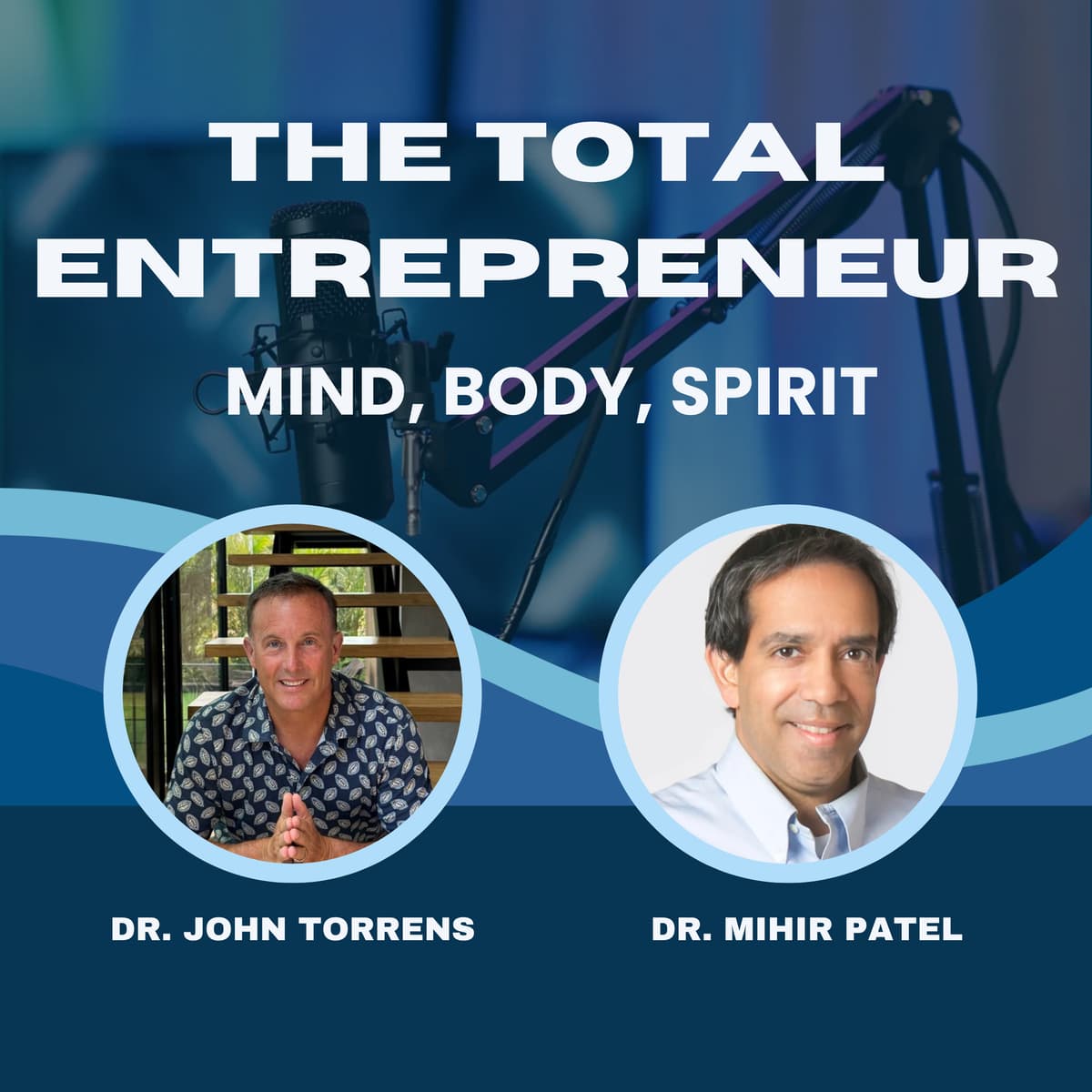
Muscle Strength Longevity Tips with Dr. Mihir Patel
with Dr. Mihir Patel
May 7, 2026 · 00:52:08
Part of our conversations on
Flexibility, I think, is part of the key here. As we get older, staying as flexible as we can, as loose as we can, doing the stretches, even though I don't like doing them, it just seems like a waste of time. I'd rather be evaluating a company or doing something else versus stretching, but that keeps us from getting stiff, and stiffness leads to injuries. So that is something to think about in terms of going forward.
Hey, welcome back to the Total Entrepreneur Mind Body Spirit Podcast, where we help entrepreneurs like you tap into the real ROI of prioritizing your mental, physical, and spiritual health. Today's guest is Dr. Mahir Patel. He's an orthopedic surgeon, but he's also much more than that. We do cover the basics of knee pain, knee surgeries, why hip fractures are more likely to lead to mortality of all causes, but we also get into some of his other work. He's an early-stage investor in medtech, so he talks about some of the investments and startups he's involved with that are really exciting to him. So enjoy the conversation. I sure did. Dr. Patel, welcome to the podcast. It's really great to have you.
Thanks for having me.
Yeah, of course. So, you wear many hats. You're an orthopedic surgeon, you're an investor, you're an advisor. But, I want to start with the orthopedic surgery part of your life. So, what are you seeing right now in the OR that could possibly be prevented, right? Because I'm thinking from a longevity perspective, what are some things that you're seeing or things that people are dealing with that are causing problems later in life?
Sure. I think, you know, just stepping back for a second, if you think of orthopedics, orthopedics sort of came from general surgery back in the day. So, in the '70s, orthopedic surgery as a residency didn't really quite exist. And then as time went on and technology improved with the orthopedic side of things in terms of hip and knee replacements, and then obviously the arthroscopic techniques that were developed later on, it became its own subspecialty. So, Just in terms of that, orthopedics itself has been very innovative just as a subspecialty for a number of decades at this point. What we're seeing in terms of longevity and prevention is actually, you know, is keeping strength up. I mean, that's the most important thing. Moving and mobility and, you know, keeping the muscles strong seems to be one of those keys to keep you out of the sort of the OR. And then, what I'd like to say is somewhat some of the activities end up being more age-appropriate. And so, I'm not going to go and try and dunk a basketball, probably tear both my Achilles, one going on the way up and probably the second one coming on the way back down. So, those kinds of things we keep in mind when we look in terms of designing these sort of protocols in terms of just trying to keep everybody healthy.
Yeah. So, actually, let's talk about knees for a minute. So, you were talking about dunking a basketball. Yeah, the Achilles, yeah, I could imagine that. But, I've had meniscus tears and things like that. I feel pretty good. But, what types of cool innovations are you seeing in terms of treatments for knee injuries in general?
Yeah. So, take your meniscus, for example. That's a very common injury. Part of it is from the biological side of things. As time goes on, all of the cartilage, the collagen starts to lose its water content. And, as it starts to lose its water content, loses its elasticity. And, in that, The structures become a little more brittle. So eventually, as things get more brittle, there is failure at certain loads or certain twisting injuries. Having said that, you know, these things can tear just a little bit at a time, then become bigger, become symptomatic. And then once it becomes symptomatic, then we have to do things with them. So in terms of the innovations out there, you know, in terms of the meniscus itself, the knees, the cartilage, The biologic side of things has improved tremendously since I did residency in terms of injectables, in terms of oral drugs as well, and supplements. And then again, keeping the knee sort of strong around with the muscle groups around there takes the load off the knee itself. So when you fatigue, you don't quite fatigue as quickly. So it reduces that level of load on the knee joint itself, you know, becoming more cartilage protective and meniscus protective. So that's some of the initial stuff that we end up doing, you know, before we end up in the OR. In terms of the OR techniques out there, things have gotten much, much better. You know, you can clip out the meniscus a little bit if it's a smaller tear. If it's torn in certain spots where the blood supply comes in from the outside to the inside of the meniscus, one can potentially repair it and repair techniques have have gotten a lot better over the years in terms of the technology, again, from the orthopedic, the industry side. And having said that, with the repairs, it takes a little longer potentially to rehab and get back to the activities. But again, it's more in the prevention mode. You're basically preserving as much biology as one can preserve in terms of that. And if you look back, you know, 30 years ago, they were taking out the entire meniscus even if you had a small tear. And we went to more meniscus-preserving surgeries, and now it's more meniscus-repairing surgeries. And then it's also supplementing everything around there just to keep the cartilage protected for, you know, so people can enjoy what they want to do into their 70s, 80s, 90s, 100s as far as we're concerned.
So that's the goal, right? Just to stay active and keep doing what you enjoy. I've read in multiple sources that a hip fracture later in life is one of the worst things that could happen to you in terms of a healthspan Kind of injury. Can you walk us through that? What, why is that? And how can somebody prevent themselves from, from dealing with a hip fracture?
Sure. Um, hip fractures, if you look at the medical studies out there, it's a 90% mortality rate at the end of 1 year. Um, and part of it is—
For all ages? Like, like how old are you? Like if you're in your 50s and you break your hip, is it still as bad as if you're saying your 70s or something?
No, just overall. Okay.
Oh, just in general, just population. Okay.
Yeah, I got you. And that's where, um, so is the hip fracture— it's more a symptom of the process, uh, of the decline, basically. So, you know, you could have that same fall in your 20s, 30s, 40s, 50s and not break anything. And then you get into your 80s, 90s, 100s and you break something, you know, whether it's the wrist, whether it's the, you know, the femoral neck, whether it's the femur. And, you know, the question is whether Whether somebody actually fell and broke their hip, or did they just have an insufficiency fracture, like a stress fracture, that broke and then you fall because you lost your balance. So that remains yet to be seen to some degree. But from our standpoint, in terms of prevention, you know, again, it comes down to the nutritional side of things. It comes down to maintaining bone health and muscle health overall. And then, and, you know, one of the most important things is, is balance and reducing your fall risk. And, you know, as orthopedic surgeons, we don't think about this probably as much as we probably should, but it comes down to your vision, right? So like, if you can't see properly in the dark, if you misstep somewhere, miss that step just because you can't see far and near, that lends itself also to sort of the whole process of falling down and trying to prevent those falls from happening.
Yeah, and then I think during the recovery, I guess the older you are, just the harder it is to really recover that same mobility and deal with your activities of daily life. Is that, I guess, part of the problem?
It is. Um, again, it's part of that decline. So everybody, you know, you start to lose your muscle strength, and to recover from even just a simple fall or just being like getting— catching a cold takes a lot longer as folks get older just because The reserve isn't quite as pronounced as it is in, you know, in people's younger years. But again, to help prevent some of that, like, again, it's about optimizing everything we can as far as we know at this point in time. And there's technology companies out there that are sort of trying to help detect this at a lot earlier stage so we can be more preventive going forward versus reacting as opposed to, you know, in terms of what's happened versus trying to prevent what's going to happen kind of thing.
So, yeah. No, that makes sense. Let's turn our attention to just longevity and increasing healthspan in general because I know that that's an interest of yours. And, you know, a lot of the young entrepreneurs I work with, they, they just grind so hard that the reason I started this podcast in the first place was to help them understand that there's a real ROI to prioritizing your health. Right? So you can, you can grind harder and longer if you're more resilient and healthier. And then at the end of your life, in your terminal decade there, you can, you can enjoy the fruits of your labor versus dealing with chronic disease. Right? So from a, from a longevity perspective, first, like new things on the horizon, like could you share your perspective on things like peptides, collagen injections? Oh, or stem cells? Cuz that's become more popular. Like what should people be thinking of? What are some cautions? What are some good things? Good use cases, that sort of thing?
Yeah. I think you can't start early enough from that standpoint. And so, in terms of diet and nutrition, so diet and nutrition, I personally went through this journey about a decade ago where I quit sort of eating as much processed food as I could. I'll still have a bag of chips with the Masters and that sort of thing. But, these are the kinds of things that you try to minimize, right? Anything you minimize is going to help. And so, staying away from the processed stuff, eating the natural stuff. And if you look back, I was a student of economics and if you look at economic history, the 4 great civilizations that started this entire world, everybody basically had a filler in terms of processed foods. And so, that filler provided the satiatedness of having a meal. And, the issue is that if everybody ate no processed foods, that's when rulers got overthrown back in economic history, historical times. People weren't satiated, famines happened, and basically, the rulers are gone. So, that was sort of, I think, the premise of all this stuff if you look back in terms of civilization. So, fast forward to now, and from our standpoint, reducing the processed foods reduces one thing, it reduces the inflammation, like a baseline level of inflammation that people have. And in doing so, those natural processes— we're still all trying to understand from the medical world how, you know, the gut affects the brain, the lungs affect the brain, everything in terms of longevity and muscle health. That inflammation, that baseline level inflammation, if you keep that at a minimum, at the end of the day, you end up remaining much more flexible. And from that flexibility, I think, is part of the key here. is as we get older, you know, staying as flexible as we can, as loose as we can, doing the stretches even though I don't like doing them. Like, it just seems like a waste of time. I'd rather be, you know, evaluating a company or doing something else versus stretching. But that prevents— that keeps us from getting stiff, and stiffness leads to injuries. So that is something to think about in terms of going forward. And, you know, one of those things is Life's sort of a journey, and even longevity is a journey. So, the marathon's not won in the first 3 miles. It's like a 26-mile race, but not even a race. It's truly a journey from our standpoint. So, maintaining that flexibility, maintaining state and keeping that inflammation down at a reasonable level basically helps promote the ability to potentially live a lot longer and a lot more fruitful life. Just don't get hurt as much. And I think that's evident a little bit in the sports world. You know, some of the sports folks are definitely looking at that as far as who they're recruiting and their training regimens and the recovery from their intense training regimens that they all have. And then that focus there is actually allowing them to perform better, I think.
Yeah. I had chondromalacia of my right knee a couple years ago and my PT was like, yeah, my waiting room is filled with guys like you who like to do the activity but don't like to stretch. So, I started stretching like it was my job. And yeah, it's amazing how just focusing on it a little bit at a time, getting that mobility back, really just kind of ease that pain. And yeah, I was lucky I, I was able to, to resolve it. So yeah, point taken about mobility and flexibility. What about stem cells from your perspective as an orthopedic surgeon? I've heard a lot of people talking about this. Actually, I know a few people who've spent a lot of money with stem cell injections. Um, one of them in particular with a specific complaint of just joint pain, hoping that that would alleviate it. I don't know enough about stem cell therapy. to really, you know, to talk about it intelligently. But I wonder what you think about it.
Yeah, you know, honestly, it's evolved. A decade ago, like, it's one of these things that you had to go to Europe, you had to go to Asia, Australia were places of so-called excellence where you could potentially get these things done. I think we're understanding it more. We're still in that journey of trying to understand everything about it and whether we will remains yet to be seen. However, I think there's benefit in all of those biologics, the stem cells, the peptides, partly because it doesn't really burn any bridges. And so, it's not like if you get a hip replacement or a knee replacement, now that just boxed out everything that we could potentially do in terms of trying to keep and preserve as much of your natural state that you have. So, that's one of the greatest benefits of all those modalities is that they They don't really— they don't burn any bridges and you can repeat it as much as you potentially can tolerate when it's all said and done. But, in terms of the stem cells, but in terms of the biological side of it, yes, that's where stem cells are the beginning of cell life. And so, they basically differentiate into different— into muscle tissue, muscle, fat, nerves. And so, from there, One would think that if you put it in the right milieu, in the right sort of environment, would that stimulate that growth of whatever happens to be in that environment? And that remains to be seen. I mean, in terms of cartilage preservation, it's being proven out at this point. So it's not experimental. I think we've got enough data showing that it does help in terms of preserving cartilage or repairing cartilage with stem cell injections, with PRP injections, where we take your own blood, spin it down, And basically re-inject it into the area that's symptomatic. And I think part of it also comes down, and some of us, we just, again, we don't quite understand all of it, but I think it also reduces your level of inflammation in that particular area. And so, in doing so, there's inflammation causes pain, causes swelling, causes discomfort. That reduces that level so you feel better. You can work out, you can do your activities, you can get the muscles stronger around there. So, It basically breaks the cycle of the downward trend. I used to tell patients it's kind of like a toilet bowl. You're spinning up on top and then all of a sudden you spin down into the gutter. And so here you're breaking that cycle and you're out of that toilet bowl at the end of the day. And so you can get stronger. And by getting stronger, you're getting stronger because it's not as painful, right? And so you don't fatigue as fast, you get the muscles stronger, then it allows you to enjoy more stuff. For longer periods of time. And again, it's, it's a slow process. It's a slow process coming on. You don't realize it until it happens. And then it's a slow process coming out. But these kinds of things help break that cycle.
Is it a valid shortcut or is it— because it sounds to me like you could do this, you can accomplish the same things with all the things you were talking about a few minutes ago with the mobility and the stretching, or are they 2 completely different approaches?
No, I think they're all related. It's all part of a program.
Gotcha.
And so, I think you could do that, you know, you could do the stretching and do the mobility. Walking backwards helps stretch out the backsides, your hamstrings. The kids used to like look and they're older now, they're in their 20s. But, when they were like, they'd ask my wife like, why are those people walking backwards? And, she'd be like, it's probably one of Dad's patients. He told them to walk backwards a little bit. And so, in our neighborhood and stuff like that. And so, So, those are the kinds of things you think opposite of in terms of you go forwards all the time, but sometimes you just— and it doesn't take much. You just have to walk backwards a little bit and you're good. But again, you start with those sort of modalities first and then you start doing the more invasive stuff. An injection technically is invasive. It's technically trauma with a needle. The whole point is to do those things to help you get back to being able to do the first round of activities and modalities that we have to help, help reduce that pain, reduce the inflammation.
Yeah. Before we start talking about some of your investment activity, I just want to get your take or read on the state of medicine in the US nowadays. I mean, you know, there's been books published and people talking about Medicine 2.0 and 3.0 and how modern medicine is great for trauma, but it's not so great for prevention. And then you layer on top the, you know, the pressures of health insurance and all these things. It seems like there's a There's a little chaos in the profession. So I was just really looking for your read on all that.
Yeah, like how much time we have.
We could talk about that.
We could talk about a lot of that. And so I think it's always been there, at least since I've been practicing. It's the same players that are in the game. So it's just, it's a matter of then which ones are, you know, winning the game at some point in time. And so, that's where— that's how I look at it. And so, when we look at this, you look at— you bring up a lot of the players. You talk about the insurance companies, the pharmaceutical companies, big industry. The government obviously is a big payer for, what, 1/6 of the economy when it comes down to it. And so, with all those, they all have their own incentives and they're aligned in certain ways. to do whatever for the healthcare system. The healthcare system is kind of like basically the family. I mean, there's chaos. There's always chaos. And so, it's just a matter of managing that level of chaos whether you can tolerate it or not. And so, that's where I think when we look at it in terms of— on the practice side, obviously, I practice and we had surgery centers and that sort of thing. Nothing fundamentally changed between the doctor and the patient. You're a patient, you come in to see us, like, we're going to fix you to the best of our abilities and figure out what's wrong and get you going in terms of the orthopedic side of things. And it's the same with every other subspecialty when it comes down to it. Now, the question is, okay, then the economic side of it comes into play. And so then who's paying for it? Like, where is this coming from? And like with any barrel, there's always bad apples in all sectors, right? But the majority of the barrels usually pretty good. And so, I think everybody means well. It's just a matter of figuring out at what point in time, you know, does something need to be changed if it's effectively affecting the majority of people or huge numbers of people in a negative fashion. And I think that's where the beauty of sort of the AI world is raising the floor for everybody and I think that's where the benefit of that will help normalize a lot of this chaos. So, I can research pretty quickly in the AI world, whether it's right or wrong, I at least have an idea. I have much more of an educated sense of going into a physician's office, talking to the insurance company, talking prior authorizations for some procedure or whatever it happens to be, both from a— patient side and the physician side, we can quickly figure out, okay, maybe we're missing something or maybe we're not missing something, maybe they're missing something. Like that level, that playing field becomes a lot more even when it comes down to it. And that's the exciting thing about the whole healthcare system at this point. I think that with the advent of those certain tools that are open to the masses, including myself, like one can really educate yourself really pretty quickly Without, you know, the— without much effort at all. And that whole concept of sort of privilege and sort of not being able to figure out things on your own, like, as long as you have internet access, you can figure it out pretty much. And at least have a reasonable idea where you can carry on a reasonable conversation, ask the right questions with whoever the expert happens to be. And again, I don't talk about just the physicians. We talk about, you know, getting our bills paid on the insurance side, talking to the claims adjuster, you know, getting that, the knee surgery approved, getting the total knee hip replacement approved by your insurance company. All of that becomes a lot easier with the tools out there now.
Yeah, that's really good to hear because it feels like that was just one of the things that was bogging providers down, or at least their offices, right? Just trying to deal with that. Have you had patients come in with opinions from Dr. ChatGPT that that you've had to sort of negotiate and work around and educate the patient on? Or have you been— have you not had experiences like that?
Oh, no, we've had it. And honestly, it's been educational both ways. Like, I don't— I actually now am in the position where, like, I don't know what I don't know. And so, like, I learn all kinds of stuff every day from all this stuff. In fact, like, in other subspecialties, not orthopedics obviously, but like in other subspecialties, Like, we can figure out what labs to order much more quickly, at least, and tell the patient, hey, we're sending you off to the rheumatologist. Make sure they, like, have them take a look at these things because this is what we're looking for. And, I can give you a clear example. 10, 15 years ago, people come in with random joint pain and we get the MRI, there wasn't much of a tear, there wasn't much biomechanically wrong with their knees. But, you're like, you have something.
Yeah.
in the rheumatoid, like you have something going on. We understand that because clinically you do. And those clinical diagnoses were clinical diagnoses because we just didn't have tests that objectified these subjective complaints. And so, as the test got better, even though we're not in med school anymore, I would look up stuff randomly like, okay, if you're going to order some inflammatory panel, what are the key ones? And, as time has gone on, those inflammatory panel tests have gotten way better. They've got new ones that have come out since I stopped training and that stuff. But again, that's the level of education we're getting out of this. We're like, hey, maybe they go check this thing. So, a seronegative— so, there's rheumatoid arthritis, which is an inflammatory condition that affects the joints. Traditionally, you got a rheumatoid factor, which is the blood test that will basically recognize that level of for lack of a better term, rheumatism in your bloodstream, going back to Tom Sawyer days. Those tests were there, but then there's also this whole category of what they called seronegative, meaning blood-negative rheumatoid factor or rheumatoid arthritis where there wasn't anything in your blood that we could detect that gave you that diagnosis. So, we'd follow these people, these patients for 7, 8 years, occasionally do some injections, send them to physical therapy to get stronger if they got a little weaker. Just to alleviate their symptoms. And then eventually, like, their bloodstreams, their bodies would create something that they would detect. And so we track them for 6, 7 years, send them to, you know, major institutions around the Midwest for a second opinion, third opinion, fourth opinion. And, um, and everybody's like, yeah, we agree with you, like, there's something there, we just don't know what it is. But now these tests have gotten better, and like, with the AI able— the ability to research this stuff and just put in, you know, I have knee pain and like, no test has been positive, like, and so what should I get? Like, ask those kinds of questions and boom, like, these esoteric tests start to pop up and lo and behold, we're finding things that now we've got a diagnosis. So now we know we can give better, basically better prognosis and we can figure out what we're doing with it, which is exciting. You know, that's the fun part of this now.
That's a great example of how, you know, you just kind of condense the timeline of getting to diagnosis. That's amazing. Is there a potential downside? Not necessarily downside, but like, how do you see AI just changing the nature of medicine, either whether it's diagnosis, doctor-patient relationship, but just in general? It's— I mean, it's going to transform a lot of industries and a lot of professions. So what are you seeing there?
Yeah, I think we're seeing unbelievable transformation. And so back in 2018, Like, I ended up writing a blog about how AI would let physicians be physicians again and sat dormant till '22-ish, 2022, '23 maybe even. So, like 4, 5, 6 years, it just sat there. And then, it like got picked up. And from a doctor-patient relationship and from our, what I call headache factor in terms of our back office, AI lets us reduce that level. And I think That's what everybody else is seeing in all their respective industries across the world from that standpoint. A lot of the pain points that are there and the sort of what we consider menial tasks or stuff that we just don't like doing, like typing in the computer, like I don't like typing in the computer. I don't like clicking in the— Like those kinds of things just get taken care of by some of these tools now. So that's obviously beneficial to treating patients. You can treat a lot more patients. Like, you can just have these conversations as long as we want, and then I don't have to go deal with the note because the note's done, right? And like, and then the tests are ordered, and then the tests are ordered and they're approved by your insurance company because all the information is properly entered into the whole system. And then your primary care doc can see what we just discussed, and they are much more efficient because they don't have to— You don't have to go in there and say, oh, I saw me and then he told me to go do this. Well, they already know that when they come into the office with you at that point, because it's already linked in, you know, in a very uniform way. So those are the kinds of things that make sort of the burden of, oh God, I gotta— it's not the seeing the patient, it's all the stuff you got to do around the patient that just goes away, which is like absolutely relieving, wonderful. And like, you just want to— you could see 100 patients a day. Just, it just depends on You know, how much time you have and how much staff you have that wants to stay around for you kind of thing. And so that's the nice thing. And then in terms of the diagnosis side, obviously, you know, there's— it can lead you in certain directions and it can point you in other directions. It's more— it can be— you can— it could start thinking of other things because everybody else is putting into the system. And, you know, and so then it's learning from the entire world versus just us, right? But the downside is sometimes it'll, just like anybody else, like it starts to overprescribe maybe in some cases. And so, you know, and that's where what we found with some of the, you know, some of the AI companies, like when you had a human reviewer that was an expert that sat on top of all of these suggestions, that ended up being the most effective, most efficient thing in terms of minimizing The overprescribing of whatever it happens to be. So, whether it's, you know, you go— I go in for an MRI and it sees some lesion and says, well, it could be cancer, go get a biopsy. Well, if you sent that same MRI to an oncologist, they're like, oh, that's just a cyst. Like, they've seen a lot more in their 20 years of practice than the AI system has at this point in time, right? So, like, 20 years from now, the AI system may say, oh, you just watch it for 6 months. we'll see what it looks like. We'll get another MRI. So that's where it's still learning, right? So it's not, it's infancy anymore, but it's not quite there. But you add, again, you add a couple of different opinions, meaning human opinions, AI opinions, and all this stuff. All of a sudden you've got a pretty good answer.
So how do you go from being an orthopedic surgeon to an equity investor? And what was that transition like?
From my standpoint, again, I was in leadership positions in our group. And so Even we had a— we have an unbelievably efficient group, but even in healthcare, we end up having inefficiencies in a very efficient group. And so the whole goal here is you find your pain points and you try to solve those pain points with efficiency things. And so that's where we started out on that journey in terms of helping scale out basically ambient dictation. You know, the conversation we're having right now, it gets transcribed by an AI transcriptionist. Well, like— not too long ago, just like 8, 9 years ago, I had to type all this stuff out, which is absolutely absurd, right? In terms of you coming to see me about your knee pain. And so, that's where my journey started there. It was like I just didn't like typing. I didn't like clicking. And so, I went around and one of our friends happens to be in the tech industry and he just happened to— we met at actually Diwali, which is the Indian New Year party. And he was like, hey, I might have something for you. And it was just by happenstance. He shows it to me. We end up— I loved it and I was like, oh, this could add a huge amount of efficiency. Well, that company ended up getting scaled out and then ended up— and a lot of those folks at that company, that got acquired by a big tech company and that tech company got acquired by another bigger tech company. That sort of just started the whole journey of my investing and looking for efficiencies in an inefficient system. specifically healthcare. And then the tools became, you know, obviously much better. You know, COVID hit, and as bad as that was, there were some positives that came out of it in the sense that the healthcare system adopted technology a lot faster. Virtual visits became a thing to do, you know, thanks to, you know, CMS at the time and allowing us to see people like this virtually and, you know, and it all being sort of okay. Like, you didn't have to— like there was regulatory things that had to be solved before that would happen. That got all solved. And so, the tech became adopted by us, the tech became cheaper, and the tech is a lot more robust. So, that sort of started my journey into the tech world and into the medtech, healthtech world. And in doing so, obviously, there's lots of inefficiencies and a lot of pain points. So, you just have to ask enough people to find out where the pain points are. And that's where they're like, let's go see if there's something we can help solve that pain point. And if You know, a certain number of people having that pain point in some subspecialty, there's probably all the other subspecialties probably having the same pain point in some sort of fashion, especially in the back office because it's very uniform in that standpoint. So that was the exciting thing. So I started looking and I just kept looking. And so then we started looking and then what ended up happening is kind of ended up being like a medical practice to some degree. So I was looking, but all of a sudden then people started finding me. And so, just like my medical practice, like when I came into practice, like nobody knew me. Like, I didn't— nobody came to see me. Like, I had to go out and say hi to all my friends who were primary care docs who I'd gone to, you know, high school with, college with, who had all settled in the area. And so, but then word got out. So, it's a word-of-mouth thing. And healthcare is very much word of mouth, as we all know. And the health tech world and the med tech world is very much word of mouth as well now. And so, that's where it became really quite exciting because, like, again, I don't know what I don't know. And so, when people came with an idea, you're like, hmm, that might actually be quite ingenious. And then, to your point about how the founders are grinding and they're not maybe taking care of their health, and we want the founders focusing on the sector that they're focusing on. But that's where we came in. We're like, okay, well, if it's working in pulmonology, it might actually work in cardiology. If it's working in orthopedics, it it might work in rheumatology. And that's the value add that we end up bringing is like, okay, we've got this network of physicians and hospitals and distributors and just inroads in sort of the back office and what the pain points are in other subspecialties. That adds the value to those founders, to those companies in terms of scaling, right? So, they're landing in one subspecialty and then they just have to scale out into other subspecialties, which becomes really rewarding because it's kind of like fixing your meniscus. Like, when we fixed your meniscus, like, I knew this was going to be good in about, you know, 3 to 6 months once we got your strength back up. It's very similar to like, oh, we never thought of that. Those words, we never thought about that. Like, when you say maybe we ought to go look at the cardiology market and they're like, yeah, we should look at that cardiology market. It's 10 times bigger than the orthopedic market. And so, so that's where you see the sort of the, oh yeah, that's a great idea kind of thing. And that's where that, that's the rewarding part of the whole situation.
That sounds like a good process, right? Just, you know, you start with, with one problem and you expand into other areas for sure. So what, how do you manage your deal flow? Like, is it all you? Do you have a team? And what types of things are you looking for? When you're getting pitch decks across your desk? Yeah.
I think from our standpoint, we have a team. And so, but there's, it's a small team. So, like, it's just everybody sees whatever they want to see. And so, I'd never say no. Like, people just send me a deck and we'll have a look at it and see what we can do with it kind of thing. And so, and again, it's sort of like, it's like a medical practice. Like, patients will come in and some will have bigger issues than others at that point in time. And so, some companies, just like a patient, some companies need a lot more help and a lot more work. At least they've gone down a path and the path is good, but it's like they're so deep into the thing now, they can't seem to get out of it from that standpoint. And there's maybe something fundamentally wrong with like what they're— how they're thinking about it. Then there's other companies that are just like, they're cruising and they're just like looking to— they just need a little tweaking. So a little physical therapy, like, for going back to the health thing, and they're, they're back running their marathons, you know, and they're on their trajectory, they're good kind of thing. Um, and then the fun part of it is, and that's why I don't really say no to any deal or any deck, because, um, and again, it goes back to me, like, knowing I don't know what I don't know. And then connecting them with somebody else and then saying, hey, why don't you go talk to these folks? These guys will help you out in a tremendous way, potentially. And it becomes synergistic. And that's what we're trying to do is becoming more synergistic, more collaborative than anything, both from capital perspective, from a tech perspective. You know, if they've got storage cost issues, like we We've seen companies pitching to us now because their storage costs have gone through the roof. So, let's try and help you out in terms of figuring out that part of it, even though I'm not a tech person at all, but I know somebody who knows a lot more tech than I do. So, I'll just refer you on to them. And so, that's how we've approached it and it's been great. It's been a lot of fun from that standpoint. So, yeah, like I said, the deal flow is coming at us now in a great way. That's where there's so much to be had in terms of the healthcare system. I think that it's boundless. I mean, you could do this for the next 50 years and never finish.
Right. Yeah. So, what are 1 or 2 investments that you're especially proud of or interested in or maybe have the highest hopes for?
Yeah. I think one of them is a small company and it's called OxyWear. And again, it's one of these It's a pulse oximeter. And so, the firm I'm a partner with, with Lead, had invested in her basically because she was a concept at the time. It's just a small product, oh, 7, 8 years ago. And then, when I started down the journey of transitioning between orthopedic surgery and doing this full-time, I basically looked at the entire portfolio of sports tech companies we had. We have like 80-some sports tech companies that were going into health tech, right? Or they want to go into health tech. And so, I went and looked and I said, okay, let's see who has FDA approvals on their devices at this point. This one popped up. And so then, went and talked to the founder and Chavini was like, yeah, we have FDA approval. And she goes, yeah. I go, what's the exact FDA approval? I'm not going to read through these FDA websites to try and figure this out. And so, she said it was for motion in all skin tones. You've ever had a pulse ox, you know, when you had— if you had a surgery, they put the thing on your finger and they measure. They tell you not to move, not to talk, and you end up, you know, they get a reading on this thing. And I said, okay, motion I get. And so I'm like, so what are you doing? And they were selling in the sports world. So they're selling to mountain climbers, you know, free divers, like athletes and that sort of thing who wanted to know their oxygen levels and whatever, if they were in a position where that might be compromised with their activity. rate. And so extreme mountain sports and stuff like that. And I go, so you said all skin tones? And I said— she goes, yeah. And I go, what's wrong with the ones that are existing now for all skin tones? She's like, they're not good. And I said, where is this? And so then— and again, as a physician, I don't trust anybody, so I had to go do my own digging at that point. So you just have to point me in the right direction, I'll go dig. And there's a New England Journal article about it from 2020 coming out of COVID They compared it to ABGs, which is what we call arterial blood gases, which is the, the basically the standard, um, of care in terms of the most accurate in terms of measuring your oxygen level versus that. And it was out of the New England Journal out of the University of Michigan. They did this whole study. And, uh, I was like, well, there it is. And I'm like, huh. And then the FDA had a commentary period. They had just started in January of '25, um, from that standpoint. as well trying to figure this, this whole thing out, but she had already figured it out. So that company is like wonderful in terms of both standard of care issues that might be an issue at some point in time for everybody. And like, if you looked at the studies out of the University of Michigan, like, you know, they're off for everybody. And, um, and so that one, and then, then adding the whole, um, oh, where can we scale this? Like the entire world. And maybe Mars eventually, you know, like they get along with it. And so, that's where— that is truly exciting. Like, so then you go talk to people, you know, in Africa and India and Australia, and all of a sudden they're like, oh, we're not aware. And like, yeah. And I had researched this with my entire extended family and retired physicians, you know, practicing physicians and nobody really— everybody knew that it didn't work with nail polish. Like, you have to take your nail polish off when you go in for, you know, for any sort of procedure. And like, that was like probably the first clue, but everybody just assumed that like it was right for everything. But turns out not necessarily so. And so that's where— that's the exciting thing. We're helping scale out, right? And so in terms of optimizing the oxygen levels, learning about it, and then being somewhat preventive, and then helping scale out across the world. And again, it's one of these things where we're selling the sports world. Now, let's go look at cardiology, pulmonology, the ICU, orthopedics, post-op ASCs, pre-op ASCs, like the whole vertical, allergy, asthma, kids with asthma, kids with maybe undiagnosed cardiomyopathy on the football field. It's the sports world, but it's also more of the medical side than it is the sports world. Maybe you catch these things. And again, it comes down to the fact that these devices, not just that one, but all these other ones, are getting continuous data. And so that continuous data stream, we can start to see trend lines in different patient populations much easier. And then you throw in the AI, the machine learning on top of all that. And now, we're talking predictions. Now, we're talking power in terms of the proprietary datasets. So, becomes much more robust, much more accurate where we're going to catch things a lot earlier than we ever have. Again, being more preventive for longevity than reactive towards solving issues that may have— we've recognized 10 years early, 15 years early. And, the founder's that way. She was diagnosed with asthma when she was 22. She had an ASD, which is a hole in her heart that gave her pulmonary hypertension. And so those are the kinds of things we're helping out. There's another company that from a data perspective is able to collect all the data. They call themselves the Palantir for healthcare. And so from their databases, like these trend lines, then that's what we start looking for. Like, are there companies out there that are already collecting some of this data we can So, it ends up not being just a single source of data, it's multifactorial. So then, multifactorial becomes exponential logarithmic in terms of power, in terms of predictions. And, the third company is a muscle— it's a muscle-building company without putting much pressure on the joints. And so, it actually came from the cardiology literature. It's called blood flow restriction. The company's name is Suji. They're in 30% of the professional sports leagues. And across the world. They started there and they're working towards the consumer. And again, it's one of these companies LEAD invested in a number of years ago. And effectively, blood flow restriction is— think in simple terms, think a tourniquet. You put a tourniquet on your leg, you work out, and you get a burn a lot faster than you would otherwise because you've cut the blood supply off. But it's measured, it's calculated, and it lets you Build the muscle but without the extra weight. And so, that's the exciting thing in terms of joint preservation. Like, for all of us who may have some knee pain creeping up as time goes on, it's fascinating. And so, you do this and you can feel that burn that you had when you were like 17 when you're lifting weights in the weight room without having to do it 100 times, number one. Number two, you don't have to use that much weight. You can use— I mean, and the nice thing is it's portable. So, you can travel with it in your carry-on suitcase and you have a gym in your bag effectively in your hotel room. And so, you just take a couple of water bottles like the ones that are in your hotel room and you could just lift weights with those things and turn up the pressure on this thing and you're building muscle and maintaining your strength from that.
Is it like a blood pressure cuff or a band or what is the device?
Yeah, it's a blood pressure cuff. And then, think just like an iPod case, there's a little iPod thing that you basically attach to it and then it goes to the app through your phone.
Okay.
Measure and then basically controls that entire device. And then, you have different programs on it that you can do for messing.
Well, that's really cool. So, you can get the same benefit as lifting heavy with lifting a little bit lighter without the wear and tear on your joints. That is really cool. I love that idea.
Yeah. And, in terms of longevity, the number one predictor of longevity is muscle strength and partly because you keep your balance, you don't fall over, everything stays upright. And so, that's the beauty and benefit of that entire device situation to the point where, again, the kids call it how it is regardless how old they are. They could be 2 and they're calling it the truth, or they're 24 and 20 and they're calling the truth. They're like, hey, Dad, no man your age should ever have veins popping like that when you're doing curls with 25-pound dumbbells. And, I'm like, yeah, this is pretty cool. And, you can feel it. You totally feel it. Wow.
And, what's the device called again? And, is it available for consumer use now?
Yeah, yeah, it is. And, the website's trisugi.com. How do you spell it? T-R-Y-S-U-J-I dot com. Okay.
TrySugi. Okay.
Yeah. So, and it's, it's, I mean, it's a great muscle building device. And they're now going direct to consumer. And so, again, think in terms of the, the, the founders, like, they were in the professional sports teams, like, and then now there's 2 big verticals here. There's direct to consumer. in terms of longevity and wellness. And then, there's a whole health space. So, the health space, we could use this for pre-op before total joint replacements to get your muscles stronger. You can use it— obviously, the technology came from the cardiac side, so that's where they're using it was in cardiac rehab. There just wasn't devices like this that were that precise. People actually use a blood pressure cuff to your point and turn it up and every clinic had figured out some sort of Yeah. It's much more objective.
Yeah. So, as you progress through your strength training using the Suji, so the app, does it— you have to input or does it just kind of know with machine learning the right amount of pressure to put there based on your goals or how does one interact with it, I guess?
Yeah. So, there's a whole program on the app. And so, you can pick your level There's also a program where it's just like, think like on a treadmill, you can have interval trainings, you can have all this stuff that you can do with it, or you can just pick 8 miles an hour and run at 8 miles per hour until you're done kind of thing.
Yeah.
So there's a, there's a, what they call a solo exercise session that you just pick what you want to do versus doing the other stuff. And then interestingly enough, like, There's the working out portion of it with it, but it also works in terms of recovery. So you put this on afterwards and there's a recovery phase and you just put these things on and all of a sudden your soreness is gone. And I go back to the fact that like part of me not necessarily transitioning from orthopedics to something else was that I would be potentially too sore to play every day, like do something every day. So you're like, well, might as well just go see patients and hang out versus going to work out or going to snowboard or play golf every day or whatever. But, with this device, I can do anything 5 days in a row. And, I proved it at the most extreme level. We go snowboarding out west. And so then, I went 5 days in a row as hard as I could. And, every night, I put these things on and the next day, I was like, hmm. It was my own little n=1. Again, it's anecdotal. You know, it's not any medical study, it's not double-blinded, none of that business. But for me, it worked. So I was like, now I can actually, I can actually play as hard as I want like every day and be fine the next day to go do the same thing or do something different where I'm not having to take the day off anymore, like in between, right? And as long as you're not doing the same thing, you don't get the overuse injury. But if you're, um, and again, I don't snowboard every day because I live in Indiana, so there's no snow here, um, or mountains for that matter. So that's one point in time for 5 days, right? And so, um, So that's the exciting thing. These are the kinds of the technology things that are coming out now that are just fantastic, both for, from, you know, at a personal selfish reason, being able to do what I want to do, but also in terms of, oh, you can see where this is going to help the outcomes of a total knee replacement, a total hip replacement, get people more active and getting them, you know, doing what they want to do. And people just be happier because of that reason.
Yeah, that's really cool. I'm gonna have to check that out. That one was interesting. Yeah. So is there, is there a deck that you're just like hoping to get, like a problem you want to solve and you're just hoping that somebody has solved it and is able to send you something, or do you just kind of— are you open-ended and just review what comes your way?
Yeah, it's been open-ended. Like, yeah, we haven't really focused on anything. And part of it is, again, a little bit selfish. For me, it's like going back to med school. And so, I'm seeing all kinds of subspecialties out there that I would never have seen if I just keep going to my office, right?
Yeah.
And so, interestingly enough, in medical school, we had a gentleman in our first 2 years of med school at Washington University. He had actually retired and I can't remember what he— he might have been a primary care doc, but he had retired and he just came back and took classes. He He was practicing— he practiced in St. Louis. He just came back and came to class every day for 2 years just to sort of see what was new from the previous 40 years that he hadn't done. And I still remember that, and I was like, this is exactly what this is, except this is adding the tech component to it, and it's much more like we're going to be able to scale this, help scale this out. So, like, you know, there's a women's health platform we're helping out, and, you know, an orthopedic surgeon on a women's health platform, like, what could I possibly add to the situation? And, uh, and it's been fascinating just like talking to friends and family who are in that sort of space just randomly, you know, and, uh, and learning all about it from, from that standpoint. And, um, uh, and then that's— and the value we bring is, oh yeah, oh yeah, those are, those are the supplements they're using, or this is a condition that, you know, was identified when a patient became pregnant. And so then now what are they going to do to prevent it, prevent that from marching on when they're in their, you know, 40s, 50s, 60s kind of thing and showing up again when it was already there? And they just track that. And with RPM, or RPM meaning remote patient monitoring, with the different, obviously all the tech devices out there, and then plus the therapeutics out there, there's value to be had To help, hoping that we're going to change that trajectory, right? So if you have pregnancy-induced hypertension, that doesn't necessarily— that's not meaning— that doesn't mean that you're going to have hypertension when you get in your 50s and 60s, like high blood pressure. Or you have pregnancy-induced diabetes, like let's keep those blood sugars lower so you don't get the complications of that or get the disease process because you've already changed your lifestyle from 30 to 50. And then, and now at 50, you're not, you're not going to have that same issue, or it may get, you know, basically pushed out to your 70s, and you still get to enjoy between your 50s and 70s. That's the exciting thing in terms of the longevity space.
That's really informative, and I appreciate you spending this time with me, Dr. Patel. So, if people are interested in learning more about your work and what you do, how can they find you?
Yeah, I think we're on several boards. And so, and then obviously LEAD is, uh, um, uh, lead.vc. That's, um, we're part of that. And then, uh, um, InStudio Ventures out of California, we're helping out in their health vertical, and Jumpstart Ventures out of Ohio. Um, and then there's Meadow Valley Partners out of New Jersey that's with Cooper Health that we're helping out as well. So we're in all 4, we're across the country from that standpoint.
Cool.
And if, and they can always email me too. And so not a problem. Cool.
That's great. Awesome. Well, thank you so much for this. It was a good conversation. I hope everybody enjoys it. Thank you.
Yeah, thanks for having me.
About This Episode
If you want the best muscle strength longevity tips available, go straight to the source, an orthopedic surgeon who sees the long-term consequences of neglecting your body every single day in the OR.
Dr. John Torrens sat down with Dr. Mihir Patel, a board-certified orthopedic surgeon, early-stage med-tech investor, and advisor who has spent his career at the intersection of elite athletic performance, joint preservation, and longevity medicine. He shares what he's seeing on the front lines of orthopedic surgery, why muscle strength is the single most important predictor of how long, and how well, you live, and the innovations he's most excited about in the health tech space.
In this episode, you'll learn:
Why muscle strength is the #1 predictor of longevity (and what happens to your body when you lose it).
The truth about knee injuries, meniscus tears, and how treatment has evolved from removal to repair to preservation.
Why a hip fracture later in life carries a 90% one-year mortality rate, and the simple habits that reduce your risk.
How inflammation is silently aging your joints, and the dietary shift that brings it down.
What Dr. Patel actually thinks about stem cells, PRP injections, and biologic therapies, and when they're worth it.
The surprising reason flexibility and stretching matter more than most entrepreneurs realize.
How AI is transforming medicine, from faster diagnosis to eliminating the administrative burden that burns doctors out.
Blood flow restriction training: how to build serious muscle with minimal weight and zero joint stress (and the device Dr. Patel personally uses).
Dr. Patel's journey from the OR to early-stage med-tech investing, and what he looks for in a pitch.
Keep listening
More on Body
About the Host
Dr. John M. Torrens
5× Inc. 5000 entrepreneur, Professor at Syracuse University's Whitman School of Management, author of Lightning in a Bottle, and TEDx speaker on ADHD as an entrepreneur's superpower.
Browse all podcast guests →Book a strategy call →