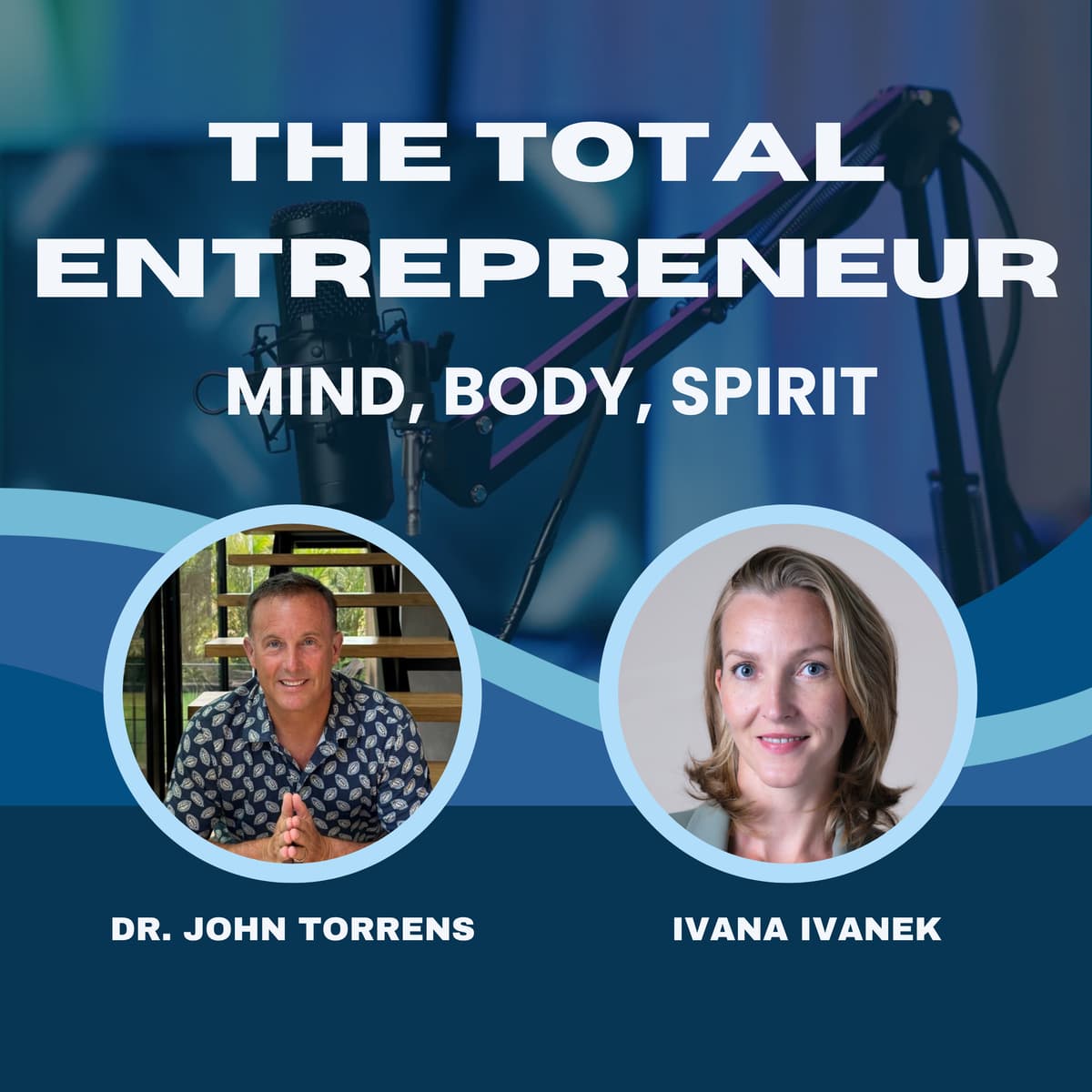
Personal Branding, Fear of Judgment, and Building Visibility That Converts With Ivana Ivanek
with Ivana Ivanek
Apr 30, 2026 · 00:49:16
Part of our conversations on
If you're building a personal brand, people want to hear your voice, see your face, and your real environment so you can build a trust with the people. It is not about perfection. People want to know who you are, what you stand for, so they can first of all find you, get to know you, trust you, and buy from you. So not speaking on a reel is not an option in 2026.
Ivana, welcome to the Total Entrepreneur Mind Body Spirit Podcast. Really, really good to have you here. Welcome.
Hi, John. I'm so stoked for this conversation.
All right. Hey, I want to start by having you talk to us a little bit about your early business failure. We always talk about the successes, but I, I know a lot of people learn through failure. So can you walk us through what that was and what happened?
Oh, with pleasure. We are all tired of highlight reels and highlight success stories. I'm happy to share. When I was in my, let's say, my youth somewhere, I grew up in Austria, born in a working-class family, grew up as an immigrant in Austria. My parents immigrated from Serbia. My path to climb the corporate ladder was paved. I had access to education, growing up in a safe country. My parents worked off their behinds to make that all possible. And I did it all, dropped out of university twice, just didn't see the point in doing the things that I could already back then find on YouTube. And my big dream was to travel the world, live by the ocean, do meaningful work as someone who helps people and become famous. I am a big fan of Beyoncé, though I cannot dance and sing like Beyoncé can, but that was the dream back in the days. So eventually, and I'm not recommending doing this to anyone who doesn't want to have sleepless nights, I dropped out of a very good job. I quit corporate life because I didn't see the point in working harder for a little bit more money in a job that stifled me, declined all promotions before that. And I invested thousands into an education and become a fitness, health, and mindset coach. Everyone around me wasn't very enthusiastic about it, you can imagine. And shortly after, I started my first business and I thought, I'm there. I made it through 4 hard years and hard, not because being an entrepreneur and trying, trying to build something on your own is hard. That too, but I didn't have any support. I didn't seek support either because asking for help was a sign of weakness. I was sitting in my corner thinking I'm the only one with that fear, with those nagging thoughts. Now today I know better. Today, every day I speak to an entrepreneur or to a business owner, we are all dealing with the same things. Back in the days, I thought I'm the only one. I made it up to a point where I was featured in the Woman magazine where I was running a health project. This was in a way so too much. I was so afraid to be judged. I was afraid to that people will think of me. I am a maniac, and I want more, more, more, more, more. So I wasn't even proud of that feature, and I was on four pages. I couldn't handle it. I wanted to be famous, but I couldn't handle fame, and I was prizing myself. Incredibly low. So if I calculate back now, if I wanted to make a living with $35 per hour, I needed to work a lot. So with all that together, with no support, I made— I had enough clients, but I didn't make any money. I could have had better clients, but I was hiding under a rock hoping to be found, sitting with my fear alone. 4 years later, I hit rock bottom mentally, physically, and financially. And the world screamed, finally, she woke up. We are so happy you're going back to a normal job. I was sitting there thinking, but can't you see that just my whole dream shattered? And that was a moment where I started preparing my comeback.
In silence.
Wow.
That story really resonates for a couple reasons. One is the, you know, you think you want fame until you have a little bit of it, and then you think, whoa, this may be a lot, right? So, and I wanna get into that later because I know you do a lot of work with people and their social media presence and their brand. And I think that's probably really important, but I wanted to get a little bit more into your failure story. So what was it? Was it just that you weren't billing enough? Was it just the nature of the model where you were charging for hours? Like, what was it that led to you ultimately having to stop doing that?
I think it's a combination of body, spirit, and mind that my body, first of all, eventually said, we are not getting out of bed today. I was physically so exhausted. I wasn't diagnosed with a burnout because I couldn't care. I was in therapy right after. But I wasn't physically not able to get up in the morning and to handle what I had to handle mentally and physically. I was an athlete myself at the time. I was weightlifting. I was going on competitions. I was just stretching myself left and right. And of course, I could have earned more and worked less, but I was afraid to charge money for my services. And I had so incredible Great results, and even with that, I wasn't able to deal with because I was thinking I'm too much everywhere I go. I'm too much. I was I had the feeling that I'm bragging, right? So it was physical and mental exhaustion in the end, and one day I didn't get up, and I knew first of all, I knew that I needed money. So I needed to go back to corporate because somebody needed to pay this therapy bill amongst other investments I have made where I didn't have a return on invest. And I knew that I needed to recover. And it was for whatever reason, I was very young, but for whatever reason, I knew this recovery is not just a 3-day flu.
Yeah. And what was the reaction from your parents when you made that switch? Were they kind of like, I told you so, or were they happy? Or like, how did that all go down?
They were sorry, of course, because if you see your child suffering, but I think they've seen me suffering long before, especially my mom. My mom has an intuition. When she knew, when I was telling her a story, she went straight in my face saying, you're lying. I'm like, okay, I'm telling— I'm saying half the truth. Like, I wouldn't lie straight to your face. But They felt sorry, but on the other hand, I think they felt a relief of finally she's being smart and she's going back to have a proper job and live a proper life because this is what was for them stable and safe. This is what they felt was the real life and they could never buy into that. I hear that from all...
Yeah, I hear that from a lot of young people who feel pressure from their parents or older siblings who, I mean, that's, you know, for the past, what, 50 years or so, you get a corporate job and that was your stability. But as we've seen recently, you know, the job is a stable paycheck until it's not, and you can be easily let go or replaced and so on. So yeah, I guess the question is, how stable is that corporate job? Really, right? So how much, how much of the angst that your parents had at first when you left to start your own company, how much of that was just due to the immigrant dynamics? Because I know from research, and at least research in the States, immigrants to the United States make some of the best and most successful entrepreneurs. And I was wondering if that just kind of translated or what your experience is with that.
Mm-hmm. So I think My parents' fear came definitely from something that, because I was doing something they have never experienced. Entrepreneurship wasn't an option. I am the first woman and first generation in my entire bloodline to have traveled the world, moved countries. I don't know how often by now, and starting something on my own and starting something on my own, which is not a brick and mortar business that everybody can relate to. If I would have a clothing boutique, Maybe they would have cheered. Maybe they would have bought one, two, three scarves. I don't know. But doing all the things online that nobody can really understand if we go back into the generations like my grandparents and my grandfather, who is the only one alive, he doesn't understand nothing about my job. And my dad, who is right now sitting downstairs as I'm visiting my family in Austria today, just asked me because it was 11 a.m. I went downstairs to have my second coffee, and before that I was working in my bed with my laptop because I'm not negotiating with creativity and motivation. If it hits, it hits. And I was pitching myself for visibility and doing the hard things immediately. Went down to have a coffee. And then I said, I'm going to get dressed for work. What? You didn't work yet? I said, I did. And he goes, looks up and down, be like, like this? And I'm like, yeah, working from the comfort of my own home with no proper pants on was always the dream. But make these people understand who only know one way. And never learned it differently. So on one hand, I felt discouraged because they wanted something different for me. On the other hand, I did see what they have done for me because they moved countries so I don't have to grow up in a war zone. They moved countries so I can live in a safe city. I have access to education and All I did was feeling guilty for living my dream because I felt like I'm not doing them justice.
Yeah. Who wants to disappoint their parents, right? I totally understand that. So, as a young girl, were you always wired for entrepreneurship? Like, did you always see yourself in business on your own, or was it a result of not enjoying the corporate job, or where were these seeds planted in the first place?
Yeah. I mean, I didn't even enjoy school, to be honest. I loved education, but never the educational path. I remember very early on questioning why I needed to know everything about the amoeba virus and how it spreads in a human body, but nobody could explain to me how Beyoncé formed Destiny's Child being only 9 years old. I was asking this kind of questions. And recently, I was emptying out my mom's cellar and we were going through my old stuff and amongst other things, some Photos, photographs, old stuff. You can barely see it on it. And I wasn't really aware of that. But I remember in church or anywhere I went, when a speaking opportunity came up, something to read, something to sing, something to present, I was the first one screaming, me, me, me, me. When we were singing in the choir for Christmas, I didn't want to be all the other angels. I wanted to be the Angel Gabriel who brings the message. That was the only speaking role of the angels. So there was like, as a very little girl, I wanted to be in the front. I wanted to bring my message across. Of course, not knowing how to bring it to the world because it needs action, it needs direction. And I truly believe it needs guidance and mentors, which I didn't know and didn't have. Mm-hmm.
I think that's common among people who end up seeking self-employment and entrepreneurship as a path. Well, thanks for sharing that. So let's, let's switch our focus to, to what you're doing now. So, um, I know you work with people on building their brand and their social media presence, but I'd love to hear in your own words what it is that you do now. And then once you explain that, maybe how you got there.
How I got there. When I was preparing for comeback, and it was a stretch of 8 years, it was a long time of recovery, of making some, let's call it now, stable money in corporate. But I decided to do one thing in 2018 because I really wanted to be living by the ocean. Island life was calling me. Don't ask me why. I just know I belong there. And eventually I moved countries. I got an opportunity to work in a diving center in Crete. And I took it. Money didn't matter. Nothing did matter. That was my ticket to the island. Very soon I realized like, well, that job isn't for me. Although I was doing what I was passionate about, I was passionate about scuba diving and I was passionate about sales and I was passionate about guiding young interns and helping them finishing their assignments. And it was a good role I had in that company. But It was same, same, but different. It was a job where I was hired for a certain amount of money, and it didn't really make a difference for me that the sun was shining more than in Austria. So I quit that job. That was my second time I quit my job without backup plan. Again, I am not recommending this to anyone. There are other ways that are more easier, but this time I told to myself, I'm going to double down on what I can do right here, right now. I'm going to stop playing small. I'm going to serve one person and solve one problem? What can I do now without big investments, without big things? And what I realized is, um, I can teach German as a foreign language. I'm qualified. I have a great methodology behind it. This is something that I developed along the way, and I know how I want to position myself as an immigrant. I know how hard it is to go to another country, learn another language, With that, change my entire identity because this is what happens automatically. Everyone who speaks a couple of languages, you know that you don't sound the same in Spanish, not the same in English, not the same in German, not the same in Japanese. And I have enough knowledge because I am a mental fitness and health coach that I can help healthcare professionals transitioning into a new country. I positioned myself so specifically and I went on all possible platforms to put myself out there without even thinking if somebody might judge me or not because I needed money. I needed dollars. And within a month, I was making income. I multiplied, multiplied it over and over again, get my testimonials, my results. And I was like, hold on, this is good. This is it. Hiding under a rock, hoping to be found. Won't make you money. I was telling that story and a young girl reached out to me. She was a teacher too, but she was in a kind working in a kindergarten. She said, "I can't know more." I know I was a kindergarten teacher in China where children learn a lot from a very young age. Here in Austria, all I do is playing Lego. I am so done with it. I am a teacher and not a babysitter. Can you help me? And I said, yes, I can help you. I helped her. We positioned her on social media, crafted the whole structures. We did what we needed to do. 9 months later, she left her job. And then it was clear for me. I knew. The only doubt I had, I was looking at the horizon at the beach. It was sunset in Greece. Beautiful. I was wearing pink flip-flops, short shorts. And a tank top with no brown. I had my success vision so in front of me, but I was thinking to myself, and it was for the last time in my life, but look at you. How can you even be successful looking like this? And it hit me, and I was like, whoa, whoa, whoa, whoa, whoa. You're not only afraid to be judged by others, you are judging yourself. The most. I dropped it with that sunset. I left it there. And yes, sometimes I don't dress for work. I dress up for appearances because I'm working at home. I do wear flip-flops because this is my Caribbean life. And not only did I know exactly what I want to be doing, which is helping people to build personal brands and a digital business card, also known as social media presence, that screams, I want you on my podcast, come teach. a masterclass in front of my membership audience. I want to feature you in my magazine and I want to work with you. But I also redefined success for myself.
And I love that you did it, you know, not thinking you had to start this new innovation and raise a bunch of money, but you were like, hey, what can I do right now that solves a problem for somebody right now? And I think we, we miss that a lot, either when we teach entrepreneurship or when we even you know, go out to try to start businesses because we just think it has to be big and complicated and require all this external capital. But the way you approached it was like, look, I, I need income right now. What can I do that will help somebody else? And that is a, that's a really great way to start. Yeah.
And this has become my secret sauce working with people because we all can translate skills from our corporate experience into entrepreneurship. And people so often think they need to be big, they need to be someone, they need to be famous to land opportunities like speaking on podcasts, speaking on stages in front of curated audiences, or being even featured in magazines or write for blogs and magazines for visibility. The truth is, I have learned how to craft with people a visibility strategy that they can implement If they have the courage tomorrow, because we all have skill and the rest you can learn. And this is the most wonderful thing because nobody wakes up one day saying like, I'm so bored, John, you know what? I'm going to start a business.
Right. Yeah.
It's something we already have within us.
Yeah. Yeah. So now with the type of business that you have and that you help other people with, do you find that, you know, there's— we talked about fear of judgment before, right? So anytime you're building your brand, you naturally have to put yourself out there. You have to get out from under that rock. So talk a little bit more about that, that fear of judgment, how it shows up in people and how you help them get over that because you did it yourself. So it's easier for you to help other people. But what's— yeah, what do you notice and what do you do about that with your clients?
Yeah. So it is a blessing and a curse at the same time. With social media today, we have a free global world stage. If we press public on our profile, you are a public figure, exposed. And so many people fear that, and it is What I noticed, not because they don't think they are good enough if they stay in their own bubble, because we all deep down know that what we bring to the table, what we bring out there can change someone's life. But then how do we start our social media accounts? We start following our aunt, our friends from school. We dig up old names, people we haven't talked in over 2 decades. Our third great cousin, our fourth great cousins, who everybody alive on this planet Earth, because we want those numbers instead of going and digging for people who are in our industry, make connections with fellow peers. So, and then you have this audience of, let's say, 300 people you met somewhere in your life. Oh, God forbid your ex. And we start social media accounts. And when it comes to then making your first post, and often it's not those pretty carousels people are putting way too much effort in, but it is putting that face in front of camera and saying what you need to say. And then it comes, poof, what is that friend gonna think of me? Oh, my 3rd grade cousin doesn't believe in the industry. My aunt thinks social media is cringe. My mom is telling me that people will scam me. What if really happens what my grandmother is saying? And then, you know, all these photos end up somewhere where they shouldn't be ending up. And you've built up that pressure, like, what will people think of me? And in the end, you ask yourself, am I an idiot for doing this? And unfortunately, that feeling, that fear of being judged and being called crazy, cringe, embarrassing, That noise is so much louder than our calling. And then we go into comparison. And then we— yeah, for templates.
For what?
For templates. How to create the real good post.
Oh, so yeah, so right. So you give them a formula so it's a little bit easier, right? And I totally get it. Like, I do put my face on video on social media now, but at first I resisted it because Because of all the things you said, right? Like, oh, who's going to care about this? Are they going to think I'm crazy? Or, you know, like I would record a video and watch it and be like, oh, that's not quite right. Let me redo it. And then 45 minutes later, I still have a video that's roughly the same thing as what I started with. And then you don't post it, right? So I think from my experience, it's that perfectionism. Like you feel like you have, it has to be like a Hollywood produced film. to put it out on social media where, you know, some of the most authentic, raw, ugly background videos catch on the best, right? So I think it's important for people to realize that that's not the case. It doesn't have to be highly produced. It doesn't have to be perfect. As a matter of fact, perfect is not what you're going for, you know.
That's what we're looking for. About the template, I don't mean I don't give templates. I mean, because people— I meant people because they are scared of saying something wrong, they're gonna use templates and then put their personality and their voice into something that doesn't fit them. And then things become difficult because suddenly you're not yourself. I'm not doing that. I'm doing that differently. But to get back to what you just said, yes, for many reasons, putting that, you know, speaking to your screen is wild. It is the most unnatural thing ever because we didn't grow up with smartphones.
Yeah.
John, if I look at my niece, she's 11 years old. They have iPads and laptops in school. She has an iPhone. She is hitting those angles. She is recording videos. I'm looking at it. I'm like, girl, please tell me, how did you do it? She said, I just do it. You know, I'm practicing for my future YouTube channel. Gen Alpha. It's just for them, it's the most normal thing. So, and what you just said, and I want to take away This thinking that if you have done 1,000 videos, have been on gazillion podcasts, that you will never record a second time recording a reel because you think, oh my God, this is stupid. Let's do it again. We all feel that every time over and over again. And I think it is a very, very big skill build to just be able to hit record. Quick edit and put it out there because quantity builds skill and delivers valuable data. Sitting polishing in the background doesn't do nothing.
Yeah, no, I agree with that. And it reminds me of the— I forget where I heard it, but somebody was telling the story. I think it was just, it was made up, but the idea was, you know, 2 groups of people, Right? And the professor tells one group of people, hey, I want you to practice for a month. I want you to plan a perfect sculpture for a month. And at the end of the month, you're going to build the sculpture. And with the other group, he's like, hey, I want you at the end of the month, you have to build a sculpture, but I want you to make one every day and show me right now. The one they did every day, none of them were really perfect or that great, but because they did it 30 times, the one at the end was really good. Whereas the team that just did the one at the end, even though they were planning and planning, it was not as good. So I think that's the idea. It's the repetition. It's the practice. And from what I've learned, just looking at my own data, like, it doesn't really matter after the first 5 or 10 seconds. Doesn't matter anyway, because nobody's watching that long, you know? So it's just, you kind of have to get over that perfectionism and realize that the repetition is the skill you're trying to build, because you want to be able to do decent videos relatively quickly without wringing your hands and—
Yeah.
And editing the heck out of them.
Yeah. I want to share a little trick with your audience here to get over that a little bit easier. So first of all, if you're building a personal brand, people want to hear your voice, see your face and your real environment. So you can build a trust with the people. Um, it is not about perfection. People want to know who you are, what you stand for, so they can, first of all, find you, get to know you, trust you, and buy from you. And so. Not speaking on a reel is not an option in 2026. But put on that camera, put it right in front of you, and before you say anything, just look at yourself. Love yourself. Don't look at the crooked nose, the eyebrows, the hair, and everything we like to judge, but remind yourself that you are doing something that most of the people don't even dare thinking about, and remind yourself that there is somebody out there needing exactly to hear what you have to say. Then get in tune with your message. You're gonna feel it in yourselves. If you are not obsessed with what you are bringing to the world, we need to work on that. There is some sort of misalignment. May it be a word, may it be at a different angle of your story. Whenever you feel like you are not 100% standing behind what you are saying, it needs work. And then when you hit record, look at that camera and don't imagine your third-grade cousin, not a friend from school, but speak to exactly that one person who needs to hear what you have to say. And you will see your eyes will light up. You will be smiling. You will be recording different videos than if you script yourself and you, you know, start thinking that, oh my God, if I say this, if I say that, if I say this, if I say that. And the right message is the one where you actually fear the judgment. Anything else that comes very easy is probably something you've taken from somewhere and reproducing it.
I've tried that before too, like, you know, use AI to script it. Like, hey, this is what I want to talk about, you know, script it out for me. And it just never sounds right. It never sounds like me, you know? So the best ones I've done are the ones with the best engagement. They're usually the ones where I'm, I'm just talking, you know? And I think you're, you're right on with that. And I like, I like the way you said, you know, just talk to the one person who needs to hear what you're saying. Just like when you started your business before, you're like, hey, I got to solve the one problem for one person. So I think the same exact thing translates, right? You still have to solve the problem for that person. You're just doing it in a different format or a different media.
Yeah. And approach them like your friend, like you and me are now talking, John. Like we are human beings, and just because we approach them over social media and let them find us over social media, you're still dealing with a human being on the other side.
Right? At least we hope so. Not a not a bot farm or something, right? Yeah.
You have a point there.
So the interesting thing about like nowadays, you know creators. are entrepreneurs, right? They're monetizing their presence, their channels, their expertise, or whatever it is. So, you know, beyond just being creators, they're also entrepreneurs. Both on their own are hard enough, and now you put them together, you've got the pressures of being an entrepreneur and the pressures of being a creator, right? So those 2 things seem to collide in the work you're doing. So can you talk to me about that dynamic a little bit and how you see that play out with your clients?
Absolutely. So yes, I do believe that today an entrepreneur is a creator. Not having a social media presence in 2026 is like opening up a shop and putting not on the lights. Posting every now and then, like, you know, when it feels right, when I'm just, you know, at my best, when I had enough sleep and I'm feeling good. Mm-hmm. On days where I have more courage, is like opening up the shop and every time somebody walks in, you turn them your back. They will not approach you. And I am not saying that you have to invest all your time in social media, but I'm saying build a solid digital business card as an entrepreneur. Build that brand. Because I'm speaking from experience. I have a podcast since 4 years. I have interviewed about 140 people by now. I am speaking on podcasts regularly. And today you will be looked up on social media, whether it's by, uh, podcast hosts, event organizers, media or your potential buyers. How often did you say, oh my God, I have found this one thing and you go run to your friend and look at this reel, like, and the friend goes, yeah, send it to me, please. Like there is no world of social media and it doesn't have to, you don't have to aim for name and big numbers or to overthink that whole thing. You need a solid message that matters to the world because only then You can grow your visibility as brand everywhere where I apply nowadays to speak in front of curated audiences, as a public speaker on stages, on a podcast. There is no way out with not having to send your social media handle. And we need to flip that switch and not treating social media like the most annoying thing. that is robbing us of all energy and as the last thing on our to-do list because then it becomes hard. It is a part of your business because just imagine the fact you have no leverage, you have no audience, no community, no network, no email list. How else are you going to put out that message?
And I think what you said earlier about like your 3rd grade cousin and your mom and your aunt on it, I think at first maybe we used it as a way just to connect with friends, right? So it was— and we would post things and look for this external validation like a like or or a heart, oh, that's really cool. We love what you're doing. Right. But then when you have to shift the mindset and think of it as work, not just social validation, maybe that's a little more helpful. Right. Because like with your work, you're not looking so much for validation. You're just focusing on the work. Right. But I do like what you said where, you know, everything can't be perfect or you can't just do it when, when you feel like it. Um, yeah, it's kind of, it's gotta be part of the day. And I think that's a big distinction is separating the social validation you might get from the fact that this is work.
Yeah, it is work. And I have a few tips to that. And it's actually very funny because when we come from a corporate world, we exactly knew when work starts and when work ends. And then you start to build your digital business card and you're on social media and you make that one post and you go, and you said that to me as well, like equally, like just as me in the beginning, you go and you check every 5 minutes. Did I get a like? Did somebody write a hate comment? What happened to that one thing? And once you start treating social media like work, it becomes very intentional. Because if we check every 5 minutes, it's not just highly destructive, but you are leaking energy like a rusted bucket with 1,000 holes.
Mm-hmm.
And I am very intentional about this. Of course I scroll, like I give myself those 10 minutes because let's be real, I love bachata and salsa dancing videos and I'm gonna freaking watch them. But if I work, I work. If I go to work on social media, what I'm going to do? Am I going to post something? Am I going to respond to comments? Am I going to make a story? Am I going to respond to my DMs? That's intentional. And I really look at this phone and be like, nothing but that. And then I close the app. The same thing is when we were, let's say, incorporate If you were in sales, let's say, did it ever cross your mind to put on your pajamas, go to bed, and make a sale? It's the same thing. Like when we go and look on social media and look for, I don't know, ideas or respond to DMs. It's not it. We don't close deals in PJs.
Yeah, that maybe would be a fun goal. But yes, I think the point is treat it like work, right? It's not social validation. So, you know, if you're posting 3 times a day because you know your target audience and you know when they're active and you know like the hooks they like to listen to, you do it 3 times a day, then yeah, you don't have to keep looking how many people liked it or whatever, right? Just do it and then go about the rest of your business and then do it again tomorrow when you have to, right? Yeah, that's a great way to look at it.
Yeah, it's a necessity. Otherwise, really, it can make you sick. And I think this is what lots of people fear. This is what a lot of people feel. Because if you feel overwhelmed with social media, you're not stupid. It's a real feeling. And it is serious. And there is just a really intentional practice with that. Because let's be real, and we spoke about this, it does make you addicted. It does something to us in a way, you know, this constant fast pictures, like our nervous system is overwhelmed and then add to it the fear of judgment, add to it the fear of rejection, add to it the fear of failure. It just becomes really a lot and being intentional with social media because on one hand you can't go without it, but we need to learn to live with it in a way that suits us.
Yeah. Yeah. And, and, and to make the most of it, you know, Yeah. Yeah, that's, that's really good, uh, good feedback. And it, you know, so I'm, I'm actually teaching a class at the university in the fall semester specifically. It's a, it's an entrepreneurial launchpad type course. So hey, starting your business, but it's specifically focused for creators cuz we just launched the center, the, the nation's first Center for the Creator Economy. So all these student creators now, and we have students monetizing their online presence, you know, to the tune of like $20,000 to $30,000 a month. as a college student. And, but you know, they don't know how to set up the business and how to manage it. So we're getting all those students together and, and kind of doing this class, which is gonna be really fun. But the thing that I kept hearing when I was planning it is just the mental health aspects of it, right?
Yes.
Because when you're constantly dealing with social media, I mean, besides the fact that the algorithm is giving you, you know, your echo chamber, all the things we just talked about, the likes, the comments, the hate, the follows, the unfollows, right? How many followers did I lose today because of this? Whatever it is, that mental health component is really something that I think is even more important than just non-digital or non-creator entrepreneurship. I don't know if you feel the same way, but I've noticed that.
Yeah, it's a blessing and a curse. I mean, have that stage for free. And I'm assuming, and there is some rumor that social media won't be for free forever. So don't be like me and Regretting that in 2020 I didn't dance on TikTok because that was the time. Don't regret in 2026 that you haven't built that digital business card. Um, numbers don't matter so much. We are moving from social media into interest media. Make sure that every, every post you post is set out for conversion. And with conversion, I mean, you want people to follow, ask them to follow. If you want them to download your lead magnet, ask them to download your deal magnet. If you want to sell, sell and tell them where to go, because one post can change your life. And you are just not wasting your precious time because everything is set out, set out for success, and it might land in the right people's hands. And also just being, you know, What takes away so much stress is knowing who you are, what you stand for, and what to say when, because when you embody that, there is no day with what shall I post today? This takes away so much pressure. Like this obsession with wanting to be there. Ooh, priceless.
What are some of the best practices for conversion?
It is, first of all, a— I call it realness over performance. People are tired of highlight reels. People want to see who you are and what you stand for. And we don't have to be that always winning, always on persona. Why that converts is because there are so many service providers out there, so many creators, and it's like, I don't know, do I buy that hand cream with the blue package or the one with the pink package? Well, I don't know. Both are the same, same price. What's the difference? And the difference is your personality that makes the people— and I mean, with your personality, also the slightly weird and all the wonderful things that make you. Like, I always speak with my hands. Honestly, I always point and do something, and I tried to hide that. And the moment I tried to do that, I end up being stiff and not myself. And you can see this in those videos. So right now, I just said, you know what, oh my goodness, screw that. I'm not doing it on stage when I perform a keynote. But when I speak in my phone, who cares? Because that's me, it's part of me. And so all that is something that makes you stand out as you and the right people will connect with you. So this is the conversion to followers, to building a community, to building an audience that's Trusts you that is really into what you are doing. The next thing is is a grounded message, and I mean a grounded message—not just what what you say to get the people to download your lead magnet or to do X Y Z—but it is your values. Like we are not building a digital business card on expertise because AI is the faster and widely correct expert. People can Google things. It's just, it's your story. And then call to actions. Don't be afraid to ask what you want.
Yeah. So if you want to comment, say, hey, comment below. If you want them to download your lead magnet, say, hey, download this. Yeah. So it's important to tell people what you're looking for. Otherwise, they're just going to look at it and scroll past it without knowing what to do with it. Maybe they'll share it.
It's just, there's so much out there of this. Like, you know what, if I— and people, you know, people need guidance. We all need that. And there's like so many things they scroll by, and if you don't tell them what to do, they will not do it. And it is a practice because when you build a personal brand and knowing who you are, what you stand for, this is something you'd figure out as you go. It is, it is pivotal. There are slight, you know, always some slight changes. And this is why a personal brand is also not stagnant. So don't be afraid to commit to something because in 10 years you can be a completely different person and you will be a completely different person because you are involving yourself as well. But I'm also, something that really converts and that really makes you stand out is don't speak about everything and everywhere. Like what people know about me, what I'm known for is about personal branding, fear of judgment and rejection, and specifically the third grade cousin opinion and your friend from school. I work with no prep or pants on. I live the Caribbean and I run not because it's fun, but because it teaches me to do the hard things and it teaches me that I can cross, I can cross every finish line I want. I love dining and wining. That's it. And this is who I am, and I'm not afraid to show that.
Yeah, yeah. And it's important for the algorithms too, right? Like, if you're posting about everything, then the algorithm really doesn't know who to show your stuff to, right? Where you belong. You're posting about, yeah, like, you know, like horse racing and then sailing and then cooking and politics all in the same day or all in the same week. The— yeah, the algorithm has no idea who to show your content to. So that's a really good tip. Yeah.
Yeah. I mean, personal branding gets personal. This is what it is about. But I can also take on everyone's fear to have to showcase your entire life. Like, people don't see my breakfast. It's boring banana porridge and has nothing to do with what I teach. However, my dinners do have something to do because I no longer sit with people On the table who are judging me and who are not respecting me and who are not supporting what I'm doing. So this is the message: when I sit on a table in a restaurant, then it's only with a person who is 100% behind me. So this is the reason why I post my dinners. I'm not posting that I play with my niece. She is annoyed with those constant pictures. I've done it sometimes. She said, "Can we stop doing selfies, please?" All the time. I'm like, okay, sure, I need to respect that. And so you don't have to showcase your entire life. It's just the things that really matter that really also drive or go into that message that paints your success account.
So what are the top things that people who are trying to build a brand and a digital presence are missing or doing wrong that you've noticed?
Okay, the first thing is they're not doing it and they are building websites in the background choosing fonts and colors for months. Yes, that matters. But as long as you're not there, your colors won't help you. This is the one thing. The other thing is waiting to be ready. My question is ready for what?
Ready for what? And that's common in startups in general, right? I see that even before there was a digital creator economy, people are like, well, I'm not ready yet. I don't have enough experience, enough money, enough contacts. You know, you're not gonna be any more ready tomorrow or next week or next month if you're not ready now because it's a mindset, right?
Yeah. The third thing people are doing wrong is, it's honestly, there are lots of templates out there, what to post when, hooks. But again, if you do not know who you are and what you stand for, and you have not curated your message, and you don't know your story to tell it from the right angle, This template won't help you because you will just squeeze yourself in a bucket you do not fit in. You will not be able to deliver that message eloquently because, as you said, I tried AI, you know, to script my thing and AI uses different words. Then you will be forced to learn that and memorize that by heart, which is not your message. Your message is. not only your lived experience, but it is also your own words. And this is something that needs practice and you need to sit down and do the work. A template and hooks won't help you. And once you know what your audience likes, you will hook them up either way.
Mm-hmm.
Like, it's great practice, but you don't fit in every box and it's not necessary anymore because Everywhere you look, people do things differently. And then people sit there and be like, okay, this person said this and this person said this and now they do this and they do this and they do fancy fonts and they don't say keep it simple and they say this and you just get confused. Be you. All the world wants right now is you and that's within you.
Yeah. So it just comes back to authenticity. Right. This is, this is what we hear in a lot of areas of life and it translates directly to your, your digital presence.
Yes. And this is when things become easy. Believe me, this isn't if they come up—
That's the irony, right? Yeah. Like doing all this other stuff makes it so hard, but it doesn't have to be that hard. But again, it just, for whatever reason in our heads, we feel like it just can't be that easy or it can't be just me. I have to put on whatever sort of persona. But yeah, I think I agree with you and I've seen it from my own experience. Yeah. Well, Ivana, I really appreciate you being here sharing your journey and your experience with us. This is a really important topic to a lot of people in the creator economy. So I really want to thank you for sharing. And if people are interested in finding you and checking out your work, where can they find you?
Yes, they can find me on Ivana, Ivanek_ on Instagram. This is where I hang out the most. My website, ivanaiwanek.com. And I have a podcast, the Online Business by Design podcast, where I interview also amazing guests and global leaders who share their stories because I want nobody ever again to sit alone with their fear that there is something wrong or they have to do a certain thing in a certain way. This is the reason why I'm bringing in these stories where you can learn from experts all over the world. And I'm speaking a lot about this judgment, rejection, and personal branding. So tune in there.
Thank you so much, Ivana.
John, thank you for having me.
About This Episode
What if the reason your expertise isn't reaching the people who need it most isn't your skills, your product, or your strategy, but the fear of what your third-grade cousin might think when they see your face on camera?
In this episode of The Total Entrepreneur: Mind, Body, Spirit, John sits down with Ivana Ivanek, personal brand strategist, visibility coach, and host of the Online Business by Design podcast. Born in Serbia and raised as an immigrant in Austria, Ivana spent four years building her first business in near-total isolation, hiding her results, undercharging for her services, and eventually hitting rock bottom, mentally, physically, and financially, before rebuilding everything from scratch. Today she helps entrepreneurs, coaches, and service providers craft a digital presence that gets them found, trusted, and hired without performing a version of themselves that doesn't fit.
Ivana breaks down exactly why so many talented entrepreneurs stay invisible online, and it has nothing to do with the algorithm. She unpacks the fear of judgment that keeps people from hitting record, why templates and AI scripts quietly kill your message, and why your social media presence in 2026 is your digital business card whether you like it or not. She shares her three-step framework for conversion-focused content built on realness over performance, a grounded message, and clear calls to action, and reveals the one mindset shift that makes showing up consistently feel less like a burden and more like a natural extension of who you already are.
Whether you've been sitting on your expertise waiting until you're ready, or you're showing up inconsistently because the fear of judgment is louder than your calling, this episode will give you both the strategy and the permission to stop hiding and start being found.
Key Points Discussed
Hiding on the rock: Why Ivana spent four years with great results, great clients, and almost no money, and the painful lesson about what happens when you wait to be discovered instead of putting yourself out there.
The fear of judgment and the third-grade cousin problem: How building your social media audience out of people who already know you, friends, family, exes, creates a silent pressure that stops you from ever saying what you actually need to say.
Your digital business card is non-negotiable: Why not having a consistent, intentional social media presence in 2026 is the equivalent of opening a shop and turning your back every time a customer walks in.
Realness over performance: Why the perfectly produced, always-winning persona no longer converts, and how your specific quirks, story, and lived experience are the exact thing that makes the right people choose you over everyone else.
The one person trick: How to break through camera anxiety instantly by forgetting the audience and speaking directly to the one person who needs to hear exactly what you have to say.
Quantity builds skill: Why posting imperfectly and often will always outperform sitting in the background polishing something that never goes live, and what a sculpture experiment tells us about why repetition beats planning.
What most people are doing wrong: The three mistakes Ivana sees constantly, hiding behind website fonts and colors, waiting until they're ready, and squeezing their message into templates that were never built for their voice.
Keep listening
More on Mind
About the Host
Dr. John M. Torrens
5× Inc. 5000 entrepreneur, Professor at Syracuse University's Whitman School of Management, author of Lightning in a Bottle, and TEDx speaker on ADHD as an entrepreneur's superpower.
Browse all podcast guests →Book a strategy call →