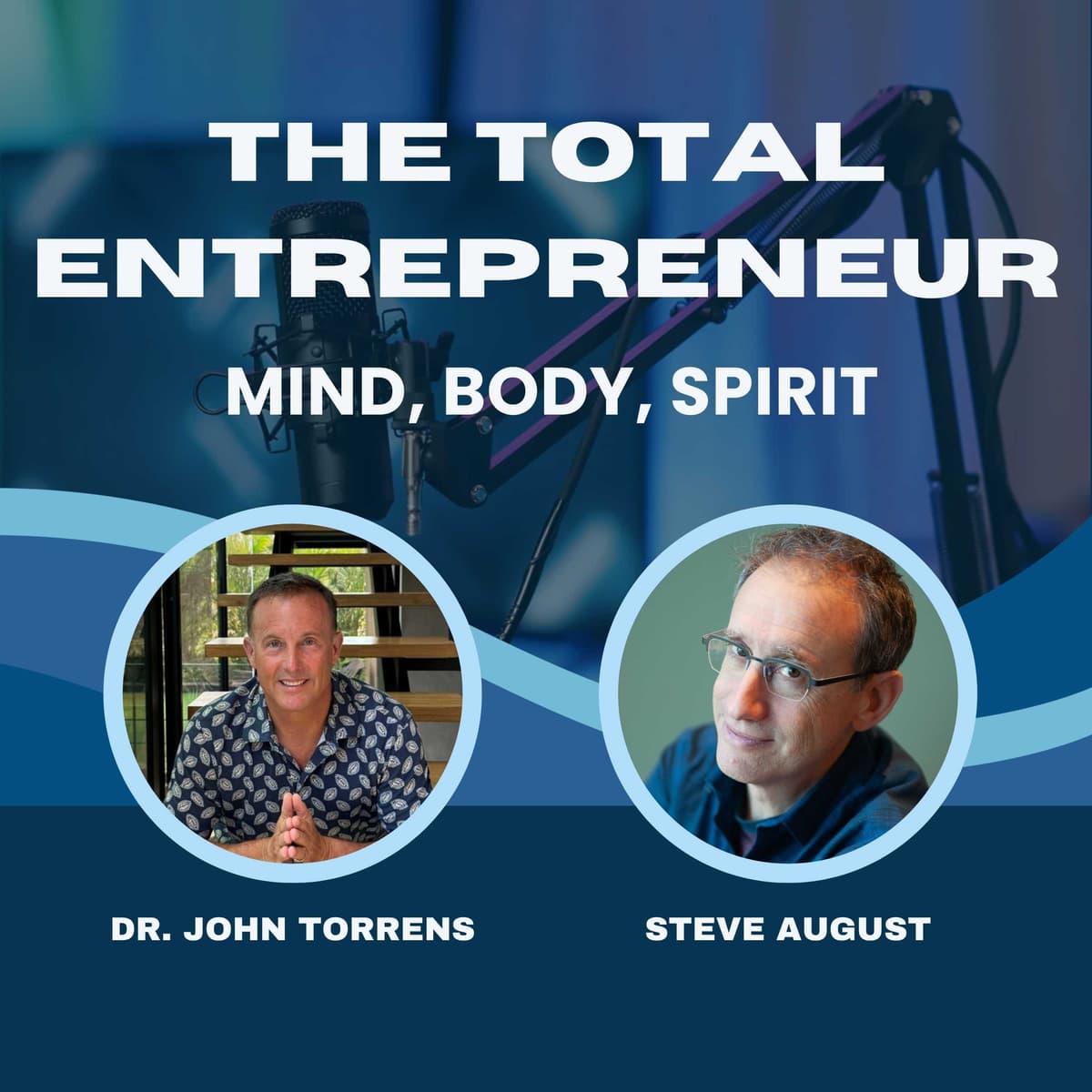
ADHD Entrepreneur Focus Formula with Steve August
with Steve August
May 14, 2026 · 00:45:48
Part of our conversations on
Hey, welcome back to the Total Entrepreneur Mind Body Spirit Podcast, where we help entrepreneurs like you prioritize their mental, physical, and spiritual health so you can tap into that real ROI that results. Today's guest is Steve August. He is the founder of the ADHD Entrepreneur Accelerator, where he helps ADHD entrepreneurs turn their brilliant chaos into consistent growth and freedom. Steven is an exited founder entrepreneur and then a CMO of a $100 million company. So he's got the track record, he's got the bona fides, he knows what he's talking about from a startup and a business perspective, and he also brings his neurodiversity to the table to help entrepreneurs with ADHD scale their companies. This was a very personally relevant conversation for me. I think you're going to enjoy it just as well. Steve, welcome to the podcast. It's great to have you here.
Great to be here, John.
Yeah. So I want to start by just kind of talking about your bona fides and, you know, just to signal some credibility for what we're about to talk about here. And, you know, so you built a startup to a multimillion-dollar exit, and then you became the CMO of a— was it a $100 million company? But you weren't diagnosed until you were 54, which is about 10 years later than I was. So I want to hear how— tell us this story.
Yeah. So, you know, it's funny, when I got out of school in the '90s and was doing my first jobs, I used to joke that I had career ADD because I would have all these jobs. I'd do everything from— I was in video, clay animation, video documentary, multimedia CD-ROM, playing in bands, doing IT support to support my musical habit, just doing all kinds of things and never staying at one thing all the time, having lots of ideas. You know, it was kind of a joke. that I'd make about career ADD. And then of course, later on, I learned the joke was on me because I had ADHD the whole time. How I got into serious entrepreneurship was my wife and I had our first kid or our only kid, first and only kid in 2002. And I was working a job that was really creative. It was museum exhibit development and it was in the San Francisco Bay Area in Oakland. And it was a wonderful job, but it didn't pay very well. And her job was in market research. Consulting, the kind of market research where she went in person to people's homes and said, okay, how are you making your coffee? How are you organizing your digital photos? And I saw that she did something before those visits that I thought, as with my tech background, I thought we could do a little better. She sent these paper diaries ahead of time just to figure out what people were doing when she wasn't there. And I said, well, we have these things called blogs, you know, maybe we could use this web diary instead of a paper diary. And we started doing that. And then we went to a conference and spoke about it. And all of a sudden people started to ask us, can we use that? And I was like, you could, but you wouldn't want to because you'd have to be super technical. But I bet you we could build something. And that's how the startup started, was a spinoff from this pain that I saw. And so I grew that. We moved from San Francisco up to Portland. I won an angel competition, raised a small— it was It was called a Series A, but it would be called a seed round right now. And kind of just grew that through fits and starts to a successful exit within our industry. We had a strategic that was like, yeah, this makes a lot of sense. And I had gotten to the point where I was like, we either need a lot more money because we need a sales team and we need an international presence because we were servicing global research companies at the time. And We had what they needed. They wanted a platform like we had, and I needed— we needed what they had, which was sales, 35 salespeople and worldwide offices. And so it made a lot of sense. And so I went and it was a successful exit and worked for them, had an earnout year that went well. And then so it was private equity backed. by a smaller private equity company. They bought a few other companies, and as private equity does, put it together, said it was integrated, and sold it to a bigger private equity company. And then they transitioned CEOs, and that's when I ended up becoming a CMO, uh, of this company. They— one of the other founders, uh, of one of the companies they acquired became the CEO. He said, Steve, why don't you be the CMO? It's like, okay. I'd never held a formal marketing position in my entire life.
Mm-hmm.
But at that point, we were $100 million and 400 people, and I got to see like the whole journey from, you know, when we started out with my wife and I in our living room to 2 guys in an accelerator, you know, office to like a boardroom in London in a glass tower, you know, reporting to a private equity board, which I like to joke about is it's not as fun as it sounds.
I've heard that.
Yes.
That's a great journey. I mean, you know, just from the startup to the exit to, you know, to joining a PE-backed company at scale. That's really cool. And I think that gives you You know, a lot of good credibility and background to help other people. So at what point in this journey was the ADHD diagnosis and what prompted you to even seek that out?
Flip forward a few years later, exited in 2014, worked for the acquiring company until 2017, was pretty burnt out at that point. I had like 888,000 miles on Delta, which I never had a chance to use because I was just traveling all the time. And I was done. I was just really done. And I would realize looking back once I got my diagnosis why I was that flavor of being done and burnt out because of the ADHD that I didn't know I was experiencing but was. And so how I got to a diagnosis is so I took kind of a year off, but I, like classic ADHD, just jumped into something else. I had this little passion project called August and Wonder, and it was this this object. It was art meets finance meets Internet of Things. So it was a bull and a bear sculpture on a— bull and a bear on a seesaw sculpture made out of metal, brass, and wood. But it tilted in real time. So it looked like old world, but it tilted in real time with the stock market. And so I was running that. And then COVID hit and really took out our supply chain. And then our kid got really sick. And so, in the meantime, I was also coaching other founders because people had come to me and said, oh, you seem to have made good, learned some things. I said, I guess I suppose I have, and started supporting other founders. So, I was coaching through that, the COVID time, and our kid was seriously ill. And by 2022, 2023, we had kind of gotten over and past the COVID thing. I mean, that business didn't, didn't come back, but the coaching had taken off. Um, and, but our, and our kid had gotten through the worst of it. And it was at that point where everything kind of, my attention fell, fell apart. Like, I, it wasn't that I couldn't finish an email. I couldn't finish the first sentence of an email. And, you know, I realized later it's because, yeah, I was in crisis the whole time during that stretch and ADHD brains do really well in crisis. Like, we can rise to that occasion.
Yeah.
You take that away. After that, one, we've spent so much energy, we've really drawn down on everything we have, and then there's no urgency and it's like everything falls apart. And that's when I was like, okay, I think this is more than just living in a distractible world. And I finally went to a doctor and said, maybe we should check this. So he gave me the assessment. He's like, oh yeah, you've got ADHD. And so that's where I started putting the puzzle pieces together. Hmm.
Now, did you go down the medication route or did you opt for other ways to manage it? Or what was your path on that?
I started, you know, with the medication. Like the first thing was like, and this is the way it works in the US, right? Is like diagnose and prescribe. It's kind of that way in most places. You have ADHD, here's your Adderall, off you go. All good. It's like, hmm. So it actually worked for 3 weeks. I was like, I am Superman. I am awesome. And then it stopped working. It gave me none of the really good stuff, but I still got the drop, right? And I started going to some pretty dark places and I was like, okay, this isn't healthy. Same thing happened with Ritalin. And I was like, okay, so what are we going to do? And then I tried— so L-theanine and caffeine together were supposed to be something that worked. Didn't for me. I've heard it has for other people, but it just made me a little jittery. It didn't really do anything for focus. And then at that point, I started to think, okay, I think I need to know more about how this works, right? Like, it's not just like a treat it with a pill kind of thing. And that's when I started to— I got an ADHD coach and started to say, okay, so what is this really about? Because that was the thing is like my doctor was fine, but it wasn't like you have ADHD. Here's what it's all about. Here are the, here are the executive function challenges that, that are probably going to pop up in some way. Here's, you know, a coach or some coaching you might be interested in. Um, there's none of that, right? There's just like, which med do you want? And so I did get, um, One med that worked really well was Wellbutrin for a little while, for about 3 months. It was a really good 3 months. And I thought, well, NDRI, I'm low on norepinephrine, I'm low on dopamine, seems worth a shot. And it worked great. Mind was quiet, focus was great. But then my body acclimated to it and you couldn't up the dose any more than I had. And I was just like, okay, I think I've tried a few other things. Tried guanfacine once where it's like, well, if we chill everything out, Then, you know, and it's like that don't work. I remember trying to give a workshop through that. That was awful. So right now, um, I'm not medicated specifically for ADHD. Uh, the one thing I've met with a naturopath that specializes in ADHD and we looked at the kind of the base level things is can I get my sleep better? And then we also did kind of hormonal, um, panels. So I am doing, um, testosterone replacement. And that seems to be keeping me at a good level. But the thing that's really turned the tide for me is the systems and understanding of, okay, how am I going to support my executive function and my brain and understand how it works and make sure I can show up and make progress every day?
Yeah, I can relate to that too. I mean, yeah, they just prescribe and medicate. Yeah. So I, we, You know, we did Ritalin, Concerta, Adderall, Vyvanse. Vyvanse actually helped me a little bit, but man, I wasn't eating, I wasn't sleeping. And I just found that like, you know, what's the point, right? If I'm not really myself, you know? Yeah.
Yeah.
So yeah, it was hard. And like you, it's just, it's really homeopathic type of strategies, like getting your sleep under control. That for me is probably the best bang for the buck. modification I've made. Like, hence the glasses. Like, I really take my sleep hygiene seriously because I, I just do so much better when I'm rested and I've got it dialed in. What else works for you? So, you know, we're doing TRT, you've got your sleep under control. Um, what are some other things that, that you rely on to keep you going?
Yeah, so the thing that I, you know, basically started developing my own system, uh, to kind of recognize, okay, I have this brain and I don't have to feel bad about the brain. I don't think of it as a disorder. I just think it's a different brain type. Yes.
Yes.
And like nobody thinks twice about supporting, like if your vision isn't quite where you want it to be, you wear glasses or you get LASIK or you wear contacts. And why should ADHD be any different? So it's more about like, okay, so how can I support this? without any kind of shame or embarrassment and just say, okay, my brain works this way. Working memory is not great. Executive function for planning and things like that is really tough. We've got time blindness. We've got all these kind of like elements of executive function that are challenged with an ADHD brain. So I started creating my own system. Well, the first thing is like, how do I actually get myself to do anything? Right?
Yeah.
Because that's the big challenge is like if Unless there's like ADHD brains get in naturally get into motion with only 2 stimuli, right? And that is intense interest or urgent consequence.
Yeah.
Right? And in between that, I call that the dopamine desert, right? And the challenge is when we have— when we're only going into motion through interest or urgency, we're always reactive. We're always working reactively. Anybody who's been through business or success as an entrepreneur knows that it's that proactive stuff, the things that whatever the quadrant is, I always get it mixed up whether it's quadrant 2 or quadrant 4, the not urgent but super important, the things that people call the rocks, right? If you can stay proactive and keep moving that stuff forward, you're going to see progress, right? If you're just going to work from interest and urgency, you're just going to be all over the place.
Yeah.
So the thing that worked The best wasn't a medication for me. It was coworking. It was body doubling, coworking. You know, I use coworking because body doubling feels like a, I don't know, a weird horror movie.
Right.
Invasion of the Body Doublers. But that was huge. So I just started inviting people to, to cowork together. And that really worked. Like, I could sit down and because there was somebody there and we'd say, okay, what are you working on? Well, I'm working on this. All right. Set a timer, 25 minutes. We'll check in. How'd you do? Oh, made progress, crushed it. I kind of need to bring myself back. And that started working. And it's like, I saw it working for other people. And then that was like the first thing. And then it was like really thinking about how ADHD brains work and that I love what Russell Barkley says about it. It's like, it's not an attention disorder, it's performance disorder, right?
Mm-hmm.
We know what to do. We have trouble doing what we know. And part of that is our ADHD brains make it really hard to decide stuff and prioritize stuff because everything's equally important and equally urgent. And so we get into this spin of overwhelm, and, um, I call it the Great Wall of Everything Now, uh, because it just stacks up and gets bigger and bigger. And it's like, well, if I just take it week by week— because I can't deal with a quarter or even a year— it's like, if I just take it, can I make this week a good week? And a good week is I know what's important. I know I make some progress on what's important and I meet my brain where it's at because I know, awesome, my brain is going to be different from day to day. Some days, I'm going to crush it. My brain is going to be on it. And other days, it's going to be all over the map and I just have to accept that. And that's okay. As long as we keep being consistent, we actually develop momentum and progress over time. So I started developing the system and I call it Focus Formula. And it's like helping people decide, do, and sustain over time. And that's what's been working for me and for some other folks as well, is just having that system. As they say, the pills don't teach the skills. And this is kind of like a system for entrepreneurs to kind of like understand what's important, keep it in sight, make progress every day, and be able to sustain it over some duration.
Yeah, no, I love that the pills don't teach the skills. That's, uh, that's really important. Yeah. And, you know, so for me, one of the things that works is just when I have downtime or unstructured time, that's when I allow my, my interest and urgency just to, to take over, right?
Yeah.
So, you know, I've got a few hours every week where I can just sit and do nothing or do everything. It doesn't matter, you know, and, and sometimes it just, you know, results in something really fruitful. And otherwise, at times it's just, you know, needless rabbit holes, right?
But yeah, for you—
oh, sorry, go ahead.
Yeah, it's just one thing that I also found really helpful is, uh, I call it the 2-hour workday mindset. It's like, I just looked at myself at 57, or, uh, you know, where I am right now, 54 when I started the ADHD understanding of my ADHD, and it's like On any given day, I have probably 2 hours of peak executive function where if you sat me down and say, do this thing, I will likely do it, right?
Yeah.
Or I can do a big thing. So I just said, okay, all I got to do is pull this off for 2 hours each day and put the most important things where my executive function is highest, then everything else is gravy. And so if I, if I get towards the end of the day and I'm like, my brain's done, it's like, okay, yeah, let's do something interesting or Yeah. You know, go wherever it wants to go.
Yeah. And that's the thing is not, not pushing against it too much, right? Because that's when you make rushed decisions or you do things that you're gonna have to redo later. So yeah, I love that, that idea. So when it's not working for you and when you're in a dysfunctional part of this cycle, what does that feel like? What does that look like?
Yeah. So it's really interesting. Uh, you bring that up because You know, so much of this ties— like, our access to executive function is really often governed by our nervous system and emotional regulation, right?
Yeah.
The more spun up we get, the less access we get to our executive function. And last week, I got news that an old college friend had passed away. And I knew that day, like, whatever I had planned was out the window. Right? And I— and that— and this obviously isn't limited to ADHD brains when you— when you—
Right.
You have a loss or something like that. Um, but before, I would have been like mad at myself for not being able to pull it back and not— and, and I just knew that over the next, you know, and it's, it's a sad way to do it, but, uh, example, but, you know, life lives.
Right.
And we get hit by stuff. And so it's about like, understanding what your brain's going to need and doing that. And some days it's like that day, I was like, whatever happens, happens. Right. And so I just, I had big plans and I downshifted. And I also kept alive the possibility that that emotion and that grief is going to find its way in and out over the next week, month, however long it needs. And I'm just going to accept that. And I think that's part of it, right?
Mm-hmm.
So that's the extreme example. It could be like the night before I got a lousy night of sleep. And it's like, okay, I got to adjust to that. But that's why when I teach people like what's a good week, like it always starts with knowing, going in at least knowing what's important, making some progress on it, but always meeting your ADHD brain where it's at, because that's, that's the ticket. Like, that's the ticket out of shame and embarrassment and all that.
And it's tricky to know what's important, right? Especially when we're wired the way we are, where everything's so important, right? So, so how do you help people distill that when they're living in a world where just everything is so important?
Yeah, we're built in a world that's trying to make everything important and does a good job, like, increasingly. We have the biggest brains working for tech companies convincing us what's important. So here's how I lay it out for people. I call it the— you have to know your magnetic north, something that pulls you very strongly. And I break that down into 2 main components. One is a mission, is what impact do you want to make on— it could be the world. It could be for your family. It could be just for yourself.
Yes.
It doesn't have to be a save the whales mission. It could just be whatever it is that's important that you want to impact, you want to make, right? And then the second component is a vision, which is like, what do you want your life to actually look like, right? Especially on a week-to-week basis. Because, you know, we can serve missions in ways that aren't healthy for us, right? Or don't correspond to the life we want, right? And the example I do give, the save the whales example, because if save the whales was your mission, you could serve that mission by getting in a boat and putting yourself in front of a harpoon. with Greenpeace. You could go to Woods Hole and study whales, or you could go to Congress and lobby for whatever money they might be inclined to give anybody right now. Those are 3 different ways to serve the mission, but they're 3 different ways of living life. And so I think that distinction, I've seen that really help people say, okay, what's important are things that move me towards that, move me towards that magnetic north. And so we break that down and it's like, okay, so what are the markers we're going to set along the way to that magnetic north, whatever that, that is for you. And that helps people because ADHD brains like are challenged by like breaking things down into steps. Right. And so we try to break things down in steps and then we'd say, okay, well, what's going to move us forward towards that this week? And that's how we get to what's important.
Yeah. I like the way you break that down. Now, so you said you had a kid. Does your, does your kid have ADHD?
They don't have ADHD. They are autistic. So we are a neurodiverse family.
Yeah. Neurodivergent for sure.
Yeah. Yeah.
So when your clients come to you, what are their main complaints? Or like, why are they reaching out to you in the first place?
Yeah. I use, there's 3 words that have popped up. They're brilliant, they're accomplished, they're embarrassed because they have achieved things in life. They have, like, you know, made it through a lot of different things. And then they hit this point where they've accomplished things and they're going to do their next phase or next chapter. Right. And then all of a sudden, it's just like it's not there for them.
Yeah.
Like, they can't do anything. They feel like they're— they've lost their ability to move stuff forward. And very often it's like they've left a structured environment like a job, and now they're setting off on business for their own. And suddenly they're like, wait, I was an all-star in that last environment. Why can't I not get myself— like, why can I not make this happen? Like, I know what to do and I just can't seem to do it. And that's when the lights really go on when we talk about, well, this is why, actually. In fact, it's— this isn't— this isn't any surprise. And there are quite a few people who are kind of in their second or third chapter of their careers, right? Where they've had really great successes. And like the same way I found my way into it. I had some legitimate successes and I got to a point where I was like, I can't make anything. I can't finish an email. And then it was like, okay, let's understand our brains and let's take away the embarrassment and let's just build to our brains. And that gets people going and put in the support systems. That they need.
Yeah. Yeah. And just kind of allowing, allowing it to be what it is until such a time that you can kind of turn it around, you know? Yeah. I find that like, even like what you said about, you know, being successful or brilliant or whatever, and still feeling embarrassed or like you haven't accomplished enough. It's like this, this recurring feeling of I'm not good enough.
Right.
So, and then that's been my thing for almost my whole life. So, When you feel like you're not good enough, you have to get advanced degrees and you have to get, you know, awards and you have to grow your company fast and all that kind of thing. And it's hard to get over that, right? But on the other hand, it's also like fuel for an engine that keeps you going. But it really, it almost comes from not the healthiest place, right? Because you're almost trying to prove something that you don't really need to prove to anybody. Yeah.
And that, and it has worked for you, like any coping mechanism, it works, right? Or else you wouldn't use it. But at a certain stage in life, um, and I knew this, you know, coming through a tough crisis, health crisis with our kiddo and all the emotions, like, I was spent. I was really spent there. And, you know, at 50, you don't have the energy you do at 20 or 30, um, or even 40, right? It's like, it changes. And, um, and so yes, you— that, that thing that you used to like get you going and get you motivated. And like, it's— it stops working and it just becomes self-flagellation after a while. And that's one of the biggest changes we make. And that's why the co-working is so valuable, because if people show up and they do something on a given day and they say, wait, this thing just took 3 months and 20 minutes— 3 months to procrastinate, 20 minutes to actually do it— like, but I did it, right?
Right.
Then And they keep doing that each day, all of a sudden that trust starts to come back, um, to themselves. And they start to, to be— and this is something that has evolved for me over the, over the last couple years as I've been getting deeper and deeper into this, is like, it's a little disorienting to not work from that sense of like, I'm— I need to like catch up, I'm perpetually behind. It's weird to work with like, yeah, I'm kind of right where I should be, and this is taking about as long as it's gonna take, and maybe I underestimated this, but—
Mm-hmm.
It's like, because that's when you're— it's a sort of a wiring to be in like hypervigilance mode the whole time. And then if you take that down, it's just like, do I still care? Yeah, I still care. It just happens to be I can do this in a calm way. And the rest of life starts to open up in a different way. So I have one person who was ready to give up on her business. She had a bookkeeping business. And when she started with a program last year, she said she was literally ready to give up. She just didn't think she was right for it. She couldn't do it. She couldn't make anything happen. And today she was just showing us her art studio. And she's a bookkeeper, but she always wanted to have this, turn her garage into an art studio. But she never could because she always felt like, oh, I gotta, you know, always under the gun with the business and all that. And then now she's like opening up that other part of her life, that creative part. And it's just amazing to see when you do start having the tools and systems in place to like navigate things in life without that kind of constant like, oh my gosh, I'm— I can't let my guard down for a minute because something's not going to get done or some ball is going to get dropped. And to work with it from that point of view of like, yeah, I got this. It's just life-changing.
Yeah, I found that too where like, yeah, if my— if I'm regulated, my nervous system is regulated and I'm out of that sympathetic mode, right? And I can just rest and digest. all that kind of stuff, I can do so much more and so much better. And maybe some of that comes with age, right? We're, we're, you're, you're 57. So am I. So I think as we get older, we start to, you know, maybe internalize that a little bit more. We're not so worried about it.
Yeah.
But what are, what are some of your ways that you, you regulate yourself? Right. So you've got to get out of sympathetic nervous system mode into parasympathetic in order to regulate and perform at your best.
How, what are some of your Yeah, there's, there's, I have a couple of head-based techniques and a couple of body-based techniques.
Okay.
Sometimes we can think our way out of it, right? And sometimes we get too spun up and now we got to just like regulate a different way. So one of my, there's 2 exercises I like for head-based stuff. One is, I call it what's true. And it's basically the simplest thing you can do is you take a piece of paper, you take your And you draw a line down the middle of it, 2 columns. Left-hand column is what's true. Right-hand column is what's story, projection, fear, assumption. And in the left-hand column, you write things that are objectively true. Like if sales were not as good last month, you say sales were this. And then you can write the stories and projections in the right-hand column. Like all the business is going down, all my clients are going to leave, all the things, I'm not good enough.
Yeah.
I'm charging too. All the stories. And so you go down and you write the what's true and it grounds you that you write out all the stories and you fold the paper over and you just look at what's true. And that helps ground a little bit sometimes because sometimes it's just a spinning. And the other one on head-based is just saying in this moment and just noticing stuff, like the stupidest stuff in front of you, the most obvious stuff. And it just sort of regrounds you because what happens when we deregulate is we we time travel. We either go to the future, which is full of worry and catastrophe, or we go to the past, which is full of like, you know, could have done that better or regret or whatever. And so in this moment, just grounds us to the present.
So if the head stuff doesn't work, which is possible, right? Sometimes you can do all that and it's still, maybe it gets you there for a minute, but yeah, no, I definitely get that. Yeah.
So the body-based stuff, There's a physiological sigh where it's just like you breathe in and then you breathe in another 20% and then sigh it out. And, it just chills out the nervous system surprisingly quickly. And, it doesn't require counting or executive function like box breathing where you're like, how many? How many? How many? Did I just count one? Am I holding?
Am I breathing in, breathing out? Yeah.
And then, the other one is just somatic tapping. Because what happens sometimes when we get dysregulated is one side of our brain is going a million miles a minute and the other side of the brain's like, what are you doing? And so you want to like get them both kind of like back together. So just even a butterfly tap.
Mm-hmm.
And then anything that's kind of bilateral, you can do it on your thigh, you can do it on your shoulders. And then, and just walking as well is a bilateral movement. So those are the tools I use when I get a little dysregulated.
Yeah, I love that, that somatic tapping. I was, um, I was working with a performance coach and that was, that was something that he recommended and it seemed kind of silly at the time, right? Just kind of tapping on your body. But then when he added a physical assessment to it, like, you know, he would say, hey, bend over and touch your toes as a baseline. I'd see how far I can get over. And then he'd send me through a couple of, you know, tapping things, tapping in different places and say, okay, bend over and touch your toes. And, and my mobility actually improved. And, I guess the— yeah, it's wild. And, it happens all over your body depending on where you're tapping. And, it's really interesting in that when you send your body and your nervous system new information or just different or novel information, it can kind of help unspin you or get you out of that cycle. So, those are really great tips. Yeah, yeah. How often do you find that you have to rely on those?
Not as often as much as I used to.
Yeah.
But there are times when I just get really spun up about something, but not as often as I used to. Here's where it happens. When I'm in launch mode and I'm about to launch something, that's when deregulation happens for me because there's so much between just general resistance of exposure. I'm going to put something out there. I hope it goes well, or people can reject me, or Like, now, it was perfect in my brain, and I can see all the flaws, you know, for this level of release that we're doing. And I get really— yeah, launches is where I spin out a lot. And so, I have to use those techniques.
Yeah. Well, during launch phase, that's when everything is urgent, and everything's also important, right? And it gets us into that, you know, the upper right quadrant there. And yeah, I could definitely see that. And which, by the way, that's, that's where our unique traits, um, really flourish too, right? That's where we shine. Like you said, like if, if you need somebody to make sense in chaos or shine in chaos, we're your guys, you know?
We can totally do that.
Yeah.
Because we're always making connections.
Yeah. Yeah. So one of the things I noticed is that a lot of people wired like us with ADHD, they go to maybe traditional sources for productivity tips or hacks, right? And I think what they find is that those traditional systems just fail ADHD entrepreneurs. So I was wondering, you know, just, yeah, if you had a thought or some kind of input on that, I don't know why that is or what they could be doing differently. Yeah.
So why that is, you know, is, is, is I always know when it's a traditional productivity kind of tip or system when they go, okay, first dump everything out of your brain. Then prioritize everything and then make a list of your to-dos. And I'm like, whoa, whoa, whoa, whoa, back up the bus. That step right there, that prioritize. Right.
Yeah.
It's like, yeah, because it's really cognitively expensive for us to take that great wall of everything now and, and stack it into us and arrange it into a sequence that is cognitively really expensive for an ADHD brain. So there has to be some other way to you know, to navigate that. We have to acknowledge that and most systems don't, right? And then just because we actually make it through that phase and we do the plan, right? And we have a plan, it doesn't mean we're going to do it, right?
Right.
Because we might have spent ourselves just all the executive function we have just making the plan. That's why like that kind of very strict time blocking doesn't work for ADHD brains because we'll have spent all our executive function trying to estimate something and we have no idea how long it's going to take because we have time blindness anyway. So it's just like, well, that's going to fail pretty quickly. And then the sustaining over time is challenging because we might love the system, but as soon as it starts to be less novel and the dopamine fades, there's drift. I call it the inevitable drift that happens when Things get novel. And it's a really interesting thing because when you think about business and life, compounding is always at work, right? It's not just in our bank accounts. When we move something forward, it compounds over time and we compound that progress and things grow. And that's how things go from being very small things to being very big things, right? But if you're constantly starting something new, then that compounding never has a chance to kick in.
Right.
And so ADHD brains tend to like have that frustration of like, I should be a lot further. It's like, but I've started 16 different times. So with those productivity systems, you know, going back to that question, like some of them are tools masquerading as systems, right? So they're like, yeah, use Monday, use Notion, use whatever. And it's like, this will make you productive. It's like, No, it won't.
Right?
It's a tool, right? It may have a bias of a system, but it's not a system in itself. And then if it does have a system, if it's not— it doesn't acknowledge what an ADHD brain needs, it's probably not going to work.
Yeah, no, I totally relate to that. Yeah, yeah, so much what you just said, I'm replaying in my head. So yeah, hey, you know, I was reading about I was reading, was it the Focus Formula you have?
Yeah.
Yeah, tell us about that because I thought that was kind of cool.
Yeah, so this is a 6-week cohort program that I have that walks people through building this exact system, right, that will work for them. And we take it like, take it from that perspective of like, okay, every, all the, all the things that, that the symptoms and everything usually coalesce around how your weeks go, right? A lot of people start their week with like ambitious lists. This is the week, we're gonna crush it. And then by the end of the week, they're like surveying the wreckage. What the heck happened?
Yeah.
Right? And so we talk about like, how do you create a weekly system that helps you like know what's important, actually make progress on what's important and sustain over time. So when you look back on the week, you feel like proud of your progress. And if you keep repeating that, that helps you over time actually get where you want to go. So we start off by helping you understand how your brain's really working, where you're getting hung up, and what your system needs to do for you. And then the second part is being able to actually decide. We actually call the module Decide. And that is understanding what's really important. Where do you really want to go? How do you break that down? How do you reality-check your projects? How do you establish your rocks? And then, the next bit is about doing. How do we actually put you in position to do and actually make the progress, not just make the plans? And then, 3 is about sustaining over time and things like ongoing dopamine management, rituals versus reward, and having an ongoing tribe. I describe it as the dopamine desert. It's like the big challenge, right? The whole thing is, can you move across the dopamine desert? When there's no dopamine, can you still make progress? And so, the whole program is set up to help you do that. So, we have coworking every weekday, about 6 going to 8 hours of coworking that are available for people in the program. We have weekly sessions, live coaching sessions, and then the whole course is gamified. We have contest of coworking. You cowork. Not only do you make progress and you move forward, but you win fabulous prizes, swag and t-shirts and stuff like that. And it's just really designed to get people by the end of it that they can say, oh, I can do this. I can make progress. I understand my brain. And now I have a weekly system and a dashboard and something that I know when I go into a week, I'm going to succeed. And when I get to the end of the week, I'm going to have made progress. And you keep doing that. And over the course of 6 weeks, lives change. It's amazing.
That sounds like a really good program. I want to just circle back to something you said earlier when the compounding, because that's something I felt pretty acutely as well, right? And in my own research, we know that people with ADHD are much more likely to be serial entrepreneurs, right? They just They start something, exit, start another one, and that's just what we do. But there's this, yeah, weird feeling of, hey, you know, if I just focused on one thing, could I have been really, really great at it? And, you know, that's just, that's just not going to happen, right?
Right.
Or it seems like it's not. So, and I love what you said about, hey, yeah, maybe, maybe we didn't compound one thing over and over and over again for 30 years, but look at all this stuff we did. Like, that would be almost Unfathomable for somebody who was just into the compounding mode, you know?
Yeah.
So I really, I really appreciated that comment. Yeah.
Yeah, no, and I think that's a great way to look at it too as a serial entrepreneur. You're like— and this is something I learned as an entrepreneur, as a founder— is like, you can be really good at different stages of a business, right? Like, some people are really good at like bringing the nothing to something, the zero to one. Right? And that's really freaking hard, right? And ADHD brains are great at that, right? Um, where I started to fall over was operating. Once we got some traction, once we had to operate and do the same thing better each day incrementally, I was like, my brain was like, this is boring. Let's, let's go, let's go for another big splash. And I think that's all it takes, all kinds of brains to make, make the world go around.
Mm-hmm.
And I think that's such a healthy way that you, you posited looking at that compounding thing is like, yeah, let's go start something else. Go, go be good at the part of the thing that you're good at and don't feel bad for being, you know, like not as good at the other part because you're just working to your brain. You're meeting it where it's at. That's how you leverage your talents.
Yeah. And I found, you know, being a university professor, so in addition to being an entrepreneur, I've been teaching at Syracuse University for almost 20 years now. That's the only real job I've ever had. And it's like just such a perfect situation and scenario, right? Because because you have all this academic freedom and time and leeway to do what you need to do within the constraints of a curriculum. But I get to work with amazing students who are doing cool things. But I feel like that maybe is the part of my professional life that has been able to compound because the more you do it, the better you get. But it's always something new, right?
Right.
Because if you're teaching a case on startups or entrepreneurship, you can't use the same case you were teaching 20 years ago, right? So, constantly have to refresh it. So I feel like that gives me the best of both worlds where I've got the compounding of the actual teaching and pedagogy, but I've got the novelty of the new examples and the new students every semester and so on. So that tends to work for me for whatever reason. I'm grateful.
Yeah, it makes total sense. One question I have for you on this, because we actually have a few academics in the program too. who have found it useful because, as you said, you know, there is a lot of freedom and a time and like, but also requirement to publish and write and do things. Yeah, yeah, that, uh, so how do you manage? I'm just curious, like, how do you manage when you have big blocks of like, oh yeah, I have to publish something or push something off into the distance and, uh, the urgency isn't quite upon you yet, and yet you have to make forward progress on that?
So I am really lucky in that I am a I'm a practitioner, so I'm a professor of practice. So, I don't have any publishing requirements, although I am involved in a small research project now, but it's not required of me. As a professor of practice, I'm required to stay involved and engaged in business activities.
Great.
So, during the summer and on breaks, I engage a little bit more heavily in the business. But honestly, I'm at a point in my main business where I don't really have an operating role anymore. And I can do the professor thing and I can do a podcast. You do other things. But I do have to develop new curricula. I do have to develop new courses. I have a department chair role. So there are things that I have to do. But yeah, point well taken about the publishing demands. And I do see that with colleagues where I'm just in awe of their ability to manage that, the amount of unstructured time they have with a big deliverable at the end.
Yeah.
I think if I did have to publish or perish, I could imagine me probably perishing in that kind of environment. Yeah. Yeah.
Yeah. Well, that makes all the sense. Like, that sounds like a perfect gig.
Yeah, no, it's, it's really good. I'm fortunate. Yeah. And I work with great students and I get to have cool conversations like this, you know, it's fun.
Yeah. Yeah.
Yeah. Well, Steve, what's one thing you wish ADHD founders knew that they are not thinking about right now?
Some of it's like the founder journey is its own thing. If they're a first-time founder, for sure, it's like it's a journey, right? Um, but I think the biggest thing is to— at the heart of it is to understand your, your brain and how your brain works and the wiring of it and understand that as a basis for how you lead and how you grow your business. Because I went through the whole thing of that journey not knowing how my brain worked and why I was experiencing some of these, these things and why the decisions and choices and behaviors that were part of the experience happened. And now as I, as I look back and go like, oh, like I can totally see how the different elements of ADHD were in play. And they weren't just in play for me. They were in play for everybody in that company and all our clients and everybody around us, like, was being, like, impacted by something that I didn't realize. So, so I would just say, you know, make sure you have the support and understanding for your brain that, that you need.
Yeah.
And that will put everything in a much better stance to succeed.
Yeah, no, I can definitely understand that. And, you know, because we're not a homogeneous group, right? Like, we both have ADHD, we've both done a few things, but our neurology is— they're probably completely different, right? So yeah, point well taken about really understanding how, how you're wired and how you operate. Yeah.
Yeah, that's great.
Well, Steve, if people are interested in learning more about you and your work, where do they find you?
Uh, you can find me at steveaugustcoaching.com. Um, you can find me on LinkedIn and, uh, yeah, those are your 2 best places.
Amazing. Thanks so much, Steve. I thought this was a good conversation. Really appreciate it.
Yeah, I really enjoyed it, John. Thanks for having me.
About This Episode
What if everything you thought was a character flaw, the scattered thinking, the unfinished projects, the inability to do what you know you should, was never a discipline problem at all, but a brain that nobody ever taught you how to use?
John sits down with Steve August, Founder of the ADHD Entrepreneur Accelerator, exited startup founder, and former CMO of a $100 million company, who wasn't diagnosed with ADHD until age 54. Drawing from his own journey through burnout, business failure, a family health crisis, and the moment everything finally fell into place, Steve now helps ADHD entrepreneurs stop fighting their brains and start building systems that actually work with them.
Steve breaks down why ADHD is not an attention disorder but a performance disorder, and why that distinction changes everything about how you approach your business. He shares the concept of the dopamine desert, why traditional productivity systems are almost designed to fail ADHD brains, and how his Focus Formula helps entrepreneurs go from surveying the wreckage at the end of every week to building real, compounding momentum. He also gets into the neuroscience of dysregulation, his two-hour workday mindset, and the head-based and body-based techniques he uses to get back on track when everything starts spinning out.
Whether you've been diagnosed, suspect you might have ADHD, or simply feel like you're constantly running at full speed while getting nowhere, this conversation will change how you think about your brain, not as a liability to manage, but as an asset to understand.
Key Points Discussed
Brilliant, accomplished, and embarrassed: Why the entrepreneurs Steve works with most often aren't struggling because they lack skill or drive, they're struggling because they've left a structured environment, lost the external scaffolding that kept them functioning, and can't understand why everything has suddenly fallen apart.
ADHD is a performance disorder, not an attention disorder: Why the real challenge isn't focus, it's doing what you already know you need to do, and why that distinction changes everything about how you build systems and lead your business.
The dopamine desert: How ADHD brains only get into motion through intense interest or urgent consequence, and why living in that reactive cycle keeps you busy without ever moving the most important things forward.
Why traditional productivity systems fail ADHD entrepreneurs: How tools like time blocking and prioritized to-do lists are cognitively expensive for ADHD brains, and why spending all your executive function making the plan often means you have nothing left to execute it.
The two-hour workday mindset: Why Steve structures his entire day around the two hours of peak executive function he actually has, and why putting the most important work there, and letting everything else be secondary, is more productive than grinding through an eight-hour day.
Body doubling and coworking: Why the single most effective tool Steve found for getting things done wasn't a medication or a method, it was having another person present, and how that simple shift rebuilds trust in yourself one 25-minute session at a time.
Magnetic north: Steve's framework for helping ADHD entrepreneurs cut through the noise of everything feeling equally urgent, by anchoring every decision to a clear mission and a vision for how they actually want their life to look week to week.
Keep listening
More on Mind




About the Host
Dr. John M. Torrens
5× Inc. 5000 entrepreneur, Professor at Syracuse University's Whitman School of Management, author of Lightning in a Bottle, and TEDx speaker on ADHD as an entrepreneur's superpower.
Browse all podcast guests →Book a strategy call →