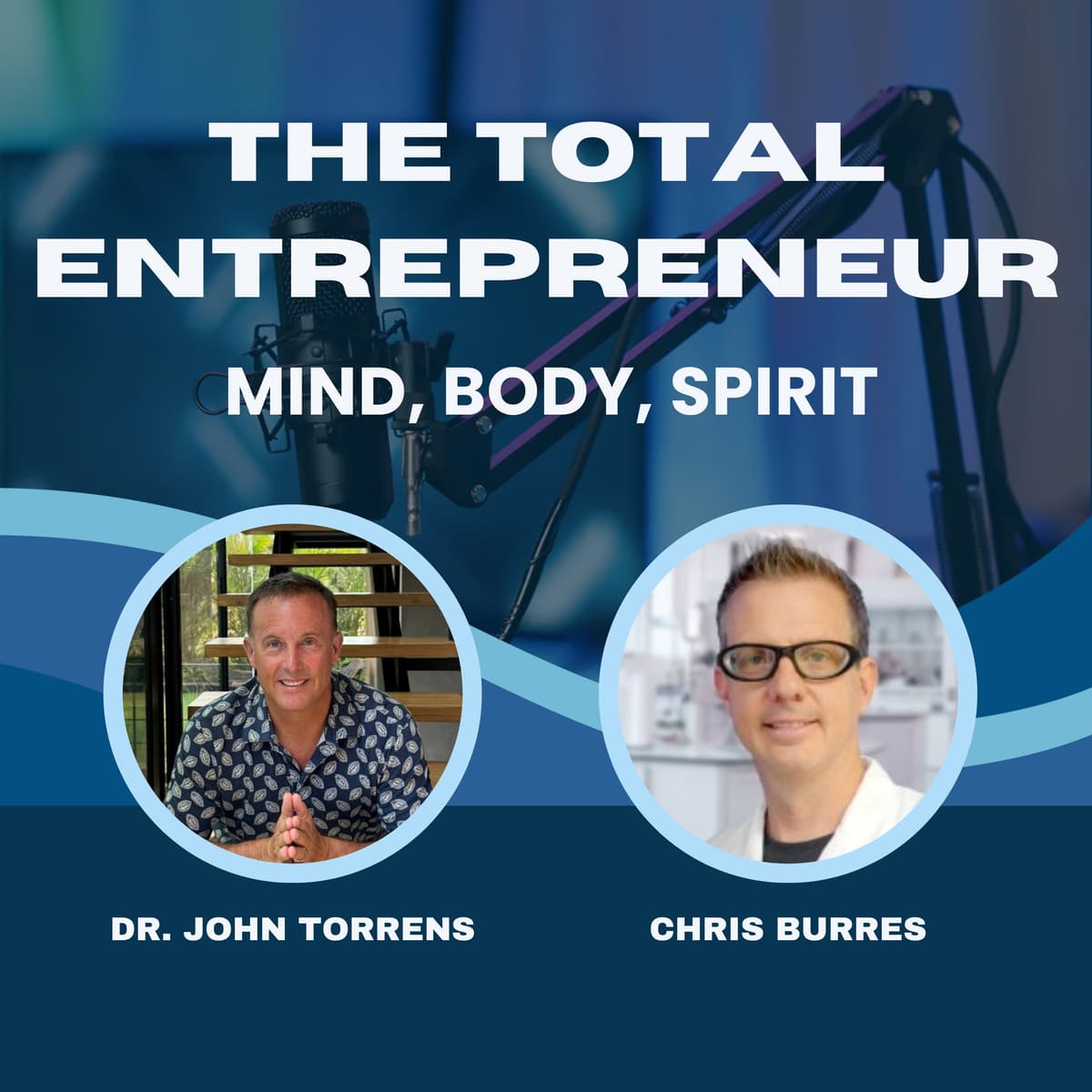
Longevity Habits for Entrepreneurs - Chris Burres
Oct 29, 2026 · 00:53:22
Part of our conversations on
Movement is life. Tough movement is freedom. So, you want to live, keep moving, but you want the freedom to, as you get older and you've got grandkids, to pick them up and go to the grocery store and get off the toilet or whatever it may be, you've got to do tough movement to maintain that freedom.
Chris, welcome to the podcast. It is really great to have you today. Thank you so much for having me.
I'm excited. about our conversation.
Me too. I wanted to start though by talking about your bio. It lists your, uh, lists your background as mechanical engineering, improv comedy, explosives, and competitive soccer. So, walk me through those and just tell me how they combine to help you as a business owner.
Yeah. So, so I knew from a very young age that I was gonna be an entrepreneur. It's kind of interesting. I'm in the health and wellness space and I'm a little bit envious of a lot of the people in the health and wellness space because They normally get here from some sort of pain-to-passion story, right? Like, they have the challenge, health challenges of their own, or maybe a loved one, and they solve them, and then they're out to save the world. And so, I'm a little envious of this. I'm also happy I don't have the pain part. Like, I got to skip that part. I knew I was going to be an entrepreneur from a very young age. At age 14, very unaltruistically, I had a poster of a Lamborghini Countach on my wall. And it was candy apple red. The gullwing doors were open. I could smell the leather in it. And I, as a 14-year-old boy, I was like, I want one of these. And I found an article that said very succinctly, if you want one supercar, you become a neurosurgeon. If you want more than one supercar, you become an entrepreneur. So, I'm 14. I didn't even know I could have 2. So, if that's an option, I'm going to be an entrepreneur. And I'm Pretty certain I didn't know exactly what that was at the time. And when it came time to go to college, what does an entrepreneur study? I actually wrote a book called Live Longer and Better. And when I was going back and researching this, you might think that I should study entrepreneurship. But when I graduated from high school, there was literally only one entrepreneurship class, not course, but class in the country at the time. Now, there's entrepreneurship courses all over the place, but I'm not even sure that's the path I would choose today. My logic was, what's the fastest way to the highest salary so I could have an income and money to invest in a business to become an entrepreneur? And I'm good in math, I'm good in science, so I studied mechanical engineering to become an entrepreneur. A couple of things went wrong with that story. First, engineering is a very hard course of study. It did not take me 4 years, so it wasn't as fast as I was thinking. It actually took me 6 years. I did get a minor in computer science and a minor in math. The other thing that went wrong with that kind of plan was I started my first company, and it's the company that I'm here representing today, while I was still in college. So, before I even got a chance to get out and make any money to invest in a business, I had already started that. And we can talk about how that happened at some point. Next, explosives. So, One of the jobs, and really the only kind of non-my-company job that I had, was with Shell Exploration and Production. And I was very fortunate to work with an incredibly talented engineer, and he had a concept that was related to explosives. So, a lot of people don't realize that explosives are actually used in the oil and gas process, right? You drill a hole into the ground, you put a piece of steel in it, and then you pump Really, it's more complicated, but you get cement on the outside of that steel to connect with the earth, the formation, and then you drop what's called a perforating gun to shoot explosives through the steel, through that concrete, and into the formation to allow oil to flow. And Dr. Sonnake had this concept of actually attaching the explosives to the exterior, that steel tube that you put down that I just described. So I was very fortunate. I got to work on an explosive project. I'm one of the co-inventors on a couple of patents as it relates to downhole explosives. I literally got to press explosives. So, you got small explosive, you got the powder, you're pressing them. You do not want to press them too hard because they go off. So, this is fantastic. I was working with somebody who had been in the oil and gas industry for 25 years and he was like, I've never pressed oil explosives until now. So, what a great experience. Comedy improv, Was kind of cool. You might think I was a theater kid in some way, right? Because I was a professional comedy improv artist. But no, I was never on stage prior. I always did decent public speaking for school projects or whatever. But I got this opportunity. I was in an improv class literally just up the street. They had just started their improv troupe. And they invited me to join them. And so, I got to do that. That was unbelievable. I really think that taking comedy improv is a great way to improve your communication skills. And there's a couple of reasons. The first and most important, in the context of where I learned it, your job when you're on stage is to make the other person look brilliant. And I think there are so many situations where you can actually say no, you can actually disagree with somebody, you can actually do these things. And if you can still make them look brilliant, you're going to come out ahead, right? Like, if you just, like, call them a moron and that's a bad business idea and we're not going to do that, you know, right-hand man, that's not a good strategy. But if they look brilliant and you can still steer it in the right direction, much better. So taking comedy improv is, is, I think, a really good job. And then I've played soccer for 25 years. I was semi-professional, which means somebody on the team got paid, not me. Like, I was, I was not that good, but I did in fact play on teams where somebody got paid. Uh, and, and I love the sport of soccer. I was so happy that the World Cup, you know, was back here for the second time.
Mm-hmm.
And, you know, Americans who, when I played growing up, it was a communist sissy sport. Uh, and now people really understand that it's the, you know, the, the largest spectator sport on the planet. Um, and how, you know, whatever the stars— people think NFL stars, basketball stars, they make lots of money. And certainly like the really top 3 might eclipse some of the soccer players. But the reality is most of the soccer players are making a lot more money and have a lot more notoriety on a global scale than the US sports. So that was really exciting for me.
Well, thanks for that. And I like how they all kind of come together. And as a young guy, who wouldn't like to work with explosives, I guess, right? So that makes sense.
Well, explosives and a Lamborghini Countach, like both. We want to blow stuff up and then ride off in a red Lamborghini Countach.
Exactly. Yeah. While the camera's rolling, right?
Yeah.
Perfect. Yeah. Nice. So, so the company, you said you started your first company before you finished college and you said it was My Vital C, right? Or that— yeah, it's maybe—
Didn't start that way, but the lab. But go ahead. Yeah.
Yeah. So yeah, walk us through that because I love the fact that you started the company while you were still in school. Those are the types of, you know, students I work with. And I think your story is important. And yeah, I'd love for them to hear it.
What I work with and what we've been manufacturing since 1991 is a molecule that we call ESS-60. So, I'm holding up a model of the molecule. Imagine a soccer ball where the lines on the soccer ball represent the bonds between the carbon atoms. So, you have a spherical molecule of 60 carbon atoms, we call that ESS-60. As I mentioned, discovered in 1985 at Rice University, which is here in Houston. And then, they went on to win the Nobel Prize in 1996 for that discovery We started manufacturing it in 1991, a full 5 years before they were awarded the Nobel Prize.
The molecule that won the Nobel Prize, was it C60 or was it ESS60?
Yeah. So, it's 60 carbon atoms in the shape of a soccer ball. So, carbon-60, C60. When we start thinking of it as a health and wellness product, that's when we think of it as ESS60, which stands for Elemental Safe Spheres and 60 atoms.
Okay. So, that's more of maybe the processing part of it?
Yes.
Okay.
Absolutely.
All right. Sorry to interrupt. I just want to make sure that's clear.
No, that's good. Right. Because so you look at that original Nobel Prize, they won the Nobel Prize for the discovery of carbon-60. It's the first closed cage molecule. And, and the molecules, it's pretty amazing. So the way I describe it is the molecule performs as well or better than the current best material in almost every application. So better inks, better batteries, better tires, better photocells. And that Seems at odds with a health and wellness supplement, but we can get to there in a little bit. So, that molecule discovered in '85, my business partner Robert was working at the Texas Center for Superconductivity, which is an organization housed on the University of Houston campus. And, he was separating this material. So, it's not just that spherical version, that's 60 atoms, there's a more football-shaped that's 70 and then 76, and they're all closed cage. And, that collection of molecules is called fullerenes. He was separating these fullerenes and isolating down to the 60-atom version of it. And, one day, his professor, super famous guy that no one in your audience has ever heard of because he's famous in the superconductivity world and nowhere else. In fact, the building that this happened in is on the University of Houston campus and we called it Chu's Castle. because Dr. Paul Chu is the reason that building was like his superconductivity fame. So, Robert's separating this material, Dr. Chu comes in and says, hey, you guys are young guys. This molecule, right? Now, we call it ESS60 molecule for consumption. This ESS60 molecule is selling for $6,000 a gram. You should go start a business. Now, my business partner Robert is from an entrepreneurial background. And, I like to joke there's always a back-of-the-napkin calculation. In this case, it was only one line. $6,000 a gram and then off he's running to build the equipment. So first, this molecule is naturally occurring. Everyone who's listening to this has been exposed to it. And, to offer up evidence, if you collect the soot from a candle flame and you might put a cold steel plate over a candle flame, you'll get that deep dark soot. That deep dark soot has parts per million or parts per billion of this ESS-60 molecule. So, Naturally occurring. But, if you want quantities that you can actually sell to scientists so they can do stuff with to put into a supplement, you have to manufacture it. And, the way you manufacture it is you vaporize graphite rods in an inert environment so there can be no oxygen and at a slight vacuum. So, it's a sealed vacuum chamber. It turns out that graphite is one of the hardest materials on the planet to vaporize. You need local temperatures of the sun to vaporize this graphite. And so, he needed help, mechanical engineering help, heat management help, drawing help, and we started a partnership while still in college to build this equipment. That equipment is still the best way to manufacture this molecule at scale. And so, very proud that we started doing that back in 1991.
When I saw MyVitalC for the first time, I thought you were selling vitamin C. Right. I didn't make the connection with the carbon and all that kind of stuff too.
That's fair and actually is a fair critique. And, I don't know that you meant it that way, but it would be a fair critique. When we came up with the name, I knew that there would be some potential for overlap with vitamin C, right? Vital C, vitamin C. My thought process was there will be zero doubts that this is healthy for you. That's right. So, if I've got to explain that it's not vitamin C, okay, great. But, from first impression, healthy. Oh, it's carbon instead of vitamin C. Great. We're already down the right path.
Yeah. I guess you don't want to lead with graphite or something, right?
Yeah.
That wouldn't be the thing. Alright.
No, that's good. Toxic ball supplement, right? Because if you improperly process carbon-60, it is toxic.
Yeah. And, I want to pressure test some of the science and the studies I was looking at earlier today in preparation, but can you give us the summary of of some of the benefits of your product and what claims you can make and can't make and that sort of thing?
Yeah. So, it is a nutritional supplement. So basically, you can't make any claims. That's just kind of where it sits. You have to be talking in terms of kind of not diseases but kind of impacts. And so, our most consistent testimonial is that people take the product in the morning, they report mental focus and energy during the day. And then better sleep that night. Now, the better sleep piece is really important for 2 key reasons. The first is, I mentioned you take it in the morning and get better sleep at night. I'm not aware of anything that you can take in the morning and get better sleep. You can certainly exercise in the morning, that'll help you sleep at night. You could get some exposure to sunlight, and that'll get your circadian rhythm in line with the rising and falling of the sun. But to take something in the morning positively impacts sleep, at night is pretty profound. The next is we're going to talk about the theories about how this molecule— let's just say we got all of the science wrong and this only helps you sleep better, then this molecule, this formula is good for your— because it's improving your sleep, is good for your mental, physical, and emotional well-being. So, these are pretty profound. I'll tell you kind of an interesting story because some of my story from the entrepreneurial perspective is Robert and Chris wish they were smarter sooner. Like we didn't make decisions that maybe a more aggressive entrepreneurial entrepreneur might make. So as an example, this study comes out where the rats did. I don't think I've mentioned the study yet. Okay.
So is this the Bhatti study in 2012? The rats? Yeah. Yeah. I wanted to talk about that, actually. Yeah.
Yeah. So, so let's dive in because right at this point in the story, I'm just a happy-go-lucky carbon nanomaterial scientist, right? I'm delivering this molecule to research institutions around the world. World. They're putting it into inks, batteries, tires, and photocells. And then, because it performs so well, it's very expensive but it performs very well, they thought that man might be working with this molecule on a regular basis. And, they also realized one of the shapes on the exterior of this ESS-60 molecule is the same shape, not the same formula, but the same shape as benzene. Benzene on its own is known to be toxic and known to be carcinogenic. So, that shape occurs 20 times on the exterior of the molecule. So, they assumed the molecule would be toxic. If man's going to be working with it, we got to know how toxic is it. They put it in a toxicity study. And instead of being toxic, the test subjects that they gave it to, in this case, Wistar rats, lived 90% longer than the control group. So, that's the single longest longevity experimental result on mammals in history, peer-reviewed published research. And, I'm very proud to share Our lab provided the material and our lab is mentioned in that original study. So, you can imagine that changed my trajectory from being a happy-go-lucky carbon nanomaterial scientist to now being a health and wellness longevity expert with a supplement on the market. And, kind of interesting, so that study came out in 2012. By mid-2013, we started getting phone calls from this crazy wacky group of people called biohackers. And, I can say that affectionately now because I am a biohacker. Yeah. Alright. We're fellow biohackers. And, they were like, hey, how much of that stuff? Those rats live 90% longer. How much of that stuff should I be taking? And, my business partner Robert and I were like, wait, wait. You mean that stuff that we sell to research institutions around the world to put into ink, batteries, tires, and photocells? Yeah, we think you should not take any. We actually added not for human consumption to the labeling. In mid-2013, so so from 1991 all the way to 2013, we don't have not for human consumption on the labeling. In mid-2013, we add it, and and I want to be clear: it was obvious in the literature that this molecule was safe. We're just conservative carbon nanomaterial scientists. That's the first piece, and then the next piece we start thinking every quarter we're getting together for our meeting, and we're like, what do we want to do with this? Do we want want to get in the supplement? industry. And, I think it's very generous to say that the supplement industry is challenged, right? Yeah. And, I'm going to give you an example. So, from mid-2013 to 2017, every quarterly meeting, we don't want to get into the supplement industry. And, in that timeframe, I actually found a peer-reviewed published research paper that showed that 50% of the supplements this research group had purchased on the market didn't have in them what they said they had in them, right? This is, you know, this is the opposite of delivering commercial quantities of carbon nanomaterials to a research institution. So, yeah, again, we just don't want to get in this industry. Finally, at the latter part of 2017, a guy with a big YouTube following— that's how things, all sorts of things change these days— started sharing all the benefits he was getting taking it on a daily basis. And, our phone went from 2 to 3 calls a week to 10 calls a day. By the way, I'm going to rewind a little bit. Those 2 to 3 calls a week were very interesting, right? So, this is still not for human consumption on the labeling. Again, 2 to 3 per week and they sounded something like this. Joe would call and say, hey, Chris, my knee pain is gone. And, I would say, hey, Joe, you mean the knee pain of your rat because it literally says not for human consumption on the labeling. And, Joe would go, yeah, yeah. Hey, if my rat weighs 275 pounds and does HIIT training on Wednesdays and Fridays, should I— I mean, should my rat take additional servings on Wednesdays and Fridays? So, we knew what was going on. And, because in the literature, it was clear it was safe, but we still had not for human consumption on the labeling just because we're conservative carbon nanomaterial scientists.
And, what form was this in at that point? Was this a powder, a liquid, a gel? What was
it? It's a powder. So, it would not surprise you that a pile of this carbon powder would be a black crystalline powder, crystals like sugar crystals or salt crystals. And, in fact, if it's properly processed, you can consume it. But it's not water soluble, so you would just excrete 99.99% of it. As soon as you put it in olive oil and it dissolves in olive oil, you break up those crystals. You've reduced the ESS-60 to individual molecules. Now it's basically infinitely more bioavailable. And that, that was what was driving it.
All right. So anyway, so back to Joe with his 250-pound rat who's doing HIIT training.
This is a sophisticated rat he's doing.
Yeah.
So we're getting these 2 to 3 calls per week. We're doing our quarterly meeting. We're not interested in getting in this business. This guy with the YouTube, big YouTube channel starts talking about all the benefits he was getting taking it on a daily basis. And now, our phone is ringing 10 times a day. And in that quarterly meeting, this is a moment where Robert and Chris wish they were smarter. We were like, this is apparently a bigger opportunity than we realized. And we looked back to that paper where 50% of the supplements on the market don't have in them what they say they have in them. And we're like, this is going to happen in this industry. We are the oldest and longest manufacturer and distributor of this molecule on the planet. We have the lab. We delivered the material to the original study. We've got the HPLC. We know how to deliver to arguably the hardest market to deliver to, right? I send a, you know, a little vial of black powder to a researcher. He gives it to his grad student. He gives it to his research associate, and they put it in HPLC and confirm that we shipped them what we sold them, right? That doesn't happen in the supplement industry, right? So, very, very different industry. So, we decided we needed to get into the industry just because we're going to be a fantastic manufacturer. And then, we asked ourselves 2 questions. The first question is a moral question. Are we comfortable selling it? So, I take it, my wife takes it, everybody in our team here takes it. So, yeah. By the way, it is not a requirement to work here that you do. You don't clock in and somebody makes sure you take your shot of MyVitalC. Really, the people here on the team, like anyone, have access to the research. And probably more importantly, they have access to the testimonials that are coming in. And again, many of these testimonials, they're so powerful we can't share yet. So, the next question was the legal question. You've got the FTC, the FDA, you got to cross the T's, you got to dot the I's. We're doing that. And so, finally in 2018, we start bringing this product to market.
Wow. So, that's quite a long journey. And, I understand the reticence to get into supplements because like you said, it is It is challenged for sure. And then you've got all these extra layers of bureaucracy and that sort of thing. But back to the research and the science. So, so, so you've got the animal studies, the, the rat study, um, still, still no human trials, right? So I guess that could result in some skepticism. But when I look at, there's a, I forget who published it, but it was a 2020 study. Um, something about the C60 in olive oil can actually turn toxic when exposed to normal light. Um, And, I think you found that 22 brands had less C60 than their labels had claimed actually, right?
Yes. So, we did test 22 of the products in the C60 space. All of them except for one were woefully low in concentration and of course one and of course ours. The particular lab isn't coming to mind, but you're talking about a study where— and you use the word normal, a normal amount of light exposure. actually caused toxicity in this? Well, the reality is if you look at the lumens, that's not a normal amount of light exposure. That's kind of like you would not leave your olive oil on your picnic table in the middle of the yard for a week and then consume that olive oil. And, what went bad was the olive oil, not the molecule. Not the C60. That molecule is actually extremely stable. So, yeah. And, there is another study that talks about mice and the mice lived less long, right? That's a weird way to say it, but when they were given olive oil with C60. And so, you're like, oh, see, it's not good. But, the rats given olive oil with C60 live significantly longer. And, this is very specifically mice. So, the mice given olive oil with C60 live significantly longer than the mice given olive oil. So, it's very clear in that study that the olive oil was detrimental to that mouse and there was actually protective effects when you put C60 in the olive oil.
Got you. Alright. No, thanks for clearing that up.
Yeah.
So, you've described C60 as a selective antioxidant, right? Yes. So, how does it know or how does it select, right? How does a molecule know which reactive oxygen species to neutralize and which one to leave alone?
In the context of why a selective antioxidant might be of importance, there's a thing called hormetic stress. Stress is actually good for us. And, if you have any doubts about that, think about the astronauts when they come back from space. They are health dumpster fires. Their bone density is decreased, their immune system is compromised. Stress is actually good for us. And, the stress that we do, and the best example, kind of the most obvious example, is say lifting weights. So, you lift weights and you actually tear apart some muscle tissue. And then, you have this hormetic response that rebuilds that muscle tissue and actually can strengthen the muscle, and so strength and size. It's well understood that if you take too many antioxidants, you can dampen that hormetic response. The last thing that a bodybuilder wants is, oh, I just did a whole bunch of curls and I took a bunch of vitamin C and now I'm not going to get as much gains because I'm dampening that hormetic response. The selective antioxidants, will actually not dampen that hormetic response but still have protective effects against the oxidative stress. So, when you think about oxidative stress, there's positively charged oxidative stress and negatively charged oxidative stress. And, this ESS-60 molecule will hold on to the negatively charged oxidative stress.
Ah. So, it is actually like a chemical charge. So, that's how it knows is the charge. Ah, okay. Exactly. Well, that makes sense. Alright. So, how does this actually improve sleep or what is the action, the mechanism of action? What's going on that helps it improve sleep?
If you go back and you think, okay, most consistent testimonial, take it in the morning, mental focus and energy during the day, better sleep at night, it really is driven by— it's the BOSS theory and we'll talk about that in a second, but the impact that we believe this is having in the mitochondria. The mitochondria is the power source of every cell. There's between 50 and 5,000 mitochondria in every cell in our body except for blood cells, which actually have zero, and then brain and neurons, which have 2 million. It is amazing how much energy our nervous system uses relative to our other systems. And, when you have 2 million mitochondria and you believe you're having a positive impact on mitochondria, then focus and energy makes perfect sense, energy for the brain, And then, better sleep actually makes perfect sense because sleep is such a brain-driven process. And, the theory that is behind that is called the BOSS theory. It stands for Buffering Oxidative Stress System. And, I'm going to roll through this. We'll get a little bit geeky and then I've got a fun analogy on the other side of this. I already mentioned mitochondria is the power source of every cell. It's ubiquitous and it's necessary for your cells to be able to have the energy to do their job. Like any energy source, there is a negative byproduct. You think about your car going down the road, it's got exhaust. You think about a power plant, there's a smokestack with smoke coming out of it. In the case of mitochondria, the negative byproduct is reactive oxygen species. Now, the way I picture these, they're like little bumper cars, and if they're left to their own devices, they run around your body and everything they smack into, they cause oxidative stress, oxidative damage. And, this sounds like a horrible situation because it is. And, like so many biological systems in our body, there is a way to manage that reactive oxygen species. And, that is with the internal— this is internal to the mitochondria— the internal glutathione and melatonin. It's worth pausing here for a second because melatonin is the sleep hormone and it's operating in the same realm as what the BOSS theory suggests this ESS60 molecule is operating in. So, some nice parallels there. So, you've got a mitochondria, it's producing the energy source, it's producing negative byproducts. You've got the available glutathione and the available melatonin managing those reactive oxygen species and everything is good. But, what happens when you stress a mitochondria? Which, of course, begs the question, how do you stress a mitochondria? I point out if you're alive in modern society, you have stressed mitochondria. Smoking, drinking, smog, EMF radiation off of your cell phone, tough conversations, whatever, driving in the city of Houston, which is where I reside. you have stressed mitochondria. And, when you do, it starts producing more reactive oxygen species than can be managed by that glutathione and melatonin. That's, again, if they're left to their own devices, those extra reactive oxygen species run around the body causing that damage. And, that's where the ESS60 molecule comes in. We know from peer-reviewed published research this ESS60 molecule gets into the mitochondria. And, as we mentioned, we know it can hold on to 6 negatively charged particles on the exterior of the cage. So, it holds on to those negatively charged reactive oxygen species so they can't run around like little bumper cars and do damage. And then, when that particular mitochondria can replenish the glutathione, replenish the melatonin, then it can manage them properly. And, that is why we say that the ESS60 molecule is the boss, buffering oxidative stress system. So, that's the geekiness. Now, it's time for the fun analogy. I believe that all biological analogies should start with Mardi Gras. I mean— A lot of biology happens at Mardi Gras, so why not? So, it's the end of Mardi Gras and you have these drunk reactive oxygen species run around Bourbon Street smashing windows, spray painting cars, and you have the New Orleans Police Department, the glutathione and the melatonin, coming onto Bourbon Street handcuffing themselves to those reactive oxygen species and getting them off of Bourbon Street. But, what happens when the New Orleans Police Department gets overwhelmed? They take those reactive oxygen species and they put them in a paddy wagon. They attach them to the exterior of the ESS60 molecule so they can't run around and do damage. And then, when the New Orleans Police Department can replenish the glutathione, replenish the melatonin, then they can handcuff themselves to those reactive oxygen species and get them off of Bourbon Street. And, the summary of that is we believe we're reducing the negative impact of stressed mitochondria. And, given the prevalence of mitochondria in your body, If you're reducing the negative impact of stressed mitochondria, you should have systemic benefits and you should have what we have, which are head-to-toe testimonials.
So, tell me about the difference between ingesting it and using it topically because I know you've got a nighttime serum, which actually I've been using for the past couple weeks in preparation for this. So, I've got a few of your products I was trying out. The serum, I found especially it's got a very nice feel on your face, it smells really good. So, I was just wondering, How does it differ between when you ingest it and when it just sits topically on your skin?
Well, some people will say, hey, first off, might this molecule, this ESS-60 molecule, have some benefits for your skin? And, we end up liver, heart, kidney, whatever, and I end up asking the question, well, does that organ have mitochondria? And, the answer is yes. So, if you're reducing the negative impact of stressed mitochondria, then in fact, you're going to have benefits. I'll tell you a funny story, right? So, I think I've done an okay job of explaining that I never wanted to be in the supplement industry.
Yes.
And then, one day, my business partner comes to me and she's like, hey, this is one of our business partners. She's like, hey, we need to make a face serum. And, I was like, oh, wow, that sounds amazing. That's why I woke up today. That's so awesome. So, Part of the reason we move forward is one, you want to support a business partner, right? And, it's not a bad idea, some kind of product diversity. But, the other is we were already getting some good testimonials on hair and nail growth, right?
Mm-hmm.
So, we came out with this and it's a night serum and it was very well received. And, about that time, my director of research came to me and he said, I found a peptide with 30 years of skin and hair improvement in peer-reviewed published research. You should check it out. So, I go check it out. I'm like, this sounds amazing. We should do something with it. We should combine it with our molecule. Well, we call that peptide UTH-29. So, it's Youth 29, the age we all want to stop aging at. And, everyone seems to confirm that wherever I go. But, the peptide is water-soluble. And, we already talked about ESS-60 is oil-soluble. We could have shoved these 2 things together with an emulsifier. But, emulsifiers do not sound healthy and they actually only have health detriments. So, we wanted to keep rid of those. So, we kept them separate. And, the typical use case is 2 squirts. This is what I use every day, 2 squirts of the UTH-29 lotion and then 2 drops per squirt. So, 4 drops of the ESS-60 Activator. And then, you're activating it real-time in your hand. And, I use it face, back of hands, And so, yeah, that particular combination we call Reduo. It's the duo, it's renewing, right? Reduo is— we're doing a wrinkle and age spot study because individually, the UTH-29 molecule and the ESS-60 molecule, there's literature showing reduction in wrinkles and reduction in age spots. So, we're doing a wrinkle and age spot study on that Reduo set.
Got you. Yeah, I liked it. Like I said, I've only been using it for a short period because it kind of came in the box and I gave it a shot. But yeah, it's been great. Yeah,
yeah. And the scent, the scent is amazing, right? So, it's not a fragrance, right? There's a lot of kind of understanding fragrance is bad. It's an essential oil. And the driving scent for that is the essential oil from damask rose oil.
Rose oil. Okay. Yeah, it smells quite lovely. Yeah. Yeah.
Yeah.
All right. Well, I wanted to ask you a little bit about your habits or stacks or how, I mean, you're, you're, you know, running a growing company that's doing well. You've probably got all sorts of stressors in your life. Um, and before we get to your book, which I thought was really cool, I just, yeah, wondering how you handle it. How do you, how do you feed and support your mind, body, and spirit in order to perform at your best in running a company?
At this point, I'm 57 years old. And, I'll share in the last, I did a DEXA scan. So, that's going to look at body composition. I did it about 18 months apart and increased muscle mass by 5 pounds and reduced fat body percentage by 2%. So, that's moving in the right direction. And, I'll share the biggest thing that I changed was protein consumption. Right. So, it turns out that our bodies are pretty good up into early 30s at taking our— so, we all know that skin cells slough off, right? Mm-hmm. And, that skin is constantly being replaced. A lot of people don't realize that's also happening with basically every organ in our body, every cell in our body at different rates. Your muscle cells tend to get replaced every 90 days. And, when we're replacing those muscle cells, you're actually breaking down the old muscle cell and rebuilding a new one. Up to our 30s, we're really good at utilizing the broken-down components of a broken-down muscle cell and repurposing it to make a new muscle cell. That starts to deteriorate dramatically at 30. And, that sounds horrible just like I kind of described earlier, but there's a solution. You just consume more protein. So, you actually have the kind of the raw working materials to make those muscles. So, my workout routine basically didn't change. I just added significantly more protein. So, I'm shooting for about 1 gram of protein per pound of lean body mass. So, that's my target lean body mass. Mm-hmm. So, that ends up being 165 grams of protein per day. It's a lot. Most of the time, I'm full of protein and I don't want any more protein. So, that's my target. I'm not sure I ever get there, but I'm consuming a lot more protein and it manifested in 5 additional pounds at an age where sarcopenia is supposed to be taking hold and there is only one direction and that is down. Sarcopenia means muscle wasting. That's literally the translation of it and is associated with old age. So, as you age, you start to lose muscle mass. And, muscle mass, muscle strength are incredibly key indicators, powerful indicators of longevity along with VO2 max. So, my focus from a from a movement perspective. And, I love the phrase, movement is life, tough movement is freedom. So, you want to live, keep moving, but you want the freedom to, as you get older and you've got grandkids, to pick them up and go to the grocery store and get off the toilet or whatever it may be, you've got to do tough movement to maintain that freedom. And so, the tough movement I'm focused on is sprinting. I absolutely love sprinting. It's kind of cool because you can do 4 15-second sprints, which if I do the math right, that's 1 minute of a workout. Of course, you're cooling down in between. You want to warm up. Right. But, you can get a really intense workout really quickly. And for me, nothing feels more youthful than just running as fast as you can. It's just kind of amazing. So that, I'll also do kind of Tabata training. There's a 4-3-4 on a bicycle, which is 4 minutes, 80%, right? So, you're pretty exhausted at the end of 4 minutes. 3 minutes, easy, super easy pace, and then 4 minutes and do that 4 times. So, those are the things that I'm doing for VO2 max. And, by the way, the sprinting is actually better. The higher you can get it, the shorter. By the way, don't go do anything without consulting a physician if you're not sprinting or close.
Right. Don't sprint if you haven't sprinted in 10 years, right?
Yeah, yeah. You will pull something, you will hurt something. Yeah. So, definitely have a consult with a physician if you don't think your current shape kind of warrants that. And then, the other one is strength training. And, I recently kind of changed my strength training. So, this is after the most recent DEXA fit, which is DEXA scan, which is to— I just added 6 minutes of working out in the mornings. So, I bike every day, I'll sprint in the mornings. That's kind of that. And then, I have a trainer who comes on Wednesdays and Fridays, so that's absolutely dedicated to resistance training. But, I added just 6 minutes. And, this is really 30 seconds on, 30 seconds off, 2 different exercises. And so, I'm doing 6 minutes in the morning and often doing that same set in the evening. I do believe that I'm going to be able to put a lot more muscle mass on by adding just that 12 minutes of working out per day. So, So, I'm excited to see what that brings. So, higher protein consumption and that training. Eating clean is absolutely focus. Getting your sleep, absolutely paramount. And, of those 3, in my mind, there's really 4 key things. It is your movement, it's your nutrition, it's your sleep, and then it's your mindset. And, for me, the most important one is the mindset. Because if you don't have the mindset and you know you need to move faster, longer, harder, whatever it is, if you don't have the mindset, it's not going to happen. If you know you need to put the Twinkie down and you don't have the mindset, it's not going to happen. And if you know you need to put the cell phone down so you can get your sleep and you don't have the mindset, it's not going to happen. Mindset's the most important thing.
Yeah, that was an incredibly good breakdown. And yeah, so I'm right there with you. I turned 58 this past summer, so all the things you're talking about are You know, it's like religion for me now. So I'm interested, like, so, and I'm having the same problem with protein. Like, it's hard to get that many grams of protein in. I don't really want to take powders and things like that. I eat a lot of eggs. I actually found that chia is a really good— for me anyway, it's helpful because it also has the fiber. But what are, like, what are your go-to sources? How do you, how do you, how do you get as much protein as you can?
Yeah, I think the best, uh, protein per calorie is shrimp. So, I will eat a lot of shrimp. And, I don't know if you're having the same thing because I'm doing intermittent fasting also. Yeah. So, on Mondays and Tuesdays, I do what's called OMAD, one meal a day. And in fact, today, I'm probably going to skip dinner. I haven't had a meal today, so I'll have my first meal tomorrow at noon because I really do think at the 36-hour mark, there's some really good autophagy that happens. And so, autophagy is you have cells in your body that have kind of— they've gone to their lifespan and normally they should have been broken down, kind of like the muscle tissue that I was talking about. It should have been broken down, but it isn't. So, they call it a senescent cell. It's also called a zombie cell.
Yeah.
And, if that were to just be a cell sitting in your muscle using resources and not delivering value, that would suck. That's not a good cell. But, they're actually much worse than that. They tend off to give off inflammatory markers. So, you want to be doing things that can cause what's called autophagy. where your body auto-eats those types of cells, those zombie cells. Fasting is a great way to get there. And, I think you get a lot of the benefits, most of the benefits or almost all of the benefits of a longer fast right at 36 hours without the pain of fasting longer. And, I have regularly done 48-hour fasts twice and I find them not that hard that you just got to get through one day and no dinner, and then you get to the next dinner. It's not that hard. Everyone's worked all day and forgotten to eat. Like, that's just a, just a reality. So, do that 2 days in a row. It's not that big a deal.
Um, you know, I, I find if I can, if I can just get to sleep, like, I don't, I don't even wake up hungry the next day. Like, even though you may be really hungry in the evening and you want to eat, but the morning you're like, oh, I— you don't even realize you didn't eat dinner, you know? So, it's— yeah, it's not that hard once you push through that. You're right.
The morning really is just— or the sleep really is an amazing reset, right? You just wake up and I'm not even hungry, I'm just going to go. And, I do have a little bit of cheating. So, I have a coffee and it's got some collagen peptides in it, but it's under 30 calories. And, when I'm doing an OMAD, that's the only thing that I'm really having. Are you doing intermittent fasting every day? Because that makes it much harder. Now, I got to try and get 165 grams of protein in 2 meals.
Mm-hmm.
That's crazy. And so, I've actually incorporated more powders to get there. Yeah. So, I'm doing a lot more stuff in the morning. If I have any sort of tough training, I'll do— and my favorite because you kind of asked how I'm getting there is 3/4 of a cup of Fage yogurt, 0% fat, so zero fat, and a scoop of protein powder. And so, then that gets mixed up and I usually add— there's a cereal called Magic Spoon, which is actually a decent cereal. I don't think any— like, it's ultra-processed, so like— Right, right. That means it's not decent, but the macros on it are good. So, it's 3 net carbs and I don't even eat a whole cup, right? I'm just putting a little bit on my yogurt so that it's got some crunch because yogurt can be just the same texture over and over again, can be bland, and it's high protein. So, So, that is something that I'm adding more often in the mornings. And then, what I really tend to have is salmon for lunch and then a shrimp or I will cook 3 pounds of lean turkey just with really chili seasoning. And, I'll eat 8 to 9 ounces of that for my dinner with a big salad with half an avocado to get all that fiber in. Yeah.
Yeah, yeah, it is tricky. I should go back to some powders because I'm sure I'm not meeting my protein requirements. But yeah, it's just you mentioned the ultra-processed foods, and once you get off it, it's, you know, you feel better, right? You just don't want to go back. Yeah. So you mentioned sprinting earlier as a good way to boost your VO2 max, which is, you know, also something I've been working on as well because it decreases by 10%, you know, every year or every decade. I mean, it's, it's crazy how fast it decreases when you get to our age, right? So Sprinting doesn't have to just be running. It could be— you could sprint like on your bike.
Yeah, that's safer, right? Yeah, well, especially on a stationary bike, it's safer. Yeah,
yeah. So, it's really just a matter of really maxing out your heart rate for a short period of time, resting, fully recovering, then doing it again a few more times. So, I just didn't want people to think that the only way to get that benefit was to go out there and start running because when I try to sprint on my feet, yeah, I end up pulling something. So, it's much better on a rower or a bike or, you know, the pool. Or something. But, yeah.
Yeah. Try the 4-3-4 because that's pretty— like, 4 minutes at a significant pace. So, you cannot pedal for 4 minutes at max. That's not possible. But, if you're hitting 80, 85, you're gutted, you're winded at the end of it, and that 3 minutes feels really good and then you do that 4 times, that's a really solid workout for a VO2 max. And really strength training if you're on your bike.
So, it's 4-3-4. What are those intervals again?
So, it's 4 sets of 4-3. And, the 4-3 is 4 minutes 80, 85, and then 3 minutes of you could almost stop, better to keep moving. And then, once the 3 minutes is up and you just do that 4 times.
Got you. Yeah, no, I love that because it's really efficient. Yeah. So, I love HIITs and Tabatas and EMOMs and that kind of thing. So, tell us about your book, Live Longer Better. I mean, I feel like we just kind of broke down a lot of the basics there. But yeah, give us a little brief on what people would expect in there.
Yeah. So, the book's called Live Longer and Better: Your Journey to Living Longer and Better Has Never Been More Achievable Than Today. And, it was written fairly kind of early on on my longevity journey. At the point that I wrote it, I had already done a summit. So, I did an online summit called Uncovering the Secrets of Longevity. Live Beyond the Norms. And, I had the opportunity to interview 57 experts in longevity including Ben Greenfield, Dr. Steven Gundry, Dave Asprey, so kind of the leaders in the biohacking space. So, it's kind of starting to step into this role of longevity expert with really we have the single longest longevity experimental result on mammals in history. So, that's the right place for the chief scientist to sit. And as I was doing that, I've just always felt a couple of things. One, I love to give back. And anytime you're giving back, one, it makes you feel great because you're giving information to other people, you're giving back to other people. And then, two, when you teach is when you cement the knowledge in your own brain, right? So, by writing all of this down, I'm now cementing that knowledge in my own brain. And what I try to do is tell that story. There's kind of cool pieces. The guys who won the Nobel Prize actually didn't discover the molecule. It's actually some grad students who discovered the molecule. That's how it often works. I'm not trying to throw any shade at those scientists. They were high-quality scientists and deserved a Nobel Prize, right? They had earned their chops. But, when you have a grad student under you, they tend to do the stuff and if they do it well, then you've got the information you need to kind of come up with the discovery. So, that's kind of a neat little piece of the story. I was sharing what it was like to start a business. We're in Houston, we didn't have AC. We're working with this material that's a black carbon material, kind of like an ink toner. So, if you were to drop a pile of ink toner that you had in your hand, basically nothing would land, right? It's so light and fluffy. And, you can imagine working with kilos of this stuff in a Totally sweaty because there is no AC. And, at the time, I was finishing my degree in mechanical engineering. So, I share the story of actually falling asleep behind the wheel. Nothing happened other than just sheer adrenaline shock because the car in front of me was a lot closer than it was before I fell asleep. And, I was pretty shocked at how quickly after that, the adrenaline did not keep me up, right? Like, within 3 minutes, I was nodding off again. I was very close to the office, got to the office, and I worked an 8-hour day, right? Like, because that's how exciting it was in the beginning. It was just like, okay, now I'm at work. Like, I've got this. I was probably taking an exam, took the exam, go there obviously extremely exhausted and do a full 8-hour shift just because it was so exciting at that time. Those are the kinds of stories that I, I like to share in the book.
I think that's important. And, you know, one of the reasons I love talking about that for my audience is because, you know, a lot of entrepreneurs, they, you know, they spend so much time and energy trying to create something interesting and create wealth for them and their families, and they forget about themselves as their key business asset. And then when it comes time to enjoy what they built, they can't because they're dealing with chronic disease that could have been prevented 20 years ago had they taken the steps, right? So I think it's a, an important message for people to hear.
No, I think that's the classic, uh, giving up your health for success and then being willing to spend all of your success to get your health back.
Like, yeah, yeah, right on. Yeah. And I get it, it's hard when you're in the thick of it, right? There's seasons for everything. And when you've got, you know, a company that's requiring your energy and attention and there's crises after crises right in front of you, you got to do what you got to do. But building resilience to deal with that better is also part of the work, I think.
So
Yeah,
100%. I, I agree.
Yeah. Well, Chris, this has been a really great conversation. If people are interested in learning more about you and your work and your company, where can they find you?
Well, we made a URL for your audience if anybody's interested in trying the product. And, you know, when you think about entrepreneurship, it's an energy game, right? Like, that's just what we were talking about. It's like that focus and energy during the day, that better sleep at night so that you can wake up the next day and tackle all the challenges. Like Elon Musk says, chew on all that broken glass. And so, it's an energy game. And, according to the BOSS Theory, supporting that mitochondria. So, I made a link. It's myvitac.com/drjohn. So, D-R-John. And, let me walk you through what you can find on that page. I did do that longevity summit, 57 experts in longevity, and I compiled tips and tricks from all of them. I asked them all for tips and tricks. So, I have 18 biohacking tips. It's a PDF that you can download and you just need your name and email. I've also got a coupon code. That coupon code is only available for the specials on that page, and you do need to go to that page to get that coupon code. So, great. When you go there, we really do think of the experience on our product as kind of a 3-month experience where it's focus and energy month 1, better sleep month 2, and then just such powerful testimonials on month 3 that we actually have to do research and we're driving some studies. Mm-hmm. We're driving frequent and severe headache studies. Certainly could be a problem for an entrepreneur. We're driving an hs-CRP study, which is kind of more nuanced. It's an inflammatory marker typically associated with cardiovascular disease and cancer. Yeah. There's peer-reviewed published research last year in beagles reducing hs-CRP. We're doing a sleep study because we have 2 ad hoc sleep studies, kind of small cohort. 100% of people of the participants have reported improvements in sleep while on the product. So, we want more formalized data that we're going to be able to publish and then And I think I mentioned a wrinkle and age spot study for that Reduo set. That's kind of the bigger type stuff that happens in month 3. So, given that, when you go down that page, you can find we offer a set of 2, a set of 3, and a set of 6. There's a 40% discount on the set of 6. The logic is, hey, 3 for me, 3 for somebody that I care about, or I paid for it, so keep all 6 for yourself. That's probably what I would do. Yeah. And then, there's also a subscription button. Saves you a couple more bucks. Even if you want 2, 3, or 6, they would be delivered every 2, 3, or 6 months. Go ahead and select the subscription. You can cancel at any time. Our customer service team has 1,000 5-star reviews on Google, so they're not trained to talk you out of canceling your subscription. They do a great job helping you. It just turns out most people do not cancel their subscription. A little bit farther down, we do offer a 2, 3, 6 of our olive oil plus that ReDuo set. So, we call it the Inside-Out set. Certainly, check that out. And then, at the bottom, we mentioned the book, Live Longer and Better. I'm very proud of this piece. You can get the book for $19.95 on Amazon. You can get it for $19.95 on this page. For $10 extra, I will autograph that book. 100% of that $10 fee goes to Operation Underground Railroad. You may remember the movie, The Sound of Freedom, which was an amazing movie, about a horrible topic, which is child exploitation. Operation Underground Railroad is doing an amazing job getting that off of our planet. It should have never been here. And so, 100% of that signature fee goes to Operation Underground Railroad.
That's amazing. Well, Chris, really appreciate that and really enjoyed the conversation. And yeah, we're looking forward to following along with your work. Thank you so much.
Excellent. Thank you for having me, Dr. Torrence.
About This Episode
Entrepreneurship is an energy game. Chris Burres, CEO of MyVitalC and co-author of Live Longer and Better, has spent more than three decades working with a Nobel Prize-winning carbon molecule, and he has strong views on the longevity habits that keep founders performing. In this episode, John talks with Chris about longevity habits for entrepreneurs, from the movement, nutrition, sleep, and mindset routines Chris follows at 57 to the path that took him from mechanical engineering, explosives, and improv comedy to a career in longevity.
Chris also explains his company’s work with carbon 60 (C60, which his company calls ESS60), the rodent research that changed his business, and the “BOSS Theory” he uses to explain his own and customers’ experiences. John pressure-tests the science along the way and asks about the limits of what’s known. This episode shares Chris’s views, his company’s research, and his personal experience, not medical advice.
What comes up
- •How a Lamborghini poster at age 14 led Chris to study mechanical engineering to become an entrepreneur, and why he started his company while still in college.
- •What it was like to work on downhole explosives at Shell, and the patents that came out of it.
- •What improv comedy taught him about communication: Your job is to make the other person look brilliant.
- •What C60 is, why it’s shaped like a soccer ball, and why his company has made it since 1991.
- •Why he and his business partner put “Not for human consumption” on their labels and spent years refusing to enter the supplement industry.
- •What changed their minds in 2017, and what it took to bring a product to market in 2018.
- •What Chris says the 2012 rat study found, and what it does and doesn’t tell us about people.
- •Questions on the science, including the lack of human trials, the 2020 light-exposure study, and product testing.
- •Chris’s “BOSS Theory” (Buffering oxidative stress system), his explanation of how C60 may support the mitochondria, and the Mardi Gras analogy that goes with it.
- •Why antioxidants that don’t blunt the body’s stress response are a topic of interest to him.
- •How he approaches nutrition: roughly one gram of protein per pound of lean body mass, and his go-to sources.
- •The tough-movement routine behind his DEXA results (about five pounds more muscle and two percentage points less body fat over 18 months): sprint intervals, the 4-3-4 bike protocol, and short strength sessions.
- •Why he does one-meal-a-day fasting twice a week, and what he says about autophagy and “zombie” cells.
- •Why mindset is the most important of his four pillars: Movement, nutrition, sleep, and mindset.
- •The entrepreneur’s trap of giving up your health for success, then spending your success to get it back.
Keep listening
More on Body
About the Host
John M. Torrens, Ph.D.
5× Inc. 5000 entrepreneur, Professor at Syracuse University's Whitman School of Management, author of Lightning in a Bottle, and TEDx speaker on ADHD as an entrepreneur's superpower.
Browse all podcast guests →Book a strategy call →