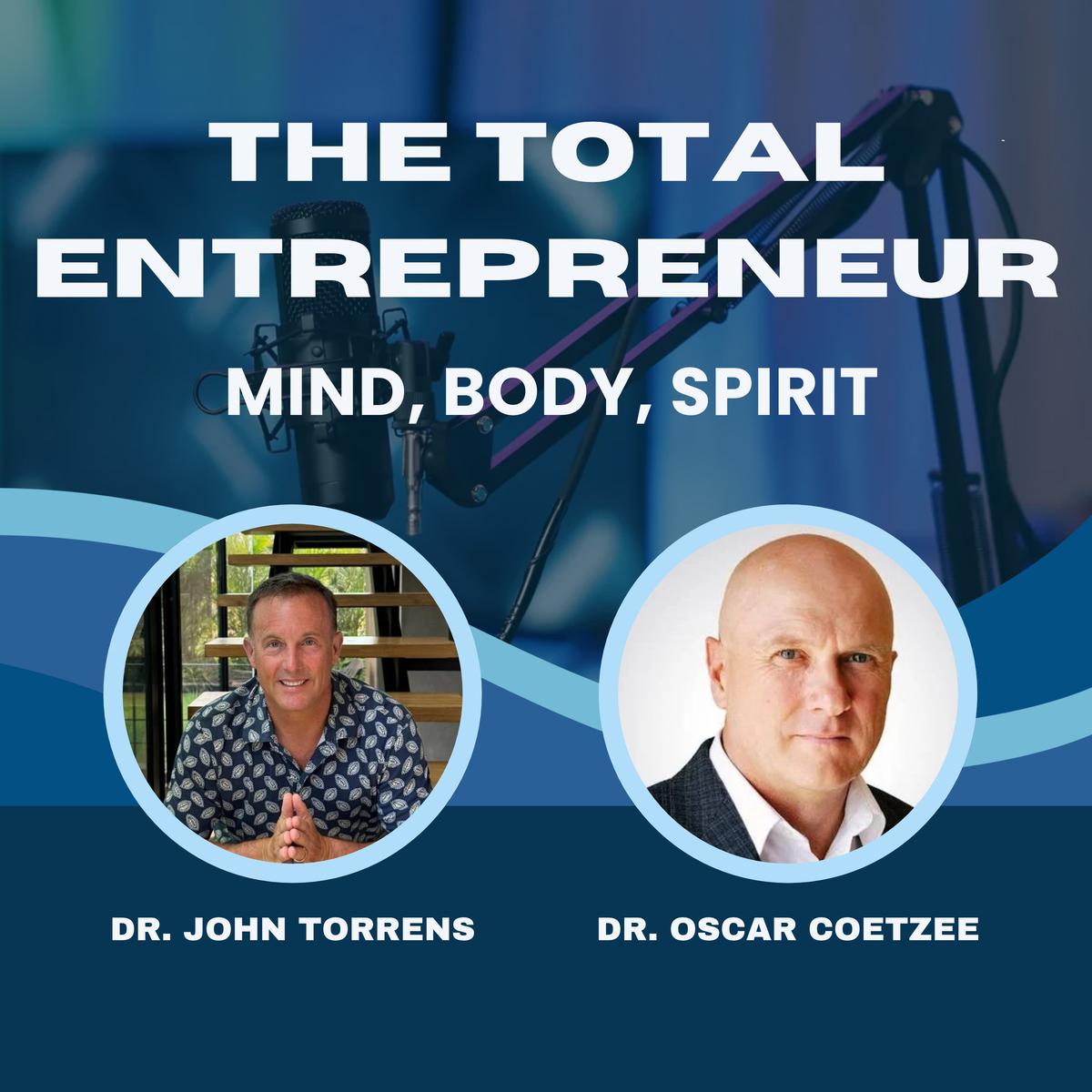
Gut Health, ADHD and Dopamine | Dr. Oscar Coetzee
Nov 20, 2026 · 00:57:18
Chapters
Part of our conversations on
The microbes in your gut produce these things, tyrosine, tryptophan, that makes serotonin, dopamine. So processed food, herbicides, pesticides, and antibiotics kills the bacteria's ability to do that. If you go on one strain of antibiotics or one cycle, depression increases by 50%. 50%.
Okay.
In, in people, if you take 2 cycles of it, you go to 75, 80%. And if you do 3 cycles of it, psychosis is a potential.
Dr. Oscar Coetzee, thanks so much for joining the podcast. Great to have you here.
Thanks for having me, John.
Yeah, so I want to jump right in and ask about probiotics. A lot of people probably have them sitting in their kitchen or in their medicine cabinet, but they may not be doing them much good. Tell us about—
Yeah, I wouldn't say that they're not doing them much good. It's just that they would have to continuously take them, right? So if you're looking at the research, uh, for the positive outcomes in traditional probiotics, it's basically indicating that unless you're taking them, you know, for an extended period of time, you're not going to have the benefits and the results. There's many, many publications that indicate successful outcomes in the use of traditional probiotics, but they're transient. So that means that they kind of get through the body unless you're staying on top of them, you know. So it's the same thing as being on a medication And you go off the medication, you know, it's not going to have the benefit. Now, on the other side of the coin, there are certain bacteria or strains of bacteria that live in our guts that are more called keystone bacteria. And those are the really, really important ones to be focusing on rather than, you know, these transient versions that come from, you know, dairy derivatives or fermented sources.
Yeah. Well, I mean, that makes sense. So I guess it's, it's just a matter of taking them, but is it Is it as simple as just grabbing a probiotic out of the store, or do you kind of need to know what you're taking? Is there certain probiotics for certain conditions?
Yeah, so the traditional system of probiotics, and this is kind of a little bit of a paradigm shift, right, from what we've learned all these years, traditional probiotics that you buy off the rack are generally derived from non-human sources, right? They derived from fermentation or dairy derivatives or things to that effect. So it's kind of like eating the food, right? And if you stop eating the food, you don't have the This new line of probiotics that have just come out are really focusing on replenishing the keystone bacteria. So, let's talk about keystone. What does that mean? So, keystone is just if you look at an arch, right, the traditional arch that's made out of stone, and you remove the top stone out of that arch that keeps it together, the whole arch collapses. So, we're talking about keystone bacteria. And, I want people to understand keystone bacteria are a specific group of strains of bacteria that literally act more like organ systems. In the human body. So it's more like a kidney or a heart. That's how important they are. And these probiotics were never available because it was almost impossible to introduce them because they're anaerobic. So they don't live on oxygen. So we couldn't put them in a capsule. But technology has evolved so much in the last 5 to 7 years that there's now availability of actually putting these probiotics back into your gut. And they come from human donors. So these microbes know how to work as a family.
Got it. So do you find that people need probiotics more now than they used to? I mean, because it seems like it's— maybe it's just more information, better education, but it seems to be a much more popular subject now. So is it true that our guts are deteriorating and we need these more, or is it just that we're more aware of the things that we need to be more—
No, our guts are definitely deteriorating. And the reasons for that is the modern lifestyle, you know, anti- antibiotic use, alcohol intake, processed food, low fiber intake, herbicides and pesticides that we spray on our food groups. It's even now been indicated that long-term use of artificial sweeteners, you know, sugar replacements, can really, really actually affect the microbiome. So, we're living in a society where it's almost impossible to rejuvenate and restore and feed these microbes the way they used to be fed. So, I would say pretty much a guarantee that everybody is at least at a compromised state, not necessarily at a deficiency state, but they're definitely at a compromised state just from modern society. If we can go back to eating seasonally and we can live in an area where we're exposed to all sorts of bacteria in the soil and we're eating off the land and we're eating 50 to 80 grams of fiber a day, then we can replenish this. But, you know as well as I do, that's just not the reality of the world that we live in. Nor is it going to become the reality. So if you can find a proper replacement for these keystone, important, important life-sustaining bacteria, then, you know, a supplement form is literally the best way that you can do it.
Right. So before we start talking about some of those keystones, I wanted to talk about some of the environmental factors because you listed quite a few, like ultra-processed foods, artificial sweeteners, and there's, there's soil depletion. There's a lot of reasons, right? So maybe let's talk through a couple of them, like maybe ultra-processed foods. What is that doing to the gut?
Well, you know, ultra-processed food is obviously processed, right? So what you do is you do 2 things. One, you remove most of the fiber because people want that quick absorption and taste of dissolving. And it doesn't, you know, it doesn't take anything but removing the fiber from making a food be able to assimilate very quickly right now. That might taste really good, but it's actually really, really bad for us. Also, if you ultra-process foods, what you're actually doing is you're actually opening up what I would call Pandora's box of inflammation a lot more. So let's say hypothetically speaking, we're all concerned about the gluten thing that everybody is always talking about, right? Ultra-processed gluten basically takes that seed and completely opens it up, right? So let's say you open up that seed because of ultra-refinement and there's problems within that seed, proteins and things that irritate humans, then you've just exposed all of it, right? Versus maybe a non-processed version where it's maybe stone ground and you can still see particles of that seed, and that just goes straight through the body. So people don't understand, generally speaking, if you eat seeds, they just go through your body. So if you take like a gluten seed and you break it open, you're opening up more inflammatory potential. So lack of fiber, more exposure to these inflammatory proteins that create inflammation and irritation in our body. And then clearly they're also nutrientless, right? A lot of the vitamins and the minerals have been depleted Because of the bleaching and the changing of the texture and the color. So everything kind of looks the same. You know, as you well know, non-processed food, it's never going to look the same. You know, the color is always going to be different depending on the year or the time of the year versus processed food. McDonald's always looks the same, right? The bread, the fry, it's never going to change. And that is part of the issue. And then one very interesting thing There's actually a kind of a fiber that they put in these processed foods, and it's called resistant starch type 4. Now, resistant starch is very good for the gut, right? Because it feeds the microbiome. But this resistant starch type 4 is so chemically modified that it actually does the opposite. So even though they put on the package that it has fiber and it's good and it's going to be good for the microbiome, It actually does the opposite. So that was a very recent discovery that these processed fibers are actually more damaging than good to the body as well.
And if you didn't know the difference, you would just go with the packaging and assume it was better.
Correct. Correct.
Yeah.
Yeah. So anything processed, you know, anything mass marketed is generally going to to have that let's call it profit margin driven form of starch, right? Or or fiber because it's all about the bottom end and the dollars and the cents. So if I can make something cheap and chemical, you know, I'm going to put it in a processed food. Unfortunately, the human body, as much as we've evolved with computers and technology and intelligence, the microbiome is still very primal. It still wants what it wants. It's been around for millions of years eating what it likes, and you're not going to change its mind In the last 200 years of what you think that should, that should be feeding these, these microbes in our gut.
And speaking of changing its mind, I know there's a serious gut-brain connection, but I, I wanna get to that in a moment. I wanna just kind of go through the list of some of the other things you mentioned. So, so alcohol is, is prevalent in society. We use it on most occasions, right? Uh, celebrations, dinners, to relax, what have you. Very prominent. What is that doing to our—
Well, just remember that, you know, in the old days, if somebody, you know, had an open wound, what do you do? You pour alcohol on it, right? Because it's a sterilizer. And that's the problem with it. You know, it's the sterilizing effect that it has on the microbiome deep down that causes the issue. Now, moderate intake of alcohol is not an issue, right? I mean, especially if it is, you know, a little bit of wine or something to that effect where their body is actually using that as a source of of nutrients or food or especially the microbiome. But as soon as you get over a certain threshold, it actually becomes toxic. Right. And then the liver has to work harder to detoxify it. And then you start depleting vitamins and minerals quite a bit because the body has to process that. But what we're talking about is, you know, reasonably strong amount of drinking, which, which could be 3, 3 drinks a day or something to that effect. And then consistently doing that, especially hard alcohols. You know, think of something that you would clean a wound with, you know, that would be something that would certainly eat your microbiome.
Right, because it's killing bacteria, good and bad.
Yeah, exactly.
So, and does it actually last all the way through until it gets to that part of your gut? Like, like when you talk about the gut microbiome, are you talking about in the upper part of the gastric system? Or is it deep into the intestines? Or where is this gut microbiome?
All the way. All the way.
Okay. So from the stomach all the way to the colon.
Okay. Yeah. Because remember, the microbiome isn't like you're going into an office building and there's a, there's a door and you unlock the door and you lock the door. You know, it's not like a submarine where you have these, these areas that you can seal off. It's literally these microbes from the top to the bottom are actually cohesively working. So imagine that you're working in a factory where you're building a car, okay? And then the guys at the top are putting the chassis together. And by the time it gets to the bottom, those are the guys that put the oil in, but they're all part of the same chain. And that car, when it gets off that assembly plant, needs the oil, but it also needs the chassis. So everybody's job is equally important. So literally, you're affecting the entire chain going down.
So it doesn't just live in one specific area in your GI tract. It is literally from the beginning to the end. Now, is it— is it as high up in this— in the track as your mouth, or does it start somewhere lower than the
No, it's a good question. Actually, your microbiome starts in your nose.
In your nose?
All the way through your throat, through your stomach, upper intestines, lower intestines, colon, large colon, all the way to your rectum. There's no area, it's basically just a long tube, right? If you want to explain it to simplistic terms, it's just a long garden hose all the way down, but it's porous, right? So, it's allowing things to go in and out. That could be part of the problem but also part of the solution. Is the porousness of that garden hose, if you want to call it that, is really that gets affected. Now, the beautiful thing about the microbiome that I'm learning, and we're learning so much as we go into this, we're actually only realizing how little we know about these microbes, is the unbelievable intellectual capacity that they have to work together. So if you throw the right microbes in the gut, they go sort out the problems for you. It's almost like you have Getting back to the analogy of the factory with the car that we're building, this is kind of the group that oversees every department. And they just come and say, okay, you guys are slacking off. You guys need to work longer hours. This is the wrong part. They literally just go in there and set it up. And that's why the keystone is so important, because these keystone microbes feed off these probiotics that you might be taking through food sources, but they're also producing things that you use. So these keystones are literally like the, the mediators between the foods and the fermentation and the sugars and the things that you're eating to the point what they're extracting and then what immune cells and other things they're expressing in your genes so that you can get the benefit. So it's unbelievable regulatory kind of ability, but they are extremely intelligent in controlling each other to the point where they can actually control some of the bad guys. To the good guys if they have enough diversity in the gut.
So what is the big deal really? Right? So I'm a busy entrepreneur and, you know, I run, I lift weights, I sleep pretty well, but, you know, I've gotta eat a lot of processed foods because I just don't have time and I drink a little bit. Um, you know, is, is it really that big of a deal? And I'm playing devil's advocate. Of course I get the idea, but yeah, I'd love to hear in your words, like why people who are busy with the stress of starting companies, with all the other things they should worry about, why they should pay attention to their gut health?
Well, because your gut health is completely connected to the levels of stress that you're experiencing as well as the lack of sleep and what you're eating. Now, look, I'm the first person that's going to tell you, as a business entrepreneur, you cannot be running out there and eating only organic foods. I myself travel. I speak all over the world, right? So, sometimes I can't eat what I eat at home. So for me, the logical step is okay. When I'm at home, I'm only going to eat the best, right? I am in control of everything that I put in my mouth. When I go out on the road and I go to a restaurant and there isn't an organic salad or whatever, I'm still going to eat the salad. I'm still going to eat the vegetable or the fruit. There's still value in eating that stuff. But part of this fast-paced lifestyle that we're experiencing and a couple of the drinks that we're having. At least give yourself a buffer. You know, when you're working out and you're taking care of your body, you're taking a protein shake to cover for the new muscle that you're building, right? Or the creatine that you're trying to supplement. The microbiome should be nothing different. And high-paced executives and business people are more prone to have consistent, what would we call, fight-or-flight response, right? Because they live on that. Right. And that's what drives them to be successful people. And when you have that level of drive in your body, just remember that you're kind of a race engine. So you're burning up more energy and these microbes are just helping you produce that energy or at least extract that energy. So make sure that they're there. So I'm not saying in any way, shape, or form, hey, get to the point where you're only eating organic food and you can never drink alcohol. No, the whole idea behind these microbes is compensation. You know, if you put these guys back into your gut, they're going to go live there. All they want you to do is, hey, John, 80% of the time or 70% of the time, just give me something that I can use and then you can do whatever you want and we'll try and fight the fire as much as we can. That's because remember, they want to live in your gut. They don't want to go in there and not live there. That's their job. They want to— they have their suitcases packed. They want to go live down there. But unfortunately, because of modern lifestyle stress and all these other things that I spoke about, we've diminished them. So, all we're saying is replenish them and move on with your life and you will see the benefits, right? From a standpoint of more energy. You mentioned the gut-brain connection a little bit earlier. You'll have better clarity, a better focus, even better sleep cycles if you start incorporating because they literally control 85% of our metabolism and our immune system, these microbes.
Yeah. So, it is worth it to try to get that under control, right? Totally get it. And, you talked about Traveling earlier, and, and I'm always interested in this because, you know, when I used to travel across time zones way more often than I do now, um, yeah, it seemed like there was always something that was off. And I, and I believe that there was, there's research to show that, um, that your gut bacteria actually have a circadian biology element to them, right? They kind of run on a daily clock. Can you explain that a little bit?
Yeah. And they're just adaptable cuz remember microbes of old, right? And they haven't changed. Okay. So these microbes haven't evolved. with millions of years of evolution. They're just microbes, right? That's what their job is. So, when you go back to history, people didn't move from Japan to San Diego in 12 hours, right? That happened— that never happened. But if they were able to carry a continent, that would have taken 2 generations to get there. So, it was more of a methodical change. So anytime that you hop and you have a temperature change and a dietary change, you know, going from, let's say again, America to Japan where the cuisine is a little bit different, your microbiome is like, hey, I've got to adapt to this. And this is why people have traveler's diarrhea. It's not so much the bacteria that's different, it's the food sources are different and your gut bacteria is responding different to the different sugars and the different proteins and the different fibers that That might be a little bit different in these different countries. And as far as the sleep cycle is concerned, it's not like your microbiome ever goes to sleep, right? They're they're always working, but they do a much better job when you are asleep. When you're asleep, they can really get to work. So they kind of more the midnight burners of of
the
other times. They're just helping you compensate. But when you sleep, they can say, okay, thanks. That's why it's called rest and digest, right? So that you can assimilate the foods and and break them down and. And they, and they can do the job. So if you're not sleeping, you're not giving those guys the ability to catch up on the work that they've fallen behind.
So it sounds like, you know, do the best you can do with what's available to you, prioritizing fiber, fresh foods, as little processing as possible, organic. And beyond that, just given what we're dealing with in modern society, it still might be worth supplementing a little bit. So let's talk about those keystones that we mentioned earlier. Let's lead with Akkermansia because that one has gotten At least in my world, it seems like it's gotten a lot of press and publicity, and I think there's not a lot of understanding of what Akkermansia is. So what is that?
Okay, so Akkermansia is a keystone bacteria. So keystone meaning you have to have it in your gut, otherwise you're going to get sick, right? So just— here's an interesting stat for you. We looked at 17,000 stool tests, and 65% of the population have less than detectable levels of Akkermansia. So just to understand what acromantia does, I'm going to give you a couple of examples. Okay, acromantia produces natural GLP-1. So everybody's familiar with the GLP-1 game, right? So acromantia produces a byproduct that stimulates receptors on your gut lining to make natural GLP-1. So clearly, no surprise that people that have obesity and weight loss resistance are low in acromantia. Because they have low production of endogenous GLP-1s that drive satiety and I'm not hungry and I can regulate my food. In addition to that, Akkermansia regulates a lot of inflammatory things. So, there's inflammatory cytokines and things that flare up in our bodies because of stress or overtraining or inflammation is a natural process of life. So, these microbes have an innate ability to drive down that inflammation. So now if you tie low Akkermansia in, well, those are normally the people with more inflammation, more pain, more inability to fall asleep because they're suffering from these inflammatory issues. In addition to that, Akkermansia is kind of the mothership of regulating some of the others because she feeds a lot of the other microbes because she produces stuff. When I say she, we'll just name it like a ship, you know.
Yeah.
Akkermansia is literally regulating Hey, I'm going to feed you. I'm going to feed you, but you're going to give me this. But the biggest thing that people don't know about Akkermansia, and this is why I say these microbes should be known as accessory organ systems, is that Akkermansia feeds off something in your gut called mucin. So you produce mucin, Akkermansia eats it. Then Akkermansia produces a small byproduct that stimulates progenitor cells in your body to make new goblet cells. So in layman's terms, Achromancia produces a byproduct that helps you make new cells for your gut lining. So if you want to tell me that that is not kind of part of your body, then you're missing the point, right? Sure. So that's what keystone microbes are. Keystone microbes is not Bifidobacterium that comes through your gut and it's helping you, giving you a little bit of lactate so that you can produce energy so you can go work out. Okay. It's producing activation of new cell development in, in your body. And there's very few microbes in the gut that have that level of connection to us. And that's why they're so deep down and anaerobic, because they're so important.
So if they're so important, nature must provide this for us somewhere in our accessible diet. So what's a natural source of Akkermansia? Where would we get it from normally before we supplement it?
Yeah, there's no food source that Produces acromancy. Basically, you kind of born with this acromancy, and even if you have less than detectable levels, it doesn't mean that you don't have any acromancy. You just have low levels of it. So where do we get exposed to these things? From mom to fetus through the birth canal, and then we have these microbes in our gut. Then we get breastfed, or we supposed to, right? Then we kind of nourish these babies a little bit, and then we go to whole foods and fibers. And then we really grow them. So it's not like acromancia comes from an apple or a banana or or a fermented food source. It's literally like your kidney. Okay, here's a kidney. If you if you if you don't support your kidney, it's gonna die, right? So the problem with modern life is that we've unfortunately lost a little bit of that. So everybody on this call. has Akkermansia, they have Faecalibacterium prausnitzii, Roseburia, some of these key microbes. But, how much do you have? Right. And, you're not ever going to lose them in totality because you would literally die because they help you make cells, they help you do things. So, I don't want people to think that we are saying you have no Roseburia, you have no Akkermansia, you have no F. prau. But, I can tell you, I can give you 150 to 200 symptoms when I can tell you that those things are becoming dangerous. dangerously low, and they are very, very connected to chronic disease. So, I think that's the key component. You can get Lactobacillus, Bifidobacterium from your transient probiotics.
You
cannot get Akkermansia because you're taking Bifidobacterium. Now, I'm saying that though, if you were to take something, a probiotic that makes something that this guy eats, then maybe you can rejuvenate. But, the interesting thing that we've seen The only things that drive acromantia higher in theory would be high fiber and things called polyphenols, which are the colors in the foods that you eat. You have the reds, greens, yellows, purples. But it seems to not bring the numbers up high enough. So it's almost like we need to do a transplant and then feed them so that they can get reactivated. And that's purely because of the modern
Gotcha. So, so let me just repeat it back so I understand. So you're, you're largely born with the acromancia that, that you're gonna have, and modern lifestyles tend to kill it off faster than we're able to eat enough to, to feed it and strengthen it and replenish it. So, so even though we have it, the degree to which we have it is largely dictated to by what we're doing. So you can't, you can't just eat a food source to replenish it, but you can eat in a way that might feed it if it's the right sources. So if you take an Akkermansia supplement, let's say you do it for a month or something, you buy a bottle and you take it and you kind of replenish your Akkermansia, if that's the right word, and then you eat pretty well afterwards with the polyphenols and the fiber, is that enough or do you still need to constantly nurture that?
Well, that's going to depend on how modern processed your diet stays, right? So if you reinsert these guys, so let's pretend that we, we're doing a kidney transplant, right? So we're reinserting Akkermansia in your gut. So yeah, now you need to eat more fiber, more polyphenols. And because they want to live there, they're going to engraft. They want to live there. But one thing that we have seen, John, that's pretty interesting is that it turns out that these guys don't do really well in isolation. So, taking Akkermansia as an individual supplement doesn't seem to have the same effect as taking a group of these keystones together where they work together and feed each other. So, it's almost like you're bringing in a team rather than an individual person. And, when this team works together and they've been together for a long time, that's very helpful.
So when you talk about the team, are you talking about some of the other keystones? Like, I think it's Faecalibacterium and Roseburia, or are you talking about other ones?
No, I'm talking about some of the key, key ones. So the 3 key ones, Akkermansia, Faecalibacterium prausnitzii, I know it's a big one, but we'll just call it F. prau, and Roseburia. So those are 3 really key ones. Now look, there's many more, right? There's 33 to 39 really, really important keystone strains. And probably a heck of a lot more that we don't even know about. But the ones that move the needle the most on metabolism and immune system that covers 85% of your your system is pretty much reliant on those three, and I'll probably throw in another one called anaerostipes kake. So here's what I will say: If you look at centenarians, people that live over 100 years, okay? There's eleven. Microbes that seem to stand out in their guts from a keystone standpoint. And the 3, the 4 that I've mentioned are part of the 11, and there's a couple of Bifidobacterium strains that also play a role. But the key, key ones would be Akkermansia, Roseburia, Faecalibacterium prausnitzii, and Rostapisca K. Those are really, really key components of a very healthy gut.
Hmm. I've been reading about fecal transplants or implants. Maybe is it an implant or a transplant? I forget what it is.
Transplants.
Transplant, right. There you go. Do those work? Tell me about those.
Yeah. So fecal transplantation has had great success in communities with C. difficile overgrowth or C. diff. You know that you get that bacterial overgrowth in the hospitals and it's really been very helpful to a lot of people that are Borderline completely antibiotic resistant and problematic. But there's dangers with fecal transplantation, right? There is genetic variants that we don't understand. If you're taking fecal matter from one person, you stick it in another person. You know how does that express? I'll give you an example. For instance, a woman at one point had C. diff. She was never overweight. She got a fecal transplantation, turned out to gain forty pounds, fixed the C. diff, but she could never lose the weight. But the person that gave her the donation was an overweight person.
Oh.
So, it's all anecdotal, but, you know, hey, you know, you got something there going on that's pretty interesting. On the other side of the coin, one guy was severely depressed, got a fecal transplantation from a person that wasn't depressed, turned out not to be depressed anymore. So, you know, there's a trade-off of benefit that could go either way. But even the FDA is a little concerned with fecal microbial transplantation just from the yuckiness standpoint, you know, and the attachment of all the other stuff that can come from it. So there's another technology that has now come into the equation, and it's called microbial ecosystem therapeutics. So let me just or met you know FMT is fecal microbial transplantation and met microbial ecosystem therapeutics. So let's just talk about met.
Sure.
So basically what met is, and again in layman's terms, imagine if I can take a fecal transplant, and I can only extract the microbes, and I lose I leave all the yuckiness out. So I'm literally just taking Akkermansia. I'm just taking F. prau, just taking rosemary and anarostipes and whatever else I want. I put it in a petri dish and then I feed it so it can regrow in culture. And then I take that, put that in a capsule through anaerobic technology, and now you're taking that. So you're literally taking a human donor from F. prau and all those guys without the yuckiness of the poop that in clinical trials have outperformed Fecal microbial transplantation without the side effects. And that's where we are now.
That sounds interesting. Yeah. And I like that, that you're taking the best of it without all the, you know, the possible negative effects of it.
Yeah.
So, so let's, let's get on to the, the gut-brain connection, 'cause I, I find that really interesting. And I wanted to first talk about serotonin. So I know that, well, the gut makes about 80, 90% of the body's serotonin, but it doesn't cross into the brain. So I'm interested in that. So is that gut-brain connection real? Is it overhyped? Does it apply to only certain neurotransmitters and compounds and substances? Or how should we be, I guess, interpreting that?
Yeah, so the gut-brain connection is a very interesting discussion because it's so loosely thrown out there. But it's more complicated than that. Your gut isn't just going to open up the gates in your gut lining and sending everything to the brain. Right? So, so that is a little bit of a misconception. So this is how the gut-brain connection works. So these microbes that I'm talking about, these keystone bacteria, and even your lactobacillus and bifidobacterium, that's why I'm saying they have benefits. They produce aromatic amino acids. So these bacteria in our gut produces tryptophan, tyrosine, and phenylalanine. And everybody's familiar with tryptophan, right? Tryptophan converts to serotonin and you're a happy guy. Tyrosine converts to dopamine. It's an overall feel-good chemical, and then epinephrine or epinephrine, so you can fight or flight really well. And then phenylalanine, the other complicated one, converts to tyrosine. And tyrosine is also, if you've ever looked at blood work and it says T3 or T4 for your thyroid, that T is also tyrosine. And that's very connected to mental health, right? Hypothyroid people are more prone to be depressed. Okay, so basically. The microbes in your gut produce these things, tyrosine, tryptophan, that makes serotonin, dopamine. Okay. So processed food, herbicides, pesticides, and antibiotics kills the bacteria's ability to do that. So now you've been on antibiotics and just for your listeners, this is a fact in scientific literature. If you go on one strain of antibiotics or one cycle, depression increases by 50%.
50%?
In people, yeah, right after that. And, I'm not talking about deep-rooted depression, I'm talking about dysthymia or mild depression.
Right, right. You're going to feel it in other words.
Yeah. If you take 2 cycles of it, you go to 75%, 80%. And, if you do 3 cycles of it, psychosis is a potential. So, just the importance of understanding how these microbes make these aromatic amino acids. Now, you said, okay, so how does the tryptophan then get into Into the brain, right?
Right.
Because the poop is not going to send it there, right? Or the gut stuff. So this is where insulin plays a role, the thing insulin that everybody knows about. So insulin is actually the carrying molecule that takes tryptophan through the blood-brain barrier. So now that brings a totally different dynamic into the equation. So what are you saying, Oscar? Are you saying that people that are insulin resistant are more prone to be depressed? Yes, 100%. The diabetic population has a higher, much higher rate of depression and anxiety than non-diabetics. So unless your insulin is working well, which is kind of the bus that takes the tryptophan to the brain, you kind of SOL. And then in addition to that, you need vitamin B6, magnesium, B1, B2, B3 in the brain to convert that to serotonin. So it's not like tryptophan shows up there, hops out, it then needs to be converted in the brain through several steps to get where it is. And that's where all the B vitamins and the vitamin C and magnesium and all those things play a role. So you basically have the microbes producing tryptophan. They go to the, to the, to the, to the guard, the border there in the gut lining and say, hey, insulin, are you here? Yep. Hop on the insulin, go to the brain. Shows up in the brain. Brain is like, okay, great, tryptophan, come in. And it's like, oh my God, we don't have any B6, we don't have any magnesium, we don't have any— oh, so this tryptophan is worthless to us. So this is why insulin, high status of B vitamins, high status of magnesium, all those things are important for you to eventually get to serotonin to be happy. So when people come to me and say to me, you know, depression and anxiety is out of control, well, I can easily explain that to you. We're killing the microbes that make The amino acids tryptophan and tyrosine. We don't have enough B vitamins in our body because we drink a lot of alcohol. Nobody has enough magnesium in their body. Nobody has enough vitamin C in their body. So is there any surprise that we have a community that has anxiety and depression? And I'm not saying that psychotherapy and psychiatry doesn't have a role, but we're completely missing the third leg of that bar stool, which is none of those things are applicable unless you have those nutrients to be able to perform at that high level. And guess what makes or extracts the B vitamins? The microbes in the gut. So it's just a vicious cycle. So that's the gut-brain connection in a wider explanation.
No, I appreciate that explanation, and it just shows how multivariate and complex this is. It's not a, it's not a simple system that we're talking about here. So a lot of my audience indexes towards ADHD. So I'd like to talk a little bit about the gut-brain connection as it affects ADHD and, you know, what the research actually shows and that sort of thing. So what's, I guess, your personal opinion and then your professional thoughts on the gut microbiome's impact on the rising incidence and prevalence of ADHD?
Yeah, I think that has to do with a couple of things, right? I think that we are People that are prone to ADD, ADHD, probably more ADHD, right? Attention hyperactive disorder in, you know, type A personality, high-level business people. You know, I don't know. I don't necessarily look at that as a negative. I just look at that as a racehorse, right? And that's just the way it is. Just understand that as a racehorse, you're going to need more food. You're going to need more energy substrates to be able to perform at that level.
And by the way, I love that analogy of the racehorse and the racehorse needing something different because my own research It actually shows that some of the most high-performing entrepreneurs do, they connect with ADHD symptoms. So that is a great analogy, by the way. And sorry to interrupt, but I just want to comment on that.
No, no, no, no. And I appreciate that because I'm a similar person. I'm trying to just defend my own behavior. No, the bottom line of this is we like to put titles on things, right? Like this person has ADHD. Well, if you didn't have ADHD individuals, you probably will have no economy. Quite frankly, right? So we put a label on that. So for me, I'm not a label person. I'm just going to look at what does an ADHD person's stool test look like? What does their mitochondria look like? What does their overall energy requirements look like? And what an ADHD person has, it needs race fuel. So if you don't consistently provide it with race fuel and the right amount of rest, then those symptoms of ADHD will worsen. So it's literally okay, fair enough. I have a racehorse. I'm gonna let this thing run the Kentucky Derby, but I want to let that thing run the Kentucky Derby five days in a row. That's never gonna happen, right? But yet, as business people, we think as racehorses we can run the Kentucky Derby five days in a row—not without proper rest, not without proper nutritional reactivation—and this is very similar to what I see because I worked with a lot of professional athletes that were burnt out. So part of my history is mental health. I am. Also a psychologist originally by trade, and then I kind of combined the two. And this is what I found: professional athletes came to me as like, "Listen, my coaches say my performance are horrible. I must be mentally not right in the head." And then we look at the affirmations and the goal setting has nothing to do with that. Then I do a mitochondrial test and see that this dude is completely burnt out, right? He just doesn't have anything anymore to perform at that level, and that's where you then. pay you attention is sometimes it's as simple as B vitamins, magnesium, more microbes in the gut to really help drive that. So, in my opinion, I know people like to put a brand on ADHD.
Sure.
That is a unique trait. There are negative side effects from that trait, but I just think you need to understand the inner part of yourself to accommodate the performance there. And ironically, when you do that, the ADHD symptomology improves, right? So it's almost like you're— it's not like you're feeding the fire, but you certainly have the fire, but you're just making sure that it doesn't burn the entire town down. You have some cross-reference protection of regulation going on somewhere.
Yeah, you've got a container for it to operate in. Yeah, I mean, that's a good point because each one of the traits that you might check off the list in the DSM-5 for ADHD, they're— yeah, they've got a positive expression and a negative one, right? Like hyperactivity and sensation-seeking, they can work really well for you when you're healthy, regulated, maybe when you've got a healthy gut. But when you're not healthy and regulated and your gut microbiome is unhealthy, they can have a very negative expression. So I think that's pretty interesting.
Yeah, and I think a big thing with the ADHD population is dopamine. Like, they dopamine people, right? So, you know, what makes dopamine? Tyrosine. What makes tyrosine? The microbes in your gut. How many microbes do you have in your gut? Because you need more dopamine than Jimmy John. And if you don't have enough dopamine, you are going to portray more symptomology. So I'm not saying that I'm trying to feed only the ADHD. The way to control ADHD is to get hyper amounts of nutrients so that the body doesn't go and run down on battery.
Yeah. Actually, I've read a few studies where elimination diets seem to be much more effective than anything you can add, at least in those studies, right? So getting rid of things like gluten and soy and dairy, dyes, sugars, caffeine.
You mean for ADHD? Yeah, for ADHD. Yeah, yeah, yeah, yeah, yeah,
yeah. Those seem to help.
Let's, let's just throw that back into the other analogy. Okay, yeah. Let's say we do an inflammatory diet or an AIP diet, so I don't have any processed food. Okay, that means I'm gonna have more fiber. What does that do? Feed Akkermansia, F. prau, and Roseburia, right? So I don't think it's the diet by itself. I believe it's the diet changes that feeds the microbiome that brings these things back that drive all these other things. So you can, you can always bring it back to the microbes in the gut and the And the byproducts of the microbes, what they produce, and a whole food diet and an anti-inflammatory diet is always going to be more real food, which is literally the precursor to a healthy microbiome.
So again, to the complexity of what we're talking about, right? It's not just as simple as you remove this, and that is the outcome, right? Because by removing something, now it's leaving something for you to eat something else, right? So if you can't eat these three things because of your elimination diet, now you've got to eat something else, and it may be something with more poly. females. It's more colorful. It's more fiber. It's, it's something that you should have. Yeah. And one thing I hear from a lot of people, because it seems to me like this is, this has happened over the course of maybe a generation, maybe a little bit more, but a lot of people are like, well, you know, my parents didn't have to take these supplements or I didn't have to worry about this as a kid. I'm just going to keep doing the same thing I always used to do. And yeah, I'm getting a little older and that's just part of getting older. But it sounds like that's not really the whole story.
You know, my argument to that is always to people, okay, well, so do you still use a phone that has like a ringer thing?
The rotary dial phone?
You're like an iPhone 29 already, right? So what makes you think that technology can't develop in other areas? Well, you're not eating the same as your parents. Number one, your parents didn't have the dopamine exposures that you have. Number two, with gaming and consistent information and consistent Entertainment—that's all dopamine-related issues, right? So that argument for me is a little bit debatable. And people ate a lot more local and processed foods really didn't exist until 1940s, 1950s, right? When we started, you know, flaring up with McDonald's and all these things, you know, over the last couple of years. So to me. As a professional, supplement is what the word means—in addition to. Okay, so if your diet is 60% good, then you need 40% supplementation to cover the base. If your diet is 20% good, you need 80% coverage. If your diet is 80% good, you need 20% coverage. But you need coverage, you know, at some point. The beautiful thing about anaerobic bacteria is that when you insert them in the gut and you start eating better. They'll start producing their own gig. You don't have to take them all the time. So, that is, I think, the important thing. And, how do you know that? Well, you just do a stool test pre and post. So, where's your microbes? Test them. Go on the probiotic, test it again. And, for anybody on this call as a high-level executive, that might be something that you should do for your entire team just as a performance investigation. You know what I mean? Like improve their microbiome. That'll improve performance. That'll improve output. That'll improve motivation because we are literally driven by the microbiome as far as anything is concerned when it comes to performance, rejuvenation, chronic disease. Everything is connected to it.
Yeah. So you said something earlier that I want to circle back to. You were talking about the, just the dopamine demands that we have nowadays. So were you suggesting that the dopamine that we're seeking through social media, like the things like we're looking at social media and experiencing with our eyes, is that also affecting our gut microbiome?
They claim it is. And I think there's enough studies that could kind of, you know, indicate with gaming, you know, they looked at people with long-term gaming and how it affected their microbiomes. And it was negatively affecting the microbiome. But you could also then argue, well, gamers are normally eating junk food while they're gaming. Right. They're not sleeping very well. So, what is the other confounders that play a role with it? I think the problem with— and we're all guilty of that, right? Sure. We have this unbelievable access to information and we are naturally inquisitive creatures. So, it's really hard to shut down that dopamine channel. And then, the threshold gets higher. It's like any other addiction. What used to work with 2 drinks is not working with 4 drinks is now working with 5 drinks. Same thing for, for dopamine surging. You know, when we do this social media thing, we need more and more and more and more and more. And I'm guilty of it like anybody else. You know, sometimes it's like, dude, you got to put the phone down, man, because you, you know, let's say you're in finance or you're in something and for me in medicine and I start reading an article and something intrigues me, I read the next one and the next one and the next one. Mm-hmm. And then it's 2 o'clock in the morning. Like, okay, well, you know, at some point you need to shut that stuff down because it drives dopamine and the rate of success that business people might have with deals or whatever that drives the dopamine game.
Right.
But there's only so much dopamine circuitry that the brain can handle before it needs to rest. And we're just overstimulating that. And we don't know the results of the long-term effect of what we're doing now. Um, you know,
right, because it's still a relatively new phenomenon, right? I mean, in terms of generations, that sort of thing. So, so we don't—
Generation, right? I mean, this is the first generation that we're doing this.
Yeah. So if somebody's looking to supplement with Keystone Probiotics, what should they look out for, and how do they separate a really good sales pitch from good science?
Well, the good thing about anaerobic strains of probiotics is very few people are selling them because the technology is pretty expensive and the research is pretty, pretty vast, you know, at this particular point. So, um, what you want to look for is you want to look for live strains of anaerobes. So you're looking for live Akkermansia, you're looking for live F. brow, live Prosnitzia, live, um, Anaerostipes.
So these naturally have to be in a cooler or freezer somewhere, or can you get them in a capsule?
No, they actually, they actually resilient to room temperature. You don't want the excess, you know what I mean? Right. Sure. But they are actually, 'cause they, they can sporulate and, and they, they have the proper kind of blister packs that can survive, you know, pretty harsh stuff. And we've done lots of clinical trials on that. And we actually did a clinical trial on a, on a group of Amish people that don't have refrigeration. And we still saw the same amount of improvement in the, in the anaerobes to a person that has refrigeration. And there's kind of an important information piece for us to understand. So that just shows you that these microbes just have the ability to know, okay, well, we'll just chill out a little bit until we get into the apartments and we get our new jobs and then we're going to start moving the needle. So they're very resilient. You know, they've been on this planet for a long time. And as long as they have the anaerobic status in their packaging, they'll just hang around until you come around.
Interesting. So you mentioned Amish populations. I find that really interesting as well because it's just a great I don't know if you call it a good control or what it is, but they live so differently, right? So, can you tell us any other interesting findings that you're aware of from a population like that?
Yeah. The bad finding about that is that I've realized that the Amish population eat a lot more processed foods than they used to do in the past. Oh, wow.
So, their lifestyle is changing.
Correct, correct. So, anxiety and depression is a lot more prevalent in their societies than it used to be. And chronic disease is a lot more prevalent, like, you know, hypercholesterolemia, heart disease, and all those kinds of things for people who are physical. But the benefit of them is that they're still local. Okay, so they don't travel vast distances quickly, correct? And that has a very interesting, profound effect on the microbiome. So they are a fantastic control if you want to look at something to the point of Okay, we're giving you this probiotic. This is your diet, but you don't have you're not moving around like Oscar and John are on planes. You know the next month, so it's definitely a slightly different dynamic. But the problem is also that their communities are also affected by glyphosate. They're also affected by antibiotics because it's everywhere, right? In the water supply, in the groundwater. So you know they not. The isolation area of subject pool that we used to think that they were, because literally some of the elders in those communities who I have a lot of direct contact with now is very concerned about their community collapsing because of modernization of what's happening around them, not so much what's happening in their community.
That makes sense. Yeah, it's too bad to lose a, you know, I guess a community like that. Yeah.
But there's a big search for them to go back, right? And that's kind of what they drive. And that's our involvement with them is, you know, how do we rejuvenate the community, you know, through traditional measures? So go back to traditional cooking, local cooking, local eating.
You
know, you don't buy the instant rice, which is all things that they've I'm not saying all of them, just saying that the majority of them.
Yeah, sure. Yeah. So, all right, so, so look for things that have the, the live bacterium in them. Yeah. Um, I wanted to ask you, I forgot to ask earlier when we were talking about foods and things you can do, but I, I was reading somewhere about a, a comparison of high fiber diet to high fermented foods diet. And it seemed my read on it was that the fermented foods actually resulted in more Variety and diversity in the gut. Is that accurate or am I, am I missing something?
No, no, definitely. Um, okay, the fermented foods provide a lot of saccharides, right? So they provide a lot of sugars that feed the bacteria, the good kinds of bacteria. And clearly fermented foods also have fiber, right? And they have enzymes. So it is actually the optimal food.
So it's not an either-or. Got you. Yeah. Okay.
So it's, it kind of contains the fiber and everything together. And this is why you finding when we feed these microbes to grow them in culture, we feed them with fermented stuff, polyphenols and sugars and oligosaccharides because they want that. And also this whole notion about the world that sugars are the bad things and fruits are the bad things and calories are It's demented. It's so crazy that we have got to a point where we've decided that aspartame is a better replacement than natural glucose. Your body wants it, right? It needs it. It can thrive on it. Just don't eat 20,000 kilograms of it a year. I mean, there's benefits to that stuff.
Right, right. Or, don't eat it naked without something to slow it down a little bit or something. Right?
Yeah, nature intended it to be, right? Right. So if you want to eat a banana that doesn't turn to sugar quickly, eat it more raw, right? Eat it greener because then the fiber content is higher. And nature always provides the best amount of fiber naturally for the foods that you're eating, you know. And people are going to tell me, oh, watermelon, what about watermelon? Doesn't have a ton of fiber, it's all sugar. I said, no, actually water is 96% water. Not sugar, right? It's just very sweet because it is diluted in into the water, and there's a decent amount of fiber. And if you eat a little bit of the rind in watermelon, you almost have one of the perfect polyphenol foods.
Was that right?
Wow!
I love watermelon, so I'll have to start digging into the rind a little more than just the flesh.
The white and the rind is really important to add in. Okay. I know that's kind of the harder, not so tasty piece, but if you can combine that. You know, when you cut a piece of watermelon, just cut like a quarter inch of the white piece and eat it with the other ones. Perfect combo.
Great. All right. Cool. So if somebody is interested in their gut microbiome and they're just not sure of the status, are there tests or labs or things that they can order at home? Like, how do they even assess their
gut? Yeah. So, you know, there's a big movement called functional medicine, right? Where we test development towards disease rather than disease, right? Like it's almost like, you know, the paradigm is shifting more. Hey, why do you want to wait until you have a disease? Don't you want to determine if you're on your way to having a disease, you know, 70 years, 5, 7 years before manifestation? So what I would encourage anybody to do is find, you know, in your local area, a functional nutritionist or a functional doctor or a person that actually can do functional testing. And those will include things like organic acid testing, which is just a normal urine test and you get a kit sent to your house, but it normally has to be ordered by one of those functional nutritionists or medical doctors or whatever. And then you do that and you do a stool test. So especially for the ADHD people, we want to look at organic acids to see how well your mitochondria or your inner part of your cells are, you know, because of that consistent stimulation. And then the stool test, we can look at these anaerobes. We want to see if they're very low because what we see is when anaerobes are low, Pathogens are higher, opportunistic bacteria are higher. When you bring these guys back, those other guys go away. So it's almost like these keystone bacteria also has the ability to be an antimicrobial in a natural way. So you might— we might be moving towards— and that's actually what some of our clinical studies indicated, is that we couldn't believe, why does it kill all these bad guys?
Hmm.
It's not an antibiotic, it's not an antimicrobial. And then, if you read a little bit deeper, it's very simple because these microbes create an anaerobic environment. So, they suck all the oxygen out and these bad guys rely on oxygen. So, they're really choking them to death in their own way without you having to go nuts. Now, I'm not saying that's going to work for E. coli or some weird infection, but for the standard opportunistic bacterial overgrowth that we see, seems to knock them right out. And that was a great additional finding to what we wanted in the study to look at is does it move acromantia? Does it move FPRAP? Does clinical significance do that? But it's these other things that it does that we're learning from.
Right. That's interesting. So it's possible to get a read on it. You can get it assessed. But yeah, have your doctor order it, either urine or stool test or something.
Yeah, but make sure you don't necessarily go to a traditional doctor because he's going to poo-poo it or play it down or say, I don't know anything about it. But there's a massive functional world out there. So go look at things like GI Map, GI Spotlight, metabolomics testing, organic acid testing. There's several companies that do them, but they could be complicated to interpret. So it's better to go through, you know, a practitioner group like our, our company only sells to practitioners, right? Because it's high-level products. But if you go to our website. You can go determine who's the local doc in your area that you can ask for, and that is also going to explain to you the probiotics a little bit better.
Yeah. So, if somebody's interested in learning more about you and your company, where do they do that?
They can just go to designsforhealth.com. So, the word designsforhealth.com. And everything is on that website. The research on this probiotic called Complete Commensal, the research on the stool testing, where you can find a practitioner, it's all part of the website.
Well, Dr. Oscar, thank you so much for joining me today. This is a great conversation and I hope people benefit from it and they're going to take a little more control over their gut health. Thanks so much.
Yeah. Well, thanks for having me, John. It's great being here.
About This Episode
Clinical nutritionist and functional medicine researcher Dr. Oscar Coetzee joins Dr. John Torrens to explain how gut microbiome health directly impacts neurotransmitter production, energy, and entrepreneurial performance.
Moving beyond off-the-shelf probiotics, Dr. Coetzee breaks down the role of anaerobic "keystone bacteria" like Akkermansia, Faecalibacterium prausnitzii, and Roseburia in regulating metabolism, inflammation, and natural GLP-1 production.
You will learn how ultra-processed foods, antibiotics, alcohol, and chronic stress deplete dopamine and serotonin precursors, and how founders with ADHD and fast-paced lifestyles can rebuild their gut-brain axis for sustained focus and mental clarity.
What comes up
- •Why Standard Probiotics Fall Short: Dr. Coetzee explains why traditional dairy or fermentation-derived probiotics are transient - meaning benefits stop when you stop taking them - compared to human-derived anaerobic keystone bacteria that act like accessory organ systems.
- •How Ultra-Processed Foods and Alcohol Erode the Microbiome: How chemically modified fibers (like resistant starch type 4), refined grains, and heavy alcohol intake strip gut diversity, trigger inflammation, and disrupt the microbiome from the nasal passages to the colon.
- •High-Performance Entrepreneurship and Circadian Gut Biology: Why entrepreneurs operate like "race engines" that burn through microbial fuel faster, and how travel across time zones and poor sleep interrupt the gut's "rest and digest" repair cycle.
- •The Keystone Trio and Microbial Ecosystem Therapeutics (MET): A look at Akkermansia (which stimulates gut lining cell renewal and natural GLP-1 production), Faecalibacterium prausnitzii, and Roseburia, alongside how MET isolates beneficial donor microbes without the drawbacks of traditional fecal transplants.
- •The Real Science Behind the Gut-Brain Connection and ADHD: How gut microbes synthesize tryptophan and tyrosine, and why insulin sensitivity, B vitamins, and magnesium are required to convert them into serotonin and dopamine for mood stability and ADHD focus.
- •Digital Dopamine Overload and Functional Testing: Managing screen-induced dopamine fatigue, leveraging fermented foods and polyphenols (including the white rind of watermelon), and using functional stool and organic acid tests to spot cellular burnout early.
Keep listening
More on Body
About the Host
John M. Torrens, Ph.D.
5× Inc. 5000 entrepreneur, Professor at Syracuse University's Whitman School of Management, author of Lightning in a Bottle, and TEDx speaker on ADHD as an entrepreneur's superpower.
Browse all podcast guests →See Ready, Start, Grow →