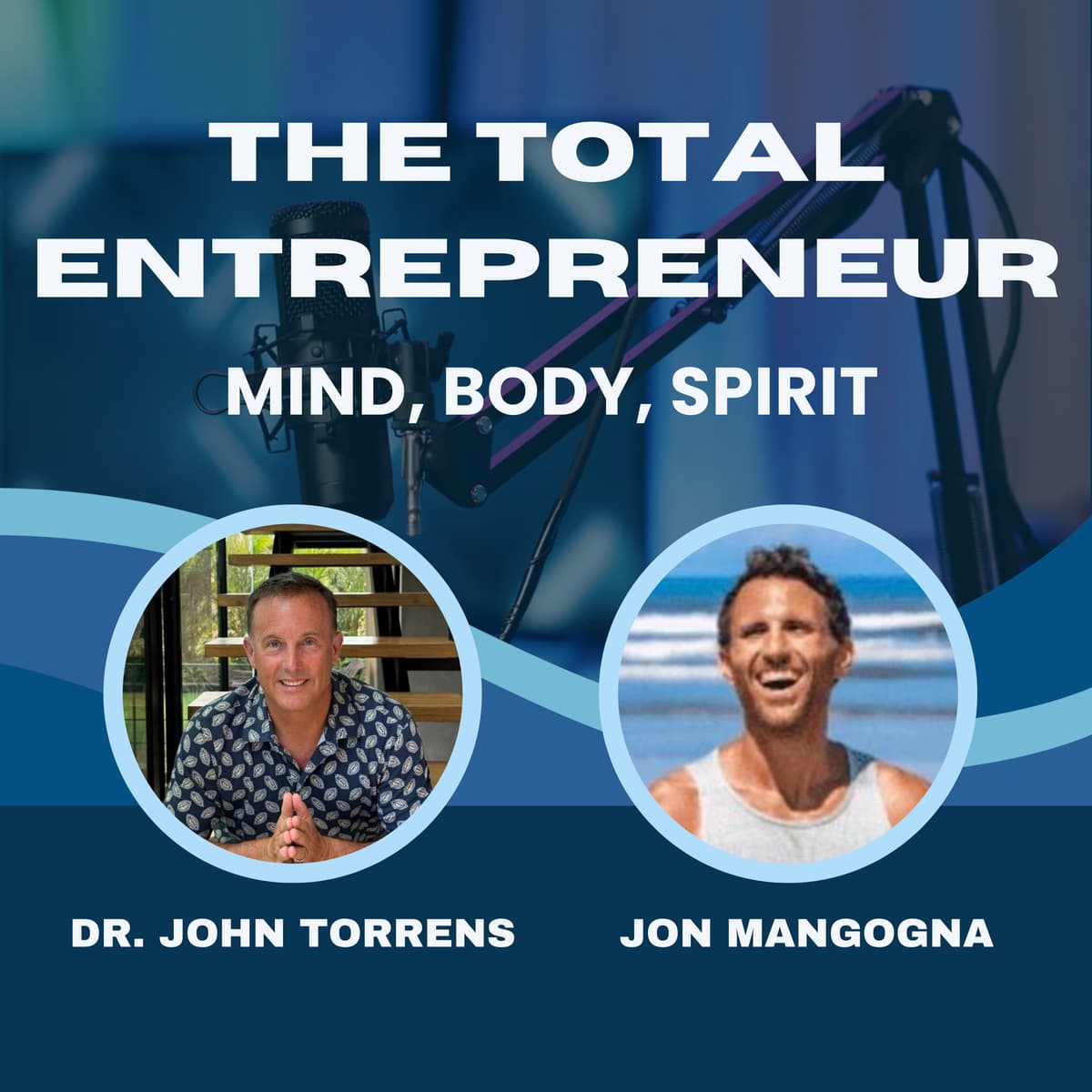
How to Reset Your Nervous System for Peak Performance with John Mangogna
with John Mangogna
Mar 27, 2026 · 00:48:52
Part of our conversations on
And we're often taught in most of our therapies, which is pain is somewhere in the periphery, say in a shoulder, and the pain's coming from the shoulder. So even most of our therapies focus on that output. We might stretch the shoulder, we might do something like massage the shoulder, something like this. But pain is just the perception from the whole system, and that perception's only created in the brain. You have specific receptors that are not pain receptors. There's really no such thing in the human body. We don't have them. We have nociceptors that are threat receptors. Touch a hot pan, Threat receptors take the information, the threatening heat, danger. That sends the signal afferently to the brain and really through the spinal cord and the brainstem. The brain then makes processes and makes a decision on the pain perception to come back out.
John, welcome to the podcast. Really great to have you here.
Hi, thanks for having me. Pleasure to speak with you.
Before we start, I'd love to hear a little bit about your background in athletics and judo specifically, because I think that sets the context in a really cool way. So tell us a little bit about that background.
Judo is really what created the big foundation of movement for me. And I started that at 5 years old, training, competing. And then onto larger scale competitions and higher stress loads and in that direction. But judo itself was always, you always have to have, you always have to keep some sort of balance and not just vestibular balance like we think about it, but you can't really overtrain in certain areas. If you do a bunch of bench press and pushup only, you're going to feel off balance when it's time to play. I call it almost like in a aggressive movement ballet. And you're always learning. You're feeling the opponent and feeling the way that they move and understanding the way you move. And there's lots of ranges of motion and hip shifting and groundwork and up. And it's this big symphony of movement. And that was really my baseline because all growing up, I then was more attracted to the movement side of things, less to the exercise side of things. Yeah.
Now you didn't just participate on a recreational level. You had kind of advanced through the sport a little bit.
Yeah. I did US Nationals for a bit. I did the Liberty Bell was a really big one. There's a really big round robin tournament where people came from all over. Some of the Cranford tournaments. I never went to the Olympics, which is obviously kind of the biggest stage in that area. But I did train a good amount with George Harris. He was part of the very first US Olympic judo team in 1968, I think it was. So I learned a lot from him.
Yeah.
It's also a very one-on-one thing, which is different than a team sport like football, soccer. Once you get out there, it's just you and the opponent, you with your mind, what you're telling yourself, and all these different things. It's a very unique Experience. Obviously there's other sports that are one-on-one like UFC now, but yeah, it taught me a whole, whole, whole heck of a lot.
Yeah. I love to explore those types of connections, right? I'd like talking to people about the mindset of elite performance in any arena and how that translates over to business. Tell me a little bit about just what your mindset was like or how you stuck with it, because to be able to compete in anything at that level doesn't happen by accident. So talk to me a little bit about what was going on and how you were able to do that.
So, I think, which is also really cool and I draw into a lot of my work now, is the coaches that I had a lot of these tricks and training in that direct area that they probably didn't even fully understand at a neurological level at the time or at a physiological level. They had just learned it even culturally from the sport and applied it. And, things like visualization. And my coach for the big fights, especially when they were round robin, which means that as you win, you just keep climbing and you might have to fight over and over again really quickly. And I'll never forget, my coach would always tell me, hey, you know, if you're not fighting in the moment, sit and watch the fight and visualize it only if you think you're going to be— that's going to be your opponent either next or in a few rounds, but not if you don't think so. And it turns out that's a very real neurological idea in your hardline neurology, where if you watch the— if I'm watching the fight and I'm visualizing it, regardless of if I'm moving or not in real time, that I'm burning through energy.
Right.
I don't think he didn't fully understand the predictive idea in the brain and your brain likes to predict. And if it can predict safety, you're better off to— Olympic athletes all know this now. They all do visualization techniques. And that was one of the things that really helped control mindset. Even growing up from that young an age, just having the structure and the discipline, it almost didn't matter the particular exercise. What mattered was having the attention focused to certain points at any given moment, and then all throughout a class. And then where do you want to go with that? And then this idea, right? That for sure is a big one that I didn't think about until working in all this stuff for the past 15 years or whatever. And I use it now. I use it for clients. I use it for people I work with.
Yeah. I love the idea of visualization because I've used it in my own life. I've seen it work in other areas. And it seems like it's just the principle that your brain or your body doesn't know the difference between something you imagine or visualize and something that you actually do. So in effect, visualization is, is another repetition. Is that your understanding? Do I have that right?
Yeah. And if you think now from all of my studies in like neurology and functional neurology and the brain-based approach, information systems, it is a very hardline neurological response. And I teach it all the time in retreats and corporate wellness retreats and stuff like this. And it's really easy. You could even do it later. I'll usually have everyone say out loud and really feel it as they say it, something like, my arms are heavy and tired. And then you have everybody do a shoulder flexion, arms up in the air, and they'll put them back down. Say it again. My arms are heavy and tired. And usually you'll start to watch people slump a little bit as they say it to themselves without thinking of it. It's already working. Then I'll have them turn around and say, my arms are light and flexible, something like this. And you'll watch them stand up a little bit taller and they'll put their arms up and everybody starts laughing because it in no way, shape, it seems like magic, right? But you're just signaling to your brain the prediction and your brain loves to predict. And if it can predict more safety, the better it can predict and predicting more safety, all of the outputs can change. And if you think of that as neurology, that's this That's this operating system that's always there, whether we like it or not. So brain takes information from all over. We can rattle off all theceptions: interoception, exteroception, proprioception, vestibular, vision, mechanoreception from the fascia and the joints, on and on.
Yeah.
It makes a decision based on that information, like an integration processing, and it creates an output. So that's efferent information coming in from all over, processing, efferent information going out. And this is so powerful because all your efferents, the outputs, pain, strength, performance, decision-making, tightness, they're all outputs, right? Not inputs. Yeah.
So a lot of people think that maybe pain is an input, right? But it's still information. I remember when we did our session maybe a month or so ago, you kept talking about giving your body information, right? All the tapping and the stretching and the poses and the positions we put ourselves into, or the exposure to different temperatures. It was all information. So yeah, dive into that a little bit more about what the brain's job is in terms of movement and how it takes information and creates outputs like strength, pain, and productivity.
Sure. And we're often taught as such in most of our therapies, which is Pain is somewhere in the periphery, say in a shoulder, and the pain's coming from the shoulder. So even most of our therapies focus on that output. We might stretch the shoulder. We might do something like massage the shoulder, something like this, right? But pain is just the perception from the whole system. And that perception's only created in the brain. You have specific receptors that are not pain receptors. There's really no such thing in the human body. We don't have them. We have nociceptors that are threat receptors. Touch a hot pan, threat receptors take the information that the threatening heat, danger, that sends the signal afferently to the brain, and really through the spinal cord and the brainstem. The brain then makes processes and makes a decision on the pain perception to come back out. And this is really empowering in my world in therapy and performance and all of it, because you can tweak those. You can effectively change information inputs to tweak pain perception that's coming out like a signal. And then if you go even further, a lot of those same inputs, well, can also influence things like strength because strength is an output as well as pain. And this is so empowering because oftentimes when I teach people this, first and foremost, especially if we're working in chronic pain and stuff, already they start to feel a little bit more empowered and that feeds the system better information. And a lot of times pain perception starts to go down simply by the knowledge and the understanding, which seems wild, but it's not. It's the hardline information systems. It's the neurology. Yeah. There's a couple of really cool examples that I always use to help people feel it instead of just rattle off the anatomy and the neurology and the, the biology. If you were to say to test your flexion, like global or systemic flexion, spine, hips, like a forward bend, and do a— and okay, yes, it's tight. Maybe I just worked all day, standing desk, seated desk, whatever.
Mm-hmm.
And, you were to do a couple of eye convergence, like focus on a target, bring the target into the bridge of the nose slowly, Usually when you come out, yeah. And the eyes are going to track in and track out. Usually when you come out almost every single time in some way, shape, or form, that forward, that systemic flexion gets better. And people are often amazed by this, but that flexion is an output. The tightness that you might feel in the hamstrings or the low back is also an output. So you really quickly Created different information for a really complex biological system. But the thing, the said thing is not hard, right? Like just put your thumb like this, follow in, follow out.
So you're saying, in other words, by just doing something that puts a little mild stress or requires something on your eye muscles, you can increase your flexion in your legs.
Yep. Yep. Spine, hip, everything. And that list goes on and on.
Now, is that unique to the eyes or are there other areas of the body where if you put them, if you require something of them, it has effects throughout the rest of the body?
Yeah. Yep. There's different ways to breathe that target the same parts of the brainstem that eye convergence would work with through the cranial nerves that also use or create flexion as an output. So oftentimes too, in the real world, in real time, I might stack some of those things together for even a bigger boost, right? For even a better output. And this is cool. You can actually test. So if you were to do, even as if you're seated, no worries, do a shoulder flexion overhead, bring your arms up overhead and feel it. And just notice it's not testing degree of range of motion. It's testing how it feels.
Good.
Okay. And put them down. You can put them behind you as well. That's shoulder extension. And just notice how it feels. So that was flexion and extension. Let's also do neck cervical because people in work mode are often tight necks. So you're going to go chin to the chest in flexion, that cervical flexion. And then you're going to look up. To the sky, that cervical extension, and just notice. Good.
Okay.
Then we're going to do a few things, but crammed into one. Even as you're seated, you're going to take a slow but really big, deep breath in through your nose. And you're going to force your ribs to expand with that inhale. And when you hit the top, when you think you got no more left, Exaggerate the inhale, pushing the ribs. Yeah, good, good, good. Purse your lips really tight and force the exhale out, out, out, out, out, out, out, out, out, out. Good, good, good, good, good. Let's do that again. Only this time, as you inhale, one thumb is going to go out ahead. You're going to take that big inhale. Your eyes are going to follow the thumb to touch the bridge of the nose. Force it up, up, up, up. Let the thumb come out, the eyes track out, force the exhale out. This time I want you to empty the exhale all the way out, all the way out, all the way out. Good. Relax for a second. And let's retest shoulder flexion. It's cool, huh?
Yeah, that's actually quite amazing.
Shoulder extension, and then even cervical. Now we can assess anything. And the really cool part is what we just did is the information systems. It's not a drill. It's not an exercise. It's not saying do this one stretch 5 times, do it 5 times a day. It's the information. We created a different information and that information created a better output. In this case, increased mobility and tone. Both directions, right?
Yeah. That maybe took all of 60 to 90 seconds to complete. It was very noticeable. My shoulders were a little tight anyway. Like I said offline before, I had a fun surf session, so I was a little tight. My takeaway from that is instead of standing on the beach before you paddle out and doing all these movements with your shoulders and stretching, maybe start with something that provides a little different information so that way your mobility will be better by the time you go to try it.
Ah, it's so interesting. That's the big aha moment. Now there is a side of things that's the execution is really easy, which is important. Hey, breathe in like this. And there is a part of that is a very complex system that I've learned and learned to harness it, but it doesn't regardless Doing it is actually still relatively easy and your return on investment for your initial investment is pretty big considering the investment was only like, could have been, you know, a minute. Right. Yeah.
So even if you're not necessarily looking to put your body under any stress or do anything, there's probably a benefit to just taking the time to do these types of things anyway.
Yeah.
Yeah.
And, we just scratched the surface on applying it to lung capacity. I mean, we only assessed mobility in that one moment, but applying it to even broader things like decision-making for work, the biochemical exchange for work. You were just in meetings for who knows how long and you have 5 minutes, what can I do? I get asked this question all the time. Solve my problem. I have 5 minutes, solve my problems. And the information systems are always my answer because you just saw the outputs change really quickly for a relatively simple investment on input change, right?
Yeah. Yeah. Now for entrepreneurs, people in a high stress environment where there's a lot of demands, they're probably not sleeping well, probably not taking care of themselves in a few different domains just because they're in that entrepreneurial startup mode, are there some specific practices that can improve maybe neurological function, decision-making, creativity, innovation, relationship building, that type of thing? If somebody is short on time and like you said, hey, I've got 5 minutes. I need the best bang for the buck. Do you have a go-to protocol or is it really dependent on what's happening?
It depends on the individual and then a group as a whole. I could just say, hey, do this, put your hands like this, feel tension, build kinetic energy, feel your feet in the ground, take that same breath that maybe you just did that I just taught you and do that for the few minutes that you have. And it's still going to create that different efferent output in all directions. And there's value in that. Then there's also value in saying, okay, let's tailor it to some of your personal and different needs. But usually it's almost like reverse engineering. So it's almost like saying, instead of taking all the different problems or effects, like, yeah, my eyes are tired and my neck is tight and maybe my back is tight. And I also didn't exercise today. And instead of trying to attack all of those things with different variables, I reverse engineer it and say, what can we do that kind of tags all those things in one shot? And that always comes back to the information systems because that's the hardware and the software controlling it all. Right.
Yeah. Yeah.
All right.
So we did the eye thing. We did the breathwork. And I remember there was like, we were tapping ourselves too. Like we were just putting some pressure on different parts of our body. And you said this was all information as well. Is that working on the same pathways or is that something completely different? Do you use it for different purposes?
Absolutely. I usually teach a stack, which is a lymphatic movement, which involves brushing, rubbing, oscillating the skin on the bone and moving the fascia in certain areas. And that always doubles down for a few things. The lymphatic system has to precede blood flow, or at least better blood flow. That includes to the brain. This also ties into VO2 max, maximum volume of oxygen that your brain and muscles can use for energy while you're exerting yourself. And even again, really simply, even without going through the full lymphatic movement, if you were to take the first lymphatic point, which is called the thoracic duct, and take your right hand, dig in there on the left side a little bit. This is also a diaphragm up here. Most people forget that the only diaphragm isn't here. You have one here, you have one at the pelvic floor, you have 12 altogether. And even just moving and oscillating in there. And then a little scrape of the collarbone. You started to move that major lymphatic duct, the biggest one, like plumbing, but you also create a lot of different information. So through that, put both arms up. And most of the time you'll notice a difference between the one you just worked on and the one you didn't. And sometimes it's visible and you'll even see like people's left arm like this and right arm like this, stuff like that. So again, really complex systems boiled down to really easily actionable steps, right?
For me, my favorite part about it is that it's not difficult, right? It doesn't take a lot of time. You just gotta do it and incorporate it into your day. And I love that for entrepreneurs under a lot of stress because they, a lot of times they're sitting all day. They're not necessarily taking care of themselves the way they would under normal circumstances. So that's really helpful. Yeah. So, I wanted to talk a little bit about— oh, sorry, go ahead, John.
I was just going to say on that note, that's the perspective shift that I want to get across too on movement, exercise, longevity, all that stuff. Because we got stuck in the same old system and all of that and we just changed the product, whereas the perspective really has to shift. And, I've been working so much in Corporate entrepreneurs and high stress loads and all over the board, the perspective shift on your time and value and understanding that you don't have to, you don't have to shut your meeting off and get to a gym space for an hour for something to be effective. I just even showed you as quickly as I could how powerful something could be in a minute or two, even if you were reading an email or something like this. All right. Maybe even in a meeting too. And it's so important because that feeds back to habit and the habit loop, right?
Yeah, for sure. And I think that's the key is that you can do this very stealthily. Nobody at a board table would really know what you're doing unless you started breathing crazy. But if you just started doing something like this, it wouldn't really draw too much attention.
Yeah. And we even went forward, we went forward to start to say with a lot of the clients and patients of mine that I work with in that particular setting, we even went further to say, okay, internalize a lot of this really technical information now so that when you are working, we have a meter of intention. So if you're on a meeting like you and I are now and you can't be sitting there and maybe you and I didn't know each other and this sort of thing. But there's still ways to decrease that intention on yourself because it's going to the meeting and still get things done, applying those tools, applying those. And this is so powerful too, right? Yeah.
So I want to talk a little bit about hormetic stress and I relate that to business, right? I've always thought in my business journey that what doesn't kill the business makes it stronger. And, that applies to the human body too. So, can you tell us about hormetic stress, how we can harness it or use it, why it's important, and that sort of thing?
Sure. So, humans love hormetic stress is what makes us human. Going all the way back anthropologically, we would have went through times of not a whole lot of food and times of probably a surplus of food and sometimes too hot and too cold. And, the thing at its root function that really allowed us to survive was being able to adapt to those stressors. Fast forward all the way till now, and on a very quick timeline in respect to the entire timeline of Homo sapiens, we took away a lot of those stressors. Everything's comfortable. Air conditioning, heating, chairs, furniture. And I'm not saying that those things are bad, It's just that we took away that human function of it all. So, the idea of hormetic stress is consciously and intentionally inducing stressors in order to make adaptations. If you think about it in simple terms, it's what happens when you really strength train. When you lift weights, you're inducing a stressor to the muscles and to the fascia. There's a bit of inflammation because of that, and then you get stronger. as a quick adaptation to that stressor, right? In business, they've actually started to adapt this on a bigger scale via things like misogis in Japanese culture. So some CEOs and leaders, and they've taken on this idea of purposely going out and saying, I'm going to create, and it could be anything. It has to have about a 50% fail rate or success rate because otherwise, if you can easily do it, it's not a hormetic stressor. And, they go out and they say, hey, we have to make it from point A to point B. It's 100 degrees out right now and we have to carry this 100 pounds with us between the 3 of us, something like this. That is feeding back to helping them make better decisions via their business, their leadership, their company, whatever it is, simply because of that hormetic stressor. It's changing the way that they're thinking about the same old problems. Right.
Yeah. And it leads to adaptability and resilience, which is a key entrepreneurial competency, right? Because you deal with something hard. So you get through that. And now the next time something hard comes along, in your mind, you're like, oh, I've dealt with that once already. I can do it again. So it sounds like it's very similar with your physiology.
Exactly. And this also has a lot to do with our physiology and things like the endogenous cannabinoid system, because everything you just described right there is the cannabinoid system that's in our bodies already. And that system, like when you run far and you start to get that like runner's high, we used to think it's endorphins. Now we know it's a little bit of endorphins, but it's more that cannabinoid system basically understanding the stressor and retrograding the neurosynapses to make the stressor a little bit easier going forward again. It happens in the sauna.
Hmm.
It happens in ice bath. It happens in long running. It happens in misogis, any of those hormetic stressors. This is the chemistry that's going on. The really powerful thing about that is that also feeds into things like neuroplasticity. It feeds into brain-derived neurotrophic factor and the things that you need, acetylcholine, norepinephrine, dopamine, the things that you need to think a bit differently when the stress levels rise too. Right.
Yeah. And it's funny because as humans, it feels like we're always seeking comfort, right? We want to make sure that we are comfortable. We don't want to be too hot. We don't want to be too cold. We don't want to be too hungry. But if you can put up with those things, it seems like adaptable and more resilient. So maybe just living with a little discomfort is good overall.
Yeah. And that's the general idea. Again, very crudely think of strength training, strength training, especially if you've never done it, it's hard, it's difficult, it's annoying almost. It's stressful. And the nervous system is even stressed in those moments, but If you apply it little by little, that same hormetic stressor turns around and you're a lot stronger. And not just at lifting weights, you're stronger at doing things like climbing the stairs when you need to, to the office maybe, or all these different things, right? Decision-making, especially for entrepreneurs and leaders. And the— let's actually do that too while we're here. So watch.
Okay.
You're going to— it's one of the quickest ways I know to induce a stressor on purpose, right? A pretty strong one. Okay. So you're going to keep your mouth closed so you don't sneak air in or out of the mouth. You're going to take 2 breaths in just normal. So little inhale like normal through the nose, little exhale like normal. Do that again one more time. And after that second exhale— Pinch your nose. So, after that exhale, pinch. And you're going to hold, and eventually, you're going to feel what's called chemoreception. It's another information system. It's reading carbon dioxide. It's going to turn pretty quickly at some point into panic and stress. You're going to meet that stressor Ride with it a little bit. You'll start to notice if you tense, if you, oh my gosh, monkey mind, what am I doing? This is silly. I could just let go. I could breathe. If you ride with that, it gets harder and harder. If you work with it, it stays okay. It's easy. It's, you're in control. Good.
Yeah, that's interesting. So for everybody who is watching or listening, that little breath hold I did, maybe it was 20 seconds or something. I've gotten myself up to 90 seconds. But what is that? What is that doing to me? What is that doing for me in my body?
So the difference is too, is I didn't let you breathe up. I actually forced you to breathe normal at a normal volume and then hold. So CO2 rises much quicker in this manner. When CO2 rises, that feeling, this chemoreception, those receptors read the CO2. They send a message through the spinal cord to the brain, through the brainstem. To places like the amygdala and the thalamus, the more kind of autonomic, the less conscious parts of the brain, if you will. That in turn, your brain says, uh-oh, CO2 going up really fast and strong. Output comes out down the phrenic nerve and forces you to breathe, right?
Mm-hmm.
So you changed the information really quickly going to things like the amygdala. I actually use this a lot in post-traumatic growth. PTSD. And because oftentimes the amygdala is stuck and a really quick, free, easy way to change the information to the amygdala is that exact feeling that you just went through right there. Right. Because of that, the hemoglobin red blood cells let go of oxygen instead of hold it. That's where you feel a little bit of that heat. And this is a cool— I teach this a lot for Like quick resets too, even in blood-brain oxygenation while you're working. I was working for a YPO organization for a while down here. And the leader of that said he does this stuff in between meetings just for a boost, a quick reset. The coolest thing about that, John, is that the same area. So when you feel that hunger for air, it's doing the same thing. It's tagging the same part of the brainstem. as when you did those eye convergence. So, hunger for air also then creates better flexor tone globally or systemically through the whole body. And, this is what I mean by really complex system but really easily actionable and executable. And, having all those outputs change like that. Yeah.
Now, that's really interesting. So, what's the range of time that a normal person would be able to hold their breath like that?
That's a, it's a great question. That's a measurement that you can actually take called your body oxygen level test. You typically want to do it right when you wake up, because as you start to move around, your heart rate increases, therefore your breathing rate's going to be faster. So right when you wake up, inhale, exhale normal. Don't try to breathe up. Don't try to change that, that, the chemical balance and just do an easy exhale whenever you're ready and hold and have a timer going. And at the very first, it's not a maximal breath hold test. It's not if you can roll around and see how long. Notice in those moments right where you start to feel that stress response. So notice where maybe your diaphragm, your stomach like tightens just a bit, or your throat tightens just a little bit, or you feel that rev of And right there, that's where you stop the timer and that's your body oxygen level test. It really depends on how people train, how, you know, do you breathe through your mouth often? Because then that BOLT score is going to be much lower. If you practice this stuff, your BOLT score is going to be much higher. An average is about 12, anywhere from 10 to 14 seconds on average.
Wow.
As that number grows with any sort of prep training, as that number increases, a lot of really cool biometrics, a lot of really cool physiological response comes with it across the board. Think about anxiety. Think about— most people don't realize that when they're getting ready, say for a big meeting, even me coming in to— I try to practice what I preach. So even me coming into this meeting, I found myself pacing around and I'm going through and then I realize going through what I want to talk about and oh my gosh, am I going to get everything? And this starts a cycle. That cycle fed back to breathing, my breathing rate, my mouth opens, my breathing becomes short and shallow. And I said, oh yeah, I have to use what I'm teaching. And this is a negative feedback loop that you can create a positive feedback loop for. And you're really training for that. Right.
Yeah. So I like the connection between that and anxiety because even just that brief breath hold, like I started to get stressed a little bit, right? Like I knew I could breathe anytime I wanted. It's not like anybody was denying me oxygen, but I felt a little stressed. So are you saying that through putting your body through this measured level of stress, you improve your adaptability and resilience to stress in the future? And that has a cascade of benefits.
Yes, exactly. That's the reason for the example. That's not the only one, but that's a really quick way to slap people in the face with the hormetic stressor and make them feel it. The other less tangible side of things of all of that is as you practice it and as you practice those hormetic stressors, say this particular one, you're also creating information of feeling of awareness. So that feeds back to you even just understanding the feeling when it's less conscious, when you are getting ready for that big meeting, when you are coming up into a big presentation, when you're coming up a big decision, a big— you're going to know that feeling now better. And because you know the feeling, you can say, ah, wait a minute. I know this feeling. I know this stressor coming. I didn't register it right away, But now I realize my breathing rate. I realize my heart rate coming up. I realize that feeling of short, shallow breathing and the feedback loop of anxiety of that leading to said thing. And immediately now you can make a change and this is powerful, right?
Yeah. An entrepreneur with a big pitch meeting or something like they're trying to raise money. And every time they walk into the pitch meeting, they get this tightness in their chest and they feel that. I think one of the benefits is they say, hey, I've felt this before and I've been able to perform through it or because of it. And maybe even just implementing a few of those things like the lymphatic movement or the breath hold or something could— so there's 2 different things in my mind, right? One is the recognition that, hey, I felt this stressor before and it didn't kill me. I got through it. And the other is there's other things, there's things you can do to help alleviate it in real time. Which is, I think, empowering for entrepreneurs. Yeah.
And that was before all this stuff came full circle together. There was a lot of study on in recent years and even years back on things like lowering cortisol through posture, holding positions and breathing. And they showed one study out of Harvard showed that holding a fake posture before a meeting, something like this, a little bit wide stance, puff up, make your body really big. You got a taste of that in my, one of my classes down here in Costa Rica and breathing deeply, not hyperventilating, but paying attention like we did just in the beginning or toward the beginning of this session. That lowered cortisol in the moment. I think their numbers were something like a 30% reduction in cortisol. For 2 minutes of that. Right.
Wow.
Before the meeting. This is really cool.
Yeah. And I've heard holding like a power pose like that, you know, just the mental benefit of it, but I heard it actually can improve testosterone and things like that. I don't know if that's true or not. I've just heard that.
Yeah. I found an exercise science really study from 1986 and it showed that 3 minutes of deep breathing, strong, And, you have to focus on it a bit. It can't be very passive. 3 minutes followed by a maximal voluntary breath hold increased circulating human growth hormone in the blood by up to 550% a half hour after that was done.
Wow.
So, lots of really cool things coming together. If I was to describe all the biological systems going into even just one of these information inputs, we'd be on the podcast till tomorrow. At least.
Yeah. So just from an applications perspective, suppose you're strength training and your goal is muscular hypertrophy. You just want to build size. Is doing that quick protocol you described with the breathing and then the maximal breath hold to increase human growth hormone, is that something that would lead to more hypertrophy in your muscles or is that not related?
Yeah, of course. Here's where I'd really start to stack those things. So we start to understand all the influence of those information systems. And then these different tools that we can use. And then really I would start to stack them together. And then you have better efficacy, you have better value for time, you have better—
Hmm.
The same way as if you said, what would be more efficient if I wanted to build muscle? Would sitting in a chair and doing a single-arm bicep curl be more efficient? Or would something like doing a— holding a squat isometric with a isometric here and tagging in now deep expansive breathing and tagging in, you know, which one would seem more efficient in the way of checking those goals, right? Same idea, same thing. Yeah.
So I want to switch directions just for a minute and talk about chronic pain, because I know you work with pro athletes and other elite performers in chronic pain. And I was wondering if you've distilled it to a common thread or like just in general, when you're dealing with chronic pain, what's your approach to that?
The first is always like a bit of this education on how the system works. And I feel that's so important because again, it's empowering. Sometimes when people learn just the fact that pain is an output and it's a perception output based off inputs, it's already, this is already empowering. That goes all the way back to Dr. John Sarno and all his work through the mid and late '70s onward with understanding things like autonomic nervous system and all that. The second part is I usually go through some of those assessments like you and I have already done a little bit to start to prove to people and show people in real time that you have a lot of control you can influence over the system via those inputs. And they don't always make sense. You show someone that my back hurts and my back is always tight and it hurts when I bend down. And one of the first things I typically do is show them some sort of sensory input and some sort of eye input like you and I did that doesn't even have anything to do with the low back. And they're like, John, I told you my back hurts, like work on the back. And then we retest and they're like, wow. The pain level's down 2 points, maybe even just 1 point. And my mobility went up. A couple of points and we did, all we did was this with our eyes or all we did with this with breathing. And this is powerful. And that creates a reinforcing positive feedback loop, a little bit of power exerted over that and that you're in control. There's really no one answer like we search for. Even surgery and pain perception in high pain and chronic pain surgeries often don't, they're not the one answer. They might be a part of it, but they're never that one single answer. And this is why too, you have people that go all across the board because I've been working this for so long and my demographic of people I've been working with is spread across the board. And sometimes you find people that are like, man, I went to the chiropractor and it saved everything. And some people are like, man, I went to the chiropractor and it didn't do anything. And on and on with therapies. Because there's also a level of things where your nervous system can like the information, it can dislike the information. It can— if you are in chronic pain right now and we got on this call and I started just hitting you with anatomy and you're in no way versed in anatomy and I'm like, listen, the quadratus lumborum and your psoas and iliopsoas feed into the low back and the spine. And not only that, but blah, blah, blah, blah, blah. Sometimes pain perception in that client and patient can get worse simply because their nervous system's going, oh my gosh, what is this guy talking about? And it's information. And this is empowering too.
Yeah, no, it really— and I agree that sometimes just thinking about it and focusing your attention on it can exacerbate it, right? So it makes sense that maybe bringing your attention somewhere else could be helpful as well.
It comes full circle because I love this stuff. The light bulbs start turning on. It comes back full circle to like self-talk and prediction and everything we talked about in the very beginning. If you're in chronic pain and you wake up and you go, ah, my back, I can't move. It's the same thing. You're already signaling to your brain in a very hardline way how you want to go forward as you get up. Right? So all that stuff comes full circle.
Yeah. That makes a lot of sense. I'm always interested in trying to give people like the one, not the one thing, like one thing that's going to fix everything. But if you've got somebody who's at a desk and they're sedentary for 6 to 8 hours a day, and maybe they're not eating as well as they should be or something, is there like, of all the things that they can or could do, is there one thing that they should start with or the thing that's going to give them the highest ROI or best bang for the buck in terms of just Overall mobility, pain, anxiety, anything like that?
Sure. That typically there, I'll come back to breathing because we can check so many of those boxes in one shot. The idea, and I might usually, I'll use all of those, touched on a few different breathing modalities so far, and usually I'll smash them all together. So I'll tell someone, even if you're seated, Whatever, standing, doesn't matter. Just feel, find your ribs, start to get them with a big, slow, steady breath in to expand. Make them expand as much as you can. Take as much air as you can. Feel all that muscular— musculature ignite because of that. And try to keep all that space and force that exhale out and all the way out. And at the very bottom, hold your breath for a moment. Let that feel it, let that hormetic stress rise. And this checks so many boxes. It's hip mobility, it's shoulder mobility, it's thoracic mobility, it's intrathoracic pressure, it's stretch from the inside out, it releases necks, it tags the midbrain, the pons, and the medulla in the brainstem, which are like faucet controls of sympathetic and parasympathetic nervous system, all in one shot. It changes blood chemistry via CO2 and O2, and all of those things come together. That would be my answer for now. Yeah, I know.
And it's funny because I've never really bought into breathwork, right? Until this past year when I started to take it more seriously. And I wish I could remember who I heard say it, but it was somebody who said the reason we don't take breathwork seriously is because we call it breathwork when in fact it's respiratory physiology. And if we could just understand that it's respiratory physiology and this is real and not woo, people would get more out of it perhaps. I don't know how you feel about it, but I've been, I'm a convert. I definitely am into breathwork now or respiratory physiology.
So this is also where that I work really hard on that perspective shift as well, for exactly that reason. And most people think that breathwork is you either have to sit in a certain position and meditate and do some sort of breathing, or you have to lie down and do something like a Tummo, like a Wim Hof breathing, holotropic. And yes, that is breathwork, But even what I just showed you so far is also breathwork. Getting the musculature of your ribs to expand is breathwork, right? And that's lung capacity. And this is the major perspective shift. That's where the knowledge, the information system of it all is so valuable, right?
Yeah. It's a really cool perspective. And I encourage anybody who's watching or listening just to research a little bit of breathwork, find your favorite app, because it is, it's super helpful. I think so. Yeah. John, I really appreciate this conversation. I think your perspective on elite performance, just in terms of athletics or just physical performance translates so easily to business performance. So I want to thank you for that. If people are interested in following you or finding you or working with you, how can they find you and get ahold of you?
So I listed some really cool reference points. One is always my Instagram, my IG, that's @in_tension, like tension, underscore movement.
Okay.
And 2 really cool websites that are— I know they're so important because this stuff has to be actionable. How do we use it? Okay, all this crazy biology and complex system. One is intentionworkout.com, and we're developing that for this exact reason, for entrepreneurs, for leaders, for everyone still, but specifically using these ideas for that. The other was a YPO group that I work with a lot, and he has thisisritual.com. And he's with me, is applying all of these ideas to groups. And he'll take a whole corporate structure, a whole group, put them all together, and we roll through all this stuff and then see how it applies to their business world.
Yeah, no, that's great. And I'll include all those links in the show notes and that sort of thing. And actually, I'm excited. I've got a group of students in Costa Rica for an international experience, and you're going to be working with them in just a few days.
So I'm looking forward to that. Yeah, stoked for that. It's going to be fun.
Awesome, John. Thank you for your perspective and your insight. Really appreciate it.
All right, John, thank you. Thanks for having me.
About This Episode
What if your strength, mobility, focus, and even pain, weren’t physical limitations, but outputs your brain could change in real time?
In this episode of Total Entrepreneur: Mind, Body, Spirit, Dr. John M. Torrens sits down with performance specialist Jon Mangogna to explore a radically different way of thinking about movement, stress, and human performance. Drawing from his background in competitive judo and years of work in functional neurology, Jon explains how the body operates as an information-processing system, where inputs like breath, vision, and sensory signals directly shape outputs like strength, pain, and decision-making.
Jon breaks down how simple, time-efficient practices, often taking less than a minute, can dramatically improve mobility, reduce pain, and enhance mental clarity. He also dives into the concept of hormetic stress, showing how intentionally exposing yourself to controlled stressors can build resilience, sharpen decision-making, and improve performance in both athletics and business.
Whether you're an entrepreneur operating under constant pressure or someone looking to optimize your physical and mental performance, this episode will challenge how you think about the body, and give you practical tools you can apply immediately.
Key Points Discussed
Jon’s background in judo and movement - How early training in judo shaped his understanding of balance, movement, and performance as an integrated system.
Visualization as a performance tool - How mental rehearsal primes the brain for performance and reduces stress in high-pressure situations.
Rethinking pain: perception vs reality - Why pain is created in the brain and how changing inputs can alter pain perception.
Real-time performance changes through simple inputs - How small changes like eye movements or breathing can immediately improve mobility and physical performance.
Quick resets for entrepreneurs under stress - How to use simple “information inputs” during the workday to improve focus, energy, and decision-making.
Why you don’t need an hour-long workout - The importance of shifting perspective from long workouts to high-impact, time-efficient practices.
Breath holds, and stress adaptation - How short breath holds can train your nervous system to handle stress and improve physiological responses.
Measuring stress tolerance (BOLT score) - What your breath-hold capacity says about your physiology and stress resilience.
Chronic pain and nervous system inputs -Why addressing inputs, not just symptoms, is key to reducing pain and improving mobility.
Keep listening
More on Mind
About the Host
Dr. John M. Torrens
5× Inc. 5000 entrepreneur, Professor at Syracuse University's Whitman School of Management, author of Lightning in a Bottle, and TEDx speaker on ADHD as an entrepreneur's superpower.
Browse all podcast guests →Book a strategy call →