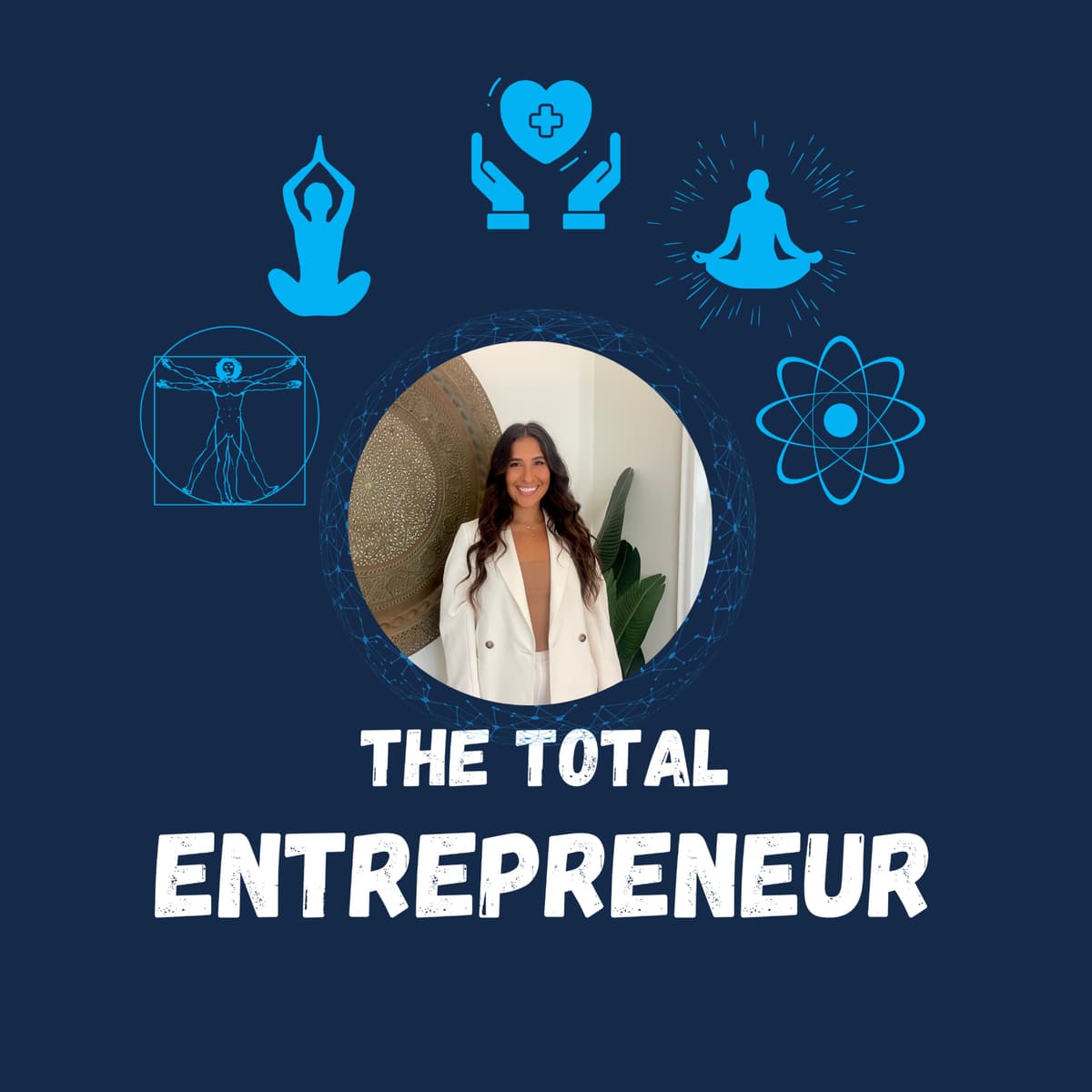
Burnout: A Mirror to Self-Discovery with Karenna Soto
with Karenna Soto
Jul 4, 2025 · 00:34:26
Part of our conversations on
Today's guest is Karena Soto. She is a speaker, co-host of the Fully Expressed podcast, and trauma-informed somatic practitioner redefining what success looks like for high-achieving women. Through her signature frameworks and somatic tools, she helps women expand their capacity, manage their energy, and lead with authenticity without burning out. On the podcast and in her work, Karena challenges the belief that women must choose between ambition and wellbeing. Her mission is a bold invitation to live fully, lead powerfully, and hold more without sacrificing who you are. Welcome to The Total Entrepreneur Mind, Body, Spirit, where we turn cutting-edge science into practical strategies for entrepreneurs. I'm your host, Dr. John Torrance, Entrepreneur Inc. 5000 honoree and professor of entrepreneurial practice at Syracuse University's Whitman School of Management. Each episode, we dive into mental, physical, and spiritual health with expert guests offering actionable insights to help you thrive and perform at your highest level. Let's get started. Karena, welcome to the podcast. It's great to have you here.
Thank you so much for having me, John. I'm so excited for this conversation.
Yeah, me too. So, I wanted to start by talking a little bit about burnout. It's something that a lot of entrepreneurs, especially young entrepreneurs, experience. So, I was wondering if you could just talk to us about your perspective of that burnout's a mirror, not really a symptom. And I think that'll resonate with a lot of our listeners.
Yeah. I mean, it's so interesting when you hear the word burnout, everyone kind of thinks of like, I'm tired, I'm exhausted. They're thinking about all these like symptoms, right? Like, am I burnt out? I'm, you know, over— I'm experiencing all these physical symptoms, but it really is simply an invitation for us to see within ourselves where we're not honoring our unique capacity Or where we have the opportunity to mature. And so when I look at burnout, I think it's both like a spiritual, emotional, mental, and physical, um, growth or maturity that we get to step into. And especially in entrepreneurship, when I first started, I hit burnout. I think a lot of us hit burnout, but there was a lot about entrepreneurship that I didn't know, and there was a lot of me dishonoring myself. And doing things because of how I think I thought was gonna make me successful or the way that entrepreneurship works for everyone, right? Like you saw all these people doing it, right? And so I did it in that way. And then, yeah, it just ended up being a mirror back to me of, so where, where I was immature or where I wasn't fully developed or where I was being invited to expand, not necessarily walk away or run away, which a lot of people think about burnout as like, okay, maybe I shouldn't be doing this.
Yeah. So, so let's break that down a little bit because I find that super interesting. And, and I think most, most experiences we have in life are probably mirrors, right? So let, you know, if, if you're feeling burnt out, it's, it's showing you something about yourself, right? Um, yeah. So, so let's dig into that cuz I find that super interesting. So you've got an entrepreneur who's, who's getting started. They're watching all the, the clips and podcasts about hustle culture and grinding and, you know, ghosting everybody so you can work on your startup and all this, right?
And now they're burnt out.
So, but how is is that a mirror, right? Like, what, what, what should they be looking at inside of them to, to get at that?
Yeah, I would ask yourselves a question as to like, what parts— where am I leaving parts of myself behind? So we all have different parts of ourselves, and I think especially in hustle culture specifically, as to what you're talking about, we're hustling but we're ignoring our experiences sometimes. And so I believe that each individual person on this planet has a unique capacity, and when I think think of capacity, capacity isn't the amount of time that you have on your calendar. Capacity is the ability to be with stress, life, entrepreneurship. And so, I think when you step into entrepreneurship, you are going way beyond your capacity, which is stretching you way too thin versus learning how to honor your capacity and expand yourself in ways that— so you don't burn out. And so, the reason it's a mirror is because I would ask you the question, it's like, where in your life are you ignoring parts of yourself, or are you suppressing parts of yourself, or are you abandoning parts of yourself? Now you're into your internal world as to like, okay, where am I leaving myself behind in this process of hustle castle culture, grinding, pushing really hard, isolating, you know, um, just to be able to build your business, your passion, whatever you're creating?
Yeah. Is your experience that people are doing all this hustling and grinding and burning out because they think by doing that they'll be happy and then after that they can take care of themselves? 'Cause that, that's what I find. So I was, I was just kind of interested in your observation on that.
Yeah, I mean, I'd love to know a little bit about yours. So tell me about your experience with that before I answer.
So yeah, I work with a lot of young entrepreneurs, student entrepreneurs, and it seems like they go all in on their startup because they feel like that's what they have to do, right? That's what they've been told to do. They buy into the hero worship and they think, well, once I hit this milestone, I'll be successful. Once I'm successful, I'll be happy and then I can take care of myself. But it almost seems like that's backwards. That's my experience. Yeah.
Yeah. I agree with that. And I also like, I would ask like the bigger questions as to like, what are they trying to prove to themselves? Or like, where is like almost deeper into like where, which parts of them are attaching to like, this thing is gonna give me the freedom, um, or this thing is gonna give me the fulfillment. I think a lot of the times, I mean, especially in early entrepreneurship, you put so much pressure on yourself to make this work. And then I would ask the bigger question that's like, well, what if this thing fails and you don't make it work? And you don't get to a place of fulfillment. And what I have realized in entrepreneurship, especially when it comes to burnout, is like we, us individually, we are the life source of our business, right? We are the thing that gives it pulse. And if we're not taking care of ourselves, then that's, then what's the point, right? That this thing that we're creating, we won't be able to sustain it. And what we have to realize is that the patterns or the habits or the way that we relate to our business early on. if we continue that for a long time, it's going to end up doing us a disservice because then when you do get to the place, let's say, of success, I'm like, are you going to continue to relate to your business in the same way? Did you set it up the same way? And so again, I would ask like the bigger question and thinking about like, okay, knowing that you are the life source to your business, you're the thing that gives it pulse. How can I make sure to show up in a way that, that I can sustain what I create. And that means also enjoying life and making sure that you're healthy physically, mentally, spiritually, emotionally, um, at the beginning of your business or entrepreneurship journey. And I think if you build with that foundation, you will get to a place where you have the success and you can have the fulfillment at the same time, right?
Yeah, no, exactly. It's almost like you can skip all that stuff and choose to be happy now. and then work on the success, right? Or like, let it just come. So, so let's talk about you for a second. So how did you get to this point where you kind of, where you realized all of this? Was there a personal turning point with burnout? Um, and what did that reflect back to you?
Yeah, I mean, I feel like I've had my own phases of burnout. Um, my first phase was when I had like really kind of got hit with like more of like chronic illness to the point of exhaustion to where my hormones were imbalanced, gut issues, headaches, migraines, and I worked on that with a naturopath from a nutritional standpoint, and I got better. But it wasn't until 2 years later where I joined and got my somatic certification, which somatics is the ability to do soma through the living body. So imagine doing your transformation through the body, not just your mind. I believe that we have— we need both, right? We need the mindset, but we also need to get on board with our bodies on board with the change. As a little small statistic, when you do transformation through the mind, you have a 20% chance of transforming. But when you do it through the body, you have an 80% chance of transformation. And that really means getting all parts of you and your body on board your transformation. But in short, during that time of me going through that certification, I realized how exhausted I was and how I was ignoring different parts within me and how I wasn't giving space for the parts of me to express themselves. I was just suppressing the parts of me in order to show up in a way that I thought I needed to show up in to be successful, to receive the success, the fulfillment, which kind of ties into everything that we're talking about here.
So did you just realize this on your own and you decided to follow this path, or did you have somebody, you know, kind of shake you a little bit and said, hey, Karena, you're, you know, you need help here? Or how did, how, how did this happen?
Yeah, I will say I don't think I've ever had anyone really call me out on like, Karena, you're burning out. No one has ever really called me out.
Okay.
That was something that I had to come to on my own. Um, I think it came through like the inner work, the ability to know inside of me like how I was operating or how I was ignoring myself really gave me the clarity as to like, wow, I'm suppressing so many parts within me in order to show up a certain way. And I came to that conclusion. Um, I've always been someone that's been super introspective. I tend to be more of the observer. I love to learn and you know, I think in my own journey, being able to experience these things, I think we all have a journey on how we get there. Um, I got there and I also got to a place where I was like, I just don't want to live my life this way. I, I want to feel connected.
Absolutely.
I want to feel like I have life, you know, I want to feel alive in my business. You know, I don't want it to feel like a burden. I don't want it to feel like something I have to do. I want it to feel like something that I love, that I want to create. And so, What does that look like? That means taking care of myself as the foundation to everything else in my business, my life, my relationships, because we don't just have our businesses, right? We have so many things outside of business that are also consuming and being a part of our energy.
Right. I say it all the time. You're, you're a human first, and then the business follows that, right? Yeah. So, I mean, no, nobody's Perfect. And none of this works 100% of the time. So you probably, I mean, I'm guessing anyway, that you still feel burnout or feel like you're going down that path once in a while. So what are the signs you look for in yourself and then how do you make these self-corrections?
Yeah. So I consider these the burnout warning signs. Um, so some of the burnout warning signs that you can pay attention to are, do you feel like you're not as motivated or able to be as focused? Um, are the things that you love in your life starting to feel like a burden? Is You know, the idea of taking on something in your business, like let's say you wanna pivot or you have a hard decision to make, is it taking you longer to make those decisions than normal? And the other things to think about, like another task. So like let's say all of a sudden you need to hire a team member, but the idea of training a team member is just like, ugh, where am I gonna have the time for it? Um, where am I gonna have the capacity for it to do that? And those I think are Um, really great things to pay attention to. Your body will also speak to you. So think about your body speaking to you through being like not having— not sleeping well at night, so you're not waking up refreshed, right? Like you're kind of tired and exhausted. Maybe you're getting a little bit more sick than normal. You're experiencing headaches, you're experiencing digestive issues. Maybe there's a lot of tension in your chest or things like that. Or in conversation, you're dissociating, which is another one that is important to pay attention to is like maybe you're with your partner, a friend, or in a business meeting and your mind is completely in a different world.
Yeah.
Those are some things to pay attention to. Um, because I would say that's where I like to think of your capacity as a battery life. And so you're kind of in the yellow, right? Like you're in this yellow state of like you could plug in and charge or you could keep pushing yourself. before you get into burnout. And that's where you get into the red, where if you look at your phone, that's where in the red, you know, your phone starts to work slower, isn't working as properly, things like that. We want to avoid that when it comes to our bodies. So what does it look like to be in the yellow for ourselves?
And yeah, so there's this idea of, I guess, depleting and renewing activity or depleting and renewing emotion, right? So, so what are some of the The renewing activities. So, so like say you're in the yellow and you notice your, your battery power is getting really low. Like how, how can you recharge it effectively?
Love this question. So this is what I call a capacity giver. Um, and so a capacity giver are gonna be things that are gonna fulfill you. And I think for every single individual, we get to figure out what that is for ourselves. But some of the most common ones that are gonna be capacity givers is making sure that you're eating nourishing meals. As an entrepreneur, I don't know how often I know this, and I did this myself. Living off coffee is not a nourishing meal.
Yeah.
You know, drinking water, um, community, you know, really connecting with other people. We see that as like a source. Is that filling us? I remember giving this talk to another set of entrepreneurs and there was an event that we went to and they said, because I walked them through what their capacity is so they can figure out where their capacity is at. And before she walked into the room, she was at a 40, but because she was able to be around community, she got up to a 60 when it came to 100% of her capacity life. And so I don't think we realize that hanging out with our friends, our other people that relate to us can be a huge capacity giver. Um, and then the other ones are gonna be obviously nature. So getting outside, grounding, sunlight.
Mm-hmm.
Um, having inspiring conversations, leaning into the parts of your business that give you energy. So for me, I also have a passion podcasts. When I am doing podcasts in person, I'm like, this gives me so much energy, I want to go create more. You can feel the energy that you get to give. So those are some examples that I think a lot of us can relate to. Um, but the invitation for anyone listening is just pay attention to your energy. Like, is this something that makes me feel alive, that gives me energy to keep going? Or is there something that is maintaining my energy? Or is this something that is draining my energy? Because we also want to pay attention to What's draining our energy.
Yeah. And the things that you talked about, right? Like nutrition, getting outside, grounding, sunlight, community. Those are things that'll make you more resilient, right? So you can maybe withstand, you know, more depleting times or something like that. But I, you know, I love the fact that we're talking about grounding, right? So like even, even 5 years ago, nobody would've really, I mean, people weren't talking about it. They didn't believe it. I mean, I've got a grounding pad on my bed. I've, my feet are on one right now.
Right.
So, so like I've I really buy into this and I love it. And, you know, I know we share a love of Costa Rica. I know when I'm there, I'm in the sand, I'm in the water, I just feel more energized, right? So I don't know, like, did— do you have anything else you could say about grounding, or do you recommend that to people you work with, or— yeah, what do you think about that?
I think it's so funny. I want to like reflect back to you. I think there is— there was this woo-wooness about grounding.
Um, yes.
And I'm just like, why? And I, and I think it's because we haven't really gotten the science behind it. So my partner, he's a certified nutritionist. He's really kind of studying a lot about light biology and the sun. And I'm not going to get this right because I am not him, but I think what's important to know, he says, he's like, you know, the electrons that we get from the earth directly into our body is, is actually supporting the cells in our body. And so grounding is actually our natural state, and we don't realize that we are connected to the earth. And so—
Yeah.
The more that we can connect to the earth, the more energized we're going to be. And the kind of grounding that we get from the earth can't be replaced. So it's so important that we put our feet on the ground, that we put our feet in the sand, that we go out in nature because we are surrounded by all these different EMFs and things that are draining our energy in our day-to-day. And so why not go to the source when it comes to—
Right.
Feeling the most energized, right? It's literally right there with— right outside our doors that we can access to. So I think grounding is the most important thing. I also think sunlight or just being outside, you can feel a difference. I think as an entrepreneur, it's so easy to get locked up behind your computer and getting stuff done and being behind a lot of blue light, which, you know, it's necessary. You know, we can't avoid that in this digital age, but how can we sprinkle in more time outside?
Mm-hmm.
Giving to our capacity and giving to our nervous system so that we can sustain everything that we're creating.
Yeah. Now I've got a good friend who's really into studying light and, you know, his, you know, his major thesis is that, you know, it's everything, you know, and it's just even in terms of the timing of your meals and, you know, the EMFs, like, you know, he, he did a little experiment where, you know, he, he got close to a very, um, strong wifi signal and he was wearing a continuous glucose monitor and the closer he got to the signal, the higher his glucose reading was, uh, just because these EMFs and this invisible light spectrum, it definitely changes the body. He actually works with a guy, he's a building biologist. Have you ever heard of such a thing, a building biologist? So, yeah, they go in and they've got a little meter and they read the electromagnetic signatures next to your outlets and this sort of thing. And so, I bought one and I was shocked to learn that the outlet next to my bedside table was just spewing out all this dirty electric energy, which was obviously affecting my sleep. And, that's one of the things we didn't didn't talk about earlier. Like, you know, we talked about nutrition and community and all the things we know, um, are good for just your own healthspan and longevity, right? But they're also obviously good for resilience. But yeah, sleep, of course, the first pillar. But yeah, you've got to get that good light in the morning, you've got to avoid blue light in the evening. And yeah, I find that super interesting. So I, yeah, I like that. I like that he's studying that. That's cool.
Oh my gosh, they would be best friends. This is my world. The, the biggest shift I would say that I've been for my health— I've been someone that has done all the things when it comes to like hormone health, gut health, nutritionist, because now that I know the value of my energy, I'm like, what can I do?
Yeah.
'Cause I've, you know, when you hit burnout, let's just bring it back to burnout. When you hit burnout, you get to a place where your energy's so stretched. I mean, I was hitting like 3:00 PM on a regular day and wanting to take like a 2 or 3 hour nap. And I'm like, wow. And I was getting hard on myself and feeling all this shame and all this guilt because I wasn't able to sleep and take a nap. And so my energy is, I think, the most important thing in my life because it's the thing that's gonna give and re— give me to receive everything back. And the biggest shift that I will say from a health perspective that has tremendously changed our lives, and this is to Nick, has been living by the circadian rhythm diet, which is what you're talking about. So, we eat and sleep with the sun. So, what does that look like? We wake up with the sun, we go to sleep with the sun, we eat only when the sun is up, and we're also eating really early dinners. And so, that in itself, and we also have like, I actually have this light in front of me. You should probably get this. I'll send you the link for this. But this kind of replicates things of the sun. I literally laugh. I'm like, Nick brought the sun into our home because even the lights that we're using for cameras, like they are harming us, you know? So what can I do to do that? Anyways, just living by the sun and eating by the sun has been, and living a circadian diet has completely changed my life. I mean, the way that I view the winter compared to why I view the summer, like in the winter we're supposed to sleep so much more. Sleep is Yeah. He says it's the melatonin of the, of the winter. You need the winter. And what we don't realize, if we live seasonally, like we're supporting ourselves all year round. And I think that's what's difficult for humans when it comes to burnout is like, we think that it's so much easier to find a structure. It's so much easier to say A plus B equals C, and how can I live this every single day of my life? Um, but when it comes to what I talk about, which is like honoring unique capacity, There is no A plus B plus equals C. It's kind of unlocking what is your signature formula for your day-to-day in entrepreneurship in a way that's going to support your capacity, which is a.k.a. going to support your energy, which is the life source to your business to like bring this all back.
Yeah. I mean, that's one of the beautiful things about entrepreneurship is that you can work when it works for you, right? You don't have— you're not stuck into a 9-to-5 scenario, right? So if your circadian rhythm is different than a 9-to-5, of job supports, you can lean into that and do that. But I, I agree with you. We, like, I eat dinner super early. Um, I'm that annoying friend who asks for the 4:30 or 5 o'clock reservation if you want to go out, you know, something like that. Right. But it, it's so like, I know, like, I, I always had trouble with my REM sleep. Right. You know, I wore an Oura Ring and I was tracking it. I'm like, why aren't I sleeping that well? And, you know, I start managing my light exposure, my EMFs, and my meal timing. And, you know, now all of a sudden I'm Killing it with my REM and my deep, you know, the small tweaks make a difference and they don't cost you anything, which is what I love about it.
We would be best friends. We're always like, can we get that 5:30 reservation please? Because yeah, about it from a digestive standpoint, you know, the later that we eat in the day, our bodies think that they're supposed to be awake, you know? And then, so we're trying to go to sleep and our body's trying to digest when it's actually At sleep time, we're— so that's our time to heal, for ourselves to recuperate, to do other things to give us the sleep that we need. Like, sleep is so important when it comes to our energy and our output for each day.
Yeah, no, it's, it's critical. And, you know, I'm, I'm glad I learned it when I did. I wish I'd learned it maybe a decade earlier, but it's, it's, it was really good.
Same.
Yeah. So, so let's turn our attention to, to the somatic work you do. So first, describe what that is, right? Because I mean, I think a lot of people sort of understand it, um, self-included, but I don't really have a really deep grasp of it. So I'd love to hear more about it.
Yeah. So when it comes to somatics, think of soma as living body. Um, what I love about somatics, again, it's the ability for you to be with your nervous system and understand what's going on within the body. It's kind of talking to a lot of what people talk about, like mind-body connection. Um, have you heard of Of course.
Yeah, I love it.
So, breathwork is a great example of a somatic practice. Um, also, you know, you can think of, yeah, yoga as a somatic practice, anything that allows you to drop in. I think specifically in my work specifically that I have done, it takes it a little bit deeper. So, we each have different sensations in our bodies when different things come up for us, right? And so, when we are feeling stretched thin, some of us might feel it in our throat, Some of us might feel it in our chest. Some of us might feel it in our belly. Some of us might feel it in our head. And so what I love about somatics, it gives you this deeper connection to your body and what's going on in your body and the sensations that are going on with your body. So every time that there is a part of us that is activated, triggered, suppressed, sad, our body is having the experience of that.
Mm-hmm.
So I don't know for you, like, if you ever— let's just— I think anger is one that people can relate to. Um, anger, frustration. Like, the invitation for you is like, where does that show up in my body? You know, like, I feel it even as I say it. Our bodies have an experience. I can, I can feel in the back of my, like, neck, you know. I'm like, immediately I'm like, I'm holding stress there. There's energy there. What does that look like? And in a somatic experiencing session, if you were to dive deeper, you would actually be able to expand and work through the energies that are in your body and help your body process the emotion or the experience that you're having. So I think what has happened a lot in our world is that there's a lot of ways we should act, but our bodies know exactly what they need to do in order to heal, um, or express emotion. But we have basically put boundaries on ourselves to be like, why can't express that. You know, a great example is, have you heard the story of the, the lion chasing the, the giraffe or something like that? And so, the lion chases the giraffe and the giraffe is running away and gets away. They immediately do this huge body shake and then they go back into rest and digest. And so—
Ah, right.
Immediately able to shake off the stress and go into more of a rest and digest state of your nervous nervous system. We have that as human beings through the body as well. And so what does it look like every single time that we experience sadness, experience, um, anger, frustration, feeling stretched in our business? What are we doing? A lot of the times we're either suppressing them in the moment and being like, I can't, I can't deal with that right now. I gotta show up with what's in front of me.
Mm-hmm.
The key thing I think in business is learning how to be with that now. So it doesn't build up over time and create an illness or show up as a physical symptom. And so to bring it back to somatics, like it's really the opportunity for you to digest and express your emotions in a way that gives them the opportunity for the parts of you to feel seen, heard, and understood. Our part, our body knows. We are just not in tune with what it needs and what it wants. Hmm.
I hadn't heard of the giraffe and the lion story before, and I like that because it, you know, just, I guess it illustrates the fact that we're not meant to be in that stress mode all the time, right? It has a very purposeful evolutionary reason to it, but we're never meant to stay there all day. And I think especially in an entrepreneurial setting where there's resource scarcity and uncertainty and ambiguity, it just sort of feeds that, right? So I think it's I understand why people always feel that stress, but yeah, maybe through some sort of somatic practice, they can get themselves back into that rest and digest phase. I, I, I've done a few breathwork sessions myself and I really liked it. And then the more I read about it, 'cause you know, I'm the type of person that when you do something, then you gotta dive into it and obsess about it for a while and learn about it. Right. So, and it connects the body to the spirit, 'cause I mean, it's literally inspiration, right? Or spirit bringing the spirit into you. And I thought that was fascinating. So just the— You know, the idea that you can get yourself into these different healing states just through breath to me was fascinating and really liberating. You know, you don't, you don't need much, but that helps.
Totally. I mean, I think I'm not a breathwork expert specifically to say. I have some breathwork expert friends if you want to talk to them. Um, but there is something that happens in the brain where we're able to release, uh, emotion. And a lot of people say like DMT or experience, um, even psychedelics. Like through breathwork, and like when you think of that to me, I'm like wow, how incredible our body is just to be able to access those things. But I didn't know that I could get there off breathing. And I think what's funny about breathwork is like people are like oh you're just doing some breathing exercises, and I'm like well there's different types of breathwork you could be doing, but it does take you into a state that allows what a lot of people use the word as your body to allow you to alchemize. So you're just expressing and releasing stuck energy and emotion. And when you think about as an entrepreneur, the more stuck energy we have, the more energy that's going to drain us. And as human beings, we do such a great job at trying to fight those emotions, which also takes our energy. And so when I think of like, when it comes to this personally, I think the most productive thing we can do Is learn how to be with our emotions, learn how to express them instead of avoiding them. But that doesn't come natural to us because feeling them can be scary. It can be overwhelming. Feel like well, if I if I if I open this can of worms, there won't be any ending. But if you realize what happens on the down the further end, that's where we hit burnout because we've been suppressing for so long. And it's like then you're experiencing one. I mean, healing from burnout. If you've experienced burnout, it could take some time. You know, it could take 1, 2, 3, 4 years of really healing from burnout. And I'm saying like physically, mentally, spiritually, emotionally.
Right.
And the challenging question that I ask a lot of entrepreneurs or people that are dabbling in their habits, I'm like, do you wanna waste 2, 3, 4 years down the line? I'm like, time is everything. And if we can just spend 10 or 15 minutes or an hour a day being with our emotion and expressing them, I'll take that for 4 years of my life later, later, right?
Yeah. And it, it's, it's simple but not easy, right? It's, it's, it's not super complicated. And I think a lot of times the simplicity of it makes it so people don't really buy into it. It's like, well, breathing, we, we do that all day long. How could that be helpful? Right. Or yoga. All right, that's great, but how's that really going to help me? But, or meditation is another good example, probably one of the more, you know, studied and researched practices. And there's all sorts of evidence and data that says the ROI on that is enormous, but it's so easy. It doesn't require a pill. It doesn't require a visit to a specialist. It doesn't require all. So I think we minimize the potential impact of it because it's so simple.
Totally. I do want to make a comment on meditation and coming from a somatic practitioner. I think sometimes meditation can be hard because as entrepreneurs or someone that is in fight or flight all the time, your mind is spiraling, right? Like you're thinking about, I don't know, you can be thinking about the million things you have to do in your business, the decisions that you have to make. Oh my gosh, I have to get ready for the kids, whatever, right? Our mind is constantly going. And I think some people resist meditation because there's this idea that you're supposed to find stillness in meditation, and that can be really hard.
Yeah, that was me.
Yeah, that was you.
Yeah, for sure.
I think, you know, you can mentally push yourself through that and be like, I'm gonna find my stillness, you know, ignore the noise in my mind. Um, my recommendation for anyone that is experiencing those things is first shake out your body, like completely shake everything out. You can even go through some tapping, through some stretching, move your body, do like a little like 5-minute yoga flow, whatever it means to like move your body, like stretch your And then allow yourself to drop into meditation. You will feel like, especially if you get up and shake everything out or start tapping any area that feels tight, you will feel the energy start to move through you. And then try and focus in your meditation on the energy that you're feeling. And then I promise you, you will find stillness because you're moving the energy that's in your head to your body and you're allowing yourself to connect to your body.
Absolutely. Anytime I meditate now, I always do a, uh, a heart coherence tech. I don't know if you're familiar with HeartMath, but I'm a HeartMath practitioner. So yeah, it's basically the connection between your heart and your brain and getting that into coherence. And the idea is that your heart sends way more information to your brain than vice versa. And if you get into a coherent heart rhythm, I mean, one, that's, you can measure that from 3 meters out and you can affect somebody else's heart rhythm. So that's kind of interesting, but I, I get into a, a coherent state, then I do my meditation and it's just so much more effective for me. Yeah.
I love that for you. I'm like, you gotta tell me more about this heart practices that you do. I feel like that is so cool.
Yeah. Heart-centered breathing is one, quick coherence. But there, yeah, there's a whole scientific institute on it called the HeartMath Institute. Yeah. You should check that out. It's a, it's a super cool, um, I, for me, uh, it could be just because it's science-based, right? There's a lot of data and like, you know, when you, when you walk into a room and you could feel the vibe. Like you are literally feeling the vibe. It's the, it's the electromagnetic frequency from somebody's heart like that you, you can feel and your heart kind of gets into rhythm with that. And it's a really cool phenomenon.
Wow. I love this. I'm going to go look into it for sure. And I'm going to tell Nick about that. That is so cool. And it's so true. Like you can feel energy. Um, you can feel where someone's at. You can also feel their state. And I think bringing this back to burnout, you know, like When you step into your room, do you want to feel connected and open, or do you want to feel rushed and all over the place and exhausted? You know that energy is so different, and I think the more that we learn to lean into our capacity givers, honor our unique capacity, truly love, you know, live from a place of you are the foundation to your business and your life, the more rooms you're going to walk into that feel more heart-centered and heart-opened versus just. feeling stretched or running all over the place and disconnected and disassociated. People can feel that.
Actually, that sounds like an amazing place to end it. That's really good. Thank you. Thank you so much for listening to the Total Entrepreneur Mind Body Spirit Podcast. If you liked what you heard or heard something interesting today, please give us a like, share a comment, or better yet, subscribe to the podcast. Thank you.
About This Episode
In this conversation, Karenna Soto, a trauma-informed somatic practitioner, discusses the concept of burnout as a reflection of one's internal state rather than just a symptom of exhaustion. She emphasizes the importance of recognizing personal capacity, the need for self-care, and the role of somatic practices in managing energy and emotions. Karenna shares her personal journey through burnout, the signs to watch for, and practical strategies for recharging energy through capacity givers, grounding, and breathwork. The discussion highlights the significance of emotional expression and the connection between the body and mind in achieving well-being and success in entrepreneurship.
Takeaways
Burnout is an invitation to explore personal growth.
Recognizing where we leave parts of ourselves behind is crucial.
Capacity is not just about time; it's about emotional and physical energy.
Self-care is foundational to sustaining a business.
Grounding connects us to the earth and replenishes energy.
Nutrition and community are vital capacity givers.
Breathwork can help release stuck energy and emotions.
Somatic practices deepen the mind-body connection.
Emotional expression prevents burnout from building up.
Living in alignment with circadian rhythms enhances well-being.
Visit www.karennasoto.com to learn more about burnout prevention with Karenna.
Keep listening
More on Body
About the Host
Dr. John M. Torrens
5× Inc. 5000 entrepreneur, Professor at Syracuse University's Whitman School of Management, author of Lightning in a Bottle, and TEDx speaker on ADHD as an entrepreneur's superpower.
Browse all podcast guests →Book a strategy call →