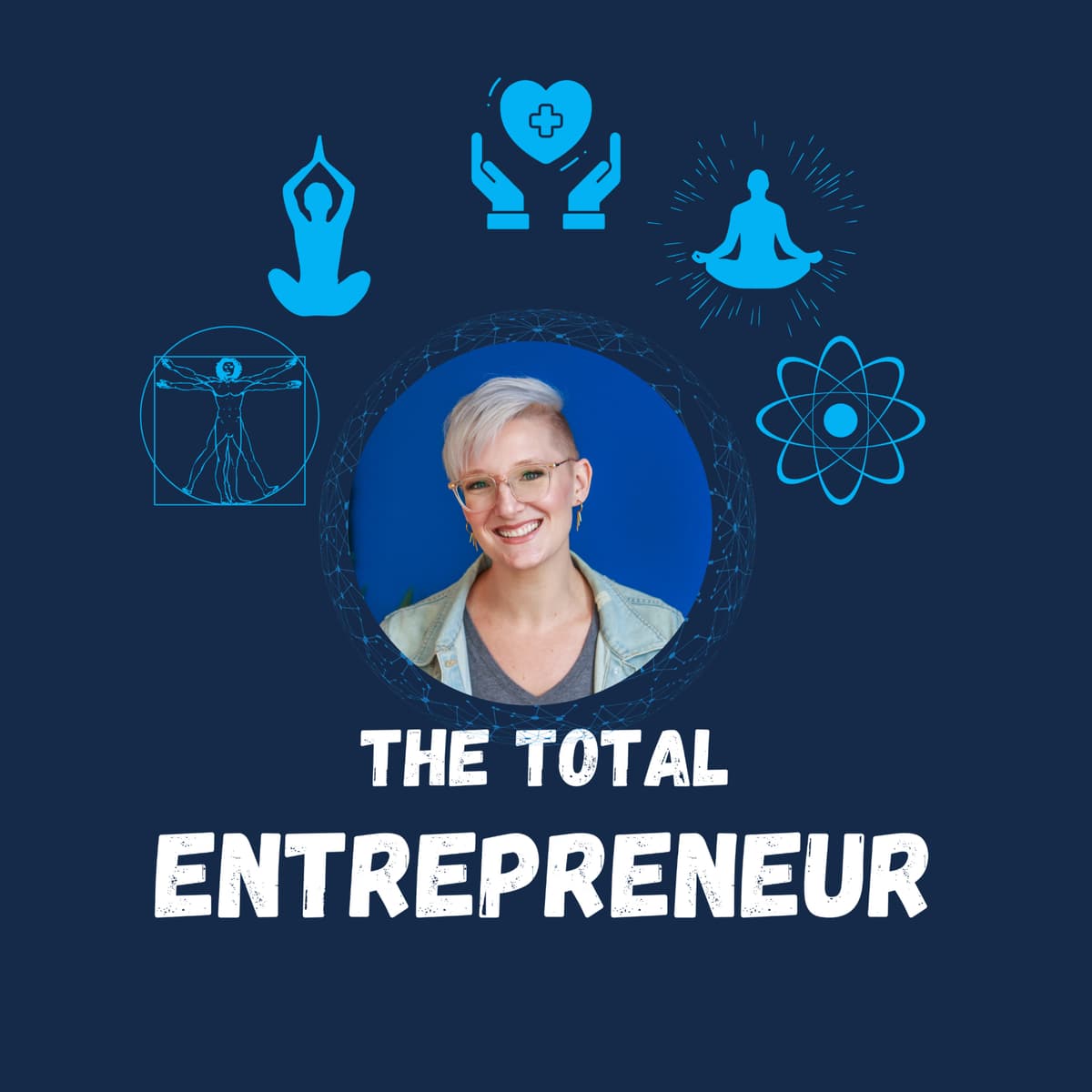
Mental and Emotional Profitability in Entrepreneurship with Mel McSherry
with Mel McSherry
Jul 11, 2025 · 00:42:56
Part of our conversations on
Today's guest is Mel McSherry, an international business and life guide who helps inspired but overwhelmed entrepreneurs honor their lives and become the architects of their own success. Mel uses their spiritual gifts and their 14+ years of business building experience to slash entrepreneurs' stress and bring their success to life. By merging Human Design with traditional business development tools, Mel coaches others on how to connect with what they want and implement their strategies and strengths to be profitable every day, mentally, emotionally, and financially. Welcome to The Total Entrepreneur: Mind, Body, Spirit, where we turn cutting-edge science into practical strategies for entrepreneurs. I'm your host, Dr. John Torrance, Entrepreneur Inc. 5000 honoree and professor of entrepreneurial practice at Syracuse University's Whitman School of Management. Each episode, we dive into mental, physical, and spiritual health with expert guests offering actionable insights to help you thrive and perform at your highest level. Let's get started. Mel, welcome. Great to meet you and great to have you here.
John, thanks so much for having me. I'm so excited to be here.
I was really interested in talking to you because you've, you're an in-demand speaker. You've given over 200 talks globally.
Yeah.
So based on your experience speaking to global audiences, I was wondering if You know, if you could just sort of distill for us the things that resonate most with your audiences, if that's possible.
Yeah, absolutely. So my main focus and what I feel I connect to a lot with entrepreneurs especially is how to prioritize their profit avenues. And I use profitability threefold. That's mentally, emotionally, and financially. And I love to extend it into those different buckets. Because we get so caught up in everything that we think we need to do. Oh, I have to have this, or I need to do this. And what we don't do is we don't truly understand where our profitability lies within ourselves first. And therefore we get overextended, we get overwhelmed. And so I love showing entrepreneurs how to connect to themselves, how to trust what they already know to be true about their process, about you know, how they want to create, what they want to create. Because again, a lot of us go, oh, I want to do this, but can I? This is how I want to do it. Is that okay? And the thing is, is yeah, that natural inclination is you naturally attuning to your most profitable points, your strengths, your strategies, and so forth. And so I really love to give entrepreneurs that permission and that pause to ask Ask themselves, okay, what do I want? How do I want this to come about? And then what are those actual customized steps that I can create for myself to build it?
Such important questions. And it's really good to hear you putting that out there. So, you know, listeners can, can ask themselves. So I guess we can jump right into that. You've got, um, you look at profitability in a slightly different way than most people might. So tell us about that.
Yeah, that, that came about from my very long journey as an entrepreneur. I've been an entrepreneur since 2010, so I've been through many different ideations. I started in the fitness industry and then moved into the coaching industry in 2016. And especially when I moved into the business coaching space, I really subscribed to that mentality of just find the experts, you know, copy and paste, You want to hit this goal by you know this date, this goal six figures, yada yada yada, right? A lot of those tactical traditional milestones, and I fully subscribe to that. And that is why I have been able to achieve a lot of those really on paper successes, like what you mentioned earlier—the fact that I've spoken over two hundred times. However, I was slowly but surely burning out, and I didn't know it at the time because. I kept thinking, oh, but this is working. I'm, I'm getting all of this, these accolades. I'm hitting all these milestones.
Mm-hmm.
But internally nothing felt mine. I felt like I had to consistently show up instead of step in. To me, that's 2 different things. And I realized I was putting this mask on myself so I fit the descriptor of quote unquote woman business owner or quote unquote international speaker. And in 2020, I was at a crossroads where I was trying to figure out why is this not working? And I realized I was putting that financial first. I was making that the absolute top goal on my whiteboard. Like, how much did I want to make this month? All of the numbers to make sure that I hit that goal. Right. Instead, and then from there, then I will feel rested. Then I will feel relaxed. Right. We'll get that. We'll get that benefit afterwards. Mm-hmm.
Right.
That's not sustainable. Right. And it doesn't even work that way. No, not at all. Even if you think it does, which I thought it did, it always gets you, right? It always bites you in the butt. And I didn't really understand how I could shift it back into something that was mine. So when I started putting my mental and emotional profitability first, really making sure that I was reprioritizing my time, in alignment with my energy. So honoring, okay, today I am super low energy. I said I was going to do XYZ. You know what? I'm going to look at my to-do list and do ABC that matches with my energy and my time. And I took that as a way to stay quote unquote consistent without burnout. And it was those little things that you do. Brendon Burchard has this great quote. He says, it's the little things you do every day that make the biggest difference. It's so good and it's so true. And we forget that. We think it's these big milestones, these big chunks that we have to take out to feel successful when really it's how can you feel mentally and emotionally profitable throughout the day so that financial actually has more room and more space to follow fluidly.
So, you said so much right there that I wish I was taking notes. But the one thing I'll talk about first, or actually, it was more of a clarification. So, You talked about the difference between showing up and stepping in. Yeah. Elaborate on that a little more for us. I think that's interesting. I think I get where you're going, but I'd like to hear your perspective.
Yeah. So for me, the difference is— so showing up is how we're, we're trained to be in a space, right? So we stand up tall, we have our eyebrows up, we are engaging, like we look welcoming, and we're really like— if you can see right now, I'm just like this. this is how I would look, and I would— when I was stepping into any sort of space or coming into a space, I would make sure all of that was on. So I was showing up as Mel, or what they thought Mel is, right? As opposed to walking into a space honoring how I'm feeling in the moment, dropping the shoulders, listening to people And listening with the intention of connecting instead of listening with the intention of selling or finding my hook or finding my way. It's more of setting that intention, going into space and just stepping in and relaxing and trusting yourself, trusting the conversation and knowing that the right people in that moment will always come find you. So those are the 2 differences to me. Showing up is very tactical, is very, um, strategic, is very planted. Stepping in is very grounded. It's very natural. And it's letting, again, that moment teach you in that moment, instead of you trying to forecast what that moment can give you.
Sounds almost like there's a difference between authenticity and just what you think you should be, or like showing up the way you described it is, hey, this is my role. This is how I, This is how I think people are expecting me to be versus just melting into it and saying, hey, this is authentically who I am. This is how I'm going to conduct myself. I think that's what people want.
Yeah. And it debunks that kind of traditional train of dress for the, you know, dress for the part that you want or dress the thing that you want for the job that you want. Dress as you are. And then you attract, you know, the way that you present yourself, the way that you talk, the way that you engage. That's what's actually going to give you those next steps to creating what you want. When you step into a space where you are acting out as a part of what you think you need to do, then every single one of those relationships, partnerships start off on that shaky level. And that just, that's exhaustion for you to try to keep that up all the time. So when you just come back to yourself and just come as you are, then you already have this natural sustainability to progress and to build on those proper relationships.
Yeah, that definitely makes sense to me for sure. And then you mentioned, you know, you had the whiteboard and you had financial goals and you were gonna hit this and you're gonna hit that. But the thing that I found interesting and the thing that I, you know, I end up speaking to a lot of young entrepreneurs about is the fact that once you reach those goals, that's not gonna be what makes you happy, right? Reaching the goal is gonna give you some satisfaction for sure, 'cause doing hard things satisfying. But because you've got these goals and because you've got a drive, you're going to forget about the one you just reached. You're probably not going to take time to celebrate it, and you're going to set the next one and reach for that. And then you're not going to be happy until you reach that one, but then you're going to reach it and you won't be happy because you've got the next one. So, I don't know if that's been your experience too.
Yeah, it's that exhausting vicious cycle, and it really doesn't give us, give us the permission to pause in that celebration. And it's though, again, going back to that saying, it's those little things you should celebrate because that's what keeps you motivated. Us choosing to be entrepreneurs, there's a reason why not everybody chooses to be entrepreneurs, right? There's, there's something different about us.
Yeah.
And yet, so we have to find our constant internal motivation to maintain building what we want to create in this world. And so you need to find it in the now. You can't just wait for it to show up today, tomorrow, because you did again XYZ. It's more of that, ooh, I had this really great conversation and that initiated this post, which could create this new offer. And it's finding those glimmers. We talk a lot about that, you know, inside of a lot of the mental health spaces of find those glimmers, find those shiny spots that you're like, yeah, no, I'm on the right path. I'm doing. the thing. So let's stick to that to make sure that that financial flows in.
Yeah, I think that's so important for people to remember and keep in mind. And yeah, it's, it's a, I think it's probably an underrated skill, right? Just being able to be present and be in the moment.
Not as easy as it sounds. It takes practice for sure.
Yeah, absolutely. Yeah. And, and it is, it's the little things, right? So it's, it's just, you know, showing up or stepping in every day, doing the little things, It doesn't have to be one big gigantic thing that takes all your energy and then you do it. And I've seen entrepreneurs try to do that, right? The big, one big strategic move, grand gesture that's going to fix all the problems. You know, like in any relationship, business is a relationship. It's the small things, the small deposits that add up. So I think that's great advice. So tell me about, so you've got, you've had 2 ventures. Did you, was there an evolution between your first and second? Like, did you learn things along the way that you applied to the second that you wished you had known on the first one?
Well, yes. And so moving from the fitness industry into business coaching, how that came about is when my son was born in 2011, I needed to find a way. I was traveling to people's homes. I was doing in-home trainings, outdoor boot camps, whole nine yards. And it was too difficult to travel with my kiddo. And so it ended up me taking a pause and figuring out how I could now create what I want with the time and energy that I now have as a new parent? And that turned into partnering with a network marketing company called Beachbody and being an online health and fitness coach for them.
Oh, cool. I know Beachbody.
Yeah. So, it was there that I got introduced to personal development. I saw Brendon Burchard speak for the first time. That's why I'm now a total follower of his. And I had gotten successful and consistent in my sales rather quickly. And that got the attention of my leader at the time. And she's like, you know, you are this— I was married at the time, but my, my husband at the time traveled all the time. So we coined me a married single mom. She's like, you're this married single mom. You are consistent in your sales. How are you doing this? And I didn't think I was doing anything out of the norm. I, I, what I was doing was just natural. But I couldn't necessarily explain it. So, she asked me just to do a day in the life of Mel following, like a training. And so, I did that. And I realized, as I have told this story, it's really fun to look back on those beginning pings of how I've progressed to where I am. And that first ping was me realizing that I was honoring my time and my energy management from day one. And how that really gave me more of that profitable consistency. And so when I quote unquote taught that to the rest of her team, all of a sudden her product, her team's productivity exploded. People naturally wanted to be on a team with me, which wasn't my intention at all. I just wanted to be a coach. I didn't want to, you know, hey girl message a bunch of people, but people just came to me and said, hey, I see what you're doing. I want to be a part of this. That got— so within a year, we were at the top 1% of the company. That got the attention of other people inside Beachbody. So I started doing team calls and trainings there. That got the attention of people in other network marketing companies. So I quietly started doing calls and trainings there. And in 2015, I was in the middle of my divorce with one foot in fitness, which was going nowhere because my other foot was in quote unquote business coaching. And I'm not very good at doing the splits. So, I thought if there was any time to have a plot twist in my journey, it was then. And beautifully, through Beachbody, I had the honor of having a year-long internship with John C. Maxwell, who is the coach of coaches. He's been around, done that for— I think he's going on 60 years now.
Wow.
And so, to be able to have a group call with him once a month for a year, that's what really gave me that push to see what business coaching is, how I could put my, you know, foot in it and my stamp on it. And so I got my international certification through him and his team, left Beachbody, and started my business coaching. And even inside of business coaching, it's, it's evolved from 2016 till now. Um, and again, it always is coming from that, that those transitional spots of, okay, I'm not feeling connected to my business, as I mentioned earlier.
Right.
And so it's, it's those, it's those prompts that show us we are moving into that next level. And it's being open to that and seeing, you know, and trusting where that has taken me that has led me now to implementing a really beautiful spiritual tool called Human Design in partnership with the traditional business and personal development tools and frameworks that I have been utilizing for the last 15 years.
That was my, one of my next questions was it was about human design. I'm, I'm fascinated by it. I love the idea of it. So yeah, tell us more about that.
Yeah. So human design is a tool and formula that combines astrology, I Ching, Kabbalah, chakras, and quantum physics. Wow. Yeah. So it's, it's not, it's not nothing. Uh, and how it, how it's used is it shows you your energetic blueprint. It shows you the profitability in your differentiation in yourself and shows you how to connect to your unique energetic blueprint. It shows you where your energy comes from, how much natural energy you have, where— how do you make your best decisions, your strategies, your starting points, your stopping points. It really gives you a customized operations manual that validates and confirms what you already knew to be true about, as I mentioned earlier, about how you want to create the business, the money, and the life that you want. And then the awareness of where you've gone too far and the vernacular to advocate yourself because you now know that this is true. So it really helps you look at all of the shoulds and really helps you understand which ones are meant for you and how to customize them to you. Because there really is no copy and paste ever. Everybody— and to make something successful successful, even the, the experts that we follow to this day, they've taken something they've been taught and they've customized it to work for themselves. And I, I love that example. I think we've gone too far in the fact that then we latch on to that and don't remember to customize. But a lot of the time is, is because we don't know how. And that's where Human Design steps in. It shows you how you can truly create what you want in a sustainable and profitable way that is based solely on yourself.
So you mentioned a lot of different philosophies there. So would you list those again? Because some of the, I mean, I really love a lot of what you mentioned, but I want to remember all the ones you said.
Yeah. So it's Kabbalah, I Ching, astrology, chakras, quantum physics.
Oh, wow. That's a great mix. Right. So, I mean, this is a large body of work and information to pull from. Absolutely. So yeah, I mean, you could spend a lifetime just on one of them, right? Yeah. So how did, how did all this come together? Like, was it, did you just have an epiphany during a meditation or was this like a series of, you know, did you journal to get to it or how did all of this come to you? Because it's, it's, yeah, it's quite a lot.
Well, I wish I could take credit that I brought this forward, but I didn't. This was actually been created by a gentleman named Ra Uru Aru. in the '70s, actually. So this has been a practice that has been around for a while. And it's becoming a little bit more popular, I would say kind of more in the Instagrammable spiritual space.
Sure.
So that, you know, everybody gets kind of where the vibe is with that. And when it found me, it was actually at a spiritual retreat in 2020, right before lockdown here in Chicago. And We were in lockdown forever here. And as I've mentioned several times, I was at this crossroads in my business where on paper, crushing it, internally dying for lack of a better, not to sound dramatic, but it was just really feeling uncomfortable.
Yeah.
I attended this retreat. One of the attendees was talking about Human Design, gave me the the link to look up my chart, I read my chart and just sobbed because I had it again. It was that validation and confirmation of, oh, I'm not stupid. I'm not lazy. I'm not— this wasn't outside my comfort zone. This was literally not how I'm designed to create what I want. Oh, that's why that didn't work. And not only that, it helped me relook at why things worked the way that they did in a profitable way.
Yeah.
And how to repeat those intentionally. And it was such— it was what I needed to advocate for myself, to really understand where I had gone too far in my practices and my routines, and really reshift and refocus and retool all the things that I had established in the coaching industry and now really turn them into something that is mine. And as I mentioned before, sustainable and connected to who I am and how I want to create what I want.
Yeah. The whole idea of literally killing yourself for your business, to me, just never made sense. Right. And I, and I had a lot of guilt about that at first. So I'm thinking, geez, you know, am I really optimized as an entrepreneur because I'm not willing to do that? Right. So you start second-guessing, you're like, well, no, I actually, I value sleep.
Yeah.
Does that make me a bad entrepreneur? Maybe, maybe I'm doing the wrong thing. Maybe I should just go get a job somewhere, right? So you do second-guess yourself because, you know, all we hear about are the, you know, Google, Facebook, Apple, and Amazons of the world, or the high-growth, high-potential companies that raise all this funding. But in fact, most companies aren't that. And I think, you know, what you're talking about with Human Design and optimizing for who you are, I mean, that, that should be the goal.
Absolutely. Because it is, it is so easy to get stuck in that rhetoric. I mean, I've been through so many different— I've lived through so many different phases in entrepreneurship, right? Like the hustle mindset, the girl boss mindset, yada, yada, yada. And I remember, again, I was, I was so deep in subscribing to it and drinking so much of the Kool-Aid that I even remember one of my hashtags used to be #9to5isfortheweek.
What? Like, what? It probably makes you cringe now, right?
Oh, I, I throw up in my mouth every time and you like an old thing pops up in my time. Like, oh, sorry. But also again, if you don't, you don't know what you don't know. Yeah. And if that's all that you see, that's all that you hear. Social media is, is definitely prevalent in that. And if you don't know anything different, then you're not going to know that there are more, there's more than one way to skin a cat. There's more than one way to build a business and it's your way. And that's what I love utilizing and holding space for, for my clients is looking at the spaces and places they've already invested in financially, emotionally, time-wise, and show them, no, you didn't make a wrong decision. You made the best decision you could with the information you had at the time. You now have new information and grounded information about yourself. So now let's relook at it and make new decisions with this new information. information. And we always learn something. You know, there's, there's never not a lesson inside of any decision that we make. So it's understanding what that lesson is, where that celebration lies, and then how can we continue to create those celebrations, create that ease inside of your business, even inside of those low WTF moments that we all experience, that you can still come back to yourself. No trust and still be actionable in a way that is sustainable and profitable.
Yeah. It almost seems to me like if you don't buy into that hype and hustle and grind culture and, you know, 9 to 5 is for the weak, it seems like you're, um, you know, promoting either being lazy or passive or something like that. But in fact, it's not at all. There's a real discipline to it and it takes a lot to kind of To step into that.
Yeah. And to not, and to know that you have, one of my favorite quotes as well is you have everything inside of you to answer the call of your soul. You just have to find it. And we don't take the time to search for it because we don't trust ourselves. And that's where human design helps build that trust first. And inside of that trust, how to create that practice consistently inside of that trust. And build on top of that. I mean, going back to Brendon Burchard and the compound effect, it is those little things. And when you start from yourself first, it's, it's more instead of just kind of building up almost like, almost I see like Jenga when you're trying to like take pieces and build apart, you're actually starting with the roots. You're creating a full foundational building for yourself. And that's what Human Design gives you. It's that blueprint to create those sustainable, profitable foundations. And then as you build each room, you know how to build it. You know where to start. You know where to stop because you have done it through your unique design.
And, and that is probably my biggest wish for my student entrepreneurs that I work with is that they, they get that and they can follow that path because I think that's where true satisfaction and ultimately joy will come from engaging in business and entrepreneurship. So, I really appreciate that.
Yeah.
One other thing I wanted to ask you about, well, there's a couple of things, but the next one anyway is this idea of spiritual gifts. So, you talk about using your spiritual gifts in business. So, maybe could you share what that might look like in practice or day-to-day or give us an example of that?
Yeah, absolutely. So, I love utilizing tools such as meditation. Uh, I do oracle card pulls as well. I love doing new moon and full moon card pulls for myself and my clients. Uh, but I, I utilize a lot of those tools. Actually, let me rephrase that. I love that I have all of those tools because I can pull from them when the client asks for it. I, I, I'm very open about talking about my spiritual practices and my spiritual tools because that does, you know, set me apart. That introduces you to me from an authentic space.
Mm-hmm.
And it's not something that I push on people, if that makes sense.
Yeah, I know. Yeah, it does.
But it's definitely when you find those practices for yourself of how to calm your nervous system, how to calm your mind, how to look for those pings, how to look for those intentions, it gives you a sense of peace that you really can't Again, find from somebody else. And the way that I love utilizing Human Design as well is I look at people's charts and it's a way for me to understand them in a way that's not tactical. It's not with an angle. I think in coaching as well, I know I was taught to always have a lens, to always have an angle, to always circle it back to, you know, this framework, this foundation, blah, blah, blah, blah. And instead, I use Human Design to really get to know my clients and to see them on more of like a, I guess you could say a 4D level to sound really woo-woo-y, but it's that deeper level insight that I see in them so I can ask them questions and guide them. That's why I actually use the term guide instead of coach now, because I'm here to facilitate.
Yeah.
I see you. I know you, you share me, you share with me where you're at. And together we really look for where, where's that rooted? Where's that coming from? And then move it to that structural actionable space. So I'm that bridge between the two. I love utilizing those outside tools and modalities that give you, you know, those messages that gives you that insight and show it, show you how you can implement those in a day-to-day space without it being so I mean, again, kind of going back to that Instagrammable, like, just manifest. It's like, yes, and there's more to it than that. So it's the combination of the two that I really love utilizing for myself. And as it, as it seems fit for my client at that time to utilize it for them as well.
Yeah, I, you know, I definitely relate to that. Like, you know, working, teaching in a serious academic institution, there's that fine line you know, between science and woo-woo, right? What I love now is that, you know, science and woo-woo are actually coming together and—
Welcome Human Design.
Right. You can see where they actually used to be one almost, right? So we finally have the tools or the instruments to measure things we never have been able to before. And now that science and woo-woo or spirituality or whatever are more, I guess, related than we ever thought they were. Now, for me, it's time for business to, you know, take a seat at that table as well. So it's kind of almost like a coming out of the closet project for me here because like I've always been, you know, maybe not the weird professor, but the professor who would talk about some weird stuff. Right. And I hope it just never got out past the classroom. But in fact, it's not weird. Right. It's, I mean, you know, I'm a HeartMath facilitator. I don't know if you're familiar with the HeartMath Institute, but it's about heart-brain coherence. Right. And just getting your your heart into a coherent rhythm. So it sends out coherent signals to the field, which affects other people's biology as one example. And I use a heart rate monitor with my students to demonstrate these principles, right? Like you can get 3 people at a table, all in a coherent heart rhythm. One person doesn't know what's going on. That 4th person who doesn't know what's going on, their heart rhythm will become coherent because of the other 3. And when you demonstrate that— then it kind of becomes not woo-woo anymore, but actual hard quantifiable science. And then you can start talking about the application and people will buy into it then, right? Because they want to be able to apply this stuff. But in the back of their head, they're like, is this real? Is this BS? Is Torrence absolutely nuts? What's going on? Right? So just trying to incorporate some of these principles and, you know, the whole idea of the quantum field and quantum physics and quantum computing, especially interesting to me, you know, especially as it relates to relationships and business. And you mentioned manifestation, right? Everybody just thinks, well, I got to do is, you know, you know, just keep thinking about it enough and it'll happen, which is not actually the way that works.
Exactly.
Yeah. Yeah. So actually, could you talk a little bit about manifestation? Because that's a, that's a topic a lot of my students lately have been kind of interested in. So yeah, I'd love to hear your perspective on it too.
Well, it's so interesting because when you, when you pair it with human design, so human design I coined it the ultimate onion of personal development because there are so many pieces of information. But, to break it down just a little bit, it describes you in different areas of your chart. And, one of those areas is called your type, which is kind of the overarching energetic blueprint that you have. So, there's 5 types and then who you are inside that type is customized by the rest of that information. And, in human—
What are the 5 types really quick?
Yeah. So, Generator, manifesting generator, projector, manifestor, and reflector.
Okay.
And so the interesting thing is, is that manifestor, which is a pure type in Human Design, is only 10% of the population. And those are the, I like to call them the magicians because they are the only ones that can, um, that can start things. that can, and I'm forgetting the word now. Oh, I love words. Um, it'll come to me, but so we'll, we'll go with that. So manifestors are the ones that can start the idea, right? The rest of us, 90% of the population have an element of weight in our design. So they're the initiators. There it is. And that's what we're taught to do, right? All of us in entrepreneurship is initiate and follow through and all these things.
Totally.
So that isn't in alignment with quote unquote manifestation is that, oh, I'm going to set this intent and I'm going to initiate it. And you know, for some people that's just initiating it with a certain word or a certain practice or what have you. And then it's going to magically work. Well, unless you are a manifester and you're doing it in a way that isn't aligned with your design as a manifester. Yes. But for 90% of us, it is having that idea and waiting for more information. It's more of a stair-step style, especially if you're a generator, which is 70% of the population. And so when it comes to manifestation, when you use the lens of Human Design, it's honoring that idea first, taking that idea of what do you want, right? That's still my favorite question ever because that gets you started of where this is going.
Yeah.
And then how you quote unquote manifest that is through aligning yourself with your design and creating actions to where it actually feels like it just showed up when really you were being intentional, intentional. You were being actionable inside of your design and you brought it forward for yourself. You're not sitting around and thumbing it. You are really understanding how you can take what you want and make it into something that is truly yours, that Yeah.
Yeah. I know. I think The Secret maybe helped us understand it, but maybe did a little bit of a disservice to it.
Yeah. Yeah. There's, there's a lot of them. It's like, oh, it's— and I see that a lot in personal development or even spiritual practices where it's, it's, it stops at a certain point. And it's the implementation that we don't necessarily get insight into. Or if we do, it is, well, make sure that you, you know, you do this practice at this time of day. It's very, it's very checklist.
Mm-hmm.
And nothing about Human Design is about checklists. Even when you understand your design, it's still up to you to put it into play so you can really see how you do that for yourself. So it's a, it's a constant experimentation and play, but it's all grounded in a very scientific spot that keeps you there and shows you when you've gone too far. So you go, oh, just kidding. I'm feeling this now. I now know to come back over here. This is where I went too far. Great. I know now this ABC. Let's, let's move forward.
Yeah. Were there things about, like, say, the astrology component of Human Design that surprised you as you were learning them? Or were these things you sort of understood or thought about before?
So astrology was kind of my gateway drug. Okay, all right. I mean, back in the day, and funnily enough, I actually grew up in a very religious household. I grew up Seventh-day Adventist in the Reformed Church. It's not a very well-known religion. My parents are still part of it. My brother and my parents are still part of the church. But I started looking for more, you know, 13, 14. I remember my good friend had an Ouija board, like that kind of deal. And it was astrology that was kind of the only modality that I was kind of allowed to have in the house, or at least like look up in things. And I— it's funny because I, I'm a Gemini, and even in astrology, those horoscopes, those descriptors are kind of like the types in Human Design. It's an overarching theme.
Right.
So it still doesn't give you that customized information. So what I love about Human Design, and also to take away, not even to dissect the tools that are inside of it, But the tools that are also available, like DiSC, StrengthsFinders, you know, Enneagram, all those things, you can see all of those results layer up. I kind of picture it as, you know, the, the personality tests that I just mentioned are kind of like the top of the iceberg, whereas Human Design is the bottom of the iceberg. Human Design is why you received those results. Yeah. And even a lot of those results can be attuned from conditioning, from, you know, training, trauma, whole nine yards. And human design takes you back to those foundational information so you can actually see where you have conditioned too close to the sun and where you have, you know, where you have been utilizing practices that aren't mentally and emotionally profitable. And so I love seeing how it plays inside of all of those different areas, you know, with planet transits and all of that, uh, really gorgeous information. But also again gives you that proper and foundational vernacular of the why behind your how. Yeah, and and that's so important, right?
Because if if you don't have the why, then yeah, you just yeah, you don't know, right? Yeah, exactly. Yeah. So I yeah, I just really love the idea of you know being profitable mentally, emotionally, financially. That just makes so much sense, and it's one of the reasons I actually started the the podcast. You know, is to to get that. message out there. But I'd like to turn my attention maybe just to a more personal question, if that's okay.
Absolutely.
Yeah. So I know you're a caregiver or you're a mom to a neurodivergent child. So how do you— and that's actually my business. We work with young children with disabilities in my company and we work with parents a lot. So I definitely understand everything that comes along with that. But I'm wondering how you manage your own energy while running a business and raising a child. Because I think that could probably be really instructional and/or helpful for Yeah.
You know, it's like everything else, it is trial and error. So, my son is autistic and has ADHD, so ADHD.
Mm-hmm.
And he was diagnosed at the age— he was recognized for being autistic at the age of 4, officially diagnosed at 7, and he will be 14 this summer. So, in the beginning, I didn't blend my energy management with him Whatsoever, because it's, it's, it's, you know, you're, you're kind of drowning in information. It's, it's a lot of emotions. It's a lot of insight. It's a lot of, uh, you know, stuff. As he's gotten older and as we've moved into, you know, different sets of learning, of challenges, of, you know, plot twists, it has helped me actually understand him a little bit deeper because I know his Human Design. And so I can see why he makes the decisions the way that he does. And I know a little bit more of how to guide him to either keep doing it or to shift it and do it a little bit differently to create a little bit more ease in his life. So it gives me a deeper, in-depth look at him. And I actually utilize it a lot with my friends who just had kids. Like I'm—
Yeah.
coined the witchy aunt because I, I'm like, look, this is what, you know, when they're hitting a problem or they're hitting a, a, a, a, yeah, a problem with their kid or something, or, uh, uh, backing up against their kid, I can be like, well, this, this is where this is coming from. This is why they're so independent. This is why they need to, you know, experience. And then, so you need to let them, you know, find out on their own, but safely. And it just gives us those different parameters. So to layer that on top of being autistic, which still, you know, it's, it's never a dull moment.
Right.
It really helps me first understand my capacity so I can make sure I'm structuring my day to be energetically available to him. Because I am a type that's called a projector. I don't have a lot of natural energy. I receive it from others. So how can I really structure my day when he's at school that I can be mentally and emotionally and energetically available to him when he gets home. And as well as how to ensure that when we are going through those hard times, to rearrange how I'm scheduling my day so I can be accessible and available to him. And that's, again, what— that's a thing that I do love about Human Design is no matter what shift you're in, I like to call them hallways. Uh, we talk a lot about the doors of opportunity, but rarely do we talk about the hallways in between. And it's those hallways that we try to push past, right? We just want to get to that next door or get to that next piece of information when really that is a point for you to celebrate, to recalibrate, to really go, okay, now what do I know to be true? Now what do I want? Now how much energy do I have? And just shift just through that hallway so you can move through it profitably. And Human Design shows you even in those low energy, overwhelming moments, how to come back to yourself and still structure it in a way to where you can, you can heal and you can be present and you can be— it takes self-care to a whole different level. It's more than, you know, manicures or massages or naps or what have you, which are all amazing.
Right. Yeah.
But again, it's, it shows you how to create those little moments. For yourself so you can be present when you need to be for those who need you the most. And it's always for seasons. It's never forever. And even in that mindset, you can still be profitable inside of it without going, okay, I just need to get through one more day and then I'll be fine. Instead of that, going, okay, I know I'm fine. How can I move through this day and move it on from step by step from there?
Yeah. And I think that mindset translates from raising a child to running a business, starting a company or whatever.
Absolutely.
So thanks for sharing that because I think that, you know, that humanizing factor is important because you're not just a life guide in a vacuum, right? You are you and you come with your experience, which is really valid and helpful. So yeah, thank you for that. Yeah. Now, if people are interested in learning more about you and your work, where could they find you?
Yeah, absolutely. So feel free to connect with me on LinkedIn, Mel McSherry. Connect with me on Instagram, Mel_McSherry. If you'd like to read a little bit more about how I utilize Human Design and what's involved in my one-on-one readings, you can check that out at melmcsherry.com. And if you've been listening and you're like, oh, I just want a little bit more time with Mel, I just have some specific questions, I do offer complimentary 30-minute virtual coffee chats. No pressure, no sales, just a safe space to spend time with me. And you can schedule that at virtualcoffeewithmel.com.
Thank you so much, Mel.
Thank you.
Thank you so much for listening to the Total Entrepreneur Mind Body Spirit podcast. If you liked what you heard or heard something interesting today, please give us a like, share a comment, or better yet, subscribe to the podcast. Thank you.
About This Episode
In this conversation, Mel McSherry, an international business and life guide, shares insights on redefining profitability for entrepreneurs by focusing on mental, emotional, and financial well-being. She discusses her journey from the fitness industry to business coaching, emphasizing the importance of self-connection and authenticity in entrepreneurship. Mel introduces the concept of Human Design as a tool for understanding one's unique energetic blueprint and how it can be integrated into business practices. The discussion also touches on the significance of small wins, the challenges of goal setting, and the balance between personal life and business responsibilities.
Takeaways
Profitability is threefold: mentally, emotionally, and financially.
Entrepreneurs often overlook their own needs, leading to overwhelm.
Showing up is tactical; stepping in is grounded and authentic.
Celebrating small wins is crucial for motivation.
Human Design provides a personalized blueprint for success.
The hustle culture can lead to burnout and dissatisfaction.
It's important to prioritize mental and emotional well-being in business.
Manifestation requires action and alignment with one's design.
Understanding one's energy management is key to sustainability.
Spiritual gifts can enhance business practices and client relationships.
Visit www.melmcsherry.com to learn more about Mel.
Keep listening
More on Mind
About the Host
Dr. John M. Torrens
5× Inc. 5000 entrepreneur, Professor at Syracuse University's Whitman School of Management, author of Lightning in a Bottle, and TEDx speaker on ADHD as an entrepreneur's superpower.
Browse all podcast guests →Book a strategy call →