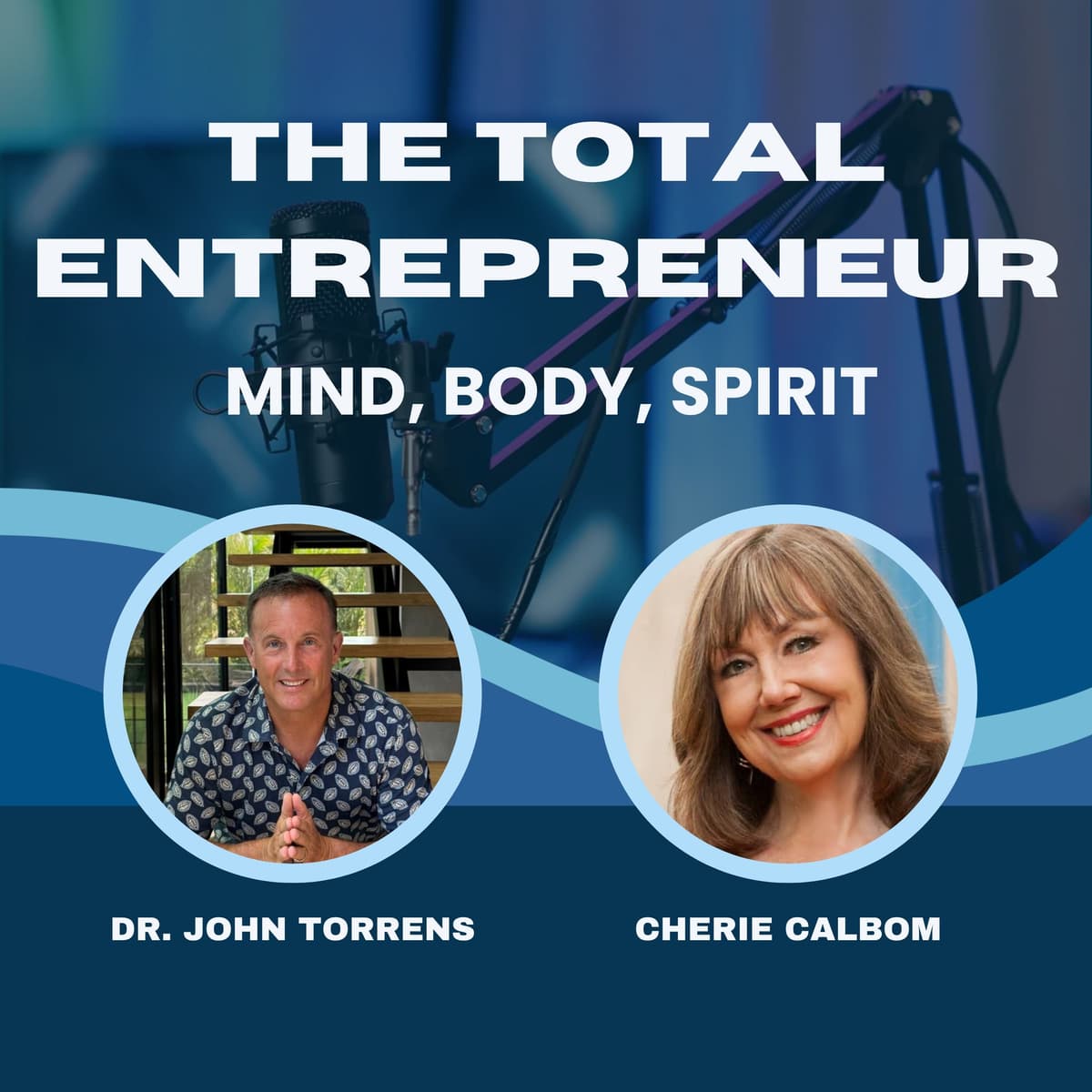
Why Seed Oils Are Bad, And What to Eat Instead | Cherie Calbom, The Juice Lady
with Cherie Calbom
Jul 31, 2026 · 00:51:45
Part of our conversations on
Cheri, welcome to the podcast. So great to have you here.
Thank you. Thank you for the invitation. I'm really excited to talk about this topic of nutrition, connecting it with being an entrepreneur.
So important, you know, and especially in the context of entrepreneurship, I think nutrition is one of the things we just forget about because we're so focused on The immediate goals, right? Like the things in front of us, the deadlines, the needs that we, we ignore our own bodies. So I'm looking forward to this conversation as well.
Well, I, I learned the hard way that you can't just eat any old thing and expect good health and expect to get to your goals. So that's why I'm here, because I had my challenges back in my 20s and corrected my health, turned everything around, and paid off. Big time, it paid off for me. So many people don't realize that without your good health, either you're going to spend all your money at the end of life trying to recover what you, you know, you could have been preventing all along, or maybe you'll never even get there because you don't have the energy, creativity, or the sparkling health that you wish you had to be more creative and get more things done.
Right. And we don't have to just accept that as part of aging or getting old, right? We have so much more control over this than we've been led to believe. And I think that's the empowering part of the message.
It's very empowering. We have tremendous control over aging, over sickness. And people don't realize that what we put in our mouth every day is building the body we're going to have tomorrow. It's building the body we have today. And so many people don't realize that that brain fog or tired or not sleeping well or just feeling wired all the time, aches pains or kind of stiff or whatever. I hear lots of comments from people, but they don't realize that it's connected to what they're eating oftentimes. And then they correct things, they get started on a new program, and it's like, wow, my brain fog just went away, my aches and pains are going away, I'm sleeping better, I have more energy. It's like, yeah, but that was all connected to what you were eating.
And it is such a great realization when you get there. But before we start with the questions I had, you mentioned your own challenges and how you Corrected them. I'd love to hear about that.
Ah, okay. In my twenties, I had chronic fatigue syndrome and fibromyalgia, and it was so bad I couldn't work. I had to quit, move home, and sleep about twelve hours a day, and wake up tired. And I felt like I had the flu all the time, and I ached all over, and no one could help me. And doctors still don't know what to do about those conditions. So I was determined, though. I wasn't going to stay in this rut. My whole life was ahead, and I was going to find a way out of this. And I went to. Some health food stores, talked to people and realized, oh, my diet's horrible. It's all wrong. I love junk food and fast food and I was a sugaraholic and I hated vegetables. No wonder I was sick. And so I got my first juicer and got rid of everything that was bad and went on a 5-day juice fast. And on day 5, my body expelled a tumor that size, size of a golf ball with blue blood vessels attached. Looks like somebody cut them. And something had— I call them nature's scissors or God's scissors, the phytonutrients that cut off angiogenesis, that's the growth of blood vessels to tumors.
Mm-hmm.
Yep. And things like, uh, uh, apigenin, luteolin, fisetin, um, many names and new ones keep popping up, uh, are in our fruits and vegetables. And so I was drinking a lot of vegetable juice and I was getting a lot of those phytonutrients that worked. And, uh, then I thought, okay, tomorrow I'm gonna be well because I got rid of this thing. That's kind of the Western thinking.
Right. Yeah.
And get rid of it. And I didn't wake up well. I was on a journey and I always tell people about this. When you're on the healing journey, it's not like take 2 pills and you're better in the morning. Um, yeah, you'll have some detox symptoms maybe, or some steps forward. It feels like a step or 2 back. Uh, but I added in whole foods. I went plant-based for just for that summer with juicing and, um, 3 months it took me, but I woke up one morning and thought, wow, I got a brand new body last night.
That is amazing. So you had chronic fatigue and fibromyalgia. It got to the point where you just couldn't take it and you had to go do something, which at the time probably felt drastic given your lifestyle choices that you were making. But were there, were there things that you noticed before it became full-blown chronic fatigue or fibromyalgia, or did it really take that long to get there? In other words, can people notice different signs before they get to that point?
Oh yes, I had signs. I was limping along. I would get probably more colds and flus than the average person, maybe a couple more a year. And I would wake up a lot of mornings groggy, just not having the brightness in the morning, the jump out of bed energy that I should have had in my 20s. So I had a few things, but mostly I was getting along okay. But there were some warning signs along the way. I didn't know they were warning signs. I didn't know. But If people are experiencing fatigue or, you know, you, you seem to need more sleep, you're getting sick more often, there's something going on and it's time to take a step back and say, what am I doing? What should I change? Maybe my immune system needs to be strengthened. Maybe I need to get rid of some toxins. Maybe I need to eat more whole foods and less junk.
Hmm.
It's all a good time to do an inventory.
Because our bodies are built for strength, right? We're not weak creatures by nature, right? We are pretty resilient, but it really depends on what you're, what you're fueling it with. So I think those are really important points.
Yeah, we're like a car in many senses. So I always say to everybody, all right, you buy this beautiful car and it says put premium in there only, right? But you say, no, I don't need that. It's too much money or whatever. I'm going to just get this inferior cheap fuel. Well, you're gonna pay a price. Your car's gonna pay a price. It's not gonna run very well. Um, a friend of a friend put diesel in one morning when he was on his way to a big meeting that he was very stressed out about. And he knew his car didn't take diesel and he died on the freeway. I mean, his car died on the freeway.
Right.
Not too far from the gas station. So our body is like a car in one sense that we've got to have the right fuel in our tank. And yet we don't come with instructions. Our car does, but we don't. We can get a new car, you can get a new engine, but we can't get a new one of these. So it's even more important what we put in our bodies and what we put in our car.
And I am going to steal that analogy with your permission, if that's okay.
Pass it along.
Yeah. When you were talking about your, your juice fast that you did, I did my first one in 2010. And prior to that, I hadn't done it. And that was actually the kind of the turning point for me in, or the second turning point in my health. But that was when a lot of the metabolic challenges I was having really sort of resolved. So yeah, it was, I just wanted to mention that I can certainly relate to that. Nothing as dramatic as passing a tumor, but certainly big changes in my sleep, even like in the whites of my eyes became whiter. I was sleeping better. I was not getting up in the middle of the night to use the bathroom several times, like just all sorts of things were better. I did notice When I, when I stopped coffee and caffeine, it was, it was a 28-day fast. Um, what was it called? Um, Clean by Dr. Younger, I think it was maybe. Anyway, I had the worst cramping in my hamstrings. I think it was caffeine withdrawal, you know, and it was, it took a while to get over that, but I, I do, um, I'm a fan of juice fasts for sure. But before we get to that, you mentioned you were eating a lot of fast food and junk and we can get away with that kind of in our 20s, right?
Mm-hmm.
But Is fast food that we consume now different than what we used to consume? Like, has it changed in a significant way?
It's changed. It's getting worse, except for a few places it's getting better. Okay.
Yeah. Tell us about that.
Steak 'n Shake, it's gotten better, but things have gotten worse. So, um, I need to look back on the timeline of McDonald's and the fat. They used to use tallow, beef tallow for their fries, fried foods, and then they changed to a seed oil. And, um, I've gotten conflicting reports, but in the '40s was when they they started, and it was all beef tallow. Beef tallow is so much better than seed oils. It's much more durable. It can take the high heat and not break down into toxic byproduct where the seed oils do. And and I found some reports that say maybe even up through the '80s McDonald's was using tallow. I'll need to go back and just verify that for sure. But somewhere along the line they changed to seed oil. So fast food has gotten worse. And all the big chains now use seed oil for their fried foods. And that is just a tragedy because it's a double or triple whammy for toxins. You know, it's heated in the beginning. I should just go over a little bit of the history of how seed oils are made.
Yeah.
But, uh, it— they take seeds, put 'em in a big vat, and heat them to a very high temperature, like 500 degrees. Well, these are polyunsaturated fatty acids. They're fragile. They break down easily. They have double bonds, at least 2 sets of double bonds. I'm talking about chemistry now, and they break easily. When they break easily, they create toxic byproducts. But it doesn't end there. They pour in hexane, a very toxic chemical, and neutralizers, deodorizers, bleaching agents, maybe degummers, whatever. All these toxic chemicals go in there, and then a clear or golden odorless, tasteless oil rolls out in a plastic bottle, and we're supposed to believe that that's heart healthy. Well, then the fast food restaurants or any restaurant gets the oil and heats it again to a high temperature again, maybe 480, maybe 500 degrees. I don't know what their deep fryer is set at, but— So we're creating once again, even more toxic byproduct like aldehydes and lipid peroxides, This is going into our body creating oxidative stress. What does that create? Inflammation. What is at the root of every disease, every malady? Inflammation. Yeah.
And so, you know, I've heard— because I've had this conversation with people about, like, you know, french fries you get in fast food restaurants, and the comment I hear often is that, well, you know, I used to eat it a lot as a kid, it's not that big of a deal. But, you know, it's, it's important to remember that it's not the same order that you had, you know, 30 years ago. It's like you said, instead of using beef tallow, they're using seed oils. So you mentioned all the bad things about seed oils, right? I want to get into the weeds a little bit more with that because it's so hard to avoid them. Like literally everything you buy, I mean, you look at the label and you're just shocked because you're like, oh, all right. What can I get without a seed oil in it, right? So a little bit more about the downside, right? So we know it leads to inflammation. And of course, we know that that is the root of a lot of disease or most disease. But how does it do that? How does it cause inflammation? These are oils from seeds that we were told are good, right?
Right.
Corn, sunflower, safflower, grapeseed, cottonseed, you know, on and on. These are good seeds, but you're telling me the oil from these seeds is bad for me. How is that possible?
It's how it's processed. So yeah, if you just took, um, well, some of those seeds are GMO, genetically modified, so they're, but if you took just a sunflower or a safflower seed and cold pressed it, um, with good treatment and not all of the chemicals, you would be fine. That would, that would be fine if you didn't eat too much of 'em. We're getting too much of the omega-6 fatty acids to omega-3s, and that alone creates inflammation. But now we've got these seed oils that are toxic, are broken broken down into aldehydes, lipid peroxides, creating oxidative stress in the body, free radicals that damage cells. Plus, we have a dominance of seed oils, inferior oils, inferior fats. Body's going to utilize them, especially when it doesn't have very much of the good fat, which is true for most people in America.
Mm-hmm.
It's going to take the seed oil, the inferior fat, and use it to replace what needs to be replaced, like the outer membrane of a cell.
Mm-hmm.
Well, when that, when parts need to be replaced, what are they going, what's the body going to choose? Inferior fat, if that's all it's got. Your brain is 60% fat. What's it going to go for if it doesn't have the good fats? So it's going to go for inferior fat. So all throughout the body, from head to toe, the body is going to use what it has. It's going to use the raw materials. It's given 'cause its job is to keep you alive, maybe not as healthy as you could be, but alive. And so these oils have a 600-day half-life.
Wow.
So we're looking at almost 2 years that they're, uh, in there in your body, uh, doing its damaging work. But I always say to people, don't be discouraged because cells are always turning over. And when you start making a turnover, I call it the oil change for your body, your body is going to start using when it needs it, the good oils. The best oils. It's going to, of course, go for the best ones it can find. And so that fat around your heart, C16 and C18, is saturated. The heart draws on it in times of stress. What if you don't have any good replenishing fats for that? Well, it's going to include inferior fats. But when you start putting the good fats back in, and what are they? Coconut oil, olive oil, avocado oil, ghee, which some people call oil or butter.
Mm-hmm.
And sesame seed oil. Those are your good oils. And you can have those. You can cook with them, buy foods that are made with them. Now we've got good fats, good oils coming into our body. And so in times of stress, the body is gonna draw on good fat, right? And the brain is going to choose good fat. So it's all positive and encouraging that when you start, if you say, okay, Today, this is my day. Simple change, I can swap out, I can swap out the oil in my pantry, I can start reading labels, buying better products with good oils in them. Your body's going to start from today on making changes.
That's a good description. I've never heard it, you know, explained that way where your cell walls or membranes, if they need fats, they're gonna go for the fats that are available and if you're putting poor fats in your body, that's what they're gonna use and then that's what your body has. And I think that's really important because a lot of us just think, and myself included, a couple decades ago, you ingest something and then it just kind of flushes out in waste without a recognition that your body's actually taking it and using it as building blocks for all the work your cells have to do. So that's a really important point.
Oh, absolutely. And I think so many people don't think about that. Um, like maybe friends have said to you, well, I used to, you know, eat those fries all the time and I didn't notice anything. I call these oils the silent killers because many times people don't know. They don't know how they're impacting their health, first of all, and they can't see what's happening on the interior. So let's look at the arteries for a moment and why does plaque collect there? Well, the cardiologists that I love to read and quote and are really in the know say plaque does not just form in an artery.
Yeah.
Cholesterol doesn't just stick there. If there was no wounding, no irritation, irritation in the artery, it would float right on through 'cause our body's gonna make cholesterol no matter what. No matter how much you try to lower it, it's gonna make it.
Yeah.
And cholesterol's just gonna float right on through. But if you've got wounds in your artery, irritations from the inflammation, from the seed oils, sugar, and fast food and junk food with all that chemical stuff in it, it's going to wound the arteries. Well, over a wound, what collects on your skin if you cut your hand, a scab inside in your arteries, Plaque. In that plaque is fat and cholesterol, but fat and cholesterol isn't the culprit. It's what wounded the artery. That's the culprit. Well, so many things going on in our bodies we can't see, so we don't know, wow, I've been eating these seed oils for a couple of decades and I can see inside what's going on. We can't, we don't know until maybe sometimes we're in dire straits.
Yeah. And I think that's why it's important that people get their, their labs or their blood work pretty regularly, talk to their doctor about it. So at least they can see trends over time, right? Because these, you know, this plaque is building up not overnight, but sometimes over decades. And it's really, I mean, we have the power to make differences and changes. So you mentioned the good oils, right? So that was coconut, Olive, sesame. What were the other ones?
Avocado and ghee.
Avocado and ghee, right. I love all of them. They're amazing. I've been actually using real butter lately. Like my wife and I will actually make our own butter. We'll go to a local CSA, get the milk and the cream, and we'll just make the butter. And then we can, we can add all sorts of cool stuff to it, like roasted garlic or rosemary or whatever we want. So my go-to lately, if I'm I'm cooking and I need, you know, something for an oil. I've been using homemade butter and I've been loving it. Am I on the right path there or should I avoid that? Or what's your thought on a good butter source?
You're on the right track and boy, making your own, you just can't get much better than that. So the joke almost now, it's not really a joke, but butter's gone full circle.
It has, I know.
Thrown out, get rid of it, butter, cheese, eggs, dairy, all dairy, all red meat, beef tallow, no more lard, nothing. And now it's back. So butter's good. Butter was always good. And it's back in style.
We had been taught and trained how bad butter was, right? It was going to clog your arteries and lead to heart disease. And yeah, then we were buying canola oil instead or margarine or something, right? Yeah.
Yeah.
No, I love, and even beef tallow, the flavor Is maybe a little bit strong sometimes for me, but I'll use it in certain cooking. Like I love to sauté mushrooms in beef tallow, for example. But in general, I like my own butter. Yeah.
I love butter. I grew up on butter, and I remember my dad saying, "We will not ever have that plastic margarine in our house. We will only have real butter." So margarine has come and gone. Thankfully, most people. Don't use it, and you go to the grocery store and you don't see it. But it was like plastic; it had partially hydrogenated oils or lots of trans fats in there, and it was terrible. So thank God we got rid of that. And to a big degree, Crisco is gone. You go to a grocery store and you see a couple of cans down in the bottom shelf in the back. But restaurants—here's something to be aware of: restaurants are still using it. I wondered because I thought I—I bet if I Google online, I was writing my. book, I won't see much in the way of sales of Crisco. Oh no, sales are still strong. But then I had to look up who's buying it because the American people kind of got the message on that one. And no, it's restaurants and food manufacturers. They love Crisco and they don't put Crisco on the label. They just call it vegetable oil or corn oil.
Yeah. I forget where I read it, but it's the origin of Crisco. It doesn't— I don't even remember it as being being real food. It was like a petroleum product or something.
Am I right about that? Crisco stands for crystallized cottonseed oil. Okay. Let me tell you about cottonseed oil. It is the father of the modern-day seed oils. So here's a little quick history. Back in the turn of the century before last, cotton was a big crop and the seeds were piling up and smelling and rotting. And what do we do with all these seeds, they were saying. And so, okay, we're gonna make oil out of it. But the oil was dark and smelly and used to lubricate machinery. That is the origin of seed oil. But then they had more seeds and more needs, and so they decided to refine it even more. And that's where that whole processing came in of the high heat and all the chemicals and super refining. And then they rolled out that machinery oil for cooking oil and then called it vegetable oil and told us it was heart-healthy. Oh, ever cure heart disease? It's still the number one killer. And yet they keep saying, no, no, no, this is heart healthy. Choose this. No, no, no.
Yeah. So it's probably really good for lubricating heavy equipment, but not so good for our human hearts. I guess it'd be a good way to summarize that.
I like that. That summed it up well.
Oh man. Yes. Yeah. You don't see Crisco that much, thank goodness. But I remember, you know, Earlier in our marriage, we would have to buy it to bake whatever was on the recipe, right? Because it called, it actually specifically called for Crisco. So you said it was crystallized cottonseed oil?
That's it. Wow. Not good. Full of trans fats. Now, most of America is aware of trans fats. We are aware that those are not good for us in any way. There's all the other oils that We keep being told by the other side because there's quite a debate going on right now of no, these oils are good for you, and all these studies proving that you need linoleic acid, which is the omega six that dominates these oils. You need that, and that's true. But you don't need it in the toxic form it's in or in the excessive form that people eat it. And so then they they're saying there are all these studies showing that people that eat more of the omega six these oils. Have lower LDL. So my response to that is yes, but they've done other studies and found yeah, their LDL went down, but they still died earlier than than the other group. But then on top of it, it isn't cholesterol per se that is linked to heart disease and heart attack. You know, and they've done studies on that, many population studies, and found as many people are dying of heart disease with low cholesterol.
Yeah. I'm so glad you mentioned that because, you know, I'm at the age where a lot of my friends of my age are starting to get put on statins because their cholesterol is too high based on standards. But I was reading where, you know, the standard for cholesterol used to be a little bit higher until they realized, oh, we have a pill that could lower cholesterol. So now we have to say your standard is a little bit lower. So, and then, you know, further reading, long-term use of statins actually is not really good for your neurological health because your brain needs cholesterol, right? So I don't know, correct me if I'm wrong because I know that that's a pretty bold statement to make, especially if I don't know what I'm talking about, but I think I'm fairly well informed on that. So talk about cholesterol and statins and the standards and that kind of thing.
It breaks my heart. So standards have been coming down and down and down and you look back in history and there was a point in time where 350 was an okay cholesterol number depending on your age. And then it came down into the 200 range and then it got to 240 and that was a good range if you were 240 or below. And then it went to 220 and now you're supposed to be below 200 and some will even say 190. And it is all going down and down and down when the statins came on the market and we just saw everything lowering and lowering. Well, Your brain does need cholesterol. Your body needs cholesterol. Your body needs good fats. So this is not a good thing. There's a new study that just came out showing that eggs, and I'm talking, not talking about egg whites, the whole egg, people that eat, did you see that? Less Alzheimer's with whole, with eggs. And here we were told for decades, get that yolk out of there. Everybody was choking down egg whites. Then we ended up with egg white injury. That's because undercooked egg whites bind biotin and cause injury. It's like this has been craziness, absolute craziness. So it isn't the cholesterol number though that is equated to heart disease, heart attack. It is inflammation and the markers. It is not cholesterol. What we should be looking at is histamine. Lp standing for lipoprotein, or CRP, C-reactive protein. Those are the markers. And if they wanted to measure LDL, it's not regular, it's oxidized LDL that should be measured. Well, I've never heard anybody say, gee, my oxidized LDL was high. I haven't seen a measurement for that. There is one, but I haven't seen it done. So we're off on a whole wrong track. We should be over on the inflammation track and measuring those 3 things, histamine, Lp, CRP. And if we want to measure LDL, the oxidized LDL.
I'm glad you mentioned eggs because there was probably a good 10-year period when I was younger, when I was at my heaviest and sickest, when I was avoiding eggs because they were bad for me. And I was avoiding butter because it was bad for me. And I was eating cereal. And like all the, all the healthy grains, right? Which just led to, you know, glucose spikes, which leads to all the, you know, the inflammation. So it took a while to get myself out of that. And you really have to be proactive in educating yourself because everywhere you turn, you're given information that isn't really accurate and you have to discern like where it's coming from, who's supporting it, why the information is out there. And what I keep coming back to is if we would just eat like our grandparents or our great-grandparents did, we'll probably be fine. That's kind of, that's where I landed.
I think we would be fine. Somebody told me this story the other day of her grandmother that died at 103. She grew up on real foods. She had her own garden right up until almost the end. She worked in her garden. She ate her real foods that she grew. You know, we do need to return to the ancestral diet. And the ancestral diet had real fats, animal fats, plenty of them, and real food, lots of vegetables from the garden. I remember my grandmother had a garden, lots of vegetables from the garden.
Yeah.
And she used to trade with the neighbors who grew chickens. So—
Right.
Vegetables for chickens. And people grew a lot of their own food, but it was natural, it was real. And now everything is so adulterated. It's filled with chemicals and fillers and dyes and preservatives. And we don't even know where it came from a lot of times.
Even if you think you're doing good and buying produce, like half of it is just sprayed with glyphosate or something. I mean, you've really got to know and trust your source. Otherwise you're just kind of swimming upstream, it seems like.
Well, we do the best we can, right?
Exactly. Yeah. Right. And I don't want to scare people, right? We are empowered. We can We can make a difference, but yeah, it's just the more you learn about it, the more you scratch your head, I guess.
Oh yeah. And say we need to return to common sense. One of the common sense things I want to say about seed oils with all of the argument on the other side saying, you know, we need them and they're good for us and don't worry about the chemicals, they evaporate and then we need linoleic acid. But I say, let's look at some common sense. Before they came on the market, we didn't have these big problems. We didn't have heart disease like we have after they came on the market. So between the 1930s and the 1950s, and seed oils really rolled out in the 1940s when coconut oil couldn't make it through the waters because of the war. So seed, then the seed oil production stepped up. Heart disease also stepped up. It increased 130% between the 1930s and the 1950s. That just says right there, look at that. That is common sense. What changed? What changed in the American diet in that time? We can point right to it. Coconut oil couldn't make it through the waters. Seed oil production stepped up. Lots of jingles and ads. And this is for the modern cook and everybody wants this oil and don't go with that old outdated lard and butter. You want the modern oil and this is the healthy oil. And then people started dropping over from heart disease and then they found fat and cholesterol in the plaque. And then they said, oh, it's all that butter and cheese and eggs and lard and red meat and it's all gotta go and the eggs have gotta go. And a few common sense voices were drowned out, but they were saying, wait a minute, we've always eaten that. We've eaten that for centuries and we didn't have this problem. So it's like, what happened to our brains? But here's what happened for a lot of the voices speaking up. There was money, big money behind that. There was no money behind the common sense.
Right. Yeah. There usually isn't. Right. So in terms of real fats, right, we've been talking about that for a minute. So one step is just clean your pantry out, ditch all the industrial oils, right? That's something easy everybody could do. Educate yourself about saturated fats and how they actually protect your heart and metabolism. And then don't fear the butter, the lard, the tallow, the ghee, and the good oils you mentioned, right? And are there, are there simple swaps or other things that you recommend that I haven't mentioned that you can reduce inflammation and restore energy just with some simple swaps?
Yes, I want to talk about the cold oils for a moment that are rich in omega-3s and include some of these because we have a great imbalance of omega-6 to omega-3. Omega-6 Omega-6 is kind of like way up here and omega-3s are here. And we need more omega-3s and less omega-6s. These are the fatty omega-6 fatty acids.
And what does your body use those for? Like, what is it doing with them?
So too much of the omega-6 fats is creating inflammation in the body. We've got about a 20 to 1 ratio in the US for most people. We should have about a 4 to 1, 4 omega-6 to 1 omega-3 fatty acid, or less. And we're way outta balance. So that's creating a lot of inflammation. So bringing the balance back is twofold. One, you just said, let's get it out of our diet as much as we can, be wise shoppers. And then number 2, let's up our omega-3s. And people just don't get very much of the omega-3s, especially today. So what's rich in omega-3s? Flaxseed and flaxseed oil, those that should always be cold. These are the cold oils: hemp seed, hemp seed oil. Walnuts are very rich in omega-3s, and walnut oil is a very fragile oil, so only use cold, like drizzle on salads or put some in your smoothie, or just take a tablespoon. That's just fine too. And then your cold water fatty fish like salmon or mackerel, trout. Sardines, and they should be wild-caught, not farm-raised. So there aren't a there isn't a huge category of omega threes. We get some from our other whole foods, but those are the dominant sources. And then there's a very healing oil. It isn't dominant in omega three, but it does have omega six and so many other wonderful components. And that is black seed oil, B L A C A. It is wonderful for the brain, for energy, and for the lungs. If you have any leftover from an upper respiratory infection, black seed oil is very healing for your lungs. So some of these, and that should only be used cold. So these should all be refrigerated that I just named and only taken cold, but they are very, very healing oils and begin to bring some balance to your body.
Hmm. That's, that's helpful. Now, what's the difference between the cold oils and cold press? So cold press is just the process, right? So you're looking for the words cold-pressed on certain oils?
Yes, it may, it may be there. Or like with olive oil, extra virgin olive oil will mean your first pressing and it would be cold pressing. You may also see expeller pressed. That's fine too. That means the heat hasn't gone to very high temperatures. It stayed at the lower temperatures and not, they've not used things like hexane or other toxic chemicals to extract that oil. So that's okay too. So your avocado and your olive and your coconut— coconut's done in more of a traditional way. They do cook it, but not at really high temperatures. And so those are either pressed or traditionally processed. And then the sesame seed oil is— because it's small market and people usually don't use a whole lot of it, doesn't seem to have gone through the industrial refinement. So it's a good one too. And then ghee, clarified butter, That's the more traditional way. So all of those are more traditional. The pressing of the fruit oils, olive or avocado and coconut, don't go through the same processing as the others. And I'll name the others too quickly. Canola and corn and soy, those 3 are your worst because they're GMO crops, genetically modified as well. Big, big GMO crops. And then safflower and sunflower, grapeseed oil, rice bran, peanut oil, oil, cottonseed oil. Those are the ones to avoid. And it may just say on a label vegetable oil. It says vegetable oil, it means one of those, or maybe a blend.
It's really important to read the label and not just trust the marketing, which doesn't necessarily have to be honest or tell you what you're really getting into. Well, thanks for that. I want to turn our attention now to— you mentioned juicing earlier, and you are known worldwide as the Juice Lady. You've got 36 books, you've sold 3.5 million copies, you've got a Master of Science from from Bastyr University, and you've done some kind of cool things, right? You were the— if I'm right, you advised the royal family of—
UAE.
UAE, right? And you were— you helped George Foreman sell the George Foreman Grill. So you've got some very interesting, I guess, um, media bona fides and credentials, right? So talk to me a little bit about juicing. I did a juice fast. I do them periodically. I'm a big fan. I love them. But you are far more experienced and much more of an expert than I am. So what do people need to know if they've never done a juice fast, and how should they approach this, and why would they?
So if you've never done a juice fast, stick to mostly vegetables. You don't want to get too much fruit. It can just send you out into being a little loopy, but your blood sugar crashing all over. So use fruit to sweeten, like make it an 80/20 rule, 80% vegetables and 20% fruit, and get a wide variety. This is going to get a lot of wonderful nutrients in your body. Juice fasting gives your body a break. It's like taking a little staycation where you're home, but you're not working elsewhere. You can clean out that closet or maybe your garage or get to a project that you let go for a long time. Same way in your body. When you give it a little break from digesting food all day long, it can focus on some damaged cells, cancer cells, maybe repairing some cells and taking out the trash. So to speak. So it's a wonderful way to rejuvenate your body and restore it. And you can do 1 day, 2 days like I did. You can do up to 5 days, whatever you want to choose. Be very cautious though when you break a fast. You don't want to break it with a cheeseburger and fries. You can really get digestive issues big time. So you want to break it with like a soup, a vegetable soup or a salad or a smoothie. Something that's lighter and easy to digest. And a big bowl of steamed vegetables would be great as well. And then juicing daily. So people ask me about that a lot, but there's no fiber in the juice. I say, well, it's like a vitamin, mineral, enzyme, phytonutrient, biophoton cocktail. So yeah, there's no fiber in your multivitamin pill either, but it's wonderful to replenish the body. So you're getting so many nutrients. That they don't even know to put in your vitamin pill probably yet because we just keep getting new identifications for different phytonutrients. And so this is a wonderful way to feed your body extra nutrients that you probably wouldn't get because we can juice a lot more than we would chew up in a day. And that is so rejuvenating and restorative for many, many people. Lots of people, when they start juicing, Notice a difference pretty early on. It's like, oh, I have more energy, or I sleep better, or I just— my immune system's stronger. I'm not getting sick as much, or I'm able to recover from things better. I hear many, many, many stories, but I always say give it a try because you just won't know how good you can feel until you do try juicing.
I completely agree with that. And I credit my very first juice fast with being the first step on me, like, just regaining my own health because it was going the wrong way. And the thing that's really cool for entrepreneurs and busy people with juice fasts is it, it takes the food prep out of the equation, right? I noticed that, like, my students or young entrepreneurs I work with, one of the reasons or one of the excuses they have for not eating well is that they just don't have time, right? It takes too much. They got to think about it. This eliminates that. You just, you know, You juice and then that's, that's what you're going to consume. What machine do you recommend, right? Because there's a variety of juicers out there. So, if somebody's new to this, what do you recommend?
I love the Nama J2 juicer and that's because it's got 2 chambers and the upper one is where you put your chopped up produce and it doesn't have to be chopped up fine. You don't have to stand there and push and push your produce through. You just put it in, close your lid, turn it on, go do something else. It juices for you. you. And you come back and you, you lift the little lid and your juice pours out and it's easy to clean. You can clean it in about a minute. So come to my website, juiceladyinfo.com, and you can take a look at it. Use my code JUICELADY and you'll get a big discount on it as well.
Oh, amazing. What was the name of that juicer you mentioned again?
Nama. So it's N-A-M-A.
All right.
N-Nancy A-M-Mary A.
Yeah. J2.
Okay. And it is the best one, I swear. And I've tried almost everything out there. It is the best one I've ever used. And it's kind of the dream come true because we used to, all of us say, gee, I wish I had a juicer that could juice for me, right? 'Cause you're standing there and you're pushing your produce through.
Oh, it's rough.
And this eliminates all of that. It just does it all for you. You'll love it.
How is it to clean? Is it, uh, is it a bear? Because I've got a Breville, I think, and that's kind of a pain to clean.
I had one. I think this is the easiest one I've ever cleaned, ever used. I can clean it in about a minute and, uh, and I just drain the parts on the drain port.
Yeah, that's great. Yeah, easy peasy. Nothing to it. Yeah. Yeah. Yeah. So if people are thinking of doing this, so you said you can do it for a day or 2. Is there like an upper limit you would recommend? Or like if somebody hasn't done it, just say, hey, you know, maybe, you know, just be prescriptive and try this, not that?
Yeah, ease your way into it. Unless there are some people that just jump off the deep end because they feel really awful. They're sick and they just, they want to turn around and they're praying for a miracle, you know. So we're all so different. But if you're fine, if you're Yeah. Healthy and you're just busy but you wanna do this, try one day like a weekend, a day you have off. Or some people have done a Friday night juice the dinner and juice breakfast and lunch on Saturday. That's 24 hours. And then eat a meal Saturday evening. Eat maybe a very nutritious, lighter kind of meal with lots of vegetables maybe or a main course salad, something like Well, that's a beautiful short little juice fast and it didn't take much denial.
3 minutes.
But kind of all split up. So you can ease your way into it and try it. It's just amazing when you get feedback that's positive, then you start thinking, okay, I maybe like to do this again. I got very positive feedback the first time around.
Right. So I want to ask you, it's maybe off topic, but I was curious, you know, when you're working with the royal family, you know, these are people that probably aren't always used to being told what to do, right? And they don't necessarily need to listen to a lot of people. So did you, did you get a lot of pushback or were they very receptive or how was that relationship as an advisor on something so personal as food?
Her Royal Highness, that the one of the daughters brought me in. She had my book Juicing for Life sold over two million copies and went into 23 countries in different languages, and she had it in Arabic, and she had been following my guide. My Juicing for Life book is a 50 ailments guide, and her book was pretty tattered and worn. She had really been using it, I noticed, and was following the different recipes for different conditions. So she wanted to bring me in for her family, primarily is how it started. And then word passed around. And knowing Middle Easterners, if you do, they have large families. And there were 70 ladies of the wide extended family that were all showing up saying they were interested. So she had to rent a hotel room. And then she invited 23 ambassadors' wives as well. So I did a lecture on juicing, and it was the most spectacular thing I've ever experienced. As they dined, we all dined, and then I spoke, and they even had headsets like a UN event where I was translated into all the ambassadors' wives' language, and of course into Arabic. So it was quite an adventure. But starting off in her home, I just just helped her and the household cooks to learn more about juicing and different recipes. But then we expanded it to the greater royal family of ladies.
Wow. Wow. That's great impact. I wanna ask about George Foreman too, 'cause he, he strikes me as just a really fun guy to be around. I don't know if that's his persona or not, but yeah. Do you mind just talking a little bit about your experience with being his nutritionist and working with him on the grill and that sort of thing?
The time of my life. 13 of the most exciting and wonderful years I've spent was with working with George and the grills and QVC. I was on QVC representing the grills. Mostly it was me. Sometimes he would join me for 13 years. And he's a funny guy. He's very smart and a dry humor kind of. And so every once in a while he'd make these little remarks, like in the, I was in the first 3 infomercials. commercials, and then, or on QVC, make these little remarks and you'd go, wait a minute, oh, that was so funny. But in the green room, when he would sit there with my husband and we would be watching numbers after, you know, we'd get off air, or sometimes they would sit there for many hours while I was back prepping to take the next round of grills on air, he was quiet. My husband said he was often very quiet, didn't say a whole lot. So He was kind of like the gentle giant, very lovely person and a lovely family. And he's greatly missed. We lost him, you know, this last year. And it's sad because he looked like he'd live forever, you know, was in good shape. And then all of a sudden he passed away.
Yeah. And how did you cross paths with him in the first place?
Well, that's the story of how I started as the juice lady. I was getting my master's in whole foods nutrition and the Juiceman Company came to my university, looking for a couple of graduate students to write the little booklet of juice recipes and tips that went in the juicer. And the head of my department asked me if I'd be interested. And when you're a student, you bet, a job, I'll take it. And so I noticed as I went down to the company that they were doing seminars around the country. They had this woman over here and the juice man over there in different cities and infomercials tagging free seminar at these locations. And I said, you know, I could do that. I have an undergrad degree in speech communication. I have a story to tell of what juicing did for me. So they said, okay, we'll give you a chance. And they right away made me their juice lady. So on the weekends, I went out and did the juice seminars, and during the week I went to school and finished up. Well, they sold not too long after I'd— like 2 years, I guess I want to say, after I'd come on board, and Salton bought bought the Juiceman juicer and some of their other products. And I just got passed along with the deal as a spokesperson. And then a couple years after that, the grill made the debut at the Gourmet Product Show in Las Vegas. I was there with the juicer representing or demonstrating that. And I was in the Salton booth and the grill was a Salton product. And George was there and I kind of assessed the whole situation and said, I know he's not gonna do all those QVC shows or all those Macy's appearances. So I made a proposal to both of them. Why don't you make me your nutritionist and the other spokesperson and I can do this? And George was all for it. He was into health and nutrition and he was all for that. And I did become his nutritionist and I did help him. And then I became the other spokesperson and did the first 3 infomercials and 13 years of QVC.
Wow.
So, it was like, wow, that was like a whirlwind.
I'm so glad I asked you that because I think— so, I want to point out a few things for listeners, especially the younger entrepreneurs. The first is that you just said yes, right? So many people don't say yes to something because they don't think it's exactly what they want to do. But the point is you just never know, right? You've got to open the door and get in the room before you can really evaluate the opportunity. So, I love that. part of your story. And then you were bold enough to be like, hey, why not me? I can do this. You know, and I think a lot of people don't do that. And that's, that's a really cool part of your story.
I think, and I always tell people this, look for a spot where nobody's filling it, right? I could see this spot and I could see what was coming. I could see this was a cool product. It's, it's pretty much destined to go somewhere. And there's nobody for back And I know George is too popular, right? He's not gonna do all this stuff. So I always tell people that, look for a need, look for a place where you can fill that need. You may not be perfect, but maybe you'll be the only one who steps up and says, I see that need and I can do this. And it paid off big time for me.
Well, that seems like a really great way to end it. And I love how we kind of took it full circle to, you know, your entrepreneurial journey too, which is really great. So remind us again where people could find more about you and your work and your books and your whatever you're doing. How can they find you?
Come visit me. So my main website is juiceladyinfo.com and get your free gifts. I've got numbers of them up there. Sign up for the newsletter, it's free, and you'll get all sorts of tips and recipes. You can go to my landing page, you can get the seed Oil Scout app, free trial, and that will give you, um, a little map of restaurants all around where you live, little green bubbles that, um, don't use seed oils. And then you'll have a scanner on there too, so you can take it shopping, just scan the barcode and it'll tell you if there's seed oils in that product or other nasty stuff. So it's a great little tool. Get my 30-day meal plan on there, it's free. So lots of freebies there. Follow me on, uh, social media, Instagram, TikTok, X, Facebook, it's all at Juice Lady Sherry, C-H-E-R-I-E. I've always got recipes and tips and fun stuff posting every day, so come follow me there too.
Thank you so much, Sherry. This— I enjoyed this conversation so much, and I appreciate you sharing your skills and experience and wisdom. Thank you. Thank you.
Thank you so much. I did too. I really enjoyed this.
About This Episode
If you've ever wondered why seed oils are bad, and what that has to do with your energy, focus, and longevity as an entrepreneur, this episode is essential listening.
Cherie Calbom, known worldwide as "The Juice Lady," is a celebrity chef, award-winning nutritionist with a Master of Science from Bastyr University, and bestselling author of 36 books with over 3.5 million copies sold. After overcoming chronic fatigue syndrome and fibromyalgia in her twenties through a radical dietary overhaul, she's spent decades helping people reclaim their health, including advising a Middle Eastern royal family and serving as George Foreman's nutritionist for 13 years.
In this episode, she sits down with John to unpack why seed oils are bad for your body, how they quietly drive the inflammation at the root of most disease, and the simple swaps that can restore your energy starting today.
In this episode, you'll learn:
Why seed oils are bad, the chemistry of how they're processed, and why that creates inflammation.
The surprising history of seed oils, from machine lubricant to "heart-healthy" cooking oil.
How your body uses the fats you eat as literal building blocks for your cells and brain.
Why inflammation, not cholesterol, may be the real marker to watch, and the tests Cherie says matter most.
The "good fats" list to cook with: butter, ghee, coconut, olive, avocado, and sesame oil.
The cold, omega-3-rich oils (flax, hemp, walnut, black seed) and how to use them.
Why the omega-6 to omega-3 imbalance in the modern diet fuels chronic inflammation.
Cherie's story of overcoming chronic fatigue and fibromyalgia through juicing and whole foods.
How to do a juice fast the right way, including how to break one safely.
The entrepreneurial lesson behind her career: spot the need nobody's filling, and say yes.
Keep listening
More on Body
About the Host
Dr. John M. Torrens
5× Inc. 5000 entrepreneur, Professor at Syracuse University's Whitman School of Management, author of Lightning in a Bottle, and TEDx speaker on ADHD as an entrepreneur's superpower.
Browse all podcast guests →Book a strategy call →