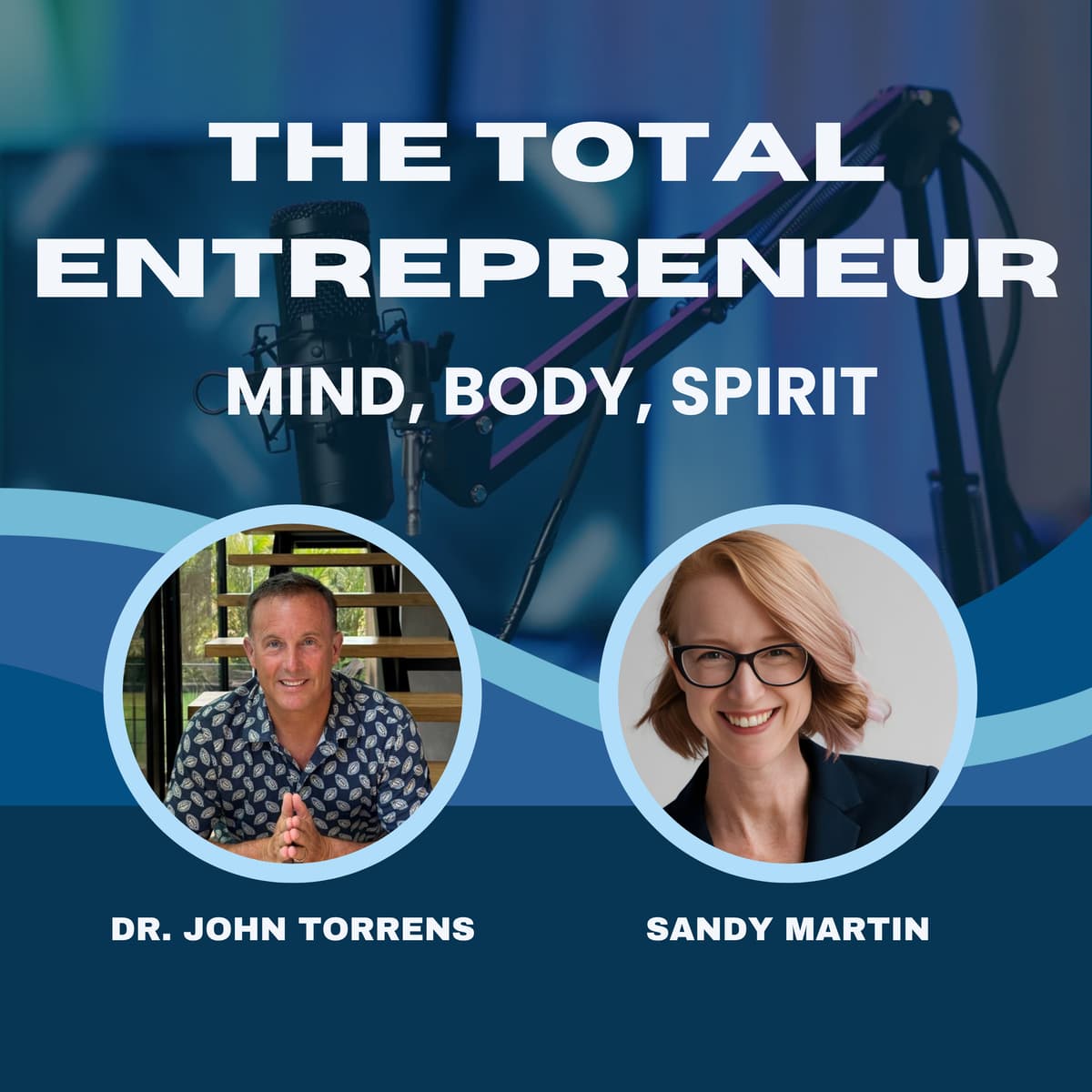
The EDGE Framework for Longevity With Sandy Martin
with Sandy Martin
May 28, 2026 · 00:56:34
Part of our conversations on
They're creating incoherence. The incoherence keeps us addicted to the screen. Give me that next hit. I'm familiar with agitation. Give me more agitation. And then that is what is getting us farther and farther from who we are as people. How do we connect with others? It is creating this incoherence in our whole lives to have that poison right in the palm of our hand.
Hey, Sandy, welcome to the podcast. Really good to have you here.
Hi, John. Thanks so much for having me. I'm really excited to be here.
Yeah, I'm excited to talk to you because you serve, I guess, double duty for the audience, right? One, you are an entrepreneur yourself, but you focus your entrepreneurial life on longevity and healthspan, biohacking, those types of things. So, it's a really cool marriage for me and my audience. So, before we get into the The biohacking and that kind of thing. Tell us a little bit about your business. It's just superficial level, but more importantly, I want to know, how do you manage it? Like, how do you manage yourself? How do you stay healthy mentally, physically, spiritually while you're doing the entrepreneur thing?
Well, I think it applies here, the same lesson I heard on my first day in my first entrepreneurship class in my MBA.
Where'd you do your MBA, by the way? Where'd you do it?
Nova Southeastern in Fort Lauderdale.
Oh, sure. Yeah.
Yeah. The Hysenga School of Business. All of my professors were retired CEOs. So, that was a really neat thing.
All but one.
The economics professor was just an economist. Just an academic. But everyone else had done something in the real world. And so, he said entrepreneurship is chaos. And that's That's normal. Your first year isn't gonna go as planned. You can have all the best intentions in the world, but something is going to go sideways, and you're going to deal with it, and it's okay. That's— you're not gonna have all your systems in place, and it's fine.
Right.
And I was in a relationship with an entrepreneur at the time, and I went, Oh, okay. Because I had really thought that what I was going to learn when I sat down in that first class on that first day was all the systems to make it better. But part of what you have to learn as an entrepreneur is how to manage chaos. And the people who are good at managing chaos are good entrepreneurs.
Mm-hmm.
And the people who are crippled by it can't overcome the obstacles and get back up and do it again the next day with a fresh attitude. You can't beat yourself up. You can't be too rigid. These are all great business lessons. And when you asked me that question, it was the first time I thought about that with respect to my own health. So how do I manage my health with respect to my business? I'm still acting like a startup. Even, even with all that I know, all that I've learned, all that I've overcome, I probably should have a scheduled time that I meditate and/or exercise every day. But really, I wake up and walk my dog, come back and have some coffee, sit down at my desk, get something done because I'm obsessed with my work. And then about 9 or 10 o'clock, Whenever the work kind of subsides, the inbox has been through, or the first task with my AI is in motion, and then I have to wait on my AI, I probably optimize my health during AI waits these days.
Yeah.
And then, you know, I have a few things that I do to stay regulated. But I think, to answer your question, the first thing I would say to anyone is, It's okay if it's chaos. Habits help, but you've got to be able to go with ebb and flow with your body and what your body needs and wants.
Yeah. In my read on it, when I kind of distill a lot of the research I read about it, it kind of comes down to resilience and your ability to bounce back. Because like you said, chaos is a thing in entrepreneurship. We got to be able to handle that. Then you mentioned things like rejection and disappointment. You're going to hear no a lot, right? So, you got to be able to bounce back physically, mentally, spiritually. So, I think a lot of the things that we work on or share or teach or try to apply ourselves have to do with resilience. Is that something you experience?
I love that because I also didn't put that together. But, when I was sick, I had a brain injury caused by mold but I didn't know it was mold for 5 months and I had to claw my way to an answer and then back to health. I knew that resilience physically was my issue because I could not bounce back to what I was. I was in a state of fatigue and total brain confusion, not just fog. And I knew my heart rate variability was low.
Mm-hmm.
I didn't know anything else. I just knew I was tired all the time. I thought I'd burnt out, but giving myself a break, I got sicker. And so, I knew it wasn't mental. And I began to understand the interplay between the mental and the physical. And when I first started to try to expand my physical capacity, it was with a rebounder. And I was doing practices to increase heart rate variability.
Mm-hmm.
And I still very much love those 2 things. And, if we talk about those things even beyond the metaphor of resilience and bouncing back, there is something joyful about bouncing that helps the spirit. There's something childlike about it. There's something a little effervescent with bouncing. And, it releases the toxins in the body. That's how our bodies— outside of our digestive tract. That's how our bodies clean out the sludge. And so if you're stuck and foggy and inflamed and stressed, stressed cortisol getting stuck in the body, bouncing can move it through. And then my meditation technique is also based on resilience. So what I do is I, because I can't just quiet my mind. I don't know if anyone else can relate to that or not. It's not so easy. But I can breathe in for 5 seconds and hum out for 5 seconds. I set my timer on my Apple Watch for 3 minutes. And then that will calculate my HRV automatically when I use the breath timer on the little meditation app or whatever it is. And the regular steady in-out at 5-second intervals creates a smooth beating of the heart. Instead of being jagged, it creates a smooth oscillating wave format, sine wave. And then the humming, especially if it's a nasal hum, you might think you want to vibrate the area around the heart and have a nice, oh, and feel it in your chest. But that's not what does the trick. It's the nasal hum because the nasal path will boost nitric oxide when it's vibrated. And that nitric oxide made from the endothelial cells Relaxes the blood vessels of the body, so you get a smooth heartbeat with relaxed blood vessels, and then the body's like, ah, okay, thank you. And that is the physiological state that allows you to charge hard or digest your meal in rest.
Yeah, I love that you're talking about heart rate variability and heart coherence. I'm a certified heart math facilitator.
Oh, me too. Yeah. Oh, you are? Oh, cool. Yeah. Oh, that's great.
Yeah. So I you know, I use the, you know, the coherence monitors and that kind of thing. Yeah, it's a big part of my day. But yeah, so just, you know, getting people on board with the fact that it's really helpful, right? And these very quick breathing and coherence techniques can make a huge difference in, you know, what you're sending out into the field and that kind of thing. Really, really important. So I didn't realize we had HeartMath in common.
That's cool. I didn't either. I have an interview on my YouTube channel with Rollin McCraty that is amazing. I got to ask him All the questions that I've been dying to ask for so long. I've been friends with Howard Martin since 2017, and I've been working with HeartMath, um, just as a person since I think 2013. And I got certified in 2015 and friends for a long time. I went out, um, and I met them on the land at their headquarters in Boulder Creek. Um, Rollin drove me around the property, showed me the magnetometer in the ground.
Oh yeah. It's so cool. Yeah.
But being able— like, I was tracking my sleep with my Oura Ring while I was there.
Yeah.
And, um, my heart rate variability overnight was significantly higher by being on the property because I slept there where they all live. And I— and because I'm surrounded by people with coherent hearts in the field, it affected the field. They weren't in the same building as me, and it raised my heart coherence. By being on the property.
Yeah.
Unbelievable. Amazing stuff.
Love it. Yeah. I love that little experiment they talk about where there's, you know, 4 people at the table, right? And then 3 are coherent and the one isn't. And then they get that 4th person into coherence just by being coherent themselves.
Yeah.
It's really, so yeah, it definitely is informative in terms of how we show up as leaders, right? So when you walk into your office in the morning, are you sending out a coherent rhythm or are you not? Are you having rushed energy or are you giving out joyful energy or whatever it is. So, that's really important. Super cool. So, I want to back up to something you said earlier about the mold and that kind of thing because you were experiencing all this. You were tired and fatigued. You didn't know why. You were trying to optimize but you didn't get to the underlying problems. And, I think I read somewhere where you spent almost $100,000 trying to fix the problem only to realize it was mold that you had to attack in the first place.
Yeah.
Walk us through that. What was going on and then how did you finally realize Holy crap, this is mold. It's not anything that I've been dealing with.
So, I did a forensic investigation of my life through my photos and my YouTube history and my Amazon purchases. And, that was when I found the trigger about 5 months into it. But, I looked because I was listening to one of Dave Asprey's books and he'd had a brain scan. I'd had a similar brain scan done. I was watching Dr. Amen's videos on YouTube, and I'm sure Dave knows him through his biohacking circles. And so, he did a scan with Dr. Amen, and I did a local scan with a local doctor because it was during COVID and I was really scared of traveling because I just— I believed all the hype. And even though my brother was a pilot and flying every single day and never got COVID, I was scared and I was also sick. Didn't know why. So, my brain, my decision-making was impaired. I didn't get on a plane and go to the Amen Clinic in Atlanta. I stayed locally and saw somebody in town. And so, they sent me out to a clinic to have it done. So, because what happened was, was that the mold was behind a wall that had been wet for a number of years. I didn't know. And I was aware that it was a wet wall when I painted it. And then I didn't think anything of it. I'm told that the paint fumes, the volatile organic compounds, carried the mold directly to my brain. So it's really unusual that somebody gets sick the way I did. It's usually in reverse. It's usually like a system overload. Like it got into my air vents after that day, and I saw it in my air vents a couple months later. I still didn't think anything of it. I've had aerodytes cleaned. Cleaned before. But because of the way it hit my brain immediately, I got my intellect, I still could think, but I couldn't process. So the part of my brain that governed tasks and anything with a sequence, so including a sentence, speaking was difficult because I couldn't find the words in order. And then I couldn't read a spreadsheet and I was just stuck. I was buffering every single thing I did. had all of the possibilities around it for every point in time. So it was the wildest— it was like doing psychedelics, which I didn't know about at the time, but I do now. So I eventually understood I was in a permanent state of presence and that I should lean in, understand what presence is, trusting I would heal again someday. But when the, the doctor, the neurologist did that scan, they did it wrong. And he didn't know they did it wrong. They probably didn't know they did it wrong. It's just some tech and some— they put me in a dark room, had me lay down while I waited. So, and I had to wait for about 15 minutes. I was bored and tired. So I closed my eyes and meditated. And then they came in, they injected the tracer and then put me in the scan. So I was lying down with my eyes closed, meditating. So my frontal lobe got quiet, less blood flow. My vision center got quiet because my eyes were closed. It just weren't active. And so they injected the tracer and it looked like I'd hit my head. And so the doctor insisted I had had such a traumatic brain injury. that, that explained the whole thing. When did you hit your head? Not since I was 10. So he prescribed hyperbarics and neurofeedback and a drug called nimodipine. Went to the hyperbaric clinic. I had to get cleared to do therapy. He recommended a home system that was milder than the one in the clinic, and it was $7,000 more to buy it. than to do the prescribed number of treatments. And so I bought one instead. That was the big chunk. $27,000 was a big chunk of the $100 grand. And hyperbaric, everything I'd read about it was just like this one-size-fits-all, fixes-everything kind of a thing. Um, but it's not because if you have mold in your brain, it causes the mold to fight back and have a stronger reaction. And so it gave me massive headaches and didn't help me get better. And not until I'd gotten the mold out. So I— that doctor also asked me what the protocol was, and when I told him, he said, oh, is it Dr. So-and-so? I was like, how do you know that? And he said, well, he's the only one that recommends that drug.
Okay.
So I said, okay. I, um, I was scheduled to go pick it up at the pharmacy right after that, and I drove to the pharmacy with the script in hand And I was like, I don't think I'm going to do this. And so I called my then-husband and I said, I'm not going to take the drug. And he goes, you have to. You have to get your brain back. And I was like, I'm not going to do it. And so they ganged up on me. They took me, he took me back to the doctor and you have to do what I say because I wear the coat and I know everything. And I refused. And at that point on, I, I, I read and watched everything I could about the brain. And I didn't exactly remember everything because I wasn't well, but I took notes while I was reading and I would go back over my notes and I would look for new things. And I was really lost for months. Um, but at some point when I read the Dave Asprey book and he said his brain scan indicated mold, I had a slide on my scan that matched what he described. And I was like, oh, and I went back to my scans, I looked at it, I'll test for mold. And then I went back through my photos, I found the wet wall, I'd taken a picture. And yeah, the rest is history. I had to— I had 2 more doctors fail me after that. One prescribed an antifungal that caused the mold to fight back so hard it gave me suicidal thoughts. And she told me at the beginning, you have to have mental health help to get through this process. And I was like, no, we're not playing that game. You don't give me a drug that makes me think things that aren't me. That's not me. I don't need to talk this through. The mold needs to talk this through, not me. It's not me. So I'm not doing something that's causing me to have thoughts. I think that that's what most people don't understand about the psychophysiological nature of being human, is that there are all kinds of microbes and organisms and hormones and molecules that affect our thoughts, but we're so egocentric. That we think it's us. Like, I wasn't depressed, I wasn't suicidal, but I kept thinking about what it would be like to drown in my tub. Well, that wasn't me. And our culture is so self-centered, we think it's us. So, like, take us, uh, someone who plays football. who gets hit in the head a bunch of times.
Yeah, and they get CTE, right?
Yeah, and then they get out of college, they move into the world, they end up with substance abuse issues, impulsivity issues, they can't hold a job, they can't— I mean, we're hearing stories about people failing to thrive after periods of intense physical workout and effort and success and It's not their fault. It's not their character. It's something else. Now, hyperbaric is great for that, but it's not great for mold. So what I learned was that when I actually— in year 2, I didn't spend nearly as much. I still took some supplements and things, but I didn't have to. I needed to move outside in the sunlight. I needed to see morning sun and evening sun. I needed to get on a rhythm. I needed to sleep better. I needed I needed gentle, gentle foods like chia seeds bind to what's in the body and help you push it out. I needed sauna. I mean, that is a helpful detox for mold. But, until I could get the mold out, I couldn't get better.
So, I want to talk about that in a minute, but how does one go about removing mold from their body once it's there? What was the protocol or what'd you have to do?
Well, the first thing is you've got to stop putting it in the body.
Okay. Yeah, that makes sense.
Yeah. The body will do it. With enough time, the body will just do it. You don't have to do anything. If you get out of the moldy environment, you don't have to do a thing.
So, your body will correct. Alright. But, did you do anything to help accelerate it like spirulina, chlorella? It sounds like you were doing—
Chlorella was great. Thank you for reminding me. I took a lot of chlorella. That was The binder that was most effective for me. I did some activated charcoal, I did some aloe vera, I drank like 3 glasses of water with lemon and chia seeds every day for a couple months. But, the chlorella is great also.
Yeah. I do chlorella too. I love it. Activated charcoal, what I've read about it is that it binds to toxins but it also— it's not discriminate. It takes a lot of things out, right?
Sure. It compulses it.
Yeah.
Like, if I drink, I rarely drink, but if I have 2 glasses of wine in a night, activated charcoal really helps me feel better the next day. I don't know if there's any science to that or not. Sometimes I'll take a berberine, sometimes I'll take an activated charcoal depending on where I am, what's around, and what else I ate. But yeah, it's not that the ways we can optimize ourself are Unavailable. And it's not that we can't undo damage sometimes with the help of some substances, but in general, if we're eating out every day, as entrepreneurs might, because who has time to cook, then you're eating food that's been prepared on Teflon. They're storing things in the restaurant in plastic. If you're getting takeout, it's coming to you typically in black plastic. If you're drinking out of to-go cups, all of your Starbucks cups are lined in forever chemicals, phthalates. And all of the phthalates and the nanoplastics in the culture of dining out, in air fresheners, in, I mean, all of the storage containers and to-go cups, they're all telling the body that it's under siege. The body's response to that is to add fat, to isolate these molecules away from the organs, store it in the fat. So my husband at the time had more mold in his body than I did because he weighed 400 pounds and I weighed about 120.
Wow, so it was all stored in his fat?
Yeah.
Wow. Hmm. Yeah, I mean, and it's so ubiquitous now that, you know, if you start talking about it, people are like, well, How can I avoid it? You just can't avoid it is what I hear a lot of. But, I wanted to go back to this idea of the hidden stressors sabotaging people's progress.
Right. So, a friend of mine called me recently and she has remade her children's lives through cleaning out her home and she really has improved the health of her whole family through a series of elimination efforts. Started with food sensitivities and went to more natural products and really thought she had it dialed in. And then she got her daughter tested and it— her daughter's test came back as her liver was working harder than it ought to. Because that's what the body does. If the body is experiencing something that's out of balance, something will work harder to get it back in balance. So she didn't look like she had a real issue on the surface, but her liver was kind of doing more, more work. And she called me, she's like, I'm doing all this stuff, what could it be? We talked it through, and then I, I said, you know, teen girls like things that smell good.
Hmm.
Does she have any perfume or air freshener or something? And she came back to me about an hour later and she sent me a link to the air freshener her daughter had just put in her room a couple of months prior.
Wow.
It was just something that was emitting a steady chemical into her bedroom. And there you go. Like, we don't think about these things and, and they cost extra. A lot of the harm we're doing to ourselves Costs more, right? Like, I'm paying you to poison me. Like, it's just unnecessary to do that. Um, but I think that the, the most harmful sabotage in our world right now is the screen and what we're consuming on it. Because social media works by keeping us engaged. And they have done the studies that show We are more engaged when we are upset or angry. And they are feeding us what gets us riled up. And so, in the language of HeartMath, they're creating frustration. And that— they're creating incoherence. The incoherence keeps us addicted to the screen. Give me that next hit. I'm familiar with agitation. Give me more agitation. And then, that is what is getting us farther and farther from who we are as people, how we can connect with others. It is creating this incoherence in our whole lives to have that poison right in the palm of our hands.
I think the problem is that it is just everywhere, right? And, you start talking about it and I remember my son sort of got me tuned into the plastic part a while ago because he was all into, hey, everything's got to be in glass. And I'm like, why, why you gotta be so difficult? Like we have plastic, just put it in the plastic. Right. But he wasn't hearing it. We got rid of all the plastic and now all of our containers are glass. Right. So you make small changes like that, but then you realize, oh, there's another thing that's, that's trying to get me. And I think that the thing that's important for people to hear is that our bodies are actually designed perfectly, right. In, in, in good conditions, they will work the way they're meant to. And if something isn't quite right, it's not because you're imperfect, it's because there's something like you said, sabotaging it, right?
Yeah, I like to talk about the body's natural intelligence as being the most intelligent source, body of knowledge in, in the world, because AI only covers what's been put into words. It right now cannot encode DNA or molecular signaling. It doesn't understand what we have been come to measure and analyze yet. And even what we've measured, some of that's wrong. Like, one of— some of the first reasons why they know that plastics affect hormones is out of a lab accident where they'd been doing studies in one kind of plastic and there wasn't supposed to be an estrogenetic effect in the results, and yet it was discovered. And it took 2 years to figure out exactly which plastic the lab had changed to, the supplier to the lab. And so they just got their Petri dishes, but the controls were having an estrogen response as well as they were doing estrogen testing on one end, but they were having it in both. But it's because the plastic that they did the test in was having an estrogen effect on the samples. And so this is back in the late '70s, I think. And that's when they started to figure out that plastics increased estrogen in everyone's bodies. It reduces estradiol. I'm saying it wrong.
Estradiol.
In women. Estradiol, thank you. And it lowers that in women and it lowers testosterone in men and women. And so I would really listen. There's an inverse relationship between Phthalates in personal products and in plastics and testosterone, and so the more of those you have, the lower your testosterone is. And wouldn't it be great if young kids today figured out that spraying on Axe body spray limits your body's ability to heal, have energy, and make babies? What if instead of thinking that was attractive, people were like? That's a clue that you're not going to be fertile someday. You are not a good match. You are harming your body. And, you smell people when they walk in a room sometimes with all the cologne they wear. And, what if we just all woke up and realized that that was harming the body?
Yeah. Well, it's hard to combat the marketing messages, right? I mean, how are you going to go up against Unilever and Procter Gamble and try to convince people that maybe those products are harming you, right? It's, it's, yeah, it's, it's difficult for sure. Yeah. So, like, of all the things we talked about, like mold, toxins, EMF, lights, plastics, all that type of thing, is it, would you triage them or prioritize them? Like, is there an order people should attack them or is it really just kind of auditing your own life and your habits? Like, how would you suggest somebody go about that?
Well, there's a part of the brain that measures effort and reward. And it's called the anterior midcingulate cortex. And so it takes your intention and it calculates it against what Lisa Feldman Barrett calls the body budget. She does a lot of the AMCC research. And so I think if you can get in touch with your own body budget, what do you have the energy to do? Sure, there are things that have cascading effects, like reducing screen time after 7 and not eating after 7 could help you sleep better. That's got a cascading effect that helps you with everything, right? It's just a simple habit. Or you could put on the glasses when you look at a screen at night, and then that could help mitigate the problems of the blue light. But for someone else, it might be that sugar is causing more damage than any of that, or it could be the plastics. Um, I think everyone has to figure out how much hard work their body's willing to agree to do, because how many of us get a week in and, and just can't keep doing it?
Yeah, no, it's a lot to manage and process and prioritize, right? But I like what you said about running a business. Well, right, right on top of it. Right. So now the temperature is, is all the way up, but I like what you said about sleep, for example. Right. So maybe instead of focusing on the, the interference, maybe it's just that the body functions. So whatever you can do to dial in your sleep, whether that's EMFs or whatever it happens to be, do that. Right. Because if you're sleeping better, your body's just gonna operate better.
Yeah.
Then maybe it's, it's your glucose and your insulin, something like that. Because if you can do that, you're gonna manage chronic disease and inflammation, heart disease, and you're gonna be able to sleep. sleep better too. So maybe it's more like, hey, what am I able to do? What's working for me in my life and my body right now and what's not? And attacking the things that maybe aren't. Maybe that's an approach.
Yeah. I mean, to do something— and with sleep, I like to start with what we can cut out. But with sleep, it might be that you have to make your room pitch black. You have to block all the light from the alarm clock. Even my Oura Ring charger has a light that I have to put a sock over on my nightstand because it's so bright. And my Molecule air freshener has a light in it. And that, unless I connect it to the Wi-Fi, it's still— so it's outside of the room now because that was too bright. And you'd be amazed at what a dark room can do for sleep, getting the temperature just right. We had to adjust. There was an air vent that was blowing directly on me, and it was causing me to wake up every time the air or heat kicked on. And so it was just, it didn't matter if the room changed temperature in that thermodynamic way, but the direct air blowing on me woke me up. I could feel it when it shifted. And so now I'm not waking up 10 times a night. They're just figuring out— you have to figure out what the disruption is in your environment before I think we can even start to address what the disruption is in the body. And there's tools too, like you can go to functionhealth.com and buy a test and go to Quest and get 160 biomarkers. So much better than what your doctor's going to do. We're all being gaslit by the doctors. They don't mean to. They mean well. They're very, very well-intended. They got into this for all the right reasons, but the insurance companies only let them do what they can do. They don't have to—
And their training is limited to, you know, certain things too, right? Like prevention isn't a big part of what they do, right?
Yeah, but a lot of them are doing it on their own.
Yeah. Yeah.
A lot of them have healthy lifestyles, but they are coached to not— they can't tell you, instead of taking the sleep pill, do all these things to get better sleep. Because if it goes wrong, then they're liable for giving you advice that didn't include a prescription. They have their, their whole model is to protect their liability. And we've got this tiny little window of what's allowable to be recommended to us through that system. And so, we can surrender our bodies to that system or we can watch podcasts like yours and get ideas for another way. I'm not saying that what I have to say is right for everybody, but I hope that what I have to say causes someone to think a little differently and then that puts them on a path towards finding what they really need.
Yeah. And, there are doctors out there. I mean, like, you know, integrative practitioners, functional medicine docs, right? They have a you know, maybe a different approach, but it's more about prevention and optimization and, and not just saying, well, you know, you're in the normal range, but, you know, it's normal based on a sicker and less healthy population. Right. So it's, it's always hard when you're in, you know, hey, everything's fine. We'll wait and see.
Do you know the secret behind the normal range that they don't tell us?
Uh, what is it?
So normal range is, it's a bell curve. Uh-huh. Um, it's 95%. Of the total. And so in that bell curve, so the range is where 95% of the population falls.
Yeah. So, well, I want to talk a little bit about your business and how you got there, what your background is. So, so first talk about how you got started with your business, what it is, and how you made that decision to say, you know what, I'm not gonna, not gonna do a 9 to 5, I'm gonna start my own company. Because a lot of people really like to hear that, that story or an inflection point. So, what was it for you?
And, and I think that I, I may not be cut out for entrepreneurship the way that my ex-husband was cut out for entrepreneurship, but he also had me. So, he had started his company in 2006 and we got together in 2008 and I had a full-time job. And so, I was working the full-time job about 50 hours a week and then helping him for about 30 hours a week. So, I was putting in the hours an entrepreneur puts in. And I was helping him to run his company, and it was large events, Comic-Cons. And in 2014, I said, there was a point in time when it shifted. I used to wake up excited about my job, and then I would wake up excited about our work together, and then I'd have to stuff down all my excitement during the day and wait till 6 o'clock at night before I could start on the stuff that really got me excited. So, this kind of started in that way, like a side hustle for me. As I was working on the family business at night. And then in 2014, we had enough tickets sold that we agreed that if we hit a number, I would quit and I would work full-time. So then we ran the company together, but it didn't really feel to me like it was my company. And I don't know, there might be other people who feel that way out there. I was solely dedicated to, I mean, I was on the line. But I was backing him up in his decisions and we collaborated, but really he was the visionary behind Comic-Cons. It wasn't my world. When I healed and we got divorced, I realized that I had to go out on my own and I needed to work again. I hadn't worked for a period of time when I was sick. And when I looked at what was available, I said, okay, I know how to do this. I know how to put on an event. I can do this. And so I, I think the difference maybe is not so much entrepreneur or not. I was a maniac before. And when I rebuilt my brain, I rebuilt it out of that state of presence that I described. And there's part of me that I was like, you can stay in the past. You don't have to be so aggressive. You don't have to push so hard. We will find a way to do this without all of that energy. And I try to be more grounded and kind and less frustrated. I try to see the world from a multitude of angles and solve problems without getting bent out of shape. And that is working. But the journey as a As a new startup again. So I had a mature business that I owned before, and now it's a small business that I've started and am growing. And, you know, I'm on the path. I'm in year 3, and let's hope I make money this year, right? That's the year that everybody says, if you can hang in this long, something magical happens and suddenly it all works out. So I don't know if that's going to be the case for me or not, but I know that my trend line is going in that direction. And I can tell you that it takes a lot out of me mentally, spiritually, physically to face that uncertainty over and over and over again, because the brain doesn't like uncertainty. Um, but in my view, there's nothing more uncertain than working for someone and trying to please 1 to 3 people in order to maintain my income. Now, I'd like to have income. I'm looking forward to someday in the near future having income. And I wouldn't ordinarily talk that way on a podcast, but you, you said you're working with fresh entrepreneurs who want to know what it's like. And sometimes you keep digging into your savings to make it work. And, um, and I think that's not uncommon. But it sucks. And then finding a way not to beat yourself up and to stay the course and to keep— stay on track. It's, it's not easy. I have a partner now, um, to take some of that, that burden off. The second piece of advice I got on my first day of my class was never partner. And so I, I just resisted having a partner for a long time, and I recognized that My ex-husband had me and he wouldn't have been a success without me. And, and I needed somebody that I could lean on, somebody who could be in this with me and have somebody— it doesn't always work. Partnership's hard. But if you're really a lone wolf, sometimes, sometimes you just don't make all the right decisions. You need somebody to check you.
Yeah, I know. Absolutely. Yeah. And so, so tell us about your company. What do you do?
I run events. I run an event called BioEdge Longevity Summit. It's coming up in New York City, August 7th and 8th. It's at the Metropolitan Pavilion in New York City, and we'll have people who represent health optimization as exhibitors and speakers, knowing that this is the 3rd step in what I believe is the process of good health. Because the 1st step is cutting things out that harm you. And the second step is decoding what the issue could be. Third step is adding things.
So that's a really good distinction, 'cause I think a lot of people go right to adding things, right? I'm gonna add this supplement, I'm gonna do this, I'm gonna add this habit. But like you said, the, the very first thing to do is, is to eliminate, right? Like, well, what can you cut out? And there is so much to eliminate.
Yeah. So it's, it's the EDGE sequence for me, the EDGE framework, eliminate, decode, gain, and execute. Gain is about the optimization and the biohacking and executing is, you know, staying the course. But I like to tell people that if you're having trouble executing on your plan, that's another signal to decode, because the brain may not have the fuel it needs. It may not be wired in the way that you want it to be and can get it to be in order to achieve your goals. And so as an entrepreneur, one of the things that might be really helpful for entrepreneurship in the, in the first stage might be impulsivity. Having no fear, just going for it, serves a lot of people really well in getting started because if you ruminate over all the problems, you won't ever start. But then there's also a phase in entrepreneurship where if you don't worry about every detail, you won't succeed. And then so if you get into it because you're not inclined to worry, That's awesome. But then if you can't get yourself to a point where you can handle all those things, you're not going to make it. So you have to be able to switch gears and, and try on different hats, wear different roles. Um, unless you've got somebody who's totally got your back, but I don't know a lot of entrepreneurs that do.
Yeah. You know what you mentioned, there's a, um, that comes right out of the entrepreneurship literature as it pertains to ADHD, it's this life cycle thing, right? So early in your entrepreneurial life cycle, all those ADHD traits are super helpful— the impulsivity, hyperactivity, sensation-seeking, risk-taking, lack of premeditation, all those things. But then as you get more mature, right, and you have to, you know, have coherent allocation of resources and policies and procedures and systems, the wheels will fall off the bus a little bit, right? So what you described is, is exactly that lifestyle of entrepreneurship overlaid upon just ADHD symptoms.
Yeah. And that expanded view of possibility that people who have ADHD have, I mean, that ability to see a new way for something to happen is outstanding. And ADHD isn't necessarily like a hard and fast thing.
Right. No, I agree with you. I think a lot of things you talk about just in terms of optimization or just regulation, it's— yeah, the research is pretty clear in that you can deal with a lot of your symptoms just getting your body back to normal.
Yeah. And, it may not be you, right? It could be that the connection between the frontal lobe and the midbrain is weaker that it hasn't been put through enough trial and error with deliberate practice. But if you go into a cold shower, if you take a shower, everybody takes a shower, and you decide every, every time before I get out, I'm going to make it cold before I get out. It doesn't even get super cold here, but I still don't want to do it. Like, it might get down to 70 degrees, I still don't want to do it. And that That decision to stand in cold water for 10 to 30 seconds at the end of a shower is something the body resists. And everybody with ADHD who's struggling to get organized in life can benefit from an intentional practice of something that kind of sucks a little.
Yeah, hormetic stress, right?
Yeah, but it's not the hormetic stress. It's the follow-through on something that kind of sucks. Just making the decision to do something that sucks a little, it's not going to kill you, and it's also good for you. But it— and you'll get endorphins because it's cold, and that's what happens to the body. The heat shock proteins activate, and you get this adrenaline effect, and it feels great. The norepinephrine, trust me, it feels great. But that little bit of, I don't want to do that right now, and overcoming that over and over and over and over again is what can train a brain to go from ADHD mode to executive mode.
I love that. You know, I'm okay because I do cold plunges almost every day. And, you know, and some days you're like, oh, you know, I don't really want to do it. But it's that— it's, yeah, doing the thing that sucks and then just adapting and overcoming it and realizing, you know what, I lived. It wasn't a big deal. It's over. And by the way, I feel great right now. Right? So, I'm gonna, I'm gonna look into that a little bit and see the connection because so that, so that, that overcoming the thing that sucked, what is the mechanism that, that might help an ADHD brain, for example?
So, it all happens in the anterior midcingulate cortex where you're setting the intention and your body's like, uh-uh, nope. Don't want to do that. Definitely don't want to do that. So, if it's a big thing, your body's going to win the argument. But if it's a little thing, like just a little bit of cold water in the shower, it's not that big a deal. I'm telling myself so I'll do it tomorrow because I haven't been doing it lately, and I know how valuable it is to exercise that muscle of doing something that sucks, especially if it's good for you. And it doesn't— we're talking about 30 seconds of your life. It's not a big commitment. But, and it's, it's not about the outcome. It's not about feeling good at the end. The thing that helps the person transition from ADHD to executive function, we're just talking about default mode network of the midbrain versus executive function of the forebrain. Excuse me. So just not in personality or diagnosis or anything, but if you're going from all available possibility to let's get shit done. Most people can go back and forth at will, but what Dr. Amen says is that people who have ADHD, when they try to concentrate, they're instead of— most people when they concentrate who have typical brains, their forebrain becomes more active. That's what happens with the intention. to focus is that they focus using the forebrain. But people who have ADHD, when they intend to focus, the default mode network lights up. And so that— there's a disconnect. Their decision to focus creates all of these ideas instead of focus. And that's not character. That's the brain. And so if you want focus, you have to train your brain at the smallest level what it means to focus. Yeah.
And, and mindfulness is helpful for that. Doing hard things that kind of suck are good for that. Yeah. No, actually, I'm glad we took that little tangent into ADHD because a lot of, as you can imagine, a lot of my audience identifies with ADHD. So yeah. Yeah.
As do I.
Yeah.
Serves me well sometimes and sometimes it doesn't.
Yeah. You know, I was gonna ask you that. I didn't know if it would be appropriate, but yeah, it seemed like, uh, yeah, my antenna was up.
Yeah.
Feel it. Yeah. Yeah. So how did you get into all this healthspan and longevity stuff? Was it, was it your battle dealing with mold or did you always have an interest in it? Because, you know, just talking to you for the, the little bit I've been talking to you, you definitely have a, a level of knowledge that isn't, um, common in, you know, just normal society. So, how did you get where you are?
Well, I was always interested in it, but what I found out when I had to heal was that a lot of the things I was doing to be healthy were mainstream healthy and they weren't healthy at all. So, I'm going to say something controversial.
Do it.
Oatmeal for breakfast is not healthy.
Thank you. Or heart-healthy Cheerios.
Not healthy.
It drives me nuts when people are talking about oatmeal and Cheerios.
Not healthy.
Thank you.
I was doing things deliberately every single day of my life to try to be healthy and making myself worse. So, I was having oatmeal with pecans and cranberries, dried cranberries soaked in sugar every day for the fruit, nuts, and oats.
Right, which was what you were trained.
Because I wanted to be healthy.
Right.
On purpose. And, it was causing more inflammation. So, the oatmeal has lectins in it that you can't cook out that cause an inflammatory response in most people. And then, you find out later that they're loaded with mold too, but that's a whole separate issue.
Yeah. And, the insulin spike that's going to result and, oh my God, The cranberries with the sugar. Yeah. So, so as an alter— and I talk about this a lot, especially the entrepreneurs that I work with with ADHD. One of the first things we get to is not, not like the, all the hacks you do in the morning for your morning routine, but like, what are you doing? Like, what do you do when you first wake up? Like, do you look at your screen? Do you not? Do you get outside? But then what do you have for breakfast? And bagels, cereal, pancakes, French toast, uh, you know, whatever. It's heartbreaking.
And then, they crash at 10.
Yeah. So, what's an alternative? If you shouldn't be eating all that stuff, what should they be eating as an example?
I'm going to say limit the sugar and figure out what your body responds well to. And, I eat differently now than I did then. When I was getting healthier, I had to go full keto, full intermittent fasting. And, I went from 150 pounds to 120 in a matter of months when I did that. And I wasn't trying to lose weight, but that was the natural course of events to restrict my eating window and limit my carbs. So I went from almost never eating eggs. I eat eggs every morning for breakfast. Sometimes I have some grass-fed sausage. Sometimes I don't. Now I will add some carbs because my body has recovered. And as a 51-year-old woman, apparently if I have a little bit more carbs helps my body feel safe, apparently. I don't know. I don't, I don't, I don't think my body feels unsafe, but I do like my one piece of sourdough toast in the morning and I have not had any side effects to that. So I have added it back in. So it's not that I think people shouldn't have toast in the morning.
Right.
Or should. I just think that we go in phases. Like I used to be vegan as a young person and that worked for me for a little while and then it didn't. When my uncle had an issue with his digestive system, I suggested he go carnivore for 6 to 12 weeks. And he did that and felt great, but I don't think he should stay carnivore. And would I go vegan again right now? Sure, in a heartbeat, if I thought I had cancer. But if I, as a regular person, I'm trying to be, trying to be more balanced. And I monitor my body and it'll tell me if I'm going off.
Yeah. And I, I think the message is just to be more intentional about it and to be discerning, right? Because just because a box of Cheerios says it's heart healthy, or, you know, everybody, you know, the, the Quaker guy on the oatmeal box, you know, looks really nice, right? You, you can't believe the marketing messages, obviously.
Right. Well, my cousin bought, um, some sort of canola oil-ish based butter substitute because it said heart healthy when I came over for dinner one night. And she said, do you want this one? I was like, no, I don't know. And she said, it says heart healthy. And, and I was like, but it's not. She's like, well, then what do you eat? I was like, I eat butter. She's like, well, I have butter. I bought this for you because I thought you were healthy. It says healthy on it. And I was like, no, no. That's a lie.
Yeah. And, I think the other thing that's important is just, you know, just like I love the EDGE framework, right? So, it's— walk me through the acronym again. What's the E, the D, the G, the E again?
It's eliminate, decode, gain, and execute.
Yeah. So, eliminate, decode, gain, and execute, right? And, you have to know what you're working with in the first place, right? So, like I wear a CGM twice a year for a couple weeks just to just to learn the stuff I didn't know I didn't know about how my body reacts to things, right? So now, I know what I should have, shouldn't have. So, it's very easy for me now to make a decision in the morning like, yeah, that cereal is not going to help me. I don't have cereal in my house anymore. I know eggs and avocado, that's going to do great for me, right? It's just really simple things like that. Actually, probably my favorite insight from wearing a CGM Is that, like, if I have a sweet tooth or I want a little something for dessert, I can eat ice cream, like homemade ice cream with, like, real cream from a local farm. I could eat that with near impunity, in terms of my glucose response anyway. If I have, like, a cookie or a cake or something, forget it. It's just all haywire.
Well, the thing I loved about my CGM the last time I wore one was how quickly I could get my blood sugar to come back down, speaking to the point of resilience.
Yeah.
So I ate out, I had pasta, I spiked, and I felt a little off. I felt that sugar rush. And, um, and I was like, you know what, it's a nice night, I'm going to take a walk, I'm going to see what happens. And within 30 minutes, it was all the way back down to normal.
Yeah, right. Yeah, those postprandial meals. Yeah, like, yeah, Regardless, I try to do that, but especially if it's a slightly carb-heavy meal or something, I will absolutely try to do a 10 to 15-minute walk and it manages that spike really well, at least for me. Yeah.
Cool.
Well, Sandy, this has been a really fun conversation for me. I loved kind of tapping into your experience and your knowledge. I feel like we probably could have gone for another couple hours here.
I like to talk fast.
But if people are interested in learning more about you and your work or, or the event you have coming up in August, where do they find all this?
BioEdge Longevity.
Okay. All right. Awesome. Thank you so much for this. Really appreciate it.
Thank you.
About This Episode
What if the reason your body isn't performing the way you want it to has nothing to do with what you're adding to your routine, and everything to do with what you haven't yet eliminated?
In this episode of Total Entrepreneur: Mind, Body, Spirit, John sits down with Sandy Martin, Founder of BioEdge Longevity Summit, certified HeartMath practitioner, biohacking entrepreneur, and survivor of a near-devastating mold illness that cost her nearly $100,000 and five months of her life before she found the root cause hiding behind a wall in her own home. Sandy has spent years at the intersection of entrepreneurship, brain health, and longevity science, and brings a level of practical, hard-won knowledge to this conversation that is almost impossible to find anywhere else.
Sandy walks through the full arc of her mold recovery - the misdiagnoses, the failed treatments, the $27,000 hyperbaric chamber that made things worse, and the moment a Dave Asprey book finally pointed her toward the answer. She breaks down the hidden stressors quietly sabotaging your health every single day, from the black plastic takeout containers and Starbucks cups lined with forever chemicals to the air freshener in your teenager's bedroom, and makes a compelling case for why social media may be the most dangerous toxin of all. She also shares her EDGE framework for longevity, the nasal humming technique that boosts nitric oxide and creates heart coherence in minutes, and why the simple act of doing something that sucks a little every day may be the most powerful brain-training tool available.
Whether you're a health-conscious entrepreneur who feels like you're doing everything right and still not thriving, or someone just beginning to question the mainstream health advice you've been following for years, this conversation will permanently change how you think about what's getting in your body's way.
Key Points Discussed
The $100,000 mold story: How Sandy spent nearly $100,000 on misdiagnoses, a $27,000 hyperbaric chamber, and treatments that made things worse - before a forensic investigation of her own photos and Amazon history finally revealed the real culprit hiding behind a wet wall in her home.
The nasal hum for heart coherence: Why a simple three-minute practice of breathing in for five seconds and humming out through the nose creates a smooth oscillating heartbeat, boosts nitric oxide production, and puts the body into the physiological state that supports both high performance and deep recovery.
The hidden stressors nobody talks about: From Starbucks cups lined with phthalates and black plastic takeout containers to air fresheners emitting a steady chemical stream into your bedroom, the everyday toxins quietly telling your body it's under siege.
Social media as incoherence: Why platforms are deliberately engineered to keep you in a state of frustration and agitation, and how that constant incoherence is pulling you further from yourself, your clarity, and your ability to connect with others.
The EDGE framework: Sandy's four-step sequence for true health optimization - Eliminate, Decode, Gain, Execute, and why most entrepreneurs skip straight to step three, adding supplements and habits on top of problems they've never actually removed.
The normal range secret: Why the "normal range" on your lab results is simply a bell curve of the general population, and why being told you're normal by a system benchmarked against an increasingly sick population is not the same as being told you're healthy.
Keep listening
More on Body
About the Host
Dr. John M. Torrens
5× Inc. 5000 entrepreneur, Professor at Syracuse University's Whitman School of Management, author of Lightning in a Bottle, and TEDx speaker on ADHD as an entrepreneur's superpower.
Browse all podcast guests →Book a strategy call →