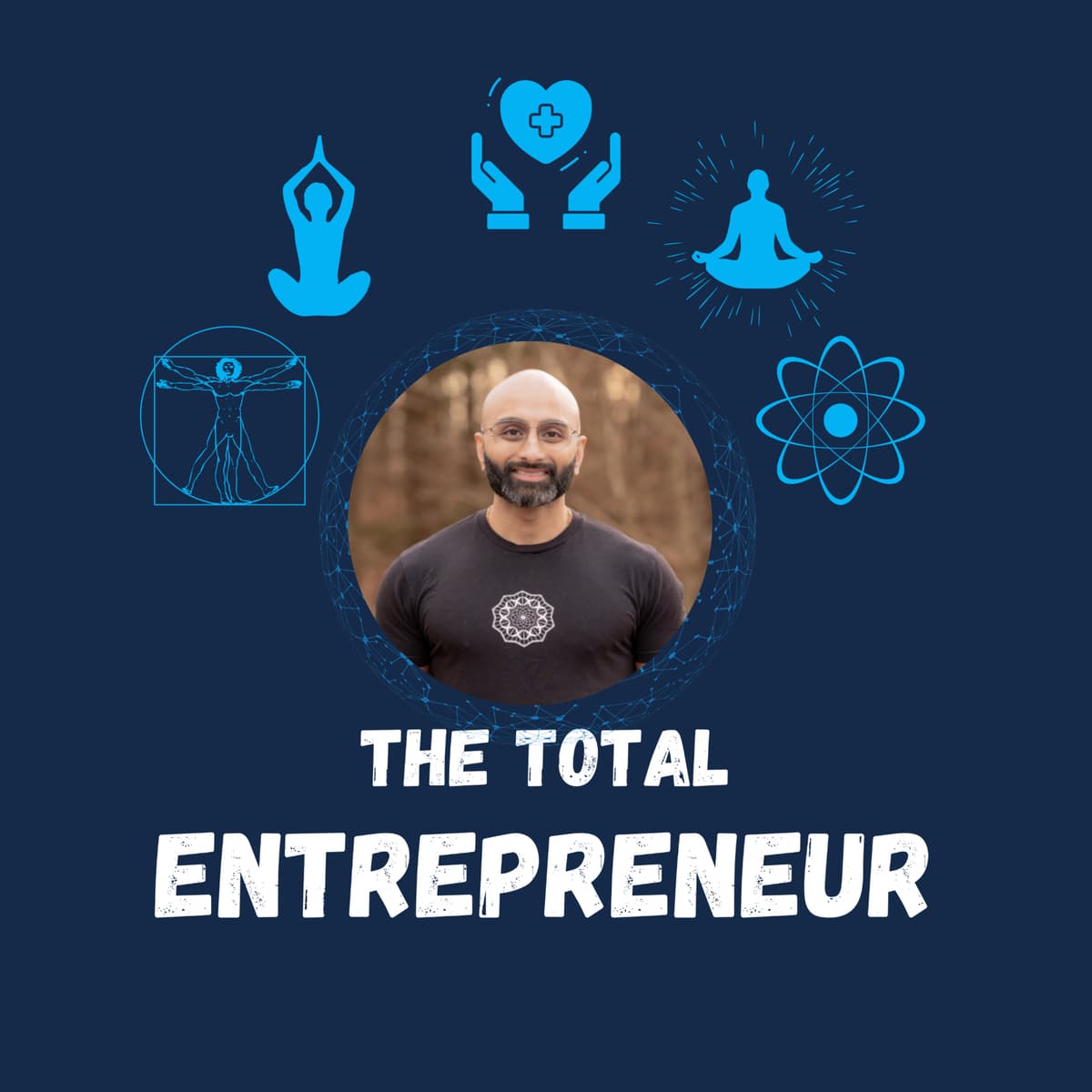
The Doctor of the Future Is YOU with Sachin Patel
with Sachin Patel
Sep 5, 2025 · 00:52:43
Part of our conversations on
Today's guest is someone I've been following for a while, and I'm very excited to bring him onto the show. Sachin Patel. He is a father, husband, breathwork facilitator, plant medicine advocate, and founder of the Living Proof Institute. He's also the creator of the Perfect Practice Mentorship, where he trains health professionals from around the world to build conscious, heart-centered practices that truly heal. He's someone who deeply believes that the doctor of the future is the patient, philosophy that really resonates with me. What I appreciate most about Sachin is that he is not just preaching theory, but he actually lives it. He blends the science, spirit, spirituality, and service in a way that feels grounded, powerful, and completely aligned with what we're trying to explore here on The Total Entrepreneur Mind Body Spirit. I hope you enjoyed the interview. Welcome to The Total Entrepreneur Mind Body Spirit. where we turn cutting-edge science into practical strategies for entrepreneurs. I'm your host, Dr. John Torrance, entrepreneur, Inc. 5000 honoree, and professor of entrepreneurial practice at Syracuse University's Whitman School of Management. Each episode, we dive into mental, physical, and spiritual health with expert guests offering actionable insights to help you thrive and perform at your highest level. Let's get started. Sachin, welcome.
Thank you, Jon. It's a pleasure to be here.
Yeah, pleasure to talk to you. So the first thing I wanted to ask you about was, you know, I've heard you say that the doctor of the future is the patient. Talk to us about that. What do you mean by that?
Yeah, absolutely. So being a healthcare practitioner, one of the things you quickly realize is that no matter how good you are as a practitioner, the value of your service and the value of your message, either comes to life or dies when the patient takes it and runs with it. And what I realized is that I could give people the most absolute best advice, but it's up to them to follow it. And also ultimately they determine the outcome, not the practitioner, unless they're laying there having a surgery, they're determining the outcome. And really when you understand the magnitude of the problem that we have right now, the biggest challenge we have in healthcare Is, A, we don't have solutions for even the most chronic of conditions and the most prevalent of conditions. We just have Band-Aids to manage people. And we wait in a reactionary way, and we have to get to a certain predetermined point of suffering and dysfunction and disease based on numbers that a system made up, right? And continues to make up. And so we're at the mercy of that system. And so that is not a viable solution. The solution isn't more functional medicine practitioners, to be quite frank. The solution is more healthy people. And so the way we create more healthy people and more healthy communities and societies is we teach people and reinforce that they are their own best medicine. And what I help people do is teach them how to access that medicine that resides inside each and every one of us, is available to each and every one of us in this moment, whether they are appreciative of that or not, there for them. We literally built ourselves from 2 cells, right?
Mm-hmm.
And these 2 cells came together and continued to divide and created this magic that we call life. And we are constantly in the process of rebuilding ourselves. In fact, right now, as people are listening to this or watching this, millions of cells, billions, and then eventually trillions of cells will quietly replace themselves. So we are literally a hologram of birth and death happening in every single moment. And so once we access that paradigm of thinking, we realize, wow, I'm actually more in control than I think. And in fact, we are our own pharmacy. We are our own kind of self-creating organism, right? And we are influenced by our environment and our thoughts, and of course our biology. And once you know what influences those things, what you realize is that none of it shows up on your doctor's lab testing.
Hmm.
So the key factors that are deterministic in one's health are not going to show up on your lab testing. So your doctor is going to miss it every single time, because what the lab test tells me is what questions the doctor is asking. So if I'm looking for disease markers, the doctor is asking, do you have this disease that meets the criteria that this system has created? Not, are you living a life that is producing and creating health and unlocking your own medicine? Which once you know how to do that, is available to you 24/7. That's why I think that us becoming our own doctors is the only solution, because anything else other than that bankrupts us morally, bankrupts us as a society financially, and it's not the world that I want to create. I want to live in a world where everyone knows how to self-actualize themselves, and we have the data to prove it, that it's possible. We have the data to show that it happens very quickly, that the body does not resist. There are no side effects. The only effect is pure health. And it's almost like a plant. When a plant is wilting, if you give it what it needs, it immediately sprouts up. And if you don't give it what it needs, nothing really happens. And so what we'll— I think we'll unpack today is how people can become their own best doctor. And once they know that, they realize how embarrassingly simple it is, and they're going to wish they knew this sooner, and they're going to wish they told their kids. And here's the thing, it's never too late because your body's right now waiting for you to unlock its own medicine.
So you said a few things in there that I made a mental note of. The first was that we don't really have any solutions. And I think maybe medicine doesn't, but like you said, we have the solution, of course, right? But the other thing that you said was, and it reminded me of previous doctor's visits when I started my own journey, I knew I wasn't feeling well, but I wasn't clinical in terms of having a disease state that they could diagnose. So for example, you could have fasting glucose of 90, but until you're at 100, you're not pre-diabetic, although all sorts of bad stuff could be going on in your body up until the point you get to 100, right? So is that what you're talking about a little bit when you say these states that the system creates and that sort of thing?
Yeah, so, you know, how do we define disease, right? It's like a mathematical equation. And so we're comparing everyone to the population.
A very sick population, by the way.
Right, and a continuously sickening population, right? So it's definitely heading and projecting in the wrong direction. So that's what our baseline comparison is. And so, if that's who we're being compared to, then that's not fair to us because we might want to feel amazing, right?
Mm-hmm.
If your mechanic said, hey, I'm going to make you the average, and I'm going to assess the problems in your car based on the average of how other people take care of their car, you'd probably skip oil changes, you'd probably skip tire rotations, you'd probably skip routine maintenance because most people don't maintain their vehicles the way they should. But if you're a car enthusiast or a health enthusiast, there's a maintenance schedule that your car needs, and it relies on that in order to function optimally. So when we're looking at blood work as an example, so here's some of the key pillars. There's 3 key pillars that affect our health. The first one is circadian biology. And circadian biology is really fascinating because every animal except humans, 'cause we are animals biologically, right?
Yeah.
We just have these amazing brains. But physiologically, we're just like a gorilla, right? It's not very much different. And so what's interesting to understand is that animals passively, they don't have to think about these key pillars when it comes to health. So the chipmunk, when I talk to my clients, I point out a chipmunk or an animal that's living close to them. That animal is governing all of its biological processes and systems based on circadian rhythms. It doesn't know it's doing it. It just lives outside.
Right.
That's just what it does.
Yeah.
And so either whether you believe in just this universe and this world is a complete fluke of things that had to happen, or whether you believe it's created in the image of perfection, it's living in synergy with its environment. And so bright days and dark nights are very important. You might hear someone like Jack Kruse say this, and what we've done is we've created dark days and bright nights. And the position of the sun changes the wavelengths of light that are passing through the atmosphere. which changes the message that the light is sending to our body, changes the angle at which the light is coming into our eyes, and therefore changes the biological functions that are taking place. So just like we know in different rooms in our house, the lighting is better at different times of the day, right? Think of it that way. We're lighting up different rooms in our eyes, on our retina, to signal to our body what time of day it is and what biological processes and hormones need to be secreted at this time. So for example, morning bright light increases dopamine production, 'cause we need dopamine to get us moving, to keep us focused, to feel reward right after we accomplish a task. It also increases cortisol, 'cause we need cortisol to increase blood sugar. So I find it interesting that doctors want you to measure your blood sugar first thing in the morning when it's supposed to be highest.
Hmm.
So cortisol's main job in physiology is to raise blood sugar. And so we haven't eaten anything, so we need something to trigger the release of increasing glucose levels, and that's what cortisol does. And so for most people, they miss that morning light cue, and then the rest of their biology is thrown off. And then they're in indoor lighting, which has only visible spectrums of light. The magic of the sun is invisible to us. So infrared light and UV light are very important signals to our biology that, again, create a cascade of hormone production, that increase melanin production, that are— most people don't know this, but your skin, when it's exposed to the sun, turns your body into a battery. It structures the water in your body. It increases nitric oxide production. It reduces any friction of your arteries passing through your body because of a process called sulfation. So all these things happen just by being in the sun. And our hunter-gatherer ancestors would have naturally been outdoors most of the time. You know, I just came back from a 4-day backcountry trip. No service, no cell phones, no screens, just the sun. That was our, that was our guide. And it was a new moon, so there was no, no like light at night. So super bright days, outdoor, outside all day. And then we aligned our biology rising and setting with the sun.
Hmm.
And it was just miraculous. Like, I felt like 5 years younger when I came back because we literally reset our whole nervous system. So the first pillar is circadian biology and We can certainly unpack that more. The second pillar is nervous system regulation. So, most people these days, because they take on the burdens of everything that's happening around them, right? They take on Elon Musk's burdens, they take on Donald Trump's burdens, they take on the FBI's burdens, right? Or whatever they're into, right? Or they take on the burden of, you know, all the challenges, the wars and stuff that are going on in the world. So, we have a completely dysregulated nervous system. And when your nervous system is dysregulated, it doesn't matter what supplements you take. it doesn't matter what foods you eat. In fact, you don't even digest your food properly when you're sympathetic dominant.
Hmm.
And so food actually becomes a poison if you don't digest it, right? It literally rots in your digestive system and creates putrefactive factors that feed toxic bacteria. And so well-digested food is medicine, undigested food is a toxin. And the determinant in whether we're gonna digest that food or not is our nervous system, the state of our nervous system when we are consuming that food and when it's in our digestive system. So, most people have no awareness of the state of their nervous system. It's like your transmission. They've got their transmission in reverse and they want to go forward, right? It doesn't matter what fuel I put in the car.
Yeah.
It doesn't matter how aligned my tires are. It doesn't matter how shiny my wax is, right? What matters is what gear am I in and where am I trying to go? And most people have a mismatched nervous system. So, they're in stress when they're trying to rest and when they're wanting to rest and digest, right? So, this affects their sleep, this affects their digestion, this affects their cardiovascular system, And then, the third pillar is rest and recovery. And, this is something that entrepreneurs especially have a hard time with because they're like, I'll sleep when I'm dead, right?
Exactly.
Or, they don't really— sleep and recovery are not very sexy but are essential, right? It's like pulling the bow back. And, when we use data like Oura Ring data to track our clients and monitor them, what we find and uncover within a couple of weeks is they have way too much stress and not enough recovery, so their nervous system is dysregulated. So circadian rhythm, nervous system regulation, and proper rest and recovery— none of that shows up on lab work, but it is absolutely essential for you to know this information about yourself. So wearables can be a great tool. If somebody's concerned about blood sugar, then I would suggest a CGM. So you have incremental data that's showing you what is actually causing the blood sugar to be elevated. What some people don't know is that blue light actually increases your blood sugar response.
Yeah, I just learned that.
For example, you could have the exact same meal, and if you have it in front of a television, which is emitting blue light, or you have it outside where you get full-spectrum light, it's going to have a different effect on your blood sugar. And so we can change— if we don't change our diet, if we change our diet but don't change the conditions under which we eat, it's not going to have the therapeutic benefit that we think it's going to have. So people who've tried everything, tried every diet, and they don't feel good, it's probably not the diet. It's probably their digestive system and nervous system.
There's so much to talk about in that, in those 3 pillars. But what it made me think of was, you know, I work with young founder CEOs all the time. And when we talk about this type of thing, the analogy I use is that you're taking It would be like you take the most important function in your business and just outsource it to somebody who's really not all that good at it, right? So like what we're doing is we're kind of abdicating our responsibility for our own health to somebody who isn't really that good at it for us personally, right? Maybe they're good at it at a population level for, you know, trauma and really sick people, but it seems like we have to take that agency back to really maximize our own health.
I 100% agree. And what I would add to that is not just someone, but something, right? So, there's a lot of, like, you know, in the spiritual world, we call it spiritual bypassing when, you know, you can't— you don't want to fix the problem, you just want to keep going to plant medicine retreats instead of actually addressing the root cause of the issue. So, you think more medicine is going to fix the problem. And some people do, you know, health bypassing, where they think, okay, I'm just going to get a red panel and not change anything, and that's going to fix everything, or I'm going to just take more supplements. I'll give you a really quick story. I had a friend of mine who came over, and he's been seeing a practitioner for quite some time. And I just started asking, like, he was asking for some guidance, so I started just probing and asking some questions, and I quickly realized that he was applying none of the 3 pillars.
Hmm.
And once I explained it to him, I said, listen, you are There's not much difference from you biologically than, if we think about it, than a plant, right? A plant needs water, it needs sunlight, it needs nutrients from the soil, it needs the right ratios of oxygen, carbon dioxide, and other gases in the air. It needs the right environment for it to thrive in, and it needs love, right? It needs all those things. But if I give it more water and I tell the plant, listen, I'm going to give you extra water this week, but I'm going to put you in a dark closet. Right? How's that going to work out? There's no amount of water that you can give a plant to make up for a lack of sunlight.
Right.
So just like we need sunlight, the plant needs sunlight as well. We need those triggers. They're biologically necessary. So I tell people to study animals, study nature. What are the things that animal is likely taking for granted or not even thinking about? And how many of those are you doing? Are you grounding every day? Well, that squirrel's grounding every day. Are you aligning your biology with the rising and setting of the sun? Every animal, plant, insect aligns its biology. So, when the sun's coming up, the birds know, they start making noises. When the sun goes down, the mosquitoes start coming out. Everything aligns with the rising and setting of the sun, except humans.
Mm-hmm.
So, until that happens, nothing changes. So, he was having low energy issues, and I'm like, well, the first thing is your sleep is probably the problem. And recovery is the issue. So we pulled out his Oura Ring and we discovered his stress was high, recovery was low.
Hmm.
And so I said, listen, more exercise isn't gonna help you 'cause that's creating more stress on your body. What you need is to go for a walk in the woods in the morning and try to do that middle of the day and try to do that in the evening if you can. And literally, there's no better advice that I could give you than doing just that. No more supplements, no more gadgets. You just have to go back to the basics and realize that these are non-negotiables.
Right.
Just like water and sunlight and all the things I mentioned about a plant are non-negotiable, we also have non-negotiables that were passive to us. We didn't have to think about them. So we were naturally grounded. We were naturally aligning with circadian rhythms. We were naturally sitting and eating and getting ourselves in a state of rest and digest. Our nervous systems were regulated because we could express ourselves emotionally. Whether it's through crying or laughing or playing instruments, we all had outlets. Drumming is a great outlet for people to get rid of the excess adrenaline in their body. We were moving our bodies so we would get rid of the adrenaline and whatever stressors we had were our own or of our small tribe. So I went with a group of 8 people. And when you're disconnected from what's happening in the world, you're so present to the next step you're taking. You're so present to, are we moving our boat in the right direction? And everything else dissolves. All the illusions of life start dissolving. And that's how our biology is set up. It's not designed to take on all the problems of all the tribe members of all the tribes in the world, which is what's happening to us. So, our nervous systems are just bombarded. And so, for him, and he's a very successful entrepreneur in his 30s, I'm like, dude, you got to fix this now. Otherwise, it's not always going to be this way.
Yeah. And he won't enjoy the fruits of his labor. you know, laid into his life. It seems like, you know, we've got so much technology and advancement accessible to us that we're kind of forgetting the simple stuff, right? So it almost seems like, well, you know, sunlight and grounding really can't be that helpful because we've got all this money we've spent on drug R&D and medtech, and that's really the stuff that's going to be helpful. Whereas, you know, the sunlight's been around forever. How much can that really help, right? Or, or how much is it really going to help to get your feet in the earth? I mean, that's not not very technologically advanced, but it seems to me that there is an ancient wisdom to that that we've just forgotten, and it's to our detriment.
Yeah, I mean, here's what's really interesting about science, John. I think you'll find this quite fascinating, is that, um, every year, do we do more science or less science?
I would guess we do more.
Yeah, exponentially more, right? So if you look at the number of articles that have been published over the last 100 years, it's like a hockey stick, right? Which means we have more questions, which means we actually know less.
Right.
So if we use science as our guide, science tells us just with the amount of research that's taking place is that it knows nothing. So what are we hanging our hats on? I'd rather hang my hat on just observing what nature has to offer. Nature is the greatest— like a tree is one of the greatest technologies that exists because it's learned to live in congruence with its environment. and take and give back and live for hundreds of years in these ecosystems. And we haven't figured that out. So what makes us more intelligent than a tree?
Right.
We're destroying our own habitat by the second. We're irresponsible as citizens of this planet. And we have this beautiful world that we could take better care of, but it starts by taking better care of ourselves. And so I look at nature as my greatest teacher, and it's already figured all this stuff out. In fact, nature has solved problems that we haven't even created yet.
Yeah. What's an example of one?
Well, if you think about it, most drugs are derivatives of plants.
Exactly. Right.
So, so the solutions already exist in nature, but they're not patentable.
Right.
Right.
Which reminds me, you know, that's why, you know, there's probably not a lot of peer-reviewed studies on sunlight as a healing modality or grounding as a healing modality, because it's, it's, you can't turn it into a profit model, right?
Yeah. I mean, You know, here's the thing, you know, the way we live life right now, the analogy I would use is somebody throws you in the middle of a pool or somebody lands in the middle of the pool. They have no idea how to swim. And so the, the, you know, and I want to say this before I say any of this is that I love doctors. I love nurses.
Absolutely.
They saved my wife's life. However, they're good people. in a paradigm that doesn't serve the client properly, or there's more that even they know that they can give, but the limitation isn't their heart and their knowledge, it's the system that they're in, right? And it's hard to break out of that system because it just is, right?
Yeah.
The societal structures are set up this way. And that's why I'm so glad I'm an entrepreneur first and a doctor second, so I could break free from that system and then teach what I learned along the way to other practitioners so they can break free and they can do what's right what they know in their heart is right, right? So I work with cardiologists, endocrinologists, nephrologists, chiropractors, naturopaths, who see that this model is broken and the way that it's societally constructed is broken. We need to create something superior to it, right? So that's what we're all doing together. So what happens in our current medical system is unfortunately doctors and nurses are trapped there. They don't have the entrepreneurial know-how to get out of that system. It can potentially pay really well, right? So we have what are called golden handcuffs. And so I feel like when it comes to that person who's now struggling in the pool, which is your average patient, you have the one person that throws in, let's call them the traditional Western medical system, they throw in a life preserver, right? So one of those lifesavers, they throw in the lifesaver, but The lifesaver dissolves. And as it dissolves, it makes the pool more toxic. And then we come back 2 hours later and they're still in the middle of the pool. They're still drowning. We throw them another lifesaver, right? But again, the more lifesavers we keep throwing at them over time, the pool becomes more and more toxic. It's toxifying the water that they're in. So eventually the toxic water kills them, not the drowning. Okay. And that's how most people are, right? We're just throwing them lifesavers.
Mm-hmm.
We're throwing drugs at them. And then the natural healer comes along and he throws them a natural lifesaver, but it's still dissolving. So they have to still keep taking it. And then someone like me comes along, or perhaps someone like you comes along and says, hey, let me teach you how to swim. And then it doesn't matter. One quote that I love, I don't know if I came up with this, but I love it, is that it doesn't matter how deep the water is if you know how to swim.
Right. Yeah, I love that.
If you don't know how to swim, you can drown in 2 inches of water, right? But if you know how to swim, it doesn't matter if the water's 10 feet deep or 10,000 feet deep, because you just gotta stay at the surface there, right? And so of course it's scarier the deeper it is, but if you know how to swim, you're good, right? If you know how to tread water, you're good. So let's teach people how to swim to the shore, right? Or how to tread water so they're not relying on something external. And guess what? But every time I throw you a life preserver, do I strengthen you or do I weaken you?
Yeah, right.
Do I build your belief in yourself or do I weaken your belief in yourself? Do I unlock your medicine or do I bury it deeper inside of you?
And I think that's, yeah, that's just another, I guess, example or a symptom, right? We've come to rely so much on the third party, on the expert, on the doctor, who, like you said, was trained in a certain way, not necessarily to optimize your healthspan or wellbeing, but to treat chronic disease and to keep you alive longer with chronic disease. And like you said, massive respect to doctors. I mean, they can fix a broken body. If you have severe trauma, there is nobody else you want to see besides these people, right?
Yeah.
But because of the way they're trained and because of the way we've been almost socialized or trained, we kind of give up our control over our own health to this system. And I think that's one of my goals is to help people, especially young entrepreneurs, take it back. 'Cause like you said, there is that grind culture where they'll sleep when they're dead and on and on. And I want to help people understand that they have to put themselves in the position of being the CEO of their body, of their wellbeing, and not to just outsource it to somebody who isn't really great at it.
Yeah. It's— and they're— and I know you intended to say this too, in all fairness, they're great at what they do, just like a firefighter is great at what they do. But if I have a squeaky door, right, and I call the fire department, they're going to tell me to buzz off, right? They're going to be like, where is— there's no fire here, right? You don't meet the criteria for where we provide the best service.
Right.
Now, with that being said, you know, you call a carpenter or you call a handyman, but if your house is burning down, you call a handyman. Right? He's not going to be able to save you with a screwdriver, right? So there's a time and place. And so, so many people are going to the fire department and the fire department is saying there's nothing wrong with you because you don't meet their predetermined criteria.
Because your house isn't on fire. Yeah, right.
But your house is in disarray, right? And when we do call the fire department, God forbid that ever happens to anyone listening to this or anyone in general, They're going to destroy your house in the process.
Mm-hmm.
So they're going to save your house and you're going to be grateful, but your house is going to be— you're going to have to— it's going to be water damaged. There's going to be all kinds of stuff. They might have to break down the doors or windows, whatever the case may be, to do whatever they can to save you or save your house. And so the same type of analogy applies to traditional healthcare. It's what are we looking for? And just like you can take your car to a body shop if it's banged up, Right. And driving school prevents the accident, right? Becoming self-actualized in terms of really simple health practices to unlock our own inner potential, it's really simple once somebody teaches you how to do it. And it's not even— here's the thing, Jon, it's not even me teaching you anything new. It's helping you remember who you are.
Yeah. Well, so let's turn our attention there. So, How can we start to do that, right? What are some of your go-to recommendations? Or if you're starting from scratch with somebody who really just needs to start with the basics, how do you start with them?
Yeah, great question. So first, we have to be committed, right? And one of the ways that I find we show our commitment is by hiring an expert. Because right now we live in an age where information has basically zero value. We almost have too much information. And because we have so much information and it can be conflicting at times, we don't know what's right and what's wrong. So what we actually need is an age of mentorship. What we're entering, I believe, is an age of mentorship and wisdom where somebody who's, let's say, been in practice for 20 years, right, is going to have all this experience and knowledge and awareness and intuition that we may not have, right? So even in the age of AI, it's not just about throwing your tests in there. You might not even know what questions to tell it, right?
Right.
Or what prompt to give it, right? So you still have to know how to utilize that information to create a plan. One thing I'll say is that when I work with clients, I work with a lot of entrepreneurs and CEOs in particular. And one of the things that we find with them is they feel like the solution has to be complicated.
Exactly right.
Leonardo da Vinci said it best. The ultimate sophistication is simplicity. Steve Jobs echoed that, right? So the whole framework of Apple, the whole like kind of overarching theme around Apple and their products when Steve Jobs was at the helm is simplicity. That's why the phone only had one button. And so, if we take that and apply it as a law, or at least a very, very palpable theory, then there's nothing more sophisticated than the human body, which means that it should, in theory, following that concept, be the simplest thing to take care of. And that's what makes it sophisticated. Something isn't sophisticated if it's clunky. And so, once People understand that paradigm shift, right? You think about a tree, like, you don't— you just have to— the seed just plants itself, right, from the previous generation, and then it just needs water, dirt, soil, a little bit of protection, right, from its surrounding, and it gets nutrients just like we get wisdom. It gets nutrients from the mycelial network underneath, and it grows, right? And that little tiny acorn turns into an oak tree. It's simple, right? It's not overly complicated. If we had to match the complexity of the tree to take care of it, right, there would be no trees around, right? So our bodies are the same way. They are absolutely— in fact, I would argue embarrassingly simple to take care of. When you're doing the right things, it's embarrassingly simple. And that's what also— what makes something easy to do also makes it easy not to do.
Yeah.
And so that's why I feel like making an investment in yourself, right? So you really value the information and put it into action, and having a way to track is very important. So we give our clients an Oura Ring, Yeah. and we track their metrics daily so that we're able to monitor their sleep cycles, we're able to monitor their resting heart rate and HRV, we're able to see trends as they're making these changes, and they are able to see that too. So I believe healthcare needs to shift to a model where we have really short feedback loops. So the longer the feedback loop, the more useless the information is.
Yeah.
Right, so if I test your blood, even if I test it once a month, right, that's very different than testing it every 15 minutes, which is what happens when you have a CGM. Every 15 minutes, it's looking at your blood sugar in real time. So you can make very targeted and actionable decisions and kind of gamify the healing process as well. making that investment, hiring wisdom, okay? Because wisdom is like a time machine. It saves you time, it saves you money, and you can get somewhere in 90 days that might take you 10 years to figure out on your own, right? And it's all figureoutable. It's just the question is how long. And if you apply it sooner, you can benefit sooner. And if you— what I love about what I at least teach to people is everything we teach is is modelable. I don't know if that's a word, but if I get you going outside, right, then that's something your whole family will benefit from. So what I teach are timeless principles that will be valid and relevant today, tomorrow, 100 years from now. They would have been valid 1,000 years ago, and they'll be valid 1,000 years in the future. That's what I like to teach my clients, not the latest fad or the latest trend. Because sometimes you find out that that's probably not the thing, right? Or next month there's something else that's out. Next month there's something else that's out. So you're always living in this sense of, I don't know enough, or I don't have enough, and I have to buy and do all these things in order for me to live forever, right? Or live longer or live a higher quality of life. Simplicity creates the highest quality of life. And so, getting up, getting outside within the first hour of the day is hugely important, unfiltered. So if you can help it, no glasses, no contact lenses, no sunglasses for sure, and no windows. You want to literally get outside because the windows block certain wavelengths of light. And so you're missing the invisible spectrums of light, which is where the magic and the medicine of the sun resides. You want to really dial into your nervous system. You're just like, if I were to eat a high sugar meal first thing in the morning, my blood sugar would just do this roller coaster all day.
day.
Our nervous system is the same way. So we really want to get grounded first thing in the morning so that we have a stable nervous system. So our morning should be restorative, right? We shouldn't just get out of bed and go right into fight or flight because that just sets the stage for our blood sugar and our nervous system for the rest of the day. So having an intentional morning practice is hugely, hugely important. And as you start practicing these principles, It doesn't mean you have to take any time out of your day. Just be intentional, right? If you enjoy your coffee in the morning, turn it into a meditation.
Mm-hmm.
If you are taking a shower, right? What can you be doing in the shower, stacking in the shower that improves your quality of life? So it could be something as simple as humming, which increases nitric oxide. You could end the shower cold, which increases your dopamine. And you're already doing hard things first in the morning, and things that you resist first thing in the morning builds a part of our brain that, is absolutely critical to decision-making and personal growth and development. It's called the anterior cingulate nucleus. And so we find that when people do things that are hard, that part of the brain grows. And people who are obese, for example, have smaller anterior cingulate nucleuses because they don't do hard things. They do easy things.
Okay.
So we can actually reshape our brain by doing things like this. So, the more you're hearing this and resisting, the more growth potential you actually have. Whereas, somebody who loves cold showers doesn't grow from them because we look forward to it. So, it's actually not growing us. And I'm not saying that you have to now do an ice bath or anything like that, but just keep that in mind. So, how can we stack our habits in the morning? Morning sunlight, centering our nervous system, having awareness and turning our morning into a meditative practice instead of a stress practice. We could be doing all the same things, but just with a slightly different intention and do them with love. That's another important thing. Meal timing is also important. So studies are now showing that having a breakfast in the morning is actually not— is a good idea. And it's better to have breakfast and an early dinner than it is to have a late breakfast or lunch and a late dinner. So if we can move that feeding window to earlier in the day, that's going to help us align our circadian biology better. Getting outside periodically throughout the day is also really important. I spend my day outside, so I'll be on this interview with you, and then all my work is going to be done outside today. I try to soak up as much of the summer as I can, because in the winter, it's a little bit harder, right?
Yeah.
And my body is now paying attention to the way shadows are being cast, is changing the time of day in the part of my brain that keeps track of that. So all my biological processes are going to work so much more effectively. Moving throughout the day. So not just moving once in the morning and maybe once in the evening, but if you can get up and move around every 15 to 20 minutes or so, that's actually much more effective. So sitting isn't bad for you. Our ancestors and animals in nature sit often. but they're not sitting for extended periods of time. So just get up and move around. That's going to be super helpful. The other thing I want people to pay attention to is their breath. The breath is the steering wheel of the nervous system. And so, and that could be a whole conversation, but the breath is basically the window into the nervous system.
Hmm.
So I could tell just by the way somebody is breathing, what state their nervous system is in. So if somebody is breathing short and shallow, I know they're in a more in a sympathetic or fight or flight type of state. If they're breathing through their mouth, I know that they're sympathetic in this moment. If they're breathing slowly and through their nose, and I can tell that their tongue is positioned correctly at the roof of their mouth, that's going to create a soothing effect on the nervous system. So these are all things that we can pay attention to and have more awareness around. And just like we can drive to work without thinking much about it, we can go through the entire day and not think much about our breath. But it literally is grabbing your nervous system by the steering wheel and guiding it in the direction you want it to go in. So if I need more focus, there's a breath for that. If I need more strength, there's a breath for that. If I need to, if I'm going on a run, there's a breath for that. If I'm trying to go to sleep, there's a breath for that. So breath is both an art and a science. And once you learn the different ways to breathe, you get a predictable response in your physiology every single time. Our bodies, the first thing in our nervous system that changes outwardly is our breath. So if a lion were to walk into your office, you would immediately gasp. If you felt a sense of relief, you would sigh. If I said something funny, you would laugh. If you were upset, you would cry, right? These are all forms of breathwork. We don't necessarily view them that way, but they are. And it's our nervous system expressing itself through the breath, because when we change our breath, it changes our internal physiology. For example, when you gasp, your lungs expand very quickly, squeezing your heart, immediately increasing blood pressure so you could run away or fight off whatever is coming after you, 'cause now we're gonna send blood from the trunk, we're gonna send it to the arms and legs.
Mm-hmm.
Right? So it would make sense for you to gasp. Whereas when we feel a sense of relief, we sigh, right? Because our lungs release grief and our diaphragm is where we store our trauma. So we just kind of let all of it out and we release that stress that we were feeling, and we now feel a sense of relief. So you can exaggerate these breathing, these different breaths that the body already uses, and then tap into that, right? So if I wanted to increase your heart rate, I could have you breathe a certain way, right? If I wanted to pump you up, I could have you breathe a certain way. If I wanted to increase adrenaline, for example, right, I would do something called bellows breath, You see Tony Robbins do this, right? So basically breathing in and out really, really fast, 30 times for 3 sets, your heart rate and your blood pressure are going to get pumping. Your adrenaline is going to be high, right? Because we're using the breath to tell the nervous system what state we want to be in. If you were trying to fall asleep, I would have you do a 4-7-8 breath. Breathe in for 4, hold for 7, let it out for 8. That tells your nervous system you're safe. And a good high-quality sleep has to— starts with feeling safe. And so our nervous system has to feel safe. But if your breath doesn't— you're not— if your breath isn't in that state, it's like you want to go put your car in park, but you're still stuck in drive, right? Expecting the car not to go anywhere. So, uh, so breath is a, a wonderful access point to the nervous system. that you have available to you 23,000 times a day. I encourage people to mouth tape at night. It's a great insurance policy to keep their mouth closed and breathe through their nose. Nasal breathing is one of the most important modalities that we recommend to our clients. You want to be breathing through your nose as much as humanly possible because your mouth is the dirtiest part of your body and puts a huge tax on your dental health and a huge tax on your lung microbiome.
Hmm.
And, and so when you're breathing through your nose, it cleanses and purifies, pressurizes, moisture regulates, temperature regulates the air. It perfects the air before it goes into the lungs. The number one chronic condition in America is periodontal disease.
Hmm.
And periodontal disease is rooted in mouth breathing. So the way we breathe has a huge effect on our heart health, has a huge effect on our lymphatic health. You know, your biggest lymph nodes in your body are underneath your diaphragm, right? And so if I was an intelligent creator, that's exactly where I'd put them, because 23,000 times a day, my lymphatic system for my trunk is going to get pumped, right? We actually have 2 pistons that pump our trunk. We have our pelvic floor muscles, and we have our diaphragm. That diaphragm is like a dome, and as we breathe in and out, this whole system pumps. But if your breath is short and shallow, guess what? Now your lymphatic drainage is not that good. Now your heart isn't getting the assistance that it normally would from the diaphragm. The diaphragm is referred to as the second heart. And so when we start looking at our breath a little bit more closely, we start realizing how important and valuable it is in helping us be healthy and feel healthy. The other thing that's interesting about our breath is that we consume 30 pounds of air a day. Which means we interface with our outside environment more with our lungs each day than the amount of food that we eat in a week.
Hmm.
And your lungs are about this, you know, the square footage of a tennis court, just like your digestive system. They're about the same surface area. So your lungs are a very important interaction that you have with the outside world. Imagine breathing in the surface area of a tennis court in and out with each breath. Right? Think about how amazing that is, and it's happening 23,000 times a day. So, yeah, I feel like when people understand the importance of breathing, they also understand when we break it down for them is the importance of nasal breathing on nitric oxide production. Nitric oxide is our— so, our immune system, just to go back one step, our immune system actually starts in our nose. So, if you were to ask me, where does your immune system start? Most people get that question wrong. It starts in your nose because all the air you breathe in is exposing itself to the inside environment, and you have a microbiome in your lungs and in your nasal cavity that's interacting with it. Nitric oxide kills viruses and bacteria on contact, so it actually is antiviral. Why was nobody teaching us how to breathe when we had this thing going around, right?
Yeah.
I don't know if it even was a thing, but so nitric oxide increases that through nasal breathing. We increase it 6-fold through nasal breathing, 15-fold through humming.
Hmm.
So you could hum in the shower, that increases nitric oxide 15-fold. And there's all the research to show this. The other thing that's interesting about nasal nitric oxide is nitric oxide increases microcirculation. And so it originally, and lowers blood pressure. So originally when they developed Viagra, Viagra is a nitric oxide recycling drug. They initially developed Viagra to help people with lowering blood pressure, because that's what nitric oxide does. If you're in your 40s, your nitric oxide goes super downhill very quickly. Okay? So, we want to do everything we can to preserve it or take supplementation to increase it. And it's really easy to test your nitric oxide levels with a saliva test. So, nitric oxide, Viagra was initially developed to recycle our own nitric oxide, but if you don't have the precursors to nitric oxide, then Viagra doesn't work for you because you don't have anything to work with. But what they discovered with Viagra, and most studies are done on men, and what they discovered is that this blood pressure medication that they thought they were developing had a very interesting side effect that it caused, you know, for men, it caused erections, right? Prolonged erections because it it increased microcirculation. Men were also, and women were also given Viagra during COVID because that increases nitric oxide. And because of the antiviral properties of nitric oxide, that's why it was being prescribed to people. And so nitric oxide increases microcirculation. Now, the hardest place to get blood to, you know where it is, John? The hardest place to get blood to?
Oh, your feet? I don't know.
Well, good guess, right? 'Cause sometimes our feet are cold. It's actually your brain.
Brain? Oh, I wouldn't have guessed that. I would have thought just naturally that would be easier for some reason.
Yeah. Well, remember, to get blood to our feet, gravity is doing most of the work, right? But to get blood to our brain, A, the circulatory system is very tiny there and minuscule, and we're working against gravity, right? So imagine somebody's nitric oxide levels are low because of the way they're breathing. they're not oxygenating and enriching their brain as much as they would if they were breathing through their nose with higher nitric oxide levels.
Wow.
So we can actually unlock another level of creativity and cognitive function. Nitric oxide addresses all 3 of the major causes of dementia and cognitive decline. So very simple to test. You can buy nitric oxide saliva test strips online. Test it on your tongue, usually first thing in the morning before eating or drinking anything. And you'll know within 10 seconds if your nitric oxide levels are where they need to be. And then if they're not, you can supplement with it, retest after 90 minutes, and you'll see that your nitric oxide levels pop back up to where they need to be. And now you've unlocked another level of sexual health, another level of cardiovascular health, another level of cognitive health. by simply increasing nitric oxide. And the fastest way you could do that is by starting to breathe as much as you can, as exclusively as you can through your nose, and particularly at night, which is when we are in the most parasympathetic state. And in that parasympathetic state, so if you think about this, rest and recovery occurs when we're in our most relaxed state. Just like if I need to take my car to the mechanic, I can't repair the car while I'm driving it around, right? I've got to put it in park and put it up on a hoist. And that's what happens when we're sleeping, right? Our brain goes through a car wash, right? We have a whole glymphatic system, takes about 7, 8 hours to clean the brain every night. So it goes through its own like detailing and waxing process, if you will. And then when we, if we're breathing through our nose, we're telling our body we're safe. When we tape our mouth and put our tongue at the roof of our mouth, it relaxes our nervous system.
Hmm.
Okay. Now I know some people have physical reasons like deviated septums and things like that that make it hard for them to breathe through their nose. There's, you know, obviously surgery would be an extreme intervention if needed. That might be the right thing for people. Joe Rogan had his deviated septum corrected and, you know, retrained how to breathe, right? So it's possible. The other thing that you can do is you can wear something called an intake, which is a magnetic clip that goes out on the outside of your nose and opens up your nostrils. I found that to be the most effective one. And you can practice good sinus hygiene. Remember, this is where your immune system starts, and you are as old as your immune system. So anything that degrades the quality of your immune system degrades the quality of your longevity.
Mm-hmm.
So now they're actually looking at the age of the immune system as the key marker for biological age versus chronological age. So how do we take care of our immune system is actually through our breath, believe it or not.
Yeah, the more I learn about breath and breathwork, the more it becomes important. Yeah, it seems like there's a lot there. And it just goes back to this, we've lost ancient wisdom, right? And what I love about all of these things we're talking about is that they don't cost you anything. You don't need a pill for it. They're accessible to you. You just have to know about it.
So yeah, it's one of those— it's some of those things that cost you not to do them, right?
Exactly. Yeah, can't afford not to, right? Right.
And then I'll, I'll just unpack. I know I've been talking a lot, so you'll have to excuse me. I get really excited.
It's amazing. I'm enjoying this a lot.
Awesome. I just want to close a loop on the day, so I'll leave it at this because there's like so many things I could talk about. Uh, one is is you want to end your day right. So, I look at what I found really helped for me is I don't look at tomorrow as the start of tomorrow. I look at tonight as the start of tomorrow.
Yeah.
And so, if I look at it that way, then my morning routine actually starts usually the day before because the morning sunlight is super important. But I would say it's easier for us to think of, okay, Tomorrow starts right now, right? How do I want my tomorrow to go? So I watch the sunrise and sunset as many days as I can, right? I'm not perfect, but as many days as I can. I have a beautiful spot right here where I sit, where I can see it. And so that's like a good way to start winding down. And that tells your brain based on, you know, the red, the sun is more orange and red at night. You have more infrared light and more red light coming in, virtually no blue or green light. You know, water looks black at night, and so do leaves. They look black at night because there's no blue or green light for them to reflect. That's why they look black. And so, there's nature, there's no blue or green light in the evening. And so, what we need to do is we need to follow that model. So, I turn off all overhead lighting after the sun goes down. I put on my blue blockers if I'm going to watch TV, and I turn on my red bulbs in my house.
Same here.
So now, I'm not perfect. So, that creates a perfect end cap for the evening. I don't open my computer screen after like a certain time unless I absolutely have to, but usually after 6, I don't look at my computer anymore. I don't really look at my phone after that time if I can help it, and I just start winding down. So our light cues are very important to signaling the appropriate hormones and neurotransmitters that we need to produce to create good quality sleep. And so you can't produce adequate amounts of melatonin if your cortisol level is high because they're antagonists to one another.
Amazing. Sachin, this was such a valuable conversation, and I really appreciate your time and expertise. And if people were interested in finding you or learning more about your work, where could they go?
Yeah, thank you for asking. So they can certainly follow me on Facebook at Sachin Patel DC. That's my personal page. That's where I do most of my posting. They can follow me on Instagram at @TheSachinPatel. We have some great tools and resources. One, our morning routine is a great resource, so they can go to www.morningroutine.ca. If they want to learn more about our programs and what it might look like working together, they can go to mymetabolicreset.ca. We work with clients remotely all over Canada and the US, and we have a few international clients as well, but we can take care of people right from the comfort of their home. Awesome.
Thank you so much.
My pleasure.
Thank you so much for listening to the Total Entrepreneur Mind Body Spirit Podcast. If you liked what you heard or heard something interesting today, please give us a like, share a comment, or better yet, subscribe to the podcast. Thank you.
About This Episode
In this episode of the Total Entrepreneur Mind, Body, Spirit podcast, host Dr. John Torrens engages in a thought-provoking discussion with Sachin Patel, a breathwork facilitator, plant medicine advocate, and founder of the Living Proof Institute. Sachin shares his philosophy that 'the doctor of the future is the patient', emphasizing the importance of self-health management. The conversation explores the key pillars of health: circadian biology, nervous system regulation, and rest and recovery. Sachin provides actionable insights into how simple practices like morning sunlight exposure, nasal breathing, and ensuring the right balance of stress and recovery can significantly boost overall well-being. Learn how understanding and implementing these fundamentals can lead to a healthier, more vibrant life.
Learn more about Sachin: www.morningroutine.ca and www.mymetabolicreset.ca
Episode Chapters
00:00 - Introduction to Today's Guest: Sachin Patel
01:24 - The Philosophy: Doctor of the Future is the Patient
02:06 - Challenges in Modern Healthcare
07:25 - The Three Pillars of Health
11:04 - The Importance of Circadian Biology
12:39 - Nervous System Regulation and Rest
15:29 - The Role of Nature and Simple Practices
21:51 - Breaking Free from the System
25:06 - The Role of Doctors in Chronic Disease Management
25:38 - Taking Control of Your Health
29:16 - The Importance of Simplicity in Health Practices
33:20 - Morning Routines for Optimal Health
37:13 - The Power of Breathwork
49:32 - Evening Routines for Better Sleep
51:34 - Conclusion and Resources
Keep listening
More on Body
About the Host
Dr. John M. Torrens
5× Inc. 5000 entrepreneur, Professor at Syracuse University's Whitman School of Management, author of Lightning in a Bottle, and TEDx speaker on ADHD as an entrepreneur's superpower.
Browse all podcast guests →Book a strategy call →