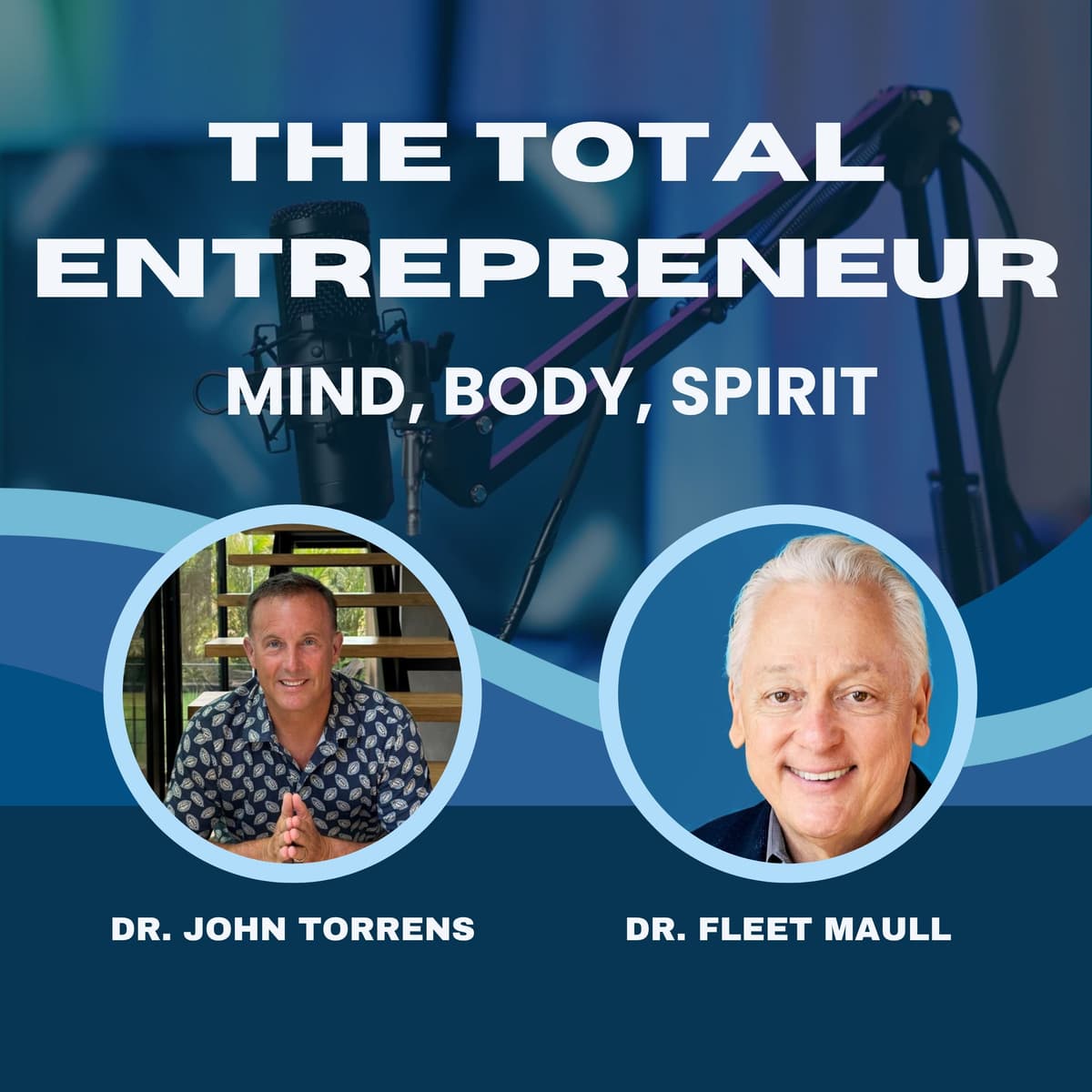
Somatic Mindfulness 101 with Dr. Fleet Maull
with Dr. Fleet Maull
Jun 26, 2026 · 00:47:03
Part of our conversations on
Dr. Fleet Moll, thank you for joining me. I'm really excited to have you here today.
Uh, Dr. John, happy to be here.
All right, man. Hey, so I wanted to talk first about mindfulness in business. It hasn't historically been something that business school students learn, although it's starting to creep its way in. It's tremendously important. So before we get into your rich background on that, I'd like to hear your perspective on why entrepreneurs, business school students, anybody engaged in business should be concerned about mindfulness.
Well, certainly some kind of awareness practice, some kind of mindfulness practice, I think is just critical to being successful in life and really especially in business because being in business kind of raises the bar for the challenges that we face. And, you know, it's interesting. I remember, I think it's been 20, 25 years ago that, you know, the global consulting company, I think it was McKinsey, and they did a mindfulness program. So suddenly mindfulness was okay in the business corporate world, right? But it's still taken quite a while to get more traction, but it's out there today. And the reason is You know, we all live in this interface between our childhood programming, whatever that was, for better or worse, which we got before we had anything to say about it. And that's literally programmed into our brains, you know, everything like being able to tie our shoes. We have a neural network that allows us to tie our shoes without having to figure that out again, right? So we have all this conditioning in there, which we had nothing to say about. And there's some good stuff in there. And most of us got our share of some gnarly stuff that our forebears hadn't quite worked out yet, and they hand it off to us, right? And I think in some ways that's our destiny as human beings, is take what we got and improve it so we pass on something better. So we live in the interface between that and the world around us, right? Now, if our condition was perfect, right, we had the perfect childhood, which nobody did, and the world around us was some, you know, very soft, full of marshmallows bubble of benevolence, then maybe we could just be in there kind of mindlessly and a habitually reactive state and it would work out. But that's not the case, obviously. And until we develop some kind of self-awareness practice, we're just kind of in there getting shoved around. And we may think we're, you know, free-thinking autonomous adults making free-thinking autonomous adult decisions all day long, but we're really not. You know, stimulus A1 comes in, we respond or react with response B2 every time. We're very highly programmed. And so in order to actually have choice, right, to really begin to be a conscious human being, much less a conscious business owner, and actually choose how we're responding to the circumstances and challenges we face day in and day out, internally within ourselves and in the world around us, to be able to choose how we respond to that rather than just reacting in habitual ways, we have to have some presence of mind. We have to have some awareness. There's got to be a a gap between a stimulus and response. You know, Viktor Frankl, in his book Man's Search for Meaning, very famously talked about that gap between a stimulus and a response, or if it's habitual reaction is a better word. But it's in that gap where all our freedom lies. And most of us, most times, don't even experience that gap. So the way we can experience and expand that gap is through mindfulness practices, where we're able to slow our mind down, develop presence of mind, more awareness, And we recognize that we're living a choice all the time. And we're either making those choices consciously, or we're letting our conditioning make those choices for us. And that may work out some of the time, but a lot of time it doesn't work out so well. And then we just find ourselves at the next consequence and the next consequence going, how did I end up here again? I think having some kind of awareness practice is just critical. It's just, you know, it should be in the toolkit of every human being. And fortunately, they're starting to bring it into K through 12 education. mostly in some of the more alternative schools, but some public school systems as well, because it's just basic human skill. I mean, we all have it to a degree. We couldn't function if we didn't have any mindfulness, but we can have a lot more, a whole lot more than most of us have until we intentionally begin to cultivate it.
One of the more common objections, if you will, from people that I work with, younger entrepreneurs, is that they either don't have time because they're in the chaos of starting or growing their companies, Or I work with a lot of entrepreneurs who have ADHD and they report that this is especially hard for them to sink into any meditative, contemplative type of practice. So I was wondering if you have any tips or suggestions for somebody in that situation.
I can address both of those. So first of all, mindfulness creates time, number one. Second of all, there's a really well-known mindfulness researcher named Amishi Jha. I think she's like at the University of Florida, University of Miami, but a very internationally world-renowned researcher who's done a lot of research with the military and with first responders on mindfulness. And this is all neuroscience research using functional MRI scans and immunoassaying techniques, all kinds of brain scanning technologies. Her book is called Peak Mind. She determined through her research that the, what they call the minimal effective dosage, right, is 12 minutes a day, ideally at one time. Hmm.
That seems accessible.
That seems pretty accessible, right? 12 minutes. You can't find 12 minutes, right? Really? You know, so, so that's number one. Anybody can find the time to begin developing a mindfulness practice. And number two, the more you do it, it'll actually create time for you. It'll create time. You'll become more productive. You'll become more spacious. You'll make better decisions, right? So a lot of times when people even aspire to develop a mindfulness practice or become quote, meditators or something like that. Well, when I finally get my life all together and get it all, then I'll have time to do that. Never works that way. But if you start doing it and you put that in the center of your life, somehow magically your whole life begins to wrap itself around it in a beautiful way, and you suddenly have a lot more time, energy, and productivity. Now, in terms of the person, you know, ADHD or racing mind, too many thoughts, right? Well, that's where we all start. And I mean, it seems like everybody's ADHD today. I don't know, I don't mean to make a light of that.
No, I—
People that really do suffer from in a significant way, but we all have busy minds, right? So there's something, again, it's from neuroscience. Our brain has almost an infinite number of neural networks, but there's some major ones, right? And I'm going to be— the neural networks I'm going to reference here are kind of groups of networks, but they are— these are things you can identify on functional MRI scans, right? So there's one called the default mode network. The default mode network, right? So DMN. And it's active when we don't direct our attention, right? If we're not actively focusing or directing our attention, the default mode network is active. So what's the default mode network like? Well, it loves to time travel, loves to travel into the imagined past and ruminate about the past. It loves to travel into the imagined future and worry about the future or fantasize about the future. It creates a, keeps a running commentary going on about the present, which isn't the real present, but it's our concepts and thoughts about the present. It loves to think about me and what others think about me and form all my opinions and constantly reinforcing my sense of a separate self, trying to hear, trying to be happy, trying to survive, trying, right? You know, that's the default mode network. So in terms of the narrow sense of self, what some people call the more egoic sense, the one that really separates us, That's where it lives and that's what enhances it. Now, I don't mean to demonize this because it has its purpose, the default mode network. It's a source of mind wandering. Well, if we can free our mind of fear and anxiety, mind wandering can be used creatively. It's how a lot of great discoveries are made. It's what is called free association in psychoanalysis. But you first have to be able to free your mind of fear and anxiety. Well, that's easier said than done. There's something called the negativity bias where because job one for any species, including human beings, is survival. So what do you think our brain pays most attention to?
Yeah, survival-oriented tasks, right?
Risks. Yeah. Danger and risk, right? So ever since, as we've evolved as human beings, however people, you know, want to view that, our brain is set up to pay more attention to risk than anything else and to remember that. So when we experience any kind of discomfort, novelty, or risk, goes right into long-term memory, creates implicit memory. Uh, when we're having positive or neutral experiences, doesn't even go into long-term memory unless we hold it in short-term memory. The science says for 12 to 25 seconds. So my colleague Rick Hanson says our brain is set up to be like Velcro for negativity and like Teflon for positivity. So our long-term memory tends to be full of fear and anxiety that creates implicit memory. And then we spin our current experiences through that implicit memory. So we have a tendency to go negative. Well, look out in the world, look at the news, you know, stand around the water cooler at work, right? You know, we have a real strong tendency to go negative, right? So that's just, you know, it's part of the human condition, but it doesn't need to rule the day for any of us. So we can override that. And that's why my friend Rick Hanson says focus on positive experiences and dwell on them, savor them, savor the good. because then they'll go into long-term memory and you'll balance some of that out in there. That's more of the long-term project. So at any rate, because of negativity bias, when we just let the mind wander, where does it wander? To the negative most of the time. That's why neuroscience researchers say a wandering mind is an unhappy mind. A mindful mind is a happier mind. Okay. So what do we do with that wandering mind? Well, there's another neural network called the task-positive network, sometimes called the executive network. And again, this is kind of describing in technical terms a group of networks with fancier-sounding neuroscientific names, but task-positive network is valid. And that has a mutually antagonistic or mutually inhibitory relationship with the default mode network. So we bring the task-positive network online, default mode network naturally starts to go offline. So most people, when they're introduced to a mindfulness practice, they're introduced to it unintentionally, but in a very cognitive way, a top-down way. You know, focus on your breath, pay attention to your breath or your body, be mindful of this. And then your mind is going to wander and you bring it back. Mind wanders, you bring it back. Okay, that is mindfulness training. Problem is it's going like this, right? Because we have nothing to anchor the mind, right? So if we can activate the task-positive network, that'll have the mind cool. We don't have to struggle. In fact, you don't want to struggle with the mind. You try to stop Some people think mindfulness is stopping your thoughts. Doesn't work. Futile. Waste of time and energy, right? Just makes it worse, right? Instead, we activate the task-positive network. The mind starts to quiet down quite naturally. So how do we do that? Well, I'd like everybody in the audience right now just to imagine probably everybody here one time or another tried to thread a needle, right?
Mm-hmm.
Or if there are any hardcore guys out there, they never threaded a needle. Maybe they put the bait on a fishhook or something like that, right? But something, just imagine you're doing that right now. Like there's the needle, the little eye, you got that thread, you're trying to get it through there. You know, you're really focusing for a moment. Your mind got really quiet, didn't it?
Hmm.
With all that experience, that's the shift. You just experienced the shift from the active default mode network to the activated task-positive network. Well, the thing is, how do you sustain that? So back to mindfulness. The way I teach mindfulness, and my model is called neuroscience-informed somatic embodied body-based mindfulness. So if you develop a deeper felt physical presence of the body externally, all the sensations we can feel on the surface of the skin from head to toe, and even more importantly, the internal landscape, which we experience through what's called interoception or internal perception. And we can feel the body all the way down to the bones. The whole body is a living organism, all sensory, the glands, circulatory system, muscles, everything about our body. We can feel it. Mostly we ignore it unless there's pain. We live up here, cognitively oriented, visually, auditorily oriented, out there. So we live up here and out there. In fact, I have a friend that says in modern culture, the body's been relegated to nothing more than a brain taxi, something to carry around this supercomputer on our shoulders. And, you know, I think that's quite natural, the human condition, because we do have a supercomputer. We all have one up here. It's the most amazing computer in the known universe. So we get fascinated with it. And also, Of course, we're very externally oriented. We need to meet our needs out there, right? So we tend to ignore the body. Now, I think when we lived in more natural settings, you had to be more in your body to survive. But in a modern world, we can walk around really disembodied and live up in our heads. So everybody knows what interoception is though, because that's how you know when you need to use the restroom. It's how you know when you're tired, how you know when you're hungry, if you experience muscle pain. anything like that's interoceptive, but most of us just ignore it. So you can cultivate access to that. And the more you feel your body, that activates the task-positive network. It keeps it activated. Mind quiets down very easily. So with this deeply embodied approach to meditation, anyone, even people with the most, the wildest discursive minds, can learn to meditate very easily and very quickly because the mind settles naturally. So I think, you know, fortunately, mindfulness has been mainstreamed a lot in our society. I still think the majority of people who try quit because they don't get the right instruction. So they find it too hard, boring. Maybe they're trying to sit there and their back hurts and knees hurt. It doesn't have to be like that. You can learn it very easily. You can start getting results immediately. And then you can do it for 5 minutes, 10 minutes, and really get a result. And that result will impact your whole day. And not only that, with mindfulness, not only can we be mindful in the moment when we practice some kind of mindfulness, but over time it increases our baseline of mindfulness. So over time, we generally have a quieter mind. We're generally more present. We're generally more aware. That becomes more of our baseline, right? So, and this is all research-based. This is all current neuroscience supporting us. So it's accessible to anybody. It's not hard to learn. And it changes everything about how we live our lives and run our businesses.
And it's probably one of the more researched things out there. I mean, there's been a lot of research on mindfulness and meditation, and the headline for people who feel like they're too busy is that maybe to not view it as superfluous to what you're doing, view it as key to what you're doing, right? Because like you mentioned, you, we kind of need that open space, that creative space where we're not thinking about anything in specific and we're tapping into our creativity and innovation and that sort of thing. So yeah, I guess if we view it as an important part of the work so we can do what we do better, maybe that's a different reframing.
I think it's really our superpower. And not only that, we all have kind of our individual superpowers, but it's our access to our own superpower. It's the portal into the best we have and the best we can do through presence. It's just simply being present. Now, I think it's very helpful to have a formal practice where we sit down for 5, 10 minutes, 12 minutes, 15, 20, whatever we can do on a fairly consistent basis. But we can also bring mindfulness to anything we're doing. We're out walking the dog. We can either be spaced out, unconsciously mind wandering, or we can be focused on being really present, enjoying being outside, feeling our feet on the ground, feeling the air, experiencing nature. enjoying being with our dog. Or we, you know, if we're— first we get present and then we— there is something we realize, you know, I need to figure something out. Well, we could constantly be thinking about something while we're also embodied and present instead of just weather running up there, the news running up there, whatever runs in our head when we don't, you know, direct it. So mindful walking, mindful driving, very helpful practice, right? You know, I get— I have a very active mind. I'm easily distracted. And one of the things that always freaked me out was while driving, You know, you get through maybe 3 major light exchanges and you suddenly realize you were kind of distracted and you don't really remember them. And you hope they were green lights because you know you didn't stop and you don't see any flashing police car lights and you didn't hit anybody. So, but it's freaky, you know, to realize you were that kind of gone. Fortunately, you got away with it because the bottom-up part of your brain is programmed to drive a car and you can drive while distracted, but it's not— I don't want to depend on that. dangerous. So for a long time, I just struggled with it, bringing myself back, bringing myself back, got to be mindful, I don't want to have an accident, you know. And then I remembered, oh, embodiment. Feel my butt in the car seat, feel the vibration coming through from the engine, feel the road vibration coming up, feel my body, feel my hands on the wheel. And suddenly it became very easy to do mindful driving. Mindful eating. If you're mindful while you're eating, You will eat less, you'll make healthier decisions, you'll enjoy your food more, right? So you can bring mindfulness into any activity, whether it's folding the laundry or, you know, anything. And the more you do that, the more you'll train your mind to be more present, more mindful, more aware. But it does help to fuel those opportunities. It helps to have a formal practice where you just sit down for a few minutes and do nothing but just sit there. And feel the body and feel the breath, but really feel it, not just direct your attention to the concept of body or the concept of breath, but you have to penetrate with a gentle effort down through the conceptual layer into directly feeling the sensate experience of the body breath, the actual tingling sensations, the muscle contractions, the pins and needles, the sensations of pressure, warmth. You have actually the aliveness of the body. When you get into that level, that activates the task-positive network. Mind quiets down. And when you do it repeatedly, you're creating a state, right? When you do that, you're getting into the state of mindfulness. States are temporary states. But when you repeat that state again and again, it starts to become a trait and you start to become a more mindful person. And that radically changes our life. We make better decisions about everything in life, including our businesses.
Yeah, our relationships are better. We solve problems better. We're more creative. We're more innovative. And what you just described made me think, Yeah, I was reading some— something that you had written about, um, you know, mindfulness misses the body, right? Because we try to get so, so much into our head. And what you were describing about feeling those sensations, so I'm guessing that's, that's the somatic element of what you teach.
Absolutely. And it's a bottom-up approach because even some people that talk about somatic meditation and bodywork and somatic work, they're still directing it in a cognitive way from up here, top down. The way our biology works, I mean, you know, our cognitive brain is very important. Don't get me wrong. And our ability to think and make, you know, it's very important. And we do direct, you know, we do direct some things. And we, in some sense, we have to begin by directing our intention to do something, right? But then what we want to do is really come into the body and learn to deeply feel the body all the way down to the cellular level. Because the way our body, the most complex system in the known universe, the human body, nervous system, and brain, By far. Like, the brain has 1.1 trillion brain cells. 80 to 100 billion of those are the smart neurons that form all the neural networks. And they create somewhere between 500 trillion and whatever a million trillion is connections. I mean, it's just infinite possibilities, right?
Yeah.
So very complex system. We also have a neural network in the gut and a neural network in the heart and neural networks at every gland. I mean, the whole body is really a is, is a brain. So we know that actually there's a communication going on continually, right? The body-mind, it's a flow of energy and information moving all the time, right? And we can learn to feel that. Well, 80% of the communication flows up to the brain and only 20% down. So we're really bottom-up systems, we're bottom-up beings, but most of our efforts to do personal development work end up being top-down, which is less effective. If we can learn to work from a bottom-up way, it's so much more effective in healing trauma and optimizing our nervous system, training the nervous system not only to— like, if I notice I'm getting too upregulated, I know how to downregulate myself. I can do some simple breathing. I can do straw breathing, 4-7-8 breathing, or just take a deep breath or work with my posture voice. I know how to bring myself— if I'm too lethargic, I know how to do things to wake up my nervous system a little bit.
Yeah.
So I can do that intentionally. But the more we train ourselves, the nervous system knows, learns how to do it on its own. And it's naturally more regulated and it's naturally responding to the challenges of life. And we're moving from self-directed, intentional, self-directed mindfulness, intentional, self-directed self-regulation, which is where we have to begin over time. This is a learning machine. The brain and nervous system, it's a learning machine. Over time, it learns to do it on its own. So we move from intentional, effortful mindfulness and self-regulation to effortless mindfulness and autoregulation, right, over time. And that transformation is readily accessible to anybody with just a little daily practice.
And I think what you said about the brain receiving more information from the body than vice versa is really important. We don't often think of it, right? We think of the brain as the command and control center. It sends all the commands out to the body and the body responds. But yeah, I'm a HeartMath facilitator and practitioner. So, you know, we know that the heart actually sends more information to the brain than vice versa. So is that one of the reasons why just your feelings and emotions are really important? And because that's sending signals to your brain and your brain reacts in kind is what it seems like.
One thing broadly, our body knows, our body knows what we need. Our body has tremendous wisdom. The body knows how to heal itself. The body has all kinds of extraordinary abilities, which science is just beginning to understand, right? So the body is a tremendous source of wisdom and knowledge. So if we would just stay more tuned into the body, feeling the body, we would make better decisions about eating, about exercise, about our health, about our relationship, because all we got to do is check in and feel. Usually when we're doing things that end up not really being in our own interest or even our own enlightened self-interest and aren't so good for others, it's because we're ignoring what the body's telling us. We're caught up here in the mind and we're ignoring. And I think you could look at all our individual relationship, communal, societal, even global problems, climate change and geopolitical problems, all the rest of it. It's really because we're all so embodied. We're ignoring the body. The body tells us what's needed. And it's connected to the earth. It's connected to the heart, right? And we've divorced ourselves from that. We're living up here in these supercomputers. It's kind of like going into the age of AI, right? We all leapfrogged into the age of AI up in our brains. And we're ignoring the body and the heart, which are really important. I mean, this is amazing having that supercomputer, but it's got to be reconnected to the body, to the earth, and the heart. So we use that brilliant machine in service of the heart, in service of the body, in service of the earth, right? So, and you talked about, you know, the HeartMath, a lot of what they talk about at HeartMath, and sometimes people confuse my organization HeartMind and HeartMath. They're both wonderful organizations. We know the HeartMath people very well. And, but they talk about heart-brain coherence, right? You could also talk about gut-brain coherence, right? Coming into flow. Well, the more embodied we become, all our systems start to cohere and we start to experience a palpable flow. And the more we feel that, then we like that. It's very healthy. It works for us. So the brain and nervous system learns how to do that. And it starts to default to that, right? Because that's a good place to be, to be in that state of flow. And really basic mind training, mindfulness awareness training in a deeply embodied way is the way that we, it's the way we really begin to get there.
Yeah, and that flow state is what people are seeking, right? When they're trying to get some work done and they need to be creative. And yeah, so we were talking about the mind and thoughts. And then earlier you were kind of mentioning reality. And I think a lot of the problems we face are largely because of the thoughts we have about whatever we saw or experienced, right? And those thoughts about whatever we experienced often don't reflect the reality of the situation. And I know you've probably got a few thoughts on that. I'd love to hear them.
The way we think about things and the way we find ourselves reacting to things mentally and emotionally is all based on our conditioning. And most of that conditioning, conditioning is fear-based to one degree or another.
Right.
So that's why becoming more deeply embodied is so helpful. Because my initial reaction to anything and what my mind does with it on a thinking level is very likely to be skewed in one way or another and be caught up in hope and fear and fantasy and a lot of fear and and my identities and all kinds of things. And, but if I can just stop and drop into the body and just for, just check in with a minute and feel, you know, let myself feel and then go, okay, what am I feeling in the body? So I'm trying to figure out this thing. I have this opportunity. What is my body? How does my body feel about that? What's my body saying? You know, maybe I'm really having trouble deciding about a business opportunity or a business deal or whether to hire somebody or any kind of decisions like that, drop into the body. And first, you know, get, get kind of centered, get kind of calm, get into connection with the body and the breath as deep as you can. And then just open that question and just let it sit there. The clarity will come. If the clarity doesn't come, then you're not ready to make the decision. But most often the clarity will come and you'll know. And you'll realize, yeah, I was trying to talk myself into that, but I knew in my gut that that wasn't going to be a good decision. That's not a good hire. It's not going to work out. This business opportunity, too good to be true, most likely not true. The body knows that I can't kid myself. So, you know, again, it's just becoming more embodied connects us with wisdom, you know, the ability to discern and make good decisions. I don't want to demonize our mind, but The patterns and habitual patterns and the fear-based patterns of our conditioned mind is not something we want to put a lot of trust in. The body is much more trustworthy. We can use our minds very creatively. The mind is an amazing thing that we have these superpowers, you know, but we need to be able to use it creatively and use it in an anchored embodied way, or it'll talk us into anything. It'll talk itself into things, right?
No, of course. And, you know, in higher ed, which is where I spend a lot of my time, it's about education, it's about critical thinking, and it's very much in the head. I think we talk about data and data analysis, but, you know, intuition is also data, right? But I don't think we really appreciate that as much as like data we could see in a spreadsheet or something. So I think what you mentioned is really important about just feeling it and letting your body send that signal up to the brain and say, hey, this is really what we think about this versus the brain saying, hey, This is a great opportunity. We should do this. It'll contribute to the top line, whatever, you know? Yeah.
And there's all, you know, in the world of cognitive science and cognitive psychology, we know there's all kinds of cognitive biases that come in. You know, recency bias is just one of the biggest ones. The 25 times we did that before and it didn't work, we forget about it. And we remember the one time it, or we remember though it worked recently. Okay, I'll do it. You know? So I mean, that's one of the why investors run into big trouble because of recency bias. But there are many of these different forms of cognitive bias. that have been studied quite a bit. You know, back when you were talking about emotions, you know, most people think, well, what is an emotion really? When I feel sadness, anger, fear, happiness, gladness, frustration, envy, jealousy, whatever I might be experiencing, joy. Well, if we think about it, most people think of it, it seems to have, there seem to be thoughts associated with it, but it's very much something I feel in my body. as well, right? So, and I would actually say it's mostly a body experience.
Mm-hmm.
But what actually happens is, and this is where we can get caught in loops that don't serve us, is we have a thought, it creates an electrical impulse. We're electrobeasts. We are biological beings. We're neurochemical beings. We are electromagnetic beings. And, you know, at some level, deep spiritual beings, right? But we are electrical beings. You can set up a thing where you can charge a light bulb from just your head.
Right.
So we have a thought, it creates an electrical impulse that travels through our nervous system. It travels to a particular gland where a particular neurotransmitter or hormone is released. We experience that release of that in the body as a feeling of anger or a feeling of sadness or a feeling of joy, right? And then our mind says, oh, what is that? Oh, that's this because of that. And that must be associated to this. Well, that's more thoughts, which trigger more electrical impulses, which go back down to create. And so we get caught in these loops, these thought-emotion loops, right? And if we have no mindfulness, we think that's reality, right? We have these loops, constant thought-emotion loops that are wired, you know, make use of how we're wired. And without mindfulness, we think they're reality. And they're not. They're just Information, energy flow.
Yeah.
Right.
Information is being filtered through our programming, our experience, our education, that sort of thing. Yeah. So we, I wanted to get to this before, but we had such a great conversation so far, but I'd love for you to share your background, which is especially rich when it comes to these different practices. You've had mentors and gurus and opportunities that a lot of people don't. I'd love for you to talk about that.
Yeah, maybe I can encapsulate it fairly briefly, but—
Yeah, anyway.
I'm a baby boomer and I grew up in the Midwest in a good middle-class Roman Catholic family. Unfortunately, I had some alcoholism in my family and good family, good values, but alcoholism that really created havoc from time to time. And so, I arrived in adolescence with kind of a big hole in my gut and a classic angry young man. And I went right into the counterculture of that time and all the craziness, right? But the family I grew up in, there was a family business. So I always kind of had that mindset, you know, a bit of business. And I worked for the family business a little bit, some summers and maybe a year during college, but it wasn't really what I wanted to do with my life. It was a good solid business and food business. So I had that kind of background, but then I went headlong into the counterculture. I was also always a spiritual seeker from early on. In fact, the joke was when I was growing up, my family thought I would become a priest, a Catholic priest. So I went very much the other direction from that. But, you know, full circle came around. I ended up becoming a Zen priest, a Buddhist priest later on. But at any rate, so I was a spiritual seeker. So all throughout the '60s and '70s, I was caught up in spiritual exploration, meditation, exploring all that, as well as all the drugs, sex, and rock and roll and all that stuff. And Angry and ended up living outside the states as an angry expat in South America. Got into some small-scale drug smuggling as a way to live outside the system. Justified that with all this us versus them thinking, and before I could, you know, eventually came back to the states and financed my way through going back to school and getting a graduate degree, doing a very an amazing. Intensive 3-year clinical training program. But before I could untangle all that mixed up stuff, I earned my way into a federal prison sentence. And I spent 14 years in a federal prison on drug charges. And, but fortunately, getting locked up was a huge wake-up call for me. My son was 9 years old at the time. I was devastated over what I'd done to him, that he was going to basically grow up without a dad. I was devastated over what I'd done to myself, to my family, my community. I let so many people down. Initially, it was mostly about me and my family and my son, and I became radically dedicated to get all the craziness out of my life and make use of all the good I'd received from my family and teachers and so forth and do something, leave a better legacy for my son just as dad went to prison or even died in prison. Initially, I was sentenced to 30 years without parole, and I was 35. The paper said I'd be 65 before I had any chance of release. So I thought my life as I'd known it was pretty much over. And immediately on entering federal prison, I got involved in 12-step work to deal with my own alcohol and substance abuse issues. And listening to one man after another talk about how it was a male prison, how their lives had unraveled with drugs and very specifically with cocaine, which I'd been involved in, you know, I could no longer— all the defense justifications I'd had, you know, back then everybody was doing it. Lawyers and doctors were doing it. It was, you know, all that fell apart. I realized I'd been involved in something quite harmful and went through a lot of remorse and regret. And all that fueled my path to transformation. So I used that 14 years in a really intentional way to transform myself, to train myself. I knew I'd initially, I thought I'd be 65 until I was actually in prison. They don't explain this to you upfront. So I was in there for a while before I figured out that you actually get a lot under the old law. Since I was fortunate enough to be sentenced prior to 1987, you get a lot of good time if you stay out of trouble. So I finally figured out, oh, if I stay out of trouble, I'll serve 18 and a half years. Well, that still felt like forever, but better than 30, right? And not easy to stay out of trouble in prison. When you get in trouble, they start taking it away in chunks, right? I even heard some people say, I did my time day for day, but I don't know if that's something to be proud of. But at any rate, and it took my appeal about 2 and a half years to go through the courts. And they— I had, I had a sentence, it was an aggregate sentence from 5 counts. And so it knocked off one, reduced me from 30 to 25. So then at that point, I knew I'd served 14 and a half. And at that point, I probably had about 11 or 12 left, right? So about 12 left. So it still kind of felt like forever, but still a lot better than 30. But still, I was just really motivated to And I was in a federal prison where people died of violence, but it was also a maximum security federal prison hospital. All the patients came from the highest security federal penitentiaries. I was in a work cadre where we had jobs to help run the place, carpentry, food service. I taught school for 14 years, was my day job, helping other prisoners learn to read or get their GED or study for correspondence college courses. And so I got very involved in working on myself, transforming myself, and I was just really dedicated. I also knew once I figured out all the good time and once my appeal went through, I knew I'd be about 50 when I got out. Well, starting your life at 50 with a serious criminal record, and I knew the government had assessed some big fines against me. And so, you know, tough to start a life. And I knew I'd really have to train myself. So I spent 14 years intensively practicing and training myself. Added a lot of value while I was there. Created all kinds of programs. Helped create the first hospice program in a prison anywhere in the world. This was— they were bringing all— this was in the heights of the AIDS epidemic and they're bringing all the AIDS patients there. So, I was in a place where men were dying of AIDS and cancer and liver disease. And so, we started a hospice program where we got outside people to come in and train a group of prisoners to go up and spend time in the hospital every day caring for men who were dying. And that was a huge transformative part of my life. And I started 2 national— I was teaching meditation. I was very involved in 12-step work. And I started 2 national organizations that catalyzed 2 national movements, all of which you're not supposed to be able to do from inside a prison. But I was able to do that based on the philosophy I developed that I now call radical responsibility, which is just taking radical ownership for whatever circumstance I'm in and what I can do with it. And so, you know, so that was a very powerful time. And I got out in 1999. So now be 27. Yeah, right now I got out around May, around May. So been 27 years since I've been out. I've had nothing but opportunity ever since I got out. And but during that, you know, I had had 10 years of training in meditation and psychology, 15 years really before I went to prison, which begs the question of I wound up in prison, but I was very thick-headed, you know, and it was the era, it was that era. But at any rate, I had a lot of training before I went. I deeply trained myself and was practicing 3, 4 hours a day and studying and reading everything I could for 14 years. And I continue to train myself. I'm always in some kind of training ever since I've gotten out. So, you know, so I've been able to create a really good life for myself. And I, again, I've always been entrepreneurial. And so, you know, I started HeartMind when I was 71, started another business. I'm still looking at starting new businesses. And, you know, a lot of people would've retired by now, but I'm out there. You know, we hit the Inc. 5000 list last year, the year before, and we're gonna hit it again this year. So, you know, really, You know, all that was kind of formed by those experiences I just described. And a through line for all of it has been the power of self-awareness, of awareness practices, embodiment practices, mindfulness practices. A lot of iterations of how that gets applied to all kinds of things, but that's really the core. Learning to be present, learning to be right here, learning to be open, learning to be relational. being able to manage one's own nervous system. So you notice when you're starting to withdraw into defensiveness and reactivity, and you can release that. Okay, let me get back in relationship. What can I do? Maybe I'm in a circumstance that really, you know, this kind of sucks. Okay. All right. Take a breath. What can I do? What's the most creative way I can respond to this that's going to move my life forward? And if I'm taking a long-term, you know, more enlightened self-interest, which is thinking long-term, It's usually in everybody else's interest as well, right? Because we're all interconnected.
So you could have easily just fallen into a victim mentality through this whole thing, which is— I mean, that would have been the pathway.
The world I was in in prison, everybody had a huge victim story. Even the staff. It's just a world of the victim mindset. That's what— and I knew when I got in there, if I don't do something really proactively, I'll end up this way. And I did not want to end up that way.
Yeah. So was that the genesis of the idea of radical responsibility or was that something you had already? Because it seems like you, yeah, you could have easily just become a victim, but you completely turned that 180 degrees.
That was the genesis of it. It's had a lot of influences and it's not, you know, I mean, these ideas have been around forever. Marcus Aurelius, one of the Socratic Roman emperors, right? So, yeah, one of the Stoic philosophers, paraphrasing one of his statements is something like, the majority of people think their life is determined by their circumstances. But in fact, it's not. It's determined by our response to those circumstances.
Yeah.
These ideas have been around for a long time, but yeah, that's where I developed my core philosophy around that. And it had various influences, but yeah. And I saw the power in ownership, that it's not a burden. It's not about self-blame. It has nothing to do with blaming oneself. It's certainly not about blaming others. It's not about blaming victims. It's just about living a choice. Like, no matter what situation I'm in, and you know, we'll all find ourselves feeling victimized, and some people are victimized.
Right.
And they may need to have that affirmed and get a lot of support. But at some point, if you get stuck there, which could be very understandable, and we may want to have a lot of compassion for people who are stuck there, especially if really terrible things happen to them, but nonetheless, they're stuck there. And, you know, if they can't find some way to get back and, okay, this horrible thing happened to me, it shouldn't happen to anybody, but it did. At some point, the second question is, what am I going to do with it? Am I going to let it take me down? Or am I going to find some way to move forward? And there's countless examples of people who've moved forward creatively from the most worst imaginable things that could happen to any human being. But most of us, I mean, it's really important. We're dealing with choices all day long. We're moving into the victim mindset around the weather, around every little thing that happens all day long, right?
Yeah.
So we don't have to practice with the big, huge stuff. We can practice with the little stuff. Like, what can I do? No matter what's going on, where's my choices? What are my options? Right. That's where the only place we have any real power, because when we attribute, most often we're attributing how we feel to what's going on out there. I'm either sad, I'm angry, I'm frustrated, you know, despair, whatever, or I'm happy, glad. And it's all because of what's happening out there. Well, we have no control over what's going on out there. Zip. Sometimes we can mildly influence it, but, you know, mostly we have no control of it. The only thing we have any control over is this. And that's hard enough to manage ourselves, influence ourselves. That takes a lot of training, right? But at least we can do something there. And, you know, certainly we're not bubbles. I mean, when stuff happens, we can say, well, it was, you know, some percent caused by something out there, this person, but we can't control any of that. And if I really attribute causation from my internal states to what's going on out there, I just give all my power away. And we do it all the time. And we mostly, I think of that in terms of negative things, right? But even positive things. If I'm really happy and I think it's because so-and-so is doing this, well, what happens when they stop doing it? Now I'm unhappy, right? So we need to take the locus of control, the agency, and move it back where it belongs inside of us and realize, you know, life is an inner game, right? And, and our happiness depends on what we do internally, not what's going on out there.
And that's an especially important message for anybody who's at the top of an organization chart, right? Like a CEO or an entrepreneur who has control over the organization. In reality, it's probably not as much control as they've been taught to believe, right? Based on what you just said. Yeah.
Let alone the marketplace or the competition or the economy or the weather.
Yeah, absolutely. Well, Fleet, I really appreciate you spending some time and sharing your wisdom. and your experience. And thank you for being vulnerable and talking about your story. If people are interested in learning more about you or things you have coming up on the horizon, where can they find you and what do you have going on that people might be interested in?
Yeah, well, people can always go to HeartMind, which is heartmind.co, heartmind.co, right? And find all about all our programs there. We have a summit coming up we're really excited about this July called the Entrepreneurial Mastery in the Age of AI. It has people like Jack Canfield, Jim Kwik, a live interview with Jay Abraham, Dan Sullivan, Dave Asprey, Ryan Deiss, Roland Field, all kinds of legendary entrepreneurs, right? And Melissa Murgatroyd and Lisa Satsevich, Alison Maslin, Alyssa Nobriga, all kinds of legendary entrepreneurs. And it's free. It's a 3-day summit. And if people want to have ongoing access to it, then they can get the lifetime access package we call it very inexpensively, but it's initially free. You have 24 hours access to each day. And then following that, we're launching a program that has 3 levels, really kind of a mastermind, do-it-with-you level, a more supportive level, and then a kind of do-it-yourself version where we're going to give people all the tools they need to either start a business, launch their solopreneurship into a real business, or if they're operating a business that's, you know, they're still wearing too many hats and then, you know, help them get from the operator into the true CEO role. learn how to scale and grow their business at whatever level. It's like they have a year access to this treasure trove of over 12 courses and all these resources and all these courses built on these amazing legendary entrepreneurs. And then our team supporting them very directly. And at the highest level, it's going to be a limited mastermind group of just about 10 people where we're going to use the cutting-edge agentic AI tools to, at the end of 3 months, They will have a world-class website, a knowledge base of all their truth, which is locked in, which AI then works on so it's not hallucinating. They'll have their brand, they'll have, you know, funnels and products, and they can do all that. They can start from zero and put all that in place in 3 months. And that's going to be in that mastermind group. But everybody else can learn how to do it on their own or learn how to do it with some support. So all that's going to launch following that Entrepreneurial Mastery Summit.
Amazing. Yeah. So hopefully people check that out and take advantage of it. And Fleet, again, thank you so much. Really appreciate you being with us today.
Well, thank you for having me, Dr. John. Great to be here.
About This Episode
Most mindfulness advice tells you to quiet your mind. Dr. Fleet Maull teaches something different, somatic mindfulness for entrepreneurs that works from the body up, not the head down. And his understanding of resilience and transformation didn't come from a textbook. It came from 14 years in federal prison.
Dr. Fleet Maull is a Buddhist priest, executive coach, and founder of HeartMind, an Inc. 5000 company. After serving over a decade in federal prison on drug charges, he built the philosophy he now calls "radical responsibility" and used it to create national hospice and mindfulness programs from inside prison walls before launching a thriving business at age 71.
In this episode, he and Dr. John break down the neuroscience of why most people quit meditation, how somatic mindfulness for entrepreneurs leads to sharper decisions and less reactivity, and how Fleet rebuilt his entire life using the same principles he now teaches founders and CEOs.
In this episode, you'll learn:
Why somatic mindfulness for entrepreneurs works faster than traditional "focus on your breath" meditation, and the neuroscience behind it.
The "default mode network" vs. "task positive network," and why your wandering mind defaults to negativity.
The minimum effective dose of mindfulness backed by research (it's only 12 minutes).
Why busy, ADHD-style minds often respond better to embodied practices than cognitive ones.
How to use "body-based decision-making" before a major business call, hire, or deal.
Fleet's concept of radical responsibility, and how it kept him from falling into a victim mindset during 14 years in federal prison.
How he built the first hospice program in prison history during the height of the AIDS epidemic.
Why recency bias quietly sabotages investors and entrepreneurs alike.
What's coming from Fleet's HeartMind organization, including a free entrepreneurship summit this July.
Keep listening
More on Mind
About the Host
Dr. John M. Torrens
5× Inc. 5000 entrepreneur, Professor at Syracuse University's Whitman School of Management, author of Lightning in a Bottle, and TEDx speaker on ADHD as an entrepreneur's superpower.
Browse all podcast guests →Book a strategy call →