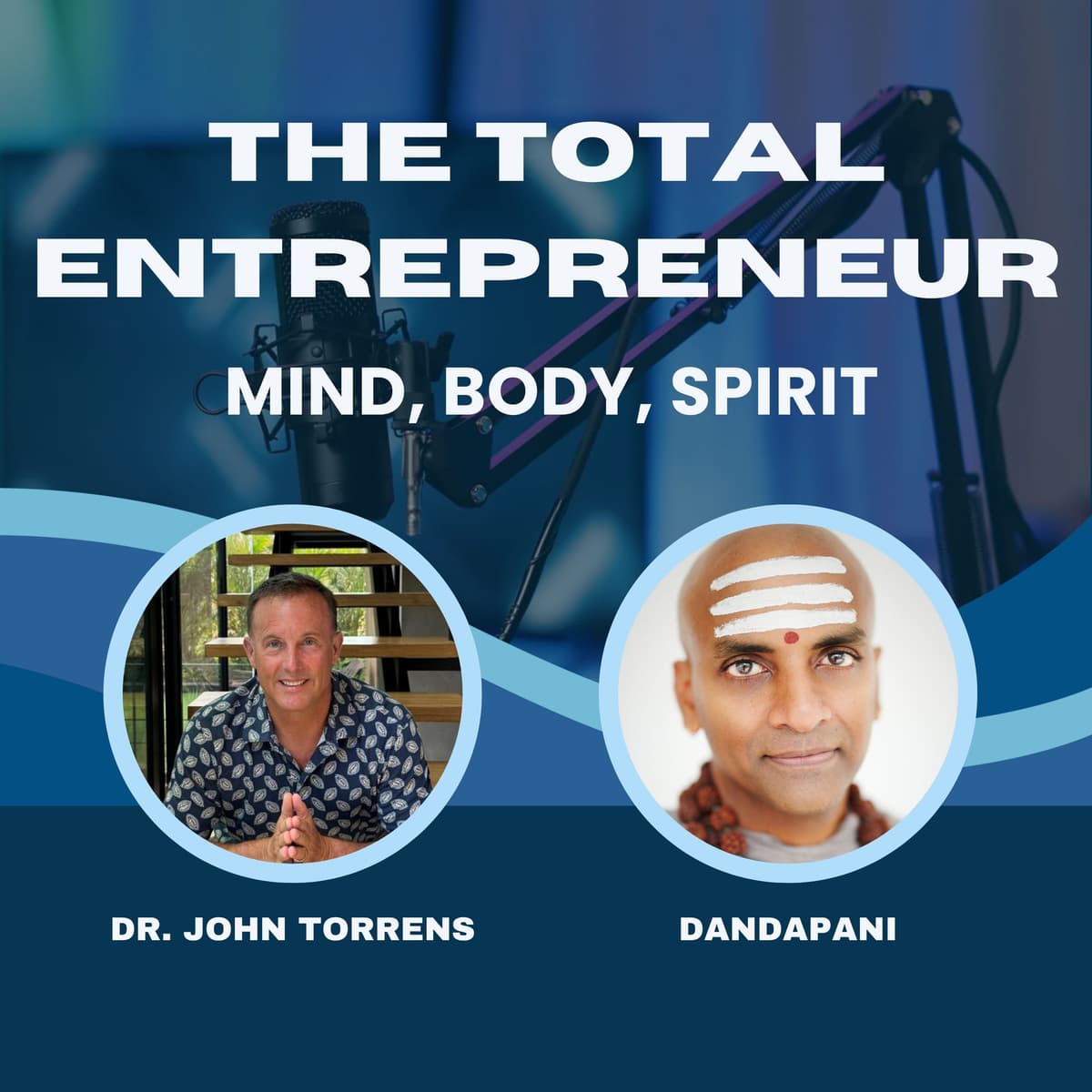
Improving Focus as an Entrepreneur: Lessons from 10 Years as a Monk | Dandapani
with Dandapani
Aug 14, 2026 · 00:57:51
Part of our conversations on
The mind doesn't move. Awareness moves within the mind, and we can control where it goes. Then it's a matter of practicing it.
Dan Dipani, welcome to the podcast. It is a pleasure to have you here.
Thank you. Thank you for inviting me. I appreciate it. Looking forward to our—
Of course. So I wanted to start by diving into some of the work you've done or some of the things you've talked about when it comes to awareness versus the mind. Not necessarily the same. And I was hoping you could just kind of share your thoughts on that.
Yeah. So at a very high level in understanding the mind, we need to understand 2 things. One is the mind and second is awareness. And I'll define it because we've all heard these words before and we all have different definitions for it. I define the mind as a vast space with many different areas within it. So One area of the mind you could say for simplicity's sake is anger, jealousy, happiness, joy, technology, food, golfing, finance. Let's call that the mind and put it aside. And then I look at awareness as a glowing ball of light. If you can imagine an orb that can float around, let's call that awareness. And how do those things work together? The mind doesn't move. It's awareness that moves within the mind. So if your ball of light goes to the happy area of the mind. It's a glowing ball of light. It lights up that area. You become conscious of that area of the mind. So imagine if you're in a big auditorium with all the lights turned off. Imagine you're at a Broadway show. It's pitch black. The spotlight shines on a corner of the stage where the actor walked on. That's the only thing you see. But as soon as the spotlight stops shining there, you don't see it anymore. The mind is no different. The areas of the mind that you become conscious of is the area of the mind that your awareness, your ball of light has gone to. So ultimately, the goal is not to control the mind, but rather to control where awareness goes within the mind. And the critical thing to understand is that any given point in time, either your environment, which are the things and people around you, that's what I define environment as, can dictate where your ball of light goes. Or if you had enough control over your own awareness, you can choose where it goes. So I'll give you an example. If someone comes up to me and says, you know, your shawl is ugly, I can allow them to take my ball of light to the upset area of the mind. But if I had enough control over my ball of light, I can choose to move it to a different area of the mind, maybe an area of the mind of gratitude and say like, oh, thank you for letting me know. What a perfect opportunity to go shopping. this afternoon. And where my ball of light goes in my mind is the perspective that I have and how I would act and react to experiences I have in life.
So the example you just used about the shawl, somebody saying it's ugly. So I definitely understand like, hey, somebody says it's ugly, I can kind of shine my light and focus on the negative aspects of it or the parts that make me feel not so good or the parts that bring in gratitude. Is there another aspect of it where you could just hear that and decide, well, my light doesn't need to shine anywhere because I just don't agree with that in the first place? And it would be like as if somebody said, hey, you know, Dan DePonte, you're a yellow Volkswagen. And you know that's not true. You don't agree with it and you just move on.
Yeah. And that's ultimately it, right? If you can pick an area of the mind that you want to live all the time and that's your home. Let's look at a simple analogy as as the planet Earth. I live in Costa Rica, in Nosara, as you know, you've been to my home. And, but I can travel, I can get on a plane, go to New York and have a New York City experience. I can go to New Delhi and have a New Delhi experience. I can go to Kenya and go to the Maasai Mara and have a safari experience. But I always return home and I have the choice where I want to go in my mind. So if I was in my home base and I'm strong enough I have enough willpower and powers of concentration and focus to hold my awareness here. You come up to me and say, you're a yellow Volkswagen, or, you know, your shawl is ugly, whatever it may be, my awareness doesn't move because it's anchored in my home base. And my home base could be a centered area of the mind, a humility area of the mind, or whichever area of the mind I decide to build my home. And ultimately, you know, in our monastic training, when I was a monk for 10 years, that was the key. That was the key, was to where's your home in the mind. And can you control every excursion and determine every excursion, or will you allow your environment to dictate where you go? And social media is a classic example. As you scroll and look at comments to see how people's awareness are so quickly taken to places they don't want to go. And essentially, you become a slave to everything and everyone around you. The goal ultimately is to be in charge of your awareness.
Right. I think it's hard, especially now with all the various distractions we have, but I think it's important just to, I guess, for people to realize that they do have control at least over where they focus their attention.
And the bigger thing to realize also is if you've never been taught this, it's hard. Making pizza is hard if you don't know how to make the dough and the bread and whatever. Or cooking a lavish Indian meal. My mom can whip out 6 dishes in under an hour and you're just like, how the heck did you make all this? But she's been cooking for people for decades. Somebody else who hasn't had that experience will find it a struggle. Anything that we've never been taught how to do or have practiced doing is always difficult and daunting. And the idea, once we have the understanding that awareness and the mind are 2 distinct things, The mind doesn't move. Awareness moves within the mind, and we can control where it goes. Then it's a matter of practicing it. But the understanding is the critical thing that needs to precede practice. If we don't, can't practice something we don't understand.
And it can be really overwhelming, right? Especially if you live in a modern society and you've got a lot of things going on and you don't have the training, the practice to help yourself. So Given that, I work with young, busy entrepreneurs. They're full-time students. They're usually engaged in their businesses full-time. I work with young entrepreneurs growing companies who have ADHD. So what's a good place for somebody to start? Knowing you can't be perfect at it or you can't be great at it right away, but how can they take that first step?
First step, get my book.
That was on my list of questions. Yeah.
First step, read it. I would say read chapters 3 to 5 twice. Make sure you understand. You have to understand the mechanics of it. And I'll stress on this. If I want to drive a stick shift car, what do I need to know? I need to know the 3 pedals. I need to know the clutch, the brake, the accelerator, the gears, steering wheel, left or right. And once I can understand and master releasing the clutch, pushing the accelerator in at the right timing and changing the gears, all 3 at once, You know, I can drive the car. But if I don't get that, the car's not going anywhere. I don't need to know how the fuel injection works, the carburetor works, none of that complicated stuff. So I would stress for your students, your listeners, to really spend time in understanding the mechanics of the mind, which is really understanding the difference between awareness and the mind. So basic, you know, a 5-year-old gets this right away. The second step then is bringing that practice into everyday life. And I always say, Pick one thing in your life that is a non-negotiable recurring event. So in an average day, a Monday to Friday, a non-negotiable recurring event in my life would be talking to my daughter. I speak with my 7-year-old daughter every day. Every time I speak with her, I keep my ball of light on her. It drifts away, I bring it back. It drifts away, I bring it back. Now, In an average day, I might spend 2 hours speaking with her, a cumulative total. Now, that's 2 hours of practicing, training to keep my ball of light on one thing for an extended period of time, which is really the art of concentration or practice. And because I think it's fair for me to say no one needs one more thing to do in their life. So rather than add one more practice, let's find something that's already existing and insert the practice into something that's existing rather than add one more thing. So that's where I would begin. But the other thing also I would really want to stress to your listeners to really kind of put in their mind is, why are you learning to focus? And unless you can make the case to yourself as to why you need to do it, you'll never really adopt learning it and practicing it. For me, the impetus is that, you know, I work really hard in growing my business and everything that I do to buy these experiences in life, to buy time with my family, the people I love, to have experiences I love, to do the things that I love. So if I've gone to that extent to create this life, then shouldn't I be present in all those experiences I've worked so hard to earn. But if I can't focus, I can't be present. And if I can't be present in those experiences, then all those experiences I worked so hard to earn are wasted ultimately. I just don't experience them fully. Then I go through life having some sort of very empty experiences. I did spend time with someone I love, but I wasn't— I was physically present, mentally absent. And then, you know, 5, 10 years, 20 years from now, I look at my life and it just feels hollow. even though I did all the things I wanted to do, none of them ever felt fulfilling because I was never able to focus and therefore never be able to be present in each of them. Yeah.
And I've read research on entrepreneurs who have exited companies. They've created tremendous wealth. They've built massive companies. But then when they finally leave, they, they have a hard time tapping into the joy that they thought they would experience because they spent so much time doing the thing that they thought was going to bring them the joy later. And now without that thing that occupied all their time and their energy, they just, they feel a little bit lost. And there's definitely a cycle there.
And there's a compounding effect, right? I remember doing, facilitating a retreat for this wealth management company. They were managing like hundreds of billions of dollars for their managerial team. And one of the guys asked me, You know, Dhanapani, should I learn to control my awareness? Do I really need to manage my energy and, you know, my purpose and my priorities on all this stuff? You know, he says, I love being— and this were literally his words— I love being at my daughter's soccer game while on the phone putting out a fire in Hong Kong and dealing with this and dealing with that. I love the intensity of that. I said to him, absolutely not. This is your life. You can live it however you want to live it. You know, it's your choice. The only thing I want you to keep in mind is that if you do this for 30 years, you create a pattern in your subconscious that gets so solidified in that way of living and thinking, your nervous system, your body, your mind, everything is hardened. Think of concrete 30 years from now, you know, with fly ash infused into it. It's so solid concrete that 30 years from now, 40 years from now, you decide to exit, you say, I'm done, I'm just going to go live on my yacht and just relax and spend time with the people I love. You won't be able to do that because there's nothing in your mind, in your nervous system, in your body that knows how to do this different thing. So I think we have to be so careful about the things that we consciously practice And the things that we also unconsciously practice. There's so many things that we do that we don't realize we're doing. Anything done in repetition creates pattern. And the longer the pattern is created and the more emotion that's in it, the more intense the pattern gets. And that's where you have people that exit a company after 15 years, 20 years, 30 years, you know, with tons of money, cannot integrate back into normal life. And the first thing they want to do is start another business. Salvation, you know, it's, and if they don't do that, they literally are in a crisis place.
Right. Well, because they've lived in, like you said, he's on the phone at the soccer game putting out a fire. And when you're always putting out fires, your nervous system isn't very flexible because it's in fight or flight constantly. Right. So I think there's a, there's a way to build resilience in through these practices that, that kind of speaks to a lot of what we're talking about here, which, which is healthy. Yeah.
I think they know how to just even sit at a table and have ice cream with their daughter for half an hour without the intensity of putting out a fire.
Right.
Like, productive. They're sitting at the table having ice cream and it's like, okay, let's talk about college and what do you want to do and this and that. And it's like, can we just have ice cream and just chill?
Yeah, just the presence.
Yeah, yeah. Can't do that, you know. If it's not planning something or solving something, they just Can't sit on a veranda and enjoy a glass of sparkling water and look at the trees.
Right. You know, maybe an appreciation that those types of activities are actually work. They're part of, you know, it's a conscious intentional thing you're doing that enables you to do what you do better and more intensely and stronger and faster later when you do it. So I think there's room for all of it. It doesn't have to be unproductive. It could be highly productive even though it might not feel that. Yeah.
And I think also, Jon, the critical approach that I'd like to always take, a very structured approach, is we have to reverse engineer, right? Ultimately, like I said to this guy, you could live your life however you want to live it. It's your life. No one gets to dictate how you want to live. But you should, or a person should ideally be able to articulate their purpose and their priorities and have that drive down All actions and lifestyle, you know, not the other way around. So for me, yes, growing my business is important, doing all of that, but also spending time with my family, my gardens, the things that I love, these are also priorities as well. So how do I set my mind up so that I can thrive in each of those areas in my life? But if I don't identify initially what my purpose are, what my purpose is, what my priorities are, and be able to get specific in that, then I don't know how to train my mind so that it can thrive in those areas. And I think people take a front-facing approach of like, you know, I need to meditate, I need to do yoga, maybe some ayahuasca, rather than reverse engineering your life. What do you want is what I would have your Students ask themselves, what do you want? And most people can't answer that.
I agree with that. Or they can in a very short term, right? Like, you know, I want to get an A, I want to graduate, I want to get the job, I want to raise a round of capital, I want to get the first customer out, whatever it is, there's a, there's a goalpost out there that is going to bring them the joy and happiness that they've been waiting for.
You know, that's the problem when you talk about the exit, right? Because once you get to that goalpost, And just say you're fortunate enough to be 45 years old and you've exited with tons of money. What do you do? And what if you were living up to 95 years old and you have 50 years left to live? Now you go, what the hell do I do with my life?
Yeah. That actually reminds me, when we were at your home, we had a really brief discussion on the difference between stewardship and legacy. And what you were just talking about with the, what does a person do for the final 50 years of their life? I think a lot of people think legacy, right? But we had a cool conversation about the difference between stewardship and legacy. And you had some interesting ideas. I'd love if you could share those.
Yeah, I define legacy as something you do for yourself. And stewardship is in service of others or in a mission that's greater than you. Legacy, people will kind of, I mean, you've been to my place and you see the gardens I've created here. And someone, I've had many people come here, stand on the veranda where we were sitting and look at the gardens and go, Dhandho Pandey, this is your legacy. And I go, no, if it's my legacy, then I want a bronze statue of me in the middle of the garden, looking like a great explorer that I've built all this, created, and everyone to know that this is what I've done. If I look at it as a stewardship, then what is the mission? How can I serve the mission? It doesn't really have to do to me. I am the steward right now for this period of time, and once I'm gone, The next to it comes in place to serve the ultimate vision and mission of the creation of these gardens and the sanctuary. And I think that's a big difference. Nothing wrong with legacy, but when you say this is my legacy, it's tied to you. Fine. It's fine for you to leave a legacy. And when I look at myself and my daughter were to get married one day and have kids, The legacy I would like to create is something that I could keep within my family, something that maybe my great-grandchild would go, oh, Grandpa Dandapani did this or built so-and-so for our family, for the betterment of our family, whatever it may be. But in the serving of a greater good, I think the stewardship is critical because then you don't bring your agenda to the table. And my guru, when his guru gave him the mission to create the monastery and to carry forward the teaching, And he referred to himself as the steward of the monastery, the head, the spiritual head and the steward. And then he had 3 stewards that were his successors. So the 4 of them were known as the stewards of the monastery. So they were always stewarding the mission that was passed down to them, not bringing their own agenda to it, rather than what, as a steward, how do I serve this selflessly in a in the highest form. And that really impressed me because when I left the monastery and then eventually had a daughter, I asked myself, what is my relationship with my daughter? I wanted to define that very clearly, and I defined it as a stewardship. How can I steward her life? Meaning that how can I serve her selflessly? What does she want to do? What are her passions, her ambitions? her goals inherently that I can serve and not bring my agenda as a parent, which a lot of parents tend to do, you know, and say, you need to do this or you need to do that. And so I think that stewardship in a more family environment as well as parents, we can be stewards, you know, as opposed to thinking my child needs to carry on my legacy.
Right. Yeah, because they're their own people and they may want to, but they may not want to either. So.
Yeah. And you see that a lot in family businesses, right? You know, there's a lot of people I know that are second, third generation family business owners and very much forced into it from the family.
Right, right. Yeah.
And that's a legacy issue, not a story. Right.
Yeah. No, that's true. So you mentioned the monastery and I was hoping you could tell us a little bit about the time when you left because from my recollection, when you left the monastery, you got $1,000 and the beads that are around your neck and maybe a few other material things, but that was about it. And I just thought that was a really cool story and I think very helpful for entrepreneurs in that context. So would you mind sharing that?
So I lived as an ordained monk for 10 years. And when my vows came up for renewal, I decided not to renew them. So typically they fly you back home. And I didn't want to go back to Australia where I grew up. The monastery is in Hawaii for context. So I said, you know, fly me to the mainland US. And I chose LA because it was the closest point of entry. And to help me get started, they gave me $1,000 cash, a MacBook Pro laptop, the monks had laptops, we used to, you know, write our books and publish things on the web and print books and things. And yeah, I had my robes, beads, So landed in LA at midnight, checked into a backpacker motel, roomed with 6 German backpackers. That was very interesting. I don't think they were expecting to room with a monk when they signed up. Yeah, and the next day went out and bought stuff, you know, t-shirt, pants, you know, things that all of you have. And my goal was like, okay, you know, I I can borrow money, but if I borrow money now, I'll always know how to borrow money. If I learn to make money, I'll always learn to make money. So I said, I won't borrow any money. And my goal is like, you know, how do I take this and start making a living? I was in LA for about a week and then I went to Colorado where I stayed with a really close friend and her husband. She had a yoga studio. So I would You know, she is the one that got me, her name's Kelly, and she was the one that actually got me teaching. She would say like, oh, on the weekend, why don't you do like a philosophy class, you know, do a 3-hour workshop? Never thought of teaching or anything like that. So we used to do that. And I would cook for her and her husband, you know, dinner and stuff. And they really enjoyed my cooking. And then she said, why don't we do cooking class? We could earn more money there. So we created these cooking classes. We'd go to these wealthy homes, like in the Vail Valley and do a cooking class. We called it Hot Monk Curry. So it had some branding to it. And cooking classes. And then I'd meet a yoga teacher that wanted a website. The monks were trained in, some of the monks were trained in HTML and CSS and JavaScript. So I'd build yoga teachers' websites. I'd print books for them. They wanted somebody, a woman husband passed away and she wanted a book to remember him. So I said, I'll design the book for you. And I just hustled any which way I could, did whatever I could do to earn money. Yeah.
And you weren't too proud to do it, right? That's where you were at and you needed to do it. And I think that's really important for young people, entrepreneurs to hear is that, yeah, I mean, you may, you probably didn't aspire to cooking for wealthy people for the rest of your life, but you knew that you could do that now. You needed to do that now. And I think that's really helpful to hear.
I think the humility is the important thing. One of our vows that we had to take in the monastery was the vow of humility. And I think that's not, again, needs to be taught. And most people aren't taught to be humble. And in the monastery, we did whatever we needed to do. So if we were to If your job was to clean the toilet every day, then that's what you did. You cleaned the toilet where all the monks went to use the toilet or the public toilet. You just cleaned it, swept the floors, whatever you did, whatever you needed to do or were told to do. So I think when I left the monastery, it's, you know, if I had a job taking the garbage out, I'd do it. I'd do it today, John.
Yeah.
If I was somewhere and I needed to take the garbage out and that was my job, I would happily do it. I'd happily go scrub a toilet today. There's no job beneath me. You know, I do whatever it takes.
And that's really important. And I like that message of humility. So now, now fast forward to where you are today. You work with large organizations, you're on stages with thousands of people. Did you, did you ever imagine that? Or did you see that back in those days? Or how did you, how did you cross that, that desert, I guess?
I didn't see, you know, what I wanted was to kind of create a sanctuary where I could live, you know, almost a little bit like a duplicate of the monastery, but without the monks of the monastery, you know, a spiritual sanctuary. I didn't know, that's what I knew I wanted. How I was going to get there wasn't clear. You know, I started speaking, people resonated with what I was teaching. You know, I initially did a bunch of, you know, Talks at yoga studios. Then I caught up with a friend of mine who was in the entrepreneurs organization. I had like, yeah, yeah, the one that got me speaking to them. And, and that I finally found a niche of people, entrepreneurs, that really resonated with my work. I found with, with speaking to, you know, the yoga studios and everything, they resonated with my work. I think the traction I didn't get the same traction as I did when I spoke to entrepreneurs. And with entrepreneurs, they seem to really connect with it, apply it, come back for more, what's next. And then the same person had later gone into YPO. So he got me speaking to YPO and then I got very much involved with YPO. But I would say, as I started to speak to entrepreneurs, you know, I'd speak to people with small businesses, maybe $1 million or $2 million, you know, really small businesses. And then I would learn about bigger businesses. Someone would have a $10 million business or a $20 million business. I'm like, wow, that's amazing. You know, and I'll speak to them. And, and then I just started to learn about bigger and bigger businesses. And, and my goal was then like, okay, you know, I want to speak to the best of the best was very quickly, you know, I want to be to the largest companies out there, to the most successful entrepreneurs, business owners. And, and that just You know, using the tools and teachings that my guru taught me about having clarity in your mind and how do you use your mind to bring those opportunities in front of you? Everything starts in the mental plane before it manifests in the physical plane, but it starts with a concept in your mind. So can I be in front of Nike? Can I speak to Nike or American Express or Bloomberg or, you know, Fortress Investment Group or Iconiq or some of these huge companies. Can I go sit in front of them? And yeah, so that was my goal. And then I wanted to work with athletes as well. You know, I was fascinated with athletes and I got to work 3 seasons with one of the top soccer players in the world, plays in the Premier League, you know, and that was a really wonderful experience. But the clarity, I think, of what we want is critical. And I would say that, you know, for your students, it's Because when we have clarity and specificity within that clarity, then we know where to channel our energy and our time. But when we don't have clarity, then it's really a broad range. And you think of energy being diluted. It's almost like a garden hose, right? You can change the nozzle into a jet or a spray.
Yeah.
And if you had the jet, you could create much more intense force to target something. But I think people don't do the work prior to that to gain the clarity and be able to articulate that clarity.
Right.
So then you just have so many different paths. Whatever comes your way is an opportunity. And I always say opportunities are not opportunities unless they're aligned with purpose.
Right. So is there a part of that? So say I This is something I really want, or I think I really want it, and I focus on it and I'm doing my best to make it happen. Yet, is there a— is it a thing where maybe your higher self or the greater good just knows that that's not really what you need? Or so is there, I guess, is there a different force at play there or something maybe internal that might help guide you from the thing you think you want to the thing that you actually need? I don't know if I made that clear, but—
Absolutely clear. Yeah. We talked earlier at the start about the mind being a vast space, right? Very vague concept of the mind. Now, let's look at the mind as a 3-story building. And if you took the Empire State Building and you chopped it up into 3 pieces, the bottom of the Empire State Building is the conscious mind or the instinctive mind where we function every day, the eating, working, typing, phone call, driving, interacting with the world driven by the 5 senses. The middle part of the Empire State Building would be the intellectual mind. It's the storehouse of It's the subconscious. It's the storehouse of past experiences, all the information you read, how well you reason and process that information. And then the top third of the building is what we— I would call the superconscious area of the mind, or where intuition comes from. Now, your ball of light can be on any one of those 3 sections at any given point in time. It can't be in both at the same time. So if you're on the bottom Third, you could be on the ground floor of the Empire State Building looking out at, you know, Fifth Avenue or 37th Street or wherever the Empire State is on, and you just see chaos. The people walking on the sidewalks, taxis honking, people yelling at each other, food carts. That's your world. And most people live there, and it's a very reactive state, right? You're walking down, someone bumps into you, you're like, what's your problem, man? And you react to that. And then you hear a siren going by and you just go like, oh God, it's so loud. But if you're on the middle part, you kind of look out and you see other buildings around you. You don't really have a view. You're kind of stuck in that information area. But if you're on the 3rd floor of the Empire State Building, right at the top in the observation deck, you can see, you look at Manhattan then and you go like, wow, what a quiet, peaceful, beautiful city this is. You can see all the way down to the Empire State Building, all the way up to Harlem, across the East River, anywhere you want to see. And from there, you get the mountaintop perspective. And you're able to tell the guy on the first floor, don't go down 37th Street because there's an accident 10 blocks down. Take this left turn, make this huge loop, and go where you want to go. And the guy on the bottom floor is going to go like, why would I make this loop? That's such a long way to get where I want to go. This is the stupidest suggestion ever. I'm just going to go down the street. So he goes down 37th Street. He's stuck in traffic in a gridlock for 2 hours, can't get out of it. Whereas the person on the observation deck would tell you something that at that time didn't seem reasonable, but from the mountaintop perspective, was the better thing to do. So a lot of us aren't trained to listen to our intuition, our superconscious area of the mind. We're either functioning in that bottom third of reacting or in the second floor where we're processing information, trying to make decisions. And then when we hear that intuition, we go like, well, that's a bunch of hogwash. Why would I do that? But if you understood the mind and you understood where it was coming from, then you would learn to trust it. As something, you know, like if you had a loving parent that truly cared for you selflessly, you would trust them. Or a mentor. I have mentors in my life. And I know sometimes they tell me something about my business I don't want to hear. I really don't want to hear that. But I know they have no agenda except for my best interest. in their heart. And even though I don't want to hear it, I don't like hearing it, I listen because I know where they're coming from and they only mean well.
So is it— it sounds almost like you'll get where you need to go eventually. It might be harder or it might be easier based on what you're tapping into.
Absolutely. All knowledge inside of you and all of us have that superconscious area of the mind inside of us. You know, the mind is one thing I always tell people that we don't have a manual for. We don't teach people how the mind works and everything else. You know, you buy a point-and-shoot camera, which sole purpose is to point and shoot, and it comes in an 80-page manual in 20 languages, right? And the mind is so complex, yet no basic education around it. So we have this amazing tool with no basic instructions on how it works. And I like to keep things very simple and basic because if you don't, then you don't gain understanding. And if you don't have understanding, you can't operate or use something. And the other thing I would also warn your students is to not get caught up in the shiny lights of complexity. I sat here and talked to you about the prefrontal cortex and how the cerebellum worked and the dopamine effect and the, you know, the serotonin and this, that, and what gamma waves or beta waves you could function in at this hour. And you know what? People would be fascinated. I would have people lining up outside the hall, 2 blocks waiting to attend that talk. But if I just said to them, your mind is a vast space and a ball of light's moving inside of it, your job is to control where the ball of light goes. Just 2 people waiting to attend that class. Right.
Yeah.
You know?
Yeah, no, I get it. You're right. So it's, I guess, the difference between what's interesting and what's truly important, maybe, or where they intersect.
And for me, what do I want in life? What is the understanding I need to get in order to help me go in that direction? I don't need to get lost in complexity and all the shiny objects along the way. I'm looking to learn and get the relevant information to push me down that path, to kick the ball a little further down that path.
Yeah. So it seems like there's a lot of energy you can expend on things that don't matter that much. And I know you've talked about energy economics, right? So you kind of start with a certain amount of energy and you have to decide how you spend it. Tell us about that.
Yeah, the concept here is that we have a finite amount of energy each day. At some point tonight, every single one of us, even if we're 20 and high energy or 60 and kind of medium energy, we run out of energy at some point. It could be 8:00 at night, it could be 2:00 in the morning. And we say, I'm done, I have no energy left, I'm going to bed. And depending on how well we sleep, our energy builds back up again. And then the next day, we have a choice as to who and what we invest in. And most people aren't discerning or making a very conscious choice as to where they invest that energy. But we treat money differently, right? And in a lot of my workshops and events, I will say to the audience, if there's 100 people in there, I said, I'm creating a startup. If everyone in this room wrote me a check for $10,000, I'd have enough money to get my startup going. Who would write me a check? No one puts their hand up. I'm like, why not? It's like, well, we don't know what the project's about. What's the startup about? Do you have a deck? What's my return on investment? And all these questions. And obviously, because no matter how wealthy you are, you have a finite amount of money. And so you want to be conscious before you give it away. Why don't we take the same approach with energy, right? You know you're going to be exhausted every night. It's been happening for decades now, right? It's not a new thing. You just haven't been conscious of that. Now that you're conscious that you get exhausted at night and you only have X amount of energy each day, Why don't we ask the same questions? So if someone comes up to you and says, I want an hour of your time or 2 hours of your time, the question should be, show me a deck. What are you going to do with my energy? What's my ROE, my return on energy? Why do I take a portion of what I just only have today and give it to you? That same portion I can invest in my family, in my business, in all the things that I have already identified to myself are my priorities in my life. But you're asking for that, which means I'm going to deny what's important and who's important in my life of that energy and give it to you. You got to really convince me you're deserving of it the same way you wanted me to convince you that giving you $10,000, or you giving me $10,000 was the right thing to do.
Yeah, that's a good perspective on it, right? Because yeah, you only have a finite amount of energy. And I guess there are replenishing things you can do throughout the day. But you know, by the end of the day, you're going to be fairly well depleted. And yeah, that's a really good way to look at it. I like that.
And just to also comment on the replenishing part, you know, the one thing I do talk to entrepreneurs a lot, because one of the questions I do get a lot around this topic of the economics of energy is people tend to ask me, You know, how can I have more energy today? You know, is it exercising, sleeping well, eating well, meditating, doing all of that stuff? And one of the things I do say to entrepreneurs, that's not the starting place. And to look at, imagine I had a plastic, a 5-gallon bucket, plastic bucket, and I want to fill it with water. What's one of the first things I need to do?
You need to find some water.
Yeah, find water and make sure the bucket no holes in it, right? Or it's like, if a bucket has a hole, I wouldn't pour water in it because it would leak. It would just be insanity. So what if I looked at my mind and my physical body as buckets that contain energy?
Right.
And by exercising and sleeping well and eating well and all these healthy practices, I'm putting more energy into my body. But shouldn't I then be asking myself, where are my energetic holes? Right? So where am I hemorrhaging energy? Because I could sleep well, exercise, eat well, meditate till the cows come home to fill myself with good energy. But if I was hemorrhaging energy all day because I had energetic holes in my body, then what's the point? My bucket never gets filled. As an entrepreneur, what are your energetic holes in your life? Are they toxic clients? toxic employees, you know, bad systems and processes. You know, one of my friends, you know, one of my mentors said to me, you know, bad systems break good people. You know, and I really like that phrase.
Yeah.
You know, what bad systems do you have in place for your business? These are all energy vampires, the energetic holes in your life that just literally drain everything. So, the systematic processes plug the holes. Fill the bucket. It's what you do with the plastic bucket. You plug the holes, then pour water in it. And your life, where are you hemorrhaging energy? Plug those holes, then pour energy in.
Yeah. And I love that you talked about the mental, physical, and spiritual aspects to all of it because that is foundational to being human, but also for entrepreneurs, you have to be healthy on those those attributes to really be a healthy business owner or leader. So yeah, thanks for mentioning that. So I wanted to talk a little bit about, so your book, you mentioned your book, we didn't name it. It's The Power of Unwavering Focus. So, you know, the idea of focus is interesting, especially to me because I work with a lot of entrepreneurs with ADHD. And I was just wondering what your tradition or what your experience, how it would treat the The neurology of a mind that just kind of resists standing still or focusing. Like there's, you know, and I understand that you can manage that a lot with food and nutrition and sleep and meditation, but there is some neural circuitry there that might prohibit somebody from really getting into that as quickly or as effectively. So I was wondering if you could talk about that a little, because I know that's a pretty widespread— Issue that people share.
So just as a disclaimer, I'm no neuroscientist, no medical—
I totally get it. Nor am I. Yeah.
I have something I call the law of practice. And it simply states whatever it is you practice is what you end up becoming really good at. I feel a lot of entrepreneurs use the excuse of distract— as being an entrepreneur as an excuse to be distracted. I'm an entrepreneur, so I'm all over the place and distracted. It's part of a quality of being an entrepreneur. I call bullshit on that. I sat in a car once with a guy that took his family's business from, I think, $300,000 to $2 billion over a period of like 20, 30 years or something. And the whole 2 hours I talked to him on the drive, He didn't pick up his phone once to look at it, and he just gave me his undivided attention. So I'm going like, you can take a business from this to that and be completely present with me for 2 hours without looking at your phone and not be ADHD. Then it's something we can— it's a trait, a skill we can learn and practice and become good at. That said, I do feel some people have, I don't know the right words, some chemical imbalance or wired differently that they struggle. to be able to concentrate. But I think most people aren't taught how to concentrate. And my argument for this is this, right? If you told me to play the piano and I could not play the piano, would you label me with PPD, performance disorder, and drug me? Or would you teach me and make me practice so I become good at playing the piano? We don't drug kids for not being able to play the piano. We teach them. And then we force them to practice till they get better. But when we ask a child to concentrate or focus and they can't focus and they're all over the place, granted, they may be eating too much sugar or the diet's bad and it's affecting that. But if they can't focus, we label them as having attention deficit, attention deficit, and then we drug them.
Yeah.
Why don't we teach them and then help them practice? And after a few years of learning and practicing, it still doesn't work. Maybe medication can be helpful. As entrepreneurs, most entrepreneurs I met are very easy to— I know people that just say, I'm an entrepreneur and I'm ADD. I have ADHD. And it's a proud badge to wear. It is not a proud badge to wear. Why can't— I'm an entrepreneur. I built a business and I pride myself of being able to focus. I pride myself of being able to sit with you and give you my undivided attention. We talked about a finite energy each day, right? And we also have a finite amount of time in this life. When you sat with me on my veranda and we drank sparkling water together, you chose to give me a portion of your life that you would never get back and a portion of your energy that you would never get back. The least I could do is honor that and value that and give you my undivided attention, not give an excuse of, I'm an entrepreneur, so I'm all over the place. Sorry, I'm scattered.
Right. Like, I have this thing, I have to pay attention to it. It's on my phone. If I don't get to it right now, then the world's going to blow up and Yeah.
The world's not going to blow up. It hasn't blown up yet. I mean, we've had 2 world wars and we're still here.
Yeah.
So I think going back to, you know, what do we want in life? And the impetus for being focused is because I want to be able to experience you. If I'm talking to you and I want to be fully present, I want to hear what you have to say. I want to experience not only what you have to say, your energy, your presence of you being there. That matters to me. And that's why I learned to focus. I don't want to go through life missing out on all of those things. And that's how you have a fulfilling life, right? A truly rich life is a byproduct of being able to be present in all your engagement, which can only happen if you can focus. Yeah.
And I like what— I like the analogy of playing the piano. And that just makes a lot of sense. And we know that there is an evidence base for things that can help children with, you know, neurological differences or neurodivergence, right? Like you said, the sugars and dyes, you cut those out, they improve. One of the most studied things regarding children with ADHD and their ability to focus and pay attention is meditation. So you just have to put the time in to teach them how to do that. And then all sorts of things become easier for them. So I think you're right on with You know, you, yeah, you get better at the things you practice. And if you're not taught how to do something, it seems kind of silly to medicate you without at least attempting, right? But I think the difference is that if you, if a kid can't play the piano, it's not as disruptive to the adults in their life as if a child is really distractible, right? Right. And hyper. So, so they want to just medicate the kid just to, to make them easier for the adults to deal with.
That's my take on it. Here's the other thing, right? If you look at ADHD, AD stands for attention deficit and HD is hyperactivity disorder. Why hyperactivity? Because you have all that energy inside this little body that has nowhere to go. So they can't sit still most of the time, probably because of bad diet, you know. But you also haven't taught them how to manage the energy in their body. You taught them how to breathe and regulate that energy inside of their body. You haven't. So it's like giving a professional athlete who comes from, you know, from the projects now $20 million a year. What's he going to do with the money? He's going to spend it all and then be broke by the time he's 27 years old because no one taught him how to manage his finances. The same way no one teaches kids how to manage their energy. See, my child has too much energy. He's running all over the place. Of course he is. Have you ever taught him how to manage his energy? Have you taught him how to harness it, to breathe, to feel energy? How can you even manage something you can't even feel? Can you feel energy inside of you? Can you learn how to harness it and channel it?
Yeah.
Well, then you medicate and you label and you medicate. What a horrible thing to do. I can't imagine. I mean, I grew up in the '70s and '80s in Asia where I couldn't focus, they just hit me with a little bamboo stick at school. That's what they did. I'd rather take that than being drugged. Right.
Well, because yeah, because it changes fundamentally, you know, maybe who you are, right? And yeah.
All those chemicals being pumped into you when you're a kid.
Yeah.
Just because you were never taught how to do something and never helped to practice it.
No.
None of this medication, right? It's just like, that shouldn't be the first layer.
It's often the very first, yeah, without going any deeper, right? There's no— I shouldn't say there's no, because there is plenty of it, but there's a lack of, hey, let's try meditation, or let's take a look at your diet. How are you sleeping? All those things. Yeah. And I like what you said too about people almost wearing their ADHD entrepreneurship as a badge of honor. Just because it's, I don't know if it's cool or if it just kind of explains away some of the behaviors that they have, but I think you're onto something there too. I think that is absolutely a thing among ADHD.
It's also an excuse, right? An excuse that I can be all over the place while I'm having dinner with you or with my family. I can just give in To this bad behavior, essentially. I'm sitting at a dinner table with my family and a few close friends, and I'm looking at my phone every 2 minutes. Stuff going on, things I need to handle, take care of. I can be at my daughter's soccer game and be on the phone the whole time.
Mm-hmm.
It gives an excuse. I'm an entrepreneur. Well, this is just how we're wired.
Right. So, so to get them out of that, kind of back to the, you know, the, the energy and the ball of light example. So, so let's take, you know, you've got an entrepreneur admittedly busy, but everybody's busy, right? And you're at a dinner table with your, your friends, your family, and you really don't want to look at your phone every 2 minutes, right? But you just feel compelled to because it's there. Like, what are, what are some techniques or like what's the first thing they could do to start to wean themselves off of that?
Honestly, the first step is really making the case to yourself as to why I want to live a different life. Unless you can convince yourself of that, you will never ever do it.
Right.
You know, you can have hacks of like turning off the phone, leaving it in the car, putting it somewhere else. All of those are hacks. You ultimately have to make the case to yourself. I want a different life. I actually want to be here in the dinner. I want to be here at the dinner table. I want to enjoy the dinner that's been prepared. I want to enjoy the company of the people I'm with. I want to feel their energy. I want to hear the things they're not saying, but I feel what they're not saying. I can sit at the dinner table with my daughter. and understand something is not right because I can feel something is off and then gently and lovingly ask her about it.
Right. Which you could not do if you were distracted by your phone. What's going on on my phone? I got to look at it. And that kind of thing. Yeah.
And I think what we are in a society always looking for patches and looking for hacks. I think that's why we have to reverse engineer the whole process. We need to start outwardly the purpose. What kind of life do you want to lead?
Right.
You could define that, then there's a reason to do it. But we'll just do breathing for a while and meditation for a while, and then somebody will come up with some new technique to help focus. And then you say, okay, I'll try that. And then I'll use this app that has a timer. And it just goes on and on and on. And 10 years from now, you're no different than who you are today. But you've tried a thousand different things.
Right. But until there's a recognition that, hey, you know, the reason that I don't want to be distracted with my phone at this dinner with my family is because, yeah, I want to live a life that brings me joy. Um, and my family's part of that, then that I guess is the shift, right? And I think that's the important part. And I think the research I've read on it is, you know, for the 8 billion people in the world, everybody really wants the same thing, right? They want They want fulfillment, peace, and love. And it could just be as simple as that. You don't have to find the thing like, what is my purpose in life? You could just say my purpose is to be joyful and loving and peaceful and fulfilled maybe. And the phone isn't part of that right now.
Yeah. Yeah. And, but that comes as a byproduct of that happiness, the joy, the sense of peace comes as a byproduct of an action or lifestyle of doing something, right? So we need to identify what makes me happy. spending time with the people I love, walking in my gardens, you know, watering my trees, whatever. Those things bring me joy. So how people want to live a happier life, they want to be more peaceful, but they don't understand what is the lifestyle that produces those feelings. And that's what they need to tweak.
Yeah. Yeah. It's almost like a simplification really, right? Because the more complexity, you add, the more energy has to go towards those layers of complexity, the more it's diffused a little bit, the more distracted you are. Yeah, so maybe, maybe, maybe a simplification. I don't know, maybe even that's too simple of an explanation.
No, I have a 4-step process I call purpose, focus, simplify, sacrifice.
Hmm.
The purpose, get really, really specific and clear about that. The purpose drives the priorities. Then second step, learn to focus, learn to focus on those priorities and practice focus so you can be good. Third step, simplify. You have finite time, finite energy, both of which you can't scale. And I don't know why it puts up that little thing, you know, both of which you can't scale. So simplify, simplify your life to those priorities. And then step 4, sacrifice, because I can't simplify without giving up something.
Yeah.
So what am I willing to give up? And the things you don't like, the people you don't like are easier to give up. But sometimes it also requires us giving up the things we want to do. Going back to what you brought up earlier in the podcast of like, I want to do this, but the higher me is telling me the loop, right? And so sometimes giving up things are not so easy, but That framework to me, the purpose-focused simplified sacrifice, is a good one to adopt to kind of have a life that's just really aligned with who and what matters to you, which then results in those feelings you're talking about of feeling more meaningful, feeling more fulfilled, happier. Ultimately, I think 8 billion people are seeking in some way or another.
Yeah, no, for sure. So where are you spending your energy lately? What's getting you excited?
Working on a mentorship program for entrepreneurs, a year-long mentorship, because I've been doing a lot over the last decade of speaking and running retreats and things like that. And I think a lot of those people are looking for something that's more ongoing. So I'm working on creating a 1-year program for entrepreneurs that can come and study with me over a year long and building a cohort. Almost like a mastermind kind of group. So that's where I'm putting my energy into. And I've also met some really amazing people from around the world. You know, it'd be great to bring them all together from Europe and Africa and Middle East and North America and stuff in a small group setting. So that's something that's— I'm very enthusiastic about. Working on a virtual Dandapani app. Some uploading 10 years of content into an LLM and then have starting off with version 1, which is only text-based. So you can text me or the virtual me, the AI me, and then it will respond based on the content that's in the LLM and making it available in multiple languages. The good thing about AI is now, you know, I just have to upload everything in English and then it can respond to you in German or Spanish. Yeah.
And, if people want to learn more about you and your work, where should they go?
Website's always the best place, dandapani.org. And, anything new that we're doing is always on there. Amazing.
Well, I know we talked about energy and how we spend our time today, and I'm very grateful that you chose to spend this hour with me and the audience. So thank you so very much.
No, thank you, John, and thanks for all your wonderful questions. Really appreciate it.
Of course.
Thank you on your show.
About This Episode
If you've ever wondered how to improve focus as an entrepreneur but felt like distraction was just part of the job, this conversation will change your mind, literally.
Dandapani spent 10 years as an ordained Hindu monk before leaving with $1,000, a laptop, and the beads around his neck to build a life and career from scratch. Today he's a sought-after speaker who works with entrepreneurs, YPO chapters, Fortune 500 companies, and professional athletes, and he's the bestselling author of The Power of Unwavering Focus.
In this episode, he sits down with John to break down the mental framework that changed everything for him: the critical difference between the mind and awareness, and why learning how to improve focus as an entrepreneur is a trainable skill, not a personality trait some people simply don't have.
What comes up
- •The "ball of light" framework: why you can't control your mind, but you can control your awareness and why that distinction changes everything.
- •How to build a "home base" in your mind so external comments and chaos don't hijack your attention.
- •Why understanding the mechanics of focus has to come before practicing it (and the simple daily habit that builds it in as little as two hours a day).
- •The real reason so many entrepreneurs feel empty after a successful exit, and how to avoid it.
- •Energy economics: why you should protect your energy as carefully as you protect your money, and the "return on energy" question to ask before saying yes to anything.
- •How to find your energetic "holes", the toxic clients, bad systems, and draining habits quietly bankrupting your daily energy.
- •Dandapani's take on ADHD and focus, including his call to stop treating distraction as an unavoidable entrepreneurial trait.
- •The three-story building metaphor for the mind, and how to access intuition (the "superconscious") instead of just reacting.
- •His four-step framework for an aligned life: purpose, focus, simplify, sacrifice.
- •The difference between legacy and stewardship, and why one is about you, and the other isn't.
- •The humbling story of leaving the monastery with almost nothing, and hustling his way to speaking on stages with thousands of people.
Keep listening
More on Mind
About the Host
Dr. John M. Torrens
5× Inc. 5000 entrepreneur, Professor at Syracuse University's Whitman School of Management, author of Lightning in a Bottle, and TEDx speaker on ADHD as an entrepreneur's superpower.
Browse all podcast guests →Book a strategy call →