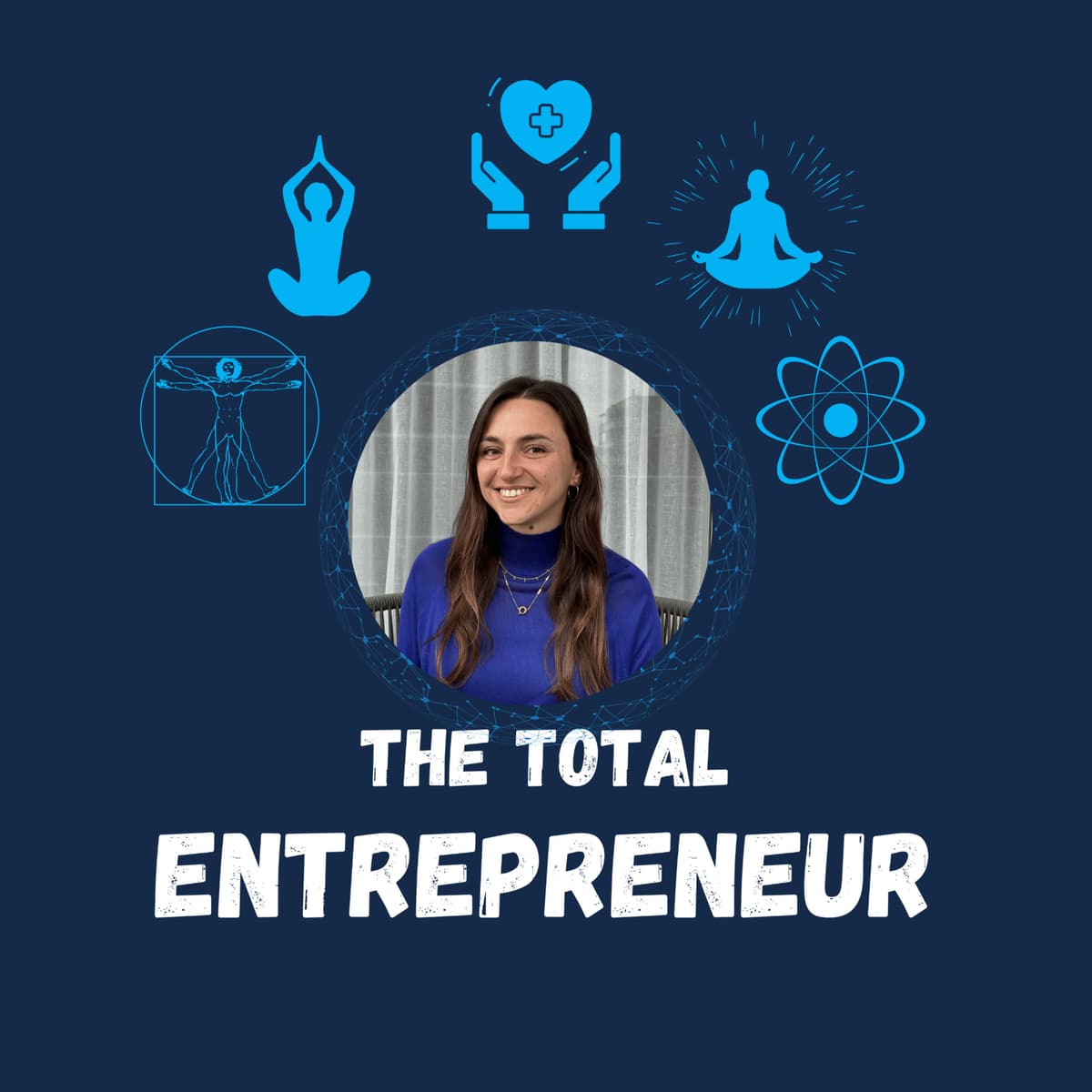
Redefining your Relationship with Alcohol with Silvia Subirana
with Alcohol with Silvia Subirana
Jul 18, 2025 · 00:28:19
Part of our conversations on
Today's guest is Sylvia Subirana, who is a clinical psychologist and head of content development at My Dry 30, a transformative app helping people reshape their relationship with alcohol while unlocking deeper fulfillment and well-being. With a master's in clinical psychology and advanced training in grief and sexual therapy, Sylvia blends mental health expertise with holistic tools like hypnotherapy, journaling, and body awareness practices. Her work empowers people to build healthier coping strategies and live more intentionally. Through My Dry 30, Sylvia is redefining personal growth one mindful step at a time. Welcome to The Total Entrepreneur: Mind, Body, Spirit, where we turn cutting-edge science into practical strategies for entrepreneurs. I'm your host, Dr. John Torrance, Entrepreneur Inc. 5000 honoree and professor of entrepreneurial practice at Syracuse University's Whitman School of Management. Each episode, we dive into mental, physical, and spiritual health with expert guests offering actionable insights to help you live your best life. you thrive and perform at your highest level. Let's get started. Sylvia, welcome. Really great to have you.
Yeah, I'm very excited to be here. Thank you so much.
Yeah, so tell me a little bit about your background. So you're a clinical psychologist and you work with an app that helps people moderate their alcohol consumption. So, so tell us about that journey.
So I myself don't drink. I haven't drunk in the past 6 years and a half, more or less. I don't really have a date because it was very organic for me. And obviously, I was doing my training to do, uh, to be a psychologist back then when I stopped drinking. And some years ago, I decided to pursue, well, to help people understand what a good habit, like the impact of good habits really. And when I was looking for new, new projects and, and new jobs that would actually motivate me and would resonate with me, I found what was my Dry 30, and now it's, it's becoming Unconscious Moderation, which was a program back then. It was just really an idea, uh, that was gonna help people rethink their relationship with alcohol, not necessarily completely quit, just understand their habits and why they were drinking, and then choose, make better choices related to that. And Because of both my knowledge in mental health for training and then life skills that gave me not drinking, then I thought that that was perfect for me. And I've been collaborating with them since, and I've loved it so far. And what I was telling you just now before we started recording, that we are doing a rebranding at the moment because when we started, the name was My Dry 30 because we thought that more people were going to be pursuing Well, being completely dry, like quitting completely, right? Whereas now that the app has been in the market for a bit more than 6 months, around 7 or 8 months, we've seen that a lot of people actually choose our program because we focus a lot on moderation as well. People can do both. You can either quit completely or learn how to moderate with our program. However, we believe that out there, there's a lot of programs that help you completely quit, but there's not many programs that help you moderate and just have a healthy relationship with alcohol, right? So that's why we changed the name to Unconscious Moderation to, well, pursue that and help people feel more, well, more in sync with what we say and what we offer.
I like that rebranding, right? Because I think it's scarier for people to think that they're never ever going to do something again than, you know, hey, you know, I'll do it when I want to, if I want to, but I'm never closing the door or I'm not closing the door on it, right? So I think that might be a really wise rebrand.
Yeah, thank you. We thought that it was the right move because if a lot of, like if 70% of our users were trying to moderate, but then we were calling it dry all the time, it sort of sent the wrong message.
Yeah, for sure. I mean, I don't drink nearly as much as I used to. I hardly drink at all, maybe I don't know, three, four drinks a month maybe. Used to be you know quite a bit more, especially in social settings. But sort of like you, it was very organic. Like I didn't just declare one day that I'm not drinking any more alcohol, but I just slowly stopped. And you know, I don't say that I'm completely abstinent, right? Because that's I don't know, maybe maybe I'll have a drink once in a while. And but the nice thing is if I want to, I will. I won't feel guilty about it. I won't go overboard. And I feel like a lot of people I know are starting to move in that direction. So I don't know, but like what? Like, what's your opinion on why this movement, right? That even the university students I work with, they seem to drink way less than I remember drinking as an undergraduate, for example. So why this movement, in your opinion?
I think people are becoming more aware of the effects of alcohol and that we actually don't need it to socialize or to be more fun or all the ideas that we were we always listened to when we were probably growing up because we have alcohol everywhere. If you look, look at movies, it's a reflection of, well, alcohol is everywhere, even in work settings, right? So, Yeah. Um, I think that nowadays people are realizing that that is not a healthy habit. And if you want to drink, do it because you really want to, not because you want to get something from it. Because what you get from it, you can get good things, but you can get A lot of bad consequences as well.
Yeah. It, you know, and right, it's, it's a known neurotoxin. It's a poison, right? So we, we know there, and, and I forget where I was reading it, but there's actually no known safe dose of alcohol. Like it, it doesn't do anything good for you. Even, you know, the resveratrol in red wine, you would have to drink an ocean of this stuff to, you know, to have it help you, you know, versus the, the effects that it's giving you negatively. So I find that really interesting. And you're right. The messaging and the branding and the marketing and the advertising they were exposed to, we're just bombarded with alcohol messages. So I think it's really tough, and especially working with young entrepreneurs who are in a high-stress environment anyway. Usually the go-to is just, well, I'm going to have a drink. So what are some of the things that you found effective for helping people moderate?
So first of all, I always ask people why. Because when they understand the reason why they drink or the reason why they're feeling stressed and that stress is— well, they're dealing with that stress with a drink, then when they understand the root of it, they can actually tackle that and say, okay, I can change things because I understand where this is coming from. Right?
Mm-hmm.
And I think that, um, one of the reasons why I believe younger people are choosing to drink less is because mental health is becoming more of a thing at the moment and more people are actually taking the time to sit down with themselves and just feel the emotions that come, right? Whereas I bet 50 years ago, or not even 50, 15 years ago, that was not a thing. That was not a thing.
Yeah.
People would just like continue life and live as they know, right? And they don't really, they didn't really stop and actually feel, right? And I think that's a big change at the moment. So that's why I always encourage people, maybe a bit older people that haven't had or that haven't grown with that message of be aware of mental health and all that. I think that is very, very powerful for them to sit down and understand where the why, like why are they drinking?
Yeah. So actually let me back up for a minute and talk about, you know, the why it's a good idea to start to moderate, right? So, so what are What are, you know, as a clinical psychologist and somebody who's been abstinent for a while, what are some of the negative effects or the negative outcomes of consuming alcohol? Just so people really understand.
As you said before, no amount of alcohol is safe. I'm never going to demonize anybody for drinking because it's a personal choice. And maybe I don't drink, but I love sugar and I love chocolate and I eat more chocolate probably than I should. So I think everybody makes their choices and—
And try and control them. isn't safe and jumping out of an airplane is not safe, right? But people do it because they enjoy it. So totally get that. And I'm with you, I would never demonize. But yeah.
Yes. But yes, it's true that no amount of alcohol is safe. And it has many different impacts on the body. Some we see and some we don't see. Obviously, we see the ones that if you drink, we see that we're going to have a hangover. Everybody knows that, right? All the effects in the brain, not only physically, but also emotionally. Because a lot of people call it like, well, make a lot of emphasis about the anxiety and the sadness that they get during a hangover, right? Where you feel like you're completely destroyed. That is short-term, right? Like everything just, all your body just is messed up because in reality, in the end, alcohol, as you said, it's full of toxins. So your body is working hard to get rid of those toxins, detoxifying, right? And that's why the sleep, for example, is very impaired. Um, and I like talking about sleep because a lot of people use it to sleep. But again, it's not a good coping mechanism or not a good mechanism to fall asleep because yes, it will knock you out, but your body will overwork all night to get rid of that, of alcohol in general. So you will wake up up the next day feeling absolutely shattered, right? You haven't slept. Well, you have slept, but you haven't rested, right? Your body hasn't rested.
Yeah.
So it's a vicious cycle that people say, oh, I cannot give up alcohol because it helps me sleep. But then when they actually give up alcohol or reduce the amount of alcohol that they drink, they realize that they have better sleep, like more restful nights, right? So Alcohol obviously impacts a lot of hormones. A lot of people feel more stressed because it triggers cortisol, which is the stress hormone. It also affects blood pressure. A lot of people have very high blood pressure, especially if they drink alcohol. So there's so many effects in the body. And it doesn't need to be— you don't need to see those effects. You don't need to benefit from those effects if you completely quit. You can also see those benefits or like all those effects sort of milding when you moderate, right? So instead of drinking 5 drinks a week, maybe you choose to drink 1 a week and you actually see those benefits coming back.
It sounds so simple, but in practice it's really difficult, right? And I understand it. Like, you know, like, you know, it's— I live in the Northeast US. The weather's finally starting to get nice. The sun goes down later, so we're outside more. we're connecting with friends that we haven't seen in a while. And, you know, the, the go-to is just, hey, let's have a cocktail, let's have a beer or something. And even though I don't necessarily want the alcohol, I want to be social, and it's just part of that. It's so ingrained, right?
Mm-hmm.
So I don't know, are— I mean, for me, like, um, those, uh, non-alcoholic spirits like Seedlip and Aplos and Ritual, I, I found those really helpful only because it gives me the the, I guess, the ritual of making the cocktail without the alcohol, right? And then I can, I can make it taste great, but I don't have to have the, the alcohol part. Um, is that something you've seen work for people?
Definitely. It's a great tool. Non-alcoholic liquors or beverages in general, mocktails. I love mocktails. And I think that they're very helpful for you to get that little, um, or do you feel that you're drinking something fancy, right? And yeah, yeah, exactly. And especially in summer, you want something refreshing. And sometimes you get a beer or you get a cocktail or like a mojito or something like that, very refreshing. But in the end, the only thing that you wanted was that refreshing feeling, right?
Right.
So, if you just do that drink, that fancy drink without the alcohol, it gives you the exact same mindset or the exact same feeling, right? And I think that that has changed a lot because when I started, Well, when I stopped drinking, there were no mocktails out there. There were no, well, at least not in Spain where I'm from. There were no non-alcoholic drinks apart from non-alcoholic beer, but I don't really like non-alcoholic beer. So, I just had water or a soda, right? Like, no, there's no, there were not many options or a juice maybe. Right now, there are so many options out there that is, they're very beneficial for people to actually do the shift because if you have that fancy drink, nobody asks what you're drinking, right?
Right.
Nobody questions if you're having alcohol or not. So some people that I work with that are scared of changing their habits or reducing their alcohol because they drink a lot with friends or with loved ones, when they start drinking mocktails instead of cocktails, they don't get those inquisitive questions of, Why are you not drinking? Are you pregnant? What is going on? Are you sick?
Right.
So if you have those mocktails then, or that drink without alcohol that looks fancy, you don't get those questions. And that is a very good starting point to then go from there. Right. Because you're going to reduce the alcohol intake and then you're going to get the benefits from it.
It's such a good point because normally, yeah, when I have a drink, it's not really because of the alcohol. I don't have any desire to get drunk. The alcohol doesn't do anything for me, but I want the socialization and that's really important. So yeah, mocktails are great. They're a go-to. I don't mind non-alcoholic beers. I think some of them are pretty good, but you're right. Like it's harder on other people when I'm not drinking, right? It makes them feel uncomfortable almost. Right. So yeah. Are you sick? Are you on medication? Uh, you know, what's going on? So do you have any advice or like some, some go-to responses that people could use when they get those awkward questions about whether or not they're drinking?
For me, the key is to keep it simple.
Yeah.
Don't over-explain or like say a lot of excuses. People disconnect and they're not interested. If you just say something like, I just don't feel like drinking today, or I'm trying to reduce my alcohol intake, think of a sentence that is short and cut to the point, right? And people normally don't, don't really ask more questions. I've suffered that a lot. I've had a lot of those conversations of, why are you not drinking? Right? And I stopped drinking when I was in my early 20s. So it was very weird for someone to not drink. Right?
Right.
And so I've been in that situation quite a lot. And I realized that people don't actually care that much, that we are more scared of what people are going to think than what actually happens. So in the end, what happened to me 99% of the times it was someone asking me why I wasn't drinking. I was like, it just doesn't sit well for me. And they're like, okay. And they continue with their nights or with their day or whatever. And that's it. Right. And the other 1% normally are people that are interested in what you're doing. Oh, how long have you— haven't you been drinking? How long haven't you done this and that? And many, many questions. Right.
Mm-hmm.
So I haven't really had the negatives or the judgment from it. And I think that that is just something that we fear and that doesn't really happen. And if it happens, that is also a very good, um, well, very good information to then, so you know what those people feel like and maybe you don't want them in your life if they are going to judge you only for not drinking, right?
Yeah. No, I definitely understand that. So a couple of myths or, you know, a couple of things that I sometimes hear is like, well, you know, my tolerance is so high, you know, 1 or 2 drinks doesn't affect me like it might you. What do you think of that?
Well, tolerance is built, right? Because when we start drinking, when we're teenagers or young adults, we start drinking and our tolerance is very, very low. So if we have a couple of drinks, we're going to get very drunk. Or for example, me right now, if I have one drink, I'm going to feel the effects straight away because that is something that my body's not used to. However, the more that we drink, the more tolerance that the body creates. So to get the effects that I get with one drink, maybe someone that drinks frequently needs to drink 5 drinks or 6 drinks. So the more you drink, the more tolerance that the body gets and the more difficult for you it is to get those or to feel those effects. But that doesn't mean that it's not affecting your body. So the way that—
That's what I'm getting at. Yeah.
Yeah. The way that one drink affects me as a non-drinker or someone who drinks frequently, even though I feel the effects and that person doesn't, it affects exactly the same way in the body. It has the same harmful effects. So that is why the more you drink, you will need more alcohol, but that will have a worse impact on you because you are putting more and more alcohol in your body.
Yeah. So in other words, don't confuse how intoxicated you feel by 1, 2, 3, 4 drinks with the negative physiological effects that are happening. Right. It's still, it's still the same whether or not you feel intoxicated. Yeah. Yeah. Is there a better type of booze or alcohol? Like, is a beer better than a glass of wine, better than a cocktail? Or within spirits, is vodka better than tequila or anything like that?
I think there's a lot of myths around this because the wine industry has always said that wine, like one glass of wine, yeah, one glass of wine a day is good for your health. But that was just a marketing campaign. It has been proven that it's not. Right. I think it really depends on the different tolerances that you have because For example, someone that gets inflamed with gluten, for example, a beer will sit worse than a glass of wine or than some spirits.
Right.
So I think it really depends on the person. But in the end, I would say that no alcohol is good. There's no type of alcohol that is good because that has the effects that it has in the body. But again, the lower the percentage, the less effects. So probably a beer, even though it has gluten, so people that react or that get inflamed because of gluten, they're going to feel it. But generally beers have less percentage compared to some wines or some spirits, right? So if you drink a cocktail that has some alcohol that is 18% compared to a beer that is 4%, that has a very, very different effect on the body.
Yeah. So, so it sounds like it's about alcohol content or percentage, but also what else is in it, right? So like a red wine could have sulfites, beer could have gluten. So it's, there's a lot more to it than just the alcoholic part. Yeah. So what kind of stories have you heard or successes, right? So have people kind of gone through this or used the app and reached out and said, my God, my life is so much better now? Uh, yeah. Tell us some of the success stories about people who have been able to moderate and feel the positive effects.
So, as I was saying before, we've done the rebranding because we've seen that loads of people pursue moderation with our programme, right? And I've talked to many people that said that they've actually, they felt the benefits and they have seen how their mind has shifted because what our programme does is giving you more options. We give you more options. When you feel stressed, your mind doesn't always go to, I need a glass of wine. It might go there one time, but then you also have other options of going for a walk or calling a friend or, I don't know, baking a cake.
Yeah.
So, it gives you different options. It opens your mind, right? And that is what a lot of people feel the most, the open mind and the options and the choices that they have, that they feel like everything broadens. And they are living exactly the same life as they were before, thought they were just a bit blinded or like only focusing on one thing and we just expand that. For me, my favorite story of success is the first story that we have, that we had when we were working on the program, we were developing it. It was not launched or anything.
Mm-hmm.
We hired a voice actress. Is it called voice actress?
Yeah. Yeah. Voiceover. Yeah.
Yeah. Yeah. To record the hypnotherapy sessions because we wanted someone with a very, very nice voice. So it was very gentle to people. Right. And we hired a girl that she had no intentions to quit alcohol. She always says, I'm from Texas. I go to football games. I drink loads of beers. And she loved that life. Right. And And she said that by day 10 that she was recording the sessions, she'd recorded 2 or 3 sessions per day, right? So by day 10, she felt like she had drunk way less in the past days than she used to.
Wow.
So she was changing her habits only by recording the hypnotherapy sessions that we offer, right? And that's when all the team was like, oh my God, this really works because this girl had no intentions to change. And imagine if you do have the intentions, it's way more powerful. And she, she was always like— I remember her explaining it, like, that was like a year ago, and she was explaining it like, I was so shocked. I was not expecting to have that many beers in my fridge because normally I would have drunk all these, but right now I have them because I, I haven't drunk. I haven't had the urge to drink, or maybe I've had 2 instead of having 5.
Wow, that's an incredible story. So just by, just by recording these, she, uh, she got the benefit. Wow. And did she report any, any positive effects? Like, was she sleeping better, have more energy, losing weight? Uh, you know, I've got friends that, you know, if they, if they stop drinking for a little bit, they, they just start dropping weight very easily. So I was curious about that.
She said that she was very, um, energized. Like, she felt like that fog that normally she had sort of disappeared and she was— she had more energy. But we've, we've had loads of feedback from people saying that they've used it to, like, consequently to, to lose weight as well, because it's a very good, good option. Like when you drop alcohol, when you stop drinking alcohol, there's a lot of inflammatory effects on that and you retain a lot of toxins and a lot of liquid in your body. And when you stop doing that, your body sort of loses that inflammation. And only by losing that inflammation, you feel like you've lost weight and you look a bit thinner. And maybe it was just inflammation. It was not even fat.
Yeah. Yeah. And just all the other things that inflammation gets in the way of, right? So like, you know, if you're an athlete or you like to do things, it's going to be harder, right? Like riding your bike or running or swimming is going to be more painful. You know, if you're drinking a lot of alcohol, I want to talk a little bit more about the sleep because we mentioned that earlier, but yeah, the myth that it helps you fall asleep, which may be true, right? Because it is a depressant. But the truth is that it really kind of messes up your sleep architecture. Is that your understanding? So yes, maybe you're knocked out for a while, but like you said, your body's got to work so much harder and you're not getting into the phases of sleep that you need to get into. Is that kind of, is that the right idea?
Yeah, exactly. And because it, as you said, the alcohol is a depressant, so you're going to feel more calm and less worried and all that. So all that noise, that conscious noise that you have before falling asleep, that probably is what is not letting you sleep. Um, yeah, that, that dials down the intensity because it's a depressant, but at the same time, the body counter-affects that. So you wake up with anxiety because the body wants that activation. It's like, well, you've— suppressed me, but now I need to reactivate it. I need to go to the other side, right? Everything that goes up goes down. So it's the same.
Right.
Your body needs to— if you go to one side, your body needs to go to the other side to compensate. So that's why I said before that it's a vicious cycle because you feel like you're falling asleep because you are, but then you wake up more tired and with more anxiety because your body needs to sort of find that balance.
Yeah. I notice if I do drink, it's much better for me to drink earlier in the day. All right. So day drinking is better for me than drinking, you know, a few hours before bed, just because my sleep is terrible. And I find that I, I wake up hotter in the middle of the night, or I don't know what that's all about, but it's anyway, if I do drink, day drinking is better for me, like on a weekend or something, you know? Yeah.
Yeah. A lot of people say that.
Yeah. Is that right?
Yeah, I've heard it this many times because if you drink during the day, you go to sleep when alcohol has sort of gone down, so you don't feel like that drowsiness or that, um, or you, you're not knocking yourself out with alcohol, right? So the, the effects of the body— your body has already taken a lot out of the system, not completely, but a part of it is out already. So I don't think it has as many effects. you don't feel as many effects.
Yeah. Yeah. Well, this is really important, especially if, you know what, I work with entrepreneurs, young entrepreneurs mostly, and they're in a high-stress environment, right? There's resource scarcity, there's ambiguity, there's uncertainty. They're running stressed a lot. And I think, you know, as they start to, I guess, work on habits that are conducive to that type of lifestyle, uh, I, yeah, I see them start to drop alcohol out of it just because they, they notice this one way or another, you know. And it's, I think it's really good that younger generations are catching on to this more quickly than, say, mine did. So it's, uh, it's encouraging for sure. Yeah. So Sylvia, if people are interested in learning more about you and what you do or your app, where can they find you?
So I always refer people to the website. It's um.app because it has all the information that you need to know. If you want to know how the program works, who's behind the program and everything, that's explained there. And you have a lot of information. I think it's a very, well, a very rich website. It has a lot of things. And if you want to explore a little bit and download the app, it's in the App Store, Unconscious Moderation, and in Google Play as well.
Excellent. Thank you so much, Sylvia.
Yeah, thank you for having me.
Thank you so much for listening to the Total Entrepreneur Mind Body Spirit Podcast. If you liked what you heard or heard something interesting today, please give us a like, share a comment, or better yet, subscribe to the podcast. Thank you.
About This Episode
Alcohol culture is shifting – and for good reason. In this conversation, clinical psychologist Sylvia Subirana opens up about her personal journey with alcohol moderation and the powerful impact it’s had on her well-being. She also shares how this journey inspired the creation of the MyDry30 app (now Unconscious Moderation ), designed to support those seeking a more mindful relationship with drinking.
The conversation explores practical strategies for reducing alcohol intake, why moderation – not abstinence – works for many, and how mental health, sleep, and energy levels improve when consumption is dialed back. Sylvia also discusses the psychology behind drinking habits, how to build healthier routines, and why mocktails are becoming a go-to social solution.
Whether you're sober-curious or simply looking to cut back, this episode offers science-backed insights and inspiring success stories that prove change is possible and worth it. Visit up.app to learn more.
Keep listening
More on Mind
About the Host
Dr. John M. Torrens
5× Inc. 5000 entrepreneur, Professor at Syracuse University's Whitman School of Management, author of Lightning in a Bottle, and TEDx speaker on ADHD as an entrepreneur's superpower.
Browse all podcast guests →Book a strategy call →