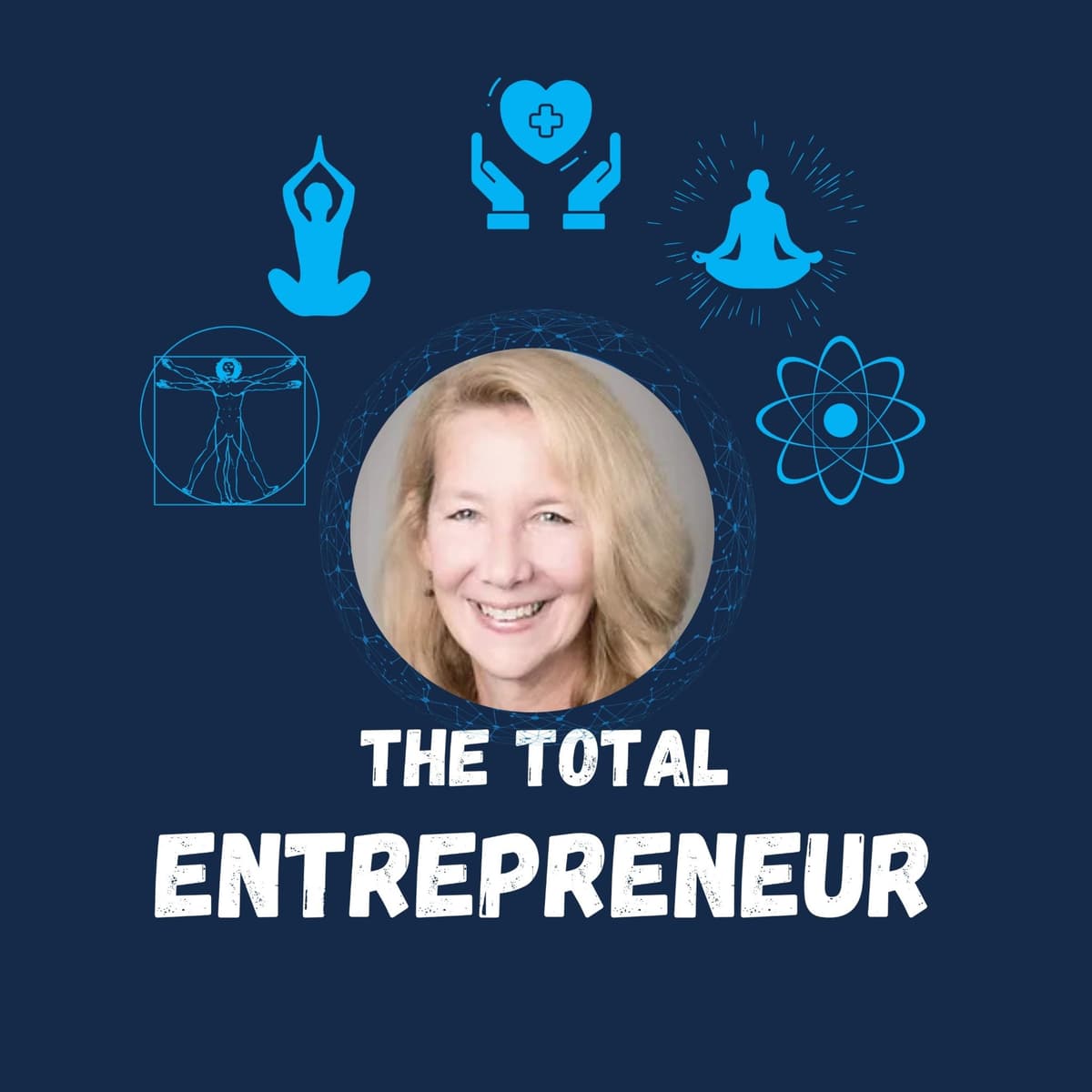
Integrative Medicine Approaches for Entrepreneurial Health with Carolyn McAuliffe, PhD, FNP
with Carolyn McAuliffe
Dec 27, 2024 · 00:43:44
Part of our conversations on
Welcome to The Total Entrepreneur, Mind, Body, Spirit, where we turn cutting-edge science into practical strategies for entrepreneurs. I'm your host, Dr. John Torrance, entrepreneur, Inc. 5000 honoree, and professor of entrepreneurial practice at Syracuse University's Whitman School of Management. Each episode, we dive into mental, physical, and spiritual health with expert guests offering actionable insights to help you thrive and perform at your highest level. Let's get started. Today's guest is Carolyn Christie McAuliffe, PhD, FNP. She is an integrative medicine practitioner with over 30 years of experience as a nurse, educator, and nurse practitioner. With a strong foundation in health promotion and disease prevention, Carolyn's practice focuses on using food as medicine alongside lifestyle modifications like exercise and restorative sleep to promote healing of the mind and body. She combines conventional medicine with alternative therapies such as acupuncture, massage, and Reiki, and is known for her compassionate, patient-centered approach. Carolyn is licensed in New York and is dedicated to providing holistic, high-quality care to her patients. Welcome, Carolyn. It's really good to see you. Thanks for being here.
Thanks, John. Thank you for having me.
Of course. So first, I want to ask what the difference is between traditional Western medicine and modalities like integrative and functional medicine.
So conventional medicine is really based on science. And in fact, physicians, caregivers are required to base their interventions on evidence that has been gained from, garnered from research and the strength of that research. Integrative medicine takes that into account, of course, but it uses conventional medicine and depending on the patient, can go very far out in terms of alternative medicine. So looking at herbs, supplements, vitamins, as well as acupuncture, massage, that kind of thing.
Very general.
Integrative is really the combination of the best of conventional and the best of alternative, and includes functional medicine, which I define as, well, most people define as trying to get to the root cause of why somebody's experiencing what they're experiencing. Holistic is much more alternative and natural, where integrative could include something like colonics or massage, which is natural. But holistic is typically more focused on food as medicine, lifestyle interventions, that kind of thing, you know, improving the quality of your sleep, eating more whole foods. That kind of thing. But integrative incorporates all of that.
Yeah. So with traditional medicine and the reliance on evidence and data and research, I mean, it seems like the things that you would apply in functional or integrative medicine, they've been around for much longer. So it seems like there would be more research and evidence on those, but it sounds like that's not true.
Most research is funded by big organizations like the National Institute of Health, Mm-hmm. Or big pharmaceutical companies where there is a price tag to the intervention.
Mm-hmm.
When we know eating a whole food is best, there isn't a lot of question about it. And for sure, there is no financial gain, maybe to the farmers, you know, in your community. There's a dearth of research in integrative and more alternative research. However, That is how I came to have the practice that I have. I was working in oncology as a director of research, and we were doing treatment protocols through the National Cancer Institute. But patients, the public, are demanding more and more thoughtful integration of measures that are more natural. And so the NCI was doing more and more research on prevention and looking at interventions that didn't cost money. So doing yoga, and we looked at the use of grape juice for nausea. We looked at Reiki and massage and those kinds of things. So the more research we did, the more I, of course I knew about this, but it just made sense to prevent cancer with those kinds of measures. But there are more and more of us for sure, and there is a call to justify it because so many of these interventions— well, seeing someone like me or paying for an acupuncturist every week can get very expensive. And so patients are now really, I don't know, complaining to insurance companies that that should be included. So once that happens, I think they're going to want some evidence. To say, well, let's do acupuncture over a colonic or just this vitamin. So I think it's going to come.
Yeah. Health insurance companies are in an interesting spot in this value chain of care, right? Because they don't necessarily exist to provide better care. They exist to offset the risk involved in catastrophic disease, right? So it seems like if there was something that could save an insurance company money, you know, like maybe having a physician prescribe meditation to deal with stress instead of a pill, that would be beneficial. Because meditation is probably one of the most researched things out there. I mean, there's plenty of data on meditation, but you still don't hear a lot of traditional doctors prescribing that or suggesting it even.
Absolutely. I wonder if the scale will tip at some point, because right now, most practices, most doctors really follow what the insurance company is dictating them to. do in terms of diagnosing and treating.
And it drives the reimbursement, right?
Correct. Yeah, correct.
Right.
And if you want to get paid from these insurance companies, you have to play ball. And so right now it's not even on their list to even talk about, you know, unless they have personal experience or they're more open-minded and have, you know, have some time to even talk about it. It's not addressed. Yeah.
Yeah, unfortunately.
Yeah.
Yeah, it seems like things are changing a little bit though, so that maybe there's hope, right? But yes, you hit it on the head. I think there's a financial incentive to prescribe the pills and the treatments for which there's a business model for somebody in this whole value chain.
Yeah. I do think it has changed. And I think COVID magnified the strengths and weaknesses of conventional medicine and more alternative approaches. because there was definitely a line where conventional medicine could not help. And so patients got really frustrated. And I mean, our practice, we— my voicemail, my website, they say we're not accepting patients, and patients will leave very desperate voicemails saying, please consider this.
Yeah.
So I think that the recognition of what pills and more conventional treatments can offer is becoming clearer, definitely to the public.
Yeah. And just to be clear, it's not that we're knocking Western medicine. Like, if you have a really aggressive bacterial infection, yes, you want an antibiotic. Or if you have terrible trauma and a broken body, you want those doctors who have that experience, right? So we're not saying there's no place for it or it doesn't belong anymore, but there does seem to be this movement more towards, you know, integrative, functional, holistic medicine, which I think is great.
Well, that's why I do practice practice integrative because there is a place for it. And many times I will use conventional meds so that somebody can heal enough that we could really embrace more alternative approaches. But for example, you know, there's something called reflux, GERD, and, you know, the pills we prescribe are very effective, but they also decrease the acid in your stomach. And so there's a lot of consequences to that, including you know, malabsorption, or, you know, you're not absorbing all the nutrition that you're eating. And so long-term, there's a consequence with bone health. But if you can get somebody so that they're not symptomatic and they can start making some dietary changes, it complements each other very effectively.
Gotcha. In the case of gastroesophageal reflux disease, you would get them to the point where they're at least stable and asymptomatic, and then maybe get them off the meds so that their body can start Absorbing the nutrients better rather than keeping them on the pill just to get rid of the symptom, in which case they're going to have other downstream effects, I guess.
Correct. And most integrative practitioners also do incorporate this functional piece. And so they'll want to say, why does this person have that? And can we address that cause as well as the symptoms? So many times there's a bacteria that kind of starts this whole thing. Conventional medicine will definitely check that, but usually they'll start with a pill, where integrative functional will usually start with labs. So that's another difference.
Yeah. I mean, and it seems like, you know, just taking a pill or doing something like that is the, I guess, expedient approach, right? Because, I mean, people nowadays are very busy. They don't necessarily have time to do the things that we know they should do, or maybe that their ancestors did. So yeah, I'm wondering what your take is on, you know, like our busy lifestyles these days, how that's impacting overall health, and, you know, maybe some practical things that people can do.
That's really a great question. You know, my mom, who was a nurse, said that the advent of antibiotics was not great for humankind because we learned we could take a pill and keep running. Before that, you had to go to bed and rest and really let your body access the measures we have, the abilities within our own body to heal. if we give it the right environment. And in doing that, you had this natural pace in your life where you had to sit with yourself and reflect on your life. And so her point was, because we didn't have that natural pace of checking in, you know, we end up at this point in our life where we look back and say, oh, I wish I'd done this and this and this.
Hmm.
But I do think meditation is a really Wonderful place to start in terms of a recommendation because that is where you empty your brain of all these assumptions and expectations and pressures and let your brain reset. So when you look at your to-do list or you start running to work, you're not starting out from a point of being overwhelmed. You can think with more clarity and mindfulness. But in terms of natural means, Exercise is found to be the most powerful thing you can do for your global health.
Hmm.
So it affects your immune system, your cardiovascular system. It affects every part of your body. But it also, like meditation, has this very profound impact on your brain and neurotransmitters and blood flow to your brain that helps, you know, circulate and feed cells with nutrients and bring out things that can collect in our brain. With it, detoxing your brain, so to say. So exercise is incredibly powerful, but you have to have the right fuel. And that comes from sleeping restoratively and eating food that is healthy and that you can absorb and use. So it's a simplistic thing to say, definitely focus on whole foods and when possible, organic. Quality does matter much more than quantity in terms of food. Sleep is, I say to patients all the time, that's the most fundamental thing you should focus on because while exercise is the most powerful, if you're not getting restorative sleep, and I define that or describe it as, you know, waking up in the morning saying, I'm ready for the day. It doesn't have to be artificial, but that you, you know, you don't feel like you need to go back to bed as soon as you step outta bed or within an hour. You know, that's—
Mm-hmm.
Definitely not restorative sleep. But if you exercise without having that, many times you can strain your body and actually go backwards in terms of benefiting your health. So food, exercise, sleep, fundamental. And then the mind-body piece. What I have found out, I'll speak for myself, because of COVID because people were in fight or flight watching the news, taking care of their families, for so long, and it was such extremes. Like, you don't need to wear a mask, you need to wear a mask, you need to wear 2 masks, you don't, you need an N95, nope, you don't need to. You know, it was so extreme. The vagus nerve, which is part of the autonomic nervous system and affects every part of our body, really got stuck in this fight-or-flight place.
Mm-hmm.
Which I am seeing the long-term consequences of it affecting immune function and even brain function, actually, on so many levels.
Well, yeah, so it sounds very simple, but it's not easy, right? So, you know, eat right, get enough sleep, and exercise. This is advice that's been around, you know, for a very long time, but still super hard to internalize and apply, right? So I think it's just a matter of prioritizing it, possibly. And sometimes it takes, you know, a major event before you realize Okay. I've got to prioritize this, right? Yeah. But let's talk a little bit about the vagus nerve. You mentioned that, and I know you've done a little work with vagus nerve toning. So what is that? How would people do it? Why would they do it?
So there's a couple of different ways to do it, and there's a couple of great resources, one of which I've just been introduced to. It's a book called How to Heal Your Nervous System, and it's a book that gives you all the tools to recognize when you're in fight or flight. And the measures that I'll talk about, there's physical therapy, there's something called Feldenkrais. I'm not sure if I'm pronouncing it right.
Oh, Feldenkrais.
Yeah. Correct. I said the K first. Yes, correct. There are interventions like that and tools like that that you can use. There's also this somatic healing with physical therapists that help access the nerve or the part of your body where trauma is sitting, which most fight or flight comes from trauma. when you're in that fight or flight, your vagus nerve can't respond as appropriately as it should because you need to go into fight or flight when it's appropriate. You know, when you're facing a potential infection or when your car's gonna go off the road, you need to come back to the center of the road or those kinds of things. You have a fever, you need to take care of your body. But it also then needs to rest and relax and restore. And if you're chronically in that fight or flight and don't get to that place of rest, it can't reset. So to tone it, there's lots of different ways, but I think basically almost all of them help you access where that stress, that trauma is in your body and the reflex most people have relative to that. So I describe it as an old-fashioned sled with rudders that have gone down a slippery snow hill, you know, 100 times. the 101st time you go down, it's going to go down the same path.
Hmm.
So these tools help you predict or sense when you're getting up to the top of that hill to metaphorically go down it on that sled and say consciously, I'm not going to go down that. I'm going to go down this gentle slope. And so the interventions stop you from going into that reflexic kind of slippery slide. and choose with very deliberate mindfulness how you want to respond. So a classic example is people flying. So people who are afraid to fly, conventionally we give them Xanax or something like a Xanax.
Okay.
And that works. For people who don't want to use that, they can do simple things like humming. And if they put their hand on their chest or on their solar plexus, which is just on the top of their abdomen, and they hum, you're actually accessing that vagus nerve and helping it to very deliberately relax. So sometimes we'll combine things. Like, I had somebody recently who's really, really afraid and has flown and has had horrible experiences. So she did the humming and she put her feet on the ground. So sometimes just feeling the ground underneath your feet helps access that vagus nerve. But if you combine all 3 of those things, humming, holding your chest, putting your feet on the ground, most people can get out of that reflexive response.
Oh.
But there are many, many tools like that. Another simple one is if you feel yourself kind of anxiety escalating, you can just kind of do this where you're stimulating all the nerves on your skin to just release that stress. and let it go. So it's—
So just brushing the arms lightly, or—
Yeah. And you can do your arm, you can do your legs, you can do your whole body. You know, if it's just a minor anxiety, you could just do your head, your arms. If it's really serious, go down to your feet. You know, you can play it by ear. But those kind of tools are accessible. And it's really interesting as patients work with a physical therapist here that I work with pretty closely, so many patients come with something that they do, they don't realize is accessing that process. So people will play with their hands or they'll hold themselves when they're nervous. Yeah. So many times it's remembering what you already are doing naturally, but then putting this deliberate mindfulness or choice, you know, to it to get yourself out of that. Yeah.
And this, this perpetual fight or flight mode. I mean, entrepreneurship is stressful, by definition in a lot of ways, right? So I think especially when you're a young entrepreneur or a student entrepreneur, you have the added stress of being a student and trying to run a business and manage that. So these are, I guess, helpful tools for them, right? So just being able to recognize when you feel like you're in fight or flight, or I guess one of the things is you may be so used to being in that state that you don't even know you're in it.
That is correct. I experienced that recently and I'm, very aware of that. And I didn't realize I was in it pretty chronically until I was out of it. And looking back, my sleep was poorer. You know, I wasn't digesting food as well. I had trouble focusing on work or on a task. But once I was out, that all shifted. And, you know, and I think our society, it goes back to taking a pill and running.
Yeah.
I think we encourage people to be productive. And there is a call by a lot of alternative practitioners, integrative as well, to stop that admiration of doing more and more and more. And, you know, we say put your oxygen mask on first before you take care of somebody else's. We use that metaphor a lot, but we don't help people. Like you said, it's easy to say, how do you translate? What is my oxygen mask? What would it take for me to reset? My brain, my body, my nervous system. It is not just as easy as saying, do it.
Right, yeah, but there are some simple things that you can do, even though they may not be easy to incorporate. You know, the things we talked about, getting good sleep, eating well, getting exercise, but there's also things that are readily accessible, like, you know, just breathing well and being in nature. Can you talk about those?
Yes, I can. I tell patients that, They— and I say it, and it sounds so strange to say it out loud, but our bodies are made to be healthy and to find homeostasis and balance, which is key to being healthy. The trick is we have to give it the environment to do that. And, your exercise benefit is different than my exercise benefit. So, it's not even just one-size-fits-all, it's really what's best for you.
Right.
But, the power of being outside in nature, You know, the vitamin D that comes from sun, you know, there's a lot of research on that. And, for bone health, for immune function, for brain health, for sensation of pain. But, getting sun naturally is so much more effective. Your body incorporates it so differently than taking a supplement.
Yeah.
Getting fresh air, it is— most buildings now, windows don't open. And, Even if they do, we are still breathing in many times pollution from cars and, you know, so many other things. So being in nature where the air is cleaner, no question about it. And then moving in nature, that exercise that is so natural versus going to a gym and walking on a treadmill. Which when you're traveling and you're crazy busy, That's better than not doing it, but getting vitamin D, fresh air, and the exposure to, you know, sound and the wind and how that affects your nervous system is so much more profound. You know, there's whole food and then there's whole exercise, whole living. We were not meant to stay inside. So—
Right.
That's one of the environmental factors I talk to patients about a lot. It's like you said, we don't even think about it, but it is very profound. So walking, you know, parking your car far enough away that you're walking or, you know, incorporating taking your dog to a park, you know, those kinds of things might be easier to incorporate.
Yeah. There's simple things that you can do if you think of them, right? Like just, and to a lot of people, they think, well, just going outside and taking a walk probably isn't gonna help my health that much. But in fact, it, you know, these small things add up.
That's a great way to put it because sickness usually isn't one thing. Sickness is you're not sleeping well, you're not eating well, and then you're exposed to something. So it goes the other way. Exactly. So if you eat well, you exercise, you can improve your sleep even gently, there is going to be a tipping point where it's really magnified. I'll say even, it's not even an additive effect, it's a multiplied effect. So there's definitely an incentive to figure out how to incorporate these more gentle things, gentle measures.
So let's talk a little bit about your thoughts on food as medicine, because I know that's something you do a lot of. And I'm just wondering how you approach it or what kind of recommendations you have for people, or what are some of the foods that maybe people aren't incorporating in their diet that they might want to consider incorporating? On the converse, what are some things that are very common in a diet today that people might want to consider minimizing or eliminating?
That could be a dissertation, as you probably know. So I'm going to start off with a caveat that it's— it is more expensive to eat well.
Which is crazy, right? I know, it's—
it's crazy. Yeah, you know, and, and there's talk about the food industry and making money on people's, you know, health. But when we're talking about food, it definitely is quality, not quantity. I will say as a general rule, and There are foods that are better if you eat organic. It's called the—
Oh, the Dirty Dozen.
Thank you.
Yes.
Yeah. So the Dirty Dozen, you definitely want— it's up to 15 now, but you definitely want to eat clean. You want to eat organic if possible. And it's because pesticides and pollution will get into that vegetable or fruit and Do you have the list right there?
Yeah, I just pulled it up because I want to read it for people, just because, you know, we talk about it and, you know. So this is the Dirty Dozen. These are the things that if you can buy organic, you definitely should because of the pesticides and that sort of thing, right?
Correct.
So this includes strawberries, spinach, kale and collard mustard greens, grapes, peaches, pears, nectarines, apples, bell and hot peppers, cherries, blueberries, and green beans, like all the things I love. So yeah, so you definitely— if you're eating those things, it's worth it to buy them organically just because you're avoiding pesticides, right?
That's right, that's right. And, you know, there's this new concept that I've been talking to patients about, which is not a new concept, you know, in medicine, but this toxic overload that it accumulates in your body, and that when we see some very specific diseases. So if you can avoid those toxins and ingesting those toxins, you're so much better off. That list of the Dirty Dozen, those are some of the healthiest foods you could eat.
Right, I know.
Very high in antioxidants, very anti-inflammatory. And I can talk about antioxidants specifically if it would help. But as a general rule, you want a broad brush of nutrients that will come from Vegetables, fruit, protein, and some carbs, as well as healthy fats. And there's no, you know, patients say, well, how much I could take and how much should I eat of this? And, you know, I'm sure the nutrition dietitian department at SU would have much more say in this, but some people need very concrete recommendations. But as a rule, eating more vegetables and fruit is always gonna be more healthy. We do know the vital influence of healthy proteins as well as fat. And just as a side note, I believe we're seeing some very unique diseases because we have been so focused on cholesterol that people aren't consuming healthier fats. And so I'm seeing a very distinct neurological influence. I think it's contributing to dementia. But it also, you know, your joints need lubrication that comes in part from fats. So my philosophy is that your body knows what you need, and that's part of the meditation and quieting yourself so you can get in touch with that. Just see how you feel when you eat a meal with a lot of dairy, or, you know, with this kind of carb or this kind of meat. And being in tune, you could say, you know what, I don't— I really don't do as well as I think I did with red meat as I do with fish, like, or chicken.
Yeah, I mean, you know, it seems like fats have gotten a bad rap recently, right? For so long, I mean, I can remember, a few decades ago, you know, we're avoiding fats at all costs, right? But in reality, our body needs these. And as a matter of fact, that should be a big part of your breakfast. Like, you know, instead of eating a bowl of cereal with, you know, antibiotic-filled milk or whatever, right? You know, maybe having just eggs, avocado toast, or something is a better way to go.
Absolutely.
Yeah.
So if you were going to avoid oils, the seed oils have been found to be much more inflammatory and damaging.
And these are what, like sunflower, pumpkin? Like, what are some of the seed oils?
Definitely canola, sunflower, as opposed to coconut, olive, sesame, avocado. Those are— they have different components in it, and it just— it's— your body uses them completely. And is very healing. Fish oils, omega-3.
But you can eat sunflowers, right, as a food source, but just try to avoid sunflower oil, maybe because of the way it's processed or just because your body can't use it the same way as some of the other fats. Is that right?
That's exactly it. And, you know, our body is ready to take any kind of food, a whole food, and use what we need and let go of what we don't. So you can't overdose on a salad. You can on a supplement. So eating the sunflower is, that's exactly it. That's, that is really healthy. Now they found the kernels, when you just eat the kernels, there is some, you're closer to the oil than eating sunflower seeds. It's exactly that. We denature our food. And so your body doesn't use it as food. They use it, uses it as either something pollution, you know, polluting, or as a medicine that they need to figure out. What to do with. So the whole food is so much better.
Yeah, so besides seed oils, what are some things that are very prevalent in our standard American diet that people should consider weaning themselves off of to get better health outcomes?
I think the biggest thing is processed foods, which have a lot of cheaper oils and fats to make it taste good. But processed foods, it's very rare that this isn't the case, There are preservatives in it so that it's convenient, and those preservatives have additives that are toxic to our bodies. And so, if you are detoxing on a regular basis, exercising, eating foods that clean your intestine, you know, really fibrous salads and fibrous foods, drinking plenty of water, you're okay. But if you are out of balance and you eat these toxic foods, you're going to accumulate them and it might not have a consequence in the next 6 months, but down the road, it's so much more likely that you'll have a consequence from those toxins.
Yeah. So avoiding ultra-processed foods to the extent you can. So things as close to whole or the way they were in nature as possible, right? So a picked apple versus applesauce or worse yet, Apple Jacks cereal or something like that, right? Or yeah. Yeah. Okay.
Yeah.
Yeah. Well, so one of the things we know is that by the time you develop a chronic disease, it didn't just happen, right? This has been decades sometimes in the making. So for young entrepreneurs, what are some things they should be thinking of now in order to stem the possibility of chronic disease later in their lives? And it's probably a lot of things we already talked about. So maybe even like, what should they be talking to their own doctors about, and how should they be advocating for themselves in a health practitioner relationship?
I would encourage anyone to ask their doctor for anything. The first thing you made me think of is their vitamin D level, because it is so fundamental to hormones, to immune function, to brain function, especially in upstate New York. A lot of your students are here, and we do not get enough exposure to sun. I mean, we have, the year I moved here from Maryland, there were 52 days of sunshine the year before. And research on vitamin D is conducted in this area because we are deficient. But it is so fundamental, and it's an easy thing to fix. And so that would be one thing.
How do you measure that? Is it only through a blood test, or are there other ways to measure your vitamin D? Blood test.
Okay.
So you'd have to specifically ask your doctor to measure vitamin D levels in your blood panels. Okay.
Correct.
Correct.
And most doctors really understand the relevance of that. It's not usually a fight to do that.
Mm-hmm.
Medicare patients, that's a different story, which is kind of crazy. But otherwise, most doctors are really happy to help to measure that. But, you know, if you get basic blood panels looking at your white blood cells, your red blood cells to make— the white blood cells to make sure you don't have some kind of underlying infection, red blood cells to make sure you don't have some kind of anemia or you're bleeding, that's a good measure of kind of fundamental health. Looking at the function of your kidneys and liver, there are blood tests for that as well. Looking at your urine to see if you're dehydrated or are more alkaline or acidic. And when we check urine, we check a pH level, and we know inflammation is more prevalent when you're more acidic.
You could test with a pH strip, right? Either with saliva or urine or something, right?
Correct.
So you don't need a blood test for that.
That's correct. Yes. Yes. You know, height, weight, BMI, from my standpoint, I've seen plenty of people who had perfect BMIs and were not absorbing nutrients or were very acidic. So BMI is not— it is a piece, but I look at it in context. Blood pressure, for sure, that is something almost every doctor's office checks and is a really fundamental— look at kidney function, heart health. So that's an easy thing. And maybe asking the doctor, their provider, what else can I do to be healthy? You know, most conventional doctors aren't talking about the vagus nerve, but from my perspective, now having looked at patients post-COVID—
Hmm.
Although I'm going to say we're still in COVID, but now that we've, we've been living this for a couple of years, Even if you do everything perfectly, if your vagus nerve is stuck in that fight or flight, you— to me, almost impossible to be healthy, honestly. Now, going back to exercise, I'm thinking about you, John. You use exercise not just for physical health. It is cathartic. It is meditative for you. And that is affecting your vagus nerve. And so when you can do those kinds of things that maximize the benefit, like Great. You know, some people eat very meditatively. There's walking meditations. So there are some ways to incorporate that, but it would be interesting to just ask your doctor and see what they say.
Yeah. Yeah. And I guess the point is to take control of your own health and health outcomes and not leave it in the hands of your doctor because they're very well-intentioned. But like you said earlier, they're under a lot of stress to see as many patients as they can because reimbursement rates are what they are because they're set by health insurance companies. the incentives aren't necessarily aligned for even the best-intentioned provider to, you know, to help you as much as they can. Let's switch our focus. I want to talk a little bit about Reiki for a minute because, you know, I love the fact that you're also a Reiki practitioner. And that's one of the things I love to end our visits with is a Reiki session. So talk about, well, what it is, what are some of the benefits of it, and that sort of thing.
Reiki is considering Eastern medicine versus Western medicine, which people experience here in America, in Europe. Eastern medicine defines health as balance. If you think of a yin-yang, you want just as much positive as negative. But another big concept is that it's not stagnant, it's moving.
Mm-hmm.
And that there is flow of chi. And so Reiki focuses on chakras, which are centers of energy. And there are hundreds of chakras, but Reiki focuses primarily on the basic 7, your crown chakra, third eye, throat chakra, your heart, solar plexus, sacral, and root. And each of those chakras have different functions and develop over time, very similar to Erikson's stages of development. But many times when we're experiencing life, we have a reaction where it's the equivalent of And, when that happens, an infection, a scare of some kind or a real, not even perceived, but somebody dies or you're in a car accident or you get a bad grade from well-meaning professor. But, when your body kind of gets startled, sometimes one of those or more of those chakras can stop moving or get out of balance and be either more yin or more yang. And, sometimes they can even start moving backwards where all the others are moving forward. The other one, this one's moving backwards. So what is so powerful about Reiki, which is how I try to practice integrative medicine with patients, is it's based on accessing your internal healer. It is not the Reiki practitioner. It is really accessing, we call it the internal physician in the person's body. And bodies seek homeostasis. They seek balance. And So the Reiki practitioner is just this conduit of what I call divine energy, kind of direct that energy towards each chakra sequentially and invite it to, to shift and change. And, but I can't make that happen. The person has to let that happen. It's such a wonderful thing for me as a clinician because it is one, that divine energy is benefiting me too. But to witness somebody shift from not digesting well or not walking their days with ease to a place of ease and absorption of nutrients, it is such a gift because it's much more than a pill or a massage treatment, which will have benefit, but shifting the alignment of those chakras so that they're all moving. that allows for that flow of Qi that benefits you. And as long as it keeps flowing, you're going to be in that balanced place. It is a multi-layered benefit for patients. And many times, the way I practice, when I can help somebody realize what they've shifted and the power they have themselves, it's even a longer benefit, much more powerful and longstanding benefit because they can do that themselves. And I think most mothers practice Reiki. You know, they hold their child, they hold their boo-boo or owie, and just the fact that they do that is healing. There's a whole science behind Reiki, and I don't want to downplay that at all, but the power of love, the power of touch is— both those things have their own potency.
Yeah, and there is actually a lot of research on touch, right? I mean, there's studies, you know, that in mammals where baby mammals who are touched and have that tactile, you know, relationship, not even with their own mother, but just with another mammal, do better on a variety of measures, right? Yeah.
There's a great scientist, I believe she was a psychologist, Virginia Satir, who said that you need so many hugs a day just to survive. And she delineated survival, maintenance, and thriving. And if I remember correctly. I do quote this, but I'm not sure it's quite correct. But you need like 7 or 8 just to survive. And you need like 12, 10 or 12 to maintain and like 13 or 14 to thrive. And—
Wow.
And now there was a research study that I just saw published. I don't know if it was a Wall Street Journal. I don't remember where it was, where I read it, but that it's not just a hug. It is the quality of the hug. It is the intention. It's the length of time. And So it's not just, here you go, here you go. But, but I've seen research that also shows you can get that from pets and a really meaningful relationship where somebody puts their hand on your arm or holds your hand or, you know, somehow holds your back. You know, it doesn't have to be just a hug. So, yeah. But the power of touch, the power of community, the power of connection, it is Understated. And with social media and technology, we have definitely seen that, that, that has shifted and affected health. We see it more and more and more. Good.
Well, yeah, I was, I was thinking we were kind of at the end when we were talking about Reiki. Anything else that you want to cover or go over?
Last thing I would say is we have much more power than we think we have to be healthy. And I think the unfortunate thing of our conventional medicine system, our healthcare system, with the expediency being such an important part and experience, I see many times people disconnect from their intuition and from their right to health autonomy.
Ah.
And that you have the right to say no, and, or I need this, and not settling and saying this is good enough, but saying, okay, this isn't a good fit. Let me look elsewhere. And TikTok makes me very nervous. There are people on there that are not qualified giving advice. It can be a starting point to say, wow, that sounds really interesting. Let me do some research on it. But it scares me. It's not, you know, there's this big fad of putting castor oil on your belly button and, you know, everything's gonna be better. And like, it's how it's presented can be so out of context. So do your research. I do have a new website getting published and I have for the first time written some blogs. I didn't even really know what they were, but I have written an article on how to read information that you're getting from the internet with discernment and a critical eye to know if it's right for you, as well as what health autonomy is and how to ensure you have it in, you know, not an offensive or violent way, but to say— This is my right. So when it comes out, which should be pretty soon, you could get some information from there if you're curious.
Yeah, but I love that idea of health autonomy, right? And it's similar to, you know, looking externally for your ability to heal, like with a pill or a procedure, versus just the things that you can already do. And it's— yeah, it's just kind of taking your power back as a person and tapping into that ability. And, and a lot of times you, you kind of know what you need anyway.
Absolutely.
And you can do your own research and then advocate for yourself, because a lot of times we just put our, you know, our health in the hands of somebody else and just give away that power and autonomy. So I think that's a really important thing that you said.
That was the frustrating piece of what I witnessed with COVID The government and these health experts became the you know, it was black and white. You have to do this. And it's not that simple ever. So I agree with you. People most times know exactly what they need, or they know something's wrong and they know what the answer that they're being given isn't correct. And so to advocate for yourself and ask questions and get second opinions and ask for what you need.
Yeah. Own your own health, right? Yeah, for sure. So if people are interested in learning more about you or even finding that article that you wrote, where would they go?
The website is integrativepractitioners.com, and I have a very old, antiquated, not a beautiful website, but my new one will be published very soon. So, and it will have a blog area and they can access it there. And I have a Facebook page and they can contact me there or read information. We have a lot of information there too, and I think the blogs go there as well so they can read it.
Well, that's great. Well, Carolyn, thank you for spending some time with us. I really appreciate it. And yeah, hopefully everybody got some great information and some tips that they can act on to own their own health outcomes and live a better life. So thank you.
You are very welcome.
Thank you so much for listening to the Total Entrepreneur Mind Body Spirit Podcast. If you liked what you heard or heard something interesting today, please give us a like, share a comment, or better yet, subscribe to the podcast. Thank you.
About This Episode
In this episode, Dr. John Torrens discusses integrating mental, physical, and spiritual health for entrepreneurs with Carolyn McAuliffe, PhD FNP. With over 30 years of experience as an integrative medicine practitioner, Carolyn explains the differences between conventional and integrative medicine, the importance of food as medicine, and practical advice on achieving holistic health. They unpack the significance of Vitamin D, the role of the vagus nerve, the benefits of nature exposure, and the impact of processed foods on health. Carolyn also touches on the practice of Reiki and the concept of health autonomy. Discover how to use food as medicine and be an advocate for your own health.
About Carolyn:
Carolyn Christie-McAuliffe, PhD, FNP is an integrative medicine practitioner with over 30 years of experience as a nurse, educator, and nurse practitioner. With a strong foundation in health promotion and disease prevention, Carolyn's practice focuses on using food as medicine, alongside lifestyle modifications like exercise and restorative sleep to promote healing of the mind and body. She combines conventional medicine with alternative therapies such as acupuncture, massage, and Reiki, and is known for her compassionate, patient-centered approach. Carolyn is licensed in New York and is dedicated to providing holistic, high-quality care to her patients.
Keep listening
More on Body
About the Host
Dr. John M. Torrens
5× Inc. 5000 entrepreneur, Professor at Syracuse University's Whitman School of Management, author of Lightning in a Bottle, and TEDx speaker on ADHD as an entrepreneur's superpower.
Browse all podcast guests →Book a strategy call →