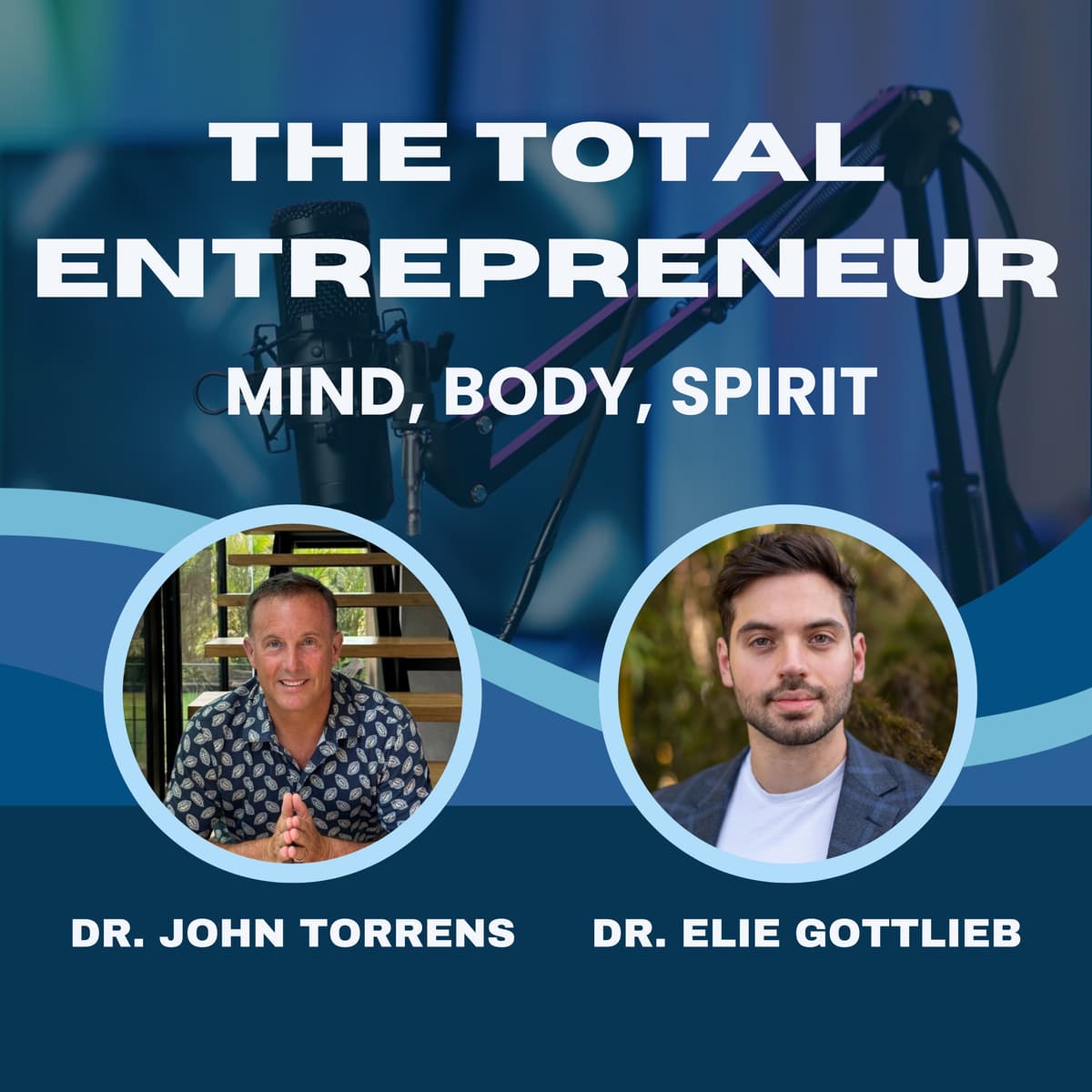
What Your Sleep Data Says About Your Brain and Body With Dr. Elie Gottlieb
with Dr. Elie Gottlieb
Mar 19, 2026 · 00:54:07
Part of our conversations on
Set an alarm as late as possible. If you know you need to get out of bed at 10 o'clock, don't set an alarm at 9 o'clock and then snooze for an hour every 5 minutes. Like, my partner does this. She needs to get out of bed at, let's say, 8 AM, and she'll set an alarm for 7, and then every 5 minutes the damn thing goes off. It's brutal. It cannot be good for your brain or your body. It's like instant shock response every 5 minutes.
Dr. Gottlieb, thanks for joining us again. Our first episode did really well, and I'm excited to dive into all things sleep science with you again.
Thank you so much for having me. It's great to be back. This is one of my favorite, definitely podcasts of the year that I did. And it's such an interesting and niche audience and an important audience that sometimes forgets about the importance of sleep. So excited to dig into the data and the science. Yeah.
Amazing. One of the big things that's changed since we last spoke is AI has been here for a little while, but it's starting to filter its way into the types of things we're talking about. So I'd love to hear your perspective on how AI is changing sleep science and the practice of getting sleep and that sort of thing. What's AI's impact been?
Yeah, obviously it's a lot. I think You know, there was still some AI at the time, but I think the AI has now moved from like describing your sleep to actively predicting what comes next and eventually sort of acting on those predictions in real time. And we'll talk about this later, but one of the biggest studies to come out over the past year was some Stanford work. They published something called Sleep FM, so Sleep Foundational Model. And essentially what they did was they trained it on about 600,000 hours of Gold standard polysomnography data from about 65,000 people. This is just one night, by the way. And what they found was that based on just one night of that objective sleep data, this Sleep FM model can predict your risk for over 130 health conditions. One night, cancers, dementias, you know, heart failure, chronic kidney disease. It was impressive, not just in the scale, But also in the, in the level of accuracy as well. So we're talking about AOC curves of 0.8 and above. It's remarkable. It means that sleep data really contains these sort of like signatures of disease that can surface, you know, years before clinical diagnosis. And that was just on one night of the gold standard. But what happens when you have consumer sleep technologies and wearables that have years of retrospective data, not necessarily to the same granularity of in-lab PSG, which has a bunch of wires all hooked up, EEG, EOG, but still has a lot of granularity. So what can we do with that technology? And that's what we're starting to show now. We recently showed that we're able to predict things like obstructive sleep apnea and chronic insomnia. Using just objective sleep data from a wearable. So I think it's really exciting. And now we're moving beyond just the measurement piece. So Google just recently published their work on what they call the per— the personal health agent. And this is essentially a like multi-agent system. So you have a data science agent, a domain expert agent, a health coach agent, and then this like central orchestrator. And essentially what happens is you can, as a user, and this is now available in all Fitbit devices, as a user, you can ask a very simple question, right? Like, how does my physical activity affect my sleep or vice versa? And what it's doing is it's taking into account some retrospective data. It sounds like a simple question. The agent needs to know, is there a relationship? How strong is that relationship for a given user? What's the latest in sleep and circadian science and exercise physiology? And then how do I actually use all that information to actionably coach someone in like an empathetic way? So this was very difficult to do or nearly impossible to do 10 years ago, 5 years ago, 2 years ago. And now we have these like agents that are working across multiple agents. to give a user a best-in-class response. But we've gone from, you've slept 7 hours and 10 minutes or 5 hours and 10 minutes to systems that can really reason about your sleep and in more contextual ways, they could predict risk and then coach you through behavioral change. Because you and I both know how impossibly difficult behavior change is.
Yeah, for sure. That is really interesting that on one night's worth of data, they can have all this predictive capability. I've read some research basically doing the same thing with vocal quality, like just from a voice recording, you can now predict Alzheimer's, Parkinson's, a lot of neurological disorders. So to see this with sleep is really unique. So what are the markers or what are the signatures? Do you know what they actually look for? And can consumers with a Whoop or can they do this themselves or are we not there yet?
Yeah, that's a good question. So there are some 510 cleared devices for things like sleep apnea, right? The Apple Watch is cleared for risk of sleep apnea as a screening tool, not a diagnostic. So too is the Galaxy device, the Samsung Galaxy device, but that's really it right now. Now the entire industry, there's this convergence of healthcare and wellness. The differentiator now in the field for a lot of these consumer technologies is in this screening platform. As not just a wellness tool, but a way to actively predict risk of a range of chronic conditions. Whoop has done some work on this space as well with blood pressure, and they got into it with the FDA, and the FDA sort of recently backed down, and they basically have now been a little bit more lenient. Let's say when it comes to claims and around use cases for tech, these kinds of technologies. I think in the next couple of years, we'll see this really profound pipeline of these technologies. that are not just screening or not just measuring sleep or physical activity or HRV, but using all that data to actually screen users on demand for a range of chronic conditions.
Yeah. And with the FDA, I get that you need a little caution, but still like their old systems can't keep up with the pace of innovation. So something's got to give in order for us to take advantage of everything that we're learning. So that's good to hear.
Absolutely. And at least, and look, in the United States, in the sleep space, at least there is a 35,000 to 1 sleep patient to physician ratio. Wow. Which is incredible, right? You have technologies that can now screen. They arguably will be tuned to screening on the basis of ensuring that there's less false negatives, right? And more false positives. So will sleep labs be inundated with people who are— their device told them they're at risk and then they do the full PSG and then they're not. I don't think that's the case per se, but it's where we're headed, right? Like our health system arguably will now be inundated with people and it's probably for the best, right? Rather than things going unchecked and undiagnosed for a period of time. Like for example, Narcolepsy is a really, you know, it could be a devastating sleep disorder. And historically it has taken someone with narcolepsy between 7 to 11 years from the time of symptoms to diagnosis. So now we have some, it was just presented at one of the most recent sleep meetings, devices that can use just a sensor's PPG. Which are in most technologies now to with 85+% overall accuracy, correctly identify whether someone has that disorder. That again, historically was impossible, required a lot of ruling out. And so it's very exciting. And I guess the question will be, can our healthcare system support this convergence of healthcare and wellness?
Yeah. Or will it have to morph into something more nimble where we don't require the gatekeeper or the provider where, like you said, AI can maybe coach us more effectively or more efficiently rather than a human provider. Yeah.
Especially for subclinical issues, right? Like at least most people in the United States don't have a sleep disorder. I think we spoke about it in the last one, but like 10 to 15 to 20%. have a sleep disorder. And again, absolutely warrants attention and a medical, a clinical pipeline. But for the rest of the population that doesn't have this clinical sleep disorder, but is still struggling with their sleep, they don't meet the diagnostic criteria for a disorder, left to their own devices. That's where I think the real value in some of these coaches will come from.
Right.
It's really that, like, you know, access to evidence-based information. Yeah.
And we don't need the subclinicals maybe clogging up the system for the people who really need that access to help, especially now that we can track it ourselves. Which brings me to another question. We were talking offline about a conversation I had with a friend just the other day who also wears an Oura Ring like I do. And over the past year, I took a really deep dive into my own sleep too. I just got maniacal about improving it since our last conversation. But her feedback was like, I had to get rid of my Oura Ring because it was stressing me out. And she felt like it was making her sleep worse. So talk to us about that. Because apparently that's a thing.
It's a very interesting concept. It's called orthosomnia. And it is this idea that there is this kind of like maladaptive preoccupation with optimizing or perfecting your own sleep and that it's most, most often organized around sleep trackers. And the truth is we're living in this age of the quantified self. This administration says they want every single person in the United States to have a wearable on their wrist or on their finger or on their arm. And the quantified self, you know, it's this idea. It's been around since 2007. There was a Wired magazine. It started this huge movement, grew to over 100 groups, 30+ countries. And the basic premise of the quantified self was that self-knowledge, Through numbers and that kind of like ethos that really has permeated everything from heart rate variability and step counts and now sleep. And we also know that nearly 50% of people in the United States own a wearable, and that is massive adoption and that's just growing. So in 2017, there was this series of case studies by Kelly Barron, brilliant researcher. And she's actually going to be on this paper that we'll discuss in a second. And they basically found patients who were describing these sleep problems that the researchers thought were actually being driven or worsened by their sleep trackers. In fact, there was one patient that she described that came in for a range of what she felt were sleep issues. The patient described sleep issues. And when they did a full sleep study on that patient, there was, it seemed normal. And then the patient went back to Kelly Baron and said, then why does my Fitbit say I'm only getting 15 minutes of deep sleep? So it's this like misperception between a gold standard, right? Polysomnography. And that's part of it. And what a device is telling me and people using the device as gospel. Baron then coined the term orthosomnia, which, you know, Latin ortho for correct and then somnus for sleep. And she was really trying to draw this like deliberate parallel with orthorexia, which is this like unhealthy preoccupation with healthy eating. And what has since happened is now people and magazine articles have pushed this idea of orthosomnia and it really outpaced the science. And really there has not been a lot of work in the orthosomnia space over the past couple of years. This idea that like your sleep tracker is ruining your sleep. Recently they tried to estimate prevalence, right? So it's at first operationally defined what orthosomnia actually is. Try to identify what the prevalence is in actual people who are using technologies, consumer sleep technologies. And based on some variable thresholds, they said a conservative estimate is about 3%. So among 3% of users, they might experience this orthosomnia all the way to the most liberal operational definition, max 14%. So it's relatively a small subset of the population. And now we're starting to identify, okay, what are the like risk factors? Someone who's obviously may have OCD-like tendencies, is overly perfectionistic about their overall health, might have insomnia. So are really in tune with like overly in tune with their sleep, preoccupied with their sleep. So that's what we're working on now, which is a review paper that convenes the subject matter experts across the academic space. Also the consumer sleep technology space. We have authors from Whoop and Oura, Nike, and a few other really brilliant groups. And what we're trying to do is say, okay, what does the data actually say? What's the prevalence? What are the potential risk factors? And then this is the fun part. What, how can we design these consumer sleep technologies in a way that reduce the risk of orthosomnia? Right. For example, intelligent onboarding, where we have some questions during onboarding of a device where we can start to map that, okay, this user might be at risk of orthosomnia. Instead of giving them a bunch of data, maybe we should be giving them a more empathetic visualization Leverage things like color psychology in a way that again reduces that risk. And most importantly, we should be moving beyond just the data. And one premise that I talk about in the paper that I'm really looking forward to is that most consumer seat technologies today, they're these like data mirrors, right? Where they give you a bunch of data and then they say, Godspeed, right? There's no contextual information, right? Again, this idea that we're measuring everything and changing nothing. Very few consumer sleep technologies have a platform and a way to go beyond the measurement.
So there's a couple of things I'm thinking of here with this orthosomnia. One, is it a really good example of the nocebo effect, right? Like a reverse placebo where people are like, oh my God, I had a bad night's sleep. Now I'm a bad sleeper. And that just cascades forward. Or is it, is it that the gold standard, the PSG you said, versus the consumer trackers, the sensitivity just isn't there. So maybe the example you used, she didn't get 15 minutes of deep sleep. She got a lot more than that. But then because her consumer sleep tracker told her it was low, it triggered this nocebo effect that just kept going. Is that, could that explain it?
That's a good point. They actually looked at, this was a study that was done a couple of years ago where they had a group of equally relatively normal sleepers, right? One group got, both groups got sham feedback. So the group that got, let's say 7 hours of sleep, one group was told that they only got 5 hours of sleep or 4 hours of sleep and their sleep was quite poor. And then the other group who got the same amount of total sleep time, they actually said, they told them that their sleep was 8 or 9 hours or an increased amount. They slept well despite both groups sleeping comparably. So when they did cognitive assessments on them, what happened? The group that was told that they slept poorly, their cognition went, it was quite poor, right? They felt, they thought they were told that they're sleeping poorly. So their cognition matched that. The other group that was told that they were sleeping well, the opposite happened, right? They performed significantly better than the other group. So all to say is it is a really good point that the data itself can influence our performance. So there's a question like, should we be artificially inflating data to make people feel better? That's one question. And some devices are doing that on their own. So for example, there are some devices that have quite poor specificity. In other words, wake detection, meaning that they're, they're underestimating wake and overestimating sleep. Garmin is a good example of this. They're among— sorry, Garmin, but worst-in-class accuracy because their specificity is so poor. So they're doing that. Other devices, don't have that problem. Oura, for example, is quite robust in this. Do Oura users have worse cognition because they're being told that they're sleeping more closely to the truth than Garmin users? That's a question. I think a lot of this can be, we can remove the stress of orthosomnia if we design user experiences in a way that combat it. So again, maybe it's also a great point. You mentioned a deep sleep point. Maybe we just give a range. Your deep sleep last night could have been between X and Y instead of saying, this is the gold standard truth, right? This is gospel. Listen to this ring or listen to this. That's a question. And maybe the future is more adaptive. So based on a user's personalized onboarding, how they prefer to be spoken to, some motivational interviewing that we can do, we can better design an adaptive user experience that's best supportive to their needs.
I can relate to that. So now I'm in the habit of when I wake up, I just try to take a check of my body and say, well, how do I feel? And then I, you know, take my, I put my ring on the charger, take it out of airplane mode. And then I look and say, okay, well, what does my data say? And I try to track that to how I feel. And there have been some days where I'm like, geez, I didn't think I slept that bad. I actually felt pretty good. But as soon as my ring tells me I didn't sleep well, now I'm just tired.
Maybe we should also be waiting to check the device. So do a check, like exactly what you just said, do a check-in first thing in the morning. Like most people don't need a device to tell them how well or refreshed they're sleeping. And in fact, are we losing that innate capability? Are we now relying on a tracker to tell us how we're feeling versus our own intuition? And really, we should be using both, right? Like, you should be using your own intuition in the morning to identify how the overall quality of your sleep— right, quality is inherently qualitative. But then if you want to dig a little bit deeper, maybe you had a coffee too late yesterday, or you had alcohol, and you want to see maybe how that affected your deep sleep or REM sleep. Obviously those aren't things that are easy for humans to identify. You're not conscious during those states. So that's where maybe the tracker is used to inform, or really things like consistency. We'll talk about in a second how we're now showing that the regularity and the consistency of someone's bedtime and wake time are stronger predictors than the amount of time spent asleep or a range of health outcomes. So maybe that's a way to like better identify, but throughout it all, I think what's most important is the contextualization of things. Ideally, we have some information on behaviors that we did throughout the day that the tracker then can correlate for you over time. It could say, okay, you've logged X data, or we're able to identify X behaviors. Here's how that has affected your sleep over time.
Yeah. So it seems like it's just, how do we use the data to our best and highest purpose, right? So another good example for you, and then this just happened maybe a week ago before I, before I went to bed, I must've just fallen asleep on the couch. So my ring picked it up as bedtime, right? Because it was about the time I go to bed, got up, brushed my teeth, went to sleep, took me a few minutes to fall asleep, but my ring thought my sleep latency was a really long time. Like it had me sleeping for a few minutes and it looked like it took me 35, 45 minutes to fall asleep. My sleep score was really bad. And in the morning I thought, I feel pretty good. How could this be? So I looked at it and when I changed the bedtime, the latency went down and the score went up. So I think that's really important for people to know is that it's all this magic algorithmic work that goes on in the background that gives you this score that you then use somehow. So it's really important for people to understand how we use the data we're getting from our wearables in the first place.
Totally. And again, like if you feel like your sleep has gotten worse or you feel overly preoccupied with trying to perfect your sleep since you got your new device, maybe it just means that it's not for you. Right. Or if it's gotten to the point where maybe your tracker has identified some issues that warrant clinical attention, maybe speak to your doctor and see if you can rule out a formal sleep disorder. I think that's where we're headed. So I agree with you though. We should not be taking our devices as this like gospel yet, because number one, they're not as accurate as the gold standard. But again, remember the gold standard is an imperfect gold standard. Polysomnography, which is the gold standard for sleep measurement, it requires historically has required someone to visually see Every 30-second epoch of data and score it as either awake, non-REM 1, non-REM 2, non-REM 3. And if you have the same technician look at that 30 seconds, you have 2 technicians, there's disagreement, right? So that's an imperfect gold standard. All this to say is sleep is a complicated space. Devices are playing telephone to what's inherently a brain state. So now you have some technologies that are in-ear EEG, that are headband EEGs that are probably a bit closer to ground truth. And that's maybe where the space is heading.
But again, Muse just came out with a band.
Yeah, Muse has had their band. There's NexSense. There's so many now. devices that are intended to estimate brain activity. And really that's a big part of sleep, but it's brain states. Yeah.
Let's go back to the study because you mentioned the one you're working on with the people from Whoop and Nike. Tell us a little bit more about that and what are the research questions you're asking and what are you finding so far, if anything?
Yeah, no, I think we covered a lot of it, but in short, it's really this qualitative synthesis of the data. When it comes to orthosomnia, there's really only 12 papers that have any reference to orthosomnia. Of those 12 papers, there's only been like 3 or 4 that have specific hypotheses around orthosomnia and have like operationally defined it and tried to identify prevalence or risk factors or develop validated scales. So this paper is really just like the culmination of that research. And again, for both clinicians and researchers and people in the consumer sleep technology space to have a platform to say, look, we get that this might be a problem. It's likely being slightly overstated and overhyped based on the media and the press that it's received, but we know it's a real thing. What are the subsets of the population that should not be using consumer sleep technologies? What are those risk factors? But how do we reduce the risk and how do we design, you know, really useful user interfaces and user experiences to ensure that users that might be at risk either reduce the risk and still give value to that data because those technologies are valuable. And there is going to be a point where most people have some kind of consumer technology tracker. And that is being used as this, like, you know, it's medicine 3.0, right? Like this pro— this future-forward proactive data stream that allows us instead of these cross-sectional measurements that we get during a check-in that we go once, twice a year, if we're lucky, it's more proactive. So that's where the space is heading. So instead of just abandoning the technology, how do we build them in a way that's useful. Yeah.
And what was it like working with Oura and Nike and Whoop? Was it, was it difficult to get everybody together? What was that experience working with industry?
Everyone's been super amenable and open, right? It's like in all of our interests to get this kind of paper out. Some are, and I will say, we actually, the full draft is being sent out probably today or tomorrow. So TBD on how they all Probably take that offline, but no, I'm sure everyone's open and really excited to— this is a novel area, right? And as researchers, even those working in industry, we're all super motivated to improve population sleep health. And if there is a subset of the population that's not being improved, we want to understand why we want to understand what can we do again to design for them.
Yeah, no, that makes a lot of sense. And yeah, hopefully this gets some wide review. That's great.
Hope so. Let's see once it's out.
So what are you looking forward to in terms of new research, new science, new breakthroughs? What's on the horizon that's getting you excited?
Yeah, I think the biggest thing is around this hyper-personalization of sleep improvement features and technologies beyond just the data. Right. There has been a lot of data over the past year alone showing the effects of sleep on a range of things. What I would like to see more of, and a lot of that data has been on sleep deprivation or insufficient sleep. What I would love to see now is, okay, we know that sleep deprivation is terrible for us. We know that inconsistent sleep schedules are terrible for us. We know that a 1% reduction in deep sleep is associated with a 27% increase in Dementia. Again, those things are terrible and we get all that. But what now happens, which the consumer sleep technology should be able to tell us if they're doing, if they're not doing harm, they're doing more good than harm. What happens when you actually improve sleep? When you have a group of people who were at one point inconsistent, insufficient, irregular, poorly efficient with their sleep, What now happens when they have the tools to improve their overall sleep to those health outcomes? Is it just a one-to-one where, you know, you just flip it, right? There's now a 1% increase in deep sleep in older adulthood. Is that associated with an improvement in cognition and all these? I like— we don't have, we don't really have that data. It's been mostly on the reduction side. So I would love to see more on the intervention side and not in the, like, clinical intervention side, right? Not necessarily with the pharmacological space, although there's been a lot of advancements recently on things like dularexin agonists and antagonists, these new DORA drugs for insomnia or narcolepsy. It's a newer class of drugs, which are great. It's useful and helpful. But what about on the behavioral side? What about on the products, product side? How are these technologies and behaviors being used to improve sleep and what's the downstream effect on overall sleep and also health? That's where I would love to see the space go again, sort of inspired by the Martin Seligman and positive psychology lens. It's okay. We know getting someone from negative 20 to 0 is useful, but now what about the optimization side? And not in the sleep maxing That's gotten a lot of press, you know, bad press. Like we shouldn't be, again, orthosomnia, trying to perfect our sleep. But what happens if we just improve it? Improve the duration, improve the consistency, efficiency. Like what is happening to overall health? That's where the field really needs to go.
Yeah, that's true.
Right.
Because why? It's good to know that it's bad and it's even better to know why it's bad or it's not working for you. But once you improve it, are you gaining anything from it? That would be really interesting to know. I didn't even get a chance to tell you about this, but after our first conversation, it took me a few months, but I switched from a Whoop to an Oura just because I like the form factor better.
Yeah.
And I noticed that my sleep was decent, but I was getting really bad REM sleep. Like less than 10% of my sleep was consistently REM. And I was up for about 2.5 hours a night, even though I didn't feel like I was awake. And I was thinking, that doesn't seem right. So took a deep dive into it, started doing all these things. So I just created this little protocol for myself of things that I did. I measured for a little while, added some things, measured for a while, and then came up with this little sleep protocol for myself that I'm sure wouldn't work for everybody else the same way it works for me. But for me, it was really good. And I think that's what people are looking for is what do I need to do to improve my sleep in order to benefit from all the things I get from improved sleep?
I love that so much, right? That N-of-1 protocol. And that's what these devices need. They need to be able to go beyond the data and say, for you, John, for you, Ellie, this is what's most useful and supportive. And experiment with this, right? Run your own sleep study and log it. And we'll be able to show you the baseline and post. And now of course there's going to be some placebo and all those, but placebo is useful, right?
Yeah.
Prioritize your sleep and it gets you to see some differences in your cognition, your overall aspect, how you feel, how you look, how you perform? Why not? So I think we're heading there. I think we'll have these, like, what we call digital twins, where we will have this, like, we will be collecting enough data that we'll be able to have this sort of digital twin in silico. And we'll be able to run these in silico trials before actually deploying them. And I think that's what's going to be really exciting when we get to the point where we've collected enough data where we know what works best, whether that's behavioral product, pharmacological supplement, and for whom. That's what's exciting. And that's where we're absolutely heading.
Yeah. But there's gotta be like a set of least common denominators for people. Right. So, so for me, you know, I've got like 5 or 6 things that I kind of incorporated into my day, early meal, no alcohol, blue light blocking glasses when the sun goes down, a couple other things. Right. And for me, that works. May not work for other people. So for entrepreneurs out there who are hustling and grinding and they're like, yeah, really sleep. That is a luxury. I'm, I just don't feel like I'm going to get anytime soon. What are the best bets for them? What are the least common denominators? It's gotta be a couple of things they can do right away.
Yeah. Yeah. I know we often speak about stress, so I'll try to tailor this in the context of like managing sleep during these high stress periods. I would first one, accept that like acute sleep loss is physiological rather than pathological, right? It's your like axis that's doing its job, right? Your cortisol is elevated. Your arousal system is in high gear. The worst thing you can do in a high stress sprint, you know, that's fundraising or product launch or crisis, whatever it might be, is then add performance anxiety on top of that. Performance anxiety related to sleep is even worse. That's how orthosomnia comes about. Right. So I would just recognize that it's okay. It's part of your body trying to figure out a state of homeostasis.
Yeah.
Second, the second is that protect at least the non-negotiables. You're not going to get your, during high stress periods, you're not going to get your 7 to 8 hours. Fine. But if you can at least protect, I would say 3 things. Number one is your wake time. There's been a lot of research again, as I mentioned, on the importance of consistency. It's very hard to keep your bedtime consistent during high stress periods, even though In an ideal world, you would mostly because it's often out of your control. Your wake time, however, is in your control. You got an alarm for that. So you can't force yourself to fall asleep at the same time every day, but you can force yourself to wake up at the same time every day. This is your sort of circadian anchor. So keeping your wake-up time consistent. The second that's in your control is your morning light exposure. Now, Andrew Huberman and so many others have spoken about the importance of light. Keep your morning light exposure consistent as much as possible. And then just a reminder, sleep is not a light switch. You can't just turn it off and on. You need this pre-sleep buffer unless you're incredibly sleep deprived, closing your laptop off after a high-stress meeting at 10 o'clock at night and getting into bed and trying to fall asleep. It's not going to work. Just not give yourself this pre-bed, pre-sleep routine, this buffer, at least 30 minutes of wind down. And what that wind down looks like is personal. Everyone said no screens, but screens could be used as a way to calm down and, and take your mind off of itself. So those are the 3 things that I would say, you know, are protect those non-negotiables. And then last I would say is use strategic napping.
Hmm.
Napping can be this workhorse when it comes to cognition, so long as it's a short, relatively short nap. And it's a nap that's timed correctly, one that's not too close to bed and one that's not too long. So 10 to 20 minutes between, for most people, 12 to 3:00 PM. That's when you get this boost to cognition and performance, and it doesn't screw up your sleep drive later on at night. So you can still get your overall main night's sleep period. And that's, that's critical. Yeah.
So just to recap real quick for everybody who's trying to put this together. So the first thing is just chill the heck out. Don't stress about your sleep data and realize that a poor night of sleep is just part of being human. It's going to happen and it doesn't necessarily mean anything except that you had a bad night of sleep. The things you can control, maybe you can't control what time you go to bed every single night, but you can control what time you wake up. You can control the amount of daylight you get early in the day. And then the last, oh, your evening routine. You can basically control what you do for the 30 minutes before you decide to try to sleep. So I wanted to ask you about the alarms. I know when I set an alarm, it like, it just jars us. I don't know. I hate waking up to an alarm and I'm fortunate that I just wake up at the same time every morning now and I just don't have an alarm. But if I have to catch a really early flight or something and I set the alarm, That is jarring and almost painful. So are there downsides to setting an alarm or is the consistency in wake time more beneficial than any downside of an alarm?
Yeah, you're going to get a shot of cortisol first. It's a stress response, right? Depending on how, and that could be a good thing. There was a recent study. This is a weird one that showed that snoozing alarms was associated with better cognition later during the day versus not like historically we've said just Set an alarm as late as possible, right? If you know you need to get out of bed at 10 o'clock, don't wait. Don't set an alarm at 9 o'clock and then snooze for an hour every 5 minutes. Like my partner does this. So she needs to get out of bed at, let's say, 8:00 AM. And she'll set an alarm for 7 and then 5 minutes, every 5 minutes, the damn thing goes off.
It's brutal.
So I will say there's levels to this, right? Probably don't have an hour of— it's not, it cannot be good for your brain or your body. It's like instant shock response every 5 minutes. But there's probably a middle ground. So I, what I would say is the data is still converging. We're still trying to figure out what should we alarm? Like in an ideal world, most people would just wake up consistently, wouldn't require an alarm. Or they would use light exposure as a— we didn't have alarms when we were in tribes and in the woods, or like we just woke up naturally. Obviously today's, it's a different time and we have the capability to define prescriptively when we should wake up. That's probably a no answer, but we use the alarm sparingly, I would say. So you don't have that shock response. And as much as possible, build that consistency in your wake-up times, become less reliant on it, or there's this anticipatory awakening right before the alarm, which is probably more useful and helpful than being shocked. Yeah.
So maybe the idea is that the alarm gets you started on this path towards consistency, and then eventually you don't need the alarm. Your body just knows, hey, it's time to wake up. So you mentioned cortisol and I was reading something and then I listened to another podcast about it, just about the timing of our morning caffeine. And that like when you wake up and the first thing you do is drink coffee, it's having this response with your natural cortisol. And I see you smiling. Oh, I know exactly what you're talking about. Tell us about this because I've been experimenting with this a little bit, trying to delay my morning coffee. I haven't done it long enough to really get anything, but I'm trying it.
Yeah. This idea was spearheaded by Andrew Huberman, which I appreciate in that It was, again, an attempt to refine the morning experience and use your biology for you rather than against you. But actually, when you look at the research, there is no, to my knowledge, no published evidence that— in fact, there was a consensus, I believe, a consensus paper that was recently written about this. There is no evidence that delaying your morning coffee has some synergistic effects with cortisol and also adenosine that is more beneficial to cognition than, than not. So I would say if you prefer to have a coffee first thing in the morning and you need it to kickstart your day because you enjoy it, there's this hedonic component as well.
Mm-hmm.
We're not just these— biology is more complicated than just an engineering problem per se. There is this psychological aspect, which we've discussed, which is really powerful. So if you enjoy your coffee first thing in the morning and you want to enjoy that without having to wait 2 hours or an hour, go for it. The true effect on your cognition, on your physiology in general, is likely minimal. And I might, I might bite my words in a couple of years. There's a new study that shows Based on the extant research right now, there is just not enough data that shows that you need time to clear adenosine or cortisol before you have your first cup of coffee. But we'll see what the data shows in a couple of years. I'm very much in the more balanced arena where for me, I enjoy my coffee first thing in the morning. It's part of my morning ritual, the same as my evening ritual. And I'd prefer not to wait 2 hours.
Yeah. And I find the same thing. So I tried experimenting with different mushroom coffees to start and then have my caffeine later, but I like the perspective of the hedonic joy part of it, right? Life has to be joyful, right? So if you're doing all these things that don't bring you joy, just because you think you're going to get some sort of physiological benefit of it, I guess the question is what benefit are you really getting if you're not enjoying it?
Yeah. Bryan Johnson is a great example of this. He's trying to live forever. And my question is like, are you enjoying that? Are you enjoying having all of these tests and experiments done? Are you happy? Like happiness is a part of the equation. It's actually shown to improve the pre-sleep gratitude journaling.
Yeah.
It's been shown to have this really incredible effect on sleep, right? pre-sleep affect in general. So are you— don't forget about that. Like we can optimize, but happiness, pre-sleep affect, all these things, psychological wellbeing. There was this huge movement 5, 10 years ago around positive psychology. It's, let's say, not as front and center anymore, but I think we should revert to that. I think we should reframe the quantified self. So long as the quantified self is also including quantifying affect and happiness. Great.
Yeah. I interviewed Dr. Kerry Burnight who wrote Joy Span, and this is where she talks about joy span versus healthspan versus lifespan. And like Bryan Johnson example, what's the use of living forever if you're not really enjoying it? And whether or not he is or would, but yeah, joy has to be part of this. And the data is pretty clear that if you are joyful and happy, based on world happiness scales and that sort of thing, you'll probably live 7 years longer. And you might live 7 years longer if you're crazy about all your protocols too. Right. So you can get the same thing in a joyful way. Right.
Or not the stress about being so perfectionistic about those protocols might be activating that HPA axis that we just spoke about. It might be more deleterious to health in the long run. You know, I always say the quantified self taken to the extreme The one study that I want, especially in the, in the context of, of, you know, assessing your genotype and genome sequencing. And there's some of this with genetic counseling. There's a lot of tools out there to identify your risk of a range of things and look at your genome. My question is, do those that know their risk of some things, do, does the knowledge of that, does it do 2 things? Does it either Increase the likelihood that you're going to change your behavior to reduce those risks? Or are you now so stressed about it that in knowing your health is worse? And I was just talking about this to some friends. I would love to see the twin study where there's twins who have obviously comparable risks or identical risks of some, let's say Alzheimer's disease, for example. Does the— because there's epigenetic factors, does the randomly assigned one twin to get the knowledge and the information about their genetic sequencing and one to not, what happens to health?
Yeah, I think it probably depends on their mindset and their outlook, right? Because like you said, one twin might decide, hey, all right, I've got knowledge. That's power. I'm going to see what I can do about this and takes that approach. And the other one might be, might just take the Doomsday approach. That's in my genes. What can I do? I can't help it, which is how voodoo hexes work. Right. It's like the nocebo. I put a hex on you and you believe it. So now your physiology abides. Right. Yeah. Yeah.
It's super interesting. Again, this cycle of intention and it's all part of mindfulness as well. It's a re— it's really important in the context of sleep and circadian health, because the more you try to sleep, the harder it is. Sleep is Gad Saar always says this, sleep is something that should naturally happen when the circumstances permit. It's not something you can force.
I wanted to ask you about chronotypes. In the Oura, I think I'm a dolphin chronotype and I don't necessarily know exactly what that means, but I was wondering like, is this just one of those, is it like window dressing they put in the app to make it fun or do chronotypes have real-world effects for people?
Yeah. I appreciate the labeling of animals to simplify it, but really there's, based on the research, there's 5 primary chronotypes. I'm sure there's a lot more when we've done some additional analyses, but essentially you can either be a strong evening type, a slight evening type, a moderate type, slight morning, or strong morning type. And these are both individual preferences. And there's some endogenous factors, genetic factors that predispose you as well. And so it's real. It's a real thing. Chronotype is very much a real thing. That's why if you tell someone who's a strong night owl to go to bed at 9 o'clock, good luck. Right.
Right.
That's why this like personalization is so important. And for the longest time, We've been saying you should honor your chronotype when it comes to bedtime and wake time schedules. So for example, you're a strong evening type, honor your late bedtime and late wake-up time. But there was this really interesting study that I think will be provocative for a lot of your listeners. And it was just published. It showed it was a Stanford group and they looked at actigraphy data. So motion data, 24-hour. wake and sleep time from about 74,000 people in the UK Biobank. And they found that morning types who stayed up late had an increased risk of basically every physical health disorder that they examined. Metabolic, cardiovascular, cancer. And that's no surprise, right? If you're a morning type, you should be in line with your chronotype, right? And you should go to bed earlier. Right. There's no surprise there, but here was the really interesting twist. Evening types, strong evening types who went to bed early, in other words, against their chronotype, had reduction in risk of diabetes and obesity and hypertension, circulatory disorders compared to evening types who followed their natural late Wow. So the popular advice, and this has happened over the past year, of honor your chronotype is potentially incomplete. And I say potentially because I do think if evening types lived in a world that was conducive to their sleep-wake schedules, these results would be different. The problem is we've built society In accordance to 9 to 5 work schedules. So I think the practical takeaway is going to bed before 1 in the morning or around that time is recommended, at least today in the society that we live in today, that's recommended for optimal health regardless of your chronotype and that the actual timing of your sleep probably matters more than the chronotype alignment. So I think it's really interesting that just within the past year, this idea of chronotype and honoring your chronotype and being aligned with your chronotype, that message has started to shift a little bit.
That is really interesting because a lot of, some of the entrepreneurship research shows that people are attracted to entrepreneurship because of that as a piece of it, right? They can work on their terms. They can if they're not a 9 to 5 chronotype, for lack of a better phrase, they don't have to. They can go to bed at 3 in the morning, start their day at 10 or something. So that's interesting, but it is interesting that society is set up to favor the morning types just because of the workday. Yeah.
Yeah. And it's especially detrimental in like students and like young, you have especially teenagers, for example, who seem lazy, right? Because they want to, they need to sleep. Right. But they naturally at that age have a delayed phase, delayed circadian rhythm where they're most optimally primed to work, to be, to perform from closer to 10, 10 o'clock to midnight. But school start times don't allow that. So there's been a huge push to delay school start times across the young adulthood and children in general.
Yeah. I've read about that for a few years. Yeah. It's just the teenagers just seem to be forced to go to school too early for their, yeah, for optimization. Yeah. Really interesting.
Yeah.
So what other final thoughts, things we should be thinking about or things on the horizon or things that are especially interesting?
Yeah. I think we covered a lot of it. I think one thing that again, we've really honed in on is that regularity in our sleep and our sleep-wake schedules is really important, arguably beating this idea of duration. So optimize as much as possible, use that word for regularity, both in your bedtime and wake-up time, but especially in your wake-up time because it's in your control and acknowledge that life happens. So if you miss it, if there's a night of poor sleep, if there is a night of inconsistent sleep-wake schedules, life happens. Ideally, we We will have the technology that either is on a wearable or a nearable that doesn't just tell us how well we're sleeping or how poorly we're sleeping, but it actually really gives actionable advice to optimize for the subsequent day, right? Like sleep happens. The behaviors that support sleep really happen during the day, not while we're sleeping. So what can we do? What's in our control That we can actually do during the day that can optimize our sleep later on in the night, later on during the night. But again, reminder that like, it's very difficult to force sleep. Again, sleep naturally happens when the circumstances are right. Understanding some basics when it comes to sleep science can be incredibly useful. Number one, this idea of sleep pressure, right? In order to fall asleep, you need to have built up, you need to have been awake long enough. Some people get into bed and they're not tired because either they had a nap too late or they're trying to force this super early bedtime. It's not going to work. And then chronotype as well. So your circadian rhythm plays a huge role in the timing of your sleep-wake. So you can have a ton of the sleep pressure, but again, if you're going to bed too early or too late based on your chronotype and circadian preference and circadian rhythm in general, it's going to be difficult to sleep or the quality of your sleep is just not going to be there. So those 2 things alone can really inform your daytime behaviors and just your outlook on sleep in general. It is in your control, but paradoxically it's actually not.
But it's worth trying to get a grip on because we know all the performance boosts that can come from healthy sleep. So that's worth it. Dr. Gottlieb, thank you so much. If people want to find you or learn more about the work you're doing, how do they find you?
Yeah. My LinkedIn, Ellie Gottlieb, my website, elliegottlieb.com. Check out some of the work that we're doing at sleep.ai. sleep.ai is the website. We're a consumer sort of B2B consumer sleep technology company. We're device product agnostic. So our goal is to improve population sleep health across a range of different services. We're a B2B company working on the SaaS space. So software as a service. So yeah, really excited to be able to chat, deep dive in a way that I don't think we were really as much able to the first time, but also dig a little bit deeper into some of the more recent data because there's been so much that has gone on over the past year. So thank you again for having me.
Yeah, of course. And I can imagine a future conversation as well. So thank you so much for your time. Appreciate it.
Thank you.
About This Episode
What if one night of sleep data could predict your risk for over 100 diseases, and help you change your health trajectory before symptoms even appear?
In this episode of Total Entrepreneur: Mind, Body, Spirit, John welcomes back sleep scientist Dr. Elie Gottlieb for a deep dive into the rapidly evolving world of sleep, AI, and personalized health. From groundbreaking research models trained on hundreds of thousands of hours of sleep data to the rise of wearable technology and digital health agents, this conversation explores how sleep is becoming one of the most powerful predictors of long-term health.
Dr. Gottlieb breaks down how AI is shifting from simply tracking sleep to predicting disease risk and coaching behavior change in real time, while also addressing the psychological side of sleep tracking, and why obsessing over your sleep data might actually make it worse. He shares practical strategies for improving sleep during high-stress periods, explains the truth about chronotypes, and reveals why consistency, not perfection, is the key to better sleep and performance.
Whether you're an entrepreneur, athlete, or high performer, this episode will change how you think about sleep, not as a passive activity, but as a daily lever for performance, longevity, and health.
Key Points Discussed
The problem with snoozing alarms: Why repeatedly snoozing your alarm may create unnecessary stress responses and disrupt your brain.
AI’s role in sleep science: How AI is evolving from tracking sleep to predicting disease risk and enabling real-time coaching.
Predicting disease from sleep data: How a Stanford model trained on 600,000+ hours of sleep data can predict risk for over 130 health conditions.
The rise of personal health agents: How AI-powered systems are combining data science, coaching, and behavioral science to improve sleep and health.
Wearables and the future of health screening: Why devices like Oura, Fitbit, and Apple Watch are becoming tools for early disease detection.
What is “orthosomnia”? How obsessing over sleep data can actually harm your sleep, and who is most at risk.
The placebo and “nocebo” effect of sleep data: Why what your device tells you about your sleep can influence how you feel and perform the next day.
Should you trust your sleep tracker? Understanding the limitations of wearable data and how to use it effectively without becoming dependent on it.
The future of personalized sleep optimization: How AI and “digital twins” could create individualized sleep protocols tailored to your biology.
Sleep during high-stress periods: Why poor sleep during stressful times is normal, and how to manage it without making it worse.
The 3 non-negotiables for better sleep: Wake time consistency, morning light exposure, and a pre-sleep wind-down routine.
The truth about alarms and snoozing: What we know (and don’t know) about the impact of alarms on cortisol and waking performance.
Should you delay your morning coffee? Why the science doesn’t strongly support delaying caffeine for cortisol optimization.
Chronotypes and sleep timing: Why going to bed earlier, even against your natural preference, may improve long-term health outcomes.
Why consistency beats perfection: How regular sleep schedules may matter more than total sleep duration for overall health.
Keep listening
More on Mind
About the Host
Dr. John M. Torrens
5× Inc. 5000 entrepreneur, Professor at Syracuse University's Whitman School of Management, author of Lightning in a Bottle, and TEDx speaker on ADHD as an entrepreneur's superpower.
Browse all podcast guests →Book a strategy call →