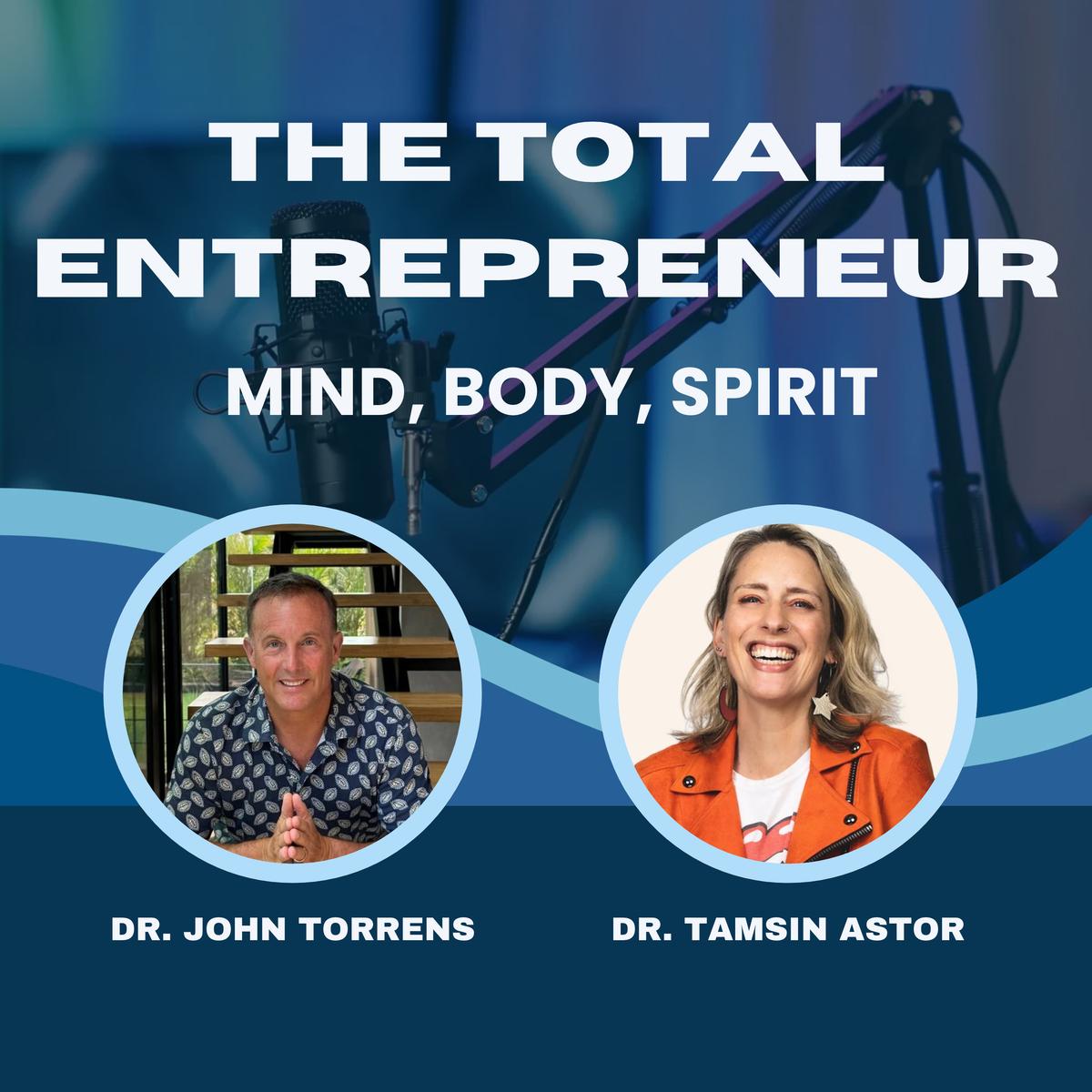
Conscious Leadership and Nervous System Regulation | Dr. Tamsin Astor
Nov 12, 2026 · 00:46:09
Part of our conversations on
I remember about 15 years ago, a friend of mine who was one of these sort of incredible researchers who was also a marathon runner, you know, her tagline was, I'll sleep when I'm dead. And I remember thinking, no, baby, no.
Dr. Aster, welcome to the podcast. Really great to have you here.
Thank you so much. I'm super excited.
Yeah. So I wanted to start by asking you about something I read in your manifesto. It says that you reject hustle culture that worships burnout. It's interesting because I'm guessing that a lot of the people tuning in now run on hustle. So talk to us about this.
So for me, that hustle culture becomes a habit, right? It becomes fuel. It's something that you have this thing of, I can't do unless there is pressure, right? And as somebody who was diagnosed with ADHD at 48, I physically, intellectually, emotionally understood that I need that deadline and how I had internalized that all my life too. Like that's how I get the term paper in is I need that deadline, right? So how do I create that in my own life? But when we constantly live in that state, we massively elevate our cortisol. And when we're living from a place of massively elevated cortisol, we don't function as well, right? Cortisol is actually a really useful hormone. For example, like it fights viruses, it fights— things that come into our body. But when we are living in a constant state of fight-flight or freeze-fawn, if you want to go into more of the trauma-informed literature, you are in an energy of constantly waiting for something to happen. And if you are going to step into conscious leadership and really lead from a place where you listen to others, you can incorporate other ideas, you're not kind of blinkered, right? You have to find ways of not stepping into that hustle culture. And it's not that I'm anti-hustle culture. You can tell I have quite a lot of energy and sort of spunk, but it's about whether it's coming from a more negative place and it's coming from this sort of massively dysregulated nervous system where you're always just about to tip over. Because tipping over into aligned action, into kind of righteous, useful rage and anger that creates awareness, reflection, and change is great. But a lot of the time that sort of hustle energy creates pressure and a lack of connection with other. And we move from a place of reactivity. We don't listen. We don't listen to our body's needs. We lose our interoceptive awareness. We forget to sleep, we forget to eat, we forget to pee. We don't watch the face of the person in front of us. We bulldoze them. So that's a lot of where it comes from is that I'm really committed to leading from conscious leadership and leading and helping people step into the energy of really showing up and serving.
How much of this state that we're in, this sympathetic nervous system state, this fight or flight, I mean, I get that, you know, if you're built that way and you're hustling all the time, it's there. But it seems like lately there's just more environmental influence to keep us there, right? Like you said, it's very useful, but we're not meant to live, to live there. So I'd love your thoughts on that.
So I think one of the things that we've forgotten is to look at the wisdom of nature. Nature, we have seasons. You and I are recording this now beginning of November, so we are now, the clocks have changed, we're tipping into winter. And what does winter tell us? Winter in the Northern Hemisphere tells us to slow down, to go into the roots, to reseed, to not be in external outside action. So we're moving towards that energy now. In Ayurveda, which I'm trained in, we are in vata season, which is movement. The leaves are falling off the trees. So we're in the moment of transition and movement towards that slowing down. And you can look at it in many different theories, philosophical frameworks, right? Yoga, Hatha, Sun-Moon, right? The masculine and the feminine, not male-female, but masculine energy and feminine energy, active energy and passive energy, polarities. If we look at this sway and this movement and look at perhaps the work of Margaret Wheatley, Meg Wheatley, on living systems, if we lean into this idea that moving between between and transitions and giving ourselves space. It's within those spaces that allow us to see often, right? When we are in constant motion, when we're constantly filling our brain, when we're constantly responding, we're constantly reacting to our calendar, to the alerts, to the notices. I mean, when I was in college, so exciting, email began, but I was still walking to the library and getting the books out of the shelves and photocopying the journals. I couldn't just have it all pop up on my phone and integrate it. It's the slowing down that allows us to really listen from within.
Yeah, I forget where I was reading it. Maybe it was Arthur Brooks, but he was talking about the need, that opportunity or time to just do nothing where you're actually doing something. But to us, it maybe feels like we're not in that busyness state, but we're actually regenerating and thinking and planning and creating.
Yeah, yeah. I think there is something really interesting about feeling like we're not being productive, right? And how we define productivity in our society, right? If you look at a lot of the sort of cultural memes and norms, I remember about 15 years ago, a friend of mine who was one of these sort of incredible researchers who was also a marathon runner, her tagline was, I'll sleep when I'm dead. And I remember thinking, no, baby, no. You need to give yourself the space. And also, Some of the research we're starting to see, like walking in nature, when we look at the patterns of the leaves, when we hear the wind, when we watch the movement of the birds, when we watch the sun, that realigns us. We're human beings, not human doings, and we learn so much. But I remember when I first started really recognizing that those practices were part of my working day, and I started thinking about and putting journaling, meditating, walking on my calendar as this is part of my business day, and this is not stuff that I'm gonna squeeze into on either side, and it might not get done because family, kids, jobs, client emergencies, fill in the blank, takes up the space. I started really understanding the priority of how those things actually feed my ability to show up and serve and think. And one of the I have a wall of Post-its of quotes that inspire me when people say things. And one of them is, slow down to speed up. Sometimes we need to stop all of the inputs to kind of go, what do I really think? What do I really feel? What's most important right now?
Recovery is actually part of the work, right? Because you can't do anything for long enough, hard enough, fast enough, good enough unless you're recovered. So I think that's a great point.
Yeah.
Yeah. And being in nature, absolutely. There's plenty of research that suggests that just being out in nature is, I mean, for people like us, It's one of the best ways to tamp down some of the negative aspects of our ADHD symptoms for sure.
Yeah, absolutely, absolutely. And I find for me, living in Brooklyn, which is relatively high energy, is having places, having routes of walks laid out that I know this is a 10-minute, 20-minute, 30-minute, hour loop. So I then don't have to think about it. And so I can walk in a particular direction and I can slow down and I can go into the park and I can go through the leafy neighborhoods and not and not listen to music and not listen to podcasts on double speed, you know, to keep me engaged and keep me going and getting double information in and just walking and letting my mind wander and noticing and seeing. And I suddenly make all these amazing connections and I think of the people who can support me or who I can reach out to or I can help in the way that if I sit there and force it at the desk and go, I've gotta do it, it doesn't happen.
Yeah, I understand that for sure. So you talked about Ayurveda earlier. And so, you came from a neuroscience background, which is very rigorous in terms of the academic requirements and that sort of thing. Ayurveda, it doesn't seem to have that level of, I guess, Western rigor that we might expect. So, I was wondering if you could talk about that and maybe close the gap between what we might consider as scientific rigor in the West and what we know about Ayurveda and Why and how it works.
So a couple of things. So I came to Ayurveda because I became a yoga teacher and my middle child was diagnosed with cancer and I got extreme burnout. And all of the allopathic Western doctors couldn't find any root cause of my sleep disturbance, my hives, my food allergies, my insomnia. And they did all the tests, all the classic tests, and they all came back negative. And so they just started saying, we'll give you symptom-suppressing drugs or remove things from your diet. And I kept going, You're not giving me a consistent basis. You're not giving me a story here. You're just trying to stop what's coming out. And that didn't sit well with me. And so I went to Ayurveda because I was in the world of yoga. And the word Ayurveda comes from Ayushveda, which means the science of life. And a lot of it is about rituals and routines. And the kind of core methodology of it is to start by making your routines whole again, and then seeing whether you still have symptoms. So that really appeals. I was like, oh, I've spent 15 years waking up when the kid or the dog wakes me up, not waking up at the same time every day, right?
Yeah.
I sort of start my day in a state of reaction to whoever needs me first, right? And so I started getting up and going to bed at the same time. I started eating at the same time. I started meditating, like getting up earlier and meditating. I started eating food that was local to where I lived and local to the season. And I started doing a lot and my symptoms all went away. And I thought, huh. There's something really interesting about that. And so one of the things that I love about Ayurveda is it's a model of opposites. And so there are energies of fire and water and earth and wind, and it combines the physical and the mental. So for example, if you're struggling with insomnia, that's scattered energy, right? That's energy that is not coherent. So it's how can you make that weighted blanket, warm food, oil massage, right? The mind and the body are inherently part of it, which to me felt really useful. Yeah. given we live in this very disembodied state. The other thing that I really appreciate about yoga and Ayurveda and the sort of philosophical aspects around that are that in the West, it's 80% of people taking this medication get better. 40% of people have these side effects or these symptoms, which is how we do science, right? We look at what's the reaction time, what's the pupil dilation, what's the electroencephalography. That was the sort of things I was doing in my neuroscience. What does the But there is, in the history of neuroscience, the case studies. And that's one of the things that appealed to me about Ayurveda is it's very specific to the person, right? They look at you and rather than going, what does 90% of people, it's like, what is happening in you? Let's start with you, your mind, your body, your integration. And in the yogic and Ayurvedic philosophies of what does it mean to be well, The definition is completely different than in the West. In the West, to be healthy is an absence of disease, an absence of symptom. In the East, to be healthy and well means, are you seated in the self? Which is a completely different way of thinking about what it means to be a healthy human, right? They sort of describe, you've got the physical body, the mental body, the energetic body. And when people kind of go, eh, I say, have you ever walked into a room— and felt somebody's emotion before they've opened their mouth or you've seen them? Yes, we can all say, I felt somebody's anger, sadness, joy, right? That's their energy body, their pranamaya kosha, right? So for me, a lot of what I started understanding and reading and practicing and finding out in Ayurveda and yogic philosophy was that it was things that modern science was starting to back up, right? So one of the examples was, you know, A lot of Ayurvedic prescriptions are food-based. We now know that the majority of serotonin is in our gut, right? So this practice of 6,000 years who's been saying, when you're feeling things like, what's going into your body?
Yeah.
Who are you talking to? What are the emotions you're feeling? What food are you putting into your system? Are you eating in your car at the traffic lights or are you sitting in a calm environment? And, you know, right? And all of these things. So for me, there was a real like, oh my goodness, these people for 6,000 years have been talking about these things and modern science is now starting to back it up. So that was how I connected the dots.
Yeah. I mean, like you said, it's a 1,000-year-old body of work and knowledge that now we're just being able to apply our modern methods to, I guess, validate. So that's helpful.
Well, and I think as well, for me, a part of it is I had to let go of my ego of like—
Of being a neuroscientist. Right, right.
And if there isn't data, then can it be true? Right? So I mean, if I'm a great reader of biographies, autobiographies, and memoirs, and I read up a lot on people like Dr. Lister, who Listerine is named after, who was one of the people who first really figured out bacteria, right? And there are always people all around the world, Florence Nightingale, and so who were all going, there's something there that we can't see. And the people who kind of moved it forward noticed that women giving birth at home died at a lower rate than women giving birth in hospitals in the 1600s, 1700s. And what they realized was that the women giving birth in hospitals were being touched by surgeons who'd come from cutting up dead bodies without washing their hands or their instruments. Now we all go, ew. But a couple of hundred years ago, people were like sent, literally went insane and were sent to like the madhouse and were like pushed out of society for suggesting that something that you couldn't see could cause this experience, right? And so part of me goes, there's a lot of the brain we don't know. So I'm sure there's a lot of things out there that we don't know yet just because we haven't got the data and the study of it right now doesn't mean that it's not true.
Yeah, no, I appreciate you saying that because, because I agree. I mean, yes, there is absolutely room for evidence-based, uh, you know, medicine and that kind of thing. But also, yeah, it's worth it to honor and respect these traditions, philosophies, and knowledge bases that have existed for thousands of years. So, so I understand why you would pursue Ayurveda for yourself, but But now you're a practitioner, right? So not only did you go to an Ayurvedic practitioner to kind of get yourself under control, something in you said, you know what, I want to practice that. So I'm wondering if that's part of your ADHD, that's just how you're built, or what made you do that? Because a lot of people might be like, hey, good for me. I'm healthy now because of Ayurveda. I'm going to recommend it to all my friends. But you said, you know what, I'm doing this.
So I think there's a couple of things, and I love that question. And I think it is now a recognition of the way I learn and the way my brain is. But I've got 10 or 12 certifications. And it's not really that I care about having the letters after my name. It's that when I discover something that makes sense to me and helps me, one is I want other people to experience it. And so whenever, as I do my work as a coach, as a facilitator, as a speaker, as an MC, I don't really subscribe to just one methodology. I go, ooh, this one, and I'm going to pull this one in here and pull this one in here. But for me to be able to do that, I need to understand it completely. And for me to understand something completely, watching videos or experiencing it myself alone is not enough. I need to be in a container where I have to watch and read and write and think and explain and teach and be examined. So for me to really embody in a full way and understand the impact and power of these things, I need to be in a learning container that's not just, here's a portal, log in, do your videos. I need to be in a place where people are going, what did that mean to you, Tamsin? How did you apply it? What's your essay? Answer the question, right? Hearing other people's experiences of it. So that's, for me, it's the desire to share things and make people's lives better and help people because I'm really driven by this desire to help leaders lead from a sense of integration and from a wholeness from within and without. And for me, the only way to really do that is to do the certifications, which is why I'm doing another one, right?
Yeah, no, I, I, that is one thing I really admire and appreciate about you is just that, that dedication to lifelong learning and, and taking all of these different things and just wrapping them up into what you do. I think that is, is really cool. So yeah, it's great. So I want to talk a little bit about your ADHD diagnosis, if you don't mind. So you said you came to that fairly, uh, recently or later in your life.
Yeah.
What led up to it? What was going on beforehand? And did the diagnosis really changed.
Yes. So I have 3 children who all have ADHD, which, ding, ding, ding, we know that's genetic, right? Yeah, I got 2, same thing. Right? But it was during COVID I was, you know, I did a lot of listening to podcasts because I wasn't able to travel in the same way. And I listened to a podcast that gave us a very crude description of the masculine and the feminine experience of ADHD. And they said, boys and men tend to, A, have much more of the physical symptoms, the kind of classic model of the ADHD boy who can't sit still in school. And the girls tend to have more of the interior scattered energy. So I was like, oh yeah, that. And then the next bit was that boys tend to go, what's wrong with the world? Right? They didn't go, I'm broken. Whereas women and girls tend to go, I'm broken. What's wrong with me? And for me it was like, All my life when I felt like I didn't fit in, I felt like I didn't understand, I felt like everybody else around me was getting it, it was never they're wrong, it was always what's wrong with me? What do I need to do to fit in? And I think I'd sort of talked myself out of it in many ways because I have a doctorate and multiple certifications and A-grade students. And it was like, you're supposed to be the kid that fails out of school. And I was like, well, and so then I started to look back and go, Oh, but I went to school where we sat in alphabetical order. My last name's Astor. I sat right in front of the teacher, right? I went to a school of all girls in uniforms with a lot of structure, which created that sort of expectation of doing the things and following the rules, right? And I grew up in a home where I was encouraged to have a voice and an opinion and to be an activist and to think about who I was and showed up in the world. So I grew up in a home where there was a lot of love, but intellectual stimulation, which helped Give me a voice. So when I started to hear this thing about the negative self-talk, I thought, oh, bollocks. And this was during COVID So when I called up, I'd done enough research to know that to get a real diagnosis, you want to be doing it over 2 to 3 days of testing so that fatigue doesn't create a false positive. So I found a place. I had to call them once a week for 9 months to get on the list to get tested. I got tested and I'd never had an IQ test and I'd never had any, and I came out with an incredibly high IQ and very similar IQ profile as my kids. So very verbal, very like verbal in the 140s. And then some of my things were around 118, 120. We know 100 is average. And I said to him, like, to explain that gap. And he said, well, the reason you feel bad at this is because this stuff you find really easy that's in the 140s, but the stuff that's in the 120s, you're above average, but because you don't find it it as easy. You feel— and then I said to him, how have I got to 48? I'm now 50. And not known? And he said, high IQ is a protective. And my whole life and my business has been about trying to create habits and structures to help me get through. And I think for me, it was perimenopause. It was when you stop having the protective nature of the estrogen and the progesterone, which are very good at mediating a lot of the the effects of brain fog and disorganization. So that was the diagnosis. So the second stage was huge grief, so much grief about the relationships that I had contributed negatively to because of rejection sensitivity dysphoria, which is this feeling like when somebody doesn't reply to a text, you're like, you hate me. What did I do wrong, right? Like this sort of emotion dysregulation, cognitive, the sort of executive dysfunction of like forgetting things, not remembering things, getting confused about things. So there was a huge amount of grief. And then I decided to hire an ADHD coach to start to tackle some of my core symptoms and understand which of my symptoms were negatively impacting my personal life and my professional life. One of them was time blindness. I'm one of those classic people that's like, oh, I've got 10 minutes. I can walk the dog, brush my teeth, empty the dishwasher before I leave the house. Like, no, you can't. So she had me brutally time out all these things so that I could be— That was one example. The second thing I did was really think about how I organized my space. So for example, my bathroom, I'd always organized by category. like teeth, hair, face, whatever. And as I dug in more to the symptoms and how to sort of daily, weekly, monthly travel. So now I have like a shelf of all the things I do every day, right? So it's like toothbrush, deodorant, face wash, right? Every day. Like I don't put a face mask on or use a razor every day. So that goes to the weekly, right? And so it's like, oh, now I can see. And I don't have 94 boxes of Tampax and no toothpaste because they're in a cupboard and I can't see them, right? object permanence, right? You have to see it. And if I don't see it, it doesn't exist, right? So I started to make these changes. And then I also started making those changes in my business too. And one of the things I realized was that the cold reach out massively triggered my RSD. So when I would go with those models of going, hey, I saw you're looking for speakers, or, hey, and then you don't hear, and then you send a second email. And then I would do it and I'd get in a burst of caffeinated energy and then I would just just hide for like 2 weeks because I felt like I was a failure, that what I was offering, the services I was offering were wrong, that everything— and I would shut down. And so I was like, okay, Soph, what can I do that feels good? I love having conversations with people. Get on more podcasts. Launch my own podcast. I launched my own podcast. And my own podcast in its second season was in the top 0.4% of business management podcasts. podcasts, which is like, okay, I'm getting into something here. But that to me felt like a way of marketing that was so aligned with who I am as a human. I want to give people tools and service and help, and I love having conversations, right? So it was this slow roll and then talking to a psychiatrist and a therapist. So a therapist around the feelings of RSD, the feelings of shame, the what happens when I feel really dysregulated, the how do I figure out— because for me, the most important aspect of relationships is not when you inadvertently get hurt or hurt somebody, but that you really lean into thoughtful, kind repair. And for me, repair is one of the most fundamental pieces of a relationship, right? And then medication. And I had this conversation because I've always been very leery about using medication in any way in my life and not becoming reliant. And the psychiatrist said to me, I said, what would feel like it was working? And she said, the way you describe your brain and your life is you've got 64 tabs open. If I've prescribed you a medication and you'll go, oh, there's 8, and I know which one to do first, as in you don't have that kind of procrastination task paralysis piece that is so huge with ADHD, she said, that's when you know it works. And on the first day I took a medication and that happened, I like, is that what normal people feel like? They know which is the thing to do first?
Yeah.
Right? Because there's a lot of juicy, awesome aspects of the hyperfocus and the incredibly intuitive connecting the dots piece and all of that piece that I love and my ability to feel people and resonate and connect. Love all those aspects of ADHD, but the I've been sitting here for 2 hours and I've done nothing because I've got an appointment in 40 minutes and I can't figure out which is the thing that I can do and how long it's going to take me and I have to leave the house to get to the dentist. Right? So yeah.
No, I definitely relate to that. And yeah, so there was a lot there. So did you feel like the medication was taking anything away from you? Because like normally people would say, hey, try to manage everything else first, right? So you were into, you were doing the nervous system regulation, it sounds like I mean, the Ayurveda was helping you and you went to the medication, you felt the benefit. Did you feel like any of the side effects were unintended or unwanted?
Yeah, so I mean, it's interesting that, so again, being somebody who's very leery about becoming reliant, one of the things that I started to do was I kept doses low and I didn't use it every day. And I started to try and notice what were the bits of my life and business that were the hardest and where would it make most sense to take the medication to use for those? those. So for example, what we're doing now, I don't need to be medicated because this is my sweet spot. I'm like, let's have idea sex. Let's talk about things and have a conversation. And it's amazing, right? Get me to sit down and do invoicing and batch content and look at my calendar and go, on this date, I'm giving a keynote. This date, I'm facilitating. What are the things I need to create? Where I've got to be doing that, that is a moment where taking a medication really helps, right? In my home, having somebody coming over for dinner, having people come into my house, my kids coming back from college, the pressure of their arrival will motivate me into action of sorting out my house, getting everything tidy, right? Putting away laundry. I spent 15 years, every 3 months, rearranging my closet because I was like, clearly I have a problem with how I'm storing my clothes, which is why I'm not putting them away. way. And I'd be like, let me do it by fabric. Let me do it by color. Let me do it by texture. Let me organize all my t-shirts for band t-shirts and then university t-shirts. And I was like, there must be a better system, right? No, it's just there isn't enough dopamine. It's boring, right? Yeah. So it was like, how can I— my psychiatrist said, don't just use your medication for work. Use it to help you Pay and filing bills, another one. I would wait until I had 6 months of bills up on the table, and then I'd be like, all right, make a massive pot of coffee, put on a movie, and try and break my way through this. Right? So it's a learning experience. And for me, I try to only take medication a couple of days a week because of that, and then notice What I can do instead to support me. For example, how stuff like I'll watch a movie with adverts, and when there's the advert, in each ad break, I'll give myself a task. Unload the dishwasher. Can I beat the clock of getting back to the sofa before the movie, before the advert break?
The urgency thing. Yeah.
Exactly. So it's how can I gamify it? Can I fold all my t-shirts up before this song finishes?
Yeah. So how did your experience as an adult getting diagnosed with ADHD change or I guess influence how you handled your kids' diagnoses?
So I think one of the things that's really interesting about sort of mental health diagnoses is that you can't see them. And when you can't see them as a society, I mean, we've gotten a lot better in the last sort of 15, 20 years of talking about mental health. I think COVID was really helpful for that, whether it's things like ADHD or anxiety or depression or ASD or anything. One of the things that I noticed as a parent when one of my kids was diagnosed with ADHD and one of my kids had cancer and watching the two of them in a store and watching people's reactions to them. So my kid with ADHD, classic little blonde, blue-eyed, bouncing off every wall, incredibly verbal little human. And the people are like, you know. My other kid, hair's all fallen out of his head, massive bags under his eyes, lost 30% of his body weight, clearly incredibly physically sick. When he's having a meltdown at the counter at Target, people go, oh, poor baby. Right? So I had this visceral experience in my kid's life of watching people judge my parenting based on the presentation of how my kids showed up. Yeah. So for me, I've been navigating that for 20 years. And so one of the things that's been really interesting is one of my kids, as I've been working through the manifestation of the symptoms and how I can handle them, when I say to them, oh my God, I've reorganized my bathroom cupboard and it's life-changing because I don't find myself with 20 bottles of shampoo and no toothpaste and whatever, goes, oh, that's really cool, Mom. The other one goes, Mom, I don't need any help from you. So I generally try and share and say, I've found this to be helpful. One of my kids spent years working with somebody to support them in understanding and creating structure and working with the short-term working memory and doing a lot of the weekly, daily practices because they were diagnosed young enough, and we were in a healthcare system in Ohio that really supported that. One of my kids has got incredibly strong willpower and has played with medications on and off, and is now in a place of trying to create the external structures to support them. Mhm. And then another one of my kids is working with an ADHD coach/therapist. But the coaching aspect— so to me, the difference between the coaching and the therapist is, is useful for the emotions and the processing and the grief. The coaching is helpful to be like, go do the thing. Like, what happens if you put like a pink label on your physics homework, right? And you put it there on your desk. Are you more likely to get it done, right? What happens if you train yourself to put your keys on a hook by the back door so that you're not trying to leave the house thinking, was I wearing that jacket or this jacket? Did I put it down in the bathroom because I ran in to pee? Did I Did I leave it next to the dog leash? Because I went with the dog, right? All those ways. And they're working with it in a different way. So for me, the way I have always parented is I'm here and available. I will give you and support you financially with resources that will help you understand yourself, will help you see people who can support you, whether it's family, therapists, I've said that to my kids all along. Anything that I can do to help you with that, I'm here and available and involve me as much as you want. So for them, I very much am there for them and I try to show up in a way that works in their— because they're all very different in the way that each of them needs. Of
course. Yeah. Well, so I want to turn our attention back to this idea of recovery and even repair as you call it. And You argued, again, back to your manifesto, that nervous system regulation is an ethical issue, right? And that's a pretty strong claim. And I actually disagree. I mean, no, I agree with you. Sorry. Let me start that again. I actually agree with that. Yeah. So why does a leader's regulation become an ethical issue? And why is it everybody else's business?
Because it's not personal. I think for many years we've had this idea that what's going on inside somebody is what's going on inside them. But the more we are doing research and looking at, so for example, HeartMath, right? The heart sends more information to the brain than the brain sends to the heart. And I remember reading that and going, no, no, no, no, honey, this must be wrong. The brain is the powerhouse. Right, it's the boss. Yeah, right? No, the heart sends more information. to the brain. We know from the HeartMath research that the electromagnetic field from the heart expands out and affects other people, right? We also know what it's like to be in relationships with people who are toxic, abusive, narcissistic, whatever, fill in the blank. And we know how our bodies respond to that. What to me is really interesting is I went to see Adam Grant new book launch vibe a few weeks ago, and Malcolm Gladwell interviewed him. Talk about some fun. I was like, oh, I miss being in a university. Right. The academic wrangling. But Malcolm said to him, what is one thing in your book that you answer that people make a mistake about in our culture? And he said, we have a lot of language around toxic people and how we need to have no contact and boundaries. And Adam Grant said, actually, the data on ambivalent people is much more important. Ambivalent people actually create much more of a spike in your blood pressure and much more of a heart rate variability. So when your heart rate is very unreliable and very sort of scattered, that's a sign that you are in a state of fight-flight, that you are not integrated, that you're not present, that you're moving into a state of reactivity or you are in a state of reactivity or fight-flight. And so, that has had me really thinking a lot in the last few weeks about the people in my life, the relationship where one minute they're leaning in and they're there and they're, how can I support you? And then the next time they're cold or dismissive and how incredibly destabilizing that is. Because when somebody's toxic and always mean, you can brace yourself. You're like, okay, I know. Right? And so, for me, the sort of ethical sort of quote, I don't really like moral, but the sort of aspect around it that to me is really important as a leaders, when you are going into a space, you are impacting people, right? Conscious leadership, conscious, aware leadership, influence, and impact. So if you are going into a space and you don't have any awareness of your interior experience, you don't have any modification, control, practice in, wow, I'm coming into this space feeling angry, I'm really anxious. And it maybe have nothing to do with the people in the room. It may be that you were carved up in traffic. It may be that your partner just told them that they're leaving you. It may be that you just had to put your mother or your grandparent into a home. It may be that your best friend just called you from another country and said, I've been diagnosed with cancer. That's going to impact what's going on inside you. And if you then go into a space and go into a place of leadership without either acknowledging that or addressing that in some way by working on your own regulation, you're going to impact how the people in the room move through the world and do their work. So that for me is why it's an ethical issue. issue is that even if you want to and think that you are keeping your energy, your nervous system, your emotions private, other people, even if they're not aware of it, can feel it. And that impacts their ability to do their work. And one of the most beautiful examples I read of that is Vishen Lakhiani, who wrote the book, The Buddha and the Badass. And he started Mindvalley, this huge learning platform and he started it with no venture capital, which is a sort of unique position to be in. And he's had a very interesting journey of being a monk and being a meditator and teaching. And when he was married, he was running his company and I think he was in Estonia at that point. One of his employees came in and said, what have I done wrong? Everything I'm saying in the last 3 days, I feel like like it's not landing right, or that it's making you annoyed, or it's confusing? And he looked at her and he went, my wife just miscarried. And he'd been holding it together and going into the office and not telling anybody, but everybody in the office was going like, why? Why? And he had this realization that people were feeling that, right? And people deserve to know. They don't necessarily need to know the intimacies of it, but they deserve to know that you are dysregulated. And if you can't figure out how to get regulated again because there's too much pain going on, that's okay. But that for me is why, is because you create this massive ripple. And when you create those massive ripples, people are not cohesive as a team. And the reason I think many of us work together in an organization is because we care about the values and the vision and the mission of what we're trying to achieve and create.
Yeah. So what you're feeding the field is important. And I think that's, you know, for anybody building a company, running a company, building a community, it's really important to know that you are feeding the field whether you're aware of it or not. Like, like you said, you can just walk into the room and feel the vibe. So if, yeah, if you're in a leadership position, that's kind of imperative for you to understand that you are affecting people even if you're not saying a word, right? Or even if your facial expression is neutral, what's coming from your heart center 3 meters out is not neutral. Yeah. Yeah.
Yeah.
All right. So I want to talk about your book for a little bit. Um, so in your book, you, you have a chapter dedicated to the shoulds. And, and I thought, and I liked that because, you know, I, I should on myself a lot. I think a lot of people should on each other. So, so why are the shoulds such very weak fuel source for change? And what else is wrong?
So, you know, I think that— so firstly, I mean, I love anything that has a sort of vague humorous element that we can get into, sort of scatological or like teenage humor. So like that to me is very like— I'm like, oh yes, don't shit on it. I mean, because I think a lot of the time we need some humor when we're dealing with these sort of very charged emotional things, right? So, you know, I think the thing about shoulds is it has an element of lack of thought about why you should do it, right? According to whom? According to what? And I think for many of us, we move through the world because of our, or in reference to, or defined by our roles, or our gender, or our trainings, or our degrees, or our religion, or where we live in the world. There are so many things that I remember when I first started my business and I was doing social media and I said shit on one of my— and this white guy in my community who'd been sort of having a conversation with me about coming in to do some facilitation work was like, you can't say shit on social media. And I was like, but why not?
Right.
I've heard you say it to me. Why can't I say it on the— So it's like, where is it coming from? So for me, it's really about the curiosity, right? So as a motivator, you can look at Gretchen Rubin's, what motivates you? Are you intrinsically, externally? What motivates you into action, right? Is it somebody else? Is it me? Am I a rebel, right? All of those, the quadrants, right? And I think for some of us, that should energy like we were talking about earlier with the ADHD, it helps us to take action. But the question is whether that action is really serving a bigger good, a greater need, or you're doing it because you've never really thought about it, you've never really questioned it. So for me, a lot of the shoulds is, am I just acting because that's what's been expected of me historically, right? Is I should wear a skirt, I should wear lipstick? I should say yes, I should say no, right? And what is the model, the framework, the thinking? And I think for me, the sort of issue of resentment comes up a lot, right? Sort of then the expectations around that. And when you look at long-term relationships, you know, ones where people are degrading each other and humiliating each other and talking about each other in a sort of derogatory, negative way, those are the relationships that generally don't survive, right? The relationships where things go wrong, but people lean into each other and find a way of connecting are the relationships that do tend to have a longer shelf life and tend to move towards long-term sort of survival. I don't really like survival, long-term thriving. But I think that should is a sort of false motivator, I think, is what I feel about it. And I feel like a lot of the last sort of 10 years around, as we've started as a society to do a lot more thinking and reflecting about kind of deconstructing homophobia and racism and transphobia, or like so many things in a much more public cultural way. It's not that we haven't been doing that, but that activism hasn't existed. But I think as a culture, there's been much more of a swing in the the last 10 years towards really facing our colonialism in a much deeper way. And we haven't got there yet, but the ruptures are starting to happen. And I think should is a big part of that. It's like, what should we be?
Yeah. Yeah. So it's not just internal, right? This is what I should be doing. It's also almost setting up expectations that are just based in nothing, I guess. Like, you should do this, they should do that, we as a group should do something. So yeah, I think that's a good point. Yeah. So one of the things I like to promise for my audience is that they can leave with something actionable, right? So
do
you have a, I guess, a habit or a practice that somebody listening or tuning in could start tomorrow that would just kind of help them either regulate better, show up better, or just be a better version of themselves?
So the practice that I do every day myself and that I do with my clients is pause, notice, choose. So when you're feeling the should energy, you're feeling a rise in emotion, you're feeling that step towards, you're feeling resistance, you're feeling yourself saying yes to something that you actually think you want to say no to. When you're having one of those, pause, take a breath, work on a little bit of regulation. The pause could be literally like, I'm going to inhale and exhale, or it could be, I'm going to put that email into the draft folder. I'm going to go to sleep. So however long you can make that pause, right? Notice. What's coming up? Am I feeling angry? Am I feeling sad? Am I feeling resentment? What am I feeling? Am I feeling it in my belly? Am I feeling it in my throat? Am I feeling my shoulders? Start to notice. Am I feeling pressure from somebody else? Am I feeling that deadline that's not mine, that they're trying to push me into saying yes or no to something? Notice, right? Get a sense of the field. And then make a choice that is in alignment with you, your values, what you care about in the world. Because the more you can, we can, one can act in alignment with what we say and we think and we feel, and we create that alignment, that integrity, integer, whole. The more we are whole, the more we create self-trust. And the more we create that alignment and self-trust, the more the people around us feel that and trust that and will pay attention to that. And that then shifts the energy, right? So pause, notice, and choose.
That is a great one. Thank you for that. If people are interested in learning more about you and your work, where do they find you?
My website, tamsinasta.com. I'm on LinkedIn a lot and on my podcast, Hot Habits with Dr. Tamsin.
Amazing. Well, Dr. Tamsin, I really appreciate your time. I— this was a great conversation. Thank you so much.
Thank you for having me, Dr. John, and I will see you soon.
About This Episode
Neuroscientist, Ayurvedic practitioner, and executive coach Dr. Tamsin Astor joins Dr. John Torrens to unpack why hustle culture worships burnout, and how high-performing founders can replace chronic cortisol spikes with sustainable, conscious leadership.
Drawing from her late-in-life ADHD diagnosis at age 48, her PhD in cognitive neuroscience, and ancient Ayurvedic principles, Dr. Astor explains how nervous system dysregulation sabotages decision-making, team cohesion, and physical health.
Listeners will discover practical frameworks for executive functioning, overcoming rejection sensitivity dysphoria (RSD), and why regulating your emotional state is an ethical responsibility for every entrepreneur.
What comes up
- •The Catalyst: Rejecting Hustle Culture & Chronic Cortisol - Dr. Astor breaks down how relying on deadline-driven urgency traps entrepreneurs in a constant fight-or-flight state, eroding interoceptive awareness and sabotaging active listening.
- •Body and Nature: Seasonal Alignment & Strategic Recovery - Why recovery is an essential part of the workday, and how scheduling nature walks, journaling, and seasonal rhythms restores cognitive clarity and mitigates ADHD symptoms.
- •Bridging Neuroscience and Ayurveda for Founder Burnout: How Dr. Astor healed severe physical burnout by integrating Western scientific rigor with Ayurvedic daily routines, circadian alignment, and gut-brain health.
- •Mind: Navigating a Late-in-Life ADHD Diagnosis & RSD - Dr. Astor shares the grief, relief, and tactical shifts following her diagnosis at 48, including gamifying mundane tasks, designing for object permanence, and using targeted medication.
- •Spirit and Ethics: Why Nervous System Regulation Is a Leadership Duty - Exploring HeartMath research and Adam Grant’s findings on emotional ambivalence, Dr. Astor explains how a leader’s unspoken internal state ripples through an entire organization.
- •Escaping the "Shoulds" with the Pause-Notice-Choose Framework: How to dismantle external expectations and reactivity using a daily three-step alignment habit that builds self-trust and integrity.
Keep listening
More on Mind
About the Host
John M. Torrens, Ph.D.
5× Inc. 5000 entrepreneur, Professor at Syracuse University's Whitman School of Management, author of Lightning in a Bottle, and TEDx speaker on ADHD as an entrepreneur's superpower.
Browse all podcast guests →Book a strategy call →