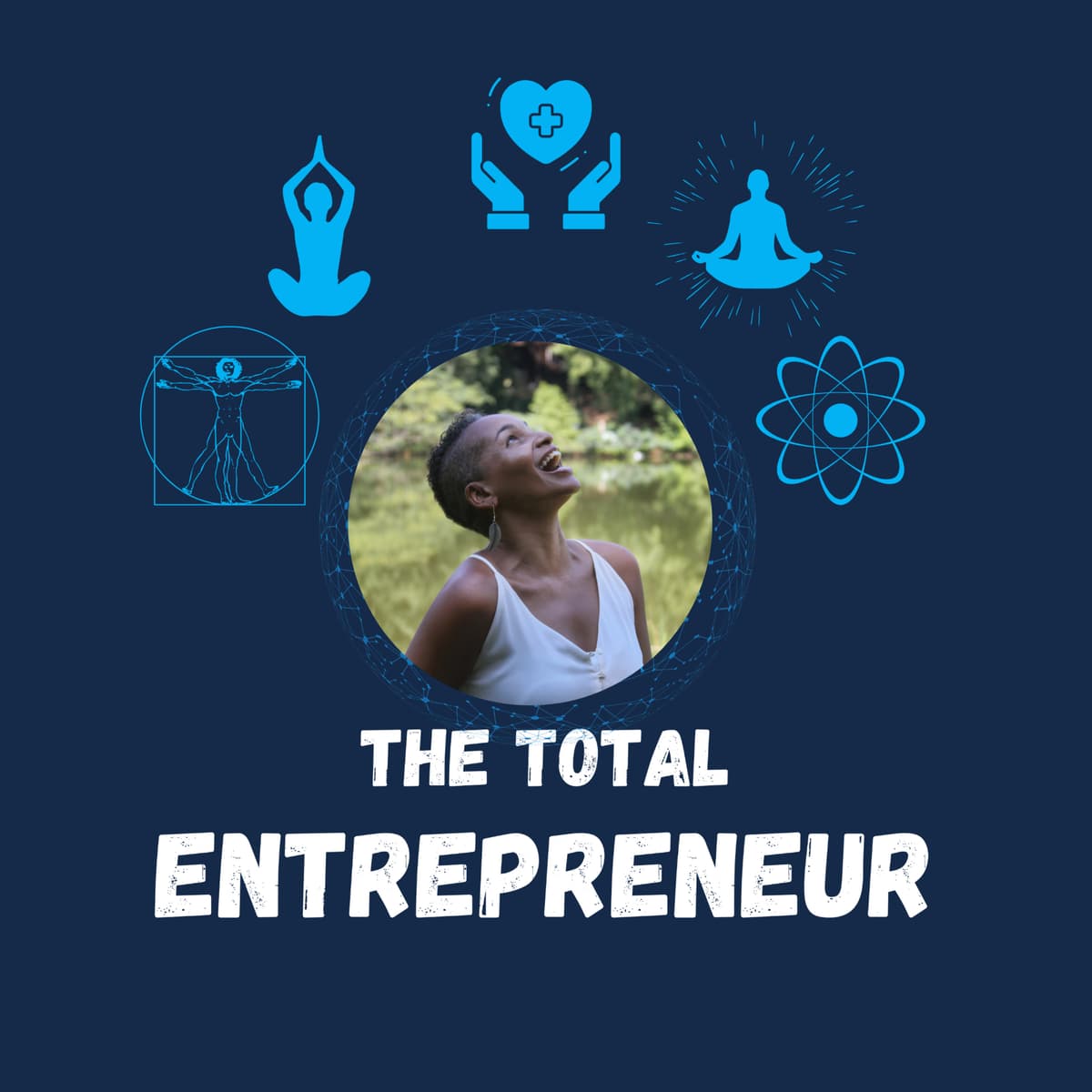
Leading with Joy and Redefining Success with Dr. Jax Black
with Joy and Redefining Success with Dr. Jax Black
Dec 4, 2025 · 00:55:44
Part of our conversations on
Hey everybody, welcome back to The Total Entrepreneur Mind, Body, Spirit. Today's guest is Dr. Jax Black, and besides having probably the coolest name I've ever heard, she also brings a tremendous amount of energy. We talk about elite athletics, finding your joy versus living in fear, how we can do that in an entrepreneurial setting, and so much more. So I hope you listen into this episode and enjoy it. And if you hear anything that resonated with you or that you like, Please subscribe, give us a like, and engage on our various platforms. Thank you so much. Enjoy the episode. Welcome to The Total Entrepreneur Mind, Body, Spirit, where we turn cutting-edge science into practical strategies for entrepreneurs. I'm your host, Dr. John Torrance, Entrepreneur Inc. 5000 honoree and professor of entrepreneurial practice at Syracuse University's Whitman School of Management. Each episode, we dive into mental, physical, and Spiritual health with expert guests offering actionable insights to help you thrive and perform at your highest level. Let's get started. Dr. Jax Black, welcome to the podcast. Wonderful to have you.
Thank you so much. Lovely to be here.
Well, why don't we start by having you just tell us a little bit about your background and your journey?
Yeah, so that's always an interesting question for me, as I once had somebody here in Charlotte ask me, where are you from? I said, the universe.
Mm-hmm.
Oh, depends on what age you want to start at. But I will say, um, I'm an intuitive psychologist as well as a studied one. Um, I was a high jumper for most of my life, in fact the shortest collegiate high jumper in the country. Um, and I only share that at the age of 51 at this point because I'm not going over any more high jump bars. But I say it to say that, listen, I had to learn how to jump over my own head since the 7th grade. And what that taught me about life, what that taught me about self-love, what that taught me about leadership, what that taught me about the potential for others to realize that they can fly too, was everything of how we came into joy for myself, but how we came into joy for my partner, Big Joy Theory, everything that we're still doing today. That's the quickest way I can get through my introduction. And I feel like I was just born this way, and I'm just here to carry this message through for myself, for my family, community, and others.
How did you choose the high jump as your event?
Like I would choose that. I have no idea. So I didn't choose it. That's part of my— I couldn't figure out when I was in gymnastics how to stay on the ground. So it was time to learn how to do a back handspring. I kept doing back tuck, back tuck, back tuck, back tuck. And I mean, I did like 50 and 60 back tucks. And, you know, when you're that age, and I was like the only African American at this very sort of elite community, very European, Pan American School, and I was still internalizing everything as a little bit negative. And so I was like, I can't do a back handspring, not to realize I could really do back tucks. So it was my gym teacher, Mr. Irv Mitchell, who I'm now back in touch with these days, who was my saving grace. And he said, why don't you try the high jump? Who knew that Mr. Mitchell was one of the top athletic coaches for track and field for young girls and women in the entire state of Ohio? I just didn't know. So he was my gym teacher, and I got started high jumping in Great.
Oh, that's, that's a great story, you know, just because of the way you got to it. And yeah, it's always good to recognize the people that played a big part in our development, right? Like your coach.
Absolutely. I couldn't have done it without him. He saw me in a way that I didn't know was possible quite yet. And it really opened up this entire journey for me.
Well, thanks for sharing that.
Yeah.
So let's move on to your— the work you're doing now. I had some time to spend with your website and really, really love what you're doing. So, let's talk first about Big Joy Theory. What is that? What does it mean? And I know you have a process that you use when you work with people. So, maybe just take us through that.
Absolutely. So, Big Joy is all about realizing that we're born for joy and not for deficits. Most of the leaders, most of the souls, most of the amazing people we work with have been taught somewhere in their journey that they're going to have to perform some version of perfection that I never figured out. I don't know if you figured it out. I didn't figure it out. So I'm like, what are we doing here? I had the wonderful opportunity to work with people at every level of organizations. Nobody had figured this thing out. And everybody was suffering as a result. And not only were they still stuck in that performance, but also they had no way out. In other words, I actually want to stop. I want to go do the thing I love doing, the thing I think I'm awesome at. But it's not on my job description. I want to go do that thing, but I can't because I don't know if I can make money at it because somebody, some teacher, some aunt, some uncle, whatever, told them that they couldn't do these things when they were young and that if they did, that they'd never make money at it. So I'm like, well, that sucks. That's not a very fun way to live. So in our model, of course, going back to the high jump, being the shortest high jumper, I exceeded all expectations that anybody had of me. And I never thought, well, I'm too short to jump. It never dawned on me, I'm too short. I'm like, I already did it. I did it last time, and I'm certainly going to do it again and to my heart's content. Whenever it is done for me, it's done for me. And I really realized coming out of undergrad that a lot of people had not had that opportunity to shine. So when it came time to performance in life, performance at a particular job, even job transitions, starting companies, when it came to really getting into the what they wanted to do with their life, everybody went back to that place of like, hmm, well, the thing I really want to do, somebody told me I couldn't make money at. And again, that sucks. So joy is just way more fun. It says you are who you are because you know how to love yourself. Our definition of joy is your heart smiling back at you being you. When you look at life that way, then there's all sorts of other performance measures that come online, that come on board. So yes, I was a high-performing athlete, but nobody else knew that I had joy drawing. I had joy just being in community. I had joy just hanging out with my cousins. None of that counted in the corporate models of success, which meant none of it was going to count towards me understanding who I wanted to become next. So actually, I probably would have just started my own company coming out of undergrad. But at that time, I'm 51, so that's kind of in the '90s. It wasn't really accessible then. And I already thought, well, I'm already doing all these other things, and I needed security, that notion of security. that comes with money, that comes with an established career. And that is really not my jam. I go into corporate America, I come out of it, and I realize, well, the CEO isn't happy, and I don't want to be like any of the senior VPs ever. So out of that, you go back to, well, who am I going to be? And I defaulted back to, well, I'm going to be everything and everyone I know how to be inside of myself through joy. So imagine you go back. I know you talk about your journey with ADHD, and a lot of the souls that we work with do have ADHD. Why? Because, yeah, it is their genius. That's just how their brain works. And why do we make that a problem for anybody? So we started doing strengths, StrengthsFinders, find your top 5 strengths. I am a maximizer. That's who I am and I've always been. And now I'm at the place where I'm a joy maximizer. So joy, the first part of it is understanding who you are through joy.
Mm-hmm.
Who are you through joy? What does that really mean? That means you're not your deficits and you're not your weaknesses. Just go back, count every breath So all the little things that I mentioned in my journey, hanging out over here, sometimes they say your best breath may not have been in the classroom. It may have been in the community. It may have been in your family. It may have been at soccer practice and you never became a soccer star, but that doesn't mean that that wasn't your best breath. So now you start to see that your understanding of who you've been becoming and who you've always been starts to reshape itself as you think about all these other lived experiences that you have that nobody counted. I had all these, like, experiences in the art room, right? And I never got to count them. I just flew by them. I got 3rd place in an art show. I didn't, like, go back and count that until I was 45.
Hmm.
Because nobody cared. It didn't matter. But I had a lot of joy in myself creating that. It really wasn't about the outcome, but creating that artistic piece. And I only got it back because I happened to be moving and I was going back through all my All my storage items and my boxes, and I found it again, right? So if we are who we are not because of all these deficits, but who we are because of joy, well then I've got a whole other story to tell. And the really important thing about that is a lot of people are stuck behind their trauma. And the way that we really look and access joy, even in the face of the deepest, darkest traumas that people are holding on to and hiding from, and that's why they have that mask in front of them. The reason why joy is so powerful is because really it illuminates that actually that trauma was not yours to hold. In other words, you didn't cause it. You didn't do that. Somebody brought that to your heart and to your soul. And when it comes to entrepreneurship in particular, that is key. That is critical. Because now I don't have to start a business from down here. I don't have to start it all the way down, holding on to that heaviness. I start a business up here. Releasing all that drama, trauma is something that's in front of me. It's not— it's somebody else's journey to overcome and heal that, and I can give that energy. I can give that dynamic back to them and remember that I am still worth everything of who I am and joy. So that's number 1. Number 2 is self-expression and joy, and that is just bringing your whole heart to everything you do so that such that you don't have to minimize it. So a lot of people perform boardroom energy. I mean, if we go to the boardroom, it's like, I'm in the boardroom. What does that mean? Who am I here? And I'm like, well, I'm going to be me everywhere. People are like, how do you do that? I'm like, I'm me everywhere. What are they asking me really? They're asking me, how are you not putting on the mask? How do you not feel compelled to do that? And I'm like, well, my masks were really too heavy. Right. So I come from a very dysfunctional family, X, Y, and Z on parental relationships. It was the '80s, right? So all the divorces, all the heaviness, all the weight. I was my parents' marriage counselor by the time I was 8, right? So I could go into that, but that's not really who I am, right? That's just what I had to do to survive. And so I know how to put down that mask because I put down that mask when I was 15. And I realized inside of myself, I don't need to be all those versions of myself for other people to find peace because I can't help them find peace without them choosing it inside of themselves. So my expression of joy is unapologetic. And I do tell people, you know, some days I wish I could do something about it, but really my energy is just this big. And I invite everybody to be whatever version of their energetic selves that they have available because that's really our brand. So we at Big Joy Theory invite people to create a joy brand. That's the highest, best version of themselves, their highest potential of who they are in joy. Brand yourself all the way up here. Invite yourself, allow yourself to smile at you becoming you. The third part of our motto, which is where it really falls into place, is you are not what you do, you are how you do it so well. And joy is just a much better way of doing that and way more fun. So once you go into joy, a lot of souls that we work with, they all of a sudden are like, oh my gosh, life is so much easier. I'm like, yeah, because you're not like going down the rabbit hole of deficits. How many hours a day were you spending there? They're like, 3 hours. I'm like, well, all that time comes back to you now. They can just breathe, trust themselves, and now they're just doing all the good shit they know how to do all day long, all day long. And the great thing about joy is once you understand this, then you understand joy is just an incredible pathway of growing, continuous growth. And it allows you to become you and you and even more you. So at the age of 50, 51, we launched a clothing business. We've got the best doggone swag business as joy guides that one can imagine. So these are some of our products back here that are always here. I'm not doing that just for our conversation.
Yeah.
But the point is, is this is how I am still growing. So everything, joy, it's like a fountain of youth. It says, I remember how I was growing when I was 3. I am still growing at 51, and I'm continuously curious about who I'm going to be at 65. And ain't that a great life?
That is a great life, and so well said. As you were talking, it— I started to think that the opposite of joy, or what's preventing us from feeling joy, which I do believe is our natural state, it's where we were meant to be, But it feels like, or it seems like fear is the thing that gets in the way, right? Fear of being judged, fear of failure, fear, whatever the fear is.
Yeah.
Does that resonate with you too?
It absolutely does. I mean, we just, we have like those smaller guidebooks. We just did one on From Fear to Joy because that's exactly right. But remember where we learned fear. So like, yes, we have innate fear of like tigers, but how did we have a fear of growth. Where do we pick that one up, right?
Or a fear of judgment.
A fear of judgment, a fear of success even. Well, those are all things that were taught. So then who taught it to us? And then usually you can go back and if you breathe in, you just take those breaths, you're doing breathwork. So you just breathe and you let that memory of who first taught me that come back to you and you'll go, it was Aunt Sus and Such. Oh, well, what was she talking about? Just keep breathing. Trust yourself. It'll come back. The fear of judgment came from Aunt Sus and Such was saying something negative about me, or I watched Aunt Sus and Such say something negative about someone else and I saw the impact on them. So all these memories of where we learned these things can be completely unpacked and then laid to rest. So again, you don't have to hold your fear of judgment as yours when often it's something you saw somebody else do or something somebody tried to give it to you, right, at some point. So people tried to give me fear of judgment. And I just remember at a very— on the playground, remember at a very young age just going like, what are you doing? And they're like, well, you such and such. And I'm like, I mean, yeah, but like, it's no big deal. Like, that's just me. And I was very confused why other people were wasting their time judging other people or trying to make somebody else feel bad for some very superficial and very illusory standard of what coolness was on the playground. I was like, this can't be the cool spot. So I'm pretty certain all these standards are nothing that I need to judge, like, my soul's journey against.
Right.
And once you sort of go back through all those things, because I know it's very real, some people were bullied. Well, what do you do, right? What do you do if that was the case? Or like, let's say you lived in a dysfunctional family and you saw one of your parents, unfortunately, be emotionally or physically abusive. What do you do with those very real experiences? Number one, of course, always therapy for your own journey and your own heart's relevance. But number 2, we can also realize that that wasn't actually your story.
Hmm.
So I laid my parents' story— I laid it to rest and I gave it back to them. And then I picked up and I was like, actually, that narrative is not my truth. And I haven't engaged in that at all. I've been doing these other things the whole time. And when I looked at my story, my story was much more clear and clean. And yes, people had maybe tried to get in my way, but they hadn't ever stopped me.
Hmm.
And so I started just leaning into that. And that's what's important about joy. It allows you to keep taking this data instead of something getting in your way and stopping you, bringing you down, and then going down the rabbit hole of deficits of everything that's gone wrong. You can continue to find the ways to breathe past that, assess more correctly, is this me or is this you? Or is this someone else? What is going on here? Is this society's anxiety? Because I don't have to internalize that either. And how do I keep moving past that in all of my decisions and all the ways that I show up and how I bring my best to what I do every day?
You mentioned fear of success a few minutes ago, and I'm interested in what that looks like because, because I get it. And I know that people often are afraid of their, the the biggest, best form of themselves, right? Because they just fear their power. So I was wondering if you can get into that a little bit more, because I think that might resonate with people who are on the verge of success but somehow keep managing not to get there.
Yeah, exactly. So great. Fear of success is really one of those things where it's not necessarily fear of the full outcome of I'm going to deliver my best itself, it is actually— and I sort of— if we look at success going this way, fear goes this way, struggle goes that way. It's not actually fearing the success in front of me. It's actually triggering the fear of failure behind me. So it's actually— you're still on the battlefield wondering if you can ever get off.
So it's still fear and it's still— yeah, it's based on, I guess, your own insecurities or mistaken beliefs or whatever it is that you've got. That's, that's keeping you from, from doing it.
That's right. A lot of people are trying to look forward and they're going, I want that success, but I've got a block here. What's the block? Well, the block is usually tethered back to something here that is still occurring. You release this, then you can turn back and you, you can trust yourself to be successful. So that fear, a lot of times we're taught that in order to become successful, there's going to be like some cliff in our soul. We're going to jump off the cliff. And that's really terrifying. So a lot of times I would say to souls, like, first of all, do you know there's no cliff?
Right.
There's no cliff in your soul. There's no high-performing athlete, right? If that's the example a lot of people understand as an athlete, there's no high-performing athlete who's running their fastest, jumping their highest, throwing their best right off of a cliff in their soul. No, no, no. There's no cliff. They have actually hit a zone of joy where they have whole body alignment. Right? That's that mind-body-spirit alignment. And they know how to move in that. And in that movement, it is like butter. It's so silky smooth. It's beautiful. It's free. It's clear. There's no blocks.
Yeah.
So we've just been taught a version of success that says we're going to have to walk outside of ourselves, become someone else, and we fear that. Well, I would fear that too.
Mm-hmm.
I've been taught, oh my goodness, in order to become successful, I'm going to have to become a version of myself I don't know if I can hold that or how long I can put that mask on. You know, and for a lot of people, it's like, oh damn, where's the mask?
Right.
Let me go get that one. And do I have it? And how much is it? Can I buy it? So nobody's asking for that in authentic success. Real success is you becoming a better you.
I was just going to mention that it almost feels like we need to redefine what success is because we've been programmed to think it's one thing. You know, it's all the normal trappings of society, right? A car, a house, a relationship, a job, the bag, the watch, whatever it is. But it seems like if you peel all that back, it's quite a bit simpler. And if you're able to tap into that joy, then it becomes a magnet, right? Once you feel joy, then that's really all you attract.
It's all you attract. And what's beautiful about what you're naming, number one, it is a completely different model and it's just super easy. Joy is you becoming a better you. Success is growth. Is your heart growing? That's the only thing I invite people to shift. It's like a— I call it a heart shift. Is your mind growing? Your mind can always take in all the knowledge. For sure, it's categorizing and cataloging all the things. Joy is, is your heart growing? So a lot of people struggle with the spirit in what we do. The spirit is your heart is activated in all that you do. Mind, body, spirit. I kind of would put it spirit, mind, body, because I think it's your heart that really can drive your brain into healthier ways of being.
Yeah. There's physiology to support that too. Yeah.
Exactly. Exactly. But we struggle with that in leadership. We struggle with that in entrepreneurship because we've got to take money from these investors. And the investors are coming with that corporate mindset. Mind, mind, mind. ROI, ROI, ROI. Right? And we kind of call it the JOI. I know it's a little corny, but I love it. And I do joy all day long. But the point is, I'm looking at a company. I'm not investing in a company unless I can see that heart smiling of that founder. Because when that heart smiles and that wisdom activates, now I want to see them at their best. I don't want to see them once I put pressure on them about a thing that's outside of them. I want to see who they are when they do what they do. That's a solid investment. The rest of it I can teach, right? So that gets to that different model. It's way easier. It's way cleaner. It is so much more fun to empower somebody in joy than to do a break-fix model of leadership.
And that's a great segue into your joy guidance that you provide. And what I find interesting about this is that it is backed up with some research. It's not just your opinion or what worked for you because you could have come into the world this way, right? Which sounds like you did. But now you've got a process that's research-backed that can assist other people and actually guide them along the way. So, I'd love for you to dig into that for us.
Yeah, absolutely. So listen, there's a lot of research in positive psychology that says focusing on what works best actually leads to higher levels of performance, right? But even as they say that, we use words like happyology mindset, we're using words like positivity, right? Those are very pop cultural terms. Those terms, although moving the sort of market in the right direction, don't at the end of the day land on Full, active, what is my data? So yes, we're talking about research outside of us. We could go find that. But I also want to call people in. Enjoy— you have your own data on when you were at your best. It's your data already. So that is the data that we activate, because then you've got 100 experiences of you being your best. And we already know that the model says this works and that this leads to higher levels of performance. But then, like you said, a lot of people would come up to me and they'd go, but you've got big energy, but you've got this going for you. How is that true for me? And I'm like, well, who said you couldn't? Who said you wouldn't? And so they would go, oh. And then they'd start breathing differently. We just leveraged a little cognitive dissonance there to create an opportunity. And I'd go, well, when's your best? When were you in joy? Not just your best, not your cognitive best, whole body joy best. When was that? And they go, oh my gosh, I had a student once. I had a student once, I asked that question, she started crying because she said, oh my God, nobody's asked me that in years.
Right?
People are not being asked, when was your heart whole? Right? So yes, the data outside of us in the research world, but also tap into your own. You've already proven that you love yourself. You've already proven that you can be the best self and the best side of you. You've already proven that you can be this version of who you are in joy. And again, if you go back to athletics, that's what you're seeing. That's what we love watching. That's what we love watching even in Hollywood, right? An actor in the perfect role, in the perfect scene, in the perfect movie, and we all know it. We all know that this was made for them. I just think that that storyline of this was made for them is true for everyone. There is something that everyone was made for, and that we are looking for that best experience that allows them to come through, and we all go, ah. There it is, right there. So it's a little bit of a different way of answering that question because in joy, it's so heart-centered. To be honest, John, it's so heart-centered that I've released some of the sort of traditional normative ways of looking at data in terms of quoting and citing all of it. But what I can tell you is hopefully everybody will now take a breath and look at their own data of who they are in joy. And realize they are more than who they are on their resume. They are more who they are. We know by degrees, we know that even academic performance does not lead to success in life. It's not even correlated. So what are we doing?
I'm using you for that.
Right? So what are we doing if that's— like, let's just look at those data points, those research-backed data points. If that is true, then what are we all doing marching to the beat of the same drum? It makes absolutely no cognitive sense to me, and it feels misaligned with my soul's knowingness that I have a right to be uniquely me. And what's really beautiful about that is once people realize that they are a part of this joyful evolution, they are a part of an interconnected universe, in joy, it allows you to realize everybody's a complementary component to one another. In other words, going back to where we first started, you do not have to perform perfection at all. Why? Because somebody else has got that part. You get your part, do your part the best you know how to do and love every ounce of it. John's got that, Jax has got this, and that's how we partner. So even networking and partnering, all those things are very different through joy. And you're right, when we're there, we attract all the right people because they'll see you so much more clearly. If we— and you can see, John, I am very, very an animated soul. So I'm going to do this even though we're on a podcast here. But a lot of people, they're hoping to be seen underneath the burden of everything around them. They're down here like, please see me. And it's like, no, no, no. You've got to shine that heart forward. You shine that heart forward, you stand up. you're in the embodiment of you, well, then it's really easy to go, oh, I see who I'm going to choose. Okay. Yeah. Hi, Jax. Hi. So it becomes so much easier and it's so much more vibrant and it's just a really lovely, fun way of moving through the world going, joy. Who's connecting with this frequency of joy? John's got a different frequency of joy. Who's connecting with that?
Hmm.
And then we can all stay curious about where all those connections take us. And how they, they guide us and lead us forward.
Yeah. Your energy is, is contagious and, and I love it. So if people are just going through their day-to-day, like almost sleepwalking through life with all the constraints and the veil that society's put on us, I would imagine it's hard for them to just peel all that back and find the joy or be able to observe it. So when somebody presents to you for the first time and you start working with them, how do you start breaking that stuff down and helping them see the joy that's already there for them?
I love that. I love even your energy as you came into asking that. Really, it starts with where we started our conversation today, as I say, hey, how you breathing? And their reaction response to that tells me where they're really at. And again, some people just start crying. And some people express like the exhaustion they have for carrying all the damn masks way too fucking long, if I can say it that way, because that's how they feel. They're like, and here I am, I've got my own company, right? It is being successful, and I'm still not free. And they're like, Matt, when am I going to get free? And so, yeah, we have very real conversations off the bat. And John, sometimes in the street, at festivals, like wherever, they're like, you know something. And I'm like, oh. What's going on? They're like, this thing. I want to get out of here. So we start with very real conversations naming the blocks, naming the traumas. And then we say, let's breathe past that. And here's what I'll offer your community of watchers. If you want to find yourself beyond that point of struggle, that weightedness, and that exhaustion, that frustration, you have to remember— Who you were before trauma ever was brought to your heart. It's the breath before the trauma. Now, if that's an elongated journey, that's what therapy's for. But energetically, you're still going to have to get back to the version of you before it cut off your breath. If you come back to this breath, Which you just breathe into it. Trust your heart and soul. You really just have to sort of push, breathe past the anxiety. Keep your soul elevated in the breath and focus there. The only thing I'll say is a whole body breath. So when I breathe, I breathe into the universe. I'm breathing all the way back to remembering I'm a star, right? So I'm not doing a— what I call a belly yoga breath. I'm breathing whole. Sometimes there's those activities where you breathe through your feet all the way up to like crown chakra energy. I'm breathing my entire body and beingness, and there in those breaths I go, oh, oh, I remember before X, Y, and Z happened, I was doing this and I was having a blast. So how did I get called in to this drama trauma way of feeling and thinking and experiencing the world around me. And that's really where all of the doubt settles in. That's where the shame blame settles in. Because a lot of times, John, people feel like trauma, it lands on your soul. And they think, I must have done something to get it here. And I'm like, oh, no, no, no, no. What was happening? And we unpack it. And usually, they were going on about their joyful evolution. Somebody saw their light, and somebody tried to take them out. They were like, no, here, I want you to feel this toxicity, this negativity, passing this burden on to you because I don't know what to do with it. But none of that is still them, right?
Mm-hmm.
So in these ways, we get back here. And that's where the work starts. So for some people, John, We do that, and they're like, within 3 sessions, they're like, yep, got it. Good. Thank you. And other times, other times, that's a year because a lot of female entrepreneurs are dealing with things like sexual assault. And that really impacts their capacity. And it's happening to all souls, right? But for female entrepreneurs in particular, it is really impacting their capacity to launch the company or to make the next big pivot. It always shows up there. We have to give her space to address that.
Mm.
And we have to get her back to the breath before it happened or back to the space of, like, you did try to tell people and no one listened. We have to give her her voice back so she can speak freely and clearly in her truth. So it gets down to very real things. things, or all sorts of intergenerational trauma, where intergenerational trauma, that means it's not yours. That means it was coming from the previous generation. That's a suit. Those are pants you can step out of and give it back and be like, and grace and gratitude, I love you, and no thank you. I've got to build a legacy here. And if you— and this is what I told my parents, John. If you want me to build a legacy, then I need you to let me do it. And I can't do it in your not breathing. I can't do it in your burden. I cannot build from deficit something that is a lasting impact and legacy for myself, for our family, for community. I cannot do it that way. Or if I'm going to do it that way and you want me to, you all are going to have to pay me a whole lot more money. Because that's going to come with health burdens and complications, and I'm going to need some insurance, right?
Yes.
I'm not going to do all that work for free the hardest way possible just because that makes the past generation comfortable. I'm going to do it the way I know we need to do it to get to the outcome of success that we all want, but nobody's been free to go to it without climbing out.
Yeah.
Climbing up the mountain in all those different ways.
Yeah, we've been programmed to believe it has to be a struggle, right? No pain, no gain. You gotta grind. You gotta sleep when you're dead. All these things, right? And nobody ever tells us that it can actually be easy and joyful if you choose that.
And if we can all choose it, acknowledging the struggle, because yes, sometimes it really is just too damn hard to choose it when you're younger and the weight of the world feels upon you. And the way that I— oh, go ahead, Jeff.
It's a real thing, right? I didn't mean to minimize that for anybody because, yes, struggles, absolutely. Everybody has them, right? But it doesn't have to be that way and it doesn't have to be that way for long. And you don't have to define your path that way either, I guess. No.
And that's right. That's right. You got it. I was just unpacking that for anybody who experienced it that way. That's right. So now that you've said that, the reality is, is still yet Regardless of whatever has happened to me, at the end of the day, this is my life and this is my journey. And I'm not necessarily here for your performance. I'm going to have to be on my deathbed looking back at me smiling whole. So I decided to say, well, like, let's not wait till my deathbed. Let's do that here. Let's make the assessment in this breath right here today. Right? And let's say, well, I get what you all are trying to do and the struggle you're trying to bring to me. And I've chosen I'm going to keep going in joy. I've decided to process that differently. I'm going to give you what's yours back. And I'm going to keep elevating into what I know is my best self because that's my accountability to me.
And that's a muscle.
That's what I'm going to do. It's a muscle.
It's a muscle. It's not easy at first. Probably the The book that changed it for me early on was The Power of Now by Eckhart Tolle. And you keep mentioning the breath and go back to that breath. And, you know, when you're, when you're in that struggle, it's usually because you're worried about something that's about to happen or you're stressed about something that did happen. But when you think about, hey, right now, like right now, I'm warm, I'm clothed, I'm not hungry, I'm not in danger. Actually, everything right now is fine. All that other stuff wait till later, you know?
No, it does. There is a presence of being that is in this space. I never say moment. I'm only saying it just to say that. I always say experience. Okay, so here's how we do it. The presence of now is whole body, mind, and spirit. So if I only go back presence of now in my brain, yes, that's good, but that's still only part of the data, speaking of data and research, right? That's only a small part of the data. The rest of the data is in my energy. The rest of the data was in my body. It's in my contextualized experience. Where was I? Who was I being? Who was I around? Was I even being myself, or was I impacted by somebody else's negativity, right? Was I reacting and responding? So we have to make certain as we unpack moments that we see the whole picture in the experience.
Yeah.
This is why this is important. I always say joy is more than a moment. It is a lifetime of possibilities. Why? Because you unpack the moment to realize there's not just one moment. What you were experiencing were a series of moments. And it just caught up and like all of a sudden in the moment, your breath was taken away.
Mm-hmm.
But come back to the experience and actually that was just a hiccup. Like somebody with negative energy just walked by and I went, oh. And I can now put moments, negative moments, I can put them into perspective. In other words, I am not just who I am in any moment. I was who I've always been when I was born. And my entire lived experience is my journey. And I'm interested and curious about who I'm becoming on that. So I'm not tracking any one job. I was never tracking any one high jump. Track me, right? I was not tracking any one— people, oh, she won. And people had all whatever experience about that since I was so short. And they would judge me for that, right? It was good. It was bad. It was this or that. And I was like, wow, I just wanted to see if my body could get over 6 feet. And I might try 6'2. Like, I just was leading with curiosity. And I wanted everyone— and I said to my colleague, one of my dearest friends, Linda Stock, Linda Steinacher now, but she said— we sat down and we said, look, we're not going to compete with one another. And I said, well, listen, I want you to win every track meet you ever have. I want you to win. She said, I want you to win. And that was it. That was the basis of our partnership. And I could call her right now, she'd say the same thing. Yeah.
Right?
And that's how we stop engaging in competition for the moment, for the win of this one thing. I don't want you to win the meet. I mean, I want you to grow. I want you to win at life.
Hmm.
And that's a whole other outcome. Who would you be, number one, if you were going to stop fighting to fight, to never fight again? Who would you be if you were going to stop fighting to struggle, to never struggle again? What would you do today to release all of it? Then the question becomes, who would you be to keep winning, to keep becoming a better you for the rest of your life?
Yeah. And it, it seems like, you know, just the, the athletic analogy, like you, you don't just show up and, and do a really good high jump, right? There's a lot you have to do before that. And maybe that isn't necessarily pleasant or pleasurable, but it's satisfying. So, There's this idea of, you know, we can do hard things and maybe not love the fact that we're doing those hard things, but we can be exceptionally satisfied after we do them because it brings us somewhere else. So the idea that the struggle is inherently good or bad, I guess, is maybe a faulty premise, right? It's, it's what is it teaching you or what's it there for? And I think that's what helps me, especially when I'm working with young entrepreneurs who are in the thick of it. where it feels like the world is gonna crumble around them. Right? It's like, you will get through this. And what is it teaching you along the way? Why did this show up for you in the first place? Okay.
Now, so I will say, John, that is my biggest bias. I love growing. I fucking love growing. It's just so much fun to me. So, yes, you were right. Not every soul loves thinking of growth in that way. Because a lot of people too have taken burdens struggle and challenge into growing, right? So what does it mean to grow if everything feels like it's coming at me by challenge? And I go, well, what if that's for your heart to grow? So that shifts it into like opportunity. So I approach all growth, and I mean heavy, hard growth, heavy, hard growth, I approach still yet as opportunity. Why not?
Why not?
I can— that's the part I can choose. I can choose to respond, and I'm just going to keep it real, John. I can respond to all the isms of the world, being an African American woman in her mid, you know, early 50s in this country, right? I can do that. But that will tell you nothing about me. And I don't think I'm going to learn anything more than what I already know if I approach things that way. What I'm going to do is realize that those hearts who are coming at me with all the isms, they're struggling to just love themselves. And my self-love, my joy, my move in this life is intimidating them. Okay, so they can— I wish you well on those journeys, right?
And that's a key learning for people, right? Like, until they realize that other people's actions say everything about them and nothing about you.
Nothing. Absolutely nothing. You'll learn nothing about me if I tell you all my woes about all the isms. You'll go, yep, yep. Now we could commiserate over That we might find some shared bonding. But here's the thing that I learned. It was in my 30s, and I finally was just like, I'm so tired of bonding in struggle. When are we going to bond in joy? So yet, if I bond with you in struggle, John, if I had told you all my struggles this entire time, you'd know nothing about me. You now probably know more about me just from me being like— oh, you're going to be like, first of all, she's got big energy. Second of all, she's already done all her joy. She's secure in it. She's going to deliver on it. She's going to move you in these ways because in whatever ways we've impacted each other through our joy and through our hearts and our smiles today, that'll be my story I carry forward. The rest of it is, and. And John did this. Right? So that puts me and my soul's becoming ahead of my resume. And that's what's really fun about joy. And that's— I love introducing people through their joy. Jax, that was the greatest introduction. I'm like, well, that's how I experience your heart. Grace and gratitude to you, right? But that's exactly it. When are we going to get connecting because I love myself, you're loving you? Well, hey, let's talk about what we can do more of because we love being who we are and what we want to do. I just think that that happens much easier through growth. And that's why joy is that growth frame as Joy Guides because I know I talk a lot. I know I'm a lot. John, listen, I want to make certain you understand that question of joy guidance. Joy guidance says, I hold space to ensure that you become the best version of who you're designed to be. Like, what is your spark of the universe? How does your star shine through your heart and soul? How do we ensure you become that today so you're not waiting at your deathbed still evaluating, did I do what I came to do?
So, so how do we translate this into leadership and business and entrepreneurship, right? Because I definitely understand how, you know, we just do it personally. But is there a translation there that is important and useful for entrepreneurs?
I believe so. I'm going to say it my way, John, and you hold me accountable to landing the plane because there are plenty of people who will tell you that Jack speaks big talk. So I will lay it out and let's land the plane. I think it's a model of authentic leadership. In other words, I don't think it's really productive to be an entrepreneur with your own spark, your own creation, and then try and lead by somebody else's design. That doesn't make any sense to me. We do not ask any athlete to do that. Oh, you're good at this? No, no, no. Go be like such-and-such over there. What? That's nonsense. That's insanity.
Such a good point.
Why do we do this to leaders? Yeah. Why do we do this to everyone else? The thing about being an athlete is it's It's such a privilege to be able to spend unapologetically X number of years, for however long you do it, right? So I had 15-plus years, 15 to 20 in total, to just spend figuring out like that sinking, that zone, that coming into mind, body, spirit in a way where I could hone it and deliver it, right? Get me on. Okay, I'm delivering it now, right? And I love that. Why does nobody else get to experience that? Why is education not teaching you to be a better you? Why are we saying you're failing the test, but actually your performance on that test allowed you to become a better you? I had a student I was teaching at DePaul University, and the student came back to me because I had given him like a B, B+ on a reflection question or something of that sort. And he said, I showed it to another professor and the professor said it sucked, that I shouldn't have gotten that, I should have gotten a C. And I said, except for the fact that that was 3 times better than your first one. I said, I understand, but you have grown immensely in this class and you deserve to be seen for that. And he just really sat back like, oh. Right. I'm like not tracking to performance. We're so competency-driven that we're missing the fact that that heart went from— if I put it in high jump terms, just because I know it— that soul went from jumping 5'4 to jumping 5'10 in 6 months. That's what I'm interested in because that's how I'm going to make a solid investment. And if I'm an entrepreneur, I want to remember that I did that in less than 6 months because guess why? That's what tells me I can do it again. So I'm going to get this company up and running, launching a clothing brand in 10 months.
Yeah.
You bet I am. And how can I trust it? Because I've already done it before. And I've done it before that. And I can come up with 3 times that I did the same thing. Now, when I say that and I pitch from there, the investment is clear. They're like, you know, the investment in Jax is, oh, she's done it and she's going to keep doing it. We're all clear. So that's where it hits the— what do they say? It hits the pavement, right? That's where the rubber really hits. is that if I'm pitching, my pitch is totally different. You're not— and I say this, and we know this about entrepreneurship, we know this about leadership— your investment might be yes in my company, but it better be about me.
Right.
You better understand the investment is in me and how I'm going to carry this forward. And if you're looking for that and you want to attract the right investors who can invest in you, that means you've got the right partnership. Now let's figure out what we're doing together.
Mm-hmm.
Right? But the how— the how is me and my team. The how is how we're going to deliver on this, right? And that's also what allows people to stay free from the worry and concern of the future of AI.
Mm-hmm. Yeah.
AI's got the what. Release. Let it go.
Joy.
Look everything up now. Now, why are you scared? Because you're not certain on how. You're not certain on how because you're not certain on who you are. So, let's figure that out. Then, let's bring your how. Let's bring your joy brand. Let's bring the how you do everything so well. Let's bring that to the world and you'll go, oh, I see. AI helps me in this way. Yeah.
So, professionally, you've got so much going on. But one other thing you do is you help entrepreneurs who have founded wellness companies exit those companies. And I'd love to hear a little bit more about that because as an entrepreneurship professor, we, we do so much to teach students about starting companies, we never really teach them how they get out. And I'd love to hear your take on this.
So, this is a new space for us that we've expanded into, but it's a natural one. And I don't want to sound like I'm repeating myself, but I want you to hear that at some level, we've talked about it. If you want to exit well, start well. It's that simple. So again, if I want to live well, if I were at the end of my life, I want to say I lived well, live well today, right? Start well. So it's the same cycle. And that's why it makes so much sense for us to be in this space and working with companies to say, hey, you've got your wellness brand, you've got your wellness company. Let's make certain, first of all, it's the best version of you showing up. That usually leads to an expansion of services by the way, if we're talking about sole proprietors and businesses and entrepreneurs and all those different things, usually it's an expansion of your service line. So it's revenue increasing to look at things that way. Then joy also, because it's refining and optimizing your best self, that's those internal efficiencies and productivities. So you actually get really good at this how, and that really impacts the what you're doing. And wellness that matters Critically, because we are actually delivering a service that is about healing. And so that's part of why we've gotten to joy being about healing leadership. Healing leadership. What if we led in a way— and I'll make certain I come back to some of the tangibilities of your question, John— but what if we're living and leading in a way in which we're offering healing energy to one another? My goodness, what would we do? All the things that we would do differently so that these companies, these organizations are no longer harming people, right? We're no longer making money off of fear. It kind of goes to Monsters, Inc., as my 5-year-old grandson is watching all the time. What if we no longer made money off of fear and we made money off of joy? So in wellness businesses, it becomes really critical. First of all, the space of brokerage is a lot of times very corporate mindset.
Sure.
Very kind of grimy, dirty, very kind of mobster-like, even some of the scams that are going on. So let's heal that. Let's give this wellness leader an opportunity to not just sell the business, buy a business and transfer it, but really, a lot of times we know Our businesses we create, those are our children. Those are our leadership children, right? So let's make certain that that baby gets on to the next best leader. So that's a connection that's got to happen mind, body, spirit. It's got to happen on all levels for that to work. It's less about the money; it is more about the rest and the peace that you'll have knowing that the company was transitioned to somebody who gets it, who maybe even. loves it as much as you do, right? It's all those types of alignments that need to happen and can carry forward in a way that just— it's like the best sort of— going back to a track analogy, but a baton pass.
Mm.
When it's really going and that person, oh, boom, and then they get that baton pass, it should be that seamless. So how do we bring joy to that so that it's not all head? Because all ahead can lead to, yes, a clean business deal, but not one that is sustainable always. So somebody could just decide, especially in this environment, everybody's looking for the next business they're going to buy. In this environment, okay, well, I just want to say I have a business. I got the money. I want the business X, Y, and Z. That's my corporate mindset speak. Forgive me.
Yeah.
So now I bought that, but actually I have no heart in it. And yeah, the original founder or owner stayed around for a few months, but I really wasn't listening because I had no heart in it. So all these things get off-kilter, and all of a sudden you've got a misalignment between an owner and a business 3 to 6 months out the gate. Now what are you going to do?
Right.
So that's where it always gets very real for people, is when we get down and into what it's even like as a customer to walk into that place, let's say it's actually got a retail space of whatever sort, now I'm engaging with that business, I'm like, what is this? It's already got an ick to it. It feels— something feels off here. If you've ever walked into a store and gone like, something feels off here.
Mm-hmm.
People go, oh, this— something feels off here. Well, it's not even supposed to be that person's business. That's what's off. So now we're in that space of helping people to make those best decisions. make them appropriately at the right time in their lives. And sometimes they're legacy transfers and deals that we also need to usher people through.
Amazing.
So, and we're doing it in a way, um, we're partnering with Unbroker, uh, in that model. And that's just a really solid partner for us, uh, because they're saying, hey, yeah, the corporate mindset way, it doesn't work over here either. So we're bringing the joy to that space and we're bringing the energy to that space to say, let's do it differently and let's pivot it and let's let the technology do what it does. And then let's let humans connect and do business well.
Well, that sounds like it's well needed. Yeah. So if, if people are interested in learning more about you and the work you're doing in the world, how can they find you?
BigJoyTheory.com, always on LinkedIn, Dr. Joy Jacks Black. InnerLit Studios is on IG. And you can always just send us an email, jax@bigjoytheory.com. And let's connect. Let's touch. Let's find a little joy.
Jax, thank you so much. This was, for me, a really fun conversation, and I hope the audience feels it as well. Thank you so much.
Thank you.
Thank you so much for listening to the Total Entrepreneur Mind Body Spirit podcast. If you liked what you heard or heard something interesting today, please give us a like, share a comment, or better yet, subscribe to the podcast. Thank you.
About This Episode
What if joy, not hustle, was the ultimate driver of success? In this episode, Dr. Jax Black, former high jumper turned intuitive psychologist and founder of Big Joy Theory, explores how leading with joy transforms the way we build businesses, lead teams, and define success.
She shares how embracing joy helps us move beyond fear, release old conditioning, and navigate transitions - whether it’s scaling a company or exiting one with heart and integrity. Dr. Black reminds us that joy isn’t a luxury; it’s a strategy for sustainable growth and authentic leadership.
A must-listen for founders ready to trade burnout for brilliance and build from a place of purpose and joy.
Episode Chapters:
00:00 - Introduction to Jax Black's Journey
03:59 - Understanding Big Joy Theory
07:04 - The Power of Joy in Overcoming Trauma
09:46 - Self-Expression and Authenticity
12:48 - Fear as a Barrier to Joy
15:49 - Redefining Success Through Joy
18:59 - Joy Guidance and Positive Psychology
21:48 - Connecting with Joy and Community
24:51 - Breathwork and Healing Trauma
27:39 - Empowering Others Through Joy
33:42 - The Burden of Struggle
36:35 - Choosing Joy Over Struggle
39:22 - The Power of Growth and Curiosity
44:14 - Authentic Leadership in Entrepreneurship
49:14 - Exiting Wellness Companies with Joy
54:14 - Bringing Joy to Business Transactions
55:28 – Outro
Keep listening
More on Business
About the Host
Dr. John M. Torrens
5× Inc. 5000 entrepreneur, Professor at Syracuse University's Whitman School of Management, author of Lightning in a Bottle, and TEDx speaker on ADHD as an entrepreneur's superpower.
Browse all podcast guests →Book a strategy call →