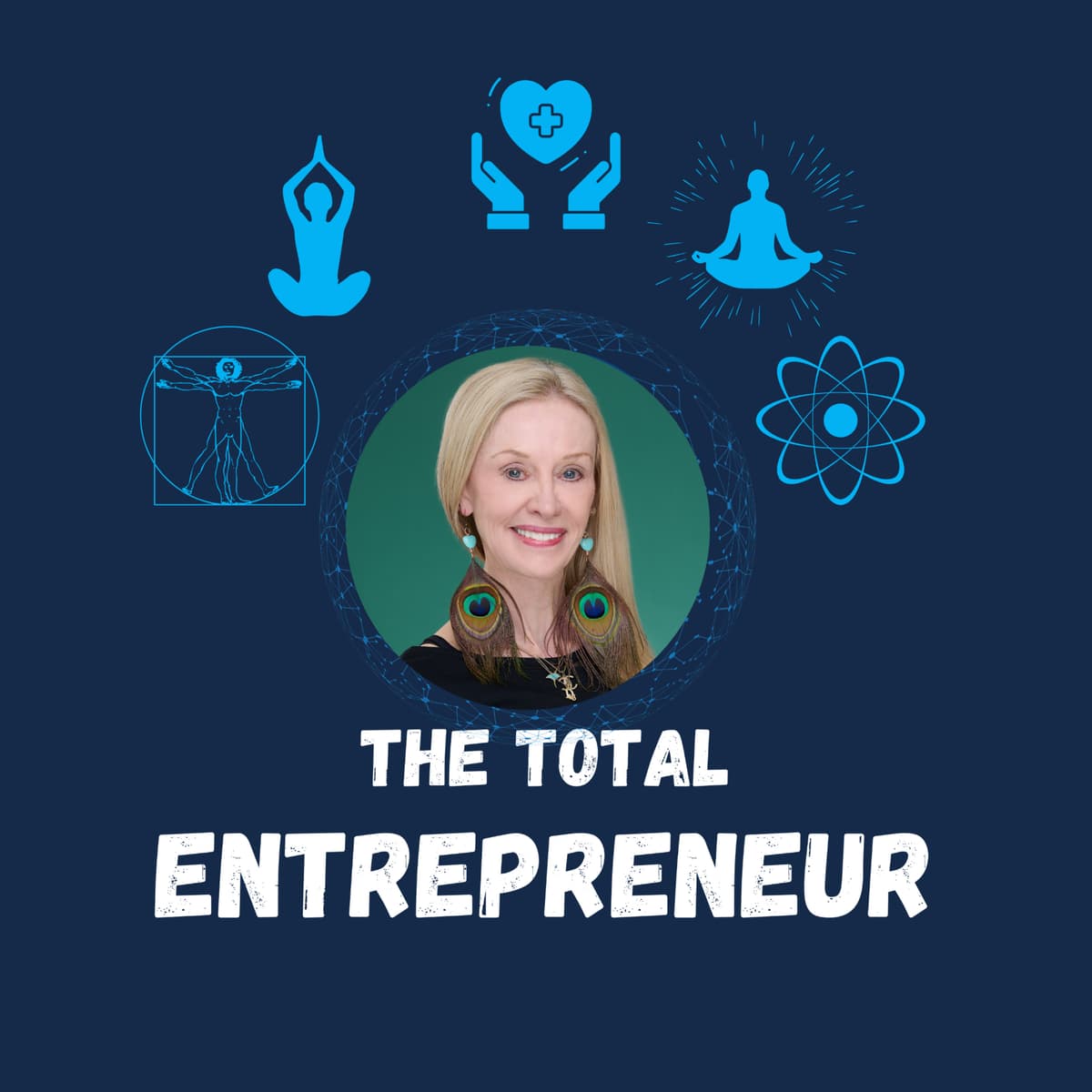
Proactive Health for Entrepreneurs with Dr. Lynn Anderson
with Dr. Lynn Anderson
May 23, 2025 · 00:33:33
Part of our conversations on
Today's guest is Dr. Lynn Anderson, who is a naturopath and yoga therapist who's authored multiple book series and has been published in major publications such as Reader's Digest, Shape, Self, Spry, the Chicago Times, Huffington Post, and Thrive Global, as well as Redbook. She was featured as one of the hottest fitness professionals over 50 in Spry magazine. She's made guest appearances on several shows, including CBS and NBC TV shows, cable, and podcasts. She's been a guest speaker at various conventions and venues, including Deepak Chopra Center and the Motion Picture Wellness Center. She's the creator and producer of Dr. Lynn's Anti-Aging Workouts for Every Body with international distribution. Welcome to The Total Entrepreneur Mind Body Spirit, where we turn cutting-edge science into practical strategies for entrepreneurs. I'm your host, Dr. John Torrance, Entrepreneur Inc. 5000 honoree and professor of entrepreneurial practice at Syracuse University's Whitman School of Management. Each episode, we dive into mental, physical, and spiritual health with expert guests offering actionable insights to help you thrive and perform at your highest level. Let's get started. Dr. Lynne, welcome. Great to have you here.
Oh, thank you for inviting me. Excited to be here today.
Yeah. Well, first question, just to set the stage, is tell us what a naturopath and a karma master is.
Well, a naturopath is actually a teacher. And what we teach is we teach the art of natural living or holistic living using the natural sciences. And it begins just with the foundation of nutrition and exercise and sleep. But I also was a master aromatherapist, I was a master herbalist, so we work with herbs, aromatherapy, color therapy, the environment, sound. So if you think in terms of natural sciences and how they affect us, That's really what a naturopath focuses on.
So yeah, it was interesting to hear you talk about sound too, because I think that's something that doesn't get a lot of publicity or something, but there's a lot to that. So yeah, talk to us a little bit about sound.
Sound, of course, we all know. I mean, if you go and you sit by a nice ocean and you listen to those nice waves, or you're in the forest and you listen to a nice breeze, it puts you— if you really sit and think with it physically and mentally, you go into a different place. If you live in a big city, I lived in Los Angeles for 30 years. And you've got that noise pollution coming at you all the time and you get home at the end of the day and you're like this just from all the traffic and the noise and everything that's going on. So we know that sound affects us. And another simple way to look at it is music. Music, different moods depending upon how you listen to music. So it's very important, really is.
Yeah. So you mentioned sleep, food, and exercise, right? Those are like the 3 pillars of a long and vibrant life, which I think is really important because you can get lost in all of the, the hype, right? So, yes, you must deal with this. Like, people must come to you and want, you know, the best hack or the shortcut or something like that, right? So, yeah, like, how do, how do you approach something like that?
Well, usually when, when clients would come to me, and you're right, right, it's like, Dr. Lynn, please take out your magic wand, tap me on the head, and boom, you know? And because we live in an instant society, you go to the doctor, the doctor writes you a prescription, you got a pill instant. But that's not holistic health. Holistic health is a lifelong thing. And I usually start by telling my clients that it's gonna take 120 days just to get to the point of starting and getting themselves on the right path. Because you can't eat healthy one day and then say, well, how come I didn't lose weight? How come I'm not healthy? It has to be a lifelong process.
Yeah. So, so 120 days, what's the significance for that? Well, like for example, I know like for me, metabolic health is something I have to keep track of, right? Mm-hmm. So my hemoglobin A1C, I keep track of that, but I know your red blood, your red blood cells take about 120 days to kind of regenerate and bind, you know, rebind to the glucose. So is that part of it or what, what else is significant about 120 days?
Yeah, that's, that's really a big part of it. And that's what I was gonna say. It takes about 120 days for the whole cellular thing to take place, but it also takes about 120 days for the mental thing to set in, you know, continually doing something. Because if you do something for 3 to 4 months, it now becomes a habit and that habit continues on. But if you do something for a week, it's sort of like, well, okay, and we quickly revert back to our old habits. We have to get rid of the old habits and establish new habits, and that's the way to do it.
Yeah, and it seems like getting rid of the old habits is just as hard, if not harder, than establishing the new ones, right? When it comes to like your sleep habits, Or alcohol consumption or what you're eating, right?
Right, absolutely. Because we are— I mean, think about it. I mean, habits, we don't really think about those things. We develop these habits and we just normally go about doing them and doing them, you know, eating the same kind of junk or drinking would be, you know, let's say you're consuming a lot of alcohol. It's very hard to pull that back and develop new habits which says maybe, oh, I'll only have a drink when I'm social. I won't drink. You know, those things are hard to change.
Yeah. Yeah. So, so in terms of the 3 pillars, we've got sleep, we've got movement and nutrition. Talk about the yoga of nutrition. I was checking that out on your website. It's a super interesting concept for me.
Yeah. Well, there's, there's many, many branches of yoga. And one of the branches of yoga is Annamaya Kosha. And Annamaya Kosha means pay attention to what you eat, what you take into your body. It's not vegetarian. It's not any specific diet. But what it teaches us is that what we take in, the nutrition we take in, affects us not just physically but mentally, and it also affects us soulfully. So if you're eating a clean diet and a healthy diet, and we all know that, I mean, that's basic science, we know that physically and mentally we feel so much better than if we're taking in a poor diet. So it really means to consciously be aware of everything that you're doing, everything you're taking into your body. And that includes the air you breathe, it includes what you drink, it includes the environment because we take that into our body, what we have in our environment.
Yeah. And it could even include what you wear, right?
Yes.
Like maybe the fabric or the material that's used to clean it. Is that right?
Absolutely. It can be that too. So, you know, it can be, you know, carpet. Carpet, you know, it's all synthetic, you know, and you're breathing that stuff in. So it's trying to keep your environment clean, keep yourself clean, and mainly keeping the internal environment clean. That's what it means.
Yeah, so give me some examples of that, right? Because I think a lot of people hear about, you know, clean eating and mindful eating and just kind of paying attention to that, but I think sometimes it's hard to hard to grasp for some people. So can you give us a couple of examples of what you mean by that?
Well, I think probably if we look at it, and I don't mean this, there's no politics here involved at all, but what RFK is doing is removing those additives and the dyes from our foods. That's what it means to consciously look at this stuff. Do you really want to put petroleum, eat petroleum? I mean, do you really want to eat that stuff? Eventually, if you put enough of that in there, it's got to stick somewhere. And it's gonna cause some kinds of problems. So really it's not about any specific diet. However, I will say most people will ask me, what would you suggest is the diet? And I always fall back on the Mediterranean diet. That is a good healthy diet if you look at it and you follow that diet. There's no junk food in there, there's no processed food. But unfortunately we live in a world that is full of Not just junk food, but processed food. Even our healthy food is processed.
Those UPFs, or ultra-processed foods, right? This, you know, maybe it's just because of my algorithms or what I read, but I'm getting all sorts of news feeds and pop-ups about UPFs. Interestingly, you could see it like some of the articles are actually saying, oh, UPFs aren't that bad, or here's a safe way to keep them in your diet. So it almost sounds like, you know, the food industry now is like getting on the bandwagon saying, hey, UPFs are actually okay.
Yeah, well, they're going to have to because you have to understand, you're going up against big dollars, big lobbying. And I've always said, and again, it's not meant to be political or anything, I've always said that RFK has the toughest job out there 'cause he's going up against Pepsi, he's going up against Coca-Cola, he's going up against these big, massive companies that have tons of money and tons of lobbying. going on. And, you know, they want us to keep consuming this stuff.
Yeah, it seems like a very unholy marriage between the food industry and the pharmaceutical industry and the medical complex, right? It's like, eat this stuff because it's cheap to produce and it'll make you sick, and then you have to take a pill.
Yeah, and we make money. We make lots of money.
Yeah, I mean, you know, I hate to think that that's true, but it kind of— it feels that way, right? So you have to be so careful and so mindful. I was actually reading an article the other day about, um, you know, you think you're getting fresh sashimi tuna in the Northeast US and it's like nice bright pink and it looks beautiful, only to come to find out that they're gassing it to keep it pink, right? Like when you get a fresh piece of tuna, it's actually brown. It's not pink.
Yeah.
But we need to see it as pink, right? So it cuts across everything. Even things that you think are super healthy, you've gotta be careful with, right? So do you have, do you have like, um, Tips, tricks, or signs, or what should people watch out for when they're shopping, or what types of things should they be looking at or looking for?
Well, in an ideal world, we would all eat natural, and natural doesn't mean that I pick up a package and it says all natural, because that's not natural. Natural means I go out and I pick the apple off the tree and I eat it. That is the only way food is natural. And so in an ideal world, we would eat that way, and what I suggest is that people eat as much fruits and vegetables and things that are naturally, rather than being processed, try to get your diet as much as you can in that way. If you eat a granola bar that's processed on top of eating a really healthy diet, it's not going to kill you.
Right.
And it's fine. We have to moderate, we have to find a balance, and we can't tip the scale on either way. You know, because sometimes people tip it the natural healthy way and they go to extremes. So there has to be that right balance in there.
Yeah, and it seems like some of the food items are sort of sneaky, right? Like a granola bar, you think, oh, it's granola, right? It's greens, it's mixed with a little honey, it's good. So are there other like things like that that are kind of sneaky that you might think are healthy for you but you really have to check on and balance?
Yogurt is an example. You know, you have to watch out for the processing of yogurt. That would be a good example of things that people eat. You know, any kind of like chips or things like, let's say I'm gonna eat carrot chips.
Uh-huh.
Okay, how are they making those carrot chips? You know, check into it. It isn't carrots you're eating. You know, there's very little carrots in most of those kinds of things. So again, it comes back and just being conscious Which is what Anna Mayakosha says, what is the most important thing in your life? It is your health. And what it— your body is your temple. And if you're not gonna take care of it, nobody else is. You know, you have to be responsible for that.
Yeah. And, you know, there's so much research about, you know, healthy entrepreneurs outperforming and, you know, having a better lifespan and generating more wealth and enjoying it into the future, right? So it's— It is important, right? It's not just like for vanity or it's not whatever, but I mean, there's a lot, there's a huge ROI to prioritizing this.
Absolutely. You have more energy, you have a different attitude. I mean, I, you know, I am not a junk food eater, but if I kind of deviate off from my diet a little bit, I can feel the difference. I can feel a lack of energy. And, you know, if you eat a lot of sugar and sweets, you can feel yourself hyper up or too much coffee. So it falls in with the naturopathic point of view, which is balance. Everything— and that is one of the most difficult things for human beings to do physically, mentally, and soulfully, is live a balanced life. It's very hard to do that. I mean, you can think just simply about balancing on one leg. It's difficult for most people to find and hold their balance.
So talking about aging and anti-aging, you talk about proactive aging versus anti-aging. So it seems like it requires a little bit of a mindset shift perhaps, but it must empower people differently to think of proactive aging versus anti-aging, right? Because you can't really stop it, but you can do it better.
Well, I was just going to say, there's no such thing as anti-aging. Whenever I do a lecture or teach my students, I always say, the minute you're born, you start aging. So that's a misnomer, anti-aging, you can't stop aging. aging, it happens. But it's the proactive approach, which is really what I teach, is like teaching my students how to get up and do things every day, which is being proactive to keep the body, to slow the process down, because we do know that we can slow the process down. However, we do need to throw genetics in there. There are genetic components too to the whole aging process. So there is no magic bullet. And anyone who is looking for that magic bullet is, you know, I mean, keep looking, but, you know, there's no magic bullet in life. And I've found that through all my years that, you know, there's no quick instant fix.
Right.
If there is, caution, use some caution.
Right. Yeah. I mean, but it seems like, you know, just kind of going back to the basics of getting a good night's sleep, moving your body and eating real food, right? You don't have to spend a lot of money. You don't have to add hours to your morning routine.
You just got to focus on a couple Yep, those 3 things they call the pillar of health. And those 3 things, if you can balance out and bring those 3 things together, you don't need supplements, you don't need all of this extra stuff out there. Those 3 things will keep you healthy and slow down the process.
Yeah. So, so I know you integrate Eastern and Western philosophies into your work. So talk about how you balance those, right? Because there, you know, there is There's people on both ends of the spectrum, right, who do one or the other. But there is a case for both, right? Like, if you, if you have trauma and a broken body, you definitely want Western medicine in the ER with you, right? But on the other hand, there's a lot of wisdom in Eastern medicine and Eastern philosophy that we've just kind of forgotten about in the Western cultures.
Right. I mean, in the ideal, the two marry each other. You know, you have that, that kind of marrying of holistic health, which I'll put it in that category, and regular medicine comes together, but that doesn't always happen. It kind of falls back to, and I can kind of flip into karma because karma—
That was my next question actually.
Yeah. I have been practicing, studying, writing, teaching, lecturing. I've been a professor on the subject of karma for 35 years. That's a long time. So a master is considered someone who practices, writes, and teaches. That's considered a master if you've done all of those things for a long amount of time. And karma is one of— is a real— people don't really understand what karma is. Karma is not good and bad.
Mm-hmm.
Good and bad is judgment. Karma means cause and effect, and it is void of judgment. So it's like whatever you do, there is an effect. That's the process of energy, and that's all we are is energy. That's all that exists is energy. And what you do with that energy is going to come back to you. So if you eat a healthy diet, it's gonna come back to you. That's what karma means. And it means to do the work to put yourself in that balanced and healthy place. When it comes to, you know, people get injured or something happens in their life, you'll hear people saying, oh my God, bad karma. Oh, how did this happen to me?
Right.
But what karma teaches us is that everything in our life that comes into our life is an opportunity. It's how you look at it. So yes, none of us want to go through trials and tribulations and tough times in our life, but that's part of being a human being. If you choose to come here, which karma says we choose to come here, as a human being, you are faced with vulnerabilities and you are faced with dealing with the chaos of life which is never gonna disappear. As I tell my students, there's no utopia.
Right.
There will always be war. There will always be famine. These things will always— people will lie, cheat, and steal. That's part of human life. Now, what do you do with that? Do you fall into the trap or do you observe it? And when someone comes and they do something to you, how do you react to that? And that's really how you create Karma.
Right. And, and that, and that's what I've read or kind of learned about as well. Right. So it's really, you can't control anybody else. The only thing you can control is your reaction to whatever's out there.
Exactly.
And that's gotta have an effect all throughout your body, right? So not only does your reaction send ripples out with a certain energy signature, right? But it must also send ripples internally. Is that right?
Absolutely. Well, that's stress, burnout. Come back to that. I mean, if you're out here and you're really stressed out here and you're allowing stress, it's going to— we know scientifically, we know what it does to the body.
Right.
You know, so any kind of vibrations or things you take in is going to affect your body. I'll give you an example that I use a lot because I think it's a good example. If I go out and I steal something, I'm a thief. There's no way about it, I'm a thief.
Right.
Now, whether I get caught or not, and let's say I never get caught, people would say, well, how does that figure in karma? For the rest of my life, I'm going to be looking over my shoulder. I'm going to be carrying that energy. You know, are you gonna find out that I'm a thief? Are you gonna find out that I stole something? You know, so when you interact with people, you carry that energy with you. And although it may not be up here, it finds its way into the cells of your body. Our cells hold the energy that we put into our body. So it's really about living, you know, consciously living your life how you want your life to be in a balanced place, hopefully.
And I think there's a big lesson there for entrepreneurs. I mean, for everybody, of course, right? But there's a special level of stress when you're starting a business and growing a business or exiting a business, right? And you could be tempted to do things that are maybe expedient, but possibly violate your ethical compass or something like that. So I think it's really important to keep that in mind and, you know, not choose the expedient path, but choose the path that's going to kind of be aligned with, with what we were just talking about in terms of karma.
Right. Because it will circle back around. And the thing is, it's good to have stress. Stress is really important.
Right, right.
I mean, we evolved having stress. Thank goodness we did because that saber-toothed tiger's coming down, you're going to get out of the way. So stress is what— stress allows us to get things done. We have deadlines, we meet deadlines, we do. So stress is not— it's not a horrible thing, it's part of life, but it's managing it and not allowing it to tip to that scale of burnout. Because once it tips to that scale, then usually there's physical, mental, and soulful collapse.
Yeah, because we weren't meant to live in a constant state of alertness or stress, right? I mean, it's there for a reason to save us when we need it, but then the rest of the time we should be avoiding that, right?
Right. But we live in a stressful society. You know, it's like, turn off the news. I mean, just turn the news on in the morning and within a few minutes your blood pressure's up.
Oh my.
No matter where you are on the spectrum, no matter what political whatever. It's always— so it's— and we live in a society today where people don't trust people. We don't trust even our institutions, our doctors and our government. And, you know, we don't have that trust, which, you know, when I grew up, you know, I grew up in the late '50s and early '60s, you know, that era. And I mean, you trusted everybody. Now, maybe we shouldn't have, But there was a different way. The government was okay and the doctors were good and we had a different way that we looked at the world. But today that's all eroded away and it's very hard for people.
Yeah. So you have a course called Burnout: It Happens to All of Us, right? So why do you believe burnout's become so pervasive? And it feels to me, because I deal with high performers a lot, it feels like especially among that cohort It's really pervasive, but I'd love your thoughts on how did we get to all this burnout?
Well, I think social media has a lot to do with it and the expectations that are on us today. I mean, we are expected to work, work, work and perform, perform, perform and compete, compete, compete. And if you take some time back, then you're considered you're not working hard enough.
Right.
We don't balance all of that out. And so, what happens is the difference between stress and burnout is stress is like having a whole bunch of balls and you're bouncing those balls, you keep them going, and you pretty much know that you can keep them going.
Right.
Burnout is when the balls fall on the floor and you can't pick them up. It's gone. And so, it's understanding when to kind of slow those balls down a little bit and maybe sometimes put them aside rather than let them fall and come back and regroup and take care of yourself physically, mentally, and soulfully.
Yeah, there seems to be a little bit more acceptance, especially among the younger people that I work with, of self-care in general, right? So they seem to be not so put off by the idea that, yeah, maybe I need a better night's sleep. They don't seem to drink as much as maybe my generation did, right? So it seems like there's a little more acceptance. about the idea that, hey, you gotta take care of yourself. So I'm very encouraged about that. But I was wondering, what are like maybe some, some early signs of burnout? Like if, you know, if you're, if you're a young entrepreneur, you're hustling away and you're doing your thing, what are the, what are the signs or what, what do you need to look out for?
Well, you're easily irritated.
Mm-hmm.
That's one of the things, you know, um, your decision-making starts to get really foggy. You know, I mean, we, as human beings, we are here to solve problems and make decisions. That's it. Every morning you make a decision to sling your feet out of the bed and get up. That's a decision. So we have problems. That's what we do as human beings. But it's harder. Those problems are harder to solve. The decisions are harder to make. Things get foggy in there and we start to doubt ourselves.
Hmm.
And when those things happen, you know, if you doubt yourself, let's use the ball analogy again. You're balancing on your You pretty much think, oh yeah, I can do this, I could do this. And the minute you turn your attention away and go, oh, I'm not sure if I can keep this going, boom.
Hmm.
So it's doubting ourselves too. I think those are the things that are kind of flags that come up and tell you, hey, maybe you need to slow this down a little bit, clear the mind, because the decisions you make and the problems that you solve, probably not gonna be done too well.
And so important. I mean, for everybody, but especially in a, in an entrepreneurial setting where you're making decisions daily that have long-lasting impacts, you're nurturing relationships that have long-lasting impacts. So, yeah. So, so you said you've been doing this for a long time. So what, what has changed in the field from when you started to now? I mean, because I could imagine it, it's been a massive change in just not only the science and the discoveries, but even just the, the vibe or the appreciation for what you do. So yeah, tell me about that.
Well, fortunately most of what I did, I was in Los Angeles, California. And that was very different 30 years ago when I went back there. California was a little more accepting still. I can tell you how many times I was called a quack. She's a quack. You know, she does hocus-pocus stuff out here.
Best way to discredit you, right?
Yeah. And yet what I spoke about was the science of nutrition, but nobody wanted to talk about the science of nutrition Because if I tell people, this is a nice healthy diet to eat, and I get people doing that, they can't monopolize that, the big companies. They can't make money off from that. That's why herbal medicine is not— if the pharmaceuticals could control herbal medicine, that's what we would be having is herbal medicine.
Right.
But they can't control that 'cause that's part of nature. So what I saw was that I mean, to me, it's like at this stage in my life, because I'm a lot older than most people at this stage, and I'm sort of going in and backing off somewhat, but I see a lot of younger people really more consciously working on taking care of their health.
Mm-hmm.
And it's not considered quackery anymore. And I'm so happy to see that because if we get right down to it, Your body, the only thing that heals, takes care of your body is good nutrition. There is not a drug on the market. They're all chemicals. They do not support the health of your body. It is a machine and it needs to be fed properly. And it's exciting to see people, you know, coming around to that.
Yeah. And these molecules and chemicals, they do one thing. And they do that one thing, I guess, reasonably well, but there's all sorts of other things that are either not happening or happening in addition to what you want to happen, right? So, it is a double-edged sword.
Yeah.
Yeah. How do you stay inspired and committed to doing this? I mean, like you said, you've been doing it for a while. You said you're older than most. You look amazing. You're probably your best advertisement for your work. So, how do you do it?
I'll share my. I'm 72. I still teach yoga every day. I also teach spin classes. I teach dance classes. I would. What I've done is it's a lifestyle, and that's what I tell when people come up to me and they go, "Dr. Lynn, you're in such great shape," and you're you know da da da da. And I'll say to them, "But I've been doing this my whole life. I didn't start last week." Yes. So you know because they can they'll compare themselves, and I say, "You you can't compare yourself to me. I've lived a different lifestyle." And don't compare yourself to anybody. Nobody should ever compare because we're all unique. But I learned at a very young age how to eat properly, how to take care of my body, and I developed a passion for what I do. I have a passion for teaching people and giving people this information. I have a passion for lighting up their life or being able to be a support system. It's a wonderful thing. If you find in your life, which is the most important thing, your passion, the thing that fills you every day, then you know you're on the right path. And I would say that that's probably where I've— what's kept me on this path is it's just a passion for what I do.
Yeah, and it's such a good point too that like, you know, you don't— you didn't just start doing what you're doing at 72 years old, right? This has been decades in the making. And, you know, I read something, I forget where it was or who I talked to, but they said, you know, kind of treat it like you're your 401 or your retirement account, right? You've got to start in your 20s or 30s in order to have it maximized by the time you're in your 70s or 80s, and your health and healthspan are similar.
Right. Well, I always projected, I always would sit down and say, well, okay, now I'm in my 50s, where do I want to be in my 60s? Where do I want to be in my 70s? Now it's like, where do I want to be in my 80s? And I see people in their 80s who are— I see people in their 70s that are old. old. And I'm like, I'm not old.
Right.
I still got a lot of kick going here. So, a lot of it is physical, yes. It's mental. It's genetics as well. But we can control a lot of that genetics. Only about 25% is genetics. The rest of it, we can have some control over. So, it's important It's hard to be able to just get up and you have to do the same thing. In yoga, we call it practice, practice, practice. When you think you've got it, keep on practicing.
Right.
You know, great athletes, they never stop practicing.
Never. Yeah.
You know, so get up every day and practice what you preach. Keep practicing it and practicing it.
Yeah, that's, that's such good advice. So if there's one thing that you could share with young entrepreneurs and just kind of get them— give them one nugget that they can keep in their heads and remember, what would it be?
Well, what I always say to people is your health is your wealth and it's the most important thing. Because let's say you got a business and you want to run that business and you want the business to be successful. That's wonderful. Go out there and fill your dreams. But if you don't have your health, it's never gonna happen. So we have to remember that the health is first and then what we do, because it takes a lot of energy mentally and physically to run a business, to be an entrepreneur. And it takes a lot of faith and belief in yourself. You gotta believe in yourself 'cause there's no boss there telling you what to do. You're the boss. And there are times when you won't have any money.
Oh yeah.
There'll be no money. And you'll think, oh my God, how am I gonna get through this? But, you know, if you're healthy, you'll always find a way to get through or to make it happen. And something will always happen. We are always taken care of if we have that positive attitude.
Yeah.
Yeah.
You're just, you're just more resilient and able to deal with what comes at you if you're, if you're focusing on your health.
Yeah, exactly. Exactly. And, you know, and don't take that for granted because, you know, Steve Jobs had all the money in the world. When he got sick, it didn't matter.
Yeah.
It didn't matter. He couldn't be saved. So, your health, if you take that back and you kind of use that as sort of like your bank account or your credit back here, it's like that's what's gonna push your business forward. It's not money that's gonna push it forward.
Right.
What pushes it forward is your energy, the energy you put into it and that Brings us all the way back to that's all we are is energy. So what you do with your energy is what's going to come around. So that's karma. What goes around comes around.
I love that. That is a— that's a great place to end it too, I think. But before we end, if people want to learn more about you and your work, where can they find you?
They can go to my website at drlynn.com, and it's spelled out D-O-C-T-O-R-L-Y-N-N.com. Everything's there. My blog, my social media handles, my classes, my consultation, all of that stuff is at drlynn.com.
Excellent. Thank you so much for sharing your experience and wisdom. That was amazing.
Thank you.
Thank you so much for listening to the Total Entrepreneur Mind Body Spirit Podcast. If you liked what you heard or heard something interesting today, please give us a like, share a comment, or better yet, subscribe to the podcast. Thank you.
About This Episode
In this episode Dr. John Torrens is joined by Dr. Lynn Anderson to discuss the realities of aging, emphasizing that while aging is inevitable, proactive measures can be taken to slow the process. Doctor Lynn is a Naturopath, yoga nutrition therapist, fitness professional, karma master, published author, international speaker and video producer with over 40 years’ experience in the field of natural health and fitness. In this conversation she stresses the significance of holistic health, nutrition, and the impact of stress and burnout on overall well-being. She introduces the concept of the 'Yoga of Nutrition' and discusses the importance of maintaining a balanced diet. The conversation concludes with insights on proactive aging versus anti-aging, underscoring the importance of health as a foundation for success in life and business.
Keep listening
More on Body
About the Host
Dr. John M. Torrens
5× Inc. 5000 entrepreneur, Professor at Syracuse University's Whitman School of Management, author of Lightning in a Bottle, and TEDx speaker on ADHD as an entrepreneur's superpower.
Browse all podcast guests →Book a strategy call →