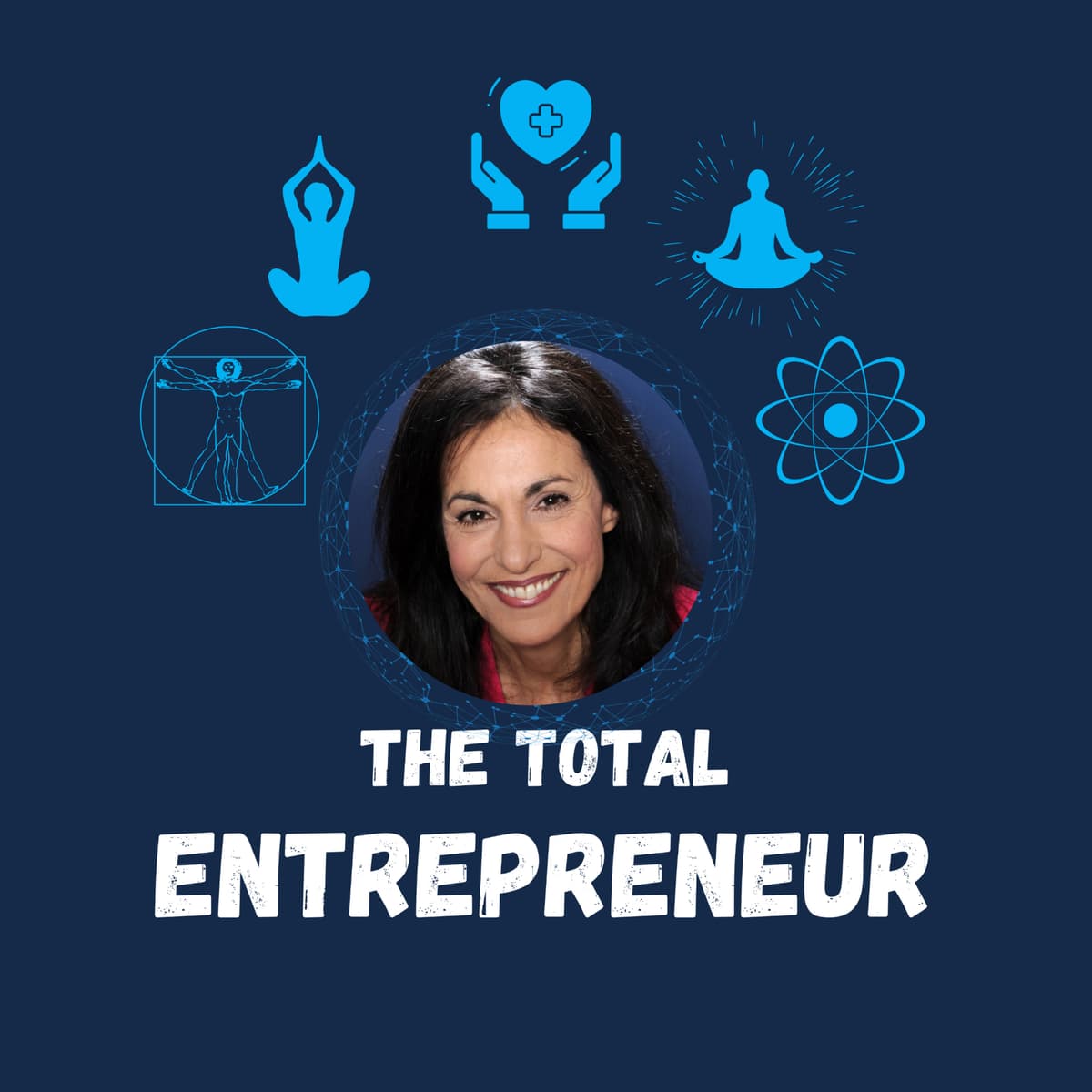
Leading with Heart: The Science of Coherence and Emotional Resilience with Dr. Deborah Rozman
with Dr. Deborah Rozman
Nov 20, 2025 · 00:48:38
Part of our conversations on
Today, we're joined by Dr. Deborah Roseman. She is the CEO of HeartMath Inc., which is the for-profit arm of the company that commercializes the science and technology developed by the HeartMath Institute. Deborah talks to us today about resilience, intuition, how to raise it at a personal, social, and global level. This is really near and dear to my heart, pun intended, because I am a HeartMath facilitator and I've seen firsthand how these techniques work. So I hope you love this conversation as much as I loved having it. And if this resonated with you and you'd like to hear more like it, please drop a like, subscribe, or send a comment. Thanks so much. Welcome to The Total Entrepreneur Mind, Body, Spirit, where we turn cutting-edge science into practical strategies for entrepreneurs. I'm your host, Dr. John Torrance, Entrepreneur Inc. 5000 honoree and professor of entrepreneurial practice at Syracuse University's Whitman School of Management. Each episode, we dive into mental, physical, and spiritual health with expert guests offering actionable insights to help you thrive and perform at your highest level. Let's get started. Dr. Roseman, welcome to the podcast. It is really great to have you. I'm looking forward to talking to you.
Thank you so much. I'm really happy to be here and to connect with people who are interested in What you're providing.
Thank you. Well, why don't we start by having you tell us just a little bit about what HeartMath is?
Sure. Well, HeartMath is a research training technology company, and we really have looked to what is the physiological underpinnings of stress and resilience, and how can we help people with a simple, user-friendly system of tools and techniques and technology be able to self-regulate their emotional reactions, not repress them or vent them, but manage them and synchronize their heart and brain in a coherent state for more access to intuition, executive thinking, and empathy and compassion and all the qualities that help us become more of who we truly are.
Sounds very simple. All right. And I know there's a lot of science and it can get pretty technical. So maybe start by talking about what coherence is between the heart and the brain.
Yeah, no, that's the key. Well, back in the 1990s, we formed a research lab at the HeartMath Institute. It's a 501 nonprofit. We brought in all sorts of researchers, brain researchers, heart researchers. We wanted to really understand, and we were longtime meditators ourselves, what's going on in terms of the stress response and when people find that place inside that is more connected to who they are, the zone, or different things people call it. And what we found was that in measuring, there was a shift in the heart rhythms when people were stressed versus when they were at peace or loving, caring, feeling positive emotion. And that's called heart rate variability. My heart rate changes with every beat. So when you say your heart rate is 65 beats per minute, that's an average. But when you really analyze and map out each beat, it's going from 70 to 50 to 60, and it averages out at whatever your heart rate is, 65 over a minute. And what we found is there's a pattern in that variability. And when you're stressed, anxious, impatient, frustrated, all the stressful emotions, that pattern becomes very jagged and irregular, like your autonomic nervous system, your parasympathetic and your sympathetic are fighting each other. And that's about how it feels inside. Now, when you're feeling appreciative, grateful, loving, caring, kind, open-hearted, peaceful, all the uplifting positive emotions that we enjoy, that make life worthwhile, your heart rate variability pattern turns into these smooth rolling hills. So the parasympathetic and sympathetic are harmoniously interacting. You're relaxed but present. You're clear, no brain fog. You're in this coherent sine wave-like waveform in the heart rhythm. And that signals the brain and the higher centers of the brain that same pattern. So it synchronizes the brain and the heart rhythms and activates your higher frontal lobes, your intuition, your executive function. So like, wow, if we could teach people how to shift when you're feeling stressed and reactive, how to shift the heart rhythm pattern, that heart rate variability, that can give you a leg up, power up your shift into more clarity and more peace and ease into the smooth rolling hills or that coherent waveform. So we call it heart coherence, heart-brain coherence, and there's been over 500 research papers now published on it since it was first published in the American Journal of Cardiology by independent researchers. So it's, it's a real key state for us to get a handle on our moods, emotions, and our health and well-being.
Yeah. And I think the important part to note there is that it's helpful to get out of your head, right? Because you can't think your way into coherence. You have to, you have to really breathe your way into coherence. Is that right?
You have to breathe and feel your way.
Feel your way. Right. Okay.
I mean, again, we always want to say it's all about the mind, but it's really the feeling calls the shots. And even if you're numb, feeling nothing, that's still a feeling. And that calls the shots a lot in how the heart and brain communicate. Yeah.
And I was looking at some of the research and tell me if I'm reading this right, but it almost looks like certain emotions, like they have an electromagnetic fingerprint almost, right? Like if you looked at them on a chart, you could actually see, well, this is gratitude. This is fear. This is joy. This is anger. Is, am I sort of on base with that?
Yeah. There's a lot of research being done at several labs on that. And our own HeartMath Institute research lab can identify using a 24-hour Holter recorder, the patterns in it where there's anxiety or anger. A lot of those emotional states have a signature, like you're saying, in the HRV pattern. And that can really lead to some cool technology that really gives people feedback and helps train them, which is— we're about tracking and training. So that we can improve our baseline coherence and feel more empowered and be able to be more creative and intuitive.
Right. And I think the— so just one more time for everybody listening, the idea is that we usually think that it's in our head, right? And we've got to calm ourselves down with our thoughts and thinking. But the truth is that the heart sends more signals to the brain than vice versa. So by starting with your heart, and with your feelings, you're sending the information to your brain that then floods your body with the chemicals that you need to do what you want to do. Is that accurate?
Yes, that is. Now, the brain can tell you to focus on your heart and do these techniques, so they're both interactive. Yeah, but what people don't realize is that your unconscious, subconscious feeling state, whether it's numb or frustrated or processing that bad conversation you had, and while you're in there trying to be happy at your work, all that is affecting what the heart's signaling the brain and your capacity to learn, to think, to be creative. There's so much brain fog happening now, and most people don't even relate that to the emotional states, but they are so connected. So the exciting news is we can take charge. We can choose our emotions. We can connect Connect with our heart rhythm to shift, not repress. People often say, aren't you just repressing it? No, you're lifting your pitch, so to speak, your vibration above it all so you can understand more what's going on and make more conscious choices.
And one of the things I love about the various HeartMath techniques is that you could do them in the wild, in real time when you need them, right? You don't need to go find a mountaintop and meditate. You could do them while you need them.
That's exactly right. And that's what they were designed for, in the moment. I mean, I was a longtime meditator, as I said, before HeartMath started. And but I can remember I'd have a wonderful morning meditation. I'd go to work and there'd be challenges and I'd get stressed. And then I couldn't wait to get home to meditate again, to release the stress or go exercise or whatever. But all that energy drain in the day, that's what HeartMath helps you eliminate so that in the moment when you start to feel a reaction, you get triggered by someone, you know what to do to shift back to the heart, get more coherent, and then move forward. So you're stopping the drain and you're building renewing energy. And that is the key to resilience, which we all need these days. And then you increase your baseline so that more situations that used to trigger you Now you see it for what it is and you don't add so much significance to it. And you can move through life and work and interactions with more balance. In fact, we have a sensor called the Inner Balance Coherence Plus Sensor that you attach. It's Bluetooth, so you use it with your smartphone and it shows you your HRV, your heart rhythm pattern, and it actually trains you, walks you in the app. The HeartMath app, how to make those shifts and how to do it to improve sleep or brain fitness or enhance your meditation. There's a lot of applications. And of course, the 500 research papers talk about that, and in a short period of time. So again, you're taking charge. The technology and the app isn't doing it to you. It's giving you the guidance for how to do that.
Yeah. I gave a keynote last week at the Health and Entrepreneurship Research Conference, and I used some of the slides from my HeartMath training.
Great.
So I talked about going from resilience to performance. And there's a lot of research that shows that resilience improves performance. And likewise, coherence can improve resilience. So, you know, going from coherence to resilience to better performance in any domain of life is really important. So I think that's one of the magic pieces of it.
Absolutely is. And even when you don't feel particularly resilient, when you get into that coherent waveform and the heart's signaling the brain, the thalamus is this brain center that synchronizes brain function. And there's a signal that goes right from the heart to the thalamus saying how the body feels, what the pattern, the frequency is. It also goes straight to the amygdala, the emotional center. And so it creates what's called cortical facilitation when you're in a coherent mode. So you have more access to your capacities, high-performance states. So it really— coherence is the optimal high-performance go-to get-ready state.
Physiologic basis for resilience, is that— so when you're increasing your heart rate variability and you're— The amount of time between beats keeps changing. That, that just makes you more resilient because you're able to go from sympathetic to parasympathetic more quickly. Is that the idea?
Well, there's 2 things. As you practice the HeartMath techniques, which you can learn about in the HeartMath app or training courses that we provide, you actually are increasing the amplitude of your heart rate variability. Which is increasing it. And that's what most HRV feedback on Apple Watches and Whoops and other wearables do. They're not measuring the pattern of HRV over time, which you really— or the coherence in it, which you really need algorithms that analyze those beat-to-beat-to-beat-to-beat changes, which is what the HeartMath technology shows you. So you're actually getting the reflection of your emotional state. And that can be at a high heart rate or a low heart rate. You can be in coherence or out of coherence. And that's the beautiful key for self-regulation is that, whereas the resilience and recovery of just looking at amplitude, which these wearables show, can be important for— athletes or for sleep or for certain things. But the far more important metric is looking at this pattern over time for being able to achieve high-performance states in the moment or regulate your reactions in the moment, which, given what's happening in the world, we really need that. It's so important. And resilience is built by our ability to do that, because then we are recouping energy, saving energy, Not draining energy that we have to recover.
Wearables are great, right? Because they do give you information, they do give you data. But like you said, there's a— you have to understand and discern what they're telling you, right? So there is a difference between the coherence technologies that you have versus a Whoop or an Oura or something.
That's right. It's what they're measuring. And, you know, we made the new HeartMath app and people can download that for a 7-day free trial. please, at your Google Play Store, Apple Store. It actually has a sensor that measures coherence built in that you can put your finger on the camera.
Mm-hmm.
And actually get a feel of what that shift is and use the techniques, the 7 Days to Greater Coherence, to help you learn that. And then of course, if you want to get the real sensor, this, which is fantastic and highly accurate and and really train with that, you can do that. And that gives you lifetime access to the HeartMath app. But all these were designed and created to go global. The world right now is, as we can all see, is in chaos. There's so much separation, division, polarization. People need to learn to get along with themselves. They need to learn to get along with each other. All that happens in the feeling level, in the heart, because the mind by itself has gotten us to this degree of hate and anger and separation and belief that your way is the right way and nobody else's is. That's really dangerous and sad for families, for workplaces, for the world. We can change that, but we have to start with ourselves and manage our own perceptions and reactions so we get more coherent, get into higher intelligence states in the moment when we need it, not just when we're meditating.
Yeah, no, and I want to talk about global coherence in a minute. First, you know, back to the idea of, yes, just, just doing it for yourself, right? Because it's got to start somewhere, and the only thing you control is you. So I, I taught a university course at Syracuse this past year, um, graduate students, and instead of having them buy textbooks, they bought the, um, the sensor that you just showed.
Cool. Yeah.
Yeah. And so we, we use the HeartMath techniques, you know, heart-focused breathing and a few others, and we did that over the period of the course. And I had students just kind of record how they were doing. And the idea was that, well, one, we wanted to improve resilience among students who are studying entrepreneurship so they could tap into that higher performance. But the other is that university studies and surveys are showing that our students are more anxious, less satisfied, feeling more disconnected than they have before. So, you know, this was just one way of trying to bring wellness to the study of entrepreneurship, which could be inherently stressful, you know, when you're doing it.
So yeah, how did the students, how did the students respond? What was the result?
Um, really positive. There were a few students who you could tell were like, ah, you know, we don't know about this.
Yeah.
You know, professor's a little wacky or whatever, but for the most part, they really, really enjoyed it. They, they clung to it. Um, yeah, once they were in, they were in. And I think it's, you know, like anything, like if you're taking a supplement and you don't get a benefit from it, you're probably not gonna take the supplement anymore.
Right.
But I think the students who stuck with it, and did it, you know, as kind of, you know, prescribed, quote unquote, I think they really felt it. And, uh, some of— I talked to a few of them and they still do it even after class. So that's positive.
Yeah. I mean, I use it every day because it just quickly, within 5 minutes, gets me into that higher pitch. And it's like, why isn't everybody just really doing it for even 5 minutes? Because it can change the course of your whole day.
Yeah. And even the course of your life, right? Depending on what happens that day.
Yeah.
And what's, what's interesting too is that it's not like you're not always in a steady state, right? So just because I'm feeling the way I am now, it doesn't mean I have to stay that way or over time. So I guess the idea of resetting the baseline is really important because you can improve your resilience over time, not just access it periodically when you need it, but you can improve it over the long-term, which is really powerful.
It's very powerful. Well, the way you improve it over the long term is by getting coherent frequently, changing that baseline. And the way you do that is not only the practice with the feedback, heart biofeedback, but stopping draining all that energy. You know, that drains your resilience. It's like you're doing whatever you're doing with health and vitamins and exercise, but it's like— you've got filling your gas tank, but there's a leak. And coherence practice plugs the leaks.
Right. It's— it helps you go from depleted energy to renewed energy, filling that body battery, right?
That's right.
Now, you said something earlier which I wanted to touch back upon. So you can, you can be in a high state of arousal. So, so I guess the point is that it's not all about just being chill and zen all the time, right? Because you can be in a relatively high state of arousal but coherent or incoherent, and you can still be pretty relaxed, incoherent or incoherent. And so can you walk us through that?
Yeah, it's a really important point because we train a lot of people in first responders, the military, situational awareness, speakers, public speakers who have had anxiety. You're in a high heart rate state. Police officers, firemen, you can be coherent and then you have more presence, poise, situational awareness right in the middle of that, more intuition, which is what you really need if you're a first responder in that way. What would be a problem? You don't have time to analyze anything. And these high-performance states or sports, there's over 30 Major League Baseball teams that use HeartMath and coherence practice so that right in the moment they can shift. into that heart-brain synchronization if they get out, or just to do it to build up that coherence in their system. And that's at high heart rates. Now, what the state of coherence is, it's actually the synchronization, that coherent harmony between your sympathetic nervous system, which is activating, raising your heart rate, and your parasympathetic nervous system, which slows down heart rate And it's more of the relaxation response. High-performance states, you don't want everybody around the board table just in this relaxed state. You want them present, aware, accessing all their faculties.
Yeah.
That's what coherence provides, is that presence. So whether it's high heart rate, low heart rate, in between, it doesn't matter because that pattern of coherence can happen. When you're meditating and relaxed, it's just a lower heart rate, but it's still in sync. Or whether you're speaking on stage and dynamic and activated at a high heart rate, and you can still be in coherence, because again, it's all related to how you feel and the synchronization between feeling and thinking and intuition and clarity.
Yeah, and that's such an important point, because Even with my students, I think at first, they, they were misconceiving it thinking, okay, I have to get my heart rate lower. Like, if I'm right, if I'm up, I've just got to get it down. And that wasn't really the point. The point was really that you can be coherent or incoherent, regardless of your heart rate.
That's exactly right. You can be sitting there and smoldering while you're relaxed and frustrated, you know, or you can be at peace and ease. And at a high heart rate, you can be angry and hateful, or you can be dynamic and connected to your audience.
So let's talk a little bit about intuition. And this is interesting for me because, you know, in a serious business school, you don't often talk about intuition, right? It's data, it's facts, it's KPIs, it's that sort of thing. But intuition plays a fairly significant role. So talk to us a little bit about that.
Yeah, I'm surprised that entrepreneurship and business schools wouldn't make that a priority. I mean, the CEO networks that I've been connected with in the research is that most CEOs look at the data, but they use their intuition to make decisions. Very strong relationship between success in business and intuition.
But you know, the funny thing is they're not taught to do that, right? It's something that they do. It's not part of a curriculum. So I think that's the interesting part. But you're right. That is how we make a lot of decisions. Yeah.
Yeah. Well, they're not taught because you rise up the ranks because you happen to have good intuition. So that's what makes you successful. But it can be taught. The physiology of intuition. If you go to the HeartMath website and look under research, you will find research articles on that. And it was published in back-to-back issues of the of a journal back in 2009, an alternative health journal. And, you know, intuition, the pathway that was found in these experiments is that intuition is like you're picking it up like an antenna in the field, an energetic field. You know, where it's coming from, who knows?
Mm-hmm.
But whether it's coming from the implicit knowledge you have stored in what you've learned, or non-local knowledge, how a mother knows her kid's in trouble across the country, or different types of intuition. I'm not even talking about the intuition that knows the lottery number.
Right.
Or that kind of psychic intuition. I'm talking about practical intuition, where your heart is like a radio receiver. And a transmitter. We pick up each other's vibes and we're putting out our vibes by our feelings and our attitudes. And so when you get coherent, you're more attuned and receptive to the information you need to know, wherever it's coming from. And that's intuition. And the pathway is actually the heart responds first to an intuitive signal. Then we measure through heart rate evoked potentials. It signals the brain, and then the brain signals the body. So that's when you get the gut feeling or the sensation. But if you can use coherence practice, you can tune to your heart's— that intuition at the heart level quicker, because it comes in through, I just have a feeling or sensation, and that That's the earliest sense. And as you practice coherence techniques, HeartMath techniques, you learn to say, okay, my head was thinking this way about an issue. Let me now do the freeze-frame technique, freeze the frame of all that. And let me ask and then tune into my heart and see what my heart intelligence says. And it's often total opposite.
Mm-hmm.
And you say, which one's smarter? Well, The heart's smart.
Mm-hmm.
And because you look at it, you go, wait, this makes more common sense. And then very often the heart's intuition is, bag it, let it go, don't make it such a big deal. Or— and that's so important these days for resilience. But also the heart can come in with real inspiration, like, hmm, maybe I should call and talk to this person and get more information about this issue. That's intuition. Or it kind of magnetizes synchronicities. Or that book just falls off the shelf that you need to learn something. Who knows what the quantum field dynamics of all that are? But coherence gives you the receptivity to that and helps align and synchronize your heart and brain so you're more open to intuitive information.
And practical applications for this abound, right? Especially if you're an entrepreneur. So you could imagine you're walking into what could be a really stressful meeting. You're pitching for investment, trying to land a big customer. It's important that you get into coherence just for yourself so you can perform better. But you hinted at it, at it earlier when you said the heart is a receiver and a transmitter, and we've got this electromagnetic field that extends roughly 3 meters from us, maybe even more. So what you're feeding the field matters, right? So can you talk to us about that? Because I think that's a really useful tool for anybody, but especially entrepreneurs in a high-stakes environment. Like, not only are you affecting yourself, but you can influence the people around you.
You do influence it unconsciously, you know? And I think one of the best examples to illustrate that, though, well, the physiology is the heart with every beat is putting out electromagnetic field. And your feelings and moods are vibrating as frequencies through that field. That's been researched, validated, measured. That's vibes, how we pick up anything. He's got bad vibes. He's got good vibes. You feel that from each other. And whatever we're feeling, if we're nervous doing an investor presentation, people pick that up. It's not bad or good. They just— some will have compassion. Some will feel like, oh, he needs more maturity or whatever. But being conscious that what you feel is being projected out, even if you don't think that, is really important. What are you feeding the field? And when you feel nervous in a presentation, it's really important— you can use Quick Coherence Technique that we teach and come right back to more of a balance and then radiate out From your heart, intentionally calm, peace, ease, patience. Any of these traditional qualities of the heart— compassion, kindness, care— are what bring you into more heart rhythm coherence. It's not just breathing, it's breathing plus activating any one of those. Gratitude. I'm just so grateful to be here presenting to all of you. Appreciate your attention. People feel that, and your heart rhythm radiates that. And that's a real easy way to enter into coherence when you're doing a presentation or when you're wanting to be conscious of that. You're putting out your vibes, and what are people feeling? The electromagnetic field is a transmitter from the heart. The brain also has a field, but it can only be measured 1 inch from the brain, whereas your heart's field can be measured, as you're saying, 3 to 5 feet. And That's probably bigger because the magnetometers don't go any farther than that. So we've done research studies at the HeartMath Institute showing my heart rhythm pattern can show up in the brainwaves of somebody standing 3 feet away and we're not even touching. So think about when you're in a crowded elevator.
Yeah.
Most people just kind of close themselves in because they are self-protecting from whatever. And but we are all in each other's field. Families are, workplaces are. And so we become more responsible for what am I putting out and what am I taking in? Because as you're putting out coherence, it's actually protecting you from other people's negative vibes. That's important. So you don't have to be subject to all that in a way that it impacts you.
That's funny. That was my next question, was to ask if you could somehow, with the signals you're sending the field, also protect you, which it sounds like it is the truth. Now, I remember that there was a study, or maybe it was just an experiment you guys did, but there were 4 people at the table. 3 people were trained in coherence techniques, and the third— could you describe that? Because to me, that was such a cool example of this in action.
It really is. There was, um, 10 card tables with 4 people at each one, and 3 of the people were trained in HeartMath, and they were all hooked up. You connected to heart rhythm, heart rate variability coherence monitors. And the 4th person was someone in this research study, just brought in off the street and invited to be part of a study. They didn't know what they were doing, just sit here. And what happened was, in almost all the tables, I think but one, the 3 people got into heart rhythm coherence and the 4th person's coherence became more Smooth, more coherent. The 4th person was lifted into more coherence. Now that's really important to pause and think about that because we affect each other. I can't tell you how many stories I've heard. HeartMath Institute teaches teachers in schools, or like yourself, you know, and children in the classroom can be very incoherent. young children especially. I can't tell you how many stories I've heard where the teacher who'd been trained in HeartMath would just stand in front of the room, do a heart lock-in, one of our techniques, shift to the heart, breathe through the heart, activate a feeling of calm or love or gratitude or compassion, one of those heart qualities, and radiate it throughout the room, broadcast it intentionally through her heart's field. And Within a few minutes, the room would start to calm down, quiet down. She just was present, and the kids felt that frequency and calmed down. That's real powerful if you're a parent, or if you're a teacher, or even in the workplace.
It's a good leader.
You know, when I have company meetings, we always start with a heart lock-in because it gets everybody in that space together.
And it could also work in reverse, right? If you're the 4th person joining a table of 3 people who are very incoherent, that could rub off on you as well.
It does. Look at the world. Look at all the social media podcasts that are incoherent and it riles people up. That is part of the problem of why the world's in the state it is.
Yeah. So that's a good segue into the Global Coherence Initiative. Yeah. So that— so I've taken part in a few of those and they're really cool and really So kind of building off the fact that, you know, the 4th person at a table of 3 others who are coherent can get coherent. Talk to us about how this works on a global basis.
Yeah, well, we have— we study personal coherence, which is what we talked about, social coherence, which is what we were just talking about, how we affect each other. And there's global coherence. And what's really cool about that, and research on global coherence— and there is an app, a free app called the Global Coherence App. Yeah, I've got it.
Yeah.
Download that. And it's showing, because the research institute also has magnetometers in different locations throughout the world, that's picking up the frequencies in the ionosphere, the Earth's geomagnetic fields, in order to see how the changes in the Earth's fields affect our human heart rate variability. And that does, seriously, different times of the month, there's more strokes or heart problems, or different times people feel more uplifted, more at ease, more— they affect mood. And so we were wondering, research, and started the Global Coherence Initiative, see, can humans affect the field?
Hmm.
And it was amazing, some of the research that's been published. And again, you can find all that at the Global Coherence website, heartmath.org/globalcoherence. Because we found that there's non-local connection between people, meaning the field is somehow connecting us at these sensor sites. There were 4 months of study, people wearing Holter reporters, over 100 people, and groups doing at each site like Lithuania, New Zealand, California, Canada, you know, people coming together at the same time doing a heart lock-in, getting in heart coherence together, sending love, care, sending heart energy to each other. And what was wild was how synchronized their heart rhythms were, not just during that period, but for the day afterwards.
Wow.
I went, whoa, there must be something in the field that is facilitating that non-local synchronization. And what they found is there's a very slow rhythm in the heart rate variability where this synchronization was happening that somehow connected with the Earth's geomagnetic fields that is enhancing that coherence. And so 0.1 Hz, the frequency of when you're in that coherent rhythm, is also nature's rhythm. So we're in tune with nature.
And Is that the Schumann resonance? Is that what you're talking about? Is that the Schumann resonance or is that something different?
No, no.
Okay.
Schumann resonance, ionosphere. Okay, got it. This is the core of the Earth. The Earth's core puts out frequencies that overlap our cardiovascular frequencies. And 0.1 Hz is one of them. So it's the geomagnetic field is a combination of the field radiating from the center of the Earth and the ionosphere. Think of the ionosphere as like the brain and the core of the Earth like the heart.
Okay.
So we are getting more in sync and there's some communication happening non-locally. And that's fascinating. So now the research institute at HeartMath is looking at using random number generators That was from a project originally started at Princeton University, the Global Consciousness Project. When Roger Nelson, the professor, retired, he joined the advisory board of HeartMath Institute to take this research forward. And so they're in the process of getting 1,000 of these RNGs, random number generators, because what he found over the years is that major global events affected the randomness of the network.
Yeah.
Some quantum interaction. And also, people practicing compassion and care, or global events that put out tremendous compassion, like Princess Diana's funeral, was off the charts what happened to the random number generators losing randomness. So we're trying to study what's going on in the field. That's really what it's saying. But the Global Coherence Initiative invites people. We do a care focus, a heart lock-in every month at the full moon, which amplifies the energy, invites everybody to join in that care focus and see what the collective coherence is. And you can do it as a group on the Global Coherence app too. A group of people practice together and see what your collective coherence is and see how you can increase your collective coherence. So it's a fun thing to explore. And there's something really real about it. So we're going to be developing some citizen science projects around that for people to really see if we can take this research to the next level.
It's one of the coolest things I've heard in a long time, just that all of these things interact. And so I've got a couple of questions that just popped up in my head while you were speaking. But I wanted to go back to the idea of the ionosphere. and the way that affects our coherence. And lately we've had, you know, I don't know if you've been following the fluctuations in the Schumann resonance and what they're calling the solar maximum recently. Is that affecting things or is that showing up in your data or is it not?
Yeah, it's there. What it means, we're just at the scratching the surface, but there's a solar cycle every 11 years where there's faster solar activity, more X-class flares, and they not only affect affect the electrical systems on the planet, they affect us, our own inner electrical system, whether we're conscious of it or not. And, you know, that's part of what the Global Coherence Initiative is researching, is to see how— there's certainly public health issues that happen around that. But what does it do to our perceptions and amplification of what our— Feelings or moods are.
I like it because maybe 30 years ago, this would've been considered way too woo to have a serious conversation about, right? But science and technology is catching up and we can explain these things better now.
That's right. Yeah, that's right. Something's happening.
Yeah. Now, can you explain how random number generators work? I talked to Dean Radin a few weeks ago and he, he did it in the context of his work at the Institute of Noetic Sciences. But I think it's always good to hear this again, just because it is— it's nothing we hear about on a daily basis.
Yeah, well, it's like computers. Everything in your computer is a 1 or a 0. And the combinations are what we create, what we see. It's amazing. And random number generators are kind of like the same kind of randomness that you find in a slot machine in Las Vegas. That's a random number generator. And you hope that the random falls on something that pays off for you. So these random number generators are just generating random numbers. And the fact that—
In a lab somewhere or in the field?
Yeah.
Okay, they're in a lab.
Well, we sell— the HeartMath Institute actually puts them together and provides them at cost to people who want to be part of this research project. And you can again go to heartmathinstitute.org And I think there's a special URL for the Random Number Generator Project, but you can find it on heartmath.org. Just search and it'll take you there. GCP 2.0, I think it is. Anyway, I don't remember it, but you can look it up. And these generators, there's, there's some of them are stacks where we can see changes in local consciousness shifts. So people like, like Dr. Joe Dispenza just is doing a research project right now with random number generators when they do coherence healing and some of their meditations. And there's an effect, there's a change. What's going on, we don't know, but we're researching to see if there's a pattern. And so now we have them throughout the world. We're trying to get a few hundred more. The goal is 1,000. to be able to do a real next-level research project with it. Again, the whole idea is collectively, can we change the randomness?
And what do you look for? So you collect the data from the random number generator, and what is it that tells you, oh, you know, we reduced the randomness? Like, what is that signal, or what is it— what are you looking for?
Just a graph of the randomness. And there's graphs on that website showing when there's these huge collective meditations, the randomness veers from normal. And global events that have strong emotional reactions from people, the randomness changes from normal. So we're trying to see now if we do collective heart lock-ins, Yet a million people downloading the HeartMath app, or 100 million, increasing their coherence baseline, can that affect the ramnicity even more? And meaning, can we really— and the implications of that are intention, that collective intention could really change things in the field. Maybe it can change weather patterns. Maybe it can change environmental energies. Maybe it can change consciousness. That's the goal.
Yeah. That reminds me of the work of Lynne McTaggart on her intentionality and her groups of 8 and things like that. Yeah. Very interesting. So, so in other words, the goal would be to not have to wait for a major global event like Princess Diana's funeral to get everybody, um, you know, in sync, but we could do that maybe more intentionally when we want to.
Absolutely. Yeah, that's right. And that lifts the participants' consciousness. and puts that frequency out in the electromagnetic field of the planet that maybe can lift the vibration of the consciousness field, lift people's hearts. There's so much suffering. If we can help open the heart of humanity, and that is our mission, to help awaken and activate the heart of humanity. And these are all ways that our research is seeing that there's an impact, an effect, and we want to amplify that and get millions of people have smart phones, even if they don't have running water. And each country we can charge something different for the HeartMath app according to what they can afford, or they can get on the Global Coherence App for free and participate in these events. That's where the next level for HeartMath is more publicity around what this is, more citizen science projects. So the research is really valid and validated. It's an exciting time because— so we can enhance intuition of people, the heart's intelligence. The world needs it very badly. It needs more heart. It's heart time, really, and how to really facilitate that.
Yeah, no, and leading from the heart, I think, is a good goal for people for sure.
And it's important in business. Yeah, I mean, talking entrepreneurs in business, the heart isn't some squishy, mushy, sentimental place. You know, that is emotionalism. The heart is power. and clarity and charisma. And it expresses clarity and kindness and love. And love is being talked about more in business and compassion. Yeah, it's not a pushover. It's, it's centered and powerful and connected with a higher brain when you're coherent.
And I like that distinction between heart and emotion, because that is important.
Yeah.
So what are you excited about? Like, what's on the horizon for HeartMath? What types of things are you working on that are That are getting you excited?
Well, I'm excited about getting the new HeartMath app out there more. I'm excited about the emphasis we're doing with health professionals. We just raised investment for growth, for scaling HeartMath, for marketing. And our lowest hanging fruit is with all the 95,000 health professionals, mental health, cardiologists who are using HeartMath with their patients. Because they're seeing such dramatic results. And then working with some of our organizational clients and our investors to bring this more to employees and employee benefits. So we get this into corporations.
That would be a great goal to achieve.
Yes, it's in the process. It's in process.
Excellent. Well, Dr. Roseman, thank you so much. Is there— well, if people are interested in learning more about you and what you do or HeartMath, where should they go?
They should go to heartmath.com. I'm the CEO of the for-profit company that is taking the research and intellectual property and productizing it and getting the technology out to the world. I'd like them also to go to their app store and download the HeartMath app and try it out with a camera sensor. Get a regular sensor if you want. Be sure to go to heartmath.com because everything's on sale. The sensor's on sale, and you want to be able to really make this your own research project. See what it does for you, because usually when people just do 5-10 minutes a day of coherence practice, within 6 weeks and sooner, they notice tremendous benefits mentally, emotionally, cognitively, sleep-wise, physically. But try it for yourself.
Yeah, no, I can testify for that for sure. Anecdotally, I've noticed that I've gotten more REM sleep in the year and a half doing this as well.
That's a huge issue.
Yeah, yeah.
And stress accumulates during the day in your system. It activates cortisol, the stress hormone that keeps you awake at night or tossing and turning. If you use the HeartMath app right before going to sleep and even during the day to cope, But right before sleep, it really will help you stay asleep, fall asleep, get more rejuvenated sleep.
Well, thank you for being here. For me, this was a really fun conversation. As I said, I'm a coherence advantage facilitator, so I just really enjoyed the opportunity to talk with you and get this information out to people who I think are really hungry for it and are ready for it. So thank you so much.
Well, thank you for having me here, and we'll have to as we start developing the employer program.
Excellent. Thank you, Dr. Roseman.
Take care.
Thank you so much for listening to the Total Entrepreneur Mind Body Spirit Podcast. If you liked what you heard or heard something interesting today, please give us a like, share a comment, or better yet, subscribe to the podcast. Thank you.
About This Episode
What if the key to better decisions, stronger leadership, and lasting resilience lies in your heart? In this episode, Dr. Deborah Rozman, CEO of HeartMath, reveals how mastering heart-brain coherence can transform the way we handle stress, connect with others, and lead with clarity. Dr. Rozman breaks down the science behind heart rate variability and shares practical techniques to regulate emotions in real time — boosting intuition, creativity, and focus. Learn how cultivating coherence not only enhances personal well-being but also contributes to collective harmony through the Global Coherence Initiative.
This episode is a must-listen for founders and leaders who want to lead with calm, compassion, and confidence.
Episode Chapters
00:00 - Introduction to HeartMath and Its Purpose
04:18 - Understanding Heart Coherence and Its Importance
07:07 - The Role of Emotions in Heart Rate Variability
09:54 - Practical Applications of HeartMath Techniques
12:42 - The Science Behind Resilience and Performance
15:52 - Intuition: The Heart as a Receiver and Transmitter
18:43 - Influencing Others Through Heart Coherence
29:04 - The Power of Coherence in Relationships
32:33 - Global Coherence Initiative: Connecting Hearts Worldwide
38:40 - The Impact of Solar Activity on Human Coherence
44:44 - Heart-Centered Leadership in Business
48:21 - Outro
Keep listening
More on Mind
About the Host
Dr. John M. Torrens
5× Inc. 5000 entrepreneur, Professor at Syracuse University's Whitman School of Management, author of Lightning in a Bottle, and TEDx speaker on ADHD as an entrepreneur's superpower.
Browse all podcast guests →Book a strategy call →