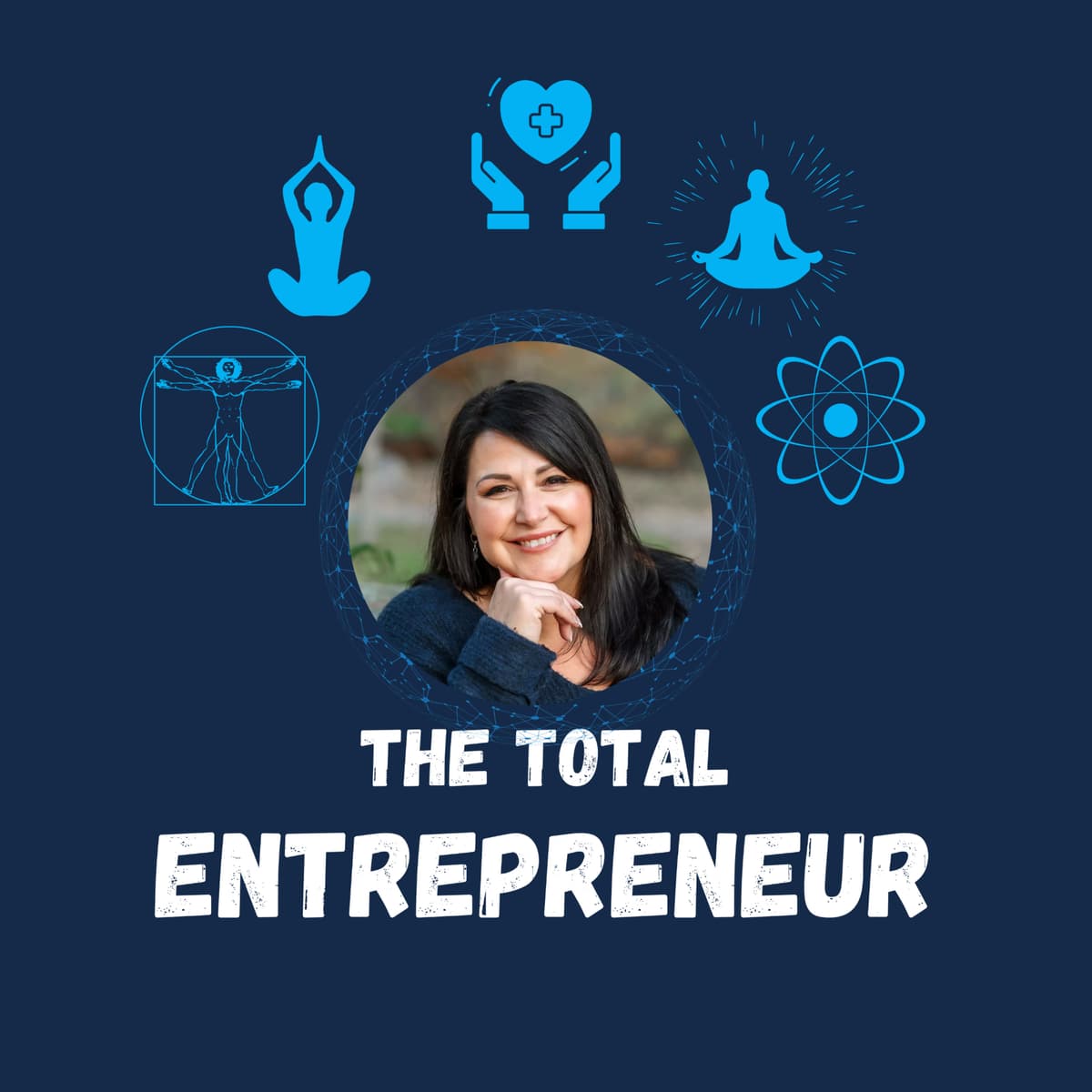
From Survival to Strength: Healing, Resilience & the Power of Breath with Aimee Goodwin
with Aimee Goodwin
Jan 9, 2026 · 00:43:22
Part of our conversations on
Hey, thanks for joining me on the Total Entrepreneur Mind Body Spirit Podcast. Today's guest is Amy Goodwin. She is a life coach and healing advocate and founder of the New Hope Healing and Resource Center and Lyme Hope, a nonprofit supporting individuals navigating chronic illness and complex healing journeys. Her work focuses on nervous system regulation, mind-body healing, and helping people move out of survival mode and back into empowered, purposeful living. Welcome to The Total Entrepreneur Mind, Body, Spirit, where we turn cutting-edge science into practical strategies for entrepreneurs. I'm your host, Dr. John Torrance, Entrepreneur Inc. 5000 honoree and professor of entrepreneurial practice at Syracuse University's Whitman School of Management. Each episode, we dive into mental, physical, and spiritual health with expert guests offering actionable insights to help you thrive and perform at your highest level. Let's get started. Amy, welcome. So nice to have you here.
Thank you for having me. I'm excited.
Well, let's start by having you tell us what moment or maybe season in your life that made you go down this path of starting to coach and help people.
Well, it's a long story, so I'll shorten it a little. All right.
We'll buckle in.
That's all right. Yeah. Buckle in. And, that part of my life led me to mentoring people with Lyme and essentially coaching people with Lyme. I had a local newspaper that did an article on me. I have no idea how— I live in a small town, so somebody knew I had Lyme and it was Lyme Awareness Month and they called me and said, hey, can I do an article on you about Lyme? I was like, yeah, sure. And, once that was released, the Lyme world just absorbed me. I didn't really know anyone else with Lyme even. Wow. And pretty soon my phone started ringing from all over Minnesota, all over the United States, even somebody calling from Australia. I have no idea how they saw the article. But really, people just needed help. They wanted to know how I found a doctor. They wanted to know how I was getting better. They wanted to know what I was doing, you know, what meds I was using, what herbs I was using, and the whole thing. And so that really eventually led to me working with Minnesota Lyme Association and starting support groups and helping people in support groups connect with each other because I kept thinking, you know, through all those phone calls, oh, this person needs to talk to this person and this person needs to talk to this person. And, and I really, really learned the power of the human connection during that time as well. And that led me to, you know, where I am now owning New Hope Wellness. which is a Lyme treatment center where I run my coaching practice. And once we started this place, I really just wanted to know more. I knew I needed to know more to help these people who were really chronically ill with staying mentally focused, you know, in the right place so that they could be better faster and hold on longer. And so I went ahead and did a coaching program that took me a year to get through, and then I did another additional program. the Clarity Catalyst through Stanford University, became certified in emotional resilience training. And, that is really what changed my whole— it changed my life, honestly, that program did. It changed how I coach. It changed how I help people. It changed how I introduce tools to people. It changed how I— everything. And so, that's the long version. It's a short version of a really long story that got me to coaching. Yeah.
So, what were you doing before you Got Lyme disease?
So before I got Lyme, I was a stay-at-home mom. I had 4 boys and, um, yeah, I was a stay-at-home mom just trying to keep my head above the water raising 4 sons. And, uh, yeah, you know, when I got Lyme, I was really a healthy person. I, I was going to the gym 4 days a week. I was somebody who was done having my babies and I knew it. So I was like, oh, I go get my body back. And, um, and Lyme really, uh, It came in quickly and took over my life. It was a very hard 5 years before I figured out what it was.
Yeah. So, it seems like, I mean, just such a terrible situation turned into something pretty magical and wonderful for you. So, what are the symptoms of Lyme? Like, how would somebody even know or suspect that maybe they should get evaluated for Lyme disease?
I'm going to answer that question in 2 parts because there's 2 parts of that.
Yeah.
So it— one of the things I really, really try to focus on and even have our patients— like, that's what our new patient folder is, spread awareness, tell people, because now you have Lyme and you have the power to help somebody else not, not be chronically ill. And so we do a lot of what I call awareness work as far as like, if you're out in the woods, if you're a hiker, if you're, you know, somebody who is a hunter or, Even anything outdoors, mowing your lawn. I have people who say, well, I don't really do anything outside. I'm like, well, do you have pets? Do your pets go outside? Like, they come in the house, they have ticks on them. Anybody anywhere honestly needs to be aware of Lyme and ticks. And so there's 2 ways. One, if you are— have been out in the woods or you've been out in the great outdoors and you— I mean, hopefully classically you notice your ticks. Not everybody does.
Right.
But you see the tick, you remove it, you know, a couple days later it's red, it— you might have a rash, you might not have a rash, you might get a, get a fever, not feel like yourself. I always tell people anything that's off right after that, then you need to go in to a doctor and get checked. And the hard part of that is a lot of doctors are doing this 1 or 2 doses of doxycycline, or they'll give you a couple weeks of it, and that's not enough. So you need to have at 4 to 6 weeks, you know, depending. We have everybody check back in at 4 weeks and see how they're doing, and we check in on them after that to make sure nothing was— we missed anything. And so there's the classic reaction of, oh, I got bit by a tick, and now, you know, we just had a guy who came in. He's— he knew me personally, and he called me and he's like, you know, I didn't see my tick. I— if I got a tick, I didn't see it, but I have like a fever, I have body aches, I haven't felt good for 2 weeks now and everything I went to the doctor, it's nothing else. Do you think it could be Lyme? And he's a big outdoorsman. He's always out hunting. He's a duck hunter. And I was like, you, you need to come in like and get checked. And he's like, well, I had this bite. It could have been a bite. It was a bruise, but not a bullseye. Well, only 50% of people even get a reaction at the site of their bite. So that's not gonna help in every case. So he came in, we did some testing. He did have Lyme disease and we treated him for 4 weeks with doxy and he's doing great.
Right.
Then there's a case like mine where I did not see a tick. I did not have the classic reaction. I did have a classic reaction, but we thought it was a spider bite. I knew the spider bit me and I like squished it in my fingers and looked, it was a spider, right? And I had a big cellulitis. I was doing some yard work and underneath my deck and it landed on my neck and I— it bit me and I slapped it and squished it.
Uh-huh.
And— but I had this classic, you know, what I know now to be like a big bullseye rash, a big reaction. I went to the doctor and got a couple days of medicine for, um, cellular— uh, what are they— uh, cellulitis. Is that the right thing? Or— yeah.
Uh-huh.
And, um, it was only about 8 weeks later that I became very, very sick. So my doctor actually suspects it was a spider bite that gave me Lyme.
Wow. So I didn't, I didn't realize you can get Lyme from a spider bite.
Oh yes. And that's a really big misconception as well. Um, we had my boys are hunters and we went to Texas a few years ago hunting hogs and they got bit by, um, fleas. And 2 of my boys tested positive, came up with a rash. They had the classic rash that you get. Um, and when we tested them, they both came back positive for Bartonella. So, um, there's a lot of ways that we can get Lyme. Lyme is passed from mom to baby. It has a higher transferable rate than AIDS, actually. Uh, AIDS is, I think, 40, and Lyme is 45. But, uh, doing what I do here, I would guess that it's much higher than that, honestly. So there's a lot of ways. So a case like mine where you're not sure What's going on? Like I know anything about Lyme. I had no idea. No doctor in five years mentioned Lyme to me, so they didn't have any idea. And I doctored a lot for five years looking for what was going on with me. You know, I went very quickly from being really healthy to you know having horrible pain, muscle pain, joint pain, nerve pain, deep exhaustion. I developed a lot of neurological sensitivities, like. Sounds hurt me, light hurt me. Going to the movies gave me horrible anxiety because the flashing of the screen was really painful, honestly. And nobody could tell me what was going on. And eventually, you know, my mom— the part of my story that's a miracle, and this is part of the reason why I'm so big about talking about my story and awareness, is because somebody doing that saved my life. And so my mom is a nurse and she was on her way to work one day and just listening to like the public radio, there was somebody on there talking about Lyme disease. And I think it was at the time where like Under Our Skin, which is a big documentary for Lyme, um, had just come out. So somebody was talking about that. And so she called me when she got to work. She's like, Amy, you have to check this out. Like you, you have these. And I wasn't excited about it. Like I was like, oh, you know, seen so many doctors and I'd chased so many. paths to have no help that I just wasn't thrilled about it. But she said, Amy, these are your people. You have to check this out. And that got me off the couch because that was back in the day where, you know, we'd have our phones. I had to go to the computer room, right, and get on the computer. That got me off the couch because I didn't know anyone else like me.
Mm-hmm.
I didn't know anyone else hurting like I was hurting. I didn't know anyone else whose life was like being just ravished for them. And so I got online and I put in the search engine and the whole Lyme world just opened up to me. And, and after hours of just sitting there listening to people's stories and watching documentaries, and I was like, Mom is right, these are my people. And that's when my search—
That's normally the case, right?
Wow.
Wow. That's— yeah, that is quite a story. You know, so it's interesting that a lot of people, and it seems like you included, you discover your purpose through a struggle, right? So I'm interested in, you know, what did all this adversity teach you about resilience that success probably never could have?
No, for sure. I love that question. I've had a lot of lessons in adversity, and I, I really believe that at the root of everything, that's what makes me such a good coach because I've been in really hard places. I've been in really dark places. I've overcome a lot of things. And that has taught me that no matter how dark it is, there's light somewhere.
True.
And, you know, we lost a daughter and I went through that grief and that really almost took me out. And I think when you survive things, hard things like that and hard things like I think that one of the hardest things honestly is having chronic illness as well, right? Having your body not be the way you want it to be. And I think when you overcome things like that, you just learn that nothing can take you out. Okay, well, there's a way to figure it out. There's hope somewhere. There's something to hang onto. There's a path I just need to find. There's A way for me to just put one step in front of the other and I'm going to make it. Like, I think I've learned there's such power in the human spirit. And if you can just focus on even the tiniest, tiniest bit of hope or light, that's all you need.
Yeah. And I think when a lot of people think of healing, they think of physical healing, right? My physical body is going to heal, but I know you look at it more holistically. So tell us about that.
As far as emotionally, is that what you're talking about?
Yeah, yeah, like beyond just the physical body healing. Yeah, like more holistic emotional healing.
Yeah, there's so much of that, you know, and I think there is a time, like in any time of struggle, there is a huge time for hope and for grief, right? And for just grit, right? Grit is gonna just, sometimes we have to just, Get up and put one foot in front of the other until the situation improves. In fact, this is kind of funny, but I— and I'm going to be writing a little thing about this, but I live in Minnesota and right now it's like freezing cold here and blizzarding and ice. And, you know, it's just, well, why do we live here kind of weather, you know? I was driving to work a couple of days ago and I saw a bald eagle and it was sitting at the very top of this very tall tree. It was sitting at the very top. And the wind was howling that day. It was just blowing and the snow was blowing and it was just this storm. And this eagle had its face up facing the wind on this, and it was just sitting there letting the storm beat it to death, just perfectly content. And I was like, oh, there's a lesson in that. There is something in that. And there are parts of struggle where you do have to just stand up and face the storm. But there are also parts of the struggle when the hard struggle has passed, but you're tired. And then it's time for emotional healing. Then it's time to be like, okay, how do I, how do I process this? How can I help my body process this? What can I do for this emotional exhaustion? What kind of help do I need? And I call those in coaching, I call those powerful questions. I call it self-assessment. Self-discovery and powerful questions. And they're just questions with curiosity. It's not judgment, right? It's not like, oh, how did I get myself in this situation again? Or, oh, how did I— it's like, no, what do I need now? And I think that's something our society is kind of bad at right now because we have a phone in our face all the time. We have such accessibility to just move on, right? And we don't pause. And be like, okay, what do I need now? What kind of care do I need? What kind of spiritual nourishment do I need? What kind of friendships do I need? What kind of rest do I need? And just to do it and take it.
Yeah, I think that's really good advice. And I love the story of the eagle, right? Just kind of standing there or sitting there high in his perch with the wind in his face. That's a good metaphor, actually.
Yeah.
So, when you work with somebody in there, like, when you're seeing doctors and going to appointments and you still don't feel better and you think this doctor is going to be the one to help you and they don't and you still feel bad, you're almost in this constant fight or flight, right?
Right.
So, when somebody comes to you like that or you encounter somebody who's in that fight or flight from endless doctor's visits and no relief, where do you start with them? Like, what's What's the first thing you recommend for them?
Well, it really depends on their story and there's 2 aspects I think of that question, like where they are emotionally, right? And where they are at in their medical journey. When somebody comes to me, if they're in fight or flight, the first thing we have to do is get them out of fight or flight and I do a lot— I work a lot with people not— not in the Lyme world as well and unfortunately, a lot of people are struggling with great anxiety. And great amounts of that fight or flight. In fact, I saw a statistic not like a few months ago that said 70% of Americans are living in fight or flight right now. And that's a staggering statistic.
Wow.
70% in fight or flight. Fight or flight is for we're in danger. Like, fight or flight is tiger chasing me and I'm gonna die. Like, that's what fight or flight is for. Fight or flight is not for everyday living. And that's why we're seeing the high amounts of anxiety. And that's why we're seeing the high amounts of overwhelm is because we don't have these basic emotional skills tools of just to bring us out of fight or flight. And so that is the first thing I do with anybody who comes into my office who is in that chronic fight or flight, because if, if we don't take care of that, they're not going to heal as well. They aren't going to cope as well. They aren't going to stay on task of any kind of treatment as well, or any kind of plan for coaching. So the first thing we have to do, and I get a lot of looks from people, I get a lot of eye rolls when I'm like, okay, we're gonna learn how to breathe. Like, I need you to just— we're gonna breathe. And, and people be like, oh, well, I'm coming to see you because I have anxiety on a scale of 10. You're gonna teach me how to breathe? And I'm like, yes, I am. And in a week, you're gonna thank me for that. So this is the most important thing. And why is it the most important thing? Because as our bodies are made, right, a lot of things happen in our bodies through fight or flight. So our— we breathe more shallowly, our vision gets very narrow, our brains move very quickly from one frantic thing to the next to make sure we're doing everything we need to do. Our pulse goes up, our blood pressure, like all of those things, like cortisol releases, adrenaline releases. And until we get all of that stuff under control, right, we aren't going to be successful in any kind of healing emotionally or physically.
Mm-hmm.
And so the first thing I do honestly is take the time to teach somebody a breathing regimen that I assign them to do and teach them how to do every day, many times a day. And little things like that, being present in your moment, learning how to control all of that will bring people out of fight or flight. And I describe that as, you know, like a bonfire that somebody's been sitting, you know, if you're sitting around a fire all day long. And you've been feeding the fire all day long because it's been a cold day or something, but you're gonna go to bed. And so you're not putting more wood on the fire. It's just a pile of hot coals. And what happens if you go up to that, or what happens if the wind blows a little bit to that pile of coals? Well, it's so hot that it just burns right up. So if you go up to that pile of coals and go, you get a flame, right? So same thing when you're in fight or flight. You are in this fight or flight all the time. Your nervous system is super reactive. Your body is super reactive. So So somebody honks their horn at you in traffic, you have a test at school that you're stressing out about, you're fighting with your spouse, right? It takes nothing to make that fight-or-flight response go. So we have to bring that down. And I do that by breathing, teaching people to breathe, and a couple of other tools. Now, if they're coming to me and they've been seeing some medical person after medical person after medical person, I will sit down with them and, and we'll talk about it. Like, what have you tried? What hasn't worked for you? What doctors have you seen? Have you seen 'Cause you can see 100 doctors and if you don't see the right doctor, it's not helping you.
Yeah.
And I saw many doctors in 5 years, many, and not that they were bad doctors, they just didn't know anything about Lyme. They didn't know how to help me. And until I found a doctor who knew how to help me, who was trained in Lyme disease, who was ILADS trained, so he was— he was a good doctor that was very educated, nothing changed my story 'til I found that person. And once I found that person, that person saved my life. So it—you can have a really great doctor who really cares about you, but if they don't know how to help you, they aren't the doctor to help with what's going on with you. Just like if I had cancer, I wouldn't be going to—I wouldn't be going to a Lyme doctor if I had cancer, right? Right. Like if I had cancer, I'd be going to an oncologist. It's no different with Lyme. You need to have a doctor who. knows Lyme, knows how to treat Lyme, knows how to diagnose Lyme to get better.
That makes sense. And if you're okay with it, I'm gonna steal that metaphor about the fire because I love it. Because if the— yeah, all it takes is a little bit of wind for that to flare back up. And that is such a good description of what happens to your body when you're constantly in that state, right? And like you said, we're not meant to stay there. We're meant to be there to get out of a a tough situation or a dangerous situation, but we've kind of trained ourselves or come to this place where we're always feeling like we're in a dangerous situation.
Yeah.
That's a great metaphor. I will steal that with your permission if that's okay.
Absolutely.
So, tell us about this. I used to hear a lot of people talk about breathwork and breathing and never really gave it much credibility until I started to talk to what I call serious breathwork people who based it in science. And, I forget who I heard say this, but I think one of the problems with breathwork is that we call it breathwork instead of respiratory physiology, right? It's real respiratory physiology. So, yes, you breathe every day, but you're not breathing for the purpose that you're talking about. So, can you walk us through a couple of these breathing techniques that you teach your clients?
Yeah. And, for me, I keep it simple. I always tell people, if you love this and you see that this is hugely beneficial for you, there is many resources for you and I will provide them with those. But I keep it simple because I am not a breathwork specialist. But I— but I will tell you a little bit about my story and why I'm passionate about this and you'll— you'll see this in this part of my story. But when I really first learned breathing, it was from a yoga— my yoga specialist, my yoga instructor.
Hmm.
And, um, I was seeing a yoga instructor sort of by force. I'd had a really big hip surgery. I was born with hip dysplasia, so I had— I didn't have normal hips. So I had a really big surgery. They broke my pelvis 4 times and tried to fix it at the Mayo Clinic. And, and I was having trouble getting like just movement back. And so my Mayo Clinic doctor said, you really need to do yoga. And I was like, I don't really do yoga. And he's like, now you do. So I was— yoga was brand new to me. I was an EMT at the time. And, um, and life was crazy. You know, I had 4 boys and I'd lived with a lot of pain, you know, with the hip dysplasia and Lyme. My body had just been through a lot. And so anyway, I went in to do my yoga, my first session of yoga, and this woman was— who's amazing, she's a friend of mine now, so I can say this— but I— she was like the epitome of what you would think a yoga instructor would be. And so I was like, oh, here we go. And, uh, anyway, I love yoga now. She's like totally converted me, and I do yoga all the time. Anyway, she's the one who taught me first to breathe. And so, she started off really— I was just laying on the floor and we were doing a couple of things she was teaching me. And, she sort of stopped mid-teaching and she said, you know, Amy, you're not breathing. And, I was like, I'm pretty sure I'm breathing. She's like, no. She's like, you're not breathing. And so, she literally took the first hour of that session and just really taught me how to breathe. And it was almost euphoric almost for me because I had never, ever, ever experienced just a pause like that to just breathe. And my body reacted profoundly. And she said to me at the end of that session, Amy, when was the last time somebody just gave you permission to breathe? And I was like, I cried actually, and I just said, never. No one's ever done that.
Yeah.
So for me, it was so profound seeing the benefits of that in my mind and in my body. My yoga mat has honestly become my solace, my place of solace. If I'm stressed or grieving or hurting, I go to my yoga mat and I breathe. And so there's so much benefit to that. And so My favorite regimen because it's very easy and simple, I have 2 of them that I use in my practice, is the 5-5-7 breathing. And, that's in for 5, hold for 5, out for 7, 3 times, 3 times a day is how I usually start people. And, I say more if you need it. And, I do that with people who are sitting on my couch. And, every time, there's never ever been a time where they're like, I don't feel any better.
That's perfect.
They always are like, oh, Oh, and so I tell people you can breathe on your couch at home. You can breathe in your car. You can breathe at your desk at work. You can breathe at the bathroom in Target. Like you can literally pause and do a 557 breathing regimen anywhere you are. I teach people to see their breath. So I have them pick a color. So pick a color so that when you're breathing in, you're really filling and you're watching that go into your lungs, into your diaphragm. And when you're breathing out, you're seeing that color. So it's also a focus. focus exercise as well, keeping them here and now with their breath. And it's very, very accurate, very powerful, I should say. And then for panic attacks, I like 418. And so for people who are in panic, I will, I will teach them 418 and that for 2 minutes. And that works very well as well.
Right. And what I've learned is that it's, you know, well, so what you said is great because you can literally do this in the wild, right? Wherever you are, when you need to. And, nobody even really needs to know that you're essentially self-medicating really because that's what you're doing. You're unlocking this amazing pharmacy you have inside your body through this breathwork. And, what I've learned is that as long as your exhale is longer than your inhale, that is going to give you some relaxing benefit. It's going to calm you down. But yeah, the 5-5-7 and what was it, the 4-1-8?
The 4-1-8. That's a good one because Like you said, it's the blowout. If somebody's, you know, even as an EMT, right, that was a lot of what I did was helping people, you know, breathe. That was what I did. And so the 4-1-8 is just this really quick, right, this really quick and then out long, really quick and then out long. And it's a really good rhythm. And you do that just again and again for 2 minutes and it will bring you down. It will bring you down. And quickly.
Yeah, it's only been maybe 6 or 7 months since I discovered it, I guess you could say, or I guess I should say bought into it, right? Because I never really believed that just breathing that you do 24/7 can give you much benefit besides just oxygenate your blood, right? I was one of those people. But, a lot of people—
You were one of the eye rollers at me.
Yeah. I mean, if I had come to you, I would have been like, I'm paying you to what? Teach me how to breathe? This is crazy. And, I probably would have giving it a chance because I do that. And then, yeah, once you experience it, it's really amazing. And, for the people that I work with, young entrepreneurs or people in startup mode that constantly feel like they're in a state of stress or anxiety or flight or flight, yeah, that's really helpful just to be able to reset yourself because then you can tap into your natural creativity and your innovation and nurture better relationships, make better decisions. It's so important and it goes beyond just getting yourself calm, right? You can do so many things so much better when you're in that state.
Yeah, yeah. When you're in fight or flight, I mean, think about that. Yeah, from an entrepreneur perspective, from like a college student, from anyone, any kind of business owner, even a mom. Like if you're in fight or flight, you are not in your present moment. You're not making good choices for yourself. You're not being creative. You're not using imagination. You're not having a good perspective. You know, you're not doing anything but Survive, right? With simple breathing, you bring yourself out of that survival mode, and then you're like, oh, the world is a brighter place. Actually, I, I can make powerful decisions for myself. I can see a clear road from here. I can figure out a way to help myself or even someone else, you know, whatever. I can figure out this project because I'm not on fire, and it's pretty hard to do good things for yourself when you're on fire.
Yeah. Or even just the language they use, right? Like when I say, hey, how you doing? They're like, oh, I'm surviving. That's usually a signal that, yeah, that's about what you're doing, right? So yeah, you need to get into a better state. Yeah. So I know you wrote a book recently called The Mountains We Climb. Tell us a little bit about that and the process because that's an accomplishment and it takes some focus and some planning. Uh, so yeah, tell, tell us about the process and then tell us about the book itself.
So The Mountains We Climb was a book that was in my head, honestly, for quite a while. And as a coach and anyone, I think, who's out there trying to help people or, you know, seeing the need of people, you know, there's such a need, especially working, you know, focusing on, on anxiety wasn't something that I planned on doing. Like that wasn't what my real focus was in my practice. But that is what my practice became because that is what everybody, almost everybody who came in here needed some help with anxiety and management of stress. And so just the mountains we climb, you know, I'm like, okay, these, these simple tools, like, and I think that's something that people don't understand is that these are simple emotional resilience tools that we learn. Does that change the chaoticness of life? No, it doesn't. Does it?
Mm-hmm.
change the craziness of relationships and a hard job or, you know, whatever. We know it doesn't change any of those things, but what it does is that these tools can give us just a way to move through these things better, to step over the harder things, and to be a little more smooth in how we're walking through life, and emotionally speaking. And so The Mountains We Climb is very much what I do as a coach. It's very much as I wrote the book, my process was I'm I'm picturing somebody sitting in front of me who needs help with these things, and I'm writing this book in a way that's simple. Like, if you were in my office, we'll be digging into things a little bit more, right? And we'll be getting to the root of things more. But The Mountains We Climb is really kind of a manual to get through hard things in life.
Mm-hmm.
And it addresses things like grief and anxiety and overwhelm and teaches tools like breathing and pausing and finding hope when feeling hopeless and things that a lot of people are dealing with. And, I made the book purposely simple so that people can read it, use the tools, and change their lives. And, that's the feedback I'm getting from a lot of people who've read the book. They're like, wow, I stopped my car on the side of the road the other day and just breathed like your book said and I feel so much better. I'm like, okay, yay. That's what we're going for. It teaches you how to self-assess without judgment. It teaches you To control that little critical voice that runs us and keeps us from doing the things that we should be doing. And it does it in a way that's simple and it does it in a way that makes it very usable. Somebody said in one of my reviews, they said, this is a book, this is a companion book that I will be carrying with me for the rest of my life. And so it's just very powerful tools introduced in a simple way and very user-friendly for the reader.
I think the simplicity is what's really important because people aren't going to get their arms around complicated or stick with complicated for that long. So, besides the breathing techniques, what are some of the things that you wrote about in the book?
So, well, breathing was a big one. Pausing is a big one. That's something that we really don't do today.
That's one of my favorites, yeah.
We are so much in just go, go, go, go, right? And we don't pause. Like I kind of said before, like pause to heal, like pause to assess and be like, what, what do I need here? Like, why do I feel this way? What resource can I get for myself? What, how do I get myself back on the schedule? Right? Those little things. Pausing is huge in any situation. I'm a huge fan of pause in any situation of conflict, in any situation of overwhelm, frustration, danger, even like the pause. To know how to move forward is very powerful. So I teach a lot about a tool called Powerful Pause. I do teach the inner critic in there, how to deal with the inner critic, which is such another huge thing that I do in my practice. But the inner critic stops us from doing so many things in our lives. So I teach about that, and also how to self-assess without criticism and. and judgment. Just having the tool to self-assess with curiosity instead of being like, oh my gosh, I'm so dumb, or, oh my gosh, how did I manage to get myself— actually be like, okay, well, why do I feel offended by that? Or why am I feeling triggered right now? Why am I? And then be like, oh, well, because of this. And be like, oh, well, that's okay. I don't have to be triggered by that person. I have me, right? I have me. And, if they don't like me, that's okay. I have me. And, when you pause and you can assess, that's very powerful without judgment because then you solve problems. Because, if we pause and self-judge, nothing gets solved at all, right? I always say you can't beat yourself into positive change. That will never happen.
Right.
But, we can show ourselves grace and move forward. And, I teach about showing grace as well. So yeah, those are some probably the bigger powerhouse tools that are talked about in the book.
Yeah, the pause button is probably one of my favorites. And I've realized that, I mean, because I've got hyperactive impulsive ADHD. So, if I don't pause, all sorts of bad things could happen. I could do things I never meant to do. I could say things I never meant to say, send an email I probably shouldn't have sent. So, the pause button for me has been really powerful. But also, I like what you said about the difference between judgment Because, yeah, that inner critic is constantly judging us. And especially if you're in business for yourself like you are, and you know this, you're always doubting yourself, right? Like, you know, should I be doing this in the first place? You've got imposter syndrome. And then are you making the right decisions? Are you making the right moves? Somebody else has a bigger, better business than me. Mine isn't, you know, whatever it is, right? So we judge ourselves instead of just kind of observing ourselves. And that's been a powerful thing for me too, is just instead of judging, just observing. you know, don't, don't say it's good, bad, whatever. Just observe what it is and see what you could learn from it. And I, yeah, I'm guessing that probably resonates with you as well.
Yeah, I love that. And I always, I, what am I learning? That's something I've learned to ask myself in struggle or in something I don't understand or in conflict, right? Like in any kind of, how do I get through this? I, I will ask, what am I learning? What am I being taught right now? What am I, what, What am I supposed to move away from this with? And that makes it a much more powerful mindset than, why is this happening to me? Why can't I ever get that right? You know, the things that we self-judge say when we're self-judging. So I love that you brought that up. Like, yeah, what are we learning? That's what we're doing here. Like, I don't believe in failure. I used to be so afraid of failure. There was a time in my life where I really cared so much what everybody thought. And I used to be so afraid of failing. And I don't really believe in failure anymore. I think every single thing that I've done in my life that hasn't worked out has brought me exactly where I am right now. So, everything is a lesson. Everything that I haven't done right or hasn't worked out for me has been a lesson for me, and I've taken something away from it. And, I think that's a powerful perspective as well.
The thought of this is happening for me, not to me, for me has been really helpful. And, like you said, it's a lesson, it's something you can learn from. And yeah, maybe it's what society's definition of failure is, but it's probably serving you in a way that maybe you don't know yet, or you haven't, you haven't realized yet. So I really do like that.
Yeah, maybe you don't have the long view yet, right? Like, you get through something like that and you have this beautiful long view, but at the time it's just a snapshot. So I always, I always consider that too. Like someday I'm going to get this someday. I'll understand why this happened. But, you know, when we lost our daughter, I was never going to understand why that happened. I couldn't rationalize that. I couldn't make that better. Like, I can't even imagine, you know, I had to settle with someday I'll, I'll know why this happened, but today I have to figure out how to move forward.
Yeah. I mean, like I said, I couldn't even imagine that. Um, but yeah, like you said, it's you. Yeah. You've got to find something in it. Right. Yeah. And the failure— oh, I'm sorry, go ahead. I think you just had something you were going to say.
I was just going to say, I think that's part of that. Now I can look back and see during that time how many things, even though I felt so stripped down emotionally, a lot of my resilience and a lot of the things I learned about resilience came from that time. And so, I'm here doing what I'm doing partially from what I learned from that. So people ask me that. I, and actually I did a women's retreat last year and I had a panel of women that did this retreat with me and, and we had a discussion panel at the end of the retreat and it was about resilience and, and all that. And one of the questions was, would you take it back? And this was a very, this is a pretty profound lesson for me. Would you take anything in your life back that's happened? Would you change it? And I was sitting on a panel of women who's like one of them, their mom had been schizophrenic. And so she had just a crazy childhood growing up. She was an entrepreneur and a business owner now and really amazing in her life. Another woman who had struggled with infertility for many, many years and did after many heartbreaks have a couple of children. So that was a wonderful story, but a very just heart-wrenching story in many ways. Another woman who had broken her she'd had cancer. And, once she got better from cancer, she broke her spine. She was thrown from a horse and she broke her spine.
Oh, man.
And so, I was sitting on a panel of women who'd really had struggles, not just little struggles. And, when that question came up, I was not the first one that was in line to answer it. And, I sat there and listened to all of these women who are very powerful women in their lives right now, who knowing their stories more intimately even than the crowd, And hearing each of them say they would not change it, that they wouldn't take back their struggles. Every one of them said that. And when it came to me, I was like, ooh, like, yeah, there's some stuff that I would probably want to take back, right? Like, I would love to not have lost my daughter, right?
Yeah.
But I thought about that as these women were answering it. And I was like, you know, I am where I am right now. Like, I can't change it. Like, I can't change it. And so I'll say, no, I can't change it. I wouldn't change it. But it was fresh. It was new for me to be able to say that. Like, after 25 years, it was very hard even to just say that.
Wow. Do you still feel her with you, or is she a source of strength for you in the work you do?
Yeah, definitely. We do feel like we are. So I have 4 sons, and my husband and I, And, we've all in our family had different incidences where a couple of my boys have seen her in dreams or even in awake things. Many times, we feel her. She's a very distinct little spirit and we feel her. So, she's part of our family and we just move on, but she's part of us. And, I feel like she has that desire to stay a part of us as well.
Yeah, I'm sure. Yeah. I mean, when you talk about resilience, losing a child is to me bouncing back from that seems like the height of resiliency. I mean, I don't know how much more resilient one could be than, than doing that. So, yeah.
Grief is tricky. Yeah.
Yeah. Mercy. Yeah.
Yeah. I just saw a beautiful, I can't take credit for this. I saw it on TikTok or something. It was a video that I saw on TikTok, but it was talking about grief. And I thought this was a beautiful explanation of grief. It said grief is like glitter. And if anybody's had kids or had glitter around, you know what it is, but it's, it's like having glitter all over you and Like you, you clean it up, but it's still in your hair and on your ears and on your skin. And then you go on, time goes on and you take a few more showers and you clean it up. And then it, but it's glitter, you know, it's still there. And then someday you're, you're vacuuming or you're wiping a shelf off and, and there's a little bit of glitter there. And I was like, oh, that's, that's very much how grief is. It's, it's, it carries you. You have to learn how to carry it. I think for a really long time, I just desperately wanted my life to go back to normal, like normal, you know what I mean? And it took me a while to realize that normal, this, this is my new normal. And so grief does not go away. You just learn how to carry grief and that's how it goes.
Well, that seems like a very good place to end it on that note. But before we go, uh, you've, you've got a website, you've got a book. So tell, uh, tell people how they can get ahold of you and find your work.
So, my website is coachamyj.com and you can get on there and see classes, websites, my books, and all my links to my books will be on there. You can find my book just on Amazon. Just search out The Mountains We Climb and it'll come right up. And, New Hope Wellness in Minnesota is where you can find us for Lyme and that's lyme-hope.org.
Amy, thank you so much for being here. I thought this was a great conversation and I hope people benefit from it. So, thank you.
Well, thank you for having me. I, this has been great. Thank you.
Thank you so much for listening to the Total Entrepreneur Mind Body Spirit Podcast. If you liked what you heard or heard something interesting today, please give us a like, share a comment, or better yet, subscribe to the podcast. Thank you.
About This Episode
What if the path to true healing isn't just about curing the body, but learning how to breathe through the storm?
In this episode, John sits down with Aimee J., a resilience coach and author of The Mountains We Climb, to discuss her transformative journey from debilitating Lyme disease to becoming a beacon of hope for others. Aimee shares how a mysterious illness that went undiagnosed for five years eventually led her to discover her life’s purpose: helping people navigate chronic illness and emotional overwhelm.
She breaks down practical, science-backed tools for managing anxiety and "fight or flight" responses, including specific breathing techniques like the "5-5-7" method that can be used anywhere from a boardroom to a traffic jam. Aimee also opens up about the profound lessons found in grief, the power of "pausing" before reacting, and why she believes we shouldn't judge our struggles but rather ask what they are teaching us.
A deeply moving conversation for anyone facing chronic pain, burnout, or emotional exhaustion who wants to reclaim their peace and build unshakeable resilience.
Episode Chapters:
Introduction to Aimee and Her Story.
The Mystery of Lyme Disease Symptoms.
Misconceptions: Lyme from a Spider Bite?
Discovering Community and Hope Online.
Understanding the "Fight or Flight" Epidemic.
The Science of Breathwork and Physiology.
Practical Tools: The 5-5-7 Breathing Method.
The Power of the "Pause" Button.
Overcoming the Inner Critic and Imposter Syndrome.
Finding Purpose in Grief and Loss.
Grief as Glitter: A New Perspective.
Connect with Dr. John M. Torrens
LinkedIn - https://www.linkedin.com/in/johnmtorrens/
Instagram - https://www.instagram.com/johnmtorrens/
TikTok - https://www.tiktok.com/@drjohntorrens
Website - Podcast.JohnMTorrens.com
Keep listening
More on Mind
About the Host
Dr. John M. Torrens
5× Inc. 5000 entrepreneur, Professor at Syracuse University's Whitman School of Management, author of Lightning in a Bottle, and TEDx speaker on ADHD as an entrepreneur's superpower.
Browse all podcast guests →Book a strategy call →