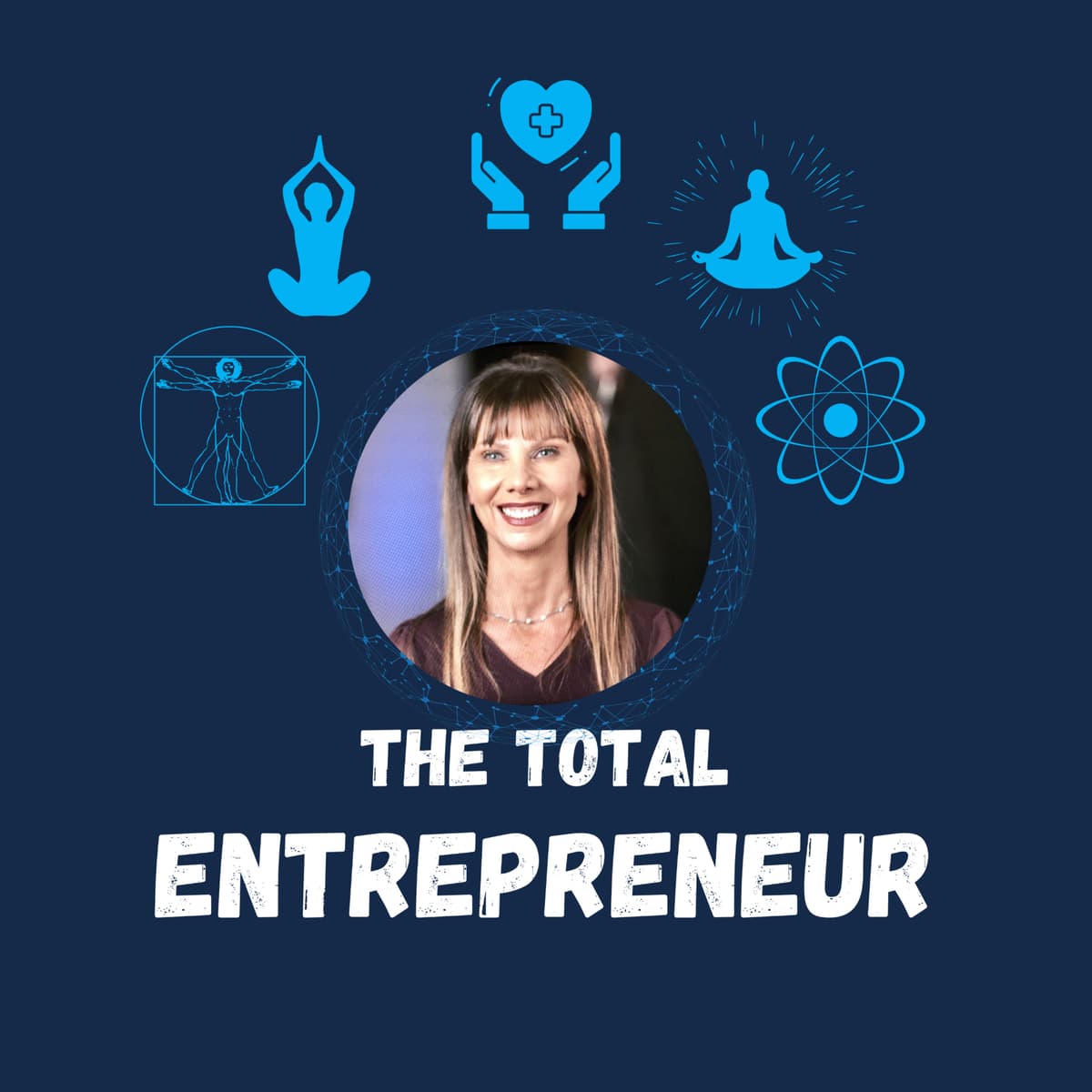
Unlocking the Matrix: The Science of Consciousness with Caroline Cory
with Caroline Cory
Aug 15, 2025 · 00:42:22
Part of our conversations on
Today on the Total Entrepreneur Mind Body Spirit, I have a very special guest. Caroline Corey is a pioneer in the field of meditation and consciousness studies. She has conducted groundbreaking research in collaboration with experts from Harvard Medical School, the Harvard Smithsonian, the Institute on Noetic Sciences, and Stanford University, exploring the connection between consciousness, health, and the physical body. Caroline has developed revolutionary methodologies to clear deep-seated trauma from the subconscious and cellular memory with. speed and accuracy. She's also an award-winning filmmaker known for Superhuman: The Invisible Made Visible, A Tear in the Sky, and Among Us, films that merge science, spirit, and storytelling to explore human potential. I think you're really going to like this conversation. Welcome to The Total Entrepreneur Mind Body Spirit, where we turn cutting-edge science into practical strategies for entrepreneurs. I'm your host, Dr. John Torrance, Entrepreneur Inc. 5000 honoree and professor of entrepreneurial practice at Syracuse University's Whitman School of Management. Each episode, we dive into mental, physical, and spiritual health with expert guests offering actionable insights to help you thrive and perform at your highest level. Let's get started. Caroline, welcome to the podcast. I am so excited to talk to you. Welcome.
Thanks so much for having me, John. This is great.
Well, before we get into your work, give us a little bit of your background. Where are you from? Where'd you grow up? How'd you get to where you are now?
So I grew up actually in France. So I have a very European education, although I was very young. I mean, I did most of my college and, you know, professional life is all in the United States. Although I also traveled all over. I lived in Japan for a long time. That's how I speak the language. So I'm I think I'm like from a little bit everywhere. You know how that goes.
Yeah.
Yeah. But I do have the European kind of background in terms of education as well, upbringing. But all of my discoveries, so to speak, like what I do right now really was, you know, started in the US. And, you know, the work on consciousness and health and everything else, you know, all expanded from here. Yeah.
It's an unconventional career path. So I've heard you say you were sensitive as a child. Is that right? So how did that translate into what you're doing now?
That's exactly how I started out because everything was so spontaneous. So I was very young. I was like 5. I would just look at people and I could sense like what was bothering them, what was wrong with them. And I would just go and put my hand on them and say, it's okay. stomach is going to heal. Or, and they look at me like, how did she know? You know, things like that. And I would see, I could see the subtle energy, um, you know, like I could see angels and things like that, you know. So, uh, yeah, so, so for me, I've, I've always, since I was a child, knew that there is more than what we see.
Yeah.
You know, I, I grew up this way. I didn't think it was anything special. I didn't think I was special. So people say, well, did you tell your parents? I didn't really say anything because I thought like everybody does this. It's not a big deal. It was later when I was an adult where I would know things or I would see things without prior knowledge, you know, and then I realized, okay, well, not everybody's doing that. What's going on here? And then I got into the field of psychology first. to study the mind, you know, to make sure I wasn't— I didn't have some sort of mind defect or some sort of psychological, you know, problem. But of course, that wasn't the case. It was more about consciousness. I was really tapping into consciousness, how it works, energy, frequencies, without even knowing it.
Now, when you started to be more public about it, I guess, for lack of a better term, was there friction or did you lose relationships because people just thought you were crazy and this is not true or something like that? I'm always interested in that.
Yeah, actually, at the time, so I've always done that, like, help people, work with people, but it wasn't my day job, so to speak. I was in the entertainment business and I did live events and productions and things like that. So, but then, uh, I think it was 2000, wrote my first book, and I was at the time working for a huge, um, corporate company. And, um, and then I realized, okay, I can't do this anymore. This is like, it's just not me, you know. I can't deal with the, you know, I just have to just talk about and just be in the energy of what I really care about, which is help people and more importantly teach people, you know, what consciousness is and how, what we are really, how we are really made. Because by then I had done so much work. I had developed methodologies in meditation, in energy medicine, you know, And also discernment. Like, how do you know you're not making things up? Like, how do you know you're getting proper guidance? How do you know you're objective? So I worked a lot on things like that. And then at one point I was like, okay, I can't do the, the normal corporate stuff anymore. I have to just like get outta there. And it was a huge challenge. Like what you're saying, it was, I was shy about it. I was hiding behind, you know, you could not see one picture of me online. You could not see one video of me online. So it was more just attracting locals, let's say, or people who kind of heard about me.
Yeah.
I would do a podcast. and it was kind of under the radar because of what you're saying. But also, I just didn't want to deal with that. It's like I just wanted to do my thing, and it is what it is. And then it was later when I realized, okay, this stuff is working. I mean, this is real. This is not woo-woo. I started working with scientists and having incredible results, and I was like, you know what, this needs to come out. So this is when I started to go, you know, online and do podcasts and videos and movies and everything else.
Yeah. So, so you mentioned working with scientists. So you've worked with scientists from Harvard, Stanford Institute on Noetic Sciences. And what I really appreciate about your work is that you apply scientific principles to the study of what could be considered, like you said, woo-woo. And it has been up till now. So how do you balance spiritual exploration or consciousness exploration with scientific perfect validation.
Yeah, so I mean, I remember like in the '80s even, you know, I would be like, I would tell my friends, uh, I'm going to Mrs. Gucci's. At the time it was a small store in Los Angeles that had organic foods, and which is, which now became Whole Foods. They came and took it over, and now we know the rest of the story. And, and then I'd be like, and I'm going to, you know, do a yoga class, and, and I do my meditation, and people would be like rolling their eyes like, Yeah, whatever. You know, like, and deep inside me, I didn't want to, I wanted to be authentic. I didn't care what people thought. And at the same time, I was dying to let them know that this is the path. This is, you know, like, I mean, the path, nobody has the answers for everything, but, you know, there's value to going back to— this organic way of eating, of being, of meditating. And so I had like, I had this challenge. And so by the time I started to come out, so to speak, I thought if we brought science to the table, so maybe those people, you know, like, and it wasn't about needing to convince other people. It was more sharing. Like, hey, we're missing something hugely important here. And so I thought science was the way actually to open up these doors and allow people who are on the fence or skeptics who think everything is woo woo, you know, to be open, to be more open to the conversation. And of course, by then, even doctors start telling us, well, meditation is good for you and, you know, helps with stress. So it was also at a time where people were more open to the idea. And so scientists, it was just so helpful. That's why the movie Superhuman was so successful because I just brought all the scientists who were doing these experiments to validate these concepts that we do create with our intention. We do create with our thoughts. And here's the experiment. We're showing you, you know, cause and effect.
So, yeah. I just love that movie, Superhuman. And it just— it takes science and, and, and applies it to this consciousness spirituality idea and research and makes it real for people. So I actually want to talk to you about Superhuman for a minute. So I mean, one of my— I have a few favorite experiments and scenes, but I was interested if you had a favorite experiment or scene from that movie.
You know what? Like, every experiment is so different, and every experiment was like, wow, this means this, this, this, and that, and this means it. So, so I don't know if I have any, but I do wanna share, for example, other than the blindfolds.
That was crazy.
That's crazy. But before that, What I wanted to share was that we did experiments with different things. So we did it on a DNA sample. We did it on water to change the pH of water. We did it on moving physical objects, you know, like a piece of paper or a pen or telekinesis. So we did all kinds of experiments. And what I want to say is that what was fascinating was how When you try to— the experiment was basically to try to affect that substance to change with just your mind, your intention.
So, are you talking about the water and the DNA ones now? Because that was actually my favorite one because you actually changed the pH of water with your intention. I think you were focusing on, on the hydrogen atom maybe, any or something. And then you, you were able to change the conductivity of DNA. It's incredible. Yeah. So please go ahead and describe that.
Yeah. So it was fascinating because every experiment, like, we learned so much and it was completely different experience. So for those who don't know, haven't seen the film, working with scientists, you create baselines and you do it over time and you repeat it and we have controls. So we did do that. But of course, in the film, we show the part. And so what was fascinating was when we work with the DNA, the idea, the intention was to increase the electrical conductivity. So electricity going basically through the DNA sample. And John, it was incredible. As soon as I looked on this at, at the edit, it just like shot up like 400%, like just— And I was like, whoa. Well, what just happened? Okay, let's do it again. Let's do it again. You know, and the DNA responds to your intention is so fast. It almost knows before you do it. So that was mind-blowing compared with the pH. So the pH, it would take a little bit more time. It was still pretty fast, but it would take a little bit more time. And then you start to learn Okay, do I focus on multiplying the hydrogen molecules, or do I just imagine a number? So you learn how you are supposed to interact with a physical substance, a biological substance, and affect it. Like you learn about yourself. You know what I mean? So I would try different techniques. I ended up multiplying the Or I don't remember if I raised it or lowered it in the movie. But so I focused on the hydrogen atoms and so molecules. And that's how I was able to shift it by quite a lot, I think, you know, in scientific terms in such a short time. But then working with the telekinesis when you're trying to move a physical object.
Yeah.
That was a whole different experience. It was like how the DNA just responded like that. The pen or the paper was like, it was like resisting. It was, I could feel like it was telling me, well, I don't wanna turn. You know, it was like, well, can you rotate this way? And it, and I could feel like, so it was a whole different understanding of how our consciousness interacts with the physical world, just doing these experiments and learning how to affect it no matter what. So that's why this film is like mind-blowing in that sense. And then of course you get to the blindfolds.
Which I had to watch that several times. And I looked up the school and I'm like, you have, this is, it's unbelievable. Yeah.
Yes. And you know, when people see like short clips on my YouTube, I mean on my Instagram or whatever, whatever, because we sometimes we promote the film or something, you know. So my, like the person who does the social media, like they love that and they do so well. So they put these clips and then the typical reaction is like, no, they're cheating. You know, it's, that's what I thought when I first saw it. I'm like, okay, what's the trick?
Yeah. So, so for people who haven't seen the film yet, what, what was the, the blindfold experiment or what was that situation?
So basically I saw kids that the first people I saw were kids in London, in the UK, and they were completely blindfolded and they would do all kinds. They would read like books. They would just play ball, like catch a ball. Like they, you know, they could, they could get on a bike and be perfectly like as if they could see everything normally.
Obstacle courses.
Yeah, yeah, yeah. Obstacles, you know, zigzag, you know, slow, you know. So I thought, okay, well, what's going on here? The trick. So I went there myself. I sat down. Her, her name is Nicola Farmer. She's amazing. So she works specifically with kids. And I saw the masks are completely darkened. Like there's, there's no way you can see any. In fact, you use them to sleep, to have complete darkness. There's no hole, there's no cheating. It is, the mask is 100% dark. And then you would do that. Like, I would do things with the kids that they didn't know. Like, I would show them an object from my purse. Like, they didn't know.
Oh.
You know, it's not like they could rehearse it or something. I would put, write down something. They didn't know what I was gonna write, you know? So, So that was mind-blowing. And from that, I was like, okay, who else is out there doing this? Because it's crazy. So then I discovered the Utah folks and other folks and the Romanian lady who works with the Russian folks.
Yeah.
And then they had done this experiment with scientists, which again, that's why I was like, I'm putting this in a movie, you know? So they had worked with scientists. In the movie, they'll see that experiment where the scientist puts a probe in the mask to show there's no light, zero light, because you could see if there are any photons in the mask. Zero photons. Complete darkness. And the person is reading.
Yeah.
And And also their pupils were like as if there were light coming in, but there is no light. So that's why when they, when the scientists did those experiments, I was like, this is amazing. We have clips, people will see that, of blind folks using this methodology to see again. Now I have to mention something because people get very excited about this. this, um, the, the, you know, and I'm not a, an expert in blindness or anything like that, but you can be blind for different reasons. Like it could be a brain injury or from birth or, you know, so different cases have different ways of, you know, of learning and being able to do this for some reason. I, I can't tell you why, but I'm just saying. So a lot of folks were able to be helped. with their blindness, but sometimes for whatever reason, if it's a trauma, it's one thing versus being born this way. So anyway, it was just so mind-blowing. And it wasn't one person.
Right.
It was kids and adults and in the US and in this country, in Germany and—
In Italy. Yeah.
In Italy. I'm like, this is real. People need to know about this. And that's the I put it towards the end of the movie, um, and that's where people completely—
Yeah, yeah, that was like just the cherry on top, right? Yeah, I think that one of the parents, um, in there, I think her quote was like, you can see it with every cell in your body, not just your eyes, right? Or the idea that your consciousness actually sees it before your eyes do or something. So there's, there's a lot more to it than just the, the visual through your eyes, which I thought was incredible.
And the eyes are just like a receptor. It's just like, uh, it's just like the, the lens, but you're seeing— like, talk about remote viewing, for example.
Yeah.
So you can see, you know, across the planet.
I started talking to people about remote viewing after I saw the movie, and I got a lot of weird looks, like, what are you talking about? And but then I— all I had to do is direct them to the CIA's own documents and so on. And I mean, it's there, you know, it's, it's documented for everybody. And just, yeah, it's just mind-blowing. Like you keep saying that, that this is, these are, these are abilities. So that was one of the questions, cuz I wanna get into your work with trauma and things like that, but I've got so many other questions. But the first one before we get to that is, you know, it's maybe people could say, okay, well it's easy for Caroline to do it. She was sensitive as a child. She was kind of born with these gifts. But I can't really tap into these types of things. So how do you respond to somebody who's got that sort of skepticism?
Yeah, that's a typical question. Like, you know, can anybody do it? Or it's just, just some people are gifted. And I truly, honestly believe anyone can do this. And I think we come in already equipped to be able to do all of these things. In fact, how many people, how many kids do you hear say they have invisible friends. They can see and hear invisible. So, but what happens is that the parents like don't want to go there and they say, hey, you know, over here, don't talk to invisible people. That's not good. You're being weird. You know? So it's like, we're so— we grew up in a society where we have all this stigma around certain things. And so before we know it, like we stop ourselves, we block ourselves from exploring these gifts that are supposed to be helping. Like, so for example, people will say, okay, so if I, you know, if, if why do I need to learn remote viewing or why do I need to, to learn the blindfolds if I can see with my eyes? You know, but it's all training. You are training to use your consciousness to affect your reality. It's like, it's— And speaking of ADHD, and autism, especially Nicola was saying that because she works a lot with kids. She was saying that this training helps kids with ADHD big time.
Yeah.
Because their brain is cut, cut off from all the, like the distractions or for something. I mean, something along those lines where you are forced to focus on the task and it trains your body. I mean, your brain to to focus basically. And that's, you know, so ADHD or not, you know.
Yeah.
So it's very, very helpful. Same with remote viewing. I use remote viewings every day. Like let's say I have a trip to take, you know, so I can remote view and see, you know what, I don't think I'm gonna stay in this area because it just feels, you know, you can feel things, you can see things, you can. So these skills are not just like to show off or whatever. We are— we came in equipped, you know, with these sorts of skills to use them. Yeah.
And we had to be programmed not to use them, right?
Exactly. The parents tell you to stop, you know, you're, uh, you get ridiculed for doing this and that. I think just the people like myself, I think it was part of my work. I think I came in doing it, remembering it on purpose so that I can just, you know, not worry about what the world is saying and just teaching and reminding people that you can just be your superhuman self.
And it seems to me that this— these principles are working whether or not you know it or whether or not you're consciously trying to apply them, right? So in part of your movie where it was the thoughts made visible, right, there was a segment on, you know, what you say has a direct and measurable effect on your body. So, you know, if you're, if you have negative self-talk all the time, you know, maybe self-effacing or maybe funny or maybe what you actually think, but that has a real effect. So these principles are working whether or not you believe it.
Exactly. Exactly. And that's the point of this work to say, hey people, when we tell you your thoughts create, they do.
Yeah.
Whether you like it or not, whether you, you know it or not. So pay attention. So exactly. That's, the reason why I made this film. Like, for people to realize all these principles are universal principles. Everybody's equipped the same way. So the idea is to unlearn, you know, those things, you know, what people are telling you, and to just go back to your authentic ability to tap into everything and affect your reality. And of course, you can use it for health. You can use it for you know, all sorts of situations. It's not just, you know, travel. Yeah, right. Yeah, yeah, yeah.
Well, so let's turn our attention now to some of the work you've been doing with, um, like trauma clearing methodologies. So can you describe some of the things you've been doing or what you've developed in those areas?
Yeah, so, so like I said, since I was a child, I could see something off with someone and I'll be like, Correct. So how did I? How did I figure it out? You know, so so I anyway after long time of research and a lot of training on myself, John, I would like sit for hours and hours and hours doing this kind of meditation and that kind of meditation and different things and discerning frequencies. Like what's the frequency of this? What's the you know until I figured out. what was objective and how to be objective and things like that. So after years of training myself, I realized that I was in a certain frequency, basically, in order, like, you have to get out of your personal human whatever in order to see clearly, to see objectively. And so, so that kind of frequency you get there. Again, through intention, but also the meditation. I created a meditation that puts you right in that frequency, which is between 734 and 1,000 hertz. And frequency is a very complicated subject, but I'm talking about the overall cellular frequency, let's say. So when you are in this range, you can tap more objectively into the information. And then If if you know how to focus, like kind of you zoom in with this technique. I call it the merging. So you're it's like you create a bridge and then you merge with let's say the person's I don't know shoulder or heart or whatever the problem is. You literally can see the root cause. Like so I would see okay when he was. 7, he almost drowned and his dad didn't save him and he has abandonment issue because of like, you can see like a whole story. And the more you do this, you get so good at it that you just like, you just go straight to the root cause. And then you, once you reverse the root cause, which is using different methods again, then the problem is gone.
Mm-hmm.
Because people don't realize that the physical issue or trauma or phobia started with a thought.
Mm-hmm.
It with an emotion. So when you're a child, for example, and you're only 3 or 4 or whatever, or 7, usually around that time. And let's say your father leaves the home or he's an alcoholic, raging alcoholic. And you are trying to have your dad just be present, give you love, give you guidance, hug, whatever. And he's not available. You, through these emotions and these feelings of sadness, disappointment, abandonment, you create a belief system. I'm not worthy. If I was worthy, he wouldn't be doing this. Right. If I'm worthy, if I count for anything, he would be here for me. But instead, he's drinking. So you create these belief systems that you didn't have before. You didn't come in as a baby thinking, I'm not worthy, or I'm a failure. You created this belief system and these feelings from having experiences as a child. So all of these thoughts and beliefs are frequencies. It's information. And where is this information? This information is in your cells, in your cellular memory. Your memory is retaining that information. And then, so when I look at you—
No, no, please.
So when I look at your shoulder and I see you, you say, I hurt my shoulder, I have chronic pain or whatever. And I see a whole story. It's because you started creating this story at the age of 7. Because when your dad left, you felt abandoned, blah, blah, blah. Which, do you see what I mean? Like you see, you didn't just injure yourself. You didn't just get sick just out of the blue. It's an accumulation of thoughts and beliefs. And so people will say, oh, but you can get a virus. Yeah, you're getting the virus because it's matching. You know, your thoughts and beliefs that I'm not good enough, I should be sick. I should— you see what I mean? Like, it's a combination of things.
And I think that's a leap for a lot of people, right? When you say, hey, you know, hey, you know, you've got a virus. And because of my thoughts and beliefs, I was more susceptible to it. But I remember in the film you were talking about the, um, the idea that your cells— each cell emits a frequency, right? So there is this idea of resonance and like attracts like. So, and I think, you know, I had a, um, a sound, uh, healing healing, uh, doctor on at one point, and they were talking about the different body systems and the frequencies. So it does make sense that each part of your body emits a frequency, and like attracts like. So it is, it is important. And then if you take it one step further, if you know that you can affect the conductivity of your DNA and you can change the pH of the water, your body's mostly water, you have DNA, so you can, you can really do a lot of Interesting and helpful things just with your thoughts and emotions.
Right, exactly. And that's the point of this work. It's like, and people get upset, like, oh, just because I had a negative thought that I got the flu or got this or that. Oh, it's not, it's not, again, it's not just a straight line. It's, it's, it's because you're run down. You have had these thoughts over and over, and then your immune system is, is, you know, and just run down. You haven't slept yet. Of course you're gonna get the virus. So it's not like a cause and effect, like, oh, you had negative thought this morning about your boyfriend, and then you get about, you know, it's, it's, you are a multidimensional being. You're not like just like this one linear thing. And so if you understand this principle, then instead of, you know, doing the bandage, you know, like just let me fix the symptom, which is, it's helpful temporarily, but, but if you train yourself to go back to why did I even get here? in the first place. There's no accidents. Like, why is this? Things don't just like happen to you. And so if you just look at it from that perspective and train yourself to go back and see, okay, it's because I have these really deeply ingrained beliefs that I don't have self-worth or I feel like a failure, then you just change it. You, you had it when you were 7. It wasn't there before. So you thought it, it stayed ingrained in your cells. You kept using it over and over until you got sick or got an accident or something. So all you have to do is if you put it in with your thoughts, then you can take it out with your thoughts. Right.
It's simple, but not easy, right? So I imagine you might get some pushback from mental health professionals, even doctors? What's that been like for you? Have you felt that?
Actually, not so bad. Not so much, except of course psychiatrists who are used to the traditional ways of just dealing with symptoms. And, you know, I mean, that's how they're trained. But usually psychologists in general, not too much the traditional ones, are quite open to understanding that, okay, at least because, you know, there's a reason, but it's not what I'm trying to say. It's not always like, you know, just because your dad left, it's because you created the problem. I mean, not the problem, the thought, you know?
Right.
So that's the difference. It's not like I'm going to forgive my dad. Of course you want to do that. You want to, you know, I want to forgive my dad. I want to forgive myself, blah, blah, blah. But that's not the rest of the story. The actual change happens when you say, I created this thought, which I didn't have before. And if I did that, I can undo it.
I can choose a different thought.
That's the difference.
Yeah.
So psychologists are sometimes open. Sometimes I get the pushback of, um, you don't want to stay in the trauma. You know, there's this whole thing of feeling the pain and being in the pain. Yeah. And I, I'm completely opposite to that.
I'm with you on that. It almost seems like you, you just keep amplifying that. Right. And because we know that what you pay attention to becomes your experience. Right. So if you pay attention to that, that's what you're going to get more of. Yeah.
Exactly. And I'm not saying to be in denial. I'm not saying it's okay. Like, But that, yeah, that's the first step. The first step is to go there and accept it. It's like, wow, I really feel horrible. Oh my God, I have this anger. Yeah, go there. It's fine. But then what? Then this is where you take charge and say, I've been angry long enough. I've been sad long enough. I've been hating myself long enough. I'm tired of, you know, as of today, this is my new belief system, and so on and so forth.
Yeah. No, that's, that's really powerful. So what are some of your practices or habits? Like, how do you apply this in your day-to-day life?
My God. So it becomes automatic. So like I said, I created this, uh, this technique to kind of align your brain and your energy with what I call source, source frequency. Source is is pretty much the frequency of your original essence, like as you were originally made. And if people want to call it creator or God or whatever, but it's your, like, it's almost like your original blueprint, you know? So it's you here and you there, you know, if that makes sense. And when you, so it's just before you train yourself, it used to be an hour meditation. Now it's like a 7-minute.
Mm-hmm.
And now for me, it's like a second. I just go there. So as soon as I open my eyes, that's where I am. I ask for the day to be in alignment with that frequency. And I'm very clear on intention. Today, I want to feel good in my body. Like, let's say if I, you know, I'm tired, muscle ache or whatever, you know, happened or something. I want that to clear, feel strong in my body. I want to, finish whatever work I have to do. If I have a meeting, I want, you know, to be successful. I want to give love. I want to get, like, whatever intention that's for the day, very clear. I don't get out of bed before that. I mean, it doesn't have to take, you know, hours. It's just being in your thought. And I just project it out there. And then, throughout the day, if I'm in a situation, let's say I am in the meeting and it's not going well for some reason, the person is, I don't know, whatever. I just go back inward in that instant and just realign myself so it doesn't affect me. So I'm constantly aware of where my energy is being pulled. And at the end of the day, same thing, just a few minutes. We're not talking. I call it spiritual hygiene. I flush out whatever, you know, negative or dark, you know, I mean, you just watch the news. I mean, you know, it's just so much.
Yeah.
I'm just saying, you know, there's so much. Sometimes I go into a store and you just, there's all these dark energies, you know. So I flush out everything out of my body and I ask For this source frequency to guide me through the night.
Yeah, so it's really just, just managing your thoughts, your intentions, your emotions, and I guess the universe just lines up in your favor when you do that.
Absolutely, 100%. 100%. I'm so glad you said it this way because it's actually very simple. Why aren't people doing it? Why aren't we teaching this to our children in school? Why aren't we just teaching that? I'm actually working on an educational system for the schools where, I mean, just teaching them intention in the morning. What's your intention for the day? Then you think, oh, I get to have an intention or I just have to go to class and wait for the teacher that I hate to tell me something? You know, like— You change your perception of what your day— so, so all these simple, simple principles can just change your life.
And it's still my favorite part about it. Not my favorite part, but I think what makes it accessible to everybody is that there's, there's science behind it now, right? It's not just Caroline sitting here talking about, you know, you're not just talking about your experience and you've got a gift and nobody else has it. These are things that people can tap into right now, you know, and that's, that's what's beautiful about it. about it, and, and that's what I really love. Yeah.
Just an example. Everybody— there's so many people even more talented than I am. It's like, it's— there's no good, bad, who's before, who's, you know, it's just that's how we are made. I think it's our birthright. We just have to own it and remember. And for the science, yeah, thank you for mentioning that there is science behind it. Even the doctors now tell us meditation works and lowers your blood pressure and lowers your cortisol levels. I mean, we have evidence of that.
Yeah. So what's, what's next for you? Are you working on more experiments, working with more scientists on any other films, or what have you got in the, in the hopper?
Actually, I'm in the middle of Superhuman 2.
Yes. Awesome.
And it's mind-blowing. Oh my God. So I'm, so I am, uh, I have some, you know, people with extraordinary talent in the film. And, the types of experiments where we did is interesting. It's with memory. I'm going to keep that as a surprise when I talk to you next time. But also, we're talking about frequency-based technologies for health. So, I'm introducing a whole— if we are energy, if we are frequency, can medicine nowadays— I think it's the medicine of the future. So, we talk about that as well.
In fact, it was probably the medicine of the past. Right? We've just forgotten it.
Yeah, that's right. You're right. Absolutely.
Absolutely. Well, Caroline, I so appreciate your work. I really enjoyed our conversation. I feel like we could have kept going. I've got pages of questions that I didn't even get to. But yeah, like you said, maybe, uh, maybe after the second film comes out, we can chat. If people are interested in finding out more about you and the amazing work you do, where can they find you?
Yeah, for the consciousness work, for the consciousness work, uh, they can go to carolinekory.com. C-O-R-Y, not C-R-A-Y. And then for my movies, they can go to omniummedia.com. And, you know, I also have, yeah, I mean, these sorts of technology like this watch, for example, which are frequencies that are delivered through red light. There's things like that also. That's superhumanwatch.com. You know, there's all of these websites.
Amazing. Well, thank you so much, Caroline.
Thanks so much for having me. That was awesome.
Thank you so much for listening to the Total Entrepreneur Mind Body Spirit Podcast. If you liked what you heard or heard something interesting today, please give us a like, share a comment, or better yet, subscribe to the podcast. Thank you.
About This Episode
What if your thoughts could influence your DNA, your health, and even the physical world around you? In this fascinating episode, Caroline Corey – pioneer in meditation, trauma healing, and consciousness studies, shares her journey from a sensitive child to a leading voice at the intersection of science and spirituality. Drawing from her groundbreaking film Superhuman , Caroline reveals experiments that demonstrate how intention and consciousness can alter physical reality, from the structure of water to genetic expression. She also discusses her powerful trauma-clearing methodologies, daily practices for staying aligned with your true self, and the profound ways beliefs shape well-being. Plus, she gives an exclusive look at Superhuman 2 and the exciting new frontiers it will explore in human potential.
Episode Chapters
00:00 - Introduction to Caroline Corey
01:24 - Caroline's Background and Early Sensitivity
04:23 - Transitioning to a Public Role
07:00 - Bridging Science and Spirituality
10:06 - Exploring the Film 'Superhuman'
14:48 - Experiments in Consciousness and Intention
20:27 - The Blindfold Experiment and Remote Viewing
23:32 - Empowering Others to Tap into Their Abilities
23:42 - The Power of Thoughts
25:20 - Trauma Clearing Methodologies
30:17 - Understanding Cellular Memory
34:07 - Challenging Traditional Mental Health Perspectives
35:30 - Daily Practices for Alignment
39:12 - The Science Behind Consciousness
40:17 - Future Projects and Innovations
42:04 - Outro
Keep listening
More on Mind
About the Host
Dr. John M. Torrens
5× Inc. 5000 entrepreneur, Professor at Syracuse University's Whitman School of Management, author of Lightning in a Bottle, and TEDx speaker on ADHD as an entrepreneur's superpower.
Browse all podcast guests →Book a strategy call →