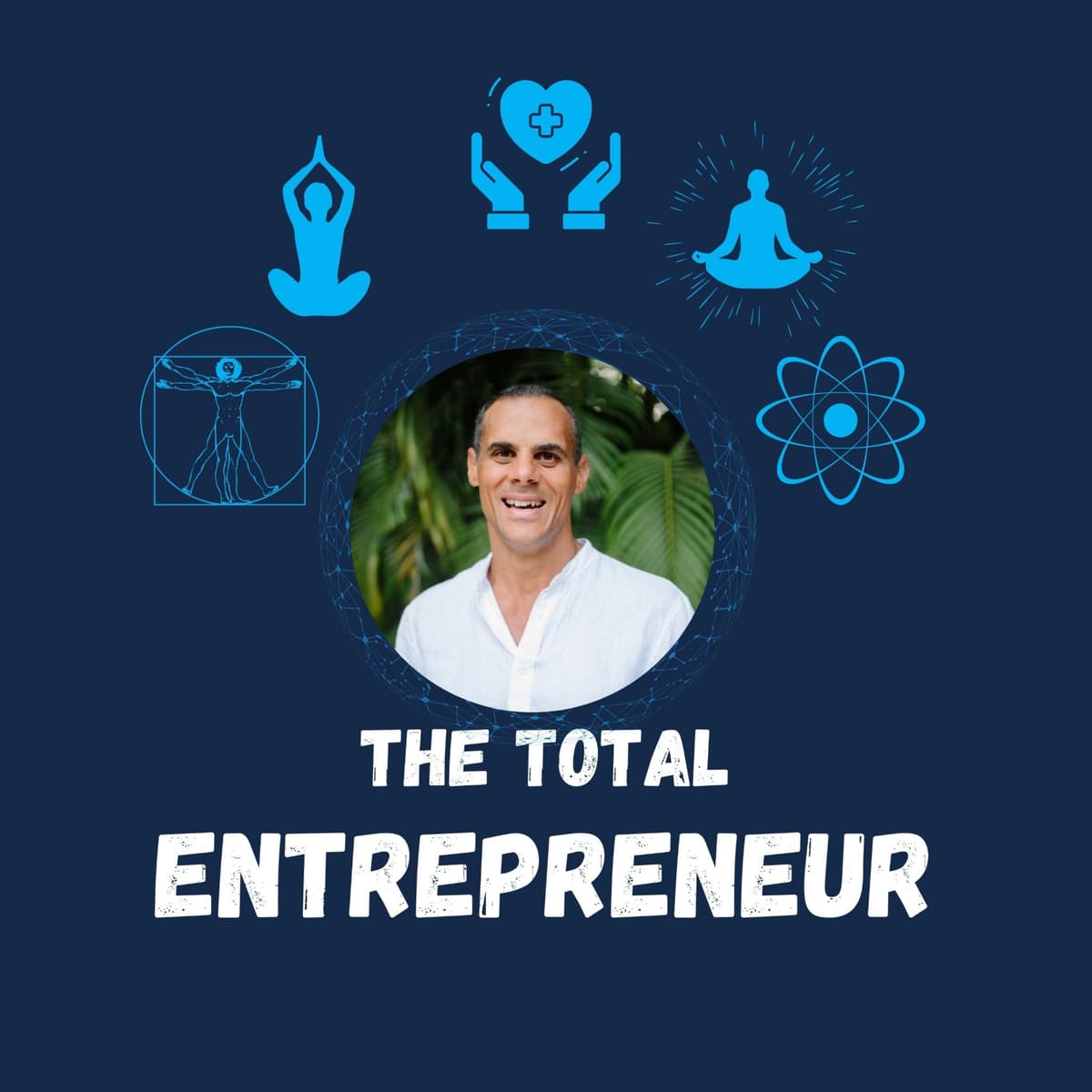
The ROI of Health and Fitness for Entrepreneurs with Timothy Jones
with Timothy Jones
Dec 6, 2024 · 00:40:26
Part of our conversations on
Welcome to The Total Entrepreneur Mind, Body, Spirit, where we turn cutting-edge science into practical strategies for entrepreneurs. I'm your host, Dr. John Torrance, entrepreneur, Inc. 5000 honoree, and professor of entrepreneurial practice at Syracuse University's Whitman School of Management. Each episode, we dive into mental, physical, and spiritual health with expert guests offering actionable insights to help you thrive and perform at your highest level. Let's get started. Today's guest is Timothy Jones. He is the CEO of Precision Nutrition, which is a behavioral health coaching education and technology company. PN has coached over 150,000 people in more than 140 countries. In addition, over 175,000 professionals have become elite coaches through PN's nutrition coaching certification program. Timothy has nearly 20 years of experience in strategy, product management, marketing, operations, and corporate development for some of the world's leading brands and public companies, including Kellogg's, CML Healthcare, and Procter Gamble. Prior to joining PN, Timothy co-founded a one-of-a-kind healthcare startup in partnership with SickKids, which was recently named one of the top pediatric hospitals in the world by Newsweek. He's been interviewed as a thought leader by Entrepreneur, Fast Company, Thrive Global, and Men's Health. Timothy's education includes a bachelor's degree in physics and kinesiology and a master of science degree in health science from Western University. He also has an MBA with a focus on behavioral science from Warwick University. His medical research has been published in the Journal of Rheumatology and the BMC Family Practice. In addition to his professional pursuits, Timothy coached football and hockey for nearly 20 years. Today, he mentors a number of his former players. He also volunteers his time as regional education chair for Young Presidents Organization, or YPO, in Canada. He loves kiteboarding, surfing, horseback riding, and salsa. Tim, welcome to the show, man. Really good to see you.
Oh man, it's fantastic. Thank you for having me on. Looking forward to this.
Yeah, I think it's going to be a great conversation. So one of the things I really appreciate about you is that not only do you do this professionally, but you walk the walk, right? I mean, you live these principles. I was hoping you could maybe just generally talk to us a little bit about the ROI for health and fitness for entrepreneurs, right? A lot of times entrepreneurs think, well, I'm too busy to focus on my health and fitness. I got to focus on the business, but it's probably not the best way to think of it, right?
I think you've nailed something there. We only have so much time and it makes a lot of sense. And that time is we have a business that we're trying to build and grow, and we might have kind of our personal lives, our professional lives, and looking at Hey, time is not a resource that I have a whole lot of. In fact, it's extremely limited. Many times the health and fitness aspect of our lives takes a backseat. And I think that happens in part because it's hard to actually quantify the impact of health and fitness activities. When you do it, people feel good and they may look good or whatever, something along those lines. But It's not right in front of us as if we were looking at a spreadsheet and seeing the dollars go up or the dollars go down. I think for that reason, many times this gets overlooked. But when you step back for a second and say, hey, why does this actually matter? Why should I pay attention to my health and fitness? I'm gonna tell you a little bit more. If I get a little bit too much in the details, let me know, John, cuz I love this stuff so I could get deep into it. But At the core of it is, as leaders, we're focused on problem solving, critical thinking, emotional regulation, and probably the biggest of all of those is decision making. If there was a drug that you could take to make you better at all those things, I think there was that movie back maybe when we were younger. I don't know about everyone else, but Limitless, where the guy took the drug and he got smarter and smarter and smarter, right? And everyone's like, yeah, I would do that. We have that drug. We have that with fitness. We have that with exercise. We have that with nutrition. And so, if you were to sit back and say, hey, how can I actually improve my decision-making ability? There's a path there.
Hmm.
And if I were to get even more specific about it, like our cognitive abilities are not static. They can be honed, they can be improved, but They also can be deteriorated. Stress, fatigue, poor health. When you are feeling a specific way, I think we could all agree we have that brain fog. Where does that come from? We feel a little bit more reactive. Where does that come from? We aren't clear-minded. Where does that come from? And so you talked about kind of investment a little bit earlier on.
Mm-hmm.
When you have financial capital, you invest it wisely, you get a great return. Cognitive capital also requires a holistic investment. This is where health and fitness comes in. So, if you were to think about this, like, hmm, if I were to get even more specific, more practical with this here for a second, stress increases levels of cortisol, which is really good in short bursts. You know, when we're out surfing, we're on there and you get that little kick, you love it. But over time, it impairs your cognitive function. You have memory problems, poor concentration, impaired decision-making. All of that impairs your ability to make great decisions. Now, contrast that with exercise has been very clear to show increases in blood flow.
Hmm.
Stimulation of brain-boosting chemicals, which help learning and memory and decision-making. It regulates stress by lowering cortisol. and releasing feel-good hormones. These all work together to improve your clarity of thought, your decision-making skills, your cognitive flexibility. Cognitive flexibility is a fancy way of saying, hey, my mind can bounce between different things and I can make better decisions. A big part of being adaptable and being creative. And so in a crazy changing world, how do we deal with this ambiguity? How do you integrate multiple streams of information? Well, you make your brain awesome. How do you make your brain awesome? I've just shared a whole bunch of things. This is where the return on investment comes from.
I love that. And yeah, you can feel the difference, right? And it's not only just the cognitive flexibility, you know, I guess that also translates to better innovation, more creativity, all those types of things that entrepreneurs need.
Absolutely. So when you're sitting in there and you think about kind of the importance of kind of cognitive flexibility, flexibility and adaptability. And if you look at kind of foundational components that contribute to creativity and innovation, it is simply put, your mind being able to think across multiple different domains, take in a whole bunch of different information. I think we'd all agree if you're tired and you're stressed, you don't do that well. And intuitively we know that part, but the part that gets missed is How can I improve and not be tired, not feel stressed, not feel foggy? And this is where kind of the exercise fitness fall into place. And that's where you get that deep return on investment.
Yeah. And I love the analogy of, you know, if there was a drug to take, we would do it. Right. And in fact, we have these endogenous drugs already. Right. We just have to access them and release them through physical activity and proper nutrition and things like that.
Right. Exactly. And it's interesting, every day, many of us in the business space, if you will, or not, grab this little cup of— I've got water right now, but my coffee cup is, you know, over here.
Yeah.
And so we're actually already proactively, we know intuitively, hey, there are chemicals that can help us be clearer, think better, do more. And this is a natural way to do that.
Yeah. So like I said earlier, you walk this walk, right? So not only are you the head of a company that deals with nutrition, but you're a pretty fit guy. I mean, We've surfed together, we've hung out. It's actually kind of annoying standing on the beach next to you. But, you know, that, that aside, you know, there was this really cool Men's Health article that you were part of, right? So walk us through this process because I think as an entrepreneur, as a CEO, and as just somebody into fitness and nutrition and athlete, I think it's really interesting, this journey you went on.
Yeah. So I could talk about this for a long time, John, and I'm going to give you the not long time version of it. All right. So as the CEO of Precision Nutrition, you would think, okay, you got to be in the best possible shape, right? There's a certain expectation that comes with that, that I think is a fair expectation because it's important you walk the walk if you're going to encourage people to take certain steps in their lives. And for me, I had been what I would consider outwardly healthy for the better part of my entire life. I've been an athlete all the way through from being a young lad all the way up until I still consider myself an athlete. And back in 2015, I went to a clinic. A company we were working with had a really cool blood testing program, and I did the blood test with one of my colleagues and saw that I had high cholesterol. This was 2015. I was surprised, very surprised, because I regularly exercised pretty intensely, actually. Both my boys were playing hockey and football, and I was doing that with them.
Yeah.
And I was sitting maybe at 11, 12% body fat, which is by all accounts relative to the regular population, very, very lean. But I still had high cholesterol and started to do some more work there and realized this runs in my family. My younger brother had it, both my parents, my grandparents, et cetera, et cetera. So I spent a number of years trying to figure this out. As CEO of this company, I should be able to figure it out. And I couldn't. I was doing blood tests literally every 2 weeks to every month for the better part of 2 and a half years, trying a whole bunch of different interventions, mainly nutrition. But my nutrition was already good. That's how you maintain that level of leanness, right? So I tried a bunch of different things. I started having a glass of red wine every day. I didn't actually drink before that. This was back, you know, so don't fault me. This was a few years back before this more recent. So this is 2015. We didn't have all the research we have now. You know, just a whole bunch of different things, different fasting protocols, all the things that you would see out there. Fast forward, a number of things didn't work. COVID came in there for a few years, and then I had a group from Rapid Health Optimization, some individuals who were actually trained by Pien, who had started a new program and said, hey, Tim, we'd like you to try it. And I did. Through that, I got into literally the best shape of my life, and I was already in pretty good shape, John. It was a mix of literally everything, specifically a very clear protocol on VO2 max training, cardiovascular training.
Yeah.
Something I had never done before at that level.
And, and one of the best predictors of longevity too, right, is VO2 max.
Exactly. Exactly. On the eating side, there was a whole lot of things that I had really changed, but specifically It was a lot more whole foods, a lot more fruits and vegetables, more fiber. And that happened through the fruits and vegetables and other intentional choices.
Right.
Higher amounts of protein and increased hydration. So those were the changes there. I definitely had a clear focus on sleep. And one of the biggest factors, as we bring this back to what we're talking about, mental clarity, productivity as entrepreneurs, was stress management. At PM, we do a whole bunch of psychometric assessments to do hiring. We have very clear systems around that. And I always had a story that I'm chill, things don't bother me. And the people around me would reinforce that story and say, you're always so even keel. I have these assessments that say that. And I actually felt like that. You know, I always thought I'm really chill. I used a glucose monitor and I have the Oura Ring. I would see these blips throughout the day in the glucose monitor that were in the normal range, but that it wasn't associated with food.
Hmm.
And I didn't know where that came from and started to figure out through the ring and through this, there are cortisol pops to increase glucose. So it's effectively, I'm having stress responses throughout the day and I'm from the brain. They added a new function for stress response. So I'm seeing stress responses happen throughout the day. So it wasn't that I am super chill and maybe I have great emotional regulation, so I didn't know it. I was completely unaware of the physical impact that was happening on my body. And so that was a massive insight.
Yeah. You know, so I've done a few talks on, you know, this whole idea of becoming the CEO of your own health, right? And one of the analogies is that as a business owner or a CEO, You have KPIs on the business, right? And you watch those, but we don't really do that with our own health. And I wore a glucose monitor for a while too, just because I wanted to know how my body reacted to things. I wore the Oura Ring.
Yeah.
I was doing all sorts of things. Right. But yeah, I think it's really important in your case, like outwardly you were an image of health, but internally you were having these spikes in your glucose and you had high cholesterol. So it goes to show that we don't really know, and it's really important to take our own data.
Yeah. Yeah, I think this is an interesting thing. You know, in our businesses, we have KPIs, as you said. And pre-working with this group, I never tracked. I knew my body fat percentage and my weight. That was it. And I swore I would never track what I ate, all these different sorts of things. I wouldn't do that. And they're basically, well, then you don't go in the program. Okay, okay, fine. Once I saw and got access to the insights that were coming from these various different Items that I was tracking, it was mind-blowing, and it occurred to me that I was really, really missing something. Now the message here isn't go out and get a ring and glucose monitor and all that. That's not what the message is. Message is I did all these things. I literally spent tens of thousands of dollars on this project. I did MRIs. I did CT scans. I did DEXA scans. I did VO2 max testing. You know, I had the rings. I tracked food circumference measurements, body fat measurements. coronary, CTA, everything. You don't need to do that. I did that. I can tell you what I learned and you can just take the, take the learnings. And the learnings were, for me, was as I tracked these things, I started to get a very clear picture of the things that truly do matter.
Yeah. So what are some of those things? Yeah.
So I would say based on what we were talking about a little bit earlier on is I found one thing very, very useful. Well, not one thing, many, many things that were very, very useful, but One thing that I think would pop for a lot of people is how do I figure out, how do I have time to be able to do this? And intensity matters.
Hmm.
It is one of the biggest factors that I found were able to allow me to coordinate time and effectiveness. So when you're thinking about return on investment, if you can incorporate intense activities into your life, you don't have to do them for long periods of time. Ah, right. You could actually get a remarkable effect. That's where the VO2 max training really, really came in for me. That was a big, big factor there.
Yeah, I've read about high-intensity interval training and how effective it is, right? So that's kind of what you're talking about?
Exactly, exactly, exactly. So for me, what that might look like to make it even more practical is one of my VO2 max workouts is a warm-up 1 minute getting my heart rate into 90, 95% of my heart rate max, and then a minute of slow. And that's 10 times. It takes you about, you know, 25 minutes with the warmup and a cooldown, maybe 30. That's doable, you know?
Yeah. And how do you do that? Are you using a machine? Are you outside running? Like, what's the—
Yeah, yeah. So for me, it's either on the bike or on the treadmill.
Okay.
Gotcha. Yeah, yeah, yeah. Bike or treadmill. I've tried it with rowing. I don't find I kind of get up with the back and forth movement. I don't get up enough in terms of heart rate. Maybe I'm not quite doing it right. There's Assault Bikes. There's a bunch of different ways that you can do it. Yeah.
So it doesn't really matter the activity. It's really just getting the heart rate up into that 90% zone for a short period of time and then allowing yourself to recover. Is it a 1-to-1 ratio that you do? So 1 minute really high, 1 minute recovery?
Yeah. So that, I mean, I have a few different protocols. That's one of them. Another one is a 4 and 3. So it's four minutes on, two minutes off. I think it's a Norwegian protocol, and that would be done four times. Those are my two most common ones. And then there's the you know everyone talking about zone two training, zone two cardio, right? Right. Yeah, yeah. Zone two cardio. So I try to work that in once a week, and I have a bunch of other activities that I do. Another insight from this is it has to be fun.
Right, because you won't do it, right?
Or you're not going to do it. And so I've termed it almost like recess, where you get to go out and play. So I got into other activities like boxing, Muay Thai, Krav Maga, and I go there and I built a little community of people that I would have a whole lot of fun with. And it doesn't feel like exercise, but these activities themselves have a VO2 max component to it. They have a cardio component. They have a strength component. They allow you to kill— I don't even know if you can say that, right? Or kill Kill a couple birds with— a bunch of birds with one stone. So finding those activities so they start to pull on different levers in your life, the social need that you have, the emotional need, the connection need, the relational need, and then the physical need. So when you can pick activities, not only as we think about the intensity part of this, but what are activities that tag a whole bunch of areas in your life versus just one specific area? Like going on the treadmill doesn't really do anything for those other aspects.
Right.
But boxing does, or surfing does, or whatever activities that you might enjoy in a group environment.
Right. Because it's, it's got to be sustainable and it's got to be something that you want to do right in order to achieve those benefits.
Exactly. Yeah.
So I still think the problem for like even a lot of the young entrepreneurs I work with, it's always time and it's kind of prioritization. So I guess it's really just a matter of just doing it and then seeing the results to the extent that you want to keep going, maybe.
You know, I think that's a big part of it. I think you hit on something when you sit back and say priorities, choices. This is a conversation that I commonly have with people that I'm working with or mentoring, so on and so forth, is that's ultimately what it comes down to is, oh, well, these are all my priorities. Well, if you have 5 priorities, you have no priorities.
That's, yeah, that's way too many, right?
You know, that's, that, that's one way. Or I hear I prioritize X, Y, and Z. And X is really important to me, but I keep putting Y over and I keep doing it over and over again. That's my behavior. Well, then that means Y is more important than X. Yeah. For those that got caught up in algebra, I hope I didn't overcomplicate it, but that's, you know, that's the fact is ultimately all of this starts with a very clear priority, a clear choice. that I want to commit to it and then following and finding the smallest possible thing that you can do to get started.
Yeah. It requires a little foresight too, right? Because, you know, it's easy just to plow through life, you know, and look at only what's in front of you. But when you think a few decades ahead and say, you know, do I want to spend my last few years managing chronic disease or do I want to spend it enjoying all of this amazing wealth or this lifestyle I've created as an entrepreneur, then the choice is easy. But you have to think that far in advance.
And that's, you know, I get it. It's bloody hard.
Yeah.
I think the conversation, nobody would say, no, I'm not thinking about my future self. They're thinking I have time to correct or I have time to do it.
Yeah. Especially if they're really young.
Yes, exactly. I'll do it when. And so I've tried to have this conversation and say, you know, When you make a choice, what would your future self say back to you at that point in time? And they're like, well, it'll be okay. So I wouldn't necessarily say, I mean, what's the short-term return on investment here is how I would look at this versus the longer version of yourself, depending on the age of the entrepreneur. Some people might, but short-term, if you sit back and you say, hey, fitness and nutrition boost energy, focus, decision-making, where you get immediate productivity gains.
Mm-hmm.
Then that's the reason. You know, it's about finding your reason right now that's going to get you out and doing the things and finding a small action. So, as I said, my thing is 25 minutes for some of that work, but you can do bursts of Tabata training in, I think, like it's 20 seconds on, 10 seconds off.
Right.
For 8 rounds, that's 4 minutes and something. You know, we're talking not about perfection. We're not talking about having to do everything. We're talking about something versus nothing.
Yeah. Consistency, right?
Yes. And I'd love to expand on that for a sec, if you wouldn't mind.
Of course.
Yeah. One of the things we've learned at PN, when you look at this industry overall and you say, okay, where do people get lost? And There's a lot of misinformation out there in this field. The challenge that I've seen is that people by and large are focusing on the wrong thing. It's like, what's the one best diet is probably one of the— or what's the one best exercise program?
Right.
And it's the wrong question because the research and our lived experience, we've worked with over 150,000 people. is that it's not the answer to that question. But as you said, it's consistency of action versus a specific program that leads to massive improvements in health and fitness. Yeah, we wrote an article a while ago called the Million Data Points article. So we had a million data points on 1,000 of our clients, and we ranked them by their end results. So we looked at girth, Girth measurements and weight loss. What we saw— oh, sorry, relative to consistency. What we saw was, as you'd expect, people who were more consistent saw improved results. But the group that had 29 to 50% consistency still saw statistically significant improvements. Wow.
So it doesn't even take that much.
So consider that for a second. 1 out of 4 days a week, right? Like 25% of the time to even half the time, people saw significant results. My friends, the answer here is consistency. It's not perfection and it's not trying to find the one perfect thing to do. It's just doing something on a regular basis. Yeah.
And I think a lot of it is what works for you, right? So like the same diet or, you know, as Attia calls it, nutritional biochemistry, right?
The Yeah.
Yeah.
Yeah.
The same diet that really works for me might not work for you just because we're built differently.
Right.
We react differently to things. So yeah, let's talk about nutrition a little bit. And I know it's impossible to say, hey, this is the one approach that's going to work for everybody, but can we distill it down to like a couple of best practices or tips that are general enough for people to start implementing?
Yeah, I absolutely think you can. Yeah. The best way I would describe this is pay attention and balance what you're putting in your body. Okay. Get enough protein, enough fiber, fruits and vegetables. Eat as much of your diet as you can from whole foods. So not out of boxes or packages. You don't run your business off templates. You're not going to use somebody else's template.
Right.
Right. Something that's quick and, oh, you just fill in the boxes. That's the equivalent of processed food for me. Like it's something that you just kind of wield up together and it's repeatable and scalable and That's not going to make your business different or differentiated or get you great returns.
Right. It might keep you in business for a little while, but you're not going to break any records, right?
Exactly. And then the last one is try to get, you know, 95% or more of your hydration, your liquids from non-calorie beverages. Yeah. I would say, you know, if you do those things, and this is one of the other challenges, John, Is those things make up, I would say, 80% of the results that you would get. We get into all these other things, nutrient timing and all these other different strategies and supplementation, all this sort of stuff. If you don't do these things, forget about all the other things.
Right.
But if you can just do these things, you will see a tremendous response In both your body, your mind, and, you know, I'll say your soul as well. I think that's what I would describe it.
Yeah. So keeping it simple and staying consistent seem to be the keys, right? But it's hard when you're a busy entrepreneur, especially like in startup mode, right? Like ultra-processed foods are everywhere. They're so easy, they're convenient. And, you know, I see so many people eating them and like you, I've eliminated ultra-processed foods because You come to learn that they're not even really food. They're like chemicals that are just being introduced into our food supply that are wreaking havoc, right? What are some things that super busy people can do to just at least start to make their way into whole foods and start eliminating ultra-processed foods? How can they approach that?
Environment drives behavior.
Yeah.
And is the biggest influencer on behavior that people don't talk about more than anything else. Myself, people say, oh, you must be so disciplined. You must have high willpower. I have neither, nor do I want either. So I've tried to make this so I don't have to think about it, that I don't have to implement discipline or willpower. I need those for other parts of my life, not things. And so where can that start? In the environment. They don't come into the home they don't come into the office.
Mm-hmm.
Because as you progress, as you get stressed, as you're under pressure, your capacity for willpower, discipline, whatever, like, declines remarkably. And your desire for these sorts of quick-hit foods goes up massively. So the bigger it gets, the more likely you are to respond. So don't even have them in your environment. That's number one.
Yeah. Okay. Because then, then you can't access them, right?
Exactly.
And by the way, there's this addicting quality to them anyway, right? Like, so you eat them and they don't really satiate you. They just make you want more of it.
Oh, you've got it. Like, you, you want to, you would go into the food science industry. These things are designed like the ratio of kind of salt to sugar, to flavor, to kind of that great mouthfeel, all those things like Make no mistake, the way you all design your products to be the most effective possible thing for your clients, these individuals are doing for your mouth.
Yeah.
To make it taste and give you a great response. So yeah, I mean, that's the first one is not having them there. I, I would say the second one is no different than being in your business. You plan. You would never just go into things and not plan. and just say, hey, we're going to wing it. Well, maybe some people do, but I prefer not to.
Right.
So you sit back and you take the time and you actually make that plan and say, okay, here's something I want to eat for the week, and make the plan so you don't have to think about it again. What I'm not saying is try to plan every single day because I don't think that's sustainable, or every moment, every hour. But, hey, here's what I want to eat for the week, and then pre-prepare the foods in advance. Similar to your strategic planning meetings, you're building a plan. When you build a plan, you pre-prepare the foods, and usually that is your proteins for the week, if you have some of the complex carbs that you want to use for the week, and then having the access. And you now have in your environment, bring into your environment, the fruits and vegetables and different whole foods that you want to have. So you've always got some healthy in and around you to eat when you need it.
So I guess it boils down to taking the same approach or intensity you would to running your business, to running your body, right? Because you're the key element in your business, especially at startup. And if you're not performing optimally, that's going to translate right over to your business.
Yeah, absolutely.
Yeah. So, well, tell us a little bit about Precision Nutrition. That's a really interesting company. And you guys are doing great things for a lot of people. Talk to us a little bit about what you guys do.
Yeah. So I love this place. As you can imagine, it kind of is a perfect merge for some of the things that we're talking about right now. So PN is a Health education, coaching, certification, and software company. So we have education programs for health and fitness professionals or aspiring health and fitness professionals. And our focus areas for that is we take a very holistic— I was talking about a reductionist approach before, kind of a first principle holistic approach, whole person approach, where we look at sleep, stress management, exercise, nutrition, all through the lens of behavior change. And we coach people on how to improve those in their lives, adopt healthy habits, build healthy practices in a very sustainable way. And then we certify health and fitness professionals to be able to coach other people on those same things. And then we have software that helps people coach within those specific domains. So, that's kind of the main parts of our business. And we've been doing that for the better part of almost 2 decades now. We're almost 200,000 individuals that we have gone through our education programs.
Wow.
And 150,000 have gone through our coaching programs.
Wow. Amazing. So, I mean, over the course of 2 decades, a lot has changed in this industry. How do you keep up on that and how do you stay sharp?
Yeah, yeah, yeah. So a lot has changed, but human biology and human psychology has not.
Ah, good point. Yeah, right.
Um, on the, on the product side, certainly like technology, how you would actually deliver the products and how you're educating people and where they're consuming information and certain fads and trends and stuff like that, they all come up for sure. But in the end, when you sit back and you take a whole person approach, you're not only considering what people eat and how they exercise, but why they make certain choices. And so we're looking at emotional, psychological, environmental influences, aiming for long-term behavior change instead of quick fixes.
Right.
Those sorts of things just haven't changed. Now, as I said, from a technological standpoint, certainly, as you have brand new tools like the new LLMs, new AI tools, They're allowing us to do some crazy cool stuff. And, you know, think about it this way, John. Imagine you have— and I'm stealing from Apple here— when they first came out with the iPod.
Mm-hmm.
Remember they had 10,000 songs in your pocket?
Yep.
That was their— the way on the shadow. For us, the way I, I think about that is imagine having a companion that's available for you 24/7 in your pocket anytime you're struggling. I'm struggling right now. I have a craving for X. Or I wasn't able to go for a run. What kind of exercise could I do? You know, 5, 10-minute little routine. I'm out at a restaurant. I don't even know what I should eat. You know, take a pic.
Mm-hmm.
I don't know what to make for dinner. Take a picture of the fridge, make a recommendation. There are amazing tools available now to help people in real time. And I think that is, you know, as we think about the progression of how when we are trying to help people make great decisions in real time based on the principles we know. We now have some new technological tools that are helping us do that in a more meaningful, more personalized way.
Yeah. So where do you see this going? I mean, it feels like we're just at the bottom of this exponential curve, really, right? Like, especially in your industry, where would you imagine this going?
Yeah, I think by and large, if I were to kind of project it out. There is this ability to scale any kind of solution where you have an algorithm that can access real-time data on your behaviors and your health metrics and make constant recommendations or help you navigate something you might struggle with. That's where I see it going. I think a lot of the challenge in this industry is, we talked about, is people are like, you know, what's best to do? What's the best program to do? And then people are like, okay, on Friday I've got the program. I'm set. I have a meal plan. I have an exercise plan. Then Monday comes. Kids forgot their lunch. I have meetings all day. I forgot my running shoes. Dot dot dot dot dot.
Something comes up. Yeah.
Something comes up, and that is real life. Right? When we get the program written out, that's not real life. That's just what you should do. It's how to incorporate it into your life. That is where everything falls down. And this is where I see some of these tools being available to you right now. As I said, I forgot my running shoes. Damn, what do I do? Well, if you have, you know, some people who are really maybe a little bit more high willpower, disciplined, some they might jump on YouTube, some, you know, they could do a little bit of a search, but that's probably more the exception. And then you spend 20 minutes trying to find a program and then your time's up, you know, and then something interests you and you're like, oh, that's interesting, maybe I'll try it. Who's that? You know, versus now in my pocket I can get a bodyweight workout literally right then and there that I can do in that moment in time. I forgot my lunch, I walk by a place, can give me a specific recommendation at that point in time. I think that's where these things go. And even further, now imagine where it's got access to your calendar. And, you know, you're having a dialogue and it says to you, hey, remember, you can't work out, or you gotta remember to bring a lunch, or you're gonna be going out for dinner on Thursday and Friday. You're gonna be away at a conference.
Ah.
You're not thinking about that in the week before or on the Monday. You're like, oh, I totally forgot that.
Mm-hmm.
So you've got something that's super personalized based on your immediate behaviors, and then you can tap on your health metrics. Like you've got all these different devices that may say, hey, you're running a little bit low. Today in terms of energy, your HRV might be down. Okay, we're going to adjust your workout this way. That's where I see this going.
Yeah. So it sounds like, you know, highly personalized based on your own biodata and kind of taking into account your lifestyle and that sort of thing.
Exactly.
Yeah. That's amazing. If you could give young entrepreneurs one key tip, what would it be?
The very first thing is finding your why, your purpose. for doing it. That's the very first thing. And having that and sticking that somewhere that you can see all the time, because that is the core behind what's going to get you into these behaviors.
Yeah, so true.
That's the very first thing is, what is my purpose? What do I want? What am I looking for? What is driving this? Then that allows you to then go into the next phase, which is, what is the choice I am going to make? I've now made this a priority. What choice am I going to make? And that choice is I'm going to do this. And then the next choice stems outta that is when am I going to do it and committing some time to be able to do it. The next is pick the smallest possible thing to start with, which is gonna run completely opposite to all of us as entrepreneurs who want to do something amazing in the world. Right?
Yeah.
You're already doing that. You're gonna be doing that in your work. You don't need to build that aspect and take that approach in every single aspect of your life. For this one here, Do the opposite. The smallest possible thing you can do to get started.
Hmm.
And find a social activity if you can that you love and start to get involved. If that's not possible, find an activity that you'll love to do and try out a couple. If you don't like one, try another, try another. No different than you would experiment in your business until you find something. No, that's good advice.
Start with something, start small because it's, it's easier to build a habit once you've established a little bit of a routine, you know, and then hopefully you start to feel better, look better, realize the benefits, and it makes you want to do it more. And then, you know, maybe it becomes a, you know, just part of your life and you know why you're doing it is because you want to have a long healthspan and, you know, live vitally up until your older years.
Yeah.
So you can enjoy everything you did. Yeah. That's cool.
Yeah, absolutely. Absolutely. And I will promise you this, you will see if you truly believe that the decisions you make as a leader and how you show up as a leader are fundamentally critical to the success of your business, this is that drug that we talked about that will improve your immediate decision-making, how you show up, your emotional regulation, your self-awareness. It will do that extremely fast. I can assure you will see the immediate benefits. And then that, as you said, will expand out. Your body starts to then crave it like it will anything else, and then it becomes a natural part of you.
Yeah, that's great. So Tim, if people wanna learn more about you or your company, where could they go? Where could they find you?
Yeah, so they can go to precisionnutrition.com and learn more about PN there. And if you wanted to connect with me, I'm on LinkedIn. I think it's Timothy Joel Jones is the little tag or the end part of the URL there. Yeah.
And how can they find the article you published in Men's Health?
So that's available if you're on Apple Health or if you went to the Men's Health website. And then again, just look up Timothy Jones. Cholesterol would probably be the other keyword there. Yeah, I don't think I talked about there through that whole program that I ended up going through. I did end up dropping my bad cholesterol levels by almost 50%. Obviously got in some of the best shape of my life. And yeah, it's a pretty cool article that will give you a much tighter summary than our conversation today. Yeah.
If anybody's interested in checking it out on Men's Health, it's called The Simple Steps That Cut This Guy's Cholesterol in Half and Got Him Ripped. And it looks like it was published back in July of '24. So yeah, if you want to check that out and get a deeper dive on it.
Great.
Well, Tim, thanks so much for being with us. You gave us some good stuff and hopefully this is something young entrepreneurs can use, you know, to add this component into their lives and build better companies and just be healthier. So thank you.
Awesome. Thanks, John. I really appreciate the opportunity to be on today.
Thank you so much for listening to the Total Entrepreneur Mind Body Spirit Podcast. If you liked what you heard or heard something interesting today, please give us a like, share a comment, or better yet, subscribe to the podcast. Thank you.
About This Episode
Often, business owners neglect their wellbeing due to time constraints, yet physical health is essential for enhancing cognitive abilities, decision making, and creativity. In this episode, Dr. John Torrens and Timothy Jones discuss the importance of prioritizing health and fitness for entrepreneurs. By investing in fitness and nutrition, entrepreneurs can naturally boost cognitive function, adaptability, and stress regulation, leading to improved decision-making and innovation. Timothy Jones, who personally embodies these principles, shares insights from his experience in the nutrition industry and his active lifestyle, emphasizing the tangible benefits and return on investment of a healthy lifestyle.
About Timothy Jones:
Timothy Jones is the CEO of Precision Nutrition, which is a behavioral health coaching education and technology company. PN has coached over 150, 000 people in more than 140 countries. In addition, over 175, 000 professionals have become elite coaches through PN's nutrition coaching certification program. Timothy has nearly 20 years of experience in strategy, product management, marketing operations, and corporate development for some of the world's leading brands and public companies, including Kellogg's CML healthcare and Procter and Gamble. Prior to joining PN, Timothy cofounded a one-of-a-kind healthcare startup in partnership with SickKids, which was recently named one of the top pediatric hospitals in the world by Newsweek. He's been interviewed as a thought leader by entrepreneur, fast company, thrive global and men's health. Timothy's education includes a bachelor's degree in physics and kinesiology and a master of science degree in health science from Western university. He also has an MBA with a focus on behavioral science from Warwick university. His medical research has been published in the Journal of Rheumatology and the BMC Family Practice. In addition to his professional pursuits, Timothy coached football and hockey for nearly 20 years. Today, he mentors a number of his former players. He also volunteers his time as regional education chair for Young Presidents Organization or YPO in Canada. He loves kiteboarding, surfing, horseback riding, and salsa.
Keep listening
More on Business
About the Host
Dr. John M. Torrens
5× Inc. 5000 entrepreneur, Professor at Syracuse University's Whitman School of Management, author of Lightning in a Bottle, and TEDx speaker on ADHD as an entrepreneur's superpower.
Browse all podcast guests →Book a strategy call →