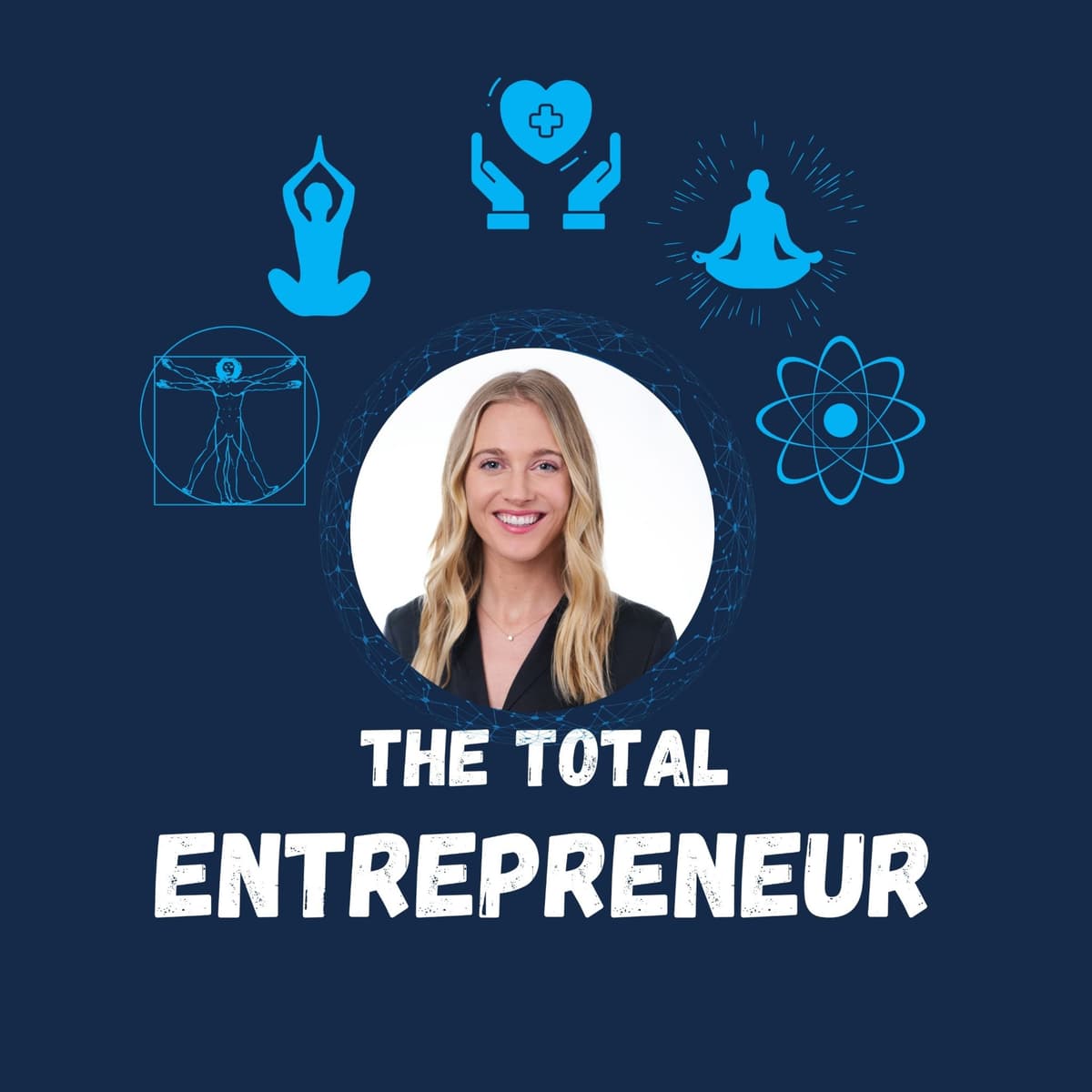
Building Mental Muscles™ with Olivia Bowser
with Olivia Bowser
Nov 15, 2024 · 00:33:06
Part of our conversations on
Welcome to The Total Entrepreneur Mind, Body, Spirit, where we turn cutting-edge science into practical strategies for entrepreneurs. I'm your host, Dr. John Torrance, entrepreneur, Inc. 5000 honoree, and professor of entrepreneurial practice at Syracuse University's Whitman School of Management. Each episode, we dive into mental, physical, and spiritual health with expert guests offering actionable insights to help you thrive and perform at your highest level. Let's get started. Today's guest is Liv Bowser. She is a leading voice for wellbeing and mental health in the workplace. She was listed as Forbes 30 Under 30 as the visionary behind mainstreaming mental fitness at work and in life, and for trademarking mental muscles. Liv is the CEO and founder of Liberate and is a certified meditation, mindfulness, yoga, and breathwork teacher. Her Liberate Journal is Amazon's Choice for mental health journals. Liv has been featured in renowned publications as a mental fitness expert and has led talks and workshops for hundreds of global organizations. What I really love about Liv's work in mental health and wellbeing is that it's relevant for entrepreneurs for so many reasons. As we'll hear later, it's clear from the literature that entrepreneurs work really hard and often to their own detriment, but that there is a real ROI in prioritizing overall wellbeing, which includes mental health. So let's get to the interview. Liv, welcome. I'm really excited to talk to you. So my first question is that, well, first you're an accomplished entrepreneur and you've got a growing company. So before we get into it, tell us a little bit more about Liberate and how you came up with that idea in the first place.
Definitely. Liberate is a mental fitness platform that supports individuals and teams with mental wellbeing. And it was really something that was born out of my own experience with mental health, specifically at work. I never thought a ton about mental health growing up, had a little anxiety in college, but was able to kind of push it to the side because I was just having so much fun. And then once I entered the working world and the real world, as we call it, It really started to develop into regular anxiety, panic attacks, regularly feeling overwhelmed, stressed, burnout, things like that. And I didn't know how to handle it. I was working, I had a high-pressure job, I didn't know how to set boundaries, and I kept turning to physical fitness to try to feel better. But no amount of running on a treadmill made me feel like I have a better relationship with my anxiety or you know, the resilience in the face of challenges that I wanted. And that was when I turned to mindfulness. I had heard that it could help. And so I started practicing meditation and breathwork and yoga, which helped a lot. It helped me feel much more stable, much more cool, calm, collected, no matter what life threw my way. What I noticed during that time though, was that there were so many resources available for my physical fitness, And not much available for mental fitness. And so I really wanted to take inspiration from the community organizations and resources like a boutique physical fitness class or a gym that are available for your physical wellbeing and apply that to mental wellbeing so that people could have a proactive practice to build mental strength, not because anything's wrong, but because we wanna feel healthy and good mentally on a daily basis. So that was really the inspiration behind Liberate. And then we started offering on-demand resources, live virtual classes for teams. We have a Slack integration, we have a bestselling journal on Amazon. So we really focus on providing accessible and approachable ways for people to take care of their mind.
Yeah, I love that. So you come up with the idea, but then there's a big gap between the idea and the launch of the business. What did you do once you thought, hey, this is what I'm going to launch? How did you get there?
Great question. I had the idea, I think, maybe 2 years before actually launching anything. It came to me because a bunch of friends were sitting around talking about how insecure they felt, how stressed they were, whatever it was. And I was thinking, we all need like a confidence boot camp. We need some class where we can go to where everyone sits in a circle and gives each other affirmations like, partially kidding, but then I was thinking, what would that look like if it lived on ClassPass, which is this platform where, you know, different fitness classes are available to people? And then I just got obsessed with that idea and exploring that opportunity. So I was working at a startup at the time, but I would spend my evenings researching. I had gone to Whitman. I knew how to make a business plan. And so I literally copied my business plan from college and deleted all the content to fill it in with this industry, to fill it in and see what the opportunity is, what the market is, who's lonely, who's mentally unwell, and really prove out whether or not it was worth exploring. I had never started a company before. I didn't really have any intention to start a company, but I was really obsessed with this idea. And so I probably did that for maybe 6 months. I would go to coffee shops on the weekends and just sit on my computer and research and build out this plan. And then I had built a website. I was just tinkering. It was like a passion side project. I didn't know what I wanted to do with. And then COVID hit and I had a lot more time because I was no longer commuting an hour each way to work. So I had a lot more time to work on it. And, you know, previously maybe anxiety was something people didn't talk about as much, or a lot of people didn't think they ever had anxiety. And then all of a sudden everyone has anxiety and everyone's mentally unwell and everyone needs support. And so before, when it was maybe this niche thing that I talked about with my girlfriends and I knew that I experienced, then it became something that everyone was experiencing. So at that point I was like, okay, this is the moment. I'm just gonna start it and we're just gonna do classes over Zoom. We're just gonna see if we can help people. So that's how it started, leading free classes over Zoom. Probably like a year after I actually started working on it. And did that for a couple months and then realized that companies really wanted support for their teams during that time. It was such a scary time for organizations that had never worked remote. Now they're all remote. Nobody knows how to connect. Nobody knows how to support each other. So we started leading these meditation classes or, you know, gratitude workshops, things like that for different organizations. About 4 months into having trial run any classes at all. It could just kind of snowballed from there, but that's how it got started.
I love that because you experienced the pain you were trying to solve, right? You experienced anxiety and you were working on your mental health, so you thought up a company and you launched it to solve it. That's amazing. So how do you get that first customer, right? That's always the hardest part. I mean, it's kind of easy and fun to think up ideas, But how did you get that first customer?
That's a great question. And I feel like I had the biggest misconception about that as a first-time entrepreneur. I truly believed if you build it, they will come. You know, I built a beautiful website and I had a social media plan and I had built curriculum for the classes and I was certified in all these modalities. And I was like, okay, where is everybody? You know, I built this, you know, what are all my customers? And it was a lot, a lot, a lot of outreach and hard work to get people to come to class. It was DMing every single person who followed me on Instagram. It was emailing my cousins, emailing my mom's friends, like just asking every single person I was connected with, whether it was like Facebook, LinkedIn, email, social media, to come to a class. Free first class, like giving things away, offering merch. Whatever it may be, there was a natural interest because of the time, because people were home and they literally had nothing else to do. So I would ask them to come to a class and they would oblige because they didn't have anything else to do and they were stressed. So that, you know, circumstance I think helped our uptake of everyone I reached out to. But it was so much manual labor and outreach for the first 2 years, probably even with corporate clients, like I'm reaching out to somebody on LinkedIn who works at Mike's Hard Lemonade and asking me to introduce her, introduce me to her HR department. Like that was how it all happened in the beginning. It was a lot of blood, sweat, and tears.
Right. I think that build it and they will come mentality is really common. I mean, I see it a lot in young entrepreneurs. So it's interesting that you were launching a company to help people with their anxiety, But in the process of the launch, you were experiencing anxiety.
Yeah, there's a lot of irony in, I think, being an entrepreneur but then also working in mental health and caring about mental health, because entrepreneurs are known for burning out and having poor mental health. It's super stressful. But I think because I had so many practices I had put in place— I had burned out, I had learned from my burnout, and then I had built this really robust mental health toolkit. So I knew when I wasn't feeling well, I knew when I needed to take a break, I knew when I needed a confidence boost, or when I needed to go for a run, or when I needed to zone in for 4 hours. Like, I had a level of awareness toward my well-being that was built through years of practicing and dedicating time to it that I think I was in a way better position than most entrepreneurs to be successful or to grow a company? Because gosh, I can't imagine building a business if you don't have those tools to support yourself. Like, it's so hard even when you have them. So if you don't have anything to support your mental health, like, there's no way.
Well, more and more research is coming out about entrepreneurs, and it goes beyond venture performance, right? It, and it spotlights things like psychological wellbeing, and it's painting a pretty clear picture that things like entrepreneurial intention and entrepreneurial competency, these things are positively affected by mental and psychological health and wellbeing. So we know based on the research that, you know, the grinding, you know, pulling all-nighters, suffering for the company type of entrepreneurship is 180 degrees away from what we know we should be doing. And I know you've trademarked the 5 mental muscles, and I really love that as a concept, and I think they're really great tools. So can you talk about the 5 mental muscles? Like, you know, describe each one of them for us?
Definitely. I also think they're really cool. So Liberate trademarked the concept of mental muscles, which was really modeled after physical fitness. You know, you go into the gym and you lift dumbbells to tone your biceps. At Liberate, we move, journal, breathe, meditate to tone mental muscles, which are presence, courage, gratitude, confidence, and resilience. And within each mental muscle, there are different skills that you can cultivate and exercise in order to build that strength. So it's the same way you wouldn't, like, you can't lift a heavy box if you've never, or I don't know if you don't have biceps, like you can't lift a heavy box if you don't have arm muscle, whatever. You can't expect yourself to easily move through a challenge if you've never exercised resilience or if you've never exercised the skills that are necessary for resilience, like creativity and flexibility. And so that was really what grounded Liberate's practice and our curriculum is every single workshop, every single class is going to focus on exercising one of these mental muscles. You may not see yourself getting stronger, you may not see your bicep getting bigger, but you will feel more capable mentally the more you practice this. So that really manifested into Different meditations based on those muscles or different workshops. At Liberate, we have, you know, a confidence workshop, a resilience workshop, Mindfulness with Coffee, which is focused on presence, gratitude, and beating burnout with balance, things like that. So it's really tangible for a lot of people. Mindfulness can be too esoteric. It can be too difficult to understand. It can be too woo woo. And what we did is really mainstreamed it. and made it relevant to critical mass. So what do most people understand? Muscles. What are people willing to exercise? Muscles. So, you know, like, let's just make it a one-to-one comparison of physical fitness. And that way it landed the message. People have heard more of the term mental muscles now in 2024, but when we started talking about it in 2020, everyone was like, what is mental fitness? What are you talking about? And, you know, a lot of people will still probably have that reaction now. So we try to make it as easy to understand as possible.
Yeah. So remind us again, what are the 5 muscles or the 5 mental muscles?
Those are presence, courage, gratitude, confidence, and resilience are the 5 mental muscles that we exercise at Liberate.
Yeah. And I love the idea that you exercise them like you would a muscle, right? That was such a great analogy to draw. So do you have one that you gravitate toward most or that you like more or that you practice most?
They're all so important. Presence is really the fundamental mental muscle. Like, if you don't have presence, that's the baseline. If you don't have presence, it's really hard to develop anything else. So presence is usually the gateway muscle for people. And then we do surveys with our corporate clients. You know, we'll send a survey to employees and we'll say, Rank your perceived strength on a scale of 1 to 10 in each of these categories: confidence, gratitude, courage, resilience, presence. And typically confidence is the lowest scoring mental muscle across the board, regardless of what industry the organization's in, regardless of the age of the respondent. So that tells us that there's a lot of work to be done in confidence. That's, you know, that's self-love, that's pride, that's really allowing yourself the self-love and respect that you deserve. And it was interesting when we started doing classes at Liberate, the curriculum would ask people to write down like 10 things they liked about themselves, and a lot of people couldn't write down a single thing.
Oh wow.
Which is so sad and, and true because that's how, you know, a lot of people are their biggest critics. Most of us are our biggest critics. And so something that we focus on in the Confidence Muscle is Acknowledging small wins and recognizing the difference between pride and bragging. For a lot of people and a lot of women, you know, we're taught not to be boastful and don't show off and be humble and all of that. But there's a really big difference between bragging and being full of yourself and being proud. Like, I've worked 30 years to get toward this goal, and I'm really proud of it. That's super different. And so we work on kind of discerning the difference there and, and allowing people to stay motivated by positive self-talk and affirmations and celebrating the small wins and all that good stuff. Because it's, you know, we— it's literal raw data. Like, we can't make it up. People are not confident, and that should change.
Yeah, it seems like we're constantly surrounded by messages that we're somehow not enough, right? We're not smart enough. We're not good enough. We're not pretty enough. We're not big enough or whatever it is. Right. It seems like it's relatively easy to tune into those messages, even though there are other more positive messages, but it seems like those are the ones we pick up and hold onto. Yeah.
I think it's even harder too for younger generations with social media. Like, even if you're not being told you're not enough, you're looking at somebody else accomplish something and you're saying, oh, I couldn't have done that. Or you're looking at the way somebody else looks and you're like, ah, my skin doesn't look as airbrushed. You know, there's like, it's just constant comparison, which really can, you know, create negative self-worth and negative self-talk and all of that. So stay off social media.
Yeah, that type of negative self-talk is super dangerous for sure. But let's go back to presence for a moment. It's the gateway muscle, right? So it seems like it's crucial. How do you assess your own presence, or how do you know whether or not you're present, and how do you work on that?
Everyone needs to work on presence, so you don't even have to worry about really auditing yourself. We all, we all, unless you're a monk, you're probably not listening to this podcast, and you, you need to work on presence. A great way to do it, so acceptance and awareness are really key in the presence muscle. Awareness is just being mindful of your thoughts. So if you and I are sitting here having this conversation and I'm like thinking about what I'm going to have for dinner, the second I recognize that, the second I'm like, oh, you're thinking about something else, and bring myself back, I'm present and I'm aware. The goal is not like for your mind to never wander, at least not, you know, at liberate. The goal is just to have an awareness of our thoughts and of our behaviors that it's impossible to have if you're not present. So an exercise that I'll do with people is to increase awareness of present emotions. Top 3 emotions right now. What are your top 3 emotions? And a lot of people would be like, what's an emotion? I don't know what I'm feeling. Hungry? I have no idea. And like, they'll almost panic because they've never asked themselves how they're feeling in this moment. And so the exercise of checking in and saying, okay, How do I feel right now? I feel energized. I feel focused. I feel full. Cool. I can do it so easily because I do it all the time.
Yeah.
But for a lot of people, they— you might have to sit there for 2 minutes and be like, how do I feel? And really listen to what comes up. It might not be immediate. So that's a really good exercise to check in with yourself. And another way, you know, if you ever have ruminating thoughts over the past or worries over the future, like Most of us do. Checking in with your 5 senses is a wonderful way to bring yourself into the present moment. So, okay, I'm thinking about that thing that happened yesterday, and I'm going over it over and over again. This isn't useful. I'm aware of that. How can I bring myself back into the present? Okay, what can I see right now? My computer. What can I hear? My voice. What can I taste? My coffee. What can I smell? My candle. What can I touch? The blanket on my legs. And you can do that once, you can do it 500 times until you calm down and get more centered and focused in on where you are now. I mean, there's so many exercises you can do, you can Google them, but those are just like a couple quick ones that I really like.
Yeah. One thing I see in the student entrepreneurs I work with actually, and even some young graduates, is imposter syndrome, you know, and I'm sure you've seen that and you might have dealt with it yourself. And, you know, it's this idea that for some reason or other, you know, people are going to catch on that they're faking it or that they're imposters, right? So how do you deal with that? Or what would you recommend to people dealing with imposter syndrome?
Imposter syndrome is very common. Every single person, I think, experiences it to some degree, even if you're wildly successful. That falls under the confidence muscle. First of all, like, it's normal, you know, especially with the access that we have to other people's accomplishments and looks and trips and everything, super normal to feel like you're not good enough or you're faking it or whatever falls under your imposter syndrome prototype. So acknowledging that it's normal to a degree, I think, is helpful versus beating yourself up like, why do I feel this way? Why am I doing this? Just because you're human. But then also acknowledging wins, acknowledging the good things, writing down a list of 10 things that you're good at. Writing a list of 3 things you've accomplished recently, giving yourself affirmations, giving yourself mantras. There's power in words. You might feel silly at first, but if you stand in front of the mirror and say, I am super smart, I am super smart, I am super smart, every day for a month, you're gonna start to believe it. Like the person who's in the courthouse who like types down everything that's being said, if you had someone who did that for your inner dialogue, It would be 80% negative for a lot of people. I'm just gonna make that up. Imagine you want that person to have it be 80% positive or 70% positive. You have to start changing the way you talk to yourself, cuz of course you're gonna have imposter syndrome if everything you say to yourself is like, oh, you're not good enough. Oh, she's smarter than you. Oh, that outfit's better. Oh, you shouldn't be here. Oh, what are you doing? Like, of course you're not gonna feel good. So it really comes back to what you say to yourself and having a level of awareness, which requires presence. In order to stop that vicious narrative in your head.
I love the idea of affirmations. I think they're important. I don't know if you've ever seen this YouTube clip. It's, it's adorable. You should check it out. It's called Jessica's Daily Affirmations. And it's this little girl with wild hair. And she's standing up on her bathroom vanity looking in the mirror saying, I love my house. I love my mom. I love my hair. I love Everything. And it is so heartwarming and you just can't help but to feel happy after watching it.
Oh my God. I'm totally gonna Google it. Thank you. That sounds amazing.
Yeah. So the thing about imposter syndrome is that if you are starting a business or scaling a business, you're not an imposter. You're actually doing it, right? So I think it is important to follow those suggestions and give yourself positive affirmations and self-love and that sort of thing, because you're not an imposter. You are actually doing it. One thing I've noticed that's been helpful for me and a lot of the young entrepreneurs that I work with is gratitude, because no matter how bad it seems in the moment, you can usually find something or several things that you're grateful for. And I really love this idea of gratitude. So I was hoping you could talk a little bit more about that mental muscle.
Gratitude is a really, really important muscle and a pretty accessible one. Like if you're overwhelmed, you know, to start being present or confidence feels really hard because you're coming at it from a not great place, gratitude is a pretty great place to start. It's so easy to practice. I mean, you can literally think of what are 3 things I'm grateful for right now. And even if that feels hard, one of my rules is I have to think of 3 things I'm grateful for in the morning before I get out of bed or touch my phone. And so a lot of the time it's like my pillow, the fact that I got to sleep in, the natural light coming in through the window, you know, whatever it is. It's super small and it can be the same every day, but there's so much power in the thoughts that we feed ourselves. It's, you know, where your focus goes, your energy flows. Or the other one I love is your mind is a garden, your thoughts are the seeds. You can grow flowers or you can grow weeds.
I love that.
Which is like a cute little, cute little rhyme. but it really is true. We get to choose the thoughts that we have. We get to choose the narratives we play into. We don't get to choose what happens to us, you know, we don't get to choose what other people do to us, but we do get to decide what to focus on. I could focus on the fact that it's raining, or I could focus on the fact that I have a really cozy blanket on, you know? And both can be true. I always say with Liberate and gratitude, you know, we talk about It's not about preaching toxic positivity. It is not about pretending everything is fine and great when it's not. Absolutely don't want you to do that. It's about creating a more balanced mindset. So recognizing that today was a really bad day and I love my house— like, both can coexist. It's not just everything's bad, everything's bad. It's there was bad and there is good.
Yeah.
And that just helps create a more balanced mindset. Because why would we want to get up every day if it's just bad, bad, bad? And studies show that it takes 3 positive thoughts to counterbalance 1 negative thought. So it's like effort to stay positive. It really is. But gratitude can really help.
I love that rhyme. I'm going to remember it for sure. It seems like it's like a cognitive reframing, right? It's important to reframe your thoughts. So I know, for example, With me, when I'm really busy at work or, you know, when the business and the academic calendar collide to make things super busy and hectic for me, it's easy to get upset or feel sorry for myself. But then I can sit there and think, well, it's busy for me because I have a business, or it's really busy for me because I have a business and I also get to teach students at an amazing university. So just a quick reframing is often all it takes just to get me back on track. Or with a rejection, maybe a potential customer rejects you or a proposal gets rejected. You could feel down about the rejection, or you could just look at it and say, okay, what did I learn from this? Or how can I make my next proposal better?
Definitely. And that is also a muscle. Like, you just did it so well because you practice gratitude every day, but For someone starting out reframing, it might feel like hard or clunky, or it might take you a couple minutes to think of what the reframe is. But the more you do it, the more it comes to you like that. And it's so easy. You're like, oh, here's the opposite, and we're moving on and we're good. So just for anyone listening who wants to try it, like, give yourself grace the first couple times because it might take you a minute to reframe, but eventually you'll be able to do it quicker.
Right. Entrepreneurs who are feeling stressed or upset about something going on in their startup or in their growing business, it's easy to get caught up into that, but they could just reframe it and say, but I have a business. I'm in business. This is a dream for a lot of people. And that could be the reframe. So the next mental muscle I want to talk about is resilience, because I think that's crucial for entrepreneurs. And Failure is a fact of life in entrepreneurship, although we don't really talk about it that much because it's not as fun or interesting as the wild successes. But my students learn a lot from failure discussions and case studies and even my own examples. So talk to us a little bit about resilience.
Resilience is also very important. They're all important, but to your point, like Even a successful entrepreneur has failed 1 billion times and been rejected 1 trillion times. Like, I have been rejected way more times than I have been accepted. I have failed way more times than I've been successful. At this point, I'm like almost immune to it, at least for the smaller ones. It just— I'm like, oh, whatever, you know, just another day. But that's resilience. It's like letting it roll right off your back. And that is for sure a muscle. I mean, it's reasonable for failures to get to you. It's reasonable for rejections to get to you. We're human. Of course we don't want that to happen. But in entrepreneurship, it's a numbers game. Like if you apply to 10 grants, maybe you'll get one. If you apply to one grant, you're probably not gonna get it. You know, if you reach out to 500 potential customers, maybe you'll get 5 of them. So that means you were rejected 495 times. Like that's a lot of rejection for someone to handle.
Right. But you still got 5 customers, which is amazing.
Right. So it's like focusing on the end goal, you know, it's focusing on what matters and why you're doing it is really important for resilience. And then just being flexible, you know, things may not come to fruition in the exact way that you had imagined, but it doesn't mean that whatever you accomplish isn't a success. It's, you know, being flexible in terms of maybe what you define success to be and what your journey looks like along the way.
Right. And your mental health improves as you gain more resilience, right? They're tied together. And there's a lot of research that talks about that. Now, one thing that I wanted to ask you earlier, but I didn't, is about your Shark Tank experience. I mean, that's rare and really cool. So talk about that for me.
Yeah, I was on Shark Tank in 2021. And it was something that I loved Shark Tank. Like, my roommate and I watched it every Friday. We were so obsessed, and we'd, you know, judge everybody going on, and we'd judge the products, and we'd guess what offer they were going to get, like everybody does. And, you know, we used to say, one day we're gonna go on, one day I'll go on, and Mark Cuban's gonna love it, you know, like things like that. But I didn't have a product, I didn't have a company, I didn't have anything like that. And then once I did have Liberate, I still loved and watched Shark Tank. But Liberate was primarily a B2B business to business, which isn't really a Shark Tank type of organization. And then it was a service-based company instead of products. You know, Shark Tank's famous for Scrub Daddy and like quick purchasable items. But I figured why not? Let's just apply. We love Shark Tank. What do I have to lose? I applied. I did this kind of rigorous application process and then was so, so, so excited to get on, which I. really manifested hard for. And it was a lot of work, you know, it was like a, maybe like a 6-month process about, and filmed. And not everybody who films gets the chance to air, so wasn't sure if it would air. And then was really excited when it aired. The experience itself was good. The experience being in the tank and being with the Sharks, it was like, you know, reality TV and it was interesting and fast-paced and I learned a lot. And I felt like I represented myself to the best of my abilities. Watching yourself on television is a little bit of a different experience, I would say. You know, like, you're not in control of the cuts. You're not in control of the narrative. So that posed some challenges to me because we didn't end up walking away with a deal, which, you know, when that happened, I had grieved. I had moved on. I had accepted it. It was fine. But then it re-aired almost 6 months later. So you kind of have to, like, relive it in a different kind of storyline.
So that—
Definitely challenged my resilience and my confidence, but I'm so happy and grateful for the experience because ultimately Shark Tank is like a $10 million commercial for any business regardless of the outcome. And so we got clients like Microsoft and Morgan Stanley and Google all because of that. None of them would've known about Liberate. We didn't run ads, we were bootstrapped. None of those companies would've known about Liberate if not for Shark Tank. And so every time it re-airs, we get new business and we get new outreach and somebody buys a journal. And so. 100% worth it. Wonderful PR experience. Yeah, that's, that's what I'll say about it.
Thanks for sharing that. It's an exciting part of your journey. And yeah, I was looking forward to hearing more about it. And I really want to thank you for joining me today. It's been such a fun conversation. So if people are interested in learning more about you and what you do, or learning more about Liberate and the services you provide, how can they find you?
Yeah, anyone feel free to reach out to me on Instagram. I'm @liv.bowser, so I would love to hear from you. And then Liberate is liberatestudio.com. Our journals, just Google, uh, type Liberate Mental Fitness Journal into the Amazon search bar and you'll see us on Amazon. They're also available on our website, or if you're looking for any type of resource beyond that for you or your team, feel free to just shoot me a note on Instagram or email me. You can find my email on our website and would love to hear from you.
Great. Liv, thank you so much. It's been awesome.
Thank you.
Thank you so much for listening to the Total Entrepreneur Mind Body Spirit Podcast. If you liked what you heard or heard something interesting today, please give us a like, share a comment, or better yet, subscribe to the podcast. Thank you.
About This Episode
In this episode Dr. John Torrens and Olivia Bowser discuss the importance of mental fitness for entrepreneurs. Olivia shares her journey of overcoming anxiety and burnout, leading to the creation of Liberate, a business focused on mental health. They unpack the concept of mental muscles™—presence, courage, gratitude, confidence, and resilience. Olivia also addresses overcoming imposter syndrome through self-awareness and gratitude and emphasizes the impacts of social media on self-worth. She reflects on her Shark Tank experience and the role of positive outlooks in leveraging challenges as growth opportunities.
About Olivia:
Olivia Bowser is a leading voice for wellbeing and mental health in the workplace. She was listed as Forbes 30 Under 30 as the visionary behind mainstreaming mental fitness at work and in life and trade marking Mental Muscles™. Olivia is the CEO & founder of Liberate and is a certified meditation, mindfulness, yoga, and breathwork teacher. Her Liberate journal is Amazon's Choice for mental health journals. She has been featured in renowned publications as a mental fitness expert and has led talks and workshops for hundreds of global organizations. Her work in mental health and wellbeing is especially relevant for entrepreneurs for a variety of reasons. It’s clear from the literature that entrepreneurs work famously hard and often to their own detriment, but that there is a real ROI in prioritizing overall wellbeing, including mental health.
Keep listening
More on Mind
About the Host
Dr. John M. Torrens
5× Inc. 5000 entrepreneur, Professor at Syracuse University's Whitman School of Management, author of Lightning in a Bottle, and TEDx speaker on ADHD as an entrepreneur's superpower.
Browse all podcast guests →Book a strategy call →