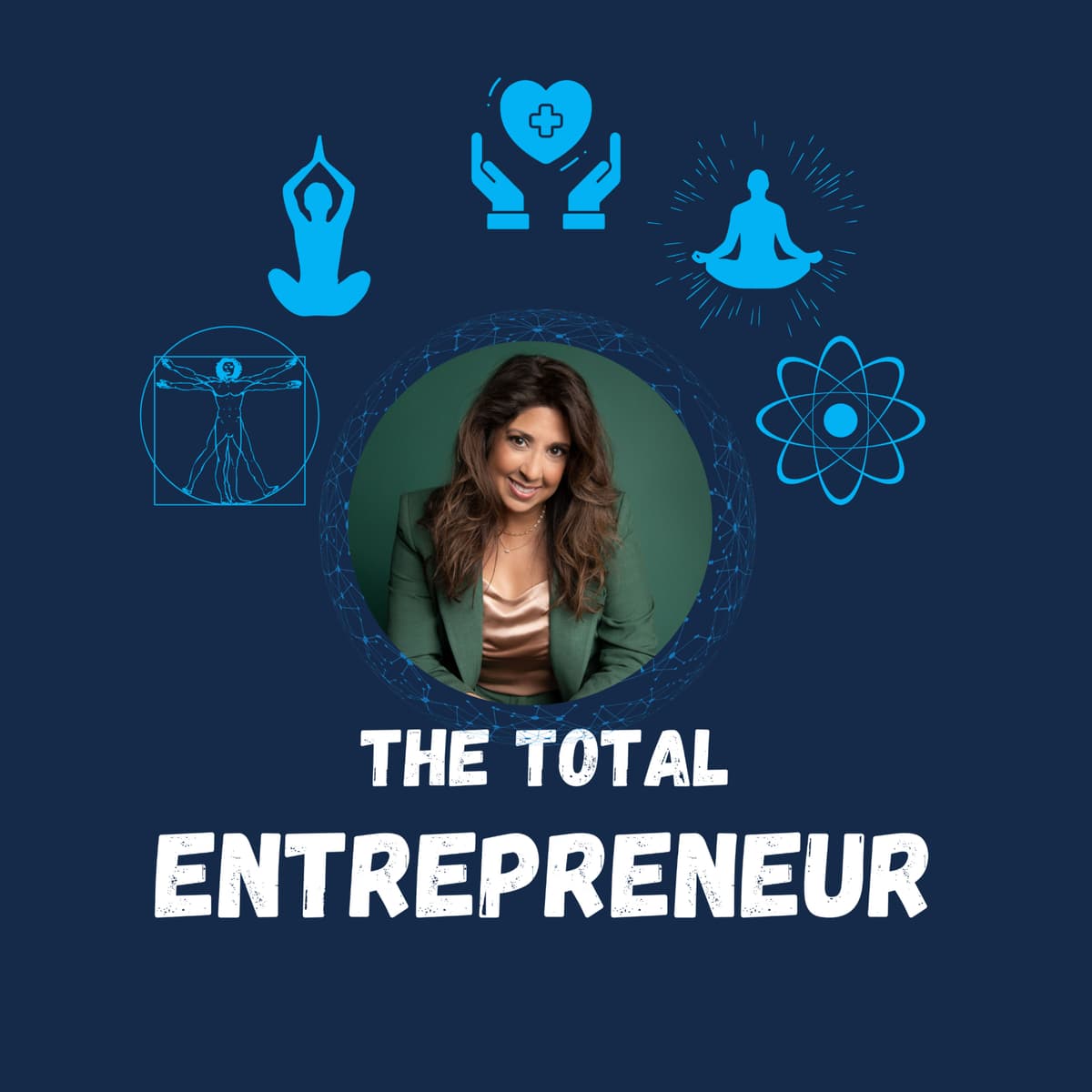
Redefining Prosperity: Money Mindset, Spirituality, and Success with Ruchi Pinniger
with Ruchi Pinniger
Oct 24, 2025 · 00:36:55
Part of our conversations on
Hey, everybody. Welcome back. Thanks for listening or watching. Today's guest is Ruchi Pininger. She is the founder and CEO of Watch Her Prosper, a financial mentorship and consulting firm devoted to helping women-led service-based businesses redefine their relationship with money and thrive. With nearly 2 decades of experience on Wall Street and in corporate finance, Ruchi brings a unique blend of strategic experience, expertise, spiritual insight, and a mindset coaching to the world of small business. Named one of the women leading the finance industry, she's on a mission to help women break free from money shame, build prosperity with confidence, and align their personal and business finances for long-term growth. Welcome to The Total Entrepreneur Mind, Body, Spirit, where we turn cutting-edge science into practical strategies for entrepreneurs. I'm your host, Dr. John Torrance. Entrepreneur Inc. 5000 honoree and professor of entrepreneurial practice at Syracuse University's Whitman School of Management. Each episode, we dive into mental, physical, and spiritual health with expert guests offering actionable insights to help you thrive and perform at your highest level. Let's get started. Ruchi, thank you so much for being here.
So great to be with you and your listeners, John. Thank you.
Well, my first question is, is about Watch Her Prosper and what inspired you to start that? Um, 'cause I know you had a couple decades in corporate and on Wall Street and in finance. So, tell us a little bit about the origin story of Watch Her Prosper.
Yeah. So, basically, when I left the corporate world, when I left Wall Street, I was so lost. I had no idea what I wanted to do. And during that time, I really was attracted to all the more human types of things within my job. So, the mentorship programs, the leadership programs, women's network. And I hired this incredible coach and I said, like, I have no idea what I want to do. I feel completely lost. lost. And she gave me this really amazing advice that I still carry with me. It's just trust the universe, ask for the messages, and really listen. And she was actually the first person who really opened me up to that spiritual side and the universe. And I think I always had it in me, but she's the one who really taught me and brought me there. And I did exactly that. I started to listen to all the incredible messages, and I kept hearing these women that started businesses that had the stories like, I love what I do, but I don't know anything about the money. I'm really not good at it. And I realized I could take all of my financial background and my Wall Street experience and marry that with my love of helping people and could really make an impact. So, that's how I started Watch Her Prosper to really help women. And now, what we do is a lot of them call us their financial therapist. What we do is really help work with them to provide financial guidance, bookkeeping, help them get ready for tax time. And it's all through a lens of money mindset and helping them redefine their prosperity.
Before we get to mindset, which I really want to talk to you about, you said something about trusting the universe and listening to messages and that kind of vocabulary language doesn't usually— you don't usually find that in Wall Street or corporate finance, right? So, did you feel like you were a fish out of water a little bit? Or I guess, how did you develop those skills and even be able to listen to the messages you were getting in the first place? I'd love to hear more about that. Yeah.
Wall Street and entrepreneurship, very different. So, I think that when you're an entrepreneur, you're really more focused on receivership. You have to be to grow. Now, when I was on Wall Street, it's all about the hustle culture, right? Go, go, go. Do, do, do. A lot of Type A. That is me, like recovering Type A.
Go, go, go.
Do, do, do. So, leaving was this really beautiful openness and awareness to this whole other world for me. And this coach is someone I hired to like bring that to me. I actually, when I was on Wall Street, I think that deep down I was always like probably a spiritual person, but I don't even know if I would have called myself that or connected to that at the time. I just knew I was a good person. Like I knew I wanted to do more in the world. I knew I wanted to help people. And a lot of us think that in order to make impact and do good, you have to like be at a nonprofit or work at a nonprofit or start a nonprofit. And that's actually what I was thinking about doing until I found this work. And now I realize like you can do good and be good and be mission-driven and have a business and make money.
Yeah.
How incredible is that?
How, how much, um, I guess market research did you do before launching? So had you, had you talked to a lot of women? Had you surveyed them? Like what, what gave you the confidence to say, okay, I'm gonna leave this lucrative career and do this thing that I feel pulled to do, but you also have to be able to pay your bills and make a living and things like that. So, what gave you the confidence to do that?
The confidence was, well, to be honest, when I was on Wall Street, I actually tried out a role in HR. I thought, oh, maybe I can get that satisfaction of helping people there. That didn't work. I literally cried at my desk every day. So, I ended up basically going back to my old group, having a temporary role, and then there was nothing left for me because I had given my job away. So, I didn't really have a choice. choice, but my choice was, do I want to stay in corporate? Do I want to go back to Wall Street or do I want to do something different? So, what happened actually was I told you about all the stories I was hearing. One of the women who was sharing all those stories was a dear friend of mine at the time. And I was like, oh, you have all of these financial concerns and worries and woes. I have this time. Why don't I help you? And I started to work with her and I started to see how much emotion there is tied to money and how much stress there is. Because I didn't come from that world, really, like not on Wall Street. I didn't feel that way. I can like reflect back and see my money stories from growing up and my money beliefs and how they impacted me. But I was— I didn't have the awareness that I do today. So, I started working with her. And after about 3 months, she started to say, wow, I feel like I fell in love with my business again. I feel like I'm not alone anymore. I feel like I have a partner in my finances. I feel like I have more control of my numbers and my life because now I really understand the financial side. I understand what's coming in, what's going out. You know, she had more financial freedom. She raised her rates for the first time in years. So the work spoke for itself in a way. And then she started to tell people about the work. And I had my first consult with a potential client and who wasn't a friend, right? And when I met with her and I shared what I could do for her, she got tears in her eyes and she said, I feel like an angel sent you. And that was my aha moment. That was when I knew that I could really do this work and change people's lives and make the impact that I want to make.
So, let's talk about mindset a little bit because you mentioned that before. So, how do you define this prosperity mindset and why is it so important and central to the work you're doing?
Well, mindset is really what is your mindset to in any given area, right? I mean, that's simply— we kind of throw that word around so much. And I think people don't really just think about it that simply. And what I started to see were all of these improvements on the practical tactical side. So, you can get your books set up. You can now make decisions from an informed place because you have great numbers. You can start saving for taxes and emergency fund. not have a ton of debt that you felt you were helpless and hopeless with. And yet, you do all those things, but then there's still something missing. Like, I would start to see these patterns where we work with our clients and we have these great revenue goals and we have things that we want to do around their expenses so that they had more money in their pocket. And they would make the revenue goals, but then they would spend all the money. And I started to question what's really happening deeper down in here. Started to realize we're carrying so much with us, right? Like over 95% of how we show up, how we be every day is our subconscious beliefs. So we don't even recognize or realize that we're carrying those with us. And like one of the examples, I mean, there's so many examples. One was where a client started to make all that money and just started to spend it all. And we ended up basically in the same position, even though she was making so much more with the work we were doing. And we realized that that was because she, you know, her father used to weaponize money and she didn't feel safe holding money. So, we all have something we carry. Like, for me, I carry with me, you know, I grew up here with immigrant parents. I ultimately, you know, we lost our dad really early. So, my mom was a single mom in the '70s, like from another country, raising us, which back then was really a big deal. Like, she essentially reinvented herself here. And what I saw as a child were all of my classmates, all of my friends with all of these beautiful things, like whatever was in fashion. So, I'm like, as I said, sort of like a '70s, '80s girl. And the Jordache jeans were the big thing back then.
Right.
And I remember like really wanting those jeans and we didn't have the money to buy them when they were like first out and they were really expensive. So, I kind of equated having those things with living this like perfect life and happy life. I even, you know, going to my days on Wall Street thinking, I finally made it. Like, this is what success looks like. I have this money now. And I bought myself a Prada bag and I thought that would change everything. I thought my life would be different and nothing changed. Like, I was the same. My life was the same, except now I had a little bit of debt and a beautiful bag on my shoulder, but I felt the same inside. So, what I realized then was prosperity comes from the inside. It's an inside job.
So, it's really about the beliefs you hold, right? So, what are some of the most common limiting beliefs that you see among your clients when it comes to money or business or any of the type of work you do? What are their main limiting beliefs?
I think a lot of them relate to sort of the way we think about when I make it. It's like all the conditions. Like, When I make this, then I'll finally feel. When I have that, then I'll finally feel. That's like a big one. It's like, why do we have to delay feeling joy? Why do we have to delay feeling satisfaction until something happens? Because then we're always chasing.
Yeah. Or why do we have to put it outside of us? Right? Like it's, it's the bag, it's the new contact or client or the new company instead of just, yeah. So how do you, how do you deal with that? Like how do you get people to realize that it is an inside job? Like you can, you can access these feelings and emotions without all the external stuff.
Exactly. I actually created my 3 Pillars of Redefining Prosperity framework. So, these 3 pillars, when we live our life based on those and we use those as our North Star, that's how we live our most prosperous life. And those pillars are wellbeing, spirituality, and then healthy relationships with people and with money. And this is what I teach and this is what I bring to the world, essentially. So, really thinking about those pillars, wellbeing, right? We obviously have the more traditional, like eat well, and sleep and, and, you know, those are great and those are so important. I want to have people think about it more broadly, though. Like, what brings you joy? Like, what are the things— if you were spoiling yourself the same way you might spoil a best friend on their birthday, if you were spoiling yourself, what is it that you need to be doing for yourself that you're not doing? Because we're pulled in all those directions, you know, like I always talk about, like, I feel like I'm an octopus with all my tentacles and everybody wants one. And, and, you know, like, if you could just like center yourself to focus on you for a moment, what is it? So for me, you know, I'm in New York City, so I love my long walks in Central Park, just strolling there with my coffee without all the demands of everybody's needs. That's one of my favorite things to do. I love regular massages. Like, you don't need to wait to go to your resort vacation to get a massage. Like, that can be part of your everyday life. So what is it for you, those of you listening, that you're not doing that you love to do that you've just been putting aside? And focus on that budget for that Put it in your calendar. The next pillar is spirituality. So this is just simply the recognition there's something bigger than us at play here, right? We are all connected. And so the universe is a mirror. I talk a lot about the universe. What you put out is what you get back. So if all day you're thinking about lack, if you're thinking about scarcity, what do you think that's doing for you, right? You're simply calling in lack and scarcity. Instead, Think about what it is you do want. Think about being in those thoughts, attracting that. So, I love to share my trademarked RIR method process here. So, recognize, interrupt, reframe. Recognize when you're having those negative disempowering thoughts, interrupt them, and then reframe with a more prosperous, more positive thought. So, if all day you're thinking, gosh, like there's never enough money, there's so much debt, Just really catch yourself and then really interrupt that and reframe it with something more like, you know, every day I'm so grateful for all of my abundance. There's always enough to pay the bills. And the biggest thing about this is it's not just the words. It's not just the mantra, right? This is about what's the feeling inside your body that you have if you had everything you could possibly want? How does that feel in your body? And, and really, like, when you start to embody that and when you start to feel what that's like, you shift your energy, you show up differently, and you're essentially attracting and calling in what it is you want and the opportunities that you're looking for.
Yeah. So few people talk about that, the energy. And, I think at first, it was The Secret, right? And, I sort of put the idea out there, but I think it did a little bit of a disservice because it said you just think about what you want and it shows up. But, I think the missing piece is the feeling of it, right? Like you said, When you do that reframe, right? Like the example I use with my students a lot is, you know, I'm, I'm so stressed. I've got too much to do cuz I started my own company. You observe that, but the reframe is, yes, I've got my own company, right? This is amazing. So it's that emotion that you feel. Yes. When you're thinking that, that sends out that vibration that attracts like, right? Is that what you're getting at? Yeah.
Yeah, exactly. John, that's exactly right, John. So like I say the O word, I hate the O word overwhelmed. Right? I hate that word because what happens when we say, I'm so overwhelmed?
Right. Automatically, just by saying the word, right? It goes into that loop. Yeah.
Exactly. That's exactly— so with your students, it's like, yes, it's like the freedom of having my own company. And how about something like, everything happens in its perfect time. I am time. How about something like that? Just like saying that, you feel differently. You show up differently. Everything feels more easeful, right? And that is the key, the feeling. And our mind doesn't know the difference between reality and imagination, right?
Yeah.
There's all those studies done that I imagine you even talk with your students about, is like the EEG activity. And so that's why that feeling is so important. Like when they measure the brain activity of a baseball player and, you know, think, imagine this, like close your eyes, imagine the baseball players like at home plate. Hits the ball, hits a home run, runs the bases, literally feels the goosebumps on their arms as they run and from the wind. They hear the roar of the crowd. They slide onto home plate. They score for their team. They win the game. What's that feeling like when they physically do it versus they think about it and visualize it in their body? Same brain activity. So this is the trick. This is the magic that happens in your mind that we can control.
And it's so different from what we learn normally, right? Like, we, you know, we control physical reality, right? But we don't really appreciate the fact that our thoughts and emotions are physical reality. We just, we just can't see them with our instruments, right?
Exactly. Exactly. And we have like an average of what, like 60,000 thoughts per day. And for, for as a woman, 80% of them are negative. Imagine what would shift in your life Imagine if 80% of them are positive, what would change for you? Third one is healthy relationships with people and with money. So, with people, it's just really thinking about like, who are you spending your time with? What are their beliefs around money? How are your relationships impacted? You're not only your relationship with them, but your relationship with money impacted. Like, do you have to pretend like you have more than you do so that you can keep up with them so you can go on trips with them? Can you be open about where you're at? By the way, and that goes even if you have a lot of money and maybe they don't, like, do you have to hide it? Are you ashamed of it? Can you be real about it? So really, what are your relationships based off of? Like, are you rising each other up, lifting each other? So that's one piece on the relationships. Then the other relationship is the money, right? So it's like, what is your relationship with money? When you ask yourself, what is the first memory I have of money? That can be really heavy for some people. Like, I've heard some really unexpected answers, and those answers have impacted the way people live and the way, especially as entrepreneurs, the receivership of money, the receivership of help.
Can you give examples of like, what do you hear in terms of people's first memories and then how that sort of affects the way they view it later on?
Yeah, there's a heavy one that I've heard recently. I'll share it. When I asked this question to someone, they said that the family member that used to watch them when their, when their parents were at work, they used to ask for money for food and they'd get molested.
Geez.
That was heavy. Imagine, imagine what that does. The safety of that in your body, like safety of not asking for money. Safety of not asking for help. Now, as an entrepreneur, how does that impact your rates, how you charge, how you spend, how you ask for the support? How do you run a business and build a company without receiving support? Like, that is a heavy one. And then there's some that may not be quite as heavy, but still we carry with us subconsciously. Like, one of my clients, um, you know, she— in, in the work that we did, what she started to realize that her father used to say, you'll never make it without my money. And she carried that with her for so many years. She didn't make money. She— she thought she was waiting for like her Prince Charming to like rescue her, you know, so that she could feel supported and make money. And it wasn't until she started to sort of like recognizing it is the first step, right? It doesn't— the change doesn't happen overnight. We have to create the safety in our body. So we do that in a lot of ways. Like some of it is just We write down our new beliefs. So like, it's safe to ask for support. It's safe to receive money. You know, it's so— it's like whatever the situation is you're dealing with, like creating the safety. So writing it, saying it out loud, all the senses, right? And then also that feeling that what's it in your body. So you want to do— that's like a very starter way to start to work through some of the old beliefs and reframe those old beliefs.
Out of the 3 pillars, Is there one that you find your clients are more stuck on or that require a little more work or have more resistance to them?
Definitely that relationship with money and those beliefs, because that is something we carry with us since we're children, right? Like, we don't even— and we don't realize it. So, there's definitely some. What I say is like, your business revenue will never outperform your relationship with money.
Your business revenue will never outperform your relationship with money. Yeah, that's insightful. And it, it, it runs pretty deep, right? Because there's so many things that you'll do to put up barriers or, or to ensure that that never happens, right? Like you, you'll, you'll make sure of it. Just kind of like, you know, the, the client whose dad said, you'll never make it without my money. That becomes this self-fulfilling prophecy. If that's what you hear, that's what you say to yourself, that's what you repeat, and then that's what you believe. So then you start taking action according to those beliefs.
That's exactly right. Until you recognize them. So, the way to really start— and a lot of us don't recognize them until we start to pay attention. So, the way for those people that are noticing like their money is not matching their mindset or their money is not matching their actions is really right. Like, we want your money to match your mindset, not your actions, because your actions aren't enough. The practical tactical is a great step. But without doing the work, the mindset work and the shifts and the belief system in your body, you're not going to be able to make the change that you want, right? So, that recognition is key and asking yourself and paying attention to your thoughts, asking yourself like, what do I believe about money? You know, and for some people, that could just be writing a letter to money. You know, it could be like, here's where we are. write something where you may say what kind of relationship you want to have with money, like, dear money, I noticed that you do this and here's how I want us to feel in our relationship. So, that's like a really cool thing to do. Even just closing your eyes and saying like, imagine money walks into a room. Imagine money is a person. What do you see? What do you feel? What do you feel in your body? Like, I was guest teaching at NYU, an entrepreneurship class. I'll have to come to yours. And I asked the students, and this was really cool. Students of that age are so in tune. It was so cool, like how I thought I was going to be going in talking about practical, tactical money and cash flow, but we talked all about mindset and relationship with money. One of the young men there, when I said to him, like, what do you see when money walks into a room? He said, I see the Kool-Aid Man. I was— yeah, that was a good one. That was a new one for me. It was just really— it's really fun to talk about it with, with students, with people of all ages.
And I've heard you talk about the spiritual connection to wealth, right? That— and again, going back to one of my first comments, those are, those are terms that are usually mutually exclusive, right? We don't often hear about spirituality when it comes to wealth. And as a matter of fact, there seems to be like this weird stigma that if, if you've got a spiritual Or if you are a spiritual nature, you almost have to identify with being poor or something, right? So, talk to us about this spiritual connection to wealth because I find that really interesting.
Well, money is just energy, right? Energy can be shared, transferred in any way with love, with support, with tasks, right? So, it's just another— it's just like a spiritual currency if you think about it that way.
Right?
So it's a reframe. And also, I think for, for people that carry that whole story about like, you, you know, I, I don't wanna charge 'cause I wanna do good work. There's a reframe there, right? It's like the more money you make, the more you can do for the world.
Probably one of the hardest things that I've noticed for new business owners is to, especially service providers, right? Products is relatively easy, but service providers have a really hard time charging or deciding what to charge. So yeah, like you said, they, they have to, they have to have a reframe, right? So I'm doing good work, so I have to charge for it. Or, and if I charge, I can do more, right?
That's exactly right. Exactly. See, see what money does. It's not just for you. I was having this conversation with someone the other day, an entrepreneur who said that growing up, when she asked for things, her family would say it's selfish. And so she's, she was having a hard time raising her rates. We got her there, but just the reframe of imagine what happens when you raise your rates. First of all, you're putting trust in your clients that they can afford the services, right? There's something about that there. You're putting trust in yourself. And what are you doing for the world? What are you doing for your team? How are you impacting your team's lives? You're able to pay them more to have a better life, and there's some, you know, change there and ripple effect there. Imagine she, she talked about how she wanted to travel Now, you can afford to travel. Now, how you're helping to employ all the people at the airlines, at the resorts that you're traveling to. There's such a ripple effect. You have more to give. You have more to donate. You might have more freedom of time to do other things in the world, to do other good work, right? So, it's just think about what the money does versus the story of, you know, rich people are bad or it's not safe. You know, I can't be a good person if I charge too much or whatever the story is. We all have our own.
Do you get— Do you get pushback or resistance when you start talking about spirituality and money, spirituality and wealth? Or do you feel like we're in a time where people are more open to this?
We're definitely in a time where people are more open. And I also think I just do it in a really safe way, like in a very gentle way that's loving. And I also say to people, like, I talk about God, I talk about universe, I talk about source. And I say just really openly, If that— if none of that connects to you, just think about your higher self. If you can even just think about that, if you don't believe in some of it, because everyone can connect to their own higher self. That's just essentially them at their next level. So if, if you can't— if it doesn't connect, if spirituality itself doesn't connect to you, just think about what would my higher self do? What would my higher self want me to do now to get there?
I know you work mostly with women, so why is it that women have, have these unique issues? I mean, men do too, but maybe talk to me, talk about the difference between men and women when it comes to this issue.
You know, we actually do, we work mostly with women 'cause that's who's been attracted to the work. But we have a lot of male clients. In fact, a lot of our clients are the spouses of our female clients that also have businesses. And that's a lot of times how they come to work. But I find men and women are really open to spirituality. I think we're in a world where people are looking for something bigger, something more to believe in. So I'm finding actually that men and women are really open to the spirituality. And those that aren't, it's not necessarily because they're a man or a woman. It's just that's who they are.
Yeah.
They're just not open. Yeah. If you're not open, you're not going to— you're not going to hear it. The first step is just being open to hearing another perspective. And if you're not open to it, it, you're not going to connect to it and you're probably not going to do it.
Who are some of your influences or what have you read? Like, how have you— like, yeah, who's influenced your body of work, the way you think about these things?
You know, definitely my mom was a big influence to me just watching her grow, you know, how she came here. She was an educator overseas and She came here reinventing herself. She started as a bank teller, worked her way up to be an executive. I also lost her very early, by the time I was 15. So she was like a big inspiration. I just like— she was that kind of person that would literally like give the shirt off her back, you know, for someone. And I just saw her doing such good. So she was a huge inspiration. And my first coach I shared with you, Eva, she she was the one who really opened me up to spirituality and being open to the messages of the universe. And, you know, and then there's so many other amazing thought leaders and coaches I've worked with that I just really trust and who have, like, shown me the expansion, just like now I'm doing for others. So I feel, I feel so grateful.
That is a great feeling to have.
Yeah.
When you go to places like NYU or Princeton and talk to students, are you surprised by things you get from them? Or what do I guess, what's your perception or impression after you leave a group of students?
I am so impressed. I mean, really, no joke. I thought I'm coming in, giving them cash flow tips, making sure they understand not to focus just on the profit, but let's look at the cash flow. That's the most important. And we end up talking about mindset and what they've gone through and their stories. And then they come like, I feel gratitude, really, like, that I get to do this work with them and that, you know, they feel safe to come to me in tears talking about how they were raised by their parents or father or this or that and what that did. And like giving them some tools for safety and creating the safety in their body to, you know, to do the— to do the work they're doing, to, to make the money, to ask for help, letting go of whatever that was fed to them or whatever they perceived was fed to them. So I just— I think they're so evolved. And they have, you know, young men and young women. It's all of them. They're just, they're different than the generation I grew up with. We didn't talk about this. Yeah.
So yeah, I'm assuming you're like me, Generation X. And, uh, yeah, it's just, um, yeah, it was, it was a different thing for sure. Yeah. And we certainly didn't talk about mental health or self-care or anything in spirituality unless it was like in a religion class that, you know, it was totally off Yeah, exactly.
You're right.
That's right. Uh, and I always say that, you know, I'm actually really excited for the future, uh, because I think once this generation takes over and takes leadership positions and starts making decisions, um, I'm excited for that. Yeah. So what, what are, what are some things that you think need more airtime in general? What do you think should people should be hearing, listening about, talking about?
I think that I think that one of the things for people is just like, what do they want for themselves? Like, a lot of us like know we want something more but have a hard time thinking about what that is. So I, I love to share an exercise of like just like a future vision for yourself of like just really connecting to what it is you want. So I, I ask people to sort of like take some time, do this exercise where they just put an hour in their calendar, kind of grab a cozy blanket, light a candle. Candle, grab a notebook, and really just start to ask themselves, like, you know, a year from now, you know, just thinking about like, where do I want to be living? Who do I want to be spending my time with? Those of you that are entrepreneurs, which is probably a lot of you listening to this beautiful podcast, it's like, where do I want my business to be? What do I— what do I want that to look like in revenue, in team, in the support that I receive? How do I want to be spending my days? And how do I want to— this is a big one— how do I want to feel every day? Think about what are those 3 things if you could wake up every day and feel like this. And that could just be peace, it could be joy, it could be ease, it could be freedom, it could be spaciousness. What is it you want to feel every day? And, and write those down. And then I want you to write a letter as if it's a year from now. So, I do this and I write a letter to my mom as if it's a year from now. And you can choose to write it to whomever or yourself and just say like, dear mom, you won't believe what a year it's been. And then just I go in and I talk about all that's happened and connect it to those answers as if it's happened. And then I want everyone to use that letter, that one-year-from-now vision, as their North Star as they're making their decisions every day. Does that decision align to that 1 year from now or doesn't it?
And writing it down is a really good technique because there is something different about the energy of writing it, right? That does make a difference. I've been keeping a journal since 1990. And yeah, it's a cool practice. And so, what are some of your go-to practices or habits that you use in your daily life to stay grounded and good?
Yeah, I do definitely breathwork. Like, my favorite is 4-7-8 breathing, which is inhale for 4, exhale for 7— I mean, hold for 7 and exhale for 8. That's one of my favorites. And I think not just doing that in the morning, but throughout the day to really stay grounded, to come from a place of responsiveness, not reaction. And that's like a key one. I love meditations because I think it really goes into your subconscious. A lot of people do say do it in the morning. I'm not so much a morning person. I'm not going to lie. I think it's really good to do it in the morning. I do a lot of it at night because that's really when I connect to it and when I have the downtime for myself. I think that's key. And I think just like I do that same belief work, writing it down, saying it out loud, feeling in my body what it's like, getting grounded. I love— I'll dance or sing. My Pink Pony Club is my favorite right now. I You can just like flow to the music and move your body. Getting grounded, those long walks for me, those— I call them strolls in Central Park. There's so many ways to get grounded and care for yourself. What about you? What's your favorite?
I like to walk. I like to ground. I like to get my feet either in the sand or the ground or something. But I, you know, I've— for the past couple of years, I've gotten to be a much better meditator. Actually, I don't know if you've— so I started using this Muse band. I don't know if you've ever seen these before, but it kind of tracks your brainwaves. So it gives you this biofeedback during your meditation so you can see how long you've spent in delta, theta, alpha, beta, gamma, that sort of thing. And there's guided meditations. So I like that. I love breathwork and heart-centered breathing. Like there's a lot of cool science out of the HeartMath Institute that's been really helpful. So yeah, so those are basically the types of things and keeping active for me is really helpful. You know?
Yeah, I love it. Great inspiration. And I need, I need the link to that.
It's super fun. There's an app and you just wear it and you do your meditation and it's got all these sensors on it. And it's, yeah, it's really, I mean, for me, I kind of, I, I do so much better with biofeedback, you know? So, Ruchi, if people are interested in learning more about you and your work, how do they find you?
So they can go to our website, watchherprosper.com. Follow me on Instagram. I love doing like Instagram stories. We share tips. tips, tricks, you know, not only like practical, tactical, but a lot of spiritual just reminders to stay grounded on the— around the belief work. So you can follow me there. Um, there's an application at Watch Her Prosper if you're interested. If you, if you as an entrepreneur who's service-based are looking for like that financial support, financial guidance, a financial partner doing your bookkeeping and numbers for you, we do Amazing.
Well, thank you so much.
Thank you. Such a great honor to be here with you and your listeners.
Thank you so much for listening to the Total Entrepreneur Mind Body Spirit Podcast. If you liked what you heard or heard something interesting today, please give us a like, share a comment, or better yet, subscribe to the podcast. Thank you.
About This Episode
What if wealth wasn’t just about numbers but about energy, alignment, and purpose? In this episode, Ruchi Pinninger, founder and CEO of Watch Her Prosper , shares her journey from Wall Street to guiding women entrepreneurs toward financial freedom and fulfilment. Ruchi explores the three pillars of prosperity: wellbeing, spirituality, and relationships, revealing how childhood beliefs and societal conditioning shape our money stories. She also offers practical tools for grounding, self-care, and shifting into a prosperity mindset that supports both business growth and personal joy.
This conversation is a must-listen for entrepreneurs who want to heal their relationship with money, charge their worth, and create abundance with impact.
Episode Chapters:
00:00 - Introduction to Ruchi Pininger and Watch Her Prosper
03:18 - The Journey from Wall Street to Entrepreneurship
06:19 - Understanding the Importance of Mindset
09:17 - Redefining Prosperity: The Inside Job
12:08 - The Three Pillars of Prosperity
14:56 - The Power of Positive Thinking and Energy
17:36 - Exploring Relationships with Money
20:39 - Overcoming Limiting Beliefs
21:23 - Recognizing Money Mindset
23:48 - The Spiritual Connection to Wealth
27:03 - Gender Perspectives on Money and Spirituality
29:35 - Influences and Inspirations
31:20 - Future Visioning and Goal Setting
33:37 - Daily Practices for Grounding and Wellbeing
36:38 - Outro
Keep listening
More on Business

About the Host
Dr. John M. Torrens
5× Inc. 5000 entrepreneur, Professor at Syracuse University's Whitman School of Management, author of Lightning in a Bottle, and TEDx speaker on ADHD as an entrepreneur's superpower.
Browse all podcast guests →Book a strategy call →