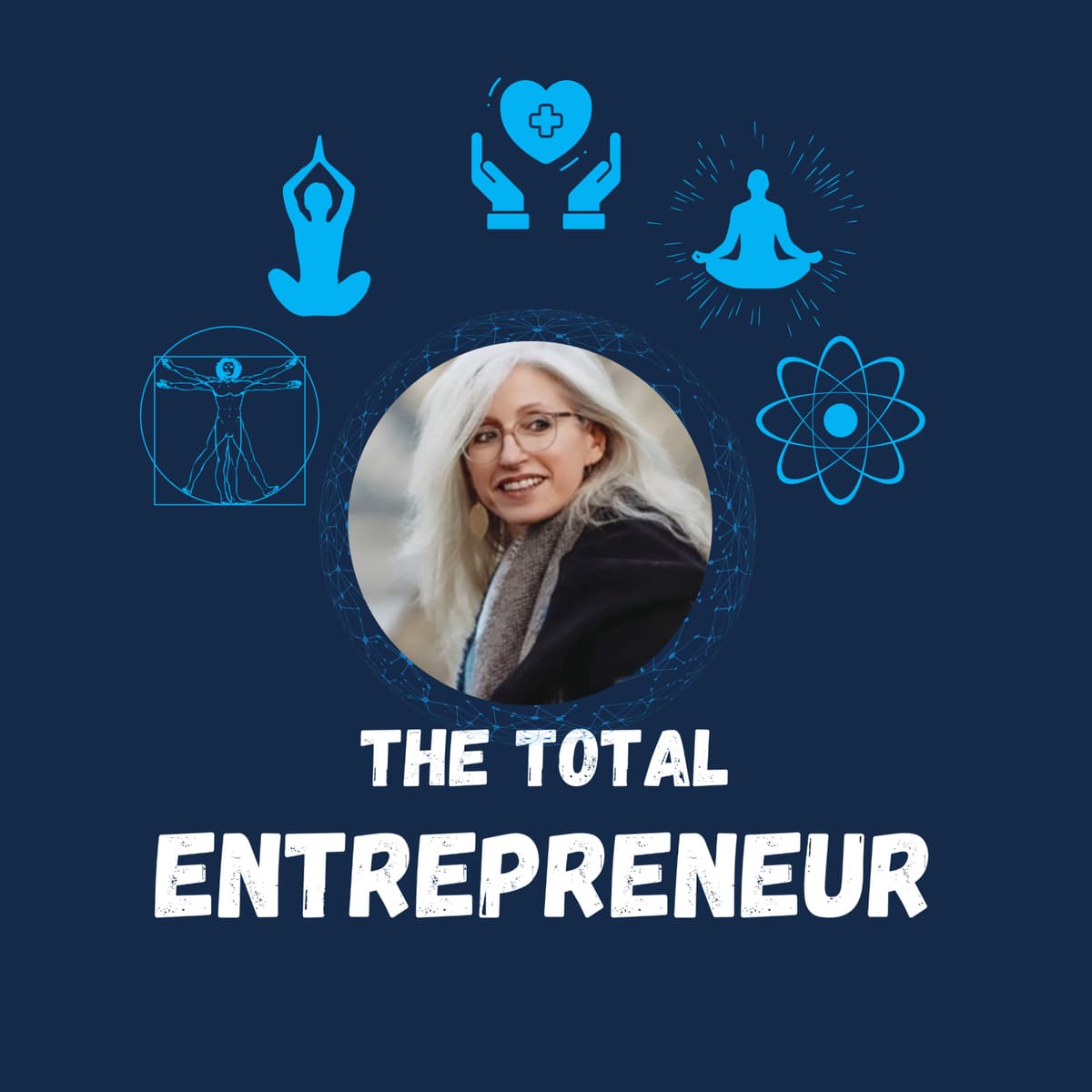
Leading with Courage, Intuition, and Fulfillment with Sara Gilbert
with Sara Gilbert
Nov 7, 2025 · 00:35:25
Part of our conversations on
Hey, everybody. Thanks for listening or watching. Today's guest is Sarah Gilbert. She is a seasoned executive coach and founder of sarahgilbert.coach, where she partners with leaders, especially women entrepreneurs and corporate executives, to build confident, resilient leadership rooted in purpose and presence. With over 20 years of experience in organizational psychology and leadership development, Sarah brings a relational, body-aware lens to coaching. She specializes in helping leaders navigate change, enhance team dynamics, and lead from authenticity. Sarah's work offers practical guidance for entrepreneurs who want to lead with clarity, emotional intelligence, and sustainable impact. Welcome to The Total Entrepreneur: Mind, Body, Spirit, where we turn cutting-edge science into practical strategies for entrepreneurs. I'm your host, Dr. John Torrance, Entrepreneur Inc. 5000 honoree and professor of entrepreneurial practice at Syracuse University's Whitman School of Management. Each episode, we dive into mental, physical, and spiritual health with expert guests offering actionable insights to help you thrive and perform at your highest level. Let's get started. Sarah Gilbert, welcome to the podcast. It is really, really great to have you here.
Thank you so much for having me.
Well, so before we get into the work you're doing now, I'd love to hear a little bit more about your background and, and how you got here in the first place.
It's by detour after detour after detour after probably another detour.
I love that. Similar. Yes. I love that.
So the original life plan was to be a kindergarten teacher. Loved it until I had to do activities in front of a group of 2-year-olds, which I was too shy to do. So I quit that because I was shy. Second life plan was to be a psychologist and then figured I didn't want to do like the master's and the PhD. So then I wanted to do, to work on the stock market exchange. And my professor at that point looked at me, he's like, you're 5'4, 120 pounds. That is not going to happen on the market because nobody's going to see you. One thing morphed into another. I worked in many years in wealth management, but what I love about wealth management is the relationship and the human behavior about money. And then in 2010, I was seeing wealth advisors coming back from major coaching program and just continuing doing things the way that they used to do. And I was like, there's got to be a better way.
Hmm.
So, in 2010, I launched my business as a business consultant in the wealth management industry. So, already, advisors who were in like the $100, $150 million under management. And as I was working on the strategy, the business, at one point, I realized that the strategy is as good as the human behind it.
So important.
And that's really where I went all deep into human behavior, neuroscience. Like, one thing that really grabbed me is psycholinguistics. So understanding the link between words and human behavior, which is my fascination today.
So you talk about potentiality. Now, I'm kind of familiar with the term, like, in a physics I guess, setting, or how do you use it, or how do you apply that term?
So I make the difference between potential and potentiality, where potential is what you see, potentiality is what we can't even see. We live in this world where, yes, we wanna maximize our potential, but that's actually not the ceiling, that's the floor, because we don't let that expansion of the magic that can happen, the trust, the alignment, like all the invisible take its step. So, my biggest strength is seeing that potentiality in people and igniting that within people because it's all things that we say, oh, I can't, I shouldn't, I would've liked to, I would've— no, no. And we limit ourselves or we reach a goal and we're like, well, that's it, and see that as a ceiling. And I'm like, no, no, we haven't even started.
Right.
And that's where potentiality, it's that exponential That kicks in. That's where the magic kicks in.
The idea of, of exponentiality too, right, is, is important, right? Because we do approach things very linearly, and maybe it's our programming, maybe it's our education, but it is very common, right, to think you do this, then you do that, then you do that. You don't— there's no exponential thinking, I guess, sometimes.
Well, yeah, and on a brain perspective, it's what keeps us safe. It's predictable. So the brain likes to stay in safety and predictability, so it's going to go linear. But The magic of life is not linear. So can we tap into that, allow that, which we tend not to?
Yeah. And why is that? Why, why don't we tap into that or why don't we allow it?
Well, again, like, but let's go back to the brain. The brain's role is just to keep us alive, which means it's in comfort zone, what it knows, what's familiar. There's clearly education, family, environment, you know, like we want to, our quest is freedom, but we're seeking security and they can't coexist.
Hmm. That's interesting. Yeah. I've read somewhere that evolutionary biology doesn't really care about our happiness, right? We're not wired for that. We're wired to survive and propagate and that sort of thing. And those behaviors that make us good at that are often at odds with this, you know, self-fulfillment and that kind of thing. Yeah.
Yeah, because you have to trust what we don't know. We have to trust— but actually, we do know because we have to trust in ourselves that we'll figure it out. But like, everyone's living above the neck, but trust is below the neck. So we all live here and we think that our body's useful purpose is just to carry our head around. But all the magic and all the knowing and the intuition and the gut feeling, it's below the neck. So can we trust that a little bit more?
So getting out of your head is not an especially easy thing, especially just because of the way we're educated and the way business runs and that sort of thing, right? I mean, we, you know, we've got KPIs, we've got metrics, we've got tangible things. And it seems like once you get outta your head and more maybe into your heart, it becomes maybe more esoteric or less acceptable or less defensible, maybe. Is that your experience?
Absolutely. Because like the most important conversation that we have is with ourselves. Like Harvard demonstrated that 95% of our decisions are based on emotions, but 5% are based on logic. That's how we anchor a decision. So, what's the story I'm going to tell myself about this decision that I'm going to make? About this move that I'm not getting, that I'm gonna make or not going to make. So we, we, we, we get into that. That 5% is as important as the 95%. So can I, can we tap into the, the rational is, or the logic is, I'll figure it out along the way. But it is also valued as a society in an era where it's about logic and intellect and measurable and predictable.
And defensible too, right? Because if you make a decision, especially in a business or a startup scenario, people need to know that you've made that with some sort of evidence or something, right? You can't just say, well, I've got a gut feeling. And I know there's plenty of room to back that up, but I feel like we've gotten away from trusting ourselves and our intuition.
I find that you have to have success under your belt to be able to say that I'm trusting my intuition because Steve Jobs only trusted his intuition. There was no logic between creating the fonts for the Mac. There was no logic with like the iPhone and so many things that he invented. But once you've got that credibility, then you can say, oh, I'm using my intuition. But there's like this credibility piece, which is all built on intuitions as well. Yeah.
And I guess that's hard for the people I work with, right? They're usually undergraduates or graduate students in an MBA program. So, they're learning a lot, they're acquiring a lot of knowledge, But because they don't have 30 years of life experience with anything, it's hard to maybe apply that intuition or something. So, what do you think? Or do you have any advice for people who are just kind of starting their careers who know they want something more, they want to get out of their heads? Or one of the things I know you talk about or ask people is that you want your— your business is already doing well, but you want it to be doing exceptionally well, right? So, how do you address that if you're relatively young and don't have a lot of experience, but you maybe have a lot of knowledge?
The way that I like to put it is follow your gut, follow the intuition, but verbalize it with logic.
Ah, okay.
And that's kind of what Steve Jobs— and I go back to Steve Jobs because I find he's such a great example on that— where he came up with the font, there was no logic. It was all about his intuition, but he phrased it to himself and especially to others in a logical way. This is the future. This is where we're going to go. Let's go and start new trends. Let's go and disrupt the marketplace. Let's make a dent in the universe. So he's following intuition, but he's verbalizing it with logic, which is more mainstream acceptable. But if he would have said, oh, let's do a font, I have a feeling that this is going to be good, people wouldn't have followed as much.
Yeah.
But he said, let's make a dent in the universe.
Completely different message, right? And I think there's an element of fear too, right? I think if we have, we have logic, right? We can say, all right, this is this is the best decision we can come up with, or the best course of action based on the logic. It almost feels safer than trusting your intuition because like you said, it's that the trust is below the head. So I'm interested in hearing more from you about that. How do we, how do we get out of our heads and get, get below our heads?
Well, first is, you know, to be able to have headspace, we need time-space, which is the, from my experience, Is one of the biggest challenge because everyone's busy being busy. And if you're not busy, you're lazy. So that is the first thing is, can I, can I go and create space, time space, so I can go and have headspace? Because when I have space, we can access all the magic. But when I'm here in my head at 300 miles an hour in fears and excuses, and I don't have access to that.
Mm-hmm.
So that's why we get our best ideas when we're in the shower, when we're on a hike, when we're on a vacation, because we have space. So can I allow myself to have space, create that space, and not having the jitter of, oh, I should be doing this and I should be doing that. And it's like, no, you know what? Saturday morning, I'll just go for a walk.
Mm-hmm.
And reconnect. How does it feel to breathe? How does it feel to smell? How does it feel to have the wind in my face? The sun, like the sun on my face, like tactile.
Mm-hmm.
So it's not just fluffy, rook. You wanna have intentionality cuz once we touch that, you touch something special and you actually sit with it for 20 seconds. 'Cause an emotion, if you sit with an emotion for 20 seconds, it comes in the body, not in the head. It comes and lodges itself in the body.
Mm-hmm.
You're gonna want more of that inner peace where you tap into something and then it's like a muscle. How can I repeat that? How can I repeat that? How can I repeat that? And the more I repeat that, the more ideas come, the more intuition comes, the more, oh, I just had this thing. It's not space. So it's the biggest challenge people have in the beginning because we're busy being busy, but it's the most important one.
And even if we're—
even if—
because I could imagine people saying, okay, I'm gonna have some time space for myself, I'm gonna block everything out of my calendar, I'm not gonna have any appointments. So they have technically space, but they're still in their heads thinking about all the stuff they got to do after this space is over or the things they're not doing because they're not doing— so it almost seems to me that it's more than just blocking out time. It's an awareness, it's a mindfulness, it's doing something productive with the time that you're not busy being busy.
And it's an intention, right? I'm not just sitting there. And this is where people get meditation or mindfulness wrong. It's not having nothing in your head. It's deciding what you're going to have in your head. So if I decide that I want to, I want to feel the feeling of the wind in my hair, I'm focusing on something. The brain can't do nothing. So you have to give it a task, but give it an intentional task versus a reactional task. And sometimes, sometimes it's like, okay, well, I am, I'm having this issue, this situation, this problem, looking for a solution. Well, when I go for a walk, I'm like, all right, you know what? Let's go and find a solution, an answer to that. That. And then you just send that out in your brain and it's gonna pick it up. And you just focus on being present, which we're not. We're really, really not present. We're everywhere else except now. So, like, can I feel that? Can I put that intentionality? And then can I just decide, oh, there's one solution, one idea that I'm looking. Is there another way that I can think about it? Like, questions are such a powerful thing to guide our attention and our intention. We tend to ask lousy questions like, why is this not working? But if I start also going for a walk with an excellent question, then I'll tap into creativity, innovation, and everything that goes with it.
There is plenty of research that shows you tap into your innovation and creativity when you are more in your heart and in your body than in your head, right? Yeah. So what do you do? You know, like, are there— do you have go-to practices? Or, you know, how do you, how do you keep yourself grounded in this space where you can be creative and innovative?
Well, it evolved over time, and it evolves even if it depends even of the different times. So if I'm very busy, sitting down and meditating is not a good way for me, because then I'll have different ideas of this, what's going on, and My head's busy, so then I'll journal.
Oh, okay.
So finding different ways, like having a buffet, is the best solution in my opinion. So either some, like if I'm very busy, I'll go and journal because you can't write anything to 30,000 things at the same time. So that will focus. Sometimes I will go for a walk, sometimes I will go for a swim, sometimes I will go and meditate.
Mm-hmm.
But I will also ask myself, what do I need now? What would bring me back into presence now? And then I'll get my answer. But the thing is, often we think, oh, I have to meditate 35 minutes every day, sitting on a cushion, going like this. And, but there's days where you get out of meditation and you're more exhausted than before.
Yeah.
Maybe journaling is the way. And so, you know, some people it's going running. That's how they come back into presence. Because they have to get it out of their nervous system. So the best is going to the discovery of what I call like our own owner's manual. Like we say when we have kids, kids don't come with an owner's manual, but I believe that we actually do. And that's the purpose of the journey is to find your own owner's manual. So if it's somebody is like, what makes you come back into the present and get out of your head is go for a run, go for a run.
Yeah.
Then you can journal, then you can meditate, then you can, But that is how you will tap in. Somebody else or another day, you will go and you meditate. So I, you know, I'll journal, I'll go for a hike, I'll go for a swim, I'll meditate. Sometimes I'll just sit in my hammock. That is what I need right now. So I'll go back to that question is, what do I need right now? What will make me feel good right now?
Yeah. Yeah. And it's a better way to ask it. So you talked earlier about the power of words and your interest in that. And I mean, it seems to me that we, we, we just, we're our own worst enemy in terms of our self-talk and that sort of thing, right? But I'm interested in your perspective on, on how we can use words and the power of words to unlock what we're looking to unlock in ourselves.
So the way that I, that I see it is humans, we're just a bubble of emotions. We're seeking to satisfy an emotion all the time. Now with these emotions, we'll, we'll create, they'll, they'll trigger a story that we have. And that story, the word that we repeat that story, then that becomes a belief. And we know that beliefs guide our behaviors and behaviors give us our act or our results. So if we go at the root of the visible is words are absolutely everything. Mm-hmm. They tell exactly what's going on inside that since we are below the neck, we're not feeling it, but above the neck we are saying it. So I love asking myself, what's the story I'm telling myself right now?
Such an important question. Yeah.
There's always a story going on, and often it's many stories going on. And these will give me, give us beliefs, our fears, everything that's causing interference between who I am and who I want to become. And that art of becoming starts by, you know, deciding who I want to be and slowing down to see, okay, what is actually creating the interference? What's the story that I'm attaching to it? How am I, what's the perspective that I'm putting this? And from there, I can decide, you know, and I can also catch what I'm saying. You know, when somebody says, you know, I'd like to do this. I'd like to, what they're actually telling you is not a dream or a goal. It's a doubt. And a doubt in themselves.
I'd like to do this, but I probably won't. Right? Yeah.
That's the second part of the sentence that we don't say.
Yeah.
So when we're able to catch our own language and really go and observe and say, okay, well, what's really the conversation behind the conversation? I'd like to, where's my doubt? I'll do this someday is a concept. And we speak in concept, but the brain understands in concrete. So I'll do this one day versus tomorrow I'm doing is not the same thing. Someday is a concept. It doesn't even exist. Tomorrow is a day.
It's measurable.
Yes. More precise and more precision that we bring in our language influences our behavior because the brain is excellent at executing, but on concrete, not on concepts. So, you know, people will say, well, I just, I want to be happy in life. It doesn't mean anything. What does happiness mean? What does this successful life mean? What does a fulfilled life mean? And from there, we can take actions.
So going back to that example, right? I want to be happy because, you know, 7+ billion people on the planet, if you polled every one of them, that would probably be one of the top things that they want. I mean, who doesn't want that? I want to be happy. So by saying I want to be happy, there's that, I guess, presupposition that you're not right now because you want to be, right? Is it— how different is it than— or what could you do instead? Like, so instead of saying, hey, I want to be happy, everybody wants to be happy, is it a matter of just like finding something that does bring happiness? Like, hey, I'm really happy when— or this made me happy— or just noticing points throughout your day when you do experience that? Or how do you, how do you switch from I want to be to acknowledging that I already am, or I can be, or I'm becoming that?
So there, there are two— well, I'll separate this into So, happiness is a feeling.
Right.
But at the end of this whole journey, there's fulfillment. So, I want to make the distinction. So, I want to be happy, yes, and you've said it really well. It's like, that means that I'm assuming that I'm presupposing that I'm not happy now. So, first is, are there things that bring— what brings me joy right now? What makes me happy right now? What makes me feel happy right now? Because to unlock the upward vortex of potentiality, it starts with fun, joy, happiness. Then we kick into creativity, innovation, right? That all goes in the same upward vortex. So, the more that I see of things that make me happy, the more I will see the things that make me happy. So, let's start there. Now, Happiness is a state in the moment. What we are actually all seeking is a fulfilled life. And there's 2 needs that every human has, and it's evolution and contribution. If you think of everyone who is old grumpy person that you've met in your life, they're either— they're lacking either one or both of these things. They're not evolving and they're not contributing.
Hmm.
So, this is something that we're all seeking. So, This might sound strange, but there's a question that I ponder on a regular basis is, what do I want to tell myself on my deathbed? I want to tell myself that I've gave it everything I've got. I've got a theme for my life that's called adventure. So, every decisions that I do every day are either bringing me towards that or not towards that. So, we need to have a measuring stick, and that is not on a bank account, on numbers of cars or whatever, is because at the end, like on our last breath, it's us. And I've read a study once that says all of our belongings will fit into a plastic grocery bag, and it's me with me.
Mm-hmm.
So, what do I want to tell myself? Clearly not that I'm so happy that I've answered every single email within 24 hours. That's not it.
Yeah.
So we're measuring in the moment on things that actually won't matter when it actually matters. So there are many decisions in my life that I'll take them simply because I will ask myself, what do I want to tell myself on my deathbed? That I gave it everything I've got. I am scared as, but I will do it because of that. And I know it will be good to give a good story at one point.
Of course, your theme for adventure. I like that. So every year I choose a different word for myself, and I think two years ago it was adventure. And I remember that year because I had opportunities to do things where I felt inclined to say, "Ah, that's too much of a hassle. I got to travel. I got to do this. I got other things." But I kept remembering my word for the year was adventure, and I'm like, "You know what? I'm just gonna do it. Why not?" And it was so much fun. I'm glad I did. So I guess I'm just. interested in connecting with you on that. And do you find that because adventure is a theme for you that you're doing things that you might not otherwise do? Or how does that shape your reality based on this?
Absolutely.
Yeah.
So, I have a word of the year and I have a theme for my life. And somehow, the word of the year and I get all my clients to do the same thing and they accumulate and they're all going through the theme towards the theme of my life. Like, they all go in that direction. Just life makes it that way. But yes, these become anchors. And that's one thing that on a mindset perspective, we need to create is those anchor points, because otherwise the brain will take the anchor points of fears, the anchor points of society rules. It will hang on to something because that's safety. So if it's my life, my rules, then I need to create my anchor points. The word of the year, the theme for my life, what do I want to tell myself on the deathbed? Those are anchor points. So they filter decisions and action.
What is your, what's your word for this year?
Iconic.
Wow. That's a great word.
And I'm telling you, it is pushing me. Like I'm looking at the calendar, I'm looking the year going on. I'm like, all right, you know, like if, if this is going to be iconic as a year, let's go. Let's do what I want to do. What I, and it, and I'm tapping into fun and creativity and I'm like, why am I exactly doing this? I know it's going to be fun, but I'm scared as, you know, because I'm a really scary person. Like, I'm, I'm afraid of everything. But if I don't have these anchors, I'm gonna stay in the comfort zone. And nobody on their deathbed says, I'm so happy I stayed in my comfort zone.
Yeah. I think it's a— there's a difference between hedonic wellbeing, which is just seeking pleasure and just being okay, and eudaimonic wellbeing, right? Which is doing hard things because they bring you satisfaction. I think there's a lot of joy satisfaction in doing hard things because the outcome was there. And I think sometimes people mix that up. They think to experience these things, I just have to be sitting there in my pajamas on a pillow, whatever. And they discount the value of hard things, perhaps. I don't know if that's your experience or not.
Well, that's the difference between pleasure and fulfillment.
Yeah.
Yeah. And just by putting 2 words, and that's such a great exercise for the brain. Just putting 2 words together, we're like, oh, okay, hold on. I have a choice now. What am I making? Am I seeking pleasure or am I seeking fulfillment?
Yeah.
Pleasure is now. It's just a moment. Fulfillment is the longer term. So questions are such a— like, yes, the words that we use, the verbs that we use, how we structure our sentences. But questions, when you ask the brain a question, it can't do anything else but finding an answer to that question. So what do I want out of my life? And I'm not looking, and this is where people get tripped up. And, you know, I was reading an article from Harvard that demonstrated that the first usage of AI right now is therapy. The second is organizing my life. And the third, finding my life purpose, which is amazing and sad at the same time. But that's another topic. But finding my life purpose is not a destination, it's a direction.
Right.
I'm seeking the right answer when it's not the right answer. It's a direction that I'm looking. And that's where clarity comes in. It's from that direction. So the, and along the way is these anchor points of words, word of the year, theme of life. What do I want to tell myself on the, like, that's where we want to kick in. Understanding that 2 things, evolution, contribution.
When people come to you, they're, I mean, they're probably coming to you because they need help with something. They have a problem that maybe they're hoping you can solve initially or something, but like, what's a normal presentation of a new client? Like, what are you seeing or what are they coming to you for?
So on a business strategy point is that they already have a business and it's going well. Like they've got it. They haven't, they have an established business, but something's missing. They can't name it. 99% of the time they can't name it. They've covered the bases of like, I've checked the box, I've made the money, I've got the clients, I've got— but there's something missing.
They've done all this stuff really well right now.
Yes.
Yeah.
They've lived above the neck and now they're like, it's still empty. And I'm realizing that more money, more this won't make a difference. And this is where we tap into Like the mission that we carry and understanding that the business or the profession, but the business is just a vehicle that contributes to the mission. So untangling those 2 to make sense of what they're doing. And it's such a bigger mission than the doing what we're doing. So if I have a wealth manager, for example, or an owner of, of a firm, Okay, yes, but we help our clients seek peace of mind. I'm like, yeah, but that's the vehicle. What's the real mission? I want to be free and I want people to be free.
Mm-hmm.
I'm like, there we go. And then we tap into that, align with that, and see also where their interference is. Because when you live in a world that's in the head, going up to people and saying, well, I want to help people being free, it takes courage to be able to say that. You have to tap into courage. We're seeking confidence, but confidence is an output. Courage is an input.
Yeah. So, in your experience, is there negative self-talk or emotional patterns that hold people back, common ones that we could start to identify and maybe overcome?
Well, the I have to, I should, those are huge alarms.
Yeah. So, you know, some kind of obligation or, you know, something that, that isn't coming from a desire or drive is like, I've got to do this. I should do this. I need to do it. Again, the presupposition is I don't want to do it, but I got to do it.
Right? I got to do it. And it's, it's external noise versus internal voice. That's where the dissonance is. So every time that there's like, I have to, I should, Uh, it's like, okay, hold on. Where's the dissonance? Like, is it a belief or is it a truth? We confuse those two. It's like, is it a belief or is it the truth? And it's funny because when I ask questions like that, people are like, you see them going back inside and they're like, is it a belief or is it the truth? Is it a belief or is it the truth?
Or what's the difference?
During, yeah, it's like, where, where, where is it located? And so these are alarms that we want to start looking, like listening to ourselves. The I'd like to, we spoke a little bit before. That means that there's a doubt. I wish I would've.
Hmm. Regret. Yeah.
And regret, you can either sit and mope with a regret, or you could use it as a crackerjack under your bum and move. Because on my deathbed, I don't wanna tell myself I wish I would've. So all these things we wanna start paying attention, like, um, Joe Dispenza, demonstrated that by the time we're 35, 95% of our behavior is on automatic. So by the time we're 35, we're zombies. It's like, okay, no, do I, is that really what I want?
Yeah.
So that's where, you know, stepping back, slowing down, observing, listening, questioning with curiosity, not judgment. The story I'm telling myself, the beliefs that I have, do I want to believe that? When people talk to me, understanding that everything that comes out of somebody's mouth are beliefs. That's it. And they're sharing a belief with me. I get the choice to filter. Do I wanna take the belief or not take the belief? So we get to filter. And sometimes somebody will talk to me and if it's a, if it's a, if it's a client for me and they're trying to tell me like, but this, I can't do this. This is not possible. That's not how we do it. And I'm like, interesting belief. I'll leave it with you. They have that reaction every time. They're like, dang, that zings. Because we're stopping that automatic, bringing intentionality, realigning. What do I want versus what's being said?
Yeah. And I like that because you didn't tell him it was a silly belief or it's not true. You just said, hey, that's interesting. I'll, I'll let you think about that.
And it's like, yeah, it's like, thank you. Like, I see emotions like a ball. Like, people are trying to give you a ball and I'm like, I don't want to play. Thank you very much. I don't want it. Yeah.
Yeah. So you mentioned Joe Dispenza. Who are some of your other influences or who are you reading? Like, what, what, what bodies of work helped get you here?
There is no, not a lot of work in terms of psycholinguistics. So one of my certifications, because I have way too many letters after my name because I thought that I should do that and I had to do that, but so I did my NLP training and in 36 hours of training, there's 1 hour on language. And for me, that was like, okay, hold on, there's something here. So, and that's where instead of taking courses or books On the language of influence to be able to influence others, I took it to how does this influence me?
Which is the place to start. That's great. Yes.
And that's where everything starts. So yes, Joe Dispenza to be able to come back to me. Like many people, I did also a lot of Tony Robbins because it stops patterns. The goal is, like I've started this stuff, I was like already over 40. And Like I wish, and that's one of my biggest dreams is that people wake up before that. So I have 2 teenagers who I pay to read business on, to read books on attachment styles, on language, like on, on all those self-development different modalities to bring more self-awareness. So anything that you can take as a self-awareness, not to put a label. But to bring in curiosity.
Yeah, curiosity for sure. Yeah, that leads to a lot of magic in my experience for sure.
Yeah. It's my favorite word. Yeah. It's curiosity. Like, can I tap into this with curiosity? And it's like, oh, that's interesting. Like the attachment style that I have on, you know, like anxious attachment style, that's how it's showing up. Instead of saying I'm taking on the label of, oh, I have an anxious attachment style, Then I can take it as something that's not my identity and just say, oh, that style, that's how it's influencing me right now. Then I'm back in the driver's seat. So these I am statements are also some of the most important ones because on a brain perspective, everything that follows I am is a command.
I am versus I should, right?
I am versus I should or versus—
I want or I will. Yeah.
I decide, you know, I have to versus I don't, I don't want to. I decide to. So yes, you know, it's precision in language changes behavior.
Yes. Well, Sarah, if people are interested in learning more about you and your work, how do they find you?
So everything is on my website. I offer, definitely do speaking coaching, and I also have different programs that people can tap into to be able to bring awareness on language either for themselves or, or when in an influence. So my, my website is sarahgilbert.coach and everything can be found there really easily.
Thank you so much for being here with us today. I appreciate it and I hope the audience gets a lot out of it. Thank you.
Thank you so much for having me.
Thank you so much for listening to the Total Entrepreneur Mind Body Spirit Podcast. If you liked what you heard or heard something interesting today, please give us a like, share a comment, or better yet, subscribe to the podcast. Thank you.
About This Episode
What if your greatest growth isn’t in what you see, but in what you don’t? In this episode, executive coach Sarah Gilbert shares her unconventional journey to coaching leaders and entrepreneurs, revealing why understanding potentiality is key to unlocking creativity, resilience, and fulfillment. Sarah dives into the role of intuition in decision-making, how precise self-talk shapes leadership, and why creating space is essential for innovation. She also explores the difference between fleeting happiness and lasting fulfillment, and how courage helps leaders rise above fear and negative self-talk.
This conversation is for entrepreneurs and executives ready to step into their highest potential with clarity and intention. Visit https://saragilbert.coach/ to learn more!
Episode Chapters:
00:00 - Journey of Self-Discovery
03:38 - Understanding Potentiality vs. Potential
06:11 - The Role of Intuition in Decision Making
08:50 - Creating Space for Creativity
11:23 - The Power of Words and Self-Talk
16:43 - Happiness vs. Fulfillment
21:36 - Life Reflections and Deathbed Thoughts
23:54 - Anchors of Life: Themes and Words
27:05 - Client Presentations and Business Insights
29:15 - Identifying Negative Self-Talk
32:07 - Influences and Self-Awareness
35:08 – Outro
Keep listening
More on Business
About the Host
Dr. John M. Torrens
5× Inc. 5000 entrepreneur, Professor at Syracuse University's Whitman School of Management, author of Lightning in a Bottle, and TEDx speaker on ADHD as an entrepreneur's superpower.
Browse all podcast guests →Book a strategy call →