You lost a deal. The client went another direction. And instead of moving on to the next prospect, you spent the rest of the day in a fog, replaying the conversation, wondering what you said wrong, questioning whether you even belong in this business.
Sound familiar?
There is a name for what just happened. Rejection Sensitive Dysphoria. RSD. And it is one of the most underdiagnosed, most impactful, and least talked about features of the ADHD brain.
What RSD Actually Is
RSD is an intense emotional response to the perception of failure, criticism, or rejection. The word dysphoria comes from the Greek: difficult to bear. That is exactly what it is. Genuinely difficult to bear.
It was first named by Dr. William Dodson, a psychiatrist specializing in adult ADHD, who kept seeing the same pattern in his patients. A critical email. A failed pitch. A missed deadline. A look of disappointment from someone they respected. The response was catastrophic and it was completely out of proportion to the event. And it was not by choice.
RSD is considered a feature of ADHD, not a separate condition. Dr. Dodson's clinical work identifies it as present in over 99 percent of adults with ADHD when directly asked. Research by Barkley and others has established emotional dysregulation as a core feature of ADHD. A 2019 study in the Journal of Affective Disorders found that emotional dysregulation in ADHD is a stronger predictor of functional impairment than either inattention or hyperactivity.
Read that last line again. Stronger than inattention. Stronger than hyperactivity. The most impairing feature of ADHD may be the one almost nobody is talking about.
The Neurological Mechanism
ADHD is fundamentally a disorder of dopamine and norepinephrine regulation. These two neurotransmitters govern how the brain processes reward, threat, motivation, and emotional significance.
In a neurotypical brain, dopamine is released in a modulated, proportional way. Criticism stings. Failure is disappointing. Rejection hurts. But the response peaks and then regulates back toward baseline.
In the ADHD brain, that modulation is impaired. The emotional response to perceived rejection does not regulate the same way. There is no smooth descent from the peak. The brain experiences the emotional hit as catastrophic, and it struggles to return to baseline. This is neurochemistry, full stop.
The amygdala, the brain's threat detection system, compounds this. In ADHD, the amygdala is hyperreactive. It has learned through years of negative feedback that social rejection and failure are genuine threats. When it detects even a potential threat, a critical tone, a delayed response, a disappointed face, it fires a full alarm. Cortisol spikes. Heart rate elevates. Cognitive function narrows. The prefrontal cortex, responsible for rational perspective, goes partially offline.
This is why, in the moment of RSD, thinking your way out of it is nearly impossible. The rational mind is not fully available. The emotional system has taken over.
A Lifetime of Data
Most ADHD entrepreneurs have been receiving corrective feedback since childhood. Sit still. Pay attention. Try harder. Be more organized. Stop interrupting. Think before you speak. Many have heard some version of you are so smart, but... thousands of times before reaching adulthood.
The brain learns from pattern. It catalogues rejection, criticism, and the experience of falling short. It builds a highly sensitive early warning system to detect all of it coming in advance.
What looks like oversensitivity is, in evolutionary terms, a very efficient threat-detection mechanism. The problem is that it is miscalibrated for the adult entrepreneurial environment, where ordinary setbacks, like a lost deal or a tough piece of feedback, are a normal and necessary part of building something.
The Critical Word: Perception
One more thing worth understanding. RSD does not require actual rejection.
The brain fires on perception. A neutral email that feels cold. Silence where you expected enthusiasm. A slightly flat response to an idea you were excited about. The ADHD brain does not always wait for confirmation that rejection happened. It fires first, asks questions later.
This is what makes RSD so insidious in business. You can be rejected by something that never happened.
The Upsides Worth Claiming
The same neurological sensitivity that makes rejection devastating also drives some genuinely powerful entrepreneurial behaviors.
RSD entrepreneurs operate at extraordinarily high standards. The preparation is meticulous. The client experience is thoughtful. The pitches are polished. Because the fear of being found inadequate is a high-octane motivational driver, and it produces exceptional work.
Because RSD entrepreneurs know viscerally what rejection feels like, they tend to be exceptional at treating clients, employees, and partners with unusual care. They build cultures where people feel genuinely seen. Their own wound becomes a professional asset.
And the loyalty RSD entrepreneurs extend to people who have accepted them fully, people who have never made them feel judged or inadequate, creates durable business relationships that are a genuine competitive advantage.
Why This Matters Right Now
If you are building a business, managing a team, selling your services, publishing your thinking, or putting yourself in front of investors, RSD is affecting your decisions. Probably in ways you have attributed to something else entirely.
The next post maps exactly where it shows up, across sales, leadership, strategy, and content creation. The patterns are specific, recognizable, and correctable.
Go Deeper
The ADHD Founder Playbook, closed. The button opens it to its title page, then turns to the back for a word about the author.
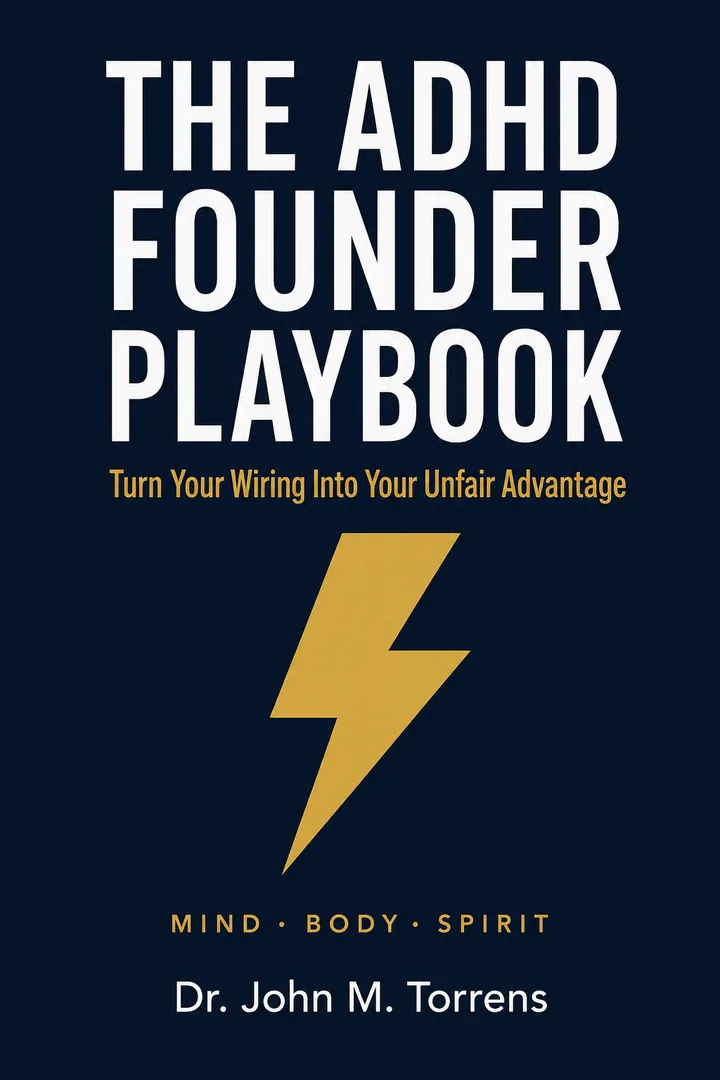
The ADHD Founder Playbook
The playbook turns this into a protocol: an 8-week field guide built to work with your wiring, including the Founder Snapshot assessment that tells you where to start.
Get the Playbook — $17 →This is part one of a three-part series on Rejection Sensitive Dysphoria and ADHD entrepreneurship. Read part two: Where RSD Is Hiding in Your Business, and part three: Managing RSD.
Dr. John M. Torrens is a Professor of Entrepreneurial Practice at the Whitman School of Management at Syracuse University, author of Lightning in a Bottle: How Entrepreneurs Can Harness Their ADHD to Win, and host of The Total Entrepreneur: Mind, Body, Spirit podcast. He coaches ADHD entrepreneurs through Entrepreneur.ing.
Privacy · Terms · Disclaimer
Entrepreneur.ing LLC · 25 First Ave SW, STE A, Watertown, SD 57201