RSD cannot be eliminated. The neurological sensitivity that drives it is part of how your brain is wired. What changes is your relationship to it, and crucially, how much influence it has over your decisions.
The goal is specific: stop the feeling from making your decisions for you.
That is a different goal than stop feeling. Sensitivity is not the problem. It is, in many ways, one of your greatest professional assets. The work is building enough regulatory capacity that your sensitivity informs your decisions rather than running them.
Here is what the evidence supports.
1. Name It in Real Time
The single most powerful first intervention is accurate labeling.
When you recognize this is RSD in the moment, the prefrontal cortex begins to re-engage. You move from inside the experience to observing it. The label creates distance. Distance creates choice.
Practical application: when you feel the emotional flood coming, say it internally or out loud. "This is RSD. This is my neurology firing, not an accurate reading of reality." This is accurate perception, and accuracy is what the ADHD brain needs most in that moment.
The research on affect labeling (naming an emotional state) consistently shows measurable reduction in amygdala activation. One sentence. Real neurological effect.
2. The 24-Hour Rule
RSD operates on compressed time. The catastrophic feeling of now, the devastating email, the brutal feedback, the failed pitch, will feel dramatically different in 24 hours. The circumstances may be identical. The neurochemical flood will have receded. The prefrontal cortex will be back online.
Practical application: build a personal policy that you do not make significant decisions, send emotionally charged communications, or draw firm conclusions from rejection experiences within 24 hours of the triggering event.
This single rule will prevent more business damage than almost any other intervention on this list. Relationships preserved. Deals saved. Teams not decimated by a reaction that felt completely justified at 9pm and completely disproportionate by morning.
3. Separate the Feedback from the Person
RSD collapses the distinction between feedback and identity. A client says the proposal is too expensive, and the RSD brain hears you are not worth it. A mentor says the strategy needs work, and the RSD brain hears you are inadequate.
Practical application: deliberately restate every piece of critical feedback in impersonal terms before responding to it.
"The proposal pricing needs adjustment." "The strategy has gaps that need addressing." "The launch timeline needs more resources."
The feedback is data. Restating it in those terms is not minimizing it. It is hearing it accurately so you can actually use it.
4. Pre-Expose to Rejection
Systematic desensitization, graduated exposure to rejection in low-stakes environments, reduces the neurological charge over time. This is evidence-based from anxiety treatment and maps directly onto RSD.
Practical application: deliberately pursue small, low-stakes rejections regularly. Ask for discounts you do not expect to receive. Pitch ideas you know will not land. Make asks where no is the most likely answer.
Every time the ADHD brain survives a rejection without catastrophe following, it recalibrates its threat assessment slightly downward. Enough repetitions and the amygdala starts treating a lost deal as survivable rather than existential.
This is systematic. It works. It is also deeply uncomfortable to start. That discomfort is evidence you are doing it right.
5. Regulate the Nervous System
RSD severity is not fixed. It fluctuates substantially based on the underlying state of your nervous system. Poor sleep, no exercise, high caffeine, chronic stress, and poor nutrition all lower the threshold for RSD triggers. A well-regulated nervous system raises it.
Practical application: treat sleep, nutrition, movement, and HRV coherence practice as RSD management tools, because that is exactly what they are.
Your RSD threshold rises measurably when you are well-rested, well-nourished, physically active, and running a coherence practice. The same email that would have triggered a flood on four hours of sleep and three coffees will feel manageable after eight hours, a real breakfast, and a morning run.
This is not soft advice. The neurological mechanism is real and the effect is significant.
6. Consider Medication
For many ADHD adults, stimulant medication meaningfully reduces RSD severity by improving dopamine and norepinephrine regulation. Alpha-2 agonists such as guanfacine and clonidine have specific evidence for emotional dysregulation in ADHD.
If you are experiencing significant RSD and are not currently working with a physician on medication management, that conversation is worth having. Medication decisions belong between you and your doctor. The point is that pharmacological support exists specifically for this, and some people find it substantially changes the picture.
7. Therapy with the Right Modalities
Cognitive Behavioral Therapy targeting ADHD and emotional dysregulation has strong evidence for reducing RSD severity over time. Dialectical Behavior Therapy, originally developed for Borderline Personality Disorder, has directly applicable skills including distress tolerance, radical acceptance, and opposite action that transfer extremely well to RSD management.
These are skills, and skills are learnable. The emotional regulation tools in DBT in particular are worth pursuing even outside of formal therapy. Workbooks exist. The framework is accessible.
8. Build a Trusted Feedback Panel
One of the most effective structural solutions to RSD in entrepreneurship is identifying two or three people whose feedback you trust completely, whose acceptance of you is not in question. People who can tell you the truth and your nervous system knows it is safe.
Practical application: when you need critical input on your work, route it through these people first. Get your baseline from a trusted source. This regulates your nervous system enough to hear the harder feedback from others with something closer to equanimity.
This is also why coaching, mastermind groups, and peer advisory networks are disproportionately valuable for ADHD entrepreneurs with RSD. They create a regulated environment for receiving the input that growth requires.
What You Are Actually Building
Every strategy here serves the same purpose. The ADHD brain is running a threat-detection system that is miscalibrated for the entrepreneurial environment. These interventions recalibrate it, gradually and systematically, until ordinary business setbacks, a lost deal, a tough review, a failed launch, register as survivable rather than catastrophic.
The sensitivity stays. That is the point. The sensitivity is the asset: the empathy, the standards, the drive, the loyalty, the depth of relationship. What goes away, with enough practice and the right systems, is the sensitivity running your decisions unchecked.
You have been building a business while managing something most people around you cannot name and would not understand. That matters. And this work, the naming, the labeling, the recalibration, is how you stop paying the RSD tax on everything you build.
Go Deeper
The ADHD Founder Playbook, closed. The button opens it to its title page, then turns to the back for a word about the author.
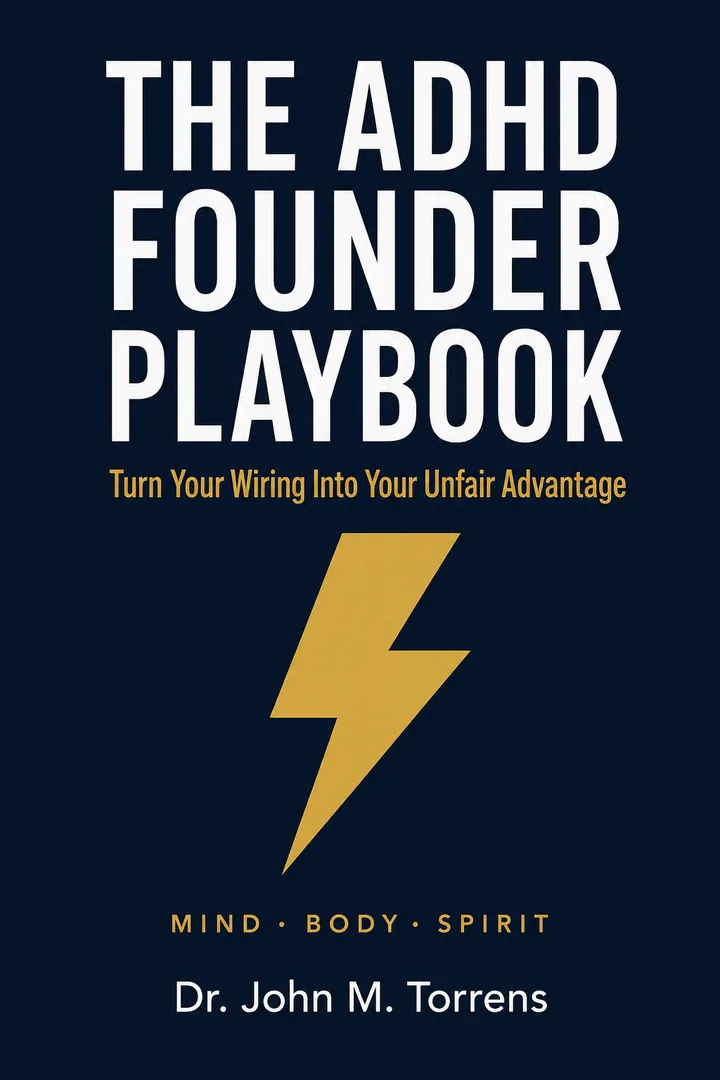
The ADHD Founder Playbook
The playbook turns this into a protocol: an 8-week field guide built to work with your wiring, including the Founder Snapshot assessment that tells you where to start.
Get the Playbook — $17 →This is part three of a three-part series on Rejection Sensitive Dysphoria and ADHD entrepreneurship. Read part one: The Emotional Pattern Quietly Running Your Business, and part two: Where RSD Is Hiding in Your Business.
Dr. John M. Torrens is a Professor of Entrepreneurial Practice at the Whitman School of Management at Syracuse University, author of Lightning in a Bottle: How Entrepreneurs Can Harness Their ADHD to Win, and host of The Total Entrepreneur: Mind, Body, Spirit podcast. He coaches ADHD entrepreneurs through Entrepreneur.ing.
Privacy · Terms · Disclaimer
Entrepreneur.ing LLC · 25 First Ave SW, STE A, Watertown, SD 57201